


Abstract
The ability of foot care specialists to place a rearfoot at the subtalar neutral position is important for the care of patients who require foot orthosis prescription, fabrication, and management. Although some clinicians perform this procedure with the patient in the prone position, others prefer a seated or standing approach. This study examined whether patient position and preferred patient position influence the ability of clinicians to place a subject's rearfoot at the subtalar neutral position. The results suggest the following: a clinician's ability to find the subtalar neutral position is better with a seated subject; clinicians do not necessarily perform better assessments on a subject in a position corresponding to their patient position preference; and clinicians who prefer their patients prone generally have more flexible and reproducible observations. In addition, the findings suggest that the nature and relative importance of the tactile and visual cues used by clinicians to place a rearfoot at the subtalar neutral position warrant further exploration.
The subtalar joint neutral position is the most widely used reference point for the clinical measurement of the relationship of rearfoot to forefoot. This position is defined as when the joint is neither supinated nor pronated [1]. A commonly used method of determining the subtalar neutral position is palpation of the head of the talus such that it is felt to extend equally at the medial and lateral borders of the talonavicular joint [2,3,4]. In this position, the subtalar joint is maximally congruent [5]. This method of locating the subtalar neutral position is commonly performed with the patient in the seated or prone open kinetic chain position [6].
The reliability of clinicians (raters) in positioning a rearfoot at the subtalar neutral position is generally poor but is better within than between raters [6,7,8]. However, these studies examined raters with unreported skill level. In addition, it is not surprising that the reported reliability scores are low, as the classic measure of reliability gives low scores when the value being examined (in this case, the subtalar neutral position) has low variability in the study sample (in this case, all of the sample values should be zero by definition) [9,10].
Recent work by Pierrynowski et al [11] overcame some of the limitations of previous studies by measuring the proficiency of experienced foot care specialists in placing seated subjects’ rearfeet at subtalar neutral. Proficiency was defined on the basis of the raters’ attempts to position a subject’s rearfoot at the subtalar neutral position relative to an estimate of each subject’s “true” subtalar neutral position. The “true” subtalar neutral position was defined as the mean value of all raters’ repeated attempts to position a given subject’s rearfoot at the subtalar neutral position. Using this procedure, their proficiency measure included both an estimate of accuracy (closeness to the truth) and precision (consistency) for each rater. Pierrynowski et al [11] showed that the ability of experienced raters to position seated subjects’ rearfeet at the subtalar neutral position was poor; the 90% confidence interval for finding the subtalar neutral position was -3.0° to +3.0°.
Further, the work by Pierrynowski et al [11] found no statistical evidence to suggest that three raters (C5, C8, C9) who preferred their patients seated (Rseated) were more proficient than three raters (C1, C3, C4) who preferred their patients prone (Rprone). However, examination of the consistency component of the proficiency scores shows that two of the Rprone did better than the Rseated (1.81, 1.07, 1.18 versus 1.68, 1.36, 1.36 for the Rprone and Rseated, respectively). This result is intriguing because all of these raters were asked to find the subtalar neutral position in seated subjects. One may have hypothesized that all of the Rseated would be more consistent than the Rprone because they have more task-specific practice [12]. A study examining the ability of Rseated and Rprone to find the subtalar neutral position in prone and seated subjects would highlight the specificity of previous practice in performing this skill.
One prior investigation examined the effect of subject position on the ability of raters to locate the subtalar neutral position. Smith-Oricchio and Harris8 showed that raters more consistently found the subtalar neutral position in standing compared to prone subjects. Unfortunately, this study failed to comment on the raters’ skill level and patient position preference, and did not examine the seated subject position.
The purpose of this investigation was to examine the consistency of experienced foot care specialists (raters) in placing subjects’ rearfeet at the subtalar neutral position as influenced by 1) subject position, and 2) the raters’ patient position preference. The authors hypothesized that the raters’ consistency would be 1) greater when the subjects were in closed kinetic chain (standing) compared to open kinetic chain (seated, prone) position, and 2) greater when examining subjects in a position corresponding to their patient position preference.
Materials and Methods
The ability of six raters to place six subjects’ rearfeet at the subtalar neutral position eight times was measured using a kinematic data-acquisition system. The kinematic data-acquisition system recorded the threedimensional (3-D) positional information of the lower leg with respect to the rearfoot. These data were analyzed to determine the consistency of the raters in performing the subtalar neutral position procedure.
Subjects, Raters, and Preference
The subjects were six volunteer university students (three males, three females; 21-28 years old; height 1.61-1.86 m; mass 61.2-79.4 kg). These individuals reported no previous serious ankle injuries, nor do they wear foot orthoses.
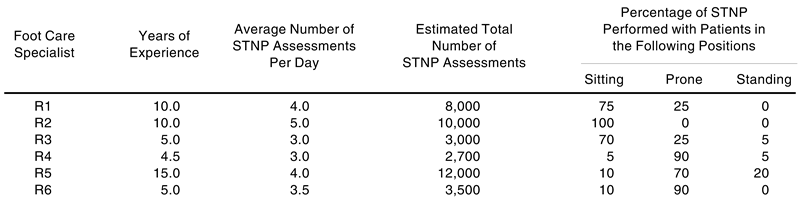
The raters were six skilled chiropodists licensed in Ontario, Canada, with more than 4 years of clinical experience, and who had performed, on average, at least three subtalar neutral position procedures each working day. Years of clinical experience and frequency of placing rearfeet at the subtalar neutral position while patients are in various positions are reported in Table 1.
Table 1.
Characteristics of the Raters
The six raters were assigned to one of two groups based on their clinical experience assessing patients in a particular position (Table 1). Three of the raters (R1, R2, R3) expressed a strong preference for assessing seated patients’ rearfeet (Rseated), while the other three (R4, R5, R6) clearly preferred their patients prone (Rprone).
Positions
The raters were required to place the subject’s rearfoot at the subtalar neutral position while the lower leg was in an open (subject seated or prone) or closed (subject standing) kinetic chain position. These positions were selected because they are frequently used clinically by foot care specialists to position the rearfoot at the subtalar neutral position [11,13]. In this study, the raters placed the rearfoot at the subtalar neutral position by moving the fourth and fifth metatarsal heads until the palpated head of the talus projected equally on both sides of the navicular [14].
The seated position required each subject to sit on an examining table (height 1.45 m) such that the leg was nonweightbearing and was at a comfortable height for the raters. Each rater then approached each subject from the front, palpated the talus head from the front, positioned the lower leg vertically, and placed the rearfoot at the subtalar neutral position.
The prone position required each subject to lie face down on an examining table (height 0.8 m) such that the nonweightbearing lower leg projected beyond the back edge of the table. Each rater approached each subject from below and behind, palpated the talar head from the front, and placed the rearfoot at the subtalar neutral position.
For the standing position, the subjects stood on the floor (height 0.0 m) with their weight equally distributed on both feet. Each rater approached each subject from the front, palpated the talar head from the front, and asked the subject to slowly supinate and pronate the right foot until he or she determined that the rearfoot was at the subtalar neutral position.
Sequencing
The sequence in which each rater assessed each subject in the different positions was not randomized owing to time and equipment constraints. First, three raters assessed the rearfoot of one of three seated subjects by placing it at the subtalar neutral position. These three raters then rotated to the next subject, assessed, rotated again, then assessed. Each of the three raters had now assessed three subjects. This sequence was then repeated an additional seven times. Second, the same group of three raters then assessed a second group of three subjects. Third, the first and second steps were followed for a second group of three raters. At the completion of this step, six raters had placed the right rearfoot of each of six subjects at the subtalar neutral position eight times. Lastly, steps one through three were repeated with the subjects in the prone and standing positions. It should be noted that only seven repeated measures were collected with the subjects in the standing position owing to time constraints.
Instrumentation and Reference System Definition
While each rater held each subject’s rearfoot at the subtalar neutral position, the 3-D position of each subject’s right rearfoot with respect to the lower leg was measured using a kinematic data-acquisition system (OptoTrak® (Northern Digital, Inc, Waterloo, Ontario, Canada.)). This device records the 3-D spatial location of special markers affixed to an object of interest. For this study, all data capture rates were set at 50 Hz. Knowing the location of three or more markers on an object, at a given instant in time, provides enough information to calculate the orientation and position of that object [15]. If the orientation and position of two objects are known, one can calculate the orientation and location of one of the objects with respect to the other [16]. Therefore, with appropriate numerical processing techniques, the 3-D position of the markers can provide the 3-D orientation and position of each subject’s lower leg relative to the rearfoot, irrespective of rearfoot position.
Not explicitly stated in the procedure above is the importance of defining a meaningful local coordinate system, fixed within the object and known relative to the attached markers. Specification of an appropriate local coordinate system allows one to calculate clinically meaningful orientation values of ankle dorsiflexion/plantarflexion, inversion/eversion, and abduction/adduction [17].
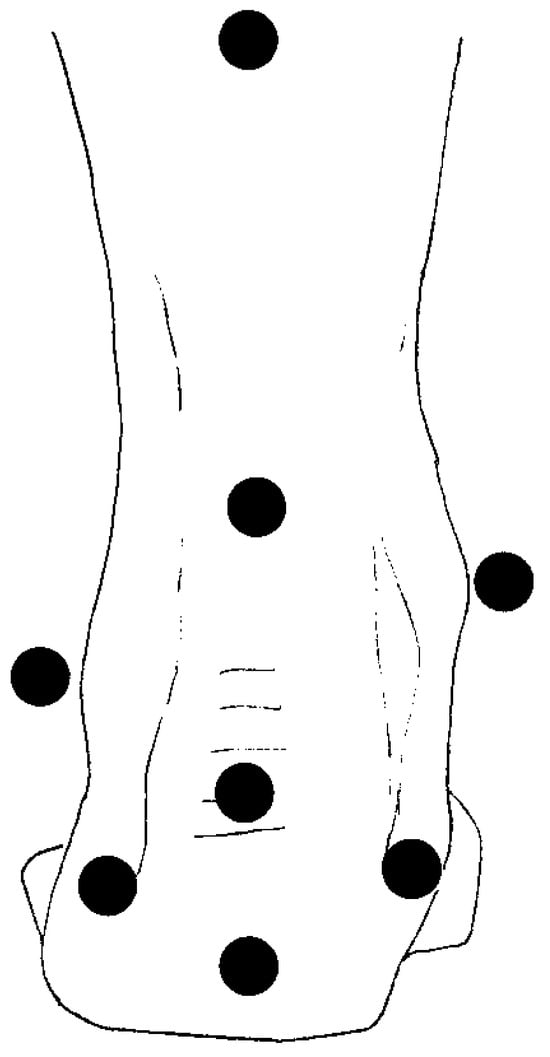
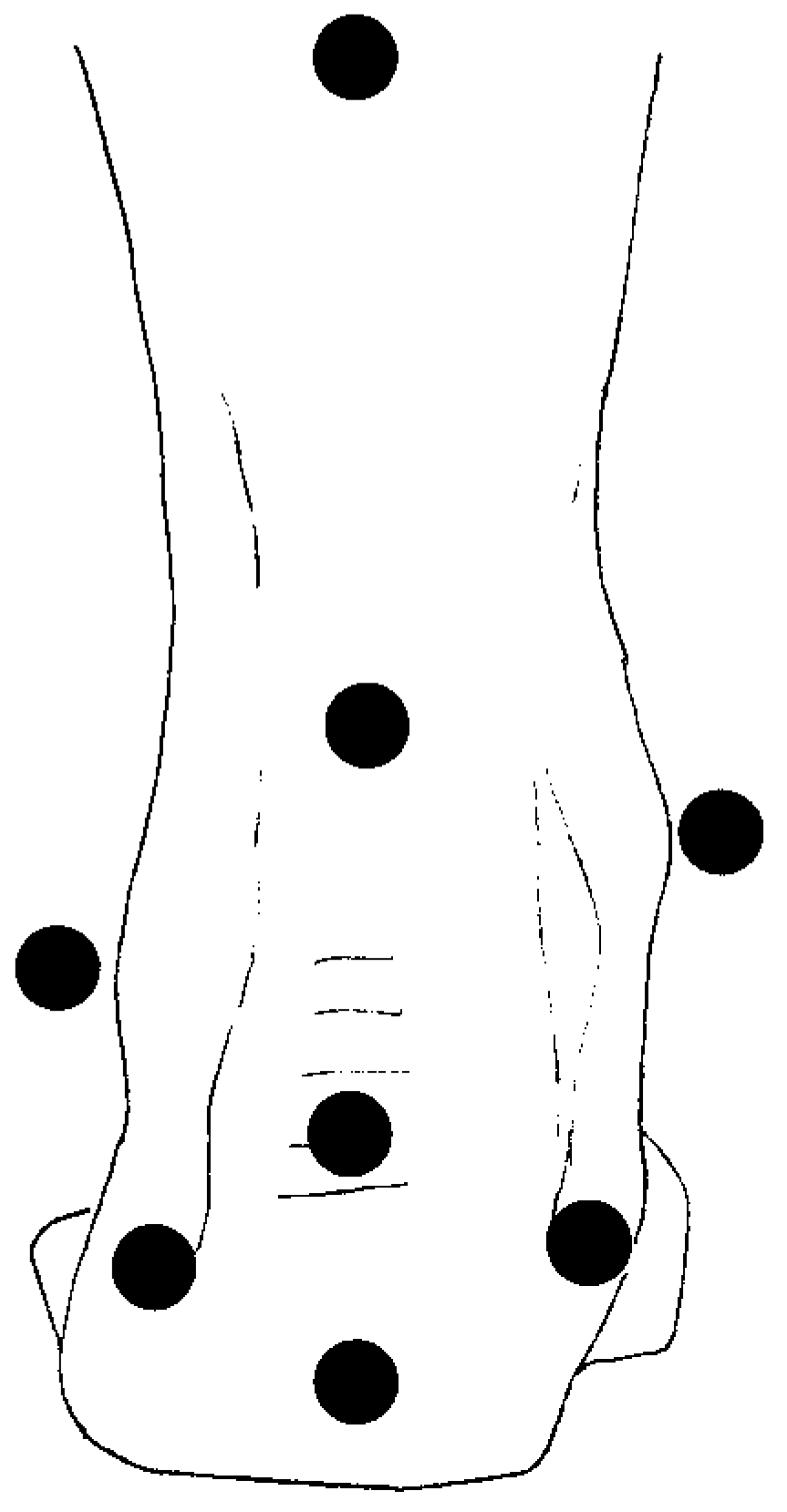
In this study, four markers were placed on the lower leg (medial and lateral malleoli, and over the Achilles tendon approximately 10 and 20 cm proximal to its insertion) and four markers on the posterior aspect of the calcaneus (at the 12, 3, 6, and 9 o’clock positions) to define the rigidly modeled lower leg and rearfoot (Figure 1). For each subject, the mean 3-D position of each of these eight markers, collected for 2 sec, was geometrically averaged over all of the rater attempts to place each seated subject’s lower leg vertically, and the rearfoot at the subtalar neutral position. It was assumed that the mean value of all of the rater attempts to place each seated subject’s lower leg vertically and the rearfoot at the subtalar neutral position was the best estimate of the subtalar neutral position for a given subject. In addition, two local coordinate systems were defined, one for the lower leg, the other for the rearfoot, with axes directed laterally, anteriorly, and vertically when a given subject’s lower leg was at the rater mean vertical and the rearfoot at the rater mean subtalar neutral position. The angular deviations from the subtalar neutral position about the posterior/anterior axis (inversion/eversion; eversion is positive) were extracted for each rater (6) assessing each subject (6) at each position (3) for each trial (7 or 8) for further analysis. Five of the desired 826 values were not available owing to methodological difficulties.
Figure 1.
Posterior diagram of a subject indicating the location of markers on the right lower leg and rearfoot. It should be noted that the markers do not have to be placed on specific anatomical landmarks and are attached to the skin using 1/8-inch-thick foam double-sided tape (the four nonposterior midline markers via 1 cm3 balsa wood cubes).
Statistical Analyses
A two-factor repeated measures analysis of variance was performed using BMDP-PC-2V® (BMDP Statistical Software, Los Angeles.) to examine whether statistical differences (type I error was chosen as 5%, corresponding to α = 0.05) existed between the positions (first factor, three levels) and raters (second factor, six levels). In addition, descriptive statistics were calculated using BMDP-PC-1D to provide an unbiased estimate of the average standard deviation for six experimental cells (Rseated and Rprone crossed with seated, prone, and standing subjects). The 90% confidence interval around the average standard deviation was also calculated.18 If the confidence interval for any pair of cells does not overlap, one can infer statistically that a difference exists between those two cells.
Results
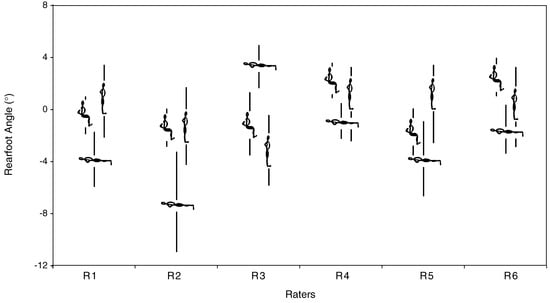
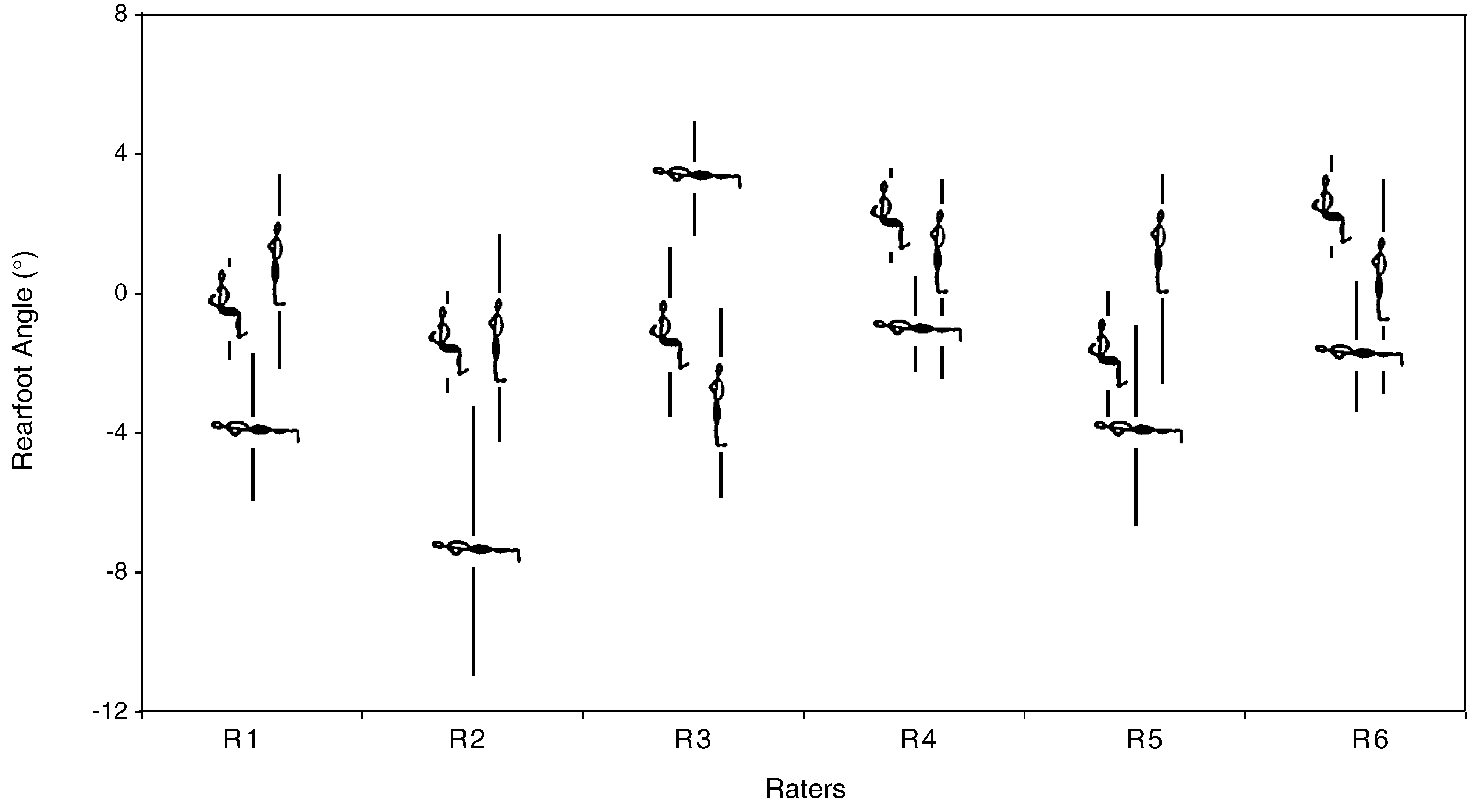
The ability of the raters to position rearfeet at the subtalar neutral position while the subjects were in the seated, prone, and standing positions is presented in Figure 2. This figure shows each rater’s ability at each position to locate the subtalar neutral position as the mean plus or minus one standard deviation of seven or eight repeated measures on six subjects. An analysis of variance revealed that there were statistically significant differences between the positions (F2,803 = 76.1) and raters (F5,803 = 52.8), and that a significant position by rater interaction existed (F10,803 = 50.1). These strong effects are partially due to the poor performance of one rater (R2) in finding the subtalar neutral position in prone subjects. This is not surprising given that R2, by his own admission, never examines patients in the prone position (Table 1).
Figure 2.
The ability of six experienced raters (R1 to R6) to place rearfeet at the subtalar neutral position while subjects are in the seated, prone, and standing positions is depicted. The mean and plus or minus one standard deviation results are shown. Positive values indicate an everted rearfoot.
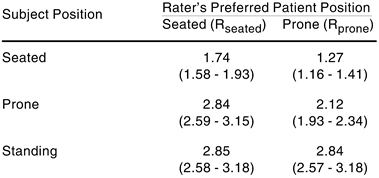
The consistency of the Rseated and Rprone in placing rearfeet at the subtalar neutral position when the subjects were in different positions is given in Table 2. Statistical examination of the cells in Table 2 suggests four clusters. Ranked from best to worst, the consistencies of these four clusters were 1) Rprone assessing seated subjects (1.27°), 2) Rseated assessing seated subjects (1.74°), 3) Rprone assessing prone subjects (2.12°), and 4) Rseated assessing prone (2.84°) or standing (2.85°) subjects, and Rprone assessing standing subjects (2.84°). These results refute the hypotheses that the raters’ consistency would be 1) greater when the subjects were in a closed kinetic chain (standing) compared to an open kinetic chain (seated, prone) position, and 2) greater when examining subjects in a position corresponding to their patient position preference.
Table 2.
Intrarater Consistency of Raters with a Preferred Patient Position in Placing Rearfeet at Subtalar Neutral When Subjects Are in Different Positions (mean consistency, 90% confidence interval; all values in degrees)
Discussion
In this study, several methodological assumptions were made to measure each rater’s assessment of a patient’s subtalar neutral position. These assumptions were as follows: 1) a measure of rearfoot inversion and eversion is directly related to subtalar motion; 2) the best estimate of the subtalar neutral position for a given subject is the mean value of all of the raters’ attempts to position that subject’s rearfoot at the subtalar neutral position; and 3) skin markers can be used to record the position of the underlying bones. Justification for these assumptions is detailed in a previous article [11].
The ability of clinicians and raters to place patients’ or subjects’ rearfeet at the subtalar neutral position has been reported in the literature [6,7,8]. These studies found that clinicians poorly position the rearfoot at the subtalar neutral position, as calculated using reliability measures. Unfortunately, classic estimates of reliability are inappropriate when examining a measure that is homogeneous across subjects [9,10]. By definition, the attempts by raters to position subjects’ rearfeet at the subtalar neutral position provide a set of homogeneous near-zero measures, thereby precluding the use of classic reliability estimates.
Pierrynowski et al [11] provided an alternative method of comparing the ability of foot care specialists to position a rearfoot at the subtalar neutral position. Given the mean and standard deviation of a set of subtalar neutral position trials for a rater or group of raters, one can calculate the percentage of subtalar neutral position attempts within a clinically meaningful range about the subtalar neutral position. They selected ±1° or ±2° as relevant for positioning the rearfoot for prescription of orthoses. Alternatively, the mean and standard deviation values can be used to calculate the 90% confidence interval of the subtalar neutral position. They reported that a group of experienced foot care specialists placed the rearfoot of a seated subject within ±1° and ±2° of the subtalar neutral position 41.3% and 72.3% of the time and that they were within ±3.0° of the subtalar neutral position 90% of the time. The results of this study were similar to those reported previously (pooled intrasubject standard deviations of 1.56° versus 1.52°).
This is not surprising, as identical methods were used and six of the eight raters participated in both studies. It should be noted, however, that different subjects were involved and that the two testing sessions were separated by 7.5 months. This suggests a strong intersession consistency among this pool of raters.
The Pierrynowski et al [11] study also reported that there was no statistical evidence to suggest that raters, accustomed to assessing patients in the prone position, were handicapped when assessing subjects in the seated position. However, close examination of the consistency component of their data (Pierrynowski et al [11], Table 3, SD) shows that two of their raters who prefer patients in the prone position (Rprone = C1, C3, C4) were more consistent than the raters who prefer patients seated (Rseated = C5, C8, C9). In this study, this finding was supported statistically; Rprone more consistently placed the rearfeet of either seated or prone subjects when compared to Rseated.
Three possible explanations may be offered for this finding. First, the two rater groups may have differed with regard to experience. Table 1 reports that the Rseated versus Rprone groups had 25 versus 24.5 total years of experience, and had performed an estimated 21,000 versus 18,200 subtalar neutral position assessments in their professional careers. These numbers would suggest a weak inverse relationship between experience and consistency (ie, more experienced, less consistent), which seems counterintuitive and was therefore rejected as a plausible explanation.
Second, since only three Rseated were compared to three Rprone, the Rprone may be more consistent than the Rseated owing to chance, since they were nonrandomly recruited from their respective professional populations (ie, three Rseated were recruited who were less consistent than three Rprone, even though the populations of Rseated and Rprone professionals have similar consistencies). If true, this calls into question the generalizability of the findings, and further research should be conducted to examine the range of rater consistencies within specific clinical groups.
Third, the Rprone are using better feedback cues than the Rseated to place rearfeet at the subtalar neutral position. Since this skill relies on palpation of the talonavicular joint, tactile feedback from the fingers is an important cue used by a rater to perform this procedure. Since a subject’s being in the prone position prevents a rater from seeing his or her fingers, this forces the rater to rely primarily on palpation feedback cues alone. Years of practice with patients in this position would increase the tactile sensitivity of Rprone [19]. Conversely, a subject’s being in the seated position allows a rater to see his or her fingers, which offers an additional visual cue for performing the subtalar neutral position procedure. Years of practice with patients in this position would increase the tactile sensitivity of the Rseated, but not to the same degree as the Rprone, since the Rseated have the additional visual feedback, which is of poorer quality than the tactile feedback [20]. However, visual feedback assists in performing this procedure and all raters should benefit by the same amount. The quantitative results of this study support this reasoning. If one considers only the seated and prone subject data in Table 2, one can calculate (using four linear equations with three unknowns) the relative weights of the palpation and visual feedback skills. This analysis yields the following feedback values, reported in degrees of consistency: palpation skill for the Rprone and Rseated groups (2.2° and 2.8°), with the visual skill reducing these values by 1.0°.
Previous work by Smith-Oricchio and Harris [8] suggested that since raters more reliably locate the subtalar neutral position in standing versus prone patients, they would be more consistent when assessing standing patients. In this study, our Rprone presented with statistically worse consistencies when assessing standing versus prone subjects, and the Rseated had statistically equivalent skill for these two subject positions. Both rater groups had lower consistency scores when assessing seated versus standing subjects. One explanation for this contradictory result is the danger of equating reliability with consistency. High reliability scores do not necessarily imply high consistencies, as reliability estimates depend upon the variability of the measurements in the study sample [9].
In hindsight, it is not surprising that the raters performed less well when the subjects were in the standing position. Examination of Table 1 shows that only three of the raters ever assess patients in the standing position, and even they do so rarely. To acquire skill, practice is required [12], and although the subtalar neutral position tactile skill is ostensibly the same for the three subject positions, the standing position has the subject bearing weight. This modifies the technique in two ways: 1) the standing subject is an active participant, since she or he is instructed to slowly supinate and pronate the foot until the rater has determined that the rearfoot is in neutral, and 2) the bones of the weightbearing rearfoot assume a different relative orientation than when unloaded [21]. When positioning a closed kinetic chain rearfoot (standing position), the raters must use a different strategy to position the rearfoot at the subtalar neutral position than when the rearfoot is open kinetic chain (seated, prone).
Although statistically significant differences were found between the measured consistency in several of the experimental cells (Rseated and Rprone crossed with subjects in the seated, prone, and standing positions), the largest difference was 1.6°. Is this clinically meaningful? If one assumes that 1) raters make unbiased estimates of patients’ subtalar neutral position (ie, their mean rearfoot placement is 0°, which is actually known to be false11), and 2) raters must clinically position a rearfoot within ±2° for orthoses prescription [2,22], the percentage of subtalar neutral position assessments within ±2° for each of the experimental cells can be calculated. These calculations yield results as follows: Rseated assessing seated and prone subjects (75% and 52%) and Rprone assessing seated and prone subjects (88% and 65%). The raters assessing standing subjects were 52% successful. Clinically, these results suggest that Rprone successfully assess 13% more patients than Rseated, and 13% more patients are successfully assessed if they are seated compared to prone. In addition, raters assessing patients in the standing position yield a percentage of successful assessments no better than what would be achieved by chance.
Finally, the matter of how foot care specialists learn the subtalar neutral position skill should be commented upon. First, previous work by Pierrynowski et al [11] and the results in this article (Figure 2) show that raters variably place the same rearfoot at the subtalar neutral position, and they place different rearfeet at different subtalar neutral positions. Strategies to reduce the interpatient and interrater biases must be addressed while these raters are being taught the subtalar neutral position skill. Second, since Rprone are more consistent in assessing subjects in the seated position, their patients would be better served if they were assessed while seated. However, Rprone would then become Rseated. Would their subtalar neutral position skill then decrease? If it does, what strategy could raters use to maintain their skill while providing the best care to their patients? These questions should be the focus of further research.
Conclusion
In this study, experienced foot care specialists (raters) were assigned to one of two groups depending upon whether they typically assessed patients in the seated (Rseated) or prone (Rprone) position. These raters then placed the right rearfeet of seated, prone, and standing asymptomatic subjects at the subtalar neutral position (six cells). Statistical examination of these cells suggests four clusters. From best to worst, these four groups were 1) Rprone when the subjects were seated (1.27°), 2) Rseated when the subjects were seated (1.74°), 3) Rprone when the subjects were prone (2.12°), and 4) Rseated with prone (2.84°) or standing (2.85°) subjects and Rprone with standing (2.84°) subjects. These results suggest the following: a clinician’s ability to find the subtalar neutral position is better with a seated subject; clinicians do not necessarily perform better assessments on a subject in a position corresponding to their patient position preference; and the Rprone clinicians generally had more flexible and reproducible observations. In addition, these findings suggest that the nature and relative importance of the tactile and visual cues used by raters to place a rearfoot at the subtalar neutral position warrant further exploration.
Acknowledgments
The chiropodists and students who participated in this study; Anh Dao Nguyen and Mary Ann O’Brien. This work was partially supported by the Edith Herman Research Fund and the Program for Faculty Development, McMaster University, Hamilton, Ontario, Canada.
References
- Root ML, Orien WP, Weed JN, et al: Biomechanical Examination of the Foot, Vol 1, Clinical Biomechanics Corp, Los Angeles, 1971.
- COOK A, GORMAN I, MORRIS J: Evaluation of the neutral position of the subtalar joint. JAPMA 78: 449, 1988.
- ELVERU RA, ROTHSTEIN JM, LAMB RL, ET AL: Methods for taking subtalar joint measurements. Phys Ther 68: 678, 1988.
- FROMHERTZ WA: “Examination,” in Physical Therapy of the Foot and Ankle, ed by GC Hunt, Churchill Living- stone, New York, 1988.
- BAILEY DS, PERILLO JT, ROLL JT: Subtalar joint neutral: a study using tomography. JAPA 74: 59, 1984.
- ELVERU RA, ROTHSTEIN JM, LAMB RL: Goniometric relia- bility in a clinical setting: subtalar and ankle joint mea- surements. Phys Ther 68: 672, 1988.
- BALDWIN EB, GRAEBNER JE: A comparison of K-square and Tractograph. JAPA 72: 629, 1982.
- SMITH-ORICCHIO K, HARRIS BA: Interrater reliability of subtalar neutral, calcaneal inversion and eversion. Phys Ther 68: 828, 1988.
- ELIASZIW M, YOUNG SL, WOODBURY MG, ET AL: Statistical methodology for the concurrent assessment of inter- rater and intrarater reliability: using goniometric mea- surements as an example. Phys Ther 74: 777, 1994.
- SHROUT PE, FLEISS JL: Intraclass correlations: uses in assessing rater reliability. Psychol Bull 86: 420, 1979.
- PIERRYNOWSKI MR, SMITH SB, MLYNARCZYK JH: Proficiency of foot care specialists to place the rearfoot at subta- lar neutral. JAPMA 86: 217, 1996.
- EPSTEIN W: “Controlled Practice or Training,” in Varie- ties of Perceptual Learning, ed by N Garmezy, HF Harlow, LV Jones, et al, McGraw-Hill, New York, 1967.
- SIMS DS, CAVANAGH PR: “Selected Foot Mechanics Related to the Prescription of Foot Orthoses,” in Disorders of the Foot and Ankle: Medical and Surgical Management, ed by MH Jahss, WB Saunders, Philadelphia, 1991.
- ROOT ML, ORIEN WP, WEED JN: Normal and Abnormal Function of the Foot: Clinical Biomechanics, Vol 2, Clinical Biomechanics Corp, Los Angeles, 1977.
- VELDPAUS FE, WOLTRING HJ, DORTMANS LJMG: A least squares algorithm for the equiform transformation from spatial marker co-ordinates. J Biomech 21: 45, 1988.
- SÖDERKVIST I, WEDIN P-Å: Determining the movements of the skeleton using well-configured markers. J Biomech 26: 1473, 1994.
- KAPANDJI IA: The Physiology of the Joints: Lower Limb, Vol 2, Churchill Livingstone, New York, 1970.
- HOGG RV, TANIS EA: Probability and Statistical Infer- ence, 2nd Ed, Macmillan Publishing, New York, 1983.
- DICKINSON J: “Proprioception and Training,” in Proprioceptive Control of ffuman Movement, ed by J Dickinson, Princeton Book Co, Princeton, NJ, 1976.
- PROTEAU L: Sensory integration in the learning of an aiming task. Can J Exp Psychol 49: 113, 1995.
- HLAVAC HF: Differences in x-ray findings with varied positioning of the foot. JAPA 57: 465, 1967.
- PHILLIPS RD, LIDTKE RH: Clinical determination of the linear equations for the subtalar joint axis. JAPMA 82: 1, 1992.

© 1997 American Podiatric Medical Association