


Abstract
Background: Prolonged standing can lead to musculoskeletal disorders, especially in the lower extremities, when appropriate footwear is not used. The aim of this study is to investigate the relationship between footwear styles, foot problems, and pain characteristics related to lower extremities in individuals with prolonged standing. Methods: A descriptive, cross-sectional study design was employed, using a random sample of individuals with prolonged standing (n = 159). Participants were asked questions about their footwear choices. They were asked to mark the lower extremity pain localization on the McGill Pain Map. In addition, foot deformities were evaluated by physical examination. Results: The findings revealed that most females (n = 88) and males (n = 71) preferred flat/sports footwear styles in both summer and winter. There was no significant difference between footwear styles and foot pain duration, intensity, and localization in both genders (p > 0.05). However, a statistically significant difference was observed among males between their summer footwear styles and pain related to lower extremities (low back pain and knee pain), and among females between their summer footwear styles and foot problems (bone deformities, skin pathologies and soft tissue issues) (p < 0.05). Conclusions: The results of this study show that the preferred footwear style was associated with lower extremity pain and foot problems, which emphasized the importance of footwear selection and footwear evaluation in the musculoskeletal evaluation of the lower extremities.
1. Introduction
Footwear was originally designed to protect human feet from environmental hazards. However, factors such as fashion trends, cosmetic considerations, and limited awareness of footwear’s impact on foot health have led to its use beyond its intended purpose [1,2]. Footwear serves as a crucial interface between the feet and the ground during various activities, significantly influencing foot comfort. Incorrect footwear choices can result in foot deformities, including conditions like foot pain, hallux valgus, claw toes, and hammer toes. Furthermore, foot-related issues can disrupt the kinetic chain of the lower extremities and affect spinal biomechanics [3].
Scientific research has established a significant relationship between the wearing of high-heeled shoes and the development of lower extremity pathologies and back pain [4,5,6,7]. Prolonged use of high-heeled shoes can lead to pathological changes due to changes in heel height, increased plantar pressure, discomfort and changes in spinal and pelvic movements. Inappropriate footwear can increase the risk of work-related musculoskeletal disorders, particularly in occupations that require prolonged standing, such as health care, military service, industrial work and teaching [8]. For example, softer footwear reduces lower back discomfort, while harder footwear increases changes in plantar pressure over time [9].
Research emphasizes that women are especially prone to foot pain due to improper shoe selections, with more than 60% of foot pain in women attributed to this factor [10,11,12]. Furthermore, recent studies indicate that footwear plays a notable role in women’s desired self-image and personal appearance [12]. Ensuring proper footwear fit is essential in preventing foot pain and deformities, particularly among vulnerable groups such as individuals with diabetes mellitus and polyneuropathy [13,14]. Studies have shown that a considerable percentage of older women wear shoes narrower than the width of their feet [15,16,17]. Based on the literature examples given above, we can say that the effect of shoe features on long-term standing has been researched more, especially in women. Therefore, this research has two aims. The first one is to determine the footwear preferences and reasons for purchasing shoes of male and female individuals who stand for a long time. The second aim of this study is to comprehensively investigate the relationship between footwear preferences and foot problems and lower extremity pain characteristics in individuals who stand for a long time, taking into account possible gender differences.
2. Materials and Methods
2.1. Study Design and Participants
This descriptive cross-sectional study was conducted over a 12-week period, specifically from July 2022 to May 2023. The data collection process involved conducting face-to-face interviews. Ethical approval for the study was obtained from the Health Sciences Ethics Committee of Mugla Sitki Kocman University (Date: 30 June 2022; Protocol no: 220106; Decision no: 94). Prior to commencing the research, participants were provided with information, and all of them signed an informed consent form. The study adhered to the ethical standards for human research as outlined in the Helsinki Declaration.
Inclusion criteria included individuals aged 18–65 years, with at least a basic level of literacy, and employed in jobs requiring prolonged standing (at least 6 h). Exclusion criteria included those with foot-related conditions (such as rheumatic diseases, diabetes mellitus, etc.), congenital lower extremity pathologies or deformities, previous lower extremity and lower back trauma or surgery, and those who refused to give informed consent or had difficulty understanding the study instructions.
2.2. Data Collection
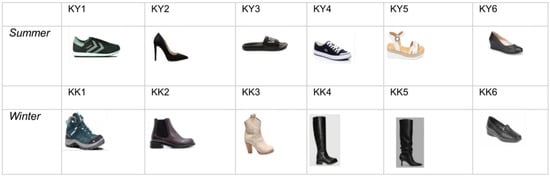
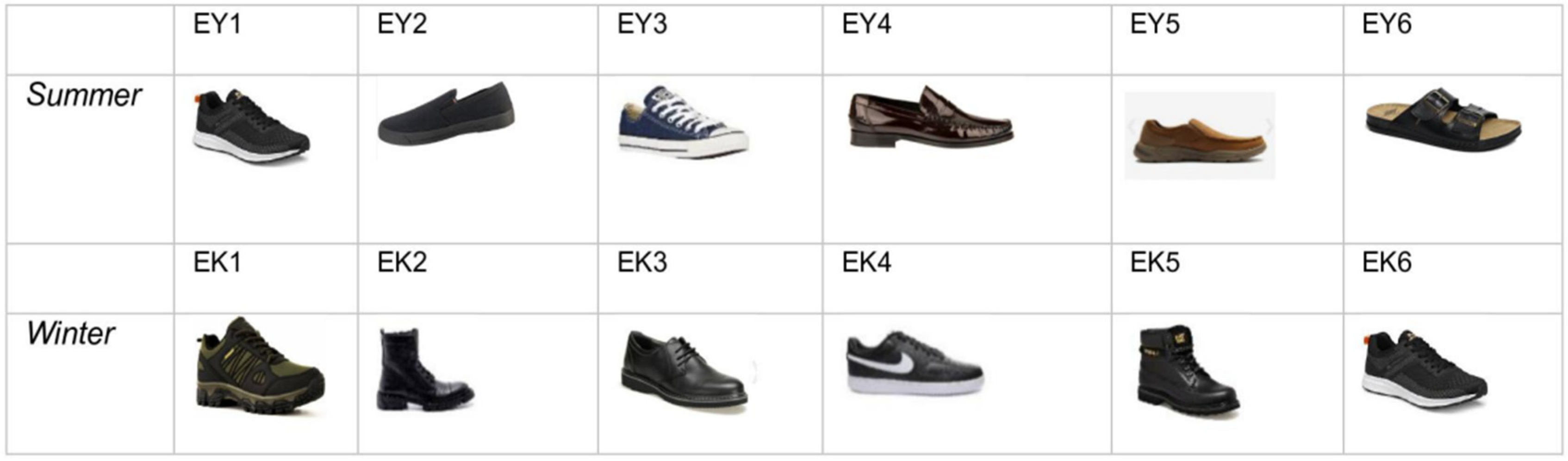
Assessment of Footwear Choices: Researchers examined the websites of Turkiye’s most popular footwear stores and determined the most preferred footwear styles. These footwear styles were categorized separately for summer and winter seasons and for female (Figure 1) and male (Figure 2) participants and a form was created. Participants were asked to mark their most preferred footwear styles in the summer and winter seasons on this form (since the participants were active working individuals who experienced standing stress, the footwear they preferred were actually the footwear they mostly wore at work). Summer footwear styles presented in Figure 1 for females were classified into three groups: Flat/Sports, High-heeled, and a combination of both. Winter footwear styles depicted in Figure 1 were also divided into three groups: Sports, Classic, and a combination of both. For men, both summer and winter footwear styles shown in Figure 2 were categorized into three groups: Classic, Sports, and a combination of both. This footwear choices form was sent for pilot testing to two foot health healthcare workers. Changes were made to the four footwear pictures with the opinions of experts.
Figure 1.
Localization of foot pain.
Figure 2.
Footwear styles for female participants.
Additionally, participants were asked two questions about their footwear choices. These questions were as follows:
- What is your primary reason for purchasing footwear? (cosmetic, foot pain, wear-out)
- How do you make your decision when choosing footwear? (comfort, cosmetic, fashion, price)
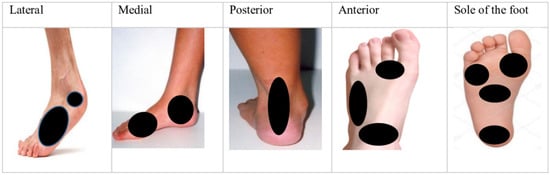
Assessment of foot problems and pain characteristics related to lower extremities: We began by collecting descriptive data from participants, including gender, age, height, weight, and Body Mass Index (BMI).Participants were then asked to indicate lower extremity pain localization using the McGill Pain Map [18]. If pain was reported, participants provided information about the total duration of pain (in months) and its severity, rated on a Numeric Rating Scale from 0 (no pain) to 10 (unbearable pain) [19]. Those experiencing foot pain were directed to indicate the pain’s location on Figure 3, which categorized pain locations into five regions: anterior, posterior, medial, lateral, and sole of the foot [20]. Subsequently, participants removed their footwear and socks for the physical examination of foot problems, which were categorized as follows:
Figure 3.
Footwear styles for male participants.
- No problem,
- Bone deformities (such as hallux valgus, hammer, and claw toes),
- Skin pathologies (such as hyperkeratotic lesions, fissures, and blisters),
- Soft tissue issues (such as musculoskeletal pathologies, neuroma, and plantar heel pain).
2.3. Statistical Analysis
The study’s sample size was determined using the G*Power version 3.1 (Germany) [21]. A t-test scenario was employed with an effect size of 0.5, α (alpha) level of 0.05, a power (1 − β) of 0.85, two groups, and a 10% dropout rate. This calculation yielded a required sample size of 158 participants [20].
For all analyses in this study, IBM Statistical Package for the Social Sciences (SPSS) Statistics version 26 was utilized. Analytical methods, including the Kolmogorov–Smirnov test, were employed to assess the normality of the variables. Additionally, visual methods such as histograms and probability graphs were utilized to visually inspect the distribution of the variables. The data were found to be non-normally distributed. Therefore, numeric data were presented using the median and interquartile range (IQR), while categorical variables were described using frequencies and percentages. In cases where multiple-choice questions permitted more than one option to be selected, percentage values were provided instead of the sample size (n) due to the larger sample size resulting from multiple responses.
To assess differences between males and females in variables related to foot health (reason for buying footwear, reason for choosing footwear, pain related to lower extremities, foot problems, and foot pain localization), a chi-square test was utilized. The relationship between gender and foot pain duration and foot pain severity was analyzed using the Mann–Whitney U test. The relationship between footwear styles and foot problems, pain localization, and pain related to lower extremities was analyzed using the chi-square test and Fisher’s Exact Test. To examine the relationship between footwear styles and foot pain duration and foot pain severity, Kruskal–Wallis’s test was employed. A statistical significance level was set to p < 0.05.
3. Results
A total of 159 individuals were included in the analysis, comprising 88 females (55.3%) and 71 males (44.7%), aged between 18 and 65 years. Most participants had a normal weight, with a BMI of 24.96 kg/m2. No significant differences were observed between the genders in terms of age, education level, occupation, and BMI (p > 0.05). The characteristics of the participants are outlined in Table 1.
Table 1.
Participant characteristics.
Both females and males reported that wear-out was the primary reason for purchasing footwear, with comfort being the deciding factor when making a purchase decision for most individuals. Eighty-seven point five percent (87.5%) of females and ninety-three point two percent (93.2%) of males reported a history of lower extremity pain, specifically affecting the lower back, knee, and/or foot. There were no significant differences observed in the duration and severity of foot pain between females and males (p > 0.05). Foot physical examination revealed the presence of conditions such as hallux valgus, Morton’s neuroma, hyperkeratotic lesions, pes planus, and plantar fasciitis among the participants. Females exhibited a higher prevalence of bone deformities, while males demonstrated a higher prevalence of skin pathologies. Seventeen point two percent (17.2%) of females and 24.8% of males reported experiencing foot pain. The localization of foot pain, pain related to lower extremities, and foot problems did not show any significant differences between females and males (p > 0.05). The variables related to foot health of the participants are presented in Table 2.
Table 2.
Foot health of participants.
Most females and males preferred flat/sports footwear styles in both seasons. The participants’ footwear choices are provided in Table 3. A statistically significant difference was observed among males between their summer footwear choices and pain related to lower extremities, and among females between their summer footwear choices and foot problems (p < 0.05). However, there was no difference between footwear style and duration, intensity, and localization of foot pain in both genders (p > 0.05). These results are presented in Table 4.
Table 3.
Footwear styles of participants.
Table 4.
Association between footwear style and foot health.
4. Discussion
The aim of this study is to investigate the relationship between footwear styles, foot problems, and pain characteristics related to lower extremities in individuals with prolonged standing. First, the footwear styles preferred by individuals in both summer and winter were determined. Additionally, their reasons for purchasing footwear were questioned. The research findings revealed that the primary reason for purchasing footwear, as indicated by both males and females, was “wear-out” while the key factor influencing footwear selection was reported as “comfort.” The results demonstrated similar trends between males and females. Studies conducted across different countries indicate that women’s footwear preferences are predominantly influenced by fashion trends [11,12]. Particularly among the younger population, it is observed that the most significant factor influencing footwear selection is current fashion trends rather than comfort and functionality [22]. Additionally, there are studies pointing out that the factor of foot size, which is essential in footwear selection, is often overlooked [23]. However, the present study has shown that the footwear choices of individuals who engage in prolonged standing are centered around comfort rather than cosmetic or fashion trends, contradicting the trends in the literature. These results suggest the influence of cultural differences. In addition, considering that the reason for most of the participants for changing footwear is “wear-out”, it can be said that economic conditions may also cause “comfort” for footwear choices. In addition, the long working hours and intensive work pace might have led individuals to prioritize comfort in their footwear choices.
There was a significant relationship between women’s summer footwear choices and foot problems, as well as between men’s summer footwear choices and lower-extremity-related pain in the present study. The increased use of high-heeled footwear among women during the summer and hard-soled classic shoes among men may contribute to this relationship. Additionally, both men (93.2%) and women (87.5%) exhibited a high prevalence of lower-extremity-related pain. Knee pain was the most common type of pain reported by both genders, followed by lower back pain. A similar study conducted in the United Kingdom with 147 surgeons who worked long hours with prolonged standing found that the most common problems reported were low back pain (71%) and foot pain (55%) [20]. Although inappropriate footwear is considered a significant factor contributing to the development of foot pathologies [23,24], the relationship between footwear selection and lower extremity pain characteristics has not been extensively investigated previously.
Previous research has identified several types of inappropriate footwear categories that are directly associated with pain and pathology. These categories include high-heeled shoes, slip-on shoes and flip-flops [23,24]. In particular, prolonged changes in spinal and pelvic movements, increased plantar pressure, pain and risk of pathology have been associated with wearing high-heeled shoes [4]. In addition, wearing shoes with minimal heel height, thin soles and stiff insoles without adequate arch support has been implicated in the development of plantar fasciitis [25]. In the present study, it was found that both genders predominantly wore sports footwear in both summer and winter, and there was no association between the type of footwear used in winter and foot problems. Although the use of sports footwear is predominant in both seasons, the thicker soles of the footwear worn in winter and the better support they provide to the foot may have reduced the incidence of pain and pathology. Similarly, Manna et al. (2001) found no significant association between type of footwear (shoes, slippers or sandals) and foot problems in 300 men and women [26]. However, the majority of the sample in both the current study (median: 29.0, IQR: 23.0) and Manna et al.’s study (age range 20–35 years) are young adults [26]. Inappropriate choice of footwear leading to musculoskeletal problems due to biomechanical changes is often observed, particularly in older-age groups [26]. Therefore, the fact that our study sample was young adults may be a reason why foot problems have not yet been observed.
In the present study, 21% of participants reported experiencing foot pain, with the majority reporting pain in the lateral, anterior and posterior regions. In contrast, a study by Anderson et al. (2018) found foot pain in 55% of individuals with prolonged standing, with most of the pain localized to the sole of the foot [9]. We believe that the difference in the localization of foot pain in the present study may be due to the fact that the sports/flat footwear model is more preferred, and sole pain is less severe due to these models. In addition, the present study did not investigate the fit of the footwear, a crucial factor that could influence foot pain. Previous research has shown that a significant proportion of people (ranging from 46% to 81%) wear narrow shoes [16,27,28]. Narrow shoes may exacerbate pain in the posterior aspect of the foot due to impingement effects. Therefore, future research should also investigate footwear fit to provide a more complete understanding and adjustment for these observed discrepancies.
The fact that footwear preferences have been analyzed in detail considering seasonal differences and gender for the first time is one of the strengths of this study. However, there are some limitations of this study that should be noted. Firstly, the lack of a significant correlation between footwear preferences and duration, severity and location of foot pain may have been influenced by age. A prospective study design rather than a cross-sectional study would have helped to clarify the causal relationship between footwear preferences and foot problems. Supporting this interpretation, a large-sample study (n = 2.627) showed that wearing narrow shoes between the ages of 20 and 39 may be a critical period for the development of hallux valgus in later life [28]. As a second limitation, young adults without any disease but who experienced the stress of prolonged standing were included in the present study. However, the prevalence of foot pain is higher in individuals with special conditions such as diabetes, rheumatological disease and osteoporosis, and variables such as localization and pain severity may also differ. Furthermore, these special populations are also at higher risk for the development of foot deformities due to inappropriate footwear choices and prolonged standing [15,29,30]. In addition, in this study, we only considered individuals who had prolonged standing stress; we did not address the daily activity level of these individuals. Studies in which the number of daily steps with prolonged standing is also determined would be valuable to address the effect of footwear on the lower extremities.
5. Conclusions
The current study has shown that comfort is the most important consideration when choosing footwear for both men and women who stand for long periods of time. It also found a significant association between women’s summer footwear preferences and foot problems, and between men’s summer footwear preferences and lower extremity pain. Footwear choice can influence foot problems and lower extremity pain in individuals. These findings highlight the importance of choosing appropriate footwear and the need to improve understanding of footwear by both patients and practitioners. The results suggest the potential value of incorporating educational programs on foot health and appropriate footwear selection into primary care services.
Author Contributions
Conceptualization, M.K.; methodology, M.K. and K.B.; validation, M.K.; formal analysis, M.K.; investigation, E.K., M.S. and İ.A.; resources, E.K., M.S. and İ.A.; data curation, M.K.; writing—original draft preparation, M.K.; writing—review and editing, M.K. and K.B.; visualization, M.K.; supervision, M.K. and K.B.; project administration, K.B.; funding acquisition, M.K., E.K., M.S., İ.A. and K.B. All authors have read and agreed to the published version of the manuscript.
Funding
This research was supported by the 2209-A Research Projects for Undergraduate Students Support Program (1919B012111028) of the Scientific and Technological Research Council of Türkiye.
Institutional Review Board Statement
The study was conducted in accordance with the Declaration of Helsinki and approved by the Health Sciences Ethics Committee of Mugla Sitki Kocman University (protocol code 220106; decision no. 94; date of approval: 30 June 2022).
Informed Consent Statement
Informed consent was obtained from all subjects involved in the study.
Data Availability Statement
The data supporting the findings of this study are available from the corresponding author upon reasonable request. Due to ethical and privacy considerations, the data are not publicly available.
Conflicts of Interest
The authors declare no conflicts of interest.
References
- Frey, C. Foot health and shoewear for women. Clin. Orthop. Relat. Res. 2000, 372, 32–44. [Google Scholar] [CrossRef] [Scilit]
- Gorecki, G.A. Shoe related foot problems and public health. J. Am. Podiatry Assoc. 1978, 68, 245–247. [Google Scholar] [CrossRef] [Scilit] [PubMed]
- Güçhan, Z.; Özaydınlı, E.I.; Demirel, S. Investigation of relationship between shoe usage and foot deformities, balance and functional performance. JETR 2014, 1, 35–42. [Google Scholar]
- Cernekova, M.; Hlavacek, P. The influence of heel height on plantar pressure. Clin. Biomech. 2008, 23, 667–668. [Google Scholar] [CrossRef] [Scilit]
- Lee, C.M.; Jeong, E.H.; Freivalds, A. Biomechanical effects of wearing high-heeled shoes. Int. J. Ind. Ergon. 2001, 28, 321–326. [Google Scholar] [CrossRef] [Scilit]
- Linder, M.; Saltzman, C.L. A history of medical scientists on high heels. Int. J. Health Serv. 1998, 28, 201–225. [Google Scholar] [CrossRef] [Scilit] [PubMed]
- Mandato, M.; Nester, E. The effects of increasing heel height on forefoot peak pressure. J. Am. Podiatr. Med. Assoc. 1999, 89, 75–80. [Google Scholar] [CrossRef] [Scilit] [PubMed]
- Andersen, J.H.; Haahr, J.P.; Frost, P. Risk factors for more severe regional musculoskeletal symptoms: A two-year prospective study of a general working population. Arthritis Rheum. 2007, 56, 1355–1364. [Google Scholar] [CrossRef] [Scilit]
- Anderson, J.; Nester, C.; Williams, A. Prolonged occupational standing: The impact of time and footwear. Footwear Sci. 2018, 10, 189–201. [Google Scholar] [CrossRef] [Scilit]
- Hill, C.; Gill, T.; Menz, H.; Taylor, A.W. Prevalence and correlates of foot pain in a population-based study: The Northwest Adelaide health study. J. Foot Ankle Res. 2008, 1, 2. [Google Scholar] [CrossRef] [Scilit]
- McRitchie, B.; Chockalingam, N. Footwear choices for painful feet—An observational study exploring footwear and foot problems in women. J. Foot Ankle Res. 2018, 11, 23. [Google Scholar] [CrossRef] [Scilit] [PubMed]
- Seferin, M.; Van der Linden, J. Protection or pleasure: Female footwear. Work 2012, 41, 290–294. [Google Scholar] [CrossRef] [Scilit]
- López, L.; González, L.C.; Losa Iglesias, M.E.; Canosa, J.L.S.; Sanz, D.R.; Lobo, C.C.; De Bengoa Vallejo, R.B. Quality of Life Impact Related to Foot Health in a Sample of Older People with Hallux Valgus. Aging Dis. 2016, 7, 45–52. [Google Scholar] [CrossRef] [Scilit]
- Chantelau, E.; Gede, A. Foot dimensions of elderly people with and without diabetes mellitus—A data basis for shoe design. Gerontology 2002, 48, 241–244. [Google Scholar] [CrossRef] [Scilit]
- Menz, H.B.; Morris, M.E. Footwear characteristics and foot problems in older people. Gerontology 2005, 51, 346–351. [Google Scholar] [CrossRef] [Scilit]
- Paiva de Castro, A.; Rebelatto, J.R.; Aurichio, T.R. The relationship between foot pain, anthropometric variables and footwear among older people. Appl. Ergon. 2010, 41, 93–97. [Google Scholar] [CrossRef] [Scilit]
- Burns, S.L.; Leese, G.P.; McMurdo, M.E. Older people and ill-fitting shoes. J. Postgrad. Med. 2002, 78, 344–346. [Google Scholar] [CrossRef] [Scilit] [PubMed]
- Escalante, A.; Lichtenstein, M.J.; White, K.; Rios, N.; Hazuda, H.P. A method for scoring the pain map of the McGill Pain Questionnaire for use in epidemiologic studies. Aging Clin. Exp. Res. 1995, 7, 358–366. [Google Scholar] [CrossRef] [Scilit] [PubMed]
- Hartrick, C.T.; Kovan, J.P.; Shapiro, S. The numeric rating scale for clinical pain measurement: A ratio measure? Pain Pract. 2003, 3, 310–316. [Google Scholar] [CrossRef] [Scilit]
- Anderson, J.; Williams, A.E.; Nester, C. Musculoskeletal disorders, foot health and footwear choice in occupations involving prolonged standing. Int. J. Ind. Ergon. 2021, 81, 103079. [Google Scholar] [CrossRef] [Scilit]
- Kang, H. Sample size determination and power analysis using the G*Power software. J. Educ. Eval. Health Prof. 2021, 18, 17. [Google Scholar] [CrossRef] [Scilit]
- Branthwaite, H.; Chockalingam, N.; Grogan, S.; Jones, M. Footwear choices made by young women and their potential impact on foot health. J. Health Psychol. 2012, 18, 1422–1431. [Google Scholar] [CrossRef] [Scilit]
- Mickle, K.J.; Munro, B.; Steele, J. Is foot pain influenced by shoe wearing habits in older people? Footwear Sci. 2011, 3, S106–S110. [Google Scholar] [CrossRef] [Scilit]
- Dufour, A.B.; Broe, K.E.; Nguyen, U.S.D.; Gagnon, D.R.; Hillstrom, H.J.; Walker, A.H.; Kivell, E.; Hannan, M.T. Foot pain: Is current or past shoewear a factor? Arthritis Care Res. 2009, 61, 1352–1358. [Google Scholar] [CrossRef] [Scilit]
- Umar, H.; Idrees, W.; Umar, W.; Khalil, A.; Rizvi, Z.A. Impact of routine footwear on foot health: A study on plantar fasciitis. J. Fam. Med. Prim. Care 2022, 11, 3851–3855. [Google Scholar] [CrossRef] [Scilit]
- Manna, I.; Pradhan, D.; Ghosh, S.; Khalil, A.; Rizvi, Z.A. A comparative study of foot dimension between adult male and female and evaluation of foot hazards due to using footwear. J. Physiol. Anthropol. Appl. Human. Sci. 2001, 20, 241–246. [Google Scholar] [CrossRef] [Scilit] [PubMed]
- Buldt, A.K.; Menz, H.B. Incorrectly fitted footwear, foot pain and foot disorders: A systematic search and narrative review of the literature. J. Foot Ankle Res. 2018, 11, 43. [Google Scholar] [CrossRef] [Scilit] [PubMed]
- Menz, H.; Roddy, E.; Marshall, M.; Thomas, M.J.; Rathod, T.; Peat, G.M.; Croft, P.R. Epidemiology of Shoe Wearing Patterns Over Time in Older Women: Associations with Foot Pain and Hallux Valgus. J. Gerontol. Ser. A Biol. Sci. Med. Sci. 2016, 71, 1682–1687. [Google Scholar] [CrossRef] [Scilit] [PubMed]
- Stoekenbroek, R.M.; Lokin, J.L.; Nielen, M.M.; Stroes, E.S.; Koelemay, M.J. How common are foot problems among individuals with diabetes? Diabetic foot ulcers in the Dutch population. Diabetologia 2017, 60, 1271–1275. [Google Scholar] [CrossRef] [Scilit]
- Guidozzi, F. Foot problems in older women. Climacteric 2017, 20, 518–521. [Google Scholar] [CrossRef] [Scilit]

Disclaimer/Publisher’s Note: The statements, opinions and data contained in all publications are solely those of the individual author(s) and contributor(s) and not of MDPI and/or the editor(s). MDPI and/or the editor(s) disclaim responsibility for any injury to people or property resulting from any ideas, methods, instructions or products referred to in the content. |
© 2026 by the authors. Published by MDPI on behalf of the American Podiatric Medical Association (APMA). Licensee MDPI, Basel, Switzerland. This article is an open access article distributed under the terms and conditions of the Creative Commons Attribution (CC BY) license.