


Abstract
Background: Hemostasis during surgery is a primary contributor to the patient’s blood management. Accurate blood loss estimation from surgery can help teams with postoperative management. The goal of this study was to analyze the accuracy of medical workers’ estimations of blood loss on different operating room items. Methods: A survey was sent out to medical students, residents, and attendings in a single academic institution. The survey asked participants to estimate the amount of simulated blood from pictures of a laparotomy sponge (lap), Ray-Tec sponge, towel, and drape. Results: There were 124 participants in the survey. All average estimations were greater than the actual amount of simulated blood on the operating room item. There was a statistically significant difference in estimations between students, residents, and attendings in all categories except Ray-Tec #1. The residents were closest in estimation in all categories; however, this was not statistically significant compared with attendings. When comparing the estimations of surgical and nonsurgical specialties, surgical specialties were the most accurate except for the estimation of laps. Conclusions: All in all, our study found a substantial overestimation of blood on operating room items by residents, students, and attending physicians. Our study suggests that estimation of surgical blood loss by analysis of soaked Ray-Tec sponges, laps, drapes, and towels may be inaccurate.
Surgical hemostasis is a primary factor in a patient’s blood management [1]. Documentation of estimated blood loss (EBL) after surgical procedures is a common practice in medicine. Members of both the anesthesia and surgical teams discuss and record this agreed upon quantity in their postoperative notes. Although just an estimation, accuracy is important for postoperative clinical decision-making, especially after major surgery. Estimated blood loss aids in the prediction of short-term postoperative risks and is considered when determining the necessity for transfusion [2].
Currently, there is no gold standard method across surgical specialties for the measurement of EBL. The American Society of Anesthesiologists recommends a combination of direct measurement and visual inspection of sponges, drapes, and fluid in canisters [3]. Even with these recommendations, it is commonly understood that these estimations are highly variable among health-care professionals and subspecialties.
To better understand just how variable these estimations are, we developed a survey for health-care professionals of all experience levels to take, providing their own anonymous EBL interpretation of various blood-saturated materials that are commonly measured in the operating room. We predicted that the average EBL would be significantly different from its true measured quantity.
Materials and Methods
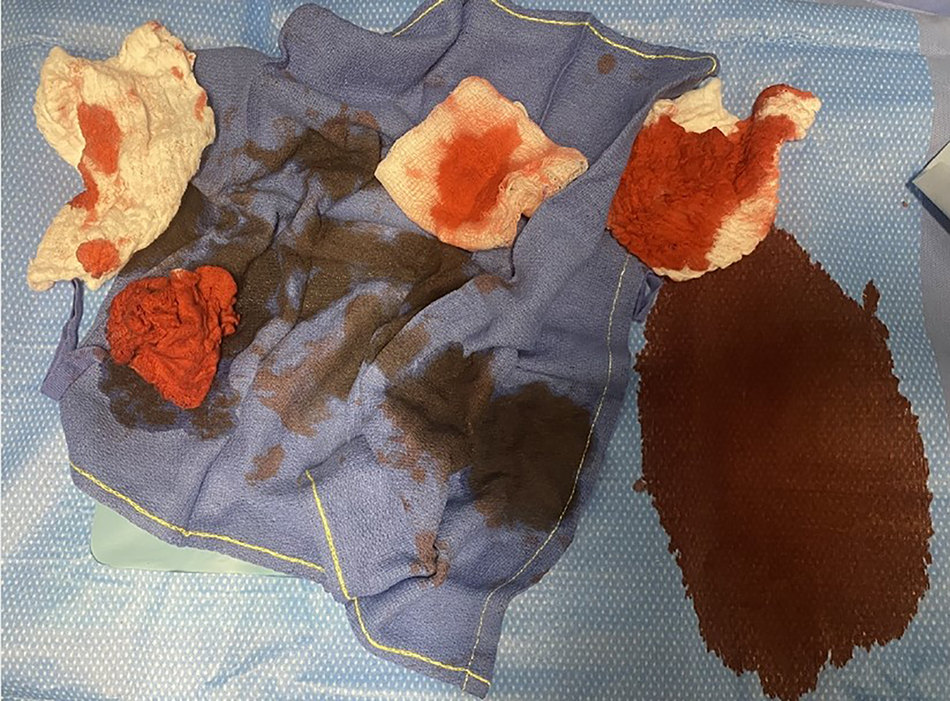
Approval was obtained from our institutional review board to conduct an online survey for medical students, residents, and attendings. Using an online survey link, flyers were posted at a single institute and listservs were sent out to residents, attendings, and the affiliated medical school. Each participant was able to fill out the survey only one time. There were no incentives to fill out the survey. Participants were asked what level of training they were in: medical student, resident, or attending. They were also asked if they were in a surgical or nonsurgical specialty. Finally, an image was included of six different operating room items with simulated blood on them (Fig. 1). The items included were items commonly used in the operating room to soak up blood: two laparotomy sponges (laps), two Ray-Tec sponges, a blue towel, and an operating room drape. Each item had a different amount of simulated blood. The participants were asked to estimate the amount of simulated blood on each item in milliliters.
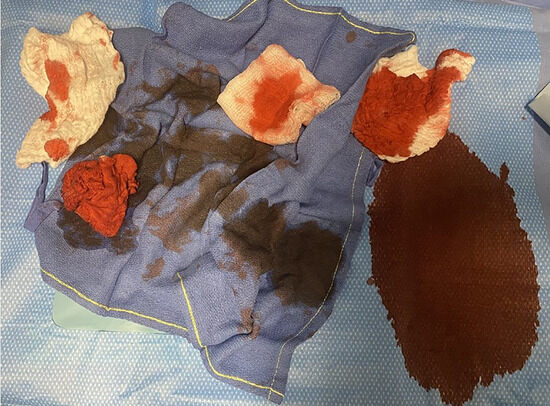
Figure 1.
Operating room items containing different amounts of simulated blood.
Statistical Analysis
Descriptive statistics were analyzed for responses for surgical versus nonsurgical groups and students, residents, and attendings. For the primary outcome, a nonnormal distribution was demonstrated; we chose to use the Kruskal-Wallis test for all continuous variables. All data were collected and analyzed in Excel (Microsoft Corporation, Redmond, Washington) using XLSTAT (Lumivero, Denver, Colorado).
Results
A total of 124 people from a single institute participated in the study, with 43 residents, 28 attendings, and 53 students responding. Respondents were asked to identify as a surgical or nonsurgical specialty. Of the 122 participants who responded to this question, 62 identified as surgical, 20 identified as nonsurgical, and 40 responded “not applicable” (N/A).
Level of Training
Statistical analysis was performed comparing the estimation of blood on different items in three groups: medical students, residents, and attendings. The correct answers are demonstrated in Table 1 and the average estimations based on training level are demonstrated in Table 2. All average estimations were greater than the actual amount of simulated blood on the operating room items. Residents were closest to the accurate estimation when estimating all items; however, this was not statistically significant compared with attendings. The students were the furthest from the accurate answer in each group. There was a statistically significant difference between estimations of students, residents, and attendings except in the first Ray-Tec group.

Table 1.
Amount of Simulated Blood on Operating Room Items
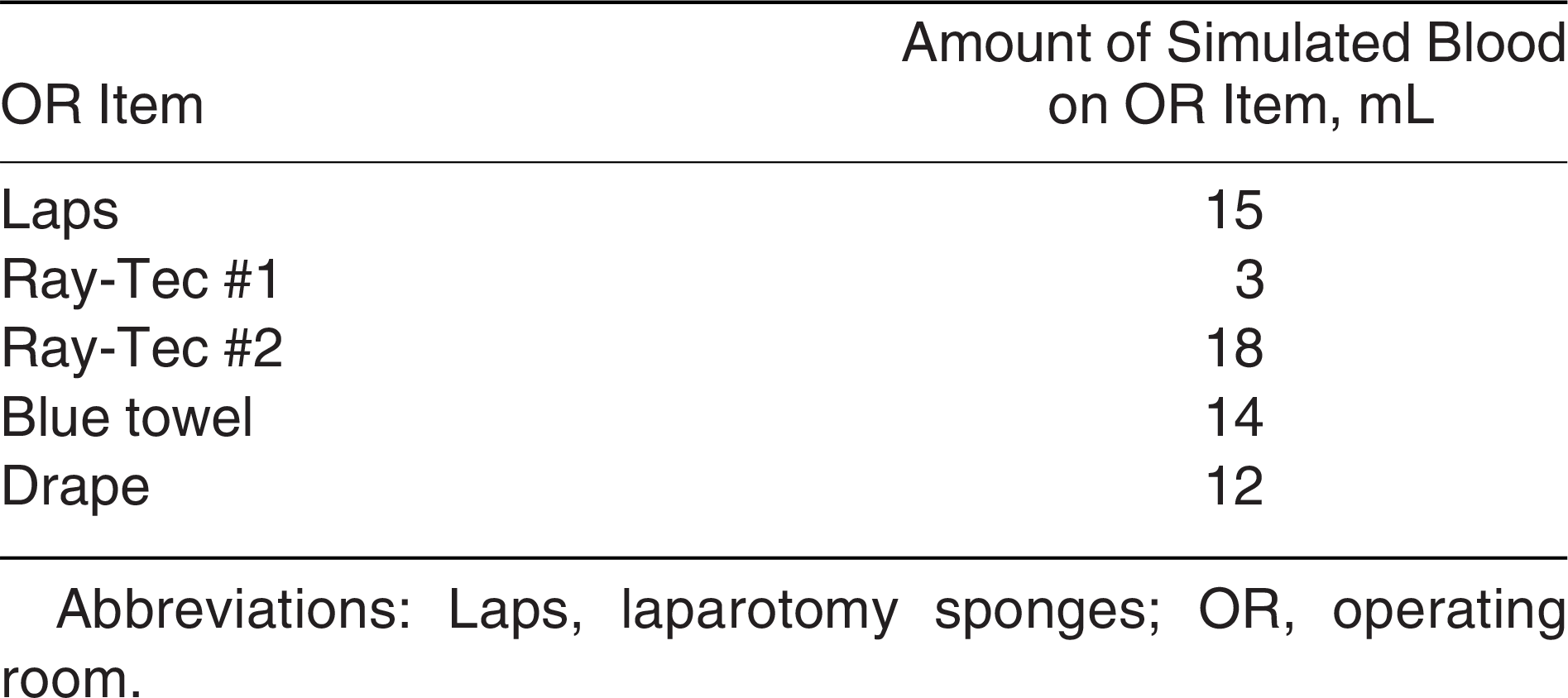
Table 2.
Average Estimation of Blood on Operating Room Items Based on Level of Training

Surgical Versus Nonsurgical Specialty Estimations
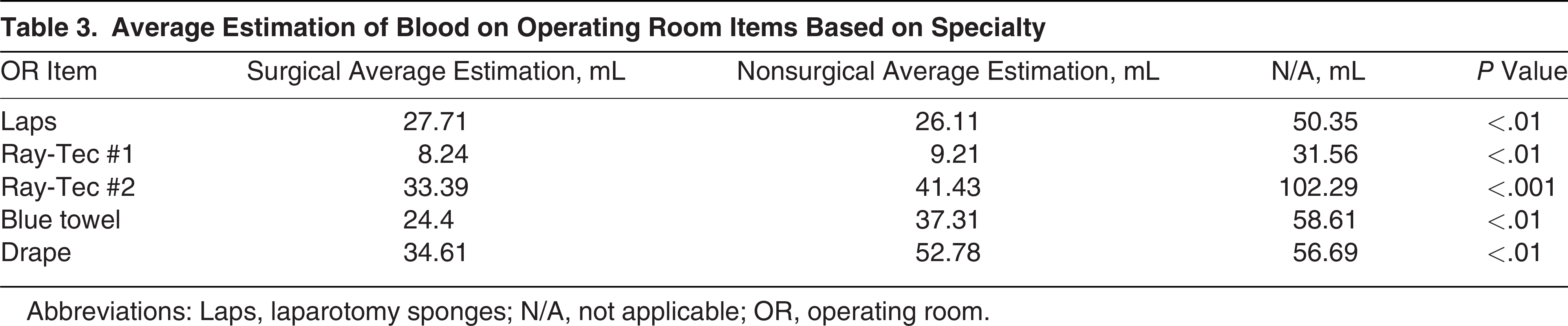
Participants were asked if they were in a surgical or nonsurgical specialty. The option N/A was provided for students. Table 3 demonstrates the average estimation of blood on operating room items broken down by surgical and nonsurgical participants. Surgical specialties were closest to the accurate answer in every category except laps. The participants who selected N/A with regard to whether they were in a surgical specialty were the least accurate in estimations for every category. There was a statistically significant difference between the surgical, nonsurgical, and N/A estimations for every category.
Table 3.
Average Estimation of Blood on Operating Room Items Based on Specialty
Discussion
Our study employed strictly visual inspection as the method of estimation, with a wide variety of experiences and backgrounds among participants. There was overestimation among every group for every operating room item available for estimation in the study. Guinn et al [4] found in their study of 60 patients undergoing posterior spine surgery that EBL exceeded measured blood loss by 40% on average. The authors posited that the inaccuracies found in their study could be secondary to the inability to visually determine the hemoglobin concentration of mixed sanguineous solutions in suction canisters and surgical sponges. Interestingly, although we did not employ canisters or mixed sanguineous solutions, the same trend in overestimation remained.
Kollberg et al [5] found in their study of 163 visual blood loss estimations that there was a trend in underestimation among their surgical staff by a median value of 30%. Although there was not an operating room item in our study that represented major blood loss, Kollberg et al found in their study that the highest incidence of underestimation occurred at the station at which they attempted to replicate major blood loss. With respect to surgical experience with estimation, we found a statistically significant difference in estimation accuracy among all three of our surgical experience groups, with the resident group being more accurate. Kollberg et al found in their study that the extent of surgical experience did not correlate with more accurate estimation. This agrees with our findings, as the resident group was the intermediate experience group, with the most experienced surgical group of attending surgeons overestimating blood loss.
Based on our finding that medical students have the least accurate estimates, we hypothesize that residents at the beginning of their residency most likely have less accurate estimations compared with more senior residents. In an attempt to improve the accuracy of blood loss estimations, we recommend that initial estimations be performed by a more senior resident or attending. Educating new residents during orientation on the amount of blood that common operating room items can hold may increase EBL accuracy. We also suggest integrating a lesson on EBL into medical student curricula so that they may begin practicing these estimations prior to residency. Online modules and in-person workshops are both reasonable methods for teaching this information. Algadiem et al [6] published a guide on the pattern of staining and absorptive capacity of gauze. Having similar guides in operating rooms may assist with more accurate blood loss estimations. Guides such as these may also be referenced when educating medical students and residents on EBL.
Our study also compared surgical specialties versus nonsurgical specialties. We found that the surgical specialties were ultimately closest to the correct answer in every operating room item category but one. This agrees with the study by Al-Kadri et al [7], which investigated the effects of education on postpartum blood loss. The authors found that education increased accuracy, which agrees with our surgical specialties having an increased level of training in blood loss in comparison with the nonsurgical group. Interestingly, the authors also found that the effects of education tended to decrease over time, which Kollberg et al [5] felt correlated with their study as well. Although no formal data were collected in our study on the recency of blood loss training among participants, this may explain why residents who were earlier in their education arc were found to be more accurate than those without formal education (students) and those with presumably more dated education (attendings).
Overall, our visual inspection study tended to show the overall inaccuracy of the method. Gerdessen et al [8] performed a meta-analysis and systematic review of the literature on blood loss estimation methods and their accuracy. Based on the 90 studies that met their inclusion criteria for the systematic review and the six studies that were included in the meta-analysis, the authors found that colorimetric quantification was most accurate in blood loss estimation. Interestingly, visual estimation was found to be the least accurate method. Although it was the least accurate, it was also the most commonly used method, which the authors suggested may be due to its ease and the lack of equipment. In order to properly analyze blood loss, equipment would have to be advanced in using both colorimetric and gravimetric methods for an accurate estimation.
There were multiple limitations to our study. The primary limitation was that the study was conducted on a primarily virtual basis, with detailed pictures of a surgical field provided to participants. However, without visually observing in person, it would be difficult to truly estimate the degree of saturation of items. Additionally, we did not conduct our study with genuine blood products; instead, we opted to use a realistic blood substitute. This could have affected both the accuracy of color representation and the appearance of the degree of saturation on the measured operating room items. For example, a darker color on an item may have been interpreted as greater saturation, whereas a lighter color may have been perceived as less saturation. Finally, our study was conducted at a teaching hospital with a strong resident and student presence, which may differ from the dynamics and education present in other health care settings.
Conclusions
All in all, our study demonstrated the inaccuracy of visual estimation of blood loss on common operating room items. In the operating room, rough estimates of blood loss are often based on visual inspection of the blood on operating room items. However, our study showed that all levels of training overestimated, with medical students being the least accurate. We recommend future studies analyze other methods for blood loss estimation in the operating room that may be more precise.
Financial Disclosure
None reported.
Conflict of Interest
None reported.
References
- Untch BR, Turek JW, Manson RJ, et al: Management of hemostasis in vascular surgery. Surgery 142(4 suppl): S26, 2007; doi: https://doi.org/10.1016/j.surg.2007.06.021.
- Tran A, Heuser J, Ramsay T, et al: Techniques for blood loss estimation in major non-cardiac surgery: a systematic review and meta-analysis. Can J Anaesth 68: 245, 2021; doi: https://doi.org/10.1007/s1263-020-01857-4. Erratum in: Can J Anaesth 68: 1306, 2021; doi: https://doi.org/10.1007/s12630-020-01886-z.
- American Society of Anesthesiologists Task Force on Perioperative Blood Management: Practice guidelines for perioperative blood management: an updated report by the American Society of Anesthesiologists Task Force on Perioperative Blood Management. Anesthesiology 122: 241, 2015.
- Guinn NR, Broomer BW, White W, et al: Comparison of visually estimated blood loss with direct hemoglobin measurement in multilevel spine surgery. Transfusion 53: 2790, 2013; doi: https://doi.org/10.1111/trf.12119.
- Kollberg SE, Häggström AE, Lingehall HC, et al: Accuracy of visually estimated blood loss in surgical sponges by members of the surgical team. AANA J 87: 277, 2019.
- Algadiem EA, Aleisa AA, Alsubaie HI, et al: Blood loss estimation using gauze visual analogue. Trauma Mon 21: e34131, 2016; doi: https://doi.org/10.5812/traumamon.34131.
- Al-Kadri HM, Dahlawi H, Al Airan M, et al: Effect of education and clinical assessment on the accuracy of post partum blood loss estimation. BMC Pregnancy Childbirth 14: 110, 2014; doi: https://doi.org/10.1186/1471-2393-14-110.
- Gerdessen L, Meybohm P, Choorapoikayil S, et al: Comparison of common perioperative blood loss estimation techniques: a systematic review and meta-analysis. J Clin Monit Comput 35: 245, 2021; doi: https://doi.org/10.1007/s10877-020-00579-8.
© 2025 American Podiatric Medical Association