


Abstract
Background: Body awareness is an expression of the extent of sensitivity and attentiveness to internal bodily signals and sensations. The foot has a critical function in providing interoceptive and exteroceptive information. The purposes of this study were to 1) compare body awareness in individuals with and without hallux valgus (HV) deformity, and 2) investigate the relationship between body awareness and HV-related parameters. Methods: A total of 129 participants completed the assessments. The severity of the HV was evaluated using the Manchester Scale; pain severity was evaluated using the numeric pain rating scale; and the functional status was evaluated using the Manchester-Oxford Foot Questionnaire. The patients were divided into two groups according to the Manchester Scale scores as the presence or absence of HV. The body awareness of the individuals with HV was assessed using the Body Awareness Questionnaire. Results: Included in this study were 69 participants with HV and 60 healthy participants. There was no difference between groups in terms of demographic properties. Two groups were found different only in pain severity (P < .01). The correlation analysis showed that there was a low correlation between the body awareness score and pain severity in both feet (right foot, r = 0.306, P = .011; left foot, r = 0.320, P = .007) in individuals with HV. Conclusions: Participants with HV had higher pain severity and the pain severity was associated with the body awareness. The level of body awareness should be assessed and taken into consideration in the management of pain in patients with HV.
Body cognition refers to the subjective and phenomenologic aspects of proprioception and interoception that enter conscious cognition and can be altered by mental processes including attention, interpretation, judgment, belief, memory, conditioning, relationship, and affect.[1] It can be also defined as the extent of sensitivity and attentiveness to internal bodily signals and sensations.[2] Because of the close relationship between body awareness and sensitivity, clinicians assume that increased body awareness will lead to, for example, somatosensory amplification, more severe anxiety symptoms, and hypochondria.[3] The attentional strategies arising from increased body awareness could enhance the risk of chronic pain.
The effect of body awareness and attentional strategies on chronic pain has been extensively investigated.[4–7] This effect can be explained as a situation in which individuals with high attentiveness actively scan their bodies to detect cues and changes in their present physical condition.[8] Those individuals tend to think about their internal processes more often and directly search for internal sensations, which may make them more sensitive to the perception of pain and make the pain process more catastrophizing. It has been shown that high body awareness is related to somatosensory amplification indicators such as anxiety, eating disorders, and impaired quality of life.[9–12]
One of the diseases that generates chronic pain and degradation in quality of life is hallux valgus (HV), which is known as lateral deviation and internal rotation of the hallux and medial deviation of the first metatarsal bone. The global prevalence of HV was reported as between 23% and 34%.[13] Although the etiology has not been identified precisely, HV deformity likely has multifactorial pathophysiology, including abnormal foot mechanics, female sex, joint hypermobility, and genetic influences.[14–16] HV is the most common forefoot deformity and causes a number of symptoms, such as self-reported foot pain and disability, difficulty with footwear, impaired balance and gait patterns, toe muscle weakness, concerns about cosmetic foot appearance, and impaired quality of life.[17] Changes in the alignment of the hallux causes problems with the plantar pressure distribution and footwear.[18]
In the literature, it was claimed that increased psychophysiologic reactivity facilitates sensitivity to somatic signals.[19] With the progression of HV deformity, most of the symptoms stated above become more severe. The changing appearance of the foot leads to the progression of cosmetic dissatisfaction. With this background, it was hypothesized that those individuals with and without HV would differ in body awareness and functional status. It was also hypothesized that body awareness could have positive correlations with pain severity in individuals with HV.
Methods
This cross-sectional and descriptive study was conducted between June 30 and November 30, 2021. Ethical approval for the study was obtained from the institutional review board of the affiliated institution under approval number GO21/646. Informed consent was obtained from all of the participants at the beginning of the online survey.
Participants
Inclusion criteria were listed as being between 18 and 65 years of age; having been diagnosed as having HV by an orthopedist; using a computer, tablet, or mobile phone; having an adequate ability to read and understand Turkish; and being willing to participate in the study. For the control group, healthy individuals without HV who were willing to participate were included in the study. Exclusion criteria included a history of lower extremity surgery, the presence of neurologic or systemic disorders, and the presence of cognitive problems. The sample size of the study was calculated as 64 participants per group according to the Numeric Pain Rating Scale based on the study of Omae et al.[20] The sample size was calculated with the basis of α = 0.05, effect size = 0.50 (medium effect size), and power = 0.80 data using G*Power version 3.1.9.3.[21] Because of the risk of missing data, we recruited 69 patients with HV.
Procedure
Online surveys and evaluation methods have become more popular and are used extensively to avoid the possible risks of the coronavirus of 2019 pandemic.[22] For this reason, Google Forms (Google, Mountain View, California) was used to assess the patients with HV in this study. The text of the announcement related to the study was shared in social media groups. The study form link was sent to the volunteers by means of Google Forms. Informed consent was added at the beginning of the study form. The volunteers who agreed to participate in the study were instructed to answer all of the questions and submit their results at the end of the survey. The demographic features and physical characteristics of the participants were collected, and their age, weight, height, body mass index, and educational levels were recorded.
Hallux Valgus Assessment
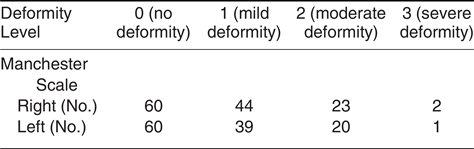
The severity of the HV deformity was evaluated using the Manchester Scale, which has been shown to be highly reliable for the self-assessment of patients with this deformity.[23,24] The scale consisted of four standardized photographs of four grades (0 = no deformity, 1 = mild deformity, 2 = moderate deformity, and 3 = severe deformity) of feet with HV. The participants were instructed to assess four photographs and choose the one that was the most similar to their feet. The participants were divided into two groups according to the Manchester Scale, as the HV group (scores of 1–3) and non-HV group (score of 0).
The participants were grouped into two groups according to the self-administered Manchester Scale scores. The participants who graded their feet as a score of 0 on the Manchester Scale (n = 60 participants) were grouped as individuals without HV.
The pain level of the patients with HV was identified using the Numeric Pain Rating Scale.[25] This scale was presented as a horizontal line that ranged between 0 and 10. The participants were instructed to rate their pain intensity within the previous week on the line according to the scale between 0 and 10 (from 0 = no pain to 10 = the most severe pain).
The functional status and pain related with HV was evaluated using the Manchester-Oxford Foot Questionnaire (MOXFQ), which is a validated questionnaire for patients with HV.[26,27] The MOXFQ, which consists of three subparameters (ie, walking-standing, foot pain, and social interaction), has 16 questions in total. Each question ranges between 0 and 4, and higher scores refer to severe situations.[27]
Body Awareness Assessment
The Body Awareness Questionnaire (BAQ) was used to assess the patient’s sensitivity to physical reactions and understand the elements (physical, social, and emotional) of the sensitivity under normal and abnormal body conditions.[2,28] The BAQ, which consists of four subparameters, consisting of prediction of body responses, sleep-wake cycle, prediction at the onset of the disease, and paying attention to changes and reactions in the body process, has 18 questions in total. Each question ranges between 1 and 7 (1 = not at all true for me to 7 = very true for me), and higher scores refer to the better body awareness.
Statistical Analysis
Statistical analyses were performed using IBM SPSS Statistics for Windows 23.0 (IBM Corp, Armonk, New York). Descriptive statistics were presented as the mean ± standard deviation, as the data were normally distributed according to the Kolmogorov-Smirnov test. The categorical variables were evaluated using the Pearson chi-square test. A value of P < .05 was accepted as statistically significant. Magnitudes of the correlations were categorized as follows: a) 0.10 to 0.30, negligible; b) 0.30 to 0.50, low; c) 0.50 to 0.70, moderate; d) 0.70 to 0.90, high; and e) 0.90 to 1.00, very high correlation.[29]
Results
The completed forms of 129 individuals were included in the study. The participants were grouped into two groups according to their self-administered Manchester Scale scores. Participants who graded their feet as a score of 0 on the Manchester Scale (n = 60 participants) were grouped as individuals without HV (Tables 1 and 2). The other participants were grouped as individuals with HV (n = 69 participants). The demographic and physical characteristics of the participants are given in Tables 1 and 2.

Table 1.
Demographic and Clinical Characteristics of the Participants According to the Groupsa
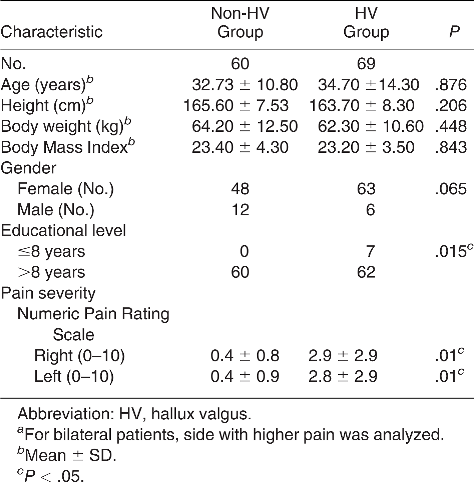
Table 2.
Manchester Scale
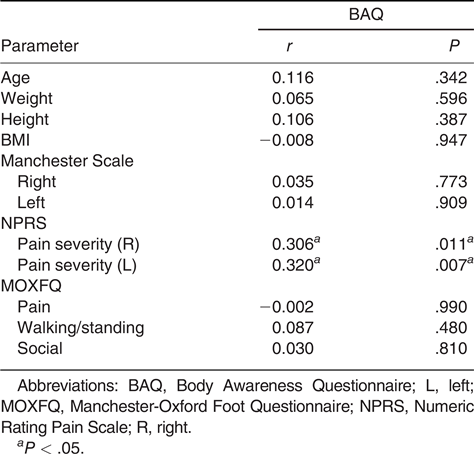
Both groups were similar with regard to their demographic and physical characteristics (Tables 1 and 2). The genders were distributed similarly between the groups (P > .05) and the pain severity was found to be higher in the HV group (P < .05) (Tables 1 and 2). The body awareness scores and the MOXFQ parameters were similar between the groups (Table 3). There was a positive low correlation between the pain severity and BAQ scores (right, r = 0.306; left, r = 0.320; P < .05), whereas there was no statistically important correlation between the MOXFQ and BAQ scores (Table 4) (P > .05).
Table 3.
Body Awareness and MOXFQ Results of the Participants According to Group
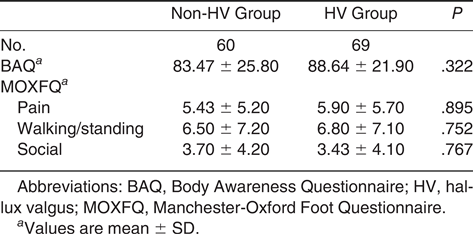
Table 4.
Correlations Between Body Awareness and Other Parameters in the HV Group
Discussion
The aims of this study were to 1) compare body awareness and functional status in individuals with and without HV, and 2) investigate the correlation between clinical outcomes (eg, age, pain severity, HV severity, functional status) and body awareness in individuals with HV. The study findings demonstrated that the presence of HV did not make a difference in terms of body awareness or quality of life. Another finding was that pain severity had a positive correlation with body awareness in the individuals with HV.
In this study, the body awareness and functional status were similar in both groups (with or without HV deformity). Although body awareness and functional status were similar, there were significant difference in terms of pain intensity. It is known that the presence of HV deformity, especially moderate or severe, is associated with self-reported pain and disability.[17] In the group with HV deformity, most of the participants had mild to moderate HV according to the Manchester Scale. Considering the low pain intensity in the HV group, one may conclude that the HV deformity did not affect the body awareness and functional status between the groups. Body awareness appears to result from an integrated activation of sensory, emotional, and cognitive aspects of the human experience. In this study, the participants’ education levels were relatively high overall in favor of the non-HV group. Reported pain of the non-HV group could be related to their educational levels’ effects on collected information about the bodily feelings.[30] Moreover, this might be related to the nature of the patient-reported questionnaires. In the literature, it was stated that questioning musculoskeletal pain may have increased the awareness of the participants’ minor pain or complaints, and sometimes the collected information could be related to other than bodily pain.[31] The difference between the HV and non-HV groups could be related to this issue, because participants without other disease or deformity were included as a control group. Lewis et al[32] reported that severity of the deformity was not found to be correlated with foot- and ankle-specific patient-reported questionnaires. Also, Omae et al[20] had similar results to our study regarding pain severity.
In the HV group, body awareness was positively correlated with pain intensity. This may have been attributed to the fact that people with higher body awareness are more sensitive to changes in their bodies and therefore perceive the severity of pain as higher than it actually is. In a similar way, Menz et al[33] stated that HV severity was significantly associated with reduced physical function, bodily pain, general health, social function, and mental health. Besides, most of the participants with HV had mild or moderate severity and had relatively low pain intensity, and there was a positive low correlation between the body awareness total score and pain severity.
Interoceptive feedback from the ankle has a critical function in postural adjustments and gait. Cutaneous afferents innervating skin on the feet provides exteroceptive information through contact with the ground or objects.[34] These interoceptive and exteroceptive inputs arising from the ankle and feet may change the perception of pain and impair body awareness. As pain is an interoceptive agent, even though the participants did not report high pain severity, their body awareness may have been affected by the pain severity.
The present study had several limitations. First, there were limited participants with severe HV in which body awareness could be affected more. Because it has been shown that pain severity was associated with HV severity,[17] the participants with severe HV did not have enough to analyze them optimally/statistically. Another limitation was that the age distribution of the participants was relatively low. Most of the studies regarding HV included elderly patients. This may have been attributed to the nonexistent or low level of Internet access and the online literacy levels of the Turkish elderly population.
Conclusions
In conclusion, body awareness is associated with chronic pain in individuals with HV. Future research is needed to investigate body awareness approaches on pain-related parameters in patients with HV. Body awareness therapies or changing the perception of pain may be effective in the management of chronic pain in individuals with HV.
Financial Disclosure: None reported.
Conflict of Interest: None reported.
References
- Mehling WE, Wrubel J, Daubenmier JJ, : Body awareness: a phenomenological inquiry into the common ground of mind-body therapies. Philos Ethics Humanit Med 6: 6, 2011.
- Shields SA, Mallory ME, Simon A: The body awareness questionnaire: reliability and validity. J Pers Assess 53: 802, 1989.
- Courtois I, Cools F, Calsius J: Effectiveness of body awareness interventions in fibromyalgia and chronic fatigue syndrome: a systematic review and meta-analysis. J Bodyw Mov Ther 19: 35, 2015.
- Hasenbring MI, Hallner D, Rusu AC: Fear-avoidance- and endurance-related responses to pain: development and validation of the Avoidance-Endurance Questionnaire (AEQ). Eur J Pain 13: 620, 2009.
- Hasenbring M: Attentional control of pain and the process of chronification. Prog Brain Res 129: 525, 2000.
- Eccleston C, Crombez G, Aldrich S, : Attention and somatic awareness in chronic pain. Pain 72: 209, 1997.
- Johnston NE, Atlas LY, Wager TD: Opposing effects of expectancy and somatic focus on pain. PloS One 7: e38854, 2012.
- Schmidt NB, Lerew DR, Trakowski JH: Body vigilance in panic disorder: evaluating attention to bodily perturbations. J Consult Clin Psychol 65: 214, 1997.
- Bekker MH, Croon MA, Van Balkom EG, : Predicting individual differences in autonomy-connectedness: the role of body awareness, alexithymia, and assertiveness. J Consult Clin Psychol 64: 747, 2008.
- Bekker MH, Croon MA, Vermaas S: Inner body and outward appearance—the relationship between orientation toward outward appearance, body awareness and symptom perception. Pers Individ Differ 33: 213, 2002.
- Oh SH, Bae BG, Park CO, : Association of stress with symptoms of atopic dermatitis. Acta Derm Venereol 90: 582, 2010.
- Ginzburg K, Tsur N, Barak-Nahum A, : Body awareness: differentiating between sensitivity to and monitoring of bodily signals. J Behav Med 37: 564, 2014.
- Nix S, Smith M, Vicenzino B: Prevalence of hallux valgus in the general population: a systematic review and meta-analysis. J Foot Ankle Res 3: 1, 2010.
- Bozant J, Serletic D, Phillips R: Tibialis posterior tendon associated with hallux abducto valgus. A preliminary study. JAPMA 84: 19, 1994.
- Carl A, Ross S, Evanski P, : Hypermobility in hallux valgus. Foot Ankle 8: 264, 1988.
- Ferrari J, Malone-Lee J: The shape of the metatarsal head as a cause of hallux abductovalgus. Foot Ankle Int 23: 236, 2002.
- Nix SE, Vicenzino BT, Smith MD: Foot pain and functional limitation in healthy adults with hallux valgus: a cross-sectional study. BMC Musculoskelet Disord 13: 197, 2012.
- Menz HB, Lord SR: Gait instability in older people with hallux valgus. Foot Ankle Int 26: 483, 2005.
- Pollatos O, Schandry R, Auer DP, : Brain structures mediating cardiovascular arousal and interoceptive awareness. Brain Res 1141: 178, 2007.
- Omae H, Ohsawa T, Hio N, : Hallux valgus deformity and postural sway: a cross-sectional study. BMC Musculoskelet Disord 22: 503, 2021.
- Faul F, Erdfelder E, Lang A-G, : G*Power 3: a flexible statistical power analysis program for the social, behavioral, and biomedical sciences. Behav Res Methods 39: 175, 2007.
- Vasantha Raju N, Harinarayana N: Online survey tools: a case study of Google Forms. Paper presented at: National Conference on Scientific, Computational & Information Research Trends in Engineering; January 30, 2016; Mysore, India.
- Menz HB, Fotoohabadi MR, Wee E, : Validity of self-assessment of hallux valgus using the Manchester scale. BMC Musculoskelet Disord 11: 215, 2010.
- Garrow AP, Papageorgiou A, Silman AJ, : The grading of hallux valgus. The Manchester Scale. JAPMA 91: 74, 2001.
- Kahl C, Cleland JA: Visual analogue scale, numeric pain rating scale and the McGill pain Questionnaire: an overview of psychometric properties. Phys Ther Rev 10: 123, 2005.
- Talu B, Bayramlar K, Bek N, : Validity and reliability of the Turkish version of the Manchester-Oxford Foot Questionnaire for hallux valgus deformity evaluation. Acta Orthop Traumatol Turc 50: 207, 2016.
- Morley D, Jenkinson C, Doll H, : The Manchester–Oxford Foot Questionnaire (MOXFQ): development and validation of a summary index score. Bone Joint Res 2: 66, 2013.
- Karaca S, Bayar B: Turkish version of Body Awareness Questionnaire: validity and reliability study. Turk J Physiother Rehabil 32: 44, 2017.
- Mukaka MM: A guide to appropriate use of correlation coefficient in medical research. Malawi Med J 24: 69, 2012.
- Cho N, Kim S, Kwon D-J, : The prevalence of hallux valgus and its association with foot pain and function in a rural Korean community. J Bone Joint Surg Br 91: 494, 2009.
- Hanvold TN, Veiersted KB, Waersted M: A prospective study of neck, shoulder, and upper back pain among technical school students entering working life. J Adolesc Health 46: 488, 2010.
- Lewis TL, Ray R, Gordon DJ: The impact of hallux valgus on function and quality of life in females. Foot Ankle Surg 28: 424, 2022.
- Menz HB, Roddy E, Thomas E, : Impact of hallux valgus severity on general and foot-specific health-related quality of life. Arthritis Care Res 63: 396, 2011.
- Mildren RL, Bent LR: Vibrotactile stimulation of fast-adapting cutaneous afferents from the foot modulates proprioception at the ankle joint. J Appl Physiol 120: 855, 2016.
© 2023 American Podiatric Medical Association