


Abstract
Background: Integrated medical curricula commonly require the review of foundational science concepts in the context of clinical applications. A detailed analysis of the Des Moines University second-year medical curricula revealed that such reviews, conducted as hours-long basic science lectures in second-year clinical systems courses, often create undesirable redundancy and can load the curriculum with excessively detailed content. We hypothesized that short, quiz-enhanced videocasts (QEVs) would allow a more focused and efficient review of foundational sciences than traditional lectures. Methods: Five biochemistry lectures in the second year Des Moines University Doctor of Podiatric Medicine curriculum were reviewed for relevance and redundancy, shortened to 8- to 12-min QEVs and offered to students as an alternative to the respective hours-long lecture. Results: Download data show that students chose content delivery by QEV as frequently as delivery of lectures, with QEV use peaking in the days immediately preceding the exam. Survey comments show that students appreciate the efficiency and flexibility of content delivery by QEV, particularly for focused exam preparation. Conclusions: We conclude that the review of foundational concepts by means of short, interactive videocasts can reduce redundant and excessively detailed content from integrated curricula. Although the faculty effort for context review, content selection, and videocast production is higher than for the design of a traditional lecture, the end product offers students a much-appreciated opportunity for efficient, focused, and individualized learning.
In the classic vertically integrated medical curriculum, foundational basic science concepts are commonly taught early and reviewed later in the clinical systems context [1]. These reviews of foundational material in the later stages of an integrated spiral curriculum can create content redundancies between parallel courses (horizontal) and between different phases of instruction (vertical redundancy), [2] particularly when participating basic science faculty are not fully involved in content integration [3]. Although planned redundancy can be beneficial, as it allows for better understanding of material through spaced repetition and application, redundancy resulting from poor coordination between lecturers is undesirable, as it wastes precious instructional time. Distinguishing between desirable and undesirable redundancy is difficult, with even students often not agreeing whether a redundancy was in fact undesirable [2].
When conducted in the form of hours-long face-to-face lectures, reviews of basic science concepts have the potential to introduce undesirable redundancies into the curriculum. The problem arises from the special circumstances that both lecturers and advanced students find themselves in. Basic scientist lecturers embedded in clinical courses may not be aware of the curricular context of their material and may thus repeat information that was or will be taught elsewhere, [4,5] resulting in the creation of horizontal redundancies. Advanced students are a heterogeneous group of individuals with different skill levels who often are well aware of their learning needs [6,7]; students who have developed a solid foundational science knowledge base might find the information presented during the review as too simplistic and will experience undesirable vertical redundancy, whereas students with poor command of the basic sciences might find the reviews too challenging. The review of foundational sciences in an integrated curriculum is thus a prime example of the current paradigm that the diversity of learners requires an individualization of the learning process to achieve optimal learning outcomes [8].
Podcasting, videocasting, and prerecorded microlectures have become valuable additions to in-person lectures, particularly for the remote, asynchronous delivery of complex content in higher and medical education [9–11]. Students generally appreciate the availability of playable-on-demand information for the review of selected topics and for focused exam preparation. [12] Even though the prerecorded format of these teaching modalities does not allow for real-time interaction with the instructor, [13] the flexibility of “anytime” content delivery nevertheless makes videocasts and similar offerings an effective educational experience [12]. The short duration of a typical videocast (3–20 min), achieved through scripted delivery of astutely selected content, maximizes learners’ attention and avoids learner fatigue [14,15]. However, the actual educational outcomes of videocasts in medical programs are somewhat unclear, as ethical and methodologic restrictions limit experimentation in this area [16].
The current study was undertaken to ascertain use patterns and learners impressions of the effectiveness of videocasts for the reviews of early curricular basic science concepts in upper-level clinical systems courses. It was hypothesized that reducing the content of basic science review sessions to essential, nonredundant material can result in dramatically shortened yet highly effective presentations that could be delivered in an attention-grabbing 10- to 15-min videocast format. Special attention was given to include quizzes with immediate feedback into the presentation, because in any type of instruction the element of feedback through formative assessment is crucial to meet the needs of adult learners [7]. We further reason that the thorough review of the curricular environment that is required for videocast content selection provides a welcome opportunity for basic science faculty to engage with the clinical curriculum to reduce redundancy, increase relevance, and improve integration [3].
Methods
Content Review and Videocast Production
A thorough review of the Des Moines University preclinical curricula identified redundancies and excessive detail in several basic science review lectures. Of these, five biochemistry review lectures in three different clinical systems courses in the Doctor of Podiatric Medicine (DPM) program—all given by the investigators—were chosen for the study. Vertical and horizontal content redundancies were identified through keyword searches of the university-wide lecture recording database, followed by viewing of the identified lectures (Panopto, Seattle, Washington). Excessively detailed material, defined as content that is not appropriate for the current level of training and will not be tested on licensing examinations, was identified through keyword searches in publicly available resources for licensing exam preparation. Session learning objectives were revised to eliminate undesirable redundancies and excessive detail, and faculty-recorded scripted visual presentations of the selected material (presentations by PowerPoint; Microsoft Corp, Redmond, Washington; recording and screen capture, Panopto). To provide learner feedback, three to five interactive quiz questions were inserted into the recordings in 3- to 5-min intervals, justifying the designation of “quiz-enhanced” for the videocast modules. A careful review of test items on the course examination was conducted to ensure that lecture and quiz-enhanced videocast (QEV) would thus be equally effective for exam preparation. In addition to the lectures and videocasts, students were provided with detailed handouts, including a listing of testable learning objectives. Scheduled lectures were delivered using the Panopto application. The experiment was conducted in duplicate in the 2020/2021 and 2021/2022 academic years for a total of nine interventions (one lecture was not duplicated); in the first year of the study, in-person attendance was not allowed because of coronavirus disease of 2019 restrictions, whereas in the second year, attendance was permitted but not mandatory. Cohort size was 52 students and 60 students for 2020 and 2021, respectively.
Content Use and Student Impressions
Live lectures with optional attendance were presented 6 to 13 days before exams in second year DPM clinical systems courses. Lecture recordings and QEVs were made available simultaneously through the Brightspace learning management system (D2L, Ontario, California), and a statement was posted to the students that lecture and QEV were fully equivalent for exam preparation. Students were encouraged to use the learning modalities of their choosing and to participate in a research survey to share their impressions on the QEV after the exam had been administered. A nine-question anonymous survey (no forced items) was made available consenting research participants to collect student input on use and effectiveness of QEVs and basic information on academic standing (ie, self-reported placement in quartile), and allow for feedback using free-text comments.
Approval and Analysis
The study was granted exempt status by the Des Moines University institutional review board (number 2020-25) for collection of anonymous student survey and video stream download data. Use of lecture and QEV files was determined by recording the number of unique users per day as reported by the learning management system. Student data on use and perceived effectiveness of QEVs were collected with a mixed-method approach, using a quantitative method for satisfaction/use data and a qualitative emerging-theme approach [17] for interpreting student free-text responses on the utility of the QEV. Data analysis, including determination of statistical significance, was conducted using Excel software. Data are presented as averages ± standard error over numbers of experiments (n = 9) or survey respondents (n = 53).
Results
QEV Use
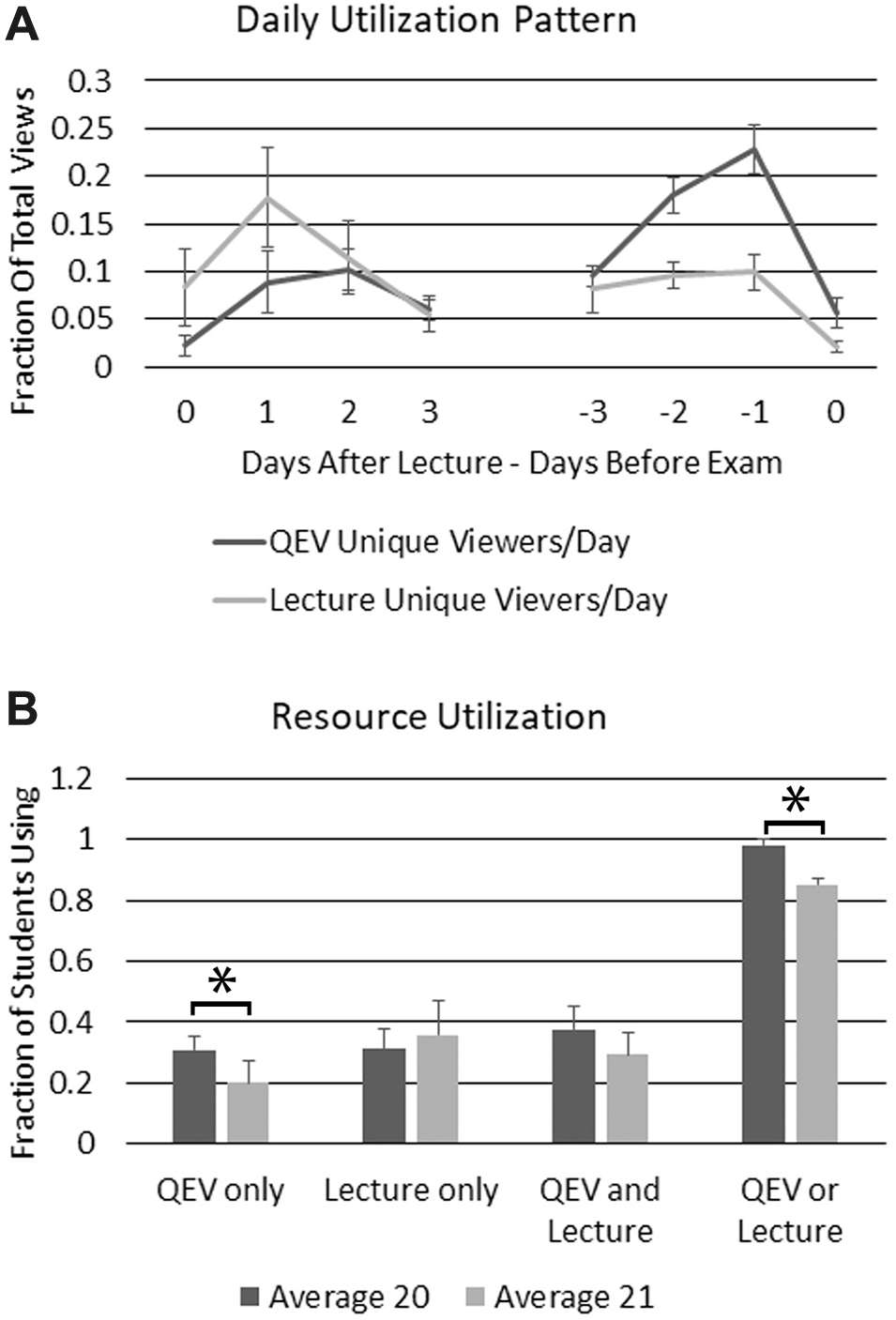
The download patterns of nine lecture recordings and their corresponding QEVs in the 2020/2021 and 2021/2022 academic years showed clear differences in use of both learning tools (Figure 1A). Although lecture download peaks on the first day after scheduled lecture delivery, QEV download peaks on the day immediately preceding the exam. In 2020, coronavirus disease of 2019 restrictions precluded students from attending the lectures in person; in 2021, students were allowed to attend live lectures, but attendance remained very low (10–15% attendance, per instructor estimate). In both years, download of presentations was the main modality of content acquisition, with 98.1 ± 2.2% (2020) and 85.3 ± 2.0% (2021) of students downloading at least one type of presentation (Figure 1B). Total resource download and download of QEV was significantly lower in 2021 than in 2020, possibly reflecting the fact that a small number of students were attending the lecture in person and did not use recordings. A total of 413 QEV and 404 lecture downloads were recorded during the 2-year period.
Figure 1.
Download pattern of quiz-enhanced video (QEV) and lecture recordings (average of nine QEV/lecture pairings administered to two cohorts of Doctor of Podiatric Medicine students in the 2020/2021 academic year. A. Daily use of resources. Download of lectures peaked the day after the scheduled event, whereas download of QEV peaked the day before the exam. B. Use of resources by the 2020 and 2021 cohorts. Student cohorts are split roughly evenly in their preference for the use of QEVs, lecture recording, or both (range, 20–37%). Use of QEV and use of any resource was significantly different between the 2020 and 2021 cohorts, possibly reflecting the effects of easing of pandemic restrictions that allowed limited in-person attendance.
Student Feedback
Effectiveness.
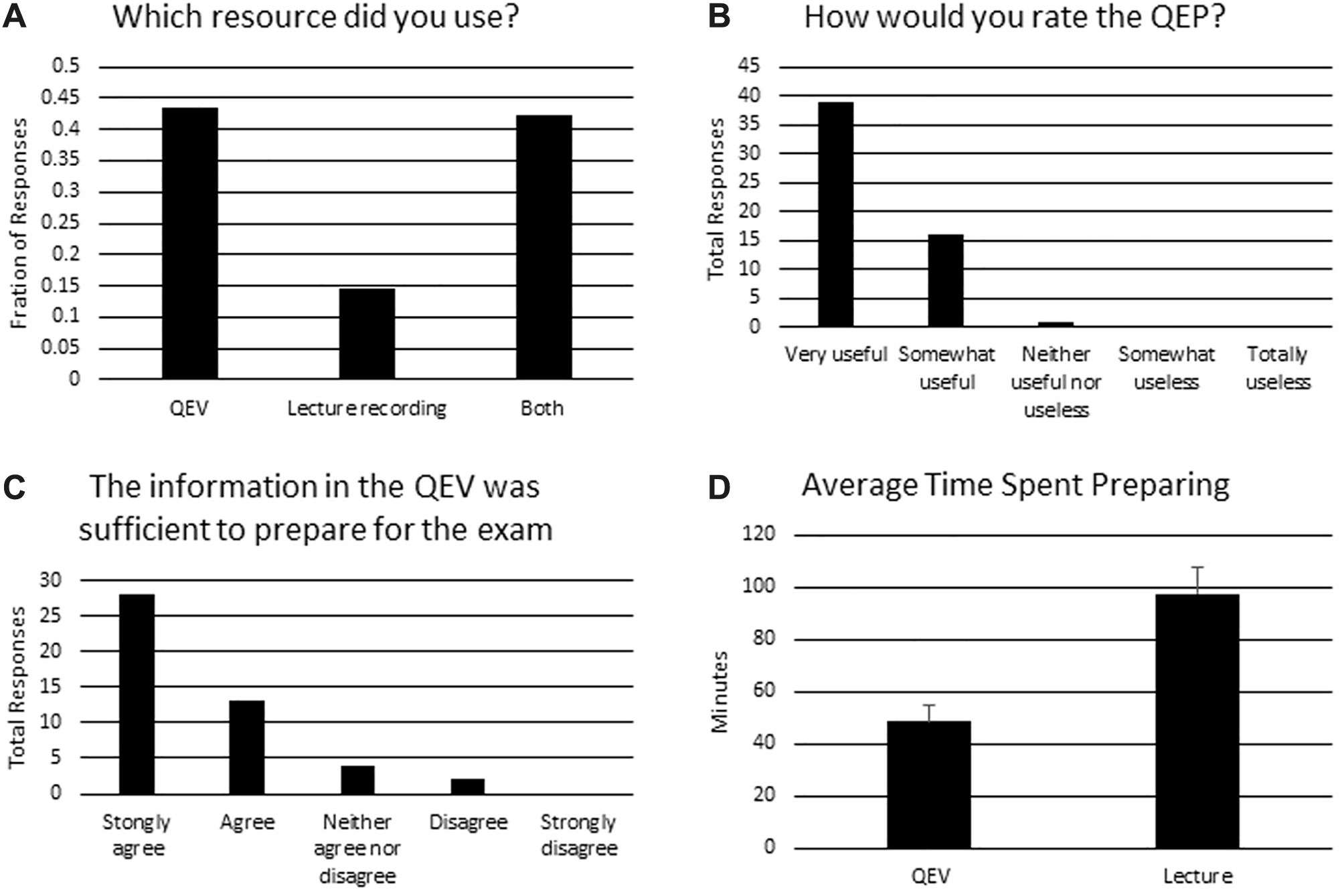
The student survey showed a high degree of satisfaction with the usefulness and effectiveness of the QEV for exam preparation. Survey respondents (n = 53) were more likely to have used the QEV (43% versus 24%) and less likely to have relied on the lecture recording alone (14% versus 33%) than the general DPM student cohort (Figure 2A), suggesting a greater enthusiasm for videocasts among research participants. Survey respondents overwhelmingly found the QEV useful/very useful (97.9%) and agreed/strongly agreed that the information provided in the QEV was sufficient to prepare for the exam (87.2%) (Figure 2B and C). Time savings from QEV use were evident in the difference in reported time dedicated to studying (47.8 ± 6 min versus 97.5 ± 10 min; P = .0001) (Figure 2D).
Figure 2.
Responses from student surveys conducted after the exam (n = 53). Research participants had a lower preference for viewing the lecture recording, and a plurality exclusively used quiz-enhanced videos (QEVs) (A). The overwhelming majority of participants found QEVs somewhat useful/very useful (B) and agreed/strongly agreed that the QEV was sufficient to prepare for the exam (C). Participants using QEVs spent significantly less time preparing for the exam than students using lecture recordings (P = .0001) (D).
Differences in Use.
Use of learning modalities was broken down by survey participant’s self-identified quartile rank. A χ2 analysis of the breakdown showed no significant differences in use between class quartiles (α = 0.18).
Student Perception of QEV.
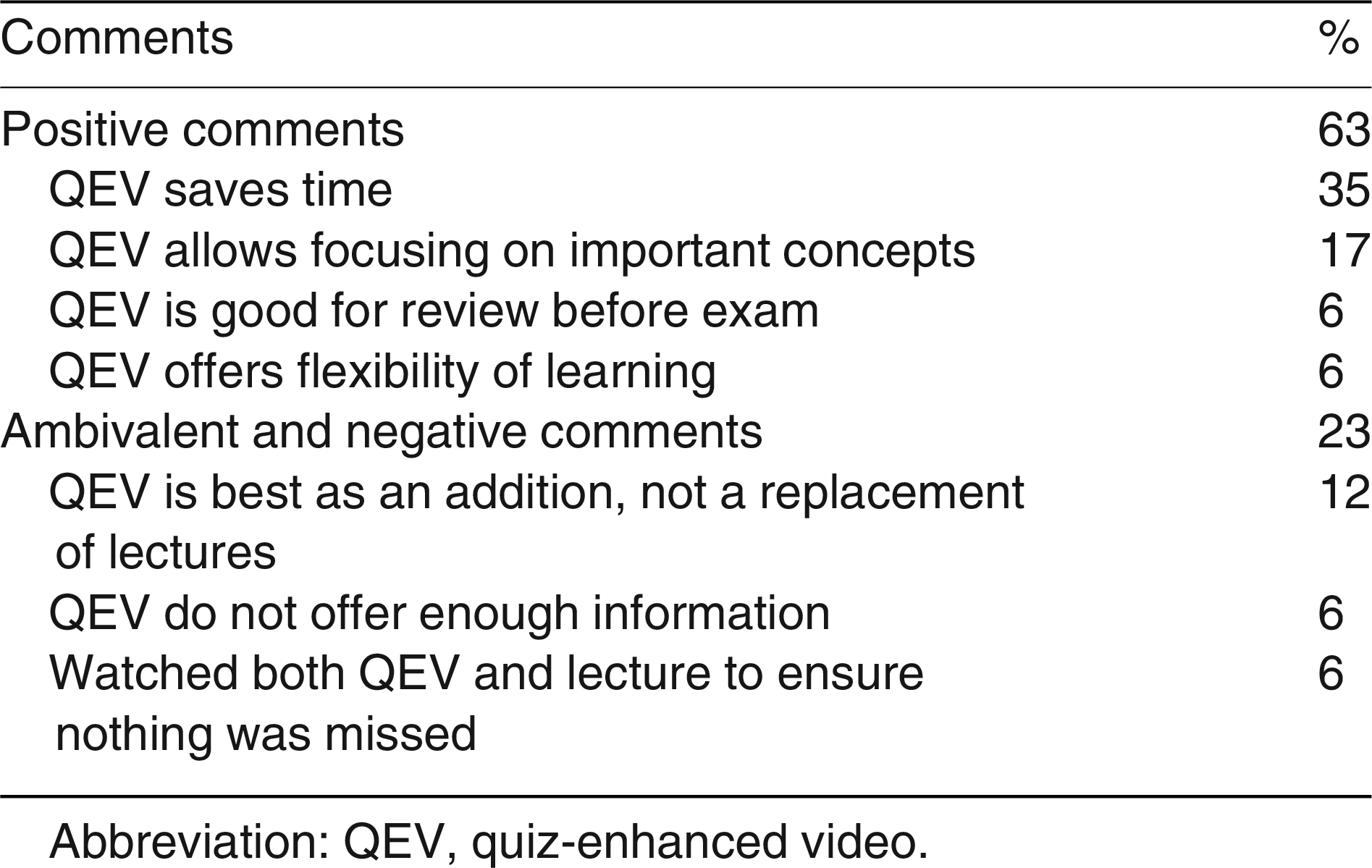
Student perception of QEV was ascertained through emerging theme analysis of 52 free-text comments on the participant survey (prompt “Please share your opinion about the Podcast”). Table 1 lists themes expressed by greater than 5% of participants. Positive comments highlighted the efficiency, focus and flexibility of QEV. It deserves mention that 12% of respondents stated that lecture and QEV were complementary resources, arguing that both learning modalities have their place in the curriculum and should be kept.
Table 1.
Thematic Analysis of Student Free-Text Comments
Discussion
In medical school curricula, basic and clinical science content is carefully sequenced to allow a smooth progression from the foundational to the applied medical sciences. This curricular model requires a review of basic science content from earlier courses in the context of later, clinically focused offerings. The key to a successful progression is deliberate integration of curricular content, which should occur both between parallel courses (horizontally) and between different phases of instruction (vertically). [1,18–20]
Redundancies and excessively detailed content can create inefficiencies in medical curricula. [2] Although a certain degree of content redundancy is deemed desirable by the designers of integrated curricula because it serves to reinforce important concepts through repetition, other redundancies result from poor coordination between basic science and clinical instructors and have no apparent instructional purpose. [2,3] Distinguishing desirable from undesirable redundancies is difficult: medical students are accomplished adult learners who self-identify their individual learning needs and goals, [6] including their need to revisit previous basic science curricular content: what looks like an undesirable redundancy to a strong student might be perceived as beneficial by less-skilled students or by students who plan to pursue a career in a related field of research. A second problem arising from the review of foundational sciences in the clinical context is that basic scientists at times lack an understanding of the clinical knowledge required at the respective level of instruction and involuntarily burden students with excessively detailed or irrelevant content. [2,20]
The present study was undertaken to establish whether short QEVs could solve the twin problems of redundancy and excessive detail that plague the later stages of preclinical education in vertically integrated curricula. Short, prerecorded presentations have been shown to be a highly effective teaching tool in medical education, [15,16] particularly for focused review of selected topics, [12] not least because their short duration maximizes learner attention. [14] For this study, we hypothesized that drastically shortening the time available for review of foundational sciences would require instructors to limit their presentations to material appropriate for the respective stage of training and for which no horizontal redundancy was found. We further aimed to increase the effectiveness of the videocasts by integrating annotated quiz questions, which would satisfy the needs of the adult learner for frequent feedback [7] and break the short presentations into highly effective microsegments of only a few minutes’ duration. [15]
We observed that the creation of appropriate QEVs requires extensive review of the curricular context and the published blueprints of licensing exams, as well as the acquisition of media production skills. [9] These tasks make videocast manufacture more labor-intensive than the design of a traditional lecture—a finding that was supported by participating faculty who estimated that videocast production takes approximately 8 hours from conception to posting (data not shown).
Student perception of the QEV was overwhelmingly positive, with the main theme of student comments being that videocasts save time by focusing on high-yield topics and avoid presentation of redundant and irrelevant material. Furthermore, the information in the videocast was deemed to be sufficient to prepare for examinations, a main concern of medical students everywhere. Although these findings were not surprising—given the fact that highly accomplished learners value efficiency and flexibility—the differential use patterns of QEV and lecture recordings provided some novel insights into student learning and resource use. Although viewing of lecture recordings peaked on the day following the live delivery of the presentation, QEV use was highest in the day immediately preceding the exam. Student comments explain this pattern by specifying that QEVs constitute the most effective tool for focused exam preparation and are often used in combination with lecture recordings. Interestingly, survey participants did not mention that QEVs do not provide an opportunity to interact in real time with the instructor, alleviating a major concern generally associated with the asynchronous delivery of content. [13]
Conclusions
We conclude that the delivery of foundational science reviews in clinical courses by QEVs has undeniable benefits for both students and faculty. For students, the focus on relevant nonredundant content and the flexibility of on-demand delivery make QEVs a highly efficient method of learning. For faculty, the necessity to identify relevant nonredundant content requires instructors to understand how their disciplines integrate into the clinical curriculum. However, student comments also point out that to satisfy the individual preferences and needs of adult learners, delivery of foundational science reviews by QEV is most effective as a complement to—not as a substitute for—the traditional lecture-based curriculum.
Financial Disclosure: The study was supported by an International Association of Medical Science Educators (IAMSE) educational scholarship grant to Dr. Schmidt.
Conflict of Interest: None reported.
References
- BrauerDG; FergusonKJ. The integrated curriculum in medical education: AMEE guide no. 96. Med Teach 2015, 37, 312. [Google Scholar]
- RoyalKD; GillilandKO; DentGA. A student-led methodology for evaluating curricular redundancy. J Multidisc Eval 2014, 10, 1. [Google Scholar]
- DominguezI; ZumwaltAC. Integrating the basic sciences in medical curricula: focus on the basic scientists. Adv Physiol Educ 2020, 44, 119. [Google Scholar]
- HopkinsR; PrattD; BowenJL; et al. Integrating basic science without integrating basic scientists: reconsidering the place of individual teachers in curriculum reform. Acad Med 2015, 90, 149. [Google Scholar]
- ZumwaltAC; DominguezI. Integrating the educators: outcomes of a pilot program to prime basic science medical educators for success in integrated curricula. Med Sci Educ 2019, 29, 637. [Google Scholar]
- ReedS; ShellR; KassisK; et al. Applying adult learning practices in medical education. Curr Probl Pediatr Adolesc Health Care 2014, 44, 170. [Google Scholar]
- TaylorDC; HamdyH. Adult learning theories: implications for learning and teaching in medical education: AMEE guide no. Med Teach 2013, 35, 83–1561. [Google Scholar]
- CookeM; IrbyDM; O’BrienBC. Educating Physicians: A Call for Reform of Medical School and Residency; Jossey-Bass: San Francisco, CA, 2010. [Google Scholar]
- CopleyJ. Audio and video podcasts of lectures for campus‐based students: production and evaluation of student use. Innov Ed Teach Int 2007, 44, 387. [Google Scholar]
- RodmanA; TrivediS. Podcasting: a roadmap to the future of medical education. Semin Nephrol 2020, 40, 279. [Google Scholar]
- KongZ; LiT; ZhangZ; et al. Application of microlecture teaching methods in standardized residency training during COVID-19 in Wuhan: a randomized, controlled study. Ann Palliat Med 2021, 10, 4017. [Google Scholar]
- ShantikumarS. From lecture theatre to portable media: students’ perceptions of an enhanced podcast for revision. Med Teach 2009, 31, 535. [Google Scholar]
- ShettyN; Bin RezaF; TomkinsonP. Letters to the editor. Med Teach 2011, 33, 592. [Google Scholar]
- CosiminiMJ; ChoD; LileyF; et al. Podcasting in medical education: how long should an educational podcast be? J Grad Med Educ 2017, 9, 388. [Google Scholar]
- PrakashSS; MuthuramanN; AnandR. Short-duration podcasts as a supplementary learning tool: perceptions of medical students and impact on assessment performance. BMC Med Educ 2017, 17, 167. [Google Scholar]
- ChoD; CosiminiM; EspinozaJ. Podcasting in medical education: a review of the literature. Korean J Med Educ 2017, 29, 229. [Google Scholar]
- GlaserBG; StraussAL. The Discovery of Grounded Theory; Aldine Publishing Co.: Chicago, 1967. [Google Scholar]
- HardenRM. What is a spiral curriculum? Med Teach 1999, 21, 141. [Google Scholar]
- WilkersonL; StevensCM; KrasneS. No content without context: integrating basic, clinical, and social sciences in a pre-clerkship curriculum. Med Teach 2009, 31, 812. [Google Scholar]
- BandieraG; BoucherA; NevilleA; et al. Integration and timing of basic and clinical sciences education. Med Teach 2013, 35, 381. [Google Scholar]
© 2023 American Podiatric Medical Association