


Abstract
Background: Individuals with diabetic neuropathy may experience plantar ulcers and postural instability. Although use of an insole with arch support has the potential to decrease the incidence of plantar ulcers, the choice of proper design and material density concerning postural stability is challenging. The objective of this pilot study was to conduct a preliminary evaluation of the immediate effects of custom-made ethyl vinyl acetate insoles with arch support and Shore A values of 30 or 50 on static balance in patients with diabetes and neuropathic foot/feet. Methods: Ten women with diabetes participated in this study. Static balance was analyzed while in double-limb standing with eyes closed and eyes open and while standing on a dominant limb with eyes open wearing shoes only and wearing shoes and insoles with Shore A values of 30 and 50. Results: With insole, the mean values of center of pressure excursions decreased significantly while standing on double limbs with eyes closed. The improvement in static balance was greater while using the insole with greater density; however, the difference was not statistically significant. Conclusions: An insole with arch support made of ethyl vinyl acetate Shore A of 30 and 50, which could decrease plantar pressure concentration, had no negative effect on the static balance of diabetes. Therefore, further research on the long-term effects of such insoles on the static balance of diabetes is suggested.
Patients with diabetes are a large portion of the world population who mostly experience mild-to-severe damage to the nervous system [1,2]. Patients with diabetic peripheral neuropathy (DPN) experience pressure concentration at some foot areas, an alteration in gait characteristics, balance disorder, and, finally, increased risk of falls (to 15 times greater than healthy individuals) [2,3,4,5,6,7,8]. The use of an insole is common in clinical practice; an insole with an arch support and a metatarsal pad, which increases the contact area with the foot, could decrease the plantar pressure concentration and avoid foot ulceration [2,9,10,11]. It may improve the neuropathic patient’s balance by the change of proprioception and activity of ascending proprioceptive chains [12,13,14]. However, Paton et al [15] stated that arch support could worsen the postural stability of patients with DPN. Although the material stiffness of insoles may affect ground reaction force through the close relationship between balance and vertical impact of ground reaction force [16], the effect of an insole on balance may be different in neuropathic and nonneuropathic patients [17,18,19]. Therefore, the design and material properties of prescribed insoles are important for patients with DPN.
The selection of insole material for patients with DPN depends on the three general requirements of control, dampening, and moldability [20]. Paton et al [20] reported high-density ethyl vinyl acetate (EVA) and LunaCell Nora EVA (Freudenberg, Weinhein, Germany) as the most suitable materials for motion control. A less stiff insole may also compromise postural stability due to reducing plantar sensory inputs [16]. Iglesias et al [19] stated that a more rigid insole could better improve the postural instability of a healthy elderly population. Two studies by Paton et al [17] and VanGeffen et al [21] reported no significant effects of the covering material of insoles or even the insoles on static balance parameters. The studies evaluated the effects of insoles consisting of complex materials such as EVA covered by Poron, leather covered by a thin layer of sandpaper, and silicone gel [15,22,23]. To our knowledge, none of the studies evaluated the effect of a homogenous EVA insole on the standing balance of patients with DPN.
Stability during quiet standing can be evaluated based on center of pressure (COP) motion. There are two main approaches to evaluate stability based on COP sways: linear and nonlinear [24]. In the linear approach, parameters such as excursion of COP, mean value of COP sway, path length, and standard division of COP sways were analyzed in the mediolateral and anteroposterior directions [25,26]. In contrast, in the nonlinear approach, the regularity of COP sway in a period is evaluated by using parameters such as approximate entropy, Lyapunov exponent, and coordination dimensions [24]. Standing balance could be assessed based on the COP measurement. Analyzing the COP excursion reveals various outcomes. The total COP excursion is the respective distance between the anteroposterior and mediolateral directions of the COP from the origin [27].
Previous studies recommended proper insole characteristics to improve balance and pressure distribution, such as a metatarsal pad, an arch support, a 1-cm-thick heel pad, and overall thickness of at least 1/4 inch [9,28,29]. A recent study examined the effects of such an insole design made of EVA on the plantar pressure of patients with DPN and reported that an EVA insole with Shore 30 could relieve hindfoot pressure [11]. However, some other studies stated that patients with DPN may respond better to flat insoles, which may not alter their balance [15,21]. Concerning these disagreements, we hypothesized that a homogenous insole made of Shore A with arch support and a metatarsal pad would improve the standing balance of patients with DPN. Therefore, this pilot study aimed to compare 1) the effects of wearing homogenous EVA insoles with arch support on the static balance of patients with DPN and 2) the effects of wearing homogenous EVA insoles compared with barefoot, shoes without EVA insoles, and shoes with insoles with two different densities on the static balance of patients with DPN, which could be the basis for a future randomized controlled trial.
Methods
Participants
The study was a pilot before-after trial of ten women with DPN. The inclusion criteria were type 2 diabetes, age older than 40 years, DPN, and normal toe in/out angle during walking. The exclusion criteria were plantar foot ulcer, amputation in the lower extremity, uncorrected vision problems, cognitive impairments, neuromuscular and/or musculoskeletal diseases, inability to stand independently, and use of drugs that may affect balance. The existence of neuropathy was assessed by the Semmes-Weinstein monofilament. Each participant was included in the study if she was unable to diagnose a pressure of 5.7 of 10 g at least at one of the plantar regions of the hallux, metatarsal heads, midfoot, and heel [30]. Patients were recruited from the Bayat outpatient clinic, Tehran, Iran. The research protocol was approved by the ethical committee of the University of University of Social Welfare and Rehabilitation Sciences, Tehran, Iran. All of the patients approved and signed informed consent. The study was performed in the biomechanics laboratory of the University of Social Welfare and Rehabilitation Sciences.
Intervention
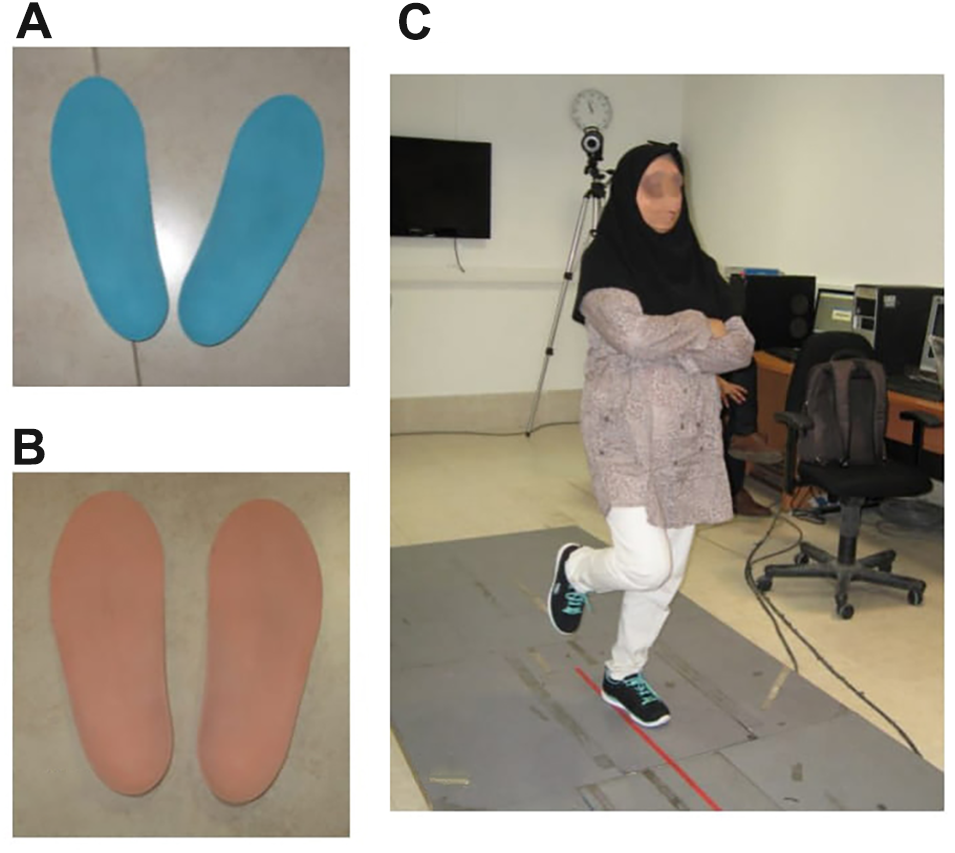
Two pairs of insoles custom-made from two different densities of EVA (Shore A) approximately 28 to 33 kg/m3 (known as Shore 30) and 55 to 65 kg/m3 (known as Shore 50) with different colors were designed and fabricated for each participant; the Shore value was checked by the Sauter system [31]. Patients were blinded to the differences between the two types of insoles (Fig. 1A and B). The insoles were designed and manufactured by a computer-aided system (provided by Paya Tech Company) in the Bayat outpatient clinic. All of the insoles were equipped with a metatarsal pad, an arch support, and a 1-cm-thick heel pad, and the overall thickness was at least 1/4 inch [9,28,29]. All of the participants were fitted with the same socks and the same tie lace shoes with a wide toe box and a 2.5-cm heel height, to avoid bias [32].
Figure 1.
The shore 50 (A) and shore 30 (B) insoles used in the study, and the standing posture for single limb standing on dominant limb (C).
Data Collection
Static balance was measured with a Kistler force platform (model 9286BA, connected to BioWare software, Version 4.0.1.2; Kistler, London, England) with a sampling frequency of 100 Hz. Static balance was evaluated under four different conditions: barefoot, insoles with Shore 30, insoles with Shore 50, and shoes only. Balance testing consisted of double-limb standing with eyes open and eyes closed and one-leg standing on the dominant side with eyes open (Fig. 1C). Participants were asked to maintain bipedal standing in place on the force platform with the legs shoulder-width apart and the arms hanging at the side of the body as motionless as possible for 30 sec [33]. During one-leg standing, the participant was instructed to cross the arms on her chest, stand on the dominant leg, and flex the nondominant leg to 90° [34]. Then the patient was requested to maintain this position with eyes open for 10 sec as motionless as possible while avoiding bringing the flexed leg in contact with the ground or the dominant leg. In the eyes open conditions, each patient looked at a landmark positioned on a wall 2 m in front of her. For each condition, 3 trials were performed. There was a resting period of 1 min between consecutive trials. The order of the trials was randomized in each participant. The cutoff frequency was 10 Hz.
Data Analysis
Total COP excursion, total mean velocity, sway area, and the 95% ellipse area (the ellipse that, with the 95% of probability, bears the sway’s center of the points) were outcome variables extracted from the COP measurement [27]:
where AP is theanteroposterior component of COP; ML, mediolateral component of COP; and N, total data length;
where t is time; and
defined as the area spread from the COP per second [35], and where AP is the anteroposterior component of COP; ML, mediolateral component of COP; and N, total data length.
The variables were extracted with Matlab software (Matlab R2014a; The MathWorks Inc, Natick, Massachusetts). Then, the normality was checked by the Shapiro-Wilk test. All of the data had a normal distribution. Two separate repeated-measures analyses of variance were performed to compare insole effects on static balance in double-limb stance and single-leg stance with eyes open and eyes closed. The significance level was considered to be P < .05. The statistical analysis was performed with IBM SPSS Statistics for Windows, Version 16.0 (IBM Corp, Armonk, New York).
Results
Ten women with DPN of the foot/feet participated in this study. Their mean ± SD age was 58.9 ± 9.21 years, mean ± SD foot length was 23.68 ± 0.74 cm, and mean ± SD mass and BMI were 74 ± 11.20 kg and 29.1 ± 3.36, respectively.
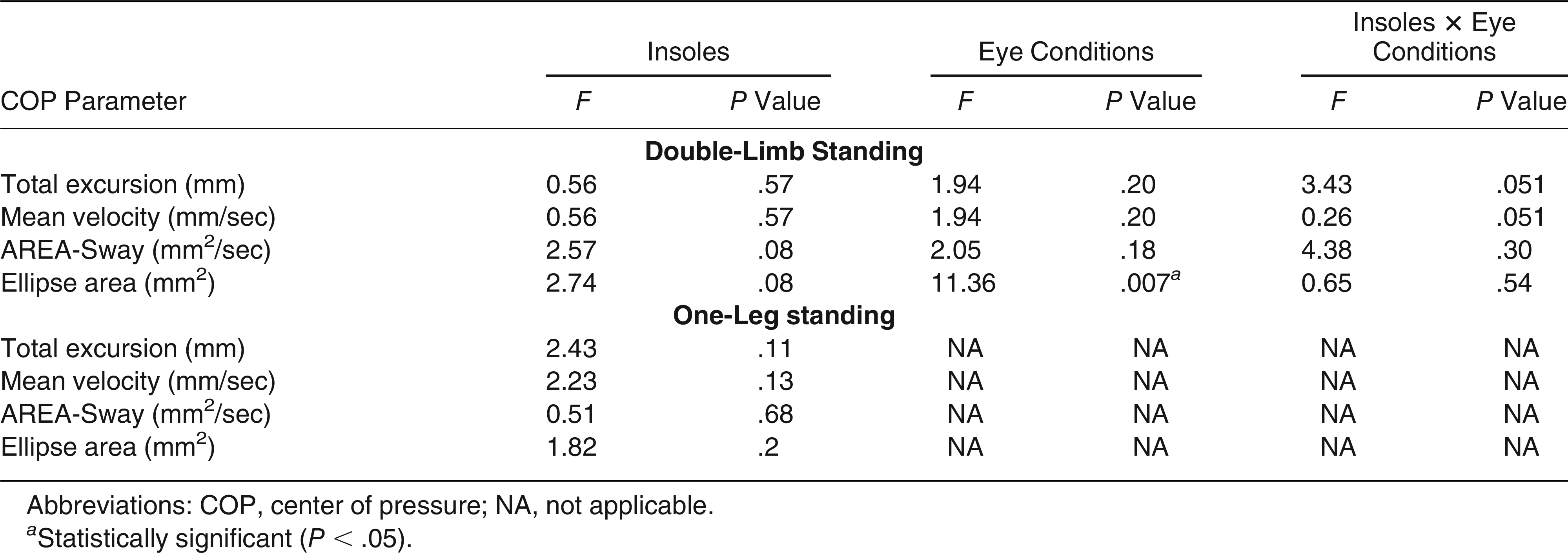
The 95% confidence intervals of the COP parameters are presented in Table 1. In double-limb standing, the main effect for eye conditions was significant for 95% ellipse area (F1,10 = 11.356; P = .007). Patients had a greater mean ± SD area of 95% ellipse with eyes closed compared with eyes open (503.396 ± 86.240 versus 365.224 ± 63.190) (Table 1). The interaction between insoles and eye conditions for the sway area parameter was also nonsignificant (F2.31,23.1 = 4.381; P = .030); during barefoot standing with eyes open, the mean ± SD sway area was less than in the other conditions (0.707 ± 0.073) (Table 1 and Table 3). While wearing insoles, the mean values of COP total excursion, mean velocity, and sway area were less with eyes closed versus eyes open; the P value was .051, revealing the clinical significance and showing a trend toward statistical significance [36].
Table 1.
The 95% Confidence Interval of Each COP Parameter and the Main and Interaction Effects of Independent Parameters (Insole and Eye) on COP Parameters.
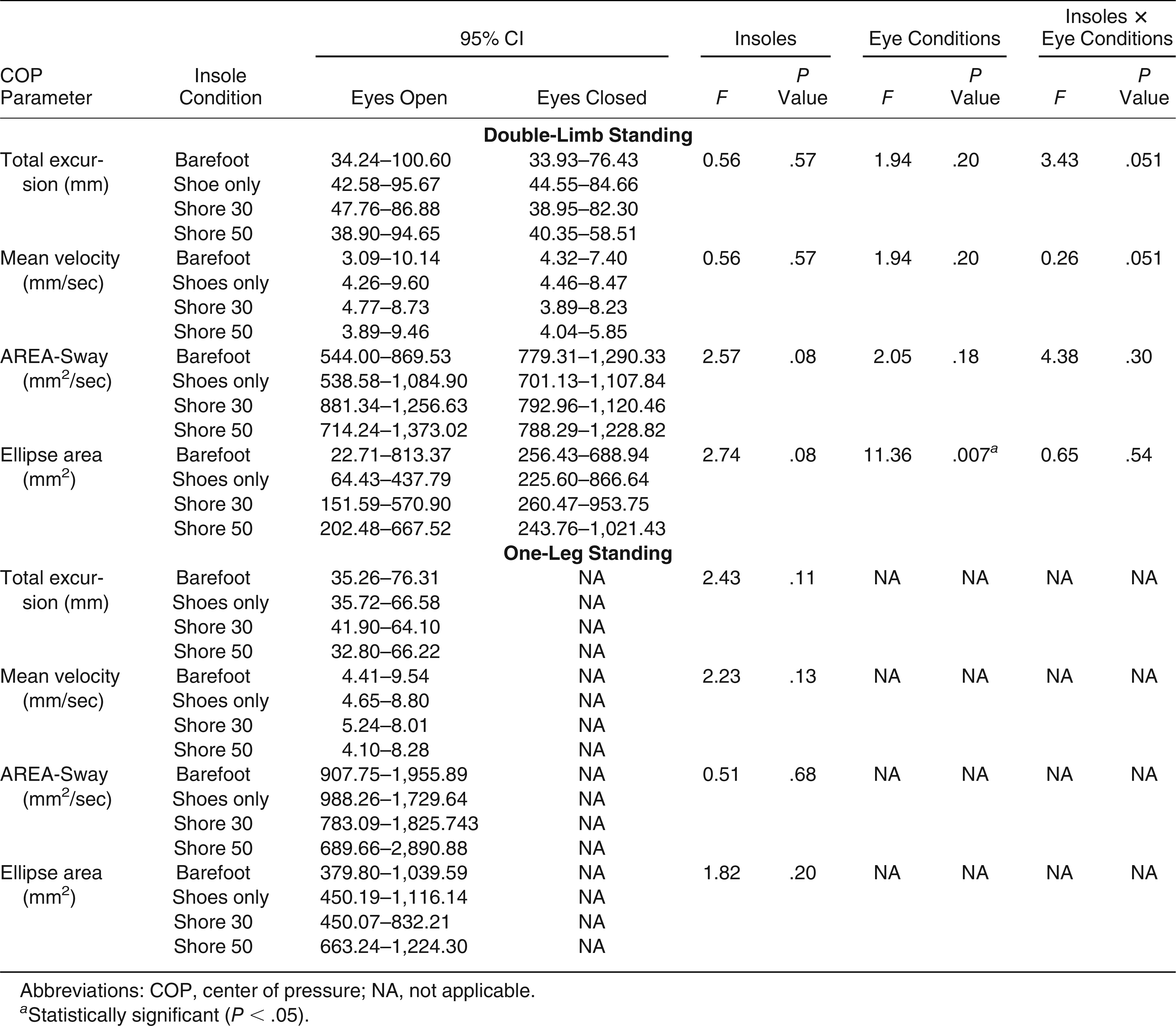
When static balance in single-leg stance was examined (Table 2), there was no significant difference in COP parameters between different insoles with eyes open (P > .05) (Table 1).
Table 2.
COP Parameters Assessed at Different Insole Conditions During Dominant-Limb Standing.
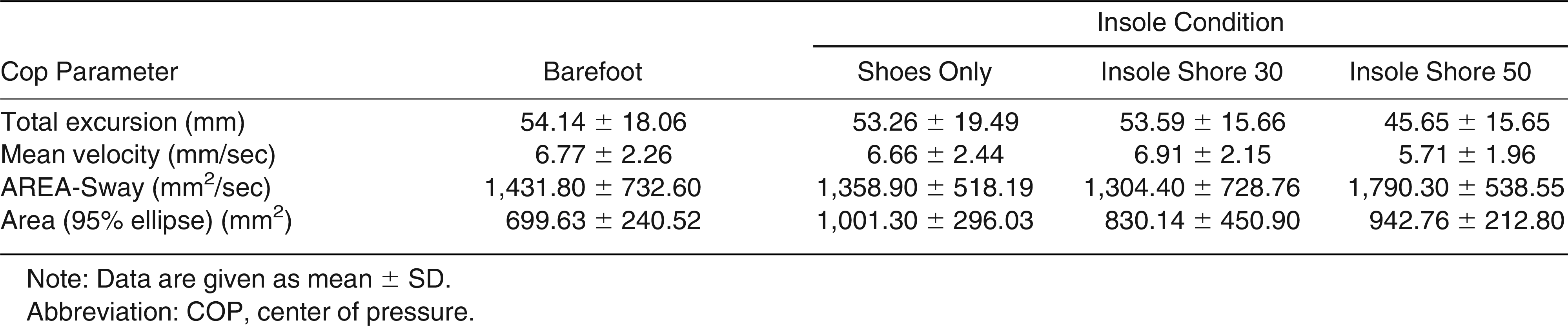
Table 3.
Main Effects and Interaction Effects of Independent Parameters (Insole and Eye) on COP Parameters.
Discussion
This pilot study examined the possible effect of two different insole densities with arch support on the static balance of females with DPN of the foot/feet. The use of insoles incorporating arch support, which could avoid plantar ulcers of diabetes by decreasing plantar pressure concentration, had no worsening effect on static balance. During standing on the dominant limb and also double-limb standing with eyes closed while wearing insoles with both densities showed an apparent trend of improved stability, which was greater for insoles with Shore 50. However, the difference was not statistically significant.
Previous studies supported the usefulness of arch support to avoid plantar pressure in populations with diabetes.[10] The use of insoles with arch support had no negative effect on the postural stability of the participants. The static balance of our participants was better when using insoles during standing on the dominant limb. These findings were in contrast to the findings of Paton et al,[15] who stated that arch support could worsen the static balance of patients with DPN. The present results were also consistent with the findings of Hatton et al,[37] who found no significant differences in single-leg standing balance and star excursion balance test performance when using various insoles. Büyükturan et al [38] reported that insoles with 10-mm thickness caused the highest postural stability and the lowest risk of falling compared with insoles made of the same material with thickness of 5 mm and 15 mm. The overall thickness of the insoles used with the present research was at least 1/4 inch but was not equal in the various regions. Therefore, nonsignificant differences may be due to this factor.
It is well-known that vision enhances postural stability.[39,40] The results of the present study also revealed more stability during double-limb standing with eyes open; in this situation, fewer values were assessed in barefoot conditions. Data collections in the eyes closed conditions revealed fewer mean values in all of the COP parameters; perhaps the increased plantar foot contact of participants by use of insoles could help to improve balance in the lack of visual inputs. This is in line with the findings of Paton et al,[17] who found negligible effects for variation in the material properties of an insole on the static balance of patients with loss of sensation.
We should be cautious about the findings because the difference between the two insole conditions was not statistically significant. Because previous research stated that balance control in peripheral neuropathic patients was less affected under dynamic measurements, this study assessed only static balance.[41] Although most of the daily activities, such as walking, occur under dynamic conditions, balance control measurement in dynamic conditions may also be useful.[3,34] Therefore, the evaluation of dynamic stability when wearing insoles with different densities may be a suggestion. Because short-term exposure to the unfamiliar condition may compromise balance initially, a possible cause may be the need for more accommodation time with the insoles.[42,43,44] Another limitation of this research was the small sample size. All of the study participants were women, which may reduce the generalizability of the results to the whole diabetes population.
Conclusions
A previous study by Tafti et al [11] showed that insoles made of EVA with arch support and Shores of 30 and 50 could decrease plantar pressure concentration, and the present study revealed that such insoles had no negative effect on the balance control of participants with DPN. The mean difference between the effects of the two insoles on static balance control was also not statistically significant. Although the 30 Shore A insoles did not produce a significant difference, they could still be recommended for these patients to decrease plantar pressure concentration. Therefore, there is a potential for further research on the long-term effects of EVA insoles with arch support on the static balance of diabetes.
Acknowledgments
Dr. Reza Safari for his help in the conception and design of the study.
Financial Disclosure
This work was part of a research project to answer a different hypothesis (grant 94.801.T.6791) supported by the Deputy of Research and Technology at the University of Social Welfare and Rehabilitation Sciences.
Conflicts of Interest
None reported.
References
- World Health Organization. Diabetes. Available at: https://www.who.int/news-room/fact-sheets/detail/diabetes. Published April 5, 2023.
- Lin, T-L; Sheen, H-M; Chung, C-T; et al. The effect of removing plugs and adding arch support to foam based insoles on plantar pressures in people with diabetic peripheral neuropathy. J Foot Ankle Res 2013, 6, 29. [Google Scholar]
- Kwon, O; Minor, S; Maluf, K; et al. Comparison of muscle activity during walking in subjects with and without diabetic neuropathy. Gait Posture 2003, 18, 105. [Google Scholar]
- Mueller, M; Minor, S; Sahrmann, S; et al. Differences in the gait characteristics of patients with diabetes and peripheral neuropathy compared with age-matched controls. Phys Ther 1994, 74, 299. [Google Scholar]
- Allet, L; Armand, S; de Bie, RA; et al. Gait alterations of diabetic patients while walking on different surfaces. Gait Posture 2009, 29, 488. [Google Scholar]
- Bonnet, C; Carello, C; Turvey, M. Diabetes and postural stability: review and hypotheses. J Mot Behav 2009, 41, 172. [Google Scholar]
- Cavanagh, P; Derr, J; Ulbrecht, S; et al. Problems with gait and posture in neuropathic patients with insulin-dependent diabetes mellitus. Diabet Med 1992, 9, 469. [Google Scholar]
- Caselli, A; Pham, H; Giurini, JM; et al. The forefoot-to-rearfoot plantar pressure ratio is increased in severe diabetic neuropathy and can predict foot ulceration. Diabetes Care 2002, 25, 1066. [Google Scholar]
- Guldemond, NA; Leffers, P; Schaper, NC; et al. The effects of insole configurations on forefoot plantar pressure and walking convenience in diabetic patients with neuropathic feet. Clin Biomech 2007, 22, 81. [Google Scholar]
- Ahmed, S; Barwick, A; Butterworth, P; et al. Footwear and insole design features that reduce neuropathic plantar forefoot ulcer risk in people with diabetes: a systematic literature review. J Foot Ankle Res 2020, 13, 1. [Google Scholar]
- Tafti, N; Turk, S; Hemmati, F; et al. Effect of wearing insole with different density on standing and walking plantar pressure distribution. J Mech Med Biol 2019, 19, 1950006. [Google Scholar]
- Bricot, B. Posturology; Icone: São Paulo, Brazil, 1999. [Google Scholar]
- Przysiezny, WL. Podoposturology: Reprogramming Through Postural Insoles: Prescription and Manufacture of Insoles Posture; Polígrafo: Londrina, Brazil, 2006. [Google Scholar]
- Ball, KA; Afheldt, MJ. Evolution of foot orthotics—part 1: coherent theory or coherent practice? J Manipulative Physiol Ther 2002, 25, 116. [Google Scholar]
- Paton, J; Glasser, S; Collings, R; et al. Getting the right balance: insole design alters the static balance of people with diabetes and neuropathy. J Foot Ankle Res 2016, 9, 40. [Google Scholar]
- Robbins, S; Waked, E. Balance and vertical impact in sports: role of shoe sole materials. Arch Phys Med Rehabil 1997, 78, 463. [Google Scholar]
- Paton, J; Hatton, AL; Rome, K; et al. Effects of foot and ankle devices on balance, gait and falls in adults with sensory perception loss: a systematic review. JBI Database System Rev Implement Rep 2016, 14, 127. [Google Scholar]
- Perry, SD; Radtke, A; Goodwin, CR. Influence of footwear midsole material hardness on dynamic balance control during unexpected gait termination. Gait Posture 2007, 25, 94. [Google Scholar]
- Iglesias, M; DeBengoaVallejo, R; Peña, D. Impact of soft and hard insole density on postural stability in older adults. Geriatr Nurs 2012, 33, 264. [Google Scholar]
- Paton, J; Jones, R; Stenhouse, E; et al. The physical characteristics of materials used in the manufacture of orthoses for patients with diabetes. Foot A nkle Int 2007, 28, 1057. [Google Scholar]
- VanGeffen, J; Dijkstra, P; Hof, A; et al. Effect of flat insoles with different Shore A values on posture stability in diabetic neuropathy. Prosthet Orthot Int 2007, 31, 228. [Google Scholar]
- Kelleher, KJ; Spence, WD; Solomonidis, S; et al. The effect of textured insoles on gait patterns of people with multiple sclerosis. Gait Posture 2010, 32, 67. [Google Scholar]
- Priplata, AA; Patritti, BL; Niemi, JB; et al. Noise-enhanced balance control in patients with diabetes and patients with stroke. Ann Neurol 2006, 59, 4. [Google Scholar]
- Karami, M; Sadeghisani, M; Omar, AHH; et al. Stability analysis in patients with neurological and musculoskeletal disorders using linear and non-linear approaches. J Mech Med Biol 2015, 15, 1530004. [Google Scholar]
- Karimi, M; Esrafilian, A. Evaluation of the stability of normal subjects and patients with Perthes and spinal cord injury disorders during short and long periods of time. Prosthet Orthot Int 2013, 37, 22. [Google Scholar]
- Karimi, MT; Solomonidis, S. The relationship between parameters of static and dynamic stability tests. J Res Med Sci 2011, 16, 530. [Google Scholar]
- Lee, C-H; Sun, T-L. Evaluation of postural stability based on a force plate and inertial sensor during static balance measurements. J Physiol Anthropol 2018, 37, 27. [Google Scholar]
- Lemmon, D; Shiang, T; Hashmi, A; et al. The effect of insoles in therapeutic footwear: a finite element approach. J Biomech 1997, 30, 615. [Google Scholar]
- Jorgensen, U; Boisen-Moller, F. Shock absorbency of factors in the shoe/heel interaction: with special focus on role of the heel pad. Foot Ankle 1989, 9, 294. [Google Scholar]
- Barber, MA; Conolley, J; Spaulding, CM; et al. Evaluation of pressure threshold prior to foot ulceration: one-versus two-point static touch. JAPMA 2001, 91, 508. [Google Scholar]
- Healy, A; Dunning, D; Chockalingam, N. Effect of insole material on lower limb kinematics and plantar pressures during treadmill walking. Prosthet Orthot Int 2011, 36, 53. [Google Scholar]
- Veves, A; Masson, E; Fernando, D; et al. Use of experimental padded hosiery to reduce abnormal foot pressures in diabetic neuropathy. Diabetes Care 1989, 12, 653. [Google Scholar]
- Hermodsson, Y; Ekdahl, C; Persson, BM; et al. Standing balance in trans-tibial amputees following vascular disease or trauma: a comparative study with healthy subjects. Prosthet Orthot Int 1994, 18, 150. [Google Scholar]
- Hatton, A; Kemp, J; Brauer, S; et al. Impairment of dynamic single-leg balance performance in individuals with hip chondropathy. Arthritis Care Res 2014, 66, 709. [Google Scholar]
- Prieto, TE; Myklebust, JB; Hoffmann, RG; et al. Measures of postural steadiness: differences between healthy young and elderly adults. IEEE Trans Biomed Eng 1996, 43, 956. [Google Scholar]
- Thiese, MS; Ronna, B; Ott, U. P value interpretations and considerations. J Thoracic Dis 2016, 8, E928. [Google Scholar]
- Hatton, A; Hug, F; Brown, B; et al. A study of the immediate effects of glycerine-filled insoles, contoured prefabricated orthoses and flat insoles on single-leg balance, gait patterns and perceived comfort in healthy adults. J Foot Ankle Res 2015, 8, 47. [Google Scholar]
- Büyükturan, Ö; Demirci, S; Büyükturan, B; et al. Effects of using insoles of different thicknesses in older adults: which thickness has the best effect on postural stability and risk of falling? JAPMA 2020, 110. Article_5. [Google Scholar]
- Simoneau, GG; Ulbrecht, SJ; Derr, JA; et al. Role of somatosensory input in the control of human posture. Gait Posture 1995, 3, 115. [Google Scholar]
- Teasdale, N; Simoneau, M. Attentional demands for postural control: the effects of aging and sensory reintegration. Gait Posture 2001, 14, 203. [Google Scholar]
- Nardone, A; Grasso, M; Schieppati, M. Balance control in peripheral neuropathy: are patients equally unstable under static and dynamic conditions? Gait Posture 2006, 23, 364. [Google Scholar]
- Ramdharry, G; Marsden, J; Day, B; et al. De-stabilizing and training effects of foot orthoses in multiple sclerosis. Mult Scler 2006, 12, 219. [Google Scholar]
- Hatton, A; Dixon, J; Rome, K; et al. Altering gait by way of stimulation of the plantar surface of the foot: the immediate effect of wearing textured insoles in older fallers. J Foot Ankle Res 2012, 5, 11. [Google Scholar]
- McKeon, P; Stein, A; Ingersoll, C; et al. Altered plantar-receptor stimulation impairs postural control in those with chronic ankle instability. J Sport Rehabil 2012, 21, 1. [Google Scholar]
© 2023 American Podiatric Medical Association