


Abstract
Background: The aim of this study was to evaluate the incidence and recovery of acute kidney injury (AKI) in patients admitted to the hospital with and without diabetes mellitus (DM) with foot infections. Methods: We retrospectively reviewed 294 patients with DM and 88 without DM admitted to the hospital with foot infections. The Kidney Disease: Improving Global Outcomes guidelines were used to define AKI. Recovery was divided into three categories: full, partial, and no re- covery within 90 days of the index AKI. Results: The AKI incidence was 3.0 times higher in patients with DM (DM 48.5% versus no DM 23.9%; 95% confidence interval [CI], 1.74–5.19; P < .01). Acute kidney injury incidence was similar at each stage in people with and without DM (stage 1, DM 58.1% versus no DM 47.6%; stage 2, DM 23.3% versus no DM 33.3%, and stage 3, DM 18.6% versus no DM 19.1%). Twenty-nine patients with diabetes had a second AKI event and four had a third event. In patients without DM, one patient had a second AKI. Cumulative AKI incidence was 4.7 times higher in people with DM (DM 60.9% versus no DM 25.0%; 95% CI, 2.72–8.03; P < .01). Patients with diabetes progressed to chronic kidney disease or in chronic kidney disease stage 39.4% of the time. Patients without diabetes progressed 16.7% of the time, but this trend was not significant (P = .07). Complete recovery was 3.8 times more likely in patients without diabetes (95% CI, 1.26–11.16; P = .02). Conclusions: Acute kidney injury incidence is higher in patients with diabetes, and com- plete recovery after an AKI is less likely compared to patients without diabetes.
Diabetic foot infection is one of the most common underlying causes of hospitalization in people with diabetes [1,2]. In addition to the stress of infection, these patients often have multiple comorbidities, require multiple medications, undergo multiple operations, and require prolonged exposure to antibiotics that predispose them to acute kidney injury (AKI). Acute kidney injury is associated with increased mortality and progression of chronic kidney disease that increases proportionally based on the severity of the event [3,4]. Even in patients that recover, patients with AKI have worse longterm clinical outcomes compared to patients with no history of AKI [5,6]. We previously identified an incidence of AKI of 27% in a cohort of patients with diabetes and osteomyelitis [7]. The aim of this study was to evaluate the incidence and recovery of AKI injury in patients with and without diabetes admitted to the hospital with moderate and severe foot infections.
Methods
Patient Selection
After approval by the University of Texas Southwestern Medical Center Institutional Review Board, medical records of patients treated between June of 2009 and February of 2017 for foot infection were reviewed. The records of 294 patients with diabetes and 88 patients without diabetes were reviewed who were admitted to the hospital with an Infectious Diseases Society of America moderate or severe foot infection [8]. The diagnosis of diabetes was based on criteria from the American Diabetes Association [9]. The presence of a severe infection was identified by clinical recognition of two or more of the following systemic inflammatory response syndrome criteria [8]: heart rate greater than 90/min; temperature greater than 38˚C or less than 36˚C; respiratory rate greater than 20/min or partial pressure of carbon dioxide less than 32 mm Hg; and white blood cell count greater than 12,000 cells/mm3, less than 4,000 cells/mm3, or greater than 10% immature bands. In addition, patient laboratory values including C-reactive protein, erythrocyte sedimentation rate, serum albumin, and hemoglobin were recorded.
Identification of AKI
We used the Kidney Disease: Improving Global Outcomes (KDIGO) serum creatinine criteria for AKI diagnosis and staging [10]. Acute kidney disease could be diagnosed if 1) there was an increase in serum creatinine by greater than or equal to 0.3 mg/dL ($26.5 mEq/L) within 48 hours in patients without chronic kidney disease (CKD), or 2) an increase in creatinine to 1.5 times baseline in patients with and without CKD. The KDIGO AKI serum creatinine criteria states that stage 1 AKI is a creatinine elevation 1.5 to 1.9 times baseline, stage 2 is 2.0 to 2.9 times baseline, and stage 3 is 3.0 times baseline [10]. Urine output criteria were not considered as part of AKI criteria. Baseline creatinine was defined as the lowest creatinine measurement during hospitalization or, if available, the mean of all creatinine measurements 7 to 365 days before the index admission [11]. Patients with CKD stage 5 were excluded.
Patient Follow-up and Outcomes
Patients were included in the study if they were followed for at least 12 months or until they died. Patients with less than 12 months of follow-up were excluded. The outcomes evaluated were the need for surgical intervention, lower extremity amputation, hospital length of stay, wound healing, reinfection, readmission, and mortality.
Acute kidney injury recovery was divided into three categories. Complete recovery was defined as patients who achieved a creatinine level that was within 115% of baseline levels [12], and partial recovery was defined as a creatinine level that remained 115% above baseline levels but less than 1.5 times baseline levels. No recovery was defined as a creatinine level that remained greater than 1.5 times the baseline value. Chronic kidney disease progression and estimated glomerular filtration rate values were determined by examining electronic medical records.
Statistical Analysis
Patient data were summarized using descriptive statistics. Median, mean, and standard deviation were used for continuous variables, whereas frequency and percentage were used for categorical variables. Characteristics and outcomes between patients with and without AKI were compared using parametric (Student t test, x2 test) and nonparametric tests (Mann-Whitney U test, Fisher exact test) as appropriate.
Results
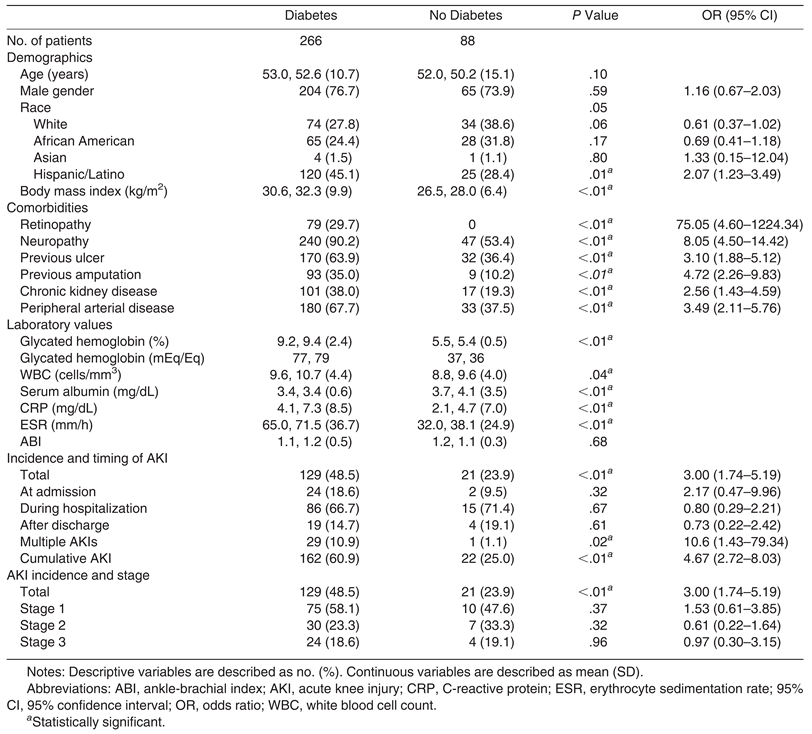
Acute kidney injury occurred in 150 patients (42.4%) with foot infections. There was a significant difference in the incidence of AKI between patients with and without diabetes. The incidence of AKI was 48.5% in patients with diabetes and 23.9% in patients without diabetes. There was no difference in timing (AKI present at admission, during hospitalization, or after discharge) in patients with and without diabetes. The incidence of the first AKI event during the index hospitalization was 3.0 times higher in patients with diabetes (48.5% versus 23.9%; 95% confidence interval [CI], 1.74–5.19; P < .01). The incidence of AKI was similar at each stage in people with and without diabetes (stage 1, DM 58.1% versus no DM 47.6% [P = .37]; stage 2, DM 23.3% versus no DM 33.3% [P = .32]; and stage 3, DM 18.6% versus no DM 19.0% [P = .96]. Among patients with diabetes, 29 had a second AKI event and four had a third event. In patients without diabetes, only one had a second AKI event. Patients with diabetic foot infections were 10.6 times more likely to have multiple AKI events than patients without diabetes (DM 10.9% versus no DM 1.1%; 95% CI, 1.43–79.33). The cumulative incidence of AKI was 4.7 times higher in people with diabetes (DM 60.9% versus no DM 25%; 95% CI, 2.72–8.03; P <.01) (Table 1).
Table 1.
Demographics, Comorbidities, and Laboratory Values.
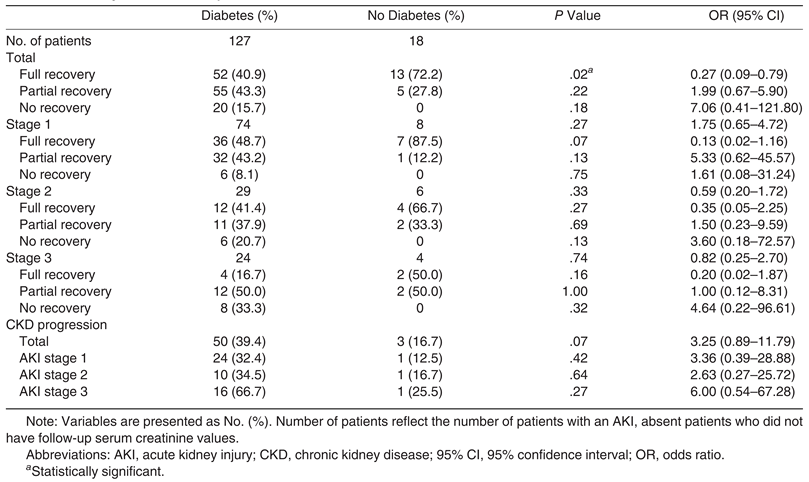
After an AKI event, full recovery to baseline creatinine levels was more likely in patients without diabetes. Complete recovery was 3.8 times more likely in people without diabetes (72.2% versus 40.9%; 95% CI, 1.26–11.16; P = .02). Patients with AKI and diabetes progressed to CKD or progressed in CKD stage 39.4% of the time. Patients without diabetes progressed at less than half the rate of patients with diabetes (16.7%; P = .07) (Table 2).
Table 2.
AKI Stages and Recovery.
Discussion
To the best of our knowledge, this is the first study to compare the incidence AKI in patients treated for foot infections with and without diabetes. We report the incidence of the first AKI episode and the cumulative incidence of AKI, and the progression of renal disease after AKI in a cohort of 392 patients with foot infection. Acute kidney injury is a frequent complication of hospitalization, and is associated with increased resource use [13], higher short-term and long-term mortality [13,14,15], progressive decline of renal function leading to the development of CKD and end-stage renal disease, and a decrease in quality of life [16]. Recent studies also suggest that AKI is a risk factor for cardiovascular disease, sepsis, malignancy, bone fracture, and upper gastrointestinal tract hemorrhage [17,18,19,20,21]. Foot infection is a sentinel event that often necessitates multiple operations, repeated infections, multiple hospitalizations, and prolonged exposure to parenteral and oral antibiotics [7]. Many of the risk factors for AKI are common in patients with foot infections, including diabetes, sepsis, peripheral vascular disease, hypertension, congestive heart failure, and low serum albumin [6,22].
In addition, on presentation, these patients often have pre–renal azotemia secondary to dehydration. This relative hypovolemia also increases the risk of renal injury from antibiotics. These shared risk factors for the development of AKI and foot infection, along with the high incidence of AKI we are reporting, have direct clinical relevance and implications on how to manage this patient population. Patients admitted to the hospital with diabetes and foot infection often have multiple comorbidities, as demonstrated in Table 1.
Our observations were novel, as we evaluated a cohort of patients with and without diabetes admitted to the hospital with moderate and severe foot infections. We reviewed electronic medical records to evaluate serial creatinine levels to evaluate progression of disease. We identified a higher incidence of AKI in people with diabetes and a higher rate of multiple AKI events compared to patients without diabetes. Intuitively, it makes sense that patients with diabetes have higher rates of AKI than nondiabetic patients. Patients with diabetic foot infections frequently have peripheral neuropathy, a comorbidity that is associated with microvascular changes common in diabetic patients with CKD.
The incidence of hospital-induced AKI varies considerably, ranging from 6.4% [23] to 21% [24,25] for all admissions. In high-risk subpopulations, such as cardiac thoracic surgery (24.3%), sepsis, critical care (31.7%), or trauma patients (19.9%), the incidence is dramatically higher [25]; among patients with diabetes, the risk of AKI increases in high-risk sub-populations. The incidence of AKI in patients with diabetes is much higher than in patients without diabetes, and ranges from 20% after coronary artery bypass surgery [26] to 72.5% in patients admitted to intensive care for sepsis [27]. The three-fold increased risk of AKI in patients with diabetes and foot infections is the highest we have identified in the medical literature.
The consequences of an AKI event are important, because AKI is associated with an increased risk of progression to CKD and death. Even among patients that have a full recovery, there is an increased risk of CKD, end-stage renal disease, and death [28]. For instance, in a retrospective study of a Veterans Health Administration database, Heung et al [29] evaluated 17,049 patients with AKI and 87,715 patients without AKI. Most of the AKI events were stage 1 (91%), with 71% of these patients achieving a full recovery within 2 days. Over the next year, 32% of AKI stage 1 patients developed CKD stage 3 or higher. In our current study, only 41% of patients with diabetes had a full recovery and returned to within 115% of their baseline creatinine levels within 90 days of the index AKI event. In contrast, 72% of patients without diabetes had a full recovery.
There are a number of ways baseline creatinine and return to baseline creatinine have been operationalized in the literature. The criteria we used to determine baseline was defined as the lowest creatinine measurement during hospitalization (ie, KDIGO) or, if available, the arithmetic mean of all creatinine measurements 7 to 365 days before the index admission [30]. A common limitation of studying AKI is the unavailability of baseline creatinine in hospital data sets, prompting the use of surrogate estimates. The Acute Dialysis Quality Initiative advocates assigning a single estimated glomerular filtration rate of 75 mL/min per 1.73 m2 and “back calculation” of creatinine using the Modification of Diet in Renal Disease equation for all patients with missing baseline creatinine data [31]. However, the advantages of this approach come at the risk for increasing misclassification, particularly among patients with CKD, who are at highest risk for AKI [30]. Because our study had a substantial proportion of these patients, this method would have potentially overestimated disease incidence and severity while diluting or inflating associations between AKI and subsequent recovery. Another method used in many published reports is to base the definition of AKI on International Classification of Diseases codes. In our review of electronic medical records and in studies that evaluate automated systems to identify AKI [32], many AKI events during hospitalization are not identified or recorded. The reports of AKI that rely on International Classification of Diseases codes probably underestimate the incidence of disease in the general population. In contrast, high-risk patients, such as patients in intensive care for sepsis after cardiac surgery, probably have more intensive monitoring for AKI events and better documentation. Because there are several criteria to define AKI, reporting will depend on the criteria used by treating physicians.
Post-AKI renal function was assessed using creatinine values drawn closest to 90 days after the AKI episode. A 90-day time frame was used based on the KDIGO guidelines, which define CKD as a persistent decline in renal function lasting more than 90 days. We chose to stratify recovery into three categories. Complete recovery was defined as patients who achieved a creatinine level that was within 115% of baseline levels, and partial recovery was defined as a creatinine level that remained 115% above baseline levels but less than 1.5 times baseline levels. No recovery was defined as a creatinine level that remained greater than 1.5 times the baseline creatinine value. It was important to include the “partial recovery” category, as population studies have shown that patients who achieve a recovery of creatinine level that remains above 115% of baseline levels still carry an increased mortality risk [12]. We believe the assessment of kidney function using creatinine drawn approximately 90 days after an AKI event may allow risk stratification for long-term outcomes and assist in decision making with regard to ongoing follow-up in this vulnerable patient population.
There are several limitations to this study. This retrospective cohort study was conducted at a single center that serves a predominately low-income, minority population. The sample size was relatively small, especially when AKI events were stratified into groups of patients with and without diabetes and then by the three stages of AKI. Another potential limitation is ascertainment bias. Patients that had soft-tissue infection rather than osteomyelitis and patients that did not require surgery or amputation were more likely not to complete the 1-year follow-up. They were therefore not included in the analysis. Sicker patients were probably more likely to stay in the system because they required treatment for other comorbidities. These patients were more likely to have multiple creatinine values and longer exposure to nephrotoxic antibiotics that both required creatinine monitoring and increased the risk of AKI and CKD.
Conclusions
The incidence of AKI in foot infections is among the highest reported in the medical literature. Patients with diabetes are three times more likely to have an AKI episode and 10.6 times more likely to have two or more AKI episodes compared to patients without diabetes and a foot infection. Within 90 days after the index AKI event, most patients with diabetes did not return to their baseline creatinine (59%). New strategies should be put in place that focus on prevention, early detection, and treatment of AKI in patients with diabetic foot infections to prevent the progression to CKD and end-stage renal disease.
Financial Disclosure
This manuscript was supported in part by the American Diabetes Association (1-17- ICTS-056).
Conflicts of Interest
None reported.
References
- Hicks, CW; SELVARAJAH, S; MATHIOUDAKIS, N. ET AL: Burden of infected diabetic foot ulcers on hospital admissions and costs. Ann Vasc Surg 2016, 33, 149. [Google Scholar] [CrossRef] [Scilit] [PubMed]
- LAVERY, LA; LAVERY, DC; HUNT, NA. ET AL: Amputations and foot-related hospitalisations disproportionately affect dialysis patients. Int Wound J 2015, 12, 523. [Google Scholar] [CrossRef] [Scilit] [PubMed]
- FORTRIE, G; DE GEUS, HRH. BETJES MGH: The aftermath of acute kidney injury: a narrative review of long-term mortality and renal function. Crit Care 2019, 23, 24. [Google Scholar] [CrossRef] [Scilit] [PubMed]
- HORNE, KL; PACKINGTON, R; MONAGHAN, J. ET AL: Three-year outcomes after acute kidney injury: results of a prospec- tive parallel group cohort study. BMJ Open 2017, 7, e015316. [Google Scholar] [CrossRef] [Scilit]
- LAFRANCE, JP; MILLER, DR. Acute kidney injury associates with increased long-term mortality. J Am Soc Nephrol 2010, 21, 345. [Google Scholar] [CrossRef] [Scilit]
- ISHANI, A; XUE, JL; HIMMELFARB, J. ET AL: Acute kidney injury increases risk of ESRD among elderly. J Am Soc Nephrol 2009, 20, 223. [Google Scholar] [CrossRef] [Scilit]
- VAN ASTEN, SAV; MITHANI, M; PETERS, EJG. ET AL: Complications during the treatment of diabetic foot osteomyelitis. Diabetes Res Clin Pract 2018, 135, 58. [Google Scholar] [CrossRef] [Scilit]
- LIPSKY, BA; BERENDT, AR; CORNIA, PB; et al. 2012 Infectious Diseases Society of America clinical practice guideline for the diagnosis and treatment of diabetic foot infec- tions. Clin Infect Dis 2012, 54, e132. [Google Scholar] [CrossRef] [Scilit]
- American Diabetes Association. Classification and diagnosis of diabetes. Diabetes Care 2017, 40 (suppl 1), S11. [Google Scholar] [CrossRef] [Scilit]
- International Society of Nephrology. KDIGO Clinical Practice Guideline for Acute Kidney Injury. Kidney Int 2012, 2 (suppl 1), 1. [Google Scholar]
- SIEW, ED; IKIZLER, TA; MATHENY, ME. ET AL: Estimating baseline kidney function in hospitalized patients with impaired kidney function. Clin J Am Soc Nephrol 2012, 7, 712. [Google Scholar] [CrossRef] [Scilit]
- PANNU, N; JAMES, M; HEMMELGARN, B. ET AL: Association between AKI, recovery of renal function, and long-term outcomes after hospital discharge. Clin J Am Soc Nephrol 2013, 8, 194. [Google Scholar] [CrossRef] [Scilit] [PubMed]
- CHERTOW, GM; BURDICK, E; HONOUR, M. ET AL: Acute kidney injury, mortality, length of stay, and costs in hospital- ized patients. J Am Soc Nephrol 2005, 16, 3365. [Google Scholar] [CrossRef] [Scilit] [PubMed]
- WANG, HE; MUNTNER, P; CHERTOW, GM. ET AL: Acute kidney injury and mortality in hospitalized patients. Am J Nephrol 2012, 35, 349. [Google Scholar] [CrossRef] [Scilit] [PubMed]
- COCA, SG; YUSUF, B; SHLIPAK, MG. ET AL: Long-term risk of mortality and other adverse outcomes after acute kid- ney injury: a systematic review and meta-analysis. Am J Kidney Dis 2009, 53, 961. [Google Scholar] [CrossRef] [Scilit]
- AHLSTROM, A; TALLGREN, M; PELTONEN, S. ET AL: Survival and quality of life of patients requiring acute renal replace- ment therapy. Intensive Care Med 2005, 31, 1222. [Google Scholar] [CrossRef] [Scilit]
- HANSEN, MK; GAMMELAGER, H; MIKKELSEN, MM. ET AL: Post-op- erative acute kidney injury and five-year risk of death, myocardial infarction, and stroke among elective car- diac surgical patients: a cohort study. Crit Care 2013, 17, R292. [Google Scholar] [CrossRef] [Scilit]
- LAI, TS; WANG, CY; PAN, SC; ET, AL. Risk of developing severe sepsis after acute kidney injury: a population- based cohort study. Crit Care 2013, 17, R231. [Google Scholar] [CrossRef] [Scilit]
- CHAO, CT; WANG, CY; LAI, CF; ET, AL. Dialysis-requiring acute kidney injury increases risk of long-term malignancy: a population-based study. J Cancer Res Clin Oncol 2014, 140, 613. [Google Scholar] [CrossRef] [Scilit]
- WANG, WJ; CHAO, CT; HUANG, YC; et al. The impact of acute kidney injury with temporary dialysis on the risk of frac- ture. J Bone Miner Res 2014, 29, 676. [Google Scholar] [CrossRef] [Scilit]
- WU, PC; WU, CJ; LIN, CJ. ET AL: Long-term risk of upper gas- trointestinal hemorrhage after advanced AKI. Clin J Am Soc Nephrol 2015, 10, 353. [Google Scholar] [CrossRef] [Scilit]
- BUCALOIU, ID; KIRCHNER, HL; NORFOLK, ER. ET AL: Increased risk of death and de novo chronic kidney disease follow- ing reversible acute kidney injury. Kidney Int 2012, 81, 477. [Google Scholar] [CrossRef] [Scilit]
- WONNACOTT, A; MERAN, S; AMPHLETT, B. ET AL: Epidemiology and outcomes in community-acquired versus hospi- tal-acquired AKI. Clin J Am Soc Nephrol 2014, 9, 1007. [Google Scholar] [CrossRef] [Scilit] [PubMed]
- SAWHNEY, S; FRASER, SD. Epidemiology of AKI: utilizing large databases to determine the burden of AKI. Adv Chronic Kidney Dis 2017, 24, 194. [Google Scholar] [CrossRef] [Scilit] [PubMed]
- SUSANTITAPHONG, P; CRUZ, DN; CERDA, J. ET AL: World inci- dence of AKI: a meta-analysis. Clin J Am Soc Nephrol 2013, 8, 1482. [Google Scholar] [CrossRef] [Scilit] [PubMed]
- HERTZBERG, D; SARTIPY, U; HOLZMANN, MJ. Type 1 and type 2 diabetes mellitus and risk of acute kidney injury after coronary artery bypass grafting. Am Heart J 2015, 170, 895. [Google Scholar] [CrossRef] [Scilit]
- VENOT, M; WEIS, L; CLEC’H, C; ET, AL. Acute kidney injury in severe sepsis and septic shock in patients with and without diabetes mellitus: a multicenter study. PLoS One 2015, 10, e0127411. [Google Scholar] [CrossRef] [Scilit]
- PATEL, SS; PALANT, CE; MAHAJAN, V. ET AL: Sequelae of AKI. Best Pract Res Clin Anaesthesiol 2017, 31, 415. [Google Scholar] [CrossRef] [Scilit]
- HEUNG, M; STEFFICK, DE; ZIVIN, K. ET AL: Acute kidney injury recovery pattern and subsequent risk of CKD: an analy- sis of Veterans Health Administration data. Am J Kidney Dis 2016, 67, 742. [Google Scholar] [CrossRef] [Scilit]
- SIEW, ED; PETERSON, JF; EDEN, SK; ET, AL. Use of multiple im- putation method to improve estimation of missing base- line serum creatinine in acute kidney injury research. Clin J Am Soc Nephrol 2013, 8, 10. [Google Scholar] [CrossRef] [Scilit]
- BELLOMO, R; RONCO, C; KELLUM, JA; ET, AL. Acute renal fail- ure—definition, outcome measures, animal models, fluid therapy and information technology needs: the Second International Consensus Conference of the Acute Dialysis Quality Initiative (ADQI) group. Crit Care 2004, 8, R204. [Google Scholar] [CrossRef] [Scilit]
- KOTHARI, T; JENSEN, K; MALLON, D; et al. Impact of daily electronic laboratory alerting on early detection and clinical documentation of acute kidney injury in hospital settings. Acad Pathol 2018, 5, 2374289518816502. [Google Scholar] [CrossRef] [Scilit]

© 2022 American Podiatric Medical Association