


Abstract
Background: Diagnosis of onychomycosis using the periodic acid–Schiff (PAS) test for sensitive identification of hyphae and fungal culture for identification of species has become the mainstay for many clinical practices. With the advent of polymerase chain reaction (PCR) testing, physicians can identify a fungal toenail infection quickly with the added benefit of species identification. We compared PAS testing with multiplex PCR testing from a clinical perspective. Methods: A total of 209 patients with clinically diagnosed onychomycosis were recruited. A high-resolution picture was taken of the affected hallux nail, and the nail was graded using the Onychomycosis Severity Index. A proximal sample of the affected toenail and subungual debris were obtained and split into two equal samples. One sample was sent for multiplex PCR testing and the other for PAS testing. The results were analyzed and compared. Results: Six patients were excluded due to insufficient sample size for PCR testing. Of the remaining 203 patients, 109 (53.7%) tested positive with PAS, 77 (37.9%) tested positive with PCR. Forty-one patients tested positive with PAS but negative with PCR, and nine tested positive with PCR but negative with PAS. Conclusions: Physicians should continue the practice of using PAS biopsy staining for confirmation of a fungal toenail infection before using oral antifungal therapy. Because multiplex PCR allows species identification, some physicians may elect to perform both tests.
Onychomycosis, a chronic fungal infection of the nail and nail bed, is responsible for up to 50% of all nail disorders worldwide.[1] The most common pathogen cultured is Trichophyton rubrum, followed by other dermatophytes such as Trichophyton mentagrophytes, molds such as Scopulariopsis brevicaulis and Aspergillus, and yeasts such as Candida albicans.[2]
The severity of onychomycosis can be graded by the Onychomycosis Severity Index (OSI). This system assesses the severity of infection by the surface area of the nail affected, the proximity of the infection to the lunula, and the presence of longitudinal spikes and thickening of the nail beyond 2 mm. A score of 1 to 5 is considered mild infection, 6 to 15 as moderate, and 16 to 35 as severe.[3]
Effective diagnosis of onychomycosis has traditionally been achieved using potassium hydroxide, periodic acid–Schiff (PAS) biopsy testing, and direct fungal culture. The PAS stain biopsy is believed to be the most sensitive method for the diagnosis of onychomycosis[4] and the technique most commonly used for diagnosing onychomycosis by podiatric physicians. Advances in molecular biological techniques now offer alternatives to detect the presence of toenail fungus pathogens, including the multiplex polymerase chain reaction (PCR) by which the DNA of a nail specimen is replicated and DNA primers are used to detect highly conserved regions of fungal DNA for pathogen identification.[5] Polymerase chain reaction has proven effective at identifying dermatophytes in nail samples with high sensitivity and a higher degree of specificity.[6]
Although PAS testing is an effective method of determining whether a nail sample is infected by fungal pathogens, it does not confirm which specific fungal species is causing the infection, and, by extension, it cannot help guide antifungal medication selection for initial therapy or especially for PAS-positive treatment failures. Although fungal culture is the standard method for identification of the specific causative species, the results are significantly delayed and fungal culture is three to four times more likely to report a false-negative result compared with PCR.[7] The purpose of this research was to determine whether PAS biopsy remains the best initial testing for the diagnosis of onychomycosis or whether multiplex PCR would identify more cases of onychomycosis in the clinical setting.
Methods
During a 16-month period, 209 patients aged 21 to 94 years from the Cleveland Foot and Ankle Clinic (Cleveland, Ohio) were enrolled in this study. Of these patients, 93 were men and 116 were women. Patients were eligible if they had a clinical suspicion of onychomycosis in a hallucal nail and had not used an oral or topical antifungal medication within the past year. Clinical suspicion was qualitatively defined by discoloration, thickness, and/or crumbling of the nail and was quantified with the OSI score. The OSI score was calculated by multiplying the area of involvement (range, 0–5) by the proximity of the disease to the matrix (range, 1–5). Ten points are added for the presence of longitudinal streaking (indicative of dermatophytoma) or for greater than 2 mm of subungual hyperkeratosis. Mild cases of onychomycosis are defined by OSI scores of 1 through 5; moderate, 6 through 15; and severe, 16 through 35.[3]
A high-definition photograph of the affected hallucal nail was taken, and a validated OSI worksheet was completed. Mechanical debridement instruments were cleansed with glutaraldehyde and then rinsed with sterile water. The nail to be sampled was cleansed with alcohol to reduce bacterial contamination. The most distal portion of the free edge of the nail was removed, and the more proximal free edge of the nail was taken and split into two equal samples. One sample was sent for multiplex PCR testing (PathoGenius/MicroGen Diagnostics Laboratory, Lubbock, Texas), and the other sample was sent for PAS testing (Bako Integrated Physician Solutions, Alpharetta, Georgia). A positive result was one in which hyphae were noted on a PAS biopsy stain or a PCR result that identified a dermatophyte, Scopulariopsis brevicaulis, Aspergillus, or Candida albicans. The samples that tested positive with PCR were further analyzed to determine the most common specific causative organisms.
Approval for this study was granted by the Kent State University College of Podiatric Medicine institutional review board (Independence, Ohio), and written consent was obtained from all of the participants.
Results
Of the 209 patients enrolled, results from six were excluded due to insufficient sample size for the laboratory analysis. The remaining 203 patients included one with mild, 22 with moderate, and 180 with severe onychomycosis according to OSI scoring. From the PCR data collected from the 203 patients studied, the most predominant fungal pathogens included T rubrum (n = 74), saprophytic molds (n = 19), and T mentagrophytes, consistent with previous studies.[2]
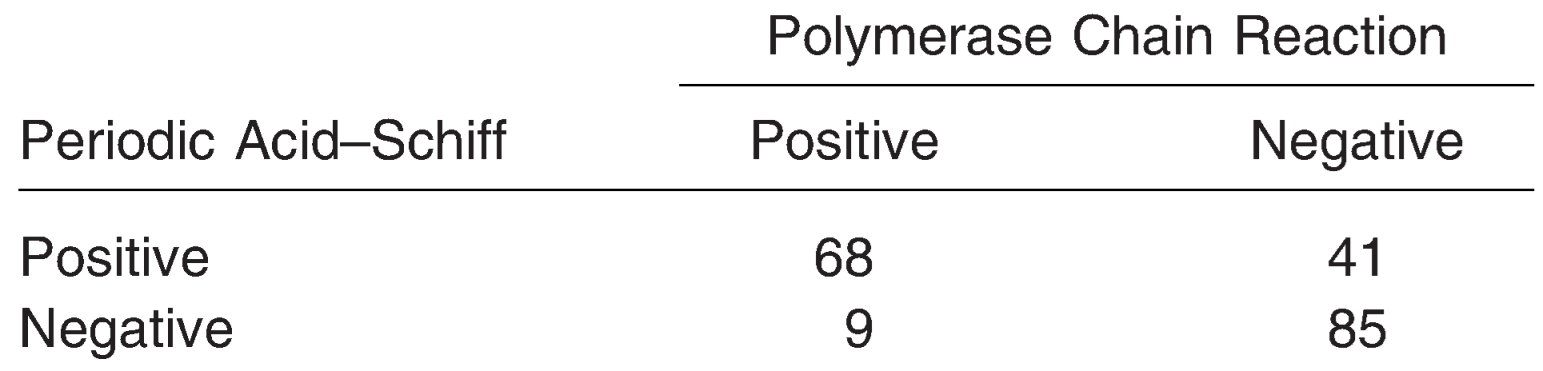
Regarding testing of the 203 specimens, 109 (53.7%) returned positive with PAS versus 77 (37.9%) that returned positive with PCR. Positive PAS samples demonstrated the presence of septate fungal elements in the sample. Positive PCR samples identified the presence of fungal genetic signatures of the particular infecting pathogen. Sixty-eight patients (33.5%) tested positive with both PAS and PCR analyses, and 85 (41.9%) tested negative with both tests. Forty-one patients (20.2%) tested positive with PAS but negative with PCR testing. Nine patients (4.4%) tested negative with PAS and positive with PCR testing (Fig. 1 and Table 1). The McNemar test showed that the proportion of positive results from PAS analysis was significantly greater than that for PCR analysis (P < .0005).
Figure 1.
Observed frequencies of periodic acid–Schiff (PAS) and polymerase chain reaction (PCR) test results.
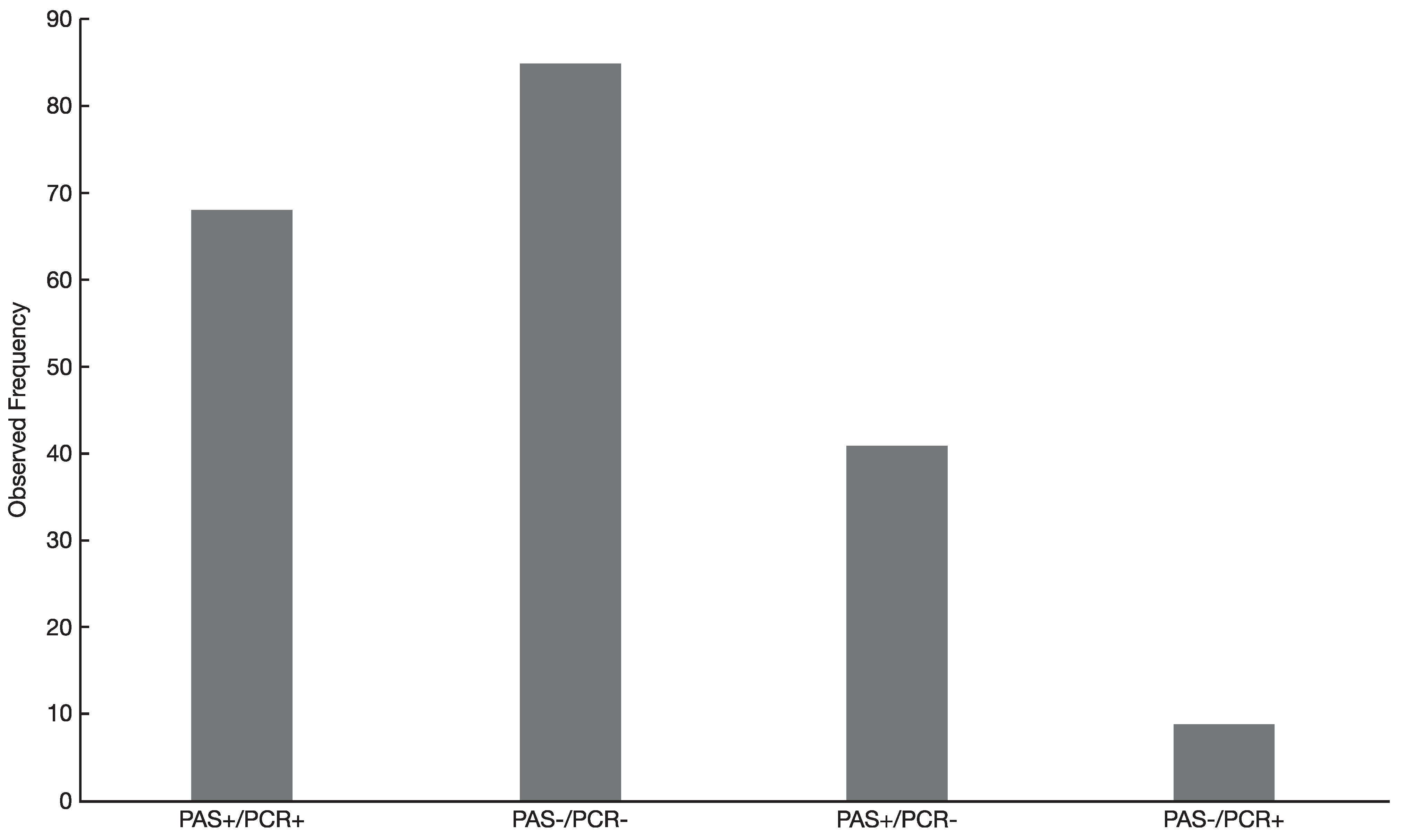
Table 1.
2 × 2 Contingency Table of Test Results.
Discussion
Effective and timely diagnosis of onychomycosis is an important factor in successful treatment of the condition. Because approximately 50% of dystrophic toenails are not due to onychomycosis, all toenails should be tested before placing a patient on an oral antifungal. Although PAS has been proved to be a very sensitive method, it is important to determine the clinical applicability of newer molecular techniques. In addition, PAS staining does not directly guide pharmacotherapy for previous PAS-positive treatment failures. Although a fungal culture can help with that aspect of testing, it has a high reported false-negative rate,[7] and the usual timetable needed for results is 4 weeks for dermatophytes and 2 weeks for yeasts and molds.[8] Although PAS is consistently used today as the most sensitive test for the diagnosis of onychomycosis,[4] new molecular methods should be clinically tested for comparison. Multiplex PCR enables the testing of multiple target segments of DNA with good accuracy, limited preparation and genotyping, and cost savings compared with other comparable methods.[9]
Polymerase chain reaction offers the benefits of amplifying minute amounts of microorganism DNA into multiple copies in a 24-hour period and identifying species-specific microorganism gene sequences. Still, a limitation of PCR includes primer selection. In a typical PCR assay, small segments of DNA known as primers must be constructed to the 5′ and 3′ ends of the desired DNA sequence to be amplified. Primers must be constructed for each and every microorganism. If primers for a particular fungus are not used, that organism would not be amplified and, therefore, not diagnosed. Multiplex PCR techniques circumvent this problem. Additionally, this is less of a concern with fungi that cause onychomycosis because it is thought that most cases are caused by T rubrum or T mentagrophytes.[10]
The present study shows that PAS remains the best initial test compared with PCR in detecting onychomycosis in a nail sample from a patient who demonstrates clinical evidence of a fungal nail infection, although PCR did identify fungal-positive results in some samples that were PAS negative. Although multiplex PCR testing should not replace PAS for the diagnosis of onychomycosis, this study provides evidence that may support the use of PCR to supplement PAS testing to diagnose and guide treatment for onychomycosis. This could lead to the identification of additional cases for treatment and enable rapid identification of the infecting pathogen for guidance on initial antifungal therapy or for optimal treatment of PAS-positive treatment failures.
In conclusion, the results of this study suggest that PAS testing remains the appropriate initial testing for the diagnosis of onychomycosis before oral antifungal treatment. The multiplex PCR technique can be ordered simultaneously to guide therapy. Furthermore, for physicians who typically order both PAS and fungal culture tests, PAS and multiplex PCR testing is an alternative approach to be seriously considered due to its expeditious results and accuracy. Other PCR techniques should be compared in the future for potentially different results.
Financial Disclosure
None reported.
Conflict of Interest
None reported.
References
- ScherRK:Onychomycosis: a significant medical disorder. J Am Acad Dermatol35: S2, 1996.
- CozzaniEAgnolettiASpeziariS: Epidemiological study of onychomycosis in older adults with onychodystrophy. Geriatr Gerontol Int16: 486, 2016.
- CarneyCTostiADanielR: A new classification system for grading the severity of onychomycosis: Onychomycosis Severity Index. Arch Dermatol147: 1277, 2011.
- WeinbergJMKoestenblattEKTutroneWD: Comparison of diagnostic methods in the evaluation of onychomycosis. J Am Acad Dermatol49: 193, 2003.
- LiXWeiTWangH: Direct detection and differentiation of causative fungi of onychomycosis by multiplex polymerase chain reaction-based assay. Eur J Dermatol21: 37, 2011.
- LitzCECavagnoloRZ:Polymerase chain reaction in the diagnosis of onychomycosis: a large, single-institute study. Br J Dermatol163: 511, 2010.
- GuptaAKNakriekoK:Onychomycosis infections: do polymerase chain reaction and culture reports agree?JAPMA107: 280, 2017.
- BosshardPP:Incubation of fungal cultures: how long is long enough?Mycoses54: e539, 2011.
- PourmandNElahiEDavisRW: Multiplex pyrosequencing. Nucleic Acids Res30: 1, 2002.
- GhannoumMAHajjehRAScherR: A large-scale North American study of fungal isolates from nails: the frequency of onychomycosis fungal distribution, and antifungal susceptibility patterns. J Am Acad Dermatol43: 641, 2000.
© 2020 American Podiatric Medical Association