


Abstract
Background: Sever’s disease is a common cause of pain in growing kids. Many papers reported in the literature discuss this pathologic condition, but no consensus regarding its etiology has been found among researchers. The aim of the present study was to describe the epidemiologic profile and associated factors of 430 athletic children in a population-based sample of soccer (29.5%), basketball (48.1%), and volleyball (22.3%) players aged 6 to 14 years. Methods: Every athlete was evaluated through physical examination, the Foot Posture Index (FPI), the Oxford Ankle Foot Questionnaire, and a custom-made sports questionnaire. Results: These data show that body mass index, sex, terrain type, sports discipline, and FPI should not be considered as risk factors for calcaneal apophysitis, whereas a significantly higher risk has been found in younger individuals (P < .01), in those with fewer training sessions per week (P ¼ .02), and in those with shorter training sessions (P < .01). Conclusions: The prevalence of Sever’s disease in the athletic children evaluated in the present study was higher in younger and less active patients, whereas no differences were registered by sex, FPI, body mass index, terrain type, or sports discipline.
Painful heel disease is a relatively common patho-logic disorder of childhood, described for the first time by James Warren Sever at the beginning of the 20th century. It affects the calcaneal apophysis and usually occurs in children aged 8 to 15 years, often affecting males, both feet, and athletes after the beginning of a new sports season, causing tempo-rary impairment in physical activities. [1,2,3]
Clinically the patient’s pain is referred where the Achilles tendon joins the calcaneal ossification center mainly after physical activity, and it can be provoked by the heel squeeze test. [4]
Different hypotheses have been suggested to explain the disease pathogenesis: inflammation of the posterior ossification center, repetitive sport injuries or excessive Achilles tendon tension on the calcaneal unossified apophysis, stress fractures, obesity, and, more recently, deformity of the foot.2,5-7
There is no consensus on the best treatment: rest, wearing a heel raise, and eccentric exercise are suggested options, but a gold standard cannot be established with the existing literature. [8,9]
The disease can cause limping or tiptoe walking to avoid ground contact on the rearfoot; further-more, it represents a reason for parents’ apprehension and an increase in health-care costs. [10] Recent-ly, several papers studied the role of sports in the child’s physical and psychological development, including the possibility that these activities could cause overuse injuries in childhood. [11,12,13]
Given the relevant epidemiology of the disease and the frequent reason for apprehension for patients and families, the purpose of the present study was to identify associations between heel pain attributable to calcaneal apophysitis and level of sport activity, type of sport, type of terrain, body mass index (BMI), and foot posture.
Materials and Methods
This study was performed according to the guide-lines of Good Clinical Practice and the Declaration of Helsinki. All of the athletes’ parents signed a written informed consent form for study participa-tion.
According to the hypothesis that compressive stress on the apophysis could determine Sever’s disease, we decided to study sports with high-impact activities and the most practiced sports in Italy among boys and girls. Children aged 6 to 14 years were considered eligible for this study because this age range is considered the most frequent for Sever’s disease. [14] Between November 1, 2015, and August 31, 2016, two volleyball, two soccer, and two basketball teams were contacted. Diagnosis of Sever’s disease was made through a positive heel squeeze test. The squeeze test has been proved to have high sensitivity and specificity. [4] Heel pain during physical activity was evaluated with a 7-point visual analog scale (VAS). [15] The Italian version of the Oxford Ankle Foot Question-naire (OxAFQ), administered to the children and their parents, was used to measure health-related quality of life and disability associated with Sever’s disease. [16] The OxAFQ considers physical activity (six items), school and play activities (four items), emotional well-being (four items), and footwear (one item). The OxAFQ was calculated using a 5-point scale, and final scores were converted into a 100-point scale. A high score is representative of superior function.
Past fractures of the foot or ankle, rheumatologic or infective diseases, and congenital malformations were considered study exclusion criteria. A podiat-ric physician performed a brief physical examina-tion, with special emphasis on the foot, before the training session. The assessment of foot posture was based on the Foot Posture Index (FPI). [17] It consists of six validated, criterion-based observations of the hindfoot and forefoot of patients standing in a relaxed position. Each item of the FPI is scored between –2 and +2, to give a total between –12 (highly supinated) and +12 (highly pronated). This method has previously been proved to be valid for assessing children’s foot alignment. [18] A custom-made questionnaire was developed to collect from each athlete the number of sport activities, number of training sessions per week, duration per session (≤60 min, 61–120 min, ≥121 min), type of terrain (natural or synthetic grass, parquet, linoleum), years of sport experience, and number of days absent from sport due to heel pain. Data analysis was performed with a software package (IBM SPSS Statistics for Windows, Version 20; IBM Corp, Armonk, New York).
Differences between the two groups (Sever’s disease and non–Sever’s disease) were assessed using crosstabs and the v2 test (and the t test when appropriate). Participant characteristics are pre-sented for the two groups as mean 6 SD and percentages. Heel pain prevalence is expressed as numbers and percentages of the three sports.
Univariate logistic regression models were used to assess the associations between Sever’s disease (positive squeeze test) and the following indepen-dent factors: age, sex, BMI, number of sport activities, type of sport, type of terrain, FPI, number of training session per week, and duration per session. Odds ratios and corresponding 95% confi-dence intervals are reported. A P ≤ .05 was regarded as significant.
Results
Of 430 athletes included in the study, 328 were boys and 102 were girls, with a mean ± SD age of 10.4 ± 1.6 years (range, 6–14 years). The mean 6 SD BMI was 17.8 ± 2.4 (range, 12.4–28.4). A total of 372 children (86.5%) practiced only one sport, 57 (13.3%) played two sports, and only one (0.2%) practiced three sports. A total of 207 children (48.1%) played basketball, 127 (29.5%) played soccer, and 96 (22.3%) played volleyball. Some children played their primary sport on different terrains: 208 children (48.3%) played on linoleum, 132 (30.7%) on parquet, and 127 (29.5%) on natural/synthetic grass.
The most common frequency of training sessions was three times per week (64.6%), followed by two times per week (25.5%), and four times per week (7.6%). There were only five children who had one training session per week (1.1%) and five who had five training sessions per week (1.1%). The mean number of sport activity sessions was 2.8 times per week. Each training session consisted of 60 to 120 min in 333 patients (77.4%), less than 60 min in 80 (18.6%), and greater than 120 min in 17 (4.0%).
Most of the children have been practicing sports for 5 years (17.4%), with a mean 6 SD of 4.5 ± 2.2 years (range, 1–10 years). The FPI was normal in 249 children (57.9%), pronated in 158 (36.7%), and supinated in 23 (5.3%). A positive squeeze test was found in 62 patients (14.4%). No differences were observed for the FPI between feet; therefore, the average between the right and left feet was considered for analysis.
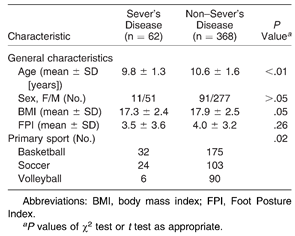
The symptomatic children were younger (P , .01) compared with the asymptomatic children (Table 1). A positive squeeze test was present in 15.5% of the children playing basketball, 18.9% playing soccer, and 6.3% playing volleyball. For children and parents, respectively, mean 6 SD OxAFQ scores were 73.3 ± 3.8 and 71.± 6 4.3 for the physical activity section, 77.5 ± 9.4 and 76.1 6 9.5 for the school and play activities section, 83.2 ± 8.2 and 87.2 ± 9.8 for the emotional well-being section, and 92.7 ± 11.4 and 97.5 6 7.4 for the footwear section. The mean 6 SD VAS pain score during physical activity was 1.4 ± 0.8.
Table 1.
Demographic Characteristics of the Sports Participants.
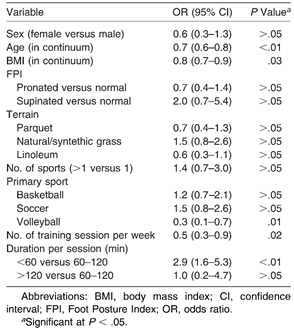
Univariate logistic regression showed that chil-dren playing volleyball had a lower risk of Sever’s disease compared with those playing basketball and soccer (Table 2). More training sessions per week was associated with a lower risk of Sever’s disease. Furthermore, training sessions shorter than 60 min were associated with a higher risk of developing Sever’s disease compared with longer sessions (ie, >60 min). The FPI and the type of terrain were not associated with an increased risk of developing Sever’s disease.
Table 2.
Univariate Logistic Regression Analysis for the Risk of Calcaneal Apophysitis.
Discussion
The present study focused on the anthropometric, clinical, and sport aspects related to the develop-ment of Sever’s disease in the athletic population. Although there were no differences in the preva-lence of the disease among the three principal sports, the present results suggest that children with calcaneal apophysitis may exhibit some differences in physical characteristics and athletic exposure.
The present findings suggest that Sever’s disease is a common problem in younger children, as reported in previous studies. [7] This assertion could be explained by a higher susceptibility of the immature ossification center in relationship with external factors that could lead to a sufferance and a fragmentation of the growth cartilage.
Unlike previous studies, BMI was not associated with an increased risk of developing the pathologic disorder. Trott [19] focused exclusively on weight, instead of BMI, postulating that high weight might have been a factor in the development of calcaneal apophysitis. Scharfbillig et al [20] did not find any statistically significant differences between the BMIs of a children’s cohort affected by Sever’s disease and an unaffected cohort. A more recent study found that symptomatic children had a higher BMI and weight compared with unaffected chil-dren. [7] This could suggest that compressive vertical loads on the calcaneal apophysis could cause Sever’s disease in children. However, the present results showed that BMI should not be considered a risk factor. Furthermore, all of the sports selected can be considered high-demand activities, with a theoretical high repetitive number of vertical loads. No statistically significant association resulted between the disease and sex. This result should be interpreted taking into account that the higher proportion of males in the Sever’s disease group could be affected by sampling bias; however, the present data are comparable with those of previous studies that suggest that Sever’s disease is more common in males. [3,20]
Previous studies reported a high prevalence of calcaneal apophysitis in more active children (ie, total sport activity minutes). [21,22,23] Interestingly, the present study showed a statistically significant association with fewer minutes of sport activity. This may be due to a sampling bias because many authors often selected patients from sporting clinics and did not perform a comparison with a non-symptomatic group. [6,24]
The present study showed that sport specializa-tion in children is not associated with an increased risk of Sever’s disease compared with children involved in different sports. Specifically, the type of sport did not result in an increased risk; however, children playing volleyball showed a lower risk. The present results are in contrast with those of a previous study reporting an increased risk of anterior knee pain in female adolescents compared with multisport athletes. [25] However, a direct com-parison cannot be performed owing to the different pathomechanics of the diseases.
Focusing on the duration of sport activity, interestingly there is a statistically significant difference between children who practice less than 60 min per single training session and more active children (ie, session training .60 min). A recent article showed that athletes have a higher pressure pain threshold and lower mean and maximum pain intensity ratings in response to stimuli compared with nonathletes. [26] It could be speculated that less-athletic patients may have a lower pain threshold.
This is the first study, to our knowledge, to investigate the theoretical association between terrain type and Sever’s disease. Impact forces or increased plantar pressures at the heel have been discussed throughout the literature as a possible contributing factor for the pain experienced with Sever’s disease. The belief that prescription of increased cushioning footwear or of heel cups with shock-absorbing properties can provide pain relief is still widely accepted. [27] Furthermore, sport surface has been proposed as a potential risk factor for overuse injuries. Girard et al, [28] in a study that assessed plantar pressure during tennis, reported a different mean force experienced with two different types of surfaces (GreenSet or clay). Tessutti et al [29] found that running on natural grass attenuates in-shoe plantar pressures in recreational runners. In this study, we considered natural or synthetic grass (third-generation), parquet, and linoleum. Even if these have substantial different hardness and rigidity, the terrain does not seem to have a significant role in the development of the disease. Those evidences strengthen the hypothesis of no association between calcaneal apophysitis and high-impact forces at the plantar surface of the heel during sport activities. These findings are in contrast to those of previous studies and to the aforementioned belief that the use of an orthotic device with a heel cup may center the soft tissues (fibrofatty padding), increasing the cushioning in the heel area and resulting in pain relief. [2,27,30]
Analysis of the FPI data from the present sample produced no significant risk factors, in contrast to other authors who hypothesized that pronation or supination posture of the foot could increase the tractional pull at the Achilles tendon calcaneal junction. [13] It could be argued that the total score of the FPI may not be totally indicative of an increased risk, but, as reported by other authors, different individual criteria may be more sensitive than others. [20]
From the present data, there is an indication that higher levels of sport participation and lower BMI are less associated with calcaneal apophysitis. Further studies are needed to confirm these findings.
The strengths of this study consist of a large population size, clinical assessment of all of the participants, and the use of a detailed, previously validated test, scales, and questionnaire. The Ox-AFQ has been used in a previous study about children affected by Sever’s disease, with similar results. [31] There are, however, limitations to this study that need consideration. The first is that this study was limited to children participating in basketball, soccer, and volleyball; different sports may increase the risk of the disease. Second, the BMI and sport exposure were collected with a nonvalidated questionnaire. However, because of a general inability of children younger than 10 years to accurately self-report usual physical activities performed, [32] we decided to consider only the duration and number of training sessions. It would be preferable to measure BMI and the type, amount, and level of sports activity with more objective instruments to further clarify the relationship between BMI, sport exposure, and Sever’s disease in children.
Conclusions
The prevalence of Sever’s disease in athletic children in the study sample was higher in younger and less-active patients, and no differences were collected by sex, FPI, BMI, type of terrain, or sport.
Funding
None reported.
Acknowledgments
The coaches, relatives, and young athletes for participating in this study.
Conflicts of Interest
None reported.
References
- HENDRIX C: Calcaneal apophysitis (Sever disease). Clin Podiatr Med Surg 22: 55, 2005.
- OGDEN JA, GANEY TM, HILL JD, ET AL: Sever’s injury: a stress fracture of the immature calcaneal metaphysis. J Pediatr Orthop 24: 488, 2004.
- MICHELI LJ, IRELAND ML: Prevention and management of calcaneal apophysitis in children: an overuse syndrome. J Pediatr Orthop 7: 34, 1987.
- PERHAMRE S, LAZOWSKA D, PAPAGEORGIOU S, ET AL: Sever’s injury: a clinical diagnosis. JAPMA 103: 361, 2013.
- ISHIKAWA SN: Conditions of the calcaneus in skeletally immature patients. Foot Ankle Clin 10: 503, 2005.
- MCKENZIE D, TAUNTON J, CLEMENT D, ET AL: Calcaneal epiphysitis in adolescent athletes. Can J Appl Sport Sci 6: 123, 1981.
- JAMES AM, WILLIAMS CM, HAINES TP: Effectiveness of interventions in reducing pain and maintaining physical activity in children and adolescents with calcaneal apophysitis (Sever’s disease): a systematic review. J Foot Ankle Res 6: 16, 2013.
- SHIELDS N: Wait and see, heel raise and eccentric exercise may be equally effective treatments for children with calcaneal apophysitis. J Physiother 62: 112, 2016.
- WIEGERINCK JI, ZWIERS R, SIEREVELT IN, ET AL: Treatment of calcaneal apophysitis: wait and see versus orthotic device versus physical therapy: a pragmatic therapeutic randomized clinical trial. J Pediatr Orthop 36: 152, 2016.
- JAMES AM, WILLIAMS CM, LUSCOMBE M, ET AL: Factors associated with pain severity in children with calcaneal apophysitis (Sever disease). J Pediatr 167: 455, 2015.
- BRENNER JS; Council on Sports Medicine and Fitness: Intensive training and sports specialization in young athletes. Pediatrics 138: 3, 2016.
- MCLEOD TCV, DECOSTER LC, LOUD KJ, ET AL: National Athletic Trainers’ Association position statement: pre-vention of pediatric overuse injuries. J Athl Train 46: 206, 2011.
- JAYANTHI N, PINKHAM C, DUGAS L, ET AL: Sports specialization in young athletes: evidence-based recommenda-tions. Sports Health 5: 251, 2013.
- MICHELI LJ: The traction apophysitises. Clin Sports Med 6: 389, 1987.
- BIERI D, REEVE RA, CHAMPION GD, ET AL: The Faces Pain Scale for the self-assessment of the severity of pain experienced by children: development, initial validation, and preliminary investigation for ratio scale properties. Pain 41: 139, 1990.
- MARTINELLI N, ROMEO G, BONIFACINI C, ET AL: Validation of the Italian version of the Oxford Ankle Foot Question-naire for Children. Qual Life Res 25: 117, 2016.
- REDMOND AC, CROSBIE J, OUVRIER RA: Development and validation of a novel rating system for scoring standing foot posture: the Foot Posture Index. Clin Biomech 21: 89, 2006.
- Gijon-Nogueron G, Montes-Alguacil J, Alfageme-Garcia P, ET AL: Establishing normative foot posture index values for the paediatric population: a cross-sectional study. J Foot Ankle Res 9: 24, 2016.
- TROTT AW: Children’s foot problems. Orthop Clin North Am 13: 641, 1982.
- SCHARFBILLIG RW, JONES S, SCUTTER S: Sever’s disease: a prospective study of risk factors. JAPMA 101: 133, 2011.
- MICHELI LJ, FEHLANDT AF: Overuse injuries to tendons and apophyses in children and adolescents. Clin Sports Med 11: 713, 1992.
- HOGAN KA, GROSS RH: Overuse injuries in pediatric athletes. Orthop Clin North Am 34: 405, 2003.
- LORD J, WINELL JJ: Overuse injuries in pediatric athletes. Curr Opin Pediatr 16: 47, 2004.
- ORAVA S, PURANEN J: Exertion injuries in adolescent athletes. Br J Sports Med 12: 4, 1978.
- HALL R, BARBER FOSS K, HEWETT TE, ET AL: Sport specialization’s association with an increased risk of developing anterior knee pain in adolescent female athletes. J Sport Rehabil 24: 31, 2015.
- FLOOD A, WADDINGTON G, THOMPSON K: Increased conditioned pain modulation in athletes. J Sports Sci 25: 1, 2016.
- PERHAMRE S, LUNDIN F, NORLIN R, ET AL: Sever’s injury; treat it with a heel cup: a randomized, crossover study with two insole alternatives. Scand J Med Sci Sports 21: 42, 2011.
- GIRARD O, EICHER F, FOURCHET F, ET AL: Effects of the playing surface on plantar pressures and potential injuries in tennis. Br J Sports Med 41: 733, 2007.
- TESSUTTI V, RIBEIRO AP, TROMBINI-SOUZA F, ET AL: Attenuation of foot pressure during running on four different surfaces: asphalt, concrete, rubber, and natural grass. J Sci Med Sport 30: 1545, 2012.
- Becerro-de-Bengoa-Vallejo R, Losa-Iglesias ME, RodriGUEZ-SANZ D: Static and dynamic plantar pressures in children with and without Sever disease: a case-control study. Phys Ther 94: 818, 2014.
- JAMES AM, WILLIAMS CM, HAINES TP: Health related quality of life of children with calcaneal apophysitis: child & parent perceptions. Health Qual Life Outcomes 14: 95, 2016.
- WELK GJ, CORBIN CB, DALE D: Measurement issues in the assessment of physical activity in children. Res Q Exerc Sport 71: 59, 2000.

© 2019 American Podiatric Medical Association