


Abstract
Background: Data from the free student-run podiatric medical clinic at Clínica Tepati at the University of California, Davis, were used to analyze medical and economic impacts on health-care delivery and to extrapolate the economic impact to the national level. Clínica Tepati also provides an excellent teaching environment and services to the uninsured Hispanic population in the Greater Sacramento area. Methods: In this analysis, we retrospectively reviewed patient medical records for podiatric medical encounters during 15 clinic days between November 2010 and February 2012. The economic impact was evaluated by matching diagnoses and treatments with Medicare reimbursement rates using International Classification of Diseases codes, Current Procedural Terminology codes, and the prevailing Medicare reimbursement rates. Results: Sixty-three podiatric medical patients made 101 visits during this period. Twenty patients returned to the clinic for at least one follow-up visit or for a new medical concern. Thirty-nine different diagnoses were identified, and treatments were provided for all 101 patient encounters/visits. Treatments were limited to those within the clinic's resources. This analysis estimates that $17,332.13 worth of services were rendered during this period. Conclusions: These results suggest that the free student-run podiatric medical clinic at Clínica Tepati had a significant medical and economic impact on the delivery of health care at the regional level, and when extrapolated, nationally as well. These student-run clinics also play an important role in medical education settings.
Student-run medical clinics have become an essential part of today's medical education. [1-3] Based on a survey by Simpson and Long, [2] there were 111 student-run clinics in the United States in 2010. Services in these student-run clinics focus on primary care, with various degrees of specialty services. [1-3] However, there has been no reported study of student-run podiatric medical clinics. Although the role of student-run clinics in serving underserved and uninsured populations in the United States has gained public attention, [1-3,4] a discussion of the potential economic savings in health-care costs from such student-run clinics is limited in the literature. This article offers the first preliminary analysis of the medical and economic impact of a student-run podiatric medical clinic on today's health-care system.
This study was conducted using data from the free student-run podiatric medical clinic at Clínica Tepati, one of the University of California (UC), Davis, student-run clinics affiliated with the School of Medicine. The clinic, which has been open since 1974, is a culturally sensitive facility that serves the uninsured and underserved Hispanic population in the Greater Sacramento area. In November 2010, the podiatric medical clinic was established and has since become an integral part of Clínica Tepati. The podiatric medical clinic is a monthly specialty clinic that is operated by podiatric medical students from the California School of Podiatric Medicine at Samuel Merritt University (Oakland, California).
Clínica Tepati is composed of the following volunteers: UC Davis undergraduate students, UC Davis School of Medicine students, podiatric medical students from the California School of Podiatric Medicine at Samuel Merritt University, and physician assistant students from UC Davis School of Medicine. The activities at Clínica Tepati are supervised by preceptors, a group of volunteer attending physicians. Clínica Tepati is organized as an interdisciplinary clinic, allowing its student volunteers to have early exposure to this health-care model while providing the basic and yet essential care to the uninsured and underserved patients. In 2012, 98% of patients seen at Clínica Tepati self-identified as Latino according to the Clínica Tepati annual report. [5] The ages of the patients ranged from 11 to 70 years, and 66% were female. Thirty-three percent of patients visited the clinic for diabetes management, with the next most common category being cardiovascular disease, at 15%. In addition to monthly podiatric medical clinics, other specialties and services provided include vaccinations, a legal advice workshop, nephrology, neurology, and gynecology. Clínica Tepati also offers referrals to ophthalmology, dentistry, mammography, and gynecology. Patients who require medications receive discounted prescriptions either from an in-house pharmacy or at a Target pharmacy.
Methods
We retrospectively reviewed patient medical records maintained by Clínica Tepati for podiatric medical encounters during 15 clinic days between November 2010 and February 2012 for this analysis. An independent student volunteer of the podiatric medical clinic who did not participate in the research project acquired the patients' medical records, copied the documents, and redacted all of the patient-identifiable parameters (eg, patient's name, date of birth, and health-care provider). We reviewed and reorganized the redacted medical records using a Microsoft Excel spreadsheet (Microsoft Corp, Redmond, Washington). We obtained information on the patients' underlying medical conditions, such as diabetes mellitus, as well as podiatric medical diagnoses and treatment plans at each visit. The collected data were then evaluated and analyzed for the presence of diabetes mellitus, types of podiatric medical diagnoses, and treatments.
The economic impact of the podiatric medical clinic was evaluated by matching each diagnosis and treatment with the prevailing Medicare reimbursement rate published in 2012-2013. The International Classification of Diseases, 9th Revision (ICD-9) and the 2012 Current Procedural Terminology (CPT) codes [6,7] were used to classify diagnoses and treatments. Comparable compensation for each procedure was obtained from the Northern California Area 05 2012 Revised Medicare Part B Fee Schedule (effective January 1, 2012). This study was approved by the institutional review board at Samuel Merritt University.
Results
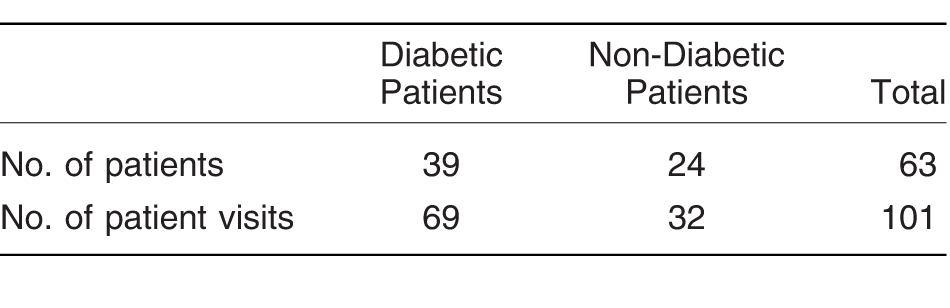
Sixty-three patients made 101 visits to the podiatric medical clinic during the 15 clinic days between November 2010 and February 2012 (Table 1). Twenty patients returned to the clinic for at least one follow-up visit or for a new medical concern. Sixty-two percent (39 patients) were diabetic, and they made up 68% of the visits. Thirty-two percent of these patients accessed the clinic more than once.

Table 1.
Number of Patients and Number of Patient Visits from November 2010 to February 2012
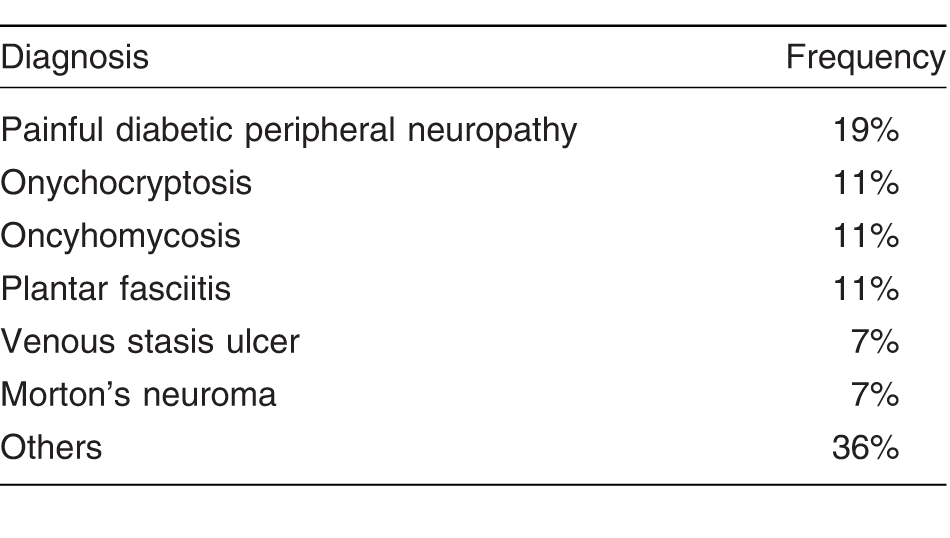
Thirty-nine different diagnoses were identified during this period in patients who accessed the clinic, and treatments were provided and rendered for all 101 patient visits/encounters. Treatments were limited to those within the clinic's resources. Diagnoses that occurred more than once are graphed in Figure 1. The most common podiatric medicine–related diagnoses include painful diabetic peripheral neuropathy, onychocryptosis, onychomycosis, and plantar fasciitis. All of the diagnoses that presented during the study period are given in Table 2, along with their corresponding ICD-9 codes. Table 3 shows the breakdown of the six most common podiatric medicine–related diagnoses and their frequency as encountered at the podiatric medical clinic.
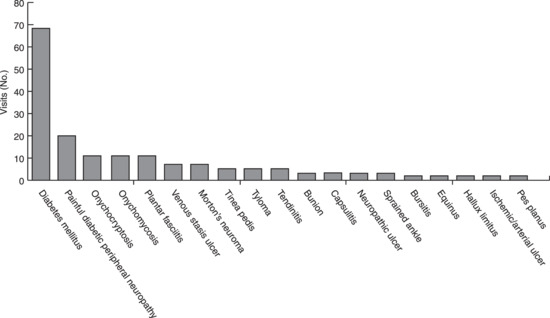
Figure 1.
Top 19 diagnoses that occurred twice or more during the study period.
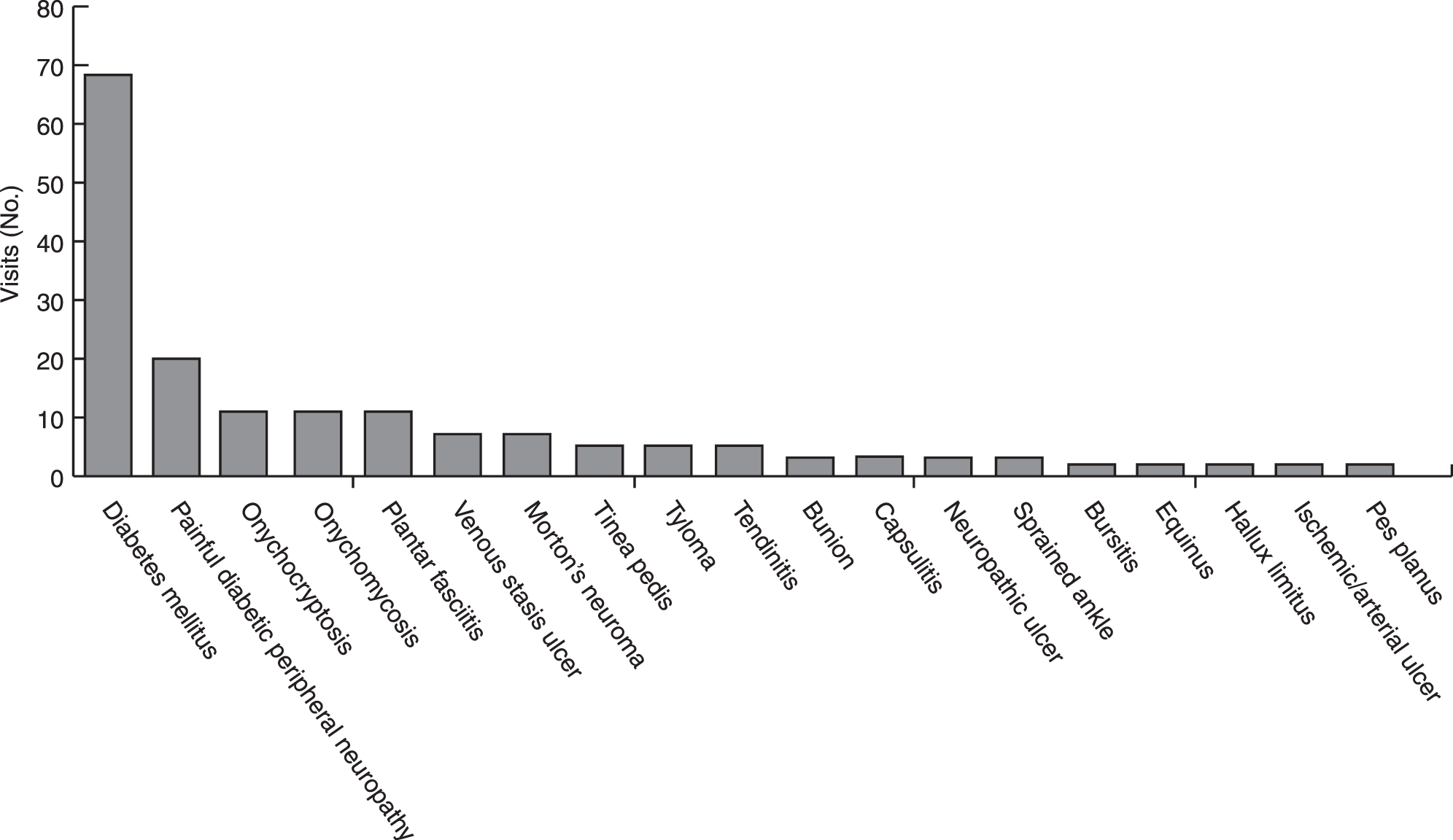
Table 2.
All of the Diagnoses and Their Corresponding ICD-9 Codes
Table 3.
Top 6 Podiatric Diagnoses and Their Frequency
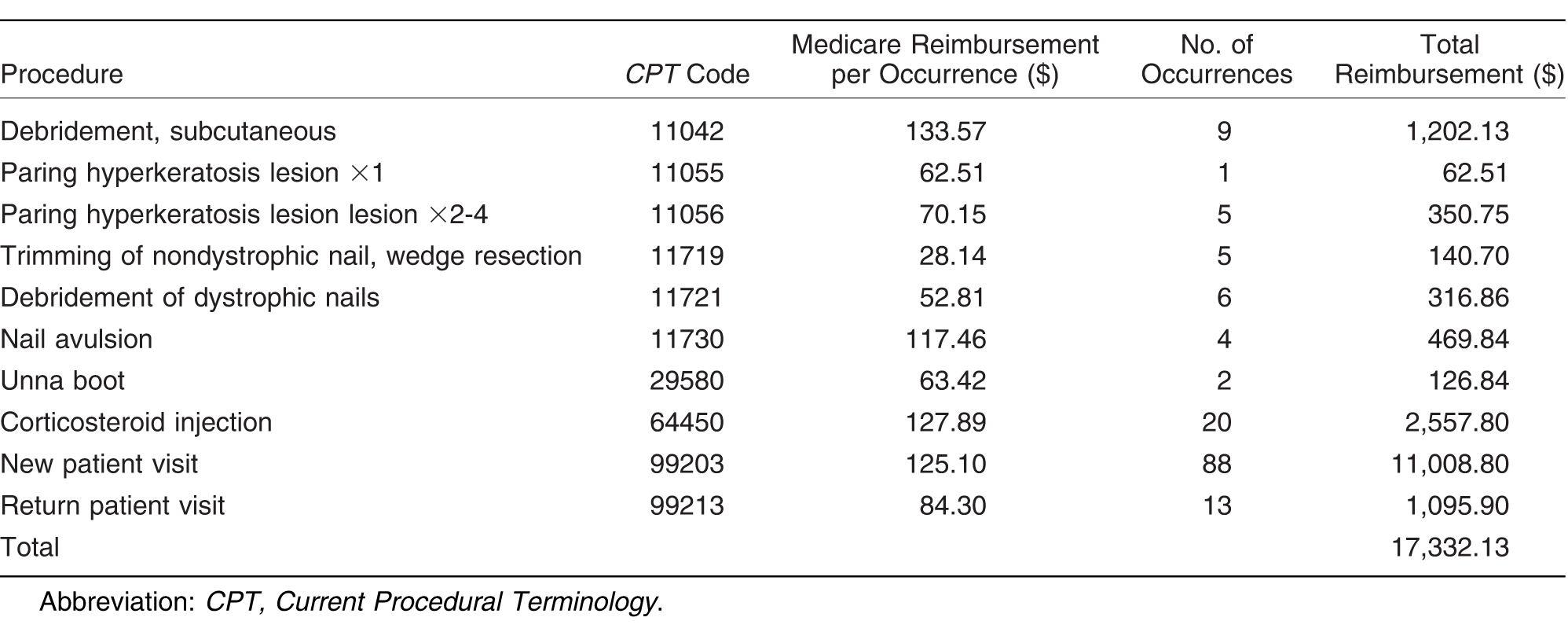
Based on Medicare's reimbursement rate for the services provided to the patients in the study, $17,332.13 worth of services was rendered during this study period (Table 4). There were 15 clinic days, which translates to an average of $1,155 worth of services delivered at no cost to the uninsured patients per clinic day. Sixty-three patients received this free podiatric medical care with an equivalent value ranging from $28.14 to $133.57, with an average of $275.11 per person (Table 4). Additional treatments, such as in-house prescriptions, discounted prescriptions, heel lifts, over-the-counter shoe inserts, removable metatarsal pads, and removable toe sleeves were also provided based on patients' symptoms and diagnoses. Gait analysis and biomechanical evaluation were performed according to patients' symptoms and complaints. However, there were no corresponding CPT codes specific to these assessments other than evaluation and management per ICD-9 codes. As a result, these services were not included in the analysis for potential reimbursement from Medicare to avoid a bundling of reimbursement consideration.
Table 4.
Procedures Performed and Their Financial Compensation Based on the Medicare Reimbursement Schedule
Discussion
Medical and Educational Impact
According to Clínica Tepati's 2010-2011 annual report, the clinic had 1,350 patient visits in 12 months. There were 101 patient visits to the podiatric medical clinic in a 15-month period (November 2010 to February 2012), or on average 81 patient visits in 12 months. This translates to approximately 6% of all patient visits to Clínica Tepati.
According to the California Podiatric Medical Association (CPMA), at least 19% of the general population has an average of 1.4 foot problems yearly; the top 10 foot problems were Achilles tendonitis, bunions, hammertoes, heel spurs, ingrown toenails, neuroma, plantar fasciitis, shin splints, sesamoiditis, and stress fractures. [8] Clínica Tepati's pathology and incidence rate of presentation did not parallel the top 10 pathologic disorders as published by the CPMA. This is likely due to regional patient demographic population variations. Compared with the CPMA's data, the Clínica Tepati study population also presented with a lower prevalence of foot and ankle concerns (6% in the podiatric medical clinic versus 19% in the CPMA 2012 data).
Of note is the high percentage of diabetic patients in Clínica Tepati and in the free podiatric medical clinic itself. Whereas 8.3% of the US population and 11.8% of the US Hispanic population are diabetic, 33% of Clínica Tepati patients and 62% of the podiatric medical clinic patients were diabetic in the present study. [9] This skewed observation may be explained by the much more detailed prescreening system implemented in Clínica Tepati and the primarily underserved and self-identified Hispanic patient population that accesses Clínica Tepati. These findings reflect the current diabetic endemic, particularly among the Hispanic and other minority populations. According to 2011 data from the Centers for Disease Control and Prevention, [9] more than 25.8 million individuals were diagnosed with diabetes in 2010. It is also projected that by 2030, more than 552 million individuals will have diabetes. Although these numbers do not differentiate between minority and nonminority populations, they still have a huge implication for foot health at the national level because it is well documented that a concerning sequela of diabetes is diabetic foot ulcerations. [10]
One of the goals of Clínica Tepati is to better educate its patient population so that personal health and wellness is enhanced. To this end, patient medical education is a pivotal component of all patient encounters. Clínica Tepati provides patient education through a teaching model that emphasizes collaboration between primary care and podiatric medicine. As indicated previously, a substantial segment of the patient population seen at the clinic has no form of medical insurance, belongs to a minority group that is often distrustful of large institutions, belongs to an underserved segment of society, or all three. As a result, Clínica Tepati may very well be the only avenue from which the patient education that the patients receive is available to them. The added benefit of this patient educational model is its impact on the students rendering the care. Through this model, medical and podiatric medical students benefit from understanding the essence of collaboration among general practitioners and specialists. In addition, medical and podiatric medical students are exposed to the spectrum of patient profiles/demographics (ie, those with third-party payer insurance to those who are indigent), and they learn how to interact and render care to all regardless of their insurance circumstances. These students also learn compassion and empathy through such a clinic, a skill that will serve them well in their path to becoming doctors/clinicians.
Economic Impact
Economically, this study suggests that the existence of the free student-run podiatric medical clinic at Clínica Tepati has substantial value. There were 63 patients who received free podiatric medical care through 101 patient encounters at the free podiatric medical clinic with an equivalent value of $17,332, or an average of $275.11 per person during the 15 clinic days between November 2010 and February 2012 (Table 4). The conservative cost in this calculation was based on Medicare's prevailing reimbursement rate for the specific ICD-9 codes and CPT codes that were rendered/documented. To view this as an extrapolated larger picture, there are currently nine accredited podiatric medical schools in the United States. If each school has only one student-run clinic that provides podiatric medical care to the uninsured population that is similar to the one at Clínica Tepati, there would be a conservative financial value of services rendered of $155,988.
According to the Employee Benefit Research Institute estimates of the 2009-2011 Current Population Survey, March Supplement, there were 6.9 million uninsured individuals in California. [11] Using the CPMA's estimate that 19% of the general population has foot problems, this would translate to 1.311 million uninsured people with foot problems in California alone. The conservative financial value of services rendered by Clínica Tepati was $275.11 per person during the 15 days of clinic visits. If every uninsured individual in California had access to free podiatric medical care, this would convert to a conservative estimate of an annual economic value of services rendered of $360,670,666 for California. Furthermore, according to the aforementioned Population Survey, [11] there were 47.2 million uninsured individuals in the United States nationwide. With the same assumption of 19% or 8.968 million of them having foot problems, and if every uninsured individual in the United States had access to free podiatric medical care, this would translate to an economic value of services equal to at least $2,467,196,444 annually. This dollar figure is significant.
Undoubtedly, there are important shortcomings in the financial impact consideration in this preliminary study and analysis. To be as simplistic as possible in the assessment of the economic impact of the clinic and to avoid overcomplicating the financial consideration, a substantial number of confounding factors were purposely omitted from the analysis. Some of the more obvious and salient ones are as follows:
- •
- The average cost of services rendered for the patients in the study is clearly limited to the number of visits made by the patients to this particular clinic. This is not necessarily a correct reflection of the average number of visits made by a patient to a medical office/clinic in a year.
- •
- Because this is a free student-run clinic, we purposefully omitted the financial cost in the analysis that constitutes the students and the clinical faculty that run the clinic to reduce the cofactors of consideration. Needless to say, if we had to factor in the cost of the clinical faculty/attending that run the clinic (eg, annual salaries) and the cost of any medical assistants and the students themselves, this would elevate the average cost of services for each patient significantly above the $275.11 per person estimate.
- •
- There was also a deliberate omission of the usual and customary patient copays and deductible costs that would have been incurred by the patient in a regular doctor's office or hospital setting.
- •
- The free or reduced cost of prescription medications, the free in-house medications, the free over-the-counter shoe inserts, and the other durable medical supplies provided/given to the patients were not factored into this analysis.
Conclusions
These findings demonstrate that free student-run clinics, such as the free podiatric medical clinic at Clínica Tepati, benefit both the uninsured individuals and the health-care system while providing early exposure to clinical training for podiatric medical students. We attempted to take a first look at the impact that such free student-run clinics have on patients, both medically and economically, and has made a tentative suggestion of the dollar value of what this would mean at a national level.
Although this article has made some generalized assumptions in terms of population distribution of the uninsured, as well as access to medical care projections, the underlying tenet and foundations suggest that free student-run medical clinics have the potential to provide substantial medical and economic benefits to the underserved and uninsured population in the United States.
Acknowledgments
Special thanks to the podiatric physicians, the California School of Podiatric Medicine podiatric medical students, and Clínica Tepati's volunteers who volunteer their time to the podiatric medical clinic. We particularly thank Drs. Amy Duckworth, Douglas Hague, Tobra Gallawa, and Brenden Tu for their support.
Financial Disclosure
None reported.
Conflict of Interest
None reported.
References
- MoskowitzD, GlascoJ, JohnsonB, et al: Students in the community: an interprofessional student-run free clinic. J Interprof Care20: 254, 2006.
- SimpsonS, LongJ: Medical student-run health clinics: important contributors to patient care and medical education. J Gen Intern Med22: 352, 2007.
- ClarkDL: A multidisciplinary, learner-centered, student-run clinic for the homeless. Fam Med35: 394, 2003.
- CohenJJ: Our compact with tomorrow's doctors. Acad Med77: 475, 2002.
- Hitzeman N: Clinica Tepati Annual Report, University of California at Davis School of Medicine, Sacramento, 2012.
- ICD-9-CM Diagnosis Codes. Find-A-Code Web site. Available at: http://www.findacode.com/icd-9/icd-9-cm-diagnosis-codes.html. Accessed July 7, 2012.
- AMACodeManager. American Medical Association Web site. Available at: https://ocm.ama-assn.org/OCM/CPTRelativeValueSearch.do. Accessed July 7, 2012.
- General Questions. California Podiatric Medical Association Web site. Available at: http://www.calpma.org/visitors/foothealth/faqs/general.
- National Diabetes Fact Sheet, 2012. Centers for Disease Control and Prevention Web site. Available at: http://www.cdc.gov/diabetes/pubs/factsheet11.htm. Accessed November 17, 2012.
- SinghN, ArmstrongDG, LipskyBA: Preventing foot ulcers in patients with diabetes. JAMA293: 217, 2005.
- FronstinP: Sources of health insurance and characteristics of the uninsured: analysis of the March 2011 Current Population Survey. Employee Benefit Research Institute Issue Brief No. 362, September 2011. Available at: http://www.ebri.org/pdf/briefspdf/EBRI_IB_09-2011_No362_Uninsured1.pdf. Accessed September 16, 2012.
© 2015 American Podiatric Medical Association