


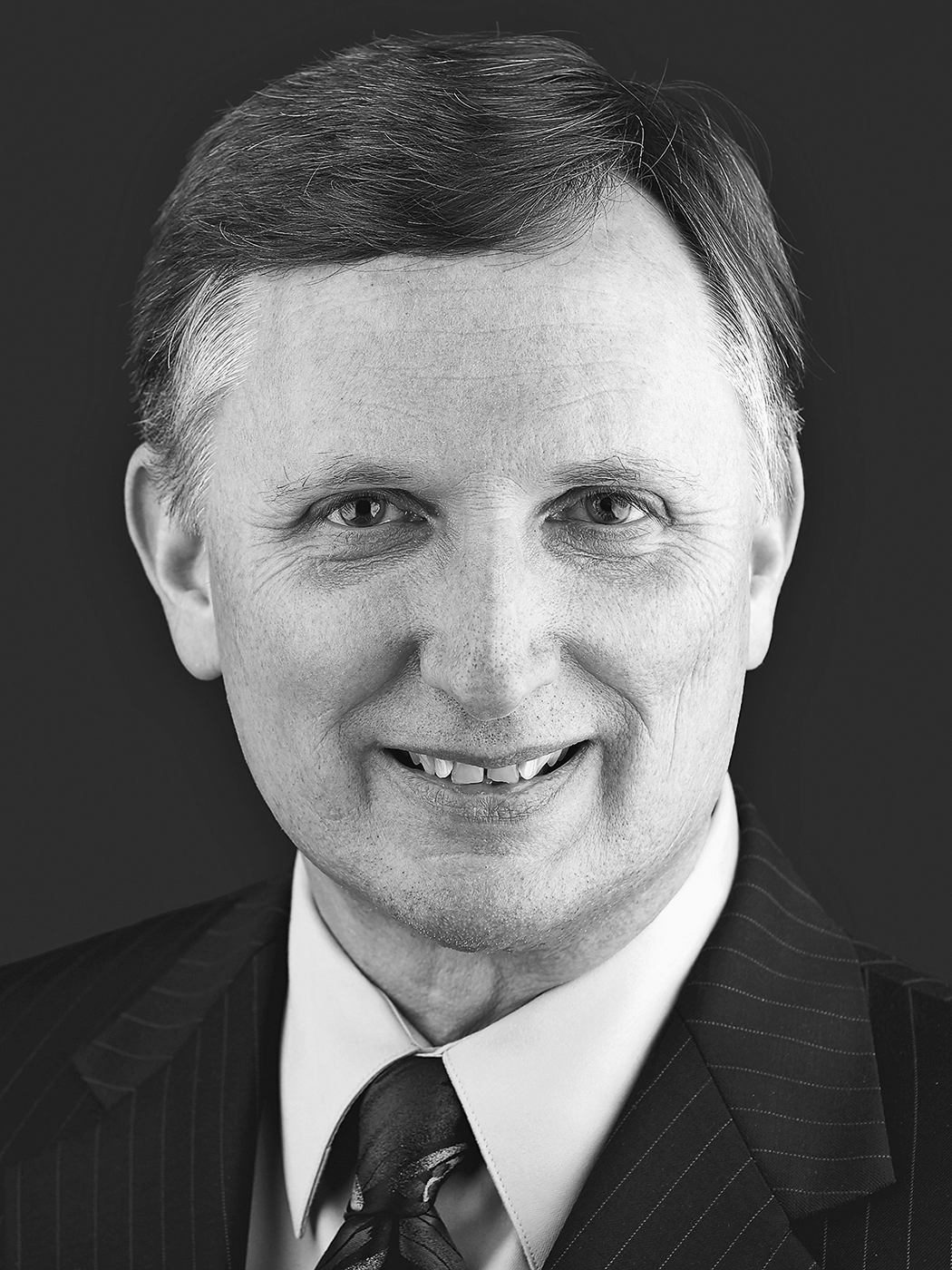
Phillip E. Ward, DPM.
President
American Podiatric Medical Association
2015–2016
President
American Podiatric Medical Association
2015–2016
Doctor speaker, delegates, fellow board members, guests, friends, and family,
I am honored to serve as the 89th president of the American Podiatric Medical Association and the first president of our association from the state of North Carolina since 1948.
I am a Tarheel from the great state of North Carolina …
where everyone pulls over to let a funeral procession pass,
where we don't have fireflies, we got lightnin‘ bugs,
where taters are a mandatory component of every meal,
where chicken is fried and so is the okra,
where sweet tea is the house wine and grocery carts are called buggies,
where when we say “bless your little heart,” it may not be a good thing,
where BBQ is pork and the best BBQ is found in Lexington, but everybody has their own secret sauce.
I am from North Carolina …
where we will be happy to carry you to the store even if it's way over yonder,
where “y'all” and “ain't” are proper words, and
where there are two shades of blue, that beautiful Carolina blue and that other one worn by that school that rhymes with “puke.”
I am from North Carolina, where we give directions using phrases like, “Turn off the paved road and go past where the Texaco station used to be,”
where we can still see Dale Earnhardt memorials, and being called “NASCAR Boy” by Dr. Spinosa is considered an honor.
I am from North Carolina …
where we didn't invent basketball, we just perfected it,
where ordering a burger “all the way” means it will come with chili and slaw on it,
where you know the difference between a copperhead and cottonmouth snake,
where you have at least one relative who raises collards,
where at least once your high school cancelled classes because of a hurricane and a snow storm in the same year,
where you know Krispy Kreme makes the best doughnuts.
I told you all of that because I want you to know that I am proud to be from the great state of North Carolina, where our state motto is Esse Quam Videri.
I will discuss the translation of this Latin phrase later, but first I want to tell you about my dad.
My father was a man who lived the meaning of the phrase Esse Quam Videri. He believed in helping others. He didn't tell people about it—he just did it and didn't care if people knew about it or not. A case in point—at his funeral, to my surprise, a local Catholic priest was present. Now, a priest at a funeral may not have surprised you, but my dad was a lifelong, twice-a-year-go-to-church-to-watch-his-kids-in-a-holiday-play kind of guy. So I was surprised to see a priest at Dad's funeral. The priest noticed my look of puzzlement at his presence and approached me to say, “You have no idea why I am here, do you?” I replied, “No, sir, I do not.” He then asked me if I knew what my daddy had done with all the fruit he raised.
Now you need to know that my dad had about 50 fruit trees on our property while I was growing up.
We fertilized those trees.
We pruned those trees.
We sprayed those trees.
We picked fruit off those trees.
Man, I really hated those trees because it took a lot of work and effort to make them produce fruit. So much work that I didn't even want to eat the fruit because I resented that work and time.
Well, this priest told me that the fruit my father raised on our land, the fruit that I resented so intently, every year was donated to a local Catholic Church-sponsored cerebral palsy summer camp. This priest was the director of that camp. My father worked hard, and he made my family work hard so that others could benefit from our work. He never told people about it. He never pounded on his chest and said, “Look what I did.” He just did it. He believed in it, and he did it. The priest wanted us to know that. He wanted to show his appreciation because he knew my father did it out of love and respect, not out of duty, and that my father wanted to let his actions show what he believed in. He didn't really care about perception. He believed in doing. In being. In reality.
So what does this have to do with the North Carolina state motto? Esse Quam Videri. We will get to that.
The American Podiatric Medical Association is a membership service and advocacy organization. APMA is not a brick and mortar building in Bethesda, MD. It is an organization of people, from the Board of Trustees to committee members to component leaders to the members and to the staff. Our common bond is that we all care about the past, present, and future of the podiatric medical profession. APMA is a very well-managed, financially sound organization with an exceptionally strong professional staff that serves the members on a daily basis.
Now by this time you have probably Googled the phrase Esse Quam Videri, so you know that it means “To be rather than to seem.”
This is what APMA is.
APMA is an organization that acts.
APMA is an organization that gets things done.
We “BE.” We don't “SEEM.”
We are proactive to the ever-changing health-care environment, and at the same time we are reactive to member issues. We advocate for members. We educate members. We promote members as the physicians, surgeons, and specialists that we are.
APMA gets things done.
As an organization, we must appreciate and value our own worth as physicians, surgeons, and specialists. We should refuse to see ourselves through the eyes of those who do not value our worth. We should not and will not let anyone but us define us.
But sometimes we face forces that are content with the “stagnant quo.” These forces may be internal or external to the podiatric profession and by my definition do not want to see the profession progress. They do not want to see changes that will benefit our members or our patients. These are organizations and agencies and in some cases individual people who refuse to recognize the fact that our scope of practice has changed. They maintain antiquated opinions regarding today's podiatrists' capabilities, education, training, and experience. During my presidency, APMA will continue to reach out to these forces to encourage them to get their head out of the sand and face the reality that, regardless of their opinion, the facts prove that we have arrived.
I've heard it said that “a compass can point due north and show you the right direction, but it won't show you the bogs, swamps, and deserts that are in the way of your journey.”
We know the direction we must take. That direction leads us to the full encompassing of DPMs into all aspects of the United States' current and future health-care delivery systems.
That includes parity in state and federal laws.
That includes parity in regulatory and administrative rules and standards.
That includes parity in third-party compensation policies.
That includes parity in health-care facility bylaws and privileges.
There may be swamps and deserts in our way, but we can and will overcome those obstacles. Complete parity with our allopathic and osteopathic colleagues is the only option. We do not have to prove that we are superior—which in many cases the evidence shows we are—we only have to prove similitude in education, training, and experience.
The University of North Carolina had a Hall of Fame basketball coach named Dean Smith. He is often referred to as the “Dean of College Coaching.” His philosophy was that winning a championship is a goal, while becoming a champion is a process. What this means is that you cannot focus on results, but you must focus on the things it takes to get results. This analogy quite well describes our congressional lobbying efforts. In the process of getting Title XIX amended to include podiatrists as physicians, we have attained many interim successes. Through the continued leadership of the APMA Legislative Committee and the APMAPAC, we will achieve our ultimate goal while reaping the benefits of the process.
Thomas Edison is often credited as saying, “Vision without execution is hallucination.” Our vision is complete parity. We have a roadmap to achieve this vision, and that is our “Pathway to Parity.” Most of the original pillars of Vision 2015 have been accomplished, and therefore Vison 2015 has morphed into the Pathway to Parity. Parity is an ongoing goal. The process to reach this goal will be managed through the Pathway to Parity Committee. This committee will oversee all areas of parity for the profession and will continue to encourage the stakeholders to work on the process of achieving the goal of parity. We have a proven track record for getting work done. I have seen a change in philosophy over the time I have been on the Board of Trustees. We have changed from a reactive organization to a proactive association, and Vision 2015 was a perfect example of deciding where we want to be and developing a process to achieve that goal.
APMA acts. We are not content with appearing to act. An example of this action is how we addressed the residency issue head on, and because of our actions, in conjunction with other stakeholders, this year there are more first-year residency positions available than Class of 2015 graduates.
I, much like you, have a deep and broad passion for the future of the profession and for this association. But to ensure a successful future, we must show that this association is relevant to our current and future members. One advantage we have in proving our relevance is that APMA and its components do things that no other organization in podiatry does.
Through our Legislative Advocacy department and PAC, we represent our members on Capitol Hill. Nobody else in podiatry does that.
There are many challenges within the arena of Health Policy and Practice; however, APMA leadership considers challenges to be opportunities. We will continue to promote, monitor, and comment on policy and regulatory changes. We will continue to propose proactive regulatory and administrative changes when appropriate. Nobody else in podiatry does that.
We provide resources on state advocacy to components and members through our Center for Professional Advocacy. Nobody else in podiatry does that.
We meet at regular intervals with CMS and private insurance companies. Nobody else in podiatry does that.
We represent our members at CPT and RUC. We have influence in the process of developing and refining CPT codes and setting appropriate reimbursement rates for those codes. Nobody else in podiatry does that.
We have developed the Coding Resource Center, which has been copied by many other specialties. The CRC prepares our members for changes in coding and reimbursement and at the same time provides student scholarships through subscriptions to the CRC. Speaking of scholarships, in 2014 APMA provided more than $210,000 in scholarships through the Educational Foundation. Nobody else in podiatry does that.
As an association, we are becoming more involved in the world of public health. APMA sponsors a Public Health Fellowship at Dartmouth University. We have a section in the American Public Health Association and a line item in the proposed budget to fund students at each podiatry college to become members of that APHA section. The APHA has tremendous influence in the health-care environment of our country. As a way of increasing our focus on and influence in public health and at no cost to APMA, I will be attending an APHA-sponsored investigational trip to Cuba in April to study the impact and treatment of diabetic foot conditions in that country and determine how that information may be used to improve the treatment of those conditions not only in Cuba but also in the United States and worldwide. APMA has a presence in the world of public health. Nobody else in podiatry does that.
We meet regularly with leadership from the American Medical Association and the American Osteopathic Association, as well as other professional medical and surgical associations. Nobody else in podiatry does that.
We provide free membership for the entire seven-year educational path required to train a current podiatric young physician. This membership includes the free Residency Education Resource Center that provides weekly educational sessions that meet CPME guidelines for residents. In addition, APMA provides free registration for students and residents at our Annual Scientific Meeting. Nobody else in podiatry does that.
APMA and its leadership are consistently visible and accessible at national, regional, and state meetings. Nobody else in podiatry does that.
So as you can see from these examples, APMA lives the North Carolina state motto Esse Quam Videri. We are the leaders in the podiatric profession both nationally and internationally, and we prove it every day. We are not content to seem to lead. We are the leaders in foot and ankle care.
We need to show our relevance to both our supporters and detractors. The way to do that is through communication, and to this end, I pledge to you that I will be an accessible and visible president. I have already worked out a monthly podcast schedule with our Communications department. I will be visible on social media, and you can follow me on Twitter @APMApresident. There are 53 APMA components and 53 weeks in my presidential term. Therefore, each week during my presidency, I will contact a member at random from a component to discuss whatever questions or issues he or she may have. I will be available and eager to discuss the APMA strategic plan and our implementation of that plan with members and stakeholders in the profession. I plan to continue the board's successful internal monthly buddy call program that Dr. Spinosa started last year. Our ability to communicate what we do and why we do it is the key to proving our relevance.
My request to you as volunteer leaders in this profession is to become more involved in promoting the profession. Take the message to your state that APMA is the organization that cares for its members and provides the tools necessary for our members not only to survive, but to thrive, in the current unprecedented health-care environment. Physician practice demographics have changed from the traditional practice model workforce to an employment model dominated by large corporations and hospitals. Many doctors feel those entities will take the place of specialty associations that act in the best interest of the physician. But those entities will not and cannot provide the advocacy for the profession that APMA and its components provide. Nobody else in podiatry does that, and that is what makes us relevant.
The question is not why someone should be a member of APMA. The question is: How can anyone afford not to be a member?
In closing, I want to express how honored I am that this House of Delegates has shown confidence in me by electing a little ol‘ country boy from North Carolina to lead this great association as its president. I have been fortunate to know many interesting and some famous people, but one of my favorites was the astronaut Rear Admiral Alan Shepard. He was a patient of mine when I practiced in Pinehurst, NC. I knew that he was probably tired of answering questions about his life as an astronaut, so the entire time I knew him, I asked him only two questions about his career. Being from Pinehurst, which is the golf capital of the world, I wanted to know what golf club he chose to use on the moon. He told me it was a 6 iron and he hit the ball 360 yards. The second question was what was going through his mind as he sat on top of that Mercury rocket knowing he would be the first American launched into space. He smiled at me and said it was a simple thought: “Lord, please don't let me screw this up.”
My friends and colleagues, I cherish your confidence, support, and prayers and pledge that I will do my best not to screw this up.
I conclude with these simple words:
Esse Quam Videri—To be rather than to seem.
Thank you.
© 2015 American Podiatric Medical Association