


Abstract
Background: Playing soccer on artificial turf can provoke pain in young players. Using shock-absorbing insoles (SAIs) can result in decreased pain perception. We sought to investigate the pain and comfort intensity experienced during the switch from natural grass to third-generation artificial turf and with the use of SAIs on artificial turf during training in young soccer players. Methods: In a prospective randomized controlled study, 75 players were included from the youth teams of U15, U17, and U19. Pain intensity and comfort were assessed after training on only grass turf for 3 months. Randomization stratified by team level and age was performed; the intervention group received SAIs, and the control group used their own insoles. Assessments were repeated after 3 weeks on artificial turf (baseline) and 3 more weeks (follow-up) on artificial turf with SAIs/usual insoles. Results: Pain intensity increased and comfort decreased significantly after 3 weeks of training on artificial grass compared with natural grass (P < .05). The addition of SAIs resulted in significantly reduced pain intensity compared with the usual insoles (P < .05). Conclusions: The switch to artificial turf is associated with less comfort and more pain during training in young soccer players. The use of SAIs led to lower pain intensity, highlighting a protective role of the insoles after 6 weeks of training on artificial turf.
In Scandinavia, soccer played on artificial turf is gaining popularity for climatic and financial reasons.[1] The characteristics of third-generation artificial turf resemble those of natural grass, and the Fédération Internationale de Football Association has now approved this surface for all types of matches.[2] Ekstrand et al[1] and Steffen et al[3] showed that the risk of injury in elite soccer played on third-generation artificial turf versus natural grass is equal. In addition, the running activity and technical standards have been reported to be unchanged when playing on artificial turf, although fewer sliding tackles and more short passes are performed.[4] Low-back pain is the most common complaint among youth soccer players playing on natural grass.[5] Aoki et al[6] and Soligard et al[7] reported an increasing occurrence of pain from the trunk region, particularly from the lower back, when training on artificial turf. This may be detrimental to the musculoskeletal system and prevent recovery after exercise.[8]
In parallel, shock-absorbing insoles (SAIs) are viewed as a means to reduce foot loading in relation to physical activity and improve performance.[9,10] Sensory changes have also been found. A reduction in tiredness and pain intensity has been reported when using insoles in relation to artificial turf,[11-14] although this does not seem to lead to a decreased risk of overuse injuries.[12,15,16] In a previous pilot study, we reported an increase in pain intensity from the leg or back measured after training following a shift from natural grass to artificial turf.[15] However, the results of this earlier study have a major flaw, ie, the lack of a control group. Once soccer shoes are equipped with SAIs, soccer players report reduced pain nearly corresponding to the level reported when training on natural grass. This led us to hypothesize that the change of playground surface from natural grass to artificial turf will result in increased pain unless SAIs are used.
This study focuses on the associations among the pain intensity reported by young elite players, the surface of the soccer field, and the use of SAIs. We hypothesized that pain intensity would be significantly reduced in the intervention group (using SAIs) compared with the control group (CON; using their own insoles). To date, this is the first prospective randomized controlled study to evaluate the effect of SAIs on pain intensity after training on artificial turf after an initial period on natural grass.
Methods
Participants and Study Design
Players from the youth teams of U15, U17, and U19 in the Danish premier league soccer club AaB (internationally known as “Aalborg BK”) participated in the study. The inclusion criteria were 1) training on natural grass and artificial turf during the study; 2) training on the same surface in the given period; 3) played under the same weather conditions; 4) a duly signed informed consent form provided by the player or by the parents if the player was younger than 18 years; 5) member of team U15, U17, or U19; and 6) previously played on artificial turf. Players were excluded if the following applied: 1) previous surgery of the foot or lower extremities, 2) history of medical trauma, 3) infection in the foot or lower extremities, 4) in a psychological state that made it impossible for the player to participate, 5) estimated to be unable to do the training, 6) unable to understand or read Danish, or 7) been injected with corticosteroids within the past 12 months. The players and parents received written and verbal information about the study before signing the informed consent. The protocol of the study was approved by the local ethics committee of North Denmark Region (N-20100084). All of the procedures were conducted in accordance with the Declaration of Helsinki.
The study was a prospective randomized controlled trial with an intervention period of 3 weeks. Allocation was concealed and conducted by a secretary not involved in the study. The allocation was stratified by team level and age and was conducted after baseline assessment using sequentially numbered opaque sealed envelopes. The stratification was done to account for the effects of age and training (the amount of training differed among the teams). In Denmark, the weather from October to April requires that the surface of the playground is changed from natural grass to artificial turf because turf hardness is not changed significantly by nonextreme temperature variations and precipitations.[17] Furthermore, soccer is subjected to a winter break beginning in December. Consequently, the training period on artificial turf (approximately 6 weeks) was divided into two periods of 3 weeks each. Outcome measures were assessed three times during the study: 1) after training on grass turf only for 3 months, 2) after 3 weeks on artificial turf with usual insoles (baseline), and 3) after 3 weeks on artificial turf with SAIs and with usual insoles (follow-up). The artificial playground in AaB is a third-generation type (Polytan LigaTurf 260; Polytan Sportstättenbau GmbH, Burgheim, Germany). After 3 weeks of training on artificial turf, the players were randomized as explained previously herein into two groups: group 1 played with SAIs (the used insoles were replaced by SAIs) and group 2 played with their usual insoles (CON) (the used insoles were left in place).
Participants were tested at the clubhouse of the Danish premier league soccer club AaB after training sessions. All of the assessments were performed by the same investigators, who followed a standardized assessment protocol and were blinded to each participant's group allocation.
Interventions
The participants in the intervention group had to use the following SAIs: Rehband 93430 Soccer Technogel Isofix (Otto Bock, Duderstadt, Germany). The technical specifications of the SAIs (3-mm gel without film) are as follows: tensile strength greater than 600 kPa (DIN EN ISO 1798), elongation at break greater than 200% (DIN EN ISO 1798), mean ± SD shore of 70 ± 3 (ASTM D2240), compression test set less than 10% (DIN EN ISO 1856), density of 850 kg/m3 (DIN EN ISO 845), and temperature stability of −30° to 80°C. The insole is an elastomer on a polyurethane base. Its flexibility and elasticity make it usable in a soccer context. The insoles were adapted individually to the players' shoes according to shoe size and then were adjusted with scissors. We did not examine foot arches because we did not want to change foot position but only promote shock absorption. The CON participants were instructed to continue using their usual insoles.
Outcome Measures
The primary outcome was the level of overall pain intensity. Overall pain intensity was assessed at rest and during physical activity (training) using a numeric rating scale where 0 indicates no pain and 10, worst thinkable pain. The reported pain score reflected overall pain from the foot, tibia, knee, thigh, groin, or back.
The secondary outcome was comfort level. Similarly, comfort level was assessed using a numeric rating scale where 0 indicates best comfort and 10, worst thinkable comfort. A difference in pain intensity of 1 on a scale from 0 to 10 was considered clinically relevant.[18]
Adverse Events
The participants were asked to report any adverse events caused by use of the insoles throughout the intervention period.
Statistics
The Student unpaired t test was used to compare the baseline characteristics of the players. The sample size was based on the primary hypothesis and was aimed at detecting a SAI/CON difference in pain intensity. Using a small effect size of 0.23 (η), a desired power of 90%, and a confidence level (α) of 5%, at least 36 participants were needed in each group (G*Power 3.1.3; Kiel University, Kiel, Germany). We aimed to include 40 players in each group, but we did not succeed. The distribution of pain and comfort data was not normal. Therefore, a Mann-Whitney U test was used to compare natural grass/artificial turf and SAI/CON. The statistical analysis was conducted at a 95% confidence level, and P < .05 was considered statistically significant. Median and 25% to 75% quartiles are reported.
Results
Enrollment took place from mid-September to mid-October 2011. The assessments corresponding to training on natural grass for 3 months were performed between October 17 and 27, 2011. Baseline and follow-up assessments related to artificial turf were made between November 7 and 11, 2011, and November 28 and December 6, 2011. A total of 90 players were eligible. Fifteen of the 90 players (approximately 17%) did not want to participate. Seventy-five players underwent randomization, with 39 assigned to the SAI group and 36 to the CON group (Fig. 1). There were no significant differences in baseline characteristics between the SAI and CON groups (Table 1). In the SAI group, four players did not receive the allocated intervention. Consequently, the use of SAIs was never started by 10% of participants in the SAI group. At follow-up, nine players did not show up. Thus, 26% of the SAI participants did not complete the intervention. In the CON group, 1 player (4%) did not show up. At follow-up, three players did not show up, resulting in 9% of the CON group not completing the control period. There were no significant baseline characteristic differences between players fulfilling the entire protocol and those dropping out (P > .11). The 58 players completing the entire protocol played in Adidas (n = 52) and Nike (n = 6) soccer shoes. The soccer shoes used were all designed for firm ground or artificial turf. Twelve players had previously been treated by either a physiotherapist (CON: 5 and SAI dropout: 3) or a chiropractor (SAI: 2 and SAI dropout: 1) or had been given insoles (CON: 1). None of the players were involved in other sports activities. In addition, 8 of the 75 players were previously treated with mild anti-inflammatory medicine (CON: 3, SAI: 3, CON dropout: 1, and SAI dropout: 1).
Figure 1.
Flow diagram of the protocol, including enrollment and randomization information. CON indicates usual insoles; SAI, shock-absorbing insole.
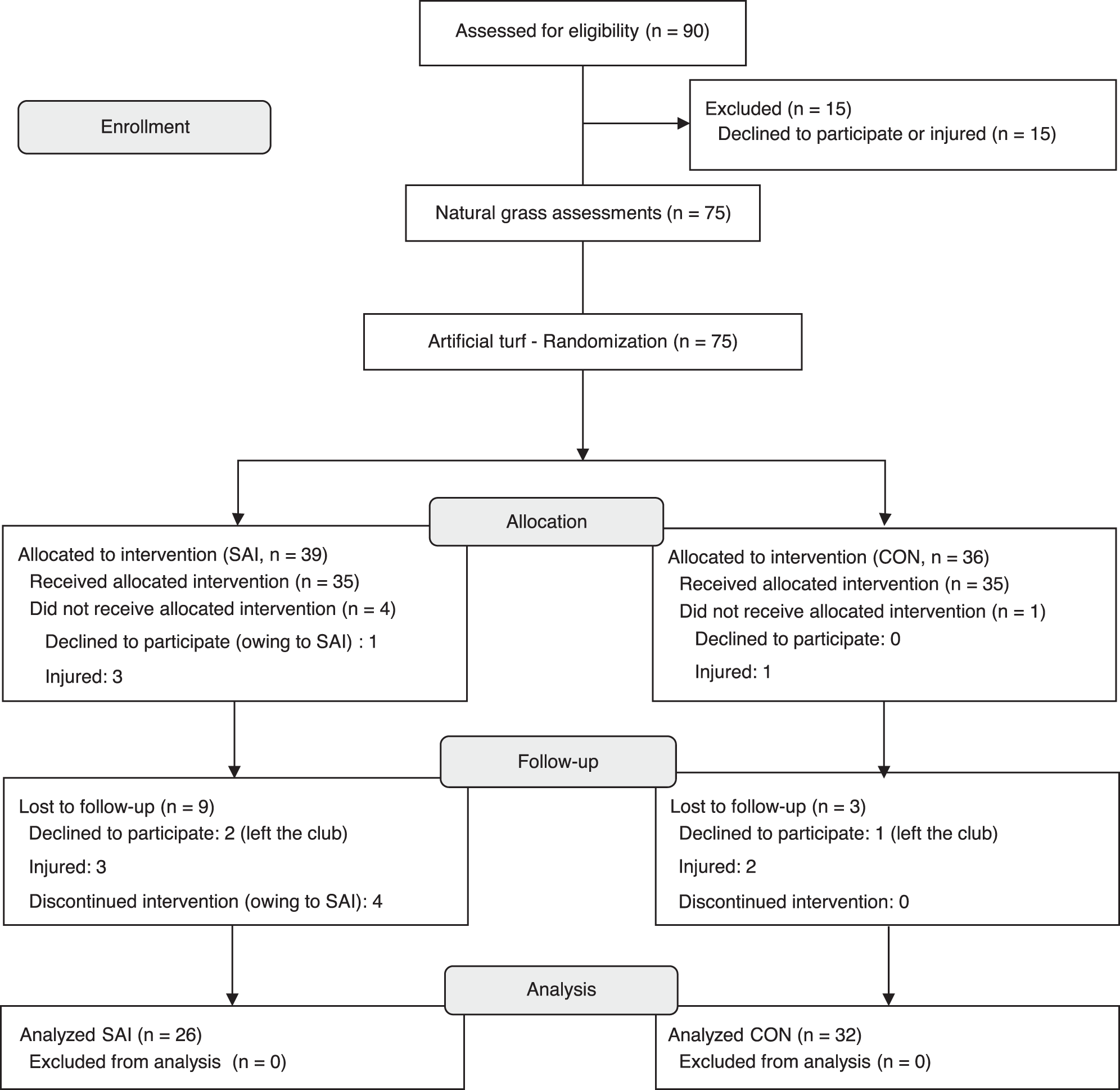
Table 1.
Baseline Characteristics of 75 Study Participants Using Shock-Absorbing Insoles (SAIs) and Usual Insoles (CON)
The transition from natural grass to artificial turf resulted in a significant increase in pain intensity (P < .001 for both) and decrease in comfort (P < .05). See Table 2 for descriptive statistics.
Table 2.
Effects of the Transition from Natural Grass to Artificial Turf on Comfort and Pain Intensity at Rest and During Activity (Training) in Young Elite Soccer Players
The observed power achieved when comparing SAI/CON groups was 0.83 (G*Power 3.1.3) and was considered acceptable.[19] As expected, no significant differences were found between groups at baseline for artificial turf (after 3 weeks of training on artificial turf) in pain intensity at rest (P = .67) and during activity (P = .68) as well as in comfort (P = .9).
Thus, differences in pain and comfort intensities were analyzed by subtracting values obtained after 3 weeks using SAI/CON from baseline for artificial turf values. Pain intensity at rest decreased significantly when comparing the SAI and CON groups (P = .03). Similarly, pain intensity during activity decreased significantly when comparing the SAI and CON groups (P = .01). Comfort intensity did not increase significantly when comparing the SAI and CON groups (P = .86). See Table 3 for descriptive statistics.
Table 3.
Effects of Shock-Absorbing Insoles (SAIs) Compared with Usual Insoles (CON) on the Differences in Comfort and Pain Intensities at Rest and During Activity (Training on Artificial Turf) in Young Elite Soccer Players
Adverse events, ie, increased discomfort or pain due to SAIs, were reported by five players in the intervention group.
Discussion
The present study confirmed that the switch from natural grass to artificial turf is associated with decreased comfort and increased pain intensity at rest and during physical activity, ie, training. Pain intensity measured 3 weeks after the addition of SAIs was reduced, demonstrating the potential role of these insoles in pain perception.
The results of this study also confirmed that artificial turf used as surface on a soccer field gave rise to increased pain in young soccer players compared with grass after 3 weeks, in line with previous findings.[15] The present results corroborate findings from recent studies[6,7] concerning complaints and pain reported from playing on artificial turf. More importantly, the present findings show that the change in playing surface and the relative lack of adaptation to artificial turf resulted in an increased pain level. This may, in turn, induce a higher rate of overuse injuries.[20] However, it was not possible to confirm this because the overall injury rate was similar to that reported in young soccer players, ie, approximately 3 per 1,000 hours of soccer per player.[21] In many ways, artificial turf seems to resemble natural grass when measuring the movement patterns and technical standards. According to the players, however, it is more difficult to kick and treat the ball on artificial turf.[4] Cutting movements increase pressure on the plantar surface,[22] and loading on the in-shoe foot is increased when measuring cutting movements on artificial turf.[23] These factors most likely explain the loss of comfort and increase in pain intensity. More important, the differences in pain intensity during the transition from natural grass to artificial turf can be seen as a clinically relevant issue despite the similar injury rate of the two types of playgrounds.
An adequate ergonomics approach is crucial for securing physiologic and biomechanical adaptations.[24] The use of SAIs is a solution to reduce biomechanical loading of the foot,[9,10,25] increase comfort, and decrease tiredness and pain.[11-15,26] The SAIs contribute to attenuation of peak pressure of the plantar surface of the foot during running and marching by 7% to 25%.[9,10] Insoles using gel materials also reduce shear forces.[25] These findings are in line with the sensorimotor changes reported when standing on a shock-absorbing mat compared with a hard surface for a prolonged period (ie, 2 hours): decreased discomfort and experimentally induced pain, diminished and more dynamic plantar pressure, and lower muscle activity.[27] These changes correspond to a reorganization of the pool of sensitized mechanoreceptors and nociceptors that may contribute to the prevention of overload injuries. This is also in agreement with Mundermann et al.[13]
The decreases in pain at rest and during training observed after 3 weeks of using SAIs were of clinical relevance[18] and can, thus, be seen as important. The nociceptive system was less sensitized and, thus, most likely to avoid the central hyperexcitability known to play a role in the development of injuries.[28] Also note that five players left the study during the test period owing to discomfort or pain from using the current SAIs. However, most players given insoles experienced a decrease in pain intensity, underlining the potent role of SAIs in relation to artificial turf in young soccer players.
There are strengths and limitations to the present study. This study is the first prospective randomized controlled study conducted with blinded investigators evaluating the effects of SAIs on pain and comfort during continuous training. Stratified randomization by age and team level ensured that the anthropometric values of the players and the volume of training did not affect the findings. The participants were young soccer players. Thus, the present findings may not be generalizable to adult players. The mean temperature decreased from 7.7° to 5° to 2.5°C during the assessments, and the mean precipitation levels were 14, 0, and 22 mm. Thus, it is unlikely that the climatic changes were solely responsible for the changes reported in comfort and pain perception. We measured only subjective outcomes, ie, overall changes in pain and comfort intensity. However, the assessment of pain intensity by means of a numeric rating scale is reported to be reliable in both clinical and research settings.[29] Future studies could investigate the effects of insoles on specific pain sites. Finally, note that the present study investigated only the short-term effects, ie, 3 weeks of SAI use. Randomized controlled trials with longer intervention times are needed to confirm these findings.
Conclusions
This prospective randomized controlled study showed that SAIs can partly remediate the decreased comfort and increased pain intensity reported during transition from natural grass to artificial turf. Further studies are required to assess the long-term effects of using SAIs on artificial turf. However, sports medicine professionals should advocate the use of SAIs as a means to increase the comfort and decrease the pain reported by soccer players training on artificial turf.
Acknowledgment
Charlotte P. Andersen, Per K. Mikkelsen, Brian P. Høj, Casper F. Nordström, Ian S. Hansen, Rasmus Keldbjerg, Lars C. Fogh, Magnus Schousboe, Maria H. Jensen, Sandy F. Jørgensen, Simone D. Larsen, and Thomas Jensen for their participation during data collection and Michael S. Rathleff for helpful advice on the CONSORT statement.
Financial Disclosure
None reported.
Conflicts of Interest
None reported.
References
- EkstrandJ, TimpkaT, HagglundM:Risk of injury in elite football played on artificial turf versus natural grass: a prospective two-cohort study. Br J Sports Med40: 975, 2006.
- Fédération Internationale de Football Association: FIFA Quality Concept for Artificial Turf Guide, Fédération Internationale de Football Association, Zurich, 2005.
- SteffenK, AndersenTE, BahrR:Risk of injury on artificial turf and natural grass in young female football players. Br J Sports Med41: I33, 2007.
- AnderssonH, EkblomB, KrustrupP:Elite football on artificial turf versus natural grass: movement patterns, technical standards, and player impressions. J Sports Sci26: 113, 2008.
- PetersonL, JungeA, ChomiakJ, et al: Incidence of football injuries and complaints in different age groups and skill-level groups. Am J Sports Med28: S51, 2000.
- AokiH, KohnoT, FujiyaH, et al: Incidence of injury among adolescent soccer players: a comparative study of artificial and natural grass turfs. Clin J Sport Med20: 1, 2010.
- SoligardT, BahrR, AndersenTE:Injury risk on artificial turf and grass in youth tournament football. Scand J Med Sci Sports22: 356, 2012.
- ReillyT, EkblomB:The use of recovery methods post-exercise. J Sports Sci23: 619, 2005.
- NiggBM, NurseMA, StefanyshynDJ:Shoe inserts and orthotics for sport and physical activities. Med Sci Sports Exerc31: S421, 1999.
- O'LearyK, VorpahlKA, HeiderscheitB:Effect of cushioned insoles on impact forces during running. JAPMA98: 36, 2008.
- FaunoP, KaalundS, AndreasenI, et al: Soreness in lower-extremities and back is reduced by use of shock absorbing heel inserts. Int J Sports Med14: 288, 1993.
- MilgromC, FinestoneA, ShlamkovitchN, et al: Prevention of overuse injuries of the foot by improved shoe shock attenuation: a randomized prospective-study. Clin Orthop281: 189, 1992.
- MundermannA, StefanyshynDJ, NiggBM:Relationship between footwear comfort of shoe inserts and anthropometric and sensory factors. Med Sci Sports Exerc33: 1939, 2001.
- SobelE, LevitzSJ, CaselliMA, et al: The effect of customized insoles on the reduction of postwork discomfort. JAPMA91: 515, 2001.
- KaalundS, FaunoP, Schmidt-OlsenS, et al: Pain reduction from using insoles when playing soccer on artificial turf, Annual Conference of the Danish Sports Medicine Society, Odense, Denmark, 2011.
- ShermanRA, KarstetterKW, MayH, et al: Prevention of lower limb pain in soldiers using shock-absorbing orthotic inserts. JAPMA86: 117, 1996.
- OrchardJ:Is there a relationship between ground and climatic conditions and injuries in football?Sports Med32: 419, 2002.
- KellyAM:The minimum clinically significant difference in visual analogue scale pain score does not differ with severity of pain. Emerg Med J18: 205, 2001.
- CohenJ:Statistical power analysis. Curr Dir Psychol Sci1: 98, 1992.
- EkstrandJ, NiggBM:Surface-related injuries in soccer. Sports Med8: 56, 1989.
- Schmidt-OlsenS, JorgensenU, KaalundS, et al: Injuries among young soccer players. Am J Sports Med19: 273, 1991.
- WongPL, ChamariK, MaoDW, et al: Higher plantar pressure on the medial side in four soccer-related movements. Br J Sports Med41: 93, 2007.
- FordKR, MansonNA, EvansBJ, et al: Comparison of in-shoe foot loading patterns on natural grass and synthetic turf. J Sci Med Sport9: 433, 2006.
- AtkinsonG, ReillyT:Sport, leisure and ergonomics VI. Ergonomics52: 411, 2009.
- CurryerM, LemaireED:Effectiveness of various materials in reducing plantar shear forces: a pilot study. JAPMA90: 346, 2000.
- LarsenK, WeidichF, Leboeuf-YdeC:Can custom-made biomechanic shoe orthoses prevent problems in the back and lower extremities? a randomized, controlled intervention trial of 146 military conscripts. J Manipulative Physiol Ther25: 326, 2002.
- MadeleineP, VoigtM, Arendt-NielsenL:Subjective, physiological and biomechanical responses to prolonged manual work performed standing on hard and soft surfaces. Eur J Appl Physiol Occup Physiol77: 1, 1998.
- WallPD, WoolfCJ:Muscle but not cutaneous C-afferent input produces prolonged increase in the excitability of the flexion reflex in the rat. J Physiol356: 443, 1984.
- PaungmaliA, SitilertpisanP, TaneyhillK, et al: Intrarater reliability of pain intensity, tissue blood flow, thermal pain threshold, pressure pain threshold and lumbo-pelvic stability tests in subjects with low back pain. Asian J Sports Med3: 8, 2012.
© 2014 American Podiatric Medical Association