


Abstract
Background: Among other adverse consequences, childhood obesity is known to influence foot structure and functionality. Yet little information is available regarding how the physiologic foot-ground interaction is altered when a localized load is carried, as occurs in the case of schoolbags. We investigated plantar contact area and pressure modifications induced by backpack carriage under actual conditions. We hypothesized that a localized load acting on the body would further increase the already excessive plantar pressure that exists with overweight and obese status.
Methods: Seventy overweight and obese schoolchildren aged 6 to 11 years underwent two 30-sec trials on a pressure platform during a regular school day, with and without a backpack. Total and subregion contact areas along with peak plantar pressures were obtained, and results were compared with those of an equal-numbered group of normal-weight schoolchildren.
Results: Overweight and obese children generally had larger contact areas and higher peak plantar pressures compared with their normal-weight peers. In overweight and normal-weight participants, the backpack induced a similar generalized increase in contact area and pressures. However, the largest changes were observed in the forefoot, suggesting that load action tends to modify the physiologic pressure patterns.
Conclusions: Backpack carriage raises the already elevated peak plantar pressures in overweight children during upright stance and modifies the physiologic pressure patterns. Further investigations are needed to clarify the features of such phenomenon when dynamic activities are performed and to verify the existence of fatigue and overexertion on the foot as well as other possible negative long-term effects.
In Italy, as in many industrialized countries, childhood obesity represents a serious concern and recently has exhibited a continuously increasing trend. A recent survey of more than 45,000 children in Italian primary schools[1] indicated that more than 23% and 12% of children are overweight and obese, respectively, with a peak of more than 16% of children being obese in the southern part of the country. Despite the large social relevance of this phenomenon, there is a noticeable disparity in the number of available studies on the consequences of obesity on musculoskeletal system functionality performed on adults versus children, as noted by Wearing et al.[2] This is surprising, as childhood obesity is likely to affect physiologic musculoskeletal development, and analysis of its evolution during growth might help elucidate future consequences in terms of the onset of associated diseases in adulthood. Moreover, it has been recognized that in addition to a variety of cardiometabolic problems, childhood obesity reduces willingness to engage in physical activity and can alter the performance of basic motor tasks, such as standing and walking.[3]
Obesity and Foot-Ground Interaction
In the past decade, several studies have investigated foot structure modifications and foot-ground interactions in obese children given that the foot is the primary interface where the body exchanges static and dynamic forces with the outside world. A common working hypothesis in these studies is that the excess mass leads to excess stress in the plantar region and, in the case of continued obesity during musculoskeletal development, modifications of foot functionality. These studies have revealed significant changes in foot structure with obesity in terms of footprint angle, Chippaux-Smirak Index, and plantar arch height[4–7] and atypical foot morphologic features (ie, a flatter, longer, robust foot)[8,9] and thicker plantar fat pads in the medial midfoot.[10] Obese children also exhibit larger contact areas and altered plantar pressure patterns characterized by significantly higher peak values in the forefoot and midfoot[5,6,11–13] but not in the rearfoot. Nevertheless, the consequences of such modifications (especially long-term ones) remain mostly unclear owing to the lack of longitudinal studies. There is, however, some agreement that foot discomfort, consequent reduced physical activity, and, in the worst cases, foot pain, are more likely to occur in obese children.
Load-Carriage Issues
Regarding the lifestyle of obese and overweight children, they, similar to other children, need to frequently carry a supplemental external load on the body, such as when school items are carried using a backpack. Such backpacks can be of substantial weight, often well beyond the threshold considered safe (ie, 10%–15% of body weight) for preventing the possibility of low-back pain onset,[14,15] and the use of backpacks has been shown to significantly alter static balance[16] and gait patterns.[17,18] Thus, obesity and backpack carriage impose additional loads on the musculoskeletal system. Both conditions are known to perturb upright posture and to increase loads at the foot-ground interface,[19] although the long-term effects of plantar pressure increases remain mostly unexplored.
It, thus, seems of some interest to understand how the foot-ground interaction (ie, contact area, pressure distribution, and pressure peaks) is affected by the presence of an unbalanced localized load and to assess whether such a load has differential effects on overweight/obese versus normal-weight children. We hypothesized that given preexisting alterations in foot structure and weightbearing mechanics, overweight and obese children may experience a combined effect caused by the interaction of excess mass and an unbalanced load carried in a backpack. This hypothesis was tested by analyzing plantar pressure maps from a sample of overweight and obese Italian primary schoolchildren (6–11 years old) obtained at school during regular lesson periods. Pressure distribution patterns, the magnitude and location of pressure peaks, and the center of pressure position were compared in overweight/obese schoolchildren and a sample of normal-weight children to identify differences between the two groups in terms of load effects on the foot-ground interaction.
Methods
Experimental Procedure
Between May 1 and June 30, 2009, 447 families agreed to participate in the study “Backpacks with Wings” by signing an informed consent form. This study was designed by the Department of Mechanical, Chemical, and Materials Engineering, University of Cagliari, Cagliari, Italy, in collaboration with three primary schools in Cagliari (in the region of Sardinia, Italy). From the initial population, 344 children (182 boys and 162 girls) were included because they indicated carrying their school items in a backpack daily; the remaining children (n = 103; 23%) used a bag with wheels and, thus, were excluded. None of the participants were affected by foot abnormalities, acute/chronic injuries, or neurologic abnormalities that could alter foot-ground interaction.
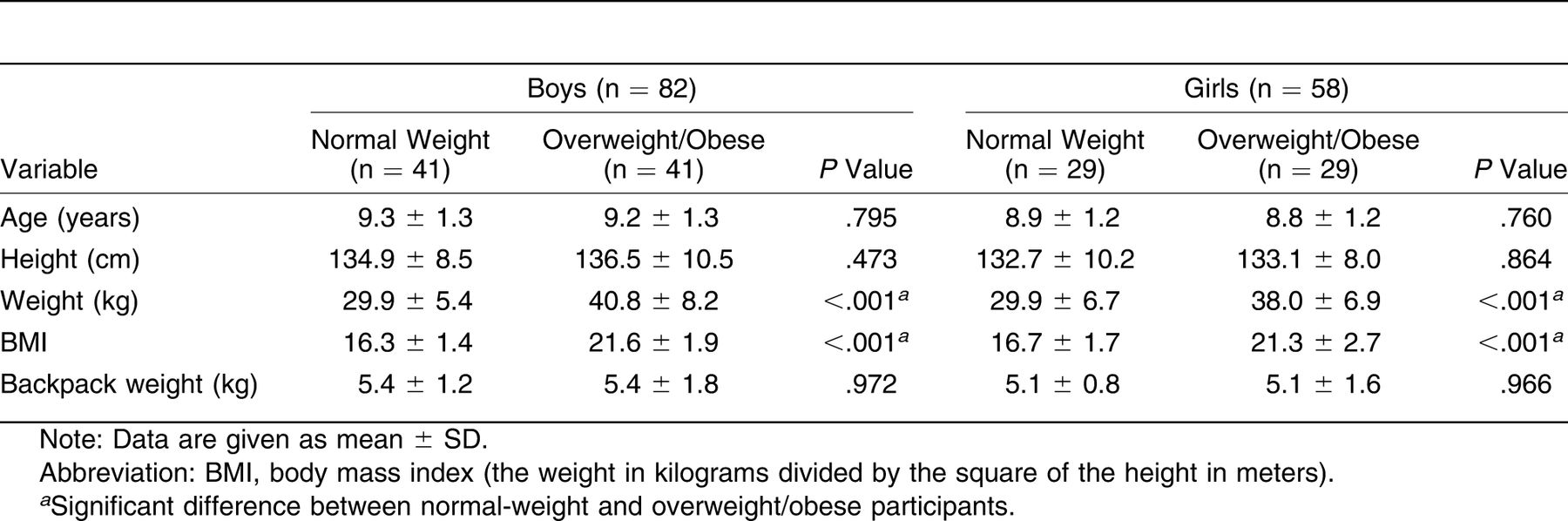
Classification of children as overweight or obese was based on the body mass index (the weight in kilograms divided by the square of the height in meters) determined for each. Measured body weight was reduced by 1 kg for all of the participants to account for the presence of clothes (typically lightweight considering the season and the environmental climate of Sardinia). Body mass index values were compared with cutoff points defined by Cole et al[20] to classify children as normal weight, overweight, or obese. This procedure resulted in the selection of 70 overweight and obese children (41 boys and 29 girls), which formed the study group. An equal number of normal-weight children, matched for age and sex, were recruited as a control group. Independent samples t tests revealed significant differences between the two groups in terms of body weight and body mass index (Table 1); backpack load was similar.
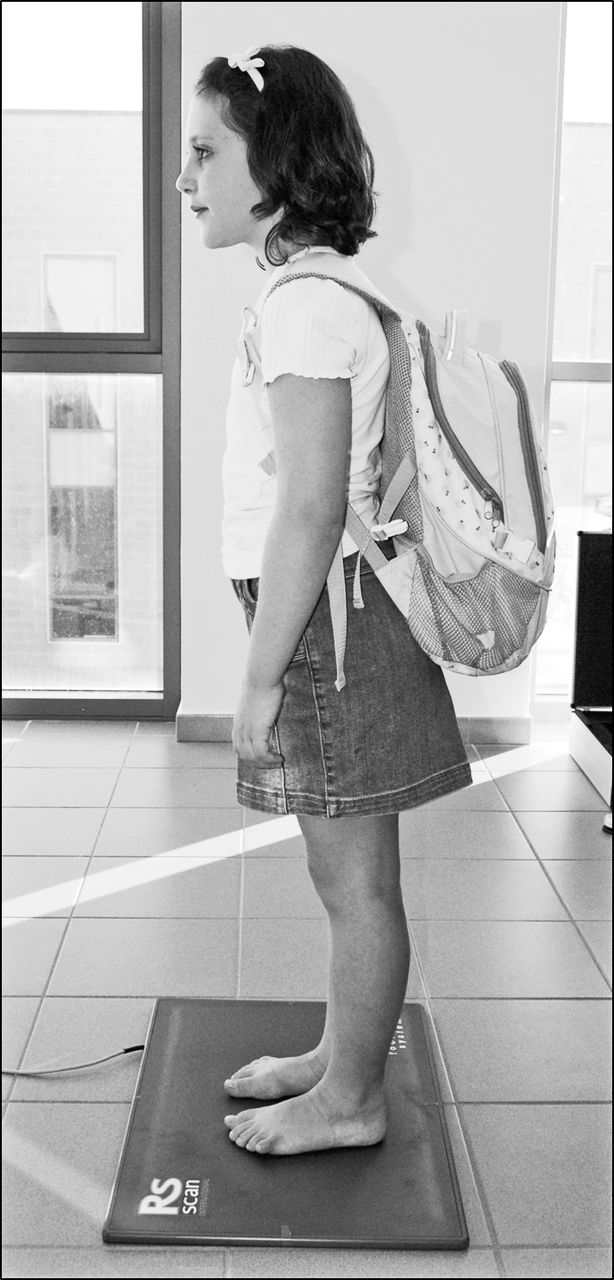
To ensure that backpacks were “normally” packed, experimental tests were randomly performed on regular school days (ie, children were aware of the ongoing study but not of the exact date of the test sessions). At the time of measurements, children were called in pairs into a dedicated quiet room with their backpacks loaded with the same items as when they entered school. After shoe removal, stature, body weight, and backpack weight were recorded. Participants were then helped to find a comfortable standing position on the pressure plate (see the next subsection), with their arms freely positioned along their legs and their gaze fixed on their reflected image in a mirror. To ensure a common reference position, children were also asked to place their feet over two 30°-oriented footprints traced on a paper sheet that was firmly attached to the plate surface. After a suitable adaptation time, an initial 30-sec measurement of plantar pressure was performed without a backpack. Subsequently, participants were given a short rest period and then were asked to put on their backpack, and a second sample was obtained (Fig. 1).
Table 1.
Anthropometric Data for the 140 Children Included in the Study
Data Acquisition and Postprocessing
Plantar pressure measurements were obtained using a Footscan 0.5 system (RSscan International, Olen, Belgium) composed of a pressure-sensitive plate (4,096 sensing elements, 7.62 × 5.08 mm, arranged in a 64 × 64 matrix) and connected via USB interface to a personal computer. The force measured by each sensor was sampled at 33 Hz, and 1,000 temporal frames were acquired and exported for further processing by means of dedicated management software (Footscan Balance; RSscan). Using custom software (developed in the Matlab [The MathWorks Inc, Natick, Massachusetts] environment), the following parameters were calculated on a frame-by-frame basis: overall and subregion contact areas according to the method of Cavanagh and Rodgers,[21] pressure distribution (including the magnitude and location of the maximum peaks), center of pressure coordinates, and arch index.[21] For each parameter, the mean value across the 1,000 frames was obtained as representative of the whole trial.
Figure 1.
Example of a schoolchild wearing a backpack while positioned on the pressure plate for the tests.
The effects of backpack carriage on the foot-ground interaction were assessed using separate two-way, mixed-factor, analyses of variance, where the independent variables were body status (overweight/obese and normal weight) and backpack presence. The specific dependent variables were total contact area, subregion contact area (rearfoot, midfoot, and forefoot), arch index, and peak pressures in the forefoot, midfoot, and rearfoot. The level of significance was set at P < .05. When relevant, post hoc Holm-Sidak tests for pairwise comparison were used to assess intragroup and intergroup differences. Initially, results were screened to determine whether the foot-ground contact parameters of interest were influenced by sex or differed bilaterally. A two-way analysis of variance revealed no difference between the left and right sides. Significant differences between boys and girls were found for overall foot-ground contact area (P = .018), with boys having larger rearfoot and forefoot areas (P = .049 and P = .003, respectively). Thus, the results described herein are limited to the right foot and are presented separately by sex.
Results
Foot-ground contact area results are summarized in Table 2. Obese boys had significantly larger contact areas in terms of overall values (P < .001) and specific rearfoot, midfoot, and forefoot area values (P < .001 for each of the three subregions). Backpack carriage increased overall contact area (P < .001) as well as midfoot and forefoot (but not rearfoot) areas (P = .013 and P < .001, respectively). Post hoc analysis indicated that the presence of the backpack affected midfoot contact area only in the normal-weight group. No interactions between obesity status and backpack presence were found. Similar results were observed for girls, for whom overall, rearfoot, midfoot, and forefoot contact area values were all significantly influenced by obesity (P < .001 for each). Presence of the backpack significantly increased overall contact area (P = .003), although this increase differed among subregions. Specifically, there were significant increases only in the forefoot (P = .006), with smaller and nonsignificant increases in the midfoot and rearfoot.
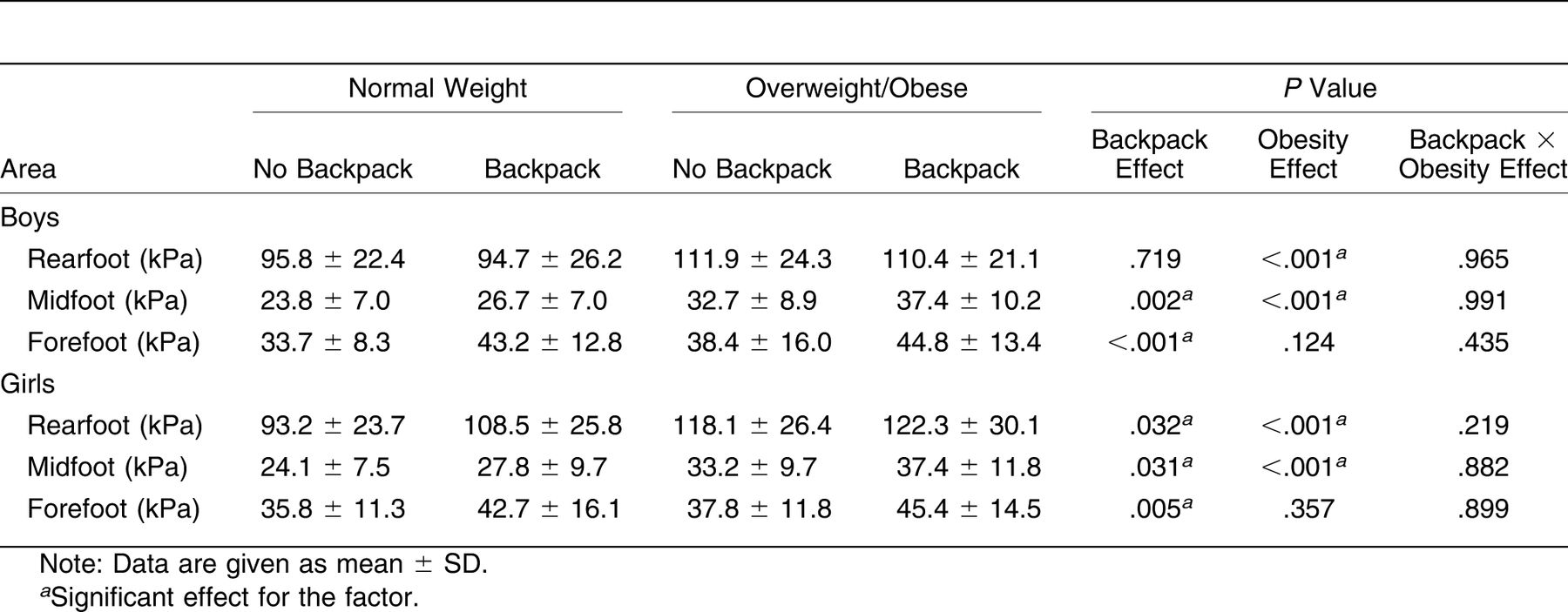
Plantar pressure values are summarized in Table 3. Among boys, and without the backpack, obesity was associated with significantly higher peak plantar pressures in the rearfoot and midfoot (by 17% and 37%, respectively; P < .001), but not in the forefoot. While wearing the backpack, overweight/obese boys had significantly higher peak pressures in the midfoot (P = .002) and forefoot (P < .001), by 13% and 22%, respectively, versus normal-weight boys. No interactive effects of obesity × backpack were found (Fig. 2A). The effect of excess mass on girls’ plantar pressures was similar, as midfoot and rearfoot peak values were significantly higher in the overweight/obese group (38% and 27%, respectively, higher for the no backpack condition; P < .001) and no substantial modifications took place in the forefoot (Fig. 2B). In contrast to boys, however, girls wearing a backpack had increased peak pressure values for all of the plantar subregions (P = .032 for the rearfoot, P = .031 for the midfoot, and P = .005 for the forefoot), with the largest effect observed in the forefoot (a 20% increase).
Table 2.
Contact Area Values for Overweight/Obese and Normal-Weight Children in the Absence and Presence of a Backpack
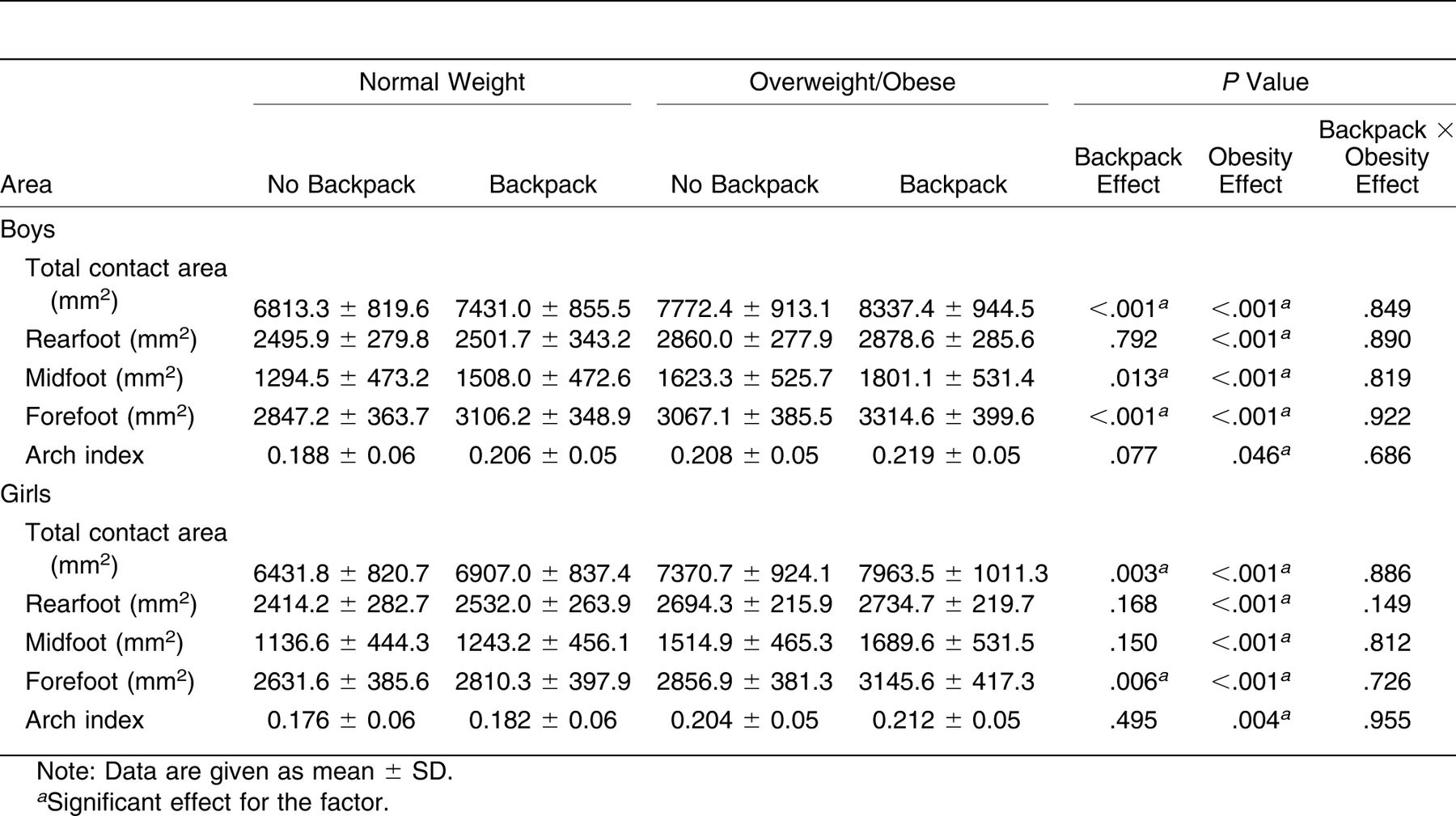
Table 3.
Plantar Pressure Values for Overweight/Obese and Normal-Weight Children in the Absence and Presence of a Backpack
The arch index was significantly higher in the overweight/obese group (boys, P = .046; girls, P = .004) but was not influenced by the presence of the backpack. In the normal-weight and overweight/obese groups, wearing the backpack caused a significant anterior shift in center of pressure (ie, toward the forefoot) (P = .002). The magnitude of this shift was 4 to 8 mm and was not influenced by obesity.
Discussion
Foot-Ground Contact: General Considerations
Although the foot structure and foot-ground interactions of obese children have been investigated only recently, most studies agree on the presence of some distinctive features, such as larger contact areas, increased contact pressures, and higher arch index values.[4–13] Similar differences were found in the present sample of schoolchildren, and overweight children were characterized by larger contact areas in all three subregions investigated. Quantitatively, the mean footprint size of the sample is in agreement with values reported by Dowling et al,[11] being approximately 6,000 and 8,000 mm2 for the normal-weight and overweight/obese groups, respectively.
It is somewhat difficult to directly compare static peak pressure results because some studies report only a single overall value for static conditions,[5,11] or no values[6] if they are more interested in testing dynamic conditions. To our knowledge, only one previous study[13] analyzed pressures in different subregions in detail and found that obesity mainly affected the midfoot and lateral forefoot. Although the present data confirm increases in the midfoot, a rearfoot increase was also observed, although no significant effects on the forefoot were evident. These differences might be explained by differences in the sample size and equipment used (ie, pressure plate versus insole system). Nevertheless, note that a generalized increase in static peak pressures for obese individuals was reported by Hills et al[22] in adults in the rearfoot, midfoot, and some metatarsal regions. Dowling et al[11] reported an overall peak pressure of 150 to 165 kPa for a group of 13 obese children whose mean age was 8.8 years. This pressure is 20% higher than that observed in the present study, and a similar difference exists between the present data and forefoot and midfoot pressure values given by Filippin et al.[13] Generally, the values presented herein are consistent with those reported by Cavanagh et al[23] from 107 adults of 135, 23.5, and 47.9 kPa for the rearfoot, midfoot, and forefoot, respectively.
Load Effects
Very little information is available on foot-ground contact alterations in obese individuals who carry additional loads (such as a backpack). Dowling et al,[5] though, tested obese and normal-weight children by applying an additional, evenly distributed load in the form of a jacket with weight equal to 20% of the participant’s weight. This was done to verify the effects of excess mass on static and dynamic plantar pressure distributions and to estimate the long-term consequences of obesity on the same parameters. They found that the additional load significantly increased overall static peak pressure and peak pressures in the rearfoot and forefoot (the midfoot was not considered) during level walking. This experiment is, to some extent, similar to the current one performed on schoolchildren, although loading a child with a school backpack differs in terms of biomechanical effects, mainly because the load is localized on the back and its magnitude is slightly lower. Herein, the mean backpack weight corresponded to a backpack to body weight ratio of approximately 16% to 17% for normal-weight children and 13% to 14% for overweight/obese children. However, the general result regarding significant increases in peak pressures is comparable between the two studies. Specifically, we observed a mean increase in peak plantar pressure of 10% to 30% depending on the plantar subregion considered, and Dowling et al[5] observed increases of 23% to 36% in the overall peak pressure.
Figure 2.
Mean ± SD Foot-ground contact pressure peaks for overweight/obese and normal-weight boys (A) and girls (B) in the absence and presence of a backpack. Asterisks indicate statistically significant difference (P < .05).
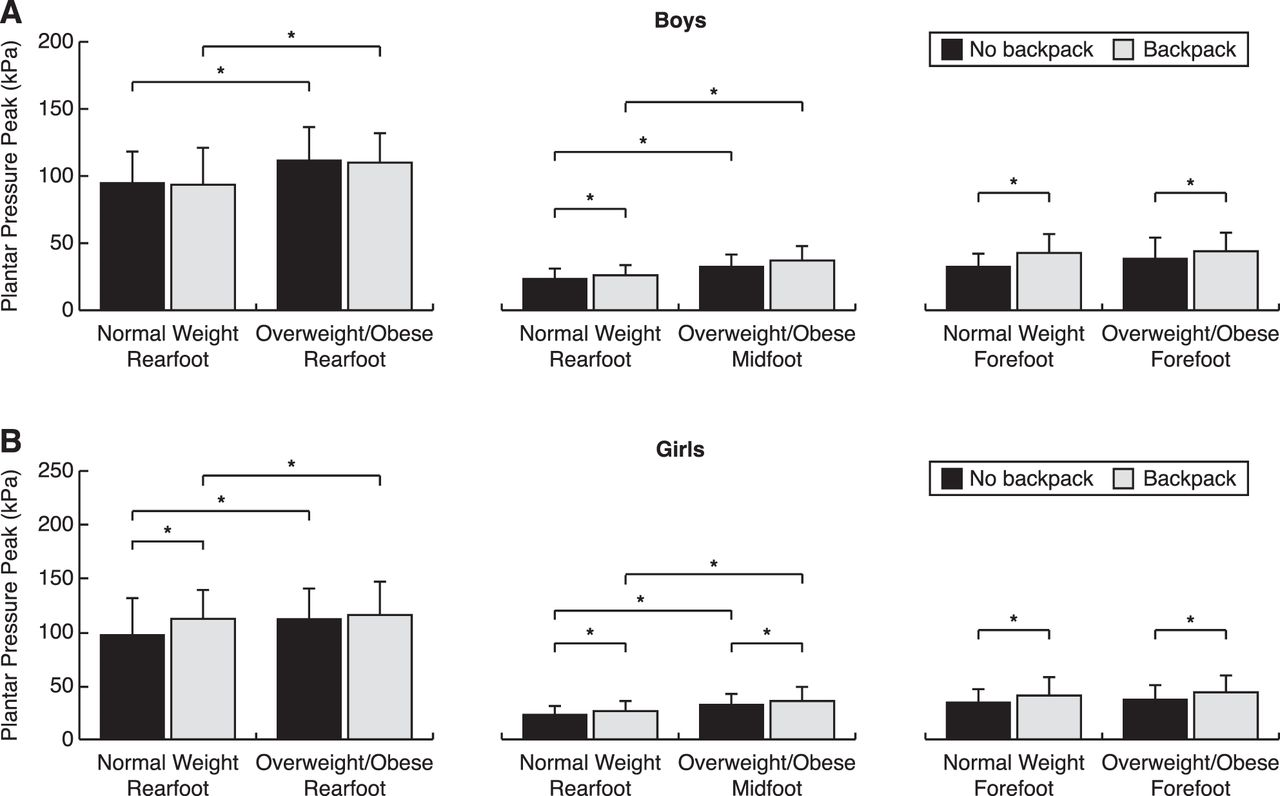
Thus, it is confirmed that the presence of an extra load, in addition to the physiologic one, significantly modifies the foot-ground interaction, and this effect seems to occur in a similar manner in normal-weight and obese/overweight children. For a school backpack, moreover, such alterations do not involve a uniform increase in plantar pressure in different contact regions but rather a modification of the physiologic patterns. If we consider the ratio of loaded to unloaded peak pressure values, this value tends to increase when moving from the rearfoot to the forefoot. In the present sample, mean values were 1.04, 1.14, and 1.20 for the rearfoot, midfoot, and forefoot, respectively. This pressure modification also has consequences in terms of the observed forward shift of the center of pressure position (toward the toes). This shift is consistent with what was previously reported by Sako et al[24] for the case of a backpack worn in a low position and, to some extent, similar to the findings of Demura et al,[25] who found that center of pressure tends to shift in the direction of a carried load. To explain this, we have to consider the postural adjustments unconsciously performed to bear a load on the back. As pointed out in previous studies,[26,27] the presence of a backpack induces a forward inclination of the trunk, presumably to counterbalance the posterior shift of the combined body-backpack system center of mass and to keep the center of mass within the base of support and, thereby, ensure stability. In principle, the result of such an action should be a restoration of the original center of mass position. In children, and perhaps owing to incomplete maturation of the postural control system, there seems to be an “overreaction” to the balance threat imposed by wearing a backpack, in which the center of mass (and, consequently, the center of pressure) tends to move forward with respect to the original position normally maintained during quiet stance.
Overall, overweight/obese and normal-weight schoolchildren share the same potential adverse effects caused by backpack carriage in terms of altered plantar pressure patterns and increased stress magnitude. This is especially the case when the load is near or above the 10% to 15% threshold considered safe by the scientific community. These effects are more critical in the case of obese children, as they already experience higher values of plantar pressures. Although the long-term consequences of childhood obesity on foot structure and functionality are still not fully understood, it has been recognized that obese adults are more prone to a variety of foot diseases, such as tendinitis, plantar fasciitis, and osteoarthritis.[28,29] Thus, it can be supposed that a long history of obesity, starting during childhood, may represent a cofactor that contributes to the onset of such problems. Moreover, some authors hypothesize that excessive plantar pressure can compromise the quality and quantity of afferent information supplied by plantar mechanoreceptors to the postural control system, which regulates body sway oscillations.[30,31] Thus, static balance is threatened twice when a heavy backpack is carried: first for biomechanical reasons[16] and second because the increased contact pressure tends to oversaturate the plantar receptors.
An important limitation of the present study, which will be the subject of future investigations, is the static nature of the tests performed. Even simple daily activities that children perform in the presence of a load (level walking, stair ascent or descent, etc) lead to dynamic pressures that are much larger than those observed herein.[32] It would, thus, be interesting to perform tests (using an insole system, for example) to monitor plantar pressure patterns during such activities. Only a single testing trial was performed herein, which involved simultaneous information about plantar pressures and postural sway. We also used a particular foot position, which could affect lower-extremity alignment. This position could make the foot appear overpronated or supinated with respect to a more neutral, resting, calcaneal stance position. Future work is needed to examine the generalizability of the present results. Last, use of longitudinal studies would be of value to verify the evolution of plantar pressure patterns during childhood and adolescence and to help in understanding if and how obesity modifies the foot-ground relationship during musculoskeletal development.
Conclusions
Among other problems, childhood obesity alters the physiologic foot-ground relationship because the excess mass is responsible for higher values of plantar pressure peaks and altered foot structure. The present study investigated whether further negative consequences on foot functionality might exist when an asymmetrical load localized on the back is added. A better knowledge of these phenomena might be of some interest because children, typically from age 6 years, are required to carry loads frequently for their school activities. The major results of the present study are as follows:
- 1)
- Overweight/obese children have significantly larger foot-ground contact areas, higher plantar pressures, and a higher arch index.
- 2)
- With an additional backpack load, the physiologic foot-ground relationship is altered, with increased contact areas (particularly the forefoot and midfoot) and increased peak pressures. Moreover, the way the body-plus-backpack load is transmitted to the ground changes, with center of pressure shifted toward the toes.
- 3)
- Although the backpack load seemed to have comparable effects on plantar pressures in normal-weight and overweight/obese children, these effects may be especially problematic for the latter as they already have elevated pressures resulting from their physical status.
As a result of these changes/effects, overweight/obese children may experience very high plantar stress even during apparently simple, low-effort activities, such as quiet upright stance. Furthermore, it can be hypothesized that other daily motor tasks, such as walking, running, and stair ascent/descent, may increase the stress to even higher levels. Together with other factors (such as inadequate footwear, for example), the prolonged and repeated exposure to excessive plantar stress may, in the long-term, induce foot discomfort, overuse problems, or actual foot diseases.
Acknowledgment
The directors of the schools involved in the research (Prof. Maria Marcella Vacca and Prof. Valentina Savona) and the teacher Enrica Collu for their invaluable support in the organization of test sessions; Ms. Elisa Priolo for postural and anthropometric data acquisition; and Dr. Maury Nussbaum for valuable comments and suggestions.
Financial Disclosure
This study was supported by the University of Cagliari.
Conflict of Interest
None reported.
References
- Binkin, N, GFontana, CLamberti, et al. :A national survey of the prevalence of childhood overweight and obesity in Italy. .Obes Rev11::2. ,2009. .
- Wearing, SC, EMHennig, NMByrne, et al. :The impact of childhood obesity on musculoskeletal form. .Obes Rev7::209. ,2006. .
- McGraw, B, BAMcClenaghan, HGWilliams, et al. :Gait and postural stability in obese and nonobese prepubertal boys. .Arch Phys Med Rehabil81::484. ,2000. .
- Riddiford-Harland, DL, JRSteele, and LHStorlien. :Does obesity influence foot structure in prepubescent children?Int J Obes24::541. ,2000. .
- Dowling, AM, JRSteele, and LABaur. :Does obesity influence foot structure and plantar pressure patterns in prepubescent children?Int J Obes25::845. ,2001. .
- Mickle, KJ, JRSteele, and BJMunro. :Does excess mass affect plantar pressure in young children?Int J Pediatr Obes1::183. ,2006. .
- Villaroya, MA, JMEsquivel, CTomas, et al. :Foot structure in overweight and obese children. .Int J Pediatr Obes3::39. ,2004. .
- Morrison, SC, BRDurward, GFWatt, et al. :Anthropometric foot structure of peripubescent children with excessive versus normal body mass. .JAPMA97::366. ,2007. .
- Mauch, M, SGrau, IKrauss, et al. :Foot morphology of normal, underweight and overweight children. .Int J Obes32::1068. ,2008. .
- Riddiford-Harland, DL, JRSteele, and LABaur. :Are the feet of obese children fat or flat? revisiting the debate. .Int J Obes35::115. ,2011. .
- Dowling, AM, JRSteele, and LABaur. :What are the effects of obesity in children on plantar pressure distributions?Int J Obes28::1514. ,2004. .
- Filippin, NT, Tde Almeida Bacarin, and PHLobo da Costa. :Comparison of static footprints and pedobarography in obese and non-obese children. .Foot Ankle Int29::1141. ,2008. .
- Filippin, NT, VLPBarbosa, ICNSacco, et al. :Effects of obesity on plantar pressure distribution in children. .Rev Bras Fisioter11::495. ,2007. .
- Brackley, HM and JMStevenson. :Are children’s backpack weight limits enough? a critical review of the relevant literature. .Spine19::2184. ,2004. .
- Skaggs, DL, SDEarly, PD’Ambra, et al. :Back pain and backpacks in school children. .J Pediatr Orthop26::358. ,2006. .
- Pau, M and MPau. :Postural sway modifications induced by backpack carriage in primary school children: a case study in Italy. .Ergonomics53::872. ,2010. .
- Pascoe, DD, DEPascoe, YTWang, et al. :Influence of carrying book bags in gait cycle and posture of youths. .Ergonomics40::631. ,1997. .
- Hong, Y and GPBrueggemann. :Changes in gait patterns in 10-year-old boys with increasing loads when walking on a treadmill. .Gait Posture11::254. ,2000. .
- Wearing, SC, EMHennig, NMByrne, et al. :Musculoskeletal disorders associated with obesity: a biomechanical perspective. .Obes Rev7::239. ,2006. .
- Cole, T, MCBellizzi, KMFlegal, et al. :Establishing a standard definition for child overweight and obesity worldwide: international survey. .BMJ320::1. ,2000. .
- Cavanagh, PR and MMRodgers. :The arch index: a useful measure from footprints. .J Biomech20::547. ,1987. .
- Hills, AP, EMHennig, MMcDonald, et al. :Plantar pressure differences between obese and non-obese adults: a biomechanical analysis. .Int J Obes25::1674. ,2001. .
- Cavanagh, PR, MMRodgers, and AIiboshi. :Pressure distribution under symptom free feet during barefoot standings. .Foot Ankle Int7::262. ,1987. .
- Sako, H, MKawahara, and HTanaka. :The effects of the load mass and load position on body sway in supporting a load on the back. .J Hum Ergol33::55. ,2004. .
- Demura, S, MUchiyama, TYamada, et al. :Effect of bag holding on the center of foot pressure and the lower leg muscle activities. .Eur J Sports Sci5::89. ,2005. .
- Goh, JH, KThambyah, and KBose. :Effects of varying backpack loads on peak forces in the lumbosacral spine during walking. .Clin Biomech (Bristol, Avon)13( suppl 1:):S26.,1998. .
- Singh, T and MKoh. :Effects of backpack load and position on spatiotemporal parameters and trunk forward lean. .Gait Posture29::49. ,2009. .
- Frey, C and JZamora. :The effects of obesity on orthopedic foot and ankle pathology. .Foot Ankle Int28::996. ,2007. .
- Anandacoomarasamy, A, MFransen, and LMarch. :Obesity and the musculoskeletal system. .Curr Opin Rheumatol21::71. ,2009. .
- Hue, O, MSimoneau, JMarcotte, et al. :Body weight is a strong predictor of postural stability. .Gait Posture26::32. ,2007. .
- Teasdale, N, OHue, JMarcotte, et al. :Reducing weight increases postural stability in obese and morbid obese men. .Int J Obes31::153. ,2007. .
- Kellis, E. :Plantar pressure distribution during barefoot standing, walking and landing in preschool boys. .Gait Posture14::92. ,2001. .
© 2013 American Podiatric Medical Association