


Abstract
Background: To our knowledge, hand dominance and side of foot disorders has not been described in the literature. We sought to evaluate whether hand dominance was associated with ipsilateral foot disorders in community-dwelling older men and women. Methods: Data were from the Framingham Foot Study (N = 2,089, examined 2002–2008). Hand preference for writing was used to classify hand dominance. Foot disorders and side of disorders were based on validated foot examination findings. Generalized linear models with generalized estimating equations were used to estimate odds ratios and 95% confidence intervals, accounting for intraperson variability. Results: Left-handed people were less likely to have foot pain or any foot disorders ipsilateral but were more likely to have hallux valgus ipsilateral to the left hand. Among right-handed people, the following statistically significant increased odds of having an ipsilateral versus contralateral foot disorder were seen: 30% for Morton’s neuroma, 18% for hammer toes, 21% for lesser toe deformity, and a twofold increased odds of any foot disorder; there was a 17% decreased odds for Tailor’s bunion and an 11% decreased odds for pes cavus. Conclusions: For the 2,089 study participants, certain forefoot disorders were shown to be ipsilateral and others were contralateral to the dominant hand. Future studies should examine whether the same biological mechanism that explains ipsilateral hand and foot preference may explain ipsilateral hand dominance and forefoot disorders. (J Am Podiatr Med Assoc 103(1): 16–23, 2013)
An individual’s predilection for being right-handed or left-handed was thought to be in synchronization with the person’s side of foot preference. Indeed, side of hand and foot preference seemed to be highly correlated. In a study of 7,364 children, Nachshon et al[1] found that more than 80% of the children preferred the right hand along with the right foot, and it was believed that cerebral dominance affected both hand and foot dominance. Although it is unknown whether these observations in children are easily transferable to an adult population, work in adults agrees with the premise of cerebral dominance. In a study of 5,064 adults, Dargent-Paré et al[2] found that foot preference was significantly associated with hand dominance, and only 5% had a cross-preference between hand and foot. In a study by Barut et al,[3] 90% of right-handed women 18 to 42 years of age preferred their right foot compared with 76% of their male counterparts; for left-handed women, it was 79% who preferred their left foot compared with 57% of their male counterparts. Among older adults, Kumar et al[4] found that in a population of mostly men 56 to 83 years of age, 94% had right-side dominance of both hand and foot and that right-side dominance increased with increasing age. Thus, dominance of “handedness” seemed to operate in accord with dominance of “footedness” for most persons, although foot preference may depend on the context of a specific foot task.
In addition to side of hand and foot preference, side of hand dominance was also believed to be a risk factor for trauma and injuries. In a study of middle school and high school students, a significantly higher proportion of left-handers reported seeing a physician for treatment of an injury in the past year, being hospitalized for injury treatment, or requiring surgery because of an injury compared with right-handers.[5] Also, left-handed college students were at increased risk for accidental injuries and had a higher risk of being injured in multiple categories of activities compared with right-handed students.[6] It is unclear whether injuries in a student population transfer to similar results for older individuals and also whether it makes a difference if the injury is to the lower or upper extremity. Nevertheless, left-hand dominance was shown to be a risk factor for proximal humerus fractures[7] and falls in older adults.[8]
Many clinicians thought that side of hand preference may carry over to side of clinical foot disorders. Anecdotally, some clinicians have noticed a link between heel, Achilles, and bunion pain with ipsilateral hand dominance. To our knowledge, hand dominance and side of foot disorders has not been described in the literature. Moving beyond these clinical observations, we believe that this study provides the first population-based insights into whether side of foot disorders is related to hand dominance. The purpose of this study was to evaluate whether hand dominance is associated with ipsilateral foot disorders in community-dwelling older men and women.
Methods
Population
The Framingham Foot Study, an ancillary study of the Framingham Heart Study, occurred between 2002 and 2008 and included members of the Framingham Offspring Cohort. The Framingham Offspring Cohort, formed in 1971, comprised the adult offspring (and their spouses) of the Framingham Heart Study cohort members (a population-based sample of two-thirds of the town of Framingham, Massachusetts, enrolled in 1948–1951).[9] The Framingham Offspring Cohort has been seen at 4-year intervals since cohort inception, and the Framingham Foot Study occurred as an ancillary study to the parent Framingham Study. Members of the Framingham Offspring Cohort had previously been queried about their hand dominance; in general, participants in this age group were not forced to use only their right hands during their school years. Between 2002 and 2008, members of the Framingham Offspring Cohort were examined in the Framingham Foot Study, including side of any observed foot disorder. All of the participants were ambulatory, cognitively intact, and able to give informed consent for the study procedures. Of the 2,181 Framingham Offspring Cohort participants, 30 were missing hand dominance data, 48 were missing data on foot disorders, eight were excluded because of foot ulcerations, and six were excluded because of amputated toes, leaving data from 2,089 people for the present analysis. In this cross-sectional observational study, most of the study participants had no missing data on the variables of interest. The institutional review boards of Hebrew SeniorLife and Boston University Medical Center (both in Boston, Massachusetts) approved this study, and all of the participants provided signed informed consent.
Hand Dominance
At the Framingham Offspring examination cycle between 1996 and 1999 and before the start of the Framingham Foot Study, participants were asked to identify which hand they preferred for writing. Using this hand preference information, we classified hand dominance as either left-handed or right-handed; no participants were identified as being ambidextrous.
Foot Conditions and Disorders
During the Framingham Foot Study, trained research nurses conducted physical examinations of participants’ feet; collected data on medical history, performance measures, and plantar pressures using a computerized mat; and administered risk assessment questionnaires. We used a validated foot examination with specific criteria[10] to assess approximately 20 foot disorders and foot symptoms (eg, self-reported foot pain present on most days in a month) and collected information on side of each foot disorder (right, left, or bilateral). We excluded ankle conditions and focused on foot disorders that were considered structural, sensory, or pain related. Specific disorders of interest included hallux valgus, Tailor’s bunion, hallux rigidus, plantar fasciitis, and Morton’s neuroma. In addition, we included foot pain, pes cavus, and pes planus. Hammer toes, claw toes, and overlapping toes were also included as individual disorders and were summarized together as any lesser toe deformity. We created a summary variable of any bunions (hallux valgus or Tailor’s bunion) and a variable that indicated the presence of any of the 11 previously mentioned foot disorders or conditions.
The structural foot disorders were indicated as present or absent based on an atlas with a pictorial depiction of each foot disorder. For example, hallux valgus was defined as the angular deviation of the hallux with respect to the first metatarsal bone toward the lesser toes at 15° or more and appears as a medial bony enlargement of the first metatarsal head.[11] The toe disorders were also based on pictorial depiction (hammer toe, claw toe, and overlapping toes). Pain-related disorders were evaluated as follows: hallux rigidus was defined as no motion possible in the range of motion of the hallux during examination; plantar fasciitis was defined as pain elicited on the examiner exerting 5 lb of force (22 N) at the site of the plantar fascia insert, with the examiner using a calibrated device to estimate 5 lb (22 N) of force before an examination and then exerting this level of pressure to evaluate whether pain was present at the plantar fasciitis site. Although other methods exist to indicate Morton’s neuroma, we defined this condition as pain elicited on exerting 5 lb of force (22 N) at the base of the third or fourth toe. Modeling after the query in the National Health and Nutrition Examination Survey on site-specific joint pain, the presence of foot pain was identified based on a participant’s response to the following question: “On most days do you have pain, aching, or stiffness in either of your feet?”
We defined pes planus and pes cavus by using a foot pressure mat (MatScan; Tekscan Inc, South Boston, Massachusetts). With the computerized mat, foot pressure data from each foot were collected with the participant standing quietly on the pressure-sensing device with his or her body weight distributed equally over both feet as described previously.[11] Briefly, a plot of the maximum pressure throughout bipedal quiet stance was obtained, and the Staheli arch index, the ratio of arch width to rearfoot width, was calculated. More specifically, the ratio of the smallest medial to lateral width of the arch region was divided by the largest medial to lateral width of the heel region (to the nearest 0.01 cm).[12] The Staheli arch index increased with an increasingly planus foot, with pes planus defined as having an arch width of 75% or more of the heel width on the foot. We chose the 75% cutoff point for the weightbearing Staheli arch index based on our unpublished previous work from the Framingham Foot Study. These data have shown that the cutoff point incorporated all of the persons with a clinical impression of pes planus and none of those without pes planus. Pes cavus was defined for each foot as having a weightbearing arch index of 0, regardless of the heel width on the foot.
Covariates
Selected covariate data were collected at the Framingham Foot Study examination, including age (years), sex, height, and weight. Weight in light clothing was measured using a calibrated balance beam scale to the nearest 0.5 lb, and standing height (without shoes) was measured using a standardized stadiometer to the nearest 0.25 inch. Weight and height were recalculated in kilograms and meters, respectively, to calculate body mass index (BMI) as weight in kilograms divided by height in meters squared. We then categorized BMI according to the World Health Organization definitions: less than 18.5 (underweight), 18.5 to 24.9 (normal weight), 25.0 to 29.9 (overweight), 30.0 to 34.9 (obese), 35.0 to 39.9 (very obese), and 40.0 or greater (morbidly obese).[13]
Statistical Analysis
We provided descriptive statistics for the study population using means, standard deviations, and percentages, as appropriate. We examined the descriptive statistics for side of foot condition or disorder (none, right, left, or bilateral) by hand dominance. Based on known associations of foot problems with age, sex, and BMI in categories of less than 25.0, 25.0 to 29.9, and 30.0 or greater, these variables were included in all of the adjusted models. For categorical variables, female was the reference group for sex, and the 25.0 to 29.9 group was the reference for BMI.
Generalized linear models with a logit link were used to calculate the crude and adjusted odds ratios and 95% confidence intervals between presence of sides of foot disorder and hand dominance. Generalized estimating equations were used to account for the intraperson variability of analyzing both feet per participant. Each foot condition or disorder was modeled separately, with the foot disorder of interest as the dependent variable and a variable indicating whether the foot being examined was on the same side as the dominant hand. Odds ratios indicate the odds of having the foot disorder on the same side as a participant’s dominant hand (ipsilateral) compared with having the foot disorder on the opposite side (contralateral). We could interpret these odds ratios as follows: there was a reduced risk of a given foot disorder being on the same side as the dominant hand; there was no risk of a given foot disorder being on the same side as the dominant hand; or there was an increased risk of a given foot disorder being on the same side as the dominant hand. We also repeated these generalized estimating equation analyses stratified by right- or left-hand dominance. All of the analyses were performed with the SAS statistical analysis package (version 9.1; SAS Institute, Inc, Cary, North Carolina).
Results
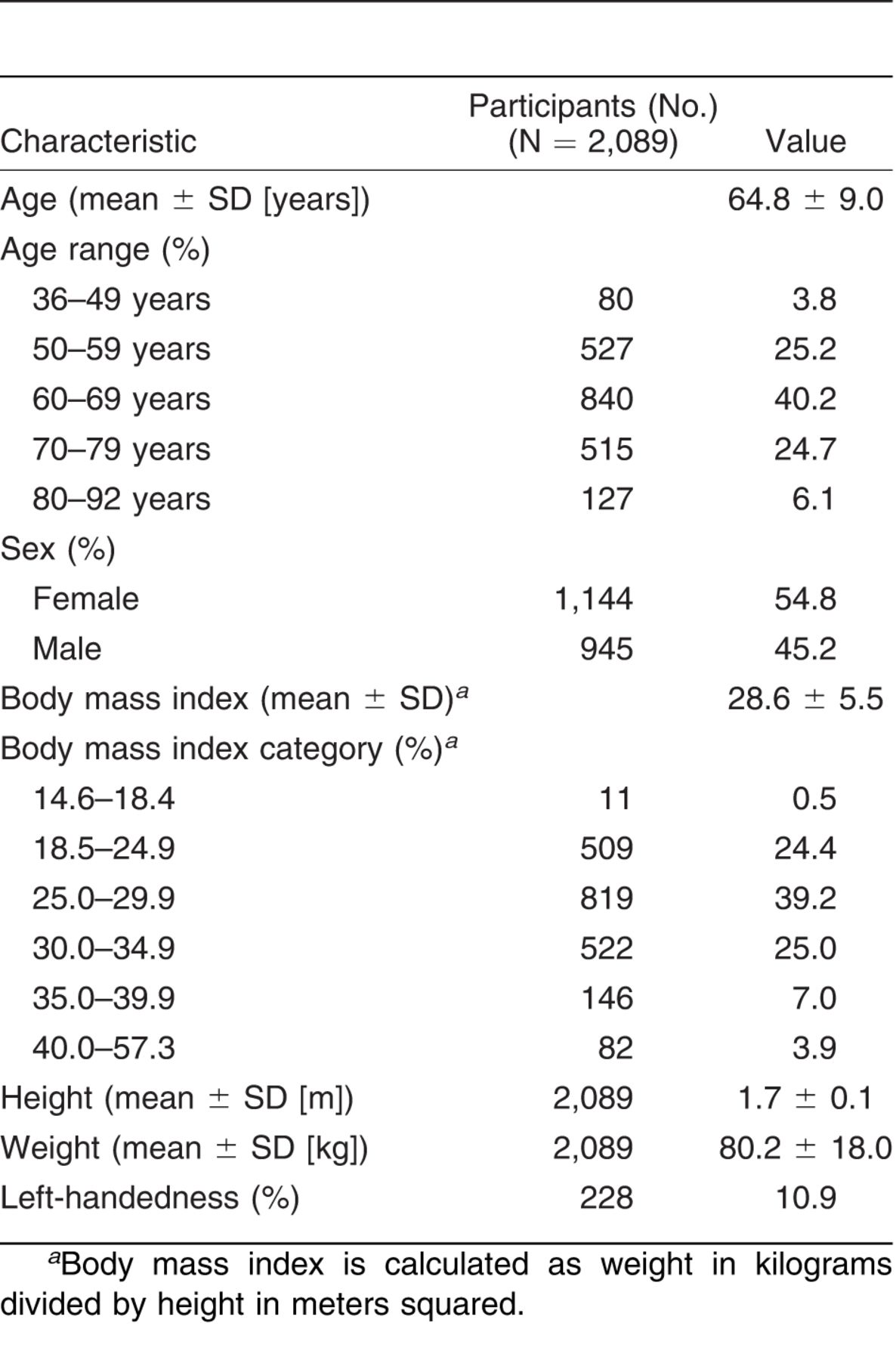
Table 1 describes the characteristics of the study cohort. The mean ± SD age was 64.8 ± 9.0 years, with 31% of the cohort being 70 years or older. Women made up 54.8% of the study participants. The mean ± SD BMI was 28.6 ± 5.5, with 35.9% of the study participants classified as obese to morbidly obese. Most of the study participants were right-handed (89.1%).
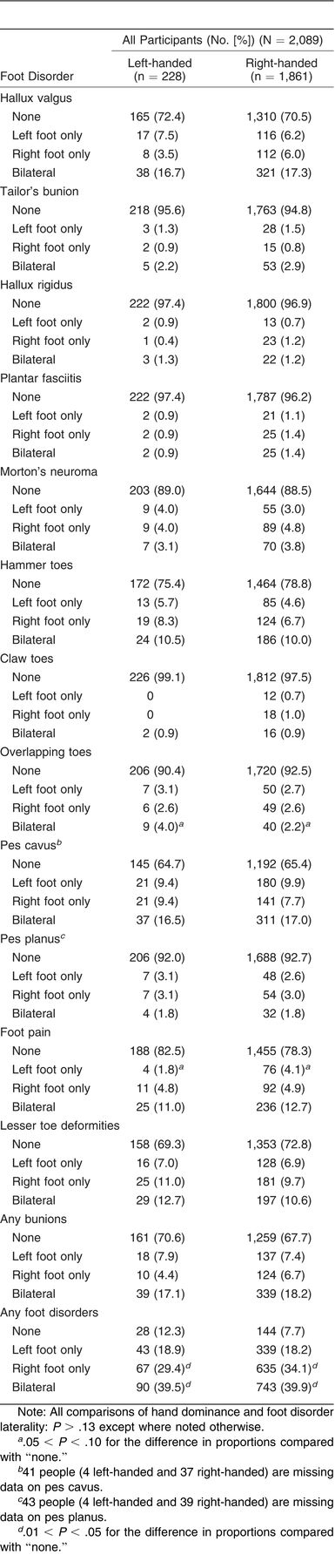
Subsequent results are organized by side of foot disorder and side of hand dominance (Table 2) and then by whether foot disorders were ipsilateral/contralateral to hand dominance, followed by results stratified by side of hand dominance (Table 3). Descriptive statistics on the distribution of side of foot disorders by side of hand dominance are presented in Table 2. There was no clear pattern of the prevalence of side of foot disorders by side of hand dominance. For example, more right-handed people had right-sided hallux valgus compared with those who were left-handed (6.0% versus 3.5%, P = .13), yet fewer left-handed people had left-sided foot pain compared with those who were right-handed (1.8% versus 4.1%, P = .08). When using a summary variable to indicate the presence of any of the foot disorders, more right-handed people had right-sided foot disorders compared with those who were left-handed (34.1% versus 29.4%, P = .01).
Table 1.
Characteristics of the Framingham Foot Study Population
We then considered whether the side of foot disorders was ipsilateral or contralateral to the side of the dominant hand. Although hand dominance was associated with older age (P = .0002) and being female (P = .008), age and sex along with BMI did not seem to confound the associations between hand dominance and side of foot disorders in this study, but they did improve precision. Therefore, we presented adjusted estimates from the generalized estimating equation analyses predicting the likelihood of having foot disorders on the same side as the dominant hand in Table 3, in addition to results stratified by side of the dominant hand.
Table 2.
Prevalence of Side of Foot Condition or Disorder by Side of Hand Dominance: the Framingham Foot Study
Compared with having a contralateral foot disorder regarding side of hand dominance, there was a 27% increased odds of having Morton’s neuroma ipsilateral to the dominant hand (95% CI, 1.07–1.51). Similarly, there was a 13% increased odds of having hammer toes (95% CI, 1.01–1.26), a 15% increased odds of having a lesser toe deformity (95% CI, 1.02–1.29), and a 79% increased odds of having any foot disorders (95% CI, 1.56–2.06), as well as a borderline statistically significant 29% increased odds of having hallux rigidux (95% CI, 0.97–1.72) ipsilateral to the dominant hand. However, there was an 11% decreased odds of having pes cavus (95% CI, 0.80–0.99) and a borderline statistically significant 14% decreased odds of having a Tailor’s bunion (95% CI, 0.72–1.02) ipsilateral to hand dominance.
Table 3.
Adjusted Odd Ratios of Hand Dominance and Ipsilateral Foot Condition or Disorder, Overall and by Side of Hand Dominance: the Framingham Foot Study
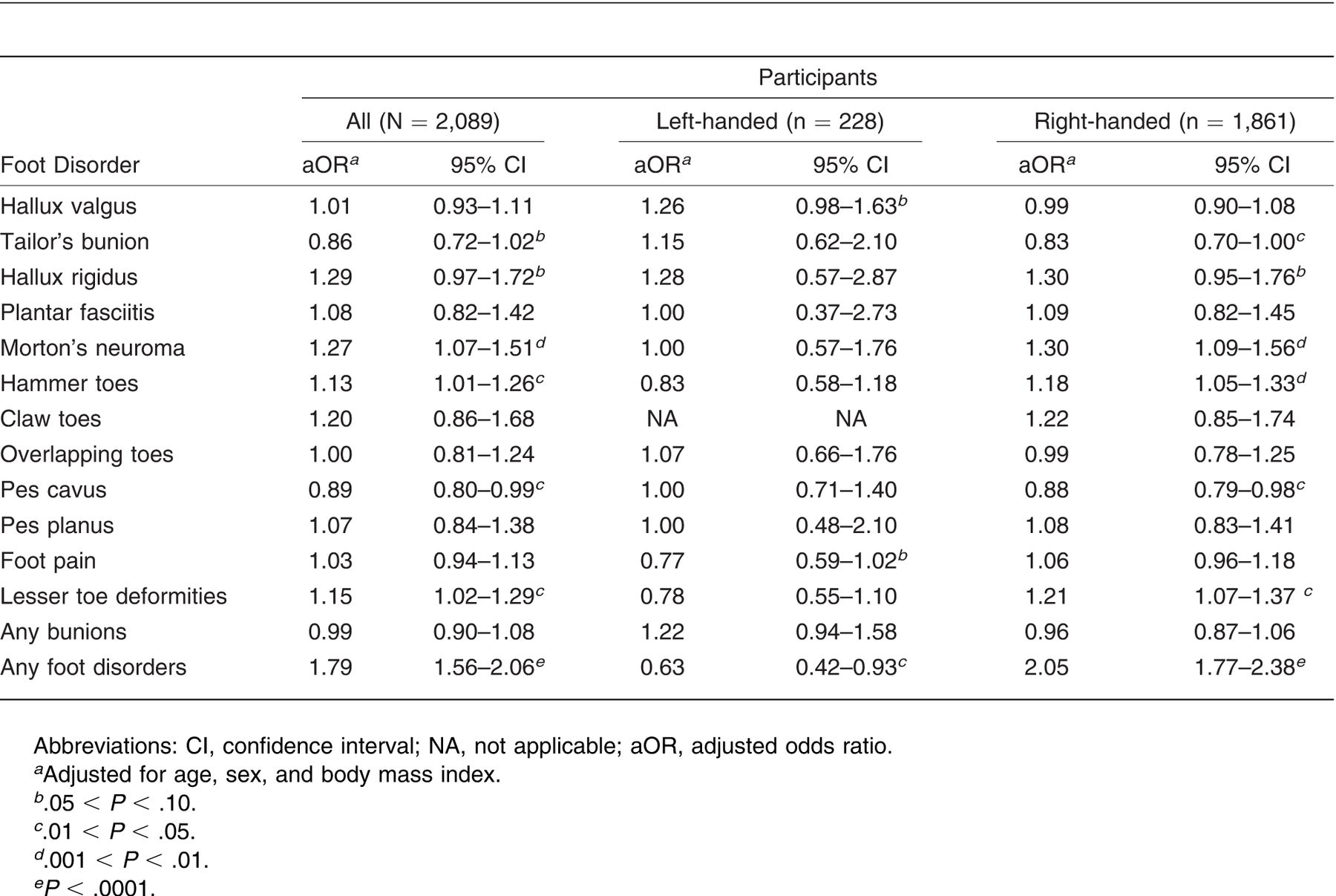
When we stratified the analysis according to side of hand dominance, the patterns of hand dominance and ipsilateral foot disorders for the previously mentioned specific foot disorders were slightly stronger in magnitude and remained significant for right-handed but not left-handed participants. In fact, there was a 37% decreased odds of any ipsilateral foot disorders (95% CI, 0.42–0.93). In addition, there was a suggested 23% decreased odds of ipsilateral foot pain (95% CI, 0.59–1.02) but a 26% increased odds of ipsilateral hallux valgus in left-handed people (95% CI, 0.98–1.63).
Discussion
In summary, right-handed people were more likely to have Morton’s neuroma, hammer toes, lesser toe deformities, and hallux rigidus ipsilateral to the dominant hand and to have pes cavus and Tailor’s bunion contralateral to the dominant hand. Left-handed people were less likely to have foot pain or any of the foot disorders ipsilateral to the dominant hand but were more likely to have hallux valgus ipsilateral to the dominant hand.
These data suggest that certain specific pedal pathologic abnormalities, and their status as ipsilateral or contralateral to the dominant hand, were more apparent for right-handed compared with left-handed people. It is possible that we had a comparatively large sample of right-handed people so not only were the estimates more stable but we also had more power to detect significant associations. Conversely, the sample of left-handed people was relatively small such that estimates of associations were less stable and we did not have the power to detect as many significant associations. In addition, although most right-handed people are right-footed, it is possible that left-handed people may have more cross-preference for preferred limb.[2–4] Thus, this cross-preference may explain the lower magnitude of association between hand dominance and side of foot disorders in left-handed people.
It is also possible, however, that there was a “foot preference” (the pedal analogy to hand dominance) that matched hand dominance in some individuals and that the same mechanism that resulted in ipsilateral hand and foot preference may have explained some of the associations between hand dominance and ipsilateral forefoot disorders. Although we did not query foot preference to allow us to explore this possibility in this study, we believe that there was more loading of the preferred limb during gait. Therefore, there may be more stress and microtrauma leading to a higher occurrence of foot disorders ipsilateral to the side of hand dominance. Moreover, if the dominant foot provided greater propulsive force while the nondominant foot provided more breaking force, the gait differences may explain the prevalence of more ipsilateral forefoot pathologic disorders associated with the dominant hand. This potential mechanism should be examined in future studies, as should whether foot preference was more directly associated with pedal pathologic abnormality prevalence than with hand dominance.
Several limitations to this study merit discussion. Classification of the side of hand dominance was based solely on self-report of the hand preferred for writing; other factors may have influenced dominant handedness and may have been more important, especially for people who were truly left-handed. Also, there exists the possibility of change in hand dominance owing to diminished fine motor control as a result of aging, or possibly because of injuries or strokes affecting one side of the body.[14] Therefore, it is possible that there is some classification error of hand dominance in this study. It was unlikely that this misclassification of hand dominance differed by side of foot disorders. Therefore, any nondifferential misclassification of hand dominance would have resulted in an underestimation of the actual magnitude of association between hand dominance and ipsilateral foot disorders (ie, these results may actually be conservative estimates of these associations). Furthermore, the study participants were predominantly of white race such that we have limited ability to generalize to other racial groups. Finally, we examined 11 relatively common foot disorders, which we classified only as present or absent without regard to severity; there may have been different associations with other foot disorders or with severe foot disorders that required podiatric surgery.
Despite these limitations, this study had several strengths. Notably, classification of specific foot disorders was based on clinically validated foot examinations, thus reducing the likelihood of misclassification or recall bias from self-report of foot disorders. Also, these data from the Framingham Foot Study were quite comprehensive, allowing us to study the association of hand dominance with many different types of foot disorders simultaneously. In addition, this study was conducted using a well-established cohort with large numbers of men and women and can be generalized to older white men and women.
In conclusion, certain forefoot disorders were shown to be ipsilateral, and other foot disorders were contralateral to the dominant hand depending on side of hand dominance in this sample of community-dwelling adults. Despite the anecdotal reports by clinicians noting a link between hand dominance and side of foot disorders, this study observed no single overall pattern, but rather we saw several interesting patterns specific to certain foot disorders or conditions, particularly forefoot problems. Clinicians may want to consider the role of hand dominance on the side of specific foot disorders in their practice. However, they may note that this study showed no clear overall pattern between hand dominance and side of foot pain or disorder, but future studies may clarify the possible role for the specific ipsilateral and contralateral results observed in this study. We believe that this study may have been the first to examine hand dominance and ipsilateral foot disorders in a population-based cohort. Future studies should examine whether the same biological mechanism that explains ipsilateral hand and foot preference may explain ipsilateral hand dominance and forefoot disorders.
Acknowledgment
Jody Riskowski, PhD, and Virginia Casey, PhD, for their helpful insights.
Financial Disclosure
This work was funded by an unrestricted research grant from the Non-surgical Foot and Ankle Service at the Hospital for Special Surgery and from the National Institutes of Health (R01-AR047853). This work was derived from the Framingham Heart Study, supported by the National Heart Lung and Blood Institute of the National Institutes of Health (contract No. N01-HC-25195) and Boston University School of Medicine. Dr. Hannan was supported by the National Institutes of Health–National Institute on Aging supplement 3R01AG026316-03S1. The sponsors played no role in the design and conduct of the study.
Conflict of Interest
None reported.
References
- Nachshon, I, DDenno, SAurand. :Lateral preferences of hand, eye and foot: relation to cerebral dominance. Int J Neurosci 18: 1, 1983.
- Dargent-Paré, C, MDe Agostini, MMesbah, et al. :Foot and eye preference in adults: relationship with handedness, sex and age. Cortex 28: 343, 1992.
- Barut, C, CMOzer, OSevinc, et al. :Relationships between hand and foot preferences. Int J Neurosci 117: 177, 2007.
- Kumar, S, IMisra, SSuman, et al. :Interrelationship of limb dominance and sensory function across age. Int J Neurosci 120: 110, 2010.
- Graham, CJ, ECleveland. :Left-handedness as an injury risk factor in adolescents. J Adolesc Health 16: 50, 1995.
- Coren, S. :Left-handedness and accident-related injury risk. Am J Public Health 79: 1040, 1989.
- Luetters, CM, JLKelsey, THMKeegan, et al. :Left-handedness as a risk factor for fractures. Osteoporos Int 14: 918, 2003.
- Chu, SP, JLKelsey, THMKeegan, et al. :Risk factors for proximal humerus fracture. Am J Epidemiol 160: 360, 2004.
- Kannel, WB, MFeinleib, PMMcNamara, et al. :An investigation of coronary heart disease in families: the Framingham Offspring Study. Am J Epidemiol 110: 281, 1979.
- Hannan, MT, JZimmer, ESullivan, et al. :Physical limitations and foot disorders in older adults [abstract]. J Am Geriatr Soc 49 ( suppl:):S22, 2001.
- Nguyen, US, HJHillstrom, WLi, et al. :Factors associated with hallux valgus in a population-based study of older women and men: the MOBILIZE Boston Study. Osteoarthritis Cartilage 18: 41, 2010.
- Staheli, LT, DEChew, MCorbett. :The longitudinal arch: a survey of eight hundred and eighty-two feet in normal children and adults. J Bone Joint Surg Am 69: 426, 1987.
- World Health Organization :Obesity: preventing and managing the global epidemic. Technical report series 894 .Available at: http://whqlibdoc.who.int/trs/WHO_TRS_894_(part1).pdf.Accessed October 10, 2008.
- Kalisch, T, CWilimzig, NKleibel, et al. :Age-related attenuation of dominant hand superiority. PLoS One 1: e90, 2006.
© 2013 American Podiatric Medical Association