Osteochondritis dissecans (OCD) is a disease that primarily affects the subchondral bone, and with disease progression, can lead to cartilage damage and subsequent detachment of osteochondral frag-ments. These may dislocate and become intra-articular loose bodies causing degenerative osteo-arthritis in severe cases. The etiology of OCD remains unclear and is likely to be multifactorial. Possible contributing etiologic factors that have been discussed include vascular, traumatic, and hereditary factors. [
1] OCD mostly affects the knee (about 75% of all cases) with an estimated incidence of 0.02% to 1.2%, [
2,
3] followed by the elbow and the ankle joints. Other sites of manifestation are very rare. [
4] OCD usually localizes to the convex articular surfaces, such as the medial femoral condyle, the humeral capitellum and the talar dome. However, it has also been described to develop at concave joint surfaces such as the subtalar joint, [
5] the tibial plafond, [
6] at the acetabulum [
7] and the glenoid, [
8] but these reports are limited to a few case reports in the literature. Diagnosis of OCD can often be made by conventional radiography. Focal lucency that dis-rupts the subchondral cortical line with surrounding sclerosis is characteristic of OCD. Computed tomography (CT) scanning has the ability to uncover small lesions that may be indistinguishable on plain radiographs and to determine the exact size and localization of lesions in preparation for surgical treatment. Magnetic resonance imaging (MRI) is useful to assess the integrity of the articular cartilage that covers the lesion as well as the viability of the subchondral bone and thus can help to guide treatment decisions. Treatment options include both nonsurgical and surgical interventions. No prospective controlled random-ized clinical trials exist that compare the various treatment modalities, so that therapeutic decisions remain mostly based on the evaluation of individual prognostic factors. In general, prognosis depends on the age of the patient at the onset of symptoms, the severity of symptoms, the localization, the size of the lesion and the stage of disease progression. [
9] Nonsurgical treatment implies partial weightbearing and nonsteroidal anti-inflammatory drugs (NSAIDs). Surgical treatment options include anterograde or retrograde drilling, excision and curettage with or without bone grafting, compression screw refixa-tion, and osteochondral mosaicplasty.
Here we report a rare case of OCD of the proximal concave articular surface of the tarsal navicular bone that was successfully treated with surgery. In a literature search using the PubMed database of the National Library of Medicine, we found eight previously published cases of OCD of the concave joint surface of the tarsal navicular bone, [
10,
11,
12,
13] with only five of them in the English literature.
Case Report
A 22-year-old female presented with recurrent progressive pain and concomitant swelling of her right midfoot and ankle upon weightbearing after suffering an ankle sprain of her right foot while walking the stairs about 6 months prior to presen-tation. These complaints would increase over the day. Being employed as a shop assistant, she had been unable to work for several weeks. Intermittent nonweightbearing and medication with NSAIDs did not result in permanent relief. She had been an active ballet dancer in childhood and adolescence but had stopped ballet years before the onset of symptoms. She used to smoke four cigarettes per day. She did not have any further recognized risk factors for osteonecrosis; pregnancy was ruled out, and she was otherwise healthy. The general medical and surgical history was unremarkable. She did not complain of pain in other joints.
Clinical examination revealed mild localized tenderness on palpation over the dorsal aspect of the tarsal navicular bone but no further pathological findings. There was no ligament instability and a normal, pain-free range of motion in the ankle and midfoot joints of both feet. The gait pattern was normal.
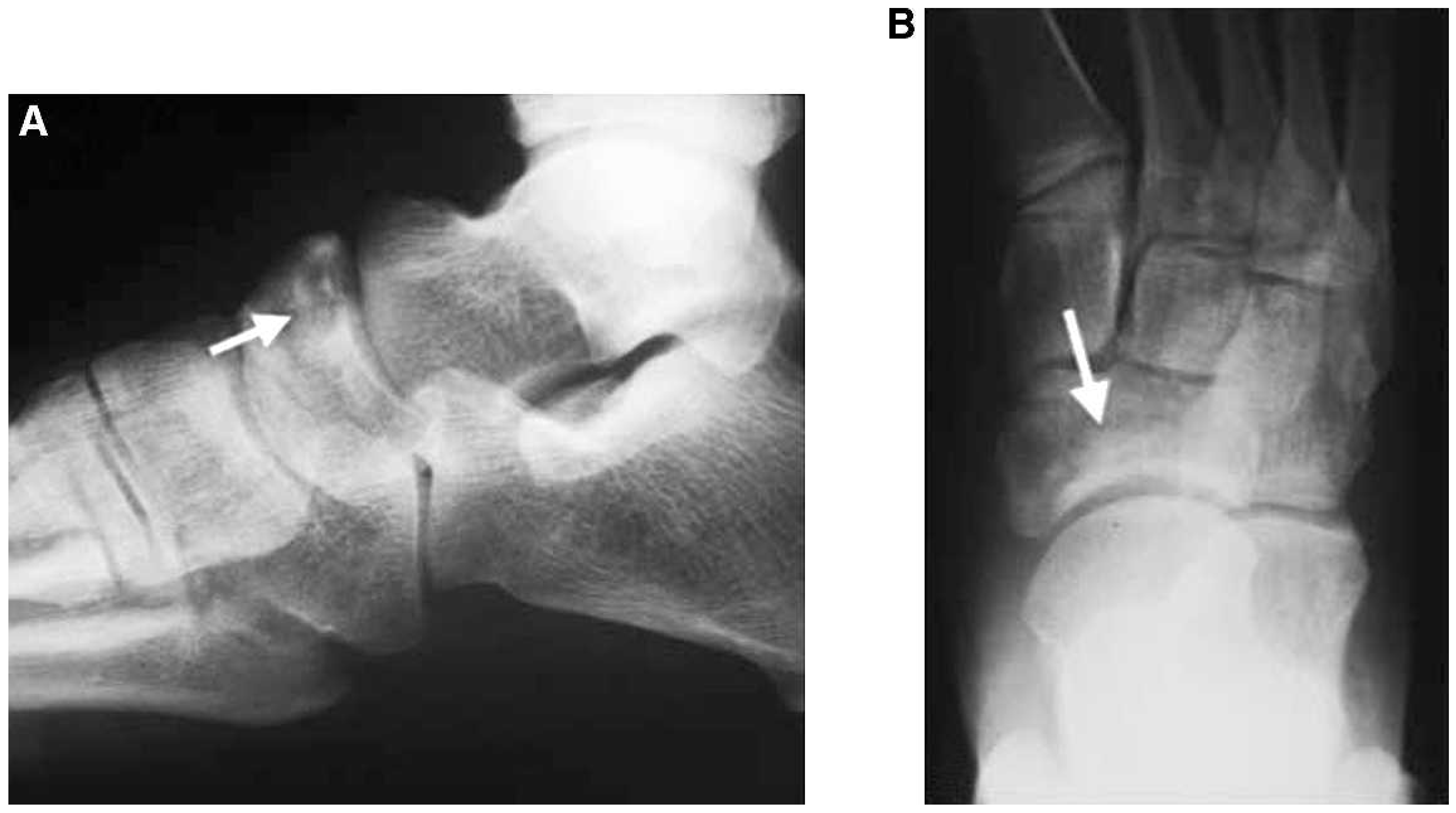
Lateral view conventional radiography showed a focal lucency in the proximal concave articular surface of the navicular bone with a nondisplaced osteochondral fragment (arrow) interrupting the subchondral cortical bone and marked surrounding sclerosis (
Figure 1A). The anterior-posterior radio-graph of the right midfoot revealed subchondral sclerosis of the central third of the articular surface of the navicular bone (
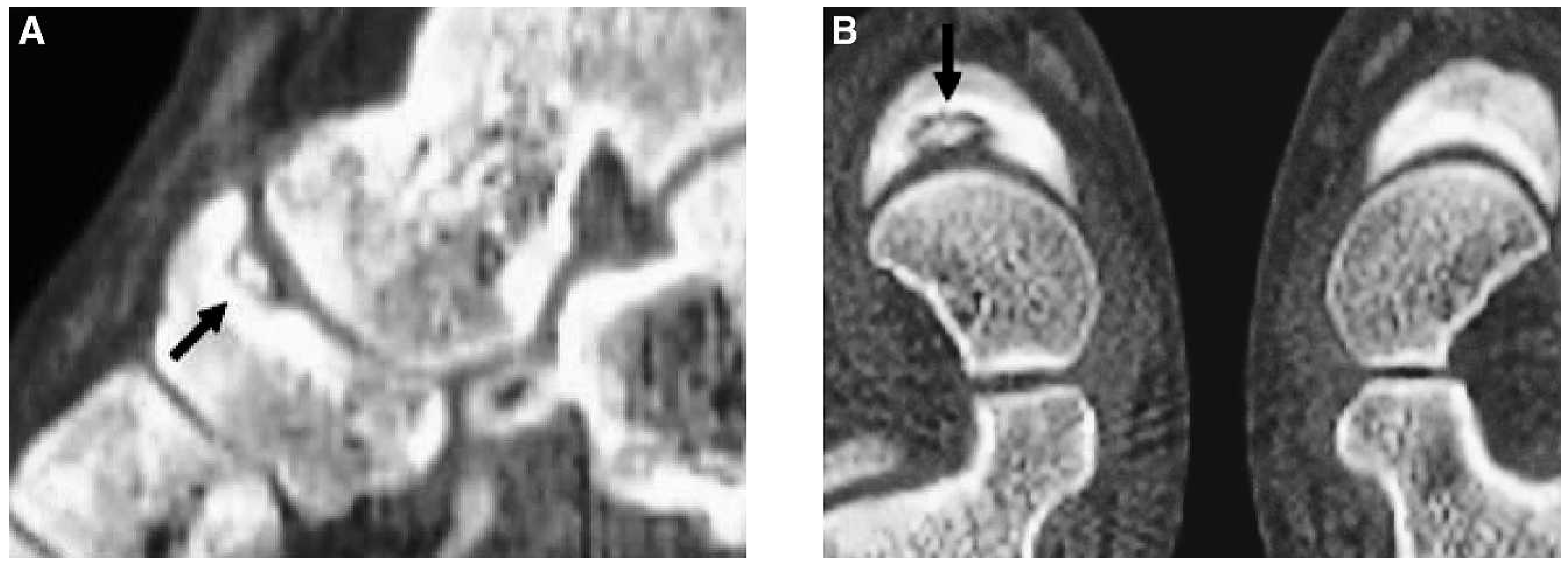
Figure 1B, arrow). The corresponding talar articular surface appeared inconspicuous in both views. A computed tomogra-phy (CT) scan confirmed the diagnosis of OCD of the navicular bone with a lesion size of approxi-mately 10 × 5 × 4 mm (
Figure 2).
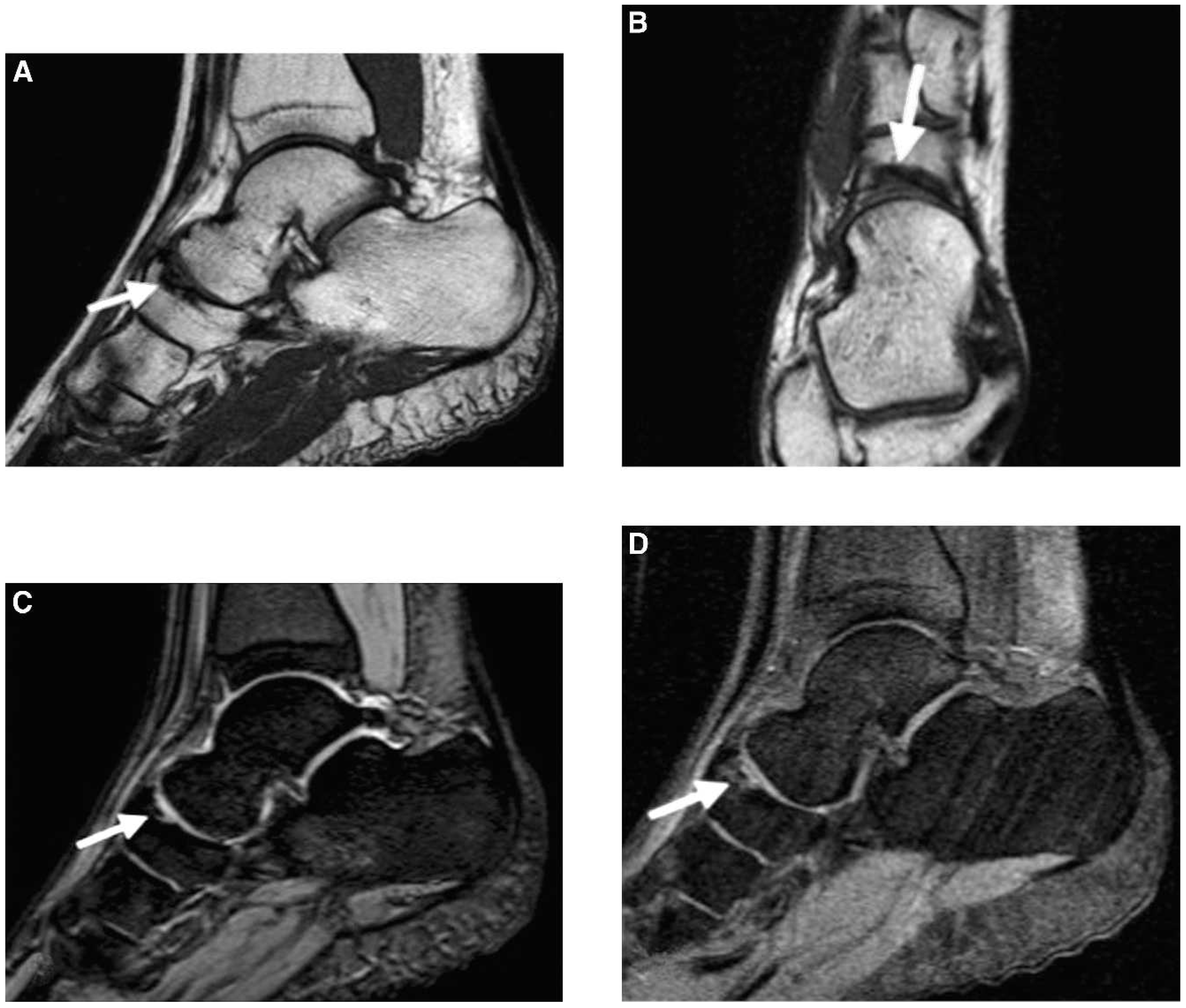
Based on these radiographic findings, the skeletal age at the onset of symptoms and the history of disabling pain upon weightbearing for several months, we recommended surgical treatment to the patient. A preoperative MRI proved that the osteochondral fragment was not vital. The sclerotic lesion was embedded in fibrous tissue of enhanced signal intensity after gadolinium administration and the cartilage surface above the lesion appeared to be largely intact (
Figure 3, arrow).
The routine preoperative laboratory workup yielded no pathological findings. Seven months after the onset of symptoms, the patient underwent surgery. A mini-arthrotomy of the talo-navicular joint was performed in order to visualize the joint surface, which appeared unremarkable. A retro-grade approach was taken for excision of the OCD lesion, leaving the articular surface untouched. To this end, the dorsal aspect of the navicular bone just distal to the talo-navicular joint was exposed and a small window of about 8 mm in diameter was made into the cortex. Through this window, the lesion was completely excised including the peripheral sclerosis. The base of the lesion was thoroughly curetted, drilled, and filled with an autologous cancellous bone graft from the right distal tibia. Histopathological analysis of the excised lesion was consistent with aseptic necrosis of the subchondral bone, confirming the diagnosis of OCD of the proximal articular surface of the tarsal navicular.
After the operation the patient was mobilized nonweightbearing with crutches for 6 weeks and was then allowed to progress from partial to full weightbearing during the next 6 weeks. At the end of this period the patient was completely pain free and had no complaints. Three weeks later, back in her job that required regular 12-hour weightbearing, she noticed swelling and discomfort of the right midfoot region, which responded well to rest, elevation, and local application of cool packs. A temporary shoe modification taking load from the midfoot resulted in effective relief of the residual complaints. Eight months after the operation the patient had resumed all her normal activities including the long periods of weightbearing at work and had no further complaints from her right midfoot region.
Discussion
In a PubMed database literature search, we found four previously published articles, reporting a total of eight cases. [
10,
11,
12,
13] OCD of the tarsal navicular bone presents similar to OCD at other sites. The unusual localization at the concave articular joint surface does not seem to influence imaging characteristics. There is focal lucency in the subchondral area with surrounding sclerosis and a cortical depression interrupting the normal subchondral cortical line. Unless the lesion is very small, OCD of the navicular is easily diagnosed on a conventional lateral radiograph of the midfoot. Seven of the previously published cases were clearly detectable by a simple lateral radiograph, as was the present case (
Figure 1A). The differential diagnosis includes stress fracture of the navicular bone, traumatic necrosis, and nontraumatic osteonecrosis of the navicular in children (Kohler’s disease) and adults (Mueller-Weiss syndrome), all of which are clearly distin-guishable from the typical presentation of OCD by conventional radiography. The reported cases of OCD of the navicular have been between 19 and 42 years of age at presentation, while OCD at the knee classically becomes symptomatic at 10 to 25 years and less frequently presents in adults. Some authors distinguish juvenile OCD in patients with open epiphyseal plates from adult OCD in patients with closed growth plates as two different entities and suggest unique aetiologies. [
14] It is generally thought, but not proven, that most of the lesions with adult onset of symptoms have already developed in the skeletally immature patient. [
14,
15] Interestingly, five out of eight cases with OCD of the navicular were females, while the female to male ratio of OCD at other sites has been reported to be about 1:2 to 1:3. [
1] The cause of OCD of the tarsal navicular bone remains unknown. It was suggested that mechanical stress may be an essential factor. [
12] In particular axial loading in plantarflexion causes a high degree of mechanical stress on the navicular bone, which is crunched between the talus and the cuneiforms in this position. Following this theory, it would be conceivable that the history of ballet dancing in the present case could have contributed to the development of OCD of the navicular by repetitive microtrauma, as it is often reported in OCD of the knee in athletic adolescents. [
14] In this context it would be interesting to conduct a study to examine the incidence of OCD of the tarsal navicular in active ballet dancers versus participants in a control group.
No randomized clinical trials exist for the outcome evaluation of surgical versus nonsurgical treatment of OCD in general. Nor can specific treatment recommendations be made for the few reported cases of OCD of the tarsal navicular. Treatment decisions must be individualized and take into account several factors. The potential for spontaneous recovery with nonoperative treatment is reported to decrease with age. [
9,
14,
16,
17] Therefore, surgical treatment is recommended more often to adult patients. Of the previously published cases, only one has been treated surgically. [
10] Long-term treatment results have not been mentioned in these case reports. We therefore lack data that favor either treatment option for OCD of the tarsal navicular. In the current case, we recommended surgery because the patient had reached skeletal maturity years before the onset of symptoms, the lesion comprised about one third of the heavily stressed articular surface, the articular cartilage appeared to be still intact, and the patient had been severely impaired by the symptoms for several months. In addition, there was marked surrounding sclerosis, which is also regarded as a negative prognostic sign with regard to healing potential under conservative treatment.
We propose that the rare diagnosis of OCD of the tarsal navicular should be kept in mind in young adults with a history of trauma or repetitive microtrauma to the midfoot region. For radiograph-ic diagnosis, a conventional lateral view is usually sufficient. Early diagnosis and surgery in stages of undamaged cartilage may help to prevent disease progression and the development of disabling osteoarthritis in the physiologically heavily loaded talonavicular joint.