


Abstract
Background: Painful diabetic neuropathy remains a difficult pathologic condition to manage effectively despite numerous pharmacologic interventions. A randomized, placebo-controlled, double-blind study was undertaken to determine whether topical 5% ketamine cream is effective in reducing the pain of diabetic neuropathy. Methods: Seventeen diabetic patients completed the study. The Michigan Neuropathy Screening Instrument was used to determine whether the neuropathy was likely caused by the diabetic condition. Hemoglobin A1c levels were measured before treatment. Patients applied 1 mL of either ketamine cream or placebo cream for 1 month. The intensity of seven different pain characteristics was evaluated before and after treatment. A two-way repeated analysis of variance design was used to test for differences between treatments and within patients (time). Results: We found no significant treatment main effect, but pain improved significantly over time in both groups. There was no statistical interaction effect (treatment × time) in any of the pain characteristics, indicating that pain improved in the two treatment groups similarly with time. Conclusions: The 5% topical ketamine cream was no more effective than was placebo in relieving pain caused by diabetic neuropathy.
According to Ochoa, [1] “neuropathic pain. . .is the cognitive response to excitation of a dysfunctional (peripheral) nervous system through stimulus energies. . .,”(p407) including chemical mediators. These chemical mediators, which are produced or released by nerve injury or chronic inflammation, activate peripheral sensory nerve endings. [2] They can directly activate the nerve (eg, histamine), including ion channels; sensitize the nerve endings to other stimuli (eg, prostaglandins); or exert a regulatory effect on the local environment (eg, bradykinin). [2] The sensation is transmitted to the dorsal horn, where it undergoes modulation by local mechanisms and by projection from supraspinal structures, which provide inhibition and facilitation. [2] The impulse then, ultimately, terminates in the cerebral cortex.
Numerous pharmaceutical interventions are used to modulate this pathway to manage painful diabetic peripheral neuropathy. Of particular interest is the observation that inhibitory neurotransmitters produced in the dorsal root ganglia are also transported to peripheral neurons, where they act directly. [3] Glutamate receptors, such as NMDA (N-methyl-d-aspartate) and AMPA (α-amino-3-hydroxy-5-methylisoxazole-4-proprionic acid), are involved in the production and maintenance of chronic pain. These receptors are found on peripheral nerve terminals in the skin. [4] Peripheral inflammation increases the amount of unmyelinated and myelinated nerves expressing glutamate receptors. [3] Pain can be produced by injecting NMDA into the rat hindpaw [5] and the knee joint, [6] which releases glutamate locally. Blocking NMDA peripherally could limit the expression of pain that is seen in neuropathy. One such chemical is ketamine, which also may block the AMPA receptor; voltage-sensitive sodium, calcium, and potassium channels; and serotonin and dopamine reuptake, [7] as well as influencing other receptors and physiologic mechanisms.
Human studies have shown the potential efficacy of using ketamine to treat pain. Warncke et al [8] used ketamine intravenously to significantly reduce the amount of burn-induced secondary hyperalgesia (pain surrounding the original burn site) in healthy volunteers. Ketamine bolus infusion followed by continuous infusion produced a significant reduction in spontaneous pain and allodynia in a double-blind placebo-controlled trial of ten patients with peripheral neuropathic pain. [9] Intramuscular and oral ketamine administration was found to produce a long-term analgesic effect in some patients with neuropathic pain in the trigeminal area. [10] However, according to the review by Hocking and Cousins, [7] there were questionable long-term effects on nonspecific neuropathic pain by using oral or parenteral ketamine.
Once NMDA receptors are activated, they cause an increase in calcium ion influx through the nerve cell membrane, which, ultimately, produces nitric oxide. This causes a toxic change to the postsynaptic inhibitory nerves that leads to hyperalgesia and allodynia. [1] Topical medications potentially allow an increased concentration of drug at peripheral sites, with greatly decreased serum concentrations and a lower adverse effect profile. The adverse effects of ketamine when administered orally or parenterally are numerous and adverse, including dysphoria and hallucinations, dry mouth, dizziness, and sedation. [10] Since NMDA receptors are found in the periphery, topical medications applied over the trigger site(s) of pain may decrease the neuropathic pain caused by peripheral and central sensitization. Fifteen of 23 patients (65%) treated for post-herpetic neuralgia with ketamine gel reported significant improvement in pain. [11] In another study, [12] five patients also reported significant pain relief.
Results of preliminary studies [11,12,13] indicated that adverse effects from topical ketamine were minimal and ranged from the possibility of a minor skin irritation to a burning sensation. There is no apparent detectable ketamine in plasma [13] after it is applied topically. When administered intravenously, however, ketamine may cause hallucinations and disorientation. It can also increase blood pressure and affect breathing.
The purpose of this study was to evaluate the effects of topical ketamine in relieving painful diabetic neuropathy. It is hoped that the design of this initial study will provide more statistical significance than past studies.
Materials and Methods
This study was reviewed and approved by the Des Moines University institutional review board. Twenty-seven patients were enrolled in the study over 18 months (September 1, 2007, through March 31, 2009). All of the patients had type 1 or 2 diabetes and were older than 18 years, with painful diabetic neuropathy. Approximately 100 patients were initially screened, primarily by telephone, to see whether they fulfilled basic inclusion and exclusion criteria. Patients screened through the telephone interview were invited to fill out a general medical questionnaire in the presence of a research assistant and had a blood pressure reading taken.
The following is a list of the exclusion criteria: 1) hypersensitivity to ketamine; 2) pregnancy, plans to become pregnant during the study, and lactation; 3) use of tramadol, cocaine, inhaled anesthetics, memantine, methadone, morphine, opiate agonist/antagonist, or opiates; 4) a history of psychiatric disorder or long-term alcohol or drug abuse, as determined from the patient’s medical history, that, in the investigator’s opinion, may pose a threat to the patient’s compliance; 5) known poor ability to complete required study visits during participation; 6) a history of skin diseases, cellulitis, or active osteomyelitis; 7) active connective tissue disease; 8) a history of local or general anesthetic complications; and 9) a history of moderate-to-severe hypertension (as defined by the Seventh Report of the Joint National Committee on Prevention, Detection, Evaluation, and Treatment of High Blood Pressure criteria, blood pressure >140/90 mm Hg), cardiac disease, respiratory difficulties, glaucoma, or alcohol use.
It was important to ensure that the neuropathy was most likely caused by diabetes and not by some other pathologic condition. We decided to use the Michigan Neuropathy Screening Instrument, [14] which has shown good correlation between test scores and the presence of diabetic neuropathy. Patients had to attain at least a score of 8 on the Michigan Neuropathy Screening Instrument or a score of 3 on the physical examination as per the instrument’s protocol. Once the Michigan Neuropathy Screening Instrument criteria were fulfilled, a serum hemoglobin A1c level was obtained to assess the patients’ level of glucose control.
Patients were randomly divided into either the treatment (5% ketamine cream) or placebo (vehicle only, composed primarily of Aquaphor gel [Beiersdorf, Hamburg, Germany]) arm of the study. The creams were compounded and randomized by NuCara Pharmacy, Waterloo, Iowa. Although Aquaphor gel was the primary base for both topicals, compounding converted the gel to a cream that was indistinguishable as ketamine or placebo to investigators and patients. There was no attempt to divide males and females equally into each group. Patients needed to possess the ability and willingness to comply with daily medication application and adherence to study requirements. All of the patients signed an informed consent form and were instructed how to apply 1 mL of the cream three times daily to the entire foot distal to the level of the malleoli for 1 month without the need for examination gloves since preliminary studies [11,12,13] elsewhere did not report adverse topical effects.
At the pretreatment and post-treatment visits, the patients filled out a form evaluating seven different types of pain on an 11-point Likert scale in the presence of a research assistant. Studies [15–18] have shown good reliability of the 11-point Likert scale (0 = no pain to 10 = worst pain imaginable) or a similar version, the 11-point box scale, in measuring pain intensity. Patients were given instruction sheets to take home that listed the cautions against eye, oral, anal, and genital contact and to wash hands immediately after application. Patients were told not to stop taking any of their current medications. They were to notify the researchers if there was any change in their medication use (addition/deletion or change in dosage) during the study. Patients were given an additional informational sheet on the most common adverse effects of ketamine and were asked to record any perceived problems.
The seven pain characteristics measured were intensity, sharpness, hot, cold, dull, sensitive, and itchy; each was measured using the same 11-point Likert scale as per the recommendation of the European Federation of Neurological Societies. [18] A two-way repeated-measures analysis of variance (group × time) was used to test for differences between (group) and within (time) patients and for group × time interactions (P = .05).
Results
Ten of the 27 patients dropped out during the study for various reasons. The demographics of the remaining 17 patients are illustrated in Table 1. Four males and six females were randomized to the treatment arm and four males and three females to the placebo arm.
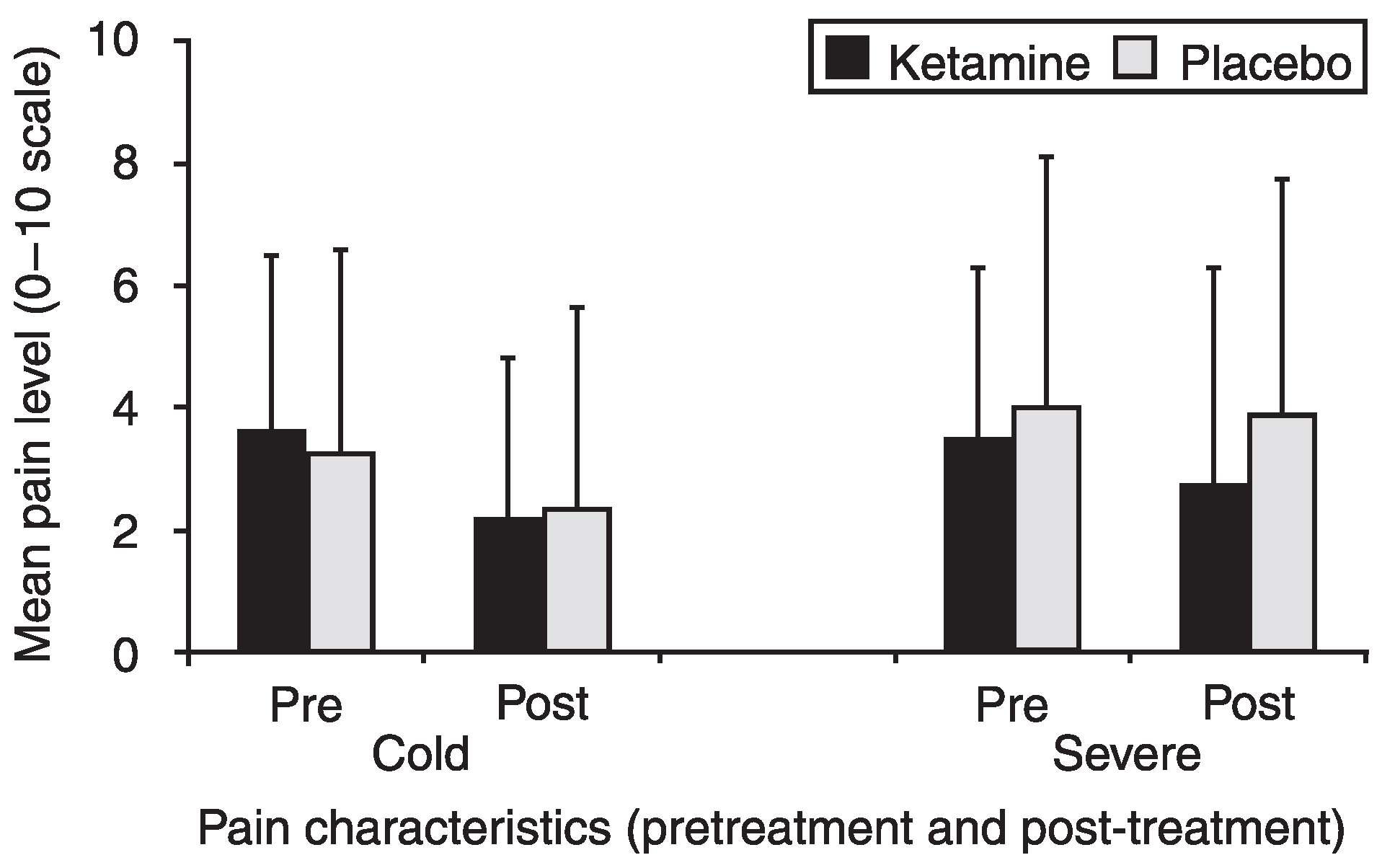
There were no statistical interaction (group × time) effects in any of the pain characteristics, indicating that the two groups behaved similarly over time regardless of the treatment. We found no between-group differences pooling the data over time or at the pretreatment and post-treatment stages. There were time differences (pooling over group) in five of the seven pain characteristics (intensity, sharpness, hot, dull, and itchy) (P < .02) (Figs. 1 and 2). Paired t tests showed time pretest and post-test differences in sharpness, dull, and itchy for the ketamine group and in intensity and sharpness for the placebo group (P < .05).
The results show that diabetic pain measures were reduced in all seven of the pain characteristics, and this reduction was significant in five of the seven pain characteristics during treatment, regardless of group assignment. This finding indicates that the placebo effect is equally as strong as 5% topical ketamine in the pain management of diabetic neuropathy.
Table 1.
Demographic Characteristics of the 17 Study Patients.
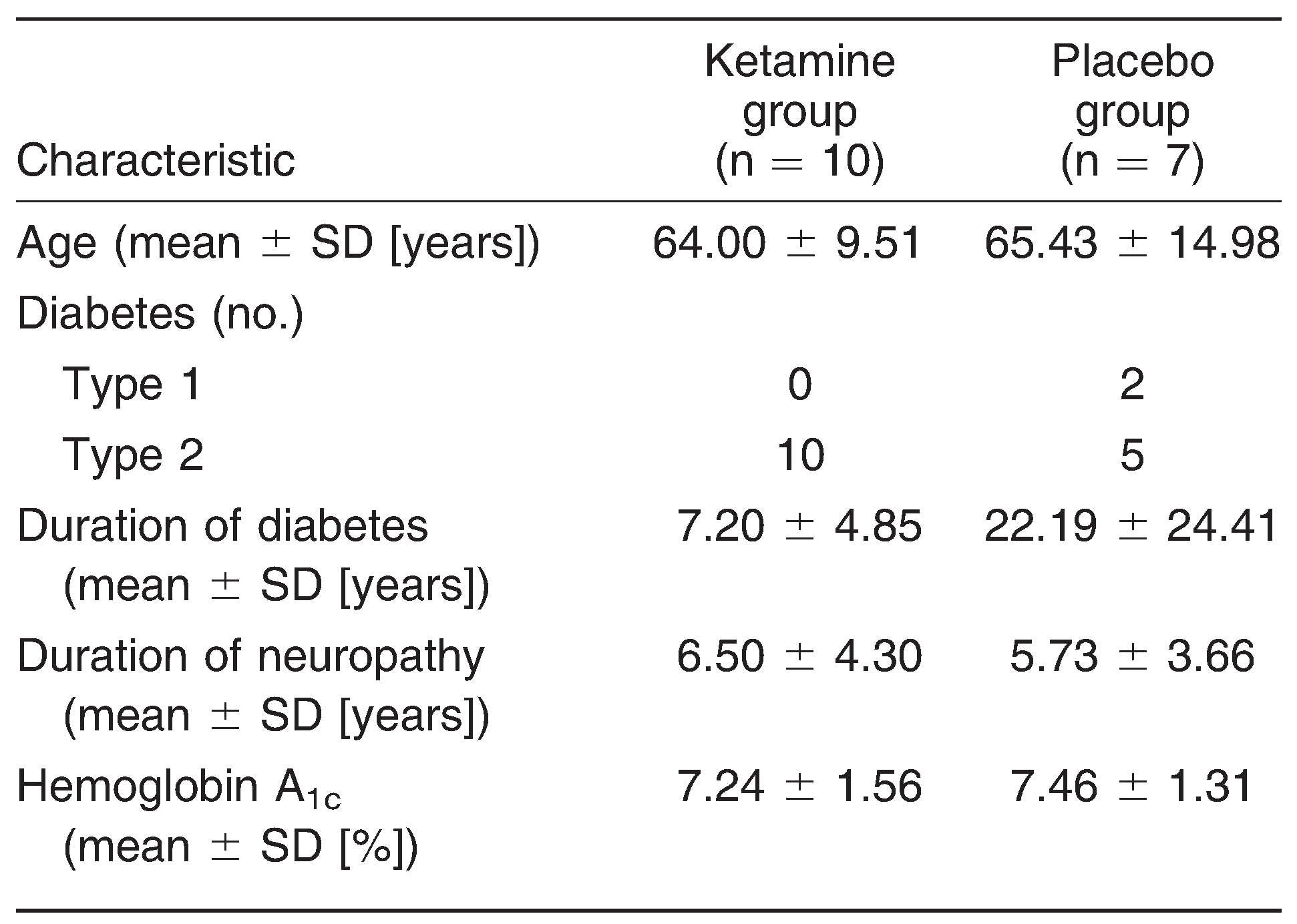
Figure 1.
Effect of treatment on the ketamine and placebo groups regarding five pain characteristics showing significant (P < .02) reduction in pain over time for both groups. Error bars represent SD.
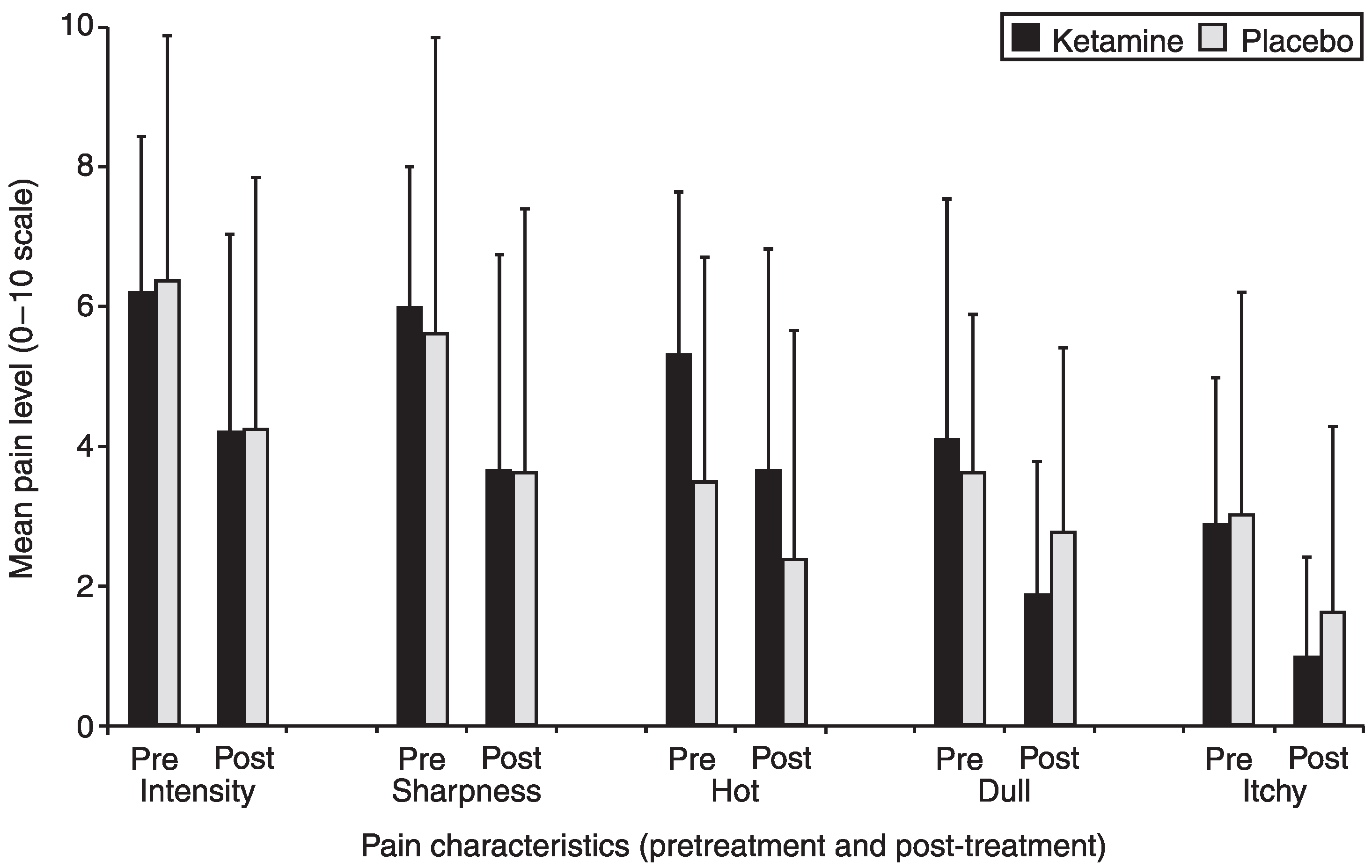
Figure 2.
Effect of treatment on the ketamine and placebo groups regarding two pain characteristics showing no change in pain over time for both groups. Error bars represent SD.
Discussion
Placebo effects play a large role in the outcomes of pain studies. Beecher [19] published a classic article wherein he identified a 33% response rate to placebos. However, more recent information [20] has revealed that the rate is often much higher. Turner et al [20] showed that patient and provider expectations, characteristics of the treatment situation, and patient psychophysiologic states affect the patient’s response to treatment. The true causes of this phenomenon are still unknown. This study is certainly not an exception, demonstrating a significant placebo effect.
A limitation of this study is the sample size. To account for the placebo effect in pain studies due to random chance alone, Moore et al [21] simulated 10,000 trials of varying group sizes to see what was the variation due to random chance alone and found that 500 patients in each treatment arm was necessary for clinical relevancy (defined as the number needed to treat). Although the initial goal was to study 40 patients in the control and ketamine groups, the conventional size for demonstrating statistical power, Moore et al claim that this standard for demonstrating statistical power works only when it is already known that the analgesic is highly effective in relieving pain. We did not reach the intended enrollment of 80 total patients because of financial restrictions.
The NMDA receptors are reported to occur in the periphery of human skin, [4–6] in unmyelinated axons at the dermal-epidermal junction. [22] Most of the articles addressing this topic examined the effects of ketamine on the rat hindpaw. [2] This raises some concerns. The glabrous skin of the rodent hindpaw is thinner and more permeable than is human skin. [23] All of the studies administered ketamine via intradermal injection and not topically. A systematic review by Perel et al [24] that compared unambiguous treatment effects (benefit or harm) between animal studies and clinical trials showed that of six studies, three had similar outcomes and three did not. They concluded that discrepancies between the results of animal studies and clinical trials may be attributable to bias or selection of the wrong animal model.
The evidence used to support a peripheral site of action of ketamine in human studies is based on intravenous or subcutaneous administration of ketamine, [2] which is much different than direct topical application. Sawynok [2] suggests that analgesic responses to ketamine are variable and may depend on the condition being treated and may be more pronounced in chronic skin inflammation or nerve injury. Oatway et al [25] found that compared with amitriptyline, ketamine had no local analgesic effect when injected into a rat hindpaw after thermally induced injury but was antihyperalgesic.
A variety of factors influence absorption of topically applied agents. Facial and intertriginous skin are thinner than extremity skin [26] and absorb medications more quickly and completely. Environmental temperature and humidity will influence absorption, as will local skin temperature and the amount of fat present in skin. Physical properties of the medication and its transport vehicle, such as particle size, lipid solubility, and polarity, will also affect diffusion. [27]
Conclusions
These findings show that 5% topical ketamine is not more efficacious than is placebo for the management of diabetic pain. However, it is apparent that multiple factors can influence the results of pain studies such as this, from inadequate sample size to the choice of vehicle for topical administration. Further work needs to be done to assess whether topical ketamine can be an effective agent in relieving diabetic neuropathic pain.
Acknowledgment:
Ms. Susan Schmidt, Mark Ellis, DPM, and Bryan Hall, DPM, for their help in preparing this manuscript, and Dr. Simon Gilleta, PhD, and Mr. Michael Essmann, BS, for their assistance in the statistical analysis.
Financial Disclosure:
This study was funded by a grant from the Des Moines University Investigational Osteopathic Education and Research Grants Committee (#3147).
Conflict of Interest:
None reported.
References
- OCHOA JL: Pain mechanisms in neuropathy. Curr Opin Neurol 1994, 7, 407. [CrossRef] [Scilit] [PubMed]
- SAWYNOK J: Topical and peripherally acting analgesics. Pharmacol Rev 2003, 55, 1.
- COGGESHALL, R.E.; CARLTON, S.M. Evidence for an inflammation-induced change in the local glutamatergic regulation of postganglionic sympathetic efferents. Pain 1999, 83, 163. [Google Scholar] [CrossRef] [Scilit] [PubMed]
- CARLTON, S.M.; HARGETT, G.L.; COGGESHALL, R.E. Localization and activation of glutamate receptors in unmyelinated axons of rat glabrous skin. Neurosci Lett 1995, 197, 25. [Google Scholar] [CrossRef] [Scilit]
- JACKSON, D.L.; GRAFF, C.B.; RICHARDSON, J.D.; et al. Glutamate participates in the peripheral modulation of thermal hyperalgesia in rats. Eur J Pharmacol 1995, 284, 321. [Google Scholar] [CrossRef] [Scilit]
- LAWLAND, N.B.; WILLIS, W.D.; WESTLUND, K.N. Excitatory amino acid receptor involvement in peripheral nociceptive transmission in rats. Eur J Pharmacol 1997, 324, 169. [Google Scholar] [CrossRef] [Scilit]
- HOCKING, G.; COUSINS, M. Ketamine in chronic pain management: an evidence-based review. Anesth Analg 2003, 97, 1730. [Google Scholar] [CrossRef] [Scilit]
- WARNCKE, T.; STUBHAUG, A.; JORUM, E. Ketamine, an NMDA receptor antagonist, suppresses spatial and temporal properties of burn-induced secondary hyperalgesia in man: a double-blind, cross-over comparison with morphine and placebo. Pain 1997, 72, 99. [Google Scholar] [CrossRef] [Scilit]
- FELSBY, S.; NIELSEN, J.; ARENDT-NIELSEN, L.; et al. NMDA receptor blockade in chronic neuropathic pain: a comparison of ketamine and magnesium chloride. Pain 1995, 64, 283. [Google Scholar] [CrossRef] [Scilit]
- RABBEN, T.; SKJELBRED, P.; OYE, I. Prolonged analgesic effect of ketamine, an N-methyl-d-aspartate receptor inhibitor, in patients with chronic pain. Pharmacol Exp Ther 1999, 289, 1060. [Google Scholar] [CrossRef] [Scilit]
- QUAN, D.; WELLISH, B.S.; GILDEN, D.H. Topical ketamine treatment of postherpetic neuralgia. Neurology 2003, 60, 1391. [Google Scholar] [CrossRef] [Scilit]
- GAMMAITONI, A.; GALLAGHER, R.M.; WELZ-BOSNA, M. Topical ketamine gel: possible role in treating neuropathic pain. Pain Med 2000, 1, 97. [Google Scholar] [CrossRef] [Scilit] [PubMed]
- LYNCH, M.E.; CLARK, A.J.; SAWYNOK, J.; et al. Topical amitriptyline and ketamine in neuropathic pain syndromes: an open-label study. J Pain 2005, 6, 644. [Google Scholar] [CrossRef] [Scilit] [PubMed]
- MARTIN, C.L.; ALBERS, J.; HERMAN, W.H.; et al. Neuropathy among the diabetes control and complications trial cohort 8 years after trial completion. Diab Care 2006, 29, 340. [Google Scholar] [CrossRef] [Scilit] [PubMed]
- JENSEN, M.P.; KAROLY, P.; O’RIORDAN, E.F.; et al. The subjective experience of acute pain: an assessment of the utility of 10 indices. Clin J Pain 1989, 5, 153. [Google Scholar] [CrossRef] [Scilit]
- JENSEN, M.P.; KAROLY, P.; BRAVER, S. The measurement of clinical pain intensity: a comparison of six methods. Pain 1986, 27, 117. [Google Scholar] [CrossRef] [Scilit]
- SEYMOUR, R.A. The use of pain scales in assessing the efficacy of analgesics in post-operative dental pain. Eur J Clin Pharmacol 1982, 23, 441. [Google Scholar] [CrossRef] [Scilit]
- CRUCCU, G.; ANAND, P.; ATTAL, N.; et al. EFNS guidelines on neuropathic pain assessment. Eur J Neurol 2004, 11, 153. [Google Scholar] [CrossRef] [Scilit]
- BEECHER HK: The powerful placebo. JAMA 1955, 159, 1602. [CrossRef] [Scilit]
- TURNER, J.A.; DEYO, R.A.; LOESER, J.D.; Von. The importance of placebo effects in pain treatment and research. JAMA 1994, 271, 1609. [Google Scholar] [CrossRef] [Scilit]
- MOORE, R.A.; GAVAGHAN, D.; TRAMER, M.R.; et al. Size is everything: large amounts of information are needed to overcome random effects in estimating direction and magnitude of treatment effects. Pain 1998, 78, 209. [Google Scholar] [CrossRef] [Scilit]
- DAVIDSON, E.M.; COGGESHALL, R.E.; CARLTON, S.M. PERIPHERAL NMDA and non-NMDA glutamate receptors contribute to nociceptive behaviors in the rat formalin test. Neuroreport 1997, 8, 941. [Google Scholar] [CrossRef] [Scilit] [PubMed]
- LU, Y.; LOU, Y.; XIE, J.; et al. Tumorigenic effect of some commonly used moisturizing creams when applied topically to UVB-pretreated high risk mice. J Invest Dermatol 2009, 129, 468. [Google Scholar] [CrossRef] [Scilit] [PubMed]
- PEREL, P.; ROBERTS, I.; SENA, E.; et al. Comparison of treatment effects between animal experiments and clinical trials: systematic review. BMJ 2007, 334, 197. [Google Scholar] [CrossRef] [Scilit] [PubMed]
- OATWAY, M.; REID, A.; SAWYNOK, J. Peripheral antihyperalgesic and analgesic actions of ketamine and amitriptyline in a model of mild thermal injury in the rat. Anesth Analg 2003, 97, 168. [Google Scholar] [CrossRef] [Scilit]
- BECKER, E. KOO J: Clinical focus: the spectrum of topical agents for the treatment of psoriasis. Available at: http://www.medscape.org/viewarticle/588415 (accessed on 15 March 2010).
- BRISSON P: Percutaneous absorption. Can Med Assoc J 1974, 110, 1182.
© 2012 American Podiatric Medical Association