


Abstract
Background: Hallux limitus (HL) is a pathology of degenerative arthritis in the first metatarsophalangeal joint (MTJ) of the great toe. Chief complaints of HL include inflammation, edema, pain, and reduced flexibility. The onset of HL commonly occurs after one of the two most common surgical procedures for foot pathologies, a bunionectomy or a cheilectomy. The purpose of this study is to determine the efficacy of dynamic splinting in treating patients with postoperative hallux limitus, in a randomized, controlled trial. Methods: Fifty patients (ages 29 to 69) were enrolled after diagnosis of HL following surgery. The duration of this study was eight weeks, and all patients received nonsteroidal anti-inflammatory drugs, orthotics, and instructions for a home exercise program. Experimental patients were also treated with dynamic splinting for first MTJ extension (60 minutes, three times per day). The dependent variable was change in active range of motion (AROM). A repeated measures analysis of variance was used with independent variables of patient categories, surgical procedure (cheilectomy vs. bunionectomy) and duration since surgery. Results: There was a significant difference in change of AROM for experimental vs. control patients (P < 0.001, T = 4.224, N = 48); there was also a significant difference for patient treated within 2 months of surgery (P = 0.0221). Conclusions: Dynamic splinting was effective in reducing contracture of postoperative hallux limitus in this study; experimental patients gained a mean 250% improvement in AROM. This modality should be considered for standard of care in treating postoperative hallux limitus.
Hallux limitus (HL) is described as a degenerative arthritic pathology in the first metatarsophalangeal joint (MTJ) and commonly affects patients with primary functional or structural abnormalities after one of the three most common surgical procedures for foot pathologies: cheilectomy, simple bunionectomy, or a first metatarsal osteotomy. [1–4] Limitations to range of motion typically occur secondary to postoperative arthrofibrosis. HL also has significant incidence following foot injuries, osteoarthritis, rheumatoid arthritis, and systemic diseases. Literature consensus has long assumed that pain reduction is a predictable result of properly selected surgical patients but improvement in the arc of functional motion about the great toe may not be expected. [2, 5–8]
Optimal action of the hallux requires plantarflexion of the first metatarsal bone, which allows the proximal phalanx to dorsiflex. This bidirectional hinge action must occur with each step. [4, 8–12] With HL, normal smooth motion of the proximal phalanx over the head of the metatarsal is disrupted leading to painful compression of the phalanx against the head of the metatarsal when the joint is dorsiflexed. This limited motion may result from several biomechanical factors including first metatarsal elevations attributable to hypermobile first ray, first metatarsal head morphology, and soft-tissue contracture or arthrofibrosis. Patient noncompliance from early ROM stretching protocols prescribed as “home therapy” is also a contributing factor. This study will determine if greater compliance arises from prescribed dynamic splinting.
Dynamic splinting uses the protocol of low-load, prolonged-duration stretching, which has been effective in reducing contracture in different joints. [1, 3, 4, 13–15] Dynamic splinting provides the biomechanically appropriate alignment with measurable, dynamic tension for increasing the joint’s time at end range. As the range of motion progresses, the calibrated tension of the dynamic splint is increased to continue stretching at the increased end range.
Treatment protocols for HL has included orthoses, shoe sole modifications, nonsteroidal anti-flammatory drugs (NSAIDs), physical therapy, home stretching exercises, and surgical procedures of the first MTJ. [1–12, 16] A recent article examined the use of dynamic flexion splinting for a master’s triathlete who was diagnosed with HL. [4] The report showed substantial improvement in the range of motion (ROM), which apparently allowed a more symmetrical, fluid gait pattern when ambulation testing was accomplished before and after this treatment. [4] Other reports have suggested investigating protocols that treat hallux limitus immediately upon diagnosis and conducting further research on stretching for HL in the postoperative setting. [1, 4, 12, 16] The purpose of this study is to determine the efficacy of dynamic splinting in treating patients with postoperative hallux limitus, in a randomized, controlled trial.
Materials and Methods
Participants
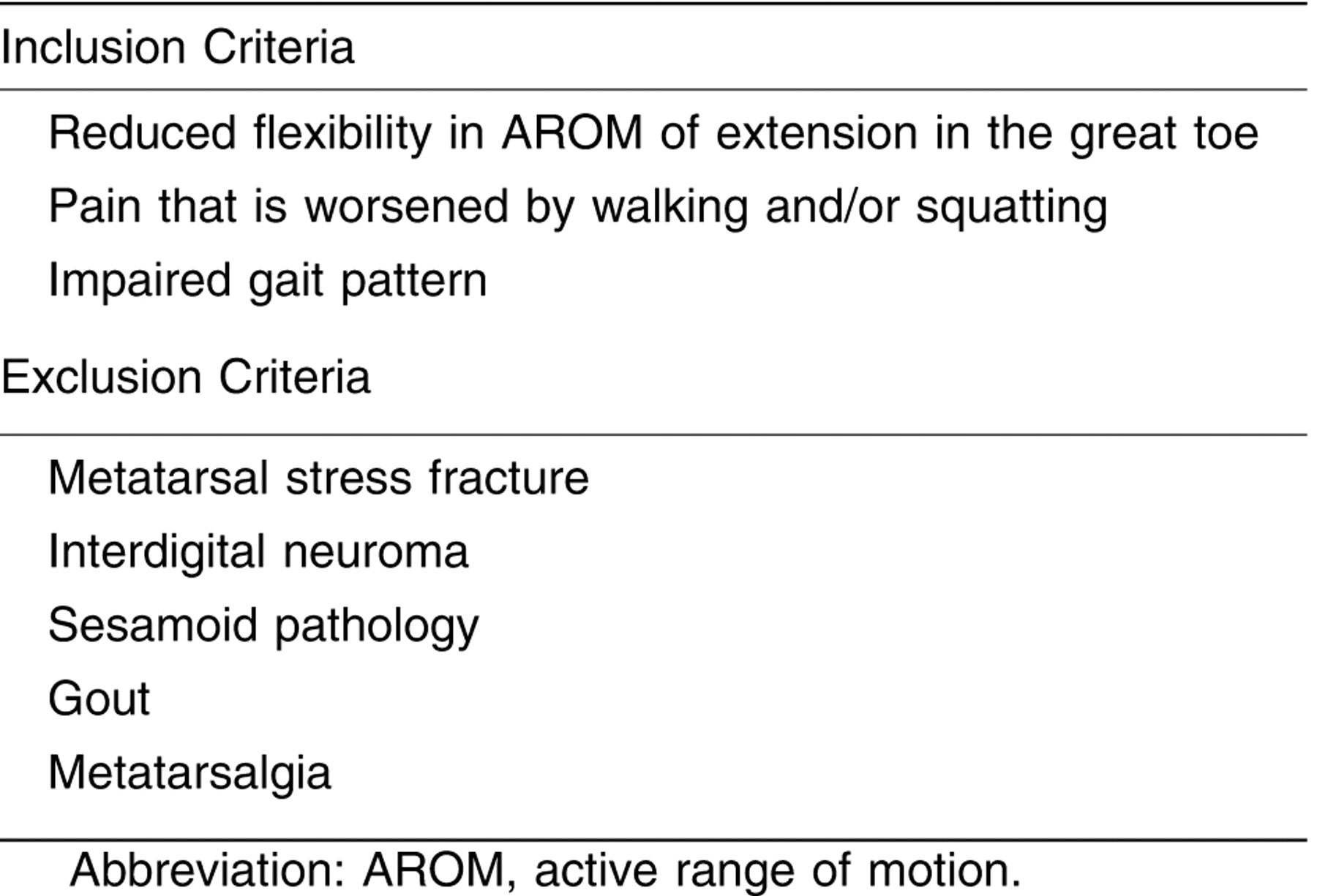
Fifty patients (24 male, 26 female) who had been diagnosed with HL following surgery were recruited from three clinics in two states for this 8-week study, including patients who were referred to the experiment listed on the NIH’s www.ClinicalTrials.gov Web site listing (Trial #NCT00717691). After qualifying under established diagnostic criteria [1, 7] and inclusion and exclusion requirements (Table 1), patients signed the informed consent as required by the Copernicus Group IRB; they were then randomly assigned to control or experimental groups. Patients recruited included those showing limited ROM of the first MTP joint (contracture) within 2 months after surgery (N = 18) and patients who presented with preexisting postoperative HL contracture (N = 32). The experimental group was composed of 14 male and 11 female patients; the control group, 10 male and 15 female patients.
Table 1.
Inclusion and Exclusion Criteria.
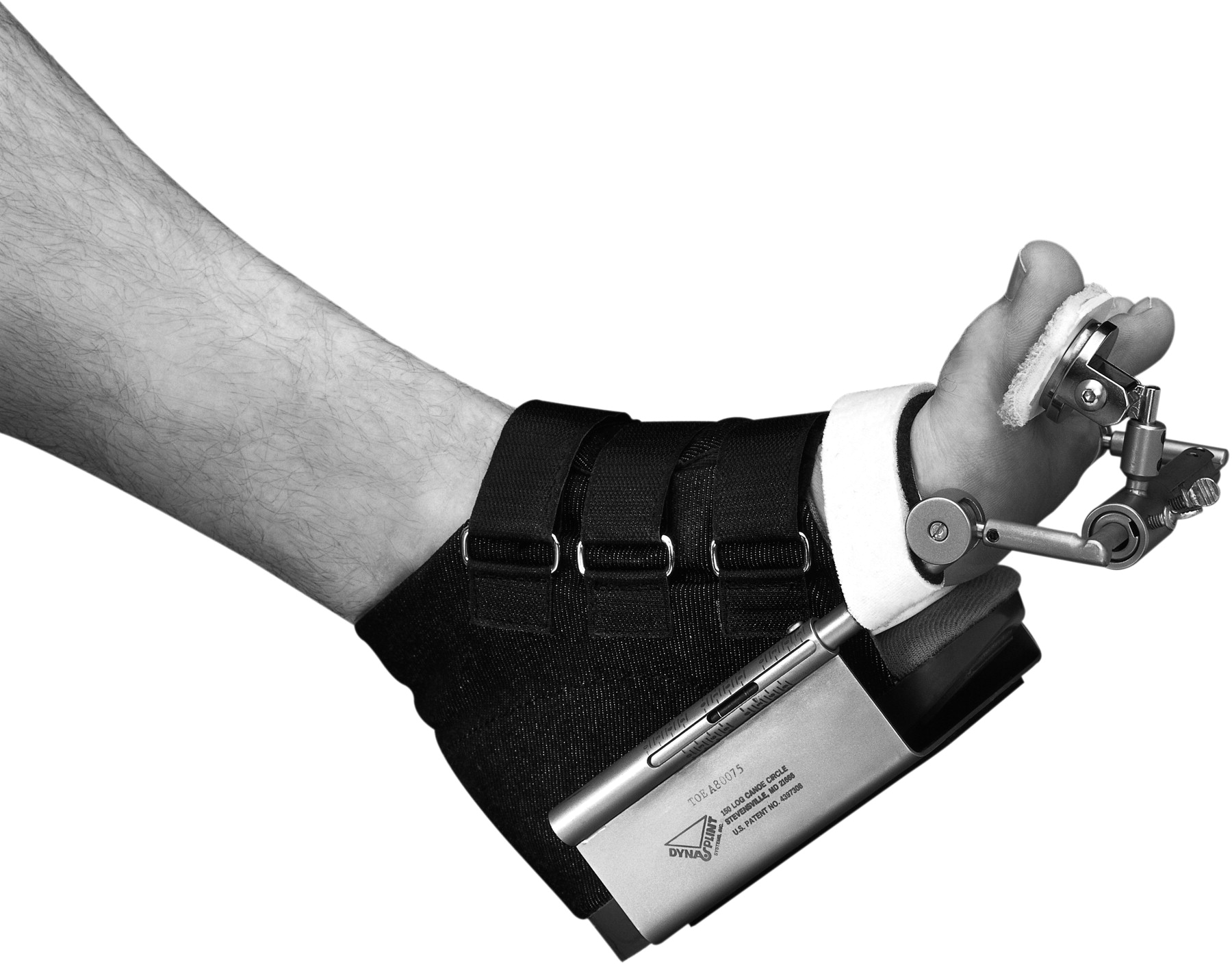
The standard of care for all patients included: analgesics and NSAIDs, orthotics, and home stretching exercises. Patients in the control group received only the standard of care, and patients in the experimental group received the standard of care plus treatment with the Metatarsophalangeal Dynasplint System (MDS; Dynasplint Systems Inc, Severna Park, Maryland) (Fig. 1).
Figure 1.
Metatarsophalangeal Dynasplint (extension) system.
Interventions
The MDS was the experimental treatment modality that exclusively stretches the patients’ first MTJ of the great toe while they were seated or resting. The initial fitting for experimental patients included customization of the unit (patient’s foot length, girth, and varying degrees of hallux edema), and training on donning and doffing of the devices. Patients also received instruction on safety, general wear and care, and standardized tension setting goals.
Dynamic splinting employs the protocol of low-load stretching for contracture reduction through an appropriate biomechanical device that increases the joint’s time at end range (of motion). [1, 3, 4, 13–15] Each patient was instructed to wear the MDS initially for 60 minutes, three times a day while seated, with an initial tension setting of #1 (0.10 foot pound of torque). This lowest intensity was used for becoming accustomed to the system.
After each patient was comfortable wearing the unit for a total of 180 minutes per day, for several days, the patient was then instructed to increase the tension one increment every 2 weeks until reaching setting #4 (0.7 foot pounds of torque). If excess fatigue followed a session (soreness lasting 15 minutes that equaled soreness following intensive manual therapy) the patient was instructed to decrease the tension one half setting for two bouts until comfortable wearing it for 60 minutes per session. Tracking of patient compliance was accomplished with a standardized daily journal that was submitted to the attending clinicians monthly.
Data Analysis
The dependent variable in this study was the change in dorsiflexion at the first metatarsal joint of the hallux (great toe). Independent variables were the patient categories (experimental vs. control), surgical procedure (simple bunionectomy vs. cheilectomy vs. first metatarsal osteotomy) and duration (weeks) since surgery. Statistical data analysis was accomplished using a one-way analysis of variance (ANOVA) and post-hoc t-tests. The data analysis was done independently by Dr. Ram Shanmugam, a biostatistics professor at Texas State University, San Marcos, TX.
Results
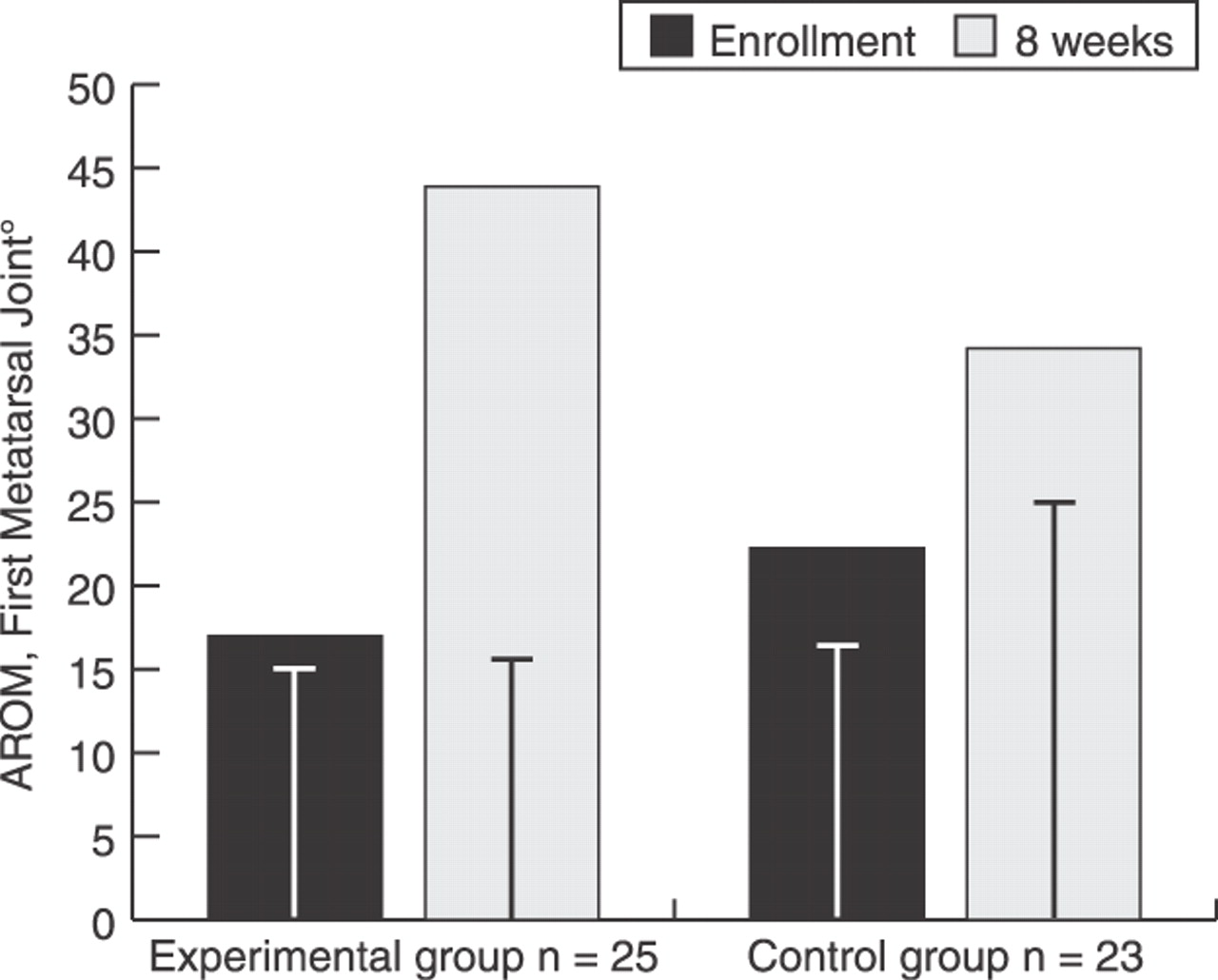
There was a significant difference between change in active range of motion (AROM) of experimental vs. control (P < 0.0001, T = 4.224, N = 48, df = 47; range −10° to +60°) (Fig. 2). Two control patients withdrew from the study because of excessive pain that required additional treatment. There was no difference in change of AROM between surgeries performed, (P > 0.05). However, a significant difference was seen for experimental patients treated immediately (less than 2 months) following surgery vs. patients treated more than 2 months following surgery (P < 0.0221, T = 2.4537, N = 25, df = 24). Compliance with the MDS schedule was greater than 95% for all experimental patients. There were no adverse events reported in the trial of this modality.
Figure 2.
Results of dynamic splinting for hallux limitus. AROM, active range of motion. P<0.0001; T=4.224; df=46; N=48.
Discussion
Contracture has commonly been seen occurring secondary to surgery, regardless of procedure [17] and this is considered each patient’s physiological response, regardless of joint specificity (ie, from the tempromandibular joint [18] to the hallux). This study showed no difference in treating contracture whether it arose from simple bunionectomy, cheilectomy, or a first metatarsal osteotomy. Evidence that contracture can occur independent of surgeon or procedure is seen following three different procedures performed by three different surgeons in two distinct areas of the United States.
Wülker and Rudert cautioned clinicians that HL symptoms might be worsened if a “forceful attempt to restore a normal range of motion at the meta-tarsophalangeal joint is made.” [16] (p63) The low-load stretch protocol used with the MTD began with only one-tenth of one foot pound of force, avoiding excess force in dorsiflexion. [1, 4, 15] Shamus et al [12] examined multiple protocols for restoring HL extension following an injury, and while their study did not reveal a single protocol to be exclusively responsible for contracture reduction, it did describe the values of passive stretching.
The purpose of this study was to determine the efficacy of a 2-month period of dynamic splinting in treating patients with postoperative hallux limitus, in a randomized, controlled trial. Efficacy was shown in using the MDS for postoperative hallux limitus as it was exclusively responsible for changing AROM in this study; patients in the experimental group showed a mean 32° change in AROM extension compared to only a mean 10° change in AROM extension for patients in the control group. The greatest change was seen for patients fit within 2 months of surgery, but patients with pre-existing HL contracture (more than 12 months following their surgery) still obtained significant changes. Dynamic splinting for increased time at end-range (of motion) is considered responsible for connective tissue elongation to reduce contracture. Dynamic splinting should now be included in the standard of care for postoperative hallux limitus.
Acknowledgments
The sponsor contributed complimentary rental of units for uninsured patients.
Financial Disclosure
None reported.
Conflict of Interest
Dr. Willis is employed by Dynasplint Systems Inc.
References
- Kalish, SR and FBWillis: Hallux limitus and dynamic splinting: a retrospective series. Foot Ankle Online J2: 1, 2009. [Published online; doi: 10.3827/faoj.2009.0204.0001]..
- Goucher, NR and MJCoughlin: Hallux metatarsophalangeal joint arthrodesis using dome-shaped reamers and dorsal plate fixation: a prospective study. Foot Ankle Int27: 869, 2006.
- Willis, FB and MJohn: Dynamic splinting increases flexion for hallux rigidus (pilot study). BioMechanics14: 49, 2007.
- John, MM, FBWillis, and AProtillo: Dynamic splinting for runner’s toe: a case report with gait analysis. JAPMA99: 367, 2009.
- Brodsky, JW, BSBaum, FEPollo, et al: Prospective gait analysis in patients with first metatarsophalangeal joint arthrodesis for hallux rigidus. Foot Ankle Int28: 162, 2007.
- Talarico, LM, GRVito, LGoldstein, et al: Management of hallux limitus with distraction of the first metatarsophalangeal joint. JAPMA95: 121, 2005.
- Payne, C, VChuter, and KMiller: Sensitivity and specificity of the functional hallux limitus test to predict foot function. JAPMA92: 269, 2002.
- Kennedy, JG, FYChow, JDines, et al: Outcomes after interposition arthroplasty for treatment of hallux rigidus. Clin Orthop Relat Res445: 210, 2006.
- DeFrino, PF, JWBrodsky, FEPollo, et al: First metatarsophalangeal arthrodesis: a clinical, pedobarographic and gait analysis study. Foot Ankle Int23: 496, 2002.
- Canseco, K, JLong, RMarks, et al: Quantitative characterization of gait kinematics in patients with hallux rigidus using the Milwaukee foot model. J Orthop Res2007. Oct30, 1–9.
- Lau, JT and TRDaniels: Outcomes following cheilectomy and interpositional arthroplasty in hallux rigidus. Foot Ankle Int22: 462, 2001.
- Shamus, J, EShamus, RNGugel, et al: The effect of sesamoid mobilization, flexor hallucis strengthening, and gait training on reducing pain and restoring function in individuals with hallux limitus: a clinical trial. J Orthop Sports Phys Ther34: 368, 2004.
- Willis, FB: Dancers restore knee flexion through dynamic splinting. BioMechanics15: 49, 2008.
- Lai, JM, GEFrancisco, and FBWillis: Dynamic splinting on range of motion and spasticity after treatment with botulinum toxin-a: a randomized, controlled pilot study. Adv Ther26: 241, 2009.
- Finger, E and FBWillis: Dynamic splinting for knee flexion contracture following total knee arthroplasty: a case report. Cases J1: 421, 2008.
- Wülker, N and MRudert: Hallux Rigidus. Foot Ankle Surg.5: 61, 1999.
- Lui, TH: Arthroscopy and endoscopy of the foot and ankle: indications for new techniques. Arthroscopy23: 889, 2007.
- Shulman, DH, BShipman, and FBWillis: Treating trismus with dynamic splinting: a cohort, case series. Adv Ther25: 9, 2008.
© 2011 American Podiatric Medical Association