


Abstract
Background: This pilot study explores the influence of preadmission data on podiatric medical school performance, specifically, the role of undergraduate institutional selectivity. This type of study has never been described in the podiatric medical education literature. We conducted a longitudinal analysis of preadmission data on 459 students from the graduating classes of 2000 to 2009 at the College of Podiatric Medicine and Surgery at Des Moines University. Methods: Multivariate linear regression was used to assess the relationship between performance during the first year of podiatric medical school and a set of independent variables that represent certain preadmission student characteristics. Student demographic characteristics, such as race/ethnicity and sex, were also included in the regression analysis as control variables. Results: The regression analysis revealed that ethnic origin, undergraduate grade point average, Medical College Admission Test biological science and verbal reasoning scores, and institutional selectivity together had a significant effect on the dependent variable (F = 18.3; P < 0.001). The variance for the independent variable/constant variables was 32%. Almost twice as many students were dismissed or withdrew in poor academic standing who attended undergraduate institutions in the lowest selectivity category. Conclusions: This analysis revealed that in the College of Podiatric Medicine and Surgery, some preadmission variables, such as institutional selectivity, undergraduate grade point average, ethnic origin, and Medical College Admission Test verbal reasoning and biological science scores, are statistically significant in predicting first-year podiatric medical school grade point average. The selectivity of a student’s undergraduate institution should be considered when screening potential podiatric medical school applicants. (J Am Podiatr Med Assoc 100(6): 479–486, 2010)
Student attrition remains a significant concern for higher education program leaders. Whereas early detection and intervention could help alleviate the problem, it is difficult to predict which applicants will be successful and which will fail in podiatric medical school. Several traditional preadmission data are used to measure the academic ability of applicants and differentiate among them regarding selection or to decrease the size of applicant pools, including the undergraduate cumulative grade point average (GPA), undergraduate cumulative science GPA, Medical College Admission Test (MCAT) scores, and institutional selectivity. Because applicant pools in podiatric medicine are smaller than those in allopathic medicine, most often the emphasis is not on screening out unqualified applicants or decreasing applicant pools through selection but on predicting which students are most likely to perform better when admitted.
Some authors have chosen to correlate preadmission variables with preclinical performance as defined by first-year medical school GPA and licensing examination scores. Mitchell [1] stated that MCAT scores and undergraduate GPA can substantially predict student performance in the basic science or preclinical years of medical school. Shen and Comrey [2] also demonstrated that preadmission variables can predict success on licensing examinations.
Others have used clinical performance to define success in admissions research and presented contrary evidence regarding the validity of preadmission variables. Silver and Hodgson [3] stated that mean clinical performance as measured by clerkship grades was not related to any preadmission variables.
Authors on both sides of the debate agree that institutional selectivity or measure of undergraduate academic rigor is an important factor when evaluating certain preadmission variables, such as undergraduate GPA [3,4]. Jones and Adams [5] stated that MCAT scores can confirm a student’s level of academic achievement regardless of undergraduate institution.
Undergraduate Cumulative and Science GPAs
Undergraduate and science GPAs are used extensively by medical schools as a measure of a student’s previous academic performance and as a possible predictor of future performance. In addition to selecting students who are likely to succeed in medical school, these variables are also used to reduce applicant pools to a more manageable size [6]. Undergraduate and science GPAs seem to be able to predict performance during the preclinical phase of medical school but have less value in predicting performance on medical licensing examinations and in clinical practice.
Previous investigators [7,8,9] have found that undergraduate GPA was a relatively strong predictor of academic success in medical school. Hall and Stocks [10] pointed out that the science GPA correlates significantly with preclinical performance. Friedman and Bakewell [11] suggested that the science GPA is the most important predictor variable. Several studies [6] have demonstrated that when a student’s undergraduate GPA is low, he or she may experience academic difficulty. Hendren [12] found that the likelihood of academic difficulty increased when a student’s undergraduate GPA was lower than 3.0. Huff and Fang [13] demonstrated that students were more likely to encounter academic difficulty with a science GPA below 3.25.
The use of undergraduate GPA alone as a variable to predict medical school performance is believed by some to be inaccurate because of the differences in academic rigor between undergraduate institutions and the possibility that the undergraduate GPA reflects disparate grading procedures [3]. Clapp and Reid [4] found that an undergraduate GPA that was adjusted to take into account an undergraduate school’s institutional selectivity was more useful than was the raw undergraduate GPA. Sarnacki [14] also advised that predicting future medical school performance is tenuous when the undergraduate GPA is not adjusted for institutional selectivity.
Jones and Thomae-Forgues [15] cautioned that the undergraduate GPA is not standardized but is based on repeated assessments of a student’s performance across time. They affirmed that a shortcoming of using the MCAT as a variable is that it is based on a single performance in an artificial setting, and they suggested that the undergraduate GPA and MCAT scores should complement one another. In fact, numerous studies [2,16,17] have shown that the predictive value of admission variables increases when the undergraduate GPA and MCAT scores are used together.
Markert [18] found that the preadmission variables of undergraduate GPA and MCAT scores were not as successful in predicting clinical performance in medical school. Silver and Hodgson [3] also confirmed this finding by stating that the predictive value of the undergraduate GPA and MCAT scores seems to decrease as students progress to the clinical years. Undergraduate GPA was also found to be a weak predictor of performance on the first part of the allopathic licensing examination [9,19].
The MCAT
The MCAT is designed to assess knowledge of basic concepts in biology, chemistry, and physics that are prerequisite to the study of medicine [20]. The MCAT scores may also be able to confirm a student’s level of undergraduate achievement by providing an opportunity to be assessed with standard content on a standard scale irrespective of undergraduate institution origin, which is not possible owing to the variability in grading at different institutions [5]. Nowacek et al. [9] stated that the MCAT provides a standard measure of performance on which all applicants can be compared regardless of their specific backgrounds and education.
The relationship between the MCAT and its ability to predict those most likely to succeed in medical school is well documented in the literature. Huff and Fang [13] found that students with lower MCAT scores are more likely to encounter academic difficulty in medical school. Their study revealed that 26% of students with a mean MCAT score below 7 did not have academic difficulty.
Wiley and Koenig [16] found that MCAT scores had higher correlations with medical school grades than did undergraduate GPA, and the combination of variables revealed even higher correlations. Other authors [2,17,21,22,23] have presented similar findings and state that although the MCAT score alone is a good predictor of medical school performance, its predictive value increases when combined with the undergraduate GPA. Several studies [2,15,23] have demonstrated that the MCAT score is more valuable as a predictor of performance on licensing examinations than is the undergraduate GPA.
Donnon et al. [21] conducted a meta-analysis of published studies between 1991 and 2005 to determine the predictive validity of MCAT scores. They found that the overall predictive validity of performance in medical school was small to medium. Although they concluded that the MCAT is a useful assessment tool that has evidence of predictive validity, they caution that it should not be the only criterion used for medical school selection. Markert [18] contends that the predictability of the MCAT score is artificially lowered because the full range of scores of all MCAT takers is not being considered in the data. The medical school screening process eliminates applicants with low undergraduate GPAs and MCAT scores, and this restriction of range lessens the predictability of these preadmission variables.
Institutional Selectivity
The use of institutional selectivity or the academic caliber of an applicant’s undergraduate institution as a variable in the admissions process allows for constant interpretation of grade data across colleges and universities [1]. Julian [19] stated that medical schools use undergraduate selectivity to compensate for psychometric inadequacies of college GPAs and that the undergraduate GPA is more meaningful when stringent admission standards or selectivity is used. Currently, three formal measures of selectivity or categorization have been studied and used for the medical school admission process: the Astin index, Barron’s Profiles of American Colleges Admissions Selector Rating of undergraduate schools, and the Carnegie Foundation for the Advancement of Teaching Classification [24].
The Astin index is the average combined Scholastic Aptitude Test score for all entering freshman at a particular institution and serves as an alternative to the academic quality of that institution. The index classifies institutions into four groups from low selectivity to very high selectivity [5].
The Barron’s Profiles of American Colleges Admissions Selector Rating examines an undergraduate school’s competitiveness based on admission standards and separates schools into six categories. The rating is based on the median entrance examination scores on the Scholastic Aptitude Test or the American College Test, high school GPA, class rank required for admission, and proportion of applicants offered acceptance. The categories are “most competitive,” “highly competitive,” “very competitive,” “competitive,” “less competitive,” and “noncompetitive [25].”
The Carnegie classification includes most degree-granting colleges and universities in the United States that are accredited by agencies recognized by the US Secretary of Education. The classification uses 18 categories based on the type of degree-granting programs at the institutions and the amount of annual federal support received at each institution. This classification is not specifically a measure of institutional selectivity but a categorization of the degree spectrum offered at these institutions [24].
Researchers have reported mixed results on whether institutional selectivity is useful for predicting medical school performance. Evans et al [26] reported that institutional selectivity was the single best predictor of success for minority students. Roman et al. [27] reported similar findings, stating that the competitiveness of the undergraduate college was one of the strongest predictors of academic performance also in minority students. Jones and Adams [5] stated that there are systematic differences in the MCAT performances of applicants with identical undergraduate GPAs but from colleges that differ in selectivity and that these differences tend to be fairly constant at each point in the GPA scale. Hall and Bailey’s [8] research echoes the role of selectivity on preadmission variables by stating that the mean GPA for students from colleges of high selectivity is significantly lower than that for students in the intermediate- and low-selectivity groups. However, the mean MCAT scores are similar. Huff and Fang [13] reported that students from institutions with a lower selectivity rating were at increased risk for academic difficulty. Mitchell [28] stated that adding selectivity information to other preadmission variables, such as MCAT scores and the undergraduate GPA, increased the predictive value for determining medical school performance.
Contrary evidence regarding selectivity has also been presented in the literature. Wiley and Koenig [16] did not find an increase in the predictive value when selectivity was added to the undergraduate GPA and the MCAT score. Blue et al. [24] reported that selectivity does not add to the ability to predict performance if the MCAT scores and the undergraduate GPA are available. This claim further supports the validity and use of the MCAT score as a predictor of medical school performance.
There are nonpsychometric factors, such as applicant interviews and letters of recommendation, that are used to determine a student’s acceptance, but the psychometric data provide admissions officers the opportunity to make direct comparisons among podiatric medical school applicants as long as the influence of undergraduate institutional selectivity is determined.
The purpose of this study was to explore the influence of preadmission data on podiatric medical school performance, specifically, the role of undergraduate institutional selectivity. This study is significant because it examines the applicability of the importance of institutional selectivity as it relates to performance during the first year of podiatric medical school. Whereas this subject is debated in the context of higher learning in general (and in a limited scope, in medical education), there are currently no published reports in the podiatric medical literature regarding the influence of institutional selectivity as a variable to predict performance during podiatric medical school.
Methods
We performed a structured record review and longitudinal analysis of preadmission data and performance data for this quantitative study. Students enrolled in the College of Podiatric Medicine and Surgery at Des Moines University constituted the study population. The admission and performance data for 459 students from the graduating classes of 2000 through 2009 consisted of MCAT scores, undergraduate cumulative GPA, undergraduate science GPA, age, sex, ethnicity, and first-year podiatric medical school GPA. Although some of the variables needed for this study were available in these data, other variables (particularly the measures of institutional selectivity) needed to be abstracted. Institutional review board approval was obtained from Des Moines University before initiating this study.
Dependent Variable
In accordance with previous literature, first-year performance, measured by first-year GPA/percentile performance scores, was used as the outcome variable [16]. The grading system used at the College of Podiatric Medicine and Surgery awards students a percentile score for each class, and students receive a cumulative percentile score at the end of the first year. The cumulative percentile score at the end of the first year was used as a proxy for first-year performance. According to Huff and Fang [13], the first year of medical school is the crucial period when academic problems are most likely to occur.
Independent Variable
The main predictor variable of interest was institutional selectivity. To represent institutional selectivity, the rankings of educational institutions based on the Baron’s Admissions Selector Ratings were used. This rating categorizes educational institutions into six categories (described in the “Institutional Selectivity” subsection previously herein). For the purposes of this study, the institutional selectivity ratings were transformed into a dichotomous variable that combines the ranges “most competitive” through “very competitive” into one category and the remaining into another category. This approach has been used successfully in previous research [24].
Control Variables
To effectively show the impact of institutional selectivity on student performance, we controlled for other known correlates that may have had a masking or confounding effect on the relationships. The MCAT scores, undergraduate and science GPAs, age, ethnicity, and sex were used as control variables.
Statistical Analysis
A multivariate linear regression technique was used to model the relationships between first-year podiatric medical school GPA and the variable representing institutional selectivity (the dichotomized Baron’s Admissions Selector Ratings) on the one hand and all of the other variables listed as control variables previously herein on the other hand. In this research, we explored the influence of preadmission data on podiatric medical school performance (first-year podiatric medical school GPA), specifically, the role of institutional selectivity. Because previous research has identified the relationships between first-year medical school GPA and other educational measurement variables, it was important to remove the effects of these known correlates of first-year medical school GPA when assessing the relationship between it and the current independent variable (Baron’s Admissions Selector Ratings).
The regression model expressed the relationship between the research variables as a linear function, with first-year podiatric medical school GPA as the dependent variable and the institutional selectivity variable and the control variables as predictor variables. In essence, there were two components of the predictor variables: the independent variable and the control variables. Modeling was performed by specifying first-year podiatric medical school GPA as a linear function of the predictor variables.
Model fitness and strength were assessed using analysis of variance. This method was used to perform the “global” null hypothesis that the overall model was inadequate and the multiple R2 or the coefficient of determination that expresses the proportion of variance in the dependent variable explained by the predictor variables in the model. Furthermore, the relative strength of the association between the dependent variable and the predictor variables was assessed using the regression coefficients. A test statistic based on the t distribution was used for each coefficient to assess the null hypothesis that they were not statistically significantly different from 0. Before performing the regression analysis, each variable was assessed for meeting the assumption required for use in multiple regression modeling. A software instrument (SPSS; SPSS Inc, Chicago, Illinois) was used to produce the entire assessment statistic.
Results
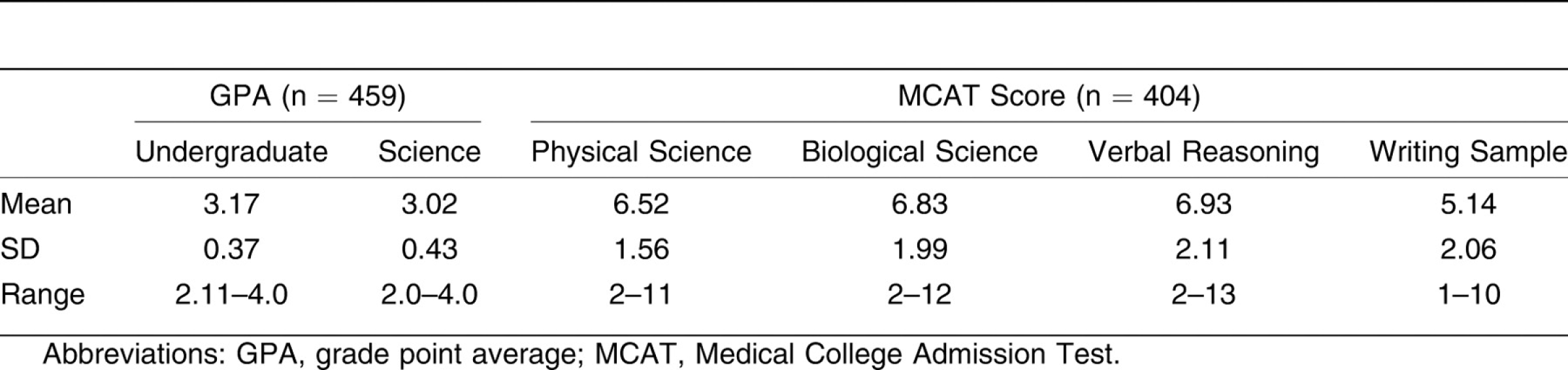
Of 459 applicants from the graduating classes of 2000 through 2009, 55 (12.0%) were admitted without MCAT scores. The institutional selectivity, sex, and ethnic origin variables are summarized in Table 1. Of the 459 matriculants studied, 228 (49.7%) attended educational institutions in the institutional selectivity category “most competitive” through “very competitive”; 367 (80.0%) were men and 314 (68.4%) were white. Fifteen students who were dismissed or withdrew in poor academic standing attended institutions in the highest institutional selectivity category compared with 29 students who attended institutions in the lowest institutional selectivity category. The descriptive statistics for the undergraduate and science GPA and MCAT variables are summarized in Table 2.
Table 1.
Descriptive Statistics for Institutional Selectivity, Sex, and Ethnic Origin.
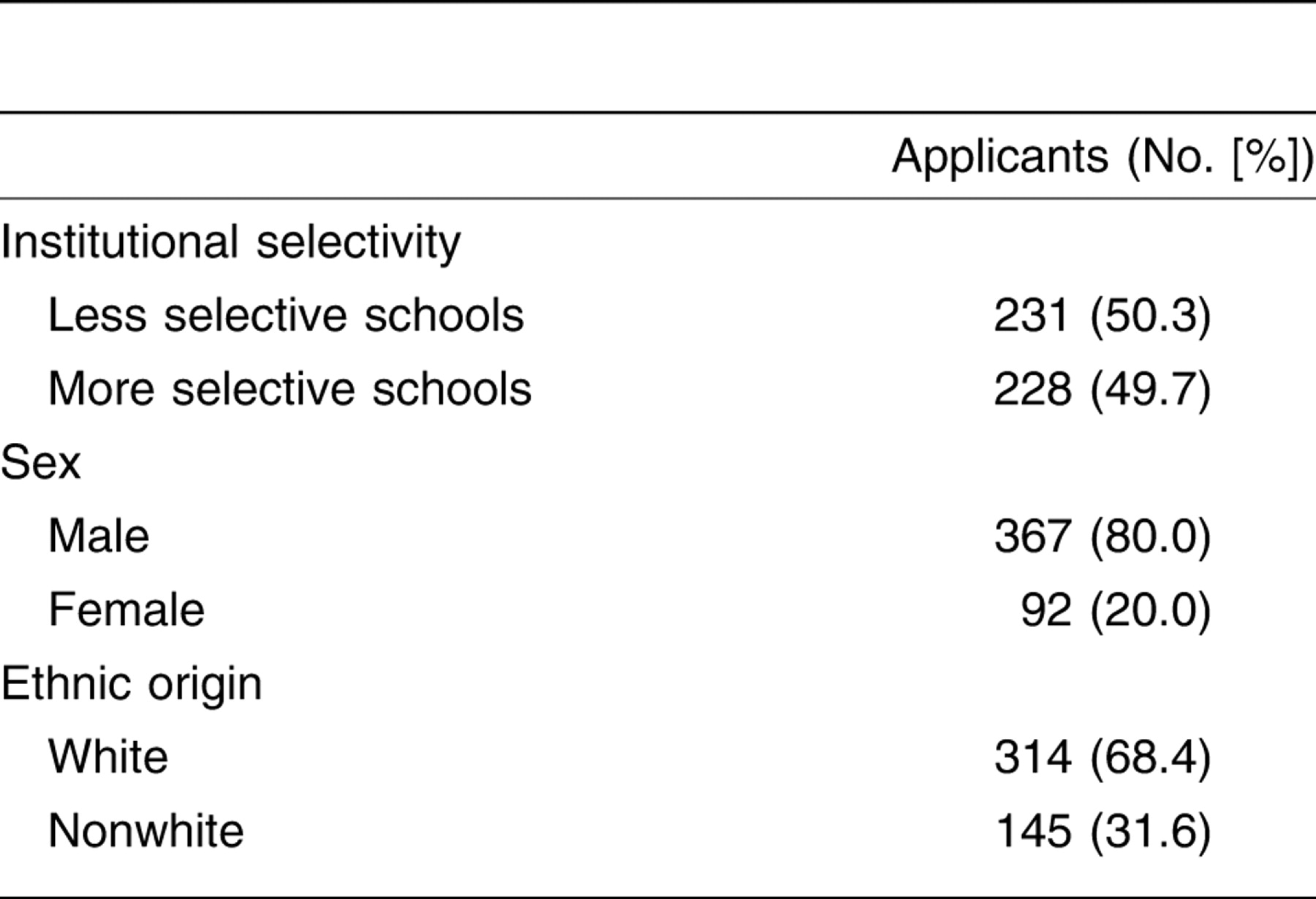
Table 2.
Descriptive Statistics for Undergraduate and Science GPAs and MCAT Scores.
Estimates from the multiple linear regression model used to examine the relationship between institutional selectivity and first-year performance (while controlling for other predictor variables) are depicted in Table 3. The adjusted multiple R2 value was 0.32. Thus, 32% of the variance in the dependent variable (first-year performance) can be said to be accounted for by or attributed to the combined variances of all of the predictor variables used in the model. The overall model was found to be significant (F = 18.3; P < 0.001).
Table 3 also provides the regression coefficients and the associated P values for the test of the null hypothesis that each of the slope parameters is not statistically significantly different from 0. Five of the ten predictor variables used in the regression model had significant P values. One of them is the variable representing the main research hypothesis (institutional selectivity).
Table 3.
Regression Coefficients Predicting First-Year Medical School GPAa.
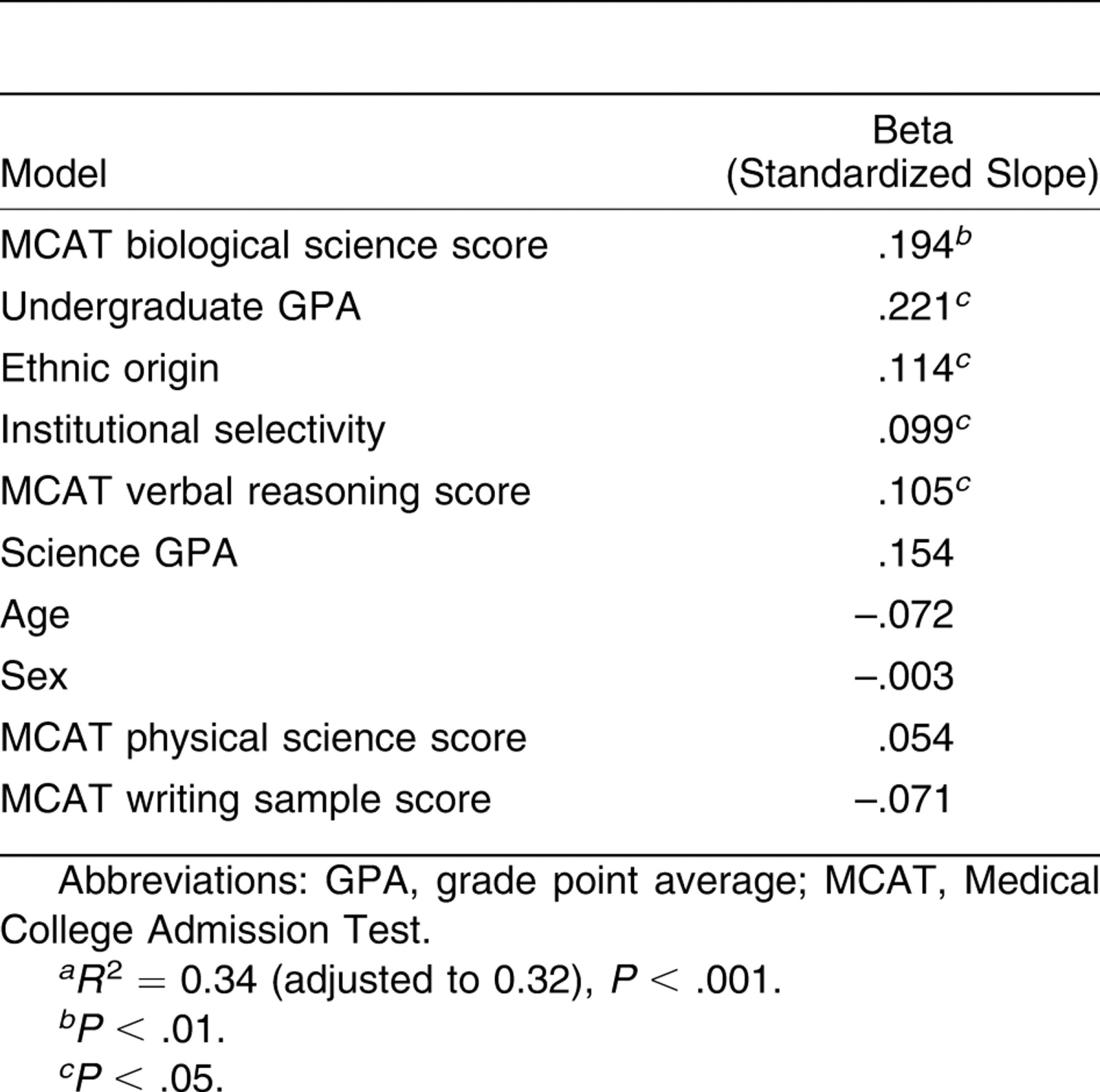
The directions of all of the slope parameters with significant P values were in the hypothesized direction. The relationship between institutional selectivity and the dependent variable was such that students who were admitted from “high-selectivity” undergraduate institutions had a greater likelihood of achieving higher first-year podiatric medical school GPAs. Higher undergraduate GPAs and MCAT scores (biological sciences and verbal reasoning) were associated with higher first-year podiatric medical school GPAs. The ethnicity variable used in the model also showed that, on average, white students had higher first-year podiatric medical school GPAs compared with nonwhite students when the effects of all of the other predictors in the model were held constant.
The standardized slope parameters also measure the strength of the association between each predictor variable and the dependent variable while controlling for all of the other predictor variables in the model. Accordingly, the strongest predictor of first-year podiatric medical school GPA was undergraduate GPA, followed by MCAT biological science score, ethnicity, MCAT verbal reasoning score, and institutional selectivity. The other predictor variables in the model did not have a statistically significant relationship with the dependent variable, and, as a result, they are not discussed.
Discussion
The use of institutional selectivity in the podiatric medical school admissions process has predictive value. Similar to those of Hall and Bailey [8], the present findings suggest that applicants who have attended undergraduate institutions that are rated as “most competitive,” “highly competitive,” and “very competitive” by the Baron’s Admissions Selector Ratings have higher first-year podiatric medical school GPAs.
The findings also suggest that institutional selectivity is not the only preadmission variable that has predictive value regarding first-year podiatric medical school GPAs. Undergraduate GPA, ethnic origin, and MCAT biological science and verbal reasoning scores also demonstrated a statistically significant relationship in predicting performance. This result reinforces the earlier findings in allopathic medicine of Mitchell [28] and Wiley and Koenig [16] that advocate using institutional selectivity with undergraduate GPA and MCAT scores to increase the predictive value.
The ethnic origin of admitted applicants demonstrated a positive correlation with the dependent variable. The data suggest that white students have a higher first-year podiatric medical school GPA, and although most students at the College of Podiatric Medicine and Surgery are white, statistical significance was present. This finding may also be related to other variables, such as institutional selectivity, MCAT scores, and undergraduate GPA. Roman et al. [27] reported that preadmission measures may be exclusionary in minority students and disadvantaged applicants and that performance on the MCAT is positively related to parental income.
If performance of disadvantaged applicants on the MCAT is related to income, then income may also have an effect on institutional selectivity. Most highly selective undergraduate institutions are expensive private institutions, and socioeconomic factors may preclude many minority students from attending these schools. Jolly [29] also reported that, on average, members of underrepresented minority groups perform less well on the MCAT, and they generally have lower college grades as well. Although the results did not demonstrate a specific relationship between these variables, it is possible that a relationship may exist and that an argument based on socioeconomic factors can be made.
The results demonstrated that the undergraduate GPA has a significant role in predicting performance in podiatric medical school. It makes sense that students with higher undergraduate GPAs have a better chance of succeeding in podiatric medical school, but anecdotal evidence suggests that students who attend highly selective undergraduate institutions typically have lower undergraduate GPAs because of the increase in academic rigor of the selective institutions. Nowacek et al. [9] agreed that undergraduate GPAs were relatively strong predictors of medical school GPAs.
The results suggest a problem with multicollinearity between undergraduate and science GPAs. A statistically significant relationship exists between the undergraduate GPA and the first-year podiatric medical school GPA, indicating that as the undergraduate GPA increases, so does the podiatric medical school GPA. The science GPA did not demonstrate a statistically significant relationship with the first-year podiatric medical school GPA. This is an unexpected result because the science GPA is a component of the undergraduate GPA.
An explanation for this finding may be the fact that students may apply to medical school after completing only prerequisite science courses and do not have to possess a science major. Yens and Stimmel [30] reported that science and nonscience majors possess equal undergraduate GPAs and perform similarly in medical school. Although all of the students admitted to medical school have taken approximately the same number of total credit hours as part of the undergraduate GPA calculation, there may be a large discrepancy in the number of hours used to calculate the science GPA between the science and nonscience majors.
The MCAT biological science and verbal reasoning scores were also valuable in predicting performance in the first-year podiatric medical school GPA. Most studies have examined the predictive value of the total MCAT score instead of the individual test sections, and its value in predicting performance is well documented. Donnon et al. [21] demonstrated that the biological science and verbal reasoning scores are the two best measures for predicting future medical student success. The predictive value of the MCAT score is most likely due to the fact that the test provides a standard measure of performance on which all applicants can be compared regardless of their background or education [9]. The independent variables displayed a variance of 32%, leaving 68% to be explained by other variables not included in this model. The predictive accuracy of this model is similar to that of other studies involving preadmission variables [21]. This finding suggests that nonpsychometric factors may play a large role in predicting success in podiatric medical school. Koenig et al. [17] support this notion by stating that although MCAT and undergraduate GPA are good predictors of medical school performance, they are not perfect.
The study may also have potentially exhibited the phenomenon of restriction of range for some variables, such as MCAT scores and undergraduate and science GPAs. When the full ranges of variables are not permitted to enter the analysis because applicants with lower GPAs and MCAT scores are not admitted to podiatric medical school, the correlations may be artificially lowered.
Conclusions
Admission to medical schools in the United States is extremely selective, but that is often not the case in podiatric medical education. The average ratio of applicants to matriculants in allopathic medicine was 2.38 in 2007 [31]. This is contrary to podiatric medicine, where the ratio of applicants to matriculants was approximately 1.31 in 2007 [32,33]. Jolly [29] stated that as the ratio of applicants to available places increases, schools naturally become more selective. However, selective admission may not be relevant to podiatric medicine because of an applicant pool that is only slightly larger than the number of matriculants.
If the size of the applicant pool prohibits selective admission, then the emphasis for admissions officers is to try to predict which applicants are most likely to perform better in podiatric medical school. The mutual data for all applicants available to admissions personnel are preadmission variables, but their predictive value has yet to be explored in the podiatric medical literature. The results of this study indicate that in the College of Podiatric Medicine and Surgery, some preadmission variables, such as institutional selectivity, undergraduate GPA, and MCAT biological science and verbal reasoning scores, are statistically significant in predicting first-year podiatric medical school GPAs.
Note that the conclusions drawn from the data are directly applicable to one podiatric medical school, and a profession-wide analysis would need to be undertaken to ensure generalizability. However, the results of the study mirror the findings of numerous others in allopathic medicine.
Future work should concentrate on determining the influence of preadmission variables on clinical competence or on examining the effect of nonpsychometric factors on podiatric medical school performance because the psychometric factors accounted for only 32% of the variance. Another consideration for future research is to evaluate whether other classifications of institutional selectivity, such as the Astin index and the Carnegie Foundation for the Advancement of Teaching Classification, have the ability to predict performance in podiatric medical school and which classification is more valuable.
Financial Disclosure
None reported.
Conflicts of Interest
None reported.
References
- Mitchell KJ: Use of MCAT data in selecting students for admission to medical school. J Med Educ 1987, 62, 871.
- Shen H, Comrey AL: Predicting medical students’ academic performances by their cognitive abilities and personality characteristics. Acad Med 1997, 72, 781.
- Silver B, Hodgson CS: Evaluating GPAs and MCAT scores as predictors of NBME I and clerkship performances based on students’ data from one undergraduate institution. Acad Med 1997, 72, 394.
- Clapp TT, Reid JC: Institutional selectivity as a predictor of applicant selection in medical school. J Med Educ 1976, 51, 850.
- Jones RF, Adams LN: The relationship between MCAT science scores and undergraduate science GPA. J Med Educ 1983, 58, 908.
- Jackson EW, Dawson-Saunders B: History of not completing courses as predictor of academic difficulty among first-year students. J Med Educ 1987, 62, 880.
- Daubney JH, Wagner EE, Rogers WA: Six-year BS/MD programs: a literature review. J Med Educ 1981, 56, 497.
- Hall FR, Bailey BA: Correlating students’ undergraduate science GPAs, theirs MCAT scores, and the academic caliber of their undergraduate colleges with their first-year academic performances across five classes at Dartmouth medical school. Acad Med 1992, 67, 121.
- Nowacek GA, Pullen E, Short J, et al: Validity of MCAT scores as predictors of preclinical grades and NBME part I examination scores. J Med Educ 1987, 62, 989.
- Hall ML, Stocks MT: Relationship between quantity of undergraduate science preparation and preclinical performance in medical school. Acad Med 1995, 70, 230.
- Friedman CP, Bakewell WE: Incremental validity of the new MCAT. J Med Educ 1980, 55, 399.
- Hendren RL: Predicting success and failure of medical students at risk for dismissal. J Med Educ 1988, 63, 595.
- Huff KL, Fang D: When are students most at risk of encountering academic difficulty? a study of the 1992 matriculants to U. S. medical schools. Acad Med 1999, 74, 454.
- Sarnacki RE: The predictive value of the premedical grade-point average. J Med Educ 1982, 57, 163.
- Jones RF, Thomae-Forgues M: Validity of the MCAT in predicting performance in the first two years of medical school. J Med Educ 1984, 59, 455.
- Wiley A, Koenig JA: The validity of the medical college admission test for predicting performance in the first two years of medical school. Acad Med 1996, 71, 83.
- Koenig JA, Sireci SG, Wiley A: Evaluating the predictive validity of MCAT scores across diverse applicant groups. Acad Med 1998, 73, 1095.
- Markert RJ: Pre-admission academic predictors of the goals of a primary care-oriented medical school. Med Educ 1985, 19, 9.
- Julian ER: Validity of the medical college admission test for predicting medical school performance. Acad Med 2005, 80, 910.
- Mitchell KJ, Haynes R, Koenig JA: Assessing the validity of the updated medical college admission test. Acad Med 1994, 69, 394.
- Donnon T, Paoluccici EO, Violato C: The predictive validity of the MCAT for medical school performance and medical board licensing examinations: a meta-analysis of the published research. Acad Med 2007, 82, 100.
- Vancouver JB, Reinhart MA, Solomon DJ, et al: Testing for validity and bias in the use of GPA and the MCAT in the selection of medical school students. Acad Med 1990, 65, 694.
- Veloski JJ, Callahan CA, Xu G, et al: Prediction of students’ performance on licensing examinations using age, race, sex, undergraduate GPAs, and MCAT scores. Acad Med 2000, 75, S28.
- Blue AV, Gilbert GE, Elam CL, et al: Does institutional selectivity aid in the prediction of medical school performance. Acad Med 2000, 75, 31.
- Barron’s Profiles of American Colleges, 27th Ed, Barron’s Educational Series, Hauppauge, NY. 2007.
- Evans DA, Jones PK, Wortman RA, et al: Traditional criteria as predictors of minority student success in medical school. J Med Educ 1975, 50, 934.
- Roman SA, Sorenson JR, Davis WI, et al: Predicting minority student performance in the first medical school year. J Natl Med Assoc 1979, 71, 661.
- Mitchell KJ: Traditional predictors of performance in medical school. Acad Med 1990, 65, 149.
- Jolly P: Academic achievement and acceptance rates of underrepresented-minority applicants to medical school. Acad Med 1992, 67, 765.
- Yens DP, Stimmel B: Science versus nonscience undergraduate studies for medical school: a study of nine classes. J Med Educ 1982, 57, 429.
- Association of American Medical Colleges: Applicants, First-Time Applicants, Acceptees, and Matriculants to U.S. Medical Schools by Sex, 1998–2009. Available at: http://www.aamc.org/data/facts/applicantmatriculant/table7-fact2009summary-web.pdf. Accessed October 8 2010.
- American Association of Colleges of Podiatric Medicine: AACPMAS Historical Trends 2000–2009. Available at: http://www.aacpm.org/html/statistics/PDFs/AppStats/Historical_TRENDS.pdf. Accessed October 8 2010.
- Council on Podiatric Medical Education: Eighty-eighth Annual Report, 2007. Available at: http://www.apma.org/Members/Education/CPMEAccreditation/CPME/CouncilonPodiatricMedicalEducationEightyeighthAnnualReport2007.aspx. Accessed October 8 2010.
© 2010 American Podiatric Medical Association