


Abstract
Background: Several studies have established an association between diabetic neuropathy and depressive symptoms. There is a link between depression and peripheral neuropathy in diabetic patients, suggesting an increased likelihood that diabetic patients will experience depressive symptoms related to lower-extremity peripheral neuropathy and arthritis during middle age and later life. The goal of this investigation was to determine whether there are age differences between insulin-dependent and non-insulin-dependent diabetic patients regarding their feelings of hopelessness and toe pain. Methods: A large population-based sample of 32,006 adults from the 1998 National Health Interview Survey was analyzed with multivariate statistical procedures. We performed χ2 and correlation procedures to test the null hypothesis that there are no age or sex differences between insulin-dependent and non-insulin-dependent diabetic patients in their reporting of feelings of hopelessness and toe pain symptoms in the previous 12 months. Results: There were significant differences between age and sex groups of insulin-dependent and non-insulin-dependent diabetic patients in reporting feelings of hopelessness and toe pain symptoms, rejecting the null hypothesis. Correlational analysis conducted between the variables of hopelessness and toe pain yielded significant correlations in insulin-dependent (r = .28; P = .0009; α = .05), and non-insulin-dependent (r = 0.19; P = .001; α = .05) women older than 61 years, concluding that diabetic women are more likely to experience hopelessness and toe pain in that age group regardless of insulin status. Conclusions: Clinicians should incorporate depression and toe pain symptoms into their assessment and treatment, especially in diabetic women older than 61 years.
The goal of this investigation was to determine whether there are age differences between persons with insulin-dependent and non-insulin-dependent diabetes mellitus regarding their feelings of hopelessness and toe pain. It is well-known that “diabetes” is a metabolic disease with chronic manifestations that involves numerous complications throughout its course, which causes severe restriction and disability in an individual’s life.[1] It has been reported that the incidence of depression is higher in diabetic patients and that diabetes management is one of the risk factors in the development of depression.[2] Several studies[3,4] have found symptoms of depression, such as feelings of hopelessness, to be prevalent in diabetic patients, especially elderly diabetic patients. And although age is a known risk factor for diabetes, the epidemiology of the disease in elderly individuals has not been adequately characterized.[5]
Factors associated with neuropathy include diabetes, poor glycemic control, male sex, white race, and older age.[6] It is one of the most common and disabling complications of diabetes because of its high incidence and its potential to lead to lower-extremity ulceration, deformation, and amputation.[7] Peripheral neuropathy manifests as sensory loss, which predisposes individuals to foot abnormalities and a high risk of ulcerations.[8] Foot ulcerations and amputations cause an extensive burden on individuals with diabetes mellitus, the health-care system, and society.[9] Furthermore, it has been reported that 4% to 33% of people with diabetes mellitus experience a type of neuropathy that can become chronic and produce unremitting pain.[10] Therefore, the understanding of neuropathy is of utmost importance.
Diabetic peripheral neuropathy results from loss of or damage to the sensory nerve fibers, which causes two main problems. The first starts with distal symmetrical sensory loss targeting the nerves with the longest axons, mostly the nerves in the lower extremity reaching the toes, in a stocking-and-glove distribution.[11] Most commonly, the nerves of the toes are the first to lose sensation. Thus, the loss of pain sensation puts the patient at higher risk for foot infections and trauma. The second is the heightened sensation of pain and burning, which can be uncomfortable for the patient. The ankle reflexes are often reduced, and as the disease progresses, the knee reflexes are also affected. In more severe and advanced cases, small muscle wasting can occur in the hands and feet, resulting in motor weakness.[12]
Regarding lower-extremity disorders, several investigations[13,14] have found a link between depression and peripheral neuropathy in diabetic patients. There may be an increased likelihood for diabetic patients to experience depressive symptoms related to peripheral neuropathy of the lower extremity during middle age and later life.[15] Similarly, Greenberg and Davis[16] found that the prevalence of foot disorders increases with age. One study[17] established an association between diabetic neuropathy and depressive symptoms such as hopelessness. Investigations[1,18] have described how foot pain may be especially debilitating because of its severe effect on daily, social, family, and, occupational functioning. Persons with diabetes who experience depression are more likely to take inappropriate care of themselves, thus increasing their risk of life-threatening complications.
Diabetes-specific emotional problems seem to be common, predominantly in depressed patients. Health-care providers who treat depression in diabetic patients should have good knowledge about the management of diabetes, the short- and long-term complications, and diabetes-specific emotional problems.[19,20] Practitioners who care for diabetic patients should be familiar with the problems of comorbid depression, decreased compliance with treatment, increased risk of complications, disability, and diminished health-related quality of life. However, there are no specific studies, to our knowledge, exploring hopelessness, toe pain, and the associations in persons with diabetes. Therefore, the aim of this study was to determine whether age differences play a role and the possible association between toe pain and feelings of hopelessness in diabetic patients.
Methods
National population-based data from the 1998 National Health Interview Survey were analyzed with multivariate statistical procedures. The 1998 National Health Interview Survey is a national probability sample of adults. We used the 1998 database because it allows for sufficiently large subsamples to test the hypothesis and also for the opportunity it provides to compare these results with those of other similar studies. Another potential reason for using the 1998 data set was that the data were not as detailed compared with recent databases. The survey elicited self-report data on a variety of health problems, including hopelessness, toe pain and stiffness, and disability resulting from these health problems. The possible association between hopelessness and toe pain among different age groups and sexes was analyzed with correlational analysis.
Statistical tools (SAS; SAS Institute Inc, Cary, North Carolina; and SUDAAN; Research Triangle Institute, Research Triangle Park, North Carolina) were used for analysis of the data. The data were divided into two subsets based on whether the subjects were using or not using insulin for diabetes. These subsets were further classified based on sex and were divided into four age groups: 18 to 25, 26 to 40, 41 to 60, and 61 years and older. Also, we split the data into people who were taking insulin for diabetes and those not taking insulin but were taking alternate treatment (other than insulin) for diabetes. All others were accounted in a separate group named “Other,” which consisted of individuals who did not use insulin for diabetes and also of people who do not have diabetes (refused, not answered, don’t know). This is technically the “not important” group from a research point of view.
Correlational analysis was conducted between the variables of hopelessness and right and left toe pain in individuals who were split into sex and different age groups and in both the insulin-dependent and insulin-independent subgroups. Women aged 61 years and older exhibited a positive association between hopelessness and toe pain and stiffness (right and left toes) independent of whether they were using insulin for their diabetes. In contrast, there was no association between insulin dependence in diabetic patients in the younger age groups and male sex. These correlations were later controlled with partial correlation procedures for possible predictor variables. The possible predictor variables were hypertension, alcohol use, body mass index, arthritis impairment, frequency of vigorous exercise, and frequency of vigorous activity. These were statistically adjusted for and did not alter any results.
The three variables of hopelessness, right toe pain, and left toe pain were fitted into two different models to better explain the variations in outcomes. First, the data were fitted into the generalized linear model to test for significant interactions. Results indicated that the interaction of the predictor variables—sex, age group, and insulin—are significant, with a P ≤ .05 for right and left toe pain. Hopelessness did not show any significant interaction with the predictor variables. A second model was used to fit the hopelessness variable into the proportional odds model of logistic regression. The odds ratio for the χ2 statistic was calculated and was found to be significant for age group and insulin dependence.
Results
A large population-based sample of 32,006 adults from the 1998 National Health Interview Survey was analyzed with multivariate statistical procedures. The survey elicited self-report data from diabetic and nondiabetic patients on a variety of health and disability problems, including diabetes and toe pain, aching, stiffness, and swelling. We performed χ2 and correlation procedures to test the null hypothesis that there are no age differences between insulin-dependent and non-insulin-dependent diabetic patients in their reporting of feelings of hopelessness and toe pain symptoms in the previous 12 months.
The percentage of people with diabetes is higher in people aged 61 years and older than in younger age groups. The percentage of women is higher compared with the percentage of men in the sample. There were fewer insulin-dependent diabetic patients (n = 609) than non-insulin-dependent diabetic patients (n = 1285) (Table 1). The remaining frequency is accounted for by missing values and the statistically “not important” subgroup. The results of this sample are sex biased. The percentage of female insulin-dependent diabetic patients (61.41%) is higher than the percentage of male insulin-dependent diabetic patients (38.59%). The age- and race-adjusted prevalence of hopelessness in insulin-dependent diabetic patients is higher compared with that in non-insulin-dependent diabetic patients. Compared with persons without diabetes, those with diabetes were, on average, older, black, and economically poor or did not have a bachelor’s degree. Persons with diabetes also had a high prevalence of hopelessness and toe pain compared with persons without diabetes.

Table 1.
Demographic Characteristics of Persons with Insulin-Dependent and Non-Insulin-Dependent Diabetes Mellitus
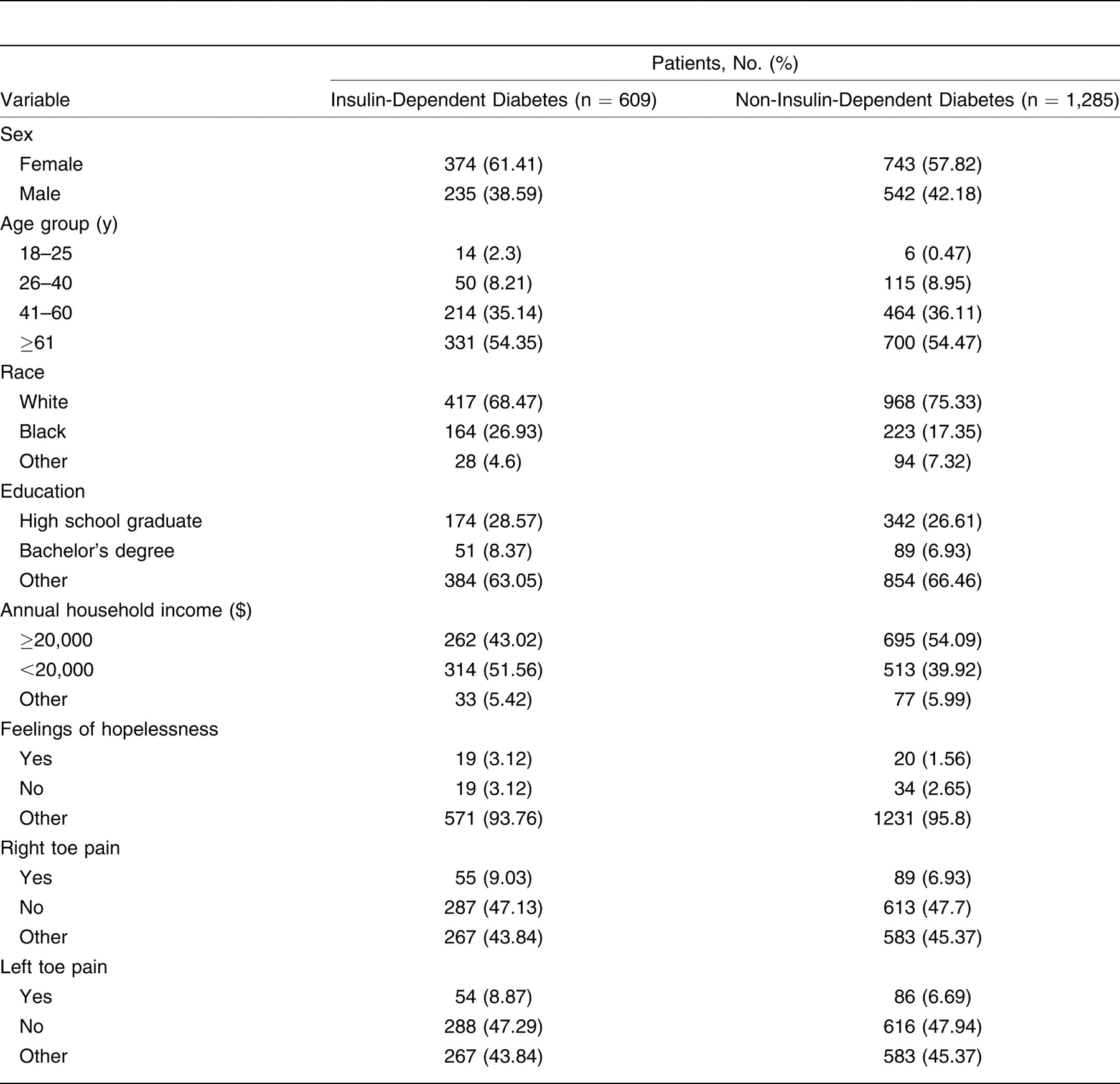
Degree of hopelessness increased with age and was higher in women than in men. The frequency of insulin-dependent diabetes is lower compared with that of non-insulin-dependent diabetes for toe pain, hopelessness, body mass index, duration of arthritis, and frequency of drinking alcohol. Because the sample size is large, the standard error values are small. The standard error mean values are higher for insulin-dependent diabetic patients than for non-insulin-dependent diabetic patients in the sample.
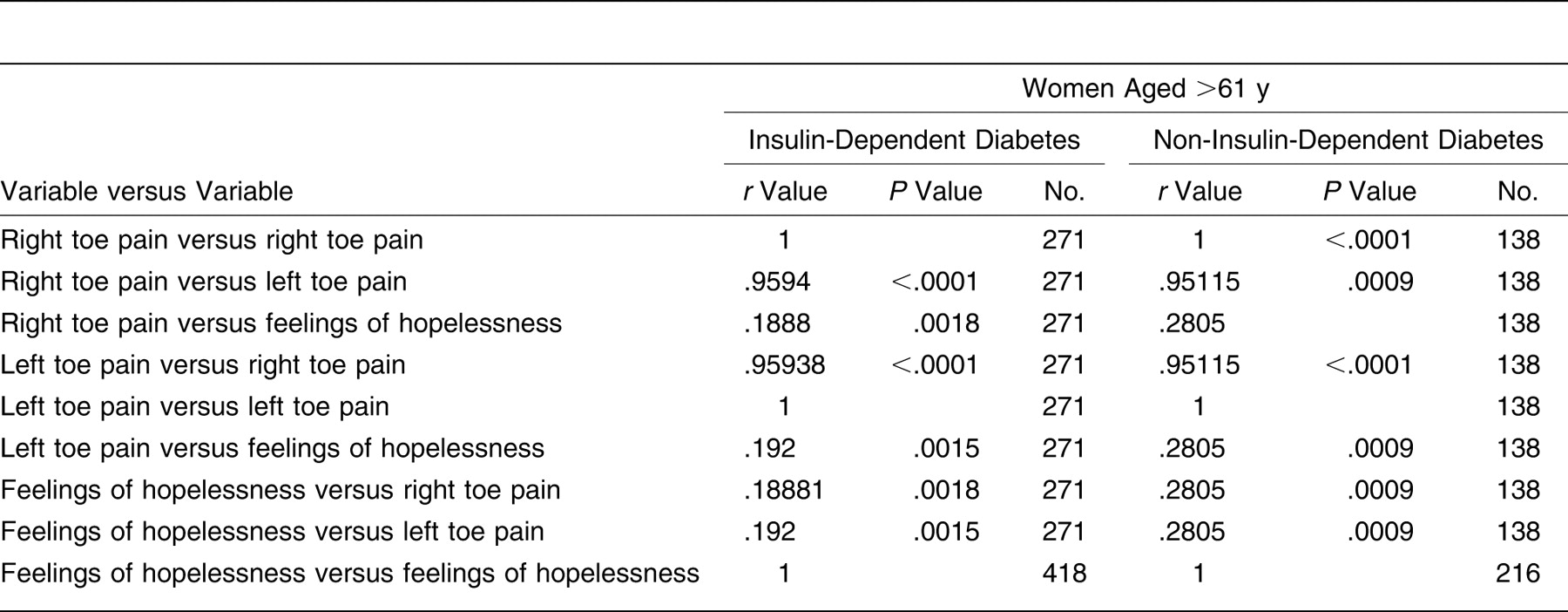
Correlational analysis conducted in persons with insulin-dependent and non-insulin-dependent diabetes mellitus yielded significant correlations between the variables of hopelessness and toe pain for women, concluding that diabetic women are more likely to experience hopelessness and toe pain in that age group regardless of insulin status. Insulin-dependent women older than 61 years (r = .28; P = .0009; α = 0.05) and non-insulin-dependent women older than 61 years (r = .19; P = .001; α = 0.05) were found to be statistically significant (Table 2). Bivariate correlations indicated that the age differences remained significant after controlling for other possible predictor variables such as hypertension, alcohol use, body mass index, duration of arthritis, and frequency of vigorous exercise.
Table 2.
Health Conditions Table Explaining Correlations Between Variables
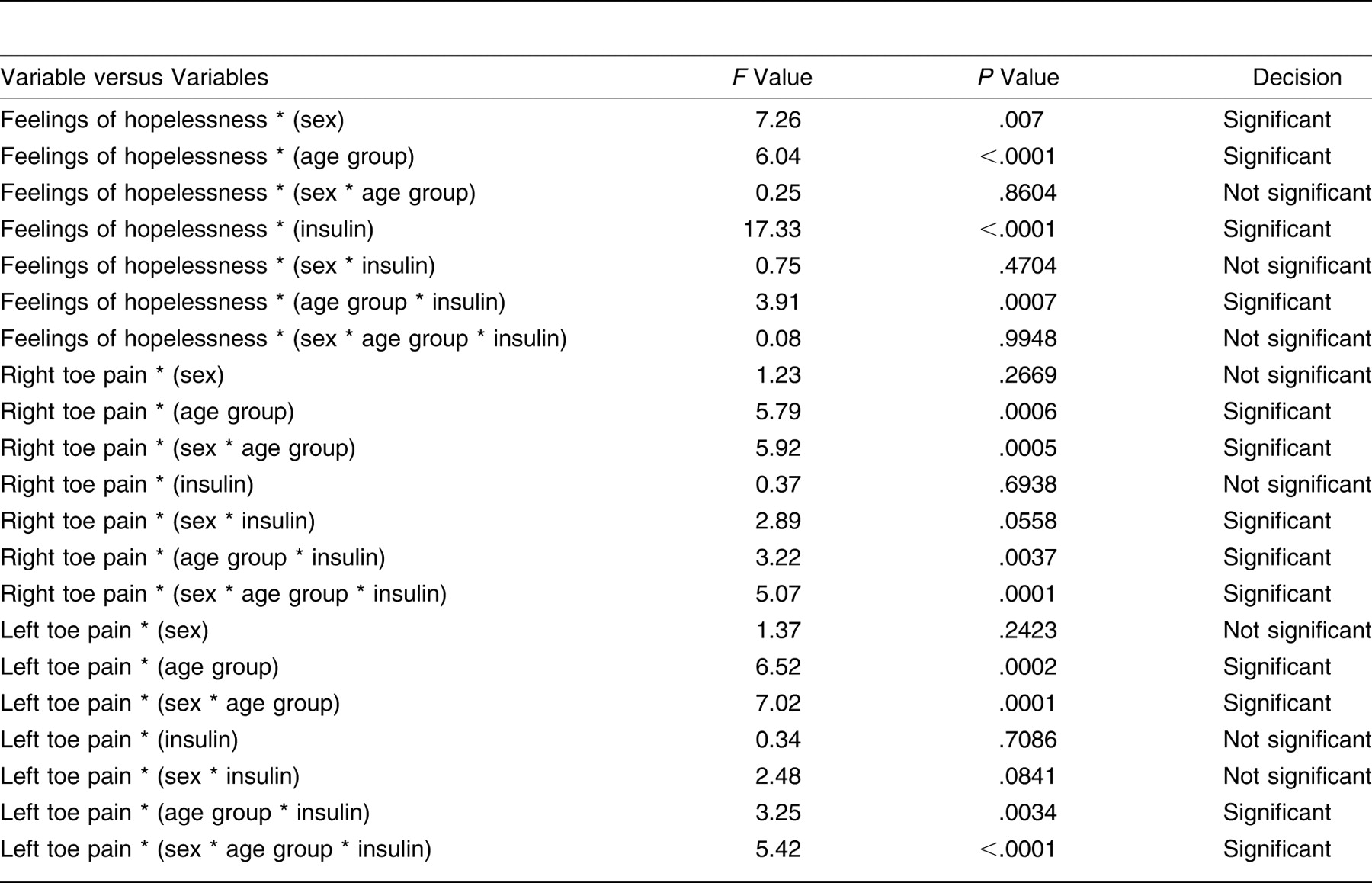
The general linear model for the variables yielded significant interactions for the predictor variables of sex, age group, and insulin, with P ≤ .001 for right and left toe pain (Table 3). The interactions were not significant in the case of the hopelessness variable (Table 3). To explain the outcomes, the variable of hopelessness was fit in a “cumulative logit fit of proportional odds logistic regression” model. The odds ratio for the χ2 statistic was calculated (χ2 = 4061, degrees of freedom = 42, and P ≤ .0001) and was found to be significant for age group and insulin dependence.
Table 3.
Model Explaining Significant Interactions of Variables
Discussion
From this study, we conclude that clinicians need to incorporate depression and toe pain symptoms into their assessment and treatment, especially in diabetic women older than 61 years. These findings and the increased prevalence of depression in diabetic patients suggest that it may be useful to examine the relative effects of disease severity and comorbid depression on quality of life in patients with diabetes.[1] This is especially important because being diagnosed as having diabetes can be a major stress in life, and coping with it requires many physical and mental accommodations. These accommodations are not only expected from the individual but also from family and friends. Improvement of such situations, at times, demands major alterations in lifestyle, work, and other daily schedules. This can consume a lot of energy from the diagnosed patient and the family. Also, older individuals increasingly have comorbid chronic conditions, such as cardiovascular disease and arthritis, which can worsen their coping skills, pose challenges to their significant others, and worsen their psychological and social well-being.
Hopelessness and diabetes factors might play an important role in certain demographic categories. These demographic categories may reflect developmental changes that occur throughout the stages of life, eg, women who experience family, social, and job losses in older age may be especially susceptible to experiencing feelings of hopelessness and toe pain. Also, research states that women live longer than men and so are more likely to experience social losses and are also more likely to experience social isolation and lack of social support compared with men of a similar age group. Clinicians should alert diabetic women older than 61 years to pay special attention to their health as these developmental changes can worsen feelings of anxiety and depression.
These results also highlight the need to recognize the important link between toe pain and different forms of emotional distress such as feelings of hopelessness. “Feelings of hopelessness” is an important factor because it determines the adult’s current mental or emotional health and the extent to which these feelings interfered with his or her life or daily activities. This is because chronic, unremitting toe pain in diabetic patients can have a negative effect on functioning and quality of life. Patients experiencing toe pain symptoms (pain, lost or reduced feeling in the feet, and unsteadiness) might have severe restrictions in daily activities (leisure, work, and daily tasks) and interpersonal relations. This can lead to changes in self-perception of the individual (being treated differently from other people) and, at times, pose devastating effects on the individual’s quality of life. This calls for major psychological and social adjustments in an individual’s life because one must adjust to a new view of oneself. This might pose a potential problem and can sometimes make treatment difficult for those who like to see themselves as invulnerable.
Anxiety and stress can also cause large jumps in blood glucose levels and can lead to panic attacks, which resemble hypoglycemic episodes and vice versa. A diabetic patient should always monitor blood glucose levels more frequently during periods of stress and pace accordingly because a conscientious diabetic patient may have a unique barometer of stress unavailable to the general population. If anxiety or hopelessness is severe, it is important to identify the specific type so that one can embark on the right treatment. Clinicians in such circumstances should be open to new medical interventions and alert the individual of possible feelings of hopelessness. Good diabetic management depends on the development of self-knowledge. Many of the things that other people’s bodies do automatically, diabetic individuals must do consciously such as closer monitoring of one’s blood glucose level and emotional state. Hence, clinicians need to incorporate depression and toe pain symptoms into their assessment and treatment, especially in diabetic women older than 61 years and warn them to pay special attention to their health because these changes, if not taken care of, can worsen feelings of mental condition of the patient. A clinician who suspects that a patient is feeling depressed should refer him or her to an appropriate mental health professional. The use of brief psychosocial screening questionnaires can be helpful in identifying patients with social and emotional problems and associated impairment in family, social, educational, and employment functioning.[21]
Financial Disclosure
None reported.
Conflicts of Interest
None reported.
References
- Eren I, Erdi O, Sahin M: The effect of depression on quality of life of patients with type II diabetes mellitus. Depress Anxiety 25: 98, 2008.
- Anderson RJ, Freedland KE, Clouse RE, et al: The prevalence of comorbid depression in adults with diabetes. Diabetes Care 24: 1069, 2001.
- Acee AM: Detecting and managing depression in type II diabetes: PHQ-9 is the answer! Medsurg Nurs 19: 32, 2010.
- Medved V, Jovanovic N, Knapic VP: The comorbodity of diabetes mellitus and psychiatric disorders. Psychiatr Danub 21: 585, 2009.
- Selvin E, Coresh J, Brancati FL: The burden and treatment of diabetes in elderly individuals in the U.S. Diabetes Care 29: 2415, 2006.
- Cheng YJ, Gregg EW, Kahn HS, et al: Peripheral insensate neuropathy: a tall problem for US adults. Am J Epidemiol 164: 873, 2006.
- Vinik AI, Park TS, Stansberry KB, et al: Diabetic neuropathies. Diabetologia 43: 957, 2000.
- Sorensen L, Molyneaux L, Yue DK: Insensate versus painful diabetic neuropathy: the effects of height, gender, ethnicity and glycaemic control. Diabetes Res Clin Pract 57: 45, 2002.
- Vileikyte L, Gonzalez JS, Leventhal H, et al: Patient interpretation of neuropathy (PIN) questionnaire. Diabetes Care 29: 2617, 2006.
- Ziegler D, Gries FA, Spuler M, et al ; Diabetic Cardiovascular Autonomic Neuropathy Multicenter Study Group: The epidemiology of diabetic neuropathy. J Diabetes Complications 6: 49, 1992.
- Aring AM, Jones DE, Falko JM: Evaluation and prevention of diabetic neuropathy. Am Fam Physician 71: 2123, 2005.
- Boulton AJ, Kirsner RS, Vileikyte L: Clinical practice: neuropathic diabetic foot ulcer. N Engl J Med 351: 48, 2004.
- Moreira RO, Amancio AP, Brum HR, et al: Depressive symptoms and quality of life in type 2 diabetic patients with diabetic distal polyneuropathy. Arq Bras Endocrinol Metabol 53: 1103, 2009.
- Vileikyte L, Peyrot M, Gonzalez JS, et al: Predictors of depressive symptoms in persons with diabetic peripheral neuropathy: a longitudinal study. Diabetologia 52: 1265, 2009.
- Regenold WT, Thapar RK, Marano C, et al: Increased prevalence of type 2 diabetes mellitus among psychiatric inpatients with bipolar I affect and schizoaffective disorders independent of psychotropic drug use. J Affect Disord 70: 19, 2002.
- Greenberg L, Davis H: Foot problems in the US: the 1990 National Health Interview Survey. JAPMA 83: 475, 1993.
- Vileikyte L: Diabetic foot ulcers: a quality of life issue. Diabetes Metab Res Rev 17: 246, 2001.
- Herber OR, Schnepp W, Rieger MA: A systematic review on the impact of leg ulceration on patient’s quality of life. Health Qual Life Outcomes 5: 44, 2007.
- Pouwer F, Skinner TC, Pibernik-Okanovic M, et al: Serious diabetes-specific emotional problems and depression in a Croatian–Dutch–English Survey from the European Depression in Diabetes [EDID] Research Consortium. Diabetes Res Clin Pract 70: 166, 2005.
- Wexler DJ, Grant RW, Wittenberg E, et al: Correlates of health-related quality of life in type 2 diabetes. Diabetologia 49: 1489, 2006.
- Cowan P, Morewitz S: Encouraging discussion of psychosocial issues at student health visits. J Am College Health 43: 197, 1995.
© 2010 American Podiatric Medical Association