


Abstract
Background: Podiatric and osteopathic medical students at Des Moines University take the same basic science medical curriculum. The first course students complete is medical biochemistry. The final common course is the second-year medical pharmacology course. Attrition typically occurs between these academic offerings. We sought to compare admissions data, retention rates, and academic performance between these two groups of medical students for the classes of 2008 to 2011. Methods: Average admission scores, performance scores for the biochemistry and medical pharmacology courses, and retention rates for the 2008 to 2011 classes were obtained from the registrar and enrollment offices. One-way analysis of variance was used to compare the scores of the two cohorts. Linear regression was used to identify changes across time. Results: The DO students showed significantly better performance than the DPM students in matriculating overall and science grade point averages, total Medical College Admissions Test scores, retention rates, and the medical biochemistry course (P < .01). There was no difference in the performance of the student groups in the medical pharmacology course. The DPM student scores across the four classes increased for both academic courses, whereas the DO student scores remained at the same level for medical biochemistry, at a rate of 0.74% per year (R2 = 0.50), and pharmacology, at a rate of 0.90% per year (R2 = 0.49). Conclusions: Admissions data and initial academic performance of osteopathic medical students were higher than those of podiatric medical students. Once attrition occurred in year 1, the difference in academic performance between these groups of students was no longer statistically significant, and students in both medical programs at that time in the curriculum are equally academically qualified.
Curricular integration and performance expectations are an academic way of life at Des Moines University. Since 1983, students in the College of Podiatric Medicine and Surgery have completed the same basic science medical curriculum as the osteopathic medical students, except for the medical pharmacology course. In year 1, both groups of students take the same courses: medical biochemistry, cell biology, general anatomy, microbiology/immunology, physiology, neuroanatomy, and pathology. Students attend the same lectures. Examinations and grading are identical. In the past 4 years, the same medical pharmacology course was presented to both cohorts of students in the fall semester of year 2. This is the final course that the podiatric and osteopathic medical students complete in the common curriculum. Before this, there were periods when the medical pharmacology course differed in content and sequencing in the podiatric and osteopathic medical programs. Historically, there has been a difference in the entering class admission profiles (grade point averages and Medical College Admissions Test [MCAT] scores) between the two academic programs. The purpose of this study was to compare admissions data, retention rates, and academic performance between the DO and DPM students and to assess academic comparability between both groups. On February 8, 2008, the Des Moines University institutional review board approved this educational research project.
Methods
The first course that podiatric and osteopathic medical students at Des Moines University complete in year 1 is medical biochemistry. The only second-year course taken by both groups of students is the medical pharmacology course offered in the first semester of year 2. Students who start these two selected courses tend to finish these courses, whereas student attrition in both programs occurs in the interval between these two courses. For these reasons, the medical biochemistry and medical pharmacology courses were selected for this study.
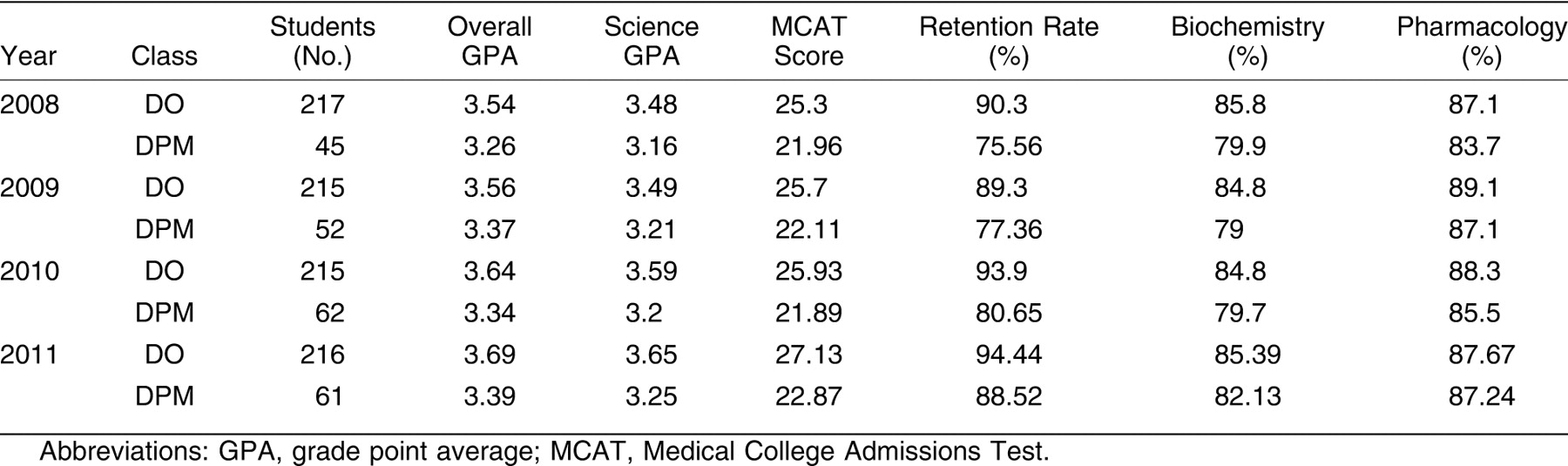
The average entering overall and science grade point averages, total MCAT scores, retention rates, and class performance in the biochemistry and medical pharmacology courses for podiatric and osteopathic medical students in the classes of 2008 to 2011 were obtained from the registrar and enrollment offices (Table 1). The average entering class size of the osteopathic program was 216 students per year compared with 54 for the entering podiatric medical classes. One-way analysis of variance was used to compare the scores of the two cohorts of students. Linear regression was also used to identify changes across time. The workload for each program in terms of credits hours was essentially the same during the two course offerings.
Table 1.
Mean Admission Characteristics, Retention Rates, and Academic Performance of DO and DPM Students.
Results
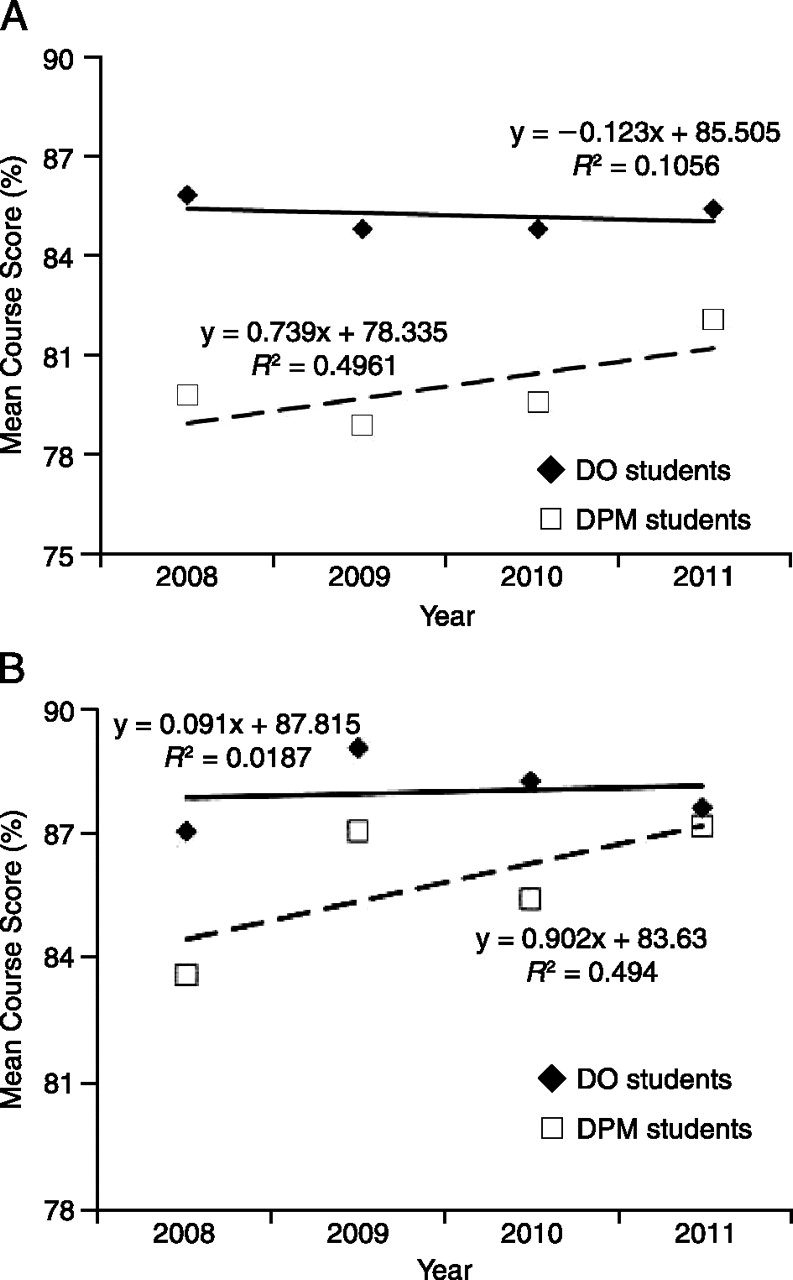
In comparing osteopathic and podiatric medical admissions variables, retention rates, and academic performance for the classes of 2008 to 2011 enrolling in Des Moines University, osteopathic medical students showed significantly better performance compared with podiatric medical students in matriculating overall grade point average, science grade point average, total MCAT score, retention rate, and the biochemistry course (P < .01). There was, however, no difference in the performance of the student groups across the 4-year period in the medical pharmacology course (Table 2). The podiatric medical student scores across the four years increased for both academic courses: biochemistry at a rate of 0.74% per year (R2 = 0.50) and pharmacology at a rate of 0.90% per year (R2 = 0.49); the osteopathic students remained at the same level (Fig. 1).
Table 2.
Results of 1-Way ANOVA to Compare Admissions Variables, Retention Rates, and Academic Performance of DO and DPM Studentsa.
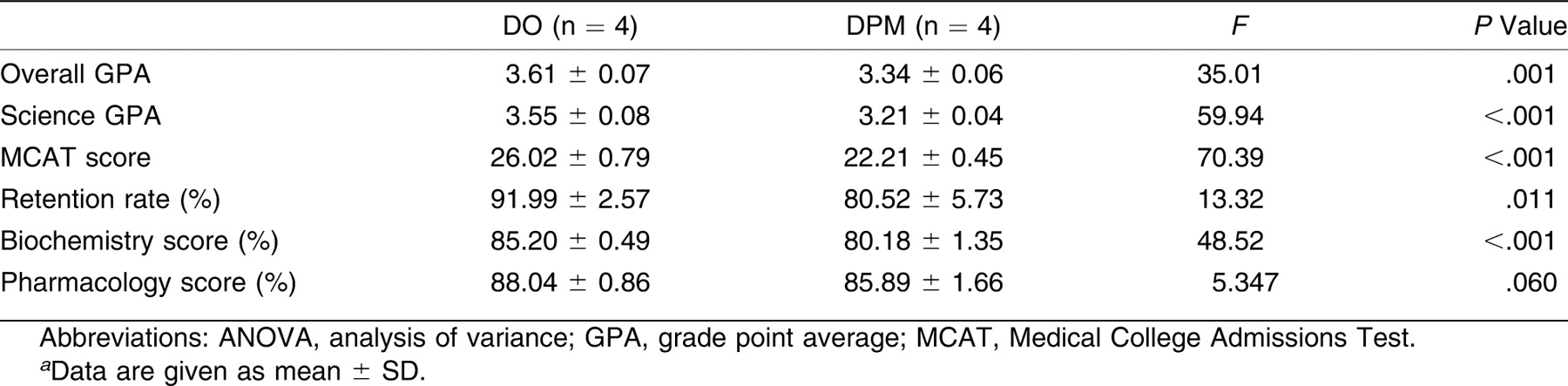
Figure 1.
Linear regression of academic performance in the medical biochemistry (A) and medical pharmacology (B) courses.
Discussion
The goal of all medical programs is to admit students who possess the greatest academic and personal skills to successfully complete a rigorous medical curriculum in preparation for residency training. Many admissions studies have been published identifying various criteria used to profile students with the highest probability of succeeding once admitted to medical school. The most common variables cited that predict academic success are undergraduate cumulative and science grade point averages and MCAT scores. [1–8] The most common conclusion reached from these studies is that students with higher entering grade point averages and MCAT scores are more likely to achieve academic success in the first year of medical school. Findings from the College of Podiatric Medicine and Surgery’s longitudinal analysis of admissions data for the classes of 2000 to 2009 identified similar findings noting undergraduate grade point averages and MCAT scores (with specific sections carrying greater influence) as having academic success predictive value.
Historically, applicant pools for osteopathic medical schools are much more robust in terms of number of applicants per available seat. Comparing the number of applicants per seat for the classes of 2008 to 2011 entering osteopathic and podiatric medical schools, the ratio based on national admissions data is 2.6:1 (2.6 applicants per seat) for osteopathic medicine compared with 1.4:1 for podiatric medicine. [9,10] This relationship translates into stronger applicant pools for osteopathic medical schools and a greater likelihood of osteopathic medical students completing the first-year course of study with fewer academic difficulties compared with entering podiatric medical students.
In comparing admissions data for osteopathic medicine and podiatric medicine for the classes included in this study (2008–2011), the mean cumulative and science undergraduate grade point averages for all students entering osteopathic medical schools were 3.45 and 3.36, respectively. [9] The mean grade point averages for students entering the College of Osteopathic Medicine at Des Moines University were 3.61 and 3.55, respectively. Transcript verification for podiatric medical applicants occurs at the individual college offices of enrollment/admission and, therefore, national data are not available. The mean cumulative and science undergraduate grade point averages for students enrolling in the College of Podiatric Medicine and Surgery at Des Moines University for the classes of 2008 to 2011 were 3.34 and 3.21, respectively.
The MCAT scores for all students entering osteopathic medical schools for the classes of 2008 to 2011 averaged 25.15. [9] The MCAT scores for students enrolling in the College of Osteopathic Medicine and the College of Podiatric Medicine and Surgery at Des Moines University for the same classes averaged 26.02 and 22.21, respectively.
The results of this study are based on two cohorts of students, podiatric and osteopathic medical, possessing different sets of admissions data (grade point averages and MCAT scores) at entry into medical school. As previously noted, the admissions data for the osteopathic medical students admitted to Des Moines University in the classes of 2008 to 2011 was higher than the admissions data for all students entering osteopathic medicine. Des Moines University students are challenged with a rigorous first-year basic science medical school curriculum and strict academic policies that maintain the integrity of the academic programs. Based on studies citing the relationship of academic success in medical school to grade point averages and MCAT scores, the assumption is that podiatric medical students as a group would experience greater academic difficulty. In this study, the podiatric medical classes did, in fact, have a higher attrition rate than the osteopathic medical classes during the first year. However, once attrition occurred in year 1, the performance of podiatric and osteopathic medical students was comparable in the medical pharmacology course. Another way of stating this finding is that there is no difference in the academic aptitude of podiatric and osteopathic medical students at Des Moines University once these groups of students begin the second year of medical school education. Also note the higher admissions data for osteopathic medical students at Des Moines compared with osteopathic medical students enrolling in all osteopathic schools.
The lower course grades for both cohorts in medical biochemistry indicate more challenging content compared with medical pharmacology. However, looking at the overall grades for each course separately across time, the curriculum and the course content delivery seems consistent, with no indication of trends (eg, grade inflation). For the osteopathic medical students, the rate of change in the grades in the 4 years (y value) indicates no trend and, thus, consistency in the class performance for both courses. In contrast, there is a trend (y value) for podiatric medical students indicating an increase in academic performance in the 4 years for both courses. This was consistent for both courses for the four classes, with a noticeable trend of the podiatric medical students narrowing the gap across time, especially in the medical pharmacology course, where there was no statistically significant difference in class performance with the osteopathic medical students. The performance improvement seen in podiatric medical course performance is not surprising considering the increase in admissions data with each entering class and the corresponding increase in retentions rates. To what extend taking the identical basic science curriculum with the osteopathic medical students motivated podiatric medical students remains speculative but is a concept that cannot be discounted.
The size of the entering classes for the osteopathic medicine program at Des Moines University is much larger than that for podiatric medical students. This may have an effect in tighter standard deviations on most of the admission and course performance measures.
Conclusions
In this study, the admissions data and initial academic performance of osteopathic medical students were statistically significantly higher than those of podiatric medical students at Des Moines University. Once attrition occurred in year 1, the academic performance difference between podiatric and osteopathic medical students at Des Moines University, based on the performance in the medical pharmacology course, was no longer statistically significant, and students in both medical programs at that time in the curriculum can be considered equally academically qualified. The challenge for podiatric medicine is to increase the applicant-to-seat ratio and to admit classes with admissions qualifications similar to those of other health professions. Academic aptitude or comparability of two groups of medical students representing different medical professions should continue to be assessed when identical curricular offerings exist between podiatric and osteopathic or allopathic medical students.
Acknowledgments
The dean and the director of admissions of the Des Moines University College of Osteopathic Medicine for supporting this project.
Financial Disclosure
None reported.
Conflicts of Interest
None reported.
References
- Donnon T, Paoluccici EO, Violata C: The predictive validity of the MCAT for medical school performance and medical board licensing examinations: a meta-analysis of the published research. Acad Med82: 100, 2007.
- Evans P, Wen FK: Does the medical school admission test predict global academic performance in osteopathic medical school?. J Am Osteopath Assoc107: 157, 2007.
- Mitchell KJ: Traditional predictors of performance in medical school. Acad Med65: 149, 1990.
- Hall FR, Bailey BA: Correlating students’ undergraduate science GPAs, their MCAT scores and the academic caliber of undergraduate colleges with first-year academic performances across five classes at Dartmouth medical school. Acad Med67: 121, 1992.
- Nowacek GA, Pullen E, Short J, et al: Validity of CAT scores as predictors of preclinical grades and NBME part 1 examination scores. J Med Educ62: 989, 1987.
- Wiley A, Koenig JA: The validity of the medical college admission test for predicting performance in the first two years of medical school. Acad Med71: 83, 1996.
- Dixon D: Relation between variables of preadmission, medical school performance, and CPMLEX-USA levels 1 and 2 performance. J Am Osteopath Assoc102: 332, 2004.
- Dixon D: Correlation of preadmission variables with medical school performance and level 1 COMLEX-USA scores. J Am Osteopath Assoc102: 510, 2002.
- American Association of Colleges of Osteopathic Medicine Admissions updates and facts about osteopathic medical education. Available at: http://www.aacom.org/about/fastfacts/Pages/default.aspx. Accessed November 1, 2008.
- American Association of College of Podiatric Medicine Applicant statistics. Available at: http://www.aacpm.org. Accessed November 2, 2008.
© 2010 American Podiatric Medical Association