


Abstract
This study examines the effects of income diversification on the stability of Vietnamese commercial banks, with particular attention to the roles of credit risk, profitability, and capital adequacy. Using panel data from 406 bank-year observations covering the period 2010–2024, the study employs the two-step system Generalized Method of Moments (System GMM) estimator to address endogeneity and dynamic effects. The results indicate that income diversification has no significant direct impact on bank stability, credit risk, or profitability. In contrast, capital adequacy exhibits a U-shaped nonlinear relationship with both bank stability and profitability. The findings suggest that the positive effects of capital adequacy emerge only after threshold levels of approximately 7.6% for bank stability and 8.1% for profitability. The interaction between income diversification and capital adequacy is statistically insignificant, indicating no moderating effect. These findings highlight the importance of maintaining adequate capital buffers rather than relying solely on income diversification to enhance banking resilience. The study provides new evidence from an emerging economy and offers practical implications for bank managers and policymakers seeking to strengthen financial stability.
Keywords:
income diversification; bank stability; credit risk; profitability; capital adequacy; liquidity; size JEL Classification:
G21; G22; G28
1. Introduction
Over the past decade, income diversification (IDIV) has become an important strategy for commercial banks seeking to reduce their dependence on traditional lending, expand non-interest income sources, and enhance competitiveness amid increasingly volatile financial markets. However, empirical studies on the relationship between income diversification and bank performance have not reached a consensus. Some studies argue that income diversification improves profitability by broadening revenue sources and reducing dependence on interest income. For example, Hakimi et al. (2023) finds that banking diversification improves the profitability of MENA banks under certain conditions. Similarly, Zhang et al. (2025) shows that digital transformation enhances bank performance by increasing income diversification and reducing credit risk, while Tariq et al. (2025) confirms that income diversification positively affects the financial stability of Pakistani banks.
Conversely, many other studies show that income diversification may increase risk and weaken bank performance or stability. Ben Rejeb and Merzki (2024) finds that excessive income diversification reduces the stability of European commercial banks, indicating over-diversification. Likewise, Kwaku Mensah Mawutor et al. (2023) shows that income diversification reduces the profitability of banks in sub-Saharan Africa, while Githaiga (2023) and Nguyen et al. (2023) also report a negative effect of income diversification on bank performance. These conflicting findings indicate that the benefits of income diversification depend on the operating characteristics, governance capacity, and business environment of each banking system.
In addition to its direct effects on profitability and stability, recent studies suggest that profitability and credit risk are important mechanisms through which income diversification affects bank stability. Ayinuola and Gumel (2023) indicates that both credit risk and liquidity risk negatively affect bank stability, while Sang Tang My (2022) demonstrates that profitability serves as a transmission channel between credit risk and financial stability. Gadzo et al. (2019), Sharma et al. (2024), and Mousa et al. (2025) also show that credit risk significantly affects bank profitability and thereby influences financial stability. However, Cheng et al. (2020) and Handriani and Anggara (2025) report different findings regarding the effect of credit risk on profitability, suggesting that this relationship remains debated and requires further testing in different research contexts.
Although many studies have analyzed the effect of income diversification on bank profitability or stability, the role of the capital adequacy ratio (CAR) in this relationship has not received sufficient attention. Abbas and Ali (2022a) shows that bank capital moderates the relationship between loan growth and credit risk in Islamic banks. Similarly, MacCarthy (2024) demonstrates that risk management mitigates the adverse effect of risk on bank performance, while Ahmad (2025) confirms that financial stability moderates the relationship between intellectual capital and firm performance. These studies imply that factors reflecting financial capacity and resilience may alter the effects of business strategies on performance. However, empirical evidence on the moderating role of CAR in the relationship between income diversification and bank stability remains very limited.
Building on this research gap, this study examines the effects of income diversification on bank profitability, credit risk, and stability, while testing the moderating role of the capital adequacy ratio in the relationship between income diversification and bank stability. Unlike previous studies, it not only evaluates the direct effect of income diversification but also analyzes the transmission mechanisms through profitability and credit risk and examines whether capital adequacy strengthens the positive effect of income diversification on financial stability. The findings are expected to add empirical evidence on income-diversification strategies in banking and provide a reference for managers and supervisory authorities in designing diversification policies consistent with capital-safety requirements and banking-system stability.
2. Literature Review and Theoretical Background
Income diversification is a strategy through which banks expand their revenue sources beyond traditional lending activities, including payment services, insurance, foreign-exchange trading, securities investment, and other financial services. Amid intensifying competition and narrowing net interest margins, many banks are restructuring their income composition to reduce dependence on lending, thereby improving performance and resilience to financial shocks. According to portfolio theory (Markowitz, 1959), diversifying income-generating sources disperses risk, reduces cash-flow volatility, and improves resource-use efficiency.
On this basis, the author examines the following relationships:
2.1. Relationships Among Income Diversification, Profitability, Credit Risk, and Bank Stability
Numerous empirical studies have demonstrated that income diversification significantly affects bank profitability, although the findings remain inconclusive. Some studies argue that income diversification improves performance because banks gain additional revenue from non-lending activities, reduce their dependence on interest income, and exploit economies of scope. For example, Ashraf and Nazir (2025) finds that income diversification positively affects the risk-adjusted profitability of Pakistani commercial banks. Similarly, Hakimi et al. (2023) confirms that banking diversification improves bank profitability in the MENA region, although the magnitude of the effect depends on economic and financial freedom.
Conversely, some studies show that excessive expansion into non-interest activities may reduce performance because of high investment costs, limited managerial expertise, and the volatility of non-traditional income. Kwaku Mensah Mawutor et al. (2023) finds that income diversification negatively affects the profitability of banks in sub-Saharan Africa. Likewise, Nguyen et al. (2023), examining Vietnamese commercial banks, and Githaiga (2023), examining East African banks, both show that income diversification reduces bank performance. These conflicting results suggest that the effect of income diversification on profitability depends on managerial capacity, the development of financial markets, and the operating conditions of each country.
Hypothesis 1 (H1).
Income diversification (IDIV) has a positive effect on bank profitability (ROA, ROE).
In addition to profitability, income diversification also affects bank credit risk. Theoretically, as the share of non-interest income increases, banks become less dependent on traditional lending, which may reduce incentives for excessive credit expansion and lower the likelihood of non-performing loans. Zhang et al. (2025) shows that digital transformation improves bank performance through two important mechanisms: greater income diversification and lower credit risk. However, other studies report the opposite result, arguing that expansion into non-traditional activities may encourage banks to assume greater risk in pursuit of profit maximization. Githaiga (2022) indicates that banks with a higher share of non-interest income tend to assume more risk, while Abbas and Ali (2022a) also shows that income diversification increases risk and reduces the stability of U.S. banks. In addition, Ben Rejeb and Merzki (2024) and Al-Nimer et al. (2024) find that income diversification increases earnings management by raising bank risk. These results show that the effect of income diversification on credit risk remains highly debated in the empirical literature.
Hypothesis 2 (H2).
Income diversification (IDIV) has a positive effect on credit risk (NPL).
Income diversification is also regarded as an important determinant of bank stability. From the traditional perspective, diversifying revenue sources reduces profit volatility, increases loss-absorbing capacity, and improves the Z-score. Tariq et al. (2025) shows that income diversification positively affects the financial stability of Pakistani banks and mediates the relationship between board gender diversity and bank stability. Similarly, Filatie and Sharma (2024) argues that diversification enhances the financial stability of Ethiopian commercial banks when combined with intellectual-capital efficiency.
However, not all studies support this view. Ben Lahouel et al. (2023) identifies a nonlinear relationship between income diversification and the stability of European banks, in which excessive diversification weakens bank stability. Abbas and Ali (2022a) also concludes that income diversification has a significant negative effect on the stability of U.S. commercial banks. These findings indicate that the benefits of diversification are realized only up to a certain level; when banks expand excessively into non-traditional activities, operational and market risks may increase and undermine financial stability.
Hypothesis 3 (H3).
Income diversification (IDIV) has a positive effect on bank stability (Z-score).
2.2. Relationships Among Profitability, Credit Risk, and Bank Stability
Profitability and credit risk are regarded as two key determinants of bank stability. Highly profitable banks can accumulate more internal capital, enhance their loss-absorbing capacity, and withstand economic shocks, thereby improving financial stability. Conversely, credit risk deteriorates asset quality, increases provisioning expenses, and reduces profitability, thus weakening a bank’s ability to maintain stable operations.
Many empirical studies confirm that profitability positively affects bank stability. Sang Tang My (2022), examining Vietnamese commercial banks over 2005–2019, finds that profitability positively affects financial stability and simultaneously serves as a transmission channel in the relationship between credit risk and bank stability. The results show that more profitable banks generally maintain stronger capital positions, have greater risk-bearing capacity, and achieve higher financial stability. Similarly, Ayinuola and Gumel (2023) indicates that larger banks with higher equity and stronger capital adequacy perform better, thereby contributing to bank stability.
Conversely, many studies show that credit risk is a major cause of declining bank stability. Ayinuola and Gumel (2023) demonstrates that credit risk and liquidity risk both have significant negative effects on the stability of Nigerian banks, while liquidity risk also increases credit risk and thereby heightens bank instability. The study further confirms a one-way causal relationship from liquidity risk to credit risk, emphasizing the need to manage both risks simultaneously to safeguard financial stability. Similar evidence is found in Vietnam, where Sang Tang My (2022) shows that credit risk affects bank stability both directly and indirectly through profitability, confirming the mediating role of profitability in transmitting the effect of credit risk to financial stability.
In addition, many studies analyze the effect of credit risk on bank profitability. Gadzo et al. (2019) shows that credit risk and operational risk both negatively affect the financial performance of universal banks in Ghana. Sharma et al. (2024) also confirms that credit, liquidity, and interest-rate risks are closely associated with profitability and emphasizes that effective management of these risks is essential for improving performance and maintaining banking-system stability. Similarly, Mousa et al. (2025) indicates that credit risk serves not only as a mediator but also as a moderator in the relationship between liquidity risk and profitability. The results show that as credit risk increases, the adverse effect of liquidity risk on bank profitability becomes stronger.
Nevertheless, empirical evidence on the relationship between credit risk and profitability remains inconclusive. Cheng et al. (2020) argues that credit risk is positively related to the profitability of listed South African banks, whereas Handriani and Anggara (2025) finds no statistical evidence that credit risk affects the profitability of Indonesian banks. The authors suggest that these differences may arise from risk-management effectiveness, the degree of loan-portfolio diversification, and cross-country differences in legal environments and banking-system development.
A synthesis of previous studies shows that profitability and credit risk both play important roles in bank stability. Most studies agree that profitability strengthens risk resilience and financial stability, whereas credit risk reduces asset quality and profitability and increases the likelihood of instability. However, evidence continues to differ regarding the magnitude and direction of the effect of credit risk on profitability across research settings. These relationships therefore require further testing in the present context to provide additional empirical evidence.
Hypothesis 4 (H4).
Profitability (ROA, ROE) has a positive effect on bank stability (Z-score).
Hypothesis 5 (H5).
Credit risk (NPL) has a negative effect on bank stability (Z-score).
Hypothesis 6 (H6).
Credit risk (NPL) has a negative effect on profitability (ROA, ROE).
2.3. The Positive Moderating Role of Capital Adequacy (CAR) in the Relationship Between Income Diversification (IDIV) and Bank Stability (Z-Score)
The capital adequacy ratio (CAR) is a key indicator of a bank’s financial capacity and resilience to risk. Within the Basel Accords, Basel I1 was introduced in 1988, followed by Basel II2 in 2004. After the 2008 global financial crisis, CAR became a central component of the Basel III3 framework, which aims to strengthen banks’ resilience to economic and financial shocks. CAR is designed to ensure that banks maintain a minimum level of capital to absorb losses arising from credit, market, and operational risks, thereby protecting depositors and preserving financial-system stability. Better-capitalized banks not only have a greater capacity to absorb losses but are also in a stronger position to expand their business and implement diversification strategies more safely. Accordingly, CAR is expected not only to affect bank stability directly but also to alter the effect of income-diversification strategies on financial stability.
Theoretically, income diversification helps banks reduce their dependence on traditional interest income, expand non-interest revenue sources, and disperse risk. However, expansion into non-traditional activities may also increase operational and market risks and require more capital to comply with capital-adequacy regulations. When a bank has a high capital adequacy ratio, its own capital acts as a buffer that absorbs losses arising from diversified activities, enabling the bank to capture the benefits of income diversification while maintaining financial stability. Conversely, when capital is low, the bank may struggle to control risks generated by non-lending activities, reducing the effectiveness of diversification and increasing the likelihood of instability.
Recent empirical studies also provide evidence that factors reflecting financial or managerial capacity may moderate the relationship between business strategies and bank performance. Abbas and Ali (2022b) is among the first studies to test the moderating role of bank capital in the relationship between loan growth and credit risk, using 217 Islamic banks in 38 countries over 2010–2019. The results show that bank capital significantly moderates the effect of loan growth on credit risk and confirm that better-capitalized banks are more capable of controlling risk while expanding lending. This finding is consistent with the moderation hypothesis in banking, according to which capital serves as a risk-mitigation mechanism and strengthens banks’ resilience to financial shocks.
Beyond the role of capital, many studies demonstrate that factors reflecting managerial capacity and financial strength can alter the effects of risk factors or business strategies on bank performance. MacCarthy (2024) shows that risk management significantly moderates the negative relationship between risk exposure and the performance of Ghanaian banks. Strengthening risk management mitigates the adverse effects of credit and liquidity risks on performance and thereby improves banks’ resilience to changes in the business environment.
From another perspective, Ahmad (2025) shows that financial stability moderates the relationship between intellectual capital and firm performance. Firms with stronger financial foundations use intangible resources more effectively to improve performance and market value and reduce bankruptcy risk. Although this study concerns non-financial firms, its findings imply that financial capacity can amplify the positive effects of strategic resources on performance.
In addition, Mulwa and Kosgei (2016) shows that credit risk moderates the relationship between diversification and the financial performance of Kenyan commercial banks. The effect of diversification on performance depends significantly on the level of credit risk confronting the bank. Similarly, Khémiri et al. (2024) finds that corporate social responsibility (CSR) moderates the relationship between financial inclusion and the stability of Islamic banks in the GCC region, indicating that internal bank characteristics can alter the effect of business strategies on financial stability. These findings reinforce the view that the effect of diversification is not entirely direct but is also shaped by factors reflecting bank financial and managerial capacity.
Hypothesis 7 (H7).
Capital adequacy (CAR) positively moderates the relationship between income diversification (IDIV) and bank stability (Z-score).
3. Methods
3.1. Data and Sample
The study utilizes panel data from commercial banks listed in Vietnam over the 2010–2024 period, representing 15 years of observations. Data were gathered from audited financial statements, annual reports, and the Vietstock database. After excluding banks that did not meet the sample selection criteria and observations with missing data, the final dataset comprised 406 bank-year observations, containing the necessary information to analyze the relationships among income diversification, credit risk, profitability, and bank stability.
The study period was selected because it encompasses a phase marked by significant changes within Vietnam’s banking system. Following the restructuring process, commercial banks have progressively strengthened their financial capacity, accelerated the resolution of non-performing loans, and implemented Basel II risk management standards while preparing a roadmap for Basel III adoption. Furthermore, the rapid growth of digital banking, electronic payment services, bancassurance, and financial service activities has created favorable conditions for banks to expand their non-interest income streams. Consequently, the 2010–2024 period is considered appropriate for assessing the impact of income diversification strategies on the stability of Vietnamese commercial banks.
Data collection, aggregation, and verification were conducted following the full release of the 2024 financial statements, ensuring the consistency and completeness of the research dataset. All financial variables were calculated based on audited financial statement data and processed consistently prior to analysis using Stata 14 software.
The use of panel data enables the tracking of changes within individual banks over time while controlling for unobserved heterogeneity across banks. This data structure is well-suited for analyzing the dynamic relationships among income diversification, credit risk, profitability, and bank stability within the scope of this study.
3.2. Variable Measurement
The dependent variable in the study is bank stability (Z-score), while the primary independent variable is income diversification (IDIV). Profitability (ROA, ROE) and credit risk (NPL) are used to examine the mechanism through which income diversification affects bank stability. The capital adequacy ratio (CAR) and its squared term (CAR2) are included in the model to investigate the potential existence of a non-linear relationship and the moderating role of capital. Additionally, the study employs several control variables, including credit growth (LoanGrowth), liquidity (LIQ), bank size (SIZE), economic growth (GDP), and inflation (CPI). Definitions, measurement methods, and data sources for these variables are detailed in Table A1.
3.3. Model Specification
To test the research hypotheses, this paper constructs three dynamic regression models to simultaneously assess the impact of income diversification on bank stability, credit risk, and profitability. These models are grounded in theory and build upon prior research, while incorporating lagged dependent variables to capture the dynamic nature of banking operations. The inclusion of the squared capital adequacy ratio (CAR2) allows for testing the potential existence of a non-linear relationship between capital and bank performance.
3.4. Estimation Method
In this study, the system GMM method is selected because the model examining the relationships among income diversification, profitability, credit risk, and bank stability may be subject to endogeneity. For example, income diversification may not only affect bank profitability and stability but may also be influenced by the bank’s own level of stability and performance. In addition, the dependent variable (Z-score) is dynamic and affected by its past values. The GMM model simultaneously accommodates the lagged dependent variable, controls for endogeneity, and limits bias arising from omitted variables and unobserved bank-specific heterogeneity, thereby providing more consistent and efficient estimates than conventional panel-regression methods.
This study employs the two-step System GMM estimator to address potential endogeneity, the dynamic nature of the dependent variables, and unobserved bank-specific heterogeneity. The term “two-step” refers to the two-step estimation procedure of the System GMM estimator rather than a two-stage regression model. In the first step, an initial weighting matrix is used to estimate the model parameters. In the second step, the residuals from the first step are used to construct an updated weighting matrix and re-estimate the model.
The System GMM framework combines equations in first differences with equations in levels. Lagged values of the dependent variables and endogenous or predetermined regressors are used as GMM-style instruments under the corresponding moment conditions, while strictly exogenous variables can be treated as standard IV-style instruments. The validity of the instruments is assessed using the Hansen test and the Difference-in-Hansen test. The Arellano–Bond AR(1) and AR(2) tests are also employed to examine serial correlation in the differenced residuals.
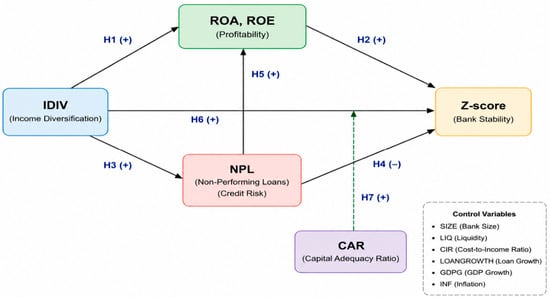
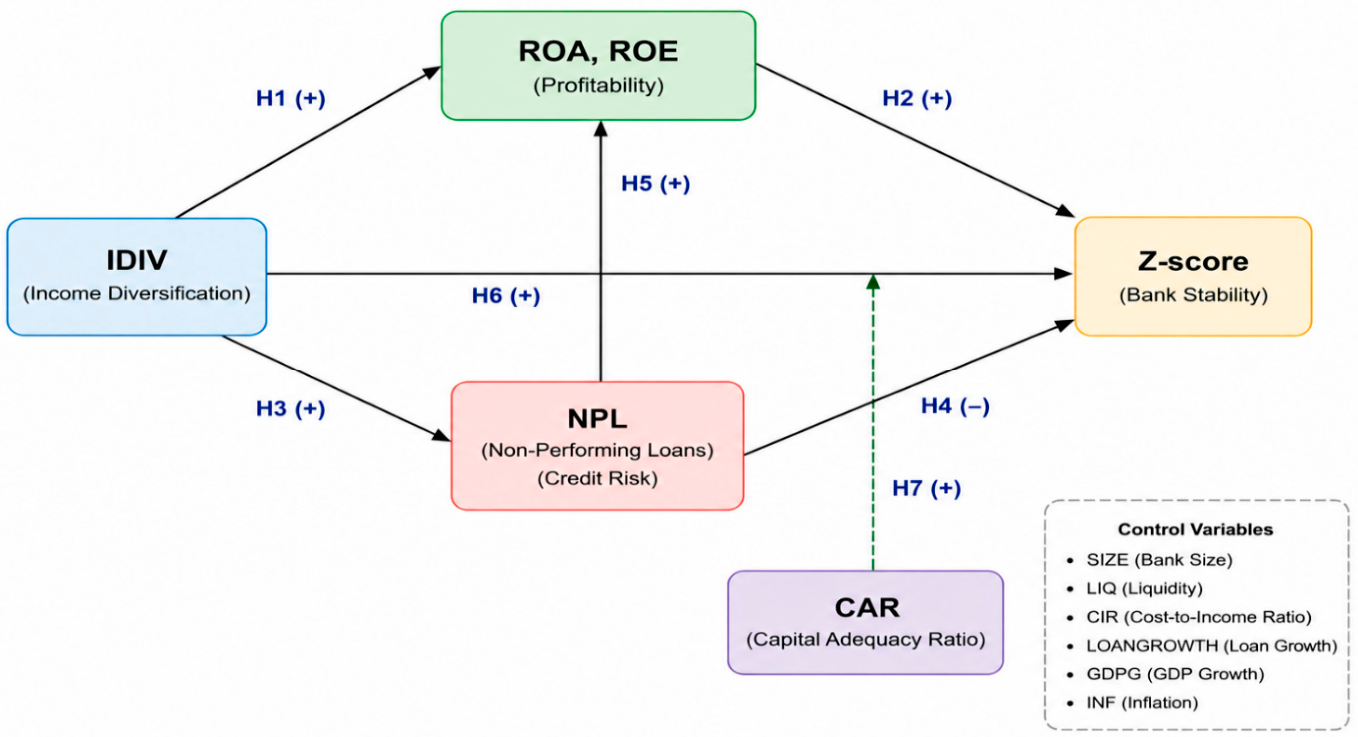
Research model (Figure 1).
Figure 1.
Research Model. Source: Developed by the author based on the literature review.
The equations are specified as follows:
Z-score = α11Z-scorei(t−1) + β11IDIV + β12ROA, ROE + β13NPL + β14CAR + β15CAR2 + β16IDIV* CAR
+ β17Control + λt + η1i + ε1it
+ β17Control + λt + η1i + ε1it
Next:
and
where Control = LoanGrowth, CIR, LIQ, SIZE, GDP, CPI; t = 1, …, T and i = 1, …, N. T and N denote time and banks, respectively. Bank stability: Z-score; Income diversification (IDIV); Profitability (ROA, ROE); Credit risk (NPL); Capital adequacy (CAR), CAR2 squared term of capital adequacy, used to test the limit of this indicator’s effect, with the optimal turning point at CAR* = −; The moderating effect in the relationship between income diversification and bank stability (IDIV_CAR). α is the estimated coefficient. Cit is the control variable. λt captures unobserved time effects. ηi denotes the unobserved bank-specific effect for each bank. εit is the random error term.
NPL = α21NPLi(t−1) + β21IDIV + β22CAR + β23CAR2 + β24Control + λt + η2i + ε2it
ROA, ROE = α31ROA, ROEi(t−1) + β31NPL + β32IDIV + β33CAR + β34CAR2 β35Control + λt + η3i + ε3it
The study uses secondary data collected from the financial statements and annual reports of listed commercial banks, the Vietstock database (Vietstock.vn), and macroeconomic indicators from the General Statistics Office (Gso.gov.vn). The sample comprises listed commercial banks from 2010 to 2024. Newly established or merged banks and banks that did not disclose complete financial information during the study period are excluded to ensure the completeness, consistency, and comparability of the dataset. According to Bollen (1989), when analyzing a linear structural model, the sample size is calculated as n = 5 × 2i, where i is the number of observed variables in the model (Bollen, 1989). According to Tabachnick and Fidell (2007), the sample size for multiple linear regression is calculated as n = 50 + 8q, where q is the number of independent variables in the model (Tabachnick & Fidell, 2007). Table A1 below presents the variable statistics, calculation formulas, and calculation bases. Details of Table A1 in Appendix A.
4. Empirical Results
Table 1 presents descriptive statistics on the distributional characteristics of the variables used in the research model, based on a total of 406 observations.
Table 1.
Descriptive Statistics of the Variables in the Model.
Table 1 presents descriptive statistics for 406 observations from 35 listed joint-stock commercial banks over 2010–2024. The mean Z-score is 22.353, indicating relatively sound financial stability but substantial variation across banks. Mean ROA and ROE are 0.86% and 9.68%, respectively, while mean NPL is 2.19%, suggesting that credit quality is generally under control. The mean IDIV is 29.2%, showing considerable variation in income diversification across banks. Mean CAR is 9.49%, above the regulatory minimum, while controls such as LIQ, SIZE, and LoanGrowth also display variation within the sample.
Table 2 presents the correlation matrix for the study variables. Most correlation coefficients are low to moderate. ROA and ROE have a relatively high positive correlation (r = 0.862; p < 0.01), reflecting consistency between the two profitability measures. NPL is negatively correlated with ROA and ROE, whereas CAR is positively correlated with both measures. Notably, IDIV and CIR are highly correlated (r = 0.936; p < 0.01); therefore, CIR is excluded from the regression models to avoid multicollinearity. Apart from this pair, all correlation coefficients are below 0.8, indicating that multicollinearity is not a serious concern in the research model.
Table 2.
Pearson Correlation Coefficients.
Multicollinearity among the variables in the research model is examined. After ROA is removed because it shows evidence of multicollinearity with ROE, the final results are presented in Table 3.
Table 3.
Multicollinearity Diagnostics.
The multicollinearity test indicates that the model does not suffer from serious multicollinearity. The VIF values range from 1.02 to 2.39, with a mean VIF of 1.49, well below the commonly accepted threshold of 5 (or 10). ROE has the highest VIF (2.39), followed by SIZE (1.73) and CAR (1.72), but all remain within safe limits. The independent variables therefore do not exhibit high linear correlations, and the model estimates are considered stable and reliable.
The validity of the instrumental variables used in System GMM estimation is assessed using the Hansen test for overidentifying restrictions (Hansen, 1982). The null hypothesis of the Hansen test posits that the instruments are valid overall; this implies that they are uncorrelated with the error term and satisfy the necessary orthogonality conditions. Consequently, a failure to reject the null hypothesis supports the validity of the set of instruments employed in the estimation models (Hansen, 1982). According to the results in Table 4, the p-values for the Hansen test are 0.764, 0.082, and 0.567 for models m1, m2, and m3, respectively. These results do not provide statistical evidence to reject the null hypothesis regarding the validity of the instrument sets.
Table 4.
Model Diagnostic Tests.
Similarly, the p-values for the Difference-in-Hansen test are 0.954, 0.645, and 0.119, all of which exceed 0.05. This indicates no evidence to reject the validity of the tested instrument groups.
Regarding the number of instruments, model m1 employs 24 instruments, model m2 uses 12, and model m3 uses 22. In all cases, the number of instruments is lower than the number of observation groups (29). This is a crucial criterion for mitigating the issue of instrument proliferation in GMM estimation.
As for the number of observation groups, the figure of 29 represents the banking units included in each System GMM estimation model after applying the necessary conditions for dynamic modeling and data availability. On this basis, the models are estimated, with the results reported in Table 5.
Table 5.
Model Estimation Results.
As shown in Table 5,
Model (m1): Effects on Bank Stability (Z-score). The regression results show that the lagged bank-stability index (L.Z-score) has a positive coefficient and is statistically significant at the 1% level (β = 0.655; p < 0.01). This indicates persistence in bank stability over time: banks with high stability in the previous period tend to maintain high stability in the current period.
Income diversification (IDIV) has a positive coefficient (β = 0.492) but is not statistically significant, providing no evidence that income diversification affects bank stability. This result contrasts with the findings of Tariq et al. (2025), Filatie and Sharma (2024), Ben Lahouel et al. (2023), and Abbas and Ali (2022a).
ROE has a positive coefficient (β = 9.216) but is not statistically significant. Meanwhile, NPL has a negative coefficient (β = −9.212), consistent with the expectation that higher credit risk reduces bank stability; however, this result is also statistically insignificant.
For the capital adequacy ratio (CAR), the CAR coefficient is negative but statistically insignificant (β = −25.728), whereas CAR2 has a positive coefficient and is statistically significant at the 1% level (β = 169.490; p < 0.01). This result indicates a U-shaped nonlinear relationship between CAR and bank stability. Specifically, when CAR is low, an increase in capital may not improve and may even reduce the Z-score; however, once CAR exceeds a certain threshold, further increases in capital improve bank financial stability. This novel finding shows a U-shaped nonlinear relationship between CAR and bank stability, with an optimal threshold—calculated using the approach described in Section 3—of approximately 7.6% (CAR* = 100%). Thus, 7.6% represents the minimum point of the U-shaped relationship between CAR and the Z-score. When CAR is below 7.6%, the marginal effect of CAR on the Z-score is negative; when CAR exceeds 7.6%, the marginal effect of CAR on the Z-score becomes positive. This implies that when CAR is below about 7.6%, increasing CAR does not clearly improve stability. Once CAR exceeds approximately 7.6%, however, further increases significantly enhance stability. This is an interesting result because the threshold is close to the Basel minimum standard. The finding is consistent with Abbas and Ali (2022b), MacCarthy (2024), Ahmad (2025), Mulwa and Kosgei (2016), and Khémiri et al. (2024).
The IDIV × CAR interaction term has a negative but statistically insignificant coefficient, indicating that capital adequacy does not moderate the relationship between income diversification and bank stability.
Among the control variables, only liquidity (LIQ) has a negative coefficient and is statistically significant at the 1% level (β = −15.707; p < 0.01), implying that higher liquidity is associated with a lower Z-score. The remaining variables, including credit growth (LoanGrowth), bank size (SIZE), GDP, and inflation (CPI), are statistically insignificant.
Model (m2): Effects on Credit Risk (NPL). The results show that the lagged non-performing loan ratio (L.NPL) has a positive coefficient and is statistically significant at the 1% level (β = 0.599; p < 0.01). This reflects the persistence of credit risk over time: banks with high non-performing loan ratios in the previous period tend to maintain high ratios in the current period.
Income diversification (IDIV) has a very small negative coefficient (β = −0.001) but is not statistically significant. Thus, there is no empirical evidence that income diversification reduces the non-performing loan ratio.
Neither CAR nor CAR2 is statistically significant, indicating that the capital adequacy ratio does not exert a significant effect on credit risk in this model.
The control variables—credit growth, liquidity, bank size, GDP, and inflation—are also statistically insignificant. Overall, the results indicate that credit risk is influenced mainly by its own past level rather than by the financial and macroeconomic factors considered.
Model (m3): Effects on Profitability (ROE). The regression results show that lagged ROE (L.ROE) has a positive coefficient and is statistically significant at the 1% level (β = 1.366; p < 0.01), indicating that bank profitability is persistent over time.
Income diversification (IDIV) has a negative coefficient (β = −0.019) but is not statistically significant, providing no evidence that income diversification affects bank profitability.
NPL has a negative coefficient (β = −1.863), consistent with the expectation that higher non-performing loans reduce profitability; however, this result is not statistically significant.
For CAR, the coefficient is negative and statistically significant at the 5% level (β = −2.144; p < 0.05), whereas CAR2 is positive and statistically significant at the 1% level (β = 13.270; p < 0.01). This further confirms a U-shaped nonlinear relationship between the capital adequacy ratio and profitability. When CAR is low, increasing capital may reduce ROE because of higher capital costs or inefficient capital use; however, after CAR reaches a certain threshold, additional capital improves profitability by strengthening financial safety and reducing risk costs. The optimal threshold is approximately 8.1% (CAR* = ). Therefore, 8.1% represents the minimum point of the U-shaped relationship between CAR and ROE. When CAR is below 8.1%, the marginal effect of CAR on ROE is negative; when CAR exceeds 8.1%, the marginal effect becomes positive. This implies that low CAR reduces profitability, but beyond approximately 8.1%, increasing CAR improves ROE. This finding is consistent with Abbas and Ali (2022b), MacCarthy (2024), Ahmad (2025), Mulwa and Kosgei (2016), and Khémiri et al. (2024).
The remaining control variables—credit growth, liquidity, bank size, GDP, and CPI—are statistically insignificant.
The following main conclusions can be drawn from the three regression models:
First, income diversification (IDIV) has no statistically significant effect on bank stability, credit risk, or profitability, because its coefficient is insignificant in all three models.
Second, the capital adequacy ratio (CAR) has a nonlinear effect on bank stability and profitability. The negative CAR coefficient combined with the positive CAR2 coefficient indicates a U-shaped relationship, implying that the effect of capital depends on the level of capital held by the bank. The optimal capital ratio for simultaneously improving profitability and bank stability is above 8.1%, which is a valuable new finding.
Third, all three dependent variables (Z-score, NPL, and ROE) are persistent over time, as indicated by the positive and highly statistically significant coefficients of their lagged values. This shows that banks’ past performance and risk levels are important determinants of their current conditions.
5. Discussion
5.1. Discussion of the Effects of Income Diversification (H1–H3)
The study results indicate that income diversification (IDIV) does not have a statistically significant impact on profitability (ROE), credit risk (NPL), or bank stability (Z-score). Consequently, hypotheses H1, H2, and H3 are rejected in the context of Vietnamese commercial banks.
These findings diverge from Portfolio Theory, which posits that diversifying revenue sources helps disperse risk, reduce reliance on traditional lending activities, and enhance bank performance. Furthermore, the results do not align with the studies of Hakimi et al. (2023), Tariq et al. (2025), and Filatie and Sharma (2024), all of which suggest that income diversification contributes to improved profitability and greater financial stability for banks.
However, the study’s findings are consistent with those of Ben Rejeb and Merzki (2024), Githaiga (2023), Nguyen et al. (2023), and Kwaku Mensah Mawutor et al. (2023), who argue that income diversification does not always yield positive outcomes. This suggests that the effectiveness of a diversification strategy depends significantly on the operating environment, the level of financial market development, and the management capabilities of individual banks.
In the case of Vietnam, this result can be attributed to several factors. First, bank revenues remain heavily reliant on lending activities, while the share of non-interest income stays relatively low. Second, many non-interest income streams are concentrated in traditional services—such as payments, bancassurance, and foreign exchange trading—and thus fail to generate a sustainable competitive advantage. Third, expanding beyond lending requires substantial resources in terms of technology, human capital, and risk management systems. Without these prerequisites fully in place, income diversification is unlikely to translate into improved operational efficiency or financial stability.
Thus, the research findings indicate that income diversification is a necessary, but not sufficient, condition for enhancing banking stability. Of greater importance are the quality of governance, the efficiency of resource utilization, and the ability to control risks during the implementation of diversification strategies.
5.2. Discussion of the Effects of Profitability and Credit Risk (H4–H6)
Regarding hypotheses H4, H5, and H6, the study found no statistical evidence indicating that profitability (ROE) and credit risk (NPL) directly influence bank stability within the research model. Furthermore, credit risk did not have a significant impact on the profitability of Vietnamese commercial banks.
These results differ from the findings of Sang Tang My (2022), Gadzo et al. (2019), Sharma et al. (2024), and Mousa et al. (2025), which suggest that credit risk erodes profitability and consequently negatively affects bank financial stability. However, the study’s findings align with Cheng et al. (2020) and Handriani and Anggara (2025), who argue that the impact of credit risk on profitability depends significantly on the specific characteristics of each banking system and country.
One possible reason is that, during the study period, the Vietnamese banking system implemented various restructuring measures, intensified the resolution of non-performing loans (NPLs), and adopted Basel II risk management standards. Consequently, the impact of NPLs on operational performance may have been better controlled compared to earlier periods. Additionally, banks increased revenue from services and optimized operating costs, helping to mitigate the negative impact of credit risk on profitability.
Another notable finding is that the lagged variables for Z-score, NPL, and ROE are all statistically significant at the 1% level. This reflects the persistence of banking performance over time, implying that banks with specific levels of stability, profitability, or credit risk in the past tend to maintain similar characteristics in subsequent periods. This finding aligns with the nature of the banking industry, where management decisions, credit policies, and risk management capabilities typically exert long-term rather than merely short-term effects.
These results indicate that enhancing bank stability cannot rely solely on controlling credit risk or improving profitability in isolation; instead, a holistic approach is required—one that integrates risk management, operational efficiency improvements, and the formulation of sustainable development strategies.
5.3. Discussion of the Moderating Role of Capital Adequacy (H7)
One of the study’s key findings is that the capital adequacy ratio (CAR) exhibits a U-shaped, non-linear relationship with both bank stability and profitability. The results indicate that at low levels of capital adequacy, increasing capital does not yield significant benefits, as it raises the cost of capital or reduces the efficiency of capital utilization. However, once the CAR surpasses thresholds of approximately 7.6% for stability and 8.1% for profitability, the impact of capital becomes positive, contributing to enhanced operational efficiency and greater resilience against financial shocks.
This finding provides additional empirical evidence supporting the work of Abbas and Ali (2022b), MacCarthy (2024), and Ahmad (2025), while extending prior research by demonstrating that the impact of capital should be analyzed through a non-linear lens rather than assuming a linear relationship. This is particularly significant as banks progressively work toward meeting Basel II and Basel III capital requirements.
However, the study found no empirical evidence to support a moderating role for the capital adequacy ratio in the relationship between income diversification and bank stability; consequently, hypothesis H7 was rejected. This result indicates that while capital is crucial for bank stability, it is insufficient to alter the effectiveness of income diversification strategies. In other words, maintaining high capital levels does not guarantee that diversification activities will yield better results if the bank lacks appropriate management capabilities or fails to effectively leverage non-interest income sources.
From a management perspective, this finding implies that capital is merely one of several prerequisites for enhancing bank stability. For income diversification strategies to be effective, banks must simultaneously invest in digital transformation, enhance human capital quality, refine risk management systems, and improve corporate governance capabilities. Furthermore, this suggests that the relationship between income diversification and bank stability is influenced by various internal factors beyond the capital adequacy ratio, opening avenues for future research into the roles of corporate governance, technological innovation, and institutional quality.
6. Policy Implications
6.1. Theoretical Implications
This study makes several significant contributions to the theoretical development regarding income diversification, credit risk, and bank stability. First, the findings provide empirical evidence that income diversification does not always yield positive effects on profitability, credit risk, and bank stability. The results indicate that the benefits of a diversification strategy depend not merely on increasing the share of non-interest income but also on the quality of governance, management capabilities, and the ability to effectively leverage new revenue streams. This helps clarify ongoing debates in prior research concerning the relationship between income diversification and bank performance.
Second, the study extends the theory of capital adequacy by identifying a U-shaped, non-linear relationship between the capital adequacy ratio (CAR) and both bank stability and profitability. These results demonstrate that the impact of capital does not follow the linear trend assumed in many previous studies; rather, it becomes effective only when a bank maintains capital levels exceeding a specific threshold. This finding strengthens the theoretical understanding of capital as a strategic resource that enables banks to enhance their resilience against financial shocks and improve long-term performance.
Third, the study found no empirical evidence supporting the mediating role of profitability or the moderating role of the capital adequacy ratio in the relationship between income diversification and bank stability. These results suggest that the relationships among these variables may be more complex than current theoretical models imply and could be influenced by other factors such as corporate governance quality, the level of digital transformation, risk management capabilities, or the institutional environment. Consequently, future research should expand the theoretical framework by incorporating additional mediating and moderating variables to more fully explain the mechanisms through which income diversification affects bank stability.
Fourth, this study contributes empirical evidence from emerging economies—specifically Vietnam—where research simultaneously examining the relationships among income diversification, credit risk, profitability, capital adequacy, and bank stability remains limited. The findings help validate the applicability of banking and finance theories within the context of developing nations and provide a basis for comparative studies across banking systems in countries with varying economic conditions and levels of financial development.
6.2. Practical Implications for Readers, Business and Management Practice
The research findings offer significant implications for bank managers, regulators, investors, and researchers in the finance and banking sector. For bank managers, the study indicates that expanding non-interest income sources should not be viewed as the sole objective of an income diversification strategy. Instead, banks need to focus on enhancing the quality and efficiency of service activities and developing high-value-added financial products—such as digital banking, electronic payments, wealth management, financial advisory, and other non-credit services. At the same time, diversification efforts must be accompanied by appropriate risk management systems to mitigate risks arising from new business activities.
For state regulators and banking supervisory authorities, the study highlights the critical role of the capital adequacy ratio (CAR) in enhancing banking system stability. The findings regarding the non-linear relationship between CAR and banking stability indicate that merely meeting regulatory minimum capital requirements is insufficient. Consequently, regulators should continue to refine the legal framework in alignment with Basel II and Basel III standards while strengthening the supervision of capital quality, early warning systems, and the risk management capabilities of commercial banks to ensure financial system stability.
For investors and shareholders, the study suggests that a bank’s operational performance should not be evaluated solely based on revenue diversification. Instead, factors such as capital adequacy, asset quality, credit risk control, and profitability should be considered concurrently to gain a comprehensive view of the bank’s financial strength and growth prospects. This approach enables investors to make more accurate and sustainable investment decisions.
For researchers and readers interested in the banking and finance sector, this study provides additional empirical evidence regarding the relationships among income diversification, credit risk, profitability, and bank stability within the context of Vietnamese commercial banks. These findings help clarify ongoing debates in existing literature while suggesting new avenues for research into the roles of digital transformation, corporate governance, institutional quality, market competition, and macroeconomic factors in enhancing banking system stability.
Overall, the study confirms that bolstering bank stability depends not only on income diversification strategies but also requires a harmonious blend of management capabilities, capital policies, risk management, and operational efficiency. Consequently, banks need to formulate long-term development strategies that balance growth objectives, financial safety, and sustainable development amidst an increasingly volatile business environment.
7. Conclusions
This study aims to analyze the impact of income diversification on the stability of Vietnamese commercial banks, while also examining the roles of credit risk, profitability, and capital adequacy ratios within this relationship. Based on a dataset comprising 406 observations from listed commercial banks in Vietnam over the 2010–2024 period—and employing the system GMM model to address endogeneity and the dynamic nature of panel data—the study presents significant findings with both academic and practical implications.
The results indicate that income diversification does not have a statistically significant direct impact on bank stability, credit risk, or profitability. This finding suggests that increasing the share of non-interest income is insufficient to improve operational performance or enhance financial stability if diversification activities are not implemented effectively or fail to generate sustainable value. This helps explain the lack of consensus in previous studies regarding the effectiveness of income diversification strategies in the banking sector.
Furthermore, the study reveals a U-shaped, non-linear relationship between the capital adequacy ratio and both bank stability and profitability. This result implies that the positive impact of capital is fully realized only when a bank maintains capital levels above a certain threshold. This is a significant finding, underscoring the role of capital policy in enhancing resilience against financial shocks and improving long-term operational performance. Additionally, the dependent variables—bank stability, credit risk, and profitability—exhibit persistence over time, indicating that past performance continues to significantly influence a bank’s current operational outcomes.
However, the study finds no empirical evidence of a mediating role for profitability or a moderating role for the capital adequacy ratio in the relationship between income diversification and bank stability. These results suggest that the mechanisms through which income diversification exerts its influence may be shaped by various factors not accounted for in the research model, such as corporate governance quality, the level of digital transformation, risk management capabilities, or the institutional environment.
Overall, the study adds empirical evidence regarding the factors influencing the stability of commercial banks in an emerging economy like Vietnam. The results confirm that enhancing bank stability depends not only on income diversification strategies but also requires a combination of management capabilities, capital policies, risk management, and operational efficiency. These findings not only enrich the theoretical framework of bank management but also provide a useful reference for bank executives and policymakers in formulating sustainable development strategies and strengthening the banking system’s resilience against economic fluctuations.
Author Contributions
Conceptualization, H.V.T. and L.T.T.; methodology, H.V.T. and L.T.T.; software, H.V.T. and L.T.T.; validation, H.V.T. and L.T.T.; formal analysis, H.V.T. and L.T.T.; investigation, H.V.T. and L.T.T.; resources, H.V.T. and L.T.T.; data curation, H.V.T. and L.T.T.; writing—original draft preparation, H.V.T. and L.T.T.; writing—review and editing, H.V.T. and L.T.T.; visualization, H.V.T. and L.T.T.; supervision, H.V.T. and L.T.T.; project administration, H.V.T. and L.T.T.; funding acquisition, H.V.T. and L.T.T. All authors have read and agreed to the published version of the manuscript.
Funding
This research received no external funding.
Institutional Review Board Statement
Not applicable.
Informed Consent Statement
Not applicable.
Data Availability Statement
The corresponding author can provide the supporting data of this study upon a reasonable request.
Conflicts of Interest
The authors declare no conflicts of interest.
Appendix A
Table A1.
Descriptive Statistics and Definitions of the Variables in the Research Model.
Notes
| 1 | https://www.bis.org/basel_framework/ (accessed on 1 August 2026). |
| 2 | |
| 3 | https://www.bis.org/bcbs/basel3.htm (accessed on 1 August 2026). |
References
- Abbas, F., & Ali, S. (2022a). Dynamics of diversification and banks’ risk-taking and stability: Empirical analysis of commercial banks. Managerial and Decision Economics, 43(4), 1000–1014. [Google Scholar] [CrossRef] [Scilit]
- Abbas, F., & Ali, S. (2022b). Economics of loan growth, credit risk and bank capital in Islamic banks. Kybernetes, 51(12), 3591–3609. [Google Scholar] [CrossRef] [Scilit]
- Ahmad, F. (2025). The relationship between intellectual capital, financial stability, firm performance, market value, and bankruptcy risk: Empirical evidence from Pakistan. Journal of the Knowledge Economy, 16(1), 1347–1395. [Google Scholar] [CrossRef] [Scilit]
- Al-Nimer, M., Arabiat, O., & Taha, R. (2024). Liquidity risk mediation in the dynamics of capital structure and financial performance: Evidence from Jordanian banks. Journal of Risk and Financial Management, 17(8), 360. [Google Scholar] [CrossRef] [Scilit]
- Ashraf, Y., & Nazir, M. S. (2025). Income diversification and bank performance: An evidence from emerging economy of Pakistan. Journal of Economic and Administrative Sciences, 41(5), 1947–1961. [Google Scholar] [CrossRef] [Scilit]
- Ayinuola, T. F., & Gumel, B. I. (2023). The nexus between liquidity and credit risks and their impact on bank stability. Asian Journal of Economics, Business and Accounting, 23(11), 15–27. [Google Scholar] [CrossRef] [Scilit]
- Ben Lahouel, B., Taleb, L., Kočišová, K., & Ben Zaied, Y. (2023). The threshold effects of income diversification on bank stability: An efficiency perspective based on a dynamic network slacks-based measure model. Annals of Operations Research, 330(1), 267–304. [Google Scholar] [CrossRef] [Scilit]
- Ben Rejeb, M., & Merzki, N. (2024). The mediating effect of bank risk on the relationship between diversification strategies and discretionary loan loss provisions. Journal of Financial Reporting and Accounting, 24(2), 1015–1045. [Google Scholar] [CrossRef] [Scilit]
- Bollen, K. A. (1989). A new incremental fit index for general structural equation models. Sociological Methods & Research, 17(3), 303–316. [Google Scholar] [CrossRef] [Scilit]
- Cheng, L., Nsiah, T. K., Ofori, C., & Ayisi, A. L. (2020). Credit risk, operational risk, liquidity risk on profitability. A study on South Africa commercial banks. A PLS-SEM Analysis. Revista Argentina de Clínica Psicológica, 29(5), 5. [Google Scholar]
- Filatie, Y. S., & Sharma, D. (2024). The mediating role of intellectual capital on the nexus between diversification, financial stability and efficiency of commercial banks in Ethiopia. Managerial Finance, 50(9), 1681–1701. [Google Scholar] [CrossRef] [Scilit]
- Gadzo, S. G., Kportorgbi, H. K., & Gatsi, J. G. (2019). Credit risk and operational risk on financial performance of universal banks in Ghana: A partial least squared structural equation model (PLS SEM) approach. Cogent Economics & Finance, 7(1), 1589406. [Google Scholar] [CrossRef] [Scilit]
- Githaiga, P. N. (2022). Income diversification and bank risk-taking: The moderating role of intellectual capital. Cogent Business & Management, 9(1), 2149142. [Google Scholar] [CrossRef] [Scilit]
- Githaiga, P. N. (2023). Intellectual capital and bank performance: The moderating role of income diversification. Asia-Pacific Journal of Business Administration, 15(4), 509–526. [Google Scholar] [CrossRef] [Scilit]
- Hakimi, A., Hamdi, H., & Khemiri, M. A. (2023). Banking in the MENA region: The pro-active role of financial and economic freedom. Journal of Policy Modeling, 45(5), 1058–1076. [Google Scholar] [CrossRef] [Scilit]
- Handriani, E., & Anggara, S. B. (2025). An analysis of firm-specific, industry specific, and macroeconomic determinants influencing bank profitability in Indonesia. Jurnal Studi Manajemen Organisasi, 22(1), 58–88. [Google Scholar] [CrossRef] [Scilit]
- Hansen, L. P. (1982). Large sample properties of generalized method of moments estimators. Econometrica: Journal of the Econometric Society, 50, 1029–1054. [Google Scholar] [CrossRef] [Scilit]
- Khémiri, W., Chafai, A., Attia, E. F., Tobar, R., & Farid Fouad, H. (2024). Trade-off between financial inclusion and Islamic bank stability in five GCC countries: The moderating effect of CSR. Cogent Business & Management, 11(1), 2300524. [Google Scholar] [CrossRef] [Scilit]
- Kwaku Mensah Mawutor, J., Boadi, I., Antwi, S., & Buawolor Tetteh, A. (2023). Improving banks’ profitability through income diversification and intellectual capital: The sub-Saharan Africa perspective. Cogent Economics & Finance, 11(2), 2271658. [Google Scholar] [CrossRef] [Scilit]
- MacCarthy, J. (2024). Moderating role of risk management between risk exposure and bank performance: Application of GMM model. Theoretical Economics Letters, 14(2), 363–389. [Google Scholar]
- Markowitz, H. M. (1959). Portfolio selection: Efficient diversification of investment. John Wiley & Sons. [Google Scholar]
- Mousa, R., Nabil, J., Safty, A., Hassan, I., & Ibrahim, Y. (2025). Liquidity–credit risk dynamics and bank profitability: Hybrid econometric and machine learning evidence from MENA. Journal of Financial Reporting and Accounting, 1–27. [Google Scholar] [CrossRef] [Scilit]
- Mulwa, J. M., & Kosgei, D. (2016). Commercial bank diversification and financial performance: The moderating role of risk. Journal of Finance and Investment Analysis, 5, 31–52. [Google Scholar]
- Nguyen, D. T., Le, T. D., & Tran, S. H. (2023). The moderating role of income diversification on the relationship between intellectual capital and bank performance evidence from Viet Nam. Cogent Business & Management, 10(1), 2182621. [Google Scholar] [CrossRef] [Scilit]
- Sang Tang My, A. N. Q. (2022). The relationship between credit risk and bank financial stability: The mediating role of bank profitability. Journal of Hunan University Natural Sciences, 49(1), 263–271. [Google Scholar] [CrossRef] [Scilit]
- Sharma, V., Gupta, M., & Jangir, K. (2024). Exploring the impact of risk factors on profitability in commercial banking in India: A PLS-SEM analysis approach. In The framework for resilient industry: A holistic approach for developing economies. Emerald Publishing Limited. [Google Scholar]
- Tabachnick, B. G., & Fidell, L. S. (2007). Experimental designs using ANOVA (Vol. 724). Thomson/Brooks/Cole. Available online: https://www.scirp.org/reference/referencespapers?referenceid=478525 (accessed on 1 August 2026).
- Tariq, W., Chen, Y., Tariq, A., & Torkkeli, M. (2025). Breaking the glass ceiling in banking: The impact of female directors, digitalization, and income diversification on financial stability. The Bottom Line, 38(1), 1–27. [Google Scholar] [CrossRef] [Scilit]
- Zhang, C., Wang, Y., & Zhang, Y. (2025). Can digital transformation improve commercial banks’ performance? The Journal of Technology Transfer, 50(4), 1341–1362. [Google Scholar] [CrossRef] [Scilit]

Disclaimer/Publisher’s Note: The statements, opinions and data contained in all publications are solely those of the individual author(s) and contributor(s) and not of MDPI and/or the editor(s). MDPI and/or the editor(s) disclaim responsibility for any injury to people or property resulting from any ideas, methods, instructions or products referred to in the content. |
© 2026 by the authors. Licensee MDPI, Basel, Switzerland. This article is an open access article distributed under the terms and conditions of the Creative Commons Attribution (CC BY) license.