


Abstract
The integration of environmental, social and governance (ESG) criteria into corporate and financial decision-making has become one of the most significant transformations in today’s financial markets. Growing regulatory pressure, stakeholder expectations and increased awareness of sustainability challenges have led companies and investors to incorporate ESG considerations into strategic and investment decisions. Despite the rapid spread of ESG practices, the academic literature presents conflicting and sometimes contradictory evidence regarding their economic implications and practical effectiveness. This article provides a review of the literature on the main academic contributions to ESG integration, focusing on three key dimensions: the economic benefits associated with ESG practices, the methodological and credibility challenges relating to ESG measurement, and the organisational and technological factors that enable effective ESG implementation. The findings indicate that ESG integration is generally associated with positive organisational outcomes, including improved financial performance, lower cost of capital, greater stakeholder trust and a reduction in firm-specific risk. However, the realisation of these benefits is not automatic and depends to a large extent on the credibility of ESG practices and information. Rather than endorsing the widely held view that ESG criteria are inherently capable of creating value, the analysis shows that the value-creating effect of ESG criteria depends crucially on the credibility of ESG practices and the quality of their implementation. The literature highlights significant methodological challenges, including rating divergence, the lack of standardised metrics, methodological opacity and the growing risk of greenwashing, which can undermine the reliability of ESG information. This paper proposes an deductive conceptual framework in which ESG effectiveness emerges from the interaction between value creation mechanisms, credibility constraints, and enabling organisational and technological factors.
1. Introduction
Over the last two decades, growing attention to environmental, social and governance issues has led to a profound transformation of the global financial system, favouring the transition from a purely speculative approach to a paradigm oriented towards sustainability and long-term value creation (Ahmad et al., 2024). This evolution has led to the gradual emergence of sustainable finance, a concept that integrates the principles of sustainable development into investment and capital management processes, focusing not only on economic profitability but also on the social and environmental impacts generated by financial activities (O. Weber, 2014). The focus on Sustainable and Responsible Investments (SRI) has intensified following a series of economic, environmental and reputational crises that have highlighted the need for closer integration between finance, ethics and social responsibility (Liang & Renneboog, 2020). The SRI approach, now formally recognised at European level through the regulatory framework outlined by the Green Deal, the Sustainable Finance Disclosure Regulation (SFDR) and the EU Taxonomy Regulation, represents one of the main drivers of evolution in the contemporary financial market. At the same time, growing investor awareness and pressure from stakeholders have accelerated the spread of investment strategies that incorporate ESG criteria into decision-making processes, radically changing the assessment of risk and return (Matos, 2020). ESG has become a structural element of financial management and corporate governance, capable of influencing the cost of capital, reputation and competitiveness of companies.
ESG disclosure refers to the communication of ESG related information by firms, typically through sustainability reports, integrated reports, or other forms of corporate reporting. It encompasses both qualitative and quantitative information regarding environmental, social, and governance practices, policies, and outcomes. While ESG disclosure is often assumed to reflect underlying ESG performance, the two constructs are not necessarily aligned. As highlighted in the literature, disclosure may reduce information asymmetry and contribute to lowering the cost of capital when it is perceived as credible (D. S. Dhaliwal et al., 2011; El Ghoul et al., 2011). However, disclosure may also assume a symbolic function, as firms can strategically communicate ESG engagement without corresponding substantive practices, thereby generating risks of greenwashing and weakening stakeholder trust (Michelon et al., 2015; Cho et al., 2015).
This tension between substantive ESG practices and symbolic disclosure highlights a fundamental gap in the literature. Although ESG is often believed to generate positive financial and stakeholder outcomes, the available evidence suggests that these effects are not uniform and may depend on how ESG information is interpreted by external stakeholders. In this regard, this study goes beyond the general assumption that ESG “creates value”, proposing a more nuanced perspective. Specifically, it argues that the value-creating effect of ESG depends on the credibility of ESG disclosure and the quality of its implementation. ESG practices do not automatically translate into better financial performance or stronger stakeholder relationships; rather, their impact is mediated by whether they are perceived as credible signals of a genuine commitment to sustainability or dismissed as symbolic communication.
This study examines the integration of ESG criteria within corporate and financial decision-making, exploring both the benefits and the limitations of sustainable investment practices. Building upon a literature review and a theoretical framework grounded in sustainable finance, the work addresses three key research questions:
- How does ESG integration affect firms’ financial performance, cost of capital, and stakeholder relationships?
- What are the main methodological and credibility issues in ESG measurement, particularly concerning rating divergence and greenwashing risks?
- Which organizational and technological factors, such as board gender diversity and digital transformation, act as enablers of credible and effective ESG practices?
The document adopts a literature review methodology. The methodological approach combines thematic synthesis and conceptual mapping to identify common patterns, contradictions and emerging determinants of sustainability.
2. Methodology
To address the research objectives of this study, a literature review was conducted to analyse the existing academic debate on ESG integration, focusing on three key dimensions: (1) the economic outcomes of ESG practices, (2) the methodological and credibility challenges associated with ESG measurement, and (3) the organisational and technological factors that enable credible and effective ESG implementation.
A structured literature review is an appropriate methodological approach when the objective is to synthesise and critically interpret a heterogeneous body of literature and develop conceptual insights or theoretical frameworks (Tranfield et al., 2003; Snyder, 2019). Compared to traditional narrative reviews, structured literature reviews follow a more systematic and transparent process in identifying, selecting, and analysing academic contributions, thereby reducing potential biases and improving the robustness of research findings (Denyer & Tranfield, 2009; Paul & Criado, 2020).
The methodological approach adopted in this study combines systematic research procedures with qualitative content analysis. This approach allows for a comprehensive understanding of the main theoretical perspectives, empirical findings, and emerging research trends related to ESG integration and sustainability reporting.
2.1. Literature Review and Selection Process
The literature review was conducted using two major academic databases: Web of Science and Scopus, widely recognised as reliable sources for high-quality academic publications. The search strategy focused on peer-reviewed journal articles dealing with ESG, corporate social responsibility (CSR), sustainability reporting, ESG ratings, greenwashing, digital transformation, and governance mechanisms associated with sustainability practices.
To identify relevant studies, a set of keywords and search strings were developed based on the research objectives and key concepts emerging from the ESG literature. Search terms included combinations of the following keywords: “ESG” OR “environmental, social and governance”, “corporate social responsibility” OR “CSR”, “ESG performance”, “greenwashing”, “sustainability disclosure”, “gender diversity on the board”, “digital transformation” OR “digitalisation”, “artificial intelligence”, “blockchain”, “big data”, “social media”.
The search process included articles published in international peer-reviewed journals, without imposing strict time limits, in order to capture both fundamental and recent contributions to the ESG debate.
The selection process followed a multi-stage screening procedure.
Firstly, duplicate records were identified and removed. Subsequently, titles, abstracts and keywords were examined to assess their relevance to the research objectives. Articles were included if they: (i) explicitly addressed practices relating to ESG, CSR or sustainability; (ii) examined economic outcomes (e.g., financial performance, cost of capital, effects on stakeholders); or (iii) analysed governance or technological factors supporting ESG implementation.
Articles were excluded if: (i) they were not directly related to ESG integration or sustainability practices; (ii) they focused on purely technical or engineering aspects without managerial or economic implications; or (iii) they lacked a clear theoretical or empirical contribution.
Furthermore, only articles written in English and limited to the field of “Business, Management and Accounting” were selected.
A full-text screening was then conducted to ensure conceptual relevance and alignment with the study’s analytical framework.
This selection process resulted in the creation of a corpus of academic contributions representing different theoretical perspectives and methodological approaches within the ESG literature.
2.2. Analytical Approach
Following the selection phase, the identified articles were analysed using qualitative content analysis (R. P. Weber, 1990). This method allows researchers to systematically examine textual data in order to identify recurring themes, conceptual patterns, and relationships between key constructs.
The analysis was conducted through an iterative process combining deductive and inductive reasoning, following an abductive approach. (Dubois & Gadde, 2002; Thomann & Maggetti, 2020). Initially, a deductive approach was adopted to organise the literature around the three main research questions guiding the study. Subsequently, an inductive analysis identified additional themes emerging from the literature, such as ESG credibility, rating divergence, and the role of digital technologies in improving transparency and traceability.
Through this process, the studies examined were grouped into three main thematic areas corresponding to the research questions of the paper:
- Economic implications of ESG integration, including financial performance, cost of capital, risk reduction, and stakeholder relations.
- Methodological and credibility challenges in ESG measurement, including rating divergences, lack of standardisation, methodological opacity, and greenwashing risks.
- Organisational and technological factors that favour ESG practices, with a focus on governance mechanisms such as gender diversity on boards and technological factors such as digital transformation, artificial intelligence, blockchain, and social media.
2.3. Development of the Conceptual Framework
The insights emerging from the literature review were subsequently synthesised to develop a deductive conceptual framework linking ESG integration, credibility challenges, enabling factors and structural outcomes.
This framework was derived from recurring patterns identified in the literature and aims to explain how ESG practices translate into structural outcomes through the interaction of three key mechanisms (i) ESG value creation mechanisms, which include financial, reputational and stakeholder benefits; (ii) measurement and credibility constraints, which can weaken the reliability and effectiveness of ESG initiatives; (iii) organisational and technological enablers, which strengthen the credibility, transparency and quality of implementation of ESG practices.
The framework provides an integrative perspective on ESG integration, highlighting the conditions under which sustainability practices are most likely to generate tangible benefits for companies and stakeholders.
3. Results
3.1. Benefits of ESG Integration
The literature reviewed in this study shows that integrating ESG criteria into corporate strategy, governance and investment decisions produces a wide range of benefits for companies.
These benefits can be grouped into five main categories, which structure the following analysis: (i) risk reduction, (ii) employee productivity and organisational performance, (iii) revenue growth and market opportunities, (iv) financial performance and firm value, and (v) cost of capital and financing conditions. In addition, the literature highlights the role of ESG in strengthening stakeholder relationships, particularly in terms of customer trust, engagement, and brand value.
3.1.1. Risk Reduction
An initial series of studies highlights the risk-reducing effects of ESG and CSR practices. Companies with a greater commitment to CSR tend to have lower idiosyncratic risk (Mishra & Modi, 2013). This finding is consistent with evidence showing that socially responsible companies, by maintaining higher levels of transparency, are less exposed to the risk of share price collapse (Kim & Zhang, 2014). Previous research on US manufacturing companies had already shown that companies with a better CSR reputation achieved higher stock returns, exposing investors to less risk (Herremans et al., 1993). Similar results were found in other sectors by Jo and Na (2012), while Bouslah et al. (2013) emphasised that stronger employee relations and greater attention to rights protection are associated with lower company-specific risk. More broadly, financial risk management practices have been shown to significantly affect firm performance, reinforcing the importance of risk mitigation strategies within ESG-oriented frameworks (Wanjohi et al., 2017; Bartram et al., 2015).
In addition to idiosyncratic risk, ESG integration appears to mitigate regulatory risk. This is particularly relevant in highly regulated and environmentally sensitive sectors, where unexpected legal and policy changes can significantly affect profitability.
3.1.2. Employee Productivity
The literature also demonstrates that ESG-oriented companies can benefit from increased employee motivation and productivity. Grant et al. (2007) argues that employees perform better when they perceive a meaningful connection between their work and its beneficiaries, which increases their willingness to engage in prosocial behaviour. Similarly, Edmans (2011) finds that employee satisfaction is positively associated with shareholder returns; companies ranked among the “100 Best Companies to Work For” generated annual stock returns 2.3% to 3.8% higher than their competitors over a period of more than 25 years.
More broadly, strengthening social practices within the company, including bonuses, flexible working arrangements, parental leave, healthcare, and inclusive workplace policies, has been associated with higher productivity and stronger organisational commitment. De Neve et al. (2018), for example, showed that employees of an Australian bank who were randomly assigned company-funded charitable donations reported greater job satisfaction than non-selected employees. These findings suggest that the social dimension of ESG can have concrete effects on internal performance through employee well-being and engagement.
3.1.3. Revenue Growth
Another important finding is that integrating ESG criteria can boost revenue growth. Companies with strong ESG performance may gain easier access to markets, licences, and public or institutional opportunities, as regulators and governments may be more willing to grant approvals to companies perceived as sustainable and responsible (Henisz et al., 2019). ESG can also influence demand dynamics. According to a McKinsey survey, approximately 70% of consumers across several sectors would be willing to pay a price premium of around 5% for environmentally friendly products, provided that they offer the same level of performance as conventional alternatives (Henisz et al., 2019). In the same report, 44% of the companies surveyed indicated that sustainability programmes were motivated by commercial and growth opportunities.
Case studies confirm these findings. Unilever has seen a 20% increase in sales of a line of water-efficient detergents compared to other products in the same category in water-scarce markets, while Neste, historically an oil refining company, now generates more than two-thirds of its profits from renewable fuels and other sustainable products (Henisz et al., 2019). These examples suggest that ESG can affect not only costs and risks, but also revenue generation through market expansion, differentiation and improved customer response.
3.1.4. Financial Performance
The relationship between ESG practices and firms’ financial performance is one of the most extensively studied topics in the literature. Since the 1970s, more than two thousand empirical studies and reviews have investigated the association between ESG/CSR and corporate financial performance (CFP) or firm value (Friede et al., 2015). While the findings are not uniformly consistent, the overall body of evidence points toward a predominantly positive association.
A large number of studies report a positive relationship between ESG/CSR and financial performance or firm value (Hillman & Keim, 2001; Hart, 1995; Shrivastava, 1995; Russo & Fouts, 1997; Aragón-Correa, 1998; Birindelli et al., 2015; Hoepner et al., 2016). This evidence is further supported by sector-specific analyses, particularly in the banking industry, where ESG disclosure has been found to positively influence financial performance (Buallay, 2019). More recent evidence confirms this pattern. S. Gao et al. (2023), using 11,742 observations from 1486 Chinese listed firms between 2010 and 2020, found that ESG practices significantly improve corporate financial performance across all life-cycle stages, especially during the growth phase. They also showed that the relationship is stronger when corporate disclosure quality is high. Iliev and Roth (2023) document that increased CSR activities positively affect operational performance, including return on assets. Margolis et al. (2009), reviewing 251 empirical studies and 106 additional studies published after 1998, also report a positive relationship between ESG practices and both financial performance and firm value, although they note that the effect size is relatively small. Firm financial outcomes are influenced by a range of strategic and sector-specific factors, including financial policies such as dividend decisions, which may reflect underlying governance quality and firm performance dynamics (Pinto & Rastogi, 2019).
Other studies focus on firm value more specifically. Chang et al. (2019) show that ESG practices positively influence firm value and that an additional dollar of cash contributes more to firm value when CSR ratings are higher. Bajic and Yurtoglu (2018) find an economically significant relationship between CSR and firm value, with the social dimension exerting the strongest influence. Al-Tuwaijri et al. (2004), focusing specifically on environmental performance and environmental disclosure, document a positive association between both variables and financial performance.
A seminal comparative study by Eccles et al. (2014) contrasts firms classified as “high sustainability” with “low sustainability” firms. Their findings show that high-sustainability companies outperform over the long term in both accounting performance and stock market returns. They also display more stakeholder-oriented governance, longer-term strategic orientation, and greater transparency in communicating environmental, social, and governance impacts. These results are consistent with stakeholder-based explanations of ESG value creation (Donaldson & Preston, 1995; Freeman & Liedtka, 1991; Freeman et al., 2010; Porter & Kramer, 2006).
The role of stakeholder visibility and customer awareness also emerges as important. Servaes and Tamayo (2013) argue that CSR increases firm value only when customer awareness is high; for firms with low customer awareness, the relationship is negative or insignificant. Similarly, Albuquerque et al. (2019) find a positive association between ESG/CSR and firm value among firms investing in advertising and marketing, interpreting this as evidence that ESG contributes more strongly to value when firms operate in contexts of high product differentiation.
Additional evidence supports a positive association using different proxies of firm value. Gillan et al. (2010), using KLD ratings, find that firms with higher ESG scores have stronger operating performance and higher Tobin’s Q. Ferrell et al. (2016) also show, using Tobin’s Q, that CSR is positively correlated with firm value and weakens the negative relationship between managerial entrenchment and firm value. L. Gao and Zhang (2015) find that income-smoothing firms with higher CSR engagement display higher Tobin’s Q and stronger earnings-return relations. Statman and Glushkov (2009), again using KLD ratings, document a positive relationship between ESG and financial performance.
Importantly, several studies suggest that ESG is particularly valuable during periods of crisis. Lins et al. (2017) show that during the 2008–2009 financial crisis, firms with high CSR engagement achieved stock returns four to seven percentage points higher, as well as greater profitability and sales, than low-CSR firms. Cornett et al. (2016), focusing on banks during the financial crisis, also report a positive and significant relationship between CSR scores and financial performance. Flammer (2015) shows that the approval of close-call CSR-related shareholder proposals results in positive publicity, improved accounting performance, higher labor productivity, sales growth, and ultimately greater firm value.
Recent work also highlights the relevance of national context. Shin et al. (2022) examine the moderating role of national culture, drawing on Hofstede’s dimensions, and show that both masculinity and individualism positively moderate the ESG–financial performance relationship. Their argument is that stakeholders confer different value on ESG depending on national cultural settings, which in turn affects firms’ financial returns from ESG engagement. This result aligns with the view that external institutional and cultural contingencies help explain why ESG pays more in some contexts than in others (Guiso et al., 2006; Hofstede et al., 2010; Jiang et al., 2020; Vitolla et al., 2021).
At the same time, not all studies support a positive relationship. Some find negative effects (Vance, 1975; Boyle & Bowden, 1997; Brammer et al., 2006), while others report insignificant results (Alexander & Buchholz, 1978; Aupperle et al., 1985; McWilliams & Siegel, 2000; Renneboog et al., 2008; Horváthová, 2010). Di Giuli and Kostovetsky (2014), for instance, find no relationship between high ESG scores and revenue growth and report that increases in ESGscores are associated with lower ROA and negative future stock returns. Buchanan et al. (2018), using Bloomberg ratings during the 2008 crisis, find that firms with higher ESG/CSR scores experienced a decline in firm value, partly due to intensified agency problems and concerns about overinvestment in CSR. Masulis and Reza (2015) also show that the stock market may react negatively to CSR-related news announcements.
Despite these conflicting results, the most comprehensive synthesis strongly supports a non-negative and often positive relationship. Friede et al. (2015), through a second-level review combining approximately 2200 primary studies, show that around 90% of the evidence reports a non-negative ESG–CFP relationship. Their analysis further reveals that the average central correlation is approximately 0.15. They also distinguish between portfolio and non-portfolio studies, showing that non-portfolio studies report substantially more positive results, whereas portfolio studies are more mixed, likely due to transaction costs, management fees, and the overlapping effects of idiosyncratic and systematic risk (Campbell et al., 2001; Luo & Bhattacharya, 2009; Carhart, 1997; Bauer et al., 2005; Peloza, 2009; Revelli & Viviani, 2015). Even so, they conclude that, at minimum, ESG investors should not expect to lose financially relative to conventional investors (Humphrey & Tan, 2014; Revelli & Viviani, 2015).
Friede et al. (2015) also compare the three ESG pillars separately and find positive correlations for environmental, social, and governance dimensions alike, without one dimension consistently dominating the others. Although governance shows the highest percentage of positive findings, the environmental dimension appears the most favorable after netting out negative results. They also observe cross-country differences: emerging markets show the highest share of positive ESG–CFP findings, while developed markets display more heterogeneous results.
More recent evidence confirms these conclusions. Whelan et al. (2021), analyzing more than 1000 studies published between 2015 and 2020, find that 71% of studies on corporate financial performance report non-negative results, while only 8% report negative ones. For climate-related corporate financial performance studies, the share of non-negative findings rises to 86%. Their second-level meta-analysis, based on 13 corporate meta-analyses covering 1272 primary studies, confirms a positive relationship between ESG and corporate financial performance, while evidence on ESG investment performance remains more mixed. They draw six main conclusions: the ESG–financial performance relationship becomes stronger over longer time horizons; ESG integration is more effective than negative screening strategies; ESG investments provide downside protection during crises; stakeholder relations, risk reduction, innovation, and operational efficiency act as mediating mechanisms; decarbonization strategies improve financial performance; and disclosure alone, without substantive implementation, does not significantly improve financial performance (Whelan et al., 2021; Cheema-Fox et al., 2019).
Taken together, these results indicate that ESG integration tends to improve financial performance and firm value, particularly over the long term and when it is embedded in real organizational practices rather than limited to symbolic disclosure.
3.1.5. Cost of Capital
Another important area of evidence concerns the relationship between ESG and the cost of capital. The literature generally shows that ESG performance reduces the cost of capital, although the evidence is stronger and more consistent for the cost of equity than for the cost of debt (Devalle et al., 2017).
With regard to the cost of equity capital, the literature is relatively unanimous in considering that ESG performance and ESG disclosure reduce the costs of financing equity capital. This effect is commonly explained through reduced information asymmetry and greater transparency (Matthiesen & Salzmann, 2017; Ng & Rezaee, 2015). Armitage and Marston (2007), based on empirical data, argue that better ESG disclosure reduces corporate risk, including beta, and thus lowers the cost of equity capital. Similar conclusions have been drawn by Borghesi et al. (2014), Crifo and Forget (2015), D. S. Dhaliwal et al. (2011), El Ghoul et al. (2011) and Reverte (2012).
Data on the cost of debt are more heterogeneous and less abundant (Erragragui, 2018). Studies in this area can be divided into two broad groups: those focusing on corporate bonds (Chen et al., 2012; Menz, 2010) and those focusing on private debt and bank loans (Anis & Utama, 2016; Goss & Roberts, 2011; Hoepner et al., 2016). In the first group, Chen et al. (2012) find that companies with stronger sustainability performance face lower required bond yields, while Menz (2010) reports a higher risk premium for European companies that are more committed to CSR.
In the banking context, Goss and Roberts (2011) argue that lenders view CSR issues as financial risks and may offer less favourable and more restrictive loan contracts to borrowers who do not meet CSR standards, particularly when loans are unsecured. Hoepner et al. (2016) and Nandy and Lodh (2012) document a negative relationship between ESG commitment and the cost of bank debt, suggesting that responsible companies are able to negotiate more favourable loan terms. Engelberg et al. (2012) add that these advantages may become stronger as the relationship between lender and borrower improves, further reducing information asymmetry.
Other studies suggest a non-linear relationship. Ye and Zhang (2011), studying Chinese companies, found that when CSR investments are below the optimal level, the cost of debt decreases as CSR investments increase; however, once CSR investments exceed the optimal level, the relationship reverses. In other words, both extremely low and extremely high CSR investments may be associated with higher borrowing costs. They also found that the optimal level of CSR is higher for small firms than for large firms.
Further nuances emerge when the three ESG pillars are analysed separately. Erragragui (2018), using a sample of 214 US companies, found that not all ESG dimensions influence creditors’ risk perception in the same way. Poor governance performance does not significantly affect the cost of debt, while poor environmental performance increases it; conversely, strong environmental and governance performance reduces debt costs. Eliwa et al. (2019), using non-financial companies from 15 EU countries plus Norway, also disaggregate ESG performance and ESG disclosure. They find that the environmental and social dimensions of ESG performance are negatively associated with the cost of debt, while the governance dimension is not statistically significant. In contrast, all three dimensions of ESG disclosure are significantly negatively associated with debt costs, with environmental disclosure having the strongest effect, followed by governance and social disclosure. These findings suggest that lenders may place particular emphasis on environmental transparency in credit assessment.
Jung et al. (2018), focusing on carbon risk, also demonstrate that creditors assess companies’ exposure to carbon emissions when financing debt. Companies that did not respond to the Carbon Disclosure Project questionnaire found a significant positive association between carbon risk and the cost of debt; an increase of one standard deviation in carbon risk exposure increased debt costs by 38 to 62 basis points. This result suggests that ESG awareness and disclosure can mitigate lenders’ concerns even when environmental exposure is substantial.
ESG Disclosure and Cost of Debt
The literature suggests that ESG disclosure may affect the cost of debt even more strongly than ESG performance itself, because it provides lenders with more information not only about achievements, but also about risks, weaknesses, and mitigation plans. Jung et al. (2018) show that while banks incorporate carbon-related risk into loan decisions, the negative effect of this risk on debt costs is reduced when firms demonstrate awareness of the issue and disclose investment plans in green technologies. Dennis and Mullineaux (2000) similarly argue that increased transparency makes debt contracts more attractive to investors. Aman and Nguyen (2013) find that stronger disclosure can mitigate agency conflicts and, in the governance domain, enable firms to access larger amounts of capital at lower cost. F. Gao et al. (2016) report a negative association between CSR disclosure and cost of debt for firms listed on the Amsterdam Stock Exchange, while Plumlee et al. (2015) find that high-quality soft ESG disclosure is negatively and significantly associated with the cost of capital.
The Moderating Role of ESG Disclosure
Because much ESG disclosure remains voluntary, scholars have questioned whether it always reflects substantive ESG engagement. Ashforth and Gibbs (1990) distinguish between a substantive approach, in which disclosure accurately reflects actual ESG activities, and a symbolic approach, in which managers communicate a high ESG commitment without corresponding performance. Michelon et al. (2015) argue that the symbolic use of ESG disclosure may serve to satisfy societal expectations without substantive action. Empirical evidence on the relationship between ESG disclosure and ESG performance is mixed, although many studies report a positive association (Al-Tuwaijri et al., 2004; Clarkson et al., 2013; D. S. Dhaliwal et al., 2011; Lyon & Maxwell, 2011; F. Gao et al., 2016), while others find a negative relationship (Hughes et al., 2001; Patten, 2002).
Eliwa et al. (2019) show that firms with weak ESG performance may increase ESG disclosure in order to capture the benefits associated with a good ESG profile, including lower borrowing costs. This supports the argument that disclosure can sometimes function as “cheap talk” rather than as a faithful representation of actual sustainability practices (Brown & Deegan, 1998; Cho & Patten, 2007; D. S. Dhaliwal et al., 2011; Y. Li et al., 2018; Cho et al., 2015). Relatedly, Chan et al. (2017) argue that firms with strong ESG performance enjoy a lower cost of capital only when they also receive positive media exposure. By contrast, F. Gao et al. (2016) contend that the negative association between CSR disclosure and debt costs emerges only when CSR performance is actually high. These findings reinforce the conclusion that disclosure is effective only when perceived as credible.
Country-Level Moderating Effects
Country characteristics also shape the relationship between ESG performance and disclosure and the cost of debt, acting as contextual moderating factors that influence how sustainability-related information is interpreted by creditors across different institutional environments. (Ioannou & Serafeim, 2012; Baldini et al., 2018), as well as creditors’ responses to them. D. Dhaliwal et al. (2014) find that the negative relationship between CSR disclosure and cost of equity is stronger in stakeholder-oriented countries. Similarly, countries such as Denmark, characterized by stronger stakeholder orientation, tend to exhibit lower debt costs than countries such as Greece (Mitchell et al., 1997; D. S. Dhaliwal et al., 2012). Eliwa et al. (2019) confirm that ESG performance and disclosure have stronger effects on debt costs in more stakeholder-oriented countries.
Hoepner et al. (2016), analyzing 470 loan contracts across 28 countries, find that country-level sustainability, encompassing both environmental and social dimensions, is associated with lower cost of debt. Specifically, a one-unit increase in a country sustainability score is associated with a reduction of 24 basis points in debt costs, with the environmental dimension exerting approximately twice the effect of the social dimension. Overall, these findings indicate that the financial benefits of ESG are not only firm-specific, but also institutionally embedded.
3.1.6. Stakeholder Relationships
The literature also shows that ESG integration strengthens stakeholder relationships, especially with customers. This effect emerges through several channels, including customer trust, customer engagement, brand image, brand loyalty, and purchase intentions.
ESG and Customer Trust
Customer trust is a key outcome of ESG engagement. Brand trust can be defined as the consumer’s belief that a brand will deliver the expected quality (Sichtmann, 2007). Trust plays a central role in purchase decisions and contributes to the formation of brand image and reputation. So et al. (2016) and Cheng et al. (2017) argue that when consumers trust a brand, they are more likely to interact with it and develop long-term loyalty. Trust can also generate other benefits such as higher profitability, lower price sensitivity, and more positive customer feedback.
When a brand reflects consumers’ values and interests, it is perceived as more reliable and attractive. Pivato et al. (2008) and Mombeuil and Fotiadis (2017) show that consumers sensitive to environmental and social issues tend to evaluate CSR efforts positively. Pivato et al. (2008), studying organic product consumers, find that CSR positively affects customer trust, which in turn influences future purchases and positive word of mouth. Mombeuil and Fotiadis (2017), in the context of Haiti, find that service quality, customer satisfaction, and trust are positively associated with perceived CSR.
Marin et al. (2009) argue that CSR is linked to greater customer loyalty both because it improves customers’ overall evaluation of the firm and because it strengthens customer identification with the company. Poolthong and Mandhachitara (2009) find that CSR positively affects perceived service quality, which then influences customer trust and brand effect. In a later study, Mandhachitara and Poolthong (2011) show that CSR is also positively associated with attitudinal loyalty. Fatma et al. (2016) further find that perceived CSR positively influences customer satisfaction and post-recovery loyalty in the hotel sector.
More recent evidence points to broader relational outcomes. Puriwat and Tripopsakul (2023), using survey data from Thai respondents, find that ESG practices are positively associated with both brand love and brand loyalty. Interestingly, these effects are stronger among respondents with low product engagement than among those with high product engagement, and the effect on brand love is stronger among younger age groups.
ESG and Customer Engagement
Customer engagement is another important mechanism through which ESG creates stakeholder value. Van Doorn et al. (2010) define customer engagement as customers’ behavioral manifestations toward a brand that go beyond purchase and are driven by motivational forces. Hollebeek (2011) and Vivek et al. (2012) argue that engagement improves perceived brand value, customer trust, customer satisfaction, emotional connection, and positive word of mouth. Brodie et al. (2013) also show that stronger customer engagement positively influences brand trust, while So et al. (2016) and Vivek et al. (2012) link engagement to greater brand appreciation and loyalty.
Agyei et al. (2021), analyzing survey responses from customers of insurance firms, find that CSR significantly affects customer engagement and that this relationship is mediated by customer-brand identification and customer satisfaction. Their findings suggest that CSR provides a genuine competitive advantage because customer engagement can in turn support revenue generation. Chomvilailuk and Butcher (2018), studying mobile service users, find that although many consumers are indifferent to CSR communication, some segments show strong appreciation when they perceive the firm as contributing positively to the community. This perceived community value positively influences customer engagement. Similar links between CSR and customer engagement are reported by Chu et al. (2019) and Gaol et al. (2022).
Tripopsakul and Puriwat (2022), using PLS-SEM on 175 questionnaires, examine the impact of ESG dimensions on both brand trust and customer engagement. Their results show that the environmental dimension has a strong effect on both engagement and brand trust; the social dimension has a strong effect on engagement and a moderate effect on trust; and governance has only a slight effect on both. They also find that customer engagement strongly affects brand trust. Interestingly, the environmental dimension exerts the greatest influence on brand trust, while the social dimension exerts the strongest influence on customer engagement. These findings suggest that firms may benefit from emphasizing different ESG dimensions depending on whether their objective is to strengthen trust or engagement.
ESG and Brand Image
Finally, the literature indicates that ESG practices positively influence brand image and purchase intentions. Puriwat and Tripopsakul (2023), using SEM on a sample of Thai consumers, find that ESG activities significantly affect brand image and purchase intention. Among the three ESG dimensions, social activities exert the strongest influence on brand image, followed by environmental and governance activities. In contrast, environmental activities have the strongest effect on purchase intention, followed by social and governance activities. Their moderation analysis also shows that these effects vary according to gender, age, and education.
H. W. Lee and Rhee (2023) likewise examine the effects of ESG on brand image, brand attitude, brand attachment, and brand loyalty. They find that environmental activities do not positively affect brand image, brand attitude, or attachment, whereas social and governance activities improve both brand image and consumers’ attitudes toward the brand. They also show that social and governance actions affect customer loyalty indirectly through brand image, brand attitude, and brand attachment.
Overall, these findings suggest that ESG contributes to stronger stakeholder relationships by shaping how customers perceive, evaluate, and emotionally connect with firms and brands.
3.2. Methodological and Credibility Issues in ESG Measurement
3.2.1. Economic Criticisms and Costs Associated with ESG Integration
While the previous sections have highlighted the potential benefits of ESG integration, a parallel stream of literature emphasises that such outcomes are not always realised and may be associated with significant economic costs. Importantly, these economic criticisms are closely connected to broader concerns regarding ESG credibility and measurement, as they often stem from difficulties in assessing the actual impact and effectiveness of ESG practices. A stream of literature highlights that ESG integration does not always generate positive outcomes and may also entail significant economic costs and disadvantages for firms. Early studies already suggested that corporate social responsibility initiatives could reduce profitability due to the additional costs required to implement social and environmental practices (Vance, 1975; Boyle & Bowden, 1997; Brammer et al., 2006).
More recent studies have revisited this argument, highlighting that ESG investments may entail short-term costs and trade-offs, particularly when implementation is not aligned with firm strategy or when benefits are difficult to measure (e.g., Di Giuli & Kostovetsky, 2014; Buchanan et al., 2018; Awawdeh et al., 2020).
This stream of research therefore reflects a persistent and evolving debate, rather than a view confined to earlier stages of the literature.
A similar position was articulated by Friedman (1970), who argued that the primary responsibility of firms is profit maximization. According to this perspective, allocating corporate resources to social or environmental objectives may increase operational costs and place companies at a competitive disadvantage. As Friedman (1970) famously stated, “there is one and only one social responsibility of business—to use its resources and engage in activities designed to increase its profits so long as it stays within the rules of the game.”
From this viewpoint, firms engaging extensively in ESG practices may incur financial disadvantages compared with firms that focus exclusively on profit maximization (Awaysheh et al., 2020; Margolis & Walsh, 2003; Zhao & Murrell, 2016).
Moreover, some scholars argue that studies identifying a positive relationship between CSR and financial performance often overlook important confounding variables. For instance, investments in research and development (R&D), which are necessary for the integration of ESG practices, are themselves strong determinants of firm performance. Consequently, the financial impact of CSR initiatives may be overstated when these factors are not adequately controlled for (Cornett et al., 2016; L. Gao et al., 2023). When models properly control for these variables, the relationship between CSR and firm performance may become neutral rather than positive (McWilliams & Siegel, 2000).
From an agency theory perspective, another potential drawback of ESG integration arises from managerial incentives. Managers may adopt CSR initiatives not necessarily to enhance firm value but to pursue personal reputational benefits or private interests, thereby increasing agency costs (Jensen & Meckling, 1976; Brammer & Millington, 2008).
3.2.2. ESG Rating Divergence and Measurement Challenges
A major methodological issue in ESG research concerns the reliability and comparability of ESG ratings. Despite the use of sophisticated methodologies by ESG rating agencies, the measurement of corporate social responsibility remains highly complex and subject to substantial divergence across rating providers (Chatterji et al., 2016; Billio et al., 2021; Capizzi et al., 2021; Berg et al., 2022; Cregan et al., 2023).
One fundamental reason for this divergence lies in the absence of standardized measurement frameworks. Cornell and Damodaran (2020) argue that it is difficult to determine whether CSR creates value partly because there is no consensus on how corporate responsibility should be measured. Unlike financial metrics, ESG performance can be assessed using different indicators, methodologies, and weighting schemes.
This lack of standardization can lead to highly divergent evaluations of the same company. A firm may be rated as a sustainability leader by one rating agency and simultaneously receive a poor rating from another agency. F. Li and Polychronopoulos (2020) identified more than 70 organizations providing ESG ratings as of 2019, each employing distinct methodologies and evaluation criteria.
Empirical evidence confirms the extent of this divergence. Berg et al. (2022), analyzing ESG ratings from six major agencies (KLD, Sustainalytics, Moody’s ESG/Vigeo-Eiris, S&P Global/RobecoSAM, Refinitiv, and MSCI), found that differences in measurement approaches explain approximately 56% of rating divergence, differences in category weights account for 6%, and differences in scope account for 38%.
Similarly, Chatterji et al. (2016) demonstrated that significant disagreement persists among ESG rating agencies even when differences in CSR definitions are controlled for. In other words, rating divergence cannot be explained solely by conceptual differences in CSR definitions.
Studies focusing on specific national contexts also confirm this phenomenon. For instance, Capizzi et al. (2021), analyzing Italian companies across six ESG rating systems, found that correlations between ESG scores ranged from only 0.03 to 0.54, indicating weak agreement among rating providers.
Other studies report slightly higher but still moderate correlations. Billio et al. (2021) documented correlations between ESG ratings ranging from 0.43 to 0.69, while Berg et al. (2022) found correlations between 0.38 and 0.71 across six major rating agencies.
Further research using measurement theory approaches also raises concerns regarding the reliability of ESG ratings. Charlin et al. (2024) found that the reliability of ESG ratings was only 18%, while the level of agreement among rating providers was just 5.4%, casting serious doubts on their credibility as tools for assessing corporate sustainability.
The divergence of ESG ratings also generates financial consequences. Christensen et al. (2022) show that higher ESG disagreement increases stock return volatility and reduces firms’ likelihood of obtaining external financing. Similarly, Gibson Brandon et al. (2021) found that firms with greater ESG rating disagreement tend to exhibit higher risk premiums.
Consistent with this finding, Avramov et al. (2022) show that ESG uncertainty increases the risk premium demanded by investors and reduces demand for stocks. ESG disagreement can also influence asset pricing dynamics, increasing both alpha and beta coefficients in CAPM-based models.
These findings indicate that ESG rating divergence creates uncertainty for investors, firms, and researchers. It also complicates empirical research because different studies relying on different ESG datasets may reach inconsistent conclusions (Berg et al., 2022).
3.2.3. Structural Limitations of ESG Ratings
Beyond rating divergence, several structural limitations affect the credibility of ESG ratings. These issues are closely related to the broader literature on corporate risk disclosure and governance, which highlights how transparency in risk-related information affects both stakeholder perception and firm valuation (Lajili, 2009).
First, ESG assessments are often based on corporate self-disclosure. Much of the information used by rating agencies originates from companies’ voluntary sustainability reports or corporate communications. This creates potential concerns about subjectivity and selective disclosure, as firms may have incentives to present their ESG activities in a favorable light (Beloe et al., 2004).
Second, ESG evaluation methodologies may introduce biases. Some rating systems place disproportionate emphasis on particular sustainability dimensions or stakeholder interests, potentially distorting the overall evaluation of corporate responsibility (Schäfer et al., 2006). For example, several rating systems focus primarily on large corporations and sustainability leaders while neglecting small and medium-sized enterprises and firms from emerging markets (Beloe et al., 2004; Fowler & Hope, 2007; Schäfer et al., 2006).
Another methodological issue concerns the aggregation of complex ESG information into a single composite score. Although this simplifies comparisons for investors, it may obscure important differences across environmental, social, and governance dimensions. Weak performance in one area can be compensated by strong performance in another, thereby masking underlying sustainability problems (M. Delmas & Blass, 2010).
Finally, ESG rating agencies often lack transparency regarding their methodologies, weighting schemes, and data sources. Because these methodologies represent a competitive advantage in a rapidly expanding market, many rating providers do not disclose detailed information about their evaluation processes. However, this lack of transparency can undermine stakeholder trust and limit the credibility of ESG ratings (Windolph, 2011; Capizzi et al., 2021).
Recent global standardisation initiatives, such as those promoted by the International Sustainability Standards Board and the Global Reporting Initiative, including the introduction of IFRS S1 and S2, can be seen as institutional mechanisms designed to reduce the fragmentation of ESG measurements and to strengthen the credibility of disclosed sustainability information.
These regulatory frameworks seek to address one of the most critical structural weaknesses identified in the literature, namely the lack of standardised metrics and the resulting divergence among ESG rating providers. By promoting greater consistency, comparability and transparency in sustainability reporting, they help to mitigate information asymmetries between companies and stakeholders, including investors and creditors.
In this regard, global standard-setting efforts can be seen as a key institutional response to the ESG “credibility gap”, which has been widely associated with rating divergence and greenwashing practices. The introduction of more harmonised and, in some jurisdictions, increasingly mandatory disclosure requirements represents a significant step towards improving the reliability of ESG information and facilitating its integration into financial decision-making processes.
3.2.4. Greenwashing Risks and Credibility Concerns
Another major credibility issue associated with ESG practices is the phenomenon of greenwashing.
Greenwashing can be defined as the intersection between poor environmental performance and positive environmental communication (M. A. Delmas & Burbano, 2011). In other words, firms may strategically disclose positive environmental information while concealing or downplaying negative environmental impacts.
The expansion of green markets and increasing stakeholder demand for sustainability information have intensified the incentives for firms to adopt green marketing strategies (Porter & Kramer, 2006). However, these dynamics have also facilitated the spread of greenwashing practices (Majláth, 2017).
Scholars commonly distinguish between claim greenwashing and executional greenwashing. Claim greenwashing refers to misleading environmental claims in corporate communications, product labeling, or advertising (Carlson et al., 1993; Baum, 2012; Tateishi, 2018). Executional greenwashing, by contrast, refers to the use of nature-related imagery or symbolic elements to create an impression of sustainability without providing substantive information (Hartmann & Apaolaza-Ibáñez, 2009; Parguel et al., 2015).
The consequences of greenwashing are significant. Empirical studies show that exposure to greenwashing reduces consumer trust, weakens brand loyalty, and decreases purchase intentions (Jahdi & Acikdilli, 2009; Chen et al., 2019; Wang et al., 2020). Greenwashing can also negatively affect corporate reputation, stakeholder relationships, and ultimately financial performance (Pizzetti et al., 2021).
Furthermore, greenwashing may undermine the credibility of sustainable markets more broadly by increasing consumer skepticism toward environmental claims (Nyilasy et al., 2014).
3.3. Organizational and Technological Enablers of ESG Integration
3.3.1. Board Gender Diversity as a Driver of ESG Performance
A substantial body of literature identifies board gender diversity as an important organizational factor that facilitates the integration of ESG practices into corporate strategy. Studies consistently show that gender diversity in corporate boards contributes to improved firm performance, enhanced corporate reputation, better decision-making processes, and greater investor confidence (Carter et al., 2003; Post & Byron, 2015; Byron & Post, 2016; Geletkanycz, 2020).
The increasing attention to gender diversity in corporate governance is also reflected in public policy initiatives. Several governments have introduced gender quota regulations to increase female representation on corporate boards. For example, Norway introduced a mandatory quota requiring at least 40% female representation on boards of listed companies. Similarly, in Italy the Golfo-Mosca Law (2011) introduced gender quotas requiring at least 20% female representation at the first board renewal and 33% in subsequent renewals, later increased to 40% by the Italian Budget Law (Law 160/2019). These regulatory initiatives reflect a broader recognition of gender equality as a key objective of sustainable development, also reflected in UN Sustainable Development Goal 5 (Gender Equality).
Beyond regulatory motivations, empirical studies demonstrate that female representation on boards is associated with improved CSR and ESG outcomes. Several studies document a positive relationship between gender diversity and corporate social responsibility performance (Flynn & Adams, 2004; Ciocirlan & Pettersson, 2012; Hafsi & Turgut, 2013; Triana et al., 2014; Post et al., 2011).
For example, Beji et al. (2021) find a positive relationship between board gender diversity and CSR performance, suggesting that women bring new perspectives and greater sensitivity to issues such as human rights and stakeholder concerns. Similarly, Hafsi and Turgut (2013) show that greater gender diversity in boards is associated with stronger CSR engagement.
Evidence also suggests that gender diversity improves environmental performance. Kassinis et al. (2016) document a positive relationship between board gender diversity and environmental performance. Nielsen and Huse (2010) further show that the presence of women on boards improves board effectiveness, particularly in relation to environmental strategy and policy implementation.
In addition to improving ESG performance, board gender diversity also appears to influence ESG disclosure. Post et al. (2011), analyzing firms in the chemical and electronics industries, find that female board representation is associated with higher-quality environmental disclosure. Similarly, Bear et al. (2010) and Fernandez-Feijoo et al. (2014) show that countries with a higher proportion of boards including at least three women exhibit higher levels of CSR reporting.
The literature also highlights the importance of critical mass theory in explaining the effect of gender diversity. Manita et al. (2018) argue that boards with fewer than three female members do not significantly influence ESG disclosure. Similarly, Post et al. (2011) show that the presence of at least three women on the board represents a critical threshold for improving environmental performance and transparency.
Several theoretical explanations have been proposed to explain this relationship. Research suggests that women may exhibit greater sensitivity to stakeholder concerns, stronger ethical orientations, and greater attention to reputational risks (Biggins, 1999; Galbreath, 2011). Adams and Funk (2012) find that female executives are more likely to support policies generating social and community benefits.
Furthermore, women directors appear to display greater risk aversion and higher levels of reporting accuracy. Zalata et al. (2019) find that female CEOs produce more accurate financial reporting, while Srinidhi et al. (2011) show that female directors are more attentive to reputational risks.
These characteristics may contribute to improving ESG disclosure quality and reducing opportunistic behavior such as greenwashing. Consequently, board gender diversity may help address some of the credibility challenges associated with ESG measurement discussed in the previous sections.
3.3.2. Digital Transformation as a Technological Enabler of ESG Practices
Alongside governance factors, digital transformation represents an important technological enabler of ESG integration.
Digitalization refers to the process of using digital technologies to transform business processes, services, and information systems. It includes the adoption of technologies such as the internet, cloud computing, artificial intelligence, big data, and the Internet of Things. Over the past decades, digital transformation has profoundly reshaped economic and organizational structures, enabling new business models and improving information accessibility.
Within the ESG context, digital technologies can enhance corporate transparency, facilitate sustainability reporting, improve resource management, and strengthen stakeholder engagement. Recent studies further confirm the growing relevance of artificial intelligence in financial markets and risk management processes, highlighting its role in enhancing decision-making and operational efficiency (El Hajj & Hammoud, 2023).
Research shows that digital technologies can incentivize firms to increase CSR activities. Branstetter et al. (2019) find that the adoption of digital technologies such as ICT systems, software tools, and big data analytics encourages companies to expand CSR initiatives. Similarly, Canarella and Miller (2018) argue that internet-based digitalization can reduce information asymmetry and agency costs between firms and stakeholders, thereby strengthening stakeholder trust and reducing the likelihood of greenwashing.
3.3.3. Artificial Intelligence, Blockchain, and ESG Monitoring
Recent technological developments further strengthen the relationship between digital transformation and ESG practices. Technologies such as artificial intelligence (AI), blockchain, and the Internet of Things are increasingly adopted by companies seeking to enhance sustainability performance.
Artificial intelligence can support ESG integration in several ways. AI systems can automate the collection and analysis of large datasets, enabling firms to monitor ESG performance in real time. For instance, AI-based tools can analyze environmental data, track carbon emissions, and identify sustainability risks (Valdez, 2022).
AI can also improve ESG disclosure by automating the preparation of sustainability reports and ensuring greater accuracy in reported information. Additionally, machine learning algorithms can support ESG-oriented decision-making by analyzing complex datasets and identifying patterns related to environmental or social risks.
For example, Royal Dutch Shell uses AI and machine learning systems to monitor methane emissions and improve maintenance processes across thousands of industrial assets (Valdez, 2022).
Blockchain technology also offers significant potential for improving ESG transparency and credibility. Because blockchain systems store immutable records of transactions across decentralized networks, they can enhance transparency, traceability, and accountability in corporate operations.
For example, blockchain systems can be used to track supply chains and verify compliance with ESG standards. Companies such as Microsoft and IBM have invested in blockchain-based solutions to improve supply chain transparency.
Blockchain applications in ESG include supply chain traceability, certification verification, sustainable investment tokenization, and shareholder voting mechanisms. By providing tamper-proof records of corporate activities, blockchain systems can help address credibility issues associated with ESG reporting (Liu et al., 2021).
3.3.4. Digital Social Responsibility and the Role of Social Media
Social media platforms such as Twitter, Facebook, and Instagram have also become important tools for corporate social responsibility communication.
Scholars increasingly refer to this phenomenon as Digital Social Responsibility (DSR), which refers to the integration of CSR practices within digital environments and online communication platforms.
Social media enable firms to communicate sustainability initiatives directly to stakeholders and engage in real-time dialogue with the public. Golob et al. (2013) show that social networks have become one of the most effective tools for implementing and communicating CSR initiatives.
Empirical studies also indicate that firms with stronger CSR engagement tend to maintain a more active online presence (Farzin & Fattahi, 2018). Tao and Wilson (2015) further find that companies concentrate CSR communication primarily on Facebook compared with other platforms.
Several mechanisms explain how social media contribute to CSR implementation. First, social media enhance transparency by allowing firms to communicate sustainability initiatives and share CSR reports and performance updates (Du & Vieira, 2012).
Second, social media enable direct stakeholder engagement, allowing companies to gather feedback and encourage participation in sustainability initiatives (J. W. Lee & Kwag, 2017; Chae, 2020).
Third, social media can support crowdfunding initiatives for social causes and facilitate community engagement in CSR projects.
Finally, social media can play a crucial role in crisis management and reputation management. Companies can use digital platforms to respond quickly to controversies related to CSR issues and demonstrate corrective actions.
Table 1 provides a synthetic overview of the main findings emerging from the literature review. It summarises the principal outcome areas, the overall direction of the evidence, the contextual conditions under which ESG effects are more likely to emerge, and the key references supporting each stream of research.
Table 1.
Summary of the main findings on ESG integration.
4. Deductive Framework
A Deductive Framework of ESG Effectiveness and Credibility
Based on the results of this literature review, a deductive framework emerges in which the effectiveness of ESG integration depends on the interaction among three main dimensions: value creation mechanisms, measurement and credibility constraints, and organizational and technological enablers (Figure 1).
Figure 1.
Deductive framework of ESG effectiveness. Figure description: The framework shows that ESG integration affects firm-level outcomes through a credibility-based mechanism. Organizational enablers, such as board gender diversity, and technological enablers, such as digital transformation, AI, blockchain, and social media, strengthen ESG credibility and implementation quality. Conversely, methodological and credibility constraints, including rating divergence, lack of standardization, and greenwashing, weaken the translation of ESG practices into financial and stakeholder-related outcomes.
First, the literature shows that ESG integration can generate value through multiple channels. These include improved financial performance, lower cost of capital, stronger customer trust and engagement, enhanced legitimacy, and reduced firm-specific and regulatory risk (Friede et al., 2015; Whelan et al., 2021; Devalle et al., 2017; Pivato et al., 2008; Agyei et al., 2021). These benefits suggest that ESG may function as a strategic capability rather than a purely symbolic or compliance-related activity.
Second, however, the realization of these benefits is not automatic. The review highlights major methodological and credibility-related challenges that can weaken or distort ESG outcomes. In particular, the absence of standardized ESG metrics, the divergence among rating agencies, the opacity of rating methodologies, and the widespread risk of greenwashing undermine the reliability of ESG assessments and reduce trust in ESG-related claims (Chatterji et al., 2016; Berg et al., 2022; Capizzi et al., 2021; M. A. Delmas & Burbano, 2011; Cregan et al., 2023). These issues introduce uncertainty for firms, investors, regulators, and researchers, and may prevent ESG from translating into concrete economic and reputational benefits.
Third, the literature identifies a set of organizational and technological factors that can strengthen the credibility and effectiveness of ESG integration. From an organizational perspective, board gender diversity appears to improve CSR and ESG performance, enhance disclosure quality, and reinforce stakeholder-oriented governance (Post et al., 2011; Hafsi & Turgut, 2013; Beji et al., 2021; Fernandez-Feijoo et al., 2014). From a technological perspective, digital transformation, including ICTs, big data, artificial intelligence, blockchain, and social media, facilitates better ESG data collection, more transparent reporting, more effective stakeholder engagement, and improved traceability of sustainability practices (Branstetter et al., 2019; Canarella & Miller, 2018; Valdez, 2022; Liu et al., 2021; Golob et al., 2013).
Taken together, these findings suggest that ESG effectiveness is best understood as the outcome of a dynamic process. ESG integration creates value when firms are able to combine substantive ESG practices with governance structures and digital tools that enhance transparency, comparability, and accountability. By contrast, when ESG practices are weakly implemented, poorly measured, or strategically communicated without substantive backing, credibility problems emerge and the expected benefits are reduced or even reversed.
To strengthen the theoretical foundations of the analytical framework, this study conceptualises credibility as a mediating mechanism through which ESG practices influence both financial and stakeholder outcomes.
Drawing primarily on signalling theory, ESG information is interpreted as signals that firms send to external stakeholders in order to reduce information asymmetry and communicate unobservable characteristics such as commitment to sustainability, risk management capabilities and long-term orientation (Spence, 1978; Connelly et al., 2011). However, the effectiveness of these signals depends crucially on their perceived credibility. When ESG disclosure is considered credible, it reduces uncertainty, lowers perceived risk and improves the firm’s valuation (D. S. Dhaliwal et al., 2011; El Ghoul et al., 2011). Conversely, when it is perceived as symbolic or opportunistic, it yields no economic or relational benefits and may even damage stakeholder trust (Michelon et al., 2015; Cho et al., 2015).
This interpretation is further supported by legitimacy theory, which explains why firms engage in ESG disclosure as a means of aligning with societal expectations (Suchman, 1995; Deegan, 2002), and by stakeholder theory, which highlights the role of different stakeholder groups in evaluating and responding to ESG signals (Freeman, 1984; Donaldson & Preston, 1995). Finally, the information asymmetry perspective provides the economic mechanism through which credible ESG disclosure affects the cost of capital and firm value (Healy & Palepu, 2001; Verrecchia, 2001).
In this sense, credibility acts as a central mediating logic linking ESG practices to their outcomes, distinguishing between substantive integration of sustainability and symbolic disclosure strategies (Ashforth & Gibbs, 1990; Lyon & Maxwell, 2011).
Accordingly, the framework developed from this review proposes that:
- ESG integration influences firm outcomes in terms of financial performance, cost of capital, and stakeholder relationships;
- this relationship is negatively conditioned by measurement and credibility problems, especially rating divergence, lack of standardization, and greenwashing risks;
- this relationship is positively enabled by organizational and technological factors, especially board gender diversity and digital transformation;
- the credibility of ESG information acts as the key mediating logic through which ESG practices are transformed into measurable business outcomes.
In this framework, credibility occupies a central position. It is the mechanism that connects ESG action to ESG outcomes. If stakeholders perceive ESG practices as credible, firms are more likely to obtain financial, relational, and reputational benefits. If credibility is low, ESG may remain symbolic, contested, or ineffective.
5. Discussion
5.1. Main Contribution of the Review
This literature review set out to focus on three interrelated questions concerning the economic effects, methodological limitations, and enabling conditions of ESG integration. The discussion of the findings suggests that ESG should not be interpreted in binary terms as either value-enhancing or value-destroying. Rather, the evidence points to a more nuanced conclusion: ESG creates value when it is credible, effectively implemented, and supported by appropriate governance and technological infrastructures.
The results related to the first research question show that ESG integration is generally associated with better financial performance, lower cost of capital, reduced idiosyncratic and regulatory risk, and stronger stakeholder relationships. This conclusion is broadly consistent with the dominant stream of the literature, which reports predominantly non-negative and often positive associations between ESG and corporate outcomes (Friede et al., 2015; Whelan et al., 2021). At the same time, the review confirms that these effects are neither universal nor homogeneous. Their strength depends on context, measurement choices, time horizon, country characteristics, and stakeholder salience.
The second research question adds an important layer of interpretation by showing that ESG outcomes cannot be fully understood without considering the methodological fragility of ESG measurement systems. The evidence on rating divergence, non-standardized metrics, and methodological opacity indicates that ESG is still affected by substantial problems of comparability and reliability (Berg et al., 2022; Chatterji et al., 2016; Capizzi et al., 2021). This suggests that some of the inconsistency in prior findings on the ESG–performance relationship may stem not only from contextual differences, but also from disagreement over what ESG actually measures. In other words, part of the debate on whether ESG “pays” may reflect an unresolved measurement problem rather than a purely economic one.
The third research question further clarifies this point by identifying governance and technology as crucial enabling conditions. The review shows that board gender diversity can improve CSR orientation, disclosure quality, and stakeholder responsiveness, while digital transformation can enhance data quality, traceability, transparency, and stakeholder engagement (Post et al., 2011; Hafsi & Turgut, 2013; Beji et al., 2021; Branstetter et al., 2019; Liu et al., 2021). These findings suggest that firms are more likely to obtain real benefits from ESG when they possess internal mechanisms capable of turning sustainability commitments into observable, verifiable, and strategically embedded practices.
A central insight emerging from this literature review is that credibility is the missing link between ESG adoption and ESG outcomes. This analysis repeatedly shows that ESG can enhance firm value, reduce financing costs, and improve stakeholder reactions, but only when stakeholders perceive ESG claims as substantive and trustworthy. This is why greenwashing, symbolic disclosure, and inconsistent ratings are not peripheral problems; they strike at the core mechanism through which ESG creates value.
From a theoretical perspective, this mechanism can be interpreted in the light of signalling theory. The disclosure of ESG information acts as a signal through which firms communicate to external stakeholders characteristics that are otherwise unobservable, such as their commitment to sustainability and the quality of their risk management (Spence, 1978; Connelly et al., 2011). However, the effectiveness of this signal depends on its perceived credibility. When ESG information is considered credible, it reduces information asymmetry, lowers perceived risk and improves the firm’s valuation (Healy & Palepu, 2001). Conversely, when ESG disclosure is perceived as symbolic or opportunistic, it fails to generate economic or relational benefits (Michelon et al., 2015; Cho et al., 2015).
This interpretation is also consistent with legitimacy theory and stakeholder theory. Firms engage in ESG disclosure to align with societal expectations and to respond to stakeholder pressures (Suchman, 1995), but the outcomes of these strategies depend on how stakeholders interpret the credibility of such disclosures. In this sense, credibility acts as the key mediating mechanism linking ESG practices to their financial and stakeholder-related outcomes (Donaldson & Preston, 1995).
From this perspective, this work contributes to the literature by shifting the focus from ESG adoption per se to the conditions under which ESG becomes credible. This distinction is important. A firm may disclose extensive ESG information and still fail to gain stakeholder trust if its communication is perceived as selective or misaligned with actual practices. Likewise, a firm may invest heavily in ESG initiatives without receiving full market recognition if the available rating systems fail to capture those efforts in a consistent and comparable way.
This discussion also helps reconcile conflicting results in prior research. Positive findings in the ESG literature may reflect cases in which firms combine substantive ESG practices with strong governance and transparent communication. Neutral or negative findings may emerge when ESG is measured inconsistently, implemented superficially, or communicated in ways that trigger skepticism. The literature on greenwashing, rating divergence, and disclosure quality strongly supports this interpretation.
5.2. Theoretical Implications
The findings of this review have implications for several theoretical perspectives.
First, they reinforce the relevance of stakeholder theory. Much of the value associated with ESG appears to arise through stronger relationships with customers, employees, investors, regulators, and broader communities. ESG seems to create value when firms respond effectively to stakeholder expectations and gain access to resources such as trust, loyalty, legitimacy, and reputational capital (Donaldson & Preston, 1995; Freeman et al., 2010; Porter & Kramer, 2006).
Second, the results support legitimacy theory, especially in the discussion of disclosure and greenwashing. Firms use ESG communication not only to inform stakeholders, but also to maintain or repair legitimacy. However, when disclosure becomes symbolic rather than substantive, legitimacy-seeking behavior may backfire and damage trust.
Third, the review also speaks to agency theory. The literature on greenwashing and managerial opportunism suggests that ESG may sometimes be used by managers for self-interested purposes rather than for long-term value creation (Jensen & Meckling, 1976; Brammer & Millington, 2008). In this regard, governance mechanisms such as board diversity may play a monitoring role that reduces opportunistic ESG communication.
Finally, the findings are also compatible with a resource-based view of ESG. Board diversity, digital capabilities, and credible reporting systems can be interpreted as strategic resources that enable firms to transform ESG commitments into sustained competitive advantages.
5.3. Managerial Implications
The discussion offers several managerial implications. First, firms should avoid treating ESG as a communication exercise detached from operations. The evidence suggests that disclosure without substantive implementation produces weak or even counterproductive outcomes. Managers should therefore prioritize the alignment between ESG reporting, ESG strategy, and actual organizational practices.
Second, firms should invest in governance structures that enhance ESG credibility. In particular, increasing female representation on boards may improve decision quality, disclosure transparency, and stakeholder responsiveness. This is not only a diversity issue, but also a strategic governance issue.
Third, managers should leverage digital technologies to improve ESG management systems. AI, blockchain, big data, and interactive digital platforms can strengthen ESG monitoring, reduce information asymmetry, and support more transparent stakeholder communication. These technologies may become particularly important as regulatory and market pressure for verifiable ESG information continues to increase.
Fourth, firms should be cautious about overclaiming sustainability achievements. The literature clearly shows that greenwashing can damage brand trust, investor confidence, employee morale, and long-term performance. The managerial challenge is therefore not simply to “communicate more,” but to communicate better, more precisely, and more credibly.
5.4. Implications for Researchers and Policymakers
For researchers, the review confirms the need for greater methodological caution in ESG studies. The use of a single ESG dataset may bias empirical findings, and future studies should, where possible, compare multiple ESG rating systems or disaggregate ESG dimensions rather than relying only on aggregate scores. Greater attention should also be paid to the mediating role of disclosure quality, stakeholder orientation, and country-level institutions.
For policymakers and standard setters, the findings highlight the urgency of reducing fragmentation in ESG measurement. The persistence of rating divergence and methodological opacity weakens the usefulness of ESG information for capital allocation and public accountability. More harmonized reporting standards, stronger assurance practices, and clearer anti-greenwashing rules may therefore be essential to improve the functioning of ESG markets.
6. Conclusions
This paper set out to examine the growing body of academic literature on ESG integration by focusing on three key dimensions: the economic benefits associated with ESG practices, the methodological and credibility challenges surrounding ESG measurement, and the organizational and technological factors that enable effective ESG implementation. By synthesizing a wide range of empirical and theoretical contributions, the review provides a comprehensive perspective on the conditions under which ESG integration can generate value for firms and stakeholders.
The findings indicate that ESG practices are generally associated with several positive organizational outcomes. Firms that integrate ESG criteria into their strategic and governance frameworks often benefit from improved financial performance, reduced idiosyncratic and regulatory risk, lower cost of capital, and stronger stakeholder relationships. These advantages are typically mediated through mechanisms such as enhanced corporate reputation, greater transparency, improved employee engagement, and stronger customer trust.
However, the literature also highlights important limitations and challenges that complicate the interpretation of ESG outcomes. In particular, the absence of standardized measurement frameworks, the significant divergence among ESG rating agencies, and the lack of transparency in rating methodologies introduce considerable uncertainty into ESG assessments. These methodological weaknesses not only complicate empirical research but may also undermine investor confidence and reduce the effectiveness of ESG as a decision-making tool.
A further critical issue concerns the risk of greenwashing. As sustainability communication becomes increasingly important for corporate legitimacy and reputation, firms may have incentives to exaggerate or selectively disclose sustainability achievements. When ESG disclosure becomes symbolic rather than substantive, stakeholder trust may be eroded and the potential economic benefits of ESG engagement may diminish.
Against this backdrop, the literature reviewed in this study highlights the importance of governance and technological factors in strengthening the credibility of ESG practices. In particular, board gender diversity appears to improve ESG orientation, disclosure quality, and stakeholder responsiveness. Similarly, digital transformation—including technologies such as artificial intelligence, blockchain, big data, and social media—can enhance transparency, traceability, and stakeholder engagement, thereby improving the reliability and effectiveness of ESG implementation.
Building on these insights, the paper proposes a deductive conceptual framework in which ESG effectiveness emerges from the interaction between value creation mechanisms, credibility constraints, and enabling organizational and technological factors. Within this framework, credibility represents the central mediating mechanism linking ESG practices to organizational outcomes. When ESG initiatives are perceived as credible, firms are more likely to achieve financial, reputational, and relational benefits. Conversely, when credibility is undermined by weak implementation, inconsistent measurement, or symbolic disclosure, the expected advantages of ESG integration may fail to materialize. This perspective enables the document to move beyond the general assumption that ESG integration is inherently a source of value creation. Instead, it puts forward a more nuanced and theoretically grounded argument, namely that ESG creates value only when supported by credible communication and concrete implementation. In this sense, credibility acts as a key mechanism determining whether ESG practices translate into tangible financial and stakeholder outcomes or remain merely symbolic.
The study also offers several implications for managers, researchers, and policymakers. For managers, the findings suggest that ESG should not be treated merely as a communication or compliance exercise but should instead be embedded within corporate strategy, governance structures, and operational processes. For researchers, the review highlights the need for greater methodological rigor and more consistent measurement approaches in ESG studies. For policymakers and standard setters, the results underscore the importance of improving the harmonization and transparency of ESG reporting frameworks in order to reduce fragmentation and strengthen the credibility of sustainability information.
This literature review suggests that ESG integration has the potential to generate significant economic and social value, but only when supported by credible implementation mechanisms, robust governance structures, and transparent measurement systems. Future research should therefore continue to explore how governance, institutional contexts, and technological innovation shape the credibility and effectiveness of ESG practices in increasingly complex and sustainability-oriented financial markets.
This study is not without limitations; indeed, the research adopts a literature review approach that may be subject to a degree of subjectivity. Furthermore, the analysis is based exclusively on secondary data drawn from the existing academic literature. Consequently, the results depend on the quality, scope and methodological choices of previous studies, which may vary significantly depending on the contexts and research designs.
Finally, the conceptual framework proposed in this study has not been empirically tested. Future research could build on this work by conducting quantitative or mixed-methods analyses to validate the identified relationships and explore their applicability in different institutional and industrial contexts.
Author Contributions
P.G.: Conceptualization, Methodology, Supervision, Validation; S.A.: Conceptualization, Methodology, Formal Analysis, Validation; V.V.: Conceptualization, Data curation, Writing original draft and review & editing. All authors have read and agreed to the published version of the manuscript.
Funding
This research received no external funding.
Data Availability Statement
The data supporting the findings of this study consist of the publicly available literature reviewed and cited in the article.
Conflicts of Interest
The authors declare no conflicts of interest.
References
- Adams, R. B., & Funk, P. (2012). Beyond the glass ceiling: Does gender matter? Management Science, 58(2), 219–235. [Google Scholar] [CrossRef] [Scilit]
- Agyei, J., Sun, S., Penney, E. K., Abrokwah, E., & Ofori-Boafo, R. (2021). Linking CSR and customer engagement: The role of customer-brand identification and customer satisfaction. Sage Open, 11(3), 21582440211040113. [Google Scholar] [CrossRef] [Scilit]
- Ahmad, H., Yaqub, M., & Lee, S. H. (2024). Environmental-, social-, and governance-related factors for business investment and sustainability: A scientometric review of global trends. Environment, Development and Sustainability, 26(2), 2965–2987. [Google Scholar] [CrossRef] [Scilit] [PubMed]
- Albuquerque, R., Koskinen, Y., & Zhang, C. (2019). Corporate social responsibility and firm risk: Theory and empirical evidence. Management Science, 65(10), 4451–4469. [Google Scholar] [CrossRef] [Scilit]
- Alexander, G. J., & Buchholz, R. A. (1978). Corporate social responsibility and stock market performance. Academy of Management Journal, 21(3), 479–486. [Google Scholar] [CrossRef] [Scilit]
- Al-Tuwaijri, S. A., Christensen, T. E., & Hughes, K. E., II. (2004). The relations among environmental disclosure, environmental performance, and economic performance: A simultaneous equations approach. Accounting, Organizations and Society, 29(5–6), 447–471. [Google Scholar] [CrossRef] [Scilit]
- Aman, H., & Nguyen, P. (2013). Does good governance matter to debtholders? Evidence from the credit ratings of Japanese firms. Research in International Business and Finance, 29, 14–34. [Google Scholar] [CrossRef] [Scilit]
- Anis, I., & Utama, S. (2016). The effect of conditional conservatism on cost of debt and mediation role of CSR disclosure: Empirical evidences from IDX. OIDA International Journal of Sustainable Development, 9(9), 19–34. [Google Scholar]
- Aragón-Correa, J. A. (1998). Strategic proactivity and firm approach to the natural environment. Academy of Management Journal, 41(5), 556–567. [Google Scholar] [CrossRef] [Scilit]
- Armitage, S., & Marston, C. (2007). Corporate disclosure and the cost of capital: The views of finance directors. ICAEW Centre for Business Performance. [Google Scholar]
- Ashforth, B. E., & Gibbs, B. W. (1990). The double-edge of organizational legitimation. Organization Science, 1(2), 177–194. [Google Scholar] [CrossRef] [Scilit]
- Aupperle, K. E., Carroll, A. B., & Hatfield, J. D. (1985). An empirical examination of the relationship between corporate social responsibility and profitability. Academy of Management Journal, 28(2), 446–463. [Google Scholar] [CrossRef] [Scilit]
- Avramov, D., Cheng, S., Lioui, A., & Tarelli, A. (2022). Sustainable investing with ESG rating uncertainty. Journal of Financial Economics, 145(2), 642–664. [Google Scholar] [CrossRef] [Scilit]
- Awawdeh, H. A., Al-Sakini, S. A., & Nour, M. (2020). Factors affecting earnings response coefficient in Jordan: Applied study on the Jordanian industrial companies. Investment Management and Financial Innovations, 17(2), 255–265. [Google Scholar] [CrossRef] [Scilit]
- Awaysheh, A., Heron, R. A., Perry, T., & Wilson, J. I. (2020). On the relation between corporate social responsibility and financial performance. Strategic Management Journal, 41(6), 965–987. [Google Scholar] [CrossRef] [Scilit]
- Bajic, S., & Yurtoglu, B. (2018). Which aspects of CSR predict firm market value? Journal of Capital Markets Studies, 2(1), 50–69. [Google Scholar] [CrossRef] [Scilit]
- Baldini, M., Maso, L. D., Liberatore, G., Mazzi, F., & Terzani, S. (2018). Role of country-and firm-level determinants in environmental, social, and governance disclosure. Journal of Business Ethics, 150(1), 79–98. [Google Scholar] [CrossRef] [Scilit]
- Bartram, S. M., Brown, G. W., & Waller, W. (2015). How important is financial risk? Journal of Financial and Quantitative Analysis, 50(4), 801–824. [Google Scholar] [CrossRef] [Scilit]
- Bauer, R., Koedijk, K., & Otten, R. (2005). International evidence on ethical mutual fund performance and investment style. Journal of Banking & Finance, 29(7), 1751–1767. [Google Scholar] [CrossRef] [Scilit]
- Baum, L. M. (2012). It’s not easy being green… or is it? A content analysis of environmental claims in magazine advertisements from the United States and United Kingdom. Environmental Communication: A Journal of Nature and Culture, 6(4), 423–440. [Google Scholar] [CrossRef] [Scilit]
- Bear, S., Rahman, N., & Post, C. (2010). The impact of board diversity and gender composition on corporate social responsibility and firm reputation. Journal of Business Ethics, 97(2), 207–221. [Google Scholar] [CrossRef] [Scilit]
- Beji, R., Yousfi, O., Loukil, N., & Omri, A. (2021). Board diversity and corporate social responsibility: Empirical evidence from France. Journal of Business Ethics, 173(1), 133–155. [Google Scholar] [CrossRef] [Scilit]
- Beloe, S., Scherer, J., & Knoepfel, I. (2004). Values for money: Reviewing the quality of SRI research. SustainAbility and MISTRA research report. Sustainability. [Google Scholar]
- Berg, F., Kölbel, J. F., & Rigobon, R. (2022). Aggregate confusion: The divergence of ESG ratings. Review of Finance, 26(6), 1315–1344. [Google Scholar] [CrossRef] [Scilit]
- Biggins, J. V. (1999). Making board diversity work. In Corporate board (Vol. 20, No. 117, pp. 11–17). Periodical Publishing. [Google Scholar]
- Billio, M., Costola, M., Hristova, I., Latino, C., & Pelizzon, L. (2021). Inside the ESG ratings:(Dis) agreement and performance. Corporate Social Responsibility and Environmental Management, 28(5), 1426–1445. [Google Scholar] [CrossRef] [Scilit]
- Birindelli, G., Ferretti, P., Intonti, M., & Iannuzzi, A. P. (2015). On the drivers of corporate social responsibility in banks: Evidence from an ethical rating model. Journal of Management & Governance, 19(2), 303–340. [Google Scholar]
- Borghesi, R., Houston, J. F., & Naranjo, A. (2014). Corporate socially responsible investments: CEO altruism, reputation, and shareholder interests. Journal of Corporate Finance, 26, 164–181. [Google Scholar] [CrossRef] [Scilit]
- Bouslah, K., Kryzanowski, L., & M’zali, B. (2013). The impact of the dimensions of social performance on firm risk. Journal of Banking & Finance, 37(4), 1258–1273. [Google Scholar] [CrossRef] [Scilit]
- Boyle, P., & Bowden, J. A. (1997). Educational quality assurance in universities: An enhanced model. Assessment & Evaluation in Higher Education, 22(2), 111–121. [Google Scholar] [CrossRef] [Scilit]
- Brammer, S., Brooks, C., & Pavelin, S. (2006). Corporate social performance and stock returns: UK evidence from disaggregate measures. Financial Management, 35, 97–116. [Google Scholar] [CrossRef] [Scilit]
- Brammer, S., & Millington, A. (2008). Does it pay to be different? An analysis of the relationship between corporate social and financial performance. Strategic Management Journal, 29(12), 1325–1343. [Google Scholar] [CrossRef] [Scilit]
- Branstetter, L. G., Drev, M., & Kwon, N. (2019). Get with the program: Software-driven innovation in traditional manufacturing. Management Science, 65(2), 541–558. [Google Scholar] [CrossRef] [Scilit]
- Brodie, R. J., Ilic, A., Juric, B., & Hollebeek, L. (2013). Consumer engagement in a virtual brand community: An exploratory analysis. Journal of Business Research, 66(1), 105–114. [Google Scholar] [CrossRef] [Scilit]
- Brown, N., & Deegan, C. (1998). The public disclosure of environmental performance information—A dual test of media agenda setting theory and legitimacy theory. Accounting and Business Research, 29(1), 21–41. [Google Scholar] [CrossRef] [Scilit]
- Buallay, A. (2019). Is sustainability reporting (ESG) associated with performance? Evidence from the European banking sector. Management of Environmental Quality: An International Journal, 30(1), 98–115. [Google Scholar] [CrossRef] [Scilit]
- Buchanan, B., Cao, C. X., & Chen, C. (2018). Corporate social responsibility, firm value, and influential institutional ownership. Journal of Corporate Finance, 52, 73–95. [Google Scholar] [CrossRef] [Scilit]
- Byron, K., & Post, C. (2016). Women on boards of directors and corporate social performance: A meta-analysis. Corporate Governance: An International Review, 24(4), 428–442. [Google Scholar] [CrossRef] [Scilit]
- Campbell, J. Y., Lettau, M., Malkiel, B. G., & Xu, Y. (2001). Have individual stocks become more volatile? An empirical exploration of idiosyncratic risk. Journal of Finance, 56(1), 1–43. [Google Scholar] [CrossRef] [Scilit]
- Canarella, G., & Miller, S. M. (2018). The determinants of growth in the US information and communication technology (ICT) industry: A firm-level analysis. Economic Modelling, 70, 259–271. [Google Scholar] [CrossRef] [Scilit]
- Capizzi, V., Gioia, E., Giudici, G., & Tenca, F. (2021). The divergence of ESG ratings: An analysis of Italian listed companies. Journal of Financial Management, Markets and Institutions, 9(2), 2150006. [Google Scholar] [CrossRef] [Scilit]
- Carhart, M. M. (1997). On persistence in mutual fund performance. The Journal of Finance, 52(1), 57–82. [Google Scholar] [CrossRef]
- Carlson, L., Grove, S. J., & Kangun, N. (1993). A content analysis of environmental advertising claims: A matrix method approach. Journal of Advertising, 22(3), 27–39. [Google Scholar] [CrossRef] [Scilit]
- Carter, D. A., Simkins, B. J., & Simpson, W. G. (2003). Corporate governance, board diversity, and firm value. Financial Review, 38(1), 33–53. [Google Scholar] [CrossRef] [Scilit]
- Chae, M. (2020). The effects of message tone and formats of CSR messages on engagement in social media. The Journal of Asian Finance, Economics and Business, 7(10), 501–511. [Google Scholar] [CrossRef] [Scilit]
- Chan, A. L. C., Lee, E., Petaibanlue, J., & Tan, N. (2017). Do board interlocks motivate voluntary disclosure? Evidence from Taiwan. Review of Quantitative Finance and Accounting, 48(2), 441–466. [Google Scholar] [CrossRef] [Scilit]
- Chang, C. H., Chen, S. S., Chen, Y. S., & Peng, S. C. (2019). Commitment to build trust by socially responsible firms: Evidence from cash holdings. Journal of Corporate Finance, 56, 364–387. [Google Scholar] [CrossRef] [Scilit]
- Charlin, V., Cifuentes, A., & Alfaro, J. (2024). ESG ratings: An industry in need of a major overhaul. Journal of Sustainable Finance & Investment, 14(4), 1037–1055. [Google Scholar]
- Chatterji, A. K., Durand, R., Levine, D. I., & Touboul, S. (2016). Do ratings of firms converge? Implications for managers, investors and strategy researchers. Strategic Management Journal, 37(8), 1597–1614. [Google Scholar] [CrossRef] [Scilit]
- Cheema-Fox, A., LaPerla, B. R., Serafeim, G., Turkington, D., & Wang, H. (2019). Decarbonization factors (pp. 20–37). Harvard Business School. [Google Scholar]
- Chen, H., Bernard, S., & Rahman, I. (2019). Greenwashing in hotels: A structural model of trust and behavioral intentions. Journal of Cleaner Production, 206, 326–335. [Google Scholar] [CrossRef] [Scilit]
- Chen, H., Kacperczyk, M., & Ortiz-Molina, H. (2012). Do nonfinancial stakeholders affect the pricing of risky debt? Evidence from unionized workers. Review of Finance, 16(2), 347–383. [Google Scholar] [CrossRef] [Scilit]
- Cheng, J. C., Chen, C. Y., Yen, C. H., & Teng, H. Y. (2017). Building customer satisfaction with tour leaders: The roles of customer trust, justice perception, and cooperation in group package tours. Asia Pacific Journal of Tourism Research, 22(4), 395–407. [Google Scholar] [CrossRef] [Scilit]
- Cho, C. H., Michelon, G., Patten, D. M., & Roberts, R. W. (2015). CSR disclosure: The more things change…? Accounting, Auditing & Accountability Journal, 28(1), 14–35. [Google Scholar]
- Cho, C. H., & Patten, D. M. (2007). The role of environmental disclosures as tools of legitimacy: A research note. Accounting, Organizations and Society, 32(7–8), 639–647. [Google Scholar] [CrossRef] [Scilit]
- Chomvilailuk, R., & Butcher, K. (2018). The impact of strategic CSR marketing communications on customer engagement. Marketing Intelligence & Planning, 36(7), 764–777. [Google Scholar] [CrossRef] [Scilit]
- Christensen, D. M., Serafeim, G., & Sikochi, A. (2022). Why is corporate virtue in the eye of the beholder? The case of ESG ratings. The Accounting Review, 97(1), 147–175. [Google Scholar] [CrossRef] [Scilit]
- Chu, S. C., Lien, C. H., & Cao, Y. (2019). Electronic word-of-mouth (eWOM) on WeChat: Examining the influence of sense of belonging, need for self-enhancement, and consumer engagement on Chinese travellers’ eWOM. International Journal of Advertising, 38(1), 26–49. [Google Scholar] [CrossRef] [Scilit]
- Ciocirlan, C., & Pettersson, C. (2012). Does workforce diversity matter in the fight against climate change? An analysis of Fortune 500 companies. Corporate Social Responsibility and Environmental Management, 19(1), 47–62. [Google Scholar] [CrossRef] [Scilit]
- Clarkson, P. M., Fang, X., Li, Y., & Richardson, G. (2013). The relevance of environmental disclosures: Are such disclosures incrementally informative? Journal of Accounting and Public Policy, 32(5), 410–431. [Google Scholar] [CrossRef] [Scilit]
- Connelly, B. L., Certo, S. T., Ireland, R. D., & Reutzel, C. R. (2011). Signaling theory: A review and assessment. Journal of Management, 37(1), 39–67. [Google Scholar] [CrossRef] [Scilit]
- Cornell, B., & Damodaran, A. (2020). Valuing ESG: Doing good or sounding good? The Journal of Impact and ESG Investing, 1(1), 76–93. [Google Scholar] [CrossRef] [Scilit]
- Cornett, M. M., Erhemjamts, O., & Tehranian, H. (2016). Greed or good deeds: An examination of the relation between corporate social responsibility and the financial performance of U.S. commercial banks around the financial crisis. Journal of Banking & Finance, 70, 137–159. [Google Scholar] [CrossRef] [Scilit]
- Cregan, C., Kulik, C. T., Perera, S., & Sardeshmukh, S. (2023). When time is running out: A growth curve analysis of older workers’ retirement intentions. Journal of Organizational Behavior, 44(5), 760–775. [Google Scholar] [CrossRef] [Scilit]
- Crifo, P., & Forget, V. D. (2015). The economics of corporate social responsibility: A firm-level perspective survey. Journal of Economic Surveys, 29(1), 112–130. [Google Scholar] [CrossRef] [Scilit]
- Deegan, C. (2002). Introduction: The legitimising effect of social and environmental disclosures—A theoretical foundation. Accounting, Auditing & Accountability Journal, 15(3), 282–311. [Google Scholar]
- Delmas, M., & Blass, V. D. (2010). Measuring corporate environmental performance: The trade-offs of sustainability ratings. Business Strategy and the Environment, 19(4), 245–260. [Google Scholar] [CrossRef] [Scilit]
- Delmas, M. A., & Burbano, V. C. (2011). The drivers of greenwashing. California Management Review, 54(1), 64–87. [Google Scholar] [CrossRef] [Scilit]
- De Neve, J. E., Krekel, C., & Ward, G. (2018). Work and well-being: A global perspective. In Global happiness policy report (pp. 74–128). Global Happiness Council. [Google Scholar]
- Dennis, S. A., & Mullineaux, D. J. (2000). Syndicated loans. Journal of Financial Intermediation, 9(4), 404–426. [Google Scholar] [CrossRef] [Scilit]
- Denyer, D., & Tranfield, D. (2009). Producing a systematic review. In D. A. Buchanan, & A. Bryman (Eds.), The Sage handbook of organizational research methods (pp. 671–689). Sage Publications Ltd. [Google Scholar]
- Devalle, A., Fiandrino, S., & Cantino, V. (2017). The linkage between ESG performance and credit ratings: A firm-level perspective analysis. International Journal of Business and Management, 12(9), 53–65. [Google Scholar] [CrossRef] [Scilit]
- Dhaliwal, D., Huang, S., Khurana, I. K., & Pereira, R. (2014). Product market competition and conditional conservatism. Review of Accounting Studies, 19(4), 1309–1345. [Google Scholar] [CrossRef] [Scilit]
- Dhaliwal, D. S., Li, O. Z., Tsang, A., & Yang, Y. G. (2011). Voluntary nonfinancial disclosure and the cost of equity capital: The initiation of corporate social responsibility reporting. The Accounting Review, 86(1), 59–100. [Google Scholar] [CrossRef] [Scilit]
- Dhaliwal, D. S., Radhakrishnan, S., Tsang, A., & Yang, Y. G. (2012). Nonfinancial disclosure and analyst forecast accuracy: International evidence on corporate social responsibility disclosure. The Accounting Review, 87(3), 723–759. [Google Scholar] [CrossRef] [Scilit]
- Di Giuli, A., & Kostovetsky, L. (2014). Are red or blue companies more likely to go green? Politics and corporate social responsibility. Journal of Financial Economics, 111(1), 158–180. [Google Scholar] [CrossRef] [Scilit]
- Donaldson, T., & Preston, L. E. (1995). The stakeholder theory of the corporation: Concepts, evidence, and implications. Academy of Management Review, 20(1), 65–91. [Google Scholar] [CrossRef] [Scilit]
- Du, S., & Vieira, E. T., Jr. (2012). Striving for legitimacy through corporate social responsibility: Insights from oil companies. Journal of Business Ethics, 110(4), 413–427. [Google Scholar] [CrossRef] [Scilit]
- Dubois, A., & Gadde, L. E. (2002). Systematic combining: An abductive approach to case research. Journal of Business Research, 55(7), 553–560. [Google Scholar] [CrossRef] [Scilit]
- Eccles, R. G., Ioannou, I., & Serafeim, G. (2014). The impact of corporate sustainability on organizational processes and performance. Management Science, 60(11), 2835–2857. [Google Scholar] [CrossRef] [Scilit]
- Edmans, A. (2011). Does the stock market fully value intangibles? Employee satisfaction and equity prices. Journal of Financial Economics, 101(3), 621–640. [Google Scholar] [CrossRef] [Scilit]
- El Ghoul, S., Guedhami, O., Kwok, C. C., & Mishra, D. R. (2011). Does corporate social responsibility affect the cost of capital? Journal of Banking & Finance, 35(9), 2388–2406. [Google Scholar] [CrossRef] [Scilit]
- El Hajj, M., & Hammoud, J. (2023). Unveiling the influence of artificial intelligence and machine learning on financial markets: A comprehensive analysis of AI applications in trading, risk management, and financial operations. Journal of Risk and Financial Management, 16(10), 434. [Google Scholar] [CrossRef] [Scilit]
- Eliwa, Y., Gregoriou, A., & Paterson, A. (2019). Accruals quality and the cost of debt: The European evidence. International Journal of Accounting & Information Management, 27(2), 333–351. [Google Scholar] [CrossRef] [Scilit]
- Engelberg, J. E., Reed, A. V., & Ringgenberg, M. C. (2012). How are shorts informed?: Short sellers, news, and information processing. Journal of Financial Economics, 105(2), 260–278. [Google Scholar] [CrossRef] [Scilit]
- Erragragui, E. (2018). Do creditors price firms’ environmental, social and governance risks? Research in International Business and Finance, 45, 197–207. [Google Scholar] [CrossRef] [Scilit]
- Farzin, M., & Fattahi, M. (2018). eWOM through social networking sites and impact on purchase intention and brand image in Iran. Journal of Advances in Management Research, 15(2), 161–183. [Google Scholar] [CrossRef] [Scilit]
- Fatma, M., Rahman, Z., & Khan, I. (2016). Measuring consumer perception of CSR in tourism industry: Scale development and validation. Journal of Hospitality and Tourism Management, 27, 39–48. [Google Scholar] [CrossRef] [Scilit]
- Fernandez-Feijoo, B., Romero, S., & Ruiz-Blanco, S. (2014). Women on boards: Do they affect sustainability reporting? Corporate Social Responsibility and Environmental Management, 21(6), 351–364. [Google Scholar] [CrossRef] [Scilit]
- Ferrell, A., Liang, H., & Renneboog, L. (2016). Socially responsible firms. Journal of Financial Economics, 122(3), 585–606. [Google Scholar] [CrossRef] [Scilit]
- Flammer, C. (2015). Does corporate social responsibility lead to superior financial performance? A regression discontinuity approach. Management Science, 61(11), 2549–2568. [Google Scholar] [CrossRef] [Scilit]
- Flynn, P. M., & Adams, S. M. (2004). Changes will bring woman Oards: Research shows that geography and industry account for considerable discrepancies in the prevalence of women directors, as does company size. But trends are favorable for more women joining corporate boards. Financial Executive, 20(2), 32–35. [Google Scholar]
- Fowler, S. J., & Hope, C. (2007). A critical review of sustainable business indices and their impact. Journal of Business Ethics, 76(3), 243–252. [Google Scholar] [CrossRef] [Scilit]
- Freeman, R. E. (1984). Strategic management: A stokcholder approach. Pitman. [Google Scholar]
- Freeman, R. E., Harrison, J. S., Wicks, A. C., Parmar, B. L., & De Colle, S. (2010). Stakeholder theory: The state of the art. Cambridge University Press. [Google Scholar]
- Freeman, R. E., & Liedtka, J. (1991). Corporate social responsibility: A critical approach. Business Horizons, 34(4), 92–99. [Google Scholar] [CrossRef] [Scilit]
- Friede, G., Busch, T., & Bassen, A. (2015). ESG and financial performance: Aggregated evidence from more than 2000 empirical studies. Journal of Sustainable Finance & Investment, 5(4), 210–233. [Google Scholar] [CrossRef] [Scilit]
- Friedman, M. (1970). The social responsibility of business is to increase its profits. The New York Times, 32–33. [Google Scholar]
- Galbreath, J. (2011). Are there gender-related influences on corporate sustainability? A study of women on boards of directors. Journal of Management & Organization, 17(1), 17–38. [Google Scholar]
- Gao, F., Dong, Y., Ni, C., & Fu, R. (2016). Determinants and economic consequences of non-financial disclosure quality. European Accounting Review, 25(2), 287–317. [Google Scholar] [CrossRef] [Scilit]
- Gao, L., Li, G., Tsai, F., Gao, C., Zhu, M., & Qu, X. (2023). The impact of artificial intelligence stimuli on customer engagement and value co-creation: The moderating role of customer ability readiness. Journal of Research in Interactive Marketing, 17(2), 317–333. [Google Scholar] [CrossRef] [Scilit]
- Gao, L., & Zhang, J. H. (2015). Firms’ earnings smoothing, corporate social responsibility, and valuation. Journal of Corporate Finance, 32, 108–127. [Google Scholar] [CrossRef] [Scilit]
- Gao, S., Meng, F., Wang, W., & Chen, W. (2023). Does ESG always improve corporate performance? Evidence from firm life cycle perspective. Frontiers in Environmental Science, 11, 1105077. [Google Scholar] [CrossRef] [Scilit]
- Gaol, F. L., Mulia Denavi, J. D., Anggaragita, B. D., Hartanto, A., & Matsuo, T. (2022). Effects of social e-commerce on consumer behavior. HighTech and Innovation Journal, 3, 376–384. [Google Scholar] [CrossRef] [Scilit]
- Geletkanycz, M. A. (2020). Social movement spillover: Barriers to board gender diversity posed by contemporary governance reform. The Leadership Quarterly, 31(6), 101438. [Google Scholar] [CrossRef] [Scilit]
- Gibson Brandon, R., Krueger, P., & Schmidt, P. S. (2021). ESG rating disagreement and stock returns. Financial Analysts Journal, 77(4), 104–127. [Google Scholar] [CrossRef] [Scilit]
- Gillan, S., Hartzell, J. C., Koch, A., & Starks, L. T. (2010). Firms’ environmental, social and governance (ESG) choices, performance and managerial motivation [Unpublished working paper]. Texas Tech University and University of Texas at Austin.
- Golob, U., Podnar, K., Elving, W. J., Ellerup Nielsen, A., Thomsen, C., & Schultz, F. (2013). CSR communication: Quo vadis? Corporate Communications: An International Journal, 18(2), 176–192. [Google Scholar] [CrossRef] [Scilit]
- Goss, A., & Roberts, G. S. (2011). The impact of corporate social responsibility on the cost of bank loans. Journal of Banking & Finance, 35(7), 1794–1810. [Google Scholar] [CrossRef] [Scilit]
- Grant, A. M., Christianson, M. K., & Price, R. H. (2007). Happiness, health, or relationships? Managerial practices and employee well-being tradeoffs. Academy of Management Perspectives, 21(3), 51–63. [Google Scholar] [CrossRef] [Scilit]
- Guiso, L., Sapienza, P., & Zingales, L. (2006). Does culture affect economic outcomes? Journal of Economic Perspectives, 20(2), 23–48. [Google Scholar] [CrossRef] [Scilit]
- Hafsi, T., & Turgut, G. (2013). Boardroom diversity and its effect on social performance: Conceptualization and empirical evidence. Journal of Business Ethics, 112(3), 463–479. [Google Scholar] [CrossRef] [Scilit]
- Hart, S. L. (1995). A natural-resource-based view of the firm. Academy of Management Review, 20(4), 986–1014. [Google Scholar] [CrossRef] [Scilit]
- Hartmann, P., & Apaolaza-Ibáñez, V. (2009). Green advertising revisited: Conditioning virtual nature experiences. International Journal of Advertising, 28(4), 715–739. [Google Scholar] [CrossRef] [Scilit]
- Healy, P. M., & Palepu, K. G. (2001). Information asymmetry, corporate disclosure, and the capital markets: A review of the empirical disclosure literature. Journal of Accounting and Economics, 31(1–3), 405–440. [Google Scholar] [CrossRef] [Scilit]
- Henisz, W., Koller, T., & Nuttall, R. (2019). Five ways that ESG creates value. McKinsey Quarterly, 4, 1–12. [Google Scholar]
- Herremans, I. M., Akathaporn, P., & McInnes, M. (1993). An investigation of corporate social responsibility reputation and economic performance. Accounting, Organizations and Society, 18(7–8), 587–604. [Google Scholar] [CrossRef] [Scilit]
- Hillman, A. J., & Keim, G. D. (2001). Shareholder value, stakeholder management, and social issues: What’s the bottom line? Strategic Management Journal, 22(2), 125–139. [Google Scholar] [CrossRef] [Scilit]
- Hoepner, A., Oikonomou, I., Scholtens, B., & Schröder, M. (2016). The effects of corporate and country sustainability characteristics on the cost of debt: An international investigation. Journal of Business Finance & Accounting, 43(1–2), 158–190. [Google Scholar] [CrossRef] [Scilit]
- Hofstede, G., Hofstede, G. J., & Minkov, M. (2010). Cultures and organizations: Software of the mind. McGraw Hill Professional. [Google Scholar]
- Hollebeek, L. D. (2011). Demystifying customer brand engagement: Exploring the loyalty nexus. Journal of Marketing Management, 27(7–8), 785–807. [Google Scholar] [CrossRef] [Scilit]
- Horváthová, E. (2010). Does environmental performance affect financial performance? A meta-analysis. Ecological Economics, 70(1), 52–59. [Google Scholar] [CrossRef] [Scilit]
- Hughes, S. B., Anderson, A., & Golden, S. (2001). Corporate environmental disclosures: Are they useful in determining environmental performance? Journal of Accounting and Public Policy, 20(3), 217–240. [Google Scholar] [CrossRef] [Scilit]
- Humphrey, J. E., & Tan, D. T. (2014). Does it really hurt to be responsible? Journal of Business Ethics, 122(3), 375–386. [Google Scholar] [CrossRef] [Scilit]
- Iliev, P., & Roth, L. (2023). Director expertise and corporate sustainability. Review of Finance, 27(6), 2085–2123. [Google Scholar] [CrossRef] [Scilit]
- Ioannou, I., & Serafeim, G. (2012). What drives corporate social performance? The role of nation-level institutions. Journal of International Business Studies, 43(9), 834–864. [Google Scholar] [CrossRef] [Scilit]
- Jahdi, K. S., & Acikdilli, G. (2009). Marketing communications and corporate social responsibility (CSR): Marriage of convenience or shotgun wedding? Journal of Business Ethics, 88(1), 103–113. [Google Scholar] [CrossRef] [Scilit]
- Jensen, M. C., & Meckling, W. H. (1976). Theory of the firm. Managerial Behavior, Agency Costs and Ownership Structure, 3(4), 305–360. [Google Scholar]
- Jiang, L., Wang, H., Tong, A., Hu, Z., Duan, H., Zhang, X., & Wang, Y. (2020). The measurement of green finance development index and its poverty reduction effect: Dynamic panel analysis based on improved entropy method. Discrete Dynamics in Nature and Society, 2020(1), 8851684. [Google Scholar] [CrossRef] [Scilit]
- Jo, H., & Na, H. (2012). Does CSR reduce firm risk? Evidence from controversial industry sectors. Journal of Business Ethics, 110(4), 441–456. [Google Scholar] [CrossRef] [Scilit]
- Jung, J., Herbohn, K., & Clarkson, P. (2018). Carbon risk, carbon risk awareness and the cost of debt financing. Journal of Business Ethics, 150(4), 1151–1171. [Google Scholar] [CrossRef] [Scilit]
- Kassinis, G., Panayiotou, A., Dimou, A., & Katsifaraki, G. (2016). Gender and environmental sustainability: A longitudinal analysis. Corporate Social Responsibility and Environmental Management, 23(6), 399–412. [Google Scholar] [CrossRef] [Scilit]
- Kim, J. B., & Zhang, L. (2014). Financial reporting opacity and expected crash risk: Evidence from implied volatility smirks. Contemporary Accounting Research, 31(3), 851–875. [Google Scholar] [CrossRef] [Scilit]
- Lajili, K. (2009). Corporate risk disclosure and corporate governance. Journal of Risk and Financial Management, 2(1), 94–117. [Google Scholar] [CrossRef] [Scilit]
- Lee, H. W., & Rhee, D. Y. (2023). Effects of organizational justice on employee satisfaction: Integrating the exchange and the value-based perspectives. Sustainability, 15(7), 5993. [Google Scholar] [CrossRef] [Scilit]
- Lee, J. W., & Kwag, M. (2017). Corporate marketing strategy using social media: A case study of the Ritz-Carlton Seoul. Journal of Asian Finance, Economics and Business, 4(1), 79–86. [Google Scholar] [CrossRef] [Scilit]
- Li, F., & Polychronopoulos, A. (2020). What a difference an ESG ratings provider makes. Research Affiliates, 24, 1–15. [Google Scholar]
- Li, Y., Gong, M., Zhang, X. Y., & Koh, L. (2018). The impact of environmental, social, and governance disclosure on firm value: The role of CEO power. The British Accounting Review, 50(1), 60–75. [Google Scholar] [CrossRef] [Scilit]
- Liang, H., & Renneboog, L. (2020). Corporate social responsibility and sustainable finance: A review of the literature. Oxford University Press. [Google Scholar]
- Lins, K. V., Servaes, H., & Tamayo, A. (2017). Social capital, trust, and firm performance: The value of corporate social responsibility during the financial crisis. The Journal of Finance, 72(4), 1785–1824. [Google Scholar] [CrossRef] [Scilit]
- Liu, T., Yuan, Y., & Yu, Z. (2021). The service architecture of Internet of things terminal connection based on blockchain technology: T. Liu et al. The Journal of Supercomputing, 77(11), 12690–12710. [Google Scholar] [CrossRef] [Scilit]
- Luo, X., & Bhattacharya, C. B. (2009). The debate over doing good: Corporate social performance, strategic marketing levers, and firm-idiosyncratic risk. Journal of Marketing, 73(6), 198–213. [Google Scholar] [CrossRef] [Scilit]
- Lyon, T. P., & Maxwell, J. W. (2011). Greenwash: Corporate environmental disclosure under threat of audit. Journal of Economics & Management Strategy, 20(1), 3–41. [Google Scholar] [CrossRef] [Scilit]
- Majláth, M. (2017). The effect of greenwashing information on ad evaluation. European Journal of Sustainable Development, 6(3), 92. [Google Scholar] [CrossRef] [Scilit]
- Mandhachitara, R., & Poolthong, Y. (2011). A model of customer loyalty and corporate social responsibility. Journal of Services Marketing, 25(2), 122–133. [Google Scholar] [CrossRef] [Scilit]
- Manita, R., Bruna, M. G., Dang, R., & Houanti, L. H. (2018). Board gender diversity and ESG disclosure: Evidence from the USA. Journal of Applied Accounting Research, 19(2), 206–224. [Google Scholar] [CrossRef] [Scilit]
- Margolis, J. D., Elfenbein, H. A., & Walsh, J. P. (2009). Does it pay to be good… and does it matter? A meta-analysis of the relationship between corporate social and financial performance. SSRN Electronic Journal, 1–68. [Google Scholar] [CrossRef] [Scilit]
- Margolis, J. D., & Walsh, J. P. (2003). Misery loves companies: Rethinking social initiatives by business. Administrative Science Quarterly, 48(2), 268–305. [Google Scholar] [CrossRef] [Scilit]
- Marin, L., Ruiz, S., & Rubio, A. (2009). The role of identity salience in the effects of corporate social responsibility on consumer behavior. Journal of Business Ethics, 84(1), 65–78. [Google Scholar] [CrossRef] [Scilit]
- Masulis, R. W., & Reza, S. W. (2015). Agency problems of corporate philanthropy. The Review of Financial Studies, 28(2), 592–636. [Google Scholar] [CrossRef] [Scilit]
- Matos, P. (2020). ESG and responsible institutional investing around the world: A critical review. CFA Institute Research Foundation. [Google Scholar]
- Matthiesen, M. L., & Salzmann, A. J. (2017). Corporate social responsibility and firms’ cost of equity: How does culture matter? Cross Cultural & Strategic Management, 24(1), 105–124. [Google Scholar] [CrossRef] [Scilit]
- McWilliams, A., & Siegel, D. (2000). Corporate social responsibility and financial performance: Correlation or misspecification? Strategic Management Journal, 21(5), 603–609. [Google Scholar] [CrossRef]
- Menz, K. M. (2010). Corporate social responsibility: Is it rewarded by the corporate bond market? A critical note. Journal of Business Ethics, 96(1), 117–134. [Google Scholar] [CrossRef] [Scilit]
- Michelon, G., Pilonato, S., & Ricceri, F. (2015). CSR reporting practices and the quality of disclosure: An empirical analysis. Critical Perspectives on Accounting, 33, 59–78. [Google Scholar] [CrossRef] [Scilit]
- Mishra, S., & Modi, S. B. (2013). Positive and negative corporate social responsibility, financial leverage, and idiosyncratic risk. Journal of Business Ethics, 117(2), 431–448. [Google Scholar] [CrossRef] [Scilit]
- Mitchell, R. K., Agle, B. R., & Wood, D. J. (1997). Toward a theory of stakeholder identification and salience: Defining the principle of who and what really counts. Academy of Management Review, 22(4), 853–886. [Google Scholar] [CrossRef] [Scilit]
- Mombeuil, C., & Fotiadis, A. K. (2017). Assessing the effect of customer perceptions of corporate social responsibility on customer trust within a low cultural trust context. Social Responsibility Journal, 13(4), 698–713. [Google Scholar] [CrossRef] [Scilit]
- Nandy, M., & Lodh, S. (2012). Do banks value the eco-friendliness of firms in their corporate lending decision? Some empirical evidence. International Review of Financial Analysis, 25, 83–93. [Google Scholar] [CrossRef] [Scilit]
- Ng, A. C., & Rezaee, Z. (2015). Business sustainability performance and cost of equity capital. Journal of Corporate Finance, 34, 128–149. [Google Scholar] [CrossRef] [Scilit]
- Nielsen, S., & Huse, M. (2010). The contribution of women on boards of directors: Going beyond the surface. Corporate Governance: An International Review, 18(2), 136–148. [Google Scholar] [CrossRef] [Scilit]
- Nyilasy, G., Gangadharbatla, H., & Paladino, A. (2014). Perceived greenwashing: The interactive effects of green advertising and corporate environmental performance on consumer reactions. Journal of Business Ethics, 125(4), 693–707. [Google Scholar] [CrossRef] [Scilit]
- Parguel, B., Benoit-Moreau, F., & Russell, C. A. (2015). Can evoking nature in advertising mislead consumers? The power of ‘executional greenwashing’. International Journal of Advertising, 34(1), 107–134. [Google Scholar] [CrossRef] [Scilit]
- Patten, D. M. (2002). The relation between environmental performance and environmental disclosure: A research note. Accounting, Organizations and Society, 27(8), 763–773. [Google Scholar] [CrossRef] [Scilit]
- Paul, J., & Criado, A. R. (2020). The art of writing literature review: What do we know and what do we need to know? International Business Review, 29(4), 101717. [Google Scholar] [CrossRef] [Scilit]
- Peloza, J. (2009). The challenge of measuring financial impacts from investments in corporate social performance. Journal of Management, 35(6), 1518–1541. [Google Scholar] [CrossRef] [Scilit]
- Pinto, G., & Rastogi, S. (2019). Sectoral analysis of factors influencing dividend policy: Case of an emerging financial market. Journal of Risk and Financial Management, 12(3), 110. [Google Scholar] [CrossRef] [Scilit]
- Pivato, S., Misani, N., & Tencati, A. (2008). The impact of corporate social responsibility on consumer trust: The case of organic food. Business Ethics: A European Review, 17(1), 3–12. [Google Scholar] [CrossRef] [Scilit]
- Pizzetti, M., Gatti, L., & Seele, P. (2021). Firms talk, suppliers walk: Analyzing the locus of greenwashing in the blame game and introducing ‘vicarious greenwashing’ M. Pizzetti et al. Journal of Business Ethics, 170(1), 21–38. [Google Scholar] [CrossRef] [Scilit]
- Plumlee, M., Brown, D., Hayes, R. M., & Marshall, R. S. (2015). Voluntary environmental disclosure quality and firm value: Further evidence. Journal of Accounting and Public Policy, 34(4), 336–361. [Google Scholar] [CrossRef] [Scilit]
- Poolthong, Y., & Mandhachitara, R. (2009). Customer expectations of CSR, perceived service quality and brand effect in Thai retail banking. International Journal of Bank Marketing, 27(6), 408–427. [Google Scholar] [CrossRef] [Scilit]
- Porter, M. E., & Kramer, M. R. (2006). The link between competitive advantage and corporate social responsibility. Harvard Business Review, 84(12), 78–92. [Google Scholar]
- Post, C., & Byron, K. (2015). Women on boards and firm financial performance: A meta-analysis. Academy of Management Journal, 58(5), 1546–1571. [Google Scholar] [CrossRef] [Scilit]
- Post, C., Rahman, N., & Rubow, E. (2011). Green governance: Boards of directors’ composition and environmental corporate social responsibility. Business & Society, 50(1), 189–223. [Google Scholar] [CrossRef] [Scilit]
- Puriwat, W., & Tripopsakul, S. (2023). Sustainability matters: Unravelling the power of ESG in fostering brand love and loyalty across generations and product involvements. Sustainability, 15(15), 11578. [Google Scholar] [CrossRef] [Scilit]
- Renneboog, L., Ter Horst, J., & Zhang, C. (2008). Socially responsible investments: Institutional aspects, performance, and investor behavior. Journal of Banking & Finance, 32(9), 1723–1742. [Google Scholar] [CrossRef] [Scilit]
- Revelli, C., & Viviani, J. L. (2015). Financial performance of socially responsible investing (SRI): What have we learned? A meta-analysis. Business Ethics: A European Review, 24(2), 158–185. [Google Scholar] [CrossRef] [Scilit]
- Reverte, C. (2012). The impact of better corporate social responsibility disclosure on the cost of equity capital. Corporate Social Responsibility and Environmental Management, 19(5), 253–272. [Google Scholar] [CrossRef] [Scilit]
- Russo, M. V., & Fouts, P. A. (1997). A resource-based perspective on corporate environmental performance and profitability. Academy of Management Journal, 40(3), 534–559. [Google Scholar] [CrossRef] [Scilit]
- Schäfer, H., Beer, J., Zenker, J., & Fernandes, P. (2006). Who is who in corporate social responsibility rating? A survey of internationally established rating systems that measure corporate responsibility. Bertelsmann Foundation/University Stuttgart. [Google Scholar]
- Servaes, H., & Tamayo, A. (2013). The impact of corporate social responsibility on firm value: The role of customer awareness. Management Science, 59(5), 1045–1061. [Google Scholar] [CrossRef] [Scilit]
- Shin, D., Al-Imamy, S., & Hwang, Y. (2022). Cross-cultural differences in information processing of chatbot journalism: Chatbot news service as a cultural artifact. Cross Cultural & Strategic Management, 29(3), 618–638. [Google Scholar] [CrossRef] [Scilit]
- Shrivastava, P. (1995). Industrial/environmental crises and corporate social responsibility. The Journal of Socio-Economics, 24(1), 211–227. [Google Scholar] [CrossRef] [Scilit]
- Sichtmann, C. (2007). An analysis of antecedents and consequences of trust in a corporate brand. European Journal of Marketing, 41(9–10), 999–1015. [Google Scholar] [CrossRef] [Scilit]
- Snyder, H. (2019). Literature review as a research methodology: An overview and guidelines. Journal of Business Research, 104, 333–339. [Google Scholar] [CrossRef] [Scilit]
- So, K. K. F., King, C., Sparks, B. A., & Wang, Y. (2016). The role of customer engagement in building consumer loyalty to tourism brands. Journal of Travel Research, 55(1), 64–78. [Google Scholar] [CrossRef] [Scilit]
- Spence, M. (1978). Job market signaling. In Uncertainty in economics (pp. 281–306). Academic Press. [Google Scholar]
- Srinidhi, B. I. N., Gul, F. A., & Tsui, J. (2011). Female directors and earnings quality. Contemporary Accounting Research, 28(5), 1610–1644. [Google Scholar] [CrossRef] [Scilit]
- Statman, M., & Glushkov, D. (2009). The wages of social responsibility. Financial Analysts Journal, 65(4), 33–46. [Google Scholar] [CrossRef] [Scilit]
- Suchman, M. C. (1995). Managing legitimacy: Strategic and institutional approaches. Academy of Management Review, 20(3), 571–610. [Google Scholar] [CrossRef] [Scilit]
- Tao, W., & Wilson, C. (2015). Fortune 1000 communication strategies on Facebook and Twitter. Journal of Communication Management, 19(3), 208–223. [Google Scholar] [CrossRef] [Scilit]
- Tateishi, E. (2018). Craving gains and claiming “green” by cutting greens? An exploratory analysis of greenfield housing developments in Iskandar Malaysia. Journal of Urban Affairs, 40(3), 370–393. [Google Scholar] [CrossRef] [Scilit]
- Thomann, E., & Maggetti, M. (2020). Designing research with qualitative comparative analysis (QCA): Approaches, challenges, and tools. Sociological Methods & Research, 49(2), 356–386. [Google Scholar]
- Tranfield, D., Denyer, D., & Smart, P. (2003). Towards a methodology for developing evidence-informed management knowledge by means of systematic review. British Journal of Management, 14(3), 207–222. [Google Scholar] [CrossRef] [Scilit]
- Triana, M. D. C., Miller, T. L., & Trzebiatowski, T. M. (2014). The double-edged nature of board gender diversity: Diversity, firm performance, and the power of women directors as predictors of strategic change. Organization Science, 25(2), 609–632. [Google Scholar] [CrossRef] [Scilit]
- Tripopsakul, S., & Puriwat, W. (2022). Understanding the impact of ESG on brand trust and customer engagement. Journal of Human, Earth, and Future, 3(4), 430–440. [Google Scholar] [CrossRef] [Scilit]
- Valdez, M. (2022). Top 3 reasons why digital transformation is key to the ‘E’ in ESG. Available online: https://opportune.com/insights/article/top-3-reasons-why-digital-transformation-is-key-to-the-e-in-esg/ (accessed on 30 January 2026).
- Vance, S. (1975). Are socially responsible corporations good investment risks? Management Review, 64, 18–24. [Google Scholar]
- Van Doorn, J., Lemon, K. N., Mittal, V., Nass, S., Pick, D., Pirner, P., & Verhoef, P. C. (2010). Customer engagement behavior: Theoretical foundations and research directions. Journal of Service Research, 13(3), 253–266. [Google Scholar] [CrossRef] [Scilit]
- Verrecchia, R. E. (2001). Essays on disclosure. Journal of Accounting and Economics, 32(1–3), 97–180. [Google Scholar] [CrossRef] [Scilit]
- Vitolla, F., Raimo, N., Rubino, M., & Garegnani, G. M. (2021). Do cultural differences impact ethical issues? Exploring the relationship between national culture and quality of code of ethics. Journal of International Management, 27(1), 100823. [Google Scholar] [CrossRef] [Scilit]
- Vivek, S. D., Beatty, S. E., & Morgan, R. M. (2012). Customer engagement: Exploring customer relationships beyond purchase. Journal of Marketing Theory and Practice, 20(2), 122–146. [Google Scholar] [CrossRef] [Scilit]
- Wang, H., Ma, B., & Bai, R. (2020). The spillover effect of greenwashing behaviours: An experimental approach. Marketing Intelligence & Planning, 38(3), 283–295. [Google Scholar]
- Wanjohi, S. M., Wanjohi, J. G., & Ndambiri, J. M. (2017). The effect of financial risk management on the financial performance of commercial banks in Kenya. International Journal of Finance and Banking Research, 3(5), 70–81. [Google Scholar] [CrossRef] [Scilit]
- Weber, O. (2014). The financial sector’s impact on sustainable development. Journal of Sustainable Finance & Investment, 4(1), 1–8. [Google Scholar]
- Weber, R. P. (1990). Basic content analysis (2nd ed.). Sage. [Google Scholar]
- Whelan, T., Atz, U., Van Holt, T., & Clark, C. (2021). ESG and financial performance. Uncovering the Relationship by Aggregating Evidence from, 1(1), 2015–2020. [Google Scholar]
- Windolph, S. E. (2011). Assessing corporate sustainability through ratings: Challenges and their causes. Journal of Environmental Sustainability, 1(1), 5. [Google Scholar] [CrossRef] [Scilit]
- Ye, K., & Zhang, R. (2011). Do lenders value corporate social responsibility? Evidence from China. Journal of Business Ethics, 104(2), 197–206. [Google Scholar] [CrossRef] [Scilit]
- Zalata, A. M., Ntim, C. G., Choudhry, T., Hassanein, A., & Elzahar, H. (2019). Female directors and managerial opportunism: Monitoring versus advisory female directors. The Leadership Quarterly, 30(5), 101309. [Google Scholar] [CrossRef] [Scilit]
- Zhao, X., & Murrell, A. J. (2016). Revisiting the corporate social performance-financial performance link: A replication of W addock and G raves. Strategic Management Journal, 37(11), 2378–2388. [Google Scholar] [CrossRef] [Scilit]
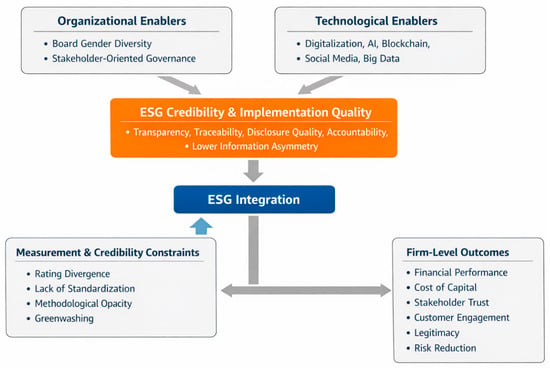
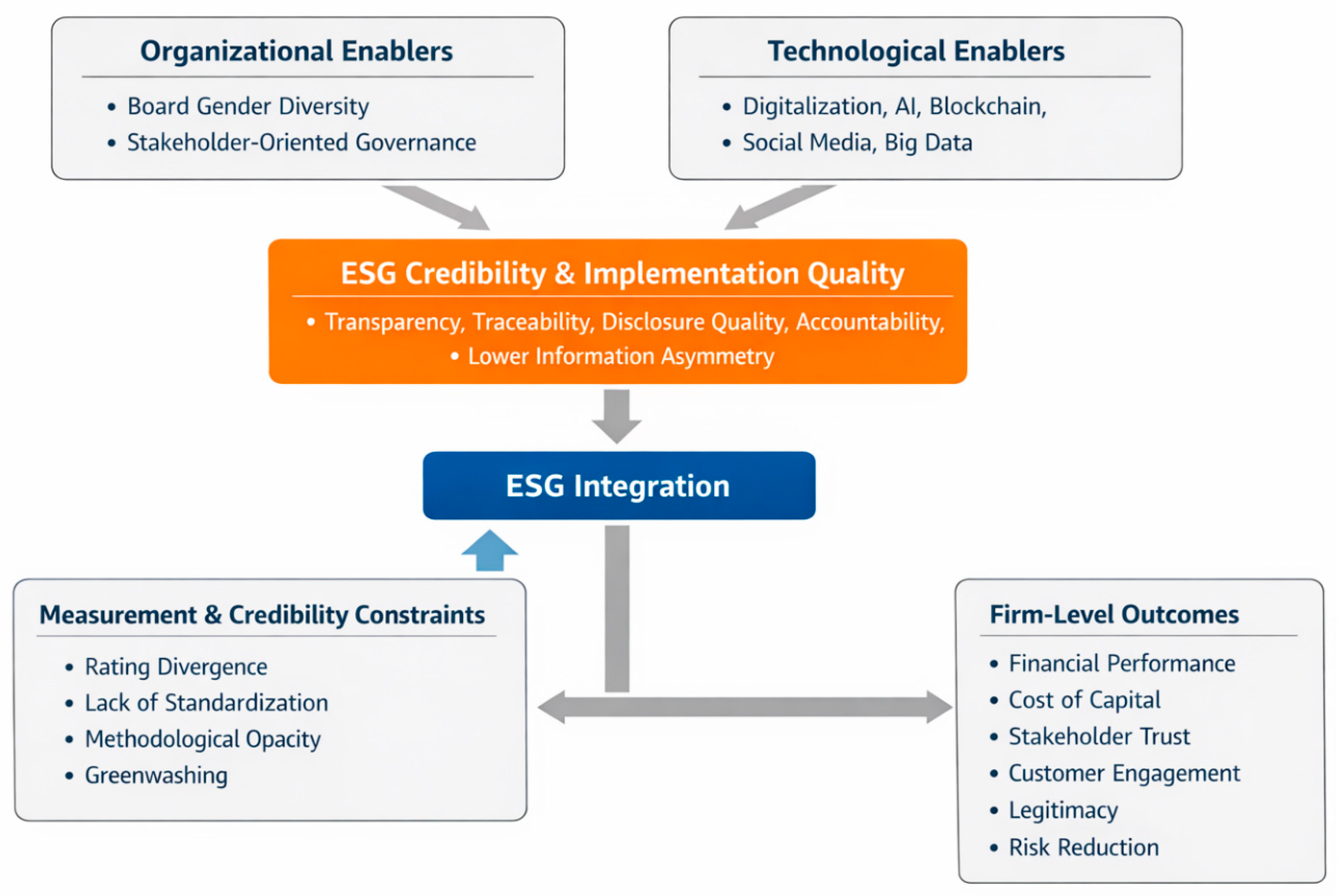

Disclaimer/Publisher’s Note: The statements, opinions and data contained in all publications are solely those of the individual author(s) and contributor(s) and not of MDPI and/or the editor(s). MDPI and/or the editor(s) disclaim responsibility for any injury to people or property resulting from any ideas, methods, instructions or products referred to in the content. |
© 2026 by the authors. Licensee MDPI, Basel, Switzerland. This article is an open access article distributed under the terms and conditions of the Creative Commons Attribution (CC BY) license.