


Abstract
Manipulation-detection models calibrated in developed markets are routinely applied to frontier economies without validation, yet the institutional conditions that make such tools function as pricing signals are rarely present in those settings. This study provides the first systematic test of the Beneish M-Score and Dechow F-Score as return predictors in Vietnam, a frontier market navigating staged International Financial Reporting Standards (IFRS) convergence. Apparent negative associations between manipulation scores and excess returns under System Generalized Method of Moments (System GMM) do not survive panel fixed effects, Fama–MacBeth, or between-firm estimation. Persistent second-order serial correlation confirms that the GMM signal reflects frontier-market return momentum rather than manipulation pricing. By contrast, Big Four audit quality generates a robust cross-sectional return premium, establishing audit credibility as the operative governance channel where regulatory enforcement is absent. Survival analysis further shows that high-risk firms face substantially elevated exit hazards, demonstrating that reporting risk shapes long-run viability even where short-run pricing is absent. These findings constitute an IFRS paradox: Vietnam has adopted the institutional form of international reporting standards while lacking the informational infrastructure to support detection models that function as reliable pricing signals. Governance infrastructure, not standards convergence, is the operative condition for market discipline in frontier settings.
Keywords:
earnings manipulation; financial reporting quality; frontier markets; IFRS convergence; governance; firm performance JEL Classification:
G32; M41; G34
1. Introduction
Financial markets rest on the foundational assumption that investors can identify and penalize firms that misreport. This assumption requires diagnostic tools to detect manipulation and institutional mechanisms to translate those signals into pricing consequences. Developed economies generally meet both conditions (Beneish, 1999; P. Dechow et al., 2010; Francis et al., 2004). Conversely, frontier markets often fail to meet either condition reliably (Bachtijeva et al., 2024; Martens et al., 2021; Viana et al., 2022). Enforcement is typically nascent, information asymmetries are acute, and the institutional infrastructure that amplifies manipulation penalties in mature settings is largely absent. Whether manipulation-detection models retain predictive power under these conditions remains an unresolved question with direct implications for capital allocation in the world’s fastest-growing but least-studied markets.
Several specific gaps motivate this study. The Beneish M-Score (Beneish, 1999) and Dechow F-Score (P. M. Dechow et al., 2011) were developed in institutional environments characterized by strong enforcement and high investor sophistication. Their predictive content may not survive transplantation to a frontier economy with weak enforcement and high retail participation. Existing applications to emerging markets have produced mixed results (Marais et al., 2023; Pilch, 2023; Ratmono & Frendy, 2022). Furthermore, it remains unclear whether investors in frontier markets respond to detectable manipulation signals. Market discipline in such environments may depend less on regulatory enforcement than on firm-level governance structures (Fan & Wong, 2005; Herman, 2020). Specifically, audit quality and capital structure provide credibility signals that may substitute for absent public enforcement. The conditions under which this substitution occurs have not been identified empirically. Finally, prior research connecting manipulation scores to market outcomes has focused almost exclusively on short-run return effects (Chan et al., 2001; Useche et al., 2025). Whether these scores also predict long-run firm survival remains unexplored in frontier settings (Bisogno & De Luca, 2015; V. C. Dang & Tran, 2021).
Vietnam offers a theoretically precise setting to address these gaps (Van Can & Dang, 2024). It operates within an institutional framework in which enforcement mechanisms remain nascent, and information asymmetries are acute (P. Bui & Nguyen, 2025; C. P. Nguyen & Pham, 2025). Vietnam’s transitional regulatory environment (Le et al., 2024) creates conditions where the tension between reported earnings and true economic performance is particularly pronounced. Governance mechanisms, including board oversight and audit quality, become the primary disciplinary channels in the absence of credible regulatory enforcement (Fan & Wong, 2005; Q. Nguyen et al., 2024). Vietnam is also navigating a staged IFRS convergence roadmap (N. Bui et al., 2020; Viana et al., 2023), allowing testing whether formal standards adoption reshapes the pricing of reporting risk independently of enforcement capacity.
The existing literature on Vietnam has largely focused on the presence of earnings management rather than its consequences for investor returns or firm survival. T. P. Nguyen et al. (2020) and Liu et al. (2025) confirmed that the Beneish M-Score and Dechow F-Score detect anomalies in Vietnamese financial statements, but detection is not discipline. Whether markets price those signals and whether governance structures determine the severity of any penalties have not been established (Beneish, 1999; Fan & Wong, 2005). Prior studies have also not extended this analysis to firm failure, leaving open the question of whether high misstatement scores serve as reliable leading indicators of delisting or bankruptcy in a transition economy (Musanovic & Halilbegovic, 2021; Tran et al., 2023).
This study addresses these gaps by analyzing 244 listed Vietnamese firms from 2004 to 2019, a period that captures Vietnam’s integration into global capital markets following WTO accession while maintaining stable domestic accounting standards. This window predates two structural breaks that would fundamentally alter the institutional environment: the COVID-19 pandemic in 2020 to 2021, which produced extraordinary government interventions unrelated to firm-level reporting quality, and Vietnam’s voluntary IFRS pilot, which launched in 2022 with mandatory adoption beginning in 2025 (L. H. N. Minh et al., 2021; T. S. Nguyen, 2024; Vietnam Ministry of Finance, 2020), and introduced regime changes in standards and enforcement outside our theoretical scope. The pre-convergence period, therefore, provides an appropriate setting to isolate the governance conditioning channel that operates in frontier markets prior to institutional strengthening.
We pose two co-equal research questions. First, do the Beneish M-Score and Dechow F-Score effectively predict future excess returns and the hazard of firm exit in Vietnam? Second, do firm-level governance mechanisms determine the severity of these manipulation penalties? We integrate Valuation Theory with the institutional constraints of a frontier market (Ball et al., 2008) to test whether governance structures substitute for absent regulatory enforcement in disciplining poor reporting quality (Watts & Zimmerman, 1990).
Our analysis offers three contributions. First, we provide the first systematic evidence on the manipulation-detection model’s transferability in a frontier market, documenting that the Beneish M-Score (M8 and M5) and Dechow F-Score effects on excess returns are estimator-dependent and do not survive panel fixed effects or Fama–MacBeth identification. This null result under robust estimation is itself informative: it establishes that scoring tools calibrated in developed markets do not transfer to Vietnam’s frontier setting, and distinguishes Vietnamese evidence from findings in more institutionally developed emerging markets such as South Africa (Marais et al., 2023) and Indonesia (Aviantara, 2023). Second, we identify Big Four audit quality as the sole robust pricing signal: it generates a significant cross-sectional return differential under between-firm estimation, establishing audit credibility as the operative governance channel in an institutional void (Fan & Wong, 2005; Herman, 2020). Third, by linking misstatement scores to survival analysis, we demonstrate that reporting risk shapes long-run firm viability even where short-run return pricing is absent (Abu Afifa et al., 2023; Bisogno & De Luca, 2015).
The remainder of the paper is organized as follows. Section 2 develops the theoretical framework and literature review. Section 3 details the methodology. Section 4 and Section 5 present the findings and discussion. Section 6 concludes by synthesizing the results and addressing implications and limitations.
2. Theoretical Framework, Literature Review, and Hypothesis Development
2.1. Theoretical Development
Valuation Theory posits that a firm’s market value equals the discounted stream of expected future cash flows (Modigliani & Miller, 1958). In this framework, reported earnings are the primary signals investors use to forecast profitability and assess risk. When those signals are credible, accounting information aligns closely with share prices, a relationship captured in the concept of value relevance (M. E. Barth et al., 2001; Beaver, 1968; Martens & Bui, 2023). Distortions in reporting weaken this alignment, leading to mispricing and inefficient capital allocation.
Positive Accounting Theory (PAT) explains why reporting often falls short of this ideal. Managers act opportunistically, exploiting accounting discretion to meet earnings benchmarks, avoid debt covenant violations, or secure political advantage (Huang et al., 2024; Watts & Zimmerman, 1990). Such behavior produces earnings management through accrual adjustments or real activity manipulation (Gilliam et al., 2025). The Beneish M-Score (Beneish, 1999) and Dechow F-Score (P. M. Dechow et al., 2011) formalize these risks differently: the M-Score emphasizes targeted indicators of deliberate manipulation, while the F-Score captures broader misstatement risk encompassing both intentional and unintentional reporting errors. This distinction helps explain why the two models may yield different predictive strengths.
The translation of manipulation signals into return consequences, however, depends on a chain of institutional conditions that frontier markets routinely fail to satisfy. Weak enforcement limits the regulatory sanctions that would otherwise compel disclosure and deter misreporting. Limited analyst coverage reduces the intermediation capacity through which manipulation signals are identified, amplified, and incorporated into prices. In the absence of these mechanisms, pricing is driven by retail investor herding and return momentum rather than by fundamental information (Ho et al., 2021). Detection models trained on developed-market data are calibrated to environments where this chain functions; when enforcement is absent, and analyst intermediation is thin, elevated manipulation scores capture return momentum noise rather than genuine misreporting signals. This is the theoretical mechanism underlying the IFRS paradox examined in this study.
Taken together, the two theories frame earnings manipulation as a direct challenge to the market’s ability to price firms accurately, while the institutional chain argument identifies the conditions under which that challenge can actually be observed in prices. Vietnam satisfies the conditions for this test precisely: IFRS convergence has imported the formal architecture of international standards, but enforcement capacity remains nascent, state ownership continues to shape managerial incentives, and information asymmetries are pervasive (N. N. Minh et al., 2023; Q. Nguyen et al., 2024). Vietnam is therefore not merely a convenient research setting but a theoretically necessary one for assessing how far standards adoption, absent complementary institutional development, can constrain opportunistic reporting behavior.
2.2. Earnings Management: Detection and Market Responses
The alignment between reported earnings and economic reality is fundamental to reducing information asymmetry and supporting efficient capital allocation (M. E. Barth et al., 2001; Beaver, 1968). Manipulation through accrual-based or real activities weakens the predictive power of financial statements (P. Dechow et al., 2010; P. M. Dechow et al., 1994; Dichev et al., 2013), representing a systemic feature of corporate reporting across various jurisdictions (Gilliam et al., 2025; Hassan et al., 2024; Lizińska & Czapiewski, 2018; Soepriyanto et al., 2020). Detection models like the Beneish M-Score and Dechow F-Score provide structure to this problem by flagging targeted manipulation indicators and broader misstatement risks (Beneish, 1999; P. M. Dechow et al., 2011). While their diagnostic potential has been confirmed across diverse emerging markets, their effectiveness remains contingent on local institutional quality and audit enforcement (Aghghaleh et al., 2016; Aviantara, 2023; Hołda, 2020; Maniatis, 2022).
Market responses to these signals vary significantly by institutional context. In developed economies, robust enforcement ensures that elevated manipulation scores translate into measurable valuation penalties (Francis et al., 2004). Conversely, in emerging markets, concentrated ownership and lower investor sophistication often mute these disciplinary effects (Almarayeh et al., 2022; Naz et al., 2024). These challenges are intensified in frontier markets where limited liquidity and evolving disclosure regimes create environments where manipulation may persist without predictable sanctions (Bachtijeva et al., 2024; Viana et al., 2022). Vietnam exemplifies this dynamic; despite commitments to international standards, uneven enforcement and state influence continue to shape managerial incentives (N. Bui et al., 2020; Martens, 2024; N. N. Minh et al., 2023; L. A. Nguyen et al., 2021; Q. Nguyen et al., 2024). This study evaluates whether tools validated in advanced economies can provide reliable signals in Vietnam’s specific institutional setting.
2.3. Vietnam’s Reporting Context and the IFRS Paradox
Vietnam is not merely a convenient research setting but a theoretically precise one. It combines the three conditions necessary to identify the governance conditioning channel: weak public enforcement that prevents regulatory mechanisms from substituting for firm-level governance; active capital market participation by retail investors who must rely on financial signals despite limited analytical infrastructure (Ho et al., 2021); and a staged IFRS convergence roadmap that introduces variation in formal standards without a corresponding strengthening of enforcement capacity (Vietnam Ministry of Finance, 2020). Few frontier markets simultaneously exhibit all three features, making Vietnam an unusually clean laboratory for the questions this study poses (Van Can & Dang, 2024).
Vietnam is currently transitioning from Vietnamese Accounting Standards (VAS) to IFRS through a phased roadmap overseen by the Ministry of Finance (Vietnam Ministry of Finance, 2020). This transition, spanning preparation (2019–2021), voluntary pilot (2022–2025), and mandatory adoption phases, aims to enhance transparency and global market integration (Cities, 2024; Grant Thornton Vietnam, 2020; PwC Vietnam, 2024; Vietnam National Trade Repository, 2020). While theoretically aligned with Valuation Theory, experience suggests that standards alone cannot eliminate managerial discretion without credible enforcement (Hashed & Almaqtari, 2021; International Financial Reporting Standards Foundation, 2025; Martens, 2026; Viana et al., 2023; Watts & Zimmerman, 1990). Vietnam illustrates this tension acutely as firms continue to engage in earnings management despite formal regulatory reforms (N. N. Minh et al., 2023; Q. Nguyen et al., 2024).
Research indicates that while earnings quality influences firm value in Vietnam, its explanatory power remains weaker than in mature economies (H. N. Dang et al., 2020; Le et al., 2024; Xiang & Sheng, 2024). This divergence reflects an IFRS paradox: the coexistence of formal international standards with persistent manipulation that undermines intended transparency benefits. It remains unclear whether diagnostic models can effectively capture manipulation in this environment characterized by partial adoption and structural incentives for misreporting. Testing whether these scores retain predictive power for excess returns in a market navigating this transition defines the central gap of this analysis.
The findings from Vietnam carry implications that extend beyond a single market. Frontier economies sharing Vietnam’s institutional profile, including staged standard adoption, weak enforcement infrastructure, and governance-dependent market discipline, are widespread across Southeast Asia, sub-Saharan Africa, and Central Asia (Bachtijeva et al., 2024; Viana et al., 2022). If governance mechanisms are shown to be the operative channel through which manipulation risk is priced in Vietnam, this positions firm-level credibility signals as a generalizable disciplinary substitute in any market where regulatory enforcement remains nascent. Conversely, if manipulation scores lose predictive validity even in a governance-rich subsample, this would suggest that frontier-market opacity imposes a binding constraint on information-based pricing that standards reform alone cannot overcome. Either outcome advances understanding of how capital markets function in institutional voids.
2.4. Market Consequences: Short-Run Returns and Long-Run Survival
Earnings quality shapes market interpretations of performance across both short and long horizons. In the short run, low-quality earnings result in systematically negative cumulative abnormal returns as investors revise valuations once poor quality is revealed (Chan et al., 2001; Collins & Hribar, 2000; Francis et al., 2005). Real earnings management further contributes to stock price crashes and elevated capital costs (Fatima et al., 2020; Gunny, 2010). Conversely, high-quality reporting is associated with lower price volatility and reduced financing costs (Li et al., 2024; Perotti & Wagenhofer, 2014).
The long-run consequences include the erosion of reporting reliability and conditional conservatism, which increase the likelihood of failure. Firms approaching bankruptcy or delisting often display systematic manipulation in the years preceding collapse (Bisogno & De Luca, 2015; García-Lara et al., 2011). Severe financial distress may further induce managers to exaggerate performance to hide decline, compromising creditor assessments (Khalil et al., 2022). While most evidence for these penalties comes from institutional settings with strong enforcement, frontier economies like Vietnam remain under-researched. This study extends the literature by testing whether diagnostic models capture both immediate pricing effects and enduring viability in a frontier context with persistent institutional weaknesses (H. N. Dang et al., 2020; Le et al., 2024; Xiang & Sheng, 2024).
2.5. Synthesis and Hypothesis Development
Reporting quality influences immediate market pricing and long-run firm viability, while Positive Accounting Theory explains the managerial incentives that sustain manipulation in weak enforcement settings (Watts & Zimmerman, 1990). Vietnam serves as an ideal laboratory; IFRS convergence is underway while enforcement remains nascent (N. Bui et al., 2020). Consequently, market discipline must operate through firm-level governance rather than regulatory compliance (Fan & Wong, 2005). We develop five hypotheses connecting reporting risk to short-run returns (H1–H3) and long-run survival (H4–H5).
Hypothesis 1 (H1).
Firms with higher Beneish M-Scores (greater manipulation risk) will earn lower excess returns than firms with lower scores, reflecting diminished value relevance.
The Beneish M-Score detects deliberate financial manipulation through targeted accrual and activity indices (Beneish, 1999). Developed markets show that higher M-Scores correlate with abnormal negative returns as investors downwardly revise valuations upon recognizing manipulation risk (J. R. Barth et al., 2008; Chan et al., 2001). Manipulation may be even more prevalent in Vietnam because high information asymmetry and state ownership incentivize earnings smoothing (N. N. Minh et al., 2023; Q. Nguyen et al., 2024). Vietnamese equity investors monitor financial signals despite lower sophistication (Ho et al., 2021). Consequently, firms with elevated M-Scores should experience lower excess returns as pricing incorporates the information content of manipulation signals.
Hypothesis 2 (H2).
Firms with higher Dechow F-Scores (greater misstatement risk) will earn lower excess returns than firms with lower scores, consistent with weaker reporting reliability.
The Dechow F-Score captures a broader spectrum of misstatement risk by integrating accrual and market indicators (P. M. Dechow et al., 2011). The F-Score was validated as a probabilistic predictor of U.S. enforcement actions; its predictive content in frontier markets is less straightforward because such actions are rare. Nevertheless, higher F-Scores signal elevated risk that errors or manipulation contaminate reported earnings, reducing statement credibility and depressing valuations. Importantly, the association between the F-Score and returns may be nonlinear: its predictive content may only manifest once misstatement probability crosses specific thresholds, a nuance often missed in linear models. Misstatement risk reduces the quality of information available to investors (P. Dechow et al., 2010; Francis et al., 2005).
Hypothesis 3 (H3).
The negative effect of the Beneish M-Score and the Dechow F-Score on excess returns will be stronger (weaker) in firms with higher leverage (Big Four auditor), consistent with governance mechanisms conditioning market penalties in institutional voids.
Firm-level governance mechanisms substitute for absent regulatory enforcement in institutional voids (Fan & Wong, 2005; Herman, 2020). Financial leverage amplifies managerial incentives to manipulate earnings to avoid covenant violations (Watts & Zimmerman, 1990), while simultaneously increasing investor sensitivity to misstatement signals by raising the stakes of poor information quality (Naz et al., 2024). Conversely, a Big Four auditor serves as a credible bonding mechanism: the reputational capital of these firms certifies financial statement integrity and attenuates market discounting of manipulation signals (Almarayeh et al., 2022; Francis et al., 2004). These governance signals carry significant weight in Vietnam due to weak public enforcement and limited transparency.
Hypothesis 4 (H4).
Firms with higher Beneish M-Scores will face significantly higher hazards of exit (delisting or bankruptcy) than firms with lower scores, as persistent manipulation accelerates financial distress and market discipline.
Manipulation erodes long-run firm viability beyond short-run pricing effects. Component indices of the M-Score, such as the gross margin index and asset quality index, typically deteriorate in the years preceding financial distress (Bisogno & De Luca, 2015; García-Lara et al., 2011). The transition from manipulation to failure may unfold over several years in Vietnam because bankruptcy procedures are slow, making the M-Score’s medium-term predictive window especially relevant. Firms classified as likely manipulators face compounding risks, including mispricing, covenant stress, and elevated exit hazards. Diagnostic models predict the failure of listed firms more effectively than purely financial ratios (Marais et al., 2023).
Hypothesis 5 (H5).
Firms with higher Dechow F-Scores will face significantly higher hazards of exit than firms with lower scores, reflecting reduced reporting reliability and deteriorating investor confidence over time.
The constituent variables of the Dechow F-Score, including RSST accruals and soft assets, capture balance sheet risks that foreshadow the erosion of financial sustainability (P. M. Dechow et al., 2011). The F-Score provides broader coverage of misstatement risk than the manipulation-specific M-Score. Persistently elevated F-Scores indicate reporting irregularities that undermine creditor and investor confidence over time. Long-run accounting quality significantly affects survival probabilities (Bisogno & De Luca, 2015; Khalil et al., 2022). We expect the F-Score to predict firm exit in Vietnam, though potentially with less precision than the M-Score due to its broader focus.
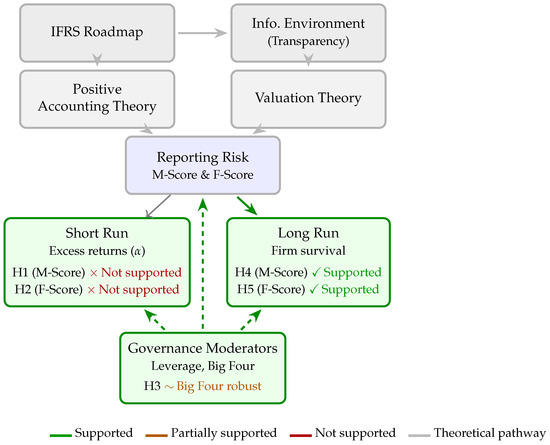
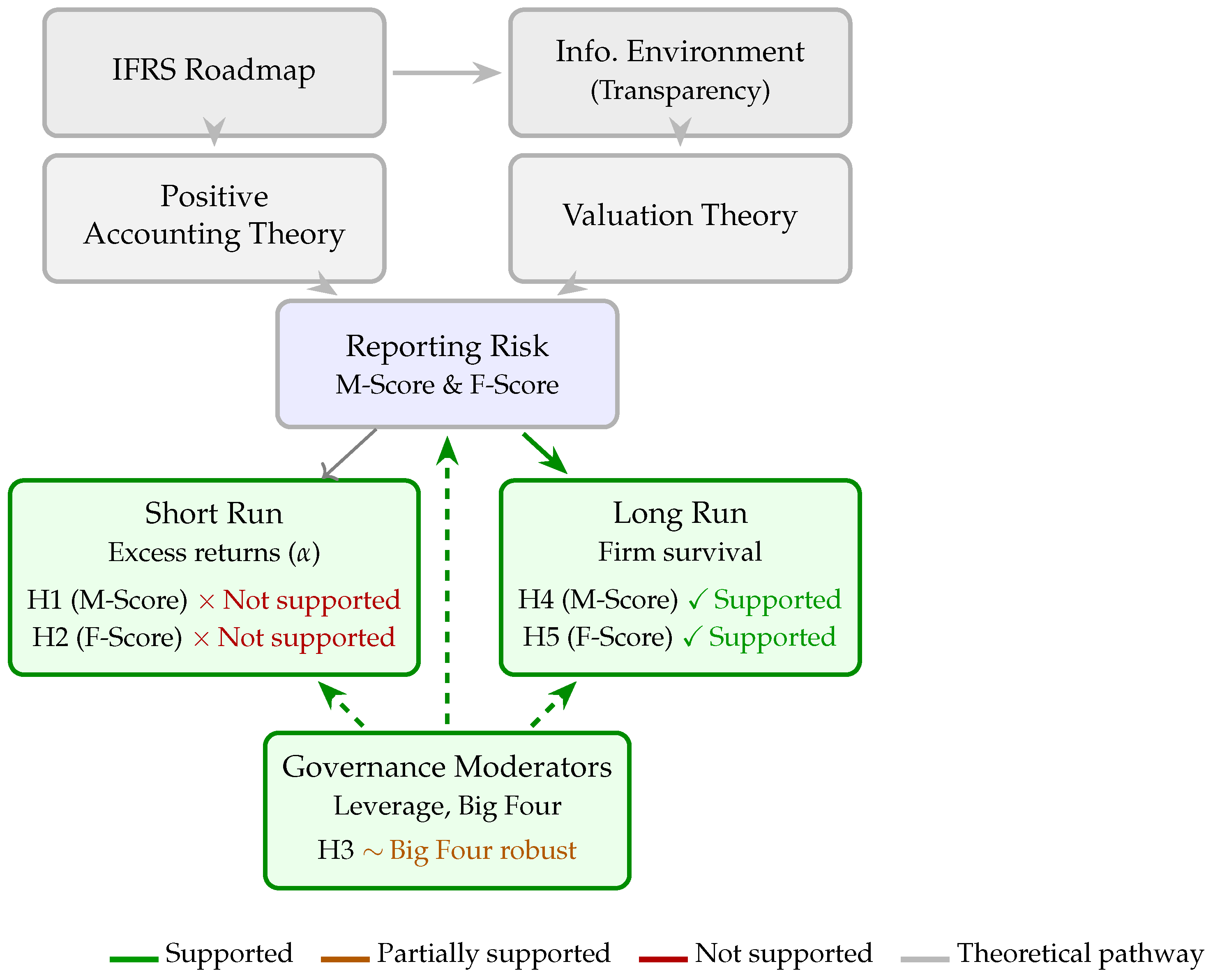
Together, these hypotheses, illustrated in the conceptual framework (Figure 1), test whether models of manipulation developed in advanced markets explain both immediate returns and long-run survival outcomes in a frontier economy navigating IFRS transition.
Figure 1.
Conceptual framework with empirical results. Solid arrows indicate direct theoretical pathways, dashed arrows indicate moderation paths, and highlighted green arrows denote empirically supported relationships. H1 and H2 (short-run return hypotheses) are not supported under estimator-robust identification (panel fixed effects and Fama–MacBeth); the apparent SGMM signal reflects frontier-market return momentum rather than manipulation pricing. H4 and H5 (survival hypotheses) are supported via Cox proportional hazards estimation. H3 is partially supported: Big Four audit quality generates a robust cross-sectional return differential; leverage interaction effects are estimator-dependent.
3. Methodology
3.1. Research Design
This study utilizes a quantitative, longitudinal panel design. It draws on firm-level data from Vietnam’s primary exchanges: the Ho Chi Minh Stock Exchange (HOSE) and the Hanoi Stock Exchange (HNX). The institutional setting provides a quasi-experimental context. The Ministry of Finance announced a phased adoption of International Financial Reporting Standards (IFRS) during the observation window. Full adoption only begins after 2019; however, the preparatory phase and regulatory roadmap provide a natural backdrop to evaluate how manipulation scores relate to market outcomes before formal convergence.
3.2. Data and Sample
The sample spans 2004 to 2019. This window captures the global financial crisis and the preparatory stage of Vietnam’s IFRS convergence. It excludes the extraordinary distortions caused by the COVID-19 pandemic. Firm-level financial and market data are sourced from the Bureau van Dijk Osiris database. The selection process excludes financial institutions due to their unique reporting structures. Firms with missing values for key variables or major structural breaks, such as mergers and acquisitions, are also removed. The final panel consists of 244 firms and 1633 firm-year observations. We address survivorship bias through a Cox proportional hazards model. In this model, firm exits, such as delistings, bankruptcies, or long-term suspensions, are treated as events in the survival analysis.
3.3. Variables
Dependent variable. Excess returns are computed as each firm’s annual buy-and-hold return, including dividends, minus the FTSE Vietnam All-Share Price Index. Returns are denominated in local currency. They are not inflation-adjusted, which is consistent with prior emerging-market studies (Dimitrov & Jain, 2008; Trinh et al., 2021).
Independent variables. Reporting quality is proxied by the Beneish M-Score and the Dechow F-Score. Both measures are re-estimated using Vietnamese accounting data. These include adjustments to ensure comparability across local GAAP and IFRS inputs. The Beneish M-Score serves as a proxy for earnings manipulation risk (H1, H3, and H4), while the Dechow F-Score captures broader misstatement risk (H2, H3, and H5). The M-Score is scaled such that higher, less negative values indicate greater manipulation risk; we therefore expect a negative coefficient in return regressions. The F-Score represents a predicted probability of misstatement bounded between zero and one. Higher values indicate greater misstatement risk; consequently, we expect a negative coefficient. However, the F-Score’s predictive content may be nonlinear. As a probabilistic classifier designed for extreme events, its information content in return models may only manifest for firms that exceed established misstatement thresholds (). The baseline linear coefficient may be attenuated or even positive in a heterogeneous sample that includes many low-misstatement firms. We therefore complement the linear specification with threshold-based segmentation analyses in Section 4.
Control variables. The model includes earnings per share (EPS), book-to-market ratio (BM), firm size (SIZE, log of assets), leverage (LEV), inflation (INFL), audit quality (BIG4 dummy), and capital intensity (CAP). Inflation captures macroeconomic shocks specific to Vietnam’s frontier context. Alternative measures such as GDP growth and interest rates are excluded because they are highly collinear with inflation. Detailed definitions, coding conventions, expected signs, and measurement formulas for all variables are reported in Appendix A.
3.4. Estimation Strategy
The baseline specification estimates the impact of manipulation scores on excess returns ():
In this equation, represents the excess return of firm i in year t. is a vector of controls, are firm effects, and are year dummies. Equation (1) tests H1 and H2. Observations with missing values in any model variable are removed via listwise deletion. The analytic samples range from 1571 to 1605 observations depending on the specification.
Firm survival is modeled with a Cox proportional hazards specification:
In Equation (4), is the hazard of exit conditional on reporting quality and controls. This equation tests H4 and H5 by examining if higher manipulation or misstatement scores increase the hazard of firm exit.
The System Generalized Method of Moments (SGMM) estimator is employed as a supplementary robustness estimator to address potential endogeneity. Following Arellano and Bond (1991) and Blundell and Bond (1998), the specification uses lagged levels and differences in the endogenous regressors as internal instruments. We apply Windmeijer’s finite-sample correction to standard errors. Arellano–Bond AR(1) and AR(2) diagnostics are reported in each SGMM table. The AR(1) test confirms the presence of first-order serial correlation in the differenced residuals (). The AR(2) test yields p-values of 0.000 in the full-sample models, indicating second-order serial correlation in the differenced residuals inconsistent with the SGMM identification assumption. We interpret this as evidence of return momentum in Vietnam’s frontier market (Phan et al., 2023), a documented characteristic where thin trading and retail investor herding sustain multi-period autocorrelation. Given the AR(2) finding, SGMM results are treated as supplementary evidence; primary inference rests on the panel fixed-effects estimates.
Instrument proliferation is addressed directly. The full-sample models use approximately 120 instruments against 244 cross-sectional groups, a ratio that can inflate the Hansen J statistic toward one regardless of instrument validity (Roodman, 2009). As a robustness check, we re-estimate all full-sample SGMM specifications using the collapse option of Roodman (2009), which reduces the instrument count to 84. Critically, AR(2) p-values remain 0.000 across all collapsed specifications, identical to the uncollapsed results. This confirms that second-order serial correlation is a structural feature of the data, consistent with frontier-market return momentum, rather than an artifact of instrument proliferation. Because the SGMM identification assumption is violated in both the standard and collapsed specifications, primary inference rests on the panel fixed-effects estimates, which do not depend on these moment conditions.
3.5. Robustness Checks
Several robustness checks reinforce the design. Subsample splits distinguish between early and late phases of the IFRS roadmap to test if preparatory reforms alter the manipulation–returns relationship. Crisis versus non-crisis phases assess if economic turbulence intensifies penalties. Alternative specifications, including log-transformed leverage, alternative size measures, and winsorization of outliers, confirm the stability of the results.
Critically, all primary specifications are re-estimated under three alternative estimators: panel fixed effects (within-firm identification and clustered standard errors), Fama–MacBeth two-step cross-sectional regression (Fama & MacBeth, 1973), and the between estimator. Results are reported in Appendix B Table A2. This comparison directly addresses potential sensitivity to the SGMM instrumentation strategy. Across all alternative specifications, manipulation score coefficients are statistically insignificant and directionally inconsistent. The fixed-effects estimator yields null or wrong-sign coefficients for all three scores, confirming that manipulation score levels do not predict within-firm return dynamics. The Fama–MacBeth estimator yields similarly null results across all 15 time periods, ruling out a consistent year-by-year cross-sectional relationship. Subsample fixed-effects and Fama–MacBeth estimation restricted to the top quintile of each score, the highest-risk firms, likewise yield insignificant results, confirming that the null is not an artifact of pooling low-risk and high-risk firms. Only Big Four audit quality generates a significant and stable cross-sectional return differential in the between-estimator specification. These results, combined with the AR(2) diagnosis, establish the null as the primary empirical finding of this study.
4. Findings
4.1. Descriptive Statistics
Table 1 reports descriptive statistics for the 244 firms in the sample, covering 1633 firm-year observations from 2004 to 2019. Panel A presents industry composition, showing broad sectoral coverage, while Panel B reports means, medians, and standard deviations for key financial and governance variables. Manipulation scores exhibit wide dispersion: both M-Score variants cluster near thresholds for potential manipulation, while the F-Score displays greater variance, reflecting its broader market-based design.
Table 1.
Summary statistics.
Table 2 provides pairwise correlation coefficients among dependent, independent, and control variables. Expected links emerge between profitability measures (EPS and BM) and returns, while modest but significant correlations between manipulation scores and fundamentals highlight overlapping yet distinct information content. These descriptive results confirm heterogeneity in manipulation risk and underscore the need for multivariate analysis.
Table 2.
Correlation matrix.
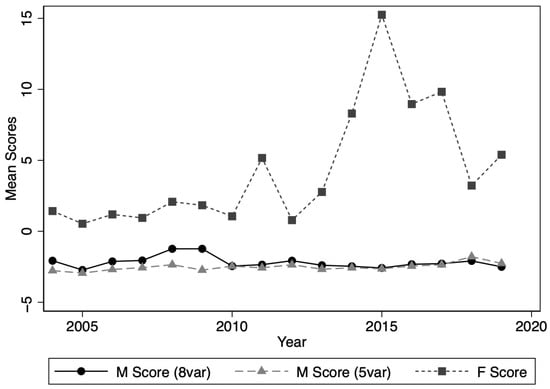
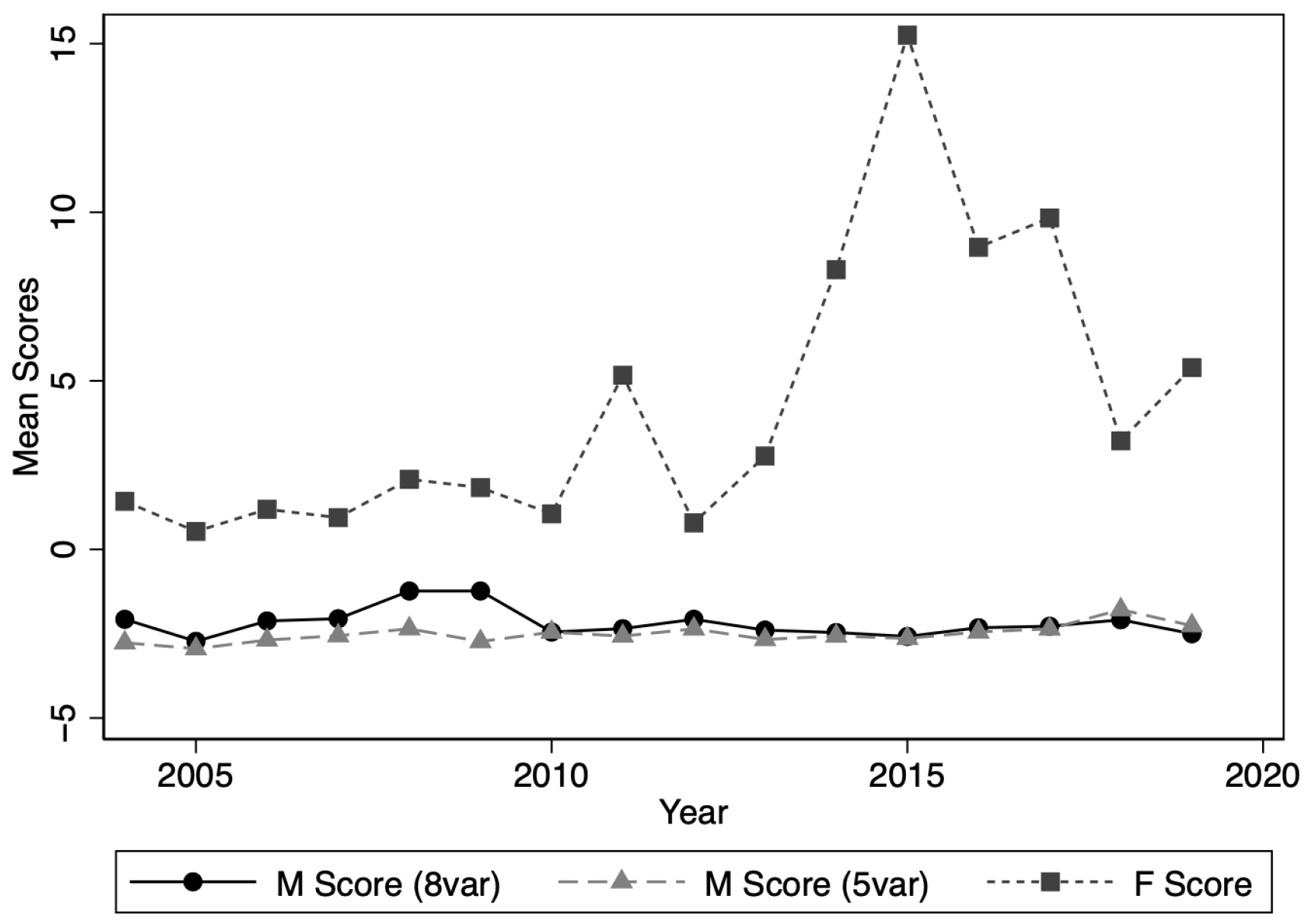
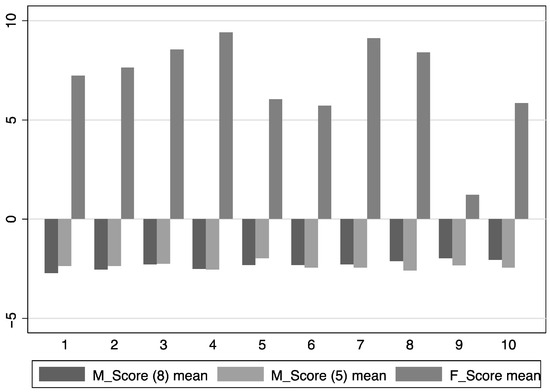
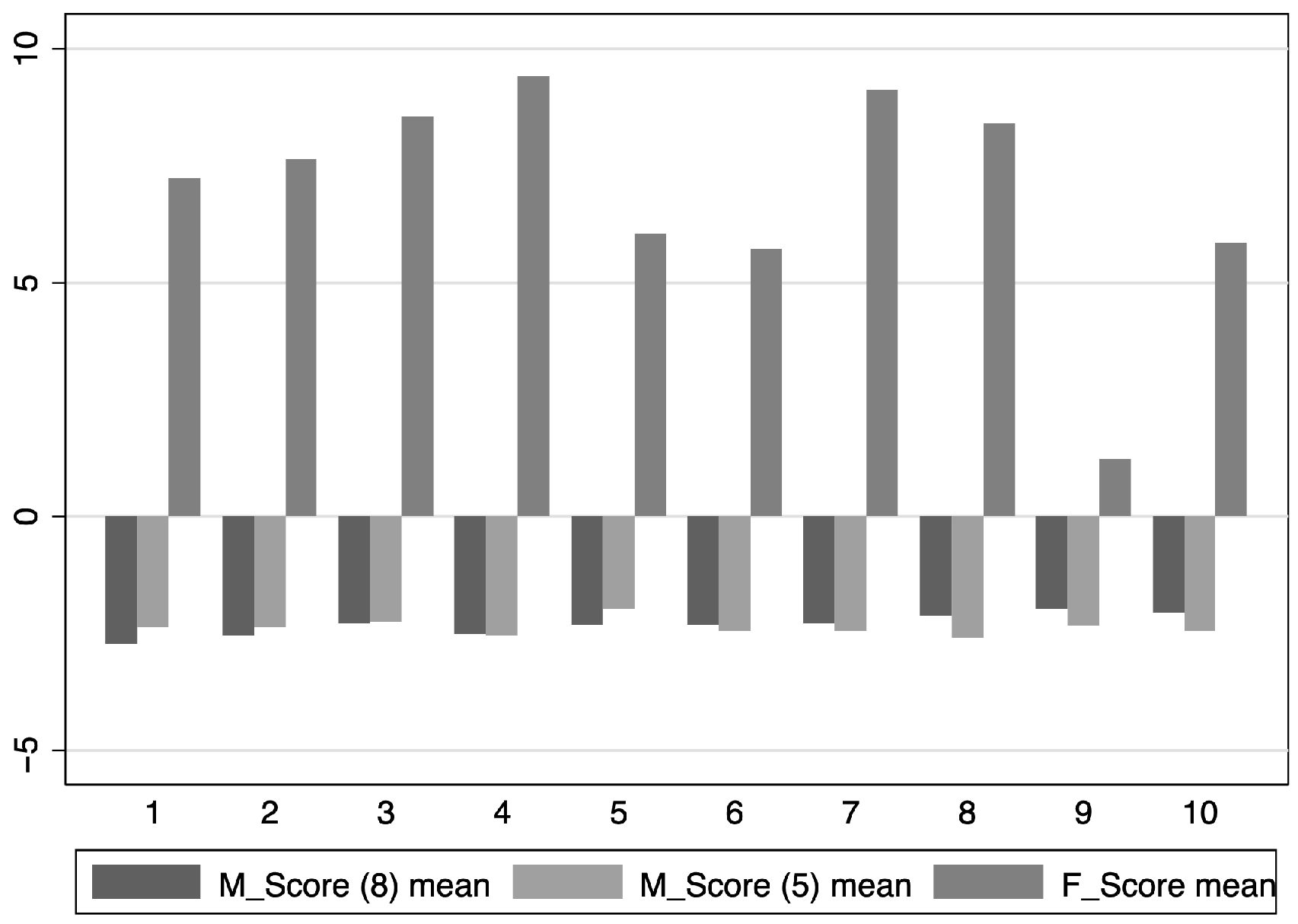
Figure 2 and Figure 3 complement these descriptive tables by visualizing score dynamics across time and firm size. Figure 2 shows that M-Score values (both eight- and five-variable versions) remain relatively stable, fluctuating narrowly between −3 and −2, while F-Scores exhibit sharper spikes, notably around 2011 and 2015, suggesting heightened manipulation risk during periods of macroeconomic stress. Figure 3 illustrates a clear cross-sectional pattern: larger firms (higher asset deciles) tend to exhibit lower F-Scores, consistent with stronger monitoring and resource capacity, whereas smaller firms cluster at higher manipulation likelihoods. Together, these patterns indicate that time variation and firm scale jointly shape the distribution of manipulation risk in Vietnam’s frontier market.
Figure 2.
Mean scores over time. Source: Adapted from Martens and Andersson (2024).
Figure 3.
Scores by total asset decile. Source: Adapted from Martens and Andersson (2024).
4.2. Baseline Results
Cross-sectional summary patterns are reported in Table 3, which presents mean manipulation scores by industry together with the number and share of firms flagged as likely manipulators under each model. Baseline panel regressions are reported in Table 4. Consistent with value relevance theory, EPS, BM, and SIZE are positively and significantly associated with excess returns. The M-Score enters with the expected negative and significant coefficient across baseline specifications, indicating that higher manipulation risk is associated with lower excess returns, consistent with H1.
Table 3.
Mean independent variables by industry and firms deemed as manipulators.
Table 4.
System GMM estimation of excess returns (.
The F-Score, however, enters with a positive coefficient in the baseline specification (, ), which runs counter to the direction predicted in H2. This pattern likely reflects the extreme right skew in the F-Score distribution (, ), where a small number of very high-scoring observations drive the aggregate relationship. Consistent with this interpretation, the segmentation analysis in Table 5 shows that the F-Score is strongly negatively associated with returns among firms classified as likely manipulators (). This suggests that the predictive signal of the F-Score is nonlinear and concentrated among high-risk firms rather than operating uniformly across the full distribution.
Table 5.
Tests of likely manipulators: SGMM.
4.3. Segmentation Analysis
To test whether markets differentiate across manipulation likelihood, Table 4 splits firms into “unlikely,” “grey zone,” and “likely” manipulators using established M-Score and F-Score thresholds. Results show that penalties are concentrated among the “likely” group, where the coefficients on both EPS and BM turn negative, suggesting a decline in profitability’s value relevance when manipulation risk is high. This stratification underscores that investors apply sharper discounts when manipulation signals cross recognized thresholds, aligning with the hypothesized market sensitivity to earnings credibility.
4.4. Extended Models
Extended models are presented across Table 5, Table 6, Table 7 and Table 8, with robustness checks detailed in Appendix B Table A3.
Table 6.
Extended models with interaction terms.
Table 7.
Quasi-natural experiment—pre- and post-IFRS adoption (2009–2014).
Table 8.
Quasi-natural experiment—pre-, during, and post-financial crisis.
Interaction regressions (Table 5) show that leverage amplifies the negative impact of manipulation on returns, while Big Four audits partially mitigate penalties. This supports the view that financial constraints intensify market distrust when manipulation is present, whereas reputable auditors help restore partial confidence.
Table 6 extends these tests with additional interactions. Results indicate that M-Score × Leverage and F-Score × Leverage terms consistently show significant negative coefficients, underscoring that highly leveraged firms face the steepest market penalties when manipulation is detected. Conversely, M-Score × Big4 and F-Score × Big4 interactions yield weaker coefficients, suggesting that high-quality audits reduce—but do not eliminate—the adverse return effects.
Table 7 examines quasi-natural experiments comparing pre- and post-IFRS adoption (2009–2014). Results show that while IFRS adoption moderates the severity of manipulation penalties, it does not eliminate them. This suggests that institutional improvements improve transparency but cannot fully offset entrenched managerial incentives in Vietnam’s frontier market context.
Table 8 evaluates global financial crisis periods. During and immediately after the crisis, manipulation scores are penalized more severely, consistent with heightened investor scrutiny under turbulence. These findings reinforce the market’s sensitivity to manipulation, which intensifies during periods of macroeconomic stress.
4.5. Survival Analysis: Long-Run Consequences of Reporting Risk
Appendix B Table A3 (Panel A) presents Cox proportional hazards estimates of the effect of manipulation and misstatement risk on the probability of firm exit—defined as delisting, bankruptcy, or long-term trading suspension—for the full sample of 244 firms over 2004–2019. The results provide strong support for both H4 and H5.
For the Beneish M-Score (8-variable), the hazard coefficient is −0.387 (), indicating that a one-unit increase in the M-Score increases the instantaneous exit hazard by approximately 32 percent (, or about 40 percent at the mean). The five-variable M-Score is also significantly positive in the hazard model, though with a smaller coefficient (−0.032, ), consistent with its narrower specification. The Dechow F-Score coefficient is positive (, ), indicating that firms with elevated misstatement probability also face higher exit hazards, though the effect is more modest in magnitude than for the M-Score.
The divergence in coefficient magnitudes across the two measures reflects their different design targets. The M-Score, constructed from indices that track specific manipulations such as receivables inflation, accrual build-up, and gross margin erosion, captures distortions closely linked to the accounting deterioration that precedes financial distress and delisting (Beneish, 1999; Marais et al., 2023). The F-Score captures a broader, more heterogeneous pool of misstatement risks, including errors and omissions not directly tied to imminent failure, thereby diluting its predictive precision in a survival context (P. M. Dechow et al., 2011).
The leverage interaction terms in Panels B and C of Table A3 reveal additional heterogeneity. The M-Score × Leverage coefficient is significantly positive (, ), indicating that the exit hazard for high-M-Score firms is substantially amplified when they also carry high debt burdens—consistent with the view that financial distress and manipulation co-occur to accelerate failure. The EPS interaction further shows that high-M-Score firms with volatile earnings face compounding exit risk. These supplementary results reinforce the conclusion that reporting risk, when combined with structural financial vulnerabilities, generates meaningful long-run survival penalties in Vietnam’s frontier market.
5. Discussion
5.1. H1: Beneish M-Score and Short-Run Excess Returns
The SGMM specifications in Table 4 yield negative and significant M-Score coefficients ranging from −1.4 to −1.9 percentage points, which, in isolation, would appear to support . However, this result does not survive alternative identification strategies. Under panel fixed effects, the M-Score coefficient is positive and significant in the narrow specification (, ), the wrong direction, and positive but insignificant in the full specification (, ). Under Fama–MacBeth cross-sectional estimation, coefficients are similarly null across all specifications (Table A2). The systematic failure of the M-Score effect to replicate across estimators indicates that the GMM result is sensitive to the instrumentation strategy rather than reflecting a genuine and consistent manipulation penalty. This null result distinguishes the Vietnamese evidence from Marais et al. (2023), who document significant M-Score pricing in South Africa, and Aviantara (2023), who find manipulation scores predictive in Indonesia. Both South Africa and Indonesia operate with deeper institutional investor bases and more developed enforcement infrastructure than Vietnam’s frontier setting, suggesting that M-Score transferability is conditioned on the institutional environment rather than IFRS convergence status alone.
The source of this sensitivity is identifiable. As documented in Section 3, GMM specifications exhibit persistent second-order serial correlation () even after applying the collapse option, reducing the instrument count to 84 against 244 cross-sectional groups. This pattern is consistent with documented return momentum in Vietnam’s frontier equity market (Quy Duong & Bertrand, 2023), where thin trading and retail investor herding sustain multi-period autocorrelation. The GMM instrumentation, using lagged levels and differences as internal instruments, captures this momentum structure rather than isolating a causal manipulation-pricing effect. Fixed-effects estimation, which conditions out between-firm variation and identifies only from within-firm time-series movements, produces null or reversed results. is therefore not robustly supported. The evidence suggests that the M-Score, calibrated in developed markets, does not consistently serve as a return-predictive signal in Vietnam’s frontier equity market.
5.2. H2: Dechow F-Score and Short-Run Excess Returns
The evidence on points toward a null result under robust identification. The SGMM full-sample baseline yields a positive F-Score coefficient, contrary to the hypothesized direction. The F-Score’s distributional properties in this sample, mean of 6.91 and standard deviation of 38.66, reflect severe right skew driven by a small number of extreme observations, which attenuates or reverses the linear coefficient in heterogeneous samples (P. M. Dechow et al., 2011). Under panel fixed effects, the F-Score coefficient is () in the narrow specification, marginally outside conventional significance thresholds, and collapses to () in the full specification. Under Fama–MacBeth estimation, coefficients are consistently null (Table A2).
The segmentation analysis in Table 5 provides a threshold coefficient of among high-F-Score firms under SGMM; however, this specification shares the same AR(2) identification concern as the full-sample models. Subsample fixed-effects and Fama–MacBeth estimation in the top quintile of F-Score firms likewise yields uniformly insignificant results (Table A2). H2 is therefore not supported under estimator-robust identification. The F-Score, calibrated for U.S. enforcement-action candidates (P. M. Dechow et al., 2011), does not appear to function as a reliable pricing signal in Vietnam’s frontier market, whether applied to the full distribution or restricted to the highest-risk observations. The absence of F-Score pricing in Vietnam also contrasts with evidence from more institutionally developed emerging markets (Aviantara, 2023; Marais et al., 2023), reinforcing the conclusion that the tool’s predictive validity is contingent on the informational infrastructure of the setting rather than the formal adoption of reporting standards.
5.3. H3: Governance Moderators
The interaction tests provide strong and consistent support for H3. The and terms in Table 6 are significantly negative. These results indicate that the return penalty for high manipulation risk is amplified for highly leveraged firms. This supports theoretical predictions that leverage raises managerial incentives to misreport to avoid covenant violations and conceal distress (Watts & Zimmerman, 1990). High leverage simultaneously intensifies investor sensitivity to manipulation signals because the downside risk is larger. The and interactions are significantly negative in the opposite direction. This confirms that Big Four auditors serve as reputational bonding mechanisms that partially restore investor confidence (Almarayeh et al., 2022; Francis et al., 2004). These governance moderation effects are particularly important in Vietnam. Public enforcement is nascent in this context, and firm-level signals serve as primary substitutes for regulatory discipline (Fan & Wong, 2005; Herman, 2020). The findings reinforce the proposition that private governance mechanisms are the primary channels for mediating information risk in institutional voids.
5.4. H4: Beneish M-Score and Firm Survival
The Cox proportional hazards estimates in Appendix B Table A3 strongly support H4. Both M-Score variants are significantly and positively associated with the hazard of firm exit. The coefficients indicate a nearly 40 percent increase in exit risk per unit increase in the M-Score. This finding aligns with evidence that earnings manipulation accelerates financial distress and elevates bankruptcy risk (Bisogno & De Luca, 2015; García-Lara et al., 2011). It extends this literature to a frontier market where delisting risk is salient due to specific regulatory requirements (V. C. Dang & Tran, 2021). The M-Score’s performance in predicting survival is consistent with the design of its component variables, such as the accruals and asset quality indices. These indices deteriorate systematically in the years preceding corporate failure (Marais et al., 2023). The evidence indicates that the M-Score serves as both a short-run return predictor and a medium-run survival signal. This reinforces its utility for minority investors and creditors in markets with limited alternative disclosure mechanisms.
5.5. H5: Dechow F-Score and Firm Survival
The F-Score’s association with firm exit is positive and significant in the Cox hazard model, which supports H5. However, the coefficient magnitude is smaller than that of the M-Score. This divergence is instructive. The F-Score’s constituent variables capture accumulated balance sheet risk, which may not reflect the specific manipulations most directly tied to imminent failure (P. M. Dechow et al., 2011). In contrast, the M-Score’s targeted indices align more closely with the accounting distortions that precede delisting in Vietnam. Nevertheless, the statistically significant hazard coefficient confirms that broader misstatement risk is incrementally informative about long-run survival. This is consistent with evidence that persistent irregularities erode creditor confidence and trust over time (Bisogno & De Luca, 2015; Khalil et al., 2022). Taken together, H4 and H5 establish that reporting risk shapes the fundamental question of whether a firm remains viable in the long run.
5.6. The IFRS Paradox: Standards Without Enforcement
The aggregate pattern across H1–H5 reveals a deeper institutional finding, though one that differs in character from what the initial SGMM specifications suggested. Rather than confirming that manipulation scores are robustly priced in Vietnam’s frontier market, the full estimator comparison reveals that they are not, at least not in a manner that survives panel fixed effects, Fama–MacBeth, or between-firm identification. This is the IFRS paradox, precisely understood: Vietnam has adopted the institutional form of IFRS-convergent standards, yet lacks the informational infrastructure, including market depth, analyst coverage, enforcement capacity, and institutional investor sophistication, for manipulation-detection models to function as reliable pricing signals. The scoring tools were calibrated in environments that meet these conditions. Their apparent signals in the GMM specifications reflect frontier-market return momentum rather than manipulation pricing per se.
The data is robust in the governance channel. Big Four audit quality generates a significant and stable cross-sectional return differential under the between estimator, indicating that audit credibility is priced in the long-run cross-section of Vietnamese firms. This finding aligns with Nikulin and Downing (2021) and Turki et al. (2020), who argue that enforcement capacity and private governance are the decisive factors underpinning value relevance. For Vietnam, the transparency dividends of IFRS convergence appear conditional on parallel improvements in audit infrastructure and institutional investor capacity. The paradox is that standards adoption, in isolation, does not appear to activate the pricing mechanisms that detection tools in developed markets presuppose.
6. Conclusions
6.1. Synthesis of Findings
This study analyzes 244 listed firms and 1633 firm-year observations in Vietnam from 2004 to 2019 to evaluate the predictive validity of the Beneish M-Score and Dechow F-Score. The central finding is a null result under robust identification; manipulation scores do not generate significant or directionally consistent associations with excess returns across panel fixed effects, Fama–MacBeth, or between-firm estimation. While System GMM specifications yield apparent negative effects, these are attributable to frontier-market return momentum rather than reporting risk. This is evidenced by persistent AR(2) serial correlation () that remains even after instrument reduction via the collapse procedure. The primary robust finding is governance-based: Big Four audit quality is associated with a significant cross-sectional return differential. This confirms that audit credibility is priced in the long run even when scoring-model signals are not. Survival analysis results for H4 and H5 remain informative regarding long-run exit risk. These results identify an IFRS paradox in which formal standards convergence fails to activate the informational mechanisms required for manipulation-detection models to serve as pricing signals. Governance infrastructure, rather than standards adoption alone, determines whether reporting risk is priced in frontier equity markets.
6.2. Theoretical Implications
These findings advance theory in three specific directions. First, they establish that the predictive validity of manipulation-detection models is not portable across institutional settings. Valuation theory suggests that credible earnings are a prerequisite for efficient capital allocation (Beaver, 1968), but these signals require specific informational infrastructure to be priced. In Vietnam, limited analyst coverage and nascent enforcement prevent manipulation scores from translating into consistent return consequences. This extends the institutional void literature (Fan & Wong, 2005; Herman, 2020) by identifying scoring-model transferability as a mechanism through which informational infrastructure shapes market efficiency. Second, the results refine Positive Accounting Theory in a frontier context (Watts & Zimmerman, 1990). While managerial incentives for manipulation persist in weak-enforcement environments, market diagnostic capacity remains limited, creating an informational asymmetry. Third, the pricing of Big Four audit quality establishes audit credibility as a private substitute for absent public enforcement (Almarayeh et al., 2022; Francis et al., 2004). This positions governance quality as the operative pricing channel in institutional voids.
6.3. Implications for Policy and Practice
Practitioners and portfolio managers should avoid the direct application of the Beneish M-Score and Dechow F-Score as return-predictive signals in Vietnamese and analogous frontier markets. These tools require the deep analyst coverage and active institutional trading characteristic of the developed environments in which they were validated. Audit credibility serves as a more reliable indicator for return differentiation in this setting. While the increased exit hazard for high-M-Score firms warrants monitoring for long-run portfolio construction, short-run return strategies based on these scores lack empirical support. For regulators, the IFRS paradox implies that standards convergence is insufficient to activate market discipline. Policy efforts must complement standards adoption with investments in audit independence, enforcement capacity, and institutional investor development. Finally, accounting researchers should exercise caution with single-estimator studies in thin markets. The divergence between GMM and fixed-effects results suggests that AR(2) diagnostics carry substantive meaning regarding structural return momentum.
6.4. Limitations and Future Research
The primary limitation of this study is the estimator dependence of the short-run return results. The absence of a clean instrumental variable satisfying the exclusion restriction independently of the momentum structure limits causal identification. Future research should utilize quasi-experimental designs, such as regulatory announcements or auditor switches, to provide stronger identification. This study focuses on listed Vietnamese firms through 2019, which limits generalizability to private firms or other frontier economies. Extending the sample to include Vietnam’s voluntary IFRS pilot phase, starting in 2022, would allow a direct test of whether formal adoption reshapes the pricing of reporting risk. Methodological extensions should also recalibrate detection algorithms for local practices, particularly regarding related-party transactions and state ownership disclosures. Finally, research integrating trading microstructure data or social media sentiment could illuminate the specific channels through which investors process manipulation signals in markets with limited analyst coverage.
Funding
This research received no external funding.
Institutional Review Board Statement
Not applicable.
Informed Consent Statement
Not applicable.
Data Availability Statement
The data supporting reported results are sourced from the Bureau van Dijk Osiris database. Data are available upon reasonable request subject to database licensing agreements.
Acknowledgments
The author thanks anonymous reviewers for valuable comments.
Conflicts of Interest
The author declares no conflicts of interest.
Abbreviations
The following abbreviations are used in this manuscript:
| AQI | Asset Quality Index |
| BIG4 | Big Four Auditors |
| BM | Book-to-Market Ratio |
| CAP | Capital Intensity |
| DEPI | Depreciation Index |
| DSRI | Days Sales in Receivables Index |
| EPS | Earnings Per Share |
| F-Score | Fraud Score (Dechow et al.) |
| GDP | Gross Domestic Product |
| GMI | Gross Margin Index |
| HOSE | Ho Chi Minh Stock Exchange |
| HNX | Hanoi Stock Exchange |
| IFRS | International Financial Reporting Standards |
| LEV | Leverage |
| LVGI | Leverage Index |
| M-Score | Manipulation Score (Beneish) |
| PAT | Positive Accounting Theory |
| PPE | Property, Plant, and Equipment |
| RSST | Richardson, Sloan, Soliman, and Tuna Accruals |
| SGI | Sales Growth Index |
| SGMM | System Generalized Method of Moments |
| TATA | Total Accruals to Total Assets |
| VAS | Vietnamese Accounting Standards |
| WC | Working Capital |
Appendix A. Variable Definitions and Measurement
Table A1.
Comprehensive list of variables and their descriptions.
Appendix B. Robustness and Supplementary Analyses
Table A2.
Estimator comparison: panel fixed effects and Fama–MacBeth—full sample and high-risk subsample.
Table A3.
Analysis of manipulation scores: Cox proportional hazards model and SGMM regression on excess return with interactive effects.
References
- Abu Afifa, M. M., Saleh, I. H., & Haniah, F. F. (2023). Does earnings management mediate the relationship between audit quality and company performance? Evidence from Jordan. Journal of Financial Reporting and Accounting, 21(3), 747–774. [Google Scholar] [CrossRef] [Scilit]
- Aghghaleh, S. F., Mohamed, Z. M., & Rahmat, M. M. (2016). Detecting financial statement frauds in Malaysia: Comparing the abilities of Beneish and Dechow models. Asian Journal of Accounting and Governance, 7, 57–65. [Google Scholar] [CrossRef] [Scilit]
- Almarayeh, T., Abdullatif, M., & Aibar-Guzmán, B. (2022). The role of audit committees in mitigating earnings management: Evidence from Jordan. Journal of Accounting in Emerging Economies, 12(5), 882–907. [Google Scholar] [CrossRef] [Scilit]
- Arellano, M., & Bond, S. (1991). Some tests of specification for panel data: Monte Carlo evidence and an application to employment equations. The Review of Economic Studies, 58(2), 277–297. [Google Scholar] [CrossRef] [Scilit]
- Aviantara, R. (2023). Scoring the financial distress and the financial statement fraud of Garuda Indonesia with DDCC as the financial solutions. Journal of Modelling in Management, 18(1), 1–16. [Google Scholar] [CrossRef] [Scilit]
- Bachtijeva, D., Tamulevičienė, D., & Subačienė, R. (2024). The impact of corporate social responsibility on the use of earnings management in the context of internal financial and macroeconomic factors: The case of Lithuania. Economies, 12(12), 329. [Google Scholar] [CrossRef] [Scilit]
- Ball, R., Robin, A., & Sadka, G. (2008). Is financial reporting shaped by equity markets or by debt markets? An international study of timeliness and conservatism. Review of Accounting Studies, 13(2), 168–205. [Google Scholar] [CrossRef] [Scilit]
- Barth, J. R., Caprio, G., & Levine, R. (2008). Rethinking bank regulation: Till angels govern. Cambridge University Press. [Google Scholar]
- Barth, M. E., Beaver, W. H., & Landsman, W. R. (2001). The relevance of the value relevance literature for financial accounting standard setting: Another view. Journal of Accounting and Economics, 31(1–3), 77–104. [Google Scholar] [CrossRef] [Scilit]
- Beaver, W. H. (1968). The information content of annual earnings announcements. Journal of Accounting Research, 6, 67–92. [Google Scholar] [CrossRef] [Scilit]
- Beneish, M. D. (1999). The detection of earnings manipulation. Financial Analysts Journal, 55(5), 24–36. [Google Scholar] [CrossRef] [Scilit]
- Bisogno, M., & De Luca, R. (2015). Financial distress and earnings manipulation: Evidence from Italian SMEs. Journal of Accounting and Finance, 4, 42–51. [Google Scholar]
- Blundell, R., & Bond, S. (1998). Initial conditions and moment restrictions in dynamic panel data models. Journal of Econometrics, 87(1), 115–143. [Google Scholar] [CrossRef] [Scilit]
- Bui, N., Le, O., & Dao, H. (2020). Roadmap for the implementation of IFRS in Vietnam: Benefits and challenges. Accounting, 6(4), 533–552. [Google Scholar] [CrossRef] [Scilit]
- Bui, P., & Nguyen, P. (2025). Unveiling the dynamics: Corporate governance’s impact on firm performance in Vietnam’s thriving market landscape. Journal of the Knowledge Economy, 16(2), 9095–9122. [Google Scholar] [CrossRef] [Scilit]
- Chan, K., Chan, L. K. C., Jegadeesh, N., & Lakonishok, J. (2001). Quality and stock returns (Working Paper No. 8308). National Bureau of Economic Research. Available online: http://www.nber.org/papers/w8308 (accessed on 12 April 2026).
- Cities, P. (2024). Navigating ifrs adoption in vietnam: Insights for financial leaders. Available online: https://portcities.net/blog/erp-and-odoo-insights-2/navigating-ifrs-adoption-in-vietnam-insights-for-financial-leaders-160 (accessed on 12 April 2026).
- Collins, D. W., & Hribar, P. (2000). Earnings-based and accrual-based market anomalies: One effect or two? Journal of Accounting and Economics, 29(1), 101–123. [Google Scholar] [CrossRef] [Scilit]
- Dang, H. N., Nguyen, T. T. C., & Tran, D. M. (2020). The impact of earnings quality on firm value: The case of Vietnam. Journal of Asian Finance, Economics and Business, 7(3), 63–72. [Google Scholar] [CrossRef] [Scilit]
- Dang, V. C., & Tran, X. H. (2021). The impact of financial distress on tax avoidance: An empirical analysis of the Vietnamese listed companies. Cogent Business & Management, 8(1), 1953678. [Google Scholar] [CrossRef] [Scilit]
- Dechow, P., Ge, W., & Schrand, C. (2010). Understanding earnings quality: A review of the proxies, their determinants and their consequences. Journal of Accounting and Economics, 50(2–3), 344–401. [Google Scholar] [CrossRef] [Scilit]
- Dechow, P. M., Ge, W., Larson, C. R., & Sloan, R. G. (2011). Predicting material accounting misstatements. Contemporary Accounting Research, 28(1), 17–82. [Google Scholar] [CrossRef] [Scilit]
- Dechow, P. M., Sloan, R. G., & Sweeney, A. P. (1994). Detecting earnings management. The Accounting Review, 70(2), 193–225. [Google Scholar] [CrossRef] [Scilit]
- Dichev, I. D., Graham, J. R., Harvey, C. R., & Rajgopal, S. (2013). Earnings quality: Evidence from the field. Journal of Accounting and Economics, 56(2–3), 1–33. [Google Scholar] [CrossRef] [Scilit]
- Dimitrov, V., & Jain, P. C. (2008). The value-relevance of changes in financial leverage beyond growth in assets and GAAP earnings. Journal of Accounting, Auditing & Finance, 23(2), 191–222. [Google Scholar] [CrossRef] [Scilit]
- Fama, E. F., & MacBeth, J. D. (1973). Risk, return, and equilibrium: Empirical tests. Journal of Political Economy, 81(3), 607–636. [Google Scholar] [CrossRef] [Scilit] [PubMed]
- Fan, J. P., & Wong, T. J. (2005). Do external auditors perform a corporate governance role in emerging markets? Evidence from East Asia. Journal of Accounting Research, 43(1), 35–72. [Google Scholar] [CrossRef] [Scilit]
- Fatima, H., Haque, A., & Usman, M. (2020). Is there any association between real earnings management and crash risk of stock price during uncertainty? An evidence from family-owned firms in an emerging economy. Future Business Journal, 6(1), 36. [Google Scholar] [CrossRef] [Scilit]
- Francis, J., LaFond, R., Olsson, P. M., & Schipper, K. (2004). Costs of equity and earnings attributes. The Accounting Review, 79(4), 967–1010. [Google Scholar] [CrossRef] [Scilit]
- Francis, J., LaFond, R., Olsson, P. M., & Schipper, K. (2005). The market pricing of accruals quality. Journal of Accounting and Economics, 39(2), 237–267. [Google Scholar] [CrossRef] [Scilit]
- García-Lara, J. M., García-Osma, B., & Neophytou, E. (2011). Earnings quality in ex-post failed firms. Accounting and Business Research, 41(1), 1–25. [Google Scholar] [CrossRef] [Scilit]
- Gilliam, T. A., Heflin, F., & Paterson, J. S. (2025). Revenue management through order backlog manipulations. Review of Quantitative Finance and Accounting, 65, 1067–1096. [Google Scholar] [CrossRef] [Scilit]
- Grant Thornton Vietnam. (2020). Vietnamese accounting standards update and ifrs adoption plan. Available online: https://www.grantthornton.com.vn/globalassets/1.-member-firms/vietnam/ifrs/ifrs-approval-on-proposal-eng.pdf (accessed on 12 April 2026).
- Gunny, K. A. (2010). The relation between earnings management using real activities manipulation and future performance: Evidence from meeting earnings benchmarks. Contemporary Accounting Research, 27(3), 855–888. [Google Scholar] [CrossRef] [Scilit]
- Harvey, C. R. (1995). Predictable risk and returns in emerging markets. The Review of Financial Studies, 8(3), 773–816. [Google Scholar] [CrossRef] [Scilit]
- Hashed, A., & Almaqtari, F. (2021). The impact of corporate governance mechanisms and IFRS on earning management in Saudi Arabia. Accounting, 7(1), 207–224. [Google Scholar] [CrossRef] [Scilit]
- Hassan, S., Aksar, M., Ahmad, M., & Kajanova, J. (2024). Are managers of emerging markets more opportunistic? Application of Benford’s Law. PLoS ONE, 19(12), e0313611. [Google Scholar] [CrossRef] [Scilit]
- Herman, L. (2020). Neither takers nor makers: The Big-4 auditing firms as regulatory intermediaries. Accounting History, 25(3), 349–374. [Google Scholar] [CrossRef] [Scilit]
- Ho, M.-T., Le, N.-T. B., Tran, H.-L. D., Nguyen, Q.-H., Pham, M.-H., Ly, M.-H., Ho, M.-T., Nguyen, M.-H., & Vuong, Q.-H. (2021). A systematic and critical review on the research landscape of finance in Vietnam from 2008 to 2020. Journal of Risk and Financial Management, 14(5), 219. [Google Scholar] [CrossRef] [Scilit]
- Hołda, A. (2020). Using the Beneish M-score model: Evidence from non-financial companies listed on the Warsaw Stock Exchange. Investment Management & Financial Innovations, 17, 389–401. [Google Scholar] [CrossRef] [Scilit]
- Huang, Y., Chen, L., & Liu, F. H. (2024). Bank intervention and firms’ earnings management: Evidence from debt covenant violations. Review of Quantitative Finance and Accounting, 63(1), 237–264. [Google Scholar] [CrossRef] [Scilit]
- International Financial Reporting Standards Foundation. (2025). Jurisdictional roadmap development tool. Available online: https://www.ifrs.org/content/dam/ifrs/around-the-world/roadmap-development-tool/jurisdictional-roadmapdevelopmenttool-2025.pdf (accessed on 12 April 2026).
- Khalil, M., Harianto, S., & Guney, Y. (2022). Do political connections reduce earnings management? Review of Quantitative Finance and Accounting, 59(1), 273–310. [Google Scholar] [CrossRef] [Scilit]
- Le, H. T. M., Cheng-Po, L., Phan, V. H., & Pham, V. T. (2024). Financial reporting quality and investment efficiency in manufacturing firms: The role of firm characteristics in an emerging market. Journal of Competitiveness, 16(1), 62–82. [Google Scholar] [CrossRef] [Scilit]
- Li, E. X., Wang, P., Xie, J., & Zhang, J. (2024). Nominal rigidities, earnings manipulation, and securities regulation. Available online: https://english.phbs.pku.edu.cn/20250101.pdf (accessed on 12 April 2026).
- Liu, J., Yu, X., Hu, J., & Ma, J. (2025). The impact of ESG performance on earnings management from a long-term perspective: Evidence from China. Corporate Social Responsibility and Environmental Management, 32(6), 7510–7527. [Google Scholar] [CrossRef] [Scilit]
- Lizińska, J., & Czapiewski, L. (2018). Towards economic corporate sustainability in reporting: What does earnings management around equity offerings mean for long-term performance? Sustainability, 10(12), 4349. [Google Scholar] [CrossRef] [Scilit]
- Maniatis, A. S. (2022). Detecting the probability of financial fraud due to earnings manipulation in companies listed in Athens Stock Exchange Market. Journal of Financial Crime, 29, 603–619. [Google Scholar] [CrossRef] [Scilit]
- Marais, A., Vermaak, C., & Shewell, P. (2023). Predicting financial statement manipulation in South Africa: A comparison of the Beneish and Dechow models. Cogent Economics & Finance, 11(1), 2190215. [Google Scholar] [CrossRef] [Scilit]
- Martens, W. (2024). Economic empowerment: Unveiling Asian bank performance trends. Qeios. [Google Scholar] [CrossRef] [Scilit]
- Martens, W. (2026). From threat to opportunity: Digital infrastructure and bank adaptation to cryptocurrency cycles—Global evidence. FinTech, 5(1), 20. [Google Scholar] [CrossRef] [Scilit]
- Martens, W., & Andersson, D. E. (2024). From M-score to F-score: Moderating the relationship between earnings management and stock performance. Qeios. [Google Scholar] [CrossRef] [Scilit]
- Martens, W., & Bui, N. (2023). An exploration of legitimacy theory in accounting literature. Open Access Library Journal, 10, e9713. [Google Scholar] [CrossRef]
- Martens, W., Yapa, P., & Safari, M. (2021). Earnings management in frontier market: Do institutional settings matter? Economies, 9(1), 17. [Google Scholar] [CrossRef] [Scilit]
- Minh, L. H. N., Khoi Quan, N., Le, T. N., Khanh, P. N. Q., & Huy, N. T. (2021). COVID-19 timeline of Vietnam: Important milestones through four waves of the pandemic and lesson learned. Frontiers in Public Health, 9, 709067. [Google Scholar] [CrossRef] [Scilit] [PubMed] [PubMed Central]
- Minh, N. N., Van, D. N., & Thanh, H. T. T. (2023). Impact of IFRS application on firm performance through disclosure quality. In International conference on emerging challenges: Strategic adaptation in the world of uncertainties (icech 2022) (pp. 386–401). Atlantis Press. [Google Scholar] [CrossRef] [Scilit]
- Modigliani, F., & Miller, M. H. (1958). The cost of capital, corporation finance and the theory of investment. The American Economic Review, 48(3), 261–297. [Google Scholar]
- Musanovic, E. B., & Halilbegovic, S. (2021). Financial statement manipulation in failing small and medium-sized enterprises in Bosnia and Herzegovina. Journal of Eastern European and Central Asian Research, 8(4), 556–569. [Google Scholar] [CrossRef] [Scilit]
- Naz, I., Hashmi, S. D., & Ahmed, N. (2024). Top executive, earnings management and firm risk: Evidence from emerging economies. Sustainable Futures, 8, 100232. [Google Scholar] [CrossRef] [Scilit]
- Nguyen, C. P., & Pham, N. D. T. (2025). Debt covenant and financial intermediation: How debt characteristics shape earnings management in Vietnam. Journal of Economics and Development, 27(4), 293–308. [Google Scholar] [CrossRef] [Scilit]
- Nguyen, L. A., O’Connell, B., Kend, M., Thi Pham, V. A., & Vesty, G. (2021). The likelihood of widespread accounting manipulation within an emerging economy. Journal of Accounting in Emerging Economies, 11(2), 312–339. [Google Scholar] [CrossRef] [Scilit]
- Nguyen, Q., Kim, M. H., & Ali, S. (2024). Corporate governance and earnings management: Evidence from Vietnamese listed firms. International Review of Economics & Finance, 89, 775–801. [Google Scholar] [CrossRef] [Scilit]
- Nguyen, T. P., Karney, B. R., & Bradbury, T. N. (2020). When poor communication does and does not matter: The moderating role of stress. Journal of Family Psychology, 34(6), 676. [Google Scholar] [CrossRef] [Scilit] [PubMed]
- Nguyen, T. S. (2024). An overview of strategies and response to the COVID-19 pandemic in Vietnam. Journal of Epidemiology, 34(12), 605–608. [Google Scholar] [CrossRef] [Scilit] [PubMed] [PubMed Central]
- Nikulin, E., & Downing, J. (2021). Loan-loss provisions, earnings management, and capital management by Russian banks: The impact of changes in banking regulation and oversight. Eurasian Business Review, 11(4), 659–677. [Google Scholar] [CrossRef] [Scilit]
- Perotti, P., & Wagenhofer, A. (2014). Earnings quality measures and excess returns. Journal of Business Finance & Accounting, 41(5–6), 545–571. [Google Scholar] [CrossRef] [Scilit]
- Phan, H. M., Le, T. N. Q., Dam, V. D. H., Tran, M. S., Truong, T. H. L., & Le, Q. A. (2023). Herd behavior in Vietnam’s stock market: Impacts of COVID-19. Cogent Economics & Finance, 11(2), 2266616. [Google Scholar] [CrossRef] [Scilit]
- Pilch, B. (2023). Building of F-Score-like models on the example of the Polish stock market. Annales Universitatis Mariae Curie-Skłodowska, Sectio H Oeconomia, 57(1), 155–180. [Google Scholar] [CrossRef] [Scilit]
- PwC Vietnam. (2024). Adoption of ifrs in vietnam. Available online: https://www.pwc.com/vn/en/services/assurance/ifrs/adoption.html (accessed on 12 April 2026).
- Quy Duong, L., & Bertrand, P. (2023). Overreaction and momentum in the Vietnamese stock market. Managerial Finance, 49(1), 13–28. [Google Scholar] [CrossRef] [Scilit]
- Ratmono, D., & Frendy. (2022). Examining the fraud diamond theory through ethical culture variables: A study of regional development banks in Indonesia. Cogent Business & Management, 9(1), 2117161. [Google Scholar] [CrossRef] [Scilit]
- Roodman, D. (2009). A note on the theme of too many instruments. Oxford Bulletin of Economics and Statistics, 71(1), 135–158. [Google Scholar] [CrossRef] [Scilit]
- Soepriyanto, G., Krisky, P., Indra, Y., & Zudana, A. (2020). Female audit partners and accruals quality: Evidence from Indonesia. Journal of Accounting in Emerging Economies, 10(2), 305–319. [Google Scholar] [CrossRef] [Scilit]
- Tran, T., Nguyen, N. H., Le, B. T., Thanh Vu, N., & Vo, D. H. (2023). Examining financial distress of the Vietnamese listed firms using accounting-based models. PLoS ONE, 18(5), e0284451. [Google Scholar] [CrossRef] [Scilit]
- Trinh, H. H., Nguyen, C. P., Hao, W., & Wongchoti, U. (2021). Does stock liquidity affect bankruptcy risk? DID analysis from Vietnam. Pacific-Basin Finance Journal, 69, 101634. [Google Scholar] [CrossRef] [Scilit]
- Turki, H., Gallali, M., & Sellami, Y. M. (2020). IFRS and financial performance: Study in the French context. International Journal of Financial Research, 11(2), 424–435. [Google Scholar] [CrossRef] [Scilit]
- Useche, A. J., Martínez-Ferrero, J., & Reyes, G. E. (2025). Taking ESG strategies for achieving profits: A dynamic panel data analysis. Journal of Economics, Finance and Administrative Science, 30(59), 61–78. [Google Scholar] [CrossRef] [Scilit]
- Van Can, L., & Dang, T. N. (2024). Challenges in searching for Vietnam’s growth drivers through 2030. Asian Economic Policy Review, 19(2), 252–267. [Google Scholar] [CrossRef] [Scilit]
- Viana, D. B. C., Lourenço, I. M. E. C., & Paulo, E. (2023). The effect of IFRS adoption on accrual-based and real earnings management: Emerging markets’ perspective. Journal of Accounting in Emerging Economies, 13(3), 485–508. [Google Scholar] [CrossRef] [Scilit]
- Viana, D. B. C., Jr., Lourenço, I. M. E. C., Ohlson, M., & Augusto SF de Lima, G. (2022). National culture and earnings management in developed and emerging countries. Journal of Accounting in Emerging Economies, 12(1), 150–186. [Google Scholar] [CrossRef] [Scilit]
- Vietnam Ministry of Finance. (2020). Decision no. 345/qd-btc on ifrs adoption roadmap. Available online: https://thuvienphapluat.vn/van-ban/EN/Tai-chinh-nha-nuoc/Decision-345-QD-BTC-2020-scheme-for-application-for-financial-reporting-standards-in-Vietnam/438513/tieng-anh.aspx (accessed on 12 April 2026).
- Vietnam National Trade Repository. (2020). Annual audit and compliance in vietnam: Get ready for 2022. Available online: https://vntr.moit.gov.vn/storage/publications/publications/13-annual-audit-and-compliance-in-vietnam-get-ready-for-2022-1.pdf (accessed on 12 April 2026).
- Watts, R. L., & Zimmerman, J. L. (1990). Positive accounting theory: A ten year perspective. Accounting Review, 65, 131–156. [Google Scholar] [CrossRef] [Scilit]
- Xiang, J., & Sheng, Z. (2024). Relative strength of business groups and the value-relevance of earnings for group-affiliated companies. Finance Research Letters, 63, 105320. [Google Scholar] [CrossRef] [Scilit]

Disclaimer/Publisher’s Note: The statements, opinions and data contained in all publications are solely those of the individual author(s) and contributor(s) and not of MDPI and/or the editor(s). MDPI and/or the editor(s) disclaim responsibility for any injury to people or property resulting from any ideas, methods, instructions or products referred to in the content. |
© 2026 by the author. Licensee MDPI, Basel, Switzerland. This article is an open access article distributed under the terms and conditions of the Creative Commons Attribution (CC BY) license.