


Abstract
The escalating prominence of environmental, social, and governance (ESG) criteria within contemporary corporate practice has generated a proliferation of measurement and reporting frameworks, creating substantial challenges regarding comparability and standardisation. This study aimed to critically analyse and synthesise the scholarly literature on ESG measurement and reporting frameworks from an accounting perspective. A systematic review adhering to Preferred Reporting Items for Systematic Reviews and Meta-Analyses (PRISMA) 2020 guidelines was conducted, searching Scopus, ScienceDirect, and Web of Science databases for the period 2020–2025, yielding a final corpus of 50 peer-reviewed articles. Findings reveal that Stakeholder Theory and Institutional Theory constitute the predominant conceptual underpinnings, with three framework categories identified: measurement, reporting, and integrated approaches. The analysis evidenced persistent methodological heterogeneity among ESG metrics and considerable variation in achieved comparability levels. Notably, the governance dimension remains underdeveloped relative to environmental and social dimensions, and small and medium-sized enterprises continue to be underrepresented despite their economic significance. This review contributes by providing a classification of ESG frameworks and their theoretical foundations, whilst identifying gaps that delineate avenues for future inquiry.
1. Introduction
Over recent decades, the global economic landscape has undergone a profound transformation, driven by a growing recognition that long-term value creation is intrinsically linked to responsible environmental stewardship, social responsibility, and robust governance structures (Fatimah et al., 2023; Shen et al., 2023; Wan et al., 2023). In this evolving context, the traditional boundaries of financial reporting have expanded to encompass non-financial dimensions that materially influence an organisation’s resilience, risk exposure, and strategic orientation (Alkaraan et al., 2023; Di Tommaso & Mazzuca, 2023), thereby intensifying demands for sustainability in measurement, reporting, and corporate disclosure practices.
Environmental, Social, and Governance (ESG) criteria have become the primary framework for stakeholders to evaluate sustainable business performance (Ciciretti et al., 2023; Tsang et al., 2023). These criteria enable stakeholders to assess how organisations manage environmental risks, engage with their communities and workforce, and ensure accountability through effective governance structures. From an accounting standpoint, ESG measurement and reporting fulfil a dual function: they convert extensive sustainability commitments into comparable metrics and foster transparent corporate disclosures for investors, regulators, and other stakeholders (Quang Trinh et al., 2023; Rossi & Candio, 2023; Ielasi et al., 2023; Mandas et al., 2023). The incorporation of ESG factors into financial decision-making redefines materiality, making non-financial information essential for capital allocation, risk evaluation, and sustainable value generation (Quang Trinh et al., 2023; Rossi & Candio, 2023).
The rise of ESG measurement and reporting frameworks has made it much harder for both those who prepare and those who use sustainability information (Almaqtari et al., 2023; Ortiz-Martínez et al., 2023). Numerous standard-setting bodies have emerged across jurisdictions, each advancing distinct conceptual foundations, methodological approaches, and disclosure requirements—notably the Global Reporting Initiative (GRI), the Sustainability Accounting Standards Board (SASB), the International Sustainability Standards Board (ISSB), and the European Sustainability Reporting Standards (ESRS) (Molnár et al., 2025; Suta et al., 2025). The heterogeneity of ESG rating methodologies employed by specialised agencies further compounds the challenges of assessing and communicating corporate sustainability performance (Gaganis et al., 2023; Xue et al., 2023), creating significant obstacles to the comparability, consistency, and decision relevance of ESG disclosures.
Even though there are more and more academic papers being published about ESG issues, the literature is still spread out across different fields (Gull et al., 2023; Zampone et al., 2022). Existing studies have predominantly adopted empirical approaches, examining the association between ESG performance and financial outcomes, the determinants of disclosure quality, or the effects of regulatory interventions, without providing a comprehensive synthesis of the underlying measurement and reporting frameworks (Mans-Kemp & van der Lugt, 2020). Prior reviews have largely employed non-systematic methodologies, thereby limiting their rigour, replicability, and comprehensiveness (Ergen Keleş et al., 2023; Nicolò et al., 2024). Consequently, a critical knowledge gap persists: the absence of a systematic review of ESG measurement and reporting frameworks that addresses their evolution, core characteristics, and limitations from an accounting and financial sustainability perspective.
Addressing this gap carries significant academic, regulatory, and practical implications. From a scholarly perspective, a systematic review establishes a rigorous foundation for identifying theoretical inconsistencies, methodological limitations, and unexplored lines of inquiry. For policymakers and regulatory bodies, such an analysis provides evidence-based insights into the convergence and divergence of existing frameworks, thereby informing harmonisation efforts (Petronela Alice et al., 2025; Suta et al., 2025). For practitioners—including corporate preparers, auditors, and investors—a comprehensive mapping of ESG measurement approaches enhances understanding of disclosure requirements, benchmarking practices, and informed decision-making (Ibáñez-Forés et al., 2023). This study is in line with the United Nations Sustainable Development Goals, especially SDGs 8, 9, 12, 13, and 16. It looks at how ESG measurement and reporting frameworks can help businesses make more contributions to sustainable development, as explained in Section 1.5.
This article gives a systematic review of the academic literature on ESG measurement and reporting frameworks from an accounting point of view. The review adheres to the guidelines set forth by the Preferred Reporting Items for Systematic Reviews and Meta-Analyses–PRISMA 2020–providing a clear and replicable examination of the existing knowledge in this domain.
The review’s main goal is to critically combine the scientific literature on ESG measurement and reporting frameworks from the point of view of accounting and financial sustainability, looking for similarities, differences, and gaps in methodology. There are three main goals that guide the analysis. First, we will look at and group the most common frameworks and standards for measuring and reporting ESG. We will look at where they come from, how they work, and what they are based on. Second, we will look at the different frameworks and see how they measure things, what they need to report, and how well they work with systems for reporting finances. Third, we will evaluate the methodological rigor of the examined studies and identify theoretical, methodological, and empirical shortcomings that inform future research directions in response to the evolving demands of accounting for financial sustainability.
1.1. Theoretical Framework
Accounting and Financial Sustainability
For this systematic review, we define financial sustainability as an organization’s ability to stay economically viable in the long term by effectively incorporating environmental, social, and governance (ESG) factors into its financial strategy, risk management, and reporting practices. This conceptualization transcends mere short-term profitability to include the congruence between financial performance and ethical corporate behavior, acknowledging that enduring value creation relies on the effective management of non-financial factors that influence organizational resilience and stakeholder trust (Govindan et al., 2021; Mans-Kemp & van der Lugt, 2020).
The concept of financial sustainability has evolved from a shareholder-centric paradigm to a broader framework that integrates economic performance, environmental responsibility, and social commitment (Bocken & Short, 2021). This change shows that more and more people agree that organisations cannot achieve long-term viability without being able to handle environmental and social risks in a business world that is becoming more complicated. Accordingly, financial sustainability denotes an organisation’s capacity to generate value over time whilst simultaneously preserving natural resources and contributing positively to the communities in which it operates.
Accounting and financial reporting have evolved substantially since their origins to keep track of business transactions (Govindan et al., 2021; Rahi et al., 2021). The modern accounting function now includes measuring, evaluating, and reporting on non-financial issues that have a big impact on how well a company is doing overall. This growth has been caused by investors, regulators, and other stakeholders asking for more information so they can make better decisions about where to put their money and how to assess risk.
The basic things that connect accounting practice to financial sustainability are value creation and financial stability. Accounting information systems are important for the management of modern businesses because they provide the data infrastructure that is used to make decisions about sustainability (Alessi et al., 2021; Ielasi et al., 2023). Accounting systems not only keep track of the value that has been created, they also help create it by giving decision-makers the information they need to make smart choices. Accounting lowers information gaps between stakeholders by making sure that everything is clear. This builds trust in the economic system.
1.2. ESG Approach in the Accounting and Financial Context
The ESG approach is based on the idea that different schools of thought are coming together to agree that the traditional financial model is not enough to deal with the complexity of sustainable corporate performance (Buchetti et al., 2025; Khamisu & Paluri, 2024). Stakeholder Theory goes beyond the idea that shareholders come first. It says that all organizations “must take into account interests that fall within their sphere of operations” (Freeman, 1984). Legitimacy Theory asserts that corporations endeavor to uphold an implicit social contract with society, thereby promoting the adoption of sustainable practices and transparent disclosure.
A growing body of academic research and professional practice has examined the determinants of financial performance, its relationship with ESG factors, and the implications for risk management (Al-Fakir Al Rabab’a et al., 2024; Zhang et al., 2025). Notwithstanding these advancements, empirical investigations have inadequately addressed the interactions by which ESG dimensions influence companies’ overall risk profiles. Evidence indicates that organizations excelling in environmental, social, and governance dimensions typically demonstrate more favorable risk profiles, resulting in reduced capital costs and enhanced resilience to external shocks.
From an accounting perspective, ESG information is of material relevance to investors, corporations, and regulators across multiple dimensions of contemporary corporate practice (Develay & Virk, 2024; Di Martino et al., 2024). For investors, ESG data give them more information about how well a company is run and any risks that could lower the value of their investment. ESG frameworks give businesses a chance to attain competitive advantage by strengthening their reputation, attracting talent, and securing long-term financing. ESG reporting helps companies act in ways that are in line with sustainability goals and public policy goals, according to regulators.
1.3. ESG Measurement Frameworks
The conceptual frameworks for assessing ESG performance demonstrate the various theoretical and methodological perspectives that characterize this emerging field (Lagasio, 2024; Martinez Meyers et al., 2024). Specialised agencies develop ESG rating systems employing proprietary methodologies that integrate quantitative and qualitative indicators to produce both aggregate scores and dimension-specific assessments. Voluntary reporting frameworks, such as GRI standards, provide a structure for the comparable presentation of ESG information; however, their non-mandatory nature limits universal applicability.
The clash between financial and non-financial metrics shows that there are fundamental differences in how we value things (Islam et al., 2025). Achieving equivalent levels of formality, verifiability, and comparability proves considerably challenging as traditional financial indicators when quantifying environmental impact, social contribution, or governance quality. This duality is clear in the ongoing conversation about how important non-financial information is and how it should be included in standard financial statements.
There are theoretical issues with ESG measurement that make it less useful for making decisions. These issues include heterogeneity, materiality, and comparability (Mandas et al., 2023). Different ESG rating companies use different methods, which causes big differences in the scores they give to the same company. This renders meaningful interpretation of scores considerably difficult for users. In financial accounting, the idea of materiality is very important. However, in the ESG context, it is more complicated because materiality is context-dependent and stakeholder-specific. Cross-organisational comparability is further impeded by the multiplicity of frameworks, indicators, and reporting periods employed, indicators, and reporting periods.
1.4. ESG Reporting Frameworks
The theoretical underpinnings of ESG and non-financial reporting are predicated on the assertion that corporate accountability must transcend mere economic considerations to include the environmental and social facets of organizational performance (Del Gesso, 2025; Rathobei et al., 2024). Agency Theory, which has historically concentrated on the shareholder-manager dynamic, is expanded in this context to encompass the reporting responsibilities that organizations hold towards a broader spectrum of stakeholders. Institutional Theory shows how ESG reporting practices spread and gain acceptance in certain areas of business.
The interplay among ESG reporting, transparency, and accountability constitutes a conceptual nexus crucial for comprehending the social function of non-financial corporate information (Cambrea et al., 2024; Fan et al., 2024). Transparency, defined as the accessibility of pertinent information to stakeholders, is an essential yet inadequate prerequisite for effective accountability. Only when disclosed information is accurate, complete, and comparable across entities can ESG reporting genuinely enhance corporate transparency.
When presenting ESG information from an accounting point of view, unresolved conceptual challenges persist regarding recognition, measurement, valuation, and assurance, even within the rules that are already in place (Camilleri, 2025; Wattanatorn & Jantarakolica, 2025). The accounting recognition of sustainability-related intangible assets and liabilities is complicated by uncertainty about future benefits and costs, which often precludes calculation with reasonable accuracy. The techniques employed to assess social and environmental footprints often exhibit a deficiency in objectivity and standardization typical of conventional accounting methodologies. The lack of universally accepted auditing standards for non-financial disclosures further impedes the attainment of independent assurance for ESG information.
1.5. ESG, Accounting, and Sustainable Development Goals
The idea that ESG reporting and sustainable development are linked comes from the fact that non-financial corporate reporting is an important way to measure and encourage companies’ contributions to global sustainability goals (Sebestyén et al., 2024; Trotta et al., 2024). The Sustainable Development Goals (SDGs) create the institutional framework that gives corporate ESG practices more meaning. This means reporting practices of company agents can either speed up or slow down progress toward sustainable development.
In this context, ESG accounting and reporting converge with five SDGs that are particularly pertinent to the focus of this review. SDG 8 (Decent Work and Economic Growth) is related to ESG reporting through indicators of labor performance, employability, and human resource management practices. In these areas, the quality of disclosure directly shows how committed a company is to inclusive growth (Chi et al., 2023; Kizys et al., 2023). SDG 9 (Industry, Innovation, and Infrastructure) has to do with making public investments in clean technology, research and development, and other projects that are good for the environment. Environmental reporting on resource efficiency, waste management, and circular economy practices (Diófási-Kovács & Nagy, 2023) is how SDG 12 (Responsible Consumption and Production) is met. SDG 13 (Climate Action) calls for strict and comparable reports on greenhouse gas emissions, climate-related risks, and strategies for reducing carbon emissions. These are key parts of the environmental measurement frameworks that this review looks at. SDG 16 (Peace, Justice, and Strong Institutions) aligns with the governance aspect of ESG, especially in relation to anti-corruption initiatives, business ethics, and mechanisms for institutional accountability.
All of these connections show that ESG accounting is not just a way for companies to report on their activities; it is also a way for institutions to connect firm-level transparency to the larger goal of sustainable development.
2. Materials and Methods
2.1. Research Design
As a result, this paper is presented as a systematic review of the scientific literature on ESG measurement and reporting frameworks from an Accounting for Sustainability perspective. The authors explicitly develop a framework in accordance with the PRISMA 2020 guidelines, globally recognized as the most advanced standard for methodology and reporting in systematic reviews. The choice of this systematic approach is very necessary, as it allows for a rigorous, transparent, and reproducible synthesis of the knowledge base, which is especially relevant in a field characterized by disciplinary fragmentation and a multitude of isolated empirical studies. This methodological design allows for the identification of conceptual patterns, theoretical gaps, and key directions for future evaluation in a clear agenda consistent with the previously established general and specific objectives.
2.2. Data Sources and Search Strategy
The systematic literature search was conducted across three internationally recognised bibliographic databases in the social sciences and business research: Scopus, ScienceDirect, and Web of Science. The search strategy was operationalised through two complementary Boolean equations. The first, broader equation—ESG reporting AND accounting AND corporate sustainability—was employed to capture the overarching conceptual intersection among ESG reporting practices, accounting systems, and corporate sustainability. A second, more refined structured query was subsequently applied to enhance retrieval precision and ensure thematic specificity. This query was adapted to the native search syntax of each database as follows:
In Scopus:
TITLE-ABS-KEY (“sustainability accounting” OR accounting) AND TITLE-ABS-KEY (“financial sustainability” OR “sustainable finance”) AND TITLE-ABS-KEY (ESG OR “environmental social governance”) AND TITLE-ABS-KEY (“ESG reporting” OR “sustainability reporting” OR “integrated reporting”)
In Web of Science (Core Collection):
TS = (“sustainability accounting” OR accounting) AND TS = (“financial sustainability” OR “sustainable finance”) AND TS = (ESG OR “environmental social governance”) AND TS = (“ESG reporting” OR “sustainability reporting” OR “integrated reporting”)
In ScienceDirect:
(“sustainability accounting” OR accounting) AND (“financial sustainability” OR “sustainable finance”) AND (ESG OR “environmental social governance”) AND (“ESG reporting” OR “sustainability reporting” OR “integrated reporting”)
The following eligibility filters were applied uniformly across all three databases: document type was restricted to peer-reviewed journal articles; language was limited to English and Spanish; and publication period was delimited to 2020–2025. The search was executed between December 2025 and 2 January 2026. The combined retrieval yielded a total of 567 records (Scopus: n = 117; ScienceDirect: n = 348; Web of Science: n = 102). The concurrent deployment of both equations was designed to optimise the balance between the breadth required to minimise the omission of potentially relevant studies and the specificity necessary to preserve the sub-thematic coherence of the extracted corpus. The verbatim documentation of the search syntax employed in each database platform, together with the explicit specification of the search execution period, is intended to ensure full reproducibility of the retrieval process in compliance with the PRISMA 2020 reporting standard.
2.3. Justification for the Selection of Databases
Scopus, ScienceDirect, and Web of Science were chosen as sources of information based on criteria of methodological effectiveness, breadth of coverage, and quality of the literature retrieved. The integration of these three databases ensures excellent coverage and quality of the indexed and peer-reviewed literature in the fields of accounting, finance, business administration, and sustainability. Scopus has a considerable collection of journals that are indexed and have recognized impact metrics, ScienceDirect provides access to these publications in the social sciences and impeccable scientific management, while Web of Science is characterized by the selection and evaluation of high-impact journals.
Using all three databases simultaneously significantly reduces the coverage bias that could have occurred if only one database had been relied upon. In addition, this strategy improves the comprehensiveness of the review process by increasing the chances of weighing all relevant studies published in various journals and countries. Triangulation is also related to the need for study replication: simply put, gathering data from various strategic sources will enable those familiar with the process to know how to access the same data again by following the same steps.
2.4. Justification of the Time Frame
The search period is from 2020 to 2025, which is a separate post-regulatory consolidation phase in ESG reporting. The EU Taxonomy Regulation went into effect in 2020, the International Sustainability Standards Board (ISSB) was set up at COP26 (2021), the European Union adopted the Corporate Sustainability Reporting Directive (CSRD) (2022), and the ISSB issued the first global sustainability disclosure standards IFRS S1 and S2 (2023). This intense regulatory activity completely changed the way ESG reports are written, and it has generated a substantial body of research examining and responding to these developments. The period 2020–2025 therefore represents the most pertinent temporal scope for examining current ESG measurement and reporting research within this evolving institutional context. The theoretical framework (Section 1) acknowledges seminal ESG literature predating 2020 by employing significant works to contextualize the review. The systematic search scope focuses on developments that happen after consolidation in order to keep the themes and analysis deep within a clearly defined regulatory framework.
2.5. Eligibility Criteria
The results must meet the following criteria: they must be published in indexed scientific journals that have been peer-reviewed; they must be written in at least one of the two languages, English or Spanish; they must focus on ESG measurement, reporting, or disclosure frameworks from accounting, financial, or corporate sustainability perspectives; and they must have been published between 2020 and 2025. These criteria make sure that the articles found meet the methodological and thematic standards needed to help the review’s goals.
The following exclusion criteria were applied: conference papers, book chapters, doctoral theses, technical reports, and non-peer-reviewed grey literature; studies addressing ESG issues only tangentially or lacking a substantive connection to accounting or financial sustainability; duplicate publications or preprints of subsequently published final versions; and articles for which full text was unavailable for evaluation.
2.6. Study Selection Process
Study selection followed the staged procedure prescribed by PRISMA 2020 guidelines (Page et al., 2021). In the first stage, duplicate records were identified through cross-referencing results from all three databases and subsequently removed to prevent any single study from being disproportionately weighted in subsequent screening phases.
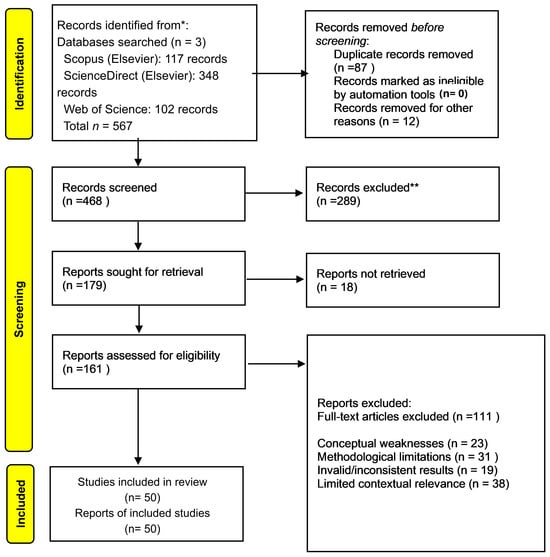
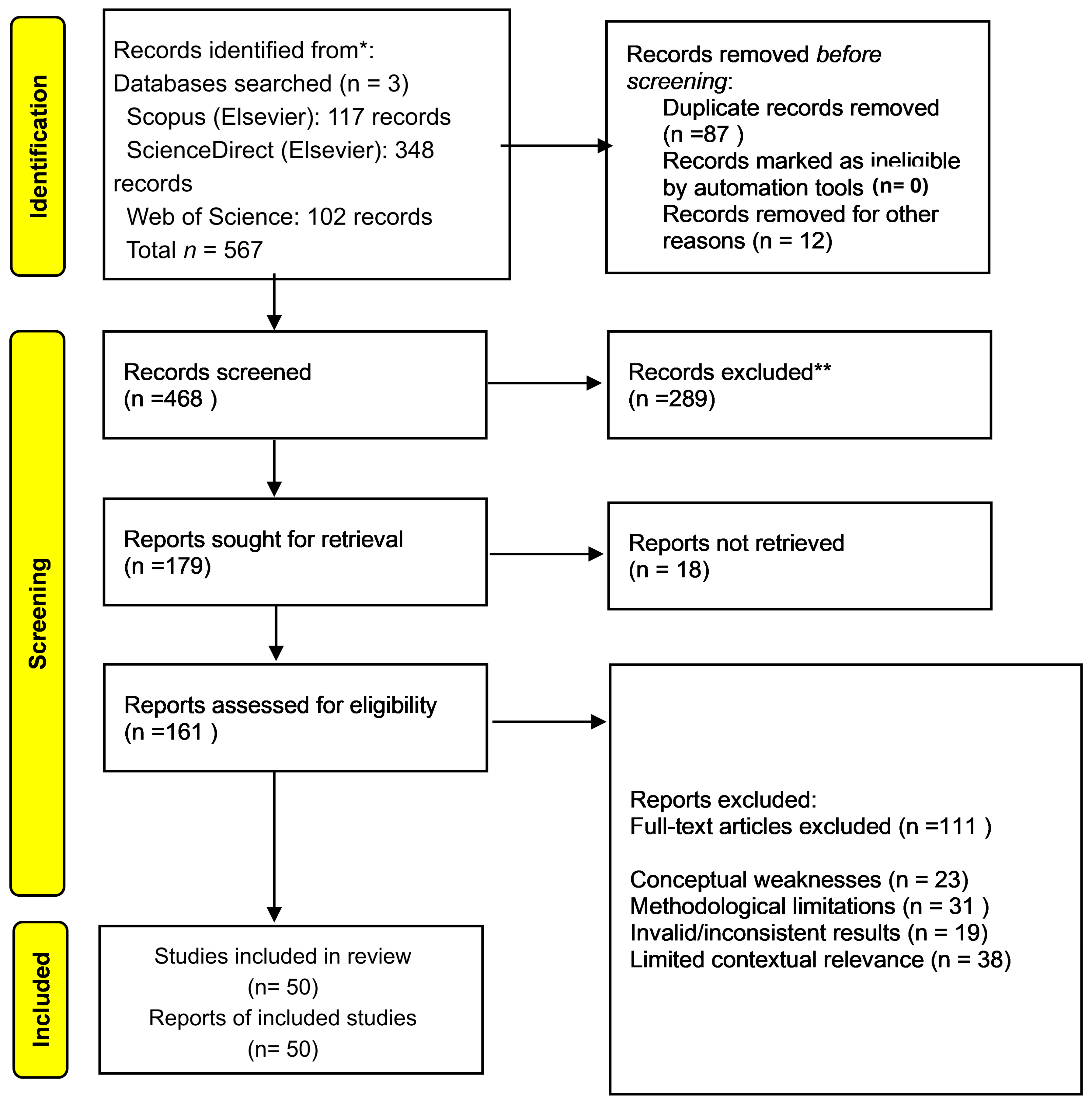
In the second phase, records were eliminated according to their title and abstract. In this case, an assessment was performed to determine the thematic congruence of each record with the objectives of this systematic review. We only moved on to the next stage with records whose titles and abstracts made a clear connection between ESG measurement and disclosure frameworks from an accounting point of view. During this phase, a lot of records were thrown away because they did not meet the requirements for inclusion. Then, the full texts of the pre-selected studies were examined with particular care to verify compliance with the established eligibility criteria. The complete selection process is illustrated in Figure 1. The complete PRISMA 2020 reporting checklist, documenting adherence to each of the 27 items of the guideline, is provided in the Supplementary Materials (File S1).
Figure 1.
PRISMA 2020 flow diagram for the systematic review process. * Databases searched: Scopus (Elsevier), ScienceDirect (Elsevier), and Web of Science. ** Records excluded during title and abstract screening based on predefined eligibility criteria (thematic incongruence with ESG measurement/reporting frameworks from an accounting perspective).
2.7. Assessment of Quality and Methodological Robustness
We used a structured protocol to make sure that the studies that went into the final synthesis were of good quality. This way, only studies with good methods could be part of it. Established critical appraisal instruments (e.g., JBI Checklist, CASP, MMAT) were evaluated; however, these tools were initially developed for clinical and health sciences research, and their criteria are not directly relevant to studies investigating ESG frameworks within accounting scholarship. Because of this, a custom-made assessment protocol was made that follows the rules for how to do systematic reviews in management and social sciences. This is done when normal appraisal tools do not work (Tranfield et al., 2003; Massaro et al., 2016).
The protocol looked at each study in two ways:
Clarity of Ideas: High: There is clear theoretical positioning, well-defined constructs, and research goals that are directly related to ESG measurement or reporting. Moderate: There is a theoretical basis, but it is not fully developed, and some constructs are unclear. Low: There is no clear theoretical framework, and the constructs are either not defined or are inconsistent.
Methodological Consistency: High means that the research design is clearly explained and justified, the sample is big enough, the right analytical methods are used, and the results can be repeated. Moderate: The design has some small gaps; the sample is acceptable but has some problems; and the techniques are mostly appropriate. Low: The design is not well described, the sample is not big enough, or the techniques are not clear or appropriate.
The overall robustness came from the combination of both dimensions: high on both = high robustness; moderate on either = moderate robustness; and low on either = low robustness.
Two authors (F.S.F.A. and M.S.R.R.) did the assessment on their own. Each author independently assessed all fifty studies according to the established criteria. Structured discussions helped settle differences in classifications until everyone agreed.
It is important to note that this assessment instrument is an author-developed protocol specifically designed for this review. While grounded in established principles for conducting systematic reviews in the social sciences (Tranfield et al., 2003; Massaro et al., 2016), it has not been independently validated. Formal inter-rater reliability measures, such as Cohen’s Kappa coefficient, were not calculated. Instead, discrepancies between the two independent assessors (F.S.F.A. and M.S.R.R.) were resolved through structured discussion until consensus was reached. The authors acknowledge that this approach, while systematic, introduces an inherent degree of subjectivity into the quality assessment.
2.8. Data Extraction and Synthesis
In terms of the data extraction process, pertinent information was methodically gathered for the investigation’s objectives. In particular, the following information was taken from each article that was read: a bibliographic data from the source, including authors, year of publication, journal, and country of institutional affiliation; b theoretical or conceptual framework used; c methodological approach used; d ESG measurement frameworks analyzed or proposed; e ESG reporting frameworks analyzed; f main results obtained with respect to accounting for financial sustainability; and g limitations in the studies themselves recognized by the authors.
The synthesis of information derived from qualitative and comparative data, in accordance with the diversity of the studies and the objectives of the systematic review. This strategy actually helps find conceptual patterns, convergence, and divergence in the literature on ESG measurement and reporting frameworks. Qualitative synthesis is regarded as fundamental to the examination of the literature concerning theoretical and methodological deficiencies; consequently, it steers future research trajectories in accordance with Sustainable Development Goals (SDGs) and the evolving demands of the accounting framework for sustainability.
3. Results
3.1. Overview of Study Selection
The search protocol across Scopus, ScienceDirect, and Web of Science retrieved a combined total of 567 records (Scopus: n = 117; ScienceDirect: n = 348; Web of Science: n = 102). Prior to screening, 87 duplicate records were removed and 12 additional records were excluded for other reasons, yielding 468 unique entries for title and abstract screening. Application of inclusion criteria resulted in 179 reports sought for retrieval, of which 18 could not be retrieved. Consequently, 161 full-text articles were assessed for eligibility. Following detailed assessment, 111 articles were excluded owing to conceptual weaknesses (n = 23), methodological limitations (n = 31), invalid or inconsistent results (n = 19), or limited contextual relevance (n = 38). The resulting corpus comprises 50 peer-reviewed articles published in indexed journals between 2020 and 2025. To address the three research objectives systematically, these studies were allocated according to their primary scholarly contribution: seventeen studies inform the framework classification analysis (Objective 1), seventeen studies contribute to the measurement and comparability assessment (Objective 2), and sixteen studies undergo methodological robustness evaluation (Objective 3).
3.2. Results Aligned with Objective 1: Classification of ESG Frameworks
The first goal was to look at and sort the most common ways to measure and report on ESG. Table 1 shows seventeen studies that make important contributions to our understanding of the theoretical foundations and typological differences between existing frameworks.
Table 1.
Classification of ESG frameworks by theoretical basis and type (n = 17).
Stakeholder Theory is the most important theoretical framework, supporting five studies (29.4%). Two studies (11.8%) are based on Institutional Theory, while the other studies use different ideas, like Circular Economy principles, Asset Pricing Theory, and Accountability frameworks. This distribution highlights the prevailing shift towards multi-stakeholder perspectives in ESG scholarship, surpassing narrow shareholder-centric frameworks.
Reporting frameworks (n = 10, 58.8%) make up the biggest group, followed by Measurement frameworks (n = 4, 23.5%) and Integrated approaches (n = 3, 17.6%). The rise in studies that focus on reporting reflects growing scholarly attention to the standardisation of disclosures. This is especially true now that there have been recent regulatory changes like the European Sustainability Reporting Standards and the Corporate Sustainability Reporting Directive.
The overwhelming majority of studies address all three ESG dimensions simultaneously (n = 16, 94.1%), and only one study looks at environmental and social aspects alone. The coverage is for Europe, Asia, and the whole world. Growing attention is being directed towards small and medium-sized enterprises.
3.3. Results Aligned with Objective 2: Measurement, Reporting, and Comparability
The second objective examined how identified frameworks operationalise ESG measurement and achieve comparability. Table 2 synthesises findings from seventeen studies that advance understanding of metrics, accounting treatments, and standardisation outcomes.
Table 2.
ESG measurement, reporting, and comparability analysis (n = 17).
The metrics used in these studies are very different from each other. The most common way to rate ESG is through specialized agencies (n = 6, 35.3%). This is followed by environmental indicators like greenhouse gas emissions (n = 4, 23.5%), composite indices (n = 4, 23.5%), and disclosure-based measures (n = 3, 17.6%). Emerging methods, such as natural language processing indices, reflect methodological innovation but impede cross-study synthesis from different studies.
In the Objective 2 subsample (n = 17), the predominant accounting approaches are Integrated methods that amalgamate financial and non-financial data (n = 7, 41.2%), succeeded by exclusively Non-financial treatments (n = 6, 35.3%) and traditional Financial approaches (n = 4, 23.5%). The fact that Integrated methods are becoming more popular reflects a growing recognition of the necessity of integrating ESG data with financial reporting systems in order to be more useful for making capital allocation decisions.
Levels of standardisation vary considerably. A total of 29.4% of studies (n = 5) have a high level of alignment with established frameworks, 52.9% (n = 9) have a medium level of alignment, and 17.6% (n = 3) have a low level of alignment. Achieved comparability, therefore, varies from high (n = 7, 41.2%) to moderate (n = 7, 41.2%) to limited (n = 3, 17.6%). Research utilizing CDP protocols or recognized GHG measurement standards exhibit enhanced comparability results.
3.4. Results Aligned with Objective 3: Robustness and Evidence Gaps
The third goal was to find theoretical, methodological, and empirical gaps and to judge how strong the study was. Table 3 shows the quality ratings for sixteen studies that were looked at based on how clear their concepts were, how consistent their methods were, and how rigorous they were overall.
Table 3.
Methodological robustness assessment of included studies (n = 16).
A significant degree of conceptual clarity characterizes the majority of the reviewed studies (n = 13, 81.3%). This is evidenced by precise definitions of constructs, distinct theoretical frameworks, and unambiguous research inquiries. Three studies (18.8%) demonstrate moderate clarity, primarily relying on implicit rather than explicit theoretical frameworks.
There is more variation in methodological consistency. Ten studies (62.5%) are very consistent because they use strict designs, big enough samples, and the right analytical methods, like advanced econometric methods. Five studies (31.3%) demonstrate moderate consistency with particular shortcomings, while one study (6.3%) employing case study methodology indicates constraints in generalizability.
The combined assessment yields the following distribution: high robustness (n = 10, 62.5%), moderate robustness (n = 5, 31.3%), and low robustness (n = 1, 6.3%). Highly regarded studies amalgamate robust theoretical frameworks with meticulous empirical execution and dissemination in esteemed peer-reviewed journals.
Recurrent limitations delineate avenues for future inquiry. Geographical specificity constrains generalizability within Chinese, Asian, UK, and European contexts. The concentration of studies in the banking and insurance sectors constrains the applicability of findings to other industries to use the same tools. The methodological innovation, particularly regarding proxy measures and tailored indices, necessitates replication and validation.
A review of the fifty-article corpus reveals several overarching patterns. In theory, views that focus on stakeholders are the most common. Most scholars agree that ESG frameworks need to work for more than just shareholders. Institutionalist accounts are gaining traction as they illustrate the influence of regulatory and normative pressures on corporate information disclosure.
The distribution of frameworks throughout the entire corpus (n = 50) indicates that reporting methods have emerged as the predominant approach, reflecting the influence of new regulatory standards. Measurement frameworks, conversely, offer an alternative perspective on the same issue. Integrated approaches that link financial and sustainability information are theoretically appealing; however, only a limited number of current studies indicate that this remains an aspiration rather than a reality.
Methodological heterogeneity remains a salient characteristic. Metrics include everything from scores from private rating agencies to standardized emission inventories to custom indexes. Comparability is positively associated with the adoption of established protocols; however, novel approaches, while beneficial for context-specific insights, hinder synthesis and benchmarking.
Quality assessment shows that the corpus is a good place to start for evidence synthesis, since approximately two-thirds of studies attained high robustness ratings. Nonetheless, the recognized limitations—geographical concentration, sectoral specificity, and methodological novelty—constrain generalizability and indicate priorities for future research initiatives.
4. Discussion
This section analyzes the findings using methodological triangulation, comparing results across the three research objectives and placing them within the larger academic conversation about ESG measurement and reporting frameworks.
4.1. Theoretical Foundations and Framework Typology
Stakeholder Theory is the predominant framework employed in studies utilizing formal theoretical constructs. It serves as the foundation for five of the seventeen classified studies (29.4%), corroborating the trends identified by Khamisu and Paluri (2024) in their comprehensive review of ESG research trends. This perspective reflects a paradigm shift away from shareholder primacy to one that recognizes that working with many groups is necessary to create long-term value. The finding aligns with Fatimah et al. (2023), who demonstrated that circular economy frameworks require stakeholder integration across supply chains. The corpus includes research employing analytical frameworks (TCCM in Khamisu & Paluri, 2024), methodological orientations (bibliometric analysis in Wan et al., 2023), and expansive conceptual paradigms (Circular Economy in Fatimah et al., 2023). This illustrates the extensive variety of methodologies employed in contemporary ESG research.
In the Objective 1 subsample, Institutional Theory emerges as a secondary yet significant framework, especially notable in studies examining regulatory environments. Shen et al. (2023) and Rahi et al. (2021) apply institutionalist frameworks to clarify cross-national variations in ESG adoption, while Xue et al. (2023) utilizes this framework to investigate the influence of governmental reforms on corporate environmental performance. The fact that all of these studies point to the same thing shows that both normative and coercive pressures have a big effect on how people use frameworks.
The distribution of framework types shows that Reporting frameworks are the most common type among the Objective 1 subsample (n = 10, 58.8%). This substantially exceeds Measurement approaches (n = 4, 23.5%) and Integrated frameworks (n = 3, 17.6%). Petronela Alice et al. (2025) on CSRD implementation and Suta et al. (2025) on ESRS adoption in Central and Eastern Europe demonstrate the increasing influence of regulatory frameworks. These studies have heightened scholarly interest in the standardisation of disclosure and reporting practices. The rise of integrated frameworks, even if they do not represent everyone, shows that more people are starting to realize that financial and non-financial information need to be systematically connected, as Mans-Kemp and van der Lugt (2020) suggested in the South African context.
This systematic review is starting to show that the corpus reveals not merely competing perspectives but a complementary structure in which distinct theoretical lenses address different but related aspects of the ESG-accounting relationship. Stakeholder Theory and Accountability Theory furnish the fundamental ethical rationale for the integration of ESG: corporate sustainability accountability must extend beyond shareholders to encompass the interests of all groups impacted by the company’s actions (Suta et al., 2025; Govindan et al., 2021; Camilleri, 2025). Institutional Theory and Regulatory Theory explain how this moral duty is carried out at the level of institutions. For instance, coercive pressures from regulators (Petronela Alice et al., 2025), mimetic isomorphism across industries (Shen et al., 2023), and normative expectations from professional bodies (Rahi et al., 2021) all push companies toward standardized reporting frameworks like ISSB and ESRS. Asset Pricing Theory shows that ESG performance affects financial results at the market level. This confirms that non-financial factors materially influence risk assessment, cost of capital, and firm valuation (Ciciretti et al., 2023; Al-Fakir Al Rabab’a et al., 2024; Di Tommaso & Mazzuca, 2023). This three-level structure—normative foundations, institutional mechanisms, and market integration—corresponds to the three framework typologies outlined in this review: Measurement frameworks make the market level work by turning ESG performance into numbers that investors care about. Reporting frameworks adapt to institutional pressures by organizing disclosure in accordance with novel standards. Integrated approaches represent the forefront of innovation, where normative, institutional, and market dimensions converge in cohesive accounting systems capable of capturing both financial and non-financial value creation (Mans-Kemp & van der Lugt, 2020; Bocken & Short, 2021). The progressive transition from standalone measurement to integrated reporting is not linear. Instead, it is a dynamic interaction between theoretical forces that shape the path from ESG awareness to financial sustainability. This implies that an organisation can sustain long-term financial viability by effectively including environmental, social, and governance factors in its financial strategy, risk management, and reporting. The integrative alignment between theoretical lenses, ESG functions, and accounting implications is summarised in Table 4.
Table 4.
Integrative conceptual alignment: Theoretical foundations, ESG functions, and accounting implications.
4.2. Measurement Heterogeneity and Comparability Challenges
The significant disparities in metrics employed in the Objective 2 subsample (n = 17) indicate that standardization remains an issue in the field. Triangulation among these studies reveals a fundamental tension: proprietary ESG ratings from agencies examined by Ciciretti et al. (2023) and Mandas et al. (2023) enable cross-sectional comparison but are impeded by methodological opacity, while customized indices developed by Sebestyén et al. (2024) and Lagasio (2024) offer context-specific validity at the expense of generalizability.
Research adhering to established protocols allows for superior comparability of results. Gaganis et al. (2023) and Al-Fakir Al Rabab’a et al. (2024) employ the GHG Protocol to enhance the comparability of their findings. Cohen et al. (2023) employs CDP’s standard disclosure framework to enhance the comparability of their work. On the other hand, new methods like Lagasio’s (2024) NLP-based greenwashing detection and Fan et al.’s (2024) machine learning methodology represent methodological innovations that nonetheless require validation prior to enabling meaningful cross-study synthesis.
The division of accounting methods in the Objective 2 subsample—Integrated (n = 7, 41.2%), Non-financial (n = 6, 35.3%), and Financial (n = 4, 23.5%)—demonstrates that the complete integration of ESG information into financial reporting systems remains an objective. Di Martino et al. (2024) and Ielasi et al. (2023) demonstrate the applicability of integrated approaches within the banking sector; however, their singular focus on this domain complicates the extrapolation of findings to other sectors. The ongoing reliance on exclusively non-financial treatments, as evidenced by Rossi and Candio (2023) and Nicolò et al. (2024), signifies the persistence of conceptual and practical barriers to integration, despite regulatory incentives.
4.3. Methodological Robustness and Evidence Gaps
The robustness test of the Objective 3 subsample (n = 16) shows that the corpus is a good place to find evidence synthesis because most of the studies have clear ideas and methods that are the same. Highly robust studies share several characteristics: they have clear theoretical positions, strict research designs, and enough samples. Islam et al. (2025), Cambrea et al. (2024), and Zhang et al. (2025) exemplify a trend that integrates robust theoretical frameworks with sophisticated econometric techniques.
A comprehensive examination of governance-related research within the corpus reveals a significant analytical emphasis on structural governance dimensions, particularly board composition and executive characteristics (Gull et al., 2023; Develay & Virk, 2024; Buchetti et al., 2025; Cambrea et al., 2024). Governance measurement can be disaggregated into three dimensions to make sense of this pattern.
Who is on the board, who owns the company, and how independent the executives are all comprise examples of structural governance. This is the most important dimension in the corpus. This predominance likely reflects the accessibility and measurability of publicly available data (like board size, gender ratios, and CEO tenure), which makes it easier to compare data from different countries.
Process governance encompasses internal controls, assurance mechanisms, frameworks for ethical compliance, and ways to get stakeholders involved. Only Alkaraan et al. (2023) and Shen et al. (2023) address these dimensions in the reviewed corpus. This reflects the inherent difficulty of applying standardised metrics to qualitative and organization-specific processes.
Outcome governance is about how well leaders are held accountable to stakeholders, how well risk management works, and how decisions about governance affect how well an organization does its job. Among the few studies addressing this domain is that of Wattanatorn and Jantarakolica (2025), and it looks at the risk of corporate crashes and legal enforcement.
This focus demonstrates a structural bias in the measurement of ESG governance: unlike environmental metrics, which have standardized methods for quantifying emissions, energy consumption, and waste (such as the GHG Protocol and CDP frameworks), governance processes and outcomes are challenging to quantify due to their qualitative, context-dependent, and organization-specific nature. This is why the “G” part of ESG frameworks is still the least developed. The metrics predominantly capture formal structures rather than the effectiveness or outcomes of governance practices or what they actually do.
Geographical concentration is always a problem that makes external validity less reliable. Most of the studies focus on European contexts (Di Tommaso & Mazzuca, 2023; Cambrea et al., 2024), Chinese markets (Chi et al., 2023; Xue et al., 2023), and developed economies overall. For example, Shen et al. (2023) did research in China and Mans-Kemp and van der Lugt (2020) did research in South Africa. These are just a few examples of places where research can be done. Nevertheless, emerging markets and developing economies remain substantially underrepresented and developing economies.
4.4. Implications for Theory, Practice, and Policy
The results show that accounting research must advance beyond the application of existing frameworks toward the development of new theoretical constructs that can explain the many different aspects of ESG. Based on their theoretical foundations, this review has led to the creation of a classification scheme that separates Measurement, Reporting, and Integrated approaches. This plan will help put future research in order.
The synthesis underscores a clear imperative for practitioners to develop new competencies. The growing demand for integrated reporting, as shown in the literature, especially by Camilleri (2025) in hospitality and Govindan et al. (2021) in logistics, demands that accounting professionals acquire additional competencies, including proficiency in non-financial metrics and sustainability frameworks. The SME-focused studies by Tsang et al. (2023) and Ortiz-Martínez et al. (2023) indicate that these competencies must extend beyond large publicly traded corporations.
The insufficient representation of small and medium-sized enterprises (SMEs) in the examined corpus requires additional scrutiny. Only Tsang et al. (2023) and Ortiz-Martínez et al. (2023) address SME contexts directly, which is problematic given that SMEs constitute the majority of global enterprises. The literature identifies three structural factors that elucidate this underrepresentation. The study looked at the main ESG reporting frameworks, like GRI, SASB, ISSB, and ESRS. These were designed for large listed corporations and are consequently ill-suited with how SMEs do things or the reports they can make. Second, SMEs often lack the specialized expertise and data systems required for systematic ESG measurement and reporting as evidenced by Tsang et al. (2023) in the context of small and medium-sized logistics companies. Third, mandatory ESG reporting requirements mostly apply to big companies, thereby reducing the incentive for SME engagement. This means that there is less real-world data that can be used for academic research. These factors indicate that the scarcity of ESG research on SMEs is not merely an oversight, but a sign of deeper problems that need specific changes to the framework and policy action.
Islam et al. (2025) say that the ongoing problems with comparability in different studies support the work of groups like the ISSB to bring standards closer together. However, the institutional factors that Wattanatorn and Jantarakolica (2025) found to be important for legal enforcement and Zhang et al. (2025) found to be important for market competitiveness demonstrate that uniform standards must be adapted to local institutional contexts to achieve the intended outcomes.
The results of this review show that ESG frameworks support financial sustainability in three main ways, as shown in the analyzed corpus: (a) risk mitigation, where carbon performance metrics and ESG ratings help organizations identify and manage financially material risks (Al-Fakir Al Rabab’a et al., 2024; Quang Trinh et al., 2023; Di Tommaso & Mazzuca, 2023); (b) stakeholder value creation, through integrated reporting that builds investor confidence and stakeholder trust (Mans-Kemp & van der Lugt, 2020; Camilleri, 2025; Govindan et al., 2021); and (c) regulatory compliance, as alignment with emerging standards (ISSB, ESRS) mitigates institutional risks and enhances market legitimacy (Petronela Alice et al., 2025; Suta et al., 2025; Shen et al., 2023).
4.5. Limitations
The time limit of 2020–2025 is based on the post-regulatory consolidation phase described by Wan et al. (2023) and Buchetti et al. (2025), but excludes significant antecedent contributions that would enrich the historical contextualisation. Future reviews encompassing a broader temporal range, like 2010 to 2025, would add to this analysis by showing how voluntary ESG initiatives have changed over time into mandatory reporting systems. The fact that the studies included are so different from each other, from quantitative empirical work like Ciciretti et al. (2023) to conceptual contributions like Bocken and Short (2021), precludes meta-analytical synthesis. Even though the robustness assessments are systematic, judgements in these assessments may be influenced by evaluator subjectivity. The links between framework type, theoretical basis, and robustness that have been seen need to be confirmed through more empirical research. These limitations define the extent of contributions while directing the correct interpretation of results. The quality assessment utilized author-developed criteria instead of a validated standardized instrument. This method is methodologically sound because clinical appraisal tools cannot be used for accounting-ESG research, but it could make the evaluator’s opinion more subjective. Additionally, formal inter-rater reliability metrics, such as Cohen’s Kappa, were not calculated. Also, this review used a qualitative synthesis approach. Future research could use bibliometric or network analyses to better understand co-citation patterns, keyword evolution, and collaborative networks in the ESG accounting literature.
A key methodological limitation is that the quality assessment relied on an author-developed instrument rather than on a validated standardized tool. Although methodologically justified—given the inapplicability of clinical appraisal instruments to accounting-ESG research—it inherently increases evaluator subjectivity. Furthermore, no formal inter-rater reliability metric, such as Cohen’s Kappa, was computed. Future systematic reviews should prioritize the development and validation of domain-specific appraisal instruments and incorporate quantitative inter-rater agreement measures.
Future systematic reviews should think about making and testing domain-specific appraisal tools for ESG accounting research.
5. Conclusions
This systematic review analyzed ESG measurement and reporting frameworks through an accounting lens, evaluating fifty peer-reviewed articles published from 2020 to 2025. The synthesis tackled three research goals: classifying frameworks, assessing measurement comparability, and evaluating methodological robustness.
In the realm of framework classification, stakeholder-oriented theories prevail in contemporary scholarship, indicating a consensus that corporate sustainability accountability transcends shareholders to include employees, communities, and environmental systems. Reporting frameworks have attracted attention commensurate with measurement approaches, which reflect a scholarly transition from metric development toward practical standardisation concerns. Integrated frameworks that merge financial and non-financial data are still not widely used, even though they are conceptually appealing.
The measurement and comparability analysis shows that persistent heterogeneity constitutes the field’s most salient challenge. Studies utilizing established protocols attain enhanced comparability, whereas proprietary ratings and customized indices, although beneficial for particular objectives, hinder cross-study synthesis. The environmental aspect gets too much attention compared to the social and governance aspects, with the latter being especially underdeveloped outside of narrow studies of board composition.
Methodological assessment shows that the majority of reviewed studies meet acceptable quality standards, which means that they provide a good basis for evidence-based practice. However, the geographical concentration in developed economies and the sectoral focus on large publicly traded companies limit external validity. Small and medium-sized businesses are still not well represented, even though they are important to the economy.
This synthesis leads to three main conclusions. First, theoretical progress necessitates frameworks that can incorporate the multidimensional aspects of ESG, rather than considering environmental, social, and governance factors as separate entities. Second, improvements in comparability depend on finding a balance between the benefits of standardization and the validity of measurements that are specific to a certain situation. Third, the governance aspect necessitates significantly increased academic focus to attain equivalence with environmental and social research domains.
The findings suggest that professional competencies in accounting must broaden to include sustainability frameworks and non-financial metrics. The evidence supports convergence efforts for regulators, but it also warns that uniform standards need to be adapted to fit different situations. The gaps that were found—governance measurement, SME contexts, emerging markets, and longitudinal designs—set the stage for future research in these areas.
The field is at a turning point. Investor demand, regulatory pressure, and social expectations are all coming together to make ESG reporting a requirement for businesses. It is still unclear if the current frameworks are good enough for this job. This review provides a systematic evaluation of current knowledge and delineates pathways through which academic inquiry can facilitate the transition to financially sustainable enterprises.
Supplementary Materials
The following supporting information can be downloaded at https://www.mdpi.com/article/10.3390/jrfm19050309/s1: File S1: The PRISMA Checklist.
Author Contributions
Conceptualization, J.K.F.S.; methodology, J.K.F.S. and M.S.R.R.; software, C.E.A.E.; validation, C.E.A.E.; formal analysis, F.S.F.A.; investigation, J.K.F.S.; resources, M.d.M.C.G.; data curation, C.E.A.E.; writing—original draft preparation, M.d.M.C.G.; writing—review and editing, M.d.M.C.G. and M.S.R.R.; visualization, F.S.F.A.; supervision, F.S.F.A.; project administration, M.S.R.R. All authors have read and agreed to the published version of the manuscript.
Funding
This research has not received external funding.
Institutional Review Board Statement
Not applicable.
Informed Consent Statement
Not applicable.
Data Availability Statement
The original contributions presented in this study are included in the article/Supplementary Material. Further inquiries can be directed to the corresponding author.
Conflicts of Interest
The authors declare that they have no conflicts of interest.
References
- Alessi, L., Ossola, E., & Panzica, R. (2021). What greenium matters in the stock market? The role of greenhouse gas emissions and environmental disclosures. Journal of Financial Stability, 54, 100869. [Google Scholar] [CrossRef] [Scilit]
- Al-Fakir Al Rabab’a, E., Rashid, A., Shams, S., & Bose, S. (2024). Corporate carbon performance and firm risk: Evidence from Asia-Pacific countries. Journal of Contemporary Accounting & Economics, 20(2), 100427. [Google Scholar] [CrossRef] [Scilit]
- Alkaraan, F., Elmarzouky, M., Hussainey, K., & Venkatesh, V. G. (2023). Sustainable strategic investment decision-making practices in UK companies: The influence of governance mechanisms on synergy between industry 4.0 and circular economy. Technological Forecasting and Social Change, 187, 122187. [Google Scholar] [CrossRef] [Scilit]
- Almaqtari, F. A., Elsheikh, T., Al-Hattami, H. M., & Mishra, N. (2023). The impact of board characteristics on environmentally friendly production: A cross country study in Asia and Europe. Journal of Cleaner Production, 392, 136257. [Google Scholar] [CrossRef] [Scilit]
- Bocken, N. M. P., & Short, S. W. (2021). Unsustainable business models—Recognising and resolving institutionalised social and environmental harm. Journal of Cleaner Production, 312, 127828. [Google Scholar] [CrossRef] [Scilit]
- Buchetti, B., Arduino, F. R., & Perdichizzi, S. (2025). A literature review on corporate governance and ESG research: Emerging trends and future directions. International Review of Financial Analysis, 97, 103759. [Google Scholar] [CrossRef] [Scilit]
- Cambrea, D. R., Quarato, F., D’Allura, G. M., & Paolone, F. (2024). Driving ESG performance: CEO succession impact in European listed firms. Management Decision, 63(2), 512–530. [Google Scholar] [CrossRef] [Scilit]
- Camilleri, M. A. (2025). Sustainability accounting and disclosures of responsible restaurant practices in environmental, social and governance (ESG) reports. International Journal of Hospitality Management, 126, 104051. [Google Scholar] [CrossRef] [Scilit]
- Chi, Y., Yang, Y., & Huang, W. (2023). Green leading institutions and corporate green innovation: Legitimacy or efficiency? Borsa Istanbul Review, 23(6), 1414–1429. [Google Scholar] [CrossRef] [Scilit]
- Ciciretti, R., Dalò, A., & Dam, L. (2023). The contributions of betas versus characteristics to the ESG premium. Journal of Empirical Finance, 71, 104–124. [Google Scholar] [CrossRef] [Scilit]
- Cohen, S., Kadach, I., & Ormazabal, G. (2023). Institutional investors, climate disclosure, and carbon emissions. Journal of Accounting and Economics, 76, 101640. [Google Scholar] [CrossRef] [Scilit]
- Del Gesso, C. (2025). Tracing the evolutionary path of visual disclosure research in corporate reporting: A longitudinal coword analysis and study agenda. Management Research Review, 48(13), 45–84. [Google Scholar] [CrossRef] [Scilit]
- Develay, E., & Virk, N. S. (2024). The effect of co-opted boards on corporate carbon performance: Evidence from financially material industries. Economics Letters, 243, 111910. [Google Scholar] [CrossRef] [Scilit]
- Di Martino, G., Miglietta, F., & Potì, V. (2024). The impact of ESG scores on the value relevance of fair value hierarchy of financial instruments: Evidence from European Banks. Research in International Business and Finance, 71, 102451. [Google Scholar] [CrossRef] [Scilit]
- Diófási-Kovács, O., & Nagy, J. (2023). Beyond CO2 emissions—The role of digitalization in multi-dimensional environmental performance measurement. Environmental and Sustainability Indicators, 18, 100252. [Google Scholar] [CrossRef] [Scilit]
- Di Tommaso, C., & Mazzuca, M. (2023). The stock price of European insurance companies: What is the role of ESG factors? Finance Research Letters, 56, 104071. [Google Scholar] [CrossRef] [Scilit]
- Ergen Keleş, F. H., Keleş, E., & Schlegelmilch, B. B. (2023). Corporate social responsibility news and stock performance: A systematic literature review. Borsa Istanbul Review, 23(2), 443–463. [Google Scholar] [CrossRef] [Scilit]
- Fan, S., Kong, D., Lu, J., & Yu, H. (2024). Does investor communication improve corporate social responsibility? A machine learning-based textual analysis. China Journal of Accounting Research, 17(3), 100370. [Google Scholar] [CrossRef] [Scilit]
- Fatimah, Y. A., Kannan, D., Govindan, K., & Hasibuan, Z. A. (2023). Circular economy e-business model portfolio development for e-business applications: Impacts on ESG and sustainability performance. Journal of Cleaner Production, 415, 137528. [Google Scholar] [CrossRef] [Scilit]
- Freeman, R. E. (1984). Strategic management: A stakeholder approach. Pitman Publishing. [Google Scholar]
- Gaganis, C., Galariotis, E., Pasiouras, F., & Tasiou, M. (2023). Managerial ability and corporate greenhouse gas emissions. Journal of Economic Behavior & Organization, 212, 438–453. [Google Scholar] [CrossRef] [Scilit]
- Govindan, K., Kilic, M., Uyar, A., & Karaman, A. S. (2021). Drivers and value-relevance of CSR performance in the logistics sector: A cross-country firm-level investigation. International Journal of Production Economics, 231, 107835. [Google Scholar] [CrossRef] [Scilit]
- Gull, A. A., Atif, M., & Hussain, N. (2023). Board gender composition and waste management: Cross-country evidence. The British Accounting Review, 55(1), 101097. [Google Scholar] [CrossRef] [Scilit]
- Ibáñez-Forés, V., Martínez-Sánchez, V., Valls-Val, K., & Bovea, M. D. (2023). How do organisations communicate aspects related to their social performance? A proposed set of indicators and metrics for sustainability reporting. Sustainable Production and Consumption, 35, 157–172. [Google Scholar] [CrossRef] [Scilit]
- Ielasi, F., Bellucci, M., Biggeri, M., & Ferrone, L. (2023). Measuring banks’ sustainability performances: The BESGI score. Environmental Impact Assessment Review, 102, 107184. [Google Scholar] [CrossRef] [Scilit]
- Islam, F., Bose, S., Ying, S. X., & Shams, S. (2025). From corporate emissions to financial statements: Understanding accounting conservatism in the wake of carbon risks. Journal of Contemporary Accounting & Economics, 21(3), 100500. [Google Scholar] [CrossRef] [Scilit]
- Khamisu, M. S., & Paluri, R. A. (2024). Emerging trends of environmental social and governance (ESG) disclosure research. Cleaner Production Letters, 7, 100079. [Google Scholar] [CrossRef] [Scilit]
- Kizys, R., Mamatzakis, E. C., & Tzouvanas, P. (2023). Does genetic diversity on corporate boards lead to improved environmental performance? Journal of International Financial Markets, Institutions and Money, 84, 101756. [Google Scholar] [CrossRef] [Scilit]
- Lagasio, V. (2024). ESG-washing detection in corporate sustainability reports. International Review of Financial Analysis, 96, 103742. [Google Scholar] [CrossRef] [Scilit]
- Liu, S., Jin, J., & Nainar, K. (2023). Does ESG performance reduce banks’ nonperforming loans? Finance Research Letters, 55, 103859. [Google Scholar] [CrossRef] [Scilit]
- Mandas, M., Lahmar, O., Piras, L., & De Lisa, R. (2023). ESG in the financial industry: What matters for rating analysts? Research in International Business and Finance, 66, 102045. [Google Scholar] [CrossRef] [Scilit]
- Mans-Kemp, N., & van der Lugt, C. T. (2020). Linking integrated reporting quality with sustainability performance and financial performance in South Africa. South African Journal of Economic and Management Sciences, 23(1), 11. [Google Scholar] [CrossRef] [Scilit]
- Martinez Meyers, S., Ferrero-Ferrero, I., & Muñoz-Torres, M. J. (2024). ARE sustainable funds doing the talk and the walk? An ESG score analysis of fund portfolio holdings. International Review of Economics & Finance, 93, 1526–1541. [Google Scholar] [CrossRef] [Scilit]
- Massaro, M., Dumay, J., & Guthrie, J. (2016). On the shoulders of giants: Undertaking a structured literature review in accounting. Accounting, Auditing & Accountability Journal, 29(5), 767–801. [Google Scholar] [CrossRef] [Scilit]
- Molnár, P., Suta, A., Lukács, B., & Tóth, Á. (2025). Linking sustainability reporting and energy use through global reporting initiative standards and sustainable development goals. Clean Technologies and Environmental Policy, 27(12), 8659–8667. [Google Scholar] [CrossRef] [Scilit]
- Nicolò, G., Zampone, G., Sannino, G., & Polcini, P. T. (2024). Sustainable development goals disclosure and analyst forecast quality. Journal of Applied Accounting Research, 26(6), 1–25. [Google Scholar] [CrossRef] [Scilit]
- Ortiz-Martínez, E., Marín-Hernández, S., & Santos-Jaén, J.-M. (2023). Sustainability, corporate social responsibility, non-financial reporting and company performance: Relationships and mediating effects in Spanish small and medium sized enterprises. Sustainable Production and Consumption, 35, 349–364. [Google Scholar] [CrossRef] [Scilit]
- Page, M. J., McKenzie, J. E., Bossuyt, P. M., Boutron, I., Hoffmann, T. C., Mulrow, C. D., Shamseer, L., Tetzlaff, J. M., Akl, E. A., Brennan, S. E., Chou, R., Glanville, J., Grimshaw, J. M., Hróbjartsson, A., Lalu, M. M., Li, T., Loder, E. W., Mayo-Wilson, E., McDonald, S., … Moher, D. (2021). The PRISMA 2020 statement: An updated guideline for reporting systematic reviews. BMJ, 372, n71. [Google Scholar] [CrossRef] [Scilit] [PubMed]
- Petronela Alice, G., Andreea Nicoleta, L., Florinel, G., Dan Marius, C., & Radu, V. (2025). Sustainable accounting under EU sustainability regulations: Comparative evidence from Romania and European case studies on CSRD implementation. Sustainability, 17(23), 10746. [Google Scholar] [CrossRef] [Scilit]
- Quang Trinh, V., Duong Cao, N., Li, T., & Elnahass, M. (2023). Social capital, trust, and bank tail risk: The value of ESG rating and the effects of crisis shocks. Journal of International Financial Markets, Institutions and Money, 83, 101740. [Google Scholar] [CrossRef] [Scilit]
- Rahi, A. F., Akter, R., & Johansson, J. (2021). Do sustainability practices influence financial performance? Evidence from the Nordic financial industry. Accounting Research Journal, 35(2), 292–314. [Google Scholar] [CrossRef] [Scilit]
- Rathobei, K. E., Ranängen, H., & Lindman, Å. (2024). Exploring broad value creation in mining—Corporate social responsibility and stakeholder management in practice. The Extractive Industries and Society, 17, 101412. [Google Scholar] [CrossRef] [Scilit]
- Rossi, P., & Candio, P. (2023). The independent and moderating role of choice of non-financial reporting format on forecast accuracy and ESG disclosure. Journal of Environmental Management, 345, 118891. [Google Scholar] [CrossRef] [Scilit]
- Sebestyén, V., Fejes, R., Tóth, E., Tóth-Nagy, G., & Kurdi, R. (2024). University of Pannonia sustainability index (UPSi) for corporate sustainability. Environmental and Sustainability Indicators, 22, 100349. [Google Scholar] [CrossRef] [Scilit]
- Shen, H., Lin, H., Han, W., & Wu, H. (2023). ESG in China: A review of practice and research, and future research avenues. China Journal of Accounting Research, 16(4), 100325. [Google Scholar] [CrossRef] [Scilit]
- Suta, A., Molnár, P., Limbach, Z., & Tóth, Á. (2025). Dictionary-based assessment of European Sustainability Reporting Standard (ESRS) disclosure topics. Discover Sustainability, 6(1), 146. [Google Scholar] [CrossRef] [Scilit]
- Tranfield, D., Denyer, D., & Smart, P. (2003). Towards a methodology for developing evidence-informed management knowledge by means of systematic review. British Journal of Management, 14(3), 207–222. [Google Scholar] [CrossRef] [Scilit]
- Trotta, A., Rania, F., & Strano, E. (2024). Exploring the linkages between FinTech and ESG: A bibliometric perspective. Research in International Business and Finance, 69, 102200. [Google Scholar] [CrossRef] [Scilit]
- Tsang, Y. P., Fan, Y., & Feng, Z. P. (2023). Bridging the gap: Building environmental, social and governance capabilities in small and medium logistics companies. Journal of Environmental Management, 338, 117758. [Google Scholar] [CrossRef] [Scilit]
- Wan, G., Dawod, A. Y., Chanaim, S., & Ramasamy, S. S. (2023). Hotspots and trends of environmental, social and governance (ESG) research: A bibliometric analysis. Data Science and Management, 6(2), 65–75. [Google Scholar] [CrossRef] [Scilit]
- Wattanatorn, W., & Jantarakolica, T. (2025). The moderating role of legal enforcement in ESG’s impact on corporate crash risk: Evidence from Asian stock market. Cleaner and Responsible Consumption, 16, 100259. [Google Scholar] [CrossRef] [Scilit]
- Xue, Q., Wang, H., Ji, X., & Wei, J. (2023). Local government centralization and corporate ESG performance: Evidence from China’s county-to-district reform. China Journal of Accounting Research, 16(3), 100314. [Google Scholar] [CrossRef] [Scilit]
- Zampone, G., Nicolò, G., Sannino, G., & De Iorio, S. (2022). Gender diversity and SDG disclosure: The mediating role of the sustainability committee. Journal of Applied Accounting Research, 25(1), 171–193. [Google Scholar] [CrossRef] [Scilit]
- Zhang, T., Qin, C., & Lu, Z. (2025). Market competitiveness and corporate ESG performance. International Review of Economics & Finance, 101, 104201. [Google Scholar] [CrossRef] [Scilit]

Disclaimer/Publisher’s Note: The statements, opinions and data contained in all publications are solely those of the individual author(s) and contributor(s) and not of MDPI and/or the editor(s). MDPI and/or the editor(s) disclaim responsibility for any injury to people or property resulting from any ideas, methods, instructions or products referred to in the content. |
© 2026 by the authors. Licensee MDPI, Basel, Switzerland. This article is an open access article distributed under the terms and conditions of the Creative Commons Attribution (CC BY) license.