


Abstract
This paper estimates how corporate innovation investment responds to climate policy uncertainty using panel data with 3197 listed firms from 2010 to 2022 in China. The findings show that climate policy uncertainty positively contributes to corporate innovation investment, and this result continues to hold after controlling for endogeneity and conducting a series of robustness tests. Furthermore, we find that stringent government environmental regulation serves as a potential mechanism, compelling firms to adopt cleaner production and increase their investment in innovation. Additionally, this positive relationship is stronger for firms with higher government subsidies and disappears for firms with a higher allocation of fixed assets. We also find that firms with fewer connections to the government are more sensitive to climate policy uncertainty and they tend to increase their investment in innovation to mitigate the uncertainty. Furthermore, when firms invest more in innovation during periods of high policy uncertainty, their long-term performance and firm value are likely to improve. This study sheds light on the importance and influence of climate policy uncertainty on corporate innovation investment in China.
Keywords:
climate policy uncertainty; corporate innovation investment; stringent government environmental regulation; China JEL Classification:
G18; D80; O31; O32
1. Introduction
In recent decades, extreme weather changes and abnormal climate events, such as global warming, rising sea levels, cyclones, and forest fires, have become increasingly severe and posed unprecedented challenges to global sustainability, prompting governments worldwide to adopt diverse policy measures aimed at mitigating greenhouse gas emissions and promoting sustainable practices1. Particularly, since the signing of the 2015 Paris Agreement, an increasing number of countries have transformed their development strategies and implemented a series of climate policies, committed to reducing emissions voluntarily, and realizing the common vision of creating a “zero-carbon society” with “net zero emissions”. However, these policies associated with climate change vary over time, and future government policies are largely unpredictable and change with political turnover and shifting policy preferences (Lee & Cho, 2023; Zhu et al., 2023). For example, Trump’s decision to withdraw from the Paris Agreement increased the degree of uncertainty of climate policies (J. Liu et al., 2024b).
With climate policy uncertainty now being quantified at the aggregate level, its impact is being increasingly examined in various studies (D. Bai et al., 2023; Lee & Cho, 2023; X. Xu et al., 2023). For corporations, navigating this uncertainty is crucial for their overall innovation investment decisions, as such investments are essential for advancing green economy development, meeting sustainable development conditions, and addressing climate policy uncertainties (D. Bai et al., 2023). In addition, it is also an important investment for the firm to advance technological solutions that drive economic growth, improve efficiency, and address various market demands (Kemp & Pontoglio, 2011). Thus, the purpose of this study is to examine how climate policy uncertainty affects innovation investment in Chinese listed firms.
Our study is motivated by two strands of research on the impact of uncertainty on corporate investment. The policy uncertainty hypothesis suggests that uncertainty in policies harms innovation. Models by Chen and Funke (2003), Bloom et al. (2007), and Bloom et al. (2016) show that when investments cannot be easily undone, companies delay investing during uncertain times, as waiting becomes more valuable. Linking these findings to the nature of innovation, it is evident that, unlike traditional investments in tangible assets like capital expenditures, innovation represents long-term, intangible assets intended to generate future profits, and requires a longer time horizon and carries higher tail risk (J. Liu et al., 2024a). The option to wait is particularly significant for investments in research and development (R&D), given that innovation involves exploring unknown approaches and untested methods, requiring substantial investment in intangible assets (Ferreira et al., 2014). This aligns with the real option theory (Myers, 1977), which suggests that firms delay investment under uncertainty to avoid costly mistakes and await clearer information (Atanassov et al., 2015; Bloom et al., 2018). Thus, policy uncertainty likely hinders innovation by increasing the value of waiting.
However, strategic growth option theory suggests that enterprises may act immediately to invest in innovation activities to secure their market share when they face uncertainty (Kulatilaka & Perotti, 1998; Tajaddini & Gholipour, 2021). Bar-Ilan and Strange (1996) suggest that R&D investments tend to increase with uncertainty, as the step-by-step nature of R&D allows firms to make incremental decisions about further investments. This process enables firms to abandon unfavorable projects and continue with those showing promise. It is similar to Weeds (2002), who finds that uncertainty may promote investment in valuable growth opportunities to gain a competitive advantage. Additionally, uncertainty can stimulate innovation investment by encouraging firms to develop technologies that align with future regulatory requirements or emerging market opportunities, as highlighted by Kulatilaka and Perotti (1998), and Tajaddini and Gholipour (2021).
Recent studies indicate that firms may adjust their corporate innovation strategies in response to high levels of climate policy uncertainty (CPU). For instance, Hoang (2022) demonstrates that in the U.S. market, climate policy uncertainty (CPU) significantly reduces R&D investment among heavy emitters. The evidence suggests that heavy emitters adopt a “wait-and-see” strategy, delaying innovation decisions until environmental policies become clearer. In addition, Farooq et al. (2024) reveal a significant negative effect of CPU on both R&D expenditures and patent applications (PTA) in the US. They argue that a high CPU introduces hesitancy and risk aversion, impacting resource allocation, market confidence, and firms’ willingness to pursue innovation. These findings highlight the importance of a clear and supportive policy environment and ample resources for fostering innovation.
Moreover, out of the existing research focusing on Chinese listed firms’ innovation strategies in response to CPU, a vast majority of them rely on US-based CPU measures, and they yield mixed results. For example, Niu et al. (2023) find that CPU negatively impacts green innovation, with this effect mediated by firms’ R&D investment and risk tolerance. Similarly, W. Huang (2023) indicates that climate policy uncertainty is negatively associated with firms’ green patenting activities. In contrast, D. Bai et al. (2023) argue that climate policy uncertainty can lead to stricter regional environmental regulations and higher levels of R&D investment by firms, ultimately boosting innovation. Likewise, Zhu et al. (2023) find a positive correlation between CPU and corporate innovation investment, indicating that government environmental regulations and optimistic market expectations drive firms to adopt cleaner production and transition to green development models. Finally, Y. Liu et al. (2024) examine the relationship between Chinese climate policy uncertainty (CPU) and corporate innovation outputs among Chinese listed firms, revealing a positive relationship. However, Y. Liu et al. (2024) constructs the Chinese CPU index primarily using data from the China News Network and uses patents to measure innovation. As noted by Shao (2018) and B. Xu and Albert (2014), the strong media censorship in China may lead to an underrepresentation of uncertainty in such sources.
To contribute to the ongoing debate, this paper examines how corporate innovation investment responds to climate policy uncertainty in Chinese listed firms. We use the Chinese climate policy uncertainty (CPU) index created by Lee and Cho (2023) and R&D expenditure as our measure of innovation. China is an ideal setting for this study for several reasons. First, as the world’s largest emitter of carbon dioxide, accounting for 30.6% of global greenhouse gas emissions in 2020 (Friedlingstein et al., 2022). Thus, a Chinese climate policy uncertainty index would serve as a significant indicator of climate-related uncertainty within China2. Understanding how this uncertainty impacts corporate innovation investment in China can provide valuable insights. Given the mixed results in previous studies, our research aims to add to the debate by providing new evidence on the relationship between Chinese climate policy uncertainty and corporate innovation investment.
Furthermore, as the second-largest economy in the world, China has consistently demonstrated a proactive stance towards reducing emissions and is committed to the strategic transformation and upgrading of its manufacturing sector. This commitment is evident from China’s declaration in September 2020 to achieve carbon peaking by 2030 and carbon neutrality by 2060 (Hepburn et al., 2021; Razzaq et al., 2023; Xue et al., 2023). Following this announcement, the implementation of climate policies has accelerated significantly, particularly at the local level (X. Li et al., 2023; Zhao et al., 2022). The Chinese government has introduced and enforced various significant measures, such as the National Program for Addressing Climate Change in China (Nuvvula et al., 2022). By analyzing these dynamics, our study aims to shed light on the intricate relationship between climate policy uncertainty and corporate innovation in the context of China’s evolving environmental landscape.
Our paper examines the impact of climate policy uncertainty on corporate innovation investment using a sample that includes 16,952 firm-year observations of 3197 unique firms in mainland China from 2010 to 2022. We find that climate policy uncertainty positively contributes to corporate innovation investment. Our results are also economically meaningful, for example, when the level of climate policy uncertainty increases by one standard deviation, there will be an increase of 8.80 percent in corporate innovation investment. Our analysis further reveals that stringent government environmental regulation serves as a potential mechanism, compelling firms to adopt cleaner production practices and increasing their investment in innovation. Moreover, this positive relationship is amplified for firms receiving substantial government subsidies but weakens for those with higher fixed asset allocations. We further find that firms who have fewer connections with the government, such as non-SOEs and non-political connections, are sensitive to the climate policy uncertainty and invest more in innovation to mitigate the climate policy uncertainty. Finally, we examine the impact of climate policy uncertainty on long-term firm performance and firm value. Analyzing the interaction between CPU and R&D investment with future Tobin’s Q and ROA, we find that this positive relationship boosts long-term performance and firm value, which shows that innovation investment improved by the climate policy uncertainty will bring the positive market expectations for firms.
We also perform a battery of robustness analysis. We address potential endogeneity issues using multiple methods: applying the Generalized Method of Moments (GMM) approach and employing an instrumental variable (IV) approach. Using dynamic panel data GMM models and the Global Average Surface Temperature (GMST) index as an instrumental variable further validated our baseline results, demonstrating the robustness and validity of our findings. To ensure our findings are robust, we test three alternative measures of climate policy uncertainty. We use the Chinese climate policy index by Lee and Cho (2023), the U.S. climate policy uncertainty index by Gavriilidis (2021), and the residual CPU, which is the error from the regression between the Chinese and U.S. indexes. All these measures show a positive and significant impact on corporate innovation investment.
Although our evidence differs from some US studies, there are notable underlying reasons and connections. First, although Hoang (2022) observes that heavy emitters reduce R&D investments in response to changes in environmental policies, he finds that CPU positively influences R&D investments among general firms, aligning with our baseline results. Second, Farooq et al. (2024) demonstrate that high CPU introduces hesitancy and risk aversion, affecting resource allocation and innovation willingness. Hoang (2022) also states that the motivation for heavy emitters to reduce R&D investments under high CPU is that if climate policy keeps tightening, heavy emitter firms would have to invest more to meet the policy requirements, leaving less resources for innovation. These findings align with our moderating results, which show that the positive effect of CPU on R&D investments is stronger for firms receiving higher government subsidies but disappears for firms with a higher allocation of fixed assets, indicating that the availability of resources significantly impact firms’ innovation investments in response to CPU. Finally, differing from the US markets, Chinese firms have different degrees of connection with the government through ownership and personal political connection, while the government is the major source of CPU. This unique setting allows us to test the true impact of CPU on innovation investments after considering the government connections, as firms with fewer government connections are more sensitive to CPU. In addition, we find that stringent government environmental regulations are a potential mechanism that compels firms to adopt cleaner production methods and increase innovation investments. Overall, while our findings differ from those in the United States, our paper compliments the US studies and enhance the comprehensiveness on why firm innovation investments react to CPU differently (availability of resources) and how environmental regulations stringency and government relationships shape this relationship.
Our paper makes several contributions. First, to our best knowledge, we are the first paper to use the Chinese climate policy uncertainty (CPU) index developed by Lee and Cho (2023) to investigate the relationship between climate policy uncertainty and corporate innovation investment, thereby complementing the existing literature on climate policy uncertainty, while prior research in China has primarily relied on the U.S. CPU, yielding mixed results. This index offers several unique contributions. Firstly, it captures climate policy uncertainty in China by leveraging information about China contained in tweets from users worldwide, not just in China. Tweets posted by global users could be a better source of measuring uncertainty than newspapers in China which are subject to strong media censorship (Shao, 2018; B. Xu & Albert, 2014) that could lead to the under-statement of uncertainty. Secondly, this method contrasts with prior research that predominantly relies on US data, thus providing a unique perspective that captures the specific context of the Chinese climate policy. Given that climate policies and their associated uncertainties vary significantly across countries, our approach offers a more accurate reflection of China’s policy environment. Thirdly, Lee and Cho (2023) also demonstrate that Chinese climate uncertainty indices are not predicted by the U.S. climate-related indices, the U.S. indices are well predicted by Chinese climate uncertainty indices. This evidence suggests that our used indices reflect China-specific information about climate uncertainty. Moreover, the fact that U.S. climate-related indices are predicted by Chinese indices indirectly emphasizes the importance of China for climate uncertainty, which is reasonable given the fact that China is the world’s largest emitter of carbon dioxide.
Second, our empirical evidence demonstrates that climate policy uncertainty can prompt companies to adjust their development and innovation strategies. Investing in innovation during periods of uncertainty not only enables firms to adapt to policy uncertainty but also contributes to improved long-term performance and enhanced firm value. Third, we provide empirical evidence that can inform policymakers in China about the mechanism of the impact of climate policy uncertainty on corporate innovation strategies—stringent government environmental regulation. The research findings may help to create more flexible and effective climate policies that enhance corporate innovation.
The paper is structured as follows. Section 2 is the literature review and hypothesis development. Section 3 describes the data, sample selection, and baseline model. Section 4 presents and discusses the main results, endogeneity tests, and findings from the mechanism analysis. Section 5 discusses the moderating effect and further analysis. Section 6 concludes the paper.
2. Literature Review and Hypothesis Development
2.1. Literature Review
The risks associated with climate change have been increasing in recent years due to the frequency of extreme weather and climate events worldwide, climate change has emerged as a significant threat to global governance (Ardia et al., 2023; J. J. Bai et al., 2021). The increasing recognition of climate change as a critical global issue has led to a series of government policies aimed at reducing carbon emissions, transitioning to clean energy, and achieving sustainability goals (Dai & Zhang, 2023). However, frequent shifts in climate policy, such as changes in carbon taxes, emissions trading systems, and renewable energy subsidies, create policy uncertainty, which significantly impacts stock and energy markets, corporate performance and risk management, and corporate decision-making, especially concerning the investment in innovation (D. Bai et al., 2023; Bouri et al., 2022; Dai & Zhang, 2023; Shang et al., 2022).
Several studies have examined the impact of climate policy uncertainty (CPU) on the stock and energy markets, including stock market volatility, energy price volatility, and renewable energy demand. For example, Yan (2023) identifies that climate policy uncertainty have significant time-varying effects on the carbon price. The author further finds that CPU shocks generally show a positive and negative alternating impact on carbon driven by some important carbon-related policies or low-carbon events. Bouri et al. (2022) highlight that the climate policy uncertainty effect is positive and reveal that CPU is an essential factor driving the good performance of green energy stocks. Shang et al. (2022) confirm that CPU reduces the need for conventional energy sources while increasing the need for renewable sources.
Some studies have examined the influence of climate policy uncertainty on corporate financial performance and risk management, including corporate total factor productivity, excessive corporate debt, and bank risks. For example, X. Ren et al. (2022b) find that climate policy uncertainty significantly reduces firm-level total factor productivity mainly via its effects on the capital status of the companies, such as hindering research and development investment and reducing the amount of free cash flow. X. Ren et al. (2022a) find that climate policy uncertainty not only directly curbs excessive debt, but also indirectly reduces excessive debt by increasing financing constraints. Moreover, the financing constraints channel is more effective in state-owned enterprises, high-tech enterprises, and high-carbon enterprises. Dai and Zhang (2023) find that climate policy uncertainty significantly reduces bank loan and investment risks while simultaneously increasing insolvency risks faced by banks.
In addition to the mentioned above, one of the most critical areas affected by climate policy uncertainty is innovation investment. Corporate innovation distinguishes itself from general corporate investment activities in the sustainable and technology innovation orientation (Afeltra et al., 2023; Hao et al., 2019; Varadarajan, 2017). Corporate innovation investment fosters a greater focus on the effective combination of environmentally sustainable innovation and sustainable technology orientation. This generates positive environmental outcomes, such as reduced resource consumption, improved efficiency in resource allocation, the creation of positive knowledge externalities and spillovers, and the mitigation of environmental pollution through more responsible emissions management. (Amore & Bennedsen, 2016; Zheng et al., 2023). The various outcomes under innovation investment hold significant potential in addressing climate change and achieving climate policy requirements.
However, the existing literature on the factors influencing corporate innovation has predominantly focused on the entity level, such as enterprises, governments, and markets. While some studies have examined the role of natural environmental factors, including climate change and climate policy (S. Ren et al., 2022), recent research on the relationship between climate policy uncertainty and corporate innovation investment has mainly used U.S. CPU index and yielded mixed results (D. Bai et al., 2023; W. Huang, 2023; Niu et al., 2023). Consequently, further investigation is needed to understand how uncertainty in climate policy impacts corporate innovation investments.
2.2. Hypothesis Development
There are different perspectives on the impact of the uncertainty on corporate innovation investment (Cui et al., 2021; Guan et al., 2021). The policy uncertainty hypothesis suggests that uncertainty in policies harms innovation. Models by Chen and Funke (2003), Bloom et al. (2007), and Bloom et al. (2016) show that when investments cannot be easily undone, companies delay investing during uncertain times, as waiting becomes more valuable. The option to wait is particularly significant for investments in research and development (R&D), given that innovation involves exploring unknown approaches, untested methods (Ferreira et al., 2014), and requiring substantial investment in intangible assets. Sendstad and Chronopoulos (2020) also argue that when entrepreneurs face policy uncertainty and do not know whether future policies are aggressive or conservative, the best they can do is to wait and see, shrink their long-term investments, and thus reduce the scope for innovation.
However, some scholars do not subscribe to the above mentioned perspective, and they argue that policy uncertainty creates risks and opportunities that can positively incentivize corporate R&D innovation and production investment (Atanassov et al., 2015; Bloom, 2007). Increased policy uncertainty can significantly influence corporate behavior, encouraging firms to seize development opportunities and increase R&D investment to gain excess profits through technological innovation (Du et al., 2023; He et al., 2020).
This is consistent with the strategic growth option theory which suggests that uncertainty might encourage investment in a growth option under imperfect competition. The reasoning behind this theory is that uncertainty can generate a growth option (J. Liu et al., 2024a). While delaying investments could leave the investment opportunity to other competitors, “immediate action may discourage entrants and enhance market share and profits” (Kulatilaka & Perotti, 1998), thus increasing competitive advantage in the future. Similarly, Weeds (2002) shows that waiting loses value when firms face competition or when investments can lead to worthwhile expansion prospects. Besides this, Jiang et al. (2009) report a positive correlation between the uncertainty measured by idiosyncratic return volatility and R&D investment. Similarly, Van Vo and Le (2017) find that firms that face higher uncertainty measured by idiosyncratic return volatility invest more in R&D, and the effect is more pronounced for firms in more competitive industries. Stein and Stone (2012) find that R&D investment is increased by the uncertainty represented by the implied volatility from equity options. Atanassov et al. (2015) document that R&D investment dramatically increases in gubernatorial election years.
In conclusion, we have reason to suspect that climate policy uncertainty may promote firms to invest more in innovation to capture market share and realize sustainable development. Accordingly, we propose the following hypothesis:
Hypothesis 1 (H1).
Climate policy uncertainty positively contributes to corporate innovation investment.
With climate risk rising, governments tend to implement policies to combat climate change, such as carbon taxes, emission caps, or renewable energy incentives (Dolge & Blumberga, 2021; Gkonis et al., 2020). However, these policies are full of uncertainties regarding the scope, timing, and stringency. For example, a change in government leadership always leads to different decisions under different climate backgrounds, such as Trump’s decision to withdraw from the Paris Agreement, increasing the degree of uncertainty of climate policies. Climate policy uncertainty creates an unpredictable regulatory environment, compelling firms to proactively respond to potential risks and opportunities. One way firms navigate this uncertainty is by anticipating stringent government environmental regulations that may emerge as part of climate policy adjustments (W. Liu et al., 2020; S. Ren et al., 2022). These regulations often mandate compliance with stricter environmental standards, requiring firms to adopt cleaner production methods and improve resource efficiency (W. Liu et al., 2020; S. Ren et al., 2022). This is also consistent with Porter’s hypothesis, which posits that well-designed environmental regulations can drive innovation, improve resource efficiency, and enhance competitiveness, leading to both economic and environmental benefits (Porter, 1991). According to Kulatilaka and Perotti (1998) and Tajaddini and Gholipour (2021), uncertainty can stimulate innovation investment by encouraging firms to develop technologies that meet future regulatory requirements or emerging market opportunities. Zhu et al. (2023) also find that as climate risk rises, the government will strengthen environmental regulation of enterprises with high energy consumption and pollution, forcing them to use clean energy and improve production technology through environmental taxes and penalties.
Based on the above analysis, the following hypothesis is proposed:
Hypothesis 2 (H2).
Stringent government environmental regulations encourage firms to adopt cleaner production methods and increase their investment in innovation under the climate policy uncertainty.
Resource dependence theory proposes that firms are not self-sufficient entities: their activities depend on their access to external resources. Given the finite nature of resources, they must strategically allocate their limited resources to achieve their goals (Pfeffer & Salancik, 1978). Government subsidies are intended to reduce the financial burden and encourage growth or sustainability, so firms with more government subsidies have more financial resources on supporting long-term and risky innovation investment (Dewenter & Malatesta, 2001). The similar results have been found by F. Su et al. (2022), who suggest that government subsidies directly provide financial support for enterprises, which helps enterprises to alleviate the pressure of funds in innovation investment and enhance the financial strength of the enterprise, to enable them to better grasp the opportunities for innovation investment. Furthermore, in addition to the external resources such as government subsidies, corporations must strategically allocate internal resources in order to carry out their investment activities. However, higher fixed asset allocation constrains resource availability and flexibility, limiting the capacity for additional investments in research and development (R&D) or technological advancements (J. Tan et al., 2021; Z. Tan & Yan, 2021). Thus, we believe that if firms allocate more resources to one area, such as fixed assets, they will have fewer resources to spend in innovation activities.
Based on the above analysis, the following hypotheses are proposed:
Hypothesis 3a (H3a).
Government subsidies boost the positive influence of climate policy uncertainty on corporate innovation investment.
Hypothesis 3b (H3b).
Higher fixed asset allocation dampens the positive influence of climate policy uncertainty on corporate innovation investment.
3. Data and Methodology
3.1. Sample Selection and Data Sources
Our initial sample consists of all Chinese A-share firms listed on the Shanghai and Shenzhen stock exchanges in the CSMAR database from 2010 to 2022. Following Cui et al. (2021), we exclude (1) financial services firms, (2) special treatment (ST) firms, and (3) firm-year observations without sufficient financial data to construct control variables for regression analysis. The final sample includes 16,952 firm-year observations of 3197 unique firms in mainland China from 2010 to 2022.
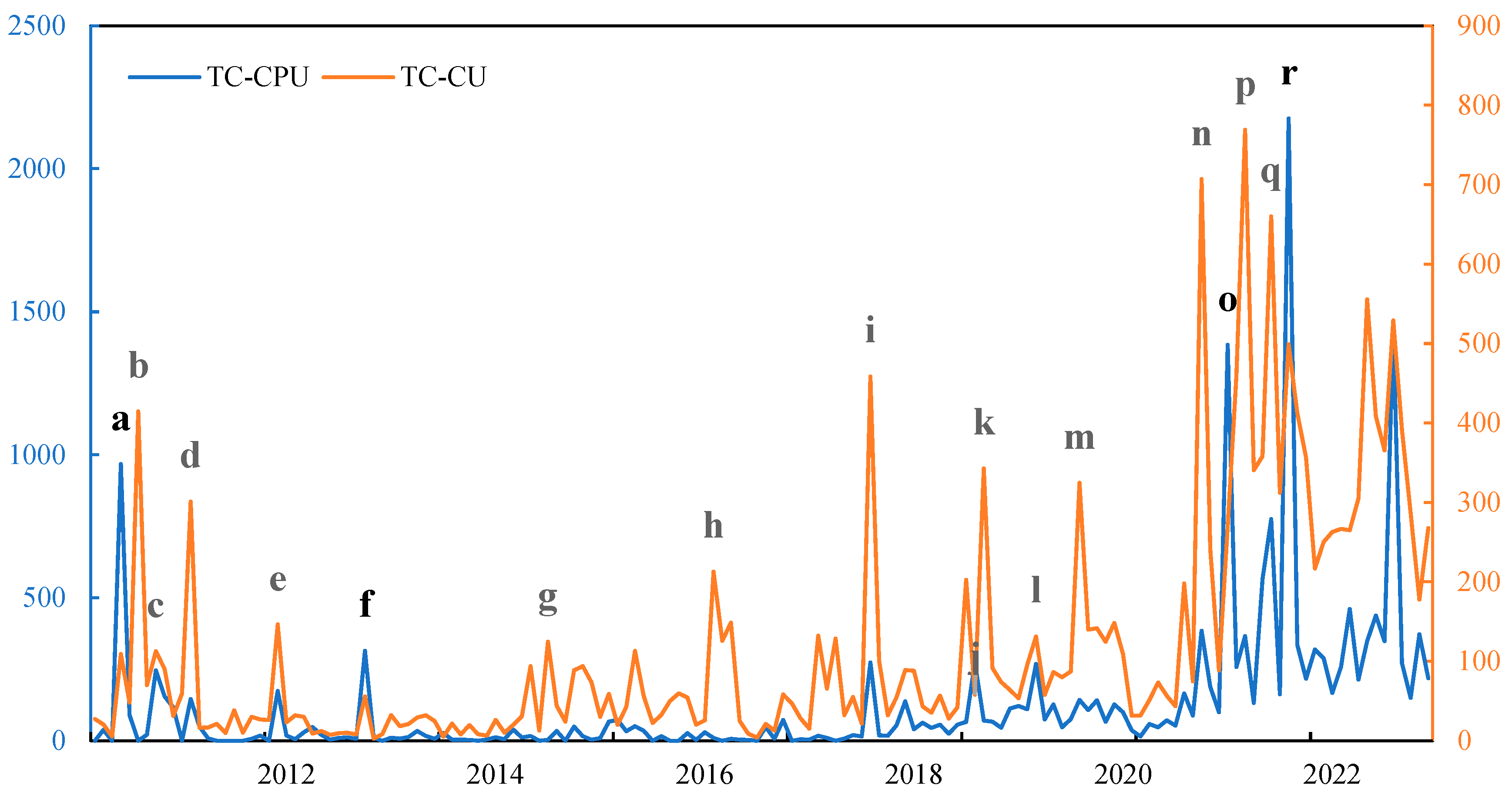
The climate policy uncertainty index (CPU) is obtained from Lee and Cho (2023) and measures Chinese climate policy uncertainty3. While the index is reported on a monthly basis beginning in 2010, we create an annual index for each firm-year observation by averaging the values over the 12 months. Following Chemmanur et al. (2019) and Mukherjee et al. (2017), we measure corporate innovation investment using R&D expenses scaled by total assets (R&D_Assets). We multiply R&D_Assets by 100 for the ease of interpretation of the regression coefficients.
Figure 1.
Twitter-based Chinese climate policy (TC-CU) and Twitter-based Chinese climate policy uncertainty (TC-CPU) with major events. This figure plots Twitter-based Chinese climate (policy) uncertainty from March 2010 to December 2022, Twitter-based Chinese climate uncertainty (TC-CU) and Twitter-based Chinese climate policy uncertainty (TC-CPU) index, which are obtained from Lee and Cho (2023). The following denotes major events with year and months in “YYYY-MM” format (we will give some examples for the major events): a. 2010-07, a major investment by China Investment Corporation into the AES’s wind power generation was dropped over; b. 2010-09, warning on climate change risk for China’s crops by a study in Nature; c. 2010-11, CCID Consulting report warned about significant policy & economy risks of China’s renewable energy industry; d. 2011-03, China’s environment minister announced tighter environmental restrictions; e. 2012-01, the government published the Second National Assessment Report on Climate Change; f. 2012-11, China’s environment minister announced social risk assessment mandates for all major industrial projects; g. 2014-08, warning on coal-to-gas plants in Inner Mongolia; h. 2016-03, ICBC announced to screen new loans for environmental risks; i. 2017-09, President Xi Jinping warned risks associated with resisting climate change; j. 2018-09, President Xi Jinping emphasized Russia–China ties amid unpredictable geopolitical climate; k. 2018-10, 18 central banks including China issued warning about climate change; l. 2019-04, President Xi Jinping highlighted building an infrastructure of sustainability under the Belt and Road Initiative; m. 2019-09, A new study warned about China’s Belt and Road Initiative for greenhouse gas emissions; n. 2020-11, Scientists warned on glaciers in Chinas Qilian mountains melting at an accelerating pace; o. 2021-02, concerns about cooperating with China regarding climate change among US politicians and EU leaders; p. 2021-04, China drafted a plan to develop its hydrogen industry by the National Development and Reform Commission; q. 2021-07, Flood deaths in central China; r. 2021-09, UK-led Cop26 talks at risk of failure over Chinas refusal to cut emission, and China warned US climate cooperation at risk over political tension (more details can be found from Lee and Cho (2023)).
3.2. Baseline Model
We examine the impact of climate policy uncertainty (CPU) on corporate innovation investment using the following regression model4:
where subscripts i and t relate to firm and year respectively. refers to the corporate innovation investment of firm i in year t, measured by R&D_Assets. is the climate policy uncertainty index of firm i in year t. Following Cui et al. (2021) and Z. Xu (2020), we include several control variables to account for firm-level characteristics and operations, such as firm size (Size), firm age (Age), leverage ratio (Leverage), return on assets (ROA), growth rate of sales (Growth), Tobin’s Q, and financial constraints index (KZ Index). Furthermore, we also control for other firm characteristics that may affect innovation investment, including managerial ownership (Mshare), the top one major shareholding (Top1), independent directors’ ratio (IndepR), the ratio of fixed assets (Fixed), number of board members (BoardSize), Dual, Big 4, state-owned enterprise (SOE) and polluting industries (Polluter). Detailed definitions of these variables are provided in Appendix A. All continuous variables are winsorized at the top and bottom 1% to mitigate the concern of outliers.
4. Empirical Results
4.1. Descriptive Statistics
Table 1 shows the descriptive statistics, including the mean, median, minimum, maximum, standard deviation, first quartile (Q1), and third quartile (Q3) value of variables. To mitigate the influence of outliers, all continuous variables are winsorized at the top and bottom 1% of their distributions. We can see that the mean of R&D_Assets is 2.610 percent, the minimum and maximum values of R&D_Assets are 0.010 percent and 11.650 percent. These align with previous studies, such as Cui et al. (2021). The mean and median of climate policy uncertainty (CPU) are 0.157 and 0.079, and the mean and median for climate uncertainty index (CU) are 0.149 and 0.096, respectively. In terms of the control variables, the average firm size is 22.08, the average return on assets is 5.00%, and the average leverage ratio is 38%. The average fixed assets investment is 19.7%. Approximately 35% of the CEOs in our sample are also chairmen, and the top one major shareholders on average hold 33% of firm stocks. The average board size consists of approximately 8 (log = 2.10) members, 38% of whom are independent directors, which is consistent with the China Securities Regulatory Commission (CSRC) requirements on board independence (J. Liu et al., 2024a). The distributions of the control variables are generally similar to those reported in previous research (Cui et al., 2021; Wen et al., 2022). We report the correlation coefficients among variables in Appendix B The correlation coefficients among variables are smaller than 0.6, indicating that the multi-collinearity issue is not a severe concern.
Table 1.
Summary statistics. This table presents the summary statistics for the sample: mean, median, minimum, maximum, standard deviation, 25%, 75%, and skewness of variables. R&D_Assets is the ratio of R&D expenditure to total assets of each firm and then multiplied by 100. CPU is the Twitter-based climate policy uncertainty index divided by 1000, as developed by Lee and Cho (2023). It is constructed by averaging the values over the preceding 12 months relative to the firm’s fiscal year-end. The definitions of the variables are provided in Appendix A. We winsorize the data at the 1% and 99% levels.
4.2. Baseline Results
To study the effect of climate policy uncertainty on corporate innovation investment, we conduct the OLS regression, controlling for industry, year and province fixed effects as well as clustering the standard errors at the firm level. Table 2 presents the baseline regression results. From columns (1) and (2), we can see that the coefficients on CPU are positive (1.800 and 1.306) and statistically significant at the 1% level, implying that climate policy uncertainty positively contributes to the corporate innovation investment. We further control for the natural logarithm of the province GDP per capita and province GDP growth rate in Column (3). The coefficient of CPU remains positive (1.166) and statistically significant at the 1% level. Using the coefficient estimates of CPU in Column (3), we calculate the economic significance of the effect of climate policy uncertainty on corporate innovation investment, holding other variables constant at their sample means: a one-standard-deviation increase in climate policy uncertainty is associated with an 8.80 percent increase in corporate innovation investment5. These estimates indicate a statistically and economically significant impact of climate policy uncertainty on corporate innovation investment.
Table 2.
Baseline regressions. This table reports the results of baseline regressions. It shows the impact of climate policy uncertainty on corporate innovation investment. The dependent variable is R&D_Assets, measured by R&D expenditure to the total assets of each firm and then multiplied by 100 in . The main independent variable is the Twitter-based Chinese climate policy uncertainty index (CPU) by Lee and Cho (2023). Definitions of variables are presented in Appendix A. The t-statistics are reported in parentheses. The superscripts *, **, and *** indicate statistical significance at the 10%, 5%, and 1% levels, respectively.
The coefficients on the control variables are generally consistent with those reported in relevant studies (Aghion et al., 2013; Almor et al., 2022; Becker-Blease, 2011). For example, the coefficients on ROA and Tobin’s Q are both positive and significant at the 1% level, suggesting that firms with higher profitability and higher market value are more likely to invest in innovative projects. In addition, the coefficient on Fixed is significantly negative, indicating that investment in fixed assets reduces corporate innovation investment. Overall, the results in Table 2 confirm that climate policy uncertainty positively contributes to corporate innovation investment, providing support for Hypothesis 1.
4.3. Robustness Checks
4.3.1. Alternative Measures of Corporate Innovation
Regarding the corporate innovation investment measurement, we use to replace the R&D_Assets as the dependent variable to check the lead-lag effect, and we use R&D_Sales and R&D_Salest+1 to replace the R&D_Assets as our alternative dependent variables. The coefficients in Panels A and B of Table 3 on CPU are still positive and significant at least at the 5% level across all columns. The findings support our baseline results.
Table 3.
Robustness check: alternative measures of corporate innovation investment. This table reports the results of a robustness check based on the baseline results. In Panel A, the dependent variable is , measured by R&D expenditure to total assets of each firm and then multiplied by 100 in . In Panel B, the dependent variable is R&D_Sales and , measured by R&D expenditure to the sales of each firm in . The main independent variable is CPU index. The t-statistics are reported in parentheses. The symbols *, **, and *** indicate statistical significance at the 10%, 5%, and 1% levels, respectively.
4.3.2. Alternative Measures of Climate Policy Uncertainty
In this section, we use three alternative measures to replace the climate policy uncertainty and re-run the baseline regression in Equation (1). First, we use Chinese climate policy index (CU) created by Lee and Cho (2023) as an alternative climate policy uncertainty to do a robustness check. Second, we use the U.S. climate policy uncertainty index (US_CPU) construct by Gavriilidis (2021) as an alternative climate policy uncertainty to do a robustness check. Third, we construct the residual CPU (R, which is the standard error that runs the regression between the Chinese CPU and the U.S. CPU in Equation (2):
The results are shown in Table 4, and the coefficients on the alternative measures of climate policy uncertainty are all significantly positive at the 1% level across the columns.
Table 4.
Robustness check: alternative measures of climate policy uncertainty. This table reports the results of robustness checks of the baseline results. In Panel A, the alternative independent variable is the climate uncertainty index (CU) construct by Lee and Cho (2023). In Panel B, the alternative independent variable is the U.S. climate policy uncertainty index (U.S. CPU) construct by Gavriilidis (2021). In Panel C, the alternative independent variable is the residual CPU, the standard error that runs the regression between the Chinese CPU and the U.S. CPU. The dependent variable is , measured by R&D expenditure to total assets of each firm. The t-statistics are reported in parentheses. The symbols *, **, and *** indicate statistical significance at the 10%, 5%, and 1% levels, respectively.
The above results indicate that the positive impacts of climate policy uncertainty on corporate innovation investment remain significant when using alternative dependent and independent variables to do robustness checks.
4.4. Endogeneity Tests
We conduct two methods to address potential endogeneity issues: the (1) Generalized Method of Moments (GMM) approach and (2) instrumental variable (IV) approach.
4.4.1. Generalized Method of Moments (GMM) Approach
Considering that using the fixed-effect (FE) method is a time-invariant process and loses a certain amount of information, the results of inferring the variance at higher levels are potentially biased (Bell & Jones, 2015). The dynamic panel data from the GMM model further extends the fixed-effects model; in addition to the internal transformation process, the lagged values of the dependent variable are also included as instruments to control for dynamic endogeneity.
Therefore, drawing on the treatment of Arellano and Bond (1991), first-difference GMM (FD-GMM) and systematic GMM (SYS-GMM) estimations are used for re-estimation. Table 5 shows the estimation results. Specifically, after controlling for the innovation investment lag term, the coefficient of CPU is 0.751 (0.691) and significantly at the 1% level for the FD-GMM (SYS-GMM). The final results are consistent with the conclusions presented in the baseline regressions, which verifies the robustness of the baseline results. Furthermore, we can find that the p-values of the AR(2) and Hansen test are both greater than 0.1 across columns (1) and (2) of Table 5, which indicates that there is no serial correlations for the standard errors and the instrument variable is valid.
Table 5.
Endogeneity test: Generalized Method of Moments. This table reports the results of the Generalized Method of Moments (GMM) endogeneity test on the baseline results. Definitions of variables are presented in Appendix A. The t-statistics are reported in parentheses. The symbols *, **, and *** indicate statistical significance at the 10%, 5%, and 1% levels, respectively.
4.4.2. Instrumental Variable (IV) Approach
In this section, we use Global Average Surface Temperature (GMST)6 as an instrumental variable for the CPU to reduce endogenous bias, following the approach of Niu et al. (2023). A valid instrumental variable needs to satisfy both correlation and exogenous conditions. On the one hand, GMST is one of the key indicators for in-depth understanding of the impact of human activities on global climate change, which can directly reflect climate fluctuations and is also one of the reference factors for climate policy formulation, so GMST is highly correlated with CPU. On the other hand, GMST depends on global natural conditions, which influence climate policy formulation and generally do not directly affect the output of technologies or innovation, and therefore the instrumental variable is exclusive.
Table 6 reports the results of the estimation using instrumental variables. In the first stage, we regress the CPU on the instrumental variables, column (1) shows that CPU increases with increasing GMST and statistical significance at the 1% level. Moreover, the first-stage F-statistic is high (F-statistic = 363.29), and the LM-statistic is statistically significant, showing that the instrumental variable is not weak. Column (2) reports the results of the second-stage regression. The explanatory variable is the fitted value of the CPU (CPU_Fitted). CPU_Fitted is positively associated with the corporate innovation investment, with statistical significance at the 1% level, with no change in the significance or sign of the core variables compared to the baseline regression results. It shows that our benchmark regression results are valid and reliable.
Table 6.
Endogeneity test: instrumental variable tests. This table reports the results of 2SLS instrumental variable analysis. Column (1) reports the results of the first-stage regression; we use the Global Average Surface Temperature (GMST) as the instrumental variable. Column (2) reports the results of the second stage regression. The explanatory variable is the fitted value of the CPU (CPU_Fitted). A set of control variables is included and definitions of variables are presented in Appendix A. The t-statistics are reported in parentheses. The superscripts *, **, and *** indicate statistical significance at the 10%, 5% and 1% level, respectively.
4.5. Mechanism Analysis
The baseline results reveal that climate policy uncertainty positively contributes to corporate innovation investment. To explore the potential mechanism of CPU on corporate innovation investment, we conduct the subsample regressions based on our hypothesis 2 and consider the environmental regulations.
To examine the effect of CPU on corporate innovation investment according to environmental regulations (policies), we divide the sample based on two key environmental regulations (policies): the low-carbon pilot city policy and the 2015 Paris Agreement. The low-carbon pilot city policies7 were implemented by the Chinese central government to promote sustainable urban development and reduce greenhouse gas emissions. These policies designate specific cities as “low-carbon pilots,” encouraging them to adopt innovative practices and technologies aimed at lowering carbon emissions and improving energy efficiency (Y. S. Ren et al., 2024; Zeng et al., 2023). The Paris Agreement is a climate change agreement signed by 196 countries worldwide and is a unified arrangement for global action to address climate change after 2020. The Paris Agreement was formally put into effect on 4 November 2016, after being approved at the Paris Climate Conference on 12 December 2015, and signed at the United Nations building in New York, USA, on 22 April 2016 (J. Liu et al., 2024a). On 3 September 2016, the Standing Committee of the National People’s Congress (NPC) approved China’s accession to the Paris Climate Change Agreement, becoming one of the parties that completed ratification of the agreement8. Since then, several carbon policies and pollution protection regulations have been created (Dai & Zhang, 2023; C. W. Su et al., 2020).
In the analysis, low-carbon pilots is the dummy variable, with a value of 1 when the firm’s headquarter city is designated as low-carbon pilot city and 0 otherwise. Firstly, we divide sample firms into low-carbon pilot cities and other cities based on the low-carbon pilots dummy variable. Secondly, we divide firms into two subsamples: “Before 2015 (including 2015)” and “After 2015”. The regression results are shown in Table 7. Columns (1) and (2) show that the coefficients of CPU are both significantly positive. However, the sample for low-carbon pilot cities has higher influence of CPU on corporate innovation investment, compared to the sample for other cities; Chow-test indicates that there is a significantly difference between these two coefficients. Columns (3) and (4) show that the positive impact of CPU on corporate innovation investment is stronger after the signing 2015 Paris Agreement. The results demonstrate that stringent government environmental regulations serve as a potential mechanism, compelling firms to adopt cleaner production and increasing their investment in innovation, providing support for H2.
Table 7.
Mechanism analysis: environmental regulations. This table reports the results of the heterogeneity tests of government environmental regulations. Environmental regulations (policies) are measured by: (a) Low-carbon pilot cities and other cities, where the low-carbon pilot city is the dummy variable, with a value of 1 when the firm’s headquarter city is designated as a low-carbon pilot city and 0 otherwise. (b) 2015 Paris Agreement. We divide firms into two subsamples: “Before 2015 (including 2015)” and “After 2015”. The t-statistics are reported in parentheses. The symbols *, ** and *** indicate statistical significance at the 10%, 5% and 1% level, respectively.
5. Moderating Effect and Further Analysis
5.1. Moderating Effect
Our findings thus far support the hypothesis that climate policy uncertainty positively contributes to corporate innovation investment. To further explore the factors that may amplify or diminish this relationship, we introduce additional variables related to corporate innovation investment, such as government subsidies and corporate asset allocation.
Government subsidies, as a key financial tool, not only impact corporate financing but also influence corporate innovation decisions, which in turn will act on the CPU and corporate innovation activities (Y. Li et al., 2021). Government support through subsidies has provided firms with sufficient R&D funds, reduced the financing pressure faced by firms, and thus enhanced the enthusiasm of companies to carry out innovation activities (Dewenter & Malatesta, 2001). Furthermore, beyond external resources like government subsidies, firms must also efficiently allocate internal resources to sustain their investment activities. Given that corporate resources are scarce and limited, firms with higher allocations to fixed assets are likely to have fewer resources available for investment in other areas (J. Tan et al., 2021; Z. Tan & Yan, 2021). Therefore, we posit that when firms allocate more resources to specific areas, such as fixed assets, their capacity to allocate resources toward innovation activities diminishes.
This section discusses how government subsidies (Subsidy) and fixed asset allocation (Fixed) act as moderating variables on CPU and corporate innovation investment. The regression results are reported in Table 8. We find that the regression coefficient of the interaction term (CPU × Subsidy) is significantly positive at the 5% level, suggesting that firms receiving greater government subsidies experience a stronger positive effect of climate policy uncertainty on corporate innovation investment. Conversely, the regression coefficient for the interaction term (CPU × Fixed) is significantly negative at the 1% level, indicating that firms with higher allocations in fixed assets tend to weaken the positive impact of climate policy uncertainty on innovation investment.
Table 8.
Moderating effect: government subsidy supporting and corporate internal asset allocation. This table reports the results of the moderating effect of government subsidy supporting and corporate internal asset allocation. The dependent variables are R&D_Assets, measured by R&D expenditure to total assets of each firm. The main independent variable is CPU index. Subsidy is measured by government subsidy received by each firm scaled by its total assets; Fixed is the ratio of fixed assets for the firm to total assets. Detailed definitions of variables are given in Appendix A. The t-statistics are reported in parentheses. The symbols *, ** and *** indicate statistical significance at the 10%, 5% and 1% level, respectively.
5.2. Further Analysis
5.2.1. Enterprise–Government Relationship
Based on prior studies, some scholars conclude that the effect of policy uncertainty on the corporate innovation depends on the government connections of corporations (Banerjee & Siebert, 2017). For example, state-owned enterprises (SOEs) are characterized by their large scale, state credit guarantee, and advantages in taxation, financing, technology, and human resources, as well as sufficient resources, compared to non-state-owned enterprises (non-SOEs), which can help them reduce the degree of policy uncertainty (D. Bai et al., 2023). This is similar to firms with political connections, politically connected firms have more information about government officials’ change and policy uncertainty due to their close relationship with the government, reducing the degree of policy uncertainty (Wang et al., 2017). Thus, compared to SOEs and politically connected firms, non-SOEs and non-politically connected firms may be more likely to be affected by climate policy uncertainty (D. Bai et al., 2023; Zhang et al., 2023).
To examine the effect of CPU on corporate innovation investment according to the enterprise–government relationship, we categorize the sample based on firms’ ownership structures and political connections. Specifically, we divide firms into state-owned enterprises (SOEs) and non-state-owned enterprises (non-SOEs), as well as politically connected firms and non-politically connected firms. In the analysis, SOE is the dummy variable, with a value of 1 when the firm is state owned and 0 otherwise. Political connection is the dummy variable, with a value of 1 when the firm is politically connected and 0 otherwise. Table 9 shows that the coefficients of CPU are significantly positive for the non-SOEs and non-politically connected groups, as shown in columns (1) and (3), but insignificant for the SOEs and politically connected groups in columns (2) and (4). Furthermore, Chow-tests indicate that the coefficients differ significantly between columns (1) and (2), as well as columns (3) and (4). These results suggest that CPU significantly contributes to corporate innovation investment in non-SOEs and non-politically connected firms, while it has no significant impact on SOEs or politically connected firms.
Table 9.
Climate policy uncertainty and enterprise–government relationship. This table reports the results of the heterogeneity tests of government-enterprise relationship. We use the (a) enterprise’s ownership structure (SOEs and Non-SOEs); (b) political connection (politically connected firms and non-politically connected firm) to represent the enterprise–government relationship. The t-statistics are reported in parentheses. The symbols *, ** and *** indicate statistical significance at the 10%, 5% and 1% level, respectively.
5.2.2. Long-Term Performance and Firm Value
Until now, the results have presented whether and how climate policy uncertainty affects corporate innovation investment. In this section, we further examine how firms’ reaction of innovation investments towards climate policy uncertainty would impact the firm performance and their value.
We find that under climate policy uncertainty, firms would improve their spendings on innovation investment. Does this also generate the positive impact on firm’s long-run performance after the innovation investment during this high uncertainty period? To check the long-run performance, we run regressions of interaction term, CPU × on the future Tobin’s Q and ROA. The results are reported in Panels A and B of Table 10. We find that the coefficient estimates of interaction term (CPU × are positive and significant at the 1% level, confirming our conjecture that the positive relationship between climate policy uncertainty and corporate innovation investment further enhances long-term firm performance and value.
Table 10.
Climate policy uncertainty and firm performance predictability. This table reports the results between climate policy uncertainty and firm performance predictability. We use the ROA and Tobin’s Q to present the firm performance and firm value. The interaction term is CPU multiplying the innovation investment. Detailed definitions of variables are given in Appendix A. The t-statistics are reported in parentheses. The symbols *, ** and *** indicate statistical significance at the 10%, 5% and 1% level, respectively.
6. Conclusions
With the climate policy uncertainty now being quantified at the aggregate level, its impact is being increasingly examined in various studies (D. Bai et al., 2023; Lee & Cho, 2023; X. Xu et al., 2023). For corporations, navigating this uncertainty is crucial for their overall innovation investment decisions since innovation plays a key role in coping with green economy development, meeting sustainable development conditions, and countering climate policy uncertainties (D. Bai et al., 2023; Kemp & Pontoglio, 2011).
This paper examines how corporate innovation investment responds to climate policy uncertainty in China. We find that climate policy uncertainty positively contributes to corporate innovation investment. The results are still reliable after addressing endogeneity issues and applying a series of robustness checks. Our analysis further indicates that stringent government environmental regulation serves as a potential mechanism, compelling firms to adopt cleaner production and increase their investment in innovation. Additionally, we find that government subsidies are conducive to promoting corporate innovation investment and higher fixed asset allocation dampens the positive influence of climate policy uncertainty on corporate innovation investment. We also find that firms with fewer connections to the government, such as non-state-owned enterprises and those without political connections, are more sensitive to climate policy uncertainty and they tend to increase their investment in innovation to mitigate the uncertainty. Furthermore, we discover that the positive relationship between climate policy uncertainty and corporate innovation investment will further foster the firm’s long-term performance and firm value, which shows that increased innovation investment driven by climate policy uncertainty generates favorable market expectations for firms.
Author Contributions
Conceptualization, J.L., J.C., M.H.K., and B.H.; methodology, J.L., J.C., M.H.K., and B.H.; software, J.L.; validation, J.L.; formal analysis, J.L.; investigation, J.L.; resources, J.L.; data curation, J.L.; writing—original draft preparation, J.L.; writing—review and editing, J.L., J.C., M.H.K., and B.H.; visualization, J.L., J.C., M.H.K., and B.H.; supervision, J.C., M.H.K., and B.H.; project administration, J.L. All authors have read and agreed to the published version of the manuscript.
Funding
This research received no external funding.
Institutional Review Board Statement
Not applicable.
Informed Consent Statement
Not applicable.
Data Availability Statement
The raw data supporting the conclusions of this article will be made available by the authors on request.
Conflicts of Interest
The authors declare no conflict of interest.
Appendix A
This table presents definitions of all the variables.
Table A1.
Variable definitions.
Appendix B
This table reports the correlation coefficients between key variables. Definitions of variables are in Appendix A.
Table A2.
Correlation matrix.
Appendix C
This table reports the results of the alternative baseline regressions. It shows the impact of climate policy uncertainty on corporate innovation investment. The dependent variable is R&D_Assets, measured by R&D expenditure to total assets of each firm. The main independent variable is Twitter-based Chinese climate policy uncertainty index (CPU) by Lee and Cho (2023). In the first column, we log all control variables. In the second column, we log all control variables and the independent variable. Definitions of variables are presented in Appendix A.
Table A3.
Alternative baseline regressions: climate policy uncertainty and corporate innovation investment.
Appendix D
This table reports the results of alternative baseline regressions. It shows the impact of climate policy uncertainty on corporate innovation investment. The dependent variable is R&D_Assets, measured by R&D expenditure to total assets of each firm. The main independent variables are Twitter-based Chinese climate policy uncertainty index (Chinese_CPU) by Lee and Cho (2023) and the U.S. climate policy uncertainty index (US_CPU) by Gavriilidis (2021). Definitions of variables are presented in Appendix A.
Table A4.
Alternative baseline regressions: climate policy uncertainty and corporate innovation investment.
Notes
| 1 | The Intergovernmental Panel on Climate Change (IPCC), 2021 report underscores the urgency of immediate, coordinated global action to reduce emissions and adapt to climate impacts. It forms a critical basis for international climate policy, including the Paris Agreement’s goal of limiting global warming to 1.5 °C or 2 °C above pre-industrial levels. |
| 2 | Recent literature introduces a new measure for firm-level climate change exposure based on transcripts of quarterly earnings conference calls (J. Huang et al., 2018; Sautner et al., 2023). However, these measures may be limited by salience bias, where managers overweight the probability of events based on their proximity or ease of recall (Alok et al., 2020; Cao et al., 2024). This bias has been observed in managerial overreactions to local disasters, such as increased cash holdings following hurricanes (Dessaint & Matray, 2017) and professional money managers underweighting nearby firms’ stocks (Alok et al., 2020). Given these limitations, we believe that the climate change index developed by Lee and Cho (2023) is more suitable for our study (J. Liu et al., 2024b). |
| 3 | The authors count the number of tweets that are related to climate policy uncertainty. They search for tweets that contain at least one keyword in each of the following categories of terms: (1) “China”, (2) “Climate”, and (3) “Uncertainty”, and (4) “Policy”. More details for constructing this index, please see: https://www.sciencedirect.com/science/article/pii/S1059056023002149 (accessed on 14 June 2024). We also provide the figure to show the Chinese Climate (Policy) Uncertainty major events from March 2010 to December 2022 (Figure 1). |
| 4 | We also use the lead-lag model, the results still remain and are reported in Appendix C. |
| 5 | We calculate the economic significance of climate policy uncertainty through = , where b is the estimated regression coefficient for the explanatory variable (1.166), is the sample standard deviation of the explanatory variable (0.197), and is the sample mean of the dependent variable (2.610). After the calculation, a 1-standard-deviation increase in climate policy uncertainty is associated with 8.80% increase in corporate innovation investment (1.166 × 0.197 ÷ 2.610 = 0.0880). |
| 6 | We collect the Global Average Surface Temperature (GMST) data from NASA official website. https://climate.nasa.gov/vital-signs/global-temperature/?intent=121 (accessed on 20 May 2024). |
| 7 | This policy is launched in 2010 by the National Development and Reform Commission (NDRC), and it includes three phases: Phase 1 (2010): Pilots started in 5 provinces (Guangdong, Liaoning, Hubei, Shaanxi, and Yunnan) and 8 cities, including Shenzhen, Tianjin, and Chongqing. Phase 2 (2012): Expanded to an additional 28 cities, such as Beijing and Shanghai. Phase 3 (2017): Focus shifted to integrating low-carbon policies into urban planning and industrial restructuring. |
| 8 | More details please see: https://unfccc.int/process-and-meetings/the-paris-agreement (accessed on 20 May 2024). |
References
- Afeltra, G., Alerasoul, S. A., & Strozzi, F. (2023). The evolution of sustainable innovation: From the past to the future. European Journal of Innovation Management, 26(2), 386–421. [Google Scholar] [CrossRef] [Scilit]
- Aghion, P., Van Reenen, J., & Zingales, L. (2013). Innovation and institutional ownership. American Economic Review, 103(1), 277–304. [Google Scholar] [CrossRef] [Scilit]
- Almor, T., Bazel-Shoham, O., & Lee, S. M. (2022). The dual effect of board gender diversity on R&D investments. Long Range Planning, 55(2), 101884. [Google Scholar] [CrossRef] [Scilit]
- Alok, S., Kumar, N., & Wermers, R. (2020). Do fund managers misestimate climatic disaster risk. The Review of Financial Studies, 33(3), 1146–1183. [Google Scholar] [CrossRef] [Scilit]
- Amore, M. D., & Bennedsen, M. (2016). Corporate governance and green innovation. Journal of Environmental Economics and Management, 75, 54–72. [Google Scholar] [CrossRef] [Scilit]
- Ardia, D., Bluteau, K., Boudt, K., & Inghelbrecht, K. (2023). Climate change concerns and the performance of green vs. brown stocks. Management Science, 69(12), 7607–7632. [Google Scholar] [CrossRef] [Scilit]
- Arellano, M., & Bond, S. (1991). Some tests of specification for panel data: Monte carlo evidence and an application to employment equations. The Review of Economic Studies, 58(2), 277–297. [Google Scholar] [CrossRef] [Scilit]
- Atanassov, J., Julio, B., & Leng, T. (2015). The bright side of political uncertainty: The case of R&D. The Review of Financial Studies, 37, 2937–2970. [Google Scholar] [CrossRef] [Scilit]
- Bai, D., Du, L., Xu, Y., & Abbas, S. (2023). Climate policy uncertainty and corporate green innovation: Evidence from Chinese A-share listed industrial corporations. Energy Economics, 127, 107020. [Google Scholar] [CrossRef] [Scilit]
- Bai, J. J., Chu, Y., Shen, C., & Wan, C. (2021). Managing climate change risks: Sea level rise and mergers and acquisitions. The Quarterly Journal of Finance, 14, 2450006. [Google Scholar] [CrossRef] [Scilit]
- Banerjee, T., & Siebert, R. (2017). Dynamic impact of uncertainty on R&D cooperation formation and research performance: Evidence from the bio-pharmaceutical industry. Research Policy, 46(7), 1255–1271. [Google Scholar]
- Bar-Ilan, A., & Strange, W. C. (1996). Investment lags. The American Economic Review, 86(3), 610–622. [Google Scholar]
- Becker-Blease, J. R. (2011). Governance and innovation. Journal of Corporate Finance, 17(4), 947–958. [Google Scholar] [CrossRef] [Scilit]
- Bell, A., & Jones, K. (2015). Explaining fixed effects: Random effects modeling of time-series cross-sectional and panel data. Political Science Research and Methods, 3(1), 133–153. [Google Scholar] [CrossRef] [Scilit]
- Bloom, N. (2007). Uncertainty and the dynamics of R&D. American Economic Review, 97(2), 250–255. [Google Scholar] [CrossRef] [Scilit]
- Bloom, N., Bond, S., & Van Reenen, J. (2007). Uncertainty and investment dynamics. The Review of Economic Studies, 74(2), 391–415. [Google Scholar] [CrossRef] [Scilit]
- Bloom, N., Draca, M., & Van Reenen, J. (2016). Trade induced technical change? The impact of Chinese imports on innovation, IT and productivity. The Review of Economic Studies, 83(1), 87–117. [Google Scholar] [CrossRef] [Scilit]
- Bloom, N., Floetotto, M., Jaimovich, N., Saporta-Eksten, I., & Terry, S. J. (2018). Really uncertain business cycles. Econometrica, 86(3), 1031–1065. [Google Scholar] [CrossRef] [Scilit]
- Bouri, E., Iqbal, N., & Klein, T. (2022). Climate policy uncertainty and the price dynamics of green and brown energy stocks. Finance Research Letters, 47, 102740. [Google Scholar] [CrossRef] [Scilit]
- Cao, Z., Chen, S. X., Dong, T., & Lee, E. (2024). Climate change uncertainty and supply chain financing. The British Accounting Review, 57, 101423. [Google Scholar] [CrossRef] [Scilit]
- Chemmanur, T. J., Kong, L., Krishnan, K., & Yu, Q. (2019). Top management human capital, inventor mobility, and corporate innovation. Journal of Financial and Quantitative Analysis, 54(6), 2383–2422. [Google Scholar] [CrossRef] [Scilit]
- Chen, Y. F., & Funke, M. (2003). Option value, policy uncertainty, and the foreign direct investment decision (HWWA Discussion Paper No. 234). Hamburg Institute of International Economics. [Google Scholar]
- Cui, X., Wang, C., Liao, J., Fang, Z., & Cheng, F. (2021). Economic policy uncertainty exposure and corporate innovation investment: Evidence from China. Pacific-Basin Finance Journal, 67, 101533. [Google Scholar] [CrossRef] [Scilit]
- Dai, Z., & Zhang, X. (2023). Climate policy uncertainty and risks taken by the bank: Evidence from China. International Review of Financial Analysis, 87, 102579. [Google Scholar] [CrossRef] [Scilit]
- Dessaint, O., & Matray, A. (2017). Do managers overreact to salient risks? Evidence from hurricane strikes. Journal of Financial Economics, 126(1), 97–121. [Google Scholar] [CrossRef] [Scilit]
- Dewenter, K. L., & Malatesta, P. H. (2001). State-owned and privately owned firms: An empirical analysis of profitability, leverage, and labor intensity. American Economic Review, 91(1), 320–334. [Google Scholar] [CrossRef] [Scilit]
- Dolge, K., & Blumberga, D. (2021). Composite risk index for designing smart climate and energy policies. Environmental and Sustainability Indicators, 12, 100159. [Google Scholar] [CrossRef] [Scilit]
- Du, L., Wei, M., Zhang, S., & Pan, J. (2023). Unveiling the policy intervention effects of natural resource regulation on firm-level pollution emissions: Evidence from China’s restrained land supply. Resources Policy, 86, 104081. [Google Scholar] [CrossRef] [Scilit]
- Farooq, U., Shafiq, M. N., Subhani, B. H., & Gillani, S. (2024). Climate policy uncertainty and regional innovation performance: New empirical evidence from the United States. Managerial and Decision Economics, 45(3), 1497–1510. [Google Scholar] [CrossRef] [Scilit]
- Ferreira, D., Manso, G., & Silva, A. C. (2014). Incentives to innovate and the decision to go public or private. The Review of Financial Studies, 27(1), 256–300. [Google Scholar] [CrossRef] [Scilit]
- Friedlingstein, P., O’sullivan, M., Jones, M. W., Andrew, R. M., Gregor, L., Hauck, J., & Peters, G. P. (2022). Global carbon budget 2022. Earth System Science Data, 14(11), 4811–4900. [Google Scholar] [CrossRef] [Scilit]
- Gavriilidis, K. (2021). Measuring climate policy uncertainty. Available online: https://ssrn.com/abstract=3847388 (accessed on 14 September 2024).
- Gkonis, N., Arsenopoulos, A., Stamatiou, A., & Doukas, H. (2020). Multi-perspective design of energy efficiency policies under the framework of national energy and climate action plans. Energy Policy, 140, 111401. [Google Scholar] [CrossRef] [Scilit]
- Guan, J., Xu, H., Huo, D., Hua, Y., & Wang, Y. (2021). Economic policy uncertainty and corporate innovation: Evidence from China. Pacific-Basin Finance Journal, 67, 101542. [Google Scholar] [CrossRef] [Scilit]
- Hao, Y., Huang, Z., & Wu, H. (2019). Do carbon emissions and economic growth decouple in China? An empirical analysis based on provincial panel data. Energies, 12(12), 2411. [Google Scholar] [CrossRef] [Scilit]
- He, F., Ma, Y., & Zhang, X. (2020). How does economic policy uncertainty affect corporate Innovation?—Evidence from China listed companies. International Review of Economics & Finance, 67, 225–239. [Google Scholar]
- Hepburn, C., Qi, Y., Stern, N., Ward, B., Xie, C., & Zenghelis, D. (2021). Towards carbon neutrality and China’s 14th five-year plan: Clean energy transition, sustainable urban development, and investment priorities. Environmental Science and Ecotechnology, 8, 100130. [Google Scholar] [CrossRef] [Scilit] [PubMed]
- Hoang, K. (2022). How does corporate R&D investment respond to climate policy uncertainty? Evidence from heavy emitter firms in the United States. Corporate Social Responsibility and Environmental Management, 29(4), 936–949. [Google Scholar] [CrossRef] [Scilit]
- Huang, J., Kerstein, J., & Wang, C. (2018). The impact of climate risk on firm performance and financing choices: An international comparison. Journal of International Business Studies, 49, 633–656. [Google Scholar] [CrossRef] [Scilit]
- Huang, W. (2023). Climate policy uncertainty and green innovation. Economics Letters, 233, 111423. [Google Scholar] [CrossRef] [Scilit]
- Jiang, G. J., Xu, D., & Yao, T. (2009). The information content of idiosyncratic volatility. Journal of Financial and Quantitative Analysis, 44(1), 1–28. [Google Scholar] [CrossRef] [Scilit]
- Kemp, R., & Pontoglio, S. (2011). The innovation effects of environmental policy instruments—A typical case of the blind men and the elephant? Ecological Economics, 72, 28–36. [Google Scholar] [CrossRef] [Scilit]
- Kulatilaka, N., & Perotti, E. C. (1998). Strategic growth options. Management Science, 44(8), 1021–1031. [Google Scholar] [CrossRef] [Scilit]
- Lee, K., & Cho, J. (2023). Measuring Chinese climate uncertainty. International Review of Economics & Finance, 88, 891–901. [Google Scholar] [CrossRef] [Scilit]
- Li, X., Xu, Q., & Wang, H. (2023). Environmental effects of the establishment of pilot free trade zones: Evidence from Chinese resource-based enterprises. Environmental Science and Pollution Research, 30(8), 21384–21403. [Google Scholar] [CrossRef] [Scilit]
- Li, Y., Zhang, Y., Lee, C. C., & Li, J. (2021). Structural characteristics and determinants of an international green technological collaboration network. Journal of Cleaner Production, 324, 129258. [Google Scholar] [CrossRef] [Scilit]
- Liu, J., Chi, J., Kabir, M. H., & Hafeez, B. (2024a, November 7–8). Climate policy uncertainty and corporate innovation investment: Evidence from China. International Corporate Governance Conference (ICGC), Cardiff, UK. [Google Scholar]
- Liu, J., Chi, J., Kabir, M. H., & Hafeez, B. (2024b, December 2–3). Climate policy uncertainty and corporate innovation investment: Evidence from China. Massey Sustainable Finance Conference (MSFC), Auckland, New Zealand. [Google Scholar]
- Liu, W., McKibbin, W. J., Morris, A. C., & Wilcoxen, P. J. (2020). Global economic and environmental outcomes of the Paris agreement. Energy Economics, 90, 104838. [Google Scholar] [CrossRef] [Scilit]
- Liu, Y., Chen, L., Cao, Z., & Wen, F. (2024). Uncertainty breeds opportunities: Assessing climate policy uncertainty and its impact on corporate innovation. International Review of Financial Analysis, 96, 103560. [Google Scholar] [CrossRef] [Scilit]
- Mukherjee, A., Singh, M., & Žaldokas, A. (2017). Do corporate taxes hinder innovation? Journal of Financial Economics, 124(1), 195–221. [Google Scholar] [CrossRef] [Scilit]
- Myers, S. C. (1977). Determinants of corporate borrowing. Journal of Financial Economics, 5(2), 147–175. [Google Scholar] [CrossRef] [Scilit]
- Niu, S., Zhang, J., Luo, R., & Feng, Y. (2023). How does climate policy uncertainty affect green technology innovation at the corporate level? New evidence from China. Environmental Research, 237, 117003. [Google Scholar] [CrossRef] [Scilit] [PubMed]
- Nuvvula, R. S., Devaraj, E., Elavarasan, R. M., Taheri, S. I., Irfan, M., & Teegala, K. S. (2022). Multi-objective mutation-enabled adaptive local attractor quantum behaved particle swarm optimisation based optimal sizing of hybrid renewable energy system for smart cities in India. Sustainable Energy Technologies and Assessments, 49, 101689. [Google Scholar] [CrossRef] [Scilit]
- Pfeffer, J., & Salancik, G. R. (1978). The external control of organizations: A resource dependence perspective. Available online: https://ssrn.com/abstract=1496213 (accessed on 25 June 2024).
- Porter, M. E. (1991). Towards a dynamic theory of strategy. Strategic Management Journal, 12(S2), 95–117. [Google Scholar] [CrossRef] [Scilit]
- Razzaq, A., Sharif, A., Ozturk, I., & Yang, X. (2023). Central inspections of environmental protection and transition for low-carbon Chinese cities: Policy intervention and mechanism analysis. Energy Economics, 124, 106859. [Google Scholar] [CrossRef] [Scilit]
- Ren, S., Hao, Y., & Wu, H. (2022). The role of outward foreign direct investment (OFDI) on green total factor energy efficiency: Does institutional quality matters? Evidence from China. Resources Policy, 76, 102587. [Google Scholar] [CrossRef] [Scilit]
- Ren, X., Qin, J., & Dong, K. (2022a). How does climate policy uncertainty affect excessive corporate debt? The case of China. Journal of Environmental Assessment Policy and Management, 24(02), 2250025. [Google Scholar] [CrossRef] [Scilit]
- Ren, X., Zhang, X., Yan, C., & Gozgor, G. (2022b). Climate policy uncertainty and firm-level total factor productivity: Evidence from China. Energy Economics, 113, 106209. [Google Scholar] [CrossRef] [Scilit]
- Ren, Y. S., Liu, P. Z., Klein, T., & Sheenan, L. (2024). Does the low-carbon pilot cities policy make a difference to the carbon intensity reduction? Journal of Economic Behavior & Organization, 217, 227–239. [Google Scholar]
- Sautner, Z., Van Lent, L., Vilkov, G., & Zhang, R. (2023). Firm-level climate change exposure. The Journal of Finance, 78(3), 1449–1498. [Google Scholar] [CrossRef] [Scilit]
- Sendstad, L. H., & Chronopoulos, M. (2020). Sequential investment in renewable energy technologies under policy uncertainty. Energy Policy, 137, 111152. [Google Scholar] [CrossRef] [Scilit]
- Shang, Y., Han, D., Gozgor, G., Mahalik, M. K., & Sahoo, B. K. (2022). The impact of climate policy uncertainty on renewable and non-renewable energy demand in the United States. Renewable Energy, 197, 654–667. [Google Scholar] [CrossRef] [Scilit]
- Shao, L. (2018). The dilemma of criticism: Disentangling the determinants of media censorship in China. Journal of East Asian Studies, 18(3), 279–297. [Google Scholar] [CrossRef] [Scilit]
- Stein, L., & Stone, E. (2012). The effect of uncertainty on investment, hiring, and R&D: Causal evidence from equity options (Working Paper No. 1649108). Available online: https://lukestein.com/stein-stone-uncertainty (accessed on 25 June 2024).
- Su, C. W., Naqvi, B., Shao, X. F., Li, J. P., & Jiao, Z. (2020). Trade and technological innovation: The catalysts for climate change and way forward for COP21. Journal of Environmental Management, 269, 110774. [Google Scholar] [CrossRef] [Scilit]
- Su, F., Song, N., Shang, H., & Fahad, S. (2022). The impact of economic policy uncertainty on corporate social responsibility: A new evidence from food industry in China. PLoS ONE, 17(6), e0269165. [Google Scholar] [CrossRef] [Scilit]
- Tajaddini, R., & Gholipour, H. F. (2021). Economic policy uncertainty, R&D expenditures and innovation outputs. Journal of Economic Studies, 48(2), 413–427. [Google Scholar]
- Tan, J., Tan, Z., & Chan, K. C. (2021). Does air pollution affect a firm’s cash holdings? Pacific-Basin Finance Journal, 67, 101549. [Google Scholar] [CrossRef] [Scilit]
- Tan, Z., & Yan, L. (2021). Does air pollution impede corporate innovation? International Review of Economics & Finance, 76, 937–951. [Google Scholar] [CrossRef] [Scilit]
- Van Vo, L., & Le, H. T. T. (2017). Strategic growth option, uncertainty, and R&D investment. International Review of Financial Analysis, 51, 16–24. [Google Scholar] [CrossRef] [Scilit]
- Varadarajan, R. (2017). Innovating for sustainability: A framework for sustainable innovations and a model of sustainable innovations orientation. Journal of the Academy of Marketing Science, 45, 14–36. [Google Scholar] [CrossRef] [Scilit]
- Wang, Y., Wei, Y., & Song, F. M. (2017). Uncertainty and corporate R&D investment: Evidence from Chinese listed firms. International Review of Economics & Finance, 47, 176–200. [Google Scholar] [CrossRef] [Scilit]
- Weeds, H. (2002). Strategic delay in a real options model of R&D competition. The Review of Economic Studies, 69(3), 729–747. [Google Scholar] [CrossRef] [Scilit]
- Wen, H., Lee, C. C., & Zhou, F. (2022). How does fiscal policy uncertainty affect corporate innovation investment? Evidence from China’s new energy industry. Energy Economics, 105, 105767. [Google Scholar] [CrossRef] [Scilit]
- Xu, B., & Albert, E. (2014). Media censorship in China. Council on Foreign Relations, 25(1), 243–249. [Google Scholar]
- Xu, X., Huang, S., Lucey, B. M., & An, H. (2023). The impacts of climate policy uncertainty on stock markets: Comparison between China and the US. International Review of Financial Analysis, 88, 102671, Retraction in 2026, International Review of Financial Analysis, 110, 105075. [Google Scholar] [CrossRef] [Scilit]
- Xu, Z. (2020). Economic policy uncertainty, cost of capital, and corporate innovation. Journal of Banking & Finance, 111, 105698. [Google Scholar] [CrossRef] [Scilit]
- Xue, M., Razzaq, A., Afshan, S., & Yang, X. (2023). Fiscal pressure and carbon intensity: A quasi-natural experiment based on education authority reform. Energy Economics, 126, 106919. [Google Scholar] [CrossRef] [Scilit]
- Yan, W. L. (2023). The dynamic spillover effects of climate policy uncertainty and coal price on carbon price: Evidence from China. Finance Research Letters, 53, 103400. [Google Scholar] [CrossRef] [Scilit]
- Zeng, S., Jin, G., Tan, K., & Liu, X. (2023). Can low-carbon city construction reduce carbon intensity? Empirical evidence from low-carbon city pilot policy in China. Journal of Environmental Management, 332, 117363. [Google Scholar] [CrossRef] [Scilit]
- Zhang, N., Deng, J., Ahmad, F., Draz, M. U., & Abid, N. (2023). The dynamic association between public environmental demands, government environmental governance, and green technology innovation in China: Evidence from panel VAR model. Environment, Development and Sustainability, 25(9), 9851–9875. [Google Scholar] [CrossRef] [Scilit]
- Zhao, S., Cao, Y., Feng, C., Guo, K., & Zhang, J. (2022). How do heterogeneous R&D investments affect China’s green productivity: Revisiting the Porter hypothesis. Science of the Total Environment, 825, 154090. [Google Scholar]
- Zheng, M., Feng, G. F., Jiang, R. A., & Chang, C. P. (2023). Does environmental, social, and governance performance move together with corporate green innovation in China? Business Strategy and the Environment, 32(4), 1670–1679. [Google Scholar] [CrossRef] [Scilit]
- Zhu, N., Zhang, X., Ren, X., & Wang, L. (2023). The response of corporate innovation to climate policy uncertainty: Evidence from China. Journal of Environmental Assessment Policy and Management, 25(02), 2350008. [Google Scholar] [CrossRef] [Scilit]

Disclaimer/Publisher’s Note: The statements, opinions and data contained in all publications are solely those of the individual author(s) and contributor(s) and not of MDPI and/or the editor(s). MDPI and/or the editor(s) disclaim responsibility for any injury to people or property resulting from any ideas, methods, instructions or products referred to in the content. |
© 2026 by the authors. Licensee MDPI, Basel, Switzerland. This article is an open access article distributed under the terms and conditions of the Creative Commons Attribution (CC BY) license.