


Abstract
Digital monetary systems redistribute both payment risk and access to transaction information. This article examines the proposed digital euro through a structured interpretive comparison of the European Commission proposal, the Council negotiating text, the European Parliament committee report, and the joint opinion of European data-protection authorities. A provision-level evidence register distinguishes proposed obligations, recommendations, institutional design intentions, and observed contextual evidence. The Digital Monetary Trust–Surveillance Paradox is presented as a sensitizing framework connecting security assurance with actor-specific information access, rather than a newly established behavioral law. Three documentary findings emerge. First, offline privacy shifts financial-integrity checks toward funding and defunding without eliminating identifiable records at those boundaries. Second, Parliament’s proposed mandatory fraud mechanism combines wider operational responsibilities with additional privacy safeguards, whereas the Council retains discretion over establishing the mechanism. Third, both negotiating texts retain a single access point for identifiers, leaving the choice of privacy-preserving implementation consequential despite stronger restrictions on identification. Baltic supervisory histories and published payment statistics provide bounded context, not tests of trust or adoption effects. A worked governance example specifies responsibilities, retention, access exceptions, oversight, and remedies. The contribution is an auditable account of how institutional choices distribute observation and accountability; psychological consequences remain propositions for subsequent research.
1. Introduction
Money is an institution of trust before it is a technology. Physical cash ordinarily permits direct, low-value exchange without generating a transaction record at an intermediary; digital payment systems distribute information among providers, operators, and sometimes public authorities under different technical and legal rules. Neither digitalization nor the existence of a ledger determines privacy by itself. The central governance question concerns which actors observe transaction information, for which purposes, under what retention and access rules, and with which mechanisms of accountability.
The coexistence of digital payment use and demand for cash makes this question consequential. Evidence from the European Central Bank (ECB) study on the payment attitudes of consumers in the euro area (SPACE) documents both declining cash transaction shares and persistent support for retaining cash as an option (European Central Bank, 2024). These are different measures: payment frequency records behavior, whereas support for cash expresses a preference about available alternatives. Neither establishes consent to expanded transaction visibility.
The principal object of analysis is the proposed digital euro. Privately issued e-money tokens and bitcoin remain bounded architectural comparators, used to clarify differences in liability, custody, identification, and redress. They are not treated as equally developed empirical cases. Under the Markets in Crypto-Assets Regulation (MiCA), e-money tokens reference one official currency and differ from asset-referenced tokens; decentralized bitcoin has neither a conventional issuer nor an issuer redemption promise (European Union, 2023b).
The digital euro would combine a public monetary liability with intermediary distribution and differentiated online and offline functions. Its institutional significance lies in the allocation of responsibilities among the Eurosystem, payment service providers (PSPs), support-service operators, data-protection authorities, and financial-intelligence authorities. This distribution requires analysis of the underlying provisions rather than treating public issuance as a sufficient assurance of either privacy or surveillance (Council of the European Union, 2025a; European Commission, 2023; European Parliament, 2026a). The European Data Protection Board (EDPB) and European Data Protection Supervisor (EDPS) supply a distinct supervisory perspective on the proposed processing arrangements.
The article contributes an actor- and purpose-specific comparison of those provisions. Existing scholarship already explains privacy costs, information-flow norms, monetary privacy, and central bank digital currency (CBDC) architecture (Auer & Böhme, 2020; Dinev & Hart, 2006; Kahn et al., 2005; Nissenbaum, 2004). The contribution here is narrower: tracing how the same integrity function is assigned different data permissions and accountability conditions across legislative versions. The conceptual contribution is an institutional framework; the findings concern documented design differences; the recommendations are normative proposals grounded in those differences. No claim of theoretical novelty rests solely on naming a paradox.
Four institutional questions guide the assessment:
- RQ1.
- How do the selected digital-euro texts allocate transaction information, identity linkage, and permitted purposes among the Eurosystem, PSPs, and support-service operators?
- RQ2.
- Where do the Commission proposal, Council text, Parliament report, and EDPB–EDPS recommendations converge or diverge on offline payments, identifier access, and fraud prevention?
- RQ3.
- What do the selected Estonian, Latvian, and Lithuanian institutional records establish about supervisory responsibilities and payment context, and what remains unknown about public trust?
- RQ4.
- Which unresolved design choices become visible when information access, retention, exceptions, oversight, and remedies are assessed together?
Estonia, Latvia, and Lithuania share euro-area monetary governance while presenting distinct supervisory histories. They are national contexts within one proposed digital-euro architecture, not three CBDC designs or a most-similar-systems test of an observed trust outcome. The study uses structured interpretive document analysis and published descriptive evidence. Questions about effects on confidence, perceived surveillance, trust, or adoption are reserved for the propositions in Section 2.3.5 and the research agenda in Section 5.4.
2. Background and Theoretical Framework
2.1. The Digital Monetary Setting and the Study Boundary
Table 1 identifies the institutional setting and its evidentiary limits. The documentary publication cut-off is 4 November 2026; source versions and links were checked for this revision on 17 November 2026. A negotiating position is not an enacted obligation, and a preparatory timetable is not a commitment to issue. Market-capitalization estimates and global theft totals are excluded from the findings because they do not measure the allocation of digital-euro information rights.
Table 1.
Institutional setting and evidentiary boundaries.
CBDC architecture requires separating the central-bank liability from the institutions operating customer interfaces and records. Auer and Böhme (2020) show why alternative architectures assign different operational responsibilities even when each represents a central-bank claim. The digital-euro comparison therefore follows the allocation of information and authority across institutions rather than using issuer type as a proxy for privacy.
Monetary design also involves financial intermediation and welfare. Keister and Sanches (2023) examine the benefits and costs of CBDC introduction where cash and bank deposits coexist. Their analysis makes clear why a privacy assessment alone does not settle the overall welfare question. Holding limits, payment usability, and banking-system effects remain distinct considerations in the digital-euro debate.
The analysis does not rank the digital euro, stablecoins, and bitcoin on a single security or legitimacy scale. These instruments expose users to different combinations of solvency, custody, availability, traceability, and governance risk. Table 2 supplies a limited conceptual comparison; the provision-level investigation concerns the digital euro.
Table 2.
Institutional and informational architecture of digital money instruments.
2.2. Conceptual Distinctions: Three Architectures of Digital Money
The three monetary forms differ in liability, data visibility, and routes to redress. Table 2 distinguishes the instrument or protocol from the behavior of issuers and service providers. Its stablecoin category is an EU-regulated e-money token referencing one official currency, not all tokens described commercially as stablecoins. The comparison is institutional background, not a corpus-based assessment of individual issuers’ data practices.
Privacy has different operational meanings across instruments. With a CBDC, the relevant questions include access by public authorities and payment service providers. With stablecoins, issuer or custodian monitoring, public-chain analysis, and potential commercial uses of data become prominent. With publicly traceable cryptocurrency, pseudonymity does not mean that payments are untraceable. For every instrument, safeguards depend on specific data flows rather than on an abstract label of public or private money.
The institutional point is equally important: public issuance does not establish trustworthy data handling by every participant, just as decentralized validation does not establish user control over information. The appropriate unit of comparison is a specified function performed by a specified actor under a specified rule. The same payment may be confidential from the central bank while remaining identifiable to the customer’s PSP.
2.3. Theoretical Framework: The Digital Monetary Trust–Surveillance Paradox
The Digital Monetary Trust–Surveillance Paradox denotes a contingent governance problem: a control justified by payment protection may also authorize observation or linkage that some users regard as inappropriate. Security assurance and information access are separate attributes of the intervention. Their coexistence does not establish a negative net effect on trust. The framework is a sensitizing device for identifying institutional choices and generating hypotheses, not a replacement for established privacy or trust theories.
2.3.1. Institutional Trust
Trust is a willingness to be vulnerable to another party based on expectations of its ability, benevolence, and integrity (Mayer et al., 1995). In political settings, trust is a judgment about the trustworthiness of institutions rather than a general mood (Levi & Stoker, 2000). Easton’s (1975) distinction between specific support for outputs and diffuse support for the institution itself is useful here: a payment instrument may work well and still be rejected if its issuer lacks diffuse support.
Institutional trust has multiple objects: confidence in the central bank is different from trust in a commercial bank, an interface provider, or an anti-fraud operator. Survey research connects CBDC intentions to these distinctions, but its results depend on the account function and outcome measured (Bijlsma et al., 2024; Tronnier et al., 2022). The Austrian discrete choice study likewise identifies heterogeneous preferences, with security against financial loss and financial incentives more influential on average than the specified privacy options (Elsinger et al., 2025). These findings do not support a universal ordering of privacy over security.
2.3.2. Privacy as Contextual Integrity and as a Public Good
Privacy concerns the appropriateness of information flows within a context, including the sender, recipient, information type, and transmission principle (Nissenbaum, 2004). Confidentiality restricts access or disclosure; anonymity prevents attribution to an identifiable person within a specified setting; pseudonymity substitutes an identifier while leaving linkage possible through additional information. Protection against identity linkage concerns who possesses or obtains that additional information. None of these properties alone establishes the others. Solove’s (2006) taxonomy further distinguishes aggregation, identification, and secondary use from initial collection.
Payment scholarship already treats privacy as an economic and institutional design property. Kahn et al. (2005) explain the value of money in supporting transactions without disclosing information that exposes users to adverse consequences. Garratt and van Oordt (2021) identify privacy externalities: one person’s disclosure may reveal information about others. Ahnert et al. (2022) analyze privacy and CBDC within the digital economy. These contributions preclude presenting the general security–privacy tension as a new discovery.
The distinction from privacy calculus is the level of explanation. Privacy-calculus research evaluates perceived disclosure benefits and costs (Dinev & Hart, 2006); the present analysis traces how institutions assign the underlying permissions. Contextual integrity already supplies the relevant information-flow dimensions, and Tronnier (2024) applies them directly to CBDC transactions. The additional contribution is a longitudinal comparison of specific legislative provisions, particularly whether an integrity function remains discretionary, becomes mandatory, or is constrained by recipient-specific safeguards. Technology-acceptance and institutional-trust models remain necessary for explaining subsequent user responses (Davis, 1989; Venkatesh et al., 2003).
Earlier threshold-based design work also precludes a novelty claim for graduated privacy itself. European Central Bank’s (2019) proof of concept explored anonymity vouchers for limited payments while preserving an AML role. Such a prototype establishes an architectural possibility under specified assumptions, not operational readiness or a legal settlement of proportionality. The present study asks how the later legislative texts allocate authority over comparable choices.
2.3.3. Surveillance and Legitimacy
Surveillance refers to organized attention to personal information for administration, influence, or control (Lyon, 2007). In payments, relevant concerns include public-authority access as well as private aggregation, profiling, and secondary use (Zuboff, 2019). The presence of a transaction record is evidence of observability, not sufficient evidence of abuse. A defensible analysis identifies the actor, legal purpose, scope of access, linkage opportunities, and safeguards before evaluating the legitimacy of that access.
Legitimacy concerns whether an exercise of authority is regarded as appropriate and justified (Suchman, 1995; Tyler, 2006). Institutional trust instead concerns expectations of an institution’s competence and conduct. Perceived security confidence concerns protection against compromise or loss; adoption intention concerns stated willingness to use an instrument, not observed uptake. This article uses legitimacy as a normative assessment of authority and procedure, informed by input, output, and throughput considerations (Scharpf, 1999; Schmidt, 2013). It does not measure sociological legitimacy or substitute trust scores for such a measure.
2.3.4. Conditional Pathways and Illustrative Perception Combinations
Let S denote a specified security or financial-integrity intervention; C, perceived security confidence; V, perceived surveillance; T, trust in a named institution; and A, adoption intention. Safeguards G, institutional architecture I, and relevant history H describe the context. Figure 1 summarizes possible pathways. All directions and magnitudes remain empirical questions. The diagram permits a direct association between S and T and does not assume that C and V exhaust the consequences of an intervention.
Figure 1.
Hypothesized pathways between controls, perceptions, institutional trust, and adoption intention. Note. Solid arrows identify candidate relationships without imposed signs. The direct S–T path and the joint influence of C and V are permitted. Safeguards, institutional architecture, and history potentially condition all pathways. The documentary analysis concerns the design of S and G; it does not observe or estimate the psychological pathways.
A verbal formulation is more appropriate than a product-of-coefficients expression for this documentary study. An intervention may alter C, V, both, or neither; each perception may be associated with T, and their joint effect may involve interaction. Safeguards may change the information actually collected, the perceived extent of observation, or the consequences users attach to that observation. Institutional architecture and history may condition any of those relationships. No additive, separable, sign-restricted, or complete-mediation model is imposed.
The hypothesized paradox would arise if users recognize an intervention’s protective value yet reduce their trust because of its information-access implications. The institutional texts identify opportunities for such a response; they do not establish that the response occurs. Adoption intention is a separate potential outcome influenced by trust as well as usefulness, cost, accessibility, merchant acceptance, and existing habits. The pathways in Figure 1 therefore specify questions for subsequent research, not an accounting identity or an estimated causal model.
Four illustrative combinations of perceptions help identify competing expectations. They are propositions about possible responses, not ranked legitimacy regimes:
- High C and low V: favorable trust judgments are plausible if users also regard the institution’s purposes and procedures as acceptable. Low concern does not establish justified authority or actual privacy.
- High C and high V: trust may rise, fall, or remain unchanged, depending on the importance users attach to protection, observation, institutional purpose, and available remedies. This combination alone does not demonstrate a paradox.
- Low C and low V: users may feel insufficiently protected despite limited surveillance concern. Low perceived observation establishes neither technical anonymity nor effective data protection.
- Low C and high V: adverse trust judgments are plausible, but neither a numerical trust level nor the lowest legitimacy ranking follows without additional assumptions and evidence.
The framework’s institutional value lies in separating access from assurance. A rule preventing identity linkage by the Eurosystem does not answer whether a PSP retains identifiable compliance records. Conversely, an obligation to detect fraud does not establish unrestricted authority to combine those records across purposes. These are distinct documentary questions, even where users later evaluate them together.
2.3.5. Propositions and Their Evidentiary Status
P1. The information implications of an integrity control depend on its institutional implementation, not solely on its stated protective purpose. The documentary comparison examines this proposition at the level of allocated functions and access permissions.
P2. Holding the information and stated purpose constant, the identity of its recipient is expected to influence perceived surveillance and trust. This is a behavioral proposition; the selected documents do not measure the effect.
P3. Credible purpose limitations, independent oversight, and effective remedies are expected to moderate the relationship between perceived surveillance and trust. A safeguard’s presence in a text does not establish its credibility or effectiveness for users.
P4. Threat salience may increase demand for protection or increase concern about exposure. These competing responses prevent a directional prediction from national incident counts alone.
P5. An enforcement episode may weaken trust by revealing failure or strengthen it by demonstrating corrective capacity. The relevant institution, timing, and respondent exposure must be measured before either account is evaluated.
P6. Stated privacy concern and payment behavior need not correspond closely because convenience, cost, habit, and access also matter. A within-person gap requires joint observations and is not inferred from separate aggregate percentages.
P7. Retaining an accessible and accepted cash option preserves a practical alternative to digital payment. Any further effect on perceived choice, trust, or adoption requires evidence about users and actual access.
2.4. Cybersecurity Risk in Digital Money
Cybersecurity concerns the confidentiality, integrity, availability, and recovery of systems and data. Financial-integrity measures include fraud prevention and requirements for anti-money laundering and countering the financing of terrorism (AML/CFT). Privacy governance limits permissible processing even where the system is secure against unauthorized access. Table 3 distinguishes these objectives and the evidence needed to assess them. Their separation avoids treating every identity check as cybersecurity or every security control as surveillance.
Table 3.
Distinct objectives and their analytical implications.
2.4.1. Crypto-Asset Theft
The February 2025 Bybit theft illustrates risk at a centralized exchange used within the crypto ecosystem. The Federal Bureau of Investigation (FBI) attributed the approximately US$1.5 billion theft to North Korean actors (Federal Bureau of Investigation, 2025). This episode is relevant to custody and operational responsibility; it does not supply a measure of digital-euro surveillance risk. Global theft aggregates are not used to rank the monetary instruments.
Decentralization of a settlement protocol does not remove intermediary dependencies. Exchanges, custodians, and private-key interfaces introduce separate responsibilities for secure operation, recovery, and redress. Work on ethical responsibilities in cryptocurrency trading addresses related questions of accountability (Alibašić, 2023), but those market-specific arguments do not establish the effects of a central-bank payment design.
2.4.2. Banks, Payment Infrastructure and Regulation
The ECB’s 2024 cyber resilience stress test covered 109 directly supervised banks, including 28 in an enhanced assessment; it identified scope to improve recovery arrangements (European Central Bank Banking Supervision, 2024). The Digital Operational Resilience Act (DORA) establishes information and communication technology (ICT) risk-management, incident-reporting, and resilience requirements within its defined financial-sector scope (European Union, 2022). Neither the stress test nor DORA demonstrates that broader transaction visibility is necessary for every resilience objective.
For the digital euro, the relevant distinction is among protecting settlement and devices against compromise, collecting information to identify financial crime, and restricting access for legitimate purposes. The comparison in Section 4 concentrates on the points where these functions intersect: offline devices and funding records, holding-limit identifiers, and cross-provider fraud assessment.
2.4.3. Limits of Cybersecurity Context
National incident counts vary with reporting thresholds, detection arrangements, affected populations, and observation periods. They do not provide comparable country-level measures of monetary trust or perceived surveillance. The analysis consequently does not reproduce or rank the Baltic administrative incident totals. Threat conditions remain relevant background for future research, while the national comparison in Section 2.6 is restricted to documented institutional events and responses.
A system may satisfy a confidentiality requirement against unauthorized outsiders while permitting extensive authorized processing. Equally, data minimization may reduce both privacy exposure and the amount of sensitive information vulnerable to compromise. The relationship between resilience and privacy is therefore design-dependent rather than necessarily antagonistic.
2.5. Privacy, Surveillance and the Digital Euro Design Debate
The central legal distinction is between the protected offline transaction and the identifiable boundaries at which value enters or leaves an offline device. Online transactions involve a different allocation of information across intermediaries and the Eurosystem. The relevant guarantees arise from particular provisions and implementation choices, not from an undifferentiated description of the instrument as anonymous (European Commission, 2023, Articles 34–37).
2.5.1. What the Public Says It Wants
The ECB’s 2020–2021 public consultation received more than 8000 replies, a record for the institution. Privacy was named the most important feature in about 43% of replies, followed by security (18%), usability across the euro area (11%), absence of extra costs (9%), and offline use (8%) (Panetta, 2021). The ECB itself stressed that the sample was self-selected and not statistically representative.
Representative payment surveys and self-selected consultations answer different questions. The SPACE evidence used here is presented in Section 3.3; the public consultation establishes the priorities expressed by its respondents, not the prevalence of those preferences in the euro-area population. No aggregate survey percentage is interpreted as an estimate of the digital euro’s effect on trust.
2.5.2. What the Institutions Propose
The Commission proposal supplies the initial allocation of processing functions in Articles 32 and 34–37. The EDPB–EDPS opinion evaluates those provisions from a data-protection perspective. The subsequent Council mandate and Parliament committee report supply alternative negotiating texts. The ECB FAQ is used only as an institutional explanation of intended implementation; it is not substituted for the legislative provisions (European Central Bank, 2026).
European Data Protection Board and European Data Protection Supervisor (2023) recognize legitimate integrity objectives while questioning whether specific processing arrangements are sufficiently justified. Their concerns identify three principal issues for comparison:
- A threshold protecting low-value online transactions from routine AML/CFT tracing, extending the protected treatment proposed for offline use (paragraph 94);
- Justification of the single access point and consideration of technical measures enabling decentralized storage of holding-limit information (paragraphs 38–41);
- Demonstration of the necessity of a general fraud mechanism, with less intrusive alternatives and storage restrictions where appropriate (paragraphs 55–60).
2.5.3. The Legislative Path
Table 4 identifies the primary versions compared. The Council text is dated 17 December 2025 and was endorsed as a negotiating mandate on 19 December; the Parliament report was tabled on 26 June 2026, and the decision to negotiate was confirmed on 9 July. These distinctions prevent a document date, a committee report, and a plenary procedural decision from being treated as the same legal event. The analysis concerns those identified versions rather than an inferred final compromise.
Table 4.
Primary digital-euro documents and their status.
The Parliament report contains both the responsible committee’s consolidated text and an appended opinion from the Committee on Civil Liberties, Justice and Home Affairs (LIBE). The legislative comparison uses the consolidated text in the main report. An appended LIBE amendment is not attributed to the Parliament negotiating position merely because it appears in the same PDF. Article and paragraph locators in Appendix A distinguish the relevant provisions.
The procedural dates are corroborated by the institutional announcements (Council of the European Union, 2025c; European Parliament, 2026b). Cash acceptance and availability are addressed in a separate negotiating instrument, ST 16697/25 (Council of the European Union, 2025b), and are not treated as provisions of the digital-euro regulation itself.
2.5.4. What Experiments and Surveys Show
Existing research already connects CBDC preferences to security, privacy, institutional trust, and information provision (Table 5). These studies inform the conceptual framework but are not re-estimated here. Their samples, elicited choices, and institutional settings differ. The contribution of this article is a provision-level governance comparison, not the discovery that privacy or trust matters for CBDC intentions.
Table 5.
Existing empirical evidence on CBDC preferences and trust.
The Austrian finding of weak average preferences among its specified privacy options and the German contextual-integrity findings about acceptable recipients are particularly useful counterweights. They show why neither the existence of a safeguard nor generalized privacy concern establishes a uniform adoption response. Georgarakos et al. (2025/2026) also report that the immediate effect of their information intervention largely dissipates after three months, underscoring the distinction between an elicited response and durable uptake.
2.6. The Baltic States as Bounded Institutional Contexts
Estonia, Latvia, and Lithuania are selected as bounded contextual illustrations within a shared monetary framework. They are not selected on measured variation in the proposed psychological mechanism. A common set of questions structures Table 6: which event is documented, which authority responded, what changed in supervision or information handling, what trust evidence exists, and which inference is excluded. Lithuania is not a residual no-shock case; its selected records concern experimentation and the transition to licensed crypto-asset services.
Table 6.
Common questions applied to the Baltic institutional contexts.
The records establish differences in the institutional problems confronting public authorities. Their value is diagnostic: they identify the institution and supervisory function to which a future trust question would need to refer. They do not establish that a commercial-bank enforcement event changes attitudes toward the ECB, or that experience with a collector token predicts acceptance of a general-purpose payment instrument.
In Estonia, the Danske Bank case concerns failures in a cross-border banking relationship and the enforcement response. United States Department of Justice (2022) documents the bank’s guilty plea and forfeiture agreement. Separately, Estonia’s Financial Intelligence Unit (2023) reported 100 active virtual-asset authorizations on 1 May 2023 following 389 expirations or withdrawals after legislative changes. The two events concern different institutional actors and are not treated as a demonstrated causal sequence.
Latvia’s ABLV history includes both adverse findings and subsequent institutional change. The Financial Crimes Enforcement Network (FinCEN) withdrawal took effect on 27 September 2024, following its announcement on 26 September. The notice describes liquidation, the withdrawal of the banking license, and changes in the Latvian AML/CFT environment (Financial Crimes Enforcement Network, 2024). Withdrawal is evidence of a changed regulatory assessment; it is neither a measure of restored public trust nor a statement that the earlier concerns never existed.
Lithuania’s LBCOIN was a digital collector coin, not a retail CBDC (Bank of Lithuania, 2020). A separate July 2025 supervisory notice described the approaching end of the national MiCA transition and expectations for orderly exit by providers not seeking authorization (Bank of Lithuania, 2025). These records concern institutional learning and the regulatory perimeter, respectively. Neither contains a comparable respondent-level measure of digital-euro trust.
The comparative role is consequently bounded. The countries share the proposed euro-area architecture but supply different contexts for understanding the identity of relevant authorities and the functions under review. Findings appear in Section 4.4, with generalization limits in Section 6. The descriptive payment evidence is not used to assign the countries to the perception combinations in Section 2.3.4.
3. Materials and Methods
This is a structured interpretive document analysis with a focused comparison of legislative provisions and published aggregate payment evidence. It is not process tracing, a causal case-comparison design, or a frequency-based content analysis. The six categories organize an explicit extraction record; they do not generate a quantitative index. The study used no specialized research software, laboratory instruments, or reagents. The method follows the principle that documentary interpretations require a visible relation between source passages, analytical categories, and claims (Schreier, 2012).
3.1. Source Selection and Temporal Boundary
The core corpus comprises five records: the Commission proposal COM(2023) 369 final and its annexes; EDPB–EDPS Joint Opinion 02/2023; Council document ST 16695/25; Parliament report A10-0185/2026, PE778.136v03-00; and the ECB FAQ dated 17 August 2026. The substantive comparison concentrates on Articles 31–37 and the associated processing annexes, with Articles 13, 16, 23, and 24 providing distribution, holding-limit, and functionality context. The core documents were identified through the Commission proposal and the linked Council, Parliament, and data-protection-authority repositories. A source was included when it supplied a primary rule, recommendation, or official design intention for an analyzed function.
The finding concerning the low-value online privacy threshold recommended in paragraph 94 of the EDPB–EDPS joint opinion is limited to Articles 34–37 of the Council negotiating text (ST 16695/25) and Articles 34–37 of the main ECON text in the Parliament report (A10-0185/2026). In those provisions, I found no rule exempting individual online payments below a specified amount from tracing for AML/CFT purposes. Other articles, annexes, and recitals were not systematically searched for an equivalent rule. Other findings about omitted wording likewise apply only to the provisions identified in each comparison.
The contextual corpus comprises the Council cash mandate, five Baltic-related primary institutional records, and SPACE 2024. Background statutes, cyber-resilience materials, the consultation, and the empirical studies in Table 5 are separately identified in Appendix A. Sources were followed through official document links and targeted searches by instrument number, institution, and named event. Press reports were excluded from provision-level interpretation where an underlying text existed; the think-tank survey, unharmonized national cyber totals, and global market statistics were removed from the evidentiary comparison. English versions establish a reproducible access boundary but favor internationally visible official narratives and omit local-language debate. The corpus is purposive, not exhaustive; no claim is made to a systematic search yield or saturation.
3.2. Analytical Categories and Decision Rules
The unit of analysis is an operative article or paragraph, or a bounded paragraph in an institutional opinion or factual notice. Six non-exclusive categories are used: FI, financial integrity and AML/CFT; CR, cybersecurity and operational resilience; DV, transaction visibility and identity linkage; PS, privacy and purpose limitation; AO, accountability and oversight; and PC, payment choice and access. FI requires an explicit financial-crime or fraud purpose; CR requires protection or recovery of systems or records; DV requires a recipient, information type, or linkage permission; PS requires a limit on processing or disclosure; AO requires an accountable actor, supervisory process, review, or remedy; PC requires availability, usability, or an alternative payment channel. A reference to security without an identifiable function is not sufficient to infer additional data access.
For each selected passage, the extraction record identifies the source version, locator, actor, function, information or access rule, category, document status, analytical observation, and inferential limit. Passages fitting several categories retain all applicable codes: an offline funding rule may simultaneously concern FI, DV, and PS. Duplicate references to the same provision are not counted as additional evidence. Table 7 demonstrates the passage-to-observation step; Table 8 compares the resulting observations across versions.
Table 7.
Worked examples of passage-level categorization.
Table 8.
Provision-level comparison of the Council and Parliament negotiating texts.
Conflicts are retained as differences between institutional positions, not resolved by treating the later text as correct or legally final. The comparison distinguishes an express revision, continued wording, and a question left to implementation. Contrary evidence includes support for offline functionality in the EDPB–EDPS opinion, stronger anti-identification provisions in the Council text, and the coexistence of stronger privacy language with Parliament’s broader fraud mandate. These qualify a simple surveillance-expansion interpretation. No independent double coding or reliability statistic is claimed.
3.3. Descriptive Data and Comparability
SPACE 2024 provides published aggregates, not newly analyzed microdata. The analysis distinguishes transaction shares, respondent preferences, and reported cash holdings from adoption intentions measured in separate studies. Table 9 identifies each population, observation period, and denominator. For the ECB-coordinated sample, fieldwork occurred in September–November 2023 and April–June 2024; Germany and the Netherlands used partly different collection arrangements documented in the report. No individual-level record linkage is attempted.
Table 9.
Published payment context with distinct units of observation.
A source discrepancy is retained in one place. The SPACE executive summary reports 58%, whereas Section 3.3 of the same report, immediately before Chart 32, gives 60% for concern when performing digital payments or other banking activities. The published passages and chart description do not provide an explanation sufficient to reconcile the two figures. They are therefore recorded as an unresolved within-report discrepancy, not averaged, substituted for each other, or used to calculate a change. Neither is treated as a measure of CBDC-specific surveillance. The country narrative identifies Estonia and the Netherlands as exceptions to majority concern. Juxtaposing separate country aggregates does not establish respondent-level relationships (Robinson, 1950).
4. Results of the Documentary Comparison
4.1. Offline Privacy Relocates Information Collection to Payment Boundaries
The first finding concerns the location of observation. The Commission proposal’s Article 37 separates offline payment records from funding and defunding information. Articles 34–36 allocate processing responsibilities across PSPs, the Eurosystem, and support-service operators. Read together, these provisions describe an actor-specific privacy boundary: protection of the purchase record does not imply that acquiring or returning offline value is unrecorded. The same distinction persists in Article 37 of both negotiating texts (Council of the European Union, 2025a; European Commission, 2023; European Parliament, 2026a).
The comparison also reveals a material difference at that boundary. The Council’s Article 34(1) permits processing related to offline use to the extent strictly necessary for integrity and security; Parliament’s Article 34(1) retains a funding-and-defunding limitation and expressly excludes further processing. Parliament’s Article 37(2) also addresses support-service providers and local-device storage, including a user-request exception. These formulations require reconciliation at the level of device-security information and payment records; they should not be reduced to a common promise of cash-like privacy. This is a difference between proposed legal formulations, not evidence that either implementation has breached privacy.
The analytical implication is that privacy must be assessed across the payment lifecycle. An observer who sees funding amounts, device identifiers, dates, and accounts does not automatically see the intervening purchases, but those boundary records still have informational value. Conversely, protecting the intervening purchases imposes constraints on centralized investigation and recovery. The framework makes this allocation visible without assuming how users value it. Section 5.3 develops a worked example.
4.2. Negotiating Texts Combine Expanded Functions with Differentiated Safeguards
The second finding is that the institutional positions do not lie on a simple continuum from security to privacy. The Council retains discretionary establishment of the Article 32 fraud mechanism. Parliament would require a mechanism before issuance and add functions alongside purpose, storage, and review safeguards. Thus, a broader protection function and stronger textual privacy conditions occur together. The comparison tests the adequacy of an undifferentiated trade-off description: the relevant questions concern what processing is authorized and which actor remains accountable for it, not merely whether the text contains more security or privacy language.
A third finding concerns the distinction between an access interface and physical storage. Both negotiating texts retain Article 35(8)’s single access point for identifiers and holding limits. Parliament adds explicit minimization and review language; the Council’s Article 35(4) strengthens segregation and restrictions against central-bank re-identification. Neither retention of an access point nor the addition of safeguards alone establishes how underlying records will be stored or combined. The EDPB–EDPS request to justify necessity and examine decentralized storage therefore remains an implementation question rather than a recommendation demonstrably fulfilled by deleting the access point.
The comparison also identifies residual delegated discretion. Data categories and operational specifications depend partly on subsequent acts and technical measures; offline limits require further calibration. The selected provisions do not establish a general low-value online exemption of the kind recommended in paragraph 94 of the joint opinion. This conclusion is limited to the compared provisions and versions. The final legal settlement, architectural implementation, and practical effectiveness remain unobserved.
4.3. Payment Behavior and Payment Choice Are Distinct Contextual Observations
SPACE records a decline in cash’s euro-area share of point-of-sale transactions from 59% in 2022 to 52% in 2024, a decrease of seven percentage points. The proportion considering cash an important option rose from 60% to 62%. Table 9 also reports Baltic cash reserves from Chart 50 of the SPACE report. These measures describe payment context. They do not identify the motivations behind cash use, a joint privacy–behavior relationship, or effects of a digital euro that was not in circulation (European Central Bank, 2024).
Cash availability is relevant to institutional design because a formal choice is meaningful only when the alternative remains practically accessible and accepted. It does not follow that cash users are motivated primarily by surveillance concerns. Convenience, budgeting, costs, merchant practices, digital skills, accessibility, and confidence in existing intermediaries are plausible alternative explanations. The cash evidence supports including payment choice in a governance assessment, not a claim that privacy caused the observed transaction pattern.
4.4. Baltic Institutional Variation Does Not Imply Predetermined Citizen Preferences
The Estonian records distinguish criminal accountability for a banking episode from administrative control over entry into the virtual-asset sector. The FIU’s authorization review establishes a changed supervisory perimeter; it does not show that the digital euro inherited a national identity database or that citizens became more willing to accept monitoring. Separating the responsible institutions is necessary before posing a future behavioral question about trust.
The Latvian record adds an opposite temporal movement within a single enforcement history: a serious concern is followed by liquidation, institutional reforms, and withdrawal of the proposed special measure. Treating the 2018 event alone as a durable indicator of distrust would omit this contrary evidence. ABLV-related regulatory change and confidence in the ECB remain separate objects of analysis (Financial Crimes Enforcement Network, 2024).
Lithuania’s records identify experimentation and the transition to licensed service provision, not an absence of institutional risk. Its collector-token project and provider-exit guidance are neither directly comparable enforcement shocks nor measurements of monetary trust. Across all three contexts, the common result is a boundary on interpretation: supervisory records identify institutional responsibilities but do not supply the missing perception or adoption outcomes. The countries are therefore not ranked by trust, privacy concern, or expected digital-euro uptake.
4.5. Documentary Findings and the Status of the Propositions
Table 10 separates the outcomes of the documentary comparison from the propositions stated in Section 2.3.5. A text supporting a safeguard establishes its proposed institutional role, not its behavioral effectiveness. The evidence supplies a basis for distinguishing functions, recipients, and review arrangements; it does not confirm a joint mediation process.
Table 10.
Findings, theoretical propositions, and evidentiary limits.
5. Discussion: Security Without Unaccountable Visibility
5.1. The Trust–Surveillance Paradox as an Institutional Design Problem
The comparison supports a differentiated account of institutional risk. Technical protection, lawful monitoring, and limits on data processing are related but distinct design obligations. A legislature may strengthen a fraud function while also strengthening the limits attached to its use. Calling this a simple exchange of privacy for security obscures which institution acquires a permission and which institution bears the duty to constrain it.
The framework complements contextual integrity by following those permissions through legislative versions. It complements CBDC architecture research by asking which operational actor receives legally authorized information rather than only where monetary claims and settlement records reside. Its contribution to trust research is a more precise set of design attributes for subsequent measurement. It does not establish that contextual integrity or existing trust models failed to recognize these relationships.
5.2. Implications for Institutional Accountability
Three implications follow from the provision-level findings. First, issuer privacy and intermediary privacy require separate evaluation: a restriction on central-bank identification leaves a distinct question about PSP records. Second, retaining a general fraud mechanism or identifier access point does not settle its necessity, proportionality, or technical architecture. Third, emergency switching and recovery require an explicit account of the records needed when a provider is unavailable. A public monetary liability alone does not answer any of these operational questions.
The author’s earlier accountability framework emphasizes role attribution, reviewable decisions, and contestability in public administration (Alibašić, 2026). Those normative elements inform the worked example below. The present article’s distinct contribution is the comparison of digital-euro provisions and their information boundaries; it does not transfer empirical findings from unrelated surveillance systems or claim that a general accountability framework validates a payment architecture.
5.3. Operational Governance Principles and an Offline-Payment Example
Five principles organize the policy contribution: specify information rights by actor and purpose; assess necessity separately from technical usefulness; connect retention and access exceptions to defined legal authority; provide independent oversight and remedies; and preserve usable payment alternatives. These are normative proposals informed by the documented design choices and data-protection principles. Their effectiveness is not an empirical finding of this study.
Worked Example of Offline Funding and a Later Disputed Restriction
Consider a user who loads an offline device through a PSP, makes several purchases, and later encounters a restriction when attempting to defund it. This is an illustrative governance scenario, not an observed incident or a description of an implemented digital euro. The Commission proposal and both negotiating texts distinguish purchase records from funding and defunding information. The following allocation combines that documented boundary with explicitly proposed accountability measures.
Actor, information, and purpose. The PSP processes the funding or defunding amount, device identifier, date and time, and relevant account numbers for the specified financial-integrity purpose. The illustrative procedure does not transmit an itemized purchase history to the Eurosystem or an anti-fraud vendor. A device-security exception, if included in the final law, would require a separate specification of the minimum technical information needed; its existence would not authorize unrestricted collection of purchase records.
Retention and exceptions. Article 37(3) of the Commission proposal applies the retention requirements of the Fourth Anti-Money Laundering Directive (Directive (EU) 2015/849, 2015, Art. 40) and its national implementing provisions to funding and defunding records. That baseline generally requires retention for five years after the relevant business relationship ends or an occasional transaction occurs, with legally authorized extensions subject to stated conditions. It does not prescribe indefinite retention, nor the same period for every device diagnostic. In this proposed procedure, diagnostics would follow a separately justified deletion schedule, while lawful preservation would be documented by category, authority, reason, and expiry. Access by a financial-intelligence unit or other competent authority would follow the applicable legal power and purpose; general administrative convenience would supply no independent access exception.
Oversight and remedy. As a normative addition, the PSP would maintain an access log and a case record identifying the rule underlying the restriction, the responsible decision-maker, and the data categories used. Its data-protection function and the competent supervisory authority would review compliance. The user would receive an accessible explanation and a route to human reconsideration, subject to lawful restrictions on disclosure in financial-crime investigations. Data-protection complaints and judicial remedies would follow the applicable General Data Protection Regulation (GDPR) framework, including Articles 77–79; a bespoke promise of automatic reimbursement is not inferred from those provisions (European Union, 2016).
The practical trade-off is explicit. Fewer centrally retained purchase records protect confidentiality but reduce the records available for reconstructing lost-device balances or investigating a disputed offline transaction. Stronger recovery promises may require additional information, device controls, or liability arrangements. Limits intended to prevent double spending may also impede users with intermittent connectivity or limited digital skills. The framework evaluates those choices by requiring a named actor, a justified data category, a retention basis, and a remedy. It does not assume that maximal privacy, frictionless recovery, and complete fraud visibility are simultaneously achievable.
5.4. A Testable Agenda for the Next Empirical Stage
A future preregistered vignette study should measure perceived security confidence, perceived surveillance, trust in each named institution, legitimacy judgments, and adoption intention separately. A factorial design might vary recipient identity, offline versus online operation, retention, independent oversight, and recovery guarantees while holding the payment description constant. Randomization identifies effects of the assigned attributes on the measured outcomes under the design’s assumptions. It does not, by itself, identify causal mediation through the measured perceptions: mediator–outcome confounding, treatment-induced confounding, measurement error, and interactions require additional assumptions or a separate mediator intervention (Imai et al., 2010).
Three competing predictions make the agenda more discriminating. First, increasing identifiable access while holding fraud protection constant is expected to increase perceived surveillance and reduce trust among privacy-sensitive respondents; null or opposite effects in a sufficiently precise study would count against that prediction. Second, independent review and a binding purpose limitation are expected to moderate the trust consequences of access; no moderation despite credible comprehension would weaken the safeguards proposition. Third, changing the information recipient from a PSP to the Eurosystem may alter responses independently of data volume; no recipient effect would weaken the actor-specific proposition. A convenience-dominant account instead predicts that fees, speed, and merchant acceptance explain choices while the specified privacy attributes contribute little. Registered effect-size thresholds and heterogeneous effects would distinguish substantive nulls from imprecision.
A weighted SPACE analysis would address associations among available items, not the complete digital-euro mechanism without suitable measures in the same respondents. Eurobarometer ECB-trust series would supply a separate contextual outcome, but attributing changes to Danske or ABLV would require temporal design, confounder assessment, and sufficient comparison units. These extensions are valuable future studies; adding mismatched aggregates here would not correct the original causal mismatch.
6. Limitations and Research Integrity
The corpus is bounded and purposively selected. English-language institutional sources favor official accounts and do not represent the full range of Baltic public debate, local reporting, or implementation experience. The extraction matrix documents interpretive judgments but does not establish independent coder reliability. No intercoder coefficient, repeat-coding exercise, exhaustive amendment census, or causal-process test is claimed. A different selection of provisions or additional national-language material might reveal further qualifications.
The study does not estimate individual effects, match respondents across surveys, or explain national variation in trust. A country panel assembled from unrelated surveys would not substitute for observing the proposed mechanisms, and the selected national events provide no controlled intervention. Findings are specific to the cited legislative versions. Their transferable insight is the need to distinguish actors, functions, processing boundaries, and accountability duties; the exact permissions and the Baltic institutional histories are not generalizable as universal CBDC properties.
The comparison evaluates documents rather than a deployed digital-euro system. Proposed privacy restrictions might be weakened or strengthened through legislation and implementation, and formal compliance might diverge from operational practice. The observed differences between the Council and Parliament texts remain historical findings even if a final compromise changes them. Claims about technical effectiveness, fraud reduction, user trust, accessibility, and adoption would require additional evidence.
7. Conclusions
The digital-euro debate demonstrates why privacy must be evaluated as an allocation of information rights across institutions. The documentary comparison identifies three substantive findings: offline purchase privacy coexists with identifiable funding boundaries; the Parliament and Council texts differ in the obligation to establish a fraud mechanism and the safeguards accompanying it; and both retain an identifier access point while leaving consequential implementation choices. These findings address the institutional research questions without treating proposed rules as realized outcomes.
The conceptual contribution is a restrained use of the Digital Monetary Trust–Surveillance Paradox to connect security functions with actor-specific observation and accountability. The Baltic records supply institutional context, while the payment statistics distinguish behavior from support for alternatives. The normative contribution is a worked assessment of purpose, retention, access exceptions, oversight, and remedy. Whether any particular arrangement strengthens trust or adoption remains an empirical question. A credible governance assessment begins by making the relevant permissions and responsibilities explicit.
Funding
This research received no external funding.
Institutional Review Board Statement
Not applicable.
Informed Consent Statement
Not applicable.
Data Availability Statement
The study uses public institutional documents and published aggregate statistics. Appendix A identifies the analyzed versions, locators, categories, and supported findings; Table 7 supplies worked extraction examples and Table 8 the provision-level comparison. No new individual-level dataset was generated.
Conflicts of Interest
The author declares no conflicts of interest.
Appendix A. Documentary Evidence Register and Audit Rules
This register identifies the bounded evidence used in the analysis. The publication cut-off is 4 November 2026; verification for this revision was conducted on 17 November 2026. Document dates are distinguished from observation periods and procedural endorsements. Article and paragraph numbers identify provisions in the version cited. Page references to the EDPB–EDPS opinion and Parliament report use the printed pagination. Direct links appear in the reference list. Categories are defined in Section 3.2; entries identify their role rather than the frequency of coded terms.
Status rule: a Commission proposal and negotiating text describe proposed obligations; an opinion describes recommendations; an FAQ describes institutional design intentions; an enacted instrument supplies a legal baseline within its scope; and an official observation establishes only the reported event or aggregate. A policy recommendation by this article is identified as normative. A document expressing concern is not treated as proof that harm has occurred. Provisions omitted from a source-specific comparison are not presumed absent from the entire legal system.
Appendix A.1. Core Legislative and Institutional Records
D1. European Commission, 28 June 2023, COM(2023) 369 final; proposal, transmitted as ST 11605/23, with annexes in ADD 1. Units: Articles 13, 16, 23–24, 30–37 and Annexes III–V; focal comparisons use Articles 31–37. Categories: FI, CR, DV, PS, AO, PC. Supports: baseline distribution of functions; offline transaction/funding distinction; initial fraud and identifier provisions (Section 4.1 and Section 4.2; Table 7 and Table 8). Limit: proposed permissions do not establish implementation or public response.
D2. EDPB and EDPS, 17 October 2023, adopted Joint Opinion 02/2023; advisory recommendation. Units: paragraphs 38–41, pp. 16–17, on identifiers; 43–44, p. 17, on offline and intermediary architecture; 55–60, pp. 20–21, on fraud; 94, p. 31, on low-value online privacy. Categories: FI, DV, PS, AO. Supports: evaluation criteria and concerns against which negotiating provisions are compared (Section 2.5.2 and Section 4.2). Contrary evidence: paragraphs 43–44 endorse offline operation and intermediary distribution. Limit: a concern or endorsement is not an observed outcome.
D3. Council of the European Union, ST 16695/25, dated 17 December 2025; negotiating mandate agreed 19 December 2025. Units: Articles 31(2)–(2a), 32(1)–(4), 34(1), 35(4) and (8), 36(4), and 37(2)–(6). Categories: FI, CR, DV, PS, AO. Supports: discretionary fraud mechanism, offline security wording, segregation and anti-identification limits, retained identifier access point, and funding-data boundary (Section 4.1 and Section 4.2; Table 8). Limit: no final compromise or operational efficacy inferred.
D4. European Parliament, 26 June 2026, A10-0185/2026, PE778.136v03-00; ECON committee report used for the negotiating decision confirmed on 9 July. Units in the main consolidated text: Article 31, pp. 69–70; Article 32, pp. 70–71; Article 34, pp. 72–74; Article 35, pp. 74–75; Article 37, pp. 76–77. Categories: FI, CR, DV, PS, AO. Supports: mandatory pre-issuance fraud function, additional safeguards, offline processing limitations, and retained access point (Section 4.1 and Section 4.2; Table 8). The LIBE opinion beginning at p. 93 is not substituted for the main text. Limit: recommendations and procedural authorization are not enactment.
D5. ECB, digital-euro FAQ, updated 17 August 2026; public design explanation. Units: “How private would the digital euro be?” and the answers on functionality and issuance. Categories: DV, PS, PC. Supports: interpretation of the institution’s intended online/offline design and the study boundary (Section 2.1 and Section 2.5.2). Limit: this source does not establish technical performance, legal compliance, or an additional legal exception.
Appendix A.2. Contextual Institutional Records and Quantitative Evidence
D6. Council of the European Union, ST 16697/25, 17 December 2025; negotiating text on the legal tender of euro banknotes and coins. Units: Articles 4–5, 7–8, and 8a. Category: PC; also AO for monitoring and remedial duties. Supports: cash acceptance, access, and resilience as policy concerns (Section 4.3 and Section 5.3; P7). Limit: separate proposed legislation, not proof of effective access in every locality.
N1. United States Department of Justice, 13 December 2022; official announcement of Danske Bank’s guilty plea and forfeiture resolution. Units: opening paragraphs and the account of the Estonian non-resident portfolio and US correspondent relationships. Categories: FI, AO. Observation period: underlying conduct preceding the 2022 resolution. Supports: the nature of the enforcement event in Table 6 and Section 2.6. Limit: the bank’s conduct is not a measured national attitude or a digital-euro information practice.
N2. Estonian FIU, 8 May 2023; official authorization notice. Units: first two substantive paragraphs and the description of deficiencies in submitted applications. Categories: FI, AO. Observation dates: legislative amendments effective 15 March 2022; active authorization count at 1 May 2023. Supports: 389 expired/withdrawn authorizations and 100 active authorizations, with administrative scrutiny of provider documentation (Table 6). Limit: the numbers do not measure legitimacy or the effectiveness of a CBDC control.
N3. FinCEN, Federal Register notice published 27 September 2024, 89 FR 79184–79186, document 2024-22299; withdrawal of an earlier finding and proposed rule, effective that date. Units: Summary, Background, and Withdrawal of the Finding and NPRM. Categories: FI, AO. Observation period: the 2018 finding through subsequent liquidation and reforms. Supports: a changed regulatory assessment and the importance of contrary evidence (Section 2.6 and Section 4.4). Limit: withdrawal does not establish restored citizen trust.
N4. Bank of Lithuania, 23 July 2020; official LBCOIN announcement. Units: opening description and explanation of the six digital tokens and physical collector coin. Categories: PC, DV. Supports: classification as a collector experiment and the distinction from general-purpose CBDC issuance (Table 6). Limit: collector participation is not a household adoption measure.
N5. Bank of Lithuania, 18 July 2025; official guidance on orderly winding down by crypto-asset providers not seeking MiCA authorization. Units: opening guidance and paragraph identifying 31 December 2025 as the transition deadline. Categories: FI, AO. Supports: the provider-transition context in Table 6. Limit: prospective guidance is not evidence that every provider complied or that the transition altered monetary trust.
Q1. ECB, SPACE 2024; published survey report. Locators within the SPACE report: Section 1 and Table 1 for methods; executive summary and Section 2.2 for transaction shares; Section 3.1 for the cash-option preference; Section 3.3 and Chart 32 for privacy wording; Section 4.4 and Chart 50 for reserves. Category: PC; DV only for stated privacy concern. Observation period: 2023–2024 fieldwork as described in Section 3.3 of this article. Supports: Table 9 and the reported source discrepancy. Limits: different denominators across measures, no respondent linkage, and no observed digital-euro use.
Appendix A.3. Background Sources and Inclusion Boundaries
L1. Regulation (EU) 2023/1114, enacted; Articles 48–49 on e-money-token issuance/redemption and Articles 59–75 on providers. L2. Regulation (EU) 2023/1113, enacted; Articles 2 and 14–17 on scope, exclusions, and transfer information. Categories: FI, DV, AO. Supports: the limited architectural comparison in Table 2. No individual stablecoin issuer’s compliance, technical freezing capability, or data policy is inferred from these provisions.
L3. Regulation (EU) 2022/2554, enacted; Articles 2, 5–16, 17–23, and 24–27 on scope, ICT management, reporting, and testing. Category: CR. L4. Directive (EU) 2015/849, Article 40, as referenced by the proposed digital-euro texts; enacted retention baseline subject to national implementation. Categories: FI, PS. L5. Regulation (EU) 2016/679, Articles 4(5), 5, 25, 35, and 77–79; enacted data-protection definitions, principles, and remedies. Categories: DV, PS, AO. Supports: Section 2.4 and Section 5.3; none is represented as a final digital-euro-specific rule.
B1. ECB Banking Supervision, 26 July 2024, stress-test announcement; paragraphs reporting 109 banks, 28 enhanced assessments, and recovery findings. Category: CR. B2. FBI, 26 February 2025, Bybit public service announcement; opening attribution and theft amount. Category: CR. These primary institutional accounts supply background examples in Section 2.4, not cross-country or cross-instrument risk estimates.
B3. Panetta, 14 April 2021, official remarks reporting the ECB consultation; passage on the 8221 responses and feature priorities. Categories: PS, PC. Self-selection prevents population inference. B4. ECB, December 2019, Exploring anonymity in central bank digital currencies; proof-of-concept discussion of anonymity vouchers and AML handling. Categories: FI, DV, PS. This is prior design literature, not the proposed digital euro’s implemented architecture.
E1–E5. The empirical literature summarized in Table 5 comprises Bijlsma et al. (2024), Tronnier et al. (2022), Tronnier (2024), Elsinger et al. (2025), and Georgarakos et al. (2025/2026). The abstract, design description, and relevant results are used for conceptual positioning. Each row identifies the study setting and inferential boundary. These studies are not pooled, newly coded as legislative observations, or represented as a common Baltic dataset.
Exclusion boundary. Secondary legislative news, global market-capitalization and theft totals, the Lithuanian think-tank survey, and unharmonized national cyber counts are excluded from the comparative findings. The retained general accountability publication supplies a stated normative antecedent, not additional digital-money observations. No exhaustive count of all potentially relevant documents is claimed.
References
- Ahnert, T., Hoffmann, P., & Monnet, C. (2022). The digital economy, privacy, and CBDC (ECB Working Paper Series No. 2662). European Central Bank. Available online: https://www.econstor.eu/bitstream/10419/264487/1/ecb.wp2662.pdf (accessed on 21 November 2026). [CrossRef]
- Alibašić, H. (2023). Developing an ethical framework for responsible artificial intelligence (AI) and machine learning (ML) applications in cryptocurrency trading: A consequentialism ethics analysis. FinTech, 2(3), 430–443. [Google Scholar] [CrossRef] [Scilit]
- Alibašić, H. (2026). Auditing the algorithmic Leviathan: A tiered accountability and reporting standards framework for democratic public administration. Standards, 6(3), 33. [Google Scholar] [CrossRef] [Scilit]
- Auer, R., & Böhme, R. (2020). The technology of retail central bank digital currency. BIS Quarterly Review, 85–100. Available online: https://www.bis.org/publ/qtrpdf/r_qt2003j.pdf (accessed on 17 November 2026).
- Bank of Lithuania. (2020, July 23). Bank of Lithuania issues LBCOIN—The world’s first digital collector coin [Press release]. Available online: https://www.lb.lt/en/news/bank-of-lithuania-issues-lbcoin-the-world-s-first-digital-collector-coin (accessed on 17 November 2026).
- Bank of Lithuania. (2025, July 18). Lietuvos bankas: Crypto-asset service providers that do not intend to continue their operations must ensure smooth winding down [Press release]. Available online: https://www.lb.lt/en/news/lietuvos-bankas-crypto-asset-service-providers-that-do-not-intend-to-continue-their-operations-must-ensure-smooth-winding-down (accessed on 17 November 2026).
- Bijlsma, M., van der Cruijsen, C., Jonker, N., & Reijerink, J. (2024). What triggers consumer adoption of central bank digital currency? Journal of Financial Services Research, 65(1), 1–40. [Google Scholar] [CrossRef] [Scilit]
- Council of the European Union. (2025a, December 17). Proposal for a regulation on the establishment of the digital euro: Mandate for negotiations with the European Parliament (ST 16695/25). Available online: https://data.consilium.europa.eu/doc/document/ST-16695-2025-INIT/en/pdf (accessed on 17 November 2026).
- Council of the European Union. (2025b, December 17). Proposal for a regulation on the legal tender of euro banknotes and coins: Mandate for negotiations with the European Parliament (ST 16697/25). Available online: https://data.consilium.europa.eu/doc/document/ST-16697-2025-INIT/en/pdf (accessed on 17 November 2026).
- Council of the European Union. (2025c, December 19). Single currency: Council agrees position on the digital euro and on strengthening the role of cash. Available online: https://www.consilium.europa.eu/en/press/press-releases/2025/12/19/single-currency-council-agrees-position-on-the-digital-euro-and-on-strengthening-the-role-of-cash/ (accessed on 17 November 2026).
- Davis, F. D. (1989). Perceived usefulness, perceived ease of use, and user acceptance of information technology. MIS Quarterly, 13(3), 319–340. [Google Scholar] [CrossRef] [Scilit] [PubMed]
- Dinev, T., & Hart, P. (2006). An extended privacy calculus model for e-commerce transactions. Information Systems Research, 17(1), 61–80. [Google Scholar] [CrossRef] [Scilit]
- Directive (EU) 2015/849 of the European Parliament and of the Council of 20 May 2015 on the prevention of the use of the financial system for the purposes of money laundering or terrorist financing. (2015). Official Journal of the European Union, L 141, 73–117. Available online: https://eur-lex.europa.eu/eli/dir/2015/849/oj (accessed on 17 November 2026).
- Easton, D. (1975). A re-assessment of the concept of political support. British Journal of Political Science, 5(4), 435–457. [Google Scholar] [CrossRef] [Scilit]
- Elsinger, H., Stix, H., & Summer, M. (2025). Consumer preferences for a digital euro: Insights from a discrete choice experiment in Austria (BIS Working Papers No. 1302). Bank for International Settlements. Available online: https://www.bis.org/publ/work1302.pdf (accessed on 17 November 2026).
- European Central Bank. (2019). Exploring anonymity in central bank digital currencies (In Focus, No. 4). Available online: https://www.ecb.europa.eu/press/intro/publications/pdf/ecb.mipinfocus191217.en.pdf (accessed on 17 November 2026).
- European Central Bank. (2024). Study on the payment attitudes of consumers in the euro area (SPACE)—2024. Available online: https://www.ecb.europa.eu/stats/ecb_surveys/space/html/ecb.space2024~19d46f0f17.en.html (accessed on 17 November 2026).
- European Central Bank. (2026, August 17). FAQs on the digital euro. Available online: https://www.ecb.europa.eu/euro/digital_euro/faqs/html/ecb.faq_digital_euro.en.html (accessed on 17 November 2026).
- European Central Bank Banking Supervision. (2024, July 26). ECB concludes cyber resilience stress test [Press release]. Available online: https://www.bankingsupervision.europa.eu/press/pr/date/2024/html/ssm.pr240726~06d5776a02.en.html (accessed on 17 November 2026).
- European Commission. (2023, June 28). Proposal for a regulation of the European Parliament and of the Council on the establishment of the digital euro (COM(2023) 369 final; transmitted as ST 11605/23, with annexes in ADD 1). Available online: https://data.consilium.europa.eu/doc/document/ST-11605-2023-INIT/en/pdf (accessed on 17 November 2026).
- European Data Protection Board & European Data Protection Supervisor. (2023, October 17). EDPB–EDPS joint opinion 02/2023 on the proposal for a regulation of the European Parliament and of the Council on the establishment of the digital euro. Available online: https://www.edpb.europa.eu/system/files/documents/2023-10/edpb_edps_jointopinion_022023_digitaleuro_en.pdf (accessed on 17 November 2026).
- European Parliament. (2026a, June 26). Report on the proposal for a regulation of the European Parliament and of the Council on the establishment of the digital euro (A10-0185/2026; PE778.136v03-00). Available online: https://redmapl3.europarl.europa.eu/RedmapFront/media/reds_iPlRp/A-10-2026-0185/A-10-2026-0185_en.pdf (accessed on 17 November 2026).
- European Parliament. (2026b, July 9). Digital euro: MEPs ready to start negotiations. Available online: https://www.europarl.europa.eu/news/en/press-room/20260708IPR46377/digital-euro-meps-ready-to-start-negotiations (accessed on 17 November 2026).
- European Union. (2016). Regulation (EU) 2016/679 of the European Parliament and of the Council of 27 April 2016 on the protection of natural persons with regard to the processing of personal data and on the free movement of such data. Official Journal of the European Union, L 119, 1–88. Available online: https://eur-lex.europa.eu/eli/reg/2016/679/oj (accessed on 17 November 2026).
- European Union. (2022). Regulation (EU) 2022/2554 of the European Parliament and of the Council of 14 December 2022 on digital operational resilience for the financial sector. Official Journal of the European Union, L 333, 1–79. Available online: https://eur-lex.europa.eu/eli/reg/2022/2554/oj (accessed on 17 November 2026).
- European Union. (2023a). Regulation (EU) 2023/1113 of the European Parliament and of the Council of 31 May 2023 on information accompanying transfers of funds and certain crypto-assets. Official Journal of the European Union, L 150, 1–39. Available online: https://eur-lex.europa.eu/eli/reg/2023/1113/oj (accessed on 17 November 2026).
- European Union. (2023b). Regulation (EU) 2023/1114 of the European Parliament and of the Council of 31 May 2023 on markets in crypto-assets. Official Journal of the European Union, L 150, 40–205. Available online: https://eur-lex.europa.eu/eli/reg/2023/1114/oj (accessed on 17 November 2026).
- Federal Bureau of Investigation. (2025, February 26). North Korea responsible for $1.5 billion Bybit hack. Internet Crime Complaint Center. Available online: https://www.ic3.gov/PSA/2025/PSA250226 (accessed on 17 November 2026).
- Financial Crimes Enforcement Network. (2024). Proposal of special measure against ABLV Bank, AS as a financial institution of primary money laundering concern; withdrawal. Federal Register, 89, 79184–79186. Available online: https://www.federalregister.gov/documents/2024/09/27/2024-22299/proposal-of-special-measure-against-ablv-bank-as-as-a-financial-institution-of-primary-money (accessed on 17 November 2026).
- Financial Intelligence Unit. (2023, May 8). 100 active authorisations in Estonia for providing virtual asset services. Available online: https://www.fiu.ee/en/news/100-active-authorisations-estonia-providing-virtual-asset-services (accessed on 17 November 2026).
- Garratt, R. J., & van Oordt, M. R. C. (2021). Privacy as a public good: A case for electronic cash. Journal of Political Economy, 129(7), 2157–2180. [Google Scholar] [CrossRef] [Scilit]
- Georgarakos, D., Kenny, G., Laeven, L., & Meyer, J. (2026). Consumer attitudes towards a central bank digital currency (ECB Working Paper No. 3035; Revised August 2026). European Central Bank. Available online: https://www.ecb.europa.eu/pub/pdf/scpwps/ecb~cde4bd616e.wp3035en.pdf (accessed on 17 November 2026). (Original work published 2025).
- Imai, K., Keele, L., & Tingley, D. (2010). A general approach to causal mediation analysis. Psychological Methods, 15(4), 309–334. [Google Scholar] [CrossRef] [Scilit] [PubMed]
- Kahn, C. M., McAndrews, J., & Roberds, W. (2005). Money is privacy. International Economic Review, 46(2), 377–399. [Google Scholar] [CrossRef] [Scilit]
- Keister, T., & Sanches, D. (2023). Should central banks issue digital currency? The Review of Economic Studies, 90(1), 404–431. [Google Scholar] [CrossRef] [Scilit]
- Levi, M., & Stoker, L. (2000). Political trust and trustworthiness. Annual Review of Political Science, 3, 475–507. [Google Scholar] [CrossRef] [Scilit]
- Lyon, D. (2007). Surveillance studies: An overview. Polity. Available online: https://www.wiley.com/en-us/Surveillance%2BStudies%3A%2BAn%2BOverview-p-9780745635910 (accessed on 17 November 2026).
- Mayer, R. C., Davis, J. H., & Schoorman, F. D. (1995). An integrative model of organizational trust. Academy of Management Review, 20(3), 709–734. [Google Scholar] [CrossRef] [Scilit]
- Nissenbaum, H. (2004). Privacy as contextual integrity. Washington Law Review, 79(1), 119–157. Available online: https://digitalcommons.law.uw.edu/wlr/vol79/iss1/10/ (accessed on 17 November 2026).
- Panetta, F. (2021, April 14). A digital euro to meet the expectations of Europeans (Introductory remarks at the ECON Committee of the European Parliament). European Central Bank. Available online: https://www.ecb.europa.eu/press/key/date/2021/html/ecb.sp210414_1~e76b855b5c.en.html (accessed on 17 November 2026).
- Robinson, W. S. (1950). Ecological correlations and the behavior of individuals. American Sociological Review, 15(3), 351–357. [Google Scholar] [CrossRef] [Scilit]
- Scharpf, F. W. (1999). Governing in Europe: Effective and democratic? Oxford University Press. [Google Scholar] [CrossRef] [Scilit]
- Schmidt, V. A. (2013). Democracy and legitimacy in the European Union revisited: Input, output and “throughput”. Political Studies, 61(1), 2–22. [Google Scholar] [CrossRef] [Scilit]
- Schreier, M. (2012). Qualitative content analysis in practice. Sage. [Google Scholar] [CrossRef] [Scilit]
- Solove, D. J. (2006). A taxonomy of privacy. University of Pennsylvania Law Review, 154(3), 477–564. [Google Scholar] [CrossRef] [Scilit]
- Suchman, M. C. (1995). Managing legitimacy: Strategic and institutional approaches. Academy of Management Review, 20(3), 571–610. [Google Scholar] [CrossRef] [Scilit]
- Tronnier, F. (2024, January 3–6). Using contextual integrity to uncover acceptability of information flows in central bank digital currency transactions. 57th Hawaii International Conference on System Sciences (pp. 5878–5887), Honolulu, HI, USA. Available online: https://aisel.aisnet.org/hicss-57/os/blockchain/2 (accessed on 17 November 2026).
- Tronnier, F., Harborth, D., & Hamm, P. (2022). Investigating privacy concerns and trust in the digital euro in Germany. Electronic Commerce Research and Applications, 53, 101158. [Google Scholar] [CrossRef] [Scilit]
- Tyler, T. R. (2006). Psychological perspectives on legitimacy and legitimation. Annual Review of Psychology, 57, 375–400. [Google Scholar] [CrossRef] [Scilit] [PubMed]
- United States Department of Justice. (2022, December 13). Danske Bank pleads guilty to fraud on U.S. banks in multi-billion dollar scheme to access the U.S. financial system. Available online: https://www.justice.gov/archives/opa/pr/danske-bank-pleads-guilty-fraud-us-banks-multi-billion-dollar-scheme-access-us-financial (accessed on 17 November 2026).
- Venkatesh, V., Morris, M. G., Davis, G. B., & Davis, F. D. (2003). User acceptance of information technology: Toward a unified view. MIS Quarterly, 27(3), 425–478. [Google Scholar] [CrossRef] [Scilit]
- Zuboff, S. (2019). The age of surveillance capitalism: The fight for a human future at the new frontier of power. PublicAffairs. Available online: https://www.hachettebookgroup.com/titles/shoshana-zuboff/the-age-of-surveillance-capitalism/9781610395700/ (accessed on 17 November 2026).
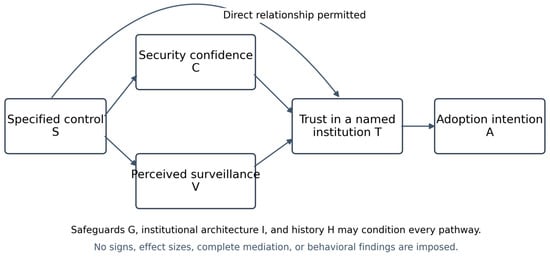
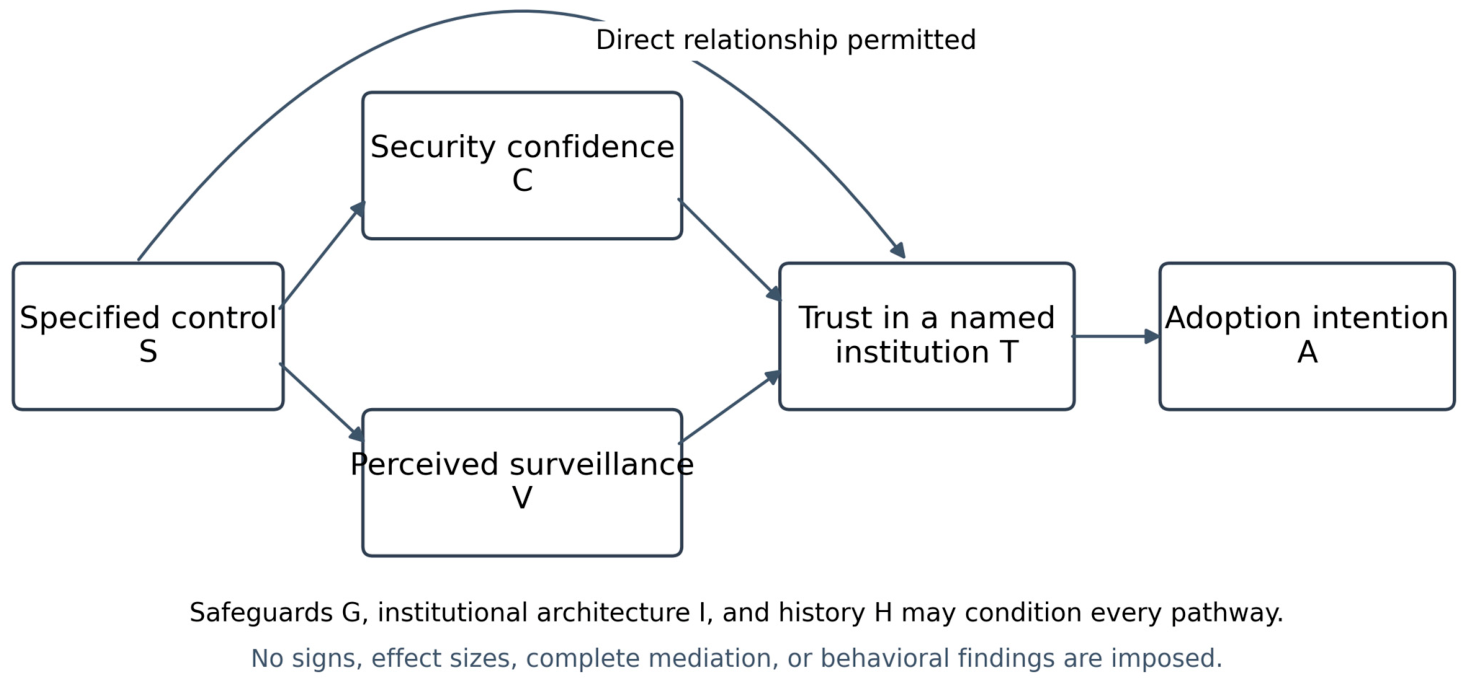

Disclaimer/Publisher’s Note: The statements, opinions and data contained in all publications are solely those of the individual author(s) and contributor(s) and not of MDPI and/or the editor(s). MDPI and/or the editor(s) disclaim responsibility for any injury to people or property resulting from any ideas, methods, instructions or products referred to in the content. |
© 2026 by the author. Licensee MDPI, Basel, Switzerland. This article is an open access article distributed under the terms and conditions of the Creative Commons Attribution (CC BY) license.