


Abstract
This study examines whether the differential equity-market response between trade-deficit and trade-surplus countries documented following the February 2025 U.S. tariff announcement persisted following the 2 April 2025 U.S. tariff announcement. Using an event-study framework and a sample of 21 countries classified according to their bilateral trade positions with the United States, the analysis evaluates abnormal market responses across comparable event windows. The results reveal a clear change in the pattern of market reactions. While the February episode was characterized by comparatively muted responses among trade-deficit countries and positive responses among trade-surplus countries, the April announcement was followed by significant negative cumulative responses across both groups. Thus, the specific response pattern documented following the February announcement was not reproduced in the April episode. One possible interpretation is that broader concerns associated with the April tariff shock may have outweighed anticipated benefits from trade reallocation; the event study does not directly test these mechanisms. The results have practical relevance for investors assessing international market exposure and diversification, firms evaluating the opportunities and risks associated with tariff-induced trade reallocation across trade-deficit and trade-surplus countries, and policymakers considering the wider international financial-market implications of tariff measures.
Keywords:
tariffs; trade balance; trade policy uncertainty; event study; trade reallocation; equity market reactions JEL Classification:
F13; F14; G14; G15
1. Introduction
The renewed use of tariffs as an instrument of U.S. trade policy has generated substantial uncertainty regarding their implications for international trade, economic activity, and financial markets (see, e.g., Baier & Bergstrand, 2001; Caldara et al., 2020; Bandyopadhyay et al., 2025; Shang et al., 2025; Kapar et al., 2025; Akhtaruzzaman et al., 2025; Özdurak & Yantur, 2025; Rotunno & Ruta, 2026). Tariff shocks can affect equity valuations through several channels, including changes in trade flows, firms’ costs and profitability, supply-chain disruptions, investment decisions, and expectations regarding future economic conditions. Their effects may also extend beyond directly targeted economies as firms and investors reassess international trade relationships and the potential responses of trading partners. Existing evidence consequently documents significant financial-market effects associated with trade-policy shocks and heightened trade-policy uncertainty (Boer et al., 2023; Bianconi et al., 2021). In particular, Bianconi et al. (2021) identify trade policy uncertainty (TPU) as a systematic risk factor affecting equity prices, highlighting a channel through which trade-policy shocks can have broader market consequences beyond their direct effects on bilateral trade.
The distinction between trade-deficit and trade-surplus countries is particularly relevant in the context of recent U.S. tariff policy. Concerns over persistent bilateral trade imbalances have been central to the rationale underlying the renewed use of tariffs. This motivation was especially evident in the 2 April 2025 announcement, which explicitly associated the new tariff regime with large and persistent U.S. goods trade deficits (The White House, 2025). McKibbin et al. (2025) similarly note the central role of bilateral trade balances in the structure of the 2025 tariff measures. Although the April tariffs were considerably broader than the measures announced earlier in the year, trade-deficit countries remained much more heavily targeted. Thus, the broader scope of the April measures did not eliminate meaningful differences in tariff exposure according to countries’ bilateral trade positions with the United States.
Such differences can generate both direct and indirect effects across trading partners. Tariffs alter bilateral trade costs and international competitive conditions, potentially redirecting trade flows and creating opportunities for countries outside the more directly affected trade relationships (Tinbergen, 1962; Krugman, 1986). Empirical evidence from the U.S.–China trade war supports this mechanism. Fajgelbaum et al. (2024) show that the tariff increases generated net export opportunities for third countries, with many “bystander” countries expanding exports of tariff-exposed products. McKibbin et al. (2025) similarly show that the 2025 tariffs can generate substantial trade diversion, with exports displaced from the U.S. market being redirected toward other markets, while retaliation magnifies the broader economic losses associated with the tariff shock. In the present setting, the greater tariff pressure faced by trade-deficit countries therefore creates potential scope for trade diversion and reallocation toward trade-surplus countries.
Recent evidence from Rao et al. (2025) is consistent with such a mechanism. Examining international equity-market responses to the 1 February 2025 U.S. tariff announcement, which targeted imports from Canada, Mexico, and China, Rao et al. classify countries according to whether they maintain a bilateral trade deficit or surplus with the United States. They document a pronounced difference in the responses of the two groups. Trade-deficit countries exhibit relatively muted and mixed market reactions, whereas trade-surplus countries experience significant positive cumulative average abnormal returns (CAARs) over the wider event windows. Specifically, trade-surplus countries record CAARs of 1.71% over (−3, +3) and 1.37% over (−5, +5), while neither group exhibits a statistically significant cumulative response over the narrower (−1, +1) window. Rao et al. interpret the positive response among trade-surplus countries as reflecting investor optimism regarding potential opportunities arising from trade diversion and reallocation.
The February and April 2025 U.S. tariff announcements differed substantially in their scope and country-specific implications. The 1 February announcement primarily targeted Canada and Mexico, with tariffs of 25%, and China, with an additional 10% tariff, while the remaining countries in the sample were not directly targeted by these measures. In contrast, the 2 April announcement introduced a much broader reciprocal tariff framework, comprising a 10% baseline tariff and higher country-specific rates for selected trading partners (The White House, 2025). Among the trade-deficit countries examined in this study, the announced rates included 46% for Vietnam, 36% for Thailand, 34% for China, 26% for India, 25% for South Korea, and 24% for Japan. Germany, Ireland, and Italy were covered by the 20% rate assigned to the European Union, whereas Canada and Mexico remained subject to separate tariff arrangements. The trade-surplus group also faced the broader tariff framework, with Belgium and the Netherlands covered by the EU rate and several other countries, including the United Kingdom, Singapore, the United Arab Emirates, Brazil, Chile, and Argentina, falling under the 10% baseline rate. Importantly, despite its broader geographical coverage, the April announcement continued to impose relatively higher tariff rates on several major trade-deficit partners of the United States, preserving meaningful differences in tariff exposure between the two groups. Consequently, the potential for trade diversion and reallocation toward trade-surplus countries remained relevant, even as the broader tariff measures introduced additional economic uncertainty and risks across international markets. The two episodes therefore provide distinct policy settings in which to examine whether the equity-market response pattern documented by Rao et al. (2025) was reproduced.
Whether this asymmetric response persists beyond the relatively targeted February tariff episode, however, remains an open question. The 2 April announcement provides a particularly informative setting in which to examine this issue. Although the April tariffs were considerably broader, trade-deficit countries remained much more heavily targeted, preserving the relative differences in tariff exposure underlying Rao et al.’s trade-balance classification. The economic conditions giving rise to potential trade diversion and reallocation therefore remained relevant: greater tariff pressure on trade-deficit countries could create opportunities for trade reallocation toward trade-surplus countries. If the trade-reallocation mechanism reflected in Rao et al.’s findings is persistent, the relative position of trade-surplus countries could continue to differentiate their equity-market responses following the April announcement.
At the same time, however, the April episode may have increased the importance of a competing channel. A broader escalation in tariff policy can generate uncertainty regarding future trade restrictions, retaliatory measures, supply-chain adjustments, investment, global demand, and firms’ expected cash flows. Trade-policy uncertainty has been identified as a systematic source of risk in equity markets (Bianconi et al., 2021), while recent evidence indicates that its relationship with stock returns becomes particularly important during high-uncertainty regimes and operates substantially through expectations regarding future cash flows (Yu et al., 2026). McKibbin et al. (2025) further show that the 2025 tariffs can generate adverse global economic effects that become larger when retaliation is incorporated. Thus, potential benefits from trade diversion and reallocation may coexist with broader adverse effects arising from heightened trade-policy uncertainty and deteriorating expectations regarding economic activity.
The April episode therefore provides a useful setting for examining these competing considerations without abandoning the trade-balance distinction at the center of Rao et al. (2025). On the one hand, the continued greater tariff exposure of trade-deficit countries preserves potential opportunities for trade-surplus countries through trade diversion and reallocation. On the other hand, the broader uncertainty and adverse economic implications associated with the April tariff shock may affect equity markets more generally and outweigh these potential benefits. Whether the trade-balance asymmetry documented following the February announcement persists under these conditions is ultimately an empirical question.
Against this background, this study examines international equity-market responses to the 2 April 2025 U.S. tariff announcement and asks whether the differential response between trade-deficit and trade-surplus countries documented by Rao et al. (2025) persists. Rather than providing another general assessment of international equity-market losses following the April tariffs, the analysis focuses specifically on countries’ bilateral trade positions with the United States. To facilitate direct comparison with Rao et al., we retain their trade-deficit and trade-surplus classification and examine the same three event windows, (−1, +1), (−3, +3), and (−5, +5), while evaluating market responses at both the individual-country and aggregate-group levels.
The results reveal a marked departure from the pattern documented following the February announcement. Consistent with Rao et al. (2025), neither trade-deficit nor trade-surplus countries exhibit statistically significant CAARs over the immediate (−1, +1) window. Over the wider windows, however, the results change substantially. Trade-deficit countries experience significant negative CAARs of approximately −7.0% over (−3, +3) and −8.0% over (−5, +5), while trade-surplus countries record significant negative CAARs of approximately −5.8% and −6.9%, respectively. Thus, the positive cumulative response previously documented among trade-surplus countries does not persist following the April announcement. Instead, significant negative cumulative responses emerge across both trade-balance groups.
One possible interpretation is that broader concerns associated with the April tariff shock may have outweighed anticipated benefits from trade diversion and reallocation. The event-study results do not directly identify these channels. Importantly, this interpretation does not imply that opportunities for trade diversion disappeared. McKibbin et al. (2025) show that trade diversion can remain substantial under the 2025 tariff regime. Rather, the equity-market evidence is consistent with the possibility that any expected benefits from such reallocation were outweighed by concerns associated with the broader trade-policy environment. This interpretation is consistent with evidence identifying TPU as a systematic source of equity-market risk and showing that its implications become particularly relevant during periods of elevated uncertainty (Bianconi et al., 2021; Yu et al., 2026).
This study contributes to the literature in two related respects. First, it examines whether the particular response pattern documented by Rao et al. (2025) following the February announcement was reproduced in April. By retaining their trade-deficit and trade-surplus classification and comparable event windows while examining a subsequent tariff episode, the study assesses whether the earlier response pattern extends beyond the February setting. Second, the study complements the emerging literature on the 2 April tariffs by shifting attention from the overall magnitude of international market losses to whether countries’ bilateral trade positions with the United States continue to differentiate their equity-market responses. The results show that the February response pattern was not reproduced in April: trade-surplus countries shift from the positive abnormal performance documented following the February announcement to significant negative cumulative abnormal returns, while trade-deficit countries shift from comparatively muted responses to substantial negative abnormal performance. The findings therefore suggest that the market implications of tariff announcements depend not only on countries’ trade positions and the associated scope for trade reallocation, but also on the broader uncertainty and economic effects generated by the underlying trade-policy shock.
The findings also have practical implications for investors, firms, and policymakers. Investors may benefit from considering the broader trade-policy environment alongside countries’ bilateral trade positions when assessing international market exposure and diversification. Firms may benefit from recognizing how their location in trade-deficit or trade-surplus countries can shape the opportunities and risks associated with tariff-induced trade reallocation, while also considering the broader market effects of tariff shocks. Policymakers, meanwhile, should consider that the financial-market effects of tariff announcements can extend across countries with different bilateral trade positions, highlighting the wider international market implications of tariff measures.
2. Data and Methodology
2.1. Data and Sample
This study examines the equity-market response to the U.S. tariff announcement of 2 April 2025. To facilitate direct comparison with Rao et al. (2025), countries are classified as trade-deficit or trade-surplus countries following their classification. The final sample comprises 21 countries, consisting of 12 trade-deficit and nine trade-surplus countries. The trade-deficit group includes Canada, China, Germany, India, Ireland, Italy, Japan, South Korea, Mexico, Russia, Thailand, and Vietnam, while the trade-surplus group comprises Argentina, Belgium, Brazil, Chile, Hong Kong, the Netherlands, Singapore, the United Arab Emirates, and the United Kingdom.
The classification of countries into trade-deficit and trade-surplus groups follows Rao et al. (2025) and is based on the United States’ bilateral merchandise trade balances in 2022, obtained from the World Integrated Trade Solution (WITS) database of the World Bank. Accordingly, a trade-deficit country refers to a country with which the United States recorded a bilateral merchandise trade deficit, while a trade-surplus country refers to a country with which the United States recorded a bilateral merchandise trade surplus. Retaining this classification ensures comparability with the February 2025 tariff episode examined by Rao et al. Although the binary classification facilitates the assessment of whether the previously documented response pattern persists, it does not capture differences in bilateral trade volumes, export composition, or the intensity of tariff exposure across individual countries.
Daily closing prices for the major national equity-market index of each country are obtained from Investing.com. The MSCI All Country World Index (MSCI ACWI) is employed as the global market benchmark. The use of national equity indices captures the market-wide response within each country and permits a consistent comparison of equity-market reactions across the two trade-balance groups.
Daily continuously compounded returns are calculated as
where Ri,t denotes the return on the equity index of country i on day t, and Pi,t and Pi,t−1 denote the corresponding closing index values on days t and t − 1, respectively. Results are reported in percentages.
The event date (t = 0) is 2 April 2025. Following Rao et al. (2025), three symmetric event windows are considered: (−1, +1), (−3, +3), and (−5, +5). Maintaining the same event windows facilitates direct comparison between the cumulative market responses surrounding the April announcement and those documented by Rao et al. following the February tariff announcement.
The reported estimates retain 2 April 2025 as the common calendar event date. The official transcript records the tariff announcement as beginning at 4:06 p.m. Eastern Daylight Time (EDT), after the closing of Asian and European equity markets (Office of the Federal Register, 2025). To account for differences in international trading hours, the analysis examines daily abnormal returns for each country throughout the (−5, +5) event window, alongside cumulative abnormal returns over three windows: (−1, +1), (−3, +3), and (−5, +5). Even the shortest window includes the first post-announcement trading session for markets that had already closed, while the wider windows capture subsequent market adjustments. Thus, the analysis does not rely exclusively on announcement-day returns, although the use of a common calendar event date does not fully synchronize the first information-relevant trading session across markets.
2.2. Event-Study Methodology
The market response to the 2 April tariff announcement is examined using the standard event-study methodology, which provides a well-established framework for assessing the effect of new information on security prices over a relatively short period surrounding an identifiable event (MacKinlay, 1997). Expected returns are estimated using the market model:
where Ri,t is the return on the equity index of country i on day t, Rm,t is the return on the MSCI ACWI, αi and βi are the market-model parameters, and εi,t is the error term.
The market-model parameters are estimated over the (−120, −11) estimation window relative to the event date. Abnormal returns (ARs) are then calculated as the difference between the observed and expected returns:
For each country, cumulative abnormal returns (CARs) are calculated over the three event windows:
where τ1 and τ2 denote the beginning and end of the respective event window. While daily ARs identify the timing of individual market reactions, CARs capture the cumulative response over the event window and therefore provide a more complete picture of the adjustment of individual equity markets to the tariff announcement.
To examine the aggregate response of the two country groups, average abnormal returns (AARs) are calculated separately for trade-deficit and trade-surplus countries as
where N denotes the number of countries in the respective group. Cumulative average abnormal returns (CAARs) are subsequently calculated as
AARs therefore measure the average daily response within each group, whereas CAARs capture the cumulative group response over the (−1, +1), (−3, +3), and (−5, +5) event windows.
Statistical significance is assessed using both parametric and non-parametric tests. This combination is useful because non-parametric procedures impose fewer assumptions on the distribution of abnormal returns and can complement conventional parametric inference. In particular, rank-based procedures have been shown to provide useful properties in event-study applications (Corrado, 1989). The analysis therefore employs a broad battery of tests, including the Patell test, cross-sectional and standardized cross-sectional tests, sign and generalized sign tests, rank and generalized rank tests, and adjusted and skewness-corrected specifications where applicable. The use of alternative testing procedures provides a robustness assessment of the statistical evidence rather than relying on the assumptions of any single test.
This consideration is particularly relevant in the present setting because the same tariff announcement constitutes a common event across international equity markets, potentially inducing cross-sectional dependence in abnormal returns. Event-study inference can be affected by such dependence when events are clustered on a common date (Kolari & Pynnönen, 2010). Accordingly, the results are evaluated across multiple parametric and non-parametric specifications, including adjusted test statistics. The statistical procedures reported in the empirical results section provide evidence on the robustness of the AAR and CAAR results across these alternative testing approaches.
The analysis is implemented using EventStudyTools (Wolf et al., 2014), employing logarithmic returns and the market model throughout. If the event date corresponds to a non-trading day for a particular market, the subsequent trading day is used. The analysis is conducted separately for the trade-deficit and trade-surplus country groups, allowing the direction, magnitude, timing, and statistical significance of their responses to the 2 April tariff announcement to be compared directly.
3. Empirical Results and Discussion
3.1. Individual-Country Market Responses
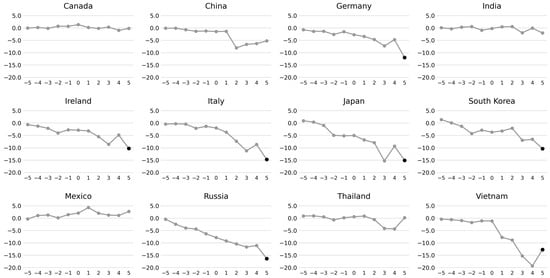
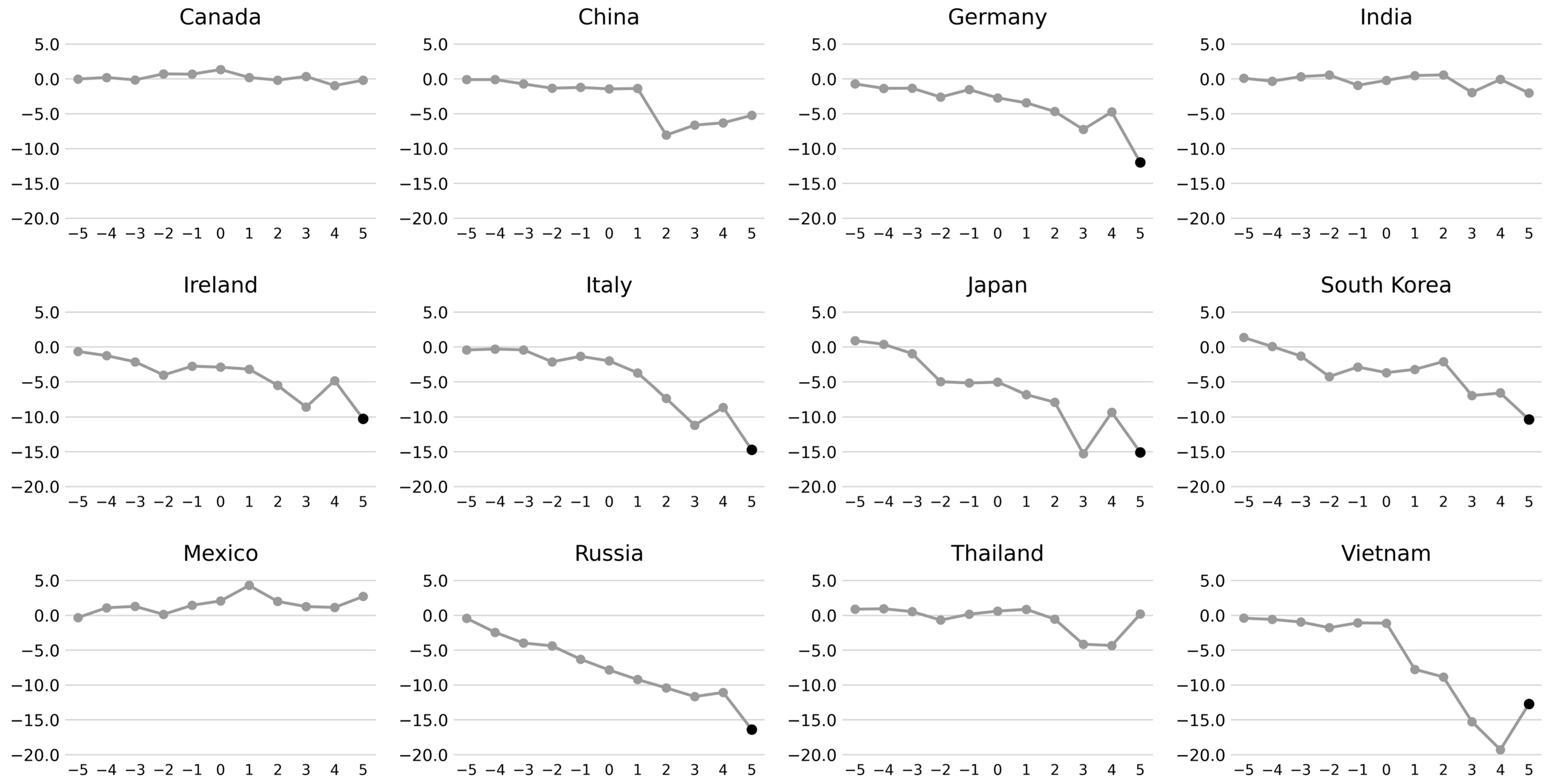
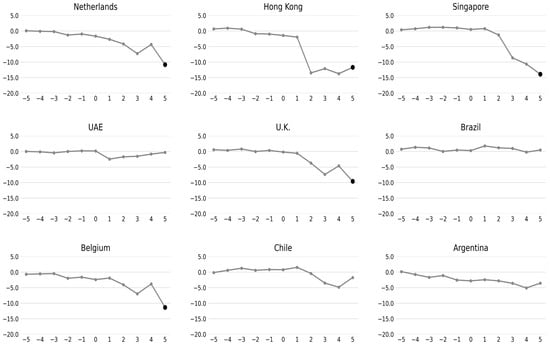
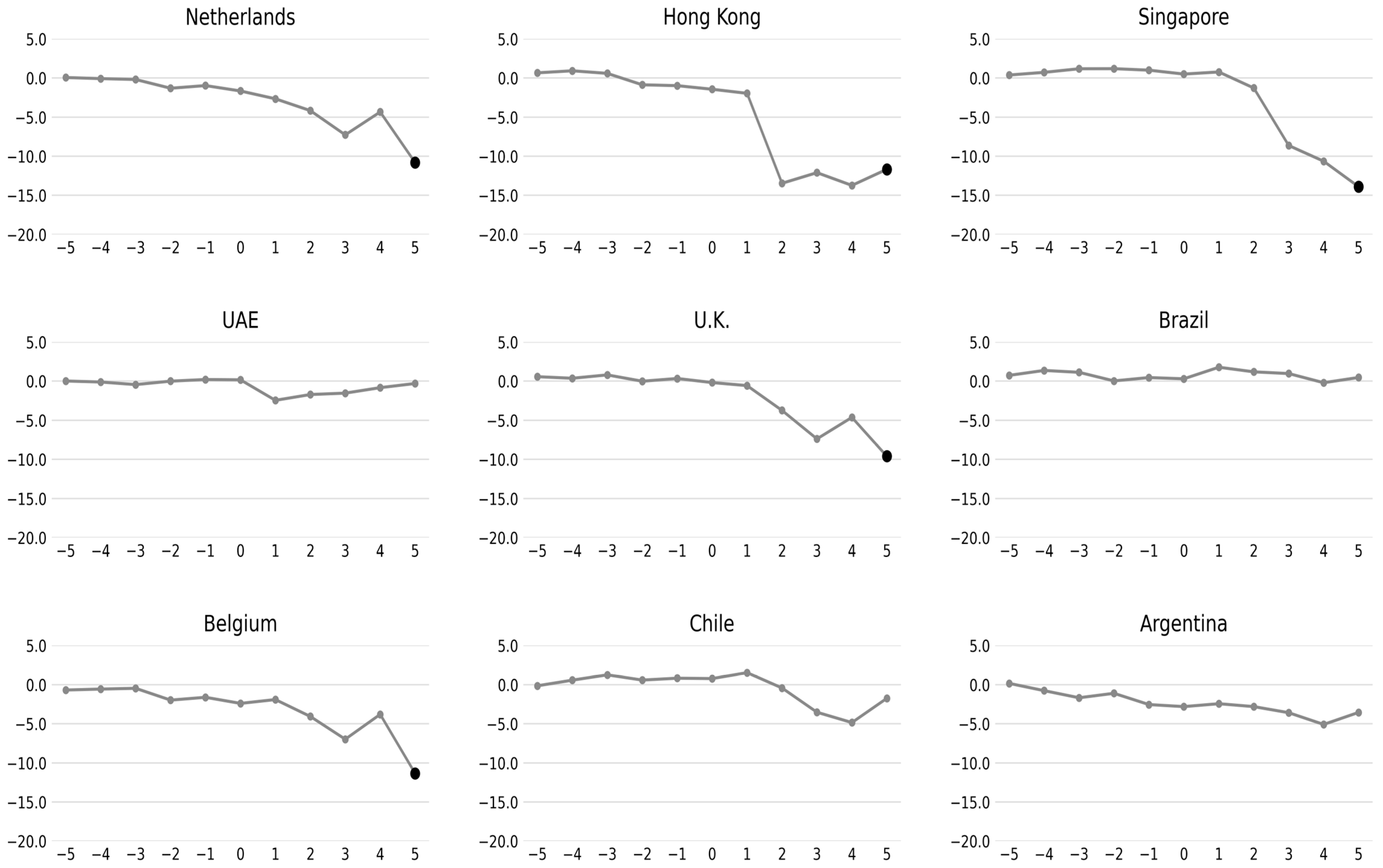
Table 1 and Table 2 report daily abnormal returns (ARs) and cumulative abnormal returns (CARs) for individual trade-deficit and trade-surplus countries, respectively, while Figure 1 and Figure 2 illustrate the corresponding cumulative abnormal-return patterns over the event period. The country-level results reveal considerable heterogeneity in both the magnitude and timing of equity-market responses to the 2 April tariff announcement. Nevertheless, a predominantly negative cumulative pattern emerges across both country groups as the event window expands.
Table 1.
Abnormal returns (ARs) and cumulative abnormal returns (CARs) for individual trade-deficit countries.
Table 2.
Abnormal returns (ARs) and cumulative abnormal returns (CARs) for individual trade-surplus countries.
Figure 1.
Cumulative abnormal returns (CARs) for trade-deficit countries. Note: The figure plots cumulative abnormal returns (CARs), in percentages, from day −5 to day +5 relative to the 2 April 2025 tariff announcement (day 0). A dark-black endpoint indicates that the CAR over the (−5, +5) event window is statistically significant at the 10% level or better.
Figure 2.
Cumulative abnormal returns (CARs) for trade-surplus countries. Note: The figure plots cumulative abnormal returns (CARs), in percentages, from day −5 to day +5 relative to the 2 April 2025 tariff announcement (day 0). A dark-black endpoint indicates that the CAR over the (−5, +5) event window is statistically significant at the 10% level or better.
Among trade-deficit countries, the immediate cumulative responses over the (−1, +1) window are generally limited. Only Mexico and Vietnam exhibit statistically significant CARs, with a positive response for Mexico and a negative response for Vietnam. The picture changes considerably over the wider event windows. Over (−3, +3), Germany, Ireland, Italy, Japan, South Korea, Russia, Thailand, and Vietnam exhibit statistically significant negative CARs, with the largest decline observed for Japan. The negative adjustment remains pronounced over (−5, +5), with substantial cumulative losses recorded across several deficit-country markets. These results indicate that the adverse response among trade-deficit countries was neither uniform across markets nor concentrated exclusively around the announcement date.
The daily ARs further indicate that an important part of the negative adjustment occurred during the days following the announcement. Several deficit-country markets experience their largest negative abnormal returns after t = 0, particularly around days +2 and +3. This pattern is also apparent in Figure 1, where the cumulative abnormal-return paths of several markets deteriorate substantially following 2 April. The country-level evidence therefore suggests that the full market implications of the announcement were reflected over several trading days rather than entirely in the immediate event window.
A broadly similar pattern emerges among trade-surplus countries. Immediate CARs over (−1, +1) are generally limited, whereas the wider event windows reveal considerably stronger negative responses. Belgium, Chile, Hong Kong, the Netherlands, Singapore, and the United Kingdom record significant negative CARs over (−3, +3), with particularly pronounced declines in some markets. Over (−5, +5), substantial negative cumulative responses remain evident for Belgium, Hong Kong, the Netherlands, Singapore, and the United Kingdom. Figure 2 similarly illustrates a broad deterioration in cumulative abnormal performance across several surplus-country equity markets following the announcement.
Taken together, the individual-country evidence shows that the negative response to the April announcement was not confined to trade-deficit economies. Substantial cumulative losses also emerged across several trade-surplus markets. At the same time, the considerable cross-country heterogeneity makes the aggregate evidence particularly important for examining the aggregate response patterns of the two trade-balance groups.
3.2. Aggregate Market Responses
Table 3 reports average abnormal returns (AARs) for the trade-deficit and trade-surplus groups over the (−5, +5) event period. The daily results reinforce the pattern observed at the individual-country level: the strongest market responses were not concentrated on 2 April itself but developed during the subsequent trading days.
Table 3.
Average abnormal return (AAR) results.
For trade-deficit countries, the event-day AAR is −0.17% and is not statistically significant. The average response subsequently becomes considerably more negative, reaching −0.82% on day +1, −1.68% on day +2, and −2.86% on day +3. The negative responses on the latter days receive broad statistical support across the reported tests. Although the group records a positive AAR of 1.02% on day +4, this is followed by a further negative response of −1.76% on day +5.
Trade-surplus countries exhibit a related pattern. Their event-day AAR is −0.38%, while the strongest negative average responses emerge after the announcement, particularly on days +2 and +3, when AARs reach −2.51% and −2.17%, respectively. A further negative AAR of −1.59% occurs on day +5. Thus, both trade-deficit and trade-surplus groups display pronounced negative average responses during the post-announcement period.
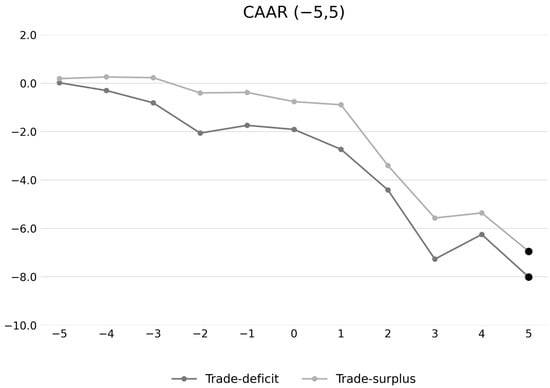
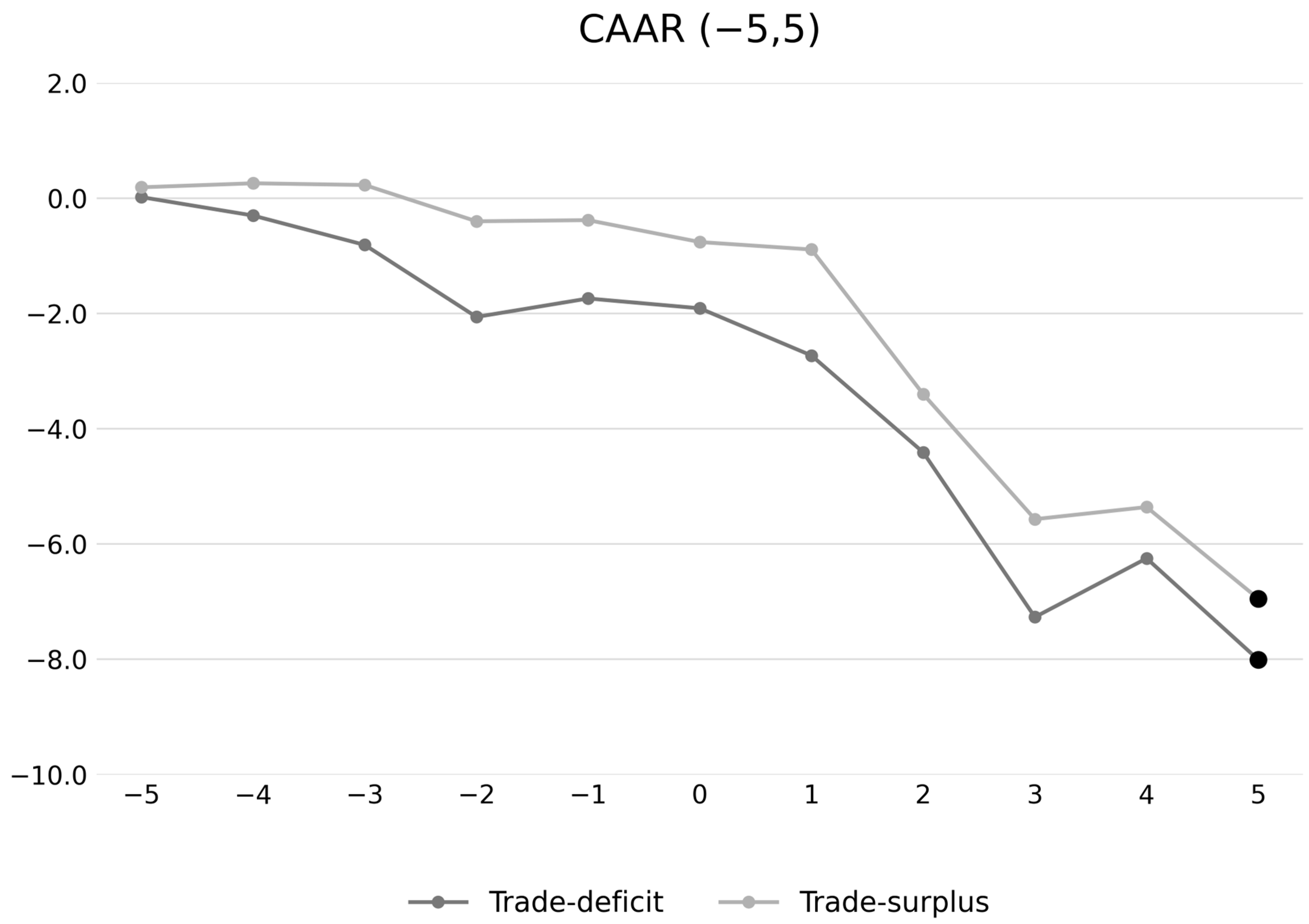
The cumulative evidence reported in Table 4 provides the clearest assessment of the aggregate response. Over the narrow (−1, +1) window, the CAARs are relatively small—approximately −0.7% for trade-deficit countries and −0.5% for trade-surplus countries—and are not statistically significant. The results change markedly as the event window expands. Over (−3, +3), trade-deficit countries record a CAAR of approximately −7.0%, while trade-surplus countries record a CAAR of approximately −5.8%. Over (−5, +5), the corresponding losses increase to approximately −8.0% and −6.9%, respectively. These negative CAARs are consistently supported by the broad battery of parametric and non-parametric tests reported in Table 4, indicating that the central findings are not dependent on a particular testing procedure.
Table 4.
Cumulative average abnormal return (CAAR) results.
Figure 3 reinforces these results by tracing the cumulative average abnormal-return paths of the two groups. Both series exhibit pronounced downward movements following the announcement, with somewhat larger cumulative losses for the trade-deficit group by the end of the event period. More importantly for the purpose of this study, however, the two groups move in the same negative direction. Thus, the April evidence is not characterized simply by negative responses among trade-deficit countries; substantial negative cumulative responses extend to the trade-surplus group as well.
Figure 3.
Cumulative average abnormal returns (CAARs) for trade-deficit and trade-surplus country groups. Note: The figure plots cumulative average abnormal returns (CAARs), in percentages, for the trade-deficit and trade-surplus country groups from day −5 to day +5 relative to the 2 April 2025 tariff announcement (day 0). A dark-black endpoint indicates that the CAAR over the (−5, +5) event window is statistically significant at the 10% level or better.
The difference between the narrow and wider event windows is also noteworthy. The insignificant CAARs over (−1, +1), followed by pronounced negative CAARs over (−3, +3) and (−5, +5), indicate that the cumulative response developed over several trading days. This pattern is consistent with the daily AAR evidence, particularly the substantial negative responses on days +2 and +3. It should not necessarily be interpreted as evidence of inefficient price adjustment, since the wider windows may also capture investors’ evolving assessment of the announcement and related information concerning its implications for future trade policy, retaliation, supply chains, and economic activity.
3.3. Comparison with Rao et al. (2025) and Interpretation
The aggregate findings provide a markedly different picture from that documented by Rao et al. (2025) following the February tariff announcement. One important similarity nevertheless emerges. Rao et al. report no statistically significant cumulative response for either trade-balance group over the (−1, +1) window, and the April results yield the same conclusion. Thus, the absence of a significant immediate cumulative response persists across the two tariff episodes.
The comparison changes fundamentally over the wider event windows. Following the February announcement, Rao et al. document comparatively muted responses among trade-deficit countries, whereas trade-surplus countries experience statistically significant positive CAARs of 1.71% over (−3, +3) and 1.37% over (−5, +5). They interpret the positive response among trade-surplus markets as reflecting investor optimism regarding potential benefits from trade diversion and reallocation. In the April episode, by contrast, both groups experience substantial negative cumulative abnormal performance. Trade-deficit countries record CAARs of approximately −7.0% and −8.0% over (−3, +3) and (−5, +5), respectively, while trade-surplus countries record corresponding CAARs of approximately −5.8% and −6.9%. The particular response pattern documented following the February announcement was therefore not reproduced following the 2 April tariff announcement.
The comparison between the two episodes should nevertheless be interpreted in light of differences in the scope, targeting, and broader economic context of the tariff announcements. Whereas the February measures were relatively targeted, the April announcement involved a substantially broader set of trade restrictions, potentially generating more widespread concerns regarding international trade, economic activity, and policy uncertainty. These differences may have contributed to the contrasting market responses observed across the two episodes. Accordingly, the findings do not imply that trade-balance asymmetries have generally disappeared or that bilateral trade positions are no longer relevant to equity-market reactions. Rather, they show that the particular response pattern documented by Rao et al. (2025) following the February announcement was not reproduced following the April announcement. Whether similar patterns emerge under other tariff-policy conditions remains an open empirical question.
This reversal is particularly informative because the economic basis for distinguishing the two groups had not disappeared. Although the April tariffs were broader than the February measures, several major U.S. trade-deficit partners continued to face relatively higher tariff rates. The relative difference in tariff exposure therefore continued to provide potential scope for trade diversion and reallocation toward trade-surplus countries. Indeed, McKibbin et al. (2025) show that the 2025 tariff regime can generate substantial trade diversion, as exports displaced from the U.S. market are redirected toward third-country markets. Consequently, the negative response of trade-surplus equity markets should not be interpreted as evidence that the potential for trade diversion or reallocation had disappeared.
One possible interpretation is that investors’ concerns about the broader implications of the April tariff shock may have outweighed anticipated benefits from trade diversion and reallocation. This interpretation is consistent with evidence on the financial-market implications of trade-policy uncertainty. Bianconi et al. (2021) identify TPU as a systematic risk factor affecting equity prices, implying that heightened uncertainty surrounding trade policy can have market-wide valuation effects beyond the countries or industries most directly exposed to particular tariff measures. Yu et al. (2026) further show that TPU contains significant information about aggregate stock returns, particularly during high-uncertainty regimes, and that its predictive effects operate importantly through expected cash flows. These findings suggest a possible economic interpretation of why the potential relative advantages associated with trade reallocation did not translate into positive equity-market performance among trade-surplus countries following 2 April.
The broader economic effects of the 2025 tariffs reinforce this interpretation. McKibbin et al. (2025) show that tariff escalation can adversely affect global economic activity and that retaliation magnifies the resulting economic losses. A broad tariff shock can therefore affect equity valuations through several interconnected channels, including expectations regarding firms’ revenues and costs, supply-chain adjustments, investment, global demand, and the possibility of retaliatory policy measures. These effects need not be confined to the economies facing the highest direct tariffs. Consequently, relatively lower tariff exposure may provide only limited protection when investors perceive the policy shock as having broader implications for the international trading environment.
The contrast between the February and April episodes can therefore be understood in terms of competing effects. Differential tariff targeting creates potential opportunities for trade-surplus countries through trade diversion and reallocation—the mechanism emphasized by Rao et al. (2025). At the same time, tariff escalation can generate a broader uncertainty effect that adversely influences equity valuations across markets. Following the more targeted February measures, Rao et al. interpret the positive cumulative abnormal performance of trade-surplus markets as reflecting investor optimism regarding potential trade-reallocation opportunities. Following the April announcement, however, the significant negative responses of both groups are consistent with an interpretation in which these potential relative benefits may have been outweighed by the broader uncertainty and adverse economic implications associated with the tariff shock.
This interpretation is particularly relevant for the trade-surplus group. Although the April tariff structure continued to differentiate between countries according to their bilateral trade positions with the United States, trade-surplus countries potentially stood to benefit from the reallocation of trade away from trade-deficit economies facing greater tariff pressure. Nevertheless, their CAARs shift from significantly positive following the February announcement to significantly negative following 2 April. This reversal provides the clearest evidence that the particular February response pattern was not reproduced in the April episode. It also suggests that countries’ bilateral trade positions alone cannot fully account for international equity-market responses when the broader policy environment changes substantially.
The results should not, however, be interpreted as rejecting the possibility of trade diversion or the mechanism proposed by Rao et al. Trade diversion may occur in the real economy even when equity markets respond negatively, and McKibbin et al. (2025) provide evidence that substantial diversion can arise under the 2025 tariff regime. The present evidence instead concerns the valuation of those potential benefits by financial markets. One possible interpretation is that investors’ concerns regarding the broader implications of the tariff announcement may have outweighed anticipated gains associated with trade reallocation. The findings therefore suggest a potential boundary condition on the market response identified by Rao et al.: the positive equity-market response associated with potential trade-reallocation opportunities in the February episode does not persist when the subsequent tariff episode is accompanied by broader uncertainty and adverse expectations across international markets.
It is important to distinguish the empirical findings from the economic mechanisms that may explain them. The event-study analysis identifies abnormal equity-market responses surrounding the tariff announcement but does not directly measure trade diversion, trade-policy uncertainty, or their respective contributions to stock-market performance. Accordingly, the possibility that broader uncertainty and adverse economic expectations outweighed anticipated benefits from trade reallocation should be regarded as a plausible interpretation, consistent with the existing literature, rather than an empirically established causal mechanism. Other factors associated with the April tariff episode may also have contributed to the observed market reactions. Identifying the relative importance of these channels requires further investigation beyond the scope of the present study.
Overall, the April evidence indicates that the particular equity-market response pattern documented following the February tariff announcement was not reproduced in the April episode. Importantly, the negative cumulative response following 2 April is not confined to trade-deficit countries. Trade-surplus countries, despite the potential opportunities associated with trade diversion and reallocation, also experienced substantial negative cumulative abnormal returns. The findings suggest that understanding the market implications of tariff announcements requires considering not only countries’ bilateral trade positions and the associated scope for trade reallocation, but also the broader uncertainty and economic effects surrounding the underlying trade-policy shock.
4. Conclusions
This study examines whether the differential equity-market response between trade-deficit and trade-surplus countries documented by Rao et al. (2025) following the February 2025 U.S. tariff announcement persists following the 2 April tariff episode. By retaining Rao et al.’s country classification and comparable event windows, the analysis examines whether the earlier response pattern was reproduced following the April announcement. The results show that this specific pattern was not reproduced: unlike the comparatively muted response of trade-deficit countries and positive response of trade-surplus countries documented following the February announcement, the April episode is characterized by significant negative cumulative responses across both trade-balance groups.
One possible interpretation is that concerns about the broader adverse implications of the April tariff shock may have outweighed anticipated benefits from trade reallocation. However, the event-study analysis does not directly identify the underlying economic mechanisms. The results therefore suggest that countries’ bilateral trade positions alone cannot fully account for international equity-market responses across tariff episodes, and that the broader uncertainty and economic effects surrounding the underlying trade-policy shock may also shape how financial markets value potential trade-reallocation opportunities.
The findings also open avenues for further research. Future studies could examine whether the different response patterns of trade-deficit and trade-surplus markets extend to other tariff and trade-policy episodes and investigate more directly the channels underlying these responses. In particular, examining the interaction between bilateral trade positions, tariff exposure, trade reallocation, and trade-policy uncertainty could provide further insight into how international financial markets respond to changes in the global trade-policy environment.
Author Contributions
A.A.S.: conceptualization, data curation, formal analysis, investigation, methodology, project administration, resources, software, validation, visualization, writing—original draft, writing—review and editing. N.F.A.: data curation, project administration, supervision, visualization, writing—review and editing. A.A.-K.: supervision, validation, visualization, writing—review and editing. A.A.: project administration, resources, software, writing—review and editing. All authors have read and agreed to the published version of the manuscript.
Funding
This research received no external funding.
Institutional Review Board Statement
Not applicable.
Informed Consent Statement
Not applicable.
Data Availability Statement
The raw data used in this study were derived from the following resources available in the public domain: [Investing.com, https://www.investing.com].
Acknowledgments
This research has been carried out during sabbatical leave granted to Ali A. Shehadeh from the University of Jordan during the academic year 2026−2027. During the preparation of this manuscript, the authors used ChatGPT and Grammarly (web-based version) solely for language refinement, including improving grammar, clarity, and readability. All conceptualization, analysis, and interpretation were conducted by the authors, who take full responsibility for the final content of the manuscript. After using these tools, the authors reviewed and edited the content as needed and take full responsibility for the content of the published article.
Conflicts of Interest
The authors declare no conflicts of interest.
References
- Akhtaruzzaman, M., Boubaker, S., Hegazi, A., & Manita, R. (2025). Does the US reciprocal tariff announcement trigger financial contagion? Journal of Accounting Literature, 1–20. [Google Scholar] [CrossRef] [Scilit]
- Baier, S. L., & Bergstrand, J. H. (2001). The growth of world trade: Tariffs, transport costs, and income similarity. Journal of International Economics, 53(1), 1–27. [Google Scholar] [CrossRef] [Scilit]
- Bandyopadhyay, S., Ferraro, D., & Bower, L. O. V. (2025). How do tariffs impact the US economy? Economics Letters, 254, 112406. [Google Scholar] [CrossRef] [Scilit]
- Bianconi, M., Esposito, F., & Sammon, M. (2021). Trade policy uncertainty and stock returns. Journal of International Money and Finance, 119, 102492. [Google Scholar] [CrossRef] [Scilit]
- Boer, L., Menkhoff, L., & Rieth, M. (2023). The multifaceted impact of US trade policy on financial markets. Journal of Applied Econometrics, 38(3), 388–406. [Google Scholar] [CrossRef] [Scilit]
- Caldara, D., Iacoviello, M., Molligo, P., Prestipino, A., & Raffo, A. (2020). The economic effects of trade policy uncertainty. Journal of Monetary Economics, 109, 38–59. [Google Scholar] [CrossRef] [Scilit]
- Corrado, C. J. (1989). A nonparametric test for abnormal security-price performance in event studies. Journal of Financial Economics, 23(2), 385–395. [Google Scholar] [CrossRef] [Scilit]
- Fajgelbaum, P., Goldberg, P., Kennedy, P., Khandelwal, A., & Taglioni, D. (2024). The US-China trade war and global reallocations. American Economic Review: Insights, 6(2), 295–312. [Google Scholar] [CrossRef] [Scilit]
- Kapar, B., Buigut, S., & Billah, S. M. (2025). The short-term reaction of financial markets to the US trade tariff announcement. Finance Research Letters, 86, 108452. [Google Scholar] [CrossRef] [Scilit]
- Kolari, J. W., & Pynnönen, S. (2010). Event study testing with cross-sectional correlation of abnormal returns. The Review of Financial Studies, 23(11), 3996–4025. [Google Scholar] [CrossRef] [Scilit]
- Krugman, P. R. (Ed.). (1986). Strategic trade policy and the new international economics. MIT Press. [Google Scholar]
- MacKinlay, A. C. (1997). Event studies in economics and finance. Journal of Economic Literature, 35(1), 13–39. [Google Scholar]
- McKibbin, W. J., Noland, M., & Shuetrim, G. (2025). The global economic effects of Trump’s 2025 tariffs (Working Paper 25-13). Peterson Institute for International Economics. [Google Scholar]
- Office of the Federal Register. (2025, April 2). Remarks announcing additional United States tariff actions on foreign imports. In Daily compilation of presidential documents (DCPD−202500423). National Archives and Records Administration. Available online: https://www.govinfo.gov/content/pkg/DCPD−202500423/html/DCPD−202500423.htm (accessed on 19 November 2026).
- Özdurak, C., & Yantur, P. (2025). The US reciprocal tariff announcement: An analysis of market reactions. Journal of Risk and Financial Management, 18(10), 565. [Google Scholar] [CrossRef] [Scilit]
- Rao, A., Lucey, B., & Kumar, S. (2025). Financial market reactions to US tariff announcements: Evidence from trade-surplus and trade-deficit countries. Finance Research Letters, 81, 107465. [Google Scholar] [CrossRef] [Scilit]
- Rotunno, L., & Ruta, M. (2026). Trade partners’ responses to US tariffs. IMF Economic Review, 2025, 1–38. [Google Scholar] [CrossRef] [Scilit]
- Shang, M., Zhang, L., Duan, H., Wang, L., & Xiao, N. (2025). Trade policy uncertainty, shipping risk, and commodity markets. Finance Research Letters, 73, 106604. [Google Scholar] [CrossRef] [Scilit]
- The White House. (2025). Executive order 14257. The White House. [Google Scholar]
- Tinbergen, J. (1962). Shaping the world economy: Suggestions for an international economic policy. Twentieth Century Fund. [Google Scholar]
- Wolf, M., Schimmer, M., & Levchenko, A. (2014). EventStudyTools (Research apps), St. Gallen. Available online: http://www.eventstudytools.com (accessed on 10 July 2026).
- Yu, D., Tang, J., & Zhou, M. (2026). Trade policy uncertainty and stock returns: A tale of two periods. International Review of Financial Analysis, 109, 104789. [Google Scholar] [CrossRef] [Scilit]

Disclaimer/Publisher’s Note: The statements, opinions and data contained in all publications are solely those of the individual author(s) and contributor(s) and not of MDPI and/or the editor(s). MDPI and/or the editor(s) disclaim responsibility for any injury to people or property resulting from any ideas, methods, instructions or products referred to in the content. |
© 2026 by the authors. Licensee MDPI, Basel, Switzerland. This article is an open access article distributed under the terms and conditions of the Creative Commons Attribution (CC BY) license.