


Abstract
This study examines whether sustainability disclosure is associated with firm performance through tax avoidance, and whether female board representation conditions these relations, using a panel of 42 non-financial firms listed on the Egyptian Exchange over 2020–2024. We estimate a moderated-mediation model (Hayes’ Model 8) in which sustainability disclosure affects return on assets directly and indirectly through tax avoidance, and female board representation conditions both paths. Sustainability disclosure is measured with an environmental, social, and governance disclosure index. Tax avoidance is captured by cash- and GAAP-based effective tax rate differentials. Estimation uses two-way fixed effects, firm-clustered standard errors, and 5000-draw firm-cluster bootstrap confidence intervals. The average association between disclosure and return on assets is positive but statistically insignificant. Sustainability disclosure is positively associated with GAAP-based tax avoidance, although only at the 10% level, and is not associated with cash-based tax avoidance; the GAAP-based association is stronger when disclosure is lagged. This pattern is consistent with, but does not establish, a legitimacy-driven use of disclosure. However, tax avoidance is not significantly associated with return on assets, so the indirect effect of disclosure on performance through tax avoidance is statistically indistinguishable from zero, and an equivalence test rejects indirect effects of 0.5 percentage points of return on assets or more per standard-deviation increase in disclosure. Female board representation is strongly and negatively associated with both cash- and GAAP-based tax avoidance, but it does not moderate the disclosure–tax avoidance link in the main specification. Instead, it negatively moderates the direct path (H4b supported): the disclosure–performance association declines as female representation rises, and the firm-cluster bootstrap interval for this interaction excludes zero. Bootstrap intervals do not, however, establish a significant positive association at any specific level of representation. Critical-mass tests show that the association weakens once a second woman joins the board, but they cannot distinguish a threshold at two women from a gradual weakening as the number of women rises. The moderation is present for both the environmental and social pillars. The direct-path moderation holds under random effects, lagged disclosure, and exclusion of the COVID-19 year, but not under pooled OLS, one-year-ahead return on assets or earnings per share. The evidence therefore does not support a tax-saving channel between disclosure and performance, and it associates female board representation with lower tax avoidance directly rather than with a weaker disclosure–tax avoidance link. All findings are conditional associations rather than causal effects.
1. Introduction
Whether sustainability pays has been one of the most persistent questions in accounting and finance research. Meta-analytic evidence suggests that corporate social and environmental activity is, on average, positively related to financial performance (Orlitzky et al., 2003; Friede et al., 2015). Nevertheless, the mechanisms behind this association remain poorly understood, particularly in emerging markets where disclosure is often voluntary, enforcement is weak, and the line between substantive commitment and impression management is blurred (Cho & Patten, 2007; Clarkson et al., 2008). This study examines one mechanism that has received limited direct attention: corporate tax avoidance. We ask whether sustainability disclosure is associated with performance partly because it gives firms the legitimacy to pay less tax, and whether female directors on the board open or close that channel. Throughout the paper, corporate sustainability disclosure (CSD) refers to what firms report about their environmental, social, and governance (ESG) activities. It is distinct from sustainability performance (what firms actually do) and from genuine commitment to sustainability. We measure only disclosure; we refer to performance or commitment only when reviewing prior studies or when interpreting our results, and we flag such interpretations as conjectures. Similarly, we use female board representation for the share of board seats held by women in our sample, and board gender diversity when referring to the broader literature.
The link between corporate social responsibility (CSR) and tax behaviour is theoretically contested. A stakeholder and ethics view holds that paying a fair share of tax is itself a core social responsibility, so firms that are genuinely committed to sustainability should avoid paying less tax (Avi-Yonah, 2008; Hoi et al., 2013; Lanis & Richardson, 2015). A legitimacy and impression-management view holds the opposite: firms that engage in aggressive tax planning have an incentive to disclose more sustainability information to offset the reputational and political costs of that behaviour (Sikka, 2010; Lanis & Richardson, 2013). Empirical evidence is mixed. Davis et al. (2016) find that socially responsible US firms do not pay more tax and may lobby for lower taxes. Watson (2015) shows that the CSR–tax avoidance relation depends on earnings performance. In Egypt, Abdelfattah and Aboud (2020) report that tax avoidance is positively associated with CSR disclosure over 2007–2016, consistent with a legitimacy motive.
If disclosure and tax avoidance are linked, a further question follows. Much of the reported “CSR pays” evidence uses after-tax accounting returns. If sustainability-disclosing firms systematically pay less tax, part of the apparent performance benefit of disclosure could be a tax saving rather than a return on stakeholder relationships. The two interpretations have very different implications. The first implies that disclosure creates value through better stakeholder relations, lower capital costs, and stronger reputation (Dhaliwal et al., 2011). The second implies that disclosure partly redistributes value from the state to shareholders under a legitimacy cover. Most existing studies treat tax avoidance either as an outcome of CSR or as a control variable. A small number of recent studies test tax avoidance as a mediator, with mixed results. Yuan et al. (2025) report that tax avoidance is one channel through which ESG disclosure raises the long-term value of Chinese listed firms, whereas Saputra et al. (2026) find that tax avoidance does not mediate the relationship between CSR and profitability among Indonesian manufacturing firms. Neither study examines whether the composition of the board conditions the mediation process, and neither is set in a market where mandatory ESG reporting and board gender requirements changed at the same time. Our study addresses these gaps by asking whether the tax-avoidance channel and the direct disclosure–performance relation depend on female board representation in such a setting.
Board gender diversity offers a natural conditioning factor. Female directors are associated with more conservative risk-taking (Byrnes et al., 1999; Huang & Kisgen, 2013), stronger monitoring (Adams & Ferreira, 2009), higher earnings quality (Srinidhi et al., 2011) and lower tax aggressiveness (Lanis et al., 2017; Richardson et al., 2016; Jarboui et al., 2020). Female directors may therefore either reduce the extent to which disclosure is used to legitimise tax avoidance or change how disclosure relates to performance more broadly. Critical mass theory adds a further nuance: a single woman on a board is often a token whose influence is limited, while three or more women can change board dynamics (Kanter, 1977; Konrad et al., 2008; Torchia et al., 2011).
Egypt provides a timely and policy-relevant setting. In July 2021, the Financial Regulatory Authority (FRA) issued Decrees No. 107 and 108, requiring listed companies and non-bank financial institutions to report on environmental, social, and governance (ESG) practices and, for larger firms, climate-related financial disclosures aligned with the Task Force on Climate-related Financial Disclosures (TCFD) framework (Climate Change Laws of the World, n.d.). In parallel, the FRA moved from requiring at least one woman on the boards of listed companies (Decrees No. 123 and 124 of 2019) to requiring 25% female representation or at least two women in 2021 (Sustainable Stock Exchanges Initiative, n.d.). The 2020–2024 sample period therefore covers a regime in which both sustainability disclosure and board gender diversity were being actively regulated. It also spans the COVID-19 shock and the currency devaluations and high inflation of 2022–2024, which put pressure on corporate tax positions and profitability. With a statutory corporate tax rate of 22.5%, Egypt is a setting in which disclosure-driven legitimacy could plausibly accompany tax avoidance. Sample firms report an average cash ETR of about 14.9% over 2020–2024, well below the statutory rate. However, part of this gap may reflect legitimate tax incentives rather than avoidance, and prior Egyptian evidence documents a positive association between tax avoidance and CSR disclosure (Abdelfattah & Aboud, 2020). We treat limited enforcement and the symbolic use of disclosure as features of the setting that motivate our hypotheses, not as facts established by our tests.
The 2021 reforms matter for the model in two ways. First, mandatory ESG reporting raises the baseline level of disclosure for all listed firms and standardises its content, so within-firm changes in CSD after 2021 partly reflect regulatory compliance. If such compliance-driven disclosure is largely checklist-based, it is more likely to serve as a legitimacy device than as a signal of substantive change, which strengthens the case for a positive association between disclosure and tax avoidance. Second, the move to a 25% or two-women requirement changes, or is expected to change, the number of women on many boards, which is the channel through which female representation could condition both the disclosure–tax avoidance path and the direct disclosure–performance path (H4b). Our design exploits within-firm variation over a period that spans these reforms, but it does not isolate the effect of the reforms themselves. An exploratory test in Section 5.4 finds no detectable change in the disclosure–tax avoidance association after 2021.
Using a panel of 42 non-financial EGX-listed firms (202 firm-years), we estimate a conditional process model (Hayes, 2015, 2022) in which CSD affects return on assets (ROA) directly and indirectly through tax avoidance, and female board representation moderates both the first-stage and the direct paths. We find four main results. First, CSD is positively associated with GAAP-based tax avoidance, although only at the 10% level, and is not associated with cash-based tax avoidance. This is consistent with a legitimacy rather than an ethical view of disclosure. The association strengthens when disclosure is lagged by one year. Second, tax avoidance is not associated with ROA, so the indirect effect of CSD on performance through tax avoidance is small and statistically insignificant. Third, female board representation is strongly and negatively associated with both cash- and GAAP-based tax avoidance, but it does not significantly weaken the CSD–tax avoidance link. Fourth, female representation negatively moderates the direct CSD–performance relation. The bootstrap interval for this interaction excludes zero. In analytic tests, the CSD–ROA association is positive only where women hold roughly 10% or less of seats, typically a single woman. However, bootstrap intervals do not confirm a significant positive association at any specific level of representation. The direct-path moderation holds under random effects, lagged disclosure, and the exclusion of 2020, but not under pooled OLS, one-year-ahead ROA or EPS, and the moderation appears for both the environmental and social pillars. Because the average CSD–ROA association is insignificant (H1) and the mediation hypothesis (H3) is not supported, we interpret all findings as conditional associations rather than causal effects.
The study makes three contributions. First, it extends the CSR–tax literature (Lanis & Richardson, 2012, 2013; Hoi et al., 2013; Abdelfattah & Aboud, 2020) by moving from a bivariate CSR–tax relationship to a process model that asks whether tax avoidance transmits the performance effects of disclosure. Unlike Yuan et al. (2025) and Saputra et al. (2026), we ask whether this process depends on board gender composition, in a setting where disclosure and board gender requirements changed in the same year. The contribution does not lie in the use of Hayes’ Model 8 itself, which is an established tool. Rather, it lies in the theoretical prediction that the model allows us to test: if disclosure legitimises tax avoidance, female directors, who are more likely to challenge a gap between what a firm says and what it does, should weaken the disclosure–tax avoidance link and therefore the indirect effect, which is captured by the index of moderated mediation. Studies that examine the pairwise links separately (disclosure and tax avoidance, board gender diversity and tax avoidance, or disclosure and performance) cannot show whether the performance association of disclosure runs through tax avoidance, or whether board composition changes that channel or the direct association. Estimating the paths jointly separates the direct association from the tax channel and tests whether each depends on female representation, which bivariate or single-moderator designs cannot do. The insignificant indirect effect is informative to the extent of its precision: its confidence interval and an equivalence test reject tax-mediated effects of economically meaningful size (Section 4.3 and Section 5.4). It suggests that any performance association of disclosure in Egypt is unlikely to be explained mainly by tax savings, even though disclosure and GAAP-based tax avoidance tend to move together. Second, it contributes to the board gender diversity literature by separating two roles that are often conflated. Female representation is directly associated with lower tax avoidance, consistent with monitoring and ethical-sensitivity arguments, but it is not associated with a weaker link between disclosure and tax avoidance in the main specification. Third, the finding that the disclosure–performance link is concentrated in boards with token female representation offers an additional perspective on the symbolic–substantive debate. Where boards are more gender diverse, sustainability disclosure appears to be decoupled from short-term profitability. This is consistent with diverse boards pursuing more substantive and costlier sustainability agendas, or with disclosure playing a weaker signalling role when governance quality is already visible. Because our index measures disclosure rather than the cost or substance of sustainability activities, these explanations are conjectures that future research should test directly.
The findings also matter for policy. They are consistent with the FRA’s decision to raise gender quotas, since female representation is the most consistent correlate of lower tax avoidance in our models. They also caution regulators that mandatory ESG reporting can coexist with, and may even legitimise, tax avoidance, which suggests a case for closer coordination between securities and tax authorities.
The rest of the paper is organised as follows. Section 2 reviews theory and literature and develops the hypotheses. Section 3 describes the sample, variables and empirical models. Section 4 reports the main results. Section 5 presents additional analyses and robustness checks, and Section 6 concludes.
2. Theories, Literature and Hypotheses
2.1. Theoretical Framework
This study draws on four complementary theories. Legitimacy theory holds that organisations seek congruence between their actions and the values of the society in which they operate (Dowling & Pfeffer, 1975; Suchman, 1995). When that congruence is threatened, managers use disclosure strategically to shape perceptions rather than to report performance neutrally (Deegan, 2002; Cho & Patten, 2007). Under this lens, sustainability disclosure can be a symbolic device that deflects scrutiny from behaviour society may view as irresponsible, including aggressive tax planning (Lanis & Richardson, 2013).
Stakeholder theory argues that firms create value by managing relationships with all parties that affect or are affected by them (Freeman, 1984). Tax payments fund public goods on which employees, customers and communities depend, so a firm genuinely oriented to stakeholders should regard tax avoidance as inconsistent with its social commitments (Avi-Yonah, 2008; Hoi et al., 2013). Stakeholder theory also predicts that credible sustainability disclosure improves performance by lowering information asymmetry, reducing the cost of capital and building reputational capital (Dhaliwal et al., 2011).
Agency theory recognises that tax avoidance is not costless to shareholders. Complex tax structures create opacity that managers can exploit for private benefit (Desai & Dharmapala, 2006; Kim et al., 2011), and the expected cash savings can be offset by penalties, reputational damage and higher political costs (Zimmerman, 1983; Hanlon & Heitzman, 2010). The net effect of tax avoidance on firm performance is therefore an empirical question.
Critical mass and upper-echelons theories explain why board composition matters. Upper-echelons theory links organisational outcomes to the values and cognitive bases of top decision-makers (Hambrick & Mason, 1984). Critical mass theory adds that minority directors influence board decisions only when their numbers are large enough to overcome tokenism (Kanter, 1977; Konrad et al., 2008; Torchia et al., 2011). Together, these theories motivate a conditional process model in which disclosure, tax behaviour and performance are linked, and in which board gender composition shapes the strength of those links.
These perspectives make competing predictions that the model can partly distinguish. Legitimacy logic should dominate where disclosure is cheap, standardised and weakly verified, and where scrutiny of tax behaviour is limited, so that disclosure can deflect attention at low cost. Stakeholder logic should dominate where disclosure is costly to fake, and stakeholders can verify it, so that disclosure reflects actual conduct. The two logics imply different signs for the first-stage path: a positive association between disclosure and tax avoidance is consistent with legitimacy theory, whereas a negative association is consistent with the stakeholder and ethical view. They also differ for the outcome stage: stakeholder theory locates the performance benefit of disclosure in channels other than tax (a positive direct effect), whereas the legitimacy channel implies that part of the benefit runs through tax savings (a positive indirect effect). Agency theory determines whether such savings reach shareholders (the sign of the tax avoidance–performance path), and critical mass and upper-echelons theories predict that the gender composition of the board conditions which logic prevails. The signs and significance of these paths and of the interaction terms therefore provide the empirical evidence that discriminates among the explanations. In this framework, H1 tests the instrumental stakeholder prediction, H2 contrasts the legitimacy and stakeholder predictions for the first-stage path, H3 tests the agency-based prediction that tax savings reach shareholders, and H4a and H4b test the critical mass and upper-echelons predictions that female representation conditions the first-stage and direct paths.
Figure 1 summarises the model: CSD affects performance directly (H1) and indirectly through tax avoidance (H2, H3), and female board representation moderates both the first-stage path (H4a) and the direct path (H4b).
Figure 1.
Conceptual model (Hayes’ Model 8). Female board representation (FREP) moderates the first-stage path from CSD to tax avoidance (H4a) and the direct path from CSD to ROA (H4b). Controls: board size, firm size, leverage, operating cash flow, capital expenditure, and cash holdings; all equations include firm and year fixed effects.
2.2. Sustainability Disclosure and Firm Performance
The instrumental stakeholder argument predicts a positive relation between sustainability disclosure and performance. Disclosure reduces information asymmetry between managers and investors, improves analyst forecast accuracy, and lowers the cost of equity, particularly for firms with superior sustainability performance (Dhaliwal et al., 2011). It can also strengthen customer loyalty, employee commitment, and access to finance from sustainability-oriented investors. Meta-analyses generally confirm a positive association between social and financial performance (Orlitzky et al., 2003; Margolis & Walsh, 2003; Friede et al., 2015). In emerging markets, where institutional voids raise the value of credible signals, the benefits of disclosure may be larger still. Abdelfattah and Aboud (2020) find that Egyptian firms with higher CSR disclosure earn higher stock returns. The introduction of mandatory ESG reporting by the FRA in 2021 is likely to have increased the visibility of disclosure to investors and lenders. We therefore propose:
H1.
Corporate sustainability disclosure is positively associated with firm performance.
2.3. Sustainability Disclosure and Tax Avoidance
Tax avoidance is defined broadly as any reduction in explicit taxes per dollar of pre-tax income (Hanlon & Heitzman, 2010). It ranges from legitimate use of tax incentives to aggressive schemes at the boundary of legality. The relationship between CSR and tax avoidance has generated two opposing views.
The ethical view treats tax as a social contribution. Firms that care about stakeholders should be reluctant to avoid tax, because doing so reduces the resources available to governments for health, education and infrastructure (Avi-Yonah, 2008). Consistent with this view, Lanis and Richardson (2012, 2015) find that Australian and US firms with higher CSR disclosure or performance are less tax-aggressive. Hoi et al. (2013) show that firms with irresponsible CSR activities avoid more tax.
The legitimacy view predicts the opposite. Tax avoidance exposes firms to reputational and political risks. Firms that avoid more tax therefore have stronger incentives to disclose sustainability information that portrays them as good corporate citizens (Sikka, 2010). Disclosure becomes a form of reputational insurance that allows aggressive tax positions to be maintained at lower social cost. Davis et al. (2016) find that CSR is negatively associated with tax payments, and Watson (2015) shows that CSR and tax avoidance can be complementary under weak earnings performance. Jarboui et al. (2020) report that UK firms with stronger sustainability performance avoid more tax.
Legitimacy theory is most often used to argue that tax avoidance prompts disclosure, that is, firms that avoid more tax disclose more to protect their legitimacy (Lanis & Richardson, 2013). We model disclosure as preceding tax avoidance for two reasons. First, our research question concerns whether disclosure is associated with performance through tax avoidance, which requires disclosure to be the antecedent variable in the process model. Second, disclosure can act as reputational insurance in advance: once a firm has built a stock of sustainability legitimacy, the expected reputational cost of a given tax position falls, which makes more aggressive positions easier to adopt and sustain (Sikka, 2010). We acknowledge that the relation is likely to be reciprocal. Section 5.1 therefore uses lagged disclosure to strengthen the temporal ordering, and Section 6.2 discusses the remaining limitation.
We expect the Egyptian setting to tilt the balance toward the legitimacy view. Sustainability disclosure was largely voluntary until 2021. Even after the FRA decrees, disclosure takes a largely checklist-based format that leaves room for symbolic compliance. Abdelfattah and Aboud (2020) find a positive association between tax avoidance and CSR disclosure among Egyptian listed firms. Under these conditions, we expect disclosure to accompany, rather than restrain, tax avoidance:
H2.
Corporate sustainability disclosure is positively associated with corporate tax avoidance.
2.4. The Mediating Role of Tax Avoidance
If disclosure is associated with greater tax avoidance, and if tax avoidance raises after-tax returns, then part of the performance effect of disclosure would operate through lower tax payments. The second link rests on the simple observation that, holding pre-tax income constant, a lower effective tax rate mechanically increases net income and after-tax returns. This mechanical component must be distinguished from a net economic benefit. Because ROA is measured after tax and the GAAP-based measure of tax avoidance is based on total tax expense, part of any positive association between them is an accounting identity rather than evidence that tax avoidance creates value. A net economic benefit arises only if the retained cash is not consumed by the costs discussed below and is redeployed productively. Tax savings also provide internal funds for investment, which matters in markets where external finance is costly. Disclosure may thus raise performance not only by building stakeholder capital but also by giving firms the legitimacy to retain cash that would otherwise go to the state.
Agency and political-cost arguments suggest that this channel may be weaker than it appears. Aggressive tax strategies can be accompanied by managerial rent extraction (Desai & Dharmapala, 2006), higher crash risk (Kim et al., 2011), and expected penalties, all of which erode the net benefit. Chen et al. (2010) show that the non-tax costs of tax aggressiveness can be high. We nevertheless expect the benefits to outweigh these costs to the extent that the probability of detection and the expected penalty are low. In that case, the expected non-tax costs of a given tax position are also low, while the cash savings are immediate, so tax savings are more likely to be retained and to raise reported returns. We therefore propose:
H3.
Tax avoidance mediates the positive relationship between corporate sustainability disclosure and firm performance.
2.5. The Moderating Role of Female Board Representation
Research on board gender diversity suggests that women directors differ from men in ways relevant to both tax behaviour and the use of disclosure. Women are on average more risk-averse in financial decisions (Byrnes et al., 1999; Huang & Kisgen, 2013) and more sensitive to ethical issues in business practice (Franke et al., 1997). Gender-diverse boards monitor more intensively and attend meetings more regularly (Adams & Ferreira, 2009), are associated with higher earnings quality (Srinidhi et al., 2011), and bring broader stakeholder perspectives to board deliberation (Hillman & Dalziel, 2003; Post & Byron, 2015). In the tax domain, female directors and executives are linked to lower tax aggressiveness (Francis et al., 2014; Richardson et al., 2016; Lanis et al., 2017; Jarboui et al., 2020). Hossain et al. (2026) examine directly whether board gender quotas change the relationship between corporate sustainability disclosures and tax avoidance, which makes this question particularly relevant in a quota setting such as Egypt. These arguments rest on average gender differences and should not be overstated. Whether female directors can act on such preferences depends on board-level attributes: their independence from management, their financial and tax expertise, their position on the board (for example, audit committee membership or the chair role), and the actual power they hold relative to other directors. An independent, financially expert woman who sits on the audit committee is better placed to question tax positions and the content of sustainability reports than one who is a family member or an executive. Our data capture the proportion and number of female directors but not these attributes, so we treat female representation as a proxy for the potential influence of women on the board rather than as a direct measure of that influence.
These arguments suggest two moderating roles. First, female directors may weaken the first-stage link between disclosure and tax avoidance. If disclosure is used to legitimise aggressive tax planning, directors who are more ethically sensitive and risk-averse are more likely to challenge the gap between what the firm says and what it does. Under this reasoning, disclosure in gender-diverse boards is more likely to reflect substantive commitment, and it should be less strongly associated with tax avoidance.
Second, female directors may condition the direct relationship between disclosure and performance. Where women are well represented, sustainability strategies may be more substantive, involving real investment in environmental and social programmes that carry short-term costs. Disclosure in such firms is a reflection of costly activity rather than a low-cost signal. Its short-term association with accounting returns may therefore be weaker. By contrast, where boards are male-dominated, disclosure may serve mainly as a low-cost legitimacy signal whose benefits, such as easier access to finance and favourable treatment by stakeholders, accrue without matching expenditure. Alternatively, female directors may strengthen this association. Stronger monitoring by gender-diverse boards can make disclosure more credible (Adams & Ferreira, 2009; Srinidhi et al., 2011), which may increase the financing and reputational benefits that investors and other stakeholders attach to it (Dhaliwal et al., 2011). Because these arguments predict opposite signs, we state H4b without a direction and let the evidence show whether female representation weakens or strengthens the direct association. Critical mass theory suggests these effects should depend on the number of women rather than their mere presence (Konrad et al., 2008; Torchia et al., 2011). We propose:
H4a.
Female board representation weakens the positive relationship between corporate sustainability disclosure and tax avoidance.
H4b.
Female board representation moderates the direct relationship between corporate sustainability disclosure and firm performance.
Because H4a concerns the first stage of the mediation process, it implies that the indirect effect of disclosure on performance through tax avoidance is itself conditional on female representation. This is tested formally with the index of moderated mediation (Hayes, 2015).
3. Research Methodology
3.1. Sample and Data
The population comprises non-financial companies listed on the Egyptian Exchange (EGX). Banks, insurers, and other financial institutions are excluded because their regulatory capital requirements, accounting rules, and tax treatment differ materially from those of non-financial firms. We further require each firm to have published annual reports with sufficient disclosure for sustainability content analysis, and complete financial and board data for the 2020–2024 period. To ensure reliable longitudinal estimation, firms must also have published complete annual financial statements, board governance disclosures, and narrative reports sufficient for content analysis for at least two consecutive years. Missing data points were first cross-checked against supplementary EGX disclosures, and firm-years still lacking core financial or governance variables were excluded during sample screening rather than imputed. Because the disclosure-adequacy criterion requires reports with enough content to be coded, the sample may under-represent firms with very low disclosure. This would truncate the lower tail of CSD and, if anything, reduce the variation available to detect associations; we acknowledge it as a limitation in Section 6.2. The final sample is an unbalanced panel of 42 firms and 202 firm-year observations. Thirty-eight firms are observed in all five years, and four firms have between two and four observations. The period begins in 2020 to capture the run-up to and the aftermath of the FRA’s 2021 ESG disclosure decrees, and it ends in 2024, the latest year for which full annual reports are available.
Sustainability disclosure and board data are collected from annual reports, board reports, and stand-alone sustainability reports. Financial data are retrieved from audited financial statements obtained from the Egyptian Exchange (EGX) official filings, the Egyptian Company for Information Dissemination (EGID), and Mubasher Info. To limit the influence of outliers and of extreme ratios in a small sample, all continuous variables are winsorised at the 10th and 90th percentiles, so about 10% of firm-years (21 of 202 for most variables) are set to each bound. Table 1 shows the distribution of the sample by sector. Food, beverages and tobacco is the largest sector (10 firms, 22.8% of observations), followed by healthcare and pharmaceuticals and real estate (6 firms each). The sample spans 11 EGX sectors.
Table 1.
Sample distribution by sector.
3.2. Measurement of Variables
Dependent variable: firm performance. Following prior research on CSR and performance (Orlitzky et al., 2003; Liu et al., 2014), firm performance is measured by return on assets (ROA), defined as net income divided by total assets. ROA is a direct measure of the accounting return available to shareholders after tax, which is the outcome through which a tax-avoidance channel should be visible. Earnings per share (EPS) is used as an alternative measure in the robustness analysis.
Independent variable: corporate sustainability disclosure. CSD is measured with a disclosure index built from content analysis of annual and sustainability reports. The index comprises three pillars: environmental (ENV), social (SOC), and governance (GOV) disclosure. Each pillar score is the proportion of applicable items the firm discloses, and CSD is the equally weighted average of the three pillar scores. The index therefore ranges from 0 to 1. The index is an unweighted checklist of 30 items, equally distributed across the environmental (10 items), social (10 items), and governance (10 items) pillars. The items are adapted from the Global Reporting Initiative (GRI) guidelines and aligned with the mandatory ESG reporting indicators annexed to FRA Decrees No. 107 and 108 of 2021. Each item is scored 1 if disclosed and 0 otherwise, without weighting, and items that are not applicable to a firm are excluded from the denominator of the pillar score. Scoring followed a standardised protocol with explicit decision rules, and all initial scores were independently cross-checked by the co-authors against the source reports, with any discrepancies resolved through joint review. The index captures the extent of disclosure, not its quality or the underlying sustainability performance. Disclosure indices of this type are widely used in the accounting literature (Clarkson et al., 2008; Lanis & Richardson, 2013).
Mediating variable: tax avoidance. Following Dyreng et al. (2008) and Hanlon and Heitzman (2010), we use two effective tax rate (ETR)-based measures. These measures are widely used because they can be computed from published financial statements, which matters in a market without tax-return data, and because the cash and GAAP versions capture deferral and permanent avoidance separately (Hanlon & Heitzman, 2010). The GAAP-based measure (GAAP_TA) captures avoidance that reduces book tax expense. The cash-based measure (CASH_TA) captures avoidance that reduces actual cash taxes paid, including deferral strategies. To make the measures increase with tax avoidance, each is computed as the Egyptian statutory corporate income tax rate of 22.5% minus the corresponding ETR:
Higher values indicate greater tax avoidance. Prior studies often truncate ETRs to the interval [0, 1] (Gupta & Newberry, 1997; Chen et al., 2010). We do not truncate ETRs to a fixed interval; instead, extreme values of GAAP_TA and CASH_TA, including those that arise when pre-tax income is negative or close to zero, are limited by the winsorisation at the 10th and 90th percentiles described in Section 3.1. Loss-making firm-years are retained (34 firm-years report negative ROA), so the sample is not restricted to profitable firms. Because winsorisation applies to the empirical distribution rather than to a theoretical bound, the upper bound of CASH_TA slightly exceeds the statutory rate of 0.225. It corresponds to a cash ETR of about −0.4%, that is, a small net cash tax refund at the 10th percentile of the cash ETR distribution. Because ETR-based measures capture any reduction in explicit taxes relative to the statutory rate, they reflect not only aggressive avoidance but also legitimate tax incentives (for example, investment-zone exemptions), loss carry-forwards, and accounting effects such as deferred tax adjustments and differences in the timing of tax payments (Hanlon & Heitzman, 2010). We therefore interpret GAAP_TA and CASH_TA as measures of tax avoidance in this broad sense.
Moderating variable: female board representation. FREP is the proportion of board seats held by women (Adams & Ferreira, 2009; Lanis et al., 2017). We also construct the number of female directors to test critical mass effects (Konrad et al., 2008).
Control variables. We control for firm characteristics known to affect both tax avoidance and performance (Chen et al., 2010; Lanis & Richardson, 2012; Minnick & Noga, 2010). Board size (BSIZE) captures board monitoring capacity. Firm size (SIZE) captures political costs and economies of scale in tax planning (Zimmerman, 1983; Rego, 2003). Leverage (LEV) captures the tax shield from debt and financial risk. Operating cash flow (CFO) captures internal resource generation. Capital expenditure (CAPEX) captures investment intensity and related depreciation allowances. Cash holdings (CASH) capture liquidity. Firm and year fixed effects absorb time-invariant firm heterogeneity, including sector, and common shocks such as the COVID-19 pandemic, the 2022–2024 devaluations, and inflation. Table 2 defines all variables.
Table 2.
Variable definitions.
3.3. Empirical Models
We estimate a conditional process model corresponding to Hayes’ (2022) Model 8, in which the moderator (FREP) conditions both the first stage of the mediation (CSD → tax avoidance) and the direct effect (CSD → ROA). Before estimating the full model, we estimate the total effect of CSD on ROA and a simple mediation model (Hayes’ Model 4) to test H1–H3.
The total effect is estimated as:
The mediator equation (first stage) is:
The outcome equation (second stage) is:
Here TA is GAAP_TA or CASH_TA, μi are firm fixed effects, and λt are year fixed effects. In the simple mediation model, the interaction terms are omitted, and the indirect effect is a1 × b1. In the moderated-mediation model, the conditional indirect effect of CSD on ROA through TA at a given value W of FREP is (a1 + a3W) × b1, and the conditional direct effect is c′1 + c′3W. The index of moderated mediation, a3 × b1, tests whether the indirect effect varies linearly with FREP (Hayes, 2015). H1 is supported if c1 > 0, H2 if a1 > 0, H3 if a1 × b1 > 0, H4a if a3 < 0 and H4b if c′3 ≠ 0.
CSD (and each pillar) and FREP are mean-centred before forming interaction terms. This makes the main-effect coefficients interpretable at the sample mean of the other variable and reduces non-essential multicollinearity.
3.4. Estimation Strategy
We estimate all equations with two-way (firm and year) fixed effects. Firm fixed effects remove time-invariant unobserved heterogeneity, such as ownership structure, corporate culture and sector, that could jointly drive disclosure, tax behaviour and performance. Standard errors are clustered by firm to allow for arbitrary serial correlation within firms (Petersen, 2009), and inference uses a t-distribution with G − 1 = 41 degrees of freedom. We choose between fixed and random effects with the cluster-robust test of overidentifying restrictions (Arellano, 1993; Wooldridge, 2010), as implemented in the xtoverid procedure (Schaffer & Stillman, 2006). The test rejects random effects for both outcome equations (χ2(10) = 28.21, p = 0.002 in the GAAP_TA specification; χ2(10) = 24.25, p = 0.007 in the CASH_TA specification) and for the CASH_TA mediator equation (χ2(9) = 19.37, p = 0.022), but not for the GAAP_TA mediator equation (χ2(9) = 6.61, p = 0.677). A cluster-robust Mundlak (1978) correlated random-effects test leads to the same conclusions. We therefore use fixed effects for all equations, which also keeps the first-stage and outcome paths on the same within-firm basis, and we report random-effects estimates as a robustness check.
Indirect and conditional effects are products of coefficients, and their sampling distributions are not normal. Following Preacher et al. (2007) and Zhao et al. (2010), we therefore construct 95% percentile confidence intervals from 5000 firm-cluster bootstrap resamples. Each draw resamples whole firms with replacement and re-estimates Equations (3)–(5), preserving the panel structure. We also report the Sobel test for comparison. Conditional effects are evaluated at the mean of FREP and at one standard deviation below and above it (9.2%, 16.5% and 23.8% of board seats). The Johnson–Neyman technique identifies the region of FREP over which the conditional direct effect of CSD is significant. Variance inflation factors are all below 1.50, so multicollinearity is not a concern.
The mediation estimates rest on identification assumptions that we state explicitly. Interpreting the indirect effect as causal would require sequential ignorability (Imai et al., 2010): conditional on the controls and the fixed effects, there are no omitted time-varying confounders of the CSD–tax avoidance, CSD–ROA, and tax avoidance–ROA relations, and no confounder of the tax avoidance–ROA relation is itself affected by CSD. Plausible time-varying confounders include changes in expected profitability, ownership or management, tax audits and regulatory pressure, any of which could shift disclosure, tax positions and performance at the same time. Firm fixed effects remove only time-invariant confounders, and year fixed effects remove only common shocks. Section 5.4 reports a sensitivity analysis that asks how strong a violation of these assumptions would need to be to produce a meaningful indirect effect. Accordingly, all estimates, including the indirect and conditional effects, are interpreted as conditional associations rather than causal effects.
Timing is a related concern. CSD, tax avoidance, and ROA are measured for the same fiscal year, and annual and sustainability reports are published after the fiscal year-end, so the contemporaneous model does not establish that disclosure precedes tax avoidance or performance. The lagged-CSD specification in Section 5.1, in which disclosure for year t − 1 (published during year t) is related to tax avoidance and performance in year t, provides a clearer temporal ordering for the first stage, and the one-year-ahead ROA specification does so for the outcome equation.
Finally, we estimate Hayes’ Model 8 as a system of linear two-way fixed-effects regressions rather than with the cross-sectional PROCESS procedure. All paths are therefore within-firm: a1 is the association between a firm’s deviation from its own mean disclosure and its deviation from its own mean tax avoidance, net of common year shocks, and b1 and the direct effects are defined in the same way. The indirect effect a1 × b1 is the change in ROA associated with a within-firm change in CSD that operates through the accompanying within-firm change in tax avoidance; it is not a comparison between high- and low-disclosure firms. The product-of-coefficients logic remains valid because the fixed effects enter each linear equation additively, and the firm-cluster bootstrap re-estimates the fixed effects in every resample, so the intervals reflect both the dependence of observations within firms and the estimation of the fixed effects. Because each firm contributes at most five years, within-firm variation is limited, which is why we emphasise interval estimates and precision (Section 5.4) rather than point estimates.
4. Results
4.1. Descriptive Statistics
Table 3 reports descriptive statistics. Mean ROA is 6.4% (median 6.6%), with a range from −5.2% to 17.9%. Sample firms are therefore profitable on average, but a meaningful minority report losses. Mean CASH_TA is 0.076, which implies an average cash ETR of about 14.9% against the 22.5% statutory rate. Mean GAAP_TA is close to zero (0.006), implying an average GAAP ETR of about 21.9%. The gap between the two measures suggests that much of Egyptian firms’ tax avoidance takes the form of cash-tax deferral rather than permanent reductions in book tax expense. However, it may also reflect timing differences in tax payments and legitimate incentives.
Table 3.
Descriptive statistics (n = 202).
The mean CSD score is 0.550, and the three pillars are of similar magnitude (ENV 0.542, SOC 0.547, GOV 0.562). Disclosure rises steadily over the period, from 0.465 in 2020 to 0.646 in 2024, consistent with the effect of the FRA’s 2021 ESG decrees. Women hold on average 16.5% of board seats (median 14.3%), ranging from 8.3% to 30.0%. Every sample firm has at least one female director, consistent with the 2019 FRA requirement. However, 58.9% of firm-years have exactly one woman on the board, 28.2% have two, and only 12.9% reach the critical mass of three or more. Average female representation declines from 23.2% in 2020 to 14.0% in 2024. Because 38 of the 42 firms are observed in every year, this decline cannot be attributed mainly to changes in sample composition. Reporting the two components separately shows that it reflects fewer women rather than larger boards: the mean number of female directors falls from 2.20 in 2020 to 1.48 in 2021 and 1.35 in 2024, while mean board size rises slightly from 9.54 to 9.83 directors. The same pattern holds for the 38 firms observed in all five years (from 2.21 to 1.34 women, with board size stable at about 9.7 to 9.8 directors). Compliance with the 2021 rule requires either 25% female representation or at least two women. Because the smallest board in the sample has seven members, a single female director represents at most 14.3% of seats, so a firm-year with only one woman meets neither criterion. Of the 161 firm-years from 2021 onwards, 110 (68.3%) have a single female director and therefore do not meet the requirement. Mean leverage is 59.7%, and the average board has 9.7 directors.
4.2. Correlation Analysis
Table 4 presents Pearson correlations. CSD is positively correlated with ROA (r = 0.35), GAAP_TA (r = 0.44), and CASH_TA (r = 0.26), all significant at the 1% level. GAAP_TA is also positively correlated with ROA (r = 0.29). These bivariate patterns are consistent with the proposed CSD → tax avoidance → performance chain. FREP is negatively correlated with CSD (r = −0.39) and with both tax-avoidance measures (r = −0.41 and −0.39), and it is not significantly correlated with ROA. The largest correlation among the regressors is 0.44, and the maximum variance inflation factor is 1.50 (CSD and FREP), well below the conventional threshold of 10. Bivariate correlations do not control for firm heterogeneity, so the multivariate fixed-effects results below provide the formal tests.
Table 4.
Pearson correlation matrix.
4.3. Total Effect and Simple Mediation (H1–H3)
Table 5 reports the total-effect model (column 1) and the simple mediation models for GAAP_TA (columns 2–3) and CASH_TA (columns 4–5). In column 1, the coefficient on CSD is positive (0.097) but not significant (t = 1.15). Once firm and year fixed effects absorb stable differences between firms and common time trends, within-firm increases in disclosure are not associated with higher ROA at the mean level of female representation. H1 is therefore not supported in the average-effect specification. Section 4.4 shows that this average masks substantial heterogeneity across boards.
Table 5.
Total effect and simple mediation (Hayes Model 4), two-way fixed effects.
Column 2 shows that CSD is positively associated with GAAP-based tax avoidance (a1 = 0.313, t = 1.93, p = 0.061). A one-standard-deviation increase in CSD (0.078) is associated with a 2.4 percentage-point increase in GAAP_TA, equivalent to about one-third of its standard deviation. This is consistent with the legitimacy view: firms that expand sustainability disclosure also lower their book tax expense relative to the statutory rate. The effect is not significant for CASH_TA (column 4; a1 = 0.099, t = 0.44). H2 therefore receives only partial and weak support: the association is significant at the 10% level for GAAP-based tax avoidance and insignificant for cash-based tax avoidance. Section 5.1 shows that the GAAP-based association is stronger with lagged disclosure but loses significance when 2020 is excluded. Female representation is negatively associated with both GAAP_TA (−0.286, t = −3.30) and CASH_TA (−0.628, t = −8.51). A one-standard-deviation increase in FREP is associated with a 4.6 percentage-point reduction in CASH_TA, about 44% of its standard deviation. This is the strongest and most consistent association in the study.
In the outcome equations (columns 3 and 5), neither GAAP_TA (b1 = 0.011, t = 0.24) nor CASH_TA (b1 = 0.006, t = 0.16) is associated with ROA. Within-firm changes in tax avoidance do not translate into changes in reported profitability once operating cash flow, investment, and leverage are controlled. Consequently, the indirect effect of CSD on ROA is negligible: 0.0035 through GAAP_TA (95% bootstrap CI [−0.032, 0.041]) and 0.0006 through CASH_TA (95% CI [−0.022, 0.019]). Sobel tests agree (z = 0.24 and 0.15). H3 is not supported. An insignificant indirect effect is not evidence that the effect is zero, so we assess its precision. Scaling the bootstrap bounds by one standard deviation of CSD (0.078), the GAAP_TA interval implies that a one-standard-deviation increase in disclosure changes ROA through tax avoidance by between about −0.25 and +0.32 percentage points (between about −0.17 and +0.14 percentage points through CASH_TA). These upper bounds are about one-fifth of the conditional direct effect at low female representation (1.6 percentage points; Section 4.4) and about 5% of the standard deviation of ROA. The data therefore rule out a large tax-mediated effect but cannot exclude a small one. Section 5.4 formalises this assessment with an equivalence test against a minimum effect of interest. In addition, since ROA is measured after tax and GAAP_TA is based on total tax expense, holding pre-tax profitability constant implies a mechanical positive association between GAAP_TA and ROA. This mechanical component would bias b1 upward, so it cannot explain the insignificant b1; however, because we do not estimate the model with a pre-tax performance measure, we cannot separate the mechanical from the economic component of b1 (Section 6.2). The control variables behave as expected: ROA increases with firm size, operating cash flow, and capital expenditure, and decreases with leverage.
4.4. Moderated Mediation (H4a and H4b)
Table 6 reports the full conditional process model. In the mediator equations (columns 1 and 3), the CSD × FREP interaction is insignificant for both GAAP_TA (a3 = 0.634, t = 0.53) and CASH_TA (a3 = −0.674, t = −0.50). Female representation therefore does not significantly change the slope of the disclosure–tax avoidance relationship, although it lowers the level of tax avoidance directly. H4a is not supported in the main specification. Because the first-stage interaction test has low power in this sample (Section 6.2), this result should not be read as evidence that female representation leaves the disclosure–tax avoidance link unchanged. Female representation appears to be associated with lower tax avoidance across the board rather than with a weaker link between disclosure and tax avoidance.
Table 6.
Moderated mediation (Hayes Model 8), two-way fixed effects.
The outcome equations (columns 2 and 4) reveal a different pattern. The CSD × FREP interaction is negative and significant in the ROA equation, whether tax avoidance is measured with GAAP_TA (c′3 = −1.405, t = −2.75, p < 0.01) or CASH_TA (c′3 = −1.392, t = −2.68, p < 0.05). Including the interaction raises the within R2 from 0.607 to 0.621. H4b is supported: the direct association between disclosure and performance depends on the gender composition of the board. The negative sign shows that the association weakens as female representation rises, which is consistent with the substantive-disclosure argument in Section 2.5 rather than with the credibility argument. Because we do not measure the quality of sustainability practices or sustainability investment, this is an interpretation of the sign rather than a direct test of that argument.
Table 7 decomposes the effects. The conditional direct effect of CSD on ROA is 0.211 (t = 2.12, p = 0.040) when female representation is one standard deviation below the mean (9.2% of seats), 0.109 (p = 0.232) at the mean, and 0.007 (p = 0.945) at one standard deviation above the mean (23.8%). The results are almost identical in the CASH_TA model. In economic terms, for a board with low female representation, a one-standard-deviation increase in CSD is associated with a 1.6 percentage-point increase in ROA based on the analytic estimate, about a quarter of the sample mean. The Johnson–Neyman analysis shows that the CSD–ROA association is significant at the 5% level only when FREP is at or below 10.2% (GAAP_TA model) or 11.4% (CASH_TA model). This covers about 30–35% of firm-years, almost all of which have a single woman on a board of nine or more directors. Because analytic inference on conditional effects can be unreliable in a small clustered panel, we base our conclusions on the firm-cluster bootstrap. The bootstrap supports the moderation itself: the 95% interval for the CSD × FREP coefficient in the ROA equation excludes zero in both models (GAAP_TA: −1.405, [−2.647, −0.462]; CASH_TA: −1.392, [−2.615, −0.429]). It does not support a significant positive disclosure–performance association at any specific level of FREP: the 95% intervals for the conditional direct effects include zero at all levels, including low FREP ([−0.044, 0.390] and [−0.029, 0.384]), and at the 90% level the effect is positive only where FREP is at or below about 10% of seats. We therefore interpret the evidence as showing that the disclosure–performance slope declines as female representation rises, not as establishing a performance benefit of disclosure in boards with low female representation. The analytic Johnson–Neyman region is reported for completeness but is not the basis of our conclusions.
Table 7.
Indirect, conditional indirect and conditional direct effects of CSD on ROA.
The conditional indirect effects are close to zero at all levels of FREP, and the index of moderated mediation is insignificant for both GAAP_TA (0.011, 95% CI [−0.078, 0.257]) and CASH_TA (−0.002, 95% CI [−0.113, 0.162]). This follows directly from the null b-path. Because tax avoidance does not affect ROA, female representation cannot change an indirect effect that is absent at every level.
Taken together, the results do not support the view that the performance association of sustainability disclosure in Egypt operates mainly through tax savings. Disclosure and GAAP-based tax avoidance move together, albeit weakly, consistent with legitimacy theory, but the associated tax savings are not reflected in profitability. The positive disclosure–performance association is concentrated in firms with token female representation in the analytic tests, and it is not detectable in more gender-diverse boards.
5. Additional Analyses and Robustness Checks
5.1. Alternative Estimators and Samples
Table 8 summarises the key coefficients across eight alternative specifications. Each row reports the CSD and FREP coefficients in the tax-avoidance equation estimated without the interaction term (as in Table 5), together with the following coefficients from Equations (4) and (5): the first-stage interaction (a3), the tax-avoidance coefficient in the ROA equation (b1), the direct-path interaction (c′3), and the simple indirect effect with a Monte Carlo 95% confidence interval (50,000 draws). Because the CSD → TA coefficient in Table 8 comes from the equation without the interaction, it differs from the coefficient reported in Table 6 (0.305 for GAAP_TA and 0.108 for CASH_TA), which is estimated with the CSD × FREP interaction and is evaluated at mean FREP.
Table 8.
Robustness checks: key coefficients.
Random-effects (Swamy–Arora) estimates are very close to the fixed-effects results. The CSD–GAAP_TA coefficient becomes significant at the 5% level (0.306), FREP remains strongly negative for both measures, b1 remains insignificant, and the CSD × FREP interaction in the ROA equation remains negative and significant (−1.129 and −1.109). Pooled OLS with sector and year dummies confirms the first-stage results, but the direct-path interaction loses significance (−0.406). This specification is not algebraically equivalent to the baseline: it replaces the 42 firm dummies with 11 sector dummies, so it uses between-firm variation within sectors as well as within-firm variation. Its purpose is to show how the results change when identification is not restricted to within-firm changes. This is expected: the moderation effect is identified mainly from within-firm variation, which pooled OLS mixes with cross-sectional differences. The loss of significance nevertheless shows that the direct-path moderation is a within-firm association and is not robust to every estimator.
Disclosure and performance may be jointly determined, and profitable firms may disclose more because they can afford to. Using one-year lagged CSD strengthens the first-stage result considerably: the coefficient on GAAP_TA rises to 0.490 (t = 5.05). Past disclosure therefore predicts current GAAP-based tax avoidance. Because tax avoidance is persistent, this timing evidence reduces, but does not eliminate, concerns about reverse causality from tax planning to disclosure. With lagged disclosure, the first-stage interaction also becomes negative and significant for CASH_TA (a3 = −6.230, t = −3.48). Over time, then, gender-diverse boards appear to weaken the cash-tax avoidance that follows disclosure, which offers partial, lagged support for H4a. Using one-year-ahead ROA as the outcome, the direct-path interaction is negative but insignificant, which suggests that the moderation operates mainly within the same fiscal year. It also means that the direct-path moderation is not robust to the specification with the clearest temporal ordering of the outcome.
Dropping the COVID-19 year, when both profitability and tax positions were distorted, leaves the direct-path interaction negative and larger (−1.938 and −1.950, both significant). The first-stage interaction for CASH_TA again becomes negative and significant (a3 = −4.333). The CSD–GAAP_TA coefficient keeps its sign but loses significance in this reduced sample (0.245, t = 1.40), so the first-stage association is sensitive to the sample period.
With EPS as the outcome, the direct-path interaction remains negative (−26.15 for GAAP_TA, t = −1.59; −29.23 for CASH_TA, t = −1.78), but it is insignificant for GAAP_TA and significant only at the 10% level for CASH_TA. The moderation result is therefore weaker for EPS, which is not scaled by assets and is not directly comparable with ROA. Interestingly, GAAP_TA is negatively associated with EPS (−3.317, t = −2.43). This is consistent with agency and political-cost arguments that aggressive book tax positions can be costly to shareholders (Desai & Dharmapala, 2006; Chen et al., 2010). The resulting indirect effect is negative, but its confidence interval includes zero ([−2.775, 0.052]).
We also tried two-stage least squares using the leave-one-out sector-year mean of CSD as an instrument. The instrument proved weak in the fixed-effects setting (first-stage F = 0.85), so these estimates are not informative and are not tabulated. We therefore rely on firm fixed effects, lagged disclosure, and the timing tests above to mitigate endogeneity concerns.
In summary, three results are stable across specifications: the negative association between female representation and both tax-avoidance measures, the insignificant association between tax avoidance and ROA, and the insignificant indirect effect. The positive CSD–GAAP_TA association is stable in sign but not in significance. The negative direct-path interaction holds under random effects, lagged disclosure, and the exclusion of 2020, but it is insignificant under pooled OLS and with one-year-ahead ROA, and weaker with EPS. We therefore regard the direct-path moderation as a within-firm, same-year association rather than as a fully robust result.
5.2. Critical Mass
Critical mass theory predicts that women directors influence board outcomes only when their number is large enough to overcome tokenism (Kanter, 1977; Konrad et al., 2008). We replace continuous FREP with dummy variables for boards with at least two and at least three women. The two-women dummy reproduces the main results. It is negatively associated with both tax-avoidance measures; it significantly weakens the CSD–CASH_TA link (a3 = −0.496, p < 0.05), and it moderates the CSD–ROA link (c′3 = −0.259, p < 0.01). In firms with a single woman on the board, the conditional direct effect of CSD on ROA is 0.235 (t = 2.48). The three-women dummy reduces tax avoidance but does not moderate either path, possibly because only 26 firm-years (12.9%) reach that threshold. These patterns are consistent with a shift between one and two women rather than at Kanter’s three-person threshold. However, they do not establish that the true threshold lies precisely there. Section 5.4 tests whether the two-women and three-women interaction coefficients differ. The three-women results also rest on only 26 firm-years, so their insignificance may reflect low statistical power rather than the absence of an effect. The critical-mass results should therefore be read as exploratory. They are consistent with, but do not by themselves justify, the FRA’s 2021 “25% or at least two women” requirement.
5.3. Pillar-Level Analysis
Table 9 replaces the composite CSD score with each pillar. The social pillar shows the most consistent associations. Social disclosure is positively associated with both GAAP_TA (0.225, p < 0.10) and CASH_TA (0.296, p < 0.05). It is also the only pillar with a significant direct association with ROA at mean female representation (0.133, p < 0.05), an association that rises to 0.206 (p < 0.01) when FREP is low and becomes insignificant when it is high. Environmental disclosure is not significantly associated with tax avoidance, but its relation with ROA is significantly moderated by FREP (−1.185, p < 0.01). Governance disclosure is weakly associated with GAAP_TA (0.202, p < 0.10) and shows no moderation. Social disclosure, covering employees, community investment, and philanthropy, is the most visible and flexible pillar, and may therefore be the most suitable for building legitimacy. This makes it a plausible candidate to accompany tax avoidance and to generate short-term stakeholder benefits. These pillar-level results should be interpreted cautiously. Each pillar is estimated in a separate model; Section 5.4 tests whether the pillar coefficients differ. The pillars are similar in level and are likely to be correlated, and estimating several pillar models increases the chance that some coefficients are significant by chance. We therefore do not claim that the social pillar is the primary driver. Its associations are the most consistent across the tax-avoidance and performance equations, while the environmental pillar shows the largest direct-path interaction.
Table 9.
Pillar-level results (two-way FE, Model 8).
5.4. Equivalence, Sensitivity and Further Tests
This section reports additional tests of the precision of the insignificant indirect effect, its sensitivity to unobserved confounding, and several specific inferences in Section 2.5, Section 5.2 and Section 5.3. First, we test whether the indirect effect is small enough to be regarded as practically negligible, using the two one-sided tests (TOST) procedure (Lakens, 2017). We set the smallest effect size of interest at ±0.5 percentage points of ROA per one-standard-deviation increase in CSD. This bound equals about 7% of the standard deviation of ROA, about 8% of mean ROA, and about one-third of the conditional direct effect at low female representation (1.6 percentage points; Section 4.4). Using 5000 firm-cluster bootstrap draws, the 90% confidence interval for the indirect effect is [−0.19, 0.26] percentage points through GAAP_TA and [−0.14, 0.11] through CASH_TA. Both intervals lie inside the equivalence bounds, so indirect effects of 0.5 percentage points or more are rejected (TOST p = 0.003 and p < 0.001). The smallest symmetric bounds that the data can reject are about ±0.26 and ±0.14 percentage points. The insignificant indirect effect is therefore not merely imprecise: tax-mediated effects of economically meaningful size are statistically unlikely, although very small effects cannot be excluded.
Second, we assess the sensitivity of the indirect effect to violations of sequential ignorability, following Imai et al. (2010). The sensitivity parameter ρ is the correlation between the residuals of the mediator and outcome equations that an omitted confounder would induce. Using the within-firm residuals of Equation (3) and of Equation (4) without the interaction term, the estimated indirect effect equals zero at ρ = 0.02 for both tax-avoidance measures. For the indirect effect to reach 0.5 percentage points per standard deviation of CSD, an unobserved confounder would have to induce a residual correlation of at least |ρ| = 0.30 for GAAP_TA and 0.85 for CASH_TA. The conclusion that the tax channel is negligible is therefore robust to weak confounding for GAAP-based avoidance and to strong confounding for cash-based avoidance. However, a confounder of moderate strength could produce a GAAP-based indirect effect of meaningful size.
Third, we test the critical-mass inference in Section 5.2 directly. We replace the binary moderator with two mutually exclusive dummies for boards with exactly two women (57 firm-years) and with three or more women (26 firm-years), so that boards with one woman are the reference group. In the ROA equation (GAAP_TA specification), the interaction of CSD with the two-women dummy is negative and significant (−0.317, t = −3.52), whereas the interaction with the three-or-more dummy is smaller and insignificant (−0.132, t = −1.21). The two interactions are jointly significant (F = 6.48, p = 0.004), but they do not differ significantly from each other (F = 1.94, p = 0.171); the CASH_TA specification gives the same pattern. When the number of female directors enters as a continuous moderator, its interaction with CSD is negative and significant (−0.120, t = −2.61). These results show that the disclosure–performance association weakens once boards move beyond a single woman, but they do not identify a sharp threshold at two women; the evidence is equally consistent with a gradual weakening as the number of women rises.
Fourth, we revisit the pillar-level inferences in Section 5.3. The pillars are positively correlated, with pairwise correlations of 0.53 to 0.61 in the pooled sample and 0.69 to 0.77 within firms. After a Holm (1979) adjustment for testing three pillars in each equation, the negative interactions with FREP in the ROA equation remain significant for the environmental (adjusted p = 0.013) and social (adjusted p = 0.026) pillars, but not for governance (adjusted p = 0.149). The social pillar’s direct associations with CASH_TA and ROA are no longer significant at the 5% level after adjustment (adjusted p = 0.104 and 0.071). When the three pillars and their interactions enter one model, the interaction coefficients do not differ significantly from one another (all p ≥ 0.157). The only significant difference is in the CASH_TA equation, where the social pillar’s coefficient exceeds the environmental pillar’s (p = 0.002). The moderating role of female representation is therefore not specific to one pillar, and evidence that the social pillar is distinctive is limited and does not survive a full multiple-testing adjustment.
Fifth, to check that the direct-path moderation does not merely reflect the tax component of after-tax returns, we approximate pre-tax return on assets as ROA divided by one minus the GAAP ETR, that is, ROA / (0.775 + GAAP_TA). Because both inputs are winsorised, this is an approximation rather than a figure taken from the financial statements. With this measure as the outcome of the direct-path model (without the tax-avoidance mediator), the CSD × FREP interaction remains negative and significant (−1.840, t = −2.82). The moderation of the disclosure–performance association by female representation is therefore present in approximate pre-tax profitability and does not arise from tax expense. We do not use this measure to re-estimate the tax avoidance–ROA path (b1), because it is constructed from GAAP_TA and would induce a mechanical relation.
Finally, we examine whether the 2021 disclosure decrees changed the association between disclosure and tax avoidance by interacting CSD with an indicator for the post-decree period. The interaction is insignificant whether the post-decree period starts in 2021 (GAAP_TA: −0.160, t = −0.57; CASH_TA: −0.070, t = −0.18) or in 2022 (GAAP_TA: 0.331, t = 1.12; CASH_TA: 0.068, t = 0.16). We therefore find no evidence that mandatory reporting changed the disclosure–tax avoidance association, although with only one or two pre-decree years this test has limited power.
6. Conclusions
This study asked whether sustainability disclosure is associated with firm performance through tax avoidance, and whether female board representation shapes that process. Using a moderated-mediation design on 42 EGX-listed non-financial firms over 2020–2024, we reach four conclusions.
First, sustainability disclosure and GAAP-based tax avoidance tend to move together rather than in opposite directions. However, the evidence is weak: the association is significant only at the 10% level in the main model and is absent for cash-based avoidance. Firms that increase their disclosure also report GAAP effective tax rates further below the statutory rate, and the association is stronger when disclosure is lagged. This is consistent with a legitimacy interpretation in which disclosure helps sustain tax positions that might otherwise attract reputational or political scrutiny. It is consistent with earlier Egyptian evidence (Abdelfattah & Aboud, 2020) and with international studies that find a positive CSR–tax avoidance link (Davis et al., 2016; Jarboui et al., 2020). For legitimacy theory, the result suggests that disclosure can accompany, rather than constrain, tax avoidance; for stakeholder theory, it does not support the prediction that disclosing firms avoid less tax.
Second, we find no evidence that the tax-avoidance channel transmits a performance benefit. Tax avoidance is not significantly associated with ROA within firms and, for GAAP-based avoidance, is negatively related to EPS. The indirect effect of disclosure on performance through tax avoidance is small and statistically insignificant across all specifications, and an equivalence test rejects tax-mediated effects of 0.5 percentage points of ROA or more per standard deviation of disclosure. The data therefore do not support the view that the performance association of disclosure in Egypt is mainly a disguised tax saving. Because the average disclosure–performance association is itself insignificant, this conclusion concerns the absence of a detectable tax channel rather than the existence of a disclosure premium. It is also possible that the tax savings associated with disclosure may be offset by non-tax costs, consistent with agency and political-cost perspectives (Desai & Dharmapala, 2006; Chen et al., 2010).
Third, female board representation is directly and negatively associated with tax avoidance. Female representation is the strongest and most stable predictor of lower tax avoidance in our models, especially for cash-based avoidance. It does not, however, reliably weaken the link between disclosure and tax avoidance in contemporaneous models. Only with lagged disclosure, excluding 2020, or using a two-women threshold does the first-stage interaction become significant for cash-based avoidance. This pattern is consistent with women directors acting mainly as a general check on tax avoidance rather than as a filter on disclosure-related avoidance. However, our design does not establish that female directors cause lower tax avoidance.
Fourth, female representation conditions the direct disclosure–performance relationship. The disclosure–ROA slope declines as female representation rises, and the bootstrap interval for this interaction excludes zero. In analytic tests, the association is positive only in boards with token female representation, at or below roughly 10% of seats, but bootstrap intervals do not confirm a significant positive association at any specific level of representation. The critical-mass analysis shows that the association weakens once a second woman joins the board; the two-women and three-or-more-women effects do not differ significantly, and the number of women also moderates the association. In this setting, moving beyond a single token director therefore appears to matter more than reaching critical mass theory’s three-woman threshold. However, the data are also consistent with a gradual weakening. The same moderation holds for approximate pre-tax profitability, so it does not arise from tax expense. One possible interpretation is that disclosure in male-dominated boards functions as a low-cost legitimacy signal associated with short-term benefits, whereas in more gender-diverse boards disclosure is tied to more substantive and costlier sustainability activity whose returns are not visible in current accounting profits. Because our index measures disclosure rather than the cost or substance of the underlying activities, and we do not observe managerial motives, this interpretation is a conjecture rather than a tested result. The moderation is present for both the environmental and social pillars and is not specific to one pillar.
6.1. Implications
For regulators, the results have two implications. The FRA’s ESG disclosure decrees have raised disclosure levels, but disclosure alone does not ensure responsible tax behaviour and may even help legitimise tax avoidance. Coordination between the FRA and the Egyptian Tax Authority, for example by requiring tax-strategy or country-by-country disclosures as part of ESG reporting, could help close this gap. The strong negative association between female representation and tax avoidance, together with the one-to-two-women threshold, is consistent with the 2021 move to a 25% or two-women requirement and with the case for effective enforcement, since firm-years with a single female director meet neither the 25% nor the two-women criterion.
For investors and analysts, the findings caution against treating high disclosure scores as evidence of responsible conduct. Disclosure scores should be read together with tax indicators and board composition. For boards and nomination committees, our exploratory evidence suggests that the presence of a second woman is associated with a different disclosure–performance relation. However, we do not examine the effect of appointing a second woman or changes in board decision-making, so this evidence should inform, rather than determine, succession planning and board evaluation.
For researchers, the study shows the value of process models. A bivariate association between CSR and performance can conceal offsetting mechanisms, and the conditions under which disclosure relates to performance may matter more than the average effect.
6.2. Limitations and Future Research
The study has several limitations that suggest avenues for future work. First, the sample is small (42 firms, 202 observations), which limits statistical power, particularly for interaction terms and critical-mass tests with few boards of three or more women. Interaction and subgroup estimates are therefore imprecise; the insignificance of the three-women results may reflect low power, and the critical-mass and pillar-level findings should be interpreted cautiously. With firm-clustered standard errors, the smallest interaction that can be detected with 80% power at the 5% level is about 1.47 in absolute value for the CSD × FREP coefficient in the ROA equation, close to the estimated −1.405, and about 3.5 to 3.9 for the first-stage interaction, far above the estimates of 0.634 and −0.674. The first-stage moderation tests (H4a) are therefore underpowered, and only five years per firm limit the within-firm variation available for all estimates. The requirement that firms publish reports with sufficient content for coding may also exclude firms with very low disclosure. Second, ROA is an after-tax measure. Pre-tax measures such as EBIT over total assets would allow a cleaner separation of operating and tax effects. Because GAAP_TA and ROA share the tax expense component, part of any association between them is mechanical, and our pre-tax check (Section 5.4) relies on an approximate pre-tax measure. Third, ETR-based measures capture a broad spectrum of tax planning but cannot separate legitimate use of incentives, such as investment-zone exemptions, from aggressive avoidance. Book-tax differences or measures of uncertain tax positions would complement them. In addition, we winsorise at the 10th and 90th percentiles, which is stricter than the common 1st/99th convention. This limits the influence of extreme ETRs and small-denominator ratios in a small sample, but it also compresses genuine variation in the tails and may attenuate the estimated associations. Fourth, the disclosure index measures the quantity of disclosure rather than its quality or the underlying sustainability performance. Future research could combine disclosure with independent ESG ratings to separate symbolic from substantive commitment directly. We also do not observe the cost or substance of sustainability activities or managerial motives, so explanations based on substantive versus symbolic disclosure remain interpretations. Fifth, although we use firm fixed effects, lagged disclosure, and timing tests, we could not find a strong external instrument, so the results should be read as conditional associations rather than causal estimates. In particular, the mediation analysis relies on sequential ignorability, which cannot be tested; our sensitivity analysis shows that a confounder of moderate strength could produce a meaningful GAAP-based indirect effect. Disclosure, tax avoidance, and performance are also measured largely in the same year, so temporal precedence is established only partly, through the lagged-disclosure specification. The FRA’s 2021 decrees offer a promising quasi-natural experiment for difference-in-differences designs with a longer post-period. Finally, extending the analysis to other MENA markets with different quota regimes, and examining director attributes beyond gender such as independence, nationality and financial expertise, would test how far these findings generalise.
Author Contributions
Conceptualization, A.M.A.E. and A.H.; methodology, A.H.; formal analysis, A.M.A.E.; data curation, A.A.Q.; writing—original draft preparation, A.M.A.E., A.H. and A.A.Q.; writing—review and editing, A.M.A.E., A.H. and A.A.Q.; supervision, A.H. All authors have read and agreed to the published version of the manuscript.
Funding
This research received no external funding.
Institutional Review Board Statement
Not applicable.
Informed Consent Statement
Not applicable.
Data Availability Statement
The dataset is available from the corresponding author upon reasonable request.
Acknowledgments
During the preparation of this study, the authors used ChatGPT (GPT-5.5) to assist with language editing, including grammar, spelling, clarity, and enhancing readability. The authors have reviewed and edited the output and take full responsibility for the content of this publication.
Conflicts of Interest
The authors declare no conflicts of interest.
Abbreviations
The following abbreviations are used in this manuscript:
| CASH_TA | Cash-based tax avoidance (statutory rate minus cash ETR) |
| CSD | Corporate sustainability disclosure |
| EGX | Egyptian Exchange |
| EPS | Earnings per share |
| ESG | Environmental, social and governance |
| ETR | Effective tax rate |
| FE | Fixed effects |
| FRA | Financial Regulatory Authority (Egypt) |
| FREP | Female board representation |
| GAAP_TA | GAAP-based tax avoidance (statutory rate minus GAAP ETR) |
| ROA | Return on assets |
| TCFD | Task Force on Climate-related Financial Disclosures |
References
- Abdelfattah, T., & Aboud, A. (2020). Tax avoidance, corporate governance, and corporate social responsibility: The case of the Egyptian capital market. Journal of International Accounting, Auditing and Taxation, 38, 100304. [Google Scholar] [CrossRef] [Scilit]
- Adams, R. B., & Ferreira, D. (2009). Women in the boardroom and their impact on governance and performance. Journal of Financial Economics, 94(2), 291–309. [Google Scholar] [CrossRef] [Scilit]
- Arellano, M. (1993). On the testing of correlated effects with panel data. Journal of Econometrics, 59(1–2), 87–97. [Google Scholar] [CrossRef] [Scilit]
- Avi-Yonah, R. S. (2008). Corporate social responsibility and strategic tax behavior. In W. Schön (Ed.), Tax and corporate governance (pp. 183–198). Springer. [Google Scholar]
- Byrnes, J. P., Miller, D. C., & Schafer, W. D. (1999). Gender differences in risk taking: A meta-analysis. Psychological Bulletin, 125(3), 367–383. [Google Scholar] [CrossRef] [Scilit]
- Chen, S., Chen, X., Cheng, Q., & Shevlin, T. (2010). Are family firms more tax aggressive than non-family firms? Journal of Financial Economics, 95(1), 41–61. [Google Scholar] [CrossRef] [Scilit]
- Cho, C. H., & Patten, D. M. (2007). The role of environmental disclosures as tools of legitimacy: A research note. Accounting, Organizations and Society, 32(7–8), 639–647. [Google Scholar] [CrossRef] [Scilit]
- Clarkson, P. M., Li, Y., Richardson, G. D., & Vasvari, F. P. (2008). Revisiting the relation between environmental performance and environmental disclosure: An empirical analysis. Accounting, Organizations and Society, 33(4–5), 303–327. [Google Scholar] [CrossRef] [Scilit]
- Climate Change Laws of the World. (n.d.). Financial regulatory authority decrees No. 107 and 108. Available online: https://www.climate-laws.org/geographies/egypt/policies/financial-regulatory-authority-decrees-no-107-and-108 (accessed on 1 November 2026).
- Davis, A. K., Guenther, D. A., Krull, L. K., & Williams, B. M. (2016). Do socially responsible firms pay more taxes? The Accounting Review, 91(1), 47–68. [Google Scholar] [CrossRef] [Scilit]
- Deegan, C. (2002). Introduction: The legitimising effect of social and environmental disclosures—A theoretical foundation. Accounting, Auditing & Accountability Journal, 15(3), 282–311. [Google Scholar]
- Desai, M. A., & Dharmapala, D. (2006). Corporate tax avoidance and high-powered incentives. Journal of Financial Economics, 79(1), 145–179. [Google Scholar] [CrossRef] [Scilit]
- Dhaliwal, D. S., Li, O. Z., Tsang, A., & Yang, Y. G. (2011). Voluntary non-financial disclosure and the cost of equity capital: The initiation of corporate social responsibility reporting. The Accounting Review, 86(1), 59–100. [Google Scholar] [CrossRef] [Scilit]
- Dowling, J., & Pfeffer, J. (1975). Organizational legitimacy: Social values and organizational behavior. Pacific Sociological Review, 18(1), 122–136. [Google Scholar] [CrossRef] [Scilit]
- Dyreng, S. D., Hanlon, M., & Maydew, E. L. (2008). Long-run corporate tax avoidance. The Accounting Review, 83(1), 61–82. [Google Scholar] [CrossRef] [Scilit]
- Francis, B. B., Hasan, I., Wu, Q., & Yan, M. (2014). Are female CFOs less tax aggressive? Evidence from tax aggressiveness. Journal of the American Taxation Association, 36(2), 171–202. [Google Scholar] [CrossRef] [Scilit]
- Franke, G. R., Crown, D. F., & Spake, D. F. (1997). Gender differences in ethical perceptions of business practices: A social role theory perspective. Journal of Applied Psychology, 82(6), 920–934. [Google Scholar] [CrossRef] [Scilit]
- Freeman, R. E. (1984). Strategic management: A stakeholder approach. Pitman. [Google Scholar]
- Friede, G., Busch, T., & Bassen, A. (2015). ESG and financial performance: Aggregated evidence from more than 2000 empirical studies. Journal of Sustainable Finance & Investment, 5(4), 210–233. [Google Scholar] [CrossRef] [Scilit]
- Gupta, S., & Newberry, K. (1997). Determinants of the variability in corporate effective tax rates: Evidence from longitudinal data. Journal of Accounting and Public Policy, 16(1), 1–34. [Google Scholar] [CrossRef] [Scilit]
- Hambrick, D. C., & Mason, P. A. (1984). Upper echelons: The organization as a reflection of its top managers. Academy of Management Review, 9(2), 193–206. [Google Scholar] [CrossRef] [Scilit]
- Hanlon, M., & Heitzman, S. (2010). A review of tax research. Journal of Accounting and Economics, 50(2–3), 127–178. [Google Scholar] [CrossRef] [Scilit]
- Hayes, A. F. (2015). An index and test of linear moderated mediation. Multivariate Behavioral Research, 50(1), 1–22. [Google Scholar] [CrossRef] [Scilit]
- Hayes, A. F. (2022). Introduction to mediation, moderation, and conditional process analysis: A regression-based approach (3rd ed.). Guilford Press. [Google Scholar]
- Hillman, A. J., & Dalziel, T. (2003). Boards of directors and firm performance: Integrating agency and resource dependence perspectives. Academy of Management Review, 28(3), 383–396. [Google Scholar] [CrossRef] [Scilit]
- Hoi, C. K., Wu, Q., & Zhang, H. (2013). Is corporate social responsibility (CSR) associated with tax avoidance? Evidence from irresponsible CSR activities. The Accounting Review, 88(6), 2025–2059. [Google Scholar] [CrossRef] [Scilit]
- Holm, S. (1979). A simple sequentially rejective multiple test procedure. Scandinavian Journal of Statistics, 6(2), 65–70. [Google Scholar]
- Hossain, M. S., Ling, C. C., Pathiranage, N. W., & Fung, C. Y. (2026). Nexus between corporate sustainability disclosures and tax avoidance: Does gender quotas on board make any difference? International Journal of Disclosure and Governance, 23(2), 387–401. [Google Scholar] [CrossRef] [Scilit]
- Huang, J., & Kisgen, D. J. (2013). Gender and corporate finance: Are male executives overconfident relative to female executives? Journal of Financial Economics, 108(3), 822–839. [Google Scholar] [CrossRef] [Scilit]
- Imai, K., Keele, L., & Tingley, D. (2010). A general approach to causal mediation analysis. Psychological Methods, 15(4), 309–334. [Google Scholar] [CrossRef] [Scilit]
- Jarboui, A., Kachouri Ben Saad, M., & Riguen, R. (2020). Tax avoidance: Do board gender diversity and sustainability performance make a difference? Journal of Financial Crime, 27(4), 1389–1408. [Google Scholar] [CrossRef] [Scilit]
- Kanter, R. M. (1977). Men and women of the corporation. Basic Books. [Google Scholar]
- Kim, J.-B., Li, Y., & Zhang, L. (2011). Corporate tax avoidance and stock price crash risk: Firm-level analysis. Journal of Financial Economics, 100(3), 639–662. [Google Scholar] [CrossRef] [Scilit]
- Konrad, A. M., Kramer, V., & Erkut, S. (2008). Critical mass: The impact of three or more women on corporate boards. Organizational Dynamics, 37(2), 145–164. [Google Scholar]
- Lakens, D. (2017). Equivalence tests: A practical primer for t tests, correlations, and meta-analyses. Social Psychological and Personality Science, 8(4), 355–362. [Google Scholar]
- Lanis, R., & Richardson, G. (2012). Corporate social responsibility and tax aggressiveness: An empirical analysis. Journal of Accounting and Public Policy, 31(1), 86–108. [Google Scholar] [CrossRef] [Scilit]
- Lanis, R., & Richardson, G. (2013). Corporate social responsibility and tax aggressiveness: A test of legitimacy theory. Accounting, Auditing & Accountability Journal, 26(1), 75–100. [Google Scholar] [CrossRef] [Scilit]
- Lanis, R., & Richardson, G. (2015). Is corporate social responsibility performance associated with tax avoidance? Journal of Business Ethics, 127(2), 439–457. [Google Scholar] [CrossRef] [Scilit]
- Lanis, R., Richardson, G., & Taylor, G. (2017). Board of director gender and corporate tax aggressiveness: An empirical analysis. Journal of Business Ethics, 144(3), 577–596. [Google Scholar] [CrossRef] [Scilit]
- Liu, Y., Wei, Z., & Xie, F. (2014). Do women directors improve firm performance in China? Journal of Corporate Finance, 28, 169–184. [Google Scholar] [CrossRef] [Scilit]
- Margolis, J. D., & Walsh, J. P. (2003). Misery loves companies: Rethinking social initiatives by business. Administrative Science Quarterly, 48(2), 268–305. [Google Scholar] [CrossRef] [Scilit]
- Minnick, K., & Noga, T. (2010). Do corporate governance characteristics influence tax management? Journal of Corporate Finance, 16(5), 703–718. [Google Scholar] [CrossRef] [Scilit]
- Mundlak, Y. (1978). On the pooling of time series and cross section data. Econometrica, 46(1), 69–85. [Google Scholar] [CrossRef] [Scilit]
- Orlitzky, M., Schmidt, F. L., & Rynes, S. L. (2003). Corporate social and financial performance: A meta-analysis. Organization Studies, 24(3), 403–441. [Google Scholar] [CrossRef] [Scilit]
- Petersen, M. A. (2009). Estimating standard errors in finance panel data sets: Comparing approaches. The Review of Financial Studies, 22(1), 435–480. [Google Scholar] [CrossRef] [Scilit]
- Post, C., & Byron, K. (2015). Women on boards and firm financial performance: A meta-analysis. Academy of Management Journal, 58(5), 1546–1571. [Google Scholar] [CrossRef] [Scilit]
- Preacher, K. J., Rucker, D. D., & Hayes, A. F. (2007). Addressing moderated mediation hypotheses: Theory, methods, and prescriptions. Multivariate Behavioral Research, 42(1), 185–227. [Google Scholar] [CrossRef] [Scilit]
- Rego, S. O. (2003). Tax-avoidance activities of US multinational corporations. Contemporary Accounting Research, 20(4), 805–833. [Google Scholar] [CrossRef] [Scilit]
- Richardson, G., Taylor, G., & Lanis, R. (2016). Women on the board of directors and corporate tax aggressiveness in Australia: An empirical analysis. Accounting Research Journal, 29(3), 313–331. [Google Scholar] [CrossRef] [Scilit]
- Saputra, A., Zarkasyi, W., Suharman, H., & Hutagaol, J. L. (2026). Do transfer pricing, CSR, ownership structure, and earnings management affect profitability through tax avoidance? Evidence from Indonesian manufacturing firms. International Journal of Financial Studies, 14(9), 248. [Google Scholar] [CrossRef] [Scilit]
- Schaffer, M. E., & Stillman, S. (2006). XTOVERID: Stata module to calculate tests of overidentifying restrictions after xtreg, xtivreg, xtivreg2, xthtaylor. Boston College Department of Economics. [Google Scholar]
- Sikka, P. (2010). Smoke and mirrors: Corporate social responsibility and tax avoidance. Accounting Forum, 34(3–4), 153–168. [Google Scholar] [CrossRef] [Scilit]
- Srinidhi, B., Gul, F. A., & Tsui, J. (2011). Female directors and earnings quality. Contemporary Accounting Research, 28(5), 1610–1644. [Google Scholar] [CrossRef] [Scilit]
- Suchman, M. C. (1995). Managing legitimacy: Strategic and institutional approaches. Academy of Management Review, 20(3), 571–610. [Google Scholar] [CrossRef] [Scilit]
- Sustainable Stock Exchanges Initiative. (n.d.). Egyptian FRA further increases women representation on boards. Available online: https://sseinitiative.org/all-news/egyptian-fra-further-increases-women-representation-on-boards (accessed on 1 November 2026).
- Torchia, M., Calabrò, A., & Huse, M. (2011). Women directors on corporate boards: From tokenism to critical mass. Journal of Business Ethics, 102(2), 299–317. [Google Scholar] [CrossRef] [Scilit]
- Watson, L. (2015). Corporate social responsibility, tax avoidance, and earnings performance. Journal of the American Taxation Association, 37(2), 1–21. [Google Scholar] [CrossRef] [Scilit]
- Wooldridge, J. M. (2010). Econometric analysis of cross section and panel data (2nd ed.). MIT Press. [Google Scholar]
- Yuan, W., Zhang, M., Guo, X., & Jiang, Y. (2025). ESG disclosure and firm long-term value: The mediating effect of tax avoidance. Finance Research Letters, 83, 107728. [Google Scholar] [CrossRef] [Scilit]
- Zhao, X., Lynch, J. G., & Chen, Q. (2010). Reconsidering Baron and Kenny: Myths and truths about mediation analysis. Journal of Consumer Research, 37(2), 197–206. [Google Scholar] [CrossRef] [Scilit]
- Zimmerman, J. L. (1983). Taxes and firm size. Journal of Accounting and Economics, 5, 119–149. [Google Scholar] [CrossRef] [Scilit]
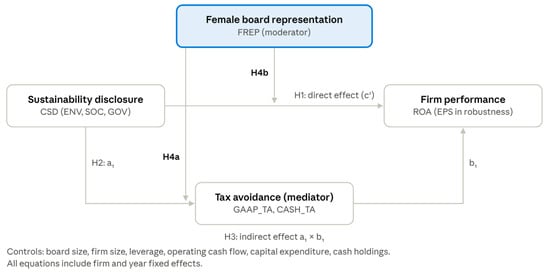
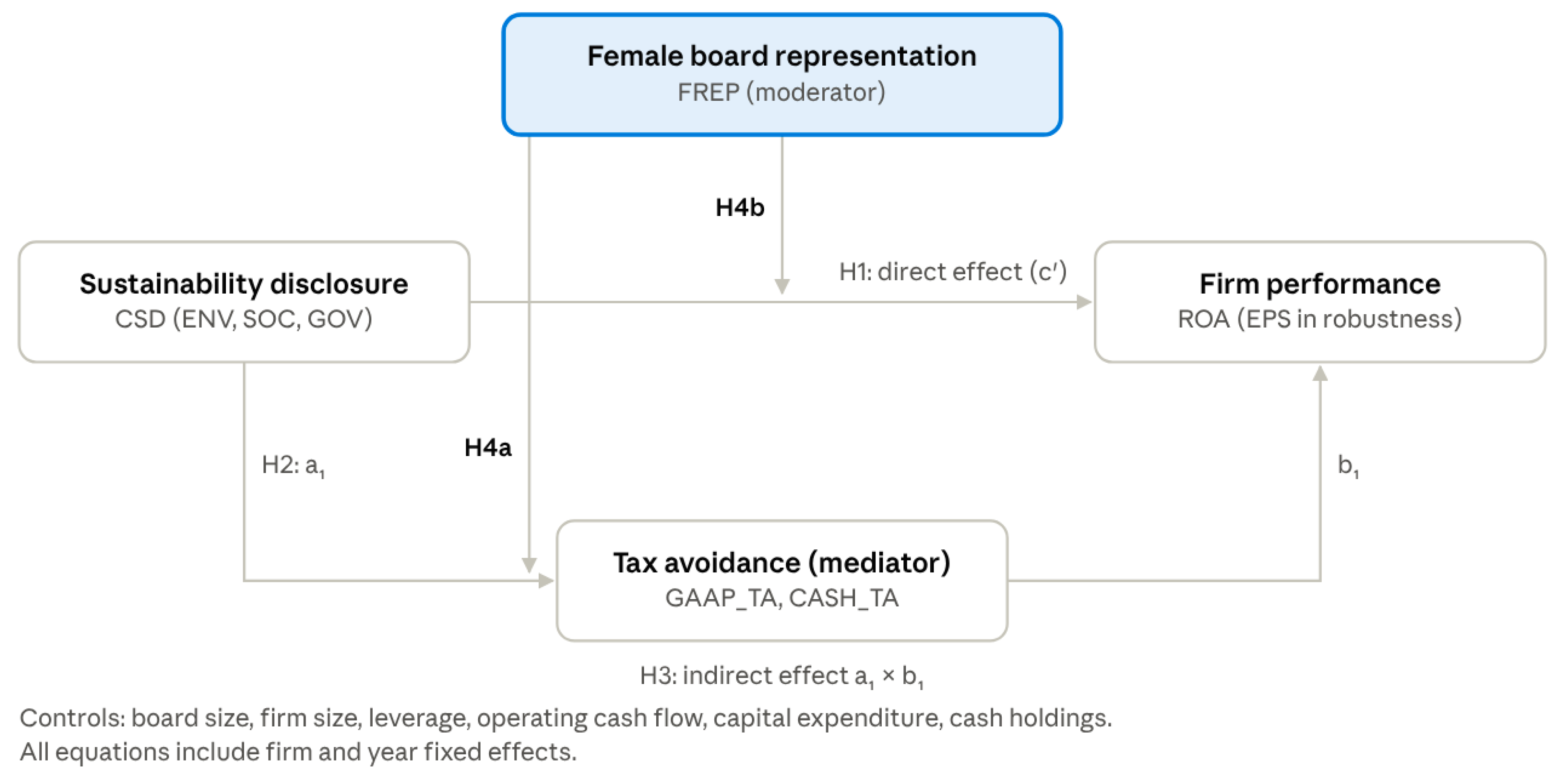

Disclaimer/Publisher’s Note: The statements, opinions and data contained in all publications are solely those of the individual author(s) and contributor(s) and not of MDPI and/or the editor(s). MDPI and/or the editor(s) disclaim responsibility for any injury to people or property resulting from any ideas, methods, instructions or products referred to in the content. |
© 2026 by the authors. Licensee MDPI, Basel, Switzerland. This article is an open access article distributed under the terms and conditions of the Creative Commons Attribution (CC BY) license.