


Abstract
The growing importance of identifying environmental, social and governance (ESG) risks is driven by increasing regulatory requirements and stakeholder expectations. However, information asymmetry, disclosure–performance gaps and potential greenwashing may limit the reliability of sustainability disclosures. This study examines the potential of financial statements as an additional source for screening ESG risk exposures and proposes an ESG Proxy Mapping Approach based on financial statement indicators. The empirical analysis covers companies listed on the Bulgarian Stock Exchange (68 in total), combining content analysis of publicly available financial and non-financial information with quantitative proxy indicators, comparative analysis and cross-report verification. The findings indicate that the feasibility of identifying potential signals varies across indicators, companies, and sectors. Proxies based on conventional accounting items tend to be more observable than those that require disclosing ESG-specific amounts. However, the mere existence of an observable accounting item or computable ratio does not establish an ESG-related cause. Missing disclosures also constrain the assessment. The findings suggest that, when combined with contextual disclosure analysis, financial-statement-based proxy mapping can support preliminary ESG risk screening, but cannot independently confirm the existence or magnitude of ESG risks.
1. Introduction
Over the past decade, companies have invested more time and resources into sustainability, influenced by increasing regulatory pressure and changing values. Sustainable development has become essential to long-term prosperity. Contemporary corporate policies are being developed as an integrated management approach that adapts a company’s vision, goals, and entire business model to the dynamic and ever-changing business environment. In this context, sustainability issues incorporating ESG risks assume a pivotal role due to their capacity to influence the financial performance (Kim & Yang, 2026, p. 3) and resilience of enterprises; stakeholder demands regarding climate, social and governance matters (Sundarasen et al., 2026, p. 1); and sustainability regulations such as the Corporate Sustainability Reporting Directive (European Parliament & Council of the European Union, 2022). More broadly, the development of regulatory frameworks should take into account the need to maintain a balance be-tween regulatory intervention and the effective functioning of market mechanisms (Minchev, 2023, p. 46). Greater accountability and transparency are expected regarding enterprises’ environmental and social commitments and the results of their actions and interactions with the environment and society. A new reporting approach is needed to complement traditional financial reporting by disclosing ESG (environmental, social, and governance) information. A current imbalance between sustainability disclosures and stakeholder expectations (Hassani & Bahini, 2022, p. 5) and a disclosure–performance gap (Tariq, 2025, p. 537) limit the ability to effectively assess ESG information. Greenwashing practices, in which information about environmental and social commitments is manipulated, also make it difficult to establish reliable, comparable information about enterprises’ environmental and social impacts and interactions, and the risks that arise from them. This highlights the need to reconsider approaches to identifying and assessing ESG risks, including the potential of financial statements to screen for how these risks manifest and affect an entity’s financial position and performance. In this context, the analytical focus shifts from examining the financial consequences of ESG factors to exploring whether financial statement information can reveal potential ESG risk signals. The Bulgarian capital market is a relevant empirical setting for examining this perspective. As an EU Member State, Bulgaria operates within the European regulatory framework for financial and sustainability reporting. However, previous research indicates that sustainability reporting has not yet become an established practice among Bulgarian companies (Petrova, 2025, p. 193). This underlines the importance of examining conventional financial statements as an additional source of information for identifying ESG risks. Furthermore, the range of sectors represented by companies listed on the Bulgarian Stock Exchange (BSE) allows the proposed approach to be explored across various economic sectors.
This study aims to evaluate the potential of financial statements as a source of information for identifying financial signals that are relevant to ESG risk assessment, using a system of proxy indicators applied to companies listed on the BSE. To achieve this, the following research questions are addressed:
RQ1: Which financial statement items and measures can be used as indicators of ESG risk signals?
RQ2: What is the profile of ESG risk signals identified through proxy indicators derived from financial statements of Bulgarian listed companies?
RQ3: To what extent do the financial statements of Bulgarian listed companies provide information that is suitable for identifying potential financial signals associated with ESG risk?
The study employs a multi-stage research design that combines qualitative, conceptual analysis with a quantitative examination of financial reporting data. The qualitative component establishes the relationship between ESG risks, their potential financial consequences, and the corresponding financial statement items. This provides the basis for developing the ESG Proxy Mapping Approach. The empirical analysis comprises a content analysis of financial and non-financial information that companies listed on the BSE have made publicly available, the application of accounting-based proxy indicators to identify potential ESG risk signals and a comparative analysis to examine differences across companies.
2. Literature Review
2.1. Nature and Financial Implications of ESG Risks
ESG risks, also referred to as sustainability, non-financial, or extra-financial risks, are environmental, social, and governance-related risks and/or opportunities that may affect an organisation (COSO & WBCSD, 2018, p. 1). Broadly speaking, these are risks arising from environmental, social, and governance issues that may affect a company’s financial position, performance, or long-term value. These risks can materialise in several ways. ESG risk stems from the exposure of a firm’s misdeeds in these areas, which can adversely affect firms by shaping stakeholder perceptions (Li et al., 2024, p. 2). The financial aspects of these risks can be analysed using concepts such as financial materiality and sustainability reporting (H. B. Christensen et al., 2021, pp. 1182–1183, 1220–1221), the impact of negative shareholder value (Krüger, 2015, pp. 304–305) and the correlation between ESG and corporate financial performance (Friede et al., 2015, p. 210). However, discrepancies in ESG ratings (Berg et al., 2022, p. 1315), greenwashing practices (Delmas & Burbano, 2011, pp. 64–65), and information asymmetry in ESG disclosures (Agapova et al., 2025) can complicate the identification and assessment of ESG risks.
However, the multifaceted nature of ESG risks, arising from their diverse sources and potential consequences, makes it difficult to establish a unified understanding of them. Nevertheless, Article 2(22) of Regulation (EU) 2019/2088 provides a regulatory definition, defining ‘sustainability risk’ as ‘an environmental, social or governance event or condition that, if it occurs, could cause an actual or a potential material negative impact on the value of the investment’.
ESG risks are associated with uncertainty over the future occurrence (or non-occurrence) of ESG-related issues. These risks are characterised by the following:
Firstly, they have a dual nature, manifesting in two aspects:
- ESG risks originate from non-financial sources yet materialise as financial consequences (typically negative) for the enterprise.
- Double materiality: ESG risks are closely linked to the concept of double materiality within the CSRD framework, reflecting both the impact of ESG factors on the enterprise and the impact of the enterprise’s activities on the environment and society.
Secondly, they have a long-term time horizon and a pronounced cumulative effect. Financial consequences accumulate gradually and materialise when a specific event or condition occurs. Moreover, their significance evolves over time.
Thirdly, their complexity stems from interactions among environmental, social, and governance factors, including natural processes, social relations, regulations, and management decisions. This interdependence creates the potential for ‘chain reaction’ impacts. For instance, depleting natural resources may disrupt supply chains, spark social unrest, and prompt new regulations. Consequently, a single environmental issue can trigger repercussions across economic, social, and governance dimensions.
Fourthly, there is uneven manifestation. Their impact depends on the macroeconomic and sectoral environment, as well as the characteristics of the individual enterprise. In this sense, ESG risks manifest at systemic and sectoral levels, as well as at the level of individual enterprises.
These specified characteristics reveal the complex and interconnected nature of ESG risks, distinguishing them from traditional corporate risk categories and requiring an integrated approach to their identification, assessment, management and disclosure.
ESG risks fall into three main categories:
Environmental risks arise from the enterprise’s interaction with the natural environment and ecosystems. These include climate change, biodiversity loss, pollution and resource limitation.
Social risks cover a wide range of impacts related to labour relations, health and safety, human rights, and relations with employees, contractors, and communities.
Governance risks relate to the quality of corporate governance, the independence and structure of the board of management, internal control, ethics and anti-corruption mechanisms.
The financial implications of ESG risks may become apparent through changes in asset values, the recognition of losses, the emergence of obligations and other effects on a company’s financial position and performance. However, the extent to which these consequences are reported in financial statements depends on the nature of the ESG risks and the relevant accounting recognition and measurement requirements. In this context, accounting conservatism is characterised by asymmetric recognition of economic profits and losses (Basu, 1997, p. 3; Watts, 2003, p. 207). Ferdous et al. (2024, pp. 1–2) provide empirical evidence that accounting conservatism is relevant to climate-related risks, documenting a positive association between firms’ exposure to these risks and their adoption of more conservative financial reporting practices. The concept of intangible liabilities, as discussed by Harvey and Lusch (1999, p. 85), together with research on environmental liabilities (Barth & McNichols, 1994), highlights the limitations of accounting recognition in capturing such exposures.
Furthermore, the European Systemic Risk Board (ESRB, 2024) identifies asset impairments, provisions, contingent liabilities, expected credit losses and fair value measurements as areas through which climate-related risks may affect financial reporting. These considerations suggest that ESG risks may result in financial consequences that are either recognised, disclosed, or not included in recognised accounting amounts. Accordingly, while financial statements may contain indirect indications of ESG-related exposures, individual accounting items cannot, in isolation, establish the existence or origin of an underlying ESG risk.
ESG risks are a unique category characterised by potential financial materiality, which explains the growing scientific and regulatory interest in these risks. If they materialise, they can significantly affect the enterprise’s financial condition and results, and relevant financial statement disclosures would reflect this. In this context, studying approaches to ESG risks and their financial manifestation in the literature is particularly important.
2.2. Empirical Research on ESG Risks
Research into ESG risks has grown significantly in recent years. According to a systematic bibliometric analysis by De Giuli et al. (2024), which covered 589 publications containing the keywords ‘ESG’ and ‘risk’ in the Scopus database between 1983 and 2022, academic interest began to accelerate after 2015–2016, reaching its peak in 2022. Additionally, Asmi et al. (2026, p. 5931) noted a 70% surge in publications on ESG risks and sustainability after mid-2022. This expansion has occurred alongside major international regulatory and policy developments, such as the Paris Agreement (2016) and the Corporate Sustainability Reporting Directive (2022). Recent systematic and bibliometric reviews have further highlighted the diversity and evolution of research in this field (Mukhtar et al., 2024; Mishra et al., 2025).
Existing research on ESG-related risk issues comprises several interconnected areas: the relationship between ESG factors and corporate financial performance (Khan et al., 2016; De Giuli et al., 2024); sustainability reporting, ESG disclosures and their reliability (D. M. Christensen et al., 2022; Berg et al., 2022); the assessment of climate-related risks and firm-level climate risk exposure (Krueger et al., 2020; Sautner et al., 2023); corporate governance and ESG-related strategies (Gillan et al., 2021); and sustainable finance, cost of capital and investment decisions (El Ghoul et al., 2011; Flammer, 2021; Matos, 2020; Bolton & Kacperczyk, 2021; Torri et al., 2023).
The literature also identifies several overarching characteristics of ESG-related risk research. First, the research’s interdisciplinary nature reflects interactions among environmental, social, governance, and financial considerations, linking sustainability-related issues to financial materiality. Second, ESG-related risks are examined within broader corporate risk management and long-term firm value (De Giuli et al., 2024; Menicucci, 2025). Third, emerging methodological approaches apply machine learning and predictive models to climate-related financial risks, ESG risk assessment, and the reliability of ESG data. Awijen et al. (2026) investigate the predictive role of physical and transition climate risks in financial market modelling, and Patel et al. (2026) develop machine learning models to estimate ESG risk scores. Caprioli et al. (2024) address missing ESG data and associated measurement uncertainty using machine learning techniques.
Another area of research concerns the extent to which ESG-related risks are reflected in financial reporting and audit practices. For example, Borghei et al. (2024) examine climate-related disclosure in the financial statements of FTSE 100 companies and identify limitations in its extent and consistency. Abdel-Rahim et al. (2024) investigate critical audit matters related to ESG, including those associated with environmental liabilities and loss contingencies. Together, these studies emphasise the importance of accounting and auditing information in understanding the potential financial ramifications of ESG risks, while also highlighting limitations in the visibility and interpretation of such information.
A review of the literature reveals several key emerging trends:
- An interdisciplinary approach that integrates various aspects of ESG risks and their manifestations.
- ESG-related risks are increasingly viewed within the broader context of corporate (business) risk and long-term corporate value (De Giuli et al., 2024; Menicucci, 2025).
- The emergence of methodological approaches involving the application of machine learning and predictive models to climate-related risks. ESG risk assessment and the reliability of ESG data: Awijen et al. (2026) investigate the predictive role of physical and transitional climate risks in financial market modelling and Patel et al. (2026) develop a machine learning model to estimate ESG risk scores. Caprioli et al. (2024) address missing ESG data and associated measurement uncertainty using machine learning techniques.
2.3. ESG and Sustainability Research: The Bulgarian Context
Research on ESG and related risks in Bulgaria remains relatively limited in scope and thematic focus when compared to the rapidly evolving international literature. A significant proportion of this research focuses on corporate sustainability reporting and the implementation of regulatory requirements for sustainability disclosure. Angelova and Ivanov (2025) analyse the impact of ESG legislation on enterprises’ operations, financial performance, and accounting, with particular attention to the challenges facing small and medium-sized enterprises. Ilieva (2024) examines the economic effects of introducing and implementing European sustainability reporting standards. Popova-Yosifova (2024) focuses on the banking sector, examining how leading Bulgarian banks implement sustainability reporting requirements and highlighting areas where problems have arisen in practice. Other publications addressing the development and practical application of corporate sustainability reporting include the work of Nikolov (2023), Vutsova et al. (2024), and Staneva (2022), which explore the strategic dimension of ESG and the integration of sustainability principles into corporate governance.
Recent research is gradually shifting focus toward sustainability risks and the limitations of ESG disclosure information. Krasteva-Hristova and Krastev (2026) examine the extent to which ESRS-oriented corporate disclosures capture systemic sustainability risks using an integrated Life Cycle Sustainability Assessment (LCSA) approach. Their analysis of three companies indicates partial integration, with aspects related to decline and end-of-life remaining underrepresented.
However, some studies provide evidence of the potential of such an approach. For example, D’Amato et al. (2022) used financial indicators to predict ESG scores, demonstrating the link between financial data and a company’s ESG profile. Furthermore, financial statements reflect ESG factors in specific line items and associated disclosures (Deloitte, 2021). Nevertheless, the potential of financial statements as a source for identifying ESG risks via proxy indicators remains under-researched. This is particularly evident in the Bulgarian context, where, despite the broadened thematic scope, research has focused on sustainability reporting and disclosure, regulatory requirements, and integrating ESG principles into corporate governance. Overall, studies addressing the financial manifestation of ESG risks remain limited. This is particularly evident in the Bulgarian context, where, despite the broadened thematic scope, research has focused on sustainability reporting and disclosure, regulatory requirements, and integrating ESG principles into corporate governance. Another challenge is that ESG-related risks do not always have a recognised accounting impact, while reported financial figures may reflect numerous economic factors unrelated to ESG risks. This highlights a methodological gap in using proxy indicators to identify ESG risk signals, as well as an empirical gap stemming from a lack of evidence for the applicability of such an approach to Bulgarian companies. In this context, the study aims to evaluate financial statements’ ability to identify ESG risk signals by formulating and implementing an ESG proxy approach for companies listed on the Bulgarian Stock Exchange (BSE).
Despite the growing body of international and Bulgarian empirical studies, the literature review indicates that they predominantly focus on the relationship between the manifestation of environmental, social and governance (ESG) factors and risks and corporate financial performance. These studies assess financial consequences using indicators such as ROA, ROE, ROI, and Tobin’s Q. (Nguyen et al., 2025) or financial and market efficiency (Iazzolino et al., 2023), i.e., with an emphasis primarily on ESG outcomes. The reverse analytical relationship, using financial information to identify ESG risks, remains far less explored. Some studies provide evidence of the potential of such an approach. For instance, D’Amato et al. (2022) use financial indicators to predict ESG scores, demonstrating the link between financial data and a company’s ESG profile. Furthermore, ESG factors are reflected in financial statements within specific line items and their associated disclosures (Deloitte, 2021).
Overall, studies addressing the financial manifestation of ESG risks remain limited. This highlights a methodological gap relating to the use of proxy indicators to identify ESG risks, as well as an empirical gap resulting from a lack of evidence regarding the applicability of such an approach to Bulgarian companies. Given this context, the study aims to assess the ability of financial statements to identify ESG risk signals by formulating and implementing an ESG proxy approach to companies listed on the Bulgarian Stock Exchange.
3. Methodology
3.1. Research Design
This study adopts a pilot research design to develop and empirically apply an ESG Proxy Mapping Approach to identify potential ESG signals through financial statement information. This approach is based on the idea that, despite their non-financial origins, ESG risks may have financially measurable consequences reflected in financial statements, provided the relevant accounting recognition, measurement, presentation, or disclosure requirements are met. Its conceptual foundation is rooted in the principle of materiality, as set out in IFRS 18, ‘Presentation and Disclosure in Financial Statements’, in Appendix A and paragraphs B1–B5 (IFRS Foundation, 2024), and in IFRS Practice Statement 2, ‘Making Materiality Judgments’, in paragraphs IN1 and IN3 (IFRS Foundation, 2017). Under these principles, information is considered material if its omission, misstatement or obscuring could reasonably be expected to influence the decisions of users of financial statements. Accordingly, the potential financial consequences of ESG risks may generate financial statement information, depending on their nature, magnitude, and applicable accounting requirements. This provides a theoretical foundation for examining financial statement items and indicators as potential signals of ESG risks.
The study employs a three-phase research design.
Phase 1: Identifying risk categories and their potential financial manifestation.
The focus is on identifying ESG risk categories and examining their potential financial manifestations in financial statements (Figure 1).
Figure 1.
Conceptual process of potential financial manifestation of ESG risks. Source: Author’s own elaboration.
Step 1: Identifying ESG risks.
A systematic review of the academic literature, International Financial Reporting Standards, and sustainability reporting frameworks and standards (ESRS, GRI and ISSB); ESG risks are classified into three main categories:
- (a)
- Environmental risks: climate risk, pollution, and resource depletion;
- (b)
- Social risks, including those related to human capital, occupational health and safety risks, and social and reputational risks;
- (c)
- Governance risks: board governance risks, transparency risks, and compliance risks.
Step 2: Analysing the financial manifestation of ESG risks.
Building on the existing literature on the financial implications of climate-related risks (including Krueger et al., 2020), this study examined the relationship between ESG risks and their financial manifestations. This analysis identified the financial and economic consequences of ESG risks, determined the affected accounting items, and established their impact on financial statements. Table 1 presents the results.
Table 1.
Financial and accounting manifestations of ESG risks.
The analysis indicates that ESG risks can affect various accounting items and be reflected in different parts of financial statements. This provides a basis for identifying financial proxy indicators.
Phase 2: Developing a framework of ESG proxy indicators and mapping them.
The ESG proxy framework is based on the relationship between ESG risks and their financial and economic consequences, as examined in Phase 1. This provides a basis for identifying accounting information and financial indicators that could signal ESG risks.
Proxy indicators are substitute measures used to represent phenomena for which data are unavailable or cannot be observed directly (OECD/European Union/EC-JRC, 2008, pp. 22–24). For this study, an ESG proxy indicator is a financial measure or accounting-related signal derived from publicly available financial statements and accompanying notes. These indicators may suggest potential ESG risk exposure or its manifestation. Depending on how they are measured and interpreted, proxy indicators can be classified as follows:
- Absolute indicators represent the monetary amounts reported in relation to potential financial consequences of ESG risks, such as fines and penalties, staff training costs and audit costs.
- Relative indicators express the relationship between financial values in the form of ratios or percentage changes, enabling comparisons to be made between entities or reporting periods. Examples include impairment loss ratio, revenue growth rate, etc.
- Signal indicators capture the presence or absence of specific accounting events, circumstances or disclosures, as well as the direction of change in selected financial indicators. They provide additional information when monetary amounts or ratios alone cannot adequately represent the nature of a potential ESG-related effect.
Complementary perspectives on potential ESG-related financial effects are provided by these categories and are applied according to the particular indicator and availability of relevant information.
The ESG framework was developed as follows:
Defining proxy indicators: A set of financial proxy indicators has been developed to identify potential ESG risk signals. Based on the existing literature on ESG-related risks and risk indicators (COSO & WBCSD, 2018, pp. 40–46; Institute of Operational Risk, 2010, pp. 1–2; IFRS Foundation, 2023, IFRS S1, paras. B1–B3), an ESG risk signal is defined as observable financial information that may indicate the presence, manifestation, or potential financial consequences of ESG risks. Their interpretation requires caution, as observed amounts or changes may reflect multiple economic factors and do not necessarily provide direct evidence of ESG risk exposure.
The proxy indicators were selected based on their potential financial relevance, observability, and availability in publicly disclosed information, building on the analysis of the financial and economic consequences of ESG risks presented in Table 1. The proposed framework is not intended to capture all possible manifestations of ESG risks (see Table 2).
Table 2.
Proxy indicators for ESG risks.
ESG proxy mapping: Inspired by Cronbach and Meehl’s (1955) concept of construct validity, a conceptual mapping was established to link ESG risks, their potential financial and economic consequences, and the proxy indicators identified in Step 1. This mapping examines the logical connections between specific ESG risks, their potential financial implications, and the accounting data through which these implications could be reflected in financial statements.
These relationships are classified as direct or indirect, depending on how specific the link is between the ESG risk and the corresponding proxy indicator. A direct relationship is identified when the indicator reflects a financial consequence that is specifically attributable to an ESG-related event or obligation, or provides direct evidence of a relevant reporting practice, supported by the available information. An indirect relationship is identified when the indicator captures broader financial effects that may arise from ESG risks and other economic factors. This classification is purely conceptual; it neither establishes causality nor constitutes empirical validation of proposed indicators.
The mapping draws on research examining financial and accounting implications of ESG-related factors. Krueger et al. (2020) highlight the financial relevance of climate risks from the perspective of institutional investors, while Deloitte (2021) discusses how ESG-related matters may affect accounting estimates and financial statement items. Edmans (2011) and Eccles et al. (2014) provide evidence on the association between employee-related or sustainability practices and corporate financial performance. In the governance context, Gompers et al. (2003) investigate how corporate governance arrangements relate to firm value. H. B. Christensen et al. (2021) analyse the economic implications of mandatory sustainability reporting, and Vaccaro and Madsen (2009) discuss the role of corporate transparency in accountability and stakeholder engagement. These studies provide a conceptual and empirical background for examining potential ESG-related financial signals; they do not directly validate the specific proxy indicators developed in this study.
The ESG proxy mapping presented is based on a refined selection of financial proxy indicators, as shown in Table 2. This selection aims to establish relationships between financial manifestations and specific ESG risks that are conceptually justified and sufficiently interpretable. Accordingly, the mapping includes only a subset of indicators from the broader set. For example, revenue growth and inventory turnover are excluded because changes to these indicators are influenced by multiple market, operational and economic factors, which makes it difficult to distinguish potential ESG-related financial effects from other determinants of financial performance. Similarly, audit fees and ESG reporting costs are excluded because they may reflect assurance activities, regulatory compliance, and improved reporting practices rather than the financial consequences of ESG risks. The presence of ESG/sustainability disclosures indicates an observable reporting practice but does not, in itself, establish deficiencies or non-compliance. The ESG proxy mapping focuses on a more limited set of proxy indicators, selected for their financial relevance and the interpretability of their conceptual relationship with ESG risks, rather than providing an exhaustive list of all potentially relevant financial data.
The resulting ESG proxy mapping, including the rationale for each relationship and its classification as direct or indirect, is presented in Table 3.
Table 3.
ESG proxy mapping.
Phase 3: Empirical testing of the proxy model.
The study empirically tested the framework using a sample of companies listed on the Bulgarian Stock Exchange (BSE) to evaluate its potential to identify ESG-related financial signals in financial statements. The analysis assessed the availability of relevant financial information, the feasibility of calculating or identifying the proposed proxy indicators and their ability to reveal financial manifestations associated with ESG risks. However, identifying such signals does not verify the corresponding ESG risks. This study does not assess the significance of the identified financial signals or the likelihood, magnitude, or impact of these risks, nor does it consider how entities respond to risk management.
This process is carried out in three consecutive steps:
Step 1: Data collection and selection criteria.
The data sources comprise financial statements, management reports and other public documents relating to the 2025 reporting period. These were obtained from company websites, the Registry Agency portal (https://portal.registryagency.bg/ (accessed on 30 September 2026)) and the Bulgarian Stock Exchange website (https://www.bse-sofia.bg/bg/ (accessed on 30 September 2026)). Separate and consolidated financial statements are used, depending on the reporting entity represented by each listed issuer. Management and other publicly available information are supplementary sources where relevant. Where necessary, comparative figures for 2024 as disclosed in the 2025 financial statements were used to calculate specific proxy indicators.
Financial statement data is extracted and processed using Python 3.14.5 scripts, which are executed in the Integrated Development and Learning Environment (IDLE). These scripts are designed to identify the accounting items required for the selected proxy indicators, extract their reported values, and organise the data by company, reporting period and accounting item. The data preparation procedure also involves cross-checking the extracted information with the source documents to identify discrepancies relating to the classification of accounting items, reporting period, measurement units and reporting entities. Any ambiguous or incorrect extract values are documented and addressed with reference to the original entities. These scripts and processing are intended to promote the transparency and reproducibility of the empirical analysis.
Step 2: Calculation of ESG proxy indicators and interpretation and assessment of the results obtained.
The ESG proxy indicators (see Table 3) are calculated for each company using accounting data extracted from their publicly available financial statements and accompanying notes. The measurement methods depend on the indicator type. Where appropriate, comparative data from the previous reporting period is employed to evaluate change in the underlying financial data. The analysis distinguishes between absolute accounting amounts and relative financial indicators. If these reflect the same financial manifestation, the absolute amount confirms its presence, while the relative indicator assesses its significance. This approach avoids duplication while preserving the distinction between identifying and measuring financial manifestations.
Calculated indicator values are not interpreted as direct assessments of ESG risks, but rather as measures of financial manifestation that may indicate potential ESG risk exposure. Identifying a financial manifestation does not automatically establish an ESG risk signal. Rather, such a signal is identified when the observed financial manifestation can be reasonably linked to a relevant ESG risk, considering the nature of the underlying accounting information and the availability of contextual evidence. For example, an increase in the personnel costs ratio could imply financial pressure related to human capital management, especially if personnel expenses rise while revenue falls. However, this change only signals potential human capital risk when additional information indicates relevant human capital exposure.
The operational rules for identifying potential ESG risk financial signals are specified separately for each proxy indicator. Rather than the application of uniform numerical criteria, consideration is given to the nature of underlying accounting information and changes in financial measures where relevant. They recognise differences between financial and non-financial companies in terms of business activities, financial statement structure and the availability of relevant accounting information. Indicators are applied only where the underlying accounting measures are identifiable and economically meaningful for the respective sector. Where sector-specific characteristics affect the calculation or interpretation of an indicator, these differences are explicitly considered in order to avoid misleading comparisons. Missing or undisclosed information is distinguished from the confirmed absence of a financial manifestation.
Table 4 presents the selected indicators, their accounting measures, sectoral applicability, corresponding financial manifestations and operational rules for identifying potential ESG-related financial signals.
Table 4.
Operationalisation of selected ESG proxy indicators.
The operational rules in Table 4 provide a consistent basis for identifying potential ESG risk signals across the sample companies. This process involves interpreting accounting information disclosed in financial statements and accompanying notes rather than relying solely on calculated proxy indicator values. If available information does not sufficiently support a plausible link between an observed financial manifestation and a specific ESG risk, the manifestation is not classified as an ESG risk signal. However, this does not imply the absence of underlying ESG risk.
Step 3: Assessment of operational feasibility and cross-report verification of the proposed ESG proxy approach.
The proposed approach is evaluated based on two criteria: operational feasibility and cross-report verification. The assessment procedure draws on general methodological principles for developing and evaluating indicators (OECD/European Union/EC-JRC, 2008).
Operational feasibility assesses the ability to use the proposed ESG proxy indicators to extract financial signals from publicly available financial statement information. The assessment is conducted at two levels: availability and computability.
Availability determines whether the accounting information for each proposed ESG proxy indicator is disclosed in financial statements and accompanying notes. For indicators expressed as absolute amounts, the presence of relevant accounting items or disclosure is examined. For relative indicators, the availability of accounting data required for each component of the calculation formula is assessed. A binary scale is applied (see Table 5).
Table 5.
Availability assessment scale.
Computability assesses whether the available accounting information is sufficiently detailed to determine or calculate the respective proxy indicator. For absolute indicators, it establishes whether the relevant accounting amount can be identified; for relative indicators, it assesses whether the disclosed information enables calculation of the indicator using the specified formula. A binary scale is applied (see Table 6).
Table 6.
Computability assessment scale.
The results of availability and computability assessments are combined to determine the operational feasibility (OF) of each proxy indicator at company level. An indicator is considered operationally feasible if the necessary accounting information is available and detailed enough to enable its calculation. The assessment follows the classification rules presented in Table 7.
Table 7.
Determination of the operational feasibility of ESG proxy indicators.
To assess the extent to which the proposed proxy indicators can be operationalised across the sample, the Operational Feasibility Coverage Rate (OFCR) is calculated for each indicator as follows:
where
—Operational Feasibility Coverage Rate for proxy indicator i.
—the number of enterprises for which proxy indicator i is operationally feasible.
N—total number of companies included in the population under assessment.
The OFCR measures the coverage of confirmed operational feasibility across the entire study population, rather than the final feasibility rate among companies for which an indicator is applicable to a given sector. Accordingly, the numerator includes only companies with confirmed operational feasibility (OF = 1), while the denominator represents the total number of companies examined for each indicator. In this study, N = 68 for each proxy indicator. Unresolved cases are included in the denominator but excluded from the numerator because their feasibility status has not been conclusively established. Therefore, the reported OFCR values represent minimum population-wide coverage and should not be interpreted as overall operational feasibility after the outstanding cases have been resolved, nor as sector-adjusted feasibility among applicable companies. Furthermore, the OFCR does not measure the frequency of ESG risk signals or validate the indicators as measures of ESG risk exposure.
Cross-report verification assesses consistency between accounting-based observations, including potential ESG risk signals identified from financial statements and relevant ESG disclosures in management reports. This assessment follows the principle of data source triangulation, comparing information from different sources to assess the consistency of the available evidence (Carter et al., 2014). In the context of the study, this comparison is informed by the principles of transparency, accountability and connectivity between financial and sustainability information.
The evaluation covers all prospective ESG-related financial indicators outlined in the interpretation criteria in Table 4. Supplementary observations were selected to examine specific interpretative issues, such as the difference between investment responses related to ESG and potential risk signals, the attribution of accounting changes to ESG-related causes and the impact of accounting measures on indicator interpretation.
Verification follows a bidirectional approach. First, selected accounting-based observations are compared with relevant disclosure in management reports. Secondly, these disclosures are examined in relation to the underlying accounting information to establish whether they support or contradict the proposed link between the financial manifestation and the relevant ESG issues. However, the assessment does not involve a comprehensive review of all ESG disclosures.
The verification outcomes are classified into one of three categories, as presented in Table 8.
Table 8.
Cross-report verification assessment.
The classification is based on the correspondence between the identified financial manifestation and the specific ESG-related circumstances disclosed in the management report. References to general ESG risks or sustainability practices are not considered sufficient supporting evidence unless a plausible connection with the underlying accounting information can be established. Similarly, the absence of relevant disclosures is interpreted as insufficient evidence rather than contradictory evidence.
To ensure transparency and reproducibility, the accounting information, applicable operational rule, relevant management report disclosure and verification outcome are documented for each assessed observation. The results are then aggregated by verification category and proxy indicator. As the verification process relies primarily on information disclosed by the reporting companies, the results are interpreted as an assessment of cross-report consistency rather than as independent external validation of the underlying ESG risks.
The evolving EU sustainability reporting framework may provide opportunities to improve the reliability of cross-report verification in future applications of the proposed approach. In particular, the limited assurance requirements under Directive (EU) 2022/2464 (CSRD), as amended by Directive (EU) 2026/470, and the connectivity requirements of ESRS 1 (European Commission, 2023, Section 9.2) could facilitate more consistent comparison between financial and sustainability information. While these requirements do not apply uniformly to all companies, the growing accessibility of verified sustainability data could enhance the effectiveness of cross-report verification in future applications of the proposed approach.
3.2. Research Scope and Sampling
The study covers the entire population of 68 companies, whose shares are traded on the Main Market: Eurobridge Market (2 companies), Premium Equity Market (10 companies), and the Standard Equity Market (56 companies) of the Bulgarian Stock Exchange (BSE). These market segments were selected because listed companies are subject to financial reporting, auditing and public disclosure requirements, which provide a relatively standardised and publicly accessible information base for applying the proposed ESG proxy approach. Preparing financial statements in accordance with International Financial Reporting Standards (IFRS) also supports comparability of accounting information across companies.
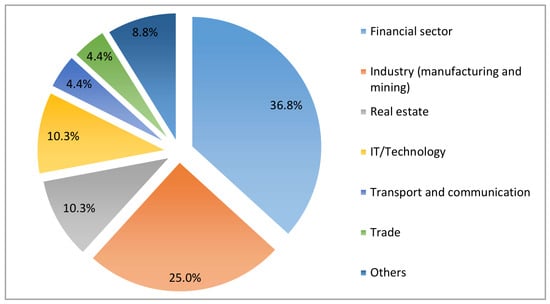
Each listed company is treated as a separate unit of observation, including cases in which both a parent company and subsidiary are listed independently. The study examines 25 financial and 43 non-financial companies. This distinction matters for applying the proposed approach because differences in business activities and accounting practices affect the applicability and interpretation of certain proxy indicators (see Table 4).
Figure 2.
Sample segmentation. Source: Author’s calculation based on the empirical data.
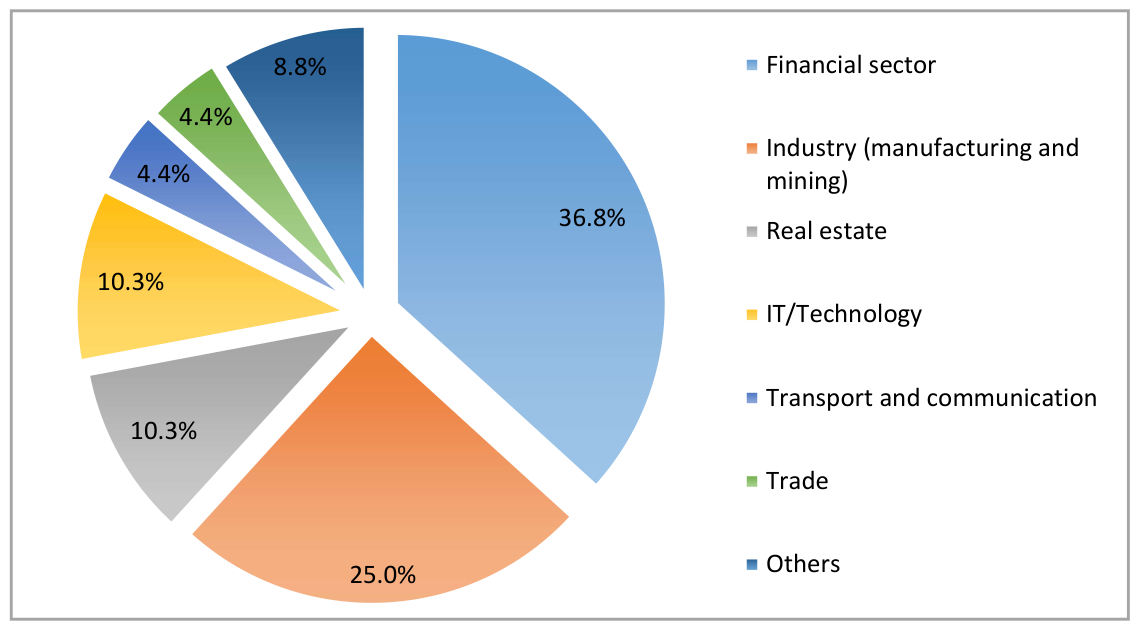
Table 9.
Sectoral distribution of the sample.
The analysis uses publicly available individual or consolidated financial statements. Using consolidated financial statements may result in financial information overlap across observations.
The analysis included all 68 companies, regardless of whether the accounting information required for the individual proxy indicators was available. Missing or insufficiently detailed information was taken into account when assessing indicator availability.
The study focuses on the 2025 reporting period and uses comparative financial information from 2024 where the operational rules require it.
This time horizon aligns with the study’s objective: assessing the practical applicability of the proposed ESG proxy approach. However, it does not allow examination of long-term trends or the cumulative financial effects of ESG risks.
3.3. Data Analysis Methods
The study employs a multi-stage research design combining quantitative and qualitative methods. These are used to develop and empirically assess the proposed ESG proxy approach in order to establish the conceptual relationship between ESG risks and their financial manifestation, as well as to evaluate the practical applicability of the proposed indicators. Qualitative methods include a normative analysis of the regulatory framework, a systematic literature review, and a documentary analysis of financial statements, their accompanying notes and management reports. Quantitative methods involve calculating financial proxy indicators and conducting descriptive statistical analyses to assess their operational feasibility and identify potential ESG risk signals. Automated data processing supports the organisation and analysis of the accounting information. These methods are integrated by interpreting the quantitative findings in the context of accounting disclosures and by examining whether the identified financial signals are consistent with relevant information in management reports.
4. Findings and Discussion
4.1. Empirical Results
The ESG Proxy Mapping approach, which is based on eight proxy indicators, was used to analyse 68 Bulgarian companies listed on the Bulgarian Stock Exchange (BSE). The analysis used their 2025 financial statements and, where appropriate, comparative information for 2024. A total of 48 identifiable, calculable combinations were found across 33 companies, of which 45 observations across 31 companies were fully interpreted in line with the predefined criteria. Insufficient evidence exists to establish a specific link between the reported financial indicators and ESG risks for the remaining observations.
Three potential ESG signals related to environmental risks were identified in two companies (Table 10).
Table 10.
Identified potential signals related to ESG risks.
The identified signals clearly demonstrate the importance of notes for financial statements in linking reported financial outcomes to specific environmental, social, and governance (ESG) circumstances. Neochim AD is a good example. Here, rising natural gas prices affected finances despite a fall in overall material and energy costs. This shows that the direction of change in a given proxy indicator is insufficient for interpretation. No sufficiently specific link to ESG risks could be established for other quantifiable observations, including asset impairments and changes in personnel expenses. At Monbat AD, a capital expenditure (CapEx) investment was identified that was not classified as an adverse financial signal.
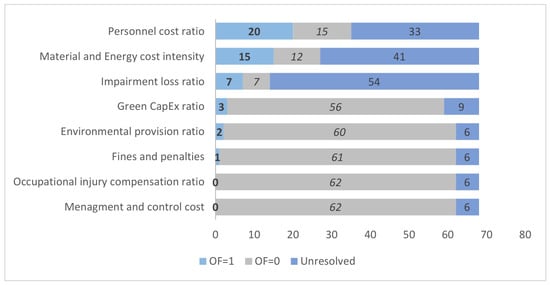
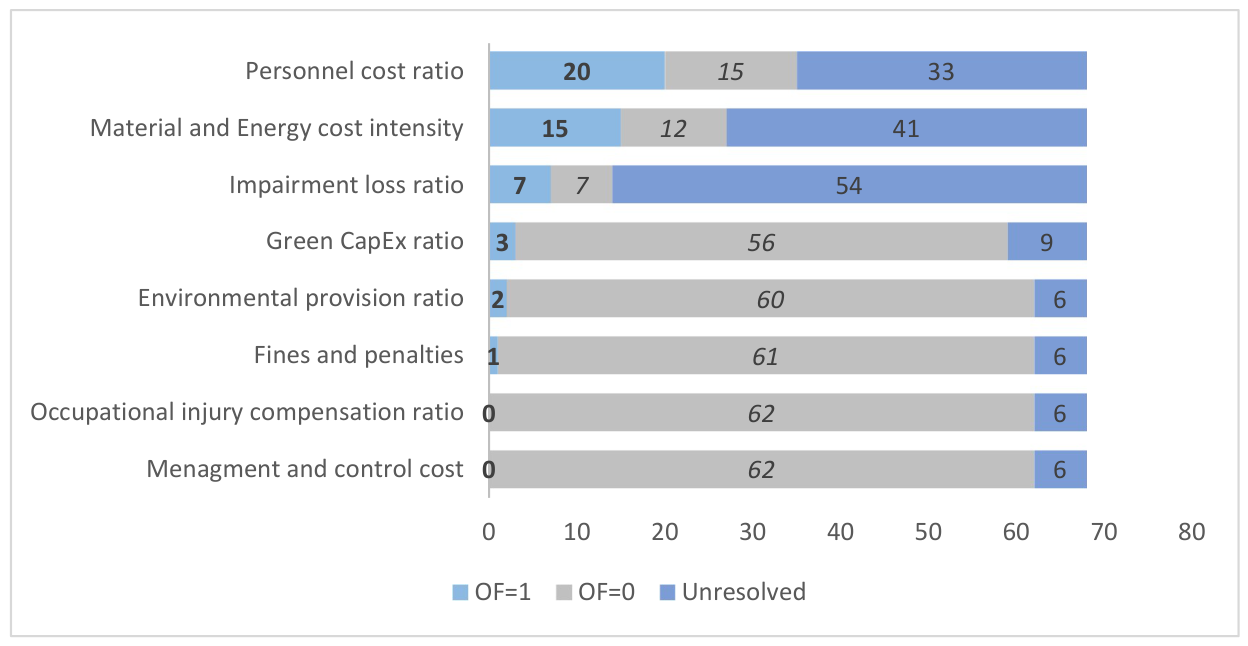
The operational applicability assessment reveals differences among the individual proxy indicators (Figure 3). The highest number of confirmed calculable combinations was found for personnel expenses (20), material and energy costs (15) and impairments (seven). Three combinations were confirmed for green capital expenditure, two for environmental provisions, and one for fines and penalties. No calculable combinations were confirmed for the remaining two indicators. While these results indicate differences in the availability and level of detail of the necessary accounting information, they do not constitute a definitive assessment of information coverage due to the presence of unresolved cases.
Figure 3.
Operational feasibility assessment of ESG proxy indicators across sampled companies. Note: OF = 1 indicates confirmed operational feasibility. OF = 0 indicates confirmed non-computability or unavailability of the required accounting information. ‘Unresolved’ denotes company–indicator combinations for which a conclusive feasibility assessment could not be established. Source: Author’s calculation based on the empirical data.
The confirmed minimum operational feasibility coverage rate (OFCR) was highest for personnel costs (29.41%), followed by material and energy costs (22.06%), then impairment losses (10.29%). Green capital expenditure (Green CapEx) was lowest (4.41%), followed by environmental provisions (2.94%) and fines and penalties (1.47%). The minimum coverage was 0% for occupational injury compensation and management and control costs. These minimum OFCR values reflect verified, computable company–indicator combinations, while unresolved assessments are retained to ensure transparency in evaluating the availability and computability of information.
While personnel costs could be identified for 35 companies, the personnel cost ratio could only be confirmed as computable for 20. This reflects the requirements of the predefined formula, particularly the need for a consistently identifiable total revenue denominator. Differences in presentation and disaggregation of revenue and financial income across companies were among the factors that limited the consistent application of the indicator.
The empirical analysis revealed differences in the applicability and interpretation of financial proxy indicators across sectors. In non-financial companies, resource costs and environmental provisions were employed to identify manifestations of financial risk relating to the environment, particularly in the chemical manufacturing and battery production sectors. In financial companies, certain accounting items, especially impairment losses, are primarily associated with credit risk and other financial exposures. Therefore, these items alone cannot automatically be interpreted as evidence of climate-related risk manifestations without additional supporting evidence. Similarly, indicators based on material and energy costs do not apply equally across all financial sector companies.
To further assess the interpretation of financial indicators, information from management reports was cross-checked for all three potential ESG-related financial signals identified under the criteria in Table 4. This was done alongside five additional observations, which were purposely selected to examine distinct interpretative issues, such as distinguishing ESG-related investment responses from potential risk signals, assessing the attribution of accounting changes to ESG-related causes and examining the effects of accounting measures on indicator interpretation. These comparisons involved five environmental observations (environmental provisions, resource intensity, and green capital expenditure (CapEx)), two social observations (personnel costs), and one governance-related observation (fines and penalties). All of these observations concerned non-financial companies. The eight observations selected for cross-report verification, along with the rationale for their inclusion, are presented in Table 11.
Table 11.
Selection of observations for cross-report verification.
Supporting evidence was found in one environmental case, while insufficient evidence was found in the remaining seven. No contradictory evidence was identified. The five supplementary observations were included for illustrative purposes, rather than as additional ESG-related financial signals or as part of a representative sample. Consequently, the findings cannot be generalised across sectors. Furthermore, this cross-report assessment reflects consistency in corporate disclosures rather than independently validating the existence of ESG risks.
4.2. Discussion
The results reveal that financial statements can serve as an additional source of information on potential environmental, social and governance (ESG) risks. However, their usefulness depends on the extent to which reported financial manifestations can be linked to specific ESG-related circumstances.
RQ1: The empirical findings indicate that certain accounting items (environmental provisions and material and energy costs in this study) can provide a basis for identifying ESG risk signals when there is a conceptually justified relationship between ESG risks, their potential financial and economic consequences, and how they are reflected in financial statements. The empirical assessment also demonstrates that merely computing a proxy indicator is insufficient for identifying an ESG-related signal. The economic substance of the financial manifestation and its interpretation in the context of specific ESG-related circumstances are what matter.
RQ2: The profile of potential ESG-related financial signals is determined by two factors: firstly, the presence of financial consequences, and secondly, the extent to which these consequences can be distinguished from conventional financial and economic factors. This explains why (a) not every reported change in an accounting measure can be interpreted as an ESG risk signal and (b) the identified environmental profile of the ESG signals should be regarded as a result of the applied identification criteria rather than as a reflection of the actual distribution of ESG risks among the companies examined. Limited available information also contributes to the absence of identified potential signals related to social and governance risks.
RQ3: Differences in the level of detail that accounting disclosures provide and the economic applicability of individual indicators constrain the informational usefulness of financial statements. Having the information required to calculate a proxy indicator does not necessarily mean that the resulting measure can be interpreted in an ESG context. This emphasises the importance of the notes for the financial statements and the need to consider sector-specific characteristics and companies’ business models. Identifying only three potential ESG-related financial signals across two of the 68 companies highlights the gap between the availability of accounting information for calculating proxy indicators and the sufficiency of that information to support plausible ESG-related interpretations.
In general, the empirical findings indicate that financial statements can be used as a supplementary source of information to detect potential financial signals associated with ESG risks. However, the mere availability of sufficient accounting data to compute an indicator does not establish a link to a specific ESG risk. Such an interpretation requires consideration of the economic substance of the underlying financial manifestation, the nature of the reported accounting item and the accompanying explanatory disclosures.
4.3. Limitations
The study faces several limitations.
First, the analysis covers a single reporting period, using comparative data from the previous period where necessary. While this enables certain changes to be observed, it does not provide a basis for identifying persistent trends or long-term relationships.
Secondly, the incomplete and heterogeneous nature of accounting disclosures limits the computability of some proxy indicators and prevents a definitive assessment of their operational feasibility across the entire study population.
Thirdly, differences in the economic relevance of individual indicators, limited information coverage and the small number of identified signals prevent reliable comparisons of ESG risks across sectors.
Finally, as the identified signals have not been independently validated using external evidence, the findings cannot be used to assess the actual frequency or intensity of ESG risks.
5. Conclusions
This study examines the potential of financial statement information to identify financial signals associated with ESG risks, with a view to determining how to use these signals to manage these risks more effectively. The ESG Proxy Mapping approach, developed and empirically applied, establishes a conceptual link between ESG risks, their potential financial and economic consequences, and how financial statements reflect them.
The added value of the ESG Proxy Mapping approach stems from its role as a preliminary screening tool for identifying potential ESG risk signals, and it can be summarised in three areas. Firstly, it provides a structured way of using publicly disclosed financial information to supplement specialised sustainability reporting. Secondly, it provides a basis for examining the potential financial implications of ESG risks, even in cases where explicit ESG disclosures are limited. Thirdly, it provides a basis for comparing accounting information with sustainability disclosures, and subsequently investigating any inconsistencies between the two.
The study’s empirical contribution lies in demonstrating the potential and limitations of using conventional financial statements as a source of ESG-related financial signals. Although accounting information enabled the calculation of proxy indicators, only three potential ESG-related financial signals were identified in two of the 68 companies under the applied interpretation criteria. This finding does not imply that financial statements lack the potential to provide ESG-relevant information. Rather, it shows that their usefulness for ESG-related screening depends on more than just the availability of accounting data; the nature, specificity and extent of company disclosures are also important, particularly in the accompanying notes. These are essential for establishing plausible links between accounting manifestations and ESG-related causes.
Future research could develop sector-specific proxy indicators, assess their reliability and analytical usefulness, and extend the temporal scope of the empirical analysis.
Funding
This research received no external funding.
Institutional Review Board Statement
Not applicable.
Informed Consent Statement
Not applicable.
Data Availability Statement
Available from the corresponding author upon reasonable request.
Acknowledgments
During the preparation of this manuscript, the author used Grammarly (v 1.2.310.2001) for language editing and grammatical refinement. However, the author thoroughly reviewed and verified the final paper to ensure technical accuracy and academic integrity.
Conflicts of Interest
The author declares no conflicts of interest.
Abbreviations
The following abbreviations are used in this manuscript:
| BSE | Bulgarian Stock Exchange |
| CSRD | Corporate Sustainability Reporting Directive |
| IFRS | International Financial Reporting Standards |
| ESRS | European Sustainability Reporting Standards |
| GRI | Global Reporting Initiative |
| ISSB | International Sustainability Standards Board |
| OFCR | Operational Feasibility Coverage Rate |
References
- Abdel-Rahim, H., Hollie, D., & Yu, S. (2024). Early evidence on critical audit matters regarding environmental, social, and governance sustainability: Trends in ESG reporting. Journal of Forensic Accounting Research, 9, 283–310. [Google Scholar] [CrossRef] [Scilit]
- Agapova, A., King, T., & Ranta, M. (2025). Navigating transparency: The interplay of ESG disclosure and voluntary earnings guidance. International Review of Financial Analysis, 97, 103813. [Google Scholar] [CrossRef] [Scilit]
- Angelova, M., & Ivanov, D. (2025). Corporate sustainability reporting—State of play and challenges. Economics and Computer Science, 11(1), 55–60. [Google Scholar]
- Asmi, F., Neher, A., & Wong, A. (2026). The evolution of environmental, social, and governance (ESG) and risk and its implications for sustainable finance: A systematic literature review. Corporate Social Responsibility and Environmental Management, 33(4), 5929–5949. [Google Scholar] [CrossRef] [Scilit]
- Awijen, H., Ben Jabeur, S., & Pillot, J. (2026). Interpretable machine learning models for ESG stock prices under transition and physical climate risk. Annals of Operations Research, 357(1), 191–221. [Google Scholar] [CrossRef] [Scilit]
- Barth, M. E., & McNichols, M. F. (1994). Estimation and market valuation of environmental liabilities relating to superfund sites. Journal of Accounting Research, 32, 177–209. [Google Scholar] [CrossRef] [Scilit]
- Basu, S. (1997). The conservatism principle and the asymmetric timeliness of earnings. Journal of Accounting and Economics, 24(1), 3–37. [Google Scholar] [CrossRef] [Scilit]
- Berg, F., Kölbel, J. F., & Rigobon, R. (2022). Aggregate confusion: The divergence of ESG ratings. Review of Finance, 26(6), 1315–1344. [Google Scholar] [CrossRef] [Scilit]
- Bolton, P., & Kacperczyk, M. (2021). Do investors care about carbon risk? Journal of Financial Economics, 142(2), 517–549. [Google Scholar] [CrossRef] [Scilit]
- Borghei, Z., Linnenluecke, M., & Bui, B. (2024). The disclosure of climate-related risks and opportunities in financial statements: The UK’s FTSE 100. Meditari Accountancy Research, 32, 1031–1363. [Google Scholar] [CrossRef] [Scilit]
- Caprioli, S., Foschi, J., Crupi, R., & Sabatino, A. (2024). Denoising ESG: Quantifying data uncertainty from missing data with machine learning and prediction intervals. arXiv, arXiv:2407.20047. [Google Scholar]
- Carter, N., Bryant-Lukosius, D., DiCenso, A., Blythe, J., & Neville, A. J. (2014). The use of triangulation in qualitative research. Oncology Nursing Forum, 41(5), 545–547. [Google Scholar] [CrossRef] [Scilit]
- Christensen, D. M., Serafeim, G., & Sikochi, A. (2022). Why is corporate virtue in the eye of the beholder? The case of ESG ratings. The Accounting Review, 97(1), 147–175. [Google Scholar] [CrossRef] [Scilit]
- Christensen, H. B., Hail, L., & Leuz, C. (2021). Mandatory CSR and sustainability reporting: Economic analysis and literature review. Review of Accounting Studies, 26(3), 1176–1248. [Google Scholar] [CrossRef] [Scilit]
- Committee of Sponsoring Organizations of the Treadway Commission (COSO) & World Business Council for Sustainable Development (WBCSD). (2018). Enterprise risk management: Applying enterprise risk management to environmental, social and governance-related risks. Available online: https://www.wbcsd.org/resources/applying-enterprise-risk-management-to-environmental-social-and-governance-related-risks/?utm_source=chatgpt.com (accessed on 30 September 2026).
- Cronbach, L. J., & Meehl, P. E. (1955). Construct validity in psychological tests. Psychological Bulletin, 52(4), 281–302. [Google Scholar] [CrossRef] [Scilit]
- D’Amato, V., D’Ecclesia, R., & Levantesi, S. (2022). ESG score prediction through a random forest algorithm. Computational Management Science, 19, 347–373. [Google Scholar] [CrossRef] [Scilit]
- De Giuli, M. E., Grechi, D., & Tanda, A. (2024). What do we know about ESG and risk? A systematic and bibliometric review. Corporate Social Responsibility and Environmental Management, 31(2), 1096–1108. [Google Scholar] [CrossRef] [Scilit]
- Delmas, M. A., & Burbano, V. C. (2011). The drivers of greenwashing. California Management Review, 54(1), 64–87. [Google Scholar] [CrossRef] [Scilit]
- Deloitte. (2021). Do ESG matters affect accounting and financial reporting today? Heads Up, 28(6). Available online: https://q.iasplus.deloitte.com/content/6be64014-59af-4612-a975-5ef459ca1472 (accessed on 30 September 2026).
- Eccles, R. G., Ioannou, I., & Serafeim, G. (2014). The impact of corporate sustainability on organizational processes and performance. Management Science, 60(11), 2835–2857. Available online: http://www.jstor.org/stable/24550546 (accessed on 30 September 2026). [CrossRef] [Scilit]
- Edmans, A. (2011). Does the stock market fully value intagibles? Employee satisfaction and equity prices. Journal of Financial Economics, 101(3), 621–640. [Google Scholar] [CrossRef] [Scilit]
- El Ghoul, S., Guedhami, O., Kwok, C. C. Y., & Mishra, D. R. (2011). Does corporate social responsibility affect the cost of capital? Journal of Banking & Finance, 35(9), 2388–2406. [Google Scholar] [CrossRef] [Scilit]
- European Commission. (2023). Commission delegated regulation (EU) 2023/2772 of 31 July 2023 supplementing directive 2013/34/EU of the European parliament and of the council as regards sustainability reporting standards. Official Journal of the European Union. [Google Scholar]
- European Parliament & Council of the European Union. (2022). Directive (EU) 2022/2464 of the European parliament and of the council of 14 December 2022 as regards corporate sustainability reporting (Corporate Sustainability Reporting Directive—CSRD). Official Journal of the European Union, L322, 15–80. [Google Scholar]
- European Systemic Risk Board (ESRB). (2024). Climate-related risks and accounting. Frankfurt am main: European systemic risk board. Available online: https://www.esrb.europa.eu/pub/pdf/reports/esrb.report202404_climaterelatedrisks~2311dfaee2.en.pdf (accessed on 30 September 2026).
- Ferdous, L. T., Atawnah, N., Yeboah, R., & Zhou, Y. (2024). Firm-level climate risk and accounting conservatism: International evidence. International Review of Financial Analysis, 95(PC), 103511. [Google Scholar] [CrossRef] [Scilit]
- Flammer, C. (2021). Corporate green bonds. Journal of Financial Economics, 142(2), 499–516. [Google Scholar] [CrossRef] [Scilit]
- Friede, G., Busch, T., & Bassen, A. (2015). ESG and financial performance: Aggregated evidence from more than 2000 empirical studies. Journal of Sustainable Finance & Investment, 5(4), 210–233. [Google Scholar] [CrossRef] [Scilit]
- Gillan, S. L., Koch, A., & Starks, L. T. (2021). Firms and social responsibility: A review of ESG and CSR research in corporate finance. Journal of Corporate Finance, 66, 101889. [Google Scholar] [CrossRef] [Scilit]
- Gompers, P., Ishii, J., & Metrick, A. (2003). Corporate governance and equity prices. The Quarterly Journal of Economics, 118(1), 107–156. [Google Scholar] [CrossRef] [Scilit]
- Harvey, M. G., & Lusch, R. F. (1999). Balancing the intellectual capital books: Intangible liabilities. European Management Journal, 17(1), 85–92. [Google Scholar] [CrossRef] [Scilit]
- Hassani, B. K., & Bahini, Y. (2022). Relationships between ESG disclosure and economic growth: A critical review. Journal of Risk and Financial Management, 15(11), 538. [Google Scholar] [CrossRef] [Scilit]
- Iazzolino, G., Bruni, M. E., Veltri, S., Morea, D., & Baldissarro, G. (2023). The impact of ESG factors on financial efficiency: An empirical analysis for the selection of sustainable firm portfolios. Corporate Social Responsibility and Environmental Management, 30(4), 1917–1927. [Google Scholar] [CrossRef] [Scilit]
- IFRS Foundation. (2017). IFRS practice statement 2: Making materiality judgements. Available online: https://www.ifrs.org/issued-standards/list-of-standards/materiality-practice-statement/ (accessed on 30 September 2026).
- IFRS Foundation. (2023). IFRS S1 general requirements for disclosure of sustainability-related financial information. IFRS Foundation. Available online: https://www.ifrs.org/issued-standards/ifrs-sustainability-standards-navigator/ifrs-s1-general-requirements/ (accessed on 19 October 2026).
- IFRS Foundation. (2024). IFRS: Presentation and disclosure in financial statements. International Accounting Standards Board. Available online: https://www.ifrs.org/issued-standards/list-of-standards/ifrs-18-presentation-and-disclosure-in-financial-statements/ (accessed on 30 September 2026).
- Ilieva, V. (2024). Economic effects of the introduction and implementation of European ESG standards for corporate sustainability reporting. Economic Alternatives, 2024(2), 61–71. [Google Scholar] [CrossRef] [Scilit]
- Institute of Operational Risk. (2010). Key risk indicators: Sound practice guidance. Available online: https://www.ior-institute.org/public/IORKRIGuidanceNov2010.pdf? (accessed on 19 October 2026).
- Khan, M., Serafeim, G., & Yoon, A. (2016). Corporate sustainability: First evidence on materiality. The Accounting Review, 91(6), 1697–1724. [Google Scholar] [CrossRef] [Scilit]
- Kim, J., & Yang, W. (2026). Does ESG drive performance or does performance enable ESG? Evidence of reverse causality from Korean firms. Corporate Social Responsibility and Environmental Management. [Google Scholar] [CrossRef] [Scilit]
- Krasteva-Hristova, R., & Krastev, B. (2026). Do ESG disclosures capture systemic sustainability risks? Integrating life cycle sustainability assessment into ESRS-based sustainability accounting. Journal of Risk and Financial Management, 19(7), 521. [Google Scholar] [CrossRef] [Scilit]
- Krueger, P., Sautner, Z., & Starks, L. T. (2020). The importance of climate risks for institutional investors. The Review of Financial Studies, 33(3), 1067–1111. [Google Scholar] [CrossRef] [Scilit]
- Krüger, P. (2015). Corporate goodness and shareholder wealth. Journal of Financial Economics, 115(2), 304–329. [Google Scholar] [CrossRef] [Scilit]
- Li, R., Wu, H., Wu, H., Zhong, M., & Lan, H. (2024). Strategic tone management in ESG reports and ESG risk. International Review of Financial Analysis, 96, 103618. [Google Scholar] [CrossRef] [Scilit]
- Matos, P. (2020). ESG and responsible institutional investing around the world: A critical review. CFA Institute Research Foundation. [Google Scholar] [CrossRef] [Scilit]
- Menicucci, E. (2025). ESG integration in the banking sector: Navigating regulatory frameworks and strategic challenges for financial institutions. Palgrave Macmillan. [Google Scholar] [CrossRef] [Scilit]
- Minchev, N. (2023). Borsi i borsova targovia—Savremenni aspekti na klasicheski postulati [Бopcи и бopcoвa тъpгoвия—cъвpeмeнни acпeкти нa клacичecки пocтyлaти]. IVIS. ISBN 978-619-205-200-3. [Google Scholar]
- Mishra, A., Alsamhi, M. H., Bajaher, M., & Alahdal, W. M. (2025). ESG research unveiled: Publication patterns, dominant themes, and future avenues—A bibliometric approach. Cogent Business & Management, 12(1), 2538711. [Google Scholar] [CrossRef] [Scilit]
- Mukhtar, B., Shad, M. K., Ali, K., Woon, L. F., & Waqas, A. (2024). Systematic literature review and retrospective bibliometric analysis on ESG research. International Journal of Productivity and Performance Management, 74(4), 1365–1399. [Google Scholar] [CrossRef] [Scilit]
- Nguyen, D. T., Tran, V. T., Phan, D. H. B., & Nguyen, Q. T. T. (2025). Unmanaged ESG risks and corporate performance—The impact of management gaps. Finance Research Letters, 83, 107707. [Google Scholar] [CrossRef] [Scilit]
- Nikolov, E. (2023). Assessing the quality of sustainability reporting: A case study of Bulgarian SOFIX companies. In Economic and social development: Book of proceedings of the 100th International Scientific Conference (pp. 27–36). D. A. Tsenov Academy of Economics. Available online: https://www.esd-conference.com/upload/book_of_proceedings/Book_of_Proceedings_esdSvishtov2023_Online.pdf (accessed on 30 September 2026).
- OECD/European Union/EC-JRC. (2008). Handbook on constructing composite indicators: Methodology and user guide. OECD Publishing. [Google Scholar] [CrossRef] [Scilit]
- Patel, S., Nath, A., & Desai, P. (2026). Predicting ESG scores using machine learning for data-driven sustainable investment. Analytics, 5(1), 7. [Google Scholar] [CrossRef] [Scilit]
- Petrova, P. (2025). Sustainability reporting practices in Bulgaria: Challenges and alignment within the European Union. In Proceedings of the NextStepEU International Conference (pp. 178–186). Alexandru Ioan Cuza University Press. [Google Scholar] [CrossRef] [Scilit]
- Popova-Yosifova, N. (2024). The new sustainability reporting requirements and their application in the banking sector. Izvestia Journal of the Union of Scientists—Varna. Economic Sciences Series, 13(1), 62–69. Available online: https://journals.mu-varna.bg/index.php/isuvsin/article/view/10233 (accessed on 30 September 2026). [CrossRef] [Scilit]
- Sautner, Z., Van Lent, L., Vilkov, G., & Zhang, R. (2023). Firm-level climate change exposure. The Journal of Finance, 78(3), 1449–1498. [Google Scholar] [CrossRef] [Scilit]
- Staneva, I. Y. (2022). ESG strategies for sustainable development in Bulgarian business organisations. Doctoral Research Annual Almanac, 15(18), 307–334. Available online: https://dlib.uni-svishtov.bg/bitstream/handle/10610/4946/5d4bfd5e66d95250d7334fdf1ca4c207.pdf (accessed on 30 September 2026).
- Sundarasen, S., Zyznarska-Dworczak, B., & Mahmood, N. A. (2026). Understanding ESG reporting drivers: Governance mechanisms, firm attributes, and regulatory roles. Cogent Business & Management, 13(1), 2622212. [Google Scholar] [CrossRef] [Scilit]
- Tariq, A. (2025). Mandatory sustainability reporting and the disclosure-performance gap: Insights from the EU directive. Meditari Accountancy Research, 33(7), 536–567. [Google Scholar] [CrossRef] [Scilit]
- Torri, G., Giacometti, R., Dentcheva, D., Rachev, S. T., & Lindquist, W. B. (2023). An axiomatic risk-reward framework for sustainable investing. arXiv, arXiv:2309.05866. [Google Scholar] [CrossRef] [Scilit]
- Vaccaro, A., & Madsen, P. (2009). Corporate dynamic transparency: The new ICT-driven ethics? Ethics and Information Technology, 11(2), 113–122. [Google Scholar] [CrossRef] [Scilit]
- Vutsova, A., Yalamov, T., & Arabadzhieva, M. (2024). Perception of sustainability and strategies of Bulgarian companies. International Journal of Professional Business Review, 9(1), e04147. [Google Scholar] [CrossRef] [Scilit]
- Watts, R. L. (2003). Conservatism in accounting—Part I: Explanations and implications. Available online: https://papers.ssrn.com/sol3/papers.cfm?abstract_id=414522 (accessed on 20 October 2026).



Disclaimer/Publisher’s Note: The statements, opinions and data contained in all publications are solely those of the individual author(s) and contributor(s) and not of MDPI and/or the editor(s). MDPI and/or the editor(s) disclaim responsibility for any injury to people or property resulting from any ideas, methods, instructions or products referred to in the content. |
© 2026 by the author. Licensee MDPI, Basel, Switzerland. This article is an open access article distributed under the terms and conditions of the Creative Commons Attribution (CC BY) license.