


Abstract
This study investigates how board characteristics shape the financial performance of Egyptian banks. It also examines whether ESG disclosure alters the strength and direction of these relationships. Drawing on a balanced panel of the 20 largest banks operating in Egypt between 2016 and 2024, the study analyses four board attributes: board size, gender diversity, board activity, and board independence. Financial performance is captured by return on assets (ROA) and return on equity (ROE), while ESG transparency is evaluated through a 35-item disclosure index encompassing environmental, social, governance, and economic dimensions. The empirical analysis employs bank fixed-effects models with year fixed effects and bank-clustered standard errors. Given the relatively small number of bank clusters, statistical inference is further assessed using a wild cluster bootstrap procedure with 9999 replications. The primary fixed-effects results indicate that board activity is positively and significantly associated with ROA. In contrast, board size, gender diversity, and board independence are not statistically significantly associated with ROA. For ROE, board size, gender diversity, and board activity also show no statistically significant associations. Board independence, however, is negatively associated with ROE. Overall, the findings provide limited evidence that board characteristics are systematically associated with bank financial performance, with the clearest evidence being the positive association between board activity and ROA. Moreover, the moderation analysis further shows that none of the interaction terms between ESG disclosure and the examined board characteristics is statistically significant for either ROA or ROE, providing no statistically reliable evidence that ESG disclosure moderates these relationships. By providing evidence from Egypt, an emerging economy undergoing substantial governance and sustainability reforms, this study extends the literature at the intersection of corporate governance, ESG transparency, and bank performance. It further contributes by providing empirical evidence on whether ESG disclosure operates as a boundary condition in the relationship between board governance and financial performance in the Egyptian banking sector.
1. Introduction
Corporate governance has become a cornerstone of organizational effectiveness and long-term sustainability, particularly within the banking sector, where governance failures can have profound consequences for financial stability and economic development (Ahmed, 2023; Eldaia et al., 2023). Banks play a pivotal role in modern economies by mobilizing savings, allocating capital across productive sectors, facilitating monetary policy transmission, and promoting sustainable economic growth (Ahmed et al., 2024). Owing to their systemic importance, weaknesses in bank governance extend beyond individual institutions and may threaten the stability of the entire financial system. Consequently, strengthening governance mechanisms has become a priority for regulators, policymakers, and investors, particularly following the global financial crisis of 2007–2009, which exposed significant deficiencies in corporate oversight and intensified scrutiny of governance practices within banking institutions (Elnahass et al., 2023).
Banks require effective governance mechanisms to manage risks, mitigate agency conflicts, and safeguard stakeholder interests (Quoc Trung, 2021; Oyewo, 2022). Sound governance practices improve the effectiveness of risk management systems, strengthen accountability, and contribute to financial stability (Marie et al., 2021). The board of directors occupies a central position because it is responsible for defining strategic direction, overseeing managerial decisions, monitoring performance, approving major investment and risk policies, and resolving conflicts between management and shareholders (Hassanein & Albitar, 2025; Hassanein & Elsayed, 2026).
Although the literature has examined the nexus between corporate governance and firm performance in both developed (Carter et al., 2010) and emerging economies (Ramadan & Hassan, 2022), empirical findings remain inconclusive. While some studies report that board size, board meetings, and ownership structures enhance financial performance (Puni & Anlesinya, 2020), others document negative or insignificant relationships between board characteristics and firm value (Kumar & Singh, 2013). These inconsistent findings suggest that the effectiveness of governance mechanisms depends on institutional, regulatory, and organizational contexts rather than being universally applicable. Moreover, much of the existing literature has focused on non-financial firms, despite the fact that banks differ substantially from other organizations because of their high levels of regulation, systemic importance, and unique governance requirements.
In the banking sector, where reputation, stakeholder confidence, and regulatory compliance are critical, ESG disclosure has become increasingly relevant because it influences both stakeholder perceptions and organizational performance (Czaja-Cieszyńska et al., 2024). Nevertheless, while previous studies have independently examined corporate governance and ESG disclosure, considerably less attention has been devoted to understanding whether ESG disclosure strengthens or weakens the relationship between board characteristics and financial performance. This represents an important gap in the literature because effective governance structures may generate greater value when accompanied by transparent ESG reporting, particularly in highly regulated industries such as banking.
This study is motivated by several considerations. First, increasing regulatory attention to corporate governance has reinforced the need to understand which board characteristics contribute most effectively to improving financial performance. Despite substantial regulatory reforms worldwide, evidence regarding the effectiveness of individual board attributes remains mixed, indicating that further investigation is warranted. Second, board gender diversity has emerged as one of the most debated governance issues in both academic research and policy discussions. While several studies report that female board representation enhances bank performance through improved monitoring, broader expertise, and higher-quality decision-making, others argue that greater diversity may increase coordination costs and prolong decision-making processes, potentially reducing organizational performance (Hassanein & Albitar, 2025; Hassanein & Elsayed, 2026). These contradictory findings suggest that the relationship between gender diversity and financial performance remains context-dependent and requires further empirical examination. Third, although ESG reporting has become increasingly important for investors, regulators, and financial institutions, empirical evidence regarding its interaction with corporate governance mechanisms remains limited, particularly in developing economies. Existing studies have primarily investigated either the direct effect of governance mechanisms on performance or the direct relationship between ESG disclosure and firm outcomes, with considerably less attention devoted to examining ESG disclosure as a moderating factor. Addressing this gap is particularly important because ESG disclosure may influence the extent to which board characteristics translate into improved organizational performance by enhancing transparency, accountability, and stakeholder confidence.
The main objective of this study is to examine the associations between board characteristics and the financial performance of Egyptian banks and to determine whether ESG disclosure conditions these relationships. Specifically, the study examines four board characteristics, including board size, gender diversity, board activity, and board independence. It evaluates their associations with return on assets (ROA) and return on equity (ROE). It further investigates the moderating role of ESG disclosure in each of these relationships. Accordingly, the study addresses two research questions. RQ1: How are board size, gender diversity, board activity, and board independence associated with the financial performance of Egyptian banks? RQ2: Does ESG disclosure moderate the relationships between these board characteristics and bank financial performance?
Egypt provides a particularly appropriate context for examining the relationships between board characteristics, ESG disclosure, and financial performance because of its evolving corporate governance and sustainability frameworks and its distinctive institutional and economic environment. Interest in strengthening corporate governance practices has increased considerably as policymakers and regulators have sought to improve transparency, accountability, and investor confidence (Nasr & Ntim, 2018). A major milestone was the publication of the revised Egyptian Corporate Governance Guide in 2016, which aligned governance practices more closely with international standards and explicitly recommended board diversity irrespective of gender, religion, or ethnicity (Marie et al., 2021).
Governance requirements subsequently evolved through several regulatory initiatives. In the capital market, Financial Regulatory Authority (FRA) Decree No. 123/2019 introduced female-board-representation requirements for companies with securities listed on the Egyptian Exchange, while related FRA requirements also covered entities operating in non-bank financial activities. These requirements were subsequently strengthened, including through FRA Decree No. 109/2021, which amended the listing and delisting rules and increased the female-representation requirement for listed companies. Importantly, these FRA provisions should not be interpreted as applying uniformly to all banks in the present sample: their relevance to sampled banks depends principally on whether the bank is listed on the Egyptian Exchange. The banking sector itself is supervised by the Central Bank of Egypt (CBE) under a distinct regulatory framework, including the Central Bank and Banking Sector Law No. 194 of 2020 and associated banking-governance requirements. Accordingly, the FRA gender-diversity provisions and the CBE banking-governance framework represent distinct, although related, components of Egypt’s broader corporate-governance environment.
Regulatory and policy initiatives, including the launch of the Egyptian ESG Index in 2010 and the adoption of Egypt Vision 2030 in 2016, have further encouraged transparency and sustainability reporting (T. Liu et al., 2023). Nevertheless, formal governance reforms do not necessarily translate into effective governance practices, particularly in developing economies where implementation may remain uneven (Samaha et al., 2012). Against this background, examining ESG disclosure as a potential moderator is especially relevant because ESG reporting can enhance transparency, legitimacy, and stakeholder confidence in the banking sector (Czaja-Cieszyńska et al., 2024), while empirical evidence from emerging markets remains comparatively limited and ESG reporting practices continue to evolve (Abdelmoneim & El-Deeb, 2024). The Egyptian setting therefore provides an important context for investigating whether board characteristics are associated with bank financial performance and whether these relationships vary with the level of ESG disclosure, particularly given the institutional and regulatory differences between emerging and developed economies (El-Deeb & Mohamed, 2024).
This study contributes as follows. First, it extends existing knowledge by examining the moderating role of ESG disclosure in the relationship between board characteristics and financial performance within the banking sector. To the best of our knowledge, this represents the first study to investigate this relationship in Egyptian banks using the complementary perspectives of agency theory and resource dependence theory. Second, the study contributes to the growing literature on board gender diversity by evaluating its effectiveness within a regulatory environment that has experienced significant governance reforms, including the Corporate Governance Guide issued in 2016, the FRA gender diversity requirements introduced in 2019 and strengthened in 2021, and the governance provisions incorporated into the Central Bank and Banking Sector Law No. 194 of 2020 (Leila & Soliman, 2020). These reforms provide a valuable opportunity to evaluate whether regulatory interventions have translated into measurable improvements in bank performance. Third, the study contributes methodologically by developing a comprehensive ESG disclosure index based on the previous literature and relevant professional guidance to measure the extent of ESG reporting. Fourth, the study contributes to the limited evidence available from developing economies, where corporate governance structures, institutional characteristics, and ESG reporting practices differ considerably from those observed in developed countries. Finally, the findings provide practical implications for regulators, policymakers, investors, bank directors, and other stakeholders by identifying the governance mechanisms that most effectively enhance financial performance while highlighting the strategic role of ESG disclosure in strengthening corporate governance outcomes.
2. Theoretical Framework and Hypothesis
2.1. Theoretical Framework
This study draws upon agency theory, resource dependence theory, and legitimacy theory to explain the relationship between board characteristics, ESG disclosure, and financial performance. These theories provide complementary perspectives on the monitoring, advisory, and legitimacy roles of boards of directors and collectively offer a comprehensive framework for understanding how corporate governance influences firm performance (Nicholson & Kiel, 2007).
Agency theory provides the primary theoretical foundation for examining board characteristics. Jensen and Meckling (1976) argue that the separation of ownership and control creates agency conflicts because managers may pursue their own interests rather than maximizing shareholder wealth. Corporate governance mechanisms, particularly the board of directors, mitigate these conflicts by enhancing monitoring, reducing information asymmetry, and limiting agency costs (Attia et al., 2023).
Resource dependence theory highlights its strategic contribution through the provision of critical organizational resources. According to Terjesen et al. (2009), organizations depend on external resources for survival and growth, and boards facilitate access to these resources through their expertise, experience, professional networks, and relationships with key stakeholders. Consequently, board characteristics influence organizational performance by strengthening both strategic decision-making and access to external resources (Radu et al., 2022). This perspective is particularly relevant in emerging economies, where firms often face resource constraints due to limited capital availability, inefficient financial markets, and economic uncertainty (Hitt et al., 1997). Accordingly, boards are expected to establish stronger connections with external stakeholders to secure valuable resources. Nevertheless, agency theory suggests that excessively large boards may reduce communication efficiency and decision-making quality, potentially weakening firm performance (Boachie, 2023). Integrating agency and resource dependence theories therefore provides a more balanced explanation of how board characteristics influence financial performance by recognizing both their monitoring and resource-provision functions (Pepper & Pepper, 2019).
Finally, legitimacy theory provides the foundation for examining the moderating role of ESG disclosure. Legitimacy reflects society’s perception that an organization’s actions are consistent with prevailing norms and expectations (Lin et al., 2025). As regulators, investors, and other stakeholders increasingly demand greater environmental and social accountability, organizations use ESG disclosure to demonstrate responsible business practices and maintain organizational legitimacy (Li et al., 2017). Accordingly, this study argues that ESG disclosure complements traditional corporate governance mechanisms by enhancing transparency, strengthening stakeholder confidence, and reinforcing the effectiveness of board characteristics in improving financial performance.
2.2. Hypotheses Development
2.2.1. Board Size
Board size represents a key dimension of board characteristics and an essential internal governance mechanism for mitigating agency problems arising between principals and managers (Eldaia et al., 2023). However, the existing literature has not reached a clear consensus regarding the influence of board size on financial performance. Several studies have identified a positive relationship between board size and firm performance (Shettima & Dzolkarnaini, 2018). Using a sample of Nigerian banks, Shettima and Dzolkarnaini (2018) reported a positive and significant association between board size and the performance of microfinance banks. Their findings imply that having a larger board may reflect sound corporate governance practices that contribute to lowering agency costs. Hakimi et al. (2018) found that board size has a positive and significant influence on profitability only when ROE is employed as the performance measure. Hassoun and Aloui (2017) further argue that when the business environment is characterized by instability and uncertainty resulting from financial crises and political developments, larger boards can offer a broader pool of expertise that facilitates more effective decision-making and may consequently improve performance. In contrast, other studies have identified a negative association between board size and firm performance (Ujunwa, 2012). Wahba and Elsayed (2014), for instance, demonstrated that the effect of board size on financial performance varies according to the stage of a company’s life cycle. Their findings showed that although board size negatively affects financial performance during the inception stage, its effect becomes positive and significant for firms operating in the expansion, maturity, or revival stages.
Furthermore, resource-dependence theory suggests that larger boards can bring greater diversity in expertise and provide broader stakeholder representation, thereby contributing to an enhanced corporate reputation. Ahmed (2023) argues that the number of directors should be neither excessively large nor unnecessarily small. Instead, an appropriate board size should allow directors to discharge their responsibilities effectively while strengthening the board’s monitoring function. The number of directors should also correspond to the size of the company and the nature of its business activities. Drawing on resource-dependence theory and the preceding discussion, the study proposes the following hypotheses:
H1a.
Board size has a significant positive effect on ROA.
H1b.
Board size has a significant positive effect on ROE.
2.2.2. Gender Diversity
Gender diversity represents an important board characteristic that has attracted increasing attention from professional bodies and accounting researchers in recent years (Hoang et al., 2018). Following the global financial crisis and major corporate failures, governance standards have been subject to considerable reassessment. Within this context, challenging the traditional stereotype that women are inferior and that their responsibilities should be confined to household roles has become one of the key motivations behind greater intervention by governments and regulatory authorities to introduce quotas or encourage companies to achieve greater gender diversity on their boards of directors (Labelle et al., 2015). Gender diversity on corporate boards can serve as a mechanism for strengthening corporate governance and enhancing disclosure practices. A diverse board incorporates different perspectives and problem-solving capabilities, which can improve the quality of decision-making at the board level (Lara et al., 2017). Female representation may also reduce the tendency toward one-sided thinking that can arise when a single gender dominates a board. At the same time, diversity can broaden collective knowledge by introducing different perspectives and ideas into the decision-making process. According to Ofori-Sasu et al. (2022), female directors tend to make prudent decisions concerning financial information disclosure, thereby substantially reducing the likelihood of banking crises and contributing to the stability of banking systems. Board diversity can also create additional channels of communication, networks, and connections among firms. Access to such external networks facilitates the acquisition of critical resources, which may ultimately enhance business performance (Reguera-Alvarado et al., 2015).
Kılıç and Kuzey (2016) reported that the presence of female directors is positively related to firm financial performance measured by return on assets, return on equity, and return on sales. Similarly, Y. Liu et al. (2013) identified a significant positive association between board gender diversity and corporate performance. Nicholson and Kiel (2007) suggest that as both the business environment and the organization itself change over time, the importance attached to different board roles is also likely to change.
Mintah and Schadewitz (2019) found that board gender diversity positively influences the value of financial institutions in the UK, suggesting that female participation on the boards of financial institutions can shape decision-making and promote stronger corporate governance, ultimately enhancing firms’ financial valuation. Similarly, Ibrahim et al. (2019) reported a significant positive relationship between gender diversity and the financial performance of insurance companies in Kenya.
In contrast, Shehata et al. (2017) reported a negative relationship between gender diversity and firm performance among SMEs over the period from 2005 to 2013, whereas Rose (2007) identified no significant relationship between board gender diversity and firm value using a sample of Danish companies. Moreover, several factors may contribute to the adverse effects associated with gender diversity, particularly those related to religious and cultural perspectives. This may be especially relevant in some Arab and Islamic countries, where female directors may sometimes be regarded as symbolic representatives rather than active participants in performing their board responsibilities. Such circumstances can create feelings of isolation and discomfort among female directors, potentially limiting their ability to contribute effectively to improving company performance (Hazaea et al., 2023).
Therefore, previous studies have produced mixed findings because of several factors, including inconsistent proxies used to measure gender diversity and financial performance, variations in research settings and study periods, and differences in the combinations of independent and control variables incorporated into empirical models (Nguyen et al., 2020). Based on the preceding discussion, we suggest the following hypotheses:
H2a.
Gender diversity has a significant positive effect on ROA.
H2b.
Gender diversity has a significant positive effect on ROE.
2.2.3. Board Activity
Vafeas (1999) indicated that holding more board meetings can enhance board effectiveness by enabling directors to perform their responsibilities more efficiently and address problems encountered by the firm, while meeting frequency also reflects the level of effort devoted by board members. From the perspective of agency theory, board meetings provide directors with opportunities to make more informed decisions, which may subsequently contribute to stronger company performance (Abang’a et al., 2022). On the one hand, several studies have documented a positive association between board meeting frequency and firm performance (Nkundabanyanga et al., 2013). Nkundabanyanga et al. (2013) argued that better organization and management of board meetings, stronger communication among directors, and more efficient board activities can strengthen board governance in Ugandan service-sector firms and, consequently, enhance their performance. Similarly, Naz et al. (2022) found that the frequency of board meetings has a significant positive influence on company performance, as regular meetings can facilitate more effective operational management and thereby contribute to improved financial outcomes.
Nonetheless, board meetings may be associated with weaker corporate performance (Malik & Makhdoom, 2016; Al-Matari, 2020). The relationship between board meeting frequency and performance may therefore be negative (Noor & Fadzil, 2013), as excessively frequent meetings can consume considerable time and organizational resources without necessarily generating corresponding benefits (Johl et al., 2015). Considering these arguments, the study proposes the following hypotheses:
H3a.
Board activity has a significant positive effect on ROA.
H3b.
Board activity has a significant positive effect on ROE.
2.2.4. Board Independence
From an agency theory perspective, the board of directors occupies the highest level within the internal governance structure, with its independence serving as an important factor in ensuring effective monitoring and control. A more independent board can strengthen governance quality through closer supervision of management, greater protection of stakeholders’ interests, and better alignment of organizational decisions with the firm’s objectives (Ahmed, 2023).
Independent directors can enhance the effectiveness of corporate governance by constraining opportunistic managerial behavior and strengthening accountability. Abidin et al. (2009) argued that independent directors are better able to monitor managerial activities and contribute to improved corporate performance because their judgments are less affected by management interests. Accordingly, increasing the proportion of independent directors may help mitigate agency conflicts between managers and stakeholders by reinforcing monitoring mechanisms and improving the quality of strategic decisions. Consequently, greater board independence is anticipated to enhance financial performance through lower agency costs and the implementation of more effective governance practices. Based on the preceding discussion, the study proposes the following hypotheses.
H4a.
Board independence has a significant positive effect on ROA.
H4b.
Board independence has a significant positive effect on ROE.
2.3. The Moderating Role of ESG Disclosure
Corporate disclosure serves as a major channel for organizations to provide stakeholders with information needed to assess corporate activities and make informed decisions regarding the allocation of economic resources. Through ESG disclosure, companies communicate how they address sustainability concerns, implement governance practices, and fulfill their responsibilities toward society and the environment. Such information enables investors and other stakeholder groups to develop a broader assessment of corporate activities and incorporate sustainability considerations into their decisions (Rohendi et al., 2024).
A strong connection exists between corporate governance and disclosure because governance effectiveness depends partly on the availability and transparency of organizational information. This relationship also operates in the opposite direction, as more comprehensive and reliable disclosure can improve governance by holding decision-makers accountable, narrowing information gaps, and strengthening stakeholder confidence in the organization (D. A. R. M. Aly et al., 2024). In this regard, ESG disclosure may complement existing governance arrangements and create conditions under which board characteristics can exert a stronger influence on corporate outcomes.
Furthermore, institutional factors play a decisive role in governing the link between corporate sustainability engagement and financial consequences. In unstable environments, Abdeljawad et al. (2024) demonstrate that institutional determinants and community-level factors condition the CSR–performance nexus. This highlights that sustainability disclosures and governance structures do not exert an autonomous impact on firm valuation; rather, their real-world financial effectiveness relies heavily on the contextual nuances and regulatory governance in place.
Abu Alia et al. (2022) reported that the interaction effect of corporate governance and voluntary disclosure helps reduce the cost of equity. Robust corporate governance fosters voluntary disclosure, sending a favorable signal regarding managerial competence and oversight, which ultimately enhances firm value. Corporate governance can function as either a complement or a substitute for disclosure, particularly under varying context-specific conditions. The complementarity view posits that effective governance structures actively enforce disclosure compliance, thereby operating as mutually reinforcing monitoring tools that reduce information asymmetry. Conversely, the substitution view suggests that robust governance mechanisms can offset the need for extensive disclosure—or vice versa—as market participants view strong internal oversight as a sufficient substitute for costly public disclosures. The dominance of either paradigm is highly contingent upon context-specific parameters, such as macroeconomic instability, institutional quality, and proprietary disclosure costs (Abu Alia et al., 2022).
Furthermore, effective governance mechanisms, such as robust audit committees and high audit quality, play a pivotal role in driving corporate transparency in developing contexts (Abu Alia & Abdeljawad, 2026). While governance arrangements actively shape Environmental, Social, and Governance Disclosure (ESGD), ESGD itself may function as a structural outcome of governance rather than merely an exogenous moderator. Incorporating this perspective ensures a more nuanced understanding of how governance directly influences disclosure quality.
Accordingly, the relationships between board characteristics and financial performance may vary according to the extent of ESG information disclosed by an organization. ESG disclosure can increase transparency, reduce information asymmetry, strengthen stakeholder monitoring, and enhance managerial accountability, potentially reinforcing the performance implications of effective board governance. However, governance mechanisms and corporate disclosure may also operate as substitutes rather than complements, particularly when strong internal governance reduces the incremental informational or monitoring benefits of additional disclosure. Moreover, the effects of ESG transparency may differ across individual board attributes and alternative dimensions of financial performance. Therefore, the theoretical arguments do not imply that ESG disclosure should uniformly strengthen the relationship between every board characteristic and financial performance. Rather, ESG disclosure is expected to condition these relationships, with the direction and magnitude of the moderating effect determined empirically. Based on these arguments, the study formulates the following non-directional moderation hypotheses.
H5a.
ESG disclosure moderates the relationship between board size and ROA.
H5b.
ESG disclosure moderates the relationship between board size and ROE.
H6a.
ESG disclosure moderates the relationship between gender diversity and ROA.
H6b.
ESG disclosure moderates the relationship between gender diversity and ROE.
H7a.
ESG disclosure moderates the relationship between board activity and ROA.
H7b.
ESG disclosure moderates the relationship between board activity and ROE.
H8a.
ESG disclosure moderates the relationship between board independence and ROA.
H8b.
ESG disclosure moderates the relationship between board independence and ROE.
The conceptual framework of the study is summarized in Figure 1.
Figure 1.
The Conceptual Framework of the Study.
3. Research Methodology
3.1. Sample
The study sample consists of the 20 largest banks operating in Egypt based on total size (measured by total assets). The ranking was based on total assets reported at the most recent available fiscal year-end (2024); the 20 banks with the largest total assets that maintained continuous operations and complete data availability throughout the 2016–2024 study period were retained, producing a balanced panel. Focusing on large banks is appropriate because these institutions possess several characteristics that improve the reliability and accuracy of content analysis, including greater availability of information, more comprehensive reporting practices, and higher levels of public visibility (Ahmed et al., 2024). In addition, most large banks are more likely to be listed on the stock exchange. They are therefore exposed to greater pressure from regulators, investors, and other stakeholders to provide higher levels of disclosure in order to enhance transparency and maintain organizational legitimacy. Consistent with this argument, the descriptive statistics show that approximately 68% of the sampled banks are listed on the stock exchange, increasing the availability and reliability of data required to measure the study variables. Notably, the sample size is inherently constrained by the small study population, as the Egyptian banking sector comprises only 38 banks. The sample encompasses 52.6% of the target population, a proportion that provides a sufficient empirical basis for generalizing the findings.
The study covers the period from 2016 to 2024, generating a balanced panel dataset consisting of 180 bank-year observations from 20 banks. Data were collected manually from multiple sources, including annual reports, corporate governance reports, stock market disclosures, and banks’ official websites. Manual data collection was adopted to ensure the accuracy and consistency of information related to board characteristics, ESG disclosure, and financial performance.
The selection of the 2016–2024 period is particularly relevant given the significant developments in Egypt’s corporate governance and sustainability environment during this period. Specifically, the latest version of Egypt’s Corporate Governance Guide was issued in 2016 to align governance practices with recent international standards and promote more effective corporate governance mechanisms (Ahmed et al., 2024). Furthermore, the Egyptian government launched Egypt’s Vision for Sustainable Development in 2016, which placed greater emphasis on environmental, social, and governance (ESG) considerations as essential elements of sustainable economic development. Accordingly, this period provides an appropriate setting to investigate how board characteristics and ESG disclosure influence the financial performance of Egyptian banks.
3.2. Variable
3.2.1. Measuring Financial Performance
Financial performance reflects the extent to which a company is capable of meeting its financial objectives successfully in relation to the outcomes it generates (Egbunike & Okerekeoti, 2018). Prior literature has employed numerous indicators to evaluate firm financial performance; however, these measures are generally classified into two broad groups: accounting-based ratios and market-based ratios (Ha et al., 2019). For the purpose of this study, return on assets (ROA) and return on equity (ROE) are employed to evaluate firms’ financial performance. Both indicators have been extensively adopted in previous research and remain among the most commonly applied measures of corporate financial performance (Ha et al., 2019). Moreover, the accounting information underlying these measures is subject to external audit, which enhances its credibility and makes it less susceptible to fluctuations or speculation arising in financial markets (Rahi et al., 2022). In addition, Tobin’s Q is employed as a supplementary, market-based measure of financial performance in the robustness analysis (Section 5.2). Following prior studies, Tobin’s Q is computed as the ratio of the market value of total assets to their book (replacement) value, where the market value of assets equals the market value of equity plus the book value of total liabilities. For listed bank-years, the market value of equity is obtained from the Egyptian Exchange. For unlisted bank-years, for which a market price is not observable, the market value of equity is approximated by its book value; however, this approximation is not merely a source of measurement error. Because total assets equal book equity plus total liabilities, substituting book equity for market equity makes the numerator of the ratio equal to the book value of total assets, so that, under this construction, the measure for unlisted bank-years reflects book values rather than market valuation and carries no market-based information. The Tobin’s Q variable therefore does not represent the same underlying construct across listed and unlisted banks: it captures market valuation only for listed bank-years (approximately 68% of the observations. For this reason, the Tobin’s Q results (Section 5.2) are reported for transparency only; they are not interpreted as evidence on market valuation, and none of the study’s conclusions rests on them.
3.2.2. Measuring ESG Disclosure
To assess the extent of ESG disclosure, this study constructed an index drawing on the approaches adopted in earlier research (Castilla-Polo et al., 2024; El-Deeb et al., 2023; Abdi et al., 2022; Gallucci et al., 2025; Global Reporting Initiative, 2013). The individual elements used to evaluate ESG disclosure are presented in Appendix A. These elements are organized under four main dimensions: economic, governance, social, and environmental. Altogether, the proposed disclosure index incorporates 35 individual items. All 35 items were specified to be relevant to every bank in the sample, which consists of large, broadly comparable commercial banks operating under a common regulatory framework; accordingly, no item was treated as bank-specific or genuinely non-applicable, and the denominator of the disclosure index is held constant at 35 items for all banks and years. This equal-applicability assumption rests on three considerations. First, the sampled banks are the largest banks operating in Egypt; they undertake broadly similar commercial-banking activities and are subject to the same supervisory and reporting framework of the Central Bank of Egypt, so the reporting areas covered by the index are common to all of them. Second, the items are drawn from the GRI G4 Financial Services Sector Disclosures, which were developed specifically for financial-services organisations, and from prior disclosure indices (Castilla-Polo et al., 2024; Global Reporting Initiative, 2013). Third, each item refers to an area in which every bank has activities or obligations—for example, all sampled banks employ staff, consume energy and materials in their operations, pay taxes, maintain compliance systems and complaints channels, and have a board and board committees—so that the absence of a disclosure is treated as non-disclosure rather than non-applicability. Holding the denominator constant also avoids bank-by-bank applicability judgements, which would introduce an additional source of coder discretion. Nevertheless, some items (e.g., investment in research and development, materials used by weight or volume, and water usage) are likely to be less material for banks than for firms in research-intensive or environmentally sensitive industries. Under a fixed denominator, lower disclosure on such items may partly reflect lower materiality rather than lower transparency. Given the similar business models of the sampled banks, this effect is expected to be broadly similar across banks, and persistent bank-specific differences in the level of the index are absorbed by the bank fixed effects in the main-effect estimates, although they may still affect the interaction terms. A sensitivity analysis based on bank-specific item applicability (i.e., an adjusted denominator) was not undertaken. The index follows an extended framework that incorporates an economic dimension alongside the environmental, social, and governance dimensions, consistent with the Global Reporting Initiative guidelines and prior disclosure research (Castilla-Polo et al., 2024; Global Reporting Initiative, 2013). The economic dimension—covering value generation and distribution, investment in research and development, approach to tax, and climate-related financial risks and opportunities—is integral to how banks communicate their broader sustainability performance to stakeholders. For clarity, the construct is referred to throughout as ESG disclosure in its extended (economic, environmental, social, and governance) sense; it captures the extent of ESG information disclosed, rather than ESG performance, ESG activities, or the quality of ESG reporting.
Content analysis has been extensively applied in accounting research, particularly in studies concerned with corporate disclosure. In the present study, manual content analysis was employed to identify the ESG items actually disclosed in the reports of each bank included in the sample. This approach was selected for several reasons: (i) the sample is relatively small, whereas automated techniques are generally more appropriate for processing larger samples; (ii) manual analysis involves examining all relevant information directly, which can contribute to greater accuracy in identifying disclosed items; and (iii) human coders are better positioned to interpret the contextual meaning of statements than automated computer-based procedures. Given these considerations, manual analysis provides greater flexibility.
In scoring the disclosure items, the study adopted an unweighted approach because neither particular index items nor specific categories of information were given additional importance. This method also reduces the subjectivity associated with assigning weights and minimizes the potential bias resulting from inappropriate weighting decisions. In contrast, applying a weighted index may unintentionally prioritize the interests of one stakeholder group over those of others (Ali et al., 2025). Accordingly, an item received a score of one when it was disclosed by a bank and zero when no corresponding disclosure was identified (Abdelrahman Adam Abdalla et al., 2024).
To enhance the transparency and reliability of the coding process, a structured coding protocol was developed specifying the meaning and scoring criteria for each of the 35 disclosure items. The coding process covered the relevant publicly available information for each bank and reporting year, including annual reports, corporate governance reports, sustainability or ESG reports where available, stock-market disclosures, and information published on the official websites of the sampled banks. Disclosure was coded as one only when the information provided substantive evidence relevant to the specific ESG item. Repetition of the same disclosure across different sections or reports did not generate additional scores because each item was assessed on a binary basis. Likewise, general statements, generic commitments, and boilerplate disclosures that did not contain substantive information relevant to a particular ESG criterion were not treated as evidence of disclosure.
To assess inter-coder reliability, two independent researchers were trained to apply the coding protocol and disclosure criteria consistently. Before the full content analysis was undertaken, both researchers independently coded a pilot subsample representing 10% of the study observations (18 bank-year observations selected by stratified random sampling across banks and reporting years to ensure representativeness). Inter-coder reliability was assessed using the percentage agreement approach, which produced an agreement rate of 96%, showing a high observed level of agreement between the two coders. Because percentage agreement does not account for agreement expected by chance, a chance-corrected statistic was additionally computed. Cohen’s kappa for the pilot coding was κ = 0.84, indicating agreement well beyond that expected by chance. The limited disagreements identified during the pilot stage were subsequently reviewed and resolved through discussion, and the coding instructions were clarified where necessary before the coding protocol was applied to the remaining observations. The finalized coding rules were then used consistently throughout the subsequent content analysis. Taken together, the structured coding protocol, independent pilot coding, explicit disclosure criteria, consistent treatment of repeated and boilerplate information, and use of multiple reporting sources were intended to enhance the consistency, transparency, and reproducibility of the ESG disclosure measure. It is further acknowledged that the governance dimension of the ESG disclosure index (7 of the 35 items) captures publicly reported governance information, whereas the board-characteristic variables measure structural board attributes. Although these constructs are conceptually distinct—disclosure versus structure—both contain governance-related information, which represents a potential source of construct overlap considered when interpreting the moderation results and revisited in the limitations (Section 6). The overlap is most direct for item 33 (structure of the board and its committees), which records whether a bank discloses information on its board and committee structure—the same reporting area from which the board-characteristic variables are drawn. The remaining governance items (cooperative values and identity, consideration of stakeholders’ views, complaints channel, compliance system, external assurance, and disclosure and transparency system) relate to governance processes and reporting practices rather than to board composition. The index records whether governance information is disclosed, whereas the board variables record the values of structural board attributes; a bank can therefore obtain the same governance-disclosure score irrespective of the size, gender composition, meeting frequency, or independence of its board. The overlap nonetheless means that the moderating variable is not fully separable from board-related governance information. Accordingly, the moderation results are interpreted as evidence on the conditioning role of overall ESG disclosure, including governance disclosure, rather than of disclosure that is entirely independent of board characteristics. Re-estimating the moderation models using an index that excludes the governance dimension (or item 33) would require additional analysis that was not undertaken in this study.
3.2.3. Control Variables
To enhance the accuracy of the study’s predictions, additional variables that may contribute to explaining financial performance were considered. Financial performance is unlikely to be determined solely by board characteristics, as several other factors may influence firms’ financial outcomes. Accordingly, and in line with the relevant literature, the study incorporates firm size, firm age, listing status, and auditor type as control variables (D. Aly et al., 2018). Table 1 presents the definitions and measurements of the variables employed in the study. The set of control variables is deliberately parsimonious. Because the panel contains only 20 bank clusters, the degrees of freedom available for within-bank estimation are limited, and introducing a large number of additional time-varying controls would risk overfitting and unstable inference. The bank fixed effects additionally absorb all time-invariant bank-level determinants of performance, such as ownership type, business model, and founding conditions, so that only time-varying confounders require explicit control. The selected controls capture the principal time-varying determinants of bank performance identified in prior literature; additional determinants were therefore not incorporated, both to preserve degrees of freedom and because time-invariant characteristics are already absorbed by the fixed-effects specification. Bank age requires a specific clarification. Because bank age is measured as the number of years between a bank’s establishment and the observation year, it increases by exactly one year for every bank from one year to the next. It is therefore a linear combination of the bank fixed effects (which capture the establishment year) and the year fixed effects (which capture the observation year), and its coefficient cannot be separately identified in the two-way fixed-effects models. Bank age was retained in the estimated specifications for consistency with the stated set of controls; however, the coefficient produced in estimation reflected only minor irregularities in the recorded bank-age values rather than genuine within-bank variation in bank age. This coefficient has no meaningful interpretation and is therefore not reported or interpreted in the fixed-effects results. In these models, the role of bank age is effectively absorbed by the bank and year fixed effects.
Table 1.
Variables definitions.
3.3. Regression Models
Given the balanced panel structure of the dataset, comprising 20 banks observed over nine years (2016–2024), this study employs panel-data regression techniques to examine the associations between board characteristics and bank financial performance. The choice between fixed-effects (FE) and random-effects (RE) estimation was formally assessed using the Hausman specification test. The null hypothesis of the Hausman test is that the individual bank-specific effects are uncorrelated with the explanatory variables, in which case the RE estimator is consistent and efficient. In contrast, rejection of the null supports the FE estimator. Accordingly, the main empirical analysis employs bank fixed-effects models. The specifications additionally incorporate year fixed effects to account for common macroeconomic, regulatory, and institutional changes over the study period. Standard errors are clustered at the bank level to account for potential within-bank dependence over time. Because the number of bank clusters is small (20), statistical inference for all models is based on the wild cluster bootstrap with 9999 Rademacher replications; the wild-bootstrap p-values, rather than conventional asymptotic p-values, are used to assess statistical significance throughout. All reported relationships are interpreted as associational: although the bank fixed-effects and one-year-lagged specifications mitigate concerns about simultaneity and reverse causality, they do not eliminate endogeneity and do not establish causal effects.
The empirical specifications incorporate bank fixed effects to control for time-invariant unobserved heterogeneity across banks and year fixed effects to account for common macroeconomic, regulatory, and institutional changes over the study period. Standard errors are clustered at the bank level to account for potential within-bank dependence over time. Because bank fixed effects absorb time-invariant bank characteristics, the coefficient on listing status (LIST) is identified exclusively from within-bank changes in listing status over the sample period. Accordingly, the estimated LIST coefficient reflects the association between changes in a bank’s listing status and financial performance rather than cross-sectional differences between banks that are permanently listed and those that are permanently unlisted. Banks whose listing status does not change over the study period do not contribute to the identification of the LIST coefficient. However, they remain part of the estimation sample for the other model parameters. Two accounting measures are adopted as indicators of financial performance, namely return on assets (ROA) and return on equity (ROE).
Models (1) and (2) initially estimate the direct effects of board characteristics on bank financial performance. Model (1) focuses on ROA and evaluates the effects associated with board size (H1a), gender diversity (H2a), board activity (H3a), and board independence (H4a). The specification of Model (1) is presented as follows:
ROA = β0 + β1 BS + β2 GD + β3BA + β4 BI + β5 FS + β6 AT + β7 List + β8FA + e
Similarly, Model (2) examines the effect of board size (H1b), gender diversity (H2b), board activity (H3b), and board independence (H4b) on ROE. The Model is specified as follows.
ROE = β0 + β1 BS + β2 GD + β 3 BA + β4 BI + β5 FS + β6 AT + β7 List + β8 FA + e
Second, Models (3) and (4) incorporate interaction terms between ESG disclosure and the individual board characteristics to determine whether ESG transparency alters their associations with financial performance. The moderation analysis subsequently examines whether ESG disclosure changes the strength or direction of the associations between individual board characteristics and financial performance. Prior to constructing the interaction terms, the continuous board characteristics and ESG disclosure are mean-centered to improve the interpretability of the constituent terms. In accordance with the empirical design, each interaction term is first estimated separately to evaluate the corresponding moderation hypothesis. The specifications containing all four interaction terms are then estimated as joint sensitivity models:
Model (3) uses ROA as the performance measure and evaluates the conditional influence of ESG disclosure across the four board characteristics. More specifically, the Model assesses whether ESG disclosure modifies the association of ROA with board size (H5a), gender diversity (H6a), board activity (H7a), and board independence (H8a). Model (3) is formulated as follows:
ROA = β0 + β 1BS + β2 GD + β3 BA + β4 BI + β5 ESGD + β6 ESGD ∗ BS + β7 ESGD ∗ GD + β8 ESGD ∗ BA + β9ESGD ∗ BI + β10 FS + β11 AT + β12 List + β13 FA + e
Finally, Model (4) considers ROE as the financial performance indicator and determines whether the relationships between the individual board characteristics and ROE vary with the level of ESG disclosure. In particular, the Model evaluates the moderating influence of ESG disclosure on the association of ROE with board size (H5b), gender diversity (H6b), board activity (H7b), and board independence (H8b). The specification of Model (4) is expressed as follows:
ROE = β 0 + β1 BS + β2 GD + β3 BA + β4 BI + β5 ESGD + β6 ESGD ∗ BS + β7 ESGD ∗ GD + β8 ESGD ∗ BA + β9 ESGD ∗ BI + β10 FS + β11 AT + β12 List + β13 FA + e
In the regression models, ROA denotes return on assets, while ROE refers to return on equity. BS indicates board size, GD denotes gender diversity, BA refers to board activity, and BI represents board independence. ESGD captures the level of ESG disclosure, whereas FS denotes bank size, AT identifies auditor type, List indicates the bank’s stock exchange listing status, and FA represents bank age. Finally, ε denotes the error term. Table 1 details the variables’ definitions. As explained in Section 3.2.3, the coefficient on FA (β8 in Models (1) and (2) and β13 in Models (3) and (4) is not separately identified in the presence of bank and year fixed effects and is not interpreted.
4. Results
4.1. Descriptive Analysis
Table 2 summarizes the descriptive statistics. The results indicate that ROA has a mean value of 0.0209, while its observed values range from a minimum of 0.001 to a maximum of 0.051. In the present sample, the mean ROE reaches 0.21035 (21%).
Table 2.
Descriptive statistics.
Regarding board characteristics, the sampled banks have an average of 9.78 directors on their boards. This result is broadly comparable with Asare et al. (2022), who reported an average board membership of approximately 9 to 10 directors across banks. It is also consistent with the view that an effective board should generally comprise between eight and ten directors. Gender diversity records a mean value of 0.1613, implying that women account for approximately 16.1% of board membership among Egyptian banks. Based on information collected from the banks’ financial reports, female board representation increased from an average of 15.4% in 2016 to 16.7% in 2024, reflecting only a modest advancement in board diversity over the study period. Board activity averages 8.85 meetings annually, with meeting frequency varying between 6 and 17. This frequency suggests that directors meet regularly to deliberate on organizational policies and strategic matters. Turning to the control variables, bank size (FS), measured as the natural logarithm of total assets, has a mean value of 2.10, with values ranging from 1.47 to 3.64 (natural logarithm of total assets in EGP billions). Auditor type has an average of 0.83. The latter indicates that most banks in the sample engage Big Four (BIG4) audit banks, which may contribute to higher audit quality. With respect to ESG disclosure, ESGD records an average of 0.4840 and a standard deviation of 0.1133, suggesting that the overall level of ESG reporting in Egypt remains below its potential. Moreover, the average ESG disclosure score remains broadly stable across the study years, consistent with the very limited within-bank variation in ESG disclosure discussed in Section 4.6 and Section 6.
4.2. Correlation and Multicollinearity Analysis
Table 3 reports that board size is significantly and positively related to ROA (r = 0.164, p < 0.05), indicating that higher ROA tends to be observed among banks with relatively larger boards. A stronger positive correlation is found between gender diversity and ROA (r = 0.317, p < 0.01), showing that increased representation of women among board members coincides with higher bank performance. The correlation between board activity and ROA is likewise positive and statistically significant (r = 0.212, p < 0.01). Among the board-related variables, board independence exhibits the largest positive correlation with ROA (r = 0.562, p < 0.01).
Table 3.
Correlation matrix.
For the control variables, both bank size (r = −0.334, p < 0.01) and bank age (r = −0.435, p < 0.01) exhibit significant inverse associations with ROA. Listing status, however, is positively related to ROA and statistically significant (r = 0.297, p < 0.01). In comparison, no statistically significant association is identified between auditor type and ROA.
Beyond identifying bivariate relationships, the correlation matrix also provides an initial assessment of whether multicollinearity may be present among the explanatory variables. When independent variables are highly correlated, multicollinearity can arise and potentially undermine the stability and reliability of regression estimates (Hasan et al., 2023). The coefficients reported in Table 3 show that correlations between the explanatory variables do not exceed the generally accepted cut-off value of 0.80. The largest coefficient occurs between bank size and bank age (r = 0.715), remaining below the specified threshold. These results therefore offer initial support for the absence of a serious multicollinearity problem. This is further evaluated using the variance inflation factor (VIF) results reported in Table 4. The VIF analysis provides a more robust diagnostic assessment of multicollinearity by examining whether correlations among independent variables may inflate the variance of estimated regression coefficients.
Table 4.
Collinearity Statistics for all models.
In Models 1 and 2, which examine the direct effect of board characteristics on financial performance, all VIF values range between 1.227 and 3.926, suggesting a low level of correlation among the explanatory variables. Similarly, the tolerance values are all above the minimum acceptable level, indicating that the independent variables provide distinct explanatory information.
For Models 3 and 4, which incorporate ESG disclosure and the interaction terms between ESG disclosure and board characteristics, the VIF values increase slightly, as expected when moderation variables are introduced. However, all values remain within acceptable limits. Specifically, the highest VIF value is 4.693 for bank age, followed by board independence (4.543) and listing status (4.070), which are still below the commonly applied threshold of 10. Furthermore, all interaction variables between ESG disclosure and board characteristics report acceptable VIF values, ranging from 1.121 to 3.359, confirming that the inclusion of moderation effects does not create multicollinearity issues.
4.3. Panel-Data Diagnostic Analysis
Before estimating the main panel regression models, diagnostic tests were conducted to assess the presence of serial correlation and cross-sectional dependence in the panel data. The Wooldridge test was employed to examine first-order serial correlation within banks, while the Pesaran CD test was used to assess whether the residuals were correlated across banks. These tests are particularly relevant in panel-data settings because ignoring dependence in the error structure may affect the reliability of conventional statistical inference. The results of these diagnostic tests are presented in Table 5.
Table 5.
Panel-Data Diagnostic Tests.
4.4. Main Fixed-Effects Regression Results (Primary Analysis)
These fixed-effects estimates, reported in Table 6, constitute the primary (main) multivariate analysis of the study, and the narrative discussion that follows is based on them. The main fixed-effects regression results indicate that the associations between board characteristics and bank financial performance vary across the two performance measures. Board size exhibits positive coefficients for both ROA and ROE; however, neither association is statistically significant according to the wild cluster bootstrap p-values (p = 0.1570 and p = 0.5787, respectively), providing no support for H1a or H1b. Similarly, gender diversity shows positive but statistically insignificant associations with both ROA (β = 0.0042, p = 0.8556) and ROE (β = 0.0004, p = 0.7559), and therefore H2a and H2b are not supported. Board activity, however, is positively and significantly associated with ROA (β = 0.0013, p = 0.0450), suggesting that more active boards are associated with higher returns on bank assets and providing support for H3a. In practical terms, the board-activity coefficient (β = 0.0013) implies that one additional board meeting per year is associated with an increase in ROA of approximately 0.13 percentage points; relative to the sample mean ROA of 2.09%, this corresponds to a proportional increase of roughly 6%, which is economically modest but non-trivial for bank profitability. This positive association between board activity and ROA is consistent with Fariha et al. (2022) and with the monitoring role of frequent board meetings emphasised by Vafeas (1999). Its association with ROE remains positive but statistically insignificant (β = 0.0001, p = 0.3295), providing no support for H3b. Board independence displays negative coefficients for both performance measures. Its association with ROA is statistically insignificant after applying the wild cluster bootstrap correction (β = −0.3207, p = 0.3857). In contrast, its association with ROE is negative and statistically significant only at the 10% level (β = −0.1856, p = 0.0952). Since H4a and H4b predict positive associations, neither hypothesis is supported. Regarding the control variables, bank size, auditor type, and listing status are not statistically significant under the wild bootstrap inference for either performance measure; the bank-age coefficient is not reported because bank age is not separately identified in the two-way fixed-effects specification (Section 3.2.3). Overall, the results suggest that board activity provides the clearest evidence of a positive association with accounting performance, particularly ROA. In contrast, the remaining board characteristics exhibit weaker or statistically unsupported relationships. The within R-squared values of 0.2993 for ROA and 0.0743 for ROE further indicate that the model explains a larger proportion of within-bank variation in ROA than in ROE. Because ROE exhibits very limited within-bank variation over the sample period, the within-R2 values of the ROE models should be interpreted with caution (see Section 4.6). Table 6 presents the detailed coefficient estimates, clustered standard errors, wild-bootstrap p-values, and model statistics.
Table 6.
Main Fixed-Effects Regression Results.
Because statistical significance is assessed using wild cluster bootstrap p-values, the differences between conventional cluster-robust inference and wild-bootstrap inference should be made explicit. Table 6 reports both the conventional bank-clustered standard errors and the wild-bootstrap p-values, so that the conventional t-ratio of each coefficient can be obtained as the ratio of the coefficient to its clustered standard error. For several coefficients, the two approaches lead to markedly different conclusions. The clearest cases concern board independence. In the ROA model, the coefficient of −0.3207 and its clustered standard error of 0.0583 imply a conventional t-ratio of approximately −5.5, which would indicate a highly significant association, whereas the wild-bootstrap p-value is 0.3857. In the ROE model, the implied conventional t-ratio for board independence exceeds 30 in absolute value, whereas the wild-bootstrap p-value is 0.0952. Similar discrepancies arise in the lagged models, for example for lagged board independence in the ROA model (implied t-ratio ≈ 5.3; wild-bootstrap p = 0.3602) and lagged ESG disclosure in the ROE model (implied t-ratio ≈ 3.1; wild-bootstrap p = 0.4733). These divergences are consistent with the tendency of conventional cluster-robust standard errors to be downward biased when the number of clusters is small, particularly when the within-bank variation of a regressor is very limited and concentrated in few banks, as is the case for board independence and ESG disclosure (Section 6). For board activity in the ROA model, the implied conventional t-ratio is approximately 1.9 (i.e., marginal significance), compared with a wild-bootstrap p-value of 0.0450, so that the evidence for this association is modest under either approach. The study’s conclusions are therefore based on the wild-bootstrap inference, and coefficients that would appear statistically significant under conventional clustered standard errors alone are not interpreted as significant.
4.5. The Moderating Role of ESG Disclosure Results
To examine whether ESG disclosure moderates the associations between board characteristics and bank financial performance, each interaction term was estimated separately for ROA and ROE. For ROA, the interaction between board size and ESG disclosure is positive but statistically insignificant (β = 0.0084, p = 0.6767), indicating that ESG disclosure does not significantly moderate the association between board size and ROA; therefore, H5a is not supported. The interaction between gender diversity and ESG disclosure is negative and insignificant (β = −0.1236, p = 0.7604), suggesting rejection of H6a. Similarly, the interaction between board activity and ESG disclosure is negative and statistically insignificant (β = −0.0068, p = 0.3351), and thus H7a is not supported. Although the interaction between board independence and ESG disclosure is positive (β = 1.6347), it remains statistically insignificant under the wild cluster bootstrap inference (p = 0.2369); consequently, H8a is not supported.
The results for ROE lead to the same overall conclusion. The interaction between board size and ESG disclosure is negative and statistically insignificant (β = −0.0005, p = 0.7480), providing no support for H5b. Likewise, the interaction between gender diversity and ESG disclosure is negative and insignificant (β = −0.0612, p = 0.6703), and therefore H6b is not supported. The interaction between board activity and ESG disclosure is also negative but statistically insignificant (β = −0.0004, p = 0.2807), providing no support for H7b. Finally, the interaction between board independence and ESG disclosure is positive but insignificant (β = 0.8518, p = 0.6443), and hence H8b is not supported. Taken together, the separate moderation models provide no statistically reliable evidence that ESG disclosure moderates the associations between the examined board characteristics and either measure of bank financial performance. Accordingly, none of the moderation hypotheses H5a–H8b is supported. The detailed results are presented in Table 7.
Table 7.
Separate ESG Moderation Models.
4.6. Sensitivity of the Moderation Results
To assess the sensitivity of the moderation results to the simultaneous inclusion of all interaction terms, the four ESG disclosure interactions were entered jointly into the fixed-effects models for ROA and ROE. The results remain consistent with the separate interaction specifications. For ROA, none of the interaction terms is statistically significant under the wild cluster bootstrap inference. Specifically, the interactions of ESG disclosure with board size (β = 0.0039, p = 0.7521), gender diversity (β = 0.1831, p = 0.5368), board activity (β = −0.0066, p = 0.3249), and board independence (β = 1.4461, p = 0.2241) are all statistically insignificant.
A similar pattern is observed for ROE. The interaction coefficients for board size (β = −0.0014, p = 0.6531), gender diversity (β = −0.0435, p = 0.8307), board activity (β = −0.0004, p = 0.2781), and board independence (β = 0.8079, p = 0.6401) are all statistically insignificant under the wild cluster bootstrap procedure.
With respect to model fit, introducing the four interaction terms increases the within R-squared for ROA from 0.2993 in the baseline specification to 0.3505 in the full interaction model, corresponding to an increase of 0.0512. For ROE, the within R-squared increases only modestly from 0.8338 to 0.8401, corresponding to an increase of 0.0064. However, the joint wild cluster bootstrap tests indicate that the four interaction terms are not jointly significant for either ROA (F = 0.8341, p = 0.8193) or ROE (F = 0.8043, p = 0.8489). Accordingly, although the inclusion of the interaction terms produces some descriptive improvement in within-model fit, particularly for ROA, the joint tests provide no statistically reliable evidence that ESG disclosure collectively moderates the relationships between the examined board characteristics and accounting-based financial performance. These findings reinforce the conclusions obtained from the separate interaction models. The detailed results are presented in Table 8. It should be noted that the within-R2 of the ROE moderation models (≈0.83) is markedly higher than that of the main ROE model (0.0743, Table 6) because the moderation specifications additionally include the ESG-disclosure main effect. This increase should not be read as evidence that ESG disclosure substantively explains ROE, and it is not inconsistent with the limited within-bank variation in ESG disclosure. The within-R2 measures the share of the within-bank (time-demeaned) variance of the dependent variable that a model explains. ROE is itself highly persistent within banks over the sample period, as reflected in the exceptionally large Wooldridge serial-correlation statistic for ROE (Table 5), so its within-bank variance is very small relative to its cross-bank variance. When the within-bank variance of the dependent variable is this small, a regressor that changes in only a few bank-years can account for a large share of it if its changes coincide with those of the dependent variable. In the present data, the limited within-bank changes in ESG disclosure largely occur in the same banks and years as the limited within-bank changes in ROE; including the ESG-disclosure main effect therefore absorbs most of the small residual within-bank variation in ROE. The high within-R2 of the ROE moderation models thus reflects the very small denominator of the within-R2 rather than substantial explanatory power, and it is not interpreted as evidence of an economically meaningful within-bank relationship between ESG disclosure and ROE. Consistent with this interpretation, for ROA, whose within-bank variation is considerably larger, the baseline specification that adds the ESG-disclosure main effect (Table 8) has the same within-R2 as the main model (0.2993; Table 6). The model-fit comparison does not affect the inference on the interaction terms, which remain statistically insignificant under the wild cluster bootstrap. Further, Appendix B provides the conditional (marginal) effects of board characteristics.
Table 8.
Full Interaction Model—Sensitivity Analysis and Model-Fit Assessment.
5. Additional Analyses and Robustness Checks
Additional analyses were conducted to address potential concerns arising from the panel structure of the data and alternative model specifications. The diagnostic tests indicated the presence of serial correlation within banks, while the evidence regarding cross-sectional dependence differed across the two performance measures. Accordingly, the empirical analysis relies on bank fixed-effects models with year fixed effects and standard errors clustered at the bank level. Given the relatively small number of bank clusters, wild cluster bootstrap inference based on 9999 replications is additionally employed to provide more reliable statistical inference. Further robustness analyses are conducted using alternative model specifications and lagged governance and ESG disclosure variables to mitigate concerns regarding simultaneity and reverse causality.
5.1. Lagged Fixed-Effects Models
To further address potential concerns regarding simultaneity and reverse causality, the main fixed-effects specifications were re-estimated using one-year lagged values of the board characteristics and ESG disclosure. As reported in Table 9, none of the lagged board characteristics are statistically significantly associated with either ROA or ROE under the wild cluster bootstrap inference. For ROA, the coefficients on lagged board size (β = 0.0001, p = 0.9433), gender diversity (β = 0.0074, p = 0.5745), board activity (β = 0.0002, p = 0.5187), and board independence (β = 0.4323, p = 0.3602) are all statistically insignificant. Lagged ESG disclosure is also insignificant (β = −0.0119, p = 0.7924). These results indicate that the positive contemporaneous association between board activity and ROA identified in the main specification does not persist when board characteristics are lagged by one year.
Table 9.
Lagged Fixed-Effects Models: Robustness to Potential Endogeneity.
A similar pattern is observed for ROE. Lagged board size (β = −0.0001, p = 0.3209), gender diversity (β = −0.0006, p = 0.7675), board activity (β = 0.0001, p = 0.8673), and board independence (β = −0.0139, p = 0.5034) are statistically insignificant. Although lagged ESG disclosure exhibits a positive coefficient (β = 0.3173), it is not statistically significant under the wild cluster bootstrap inference (p = 0.4733). The control variables likewise provide no statistically significant associations at conventional levels. The lagged models are based on 160 bank-year observations across 20 banks and produce within R-squared values of 0.3110 for ROA and 0.2502 for ROE.
Overall, the lagged specification provides limited evidence that prior-year board characteristics or ESG disclosure are systematically associated with subsequent accounting performance. Accordingly, the lagged analysis does not reinforce the contemporaneous associations identified in the main models. Rather than establishing causality, these results should be interpreted as an additional robustness exercise that reduces, but does not eliminate, concerns regarding simultaneity and reverse causality.
5.2. Alternative Performance Measure: Tobin’s Q
The Tobin’s Q measure is market-based only for listed bank-years; for unlisted bank-years, it reflects book values because market equity is proxied by book equity. The variable therefore does not capture the same construct across listed and unlisted banks, and the estimates reported below cannot be interpreted as evidence on how the market values board characteristics or ESG disclosure. They are reported for transparency, and no substantive conclusion is drawn from them. The results of the main fixed-effects specification show that none of the board characteristics is statistically significantly associated with Tobin’s Q under the wild cluster bootstrap inference. Specifically, board size (β = 0.0027, p = 0.1750), gender diversity (β = 0.0202, p = 0.1656), and board activity (β = 0.0018, p = 0.1340) exhibit positive but statistically insignificant associations with Tobin’s Q. In contrast, board independence displays a negative but statistically insignificant coefficient (β = −2.8346, p = 0.1172). The control variables are likewise statistically insignificant under the wild-bootstrap inference. These findings indicate that the direct associations observed for the accounting-based performance measures are not reproduced when the Tobin’s Q proxy is used.
The separate moderation models, however, reveal a notable result for board independence. The interactions between ESG disclosure and board size (β = −0.0022, p = 0.8024), gender diversity (β = −1.9447, p = 0.2439), and board activity (β = −0.0037, p = 0.1317) are statistically insignificant. In contrast, the interaction between board independence and ESG disclosure is positive and statistically significant (β = 29.9748, p < 0.001), indicating that the association between board independence and Tobin’s Q varies significantly with the level of ESG disclosure in the separate specification. This finding is also retained in the full interaction sensitivity model, where the BI × ESGD coefficient remains positive and statistically significant (β = 29.0212, p = 0.0351), whereas the remaining interaction terms continue to be statistically insignificant.
Nevertheless, the joint wild cluster bootstrap test of the four interaction terms is statistically insignificant (F = 5.9545, p = 0.1773), despite the conventional joint test being significant (F = 5.9170, p = 0.0029). Accordingly, the Tobin’s Q analysis does not provide statistically reliable evidence that the ESG interactions are jointly significant once the small number of bank clusters is taken into account. Moreover, the individually significant board independence × ESG disclosure interaction should not be interpreted as evidence of market-based moderation, for two reasons: the dependent variable does not reflect market valuation for unlisted bank-years, and board independence and ESG disclosure exhibit very limited within-bank variation, so that the interaction is only weakly identified (Section 6). The detailed results are presented in Table 10.
Table 10.
Robustness Analysis Using Tobin’s Q as an Alternative Performance Measure.
6. Conclusions
This study examines the relationship between board characteristics and the financial performance of Egyptian banks within an emerging-economy context characterized by evolving corporate governance and sustainability-reporting practices. Specifically, it investigates whether board size, gender diversity, board activity, and board independence are associated with bank financial performance and whether ESG disclosure moderates these relationships. The analysis uses a balanced panel of 20 Egyptian banks observed from 2016 to 2024, comprising 180 bank-year observations. Financial performance is measured using ROA and ROE, while ESG disclosure is captured through a 35-item disclosure index. The empirical analysis employs bank fixed-effects models with year fixed effects and bank-clustered standard errors. Given the relatively small number of bank clusters, statistical inference is further evaluated using wild cluster bootstrap procedures based on 9999 replications. Additional robustness analyses include joint interaction specifications, one-year-lagged governance and ESG variables, and a supplementary Tobin’s Q specification whose market-based interpretation is limited to listed banks.
The findings vary according to the financial performance measure considered. In the primary fixed-effects specifications with wild-cluster-bootstrap inference, board activity is the only board characteristic significantly and positively associated with ROA (p = 0.045), whereas board independence is negatively associated with ROE only at the 10% significance level (p = 0.095). Board size and gender diversity are not significantly associated with either performance measure. Once bank heterogeneity, year effects, and small-cluster inference are taken into account, the board characteristics therefore exhibit weak or statistically unsupported relationships with accounting performance, and hypotheses H1–H4 receive, at best, only limited support (specifically, board activity in the ROA model). The moderation analysis, however, must be distinguished from these main effects. Specifically, moderation is evaluated through the interaction coefficients between ESG disclosure and each board characteristic rather than through changes in the coefficients of the board characteristics themselves. Using wild-cluster-bootstrap inference, none of the ESGD interaction terms is statistically significant for either ROA or ROE. Accordingly, the results provide no statistically reliable evidence that ESG disclosure changes the strength or direction of the associations between the examined board characteristics and bank financial performance, and the moderation hypotheses H5a–H8b are not supported. This finding does not imply that the main effects of the board characteristics disappear or reverse when ESG disclosure is included; rather, it indicates that the estimated slopes of these relationships do not vary significantly with the level of ESG disclosure.
The supplementary Tobin’s Q results do not alter these conclusions. Because market equity is proxied by book equity for unlisted bank-years, the Tobin’s Q variable reflects market valuation only for listed banks and does not represent the same construct across the sample; the positive board independence × ESG disclosure interaction observed for Tobin’s Q therefore cannot be interpreted as evidence that ESG disclosure shapes how the market values independent board oversight. Although the board independence interaction is individually significant in the Tobin’s Q specifications, the four ESG interaction terms are not jointly significant under wild cluster bootstrap inference (F = 5.9545, p = 0.1773). Evidence therefore does not establish a difference in ESG moderation across performance measures. Nonetheless, conclusions concerning the governance–performance relationship should not be generalized from a single financial-performance indicator; future research using a market-based measure that is observable for all sampled banks would be required to assess whether ESG disclosure conditions the market valuation of board characteristics.
The findings have implications that extend beyond conventional recommendations to improve board composition. For Egyptian banks and their regulators, the results caution against assuming that formal changes in board structure will automatically translate into stronger financial performance. Once bank-specific heterogeneity, time effects, and small-cluster inference are considered, the evidence for several board characteristics becomes considerably less robust, while ESG disclosure does not systematically strengthen the relationships between board characteristics and ROA or ROE. This suggests that governance policy should place greater emphasis on the substantive effectiveness of boards—the quality of oversight, deliberation, expertise, and accountability—rather than relying exclusively on numerical indicators of board composition or disclosure compliance. Similarly, the absence of consistent ESG moderation for accounting-based performance indicates that expanding ESG disclosure alone should not be regarded as a substitute for effective internal governance. For regulators and bank managers, the broader implication is therefore to consider governance quality, ESG transparency, and the performance criterion jointly rather than treating board structure or ESG disclosure as isolated mechanisms for improving bank performance.
Some limitations should be recognized. First, the study focuses on the 20 largest Egyptian banks over the 2016–2024 period. Although the selection of large banks improves data availability and consistency, these institutions may differ systematically from smaller banks in their governance structures, disclosure practices, resources, regulatory visibility, and stakeholder scrutiny. The findings should therefore not be assumed to represent all banks operating in Egypt. Second, the empirical analysis is based on only 20 bank clusters. Although bank-clustered standard errors and wild cluster bootstrap inference based on 9999 replications are employed to improve statistical inference with a small number of clusters, the limited cross-sectional dimension may still constrain statistical power and the precision of the estimated relationships. Third, some conceptual overlap may exist between the governance dimension of the ESG disclosure index and the board characteristics examined as explanatory variables. Although ESG disclosure measures the extent of publicly reported ESG information, whereas the board variables capture specific structural characteristics of the board, both constructs contain governance-related information. This potential overlap should be considered when interpreting the interaction results. In particular, one governance item (structure of the board and its committees) relates directly to the board attributes examined, and the moderation models were not re-estimated using an index that excludes governance items. In addition, the index assumes that all 35 items are equally applicable to every sampled bank and uses a constant denominator; because some items may be less material for banks, non-disclosure may partly reflect lower materiality rather than lower transparency. Fourth, potential endogeneity and reverse causality remain important limitations. The fixed-effects specifications control for time-invariant unobserved bank heterogeneity, and the one-year-lagged analyses mitigate concerns regarding simultaneity; however, these approaches do not fully establish causal relationships. Board composition and ESG disclosure may influence financial performance. At the same time, better-performing banks may simultaneously have greater capacity to strengthen governance structures, attract independent or female directors, and invest in ESG reporting. Accordingly, the estimated relationships should be interpreted as associations rather than definitive causal effects. Finally, the study is confined to a single national institutional setting and examines four dimensions of board structure. These features may limit the generalizability of the findings and leave other potentially relevant governance characteristics, such as directors’ experience and CEO duality, outside the scope of the analysis. A further limitation concerns measurement and identification. For unlisted bank-years, the market value of equity required for Tobin’s Q is not directly observable and was approximated, so that the measure reflects book values rather than market valuation for these observations and does not represent the same construct across listed and unlisted banks; the Tobin’s Q results are therefore not used to support the study’s conclusions. Moreover, because bank age is collinear with the bank and year fixed effects, the study cannot assess the association between bank age and performance. In addition, board independence, ESG disclosure, and ROE exhibit very limited within-bank variation over the sample period; the fixed-effects estimates for board independence and ESG disclosure, the ESG-disclosure interactions, and the ROE models are therefore only weakly identified and should be interpreted with corresponding caution.
These limitations provide directions for extending the research. First, future studies could construct cross-country samples to determine whether the relationships identified here persist under different institutional and governance environments. Second, the analytical framework could be broadened beyond board characteristics by examining other governance mechanisms, including ownership structure and audit committee attributes. Third, subsequent models could incorporate additional control factors, such as profitability, industry characteristics, and growth, to develop a richer explanation of financial outcomes. Fourth, board-level factors omitted from the current investigation, including directors’ experience and CEO duality, warrant separate examination. Fifth, future research could draw on alternative theoretical perspectives, including stakeholder, shareholder, and institutional theories, to identify additional mechanisms and variables through which governance may shape performance. Finally, reliance on ROA and ROE can be relaxed by employing other accounting- and market-oriented indicators, including Tobin’s Q, earnings per share, return on sales, return on investment, profit margin, and economic value added. Future research could also employ stronger identification strategies, where suitable data and instruments are available, to address potential endogeneity more directly and distinguish the direction of causality between board characteristics, ESG disclosure, and bank financial performance. Future studies could also test the sensitivity of the moderation results to ESG disclosure indices that exclude governance items or allow for bank-specific item applicability, and could examine market-based performance using samples or measures for which market values are observable for all banks.
Author Contributions
Conceptualization, A.E.M.A.E.M. and A.H.; methodology, A.E.M.A.E.M., Y.I. and M.M.A.A.; software, M.M.A.A.; validation, M.M.A.A. and A.E.M.A.E.M.; formal analysis, M.M.A.A. and Y.I.; investigation, A.E.M.A.E.M., Y.I. and A.H.; resources, A.H.; data curation, A.E.M.A.E.M. and M.M.A.A.; writing—original draft preparation, A.E.M.A.E.M., M.M.A.A. and A.H.; writing—review and editing, A.E.M.A.E.M., M.M.A.A., Y.I. and A.H.; visualization, A.E.M.A.E.M. and M.M.A.A.; supervision, A.H.; project administration, M.M.A.A.; funding acquisition, A.H. All authors have read and agreed to the published version of the manuscript.
Funding
This research received no external funding.
Institutional Review Board Statement
Not applicable.
Informed Consent Statement
Not applicable.
Data Availability Statement
The data and materials supporting the findings of this study are available from the corresponding author upon reasonable request.
Acknowledgments
We would like to acknowledge the authors’ affiliations for supporting this study. During the preparation and revision of this manuscript, the authors used AI-assisted language-editing tools, including Grammarly, solely to improve grammar, spelling, readability, and linguistic clarity. These tools were not used to generate the research design, formulate the hypotheses, collect or code the data, conduct the statistical analyses, interpret the empirical findings, or develop the study’s conclusions. All substantive academic content, analyses, interpretations, and revisions were critically reviewed and approved by the authors, who take full responsibility for the content of the manuscript.
Conflicts of Interest
The authors declare no conflicts of interest.
Appendix A. ESG Disclosure Index
| The ESG Disclosure Index | ||
| No | Categories | Subcategory |
| 1 | Social | Assistance and social benefits |
| 2 | Balance of work and family life | |
| 3 | Continuous training | |
| 4 | Equal opportunities | |
| 5 | Occupational health and safety | |
| 6 | Employees Turnover Rate | |
| 7 | Gender Diversification and Wages Level | |
| 8 | Children and Forced Labor | |
| 9 | Actions that promote the development of the community | |
| 10 | Establishment of a foundation | |
| 11 | Sponsorship and patronage | |
| 12 | Customer satisfaction | |
| 13 | Non-discrimination | |
| 14 | Environmental | Energy efficiency |
| 15 | Carbon Emissions | |
| 16 | Water Usage | |
| 17 | Waste management | |
| 18 | Materials used by weight or volume | |
| 19 | Environmental policy | |
| 20 | Sourcing from responsible suppliers | |
| 21 | Environmental expenditures | |
| 22 | Reportable incidents | |
| 23 | Economic | Value generated and distributed |
| 24 | Local suppliers and employees | |
| 25 | Information on investment in research and development | |
| 26 | Information on sanctions | |
| 27 | Financial implications and other risks and opportunities due to climate change | |
| 28 | Approach to tax | |
| 29 | Corporate governance | Cooperative values and identity |
| 30 | Consideration of stakeholders’ views in decision-making | |
| 31 | Complaints channel | |
| 32 | Compliance system | |
| 33 | Structure of the board and its committees | |
| 34 | External Assurance | |
| 35 | Disclosure and transparency system | |
Appendix B. Conditional (Marginal) Effects of Board Characteristics
Table A1.
Conditional Effects of Board Characteristics at Low, Mean, and High Levels of ESG Disclosure.
References
- Abang’a, A. O. G., Tauringana, V., Wang’ombe, D., & Achiro, L. O. (2022). Corporate governance and financial performance of state-owned enterprises in Kenya. Corporate Governance: The International Journal of Business in Society, 22(4), 798–820. [Google Scholar] [CrossRef] [Scilit]
- Abdeljawad, I., Rashid, M., Arafat, N. A. R., Naifeh, H., & Ghanem, N. (2024). CSR and firm performance nexus in a highly unstable political context: Institutional influence and community cohesion. International Journal of Business Governance and Ethics, 18(6), 678–701. [Google Scholar] [CrossRef] [Scilit]
- Abdelmoneim, Z., & El-Deeb, M. S. (2024). BOD characteristics and their impact on the link between ESG disclosure and integrated reporting disclosure quality: A study of Egyptian non-financial firms. Future Business Journal, 10(1), 18. [Google Scholar] [CrossRef] [Scilit]
- Abdelrahman Adam Abdalla, A., Salleh, Z., Hashim, H. A., Wan Zakaria, W. Z., & Al-ahdal, W. M. (2024). The effect of board of directors attributes, environmental committee and institutional ownership on carbon disclosure quality. Business Strategy & Development, 7(4), e70023. [Google Scholar] [CrossRef] [Scilit]
- Abdi, Y., Li, X., & Càmara-Turull, X. (2022). Exploring the impact of sustainability (ESG) disclosure on firm value and financial performance (FP) in airline industry: The moderating role of size and age. Environment, Development and Sustainability, 24(4), 5052–5079. [Google Scholar] [CrossRef] [Scilit]
- Abidin, Z., Kamal, M., & Jusoff, K. (2009). Board structure and corporate performance in Malaysia. International Journal of Economics and Finance, 1(1), 150–164. [Google Scholar] [CrossRef] [Scilit]
- Abu Alia, M., & Abdeljawad, I. (2026). Governing transparency: How audit committees and audit quality shape corporate social responsibility disclosure in developing countries. Business Strategy & Development, 9(1), e70283. [Google Scholar] [CrossRef] [Scilit]
- Abu Alia, M., Abdeljawad, I., Jallad, S. E., & Rashid, M. (2022). Voluntary disclosure-cost of equity nexus and the moderating role of corporate governance: Evidence from an extremely politically unstable context. International Journal of Islamic and Middle Eastern Finance and Management, 15(6), 1035–1052. [Google Scholar] [CrossRef] [Scilit]
- Ahmed, M. M. A. (2023). The relationship between corporate governance mechanisms and integrated reporting practices and their impact on sustainable development goals: Evidence from South Africa. Meditari Accountancy Research, 31, 1919–1965. [Google Scholar] [CrossRef] [Scilit]
- Ahmed, M. M. A., Hassan, D. K. A. E. S. A., & Magar, N. H. A. (2024). The moderating role of board gender diversity on the relationship between audit committee characteristics and financial performance: Evidence from Egypt. Journal of Financial Reporting and Accounting, 24(2), 1114–1141. [Google Scholar] [CrossRef] [Scilit]
- Ali, N. B. M., Ali Hussin, H. A. A., Mohammed, H. M. F., Mohmmed, K. A. A. H., Almutiri, A. A. S., & Ali, M. A. (2025). The effect of environmental, social, and governance (ESG) disclosure on the profitability of Saudi-listed firms: Insights from Saudi Vision 2030. Sustainability, 17(7), 2977. [Google Scholar] [CrossRef] [Scilit]
- Al-Matari, E. M. (2020). Do characteristics of the board of directors and top executives have an effect on corporate performance among the financial sector? Evidence using stock. Corporate Governance: The International Journal of Business in Society, 20(1), 16–43. [Google Scholar] [CrossRef] [Scilit]
- Aly, D., El-Halaby, S., & Hussainey, K. (2018). Tone disclosure and financial performance: Evidence from Egypt. Accounting Research Journal, 31(1), 63–74. [Google Scholar] [CrossRef] [Scilit]
- Aly, D. A. R. M., Hasan, A., Obioru, B., & Nakpodia, F. (2024). Corporate governance and environmental disclosure: A comparative analysis. Corporate Governance: The International Journal of Business in Society, 24(8), 210–236. [Google Scholar] [CrossRef] [Scilit]
- Asare, N., Muah, P., Frimpong, G., & Anyass, I. A. (2022). Corporate board structures, financial performance and stability: Evidence from banking markets in Africa. Journal of Money and Business, 3, 43–59. [Google Scholar] [CrossRef] [Scilit]
- Attia, E. F., Khémiri, W., & Mehafdi, M. (2023). Does ownership structure reduce earnings manipulation practice of Egyptian listed firms? Evidence from a dynamic panel threshold model. Future Business Journal, 9(1), 34. [Google Scholar] [CrossRef] [Scilit]
- Boachie, C. (2023). Corporate governance and financial performance of banks in Ghana: The moderating role of ownership structure. International Journal of Emerging Markets, 18(3), 607–632. [Google Scholar] [CrossRef] [Scilit]
- Carter, D. A., D’Souza, F., Simkins, B. J., & Simpson, W. G. (2010). The gender and ethnic diversity of US boards and board committees and firm financial performance. Corporate Governance: An International Review, 18(5), 396–414. [Google Scholar] [CrossRef] [Scilit]
- Castilla-Polo, F., García-Martínez, G., Guerrero-Baena, M. D., & Polo-Garrido, F. (2024). The cooperative ESG disclosure index: An empirical approach. Environment, Development and Sustainability, 27, 18699–18724. [Google Scholar] [CrossRef] [Scilit]
- Czaja-Cieszyńska, H., Kordela, D., & Garanti, Z. (2024). Banking sector and ESG scoring: European Union overview. In Exploring ESG challenges and opportunities: Navigating towards a better future (Vol. 116, pp. 175–195). Emerald Publishing Limited. [Google Scholar]
- Egbunike, C. F., & Okerekeoti, C. U. (2018). Macroeconomic factors, firm characteristics and financial performance: A study of selected quoted manufacturing firms in Nigeria. Asian Journal of Accounting Research, 3(2), 142–168. [Google Scholar]
- Eldaia, M., Hanefah, M., & Marzuki, A. (2023). Moderating role of Shariah committee quality on relationship between board of directors effectiveness and the performance of Malaysian Takaful. Competitiveness Review, 33(1), 62–84. [Google Scholar] [CrossRef] [Scilit]
- El-Deeb, M. S., Ismail, T. H., & El Banna, A. A. (2023). Does audit quality moderate the impact of environmental, social and governance disclosure on firm value? Further evidence from Egypt. Journal of Humanities and Applied Social Sciences, 5(4), 293–322. [Google Scholar] [CrossRef] [Scilit]
- El-Deeb, M. S., & Mohamed, L. (2024). The moderating role of board gender diversity on the association between audit committee attributes and integrated reporting quality. Future Business Journal, 10(1), 85. [Google Scholar] [CrossRef] [Scilit]
- Elnahass, M., Tahir, M., Abdul Rahman Ahmed, N., & Salama, A. (2023). Internal governance mechanisms and information value of banks’ earnings. Journal of Accounting in Emerging Economies, 14, 450–488. [Google Scholar] [CrossRef] [Scilit]
- Fariha, R., Hossain, M. M., & Ghosh, R. (2022). Board characteristics, audit committee attributes and firm performance: Empirical evidence from emerging economy. Asian Journal of Accounting Research, 7(1), 84–96. [Google Scholar] [CrossRef] [Scilit]
- Gallucci, C., Santulli, R., & Tipaldi, R. (2025). ESG disclosure and access to credit: A configurational analysis of European listed firms. Business Strategy and the Environment, 34, 5838–5856. [Google Scholar] [CrossRef] [Scilit]
- Global Reporting Initiative. (2013). GRI G4 financial services sector disclosures. Global Reporting Initiative. [Google Scholar]
- Ha, T. V., Dang, N. H., Tran, M. D., Van Vu, T. T., & Trung, Q. (2019). Determinants influencing financial performance of listed firms: Quantile regression approach. Asian Economic and Financial Review, 9(1), 78–90. [Google Scholar] [CrossRef] [Scilit]
- Hakimi, A., Rachdi, H., Ben Selma Mokni, R., & Hssini, H. (2018). Do board characteristics affect bank performance? Evidence from the Bahrain Islamic banks. Journal of Islamic Accounting and Business Research, 9(2), 251–272. [Google Scholar] [CrossRef] [Scilit]
- Hasan, A., Sufi, U., & Hussainey, K. (2023). Risk committee characteristics and risk disclosure in banks: Evidence from an emerging economy. Journal of Applied Accounting Research, 24, 910–932. [Google Scholar] [CrossRef] [Scilit]
- Hassanein, A., & Albitar, K. (2025). An inverted U-shaped relationship between reporting risk information and corporate value: Evidence from the UK. Review of Managerial Science, 19(9), 2833–2866. [Google Scholar] [CrossRef] [Scilit]
- Hassanein, A., & Elsayed, N. (2026). Reporting ESG initiatives and gender diversity in Germany: Implications for stock liquidity. International Journal of Finance & Economics, 31(2), 2824–2844. [Google Scholar] [CrossRef] [Scilit]
- Hassoun, A., & Aloui, C. (2017). The complementary/substitution effects of post-privatization corporate governance mechanisms on firm performance in selected MENA countries. Journal of Accounting in Emerging Economies, 7(3), 399–420. [Google Scholar] [CrossRef] [Scilit]
- Hazaea, S. A., Al-Matari, E. M., Farhan, N. H., & Zhu, J. (2023). The impact of board gender diversity on financial performance: A systematic review and agenda for future research. Corporate Governance: The International Journal of Business in Society, 23(7), 1716–1747. [Google Scholar] [CrossRef] [Scilit]
- Hitt, M. A., Hoskisson, R. E., & Kim, H. (1997). International diversification: Effects on innovation and firm performance in product-diversified firms. Academy of Management Journal, 40(4), 767–798. [Google Scholar] [CrossRef] [Scilit]
- Hoang, T. C., Abeysekera, I., & Ma, S. (2018). Board diversity and corporate social disclosure: Evidence from Vietnam. Journal of Business Ethics, 151, 833–852. [Google Scholar] [CrossRef] [Scilit]
- Ibrahim, H. A., Ouma, C., & Koshal, J. (2019). Effect of gender diversity on the financial performance of insurance firms in Kenya. International Journal of Research in Business and Social Science, 8(5), 274–285. [Google Scholar] [CrossRef] [Scilit]
- Jensen, M. C., & Meckling, W. H. (1976). Theory of the firm: Managerial behavior, agency costs and ownership structure. Journal of Financial Economics, 3(4), 305–360. [Google Scholar] [CrossRef] [Scilit]
- Johl, S. K., Kaur, S., & Cooper, B. J. (2015). Board characteristics and firm performance: Evidence from Malaysian public listed firms. Journal of Economics, Business and Management, 3(2), 239–243. [Google Scholar] [CrossRef] [Scilit]
- Kılıç, M., & Kuzey, C. (2016). The effect of board gender diversity on firm performance: Evidence from Turkey. Gender in Management: An International Journal, 31(7), 434–455. [Google Scholar] [CrossRef] [Scilit]
- Kumar, N., & Singh, J. P. (2013). Effect of board size and promoter ownership on firm value: Some empirical findings from India. Corporate Governance: The International Journal of Business in Society, 13(1), 88–98. [Google Scholar] [CrossRef] [Scilit]
- Labelle, R., Francoeur, C., & Lakhal, F. (2015). To regulate or not to regulate? Early evidence on the means used around the world to promote gender diversity in the boardroom. Gender, Work & Organization, 22(4), 339–363. [Google Scholar] [CrossRef] [Scilit]
- Lara, J. M. G., Osma, B. G., Mora, A., & Scapin, M. (2017). The monitoring role of female directors over accounting quality. Journal of Corporate Finance, 45, 651–668. [Google Scholar] [CrossRef] [Scilit]
- Leila, M. N., & Soliman, E. (2020). Egypt and the IMF: Should governance be good to get money? Available online: https://papers.ssrn.com/sol3/papers.cfm?abstract_id=3741741 (accessed on 18 April 2026).
- Li, D., Zheng, M., Cao, C., Chen, X., Ren, S., & Huang, M. (2017). The impact of legitimacy pressure and corporate profitability on green innovation: Evidence from China top 100. Journal of Cleaner Production, 141, 41–49. [Google Scholar] [CrossRef] [Scilit]
- Lin, Z., Wang, Z., Ho, A., & Wang, C. (2025). Does ESG disclosure influence firm’s green innovation? Evidence from China. Sustainability Accounting, Management and Policy Journal, 17, 88–116. [Google Scholar] [CrossRef] [Scilit]
- Liu, T., Abdelbaky, A., Elamer, A. A., & Elmahgoub, M. (2023). Real earnings management and ESG disclosure in emerging markets: The moderating effect of managerial ownership from a social norm perspective. Heliyon, 9(12), e22832. [Google Scholar] [CrossRef] [Scilit] [PubMed]
- Liu, Y., Wei, Z., & Xie, F. (2013). Do women directors improve firm performance in China? Journal of Corporate Finance, 28, 169–184. [Google Scholar] [CrossRef] [Scilit]
- Malik, M. S., & Makhdoom, D. D. (2016). Does corporate governance beget firm performance in fortune global 500 companies? Corporate Governance, 16(4), 747–764. [Google Scholar] [CrossRef] [Scilit]
- Marie, M., Kamel, H., & Elbendary, I. (2021). How does internal governance affect banks’ financial stability? Empirical evidence from Egypt. International Journal of Disclosure and Governance, 18, 240–255. [Google Scholar] [CrossRef] [Scilit]
- Mintah, A. P., & Schadewitz, H. (2019). Gender diversity and firm value: Evidence from UK financial institutions. International Journal of Accounting & Information Management, 27(1), 2–26. [Google Scholar] [CrossRef] [Scilit]
- Nasr, M. A., & Ntim, C. G. (2018). Corporate governance mechanisms and accounting conservatism: Evidence from Egypt. Corporate Governance: The International Journal of Business in Society, 18(3), 386–407. [Google Scholar] [CrossRef] [Scilit]
- Naz, M. A., Ali, R., Rehman, R. U., & Ntim, C. G. (2022). Corporate governance, working capital management, and firm performance: Some new insights from agency theory. Managerial and Decision Economics, 43(5), 1448–1461. [Google Scholar] [CrossRef] [Scilit]
- Nguyen, T. H. T., Ntim, C. G., & Malagila, J. K. (2020). Women on corporate boards and corporate financial and non-financial performance: A systematic literature review and future research agenda. International Review of Financial Analysis, 71, 101554. [Google Scholar] [CrossRef] [Scilit]
- Nicholson, G. J., & Kiel, G. C. (2007). Can directors impact performance? A case-based test of three theories of corporate governance. Corporate Governance: An International Review, 15(4), 585–608. [Google Scholar] [CrossRef] [Scilit]
- Nkundabanyanga, S. K., Ntayi, J., & Sejjaaka, S. (2013). A model for effective board governance in Ugandan’s services sector firms. Journal of Accounting in Emerging Economies, 3(2), 125–144. [Google Scholar] [CrossRef] [Scilit]
- Noor, M. A. M., & Fadzil, F. H. (2013). Board effectiveness and performance from perspective of governance code in Malaysia. World Review of Business Research, 3(3), 191–206. [Google Scholar]
- Ofori-Sasu, D., Sarpong, M. O., Tetteh, V., & Kusi, B. A. (2022). Banking disclosure and banking crises in Africa: Does board gender diversity play a role? Humanities and Social Sciences Communications, 9(1), 12. [Google Scholar] [CrossRef] [Scilit]
- Oyewo, B. (2022). Enterprise risk management and sustainability of banks performance. Journal of Accounting in Emerging Economies, 12(2), 318–344. [Google Scholar] [CrossRef] [Scilit]
- Pepper, A., & Pepper, B. (2019). Agency theory and executive pay. Springer International Publishing. [Google Scholar]
- Puni, A., & Anlesinya, A. (2020). Corporate governance mechanisms and firm performance in a developing country. International Journal of Law and Management, 62(2), 147–169. [Google Scholar] [CrossRef] [Scilit]
- Quoc Trung, N. K. (2021). Determinants of bank performance in Vietnamese commercial banks: An application of the camels model. Cogent Business and Management, 8(1), 1979443. [Google Scholar] [CrossRef] [Scilit]
- Radu, C., Smaili, N., & Constantinescu, A. (2022). The impact of the board of directors on corporate social performance: A multivariate approach. Journal of Applied Accounting Research, 23(5), 1135–1156. [Google Scholar] [CrossRef] [Scilit]
- Rahi, A., Akter, R., & Johansson, J. (2022). Do sustainability practices influence financial performance? Evidence from the Nordic financial industry. Accounting Research Journal, 35(2), 292–314. [Google Scholar] [CrossRef] [Scilit]
- Ramadan, M. M., & Hassan, M. K. (2022). Board gender diversity, governance and Egyptian listed firms’ performance. Journal of Accounting in Emerging Economies, 12(2), 279–299. [Google Scholar] [CrossRef] [Scilit]
- Reguera-Alvarado, N., de Fuentes, P., & Laffarga, J. (2015). Does board gender diversity influence financial performance? Evidence from Spain. Journal of Business Ethics, 141(2), 337–350. [Google Scholar] [CrossRef] [Scilit]
- Rohendi, H., Ghozali, I., & Ratmono, D. (2024). Environmental, social, and governance (ESG) disclosure and firm value: The role of competitive advantage as a mediator. Cogent Business & Management, 11(1), 2297446. [Google Scholar] [CrossRef] [Scilit]
- Rose, C. (2007). Does female board representation influence firm performance? The Danish evidence. Corporate Governance, 15(2), 404–413. [Google Scholar] [CrossRef] [Scilit]
- Samaha, K., Dahawy, K., Hussainey, K., & Stapleton, P. (2012). The extent of corporate governance disclosure and its determinants in a developing market: The case of Egypt. Advances in Accounting, 28(1), 168–178. [Google Scholar] [CrossRef] [Scilit]
- Shehata, N., Salhin, A., & El-Helaly, M. (2017). Board diversity and firm performance: Evidence from the UK SMEs. Applied Economics, 49(48), 4817–4832. [Google Scholar] [CrossRef] [Scilit]
- Shettima, U., & Dzolkarnaini, N. (2018). Board characteristics and microfinance institutions’ performance: Panel data evidence from Nigeria. Journal of Accounting in Emerging Economies, 8(3), 369–386. [Google Scholar]
- Terjesen, S., Sealy, R., & Singh, V. (2009). Women directors on corporate boards: A review and research agenda. Corporate Governance: An International Review, 17(3), 320–337. [Google Scholar] [CrossRef] [Scilit]
- Ujunwa, A. (2012). Board characteristics and the financial performance of Nigerian quoted firms. Corporate Governance: The International Journal of Business in Society, 12(5), 656–674. [Google Scholar] [CrossRef] [Scilit]
- Vafeas, N. (1999). Board meeting frequency and firm performance. Journal of Financial Economics, 53(1), 113–142. [Google Scholar] [CrossRef] [Scilit]
- Wahba, H., & Elsayed, K. (2014). The effect of life-cycle stage of a firm on the relationship between board size and financial performance. International Journal of Managerial and Financial Accounting, 6(4), 273–295. [Google Scholar] [CrossRef] [Scilit]
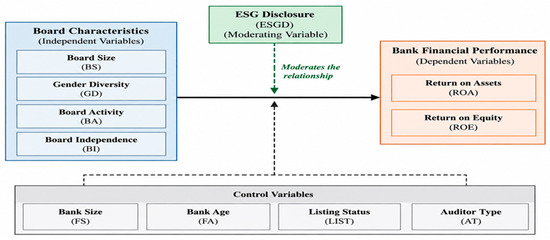
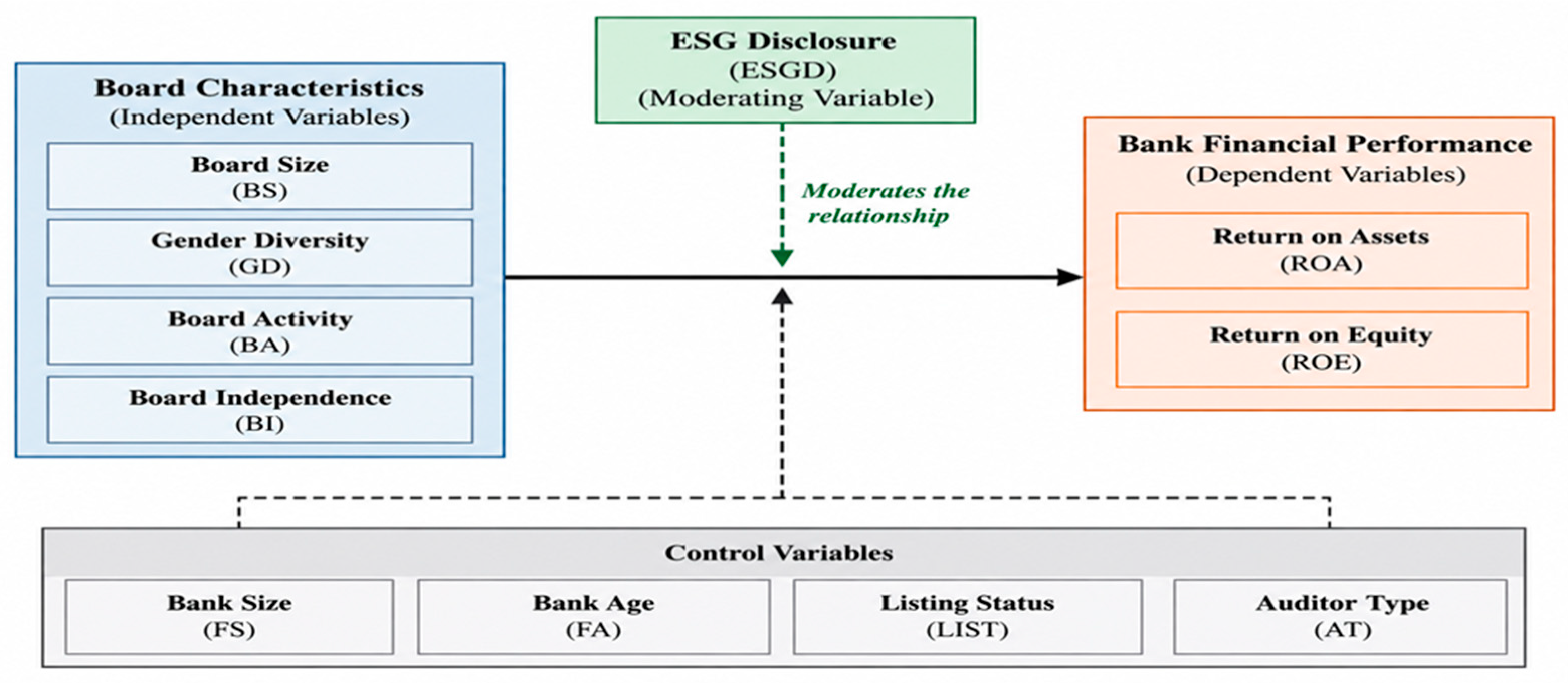

Disclaimer/Publisher’s Note: The statements, opinions and data contained in all publications are solely those of the individual author(s) and contributor(s) and not of MDPI and/or the editor(s). MDPI and/or the editor(s) disclaim responsibility for any injury to people or property resulting from any ideas, methods, instructions or products referred to in the content. |
© 2026 by the authors. Licensee MDPI, Basel, Switzerland. This article is an open access article distributed under the terms and conditions of the Creative Commons Attribution (CC BY) license.