


Simple Summary
[177Lu]Lu-PSMA-617 is a targeted radioligand therapy for patients with advanced prostate cancer that has continued to grow despite standard treatments. Although clinical trials have shown that this treatment can improve survival, less is known about how it performs in routine practice after public funding becomes available. We evaluated the first group of patients treated through a publicly funded multidisciplinary theranostic program in Toronto, Canada. Among 77 patients, treatment demonstrated meaningful anti-cancer activity and a manageable safety profile despite patients having more advanced disease and poorer baseline health than those typically enrolled in clinical trials. Our findings show that [177Lu]Lu-PSMA-617 can be successfully delivered within a publicly funded healthcare system and provide important real-world evidence to support broader implementation. These results may help inform future service planning, access to care, and research in radioligand therapy.
Abstract
[177Lu]Lu-PSMA-617 improves outcomes in patients with PSMA-positive metastatic Androgen Pathway Modulation-Resistant prostate cancer (mAPMR) previously treated with androgen deprivation therapy, androgen receptor pathway inhibitors and taxane chemotherapy; however, Canadian real-world data following public reimbursement remain limited. We evaluated the implementation and outcomes of a multidisciplinary theranostic program and the initial real-world experience with [177Lu]Lu-PSMA-617 at Princess Margaret Cancer Centre, University Health Network. In total, 77 consecutive patients with mAPMR treated between December 2024 and May 2026 were retrospectively reviewed. Median age was 72 years, 22% had visceral metastases, and median baseline PSA was 146 µg/L. Patients received a median of four treatment cycles. Median follow-up was 7.2 months. PSA, PSA50 response, and radiographic response rates were 66%, 40%, and 19%, respectively. Median radiographic progression-free survival was 6.7 months (95% CI 4.7–9.1), and median overall survival was 12.3 months (95% CI 9.8—not reached). Grade 3–4 adverse events occurred in 16% of patients, and treatment discontinuation rate due to toxicity was only 1%. Despite less favourable baseline characteristics than the pivotal VISION trial, [177Lu]Lu-PSMA-617 demonstrated clinically meaningful activity and a manageable safety profile. These findings support the feasibility and effectiveness of delivering PSMA-targeted radioligand therapy within a publicly funded healthcare system.
1. Introduction
Prostate cancer is the most commonly diagnosed cancer and the second leading cause of cancer-related death in men, excluding non-melanoma skin cancers [1]. Metastatic Androgen Pathway Modulation-Resistant prostate cancer (mAPMR, previously known as metastatic castrate-resistant prostate cancer or mCRPC) represents the advanced stage of the disease and remains incurable. Patients with mAPMR progressing after androgen receptor pathway inhibitors (ARPIs) and docetaxel chemotherapy have a relatively poor prognosis and limited therapeutic options.
[177Lu]Lu-PSMA-617 is a prostate-specific membrane antigen (PSMA)-targeted radioligand therapy and theranostic agent that delivers beta-emitting radiation directly to PSMA-expressing tumor cells. In the phase III VISION trial, the addition of [177Lu]Lu-PSMA-617 to protocol-permitted standard of care significantly improved PSA50 response rates, radiographic progression-free survival (rPFS), overall survival (OS) and health-related quality of life in patients with PSMA-positive mAPMR previously treated with ARPIs and taxane-based chemotherapy [2]. Treatment had a manageable safety profile [2]. Similarly, the randomized phase II TheraP trial demonstrated higher PSA50 response rates, improved rPFS and quality of life with [177Lu]Lu-PSMA-617 compared with cabazitaxel, although no significant difference in OS was observed [3]. The results from the VISION trial led to regulatory approval of [177Lu]Lu-PSMA-617 by the United States Food and Drug Administration (FDA), European Medicines Agency (EMA), and Health Canada in 2022. Canadian and international guidelines also endorsed [177Lu]Lu-PSMA-617 for this indication [4,5,6].
However, patients enrolled in clinical trials may not fully reflect those encountered in routine clinical practice who are often older, have more comorbidities, poorer performance status, impaired organ function, and higher symptom burden. In addition, implementation of [177Lu]Lu-PSMA-617 presents several unique logistical challenges, including the need for PSMA PET imaging and interpretation for patient selection, close coordination between medical oncology and nuclear medicine teams, patient education on radiation safety, radiopharmaceutical supply and handling, and restricted treatment capacity in public-funded healthcare systems. These factors may influence both access to treatment and timeliness of therapy delivery, potentially affecting patient outcomes. Therefore, real-world data are essential to evaluate the effectiveness, safety, and feasibility of [177Lu]Lu-PSMA-617 outside the clinical trial setting.
Although several real-world studies have reported encouraging outcomes [7,8,9,10,11,12,13], Canadian data remain very limited. Public reimbursement for [177Lu]Lu-PSMA-617 became available in Ontario in December 2024 at select centres with adequate infrastructure and capability of rapid implementation, including the Princess Margaret Cancer Centre (PM) and the affiliated Nuclear Medicine Department in Toronto General Hospital, both within the University Health Network (UHN). We therefore describe the implementation of a multidisciplinary theranostic program at PM, UHN, and report initial real-world outcomes of patients with mAPMR treated with [177Lu]Lu-PSMA-617, following public funding in Ontario.
2. Materials and Methods
This single-centre retrospective study included consecutive patients with mAPMR who received at least one dose of [177Lu]Lu-PSMA-617 at UHN, Toronto, ON, Canada, between Dec 2024 and May 2026. Eligibility criteria followed Health Canada and Ontario provincial reimbursement criteria: progressive mAPMR after ARPI and taxane-based chemotherapy, PSMA PET/CT findings meeting VISION criteria [2], adequate organ function, acceptable performance status, and multidisciplinary theranostic tumor board approval. FDG PET/CT was not routinely required as per provincial reimbursement criteria, but could be obtained by the treating oncologist if clinically indicated.
2.1. Patient Pathway
Patients underwent baseline PSMA PET/CT using either [68Ga]Ga-PSMA-11 or [18F]DCFPyL tracers. Baseline PSMA PET/CT and contrast CT chest abdomen pelvis were centrally reviewed at UHN to confirm eligibility according to VISION criteria [2]. Clinical eligibility was assessed by medical oncologists specialized in genitourinary malignancies at PM. Eligible patients were reviewed at a weekly theranostic tumor board comprising medical oncology, nuclear medicine, radiation oncology, and uro-oncology specialists treating prostate cancer. Medical oncologists served as the most responsible physicians and reviewing patients before each dose to confirm treatment eligibility and authorize treatment administration. Nuclear medicine then ordered the subsequent dose of the radiopharmaceutical.
[177Lu]Lu-PSMA-617 doses were obtained from commercial supply of Novartis Pharmaceuticals Canada INC. (Montreal, QC, Canada), and administered on an outpatient basis in Nuclear Medicine at 7.4 GBq (200 mCi) every 6 weeks for up to 6 cycles. Prochlorperazine 10 mg every 6 h was prescribed for nausea as needed. Patients underwent clinical and laboratory assessments before each cycle, with restaging CT chest, abdomen pelvis and bone scans typically performed after 2–4 cycles. Repeat PSMA PET for response assessment to [177Lu]Lu-PSMA-617 was not routinely available. Treatment continued until unequivocal disease progression, unacceptable toxicity, patient withdrawal, or completion of planned therapy.
2.2. Outcomes
Efficacy outcomes included PSA response, radiographic response, PSA progression-free survival (PSA-PFS), radiographic progression-free survival (rPFS), and overall survival (OS). PSA and PSA50 responses were defined as any PSA decline, and ≥50% decline from baseline, respectively, among evaluable patients with at least 1 PSA assessment post-treatment initiation. PSA progression was defined according to PCWG3 criteria [14].
Radiographic progression was assessed among evaluable patients with available post-treatment conventional imaging. Soft tissue disease response was categorized according to modified RECIST 1.1 criteria as per PCWG3 recommendations, and overall radiographic response was assessed according to PCWG3 criteria whenever possible [14,15]. In summary, for RECIST 1.1, up to five target lesions in total and up to 2 target lesions per site should be recorded as target lesions. For extra-skeletal disease of metastatic prostate cancer, PCWG3 recommends using RECIST 1.1 criteria, however to record up to 5 lesions per site of metastatic disease spread to address disease heterogeneity and track patterns of metastatic progression. Complete response (CR) was defined as disappearance of all lesions (nodal short axis < 1 cm), partial response (PR), a ≥30% decrease in the sum of target lesion diameters, and progressive disease (PD), a ≥20% increase, new metastatic lesions, or unequivocal progression of non-target lesions; all other cases were classified as stable disease (SD). For bone-only metastases assessed according to the PCWG3 2 + 2 rule, unconfirmed PD was defined as ≥2 new lesions on the first post-treatment scan and confirmed PD was defined as ≥2 additional lesions on the subsequent scan, with persistence of the initial lesions.
Time to PSA-PFS was calculated from treatment initiation to the date of PSA progression, or death from any cause or last follow-up, whichever occurred first. Time to rPFS was calculated from treatment initiation to the date of confirmed radiographic progression or death from any cause or last follow-up, whichever occurred first. Time to OS was calculated from treatment initiation to the date of death from any cause. Patients alive without an event were censored at the date of last follow-up.
Prespecified adverse events (AEs) included fatigue, xerostomia, nausea, acute kidney injury (AKI), anemia, thrombocytopenia, neutropenia, and myelodysplastic syndrome (MDS) or leukemia. AEs were defined as worsening toxicities relative to baseline from treatment initiation until 4 weeks after the last cycle according to electronic medical record review, and graded according to the Common Terminology Criteria for Adverse Events (CTCAE), version 5.0 [16].
2.3. Statistical Analysis
Continuous variables are reported as median (range) and categorical variables as counts (%). Associations between baseline characteristics, treatment outcomes and toxicities were assessed using Kruskal–Wallis, Chi-square test, or Fisher’s exact test as appropriate. PSA-PFS, rPFS, and OS were estimated using the Kaplan–Meier method. All p-values were 2-sided, with p < 0.05 considered statistically significant. Statistical analyses were performed using SAS Version 9.4 of the SAS system (Copyright © 2023 by SAS Institute, Inc., Cary, NC, USA).
3. Results
3.1. Patient Characteristics
A total of 77 consecutive patients were identified, including 35 internal PM patients (45.5%) and 42 patients (54.5%) referred from external institutions across Ontario. Baseline characteristics are summarized in Table 1.
Table 1.
Baseline characteristics of the overall cohort.
Median age was 72 years (range 49.0–87.0) and 47% presented with de novo metastases. All patients received prior ADT, ARPI and docetaxel chemotherapy. In addition, nearly a quarter each had previously received cabazitaxel or radium 223. Only two patients received prior PSMA-targeting radioligand therapy. Homologous recombination deficiency (HRD) and mismatch repair deficiency (dMMR or microsatellite instabililty-high [MSI-H]) were detected in 8% and 3%, respectively. At baseline, median PSA was 146 (range 0.9–4677.2), 22% had visceral metastases, 81% had ECOG performance status 0-1, 21% had Grade ≥ 2 anemia and 9% had hemoglobin < 90 g/L.
Compared to internal patients, externally referred patients had numerically higher baseline median PSA (189.1 vs. 85.5, p = 0.11), higher Gleason score (Gleason ≥ 8 87.2% vs. 59.4%, p = 0.007), median hemoglobin (116.5 vs. 108, p = 0.0488), and more frequent de novo metastases (59.5% vs. 31.4%, p = 0.0139) (Supplementary Materials Table S1). Other baseline characteristics were broadly consistent.
3.2. Treatment Patterns
All patients underwent screening with PSMA PET/CT (14 with [18F]DCFPyL tracer, 63 patients had [68Ga]Ga-PSMA-11). Only one patient had an additional FDG PET CT prior to treatment. All patients fulfilled VISION PSMA PET eligibility criteria, and had at least one PSMA-avid metastasis with an miPSMA score of 3. No patients had sizable PSMA-negative lesions (osseous metastases with a ≥1 cm soft-tissue component, visceral metastases ≥1 cm, or nodal metastases ≥ 2.5 cm), defined as PSMA uptake below hepatic background on corresponding conventional imaging.
Median time from PSMA PET CT imaging to treatment initiation was 47 days (range 8–152), and did not differ significantly between internal (41.0 days [range 8.0–152]) and externally referred patients (53.0 days [range 10.0–149.0], p = 0.1059). Delays exceeding 90 days occurred in 14 patients, including 9 external referrals and 5 who underwent PSMA PET/CT before or during the previous line of systemic therapy, and required subsequent progression to meet eligibility criteria for [177Lu]Lu-PSMA-617.
In total, 320 doses of [177Lu]Lu-PSMA-617 were administered, with a median of 4 doses per patient (range 1–6). No concurrent systemic therapies were administered except ongoing ADT as per provincial reimbursement criteria. Among 60 patients who have completed or discontinued treatment, 50% received ≤ 4 cycles, while 45% received all 6 cycles.
3.3. Efficacy Outcomes
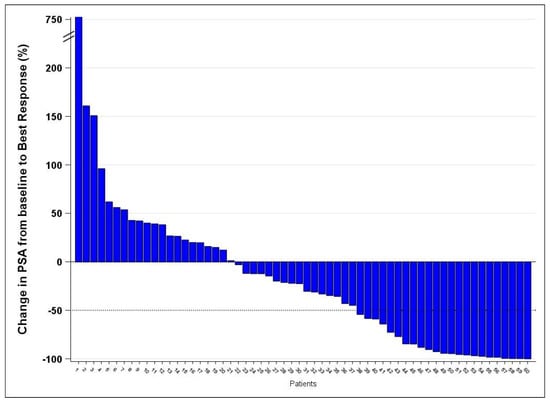
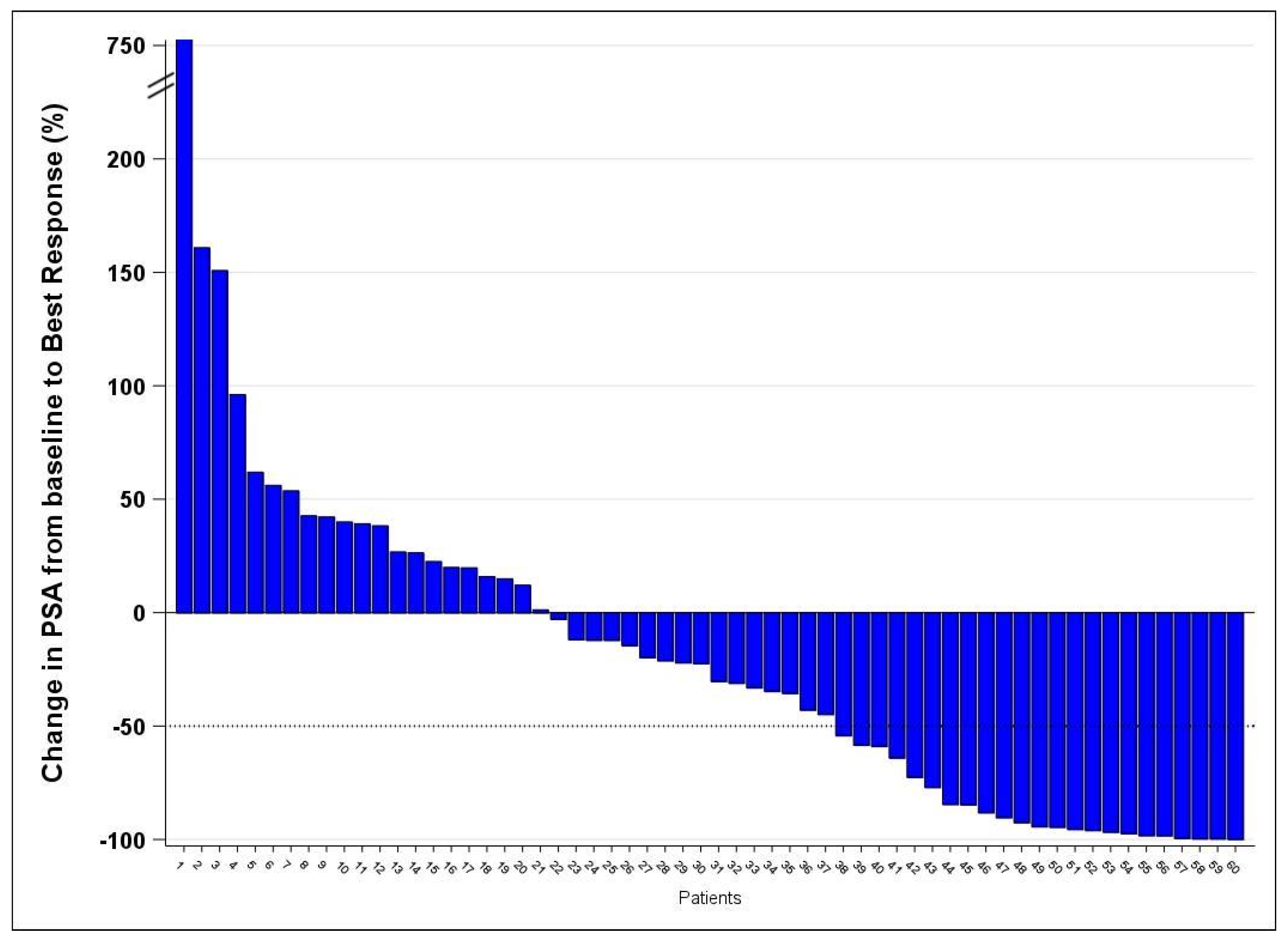
All patients had available PSA post-treatment; therefore, they were evaluable for PSA response. In the overall cohort including patients with ongoing therapy, 51 patients achieved any PSA decline (66%), and 31 (40%) achieved a PSA50 response (Figure 1 and Table 2).
Figure 1.
PSA response in the overall cohort.
Table 2.
Best PSA and radiographic response in evaluable patients in the overall cohort.
Among the 39 patients who experienced an initial PSA rise after cycle 1, 15 (39%) subsequently achieved a PSA response. Most PSA responses occurred after the first two cycles and only three patients (6%) had their first PSA response after cycle 3. For one of these patients, post-cycle 2 PSA data were unavailable.
In the exploratory subgroup analyses, prior exposure to systemic therapies including cabazitaxel and radium-223 exposure did not significantly impact PSA response or PSA50 response (Supplementary Materials Tables S3 and S4). All eight patients with HRD or dMMR/MSI-H alterations achieved a PSA response (100%), and numerically higher PSA50 response rate compared to patients without such alterations (50% vs. 39%, p = 0.7035). No other baseline characteristics, including baseline Grade ≥ 2 anemia, were significantly associated with PSA or PSA50 response (Supplementary Materials Tables S3 and S4).
Radiographic response assessment was most often assessed by conventional imaging (94%), where only two patients (3%) had PSMA PET CT post-therapy. Among 64 evaluable patients, 12 (19%) had radiographic response as best response, all of which were partial responses (Table 2), and 39% had progressive disease.
At the data cut-off point, 12 patients had ongoing radiographic response, 11 of whom also had ongoing PSA response. Among 45 patients with confirmed radiographic progression at last follow-up, all but 1 also had PSA progression.
Additional exploratory analyses were performed to evaluate whether inclusion of patients with ongoing treatment, who had incomplete follow-up and response assessment, may have influenced the response estimates. PSA and radiographic response rates were comparable between the subset of evaluable patients who had completed or discontinued treatment and the overall cohort (Supplementary Materials, Table S2).
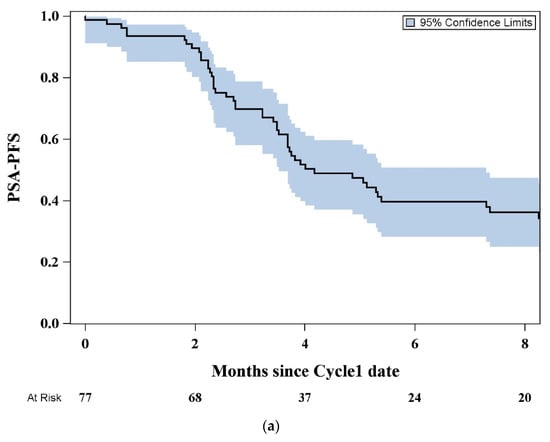
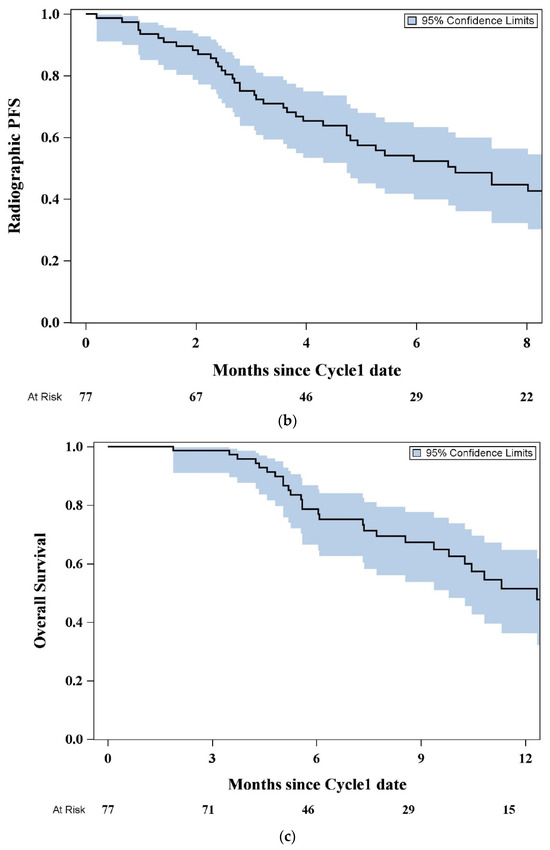
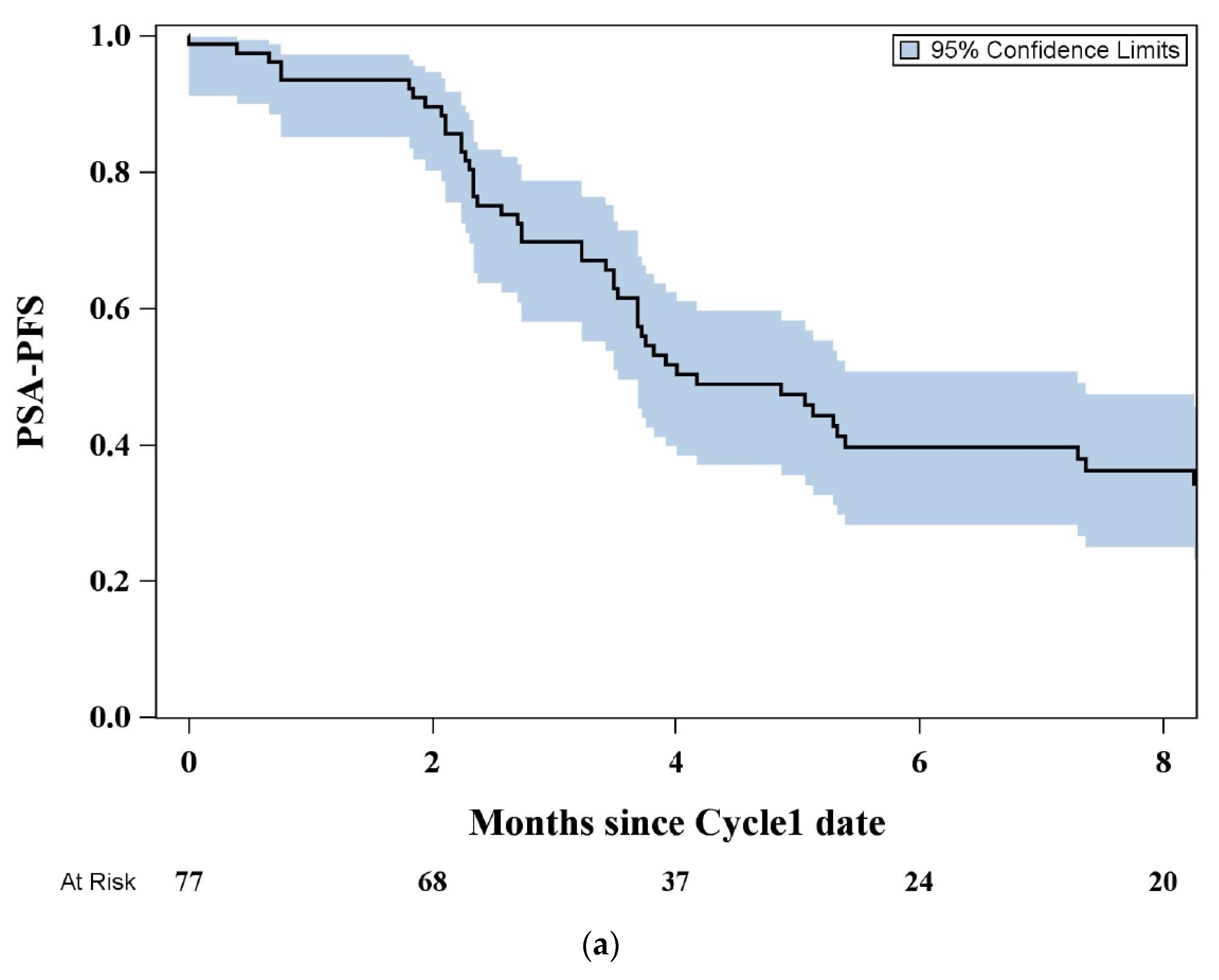
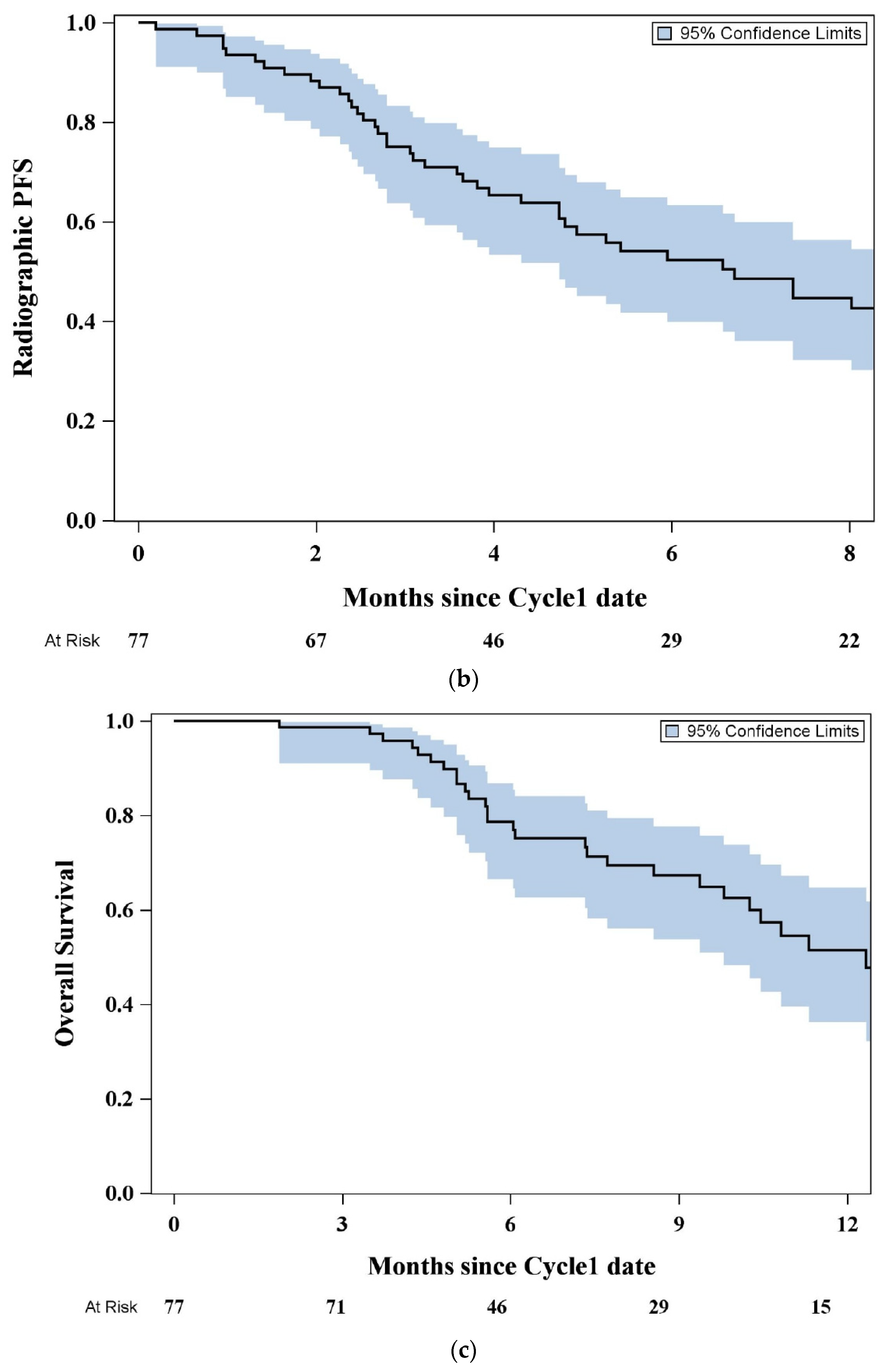
Median follow-up was 7.2 months (range 1.8, 19.8). Median PSA-PFS was 4.2 months (95% CI 3.5–7.3), median rPFS was 6.7 months (95% CI 4.7–9.1), and median OS was 12.3 months (95% CI 9.8-NR), as shown in Figure 2. In the exploratory subgroup analyses, PSA response (62.9% vs. 69.0%, p = 0.57), PSA50 response (40.0% vs. 40.5%, p = 0.97), median PSA-PFS (4.2 months [95% CI 3.5–8.3] vs. 4.9 months [95% CI 2.7–9.4]), median rPFS (6.7 months [95% 3.7–9.9] vs. 6.0 months [95% CI 3.8–9.4] and median OS (10.5 months [95% CI 9.4–NR, not reached] vs. NR [95% CI 7.0-NR]) were comparable between internally and externally referred patients, respectively.
Figure 2.
(a) PSA progression-free survival; (b) radiographic progression-free survival; (c) overall survival.
3.4. Adverse Events
Common AEs were fatigue (66%), anemia (61%), xerostomia (52%), thrombocytopenia (39%), nausea (21%), and AKI (18%) (Table 3). Grade 3/4 AEs occurred in 12 patients (16%), most commonly anemia (14%), with 10 patients (13%) requiring transfusion. No treatment-related deaths, myelodysplastic syndrome or leukemia were observed.
Table 3.
Prespecified treatment-related adverse events of interest.
Dose delay of > 1 week due to AE occurred in 9 patients (12%), while dose reduction occurred in 12 patients (16%), all attributable to Grade 3/4 toxicities. Dose modification did not significantly impact PSA response (Supplementary Materials Tables S3 and S4). Treatment discontinuation due to AEs occurred in only one patient (1%).
In the exploratory subgroup analyses, prior Radium-223 exposure was associated with higher rates of hematologic toxicity (Supplementary Materials Table S5). Prior therapy was significantly associated with treatment-related AEs. Baseline hemoglobin < 100 g/L was associated with numerically higher rates of treatment-related anemia but this difference did not reach statistical significance (Supplementary Materials Tables S5–S10).
4. Discussion
To our knowledge, this is the first Canadian study describing real-world implementation and outcomes of [177Lu]Lu-PSMA-617 following public reimbursement in Canada. Our findings suggest that PSMA-targeted radioligand therapy can be successfully delivered through a publicly funded multidisciplinary theranostic program, with efficacy and safety outcomes broadly consistent with those reported in VISION and other real-world cohorts.
The median interval from PSMA PET/CT to treatment initiation was 47 days, comparable to reports from other centres [10,17], but longer than the 4-week interval specified in VISION [2]. This likely reflects the logistical challenges of coordinating radioligand therapy within a publicly funded healthcare system outside a clinical trial or access program. Delays in treatment initiation are clinically relevant, as patients with advanced mAPMR may progress while awaiting therapy and become ineligible for treatment [17]. At our centre, treatment capacity was not a limiting factor. However, some patients underwent PSMA PET/CT before confirmed radiographic or clinical progression and therefore did not meet eligibility criteria at the time of PSMA PET/CT imaging, resulting in a longer interval between PSMA PET/CT and [177Lu]Lu-PSMA-617 initiation. Recent data suggest that shorter intervals between PSMA PET/CT and treatment initiation may be associated with improved outcomes [18]. Together, these findings underscore the importance of appropriate timing and timely access to conventional imaging and PSMA PET/CT, coordinated referral pathways, and adequate treatment capacity.
Eligibility in our program was primarily determined using PSMA PET/CT and conventional imaging, consistent with VISION [2]. Although additional FDG PET/CT may identify patients with discordant FDG-positive/PSMA-negative disease who are less likely to benefit from treatment and provide additional prognostic information [3,19], outcomes in our cohort were comparable to those reported in a recent Quebec cohort in Canada, where patients were selected using both PSMA and FDG PET/CT prior to provincial funding in Quebec [10]. These findings suggest that routine FDG PET/CT is not required for all patients with the currently approved indication, although it may be useful to guide treatment selection in select scenarios. Our institutional theranostic multidisciplinary cancer conference recommends consideration of FDG PET/CT in patients with borderline PSMA avidity, or features suggestive of aggressive or dedifferentiated disease such as low PSA production and predominant visceral metastases. For these cases, biopsy of discordant FDG-positive/PSMA-negative disease is recommended when feasible to exclude neuroendocrine differentiation and confirm ineligibility for [177Lu]Lu-PSMA-617. Routine incorporation of FDG PET/CT into eligibility assessment, however, must be balanced against the additional resource requirements and potential delays in treatment initiation within a publicly funded healthcare system.
Our cohort represented a broader real-world population than that enrolled in VISION, including those with poorer performance status, lower baseline marrow reserve (9% had baseline hemoglobin < 90 g/L, an exclusion criterion in VISION [2]), and substantially higher median baseline PSA levels than that in VISION (146 vs. 77.5 µg/L) [2] and the Quebec cohort (146 vs. 49) [10]. These differences reflect the broader eligibility criteria and greater disease burden encountered in routine clinical practice. Despite these less favourable characteristics, PSA (66% vs. 72%) and PSA 50 response rates (40% vs. 46%) were comparable to VISION [2]. Notably, most PSA responses occurred within the first two cycles, although delayed responses were observed similar to previous reports [11], suggesting that an early PSA rise alone should not necessarily prompt treatment discontinuation in the absence of clinical or radiographic progression.
The radiographic response rate defined by conventional imaging was lower in our study than in VISION (19% vs. 30%) [2], potentially reflecting differences in baseline disease burden, imaging timing, and inherent variability of imaging assessment in routine practice compared with prospective clinical trial settings. Nevertheless, radiographic and PSA responses were generally concordant. While most patients did not undergo serial PSMA PET/CT, further studies are needed to define its role in response assessment.
Median rPFS (6.7 vs. 8.7 months) and OS (12.3 vs. 15.3 months) were modestly shorter than in VISION [2]. Given the relatively short follow-up, OS data in our cohort may be immature; however, the data appear comparable to the Quebec cohort (12.3 vs. 13.0 months) [10]. In the context of similar PSA response rates, this likely reflects the differences in patient population rather than decreased treatment efficacy. Notably, externally referred patients achieved outcomes comparable to internal patients despite having higher baseline PSA levels and greater prior treatment exposure. While these data are hypothesis-generating, it suggests the feasibility of a provincial referral model for [177Lu]Lu-PSMA-617. As access expands and physician experience grows, these outcomes may improve as 1[177Lu]Lu-PSMA-617 is increasingly used earlier in the treatment course, particularly before cabazitaxel, a shift we observed over time along with other centres [11].
Importantly, prior radium-223 did not preclude subsequent benefit from [177Lu]Lu-PSMA-617, consistent with findings from the RALU study [20]. However, these analyses were limited by the small sample size and should be interpreted as hypothesis-generating only. Whether retreatment with PSMA-targeted radioligand therapy benefits selected patients is being evaluated in ongoing clinical trials (RE-LuPSMA NCT06288113, VECTRA-01 NCT07611110).
Overall, [177Lu]Lu-PSMA-617 was well tolerated. Approximately half of the patients who completed treatment received all six planned cycles, similar to VISION [2], but numerically higher than the proportion reported in the Quebec cohort (26%) [10]. Most adverse events were low grade and manageable with supportive measures, treatment delays, or dose modification. However, our follow-up was relatively short and longer-term follow-up is needed to confirm these findings. Treatment discontinuation due to toxicity was rare, consistent with previous reports [3,13]. Xerostomia and anemia were more frequent than in VISION [2], although similar to the TheraP trial and other real-world cohorts [3,9]. Rates of Grade 3/4 anemia were similar to VISION (14% vs. 13%). Prior radium-223 exposure was associated with hematologic toxicity, highlighting the potential for cumulative marrow toxicity when sequencing radiopharmaceutical therapies. No cases of myelodysplastic syndrome, leukemia, or treatment-related death were observed. However, longer-term follow-up will be important as PSMA-targeted radioligand therapy moves earlier in the treatment paradigm.
Although cost-effectiveness was beyond the scope of this study, prior analyses have highlighted the substantial cost associated with [177Lu]Lu-PSMA-617, which exceeds the Canadian benchmark willingness-to-pay threshold of $50,000 per quality adjusted life-year (QALY) gained [21,22]. Requirement for PSMA PET imaging may further increase health system costs. Canada’s Drug Agency (CADTH) recommended reimbursement with conditions, including reduced drug prices, based on the survival and quality of life benefits demonstrated in VISION. Real-world cost effectiveness following implementation warrants further evaluation, particularly as the PSMA radioligand therapy landscape expands. As emerging PSMA-targeted radioligand therapies, including Actinium-225, Terbium-161, and Lead-212, advance in development, experience with the implementation of [177Lu]Lu-PSMA-617 may help inform their integration into publicly funded healthcare systems [23].
This study is limited by its retrospective, single-centre design, sample size, and relatively short follow-up. The relatively small number of patients in certain subgroups, including those with visceral disease, baseline Grade ≥ 2 anemia, HRD or dMMR/MSI-H alterations, limited the statistical power of these exploratory subgroup analyses. In addition, no adjustments were made for multiple comparisons; therefore, findings of these exploratory analyses should be interpreted as hypothesis-generating only. Nevertheless, the cohort captures a geographically diverse patient population across Ontario, and provides early Canadian real-world evidence supporting the feasibility, effectiveness, and safety of [177Lu]Lu-PSMA-617 within a publicly funded healthcare system. Adverse event reporting in medical records is limited by incomplete documentation, reporting bias, and the lack of standardized patient-reported outcomes for symptomatic events inherent to retrospective studies. Larger, multicentre studies with longer follow-up are needed to further characterize outcomes following implementation.
5. Conclusions
Publicly funded [177Lu]Lu-PSMA-617 was successfully implemented through a multidisciplinary theranostic program at Princess Margaret Cancer Centre, UHN. In this real-world cohort of patients with mAPMR and less favourable baseline characteristics than those enrolled in VISION, treatment demonstrated clinically meaningful activity with a manageable safety profile, supporting the initial effectiveness and tolerability of [177Lu]Lu-PSMA-617 outside highly selected clinical trial populations. These findings provide an early benchmark for Canadian real-world outcomes and support broader implementation of PSMA-targeted radioligand therapy across Canada and other publicly funded healthcare systems.
Supplementary Materials
The following supporting information can be downloaded at https://www.mdpi.com/article/10.3390/curroncol33110666/s1: Table S1. Baseline characteristics of internal and externally referred patients; Table S2: Best PSA and radiographic response among evaluable patients who completed or discontinued treatment; Table S3: Impact of selected variables on PSA response; Table S4: Impact of selected baseline variables on PSA50 response; Table S5: Impact of the baseline variables on anemia; Table S6: Impact of the baseline variables on neutropenia; Table S7: Impact of the baseline variables on thrombocytopenia; Table S8: Impact of the baseline variables on dry mouth; Table S9: Impact of the baseline variables on nausea; Table S10: Impact of the baseline variables on acute kidney injury.
Author Contributions
Conceptualization, D.M.J. and S.S.S.; Methodology, D.M.J. and S.S.S.; Software, E.G.A.; Validation, D.M.J. and E.G.A.; Formal Analysis, E.G.A.; Investigation, D.M.J.; Resources, J.G., M.G., P.V.-H. and U.M.; Data Curation, D.M.J., S.G., P.V.-H., U.M., S.A.M., J.G., M.G., E.M.A.-E., N.F.-R., V.K., S.A. (Sheeraz Ali), S.A. (Sulaiman Almuthri), K.A., R.K.W., N.E.F. and S.S.S.; Writing—Original Draft Preparation, D.M.J., Writing—Review and Editing, all authors; Supervision, D.M.J.; Project Administration, S.G. and D.M.J.; Funding Acquisition, D.M.J. All authors have read and agreed to the published version of the manuscript.
Funding
Novartis Pharmaceuticals Canada INC, provided funding to support statistical analysis by a biostatistician at Princess Margaret Cancer Centre. Novartis did not have any participation in study design, data collection, analysis planning, interpretation, manuscript preparation, or the decision to submit this manuscript.
Institutional Review Board Statement
The study was conducted in accordance with the Declaration of Helsinki, and approved by the Research Ethics Board (CAPCR 23-5269.3, 21 September 2026 of approval) of University Health Network for studies involving humans.
Informed Consent Statement
Patient consent was waived due to the retrospective nature of this study.
Data Availability Statement
The data presented in this study are available on request from the corresponding author due to institutional Research Ethics approval requirements for data sharing.
Acknowledgments
The authors want to acknowledge Alain Paquette, administrative assistant in the Division of Medical Oncology, Princess Margaret Cancer Center, for his invaluable contributions to referral coordination, patient navigation, and facilitating patient access to [177Lu]Lu-PSMA-617, all of which were instrumental to the successful delivery of the program. During the preparation of this manuscript, the authors used Microsoft 365 CoPilot Version number bizchat.20260701.51.17 for the purposes of generating the graphical abstract, refining grammar and managing character counts during the editing process. The prompts used for the graphical abstract were as follows: generate a publication-style graphical abstract illustrating PSMA theranostics and [177Lu]Lu-PSMA-617 treatment for advanced prostate cancer; summarize the study population, treatment pathway, baseline characteristics, PSA and PSA50 responses, survival outcomes, and safety; use a clean academic medical-journal aesthetic with a restrained blue/teal palette; and iteratively refine the layout, terminology, spacing, and presentation of study outcomes. No artificial intelligence (AI) tools were used to generate any other text, data, graphics, study design, or to perform data collection, analysis, and interpretation. The authors have reviewed and edited the output and take full responsibility for the content of this publication.
Conflicts of Interest
Di Maria Jiang—Speaker fees and honoraria: Pfizer, Janssen, Bayer, EMD Serono, Abbvie, AstraZeneca, Astellas, Novartis, Ipsen; Consulting/advisory board: Pfizer, Bayer, EMD Serono, McKesson, AstraZeneca/Merck, Janssen, Knight Therapeutic, Novartis, Amgen, JAMP; Grants: Bayer, Pfizer, Novartis; Travel: Janssen, Pfizer, EMD Serono, Novartis; Senior Medical Officer for trials for Synnovation Therapeutics and T.O.A.D; Patrick Veit-Haibach—IS grants: Bayer, Roche Pharmaceuticals, Siemens Healthineers, GE Healthcare; Industry Sponsored Theranostic Trials: Novartis, RayzeBio, Fusion, Eli Lilly, Bayer, Alpha 9, Telix, Ratio Therapeutic; Advisory Board: Novartis, Eli Lilly, GE Healthcare, Initio Medical; Shareholder: Initio Medical; IIS trial support: Pentixapharm, Siemens Healthineers, GE Healthcare, Spectrum Dynamics; Speaker fees and travel support: Siemens Healthineers, GE Healthcare, Singapore Nuclear Medicine Society, Novartis, Eli Lilly; Ontario Association of Radiologists, Novartis, JCA PET/CT, Astellas, Taiwan Oncology Society, ACUOG, CAR, CANM, Bayer; Springer Nature: editor fee; Reviewer compensation: Wellcome Trust; German Cancer Center: Strategic panel advisory compensation and travel support. Rebecca Wong—Industry Sponsored Theranostic Trials: POINT, Oranomed, Novartis, Rayzebio. Precirix, Speaker fees: CAR; Ur Metser, Seyed Ali Mirshahvalad, Shreya Gramolini, Eshetu G. Atenefu, Mihaela Ginj, Esmail Al-Ezzi, Nazanin Fallah-Rad, Vikaash Kumar, Sheeraz Ali, Sulaiman Almuthri, Khaled Abdulalem, Neil Eric Fleshner—no COIs; Judy Gabrys—speaker fee: Novartis; Srikala S. Sridhar—grants: Bayer, EMD Serono; consulting fees—Astellas, Bayer, Novartis, Pfizer, Janssen, Merck, Bicycle Therapeutics; speaker fee: Pfizer, Bayer; travel: Janssen, Knight Therapeutics. The funders had no role in the design of the study; in the collection, analyses, or interpretation of data; in the writing of the manuscript; or in the decision to publish the results.
References
- Kratzer, T.B.; Mazzitelli, N.; Star, J.; Dahut, W.L.; Jemal, A.; Siegel, R.L. Prostate cancer statistics, 2025. CA A Cancer J. Clin. 2025, 75, 485–497. [Google Scholar] [CrossRef] [Scilit] [PubMed]
- Sartor, O.; de Bono, J.; Chi, K.N.; Fizazi, K.; Herrmann, K.; Rahbar, K.; Tagawa, S.T.; Nordquist, L.T.; Vaishampayan, N.; El-Haddad, G.; et al. Lutetium-177–PSMA-617 for Metastatic Castration-Resistant Prostate Cancer. N. Engl. J. Med. 2021, 385, 1091–1103. [Google Scholar] [CrossRef] [Scilit] [PubMed]
- Hofman, M.S.; Emmett, L.; Sandhu, S.; Iravani, A.; Joshua, A.M.; Goh, J.C.; Pattison, D.A.; Tan, T.H.; Kirkwood, I.D.; Ng, S.; et al. [177Lu]Lu-PSMA-617 versus cabazitaxel in patients with metastatic castration-resistant prostate cancer (TheraP): A randomised, open-label, phase 2 trial. Lancet 2021, 397, 797–804. [Google Scholar] [CrossRef] [Scilit] [PubMed]
- Saad, F.; So, A.I.; Aprikian, A.; Finelli, A.; Fleshner, N.E.; Gleave, M.E.; Hamilou, Z.; Niazi, T.; North, S.A.; Pouliot, F.; et al. 2025 Canadian Urological Association-Canadian Uro-oncology Group Guideline: Metastatic castration-resistant prostate cancer (Update). Can. Urol. Assoc. J. 2025, 19, E276–E289. [Google Scholar] [CrossRef] [Scilit] [PubMed]
- Taplin, M.-E.; Bin Riaz, I.; Rumble, R.B.; Naqvi, S.A.A.; Hope, T.A.; Dias, M.F.; He, H.; Hotte, S.J.; Emamekhoo, H.; Murad, M.H.; et al. Systemic Therapy in Patients With Metastatic Castration-Resistant Prostate Cancer: ASCO Living Guideline, Version 2026.1. J. Clin. Oncol. 2026, 44, JCO2502693. [Google Scholar] [CrossRef] [Scilit] [PubMed]
- Fizazi, K.; Attard, G.; Azad, A.; Baciarello, G.; Beltran, H.; Bjartell, A.; Blanchard, P.; Bossaert, F.; Castro, E.; Compérat, E.; et al. Advanced and metastatic prostate cancer: ESMO Clinical Practice Guideline for diagnosis, treatment and follow-up. Ann. Oncol. 2026, 37, 590–607. [Google Scholar] [CrossRef] [Scilit] [PubMed]
- Murthy, V.; Voter, A.F.; Nguyen, K.; Allen-Auerbach, M.; Chen, L.; Caputo, S.; Ledet, E.; Akerele, A.; Tuchayi, A.M.; Lawhn-Heath, C.; et al. Efficacy and Toxicity of [177Lu]Lu-PSMA-617 for Metastatic Castration-Resistant Prostate Cancer: Results from the U.S. Expanded-Access Program and Comparisons with Phase 3 VISION Data. J. Nucl. Med. 2024, 65, 1740–1744. [Google Scholar] [CrossRef] [Scilit] [PubMed]
- Gafita, A.; Voter, A.; Shesadri, S.; Spitz, A.; Marshall, C.H.; Rowe, S.P.; Markowski, M.C.; Pomper, M.G.; Civelek, A.C.; Carducci, M.A.; et al. Initial Experience with [177Lu]Lu-PSMA-617 After Regulatory Approval for Metastatic Castration-Resistant Prostate Cancer: Efficacy, Safety, and Outcome Prediction. J. Nucl. Med. 2024, 65, 1724–1730. [Google Scholar] [CrossRef] [Scilit] [PubMed]
- Tuchayi, A.M.; Yadav, S.; Jiang, F.; Kim, S.T.; Saelee, R.K.; Morley, A.; Juarez, R.; Lawhn-Heath, C.; Wang, Y.; de Kouchkovsky, I.; et al. Real-World Experience with177Lu-PSMA-617 Radioligand Therapy After Food and Drug Administration Approval. J. Nucl. Med. 2024, 65, 735–739. [Google Scholar] [CrossRef] [Scilit] [PubMed]
- Pouliot, F.; Lodde, M.; Besançon, M.; Castonguay, V.; Morin-Coulombe, A.; Fradet, V.; Fradet, Y.; Lacombe, L.; Lévesque, É.; Marcoux, N.; et al. Trajectory timelines and treatment efficacy of 177Lu-PSMA-617 radioligand therapy for metastatic castration-resistant prostate cancer. Can. Urol. Assoc. J. 2026, 20, 163–169. [Google Scholar] [CrossRef] [Scilit] [PubMed]
- Bailly, C.; Vija, L.; Somme, F.; Massard, V.; Barthélémy, P.; Giraudet, A.-L.; Godbert, Y.; Fléchon, A.; Girault, S.; Abadie-Lacourtoisie, S.; et al. Real-World Outcomes of [177Lu]Lu-PSMA-617 in the French Early-Access Program for Patients with Metastatic Castration-Resistant Prostate Cancer. J. Nucl. Med. 2026, 67, 1613–1619. [Google Scholar] [CrossRef] [Scilit] [PubMed]
- Kafka, M.; Horninger, A.; di Santo, G.; Virgolini, I.; Neuwirt, H.; Unterrainer, L.M.; Kunte, S.C.; Deiss, E.; Paffenholz, P.; Heidenreich, A.; et al. Real-world Outcomes and Predictive Biomarkers for 177Lutetium Prostate-specific Membrane Antigen Ligand Treatment in Metastatic Castration-resistant Prostate Cancer: A European Association of Urology Young Academic Urologists Prostate Cancer Working Group Multi-institutional Observational Study. Eur. Urol. Oncol. 2023, 7, 421–429. [Google Scholar] [CrossRef] [Scilit] [PubMed]
- Khreish, F.; Ghazal, Z.; Marlowe, R.J.; Rosar, F.; Sabet, A.; Maus, S.; Linxweiler, J.; Bartholomä, M.; Ezziddin, S. 177 Lu-PSMA-617 radioligand therapy of metastatic castration-resistant prostate cancer: Initial 254-patient results from a prospective registry (REALITY Study). Eur. J. Nucl. Med. Mol. Imaging 2021, 49, 1075–1085. [Google Scholar] [CrossRef] [Scilit] [PubMed]
- Scher, H.I.; Morris, M.J.; Stadler, W.M.; Higano, C.; Basch, E.; Fizazi, K.; Antonarakis, E.S.; Beer, T.M.; Carducci, M.A.; Chi, K.N.; et al. Trial Design and Objectives for Castration-Resistant Prostate Cancer: Updated Recommendations From the Prostate Cancer Clinical Trials Working Group 3. J. Clin. Oncol. 2016, 34, 1402–1418. [Google Scholar] [CrossRef] [Scilit] [PubMed]
- Eisenhauer, E.A.; Therasse, P.; Bogaerts, J.; Schwartz, L.H.; Sargent, D.; Ford, R.; Dancey, J.; Arbuck, S.; Gwyther, S.; Mooney, M.; et al. New response evaluation criteria in solid tumours: Revised RECIST guideline (version 1.1). Eur. J. Cancer 2009, 45, 228–247. [Google Scholar] [CrossRef] [Scilit] [PubMed]
- Common Terminology Criteria for Adverse Events (CTCAE) Version 5.0. Available online: https://dctd.cancer.gov/research/ctep-trials/for-sites/adverse-events/ctcae-v5-5x7.pdf (accessed on 2 October 2026).
- Ravi, P.; Whelpley, B.; Kelly, E.; Wolanski, A.; Ritzer, J.; Robertson, M.; Shah, H.; Morgans, A.K.; Wei, X.X.; Sunkara, R.; et al. Clinical Implementation of 177Lu-PSMA-617 in the United States: Lessons Learned and Ongoing Challenges. J. Nucl. Med. 2023, 64, 349–350. [Google Scholar] [CrossRef] [Scilit] [PubMed]
- Parihar, A.S.; Dehdashti, F.; Pant, N.; Ravindra, S.G.; Pachynski, R.; Picus, J.; Reimers, M.A.; Bhatt, A.; Gay, H.; Song, W.; et al. Evaluating Interim Progression: First Posttherapy 177Lu-PSMA SPECT/CT Relative to Baseline PSMA PET/CT. J. Nucl. Med. 2026, 67, 1582–1585. [Google Scholar] [CrossRef] [Scilit] [PubMed]
- Telli, T.; Lopes, L.; Karpinski, M.; Pabst, K.M.; Grünwald, V.; Shi, K.; Hadaschik, B.; Kesch, C.; Umutlu, L.; Herrmann, K.; et al. Prognostic value of [18F]FDG- and PSMA-PET in patients evaluated for [177Lu]Lu-PSMA therapy of mCRPC. Eur. J. Nucl. Med. Mol. Imaging 2025, 52, 3199–3210. [Google Scholar] [CrossRef] [Scilit] [PubMed]
- Rahbar, K.; Essler, M.; Pabst, K.M.; Eiber, M.; la Fougère, C.; Prasad, V.; Rassek, P.; Hasa, E.; Dittmann, H.; Bundschuh, R.A.; et al. Safety and Survival Outcomes of 177Lu-Prostate-Specific Membrane Antigen Therapy in Patients with Metastatic Castration-Resistant Prostate Cancer with Prior 223Ra treatment: The RALU Study. J. Nucl. Med. 2022, 64, 574–578. [Google Scholar] [CrossRef] [Scilit] [PubMed]
- Canadian Agency for Drugs and Technologies in Health (CADTH). CADTH Reimbursement Recommendation: Lutetium (177Lu) Vipivotide Tetraxetan (Pluvicto). Can. J. Health Technol. 2023, 3. Available online: https://www.cda-amc.ca/sites/default/files/DRR/2023/PC0297%20Pluvicto%20-%20Final%20CADTH%20Recommendation%20(with%20redactions%20March%203%2C%202023_For%20publishing_JH_BMc-meta.pdf) (accessed on 19 October 2026).
- Brinkmann, C.; Baum, R.P.; Stargardt, T. Cost-utility analysis of 177Lu-PSMA-617 radioligand therapy in second-line and third-line treatment for metastatic castration-resistant prostate cancer (mCRPC) in Germany. Eur. J. Nucl. Med. Mol. Imaging 2025, 52, 4377–4389. [Google Scholar] [CrossRef] [Scilit] [PubMed]
- Dragonetti, V.; Mattana, F.; Ceci, F. PSMA Therapy Grey Zones: Actinium, Lutetium, or Terbium for the Future of Radioligand therapy? Eur. Urol. Focus 2026, in press. [Google Scholar] [CrossRef] [Scilit] [PubMed]

Disclaimer/Publisher’s Note: The statements, opinions and data contained in all publications are solely those of the individual author(s) and contributor(s) and not of MDPI and/or the editor(s). MDPI and/or the editor(s) disclaim responsibility for any injury to people or property resulting from any ideas, methods, instructions or products referred to in the content. |
© 2026 by the authors. Licensee MDPI, Basel, Switzerland. This article is an open access article distributed under the terms and conditions of the Creative Commons Attribution (CC BY) license.