


Simple Summary
Chimeric antigen receptor T-cell therapy with idecabtagene vicleucel has improved outcomes for relapsed multiple myeloma, but real-world results vary considerably. In this evidence synthesis of real-world studies, we evaluated how tumors growing outside the bone marrow, termed extramedullary disease, and prolonged low blood counts affect treatment success. We found that approximately one in five treated patients has extramedullary involvement, which consistently cuts progression-free survival roughly in half compared to those without soft-tissue tumors. Additionally, severe low blood counts remain common three months after treatment, especially low platelets and white blood cells. Importantly, delayed blood recovery is primarily driven by extensive cancer in the bone marrow rather than tumors outside the bone. These findings emphasize that clinicians should thoroughly evaluate both tumor locations and bone marrow health before infusion to optimize treatment selection, anticipate supportive care needs, and guide the design of future clinical trials.
Abstract
Background: Idecabtagene vicleucel (ide-cel) has demonstrated substantial activity in relapsed/refractory multiple myeloma (RRMM), but outcomes in real-world patients remain heterogeneous. Extramedullary disease (EMD) is an adverse phenotype, and prolonged cytopenias may complicate post-CAR-T recovery. We synthesized real-world standard-of-care ide-cel evidence to characterize EMD-associated efficacy outcomes and prolonged hematotoxicity. Methods: We performed a focused evidence synthesis of real-world ide-cel studies reporting EMD-stratified outcomes, cytopenias, hematopoietic interventions, or safety in RRMM. Data were extracted into a structured workbook. Because several US datasets were derived from potentially overlapping registry or consortium populations, primary EMD prevalence and progression-free survival (PFS) synthesis was restricted to non-overlapping EMD-stratified cohorts. Progression-free survival (PFS) was analyzed in parallel across contributing cohorts rather than pooled mathematically. Cytopenia outcomes were summarized descriptively at day 30/month 1 and day 90/month 3. Results: Five real-world studies were included. Across two non-overlapping ide-cel-only EMD-stratified cohorts, 111 of 510 infused patients had reported EMD, corresponding to a combined study-reported prevalence of 21.8% (17.0% in the French registry and 23.9% in the US cohort). Median PFS was shorter with EMD in both contributing cohorts: 6.21 versus 14.82 months in FENIX/DESCAR-T and 5.3 versus 11.1 months in the US EMD-focused cohort. Across both independent cohorts, presence of extramedullary disease was consistently associated with significantly inferior progression-free survival: median PFS was 6.21 months (95% CI: 4.01–NR) versus 14.82 months (95% CI: 11.30–18.37) in the French FENIX/DESCAR-T cohort (adjusted HR 3.15, 95% CI: 1.82–5.47; p < 0.0001), and 5.30 months (95% CI: 4.10–6.90) versus 11.10 months (95% CI: 9.20–12.60) in the US cohort (adjusted HR 1.50, 95% CI: 1.10–2.20; p = 0.02). In the US EMD-focused cohort, day-90 ORR was 52% with EMD versus 82% without EMD. EMD independently predicted inferior PFS in both adjusted analyses. A multicenter cohort evaluating both ide-cel and ciltacabtagene autoleucel (cilta-cel) contributed supportive evidence, with ide-cel-treated EMD patients achieving a best overall response rate (ORR) of 61% (≥PR per IMWG criteria). In the cytopenia-focused cohort, grade ≥ 3 cytopenia was present in 64.7% at day 30 and 40.4% at day 90. Grade ≥ 3 thrombocytopenia was present at day 90/month 3 in 20.8–27.7% across ide-cel-only hematotoxicity studies. Conclusions: Real-world ide-cel data identify EMD as a high-risk phenotype associated with inferior response durability and approximately halved median PFS. Prolonged grade ≥ 3 cytopenias are common after standard-of-care ide-cel, particularly thrombocytopenia and neutropenia. These findings support pre-infusion risk stratification incorporating true EMD status, marrow disease burden, and hematopoietic reserve.
1. Introduction
Idecabtagene vicleucel (ide-cel), a B-cell maturation antigen-directed chimeric antigen receptor T-cell therapy, has transformed the treatment landscape for patients with relapsed or refractory multiple myeloma (RRMM) who have previously received proteasome inhibitors, immunomodulatory agents, and anti-CD38 monoclonal antibodies. Although pivotal clinical trials demonstrated durable responses and clinically meaningful progression-free survival (PFS), these results may not fully reflect outcomes achieved in routine clinical practice, where patients often present with greater comorbidity burden, baseline cytopenias, organ dysfunction, aggressive disease biology, and prior BCMA exposure [1,2,3].
Among these high-risk features, extramedullary disease (EMD) is increasingly recognized as a clinically distinct and adverse phenotype in multiple myeloma. Contemporary definitions distinguish true EMD, typically involving visceral or soft-tissue plasmacytomas non-contiguous with bone, from paraskeletal disease arising from osseous lesions [2]. Real-world ide-cel studies have shown that patients with EMD experience inferior response durability and shorter PFS compared with patients without EMD [4,5]. In the French FENIX/DESCAR-T registry and the US EMD-focused multicenter cohort, EMD independently predicted worse outcomes after ide-cel therapy [4,5]. Together, these findings suggest that EMD remains a major determinant of inferior outcomes despite BCMA-directed CAR-T therapy [4,5]. Patients with EMD frequently have a higher disease burden, greater marrow involvement, and require intensive bridging therapy before CAR-T infusion, factors that may also contribute to delayed hematopoietic recovery after treatment. Despite these advances, EMD remains one of the greatest unmet clinical challenges in multiple myeloma. Although retrospective series have shown that intensive regimens such as VDPACE combined with an immunomodulatory agent can achieve disease debulking with overall response rates of up to 76% in relapsed/refractory extramedullary myeloma, whether aggressive bridging cytoreduction translates into improved post-CAR-T durability remains an unproven hypothesis that warrants dedicated prospective study.
Beyond disease biology, treatment-related toxicities have emerged as another major determinant of long-term outcomes after BCMA-directed CAR-T therapy. Prolonged hematotoxicity has emerged as an important limitation of SOC ide-cel therapy. Persistent cytopenia may delay recovery, increase transfusion and growth factor requirements, predispose patients to infection, and limit subsequent therapies. Persistent cytopenias are associated with increased infectious complications, prolonged hospitalization, transfusion dependence, higher healthcare utilization, and may limit access to subsequent therapies or clinical trials.
In a real-world analysis, grade ≥ 3 cytopenias persisted in 65% of patients at day 30 and 40% at day 90 after ide-cel, with thrombocytopenia remaining a prominent late toxicity [6]. High marrow plasma-cell burden, circulating plasma cells, and baseline anemia were associated with prolonged cytopenias, suggesting that disease burden and hematopoietic reserve are important determinants of post-CAR-T recovery [7]. These observations suggest that both disease-related factors and impaired hematopoietic reserve contribute to delayed blood count recovery following ide-cel therapy.
Several multicenter, registry-based, and institutional studies have evaluated outcomes following standard-of-care ide-cel therapy; however, interpretation across studies remains challenging because of overlapping patient populations, heterogeneous definitions of EMD and prolonged cytopenias, inconsistent reporting of hematologic recovery, and variable inclusion of patients with prior BCMA exposure [2,5,7,8]. Consequently, no comprehensive evidence synthesis has specifically focused on the combined impact of EMD and prolonged hematotoxicity after standard-of-care ide-cel therapy. A focused synthesis prioritizing non-overlapping cohorts and harmonized efficacy and hematologic endpoints is therefore needed to better define these clinically important outcomes.
To address these clinical uncertainties, we performed a focused transatlantic evidence synthesis rather than a broad systematic review, deliberately targeting the high-risk sub-entity of extramedullary disease because patients with visceral or soft-tissue involvement were under-represented in pivotal trials and face shortened response durability in routine practice. We sought to address two major unanswered questions: (1) how EMD influences treatment efficacy and progression-free survival following ide-cel, and (2) the incidence, predictors, and management of prolonged hematotoxicity. Specifically, we estimated EMD prevalence, summarized EMD-associated response and progression-free survival outcomes, characterized grade ≥ 3 cytopenias after ide-cel, and reviewed hematopoietic interventions used to support blood count recovery.
2. Methods
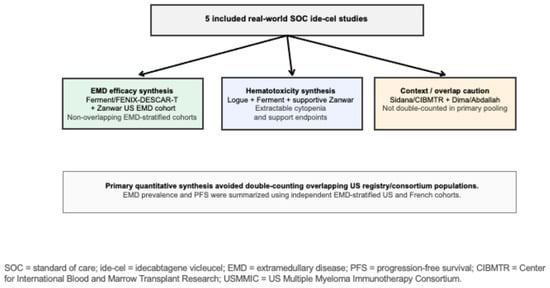
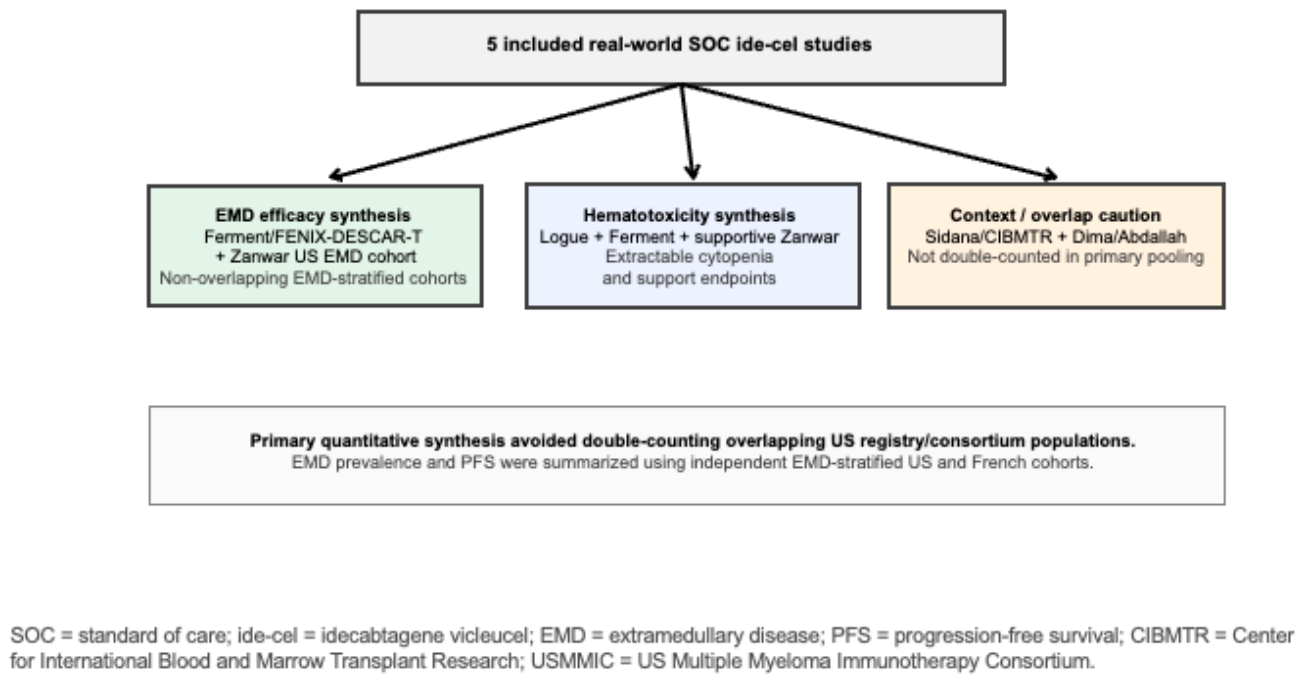
We performed a focused descriptive evidence synthesis of published real-world studies evaluating standard-of-care (SOC) chimeric antigen receptor (CAR) T-cell therapy with idecabtagene vicleucel (ide-cel) in patients with RRMM. This study was designed as a focused evidence synthesis rather than an exhaustive systematic review or meta-analysis, prioritizing the isolation of non-overlapping, high-impact cohorts over broad bibliographic aggregation to eliminate patient double-counting across overlapping registry and consortium datasets [9]. A targeted literature search was executed in the PubMed database on 6 May 2026 to identify published observational cohorts evaluating standard-of-care idecabtagene vicleucel (ide-cel) in patients with relapsed or refractory multiple myeloma. The search strategy utilized the predefined search string: ((“idecabtagene vicleucel”[Supplementary Concept] OR “idecabtagene vicleucel”[TW] OR “ide-cel”[TW] OR “bb2121”[TW] OR “bb21217”[TW] OR “Abecma”[TW]) AND (“Multiple Myeloma”[MeSH] OR “Multiple Myeloma”[TW])). Eligible studies were restricted to observational cohorts, registry analyses, or multicenter retrospective studies that reported SOC ide-cel outcomes related to EMD, response, PFS, cytopenias, hematopoietic interventions, or safety. Interventional clinical trials (including the KarMMa series), preclinical evaluations, narrative reviews, case reports or small series with fewer than 10 patients, duplicate publications, and studies without extractable ide-cel-specific outcomes were excluded. Rather than depicting a bibliographic screening flow, Figure 1 illustrates our analytic cohort allocation framework developed to minimize duplicate patient representation across potentially overlapping multicenter consortia and registry datasets.
Figure 1.
Analytic Framework and Cohort Allocation Strategy. Flowchart illustrating the allocation of five real-world standard-of-care ide-cel studies. The primary quantitative EMD efficacy synthesis was restricted to two non-overlapping ide-cel-only EMD-stratified cohorts: FENIX/DESCAR-T and the US EMD-focused cohort. Logue 2022 [7] served as the primary hematotoxicity cohort. Sidana 2025/CIBMTR [6] was retained as a large SOC ide-cel benchmark. Dima/Abdallah 2024 [10] was included as supportive EMD evidence, with ide-cel-specific data extracted where available and mixed ide-cel/cilta-cel outcomes excluded from primary ide-cel-only pooled estimates.
Data were extracted into a structured workbook capturing study design, cohort source, number of patients leukapharesed and infused, follow-up, EMD definition, EMD prevalence, response outcomes, survival outcomes, cytopenias, hematopoietic interventions, and reported predictors of hematotoxicity. When only percentages were reported, numerators were back-calculated from available denominators and flagged as calculated values. Study selection and data extraction were performed independently by two investigators, with discrepancies resolved by consensus. Study quality and risk of bias were systematically evaluated across all included cohorts using the National Institutes of Health (NIH) Quality Assessment Tool for Observational Cohort and Cross-Sectional Studies (Supplementary Table S1).
Because major US academic medical centers concurrently contribute commercial ide-cel data to mandatory national registries (such as the CIBMTR) and multi-institutional research consortia (such as the US Multiple Myeloma Immunotherapy Consortium and USMIRC) during the same calendar years (2021–2023), published US real-world cohorts harbor substantial patient overlap. Indiscriminately pooling these datasets alongside single-center or subgroup reports (e.g., Logue et al. or Zanwar et al.) would double-count identical patient populations and artificially inflate statistical precision; therefore, studies were segregated into distinct analytical pathways (Figure 1). For the primary EMD efficacy synthesis, we restricted quantitative descriptive estimates to two non-overlapping cohorts: the French FENIX/DESCAR-T registry and the US multicenter cohort [4,5]. In the US multicenter cohort (Zanwar et al.), EMD was strictly defined as visceral or soft-tissue plasmacytomas non-contiguous with bone, assessed by contrast-enhanced computed tomography, magnetic resonance imaging, or 18F-FDG PET/CT prior to lymphodepletion, with paraskeletal disease categorized separately. In the supportive mixed-product cohort (Dima et al.), EMD was similarly defined as extraosseous/visceral plasmacytomas without bone contact. In contrast, in the French FENIX/DESCAR-T registry (Ferment et al.) and CIBMTR registry (Sidana et al.), extramedullary involvement was recorded as baseline disease status upon study enrollment or apheresis per institutional reporting without central imaging re-review to confirm exclusion of paraskeletal disease. In the French FENIX/DESCAR-T registry (Ferment et al.), extramedullary involvement was recorded as baseline disease status upon study enrollment or apheresis per treating center documentation according to standard registry protocols, primarily evaluated via 18F-FDG PET/CT or computed tomography. Because central adjudication to definitively exclude contiguous paraskeletal lesions could not be independently confirmed across all French registry entries, the combined prevalence across the two cohorts (111 of 510 infused patients; 21.8%) is reported as study-reported EMD rather than an absolute pooled rate of adjudicated true EMD. Broader CIBMTR and US consortium studies were retained for contextual interpretation but were not double counted in the primary pooled aggregated EMD estimates [6,8]. A mixed-product SOC BCMA CAR-T EMD cohort by Dima et al. was included for supportive EMD evidence, but only ide-cel-specific extractable values were used in ide-cel-focused analyses; mixed ide-cel/cilta-cel survival estimates were not incorporated into the primary ide-cel-only pooled descriptive PFS synthesis [10]. The study-level analytic role of each cohort is summarized in Table 1 and Figure 1.
Table 1.
Study Characteristics and Analytic Role of Included Cohorts.
The primary outcomes were EMD prevalence, EMD-associated response, and PFS. Extracted EMD-specific efficacy outcomes are presented in Table 2. Overall descriptive EMD prevalence was calculated as the total number of EMD cases divided by the total number of infused patients across the two non-overlapping EMD-stratified cohorts. Progression-free survival was evaluated by comparing the reported study-specific medians and multivariable-adjusted hazard ratios across the non-overlapping EMD-stratified cohorts. Because individual patient-level time-to-event data were not available, medians were not pooled mathematically; instead, outcomes were analyzed in parallel to evaluate consistency of the biological signal across independent datasets. Hazard ratios for EMD-associated PFS were extracted and tabulated but not synthesized statistically because of the limited number of independent estimates and differences in adjusted model structure.
Table 2.
Extramedullary Disease Prevalence, Response, and Survival Outcomes After Standard-of-Care Ide-cel.
Landmark cytopenia outcomes reflect cross-sectional laboratory evaluations among surviving, evaluable patients at each predefined timepoint rather than continuous individual patient-level persistence. In the primary hematotoxicity cohort (Logue et al.), 51 of 52 infused patients were evaluable at day 30 and 47 at day 90, with attrition reflecting early non-relapse mortality, disease progression, or missing landmark lab data. Similarly, in FENIX/DESCAR-T (Ferment et al.), evaluable denominators were 158 of 159 infused patients at month 1 and 154 at month 3. Landmark rates represent observed count severity at that calendar window irrespective of interim supportive care (such as transfusions, growth factors, or stem-cell boosts). Hematopoietic interventions, including growth-factor support, transfusions, thrombopoietin agonists, intravenous immunoglobulin, and stem-cell boosts, were summarized narratively because definitions and reporting windows varied across studies.
All analyses were performed in R using readxl, data.table, dplyr, stringr, and ggplot2 [11]. No hypothesis testing or formal between-study comparisons were performed because of heterogeneity in study design and outcome reporting. Descriptive tables and figures were generated from the cleaned extraction workbook.
Given substantial cohort overlap risk, heterogeneous endpoint definitions, and absence of patient-level data, formal meta-analysis was intentionally avoided because substantial cohort overlap, heterogeneous endpoint definitions, inconsistent reporting of EMD, and the absence of patient-level data violated key assumptions required for quantitative pooling. Accordingly, all findings should be interpreted as descriptive rather than inferential estimates.
3. Results
The targeted PubMed search identified 55 records, of which 32 were excluded following title and abstract screening because they represented preclinical investigations, laboratory-based constructs, or non-myeloma disease models. Twenty-three articles underwent full-text assessment; 18 were excluded because they represented clinical trials, narrative reviews, case series involving fewer than 10 patients, or studies lacking extractable ide-cel-specific extramedullary disease or day-90 cytopenia endpoints. Five independent or non-overlapping real-world observational cohorts met all eligibility criteria and were included in the evidence synthesis (Table 1, Figure 1). Study-level quality appraisal using the National Institutes of Health quality assessment tool confirmed good methodological rigor across all contributing cohorts (Supplementary Table S1). Because several US registry and consortium datasets included overlapping patient populations, the primary quantitative EMD synthesis was intentionally restricted to two independent ide-cel-only cohorts.
Across these two non-overlapping cohorts, 111 of 510 infused patients had extramedullary involvement, corresponding to a combined study-reported prevalence of 21.8% (Table 2). These findings suggest that approximately one in five patients undergoing standard-of-care ide-cel has true extramedullary disease at infusion. The prevalence of EMD was 17.0% in the French FENIX/DESCAR-T cohort and 23.9% in the US multicenter cohort (Table 2). In the US cohort, EMD was strictly restricted to non-contiguous soft-tissue or visceral lesions, whereas the French registry captured extramedullary disease per institutional documentation according to DESCAR-T guidelines.
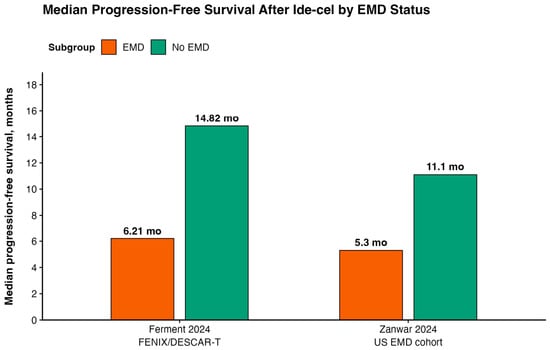
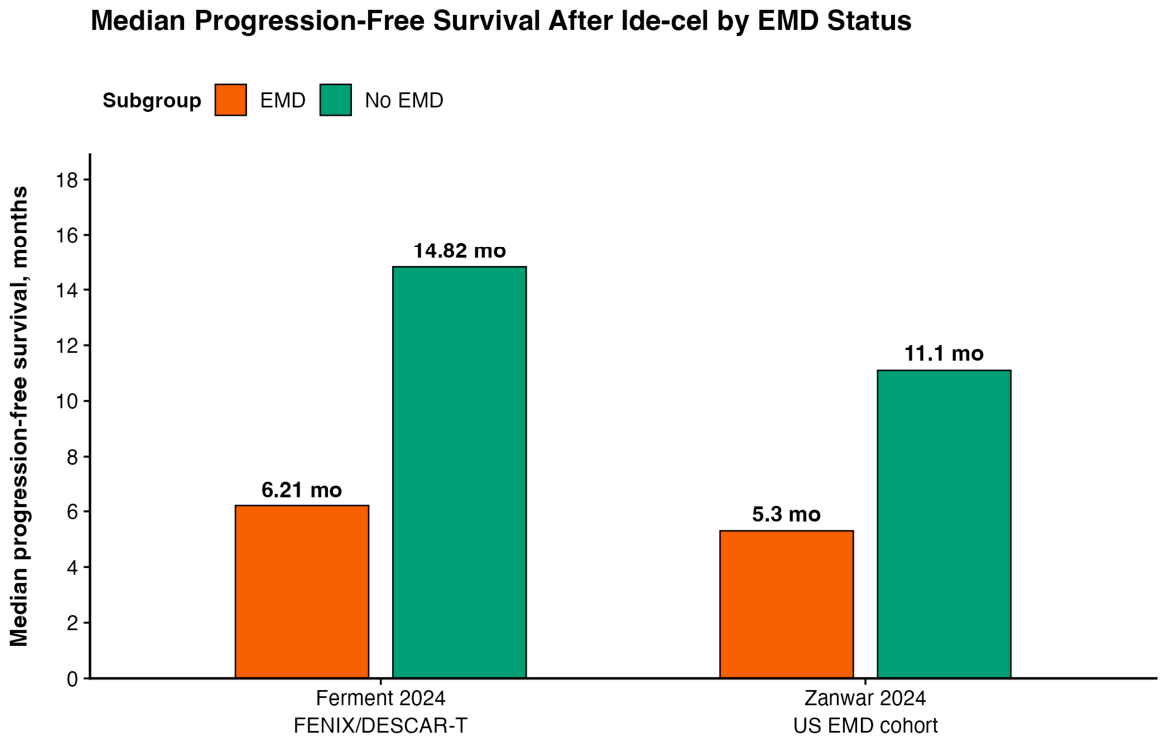
EMD was consistently associated with inferior efficacy after ide-cel. In the US EMD-focused cohort, day 90 overall response rate was 52.4% among patients with EMD compared with 82.0% among those without EMD (Table 2). Assuming the total infused cohort as the denominator, this corresponds to approximately 44 of 84 and 219 of 267 patients, though landmark restaging attrition or missing evaluations were not independently disaggregated in the original publication. While the French FENIX/DESCAR-T registry did not report a standalone, EMD-stratified overall response rate, it did confirm the adverse nature of this phenotype through survival metrics. Extramedullary disease was consistently associated with markedly shortened progression-free survival across both independent standard-of-care cohorts. In the French FENIX/DESCAR-T registry, median PFS was 6.21 months (95% CI: 4.01–NR) for patients with EMD compared with 14.82 months (95% CI: 11.30–18.37) for those without EMD (adjusted HR 3.15, 95% CI: 1.82–5.47; p < 0.0001). Similarly, in the US multicenter EMD-focused cohort, median PFS was 5.30 months (95% CI: 4.10–6.90) in the EMD cohort compared with 11.10 months (95% CI: 9.20–12.60) in the non-EMD cohort (adjusted HR 1.50, 95% CI: 1.10–2.20; p = 0.02) (Table 2, Figure 2). Thus, across both transatlantic datasets, median PFS duration was shortened by approximately half or more among patients presenting with true extramedullary disease.
Figure 2.
Median Progression-Free Survival After Ide-cel by Extramedullary Disease Status. Grouped bar chart showing median progression-free survival (PFS) for patients with extramedullary disease (EMD, orange) versus without EMD (green) across the FENIX/DESCAR-T registry [5], and the US EMD cohort [4]. In both independent cohorts, presence of EMD was consistently associated with significantly shorter median PFS. Abbreviations: EMD, extramedullary disease; mo, months; PFS, progression-free survival.
Adjusted analyses from both EMD-stratified cohorts supported EMD as an independent adverse prognostic factor for PFS. In the US EMD-focused cohort, EMD was independently associated with inferior PFS with an adjusted hazard ratio of 1.50. In FENIX/DESCAR-T, EMD was also independently associated with inferior PFS, with an adjusted hazard ratio of 3.15 (Table 2). These hazard ratios were not statistically pooled because of differences in covariate adjustment, registry structure, and the limited number of independent EMD-stratified estimates. Despite differences in adjustment strategies, both studies consistently identified EMD as an independent adverse prognostic factor following ide-cel.
A multicenter cohort evaluating both commercial BCMA CAR-T products (ide-cel and ciltacabtagene autoleucel [cilta-cel]) by Dima et al. provided supportive evidence. In this study, 108 patients received ide-cel, including 36 with EMD (prevalence 33.3%), among whom the best overall response rate (ORR; defined as ≥ partial response per IMWG criteria) was 61%. Because ide-cel-specific PFS by EMD status was not reported and survival estimates were presented for the combined ide-cel/cilta-cel cohort, these data were not incorporated into the primary ide-cel-only weighted PFS synthesis [11]. Extramedullary disease and hematologic outcomes were directly evaluated in the US multicenter ide-cel cohort (Zanwar et al.). In unadjusted subgroup comparisons, patients with EMD required significantly more autologous CD34 + stem-cell boosts to rescue delayed count recovery (14.3% [12/84] vs. 4.1% [11/267]; p = 0.001) (Table 3). Furthermore, landmark grade ≥ 3 cytopenias at day 90 were higher among patients with EMD, including neutropenia (21.4% [18/84] vs. 9.0% [24/267]) and thrombocytopenia (29.8% [25/84] vs. 19.1% [51/267]) (Table 3). However, early landmark hematologic toxicities did not differ significantly: at day 30, grade ≥ 3 neutropenia occurred at virtually identical frequencies (34.5% [29/84] with EMD vs. 33.0% [88/267] without EMD), and day-30 grade ≥ 3 thrombocytopenia showed overlapping confidence intervals (53.6% [45/84] vs. 43.1% [115/267]) (Table 3). Similarly, overall infection rates, growth factor support, and thrombopoietin agonist use were comparable between EMD and non-EMD cohorts in Zanwar et al. In the supportive mixed-product cohort (Dima et al.), active EMD was also associated with higher stem-cell boost utilization (23.4% [11/47] vs. 3.8% [4/105]; p = 0.0002). Nevertheless, neither study demonstrated that EMD independently predicted persistent cytopenias after multivariable adjustment for baseline marrow burden and prior therapies [10].
Table 3.
Post-Ide-cel Hematologic Outcomes Stratified by Extramedullary Disease Status (Zanwar et al., 2024) [4].
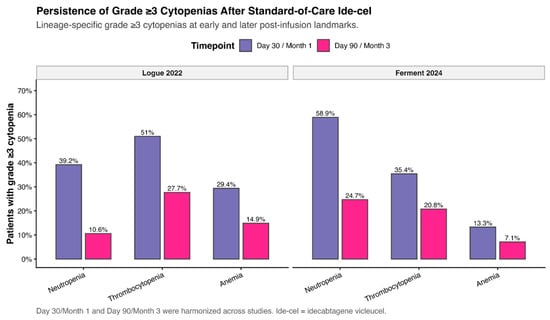
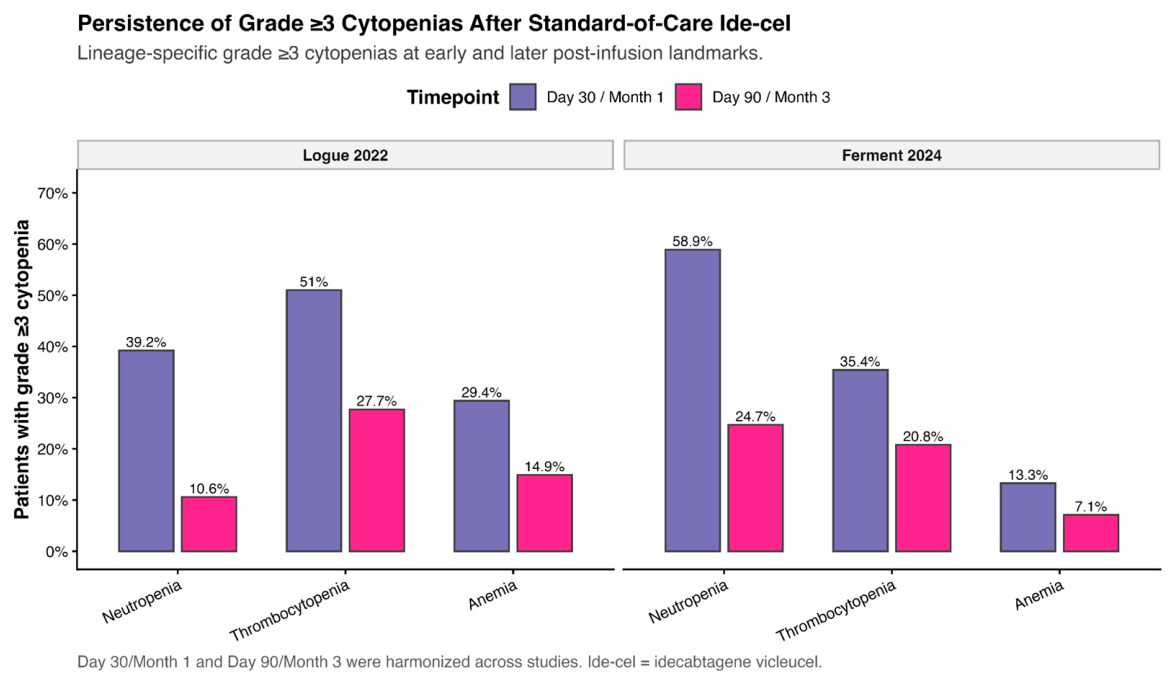
Beyond disease control, prolonged hematologic toxicity represented another consistent finding across real-world ide-cel studies. Prolonged hematotoxicity is common after standard-of-care ide-cel. In the focused cytopenia and infection cohort, grade ≥ 3 cytopenia was present in 33 of 51 evaluable patients at day 30 and 19 of 47 at day 90, corresponding to rates of 64.7% and 40.4%, respectively (Table 4). Lineage-specific cytopenia patterns were consistent across the US cytopenia cohort and FENIX/DESCAR-T. At day 90/month 3, grade ≥ 3 thrombocytopenia was present in 27.7% and 20.8% of patients; grade ≥ 3 anemia in 14.9% and 7.1%; and grade ≥ 3 neutropenia in 10.6% and 24.7%, respectively (Table 4; Figure 3). Although blood counts improved over time, substantial proportions of patients continued to experience severe cytopenias three months after CAR-T infusion.
Table 4.
Post-Ide-cel Hematotoxicity and Lineage-Specific Grade ≥ 3 Cytopenia Profile.
Figure 3.
Prevalence of Grade ≥3 Cytopenias After Standard-of-Care Ide-cel. Grouped bar chart tracking severe neutropenia, thrombocytopenia, and anemia at day 30/month 1 (purple) and day 90/month 3 (pink) in the Logue 2022 [7] and Ferment 2024 [5] cohorts. While severe neutropenia rates decline significantly by day 90, grade ≥ 3 thrombocytopenia remains present as a prominent late toxicity, affecting 20.8% to 27.7% of patients across studies.
Supportive hematopoietic interventions were frequently required in the cytopenia-focused cohort, including granulocyte colony-stimulating factor, transfusion support, thrombopoietin agonists, intravenous immunoglobulin, and CD34-positive stem-cell boosts (Table 4). A high baseline marrow plasma-cell burden was the most consistently reported predictor of prolonged cytopenia; in multivariable analysis from the cytopenia-focused cohort, marrow plasma-cell burden ≥ 50% was associated with increased odds of day-90 grade ≥ 3 cytopenia (OR, 6.40; 95% CI, 1.40–33.60). These findings suggest that baseline disease burden is an important determinant of delayed hematopoietic recovery following ide-cel therapy.
4. Discussion
In this focused transatlantic evidence synthesis of real-world SOC ide-cel studies, EMD consistently emerged as a high-risk phenotype associated with inferior response durability and shorter PFS. Approximately one in five patients undergoing standard-of-care ide-cel had documented extramedullary involvement, underscoring that this aggressive disease phenotype is common in contemporary CAR-T practice. Definitions varied slightly between contributing datasets: the US multicenter cohort strictly restricted eligibility to true EMD (visceral or soft-tissue lesions non-contiguous with bone), whereas the French registry captured extramedullary disease as documented within DESCAR-T. Although the inability to centrally verify the complete exclusion of paraskeletal lesions across all registry entries represents an inherent limitation of observational registry data, the directional consistency of shortened progression-free survival and inferior response across both cohorts substantiates the negative prognostic impact of extramedullary involvement irrespective of minor institutional reporting differences [4,5].
Consistent across both independent cohorts, patients with EMD experienced substantially inferior disease control following ide-cel therapy. These findings confirm that, although BCMA-directed CAR-T therapy retains activity in patients with EMD, responses remain less durable than in patients without extramedullary involvement. The consistency of this observation across geographically distinct cohorts strengthens the evidence that EMD remains one of the strongest adverse prognostic factors following standard-of-care ide-cel [4,5]. The markedly lower response rate observed among patients with EMD further supports the concept that extramedullary disease reflects biologically aggressive myeloma with reduced susceptibility to immune effector therapy. Rather than relying on mathematical pooling of study medians, evaluating the two independent cohorts in parallel underscores the robustness of this adverse phenotype, with median progression-free survival shortened by approximately half or more in both the French FENIX/DESCAR-T cohort (6.21 versus 14.82 months) and the US multicenter cohort (5.30 versus 11.10 months).
The adjusted analyses further support EMD as an independent adverse prognostic factor. EMD was associated with inferior PFS in both the US cohort (adjusted HR 1.50) and the FENIX/DESCAR-T cohort (adjusted HR 3.15). Hazard ratios were not formally pooled because of heterogeneity in the model design and limited independent estimates. Despite differences in study design, the Dima cohort reinforced the consistency of inferior outcomes among patients with EMD receiving BCMA-directed CAR-T therapy [10].
Prolonged hematotoxicity is a major limitation of ide-cel therapy. In the cytopenia-focused cohort, grade ≥ 3 cytopenia was present in 64.7% of patients on day 30 and 40.4% on day 90.7 Thrombocytopenia and neutropenia were the dominant persistent toxicities, with grade ≥ 3 thrombocytopenia remaining present in 20.8–27.7% of patients on day 90 [7,12]. Persistent cytopenias likely reflect multifactorial marrow injury involving baseline hematopoietic reserve depletion, inflammatory toxicity, prior therapy-related stem-cell damage, and ongoing immune activation. A high baseline marrow plasma cell burden is strongly associated with prolonged cytopenia, supporting the concept that heavy marrow involvement compromises hematopoietic recovery after CAR-T therapy [7]. Importantly, real-world evidence indicates that extramedullary disease and prolonged hematotoxicity represent distinct, complementary clinical challenges rather than a direct causal relationship. In the multivariable predictor modeling by Logue et al., high baseline bone marrow plasma-cell burden (≥50%) independently predicted day-90 severe cytopenias (OR 6.40, 95% CI: 1.40–33.60), whereas EMD did not independently predict prolonged cytopenia when controlling for baseline counts and marrow involvement. Although unadjusted data from Zanwar et al. and Dima et al. demonstrate that patients with EMD experience higher rates of day-90 cytopenias and require more stem-cell boosts (14.3% vs. 4.1%), early day-30 neutropenia and overall infection rates did not differ. This increased need for late hematopoietic support likely reflects higher cumulative pre-CAR-T treatment exposure, extensive bridging therapy, and diminished baseline reserve commonly present in patients with aggressive extramedullary presentations, rather than direct bone marrow suppression mediated by extramedullary plasmacytomas. Thus, while EMD independently predicts inferior response durability and shortened PFS, prolonged hematotoxicity is primarily governed by pre-infusion marrow plasma cell burden, baseline cytopenias, and compromised hematopoietic reserve.
Supportive care requirements were substantial and included G-CSF, transfusions, thrombopoietin agonists, IVIG, and stem-cell boosts [7]. Higher stem-cell boost utilization among patients with EMD in both the US EMD-focused and Dima et al. cohorts suggests increased hematopoietic vulnerability in this subgroup [4,10], These findings support systematic pre-infusion assessment of hematopoietic reserve, including baseline cytopenias, marrow burden, inflammatory markers, and stem-cell availability [7]. Consistent with these findings, multicenter studies support autologous CD34 + stem-cell boosts as an effective rescue strategy for prolonged post-CAR-T cytopenias by restoring hematopoiesis and reducing transfusion and growth-factor requirements [13]. Emerging retrospective evidence also suggests that eltrombopag may safely facilitate hematologic recovery in selected patients with persistent cytopenias after CAR-T therapy [14].
This synthesis has several practical implications for the field. True EMD should be carefully identified before ide-cel therapy using appropriate imaging modalities, as prognosis differs substantially from paraskeletal disease [15]. Patients with EMD should be counseled regarding the likelihood of shorter response durability. While earlier referral, tailored bridging regimens, and localized radiation therapy have been proposed as strategies to control bulky, symptomatic disease prior to infusion, the observational data synthesized here identify an adverse prognostic phenotype rather than establish that specific bridging interventions improve post-infusion outcomes [16]. Similarly, although retrospective reports describe overall response rates of 76% with VDPACE-based salvage in relapsed/refractory MM with EMD, whether intensive bridging cytoreduction modifies the intrinsic biological resistance of extramedullary clones after ide-cel infusion remains an open clinical question requiring comparative investigation [17]. Similarly, patients with heavy marrow involvement or baseline cytopenias should be recognized as high risk for prolonged hematotoxicity and may require proactive supportive care planning [7].
As BCMA-targeted therapies are used earlier in the treatment landscape, sequencing strategies will become increasingly important. Prior BCMA-directed exposure has been associated with inferior outcomes in several real-world cohorts, likely reflecting antigen modulation, T-cell dysfunction, and selection of resistant disease clones [4,5,18,19]. Future prospective trials are needed to test hypotheses regarding alternative sequencing, dual-antigen targeting, consolidative approaches, and post-CAR-T maintenance in patients presenting with EMD [20]. Emerging data suggest that simultaneous targeting of BCMA and GPRC5D may represent a promising strategy for this high-risk population. In a phase 2 study of anti-BCMA/GPRC5D bispecific CAR-T therapy, patients with relapsed/refractory multiple myeloma and extraosseous EMD achieved a 97% overall response rate with universal MRD negativity among responders, highlighting the potential of dual-antigen targeting to overcome resistance mechanisms associated with aggressive extramedullary disease [21]. Similarly, the phase 2 RedirecTT-1 study demonstrated that dual-target immune redirection with talquetamab plus teclistamab achieved a 79% overall response rate, with 12-month progression-free and overall survival rates of 61% and 74%, respectively, in patients with drug-resistant true extramedullary myeloma [22]. However, these dual-antigen strategies remain investigational hypotheses rather than established solutions; controlled comparative trials are required to prove whether dual targeting or post-CAR-T maintenance can overcome the inferior survival trajectory observed in real-world ide-cel cohorts.
A major strength of this study was the conservative analytic approach used to minimize the overlap among institutional, consortium, and registry datasets. By restricting primary EMD analyses to non-overlapping ide-cel-specific cohorts, this study prioritized validity over apparent sample size and reduced the risk of double counting [23]. This approach also improved interpretability by restricting the primary synthesis to ide-cel-specific cohorts that explicitly evaluated extramedullary involvement. However, potential definitional heterogeneity must be acknowledged: while the US multicenter study explicitly segregated true EMD from paramedullary or paraskeletal lesions, the French registry relied on center-reported extramedullary status without centralized imaging re-review to confirm exclusion of bone-contiguous disease. However, several limitations must be acknowledged. This study was designed as a targeted, structured evidence synthesis rather than an exhaustive multi-database systematic review or meta-analysis. The literature search was limited to a single bibliographic database (PubMed) on a single calendar date, and excluded unindexed conference abstracts and non-English publications, which may have omitted smaller single-center experiences. Conference abstracts were excluded. However, because commercial standard-of-care ide-cel utilization is concentrated within major national registries and academic consortia that are indexed in MEDLINE, our primary objective prioritized resolving documented cohort overlap, verifying extramedullary definitions, and ensuring auditable data extraction over expansive bibliographic retrieval. Furthermore, study-level quality appraisal using the National Institutes of Health quality assessment tool confirmed good methodological rigor across all contributing cohorts (Supplementary Table S1). The available evidence is limited: the main EMD-efficacy analysis is based on two separate cohorts of ide-cel patients, and the hematotoxicity analysis primarily relies on one cohort with additional lineage-specific data from a second. Notably, non-overlap was only ensured within the efficacy cohort; since the efficacy and toxicity groups were drawn from overlapping populations in US cohorts and registries, some patients may be counted in both, so these data streams should not be considered independent.
All studies included were retrospective and observational, with unavoidable residual confounding. Patients with EMD often have additional high-risk features that may influence outcomes, and variations exist in imaging methods, EMD definitions, hematotoxicity criteria, and reporting periods across studies. Furthermore, hazard ratios varied considerably between registries, reflecting differences in covariate adjustments and clinical practices. Consequently, these estimates are descriptive, aiming to identify consistent trend directions and assist in pre-infusion risk assessment rather than providing pooled treatment-effect estimates.
An additional methodological consideration is survivor selection bias inherent to post-infusion cohort analyses. Because this synthesis evaluated patients who successfully received standard-of-care ide-cel infusion, these metrics reflect conditional outcomes that do not capture patients who suffered clinical deterioration or death between leukapheresis and lymphodepletion. In the French FENIX/DESCAR-T registry (Ferment et al.), where disease status was documented at apheresis, a lower proportion of patients with high-risk features reached infusion due to early progressive disease. Because extramedullary myeloma frequently exhibits explosive kinetics, pre-infusion attrition disproportionately affects patients harboring active EMD, indicating that real-world EMD prevalence at apheresis is likely higher and observed post-infusion survival represents conditional estimates.
Despite the inherent limitations of retrospective observational data, the consistency of findings across independent transatlantic cohorts strengthens confidence in the clinical relevance of these observations. Real-world ide-cel outcomes demonstrate that EMD remains one of the strongest adverse prognostic features despite BCMA-directed CAR-T therapy, whereas prolonged cytopenias continue to represent a major determinant of morbidity after treatment. Collectively, these findings support incorporating EMD status, baseline marrow plasma-cell burden, hematopoietic reserve, prior BCMA exposure, and bridging therapy requirements into routine pre-infusion risk assessment to improve patient counseling, supportive care planning, and individualized treatment selection [24,25]. Future prospective studies should prioritize standardized EMD definitions, harmonized hematotoxicity reporting, and evaluation of optimized sequencing strategies, dual-target immunotherapies, and post-CAR-T maintenance approaches to improve the durability of responses in this particularly high-risk patient population [20,22,25].
Supplementary Materials
The following supporting information can be downloaded at: https://www.mdpi.com/article/10.3390/curroncol33110642/s1. Supplementary Table S1. Methodological Quality and Risk-of-Bias Assessment of Included Real-World Studies (NIH Quality Assessment Tool for Observational Cohort and Cross-Sectional Studies).
Author Contributions
Conceptualization, M.A.S., M.B.A. and A.-O.A.; methodology, M.A.S. and A.-O.A.; software, M.A.S. and A.K.; validation, M.B.A. and A.-O.A.; formal analysis, M.A.S., A.K., M.B.A., B.P., S.A., H.S., A.M., O.A., P.M., M.R.S., A.M.K., Z.M., M.U.M., J.K., A.H., and A.-O.A.; investigation, M.A.S., M.B.A., A.-O.A. and A.K.; resources, A.-O.A.; Data curation, M.A.S. and A.K.; writing—A.K. and M.A.S.; writing—review and editing, M.A.S., A.K., M.B.A., B.P., S.A., H.S., A.M., O.A., P.M., M.R.S., A.M.K., Z.M., M.U.M., J.K., A.H., and A.-O.A.; visualization, B.P., S.A., H.S., A.M., O.A., P.M., M.R.S., A.M.K., Z.M., M.U.M., J.K., A.H., and A.-O.A.; supervision, M.B.A. and A.-O.A.; project administration, A.-O.A. and B.P.; funding acquisition, A.-O.A. All authors have read and agreed to the published version of the manuscript.
Funding
This research received no external funding.
Institutional Review Board Statement
Not applicable.
Informed Consent Statement
Not applicable.
Data Availability Statement
No new data were created or analyzed in this study.
Acknowledgments
During the preparation of this manuscript, the authors used Gemini (Advanced version, Google) to assist with language editing, sentence paraphrasing, and enhancing narrative conciseness across selected sections. The authors independently evaluated, fact-checked, and revised all generated suggestions and take full responsibility for the data integrity, scientific interpretation, and final content of this publication.
Conflicts of Interest
The authors declare no conflicts of interest.
References
- Munshi, N.C.; Anderson, L.D.; Shah, N.; Madduri, D.; Berdeja, J.; Lonial, S.; Raje, N.; Lin, Y.; Siegel, D.; Oriol, A.; et al. Idecabtagene Vicleucel in Relapsed and Refractory Multiple Myeloma. N. Engl. J. Med. 2021, 384, 705–716. [Google Scholar] [CrossRef] [Scilit] [PubMed]
- Bladé, J.; Beksac, M.; Caers, J.; Jurczyszyn, A.; von Lilienfeld-Toal, M.; Moreau, P.; Touzeau, C.; Rosiñol, L.; Rasche, L.; Zweegman, S.; et al. Extramedullary disease in multiple myeloma: A systematic literature review. Blood Cancer J. 2022, 12, 45. [Google Scholar] [CrossRef] [Scilit] [PubMed]
- Gandhi, U.H.; Cornell, R.F.; Lakshman, A.; Gahvari, Z.J.; McGehee, E.; Jagosky, M.H.; Hashmi, H.; Malek, E.; Kang, Y.; Chhabra, S.; et al. Outcomes of patients with multiple myeloma refractory to CD38-targeted monoclonal antibodies. Leukemia 2019, 33, 2266–2275. [Google Scholar] [CrossRef] [Scilit] [PubMed]
- Zanwar, S.; Sidana, S.; Shune, L.; Puglianini, O.C.; Pasvolsky, O.; Gonzalez, R.; Khurana, S.; Lin, Y.; Sborov, D.W.; Hansen, D.K.; et al. Impact of extramedullary multiple myeloma on outcomes with idecabtagene vicleucel. J. Hematol. Oncol. 2024, 17, 42. [Google Scholar] [CrossRef] [Scilit] [PubMed]
- Ferment, B.; Lambert, J.; Caillot, D.; Lafon, I.; Karlin, L.; Lazareth, A.; Touzeau, C.; Leleu, X.; Moya, N.; Harel, S.; et al. French early nationwide idecabtagene vicleucel chimeric antigen receptor T-cell therapy experience in patients with relapsed/refractory multiple myeloma (FENIX): A real-world IFM study from the DESCAR-T registry. Br. J. Haematol. 2024, 205, 990–998. [Google Scholar] [CrossRef] [Scilit] [PubMed]
- Sidana, S.; Ahmed, N.; Akhtar, O.S.; Brazauskas, R.; Oloyede, T.; Bye, M.; Davis, J.A.; Sborov, D.W.; Dima, D.; Khurana, S.; et al. Standard-of-care idecabtagene vicleucel for relapsed/refractory multiple myeloma. Blood 2025, 146, 167–177. [Google Scholar] [CrossRef] [Scilit] [PubMed]
- Logue, J.M.; Peres, L.C.; Hashmi, H.; Colin-Leitzinger, C.M.; Shrewsbury, A.M.; Hosoya, H.; Sborov, D.W.; Hansen, D.K.; Freeman, C.L.; Locke, F.L.; et al. Early cytopenias and infections after standard of care idecabtagene vicleucel in relapsed or refractory multiple myeloma. Blood Adv. 2022, 6, 6109–6119. [Google Scholar] [CrossRef] [Scilit] [PubMed]
- Hansen, D.K.; Sidana, S.; Peres, L.C.; Colin Leitzinger, C.; Shune, L.; Shrewsbury, A.; Gonzalez, R.; Pasvolsky, O.; Sborov, D.W.; Wagner, C.; et al. Idecabtagene Vicleucel for Relapsed/Refractory Multiple Myeloma: Real-World Experience From the Myeloma CAR T Consortium. J. Clin. Oncol. Off. 2023, 41, 2087–2097. [Google Scholar] [CrossRef] [Scilit] [PubMed]
- Page, M.J.; McKenzie, J.E.; Bossuyt, P.M.; Boutron, I.; Hoffmann, T.C.; Mulrow, C.D.; Shamseer, L.; Tetzlaff, J.M.; Akl, E.A.; Brennan, S.E.; et al. The PRISMA 2020 statement: An updated guideline for reporting systematic reviews. BMJ 2021, 372, n71. [Google Scholar] [CrossRef] [Scilit] [PubMed]
- Dima, D.; Abdallah, A.-O.; Davis, J.A.; Awada, H.; Goel, U.; Rashid, A.; Ahmed, N.; Sborov, D.W.; Jagosky, M.H.; Wesson, W.; et al. Impact of Extraosseous Extramedullary Disease on Outcomes of Patients with Relapsed-Refractory Multiple Myeloma receiving Standard-of-Care Chimeric Antigen Receptor T-Cell Therapy. Blood Cancer J. 2024, 14, 90. [Google Scholar] [CrossRef] [Scilit] [PubMed]
- R Core Team. R: A Language and Environment for Statistical Computing. 2024. Available online: https://www.R-project.org/ (accessed on 17 May 2026).
- Rejeski, K.; Hansen, D.K.; Bansal, R.; Sesques, P.; Ailawadhi, S.; Logue, J.M.; Bräunlein, E.; dos Santos, D.M.C.; Freeman, C.L.; Alsina, M.; et al. The CAR-HEMATOTOX score as a prognostic model of toxicity and response in patients receiving BCMA-directed CAR-T for relapsed/refractory multiple myeloma. J. Hematol. Oncol. 2023, 16, 88. [Google Scholar] [CrossRef] [Scilit] [PubMed]
- Mohan, M.; Szabo, A.; Patwari, A.; Esselmann, J.; Patel, T.; Bachu, R.; Rein, L.E.; Janardan, A.; Bhatlapenumarthi, V.; Annyapu, E.; et al. Autologous stem cell boost improves persistent immune effector cell associated hematotoxicity following BCMA directed chimeric antigen receptor T (CAR T) cell therapy in multiple myeloma. Bone Marrow Transpl. 2024, 59, 647–652. [Google Scholar] [CrossRef] [Scilit] [PubMed]
- Wesson, W.; Ahmed, N.; Davis, J.A.; McGann, M.; Rashid, A.; Tabak, C.; Ming, R.; Terpos, E.; Dimopoulos, M.A.; Dispenzieri, A.; et al. Use of Eltrombopag for Post-CAR T Cytopenias: A Multi-Institutional Experience. Blood 2023, 142, 2136. [Google Scholar] [CrossRef] [Scilit]
- Hillengass, J.; Usmani, S.; Rajkumar, S.V.; Durie, B.G.M.; Mateos, M.-V.; Lonial, S.; Joao, C.; Anderson, K.C.; García-Sanz, R.; Riva, E.; et al. International myeloma working group consensus recommendations on imaging in monoclonal plasma cell disorders. Lancet Oncol. 2019, 20, e302–e312. [Google Scholar] [CrossRef] [Scilit] [PubMed]
- Ababneh, H.S.; Yee, A.J.; Raje, N.S.; Martin, S.; Frigault, M.J.; Ng, A.K.; Patel, C.G. Radiation therapy as a bridging and salvage strategy in patients with relapsed or refractory multiple myeloma undergoing BCMA-targeted CAR T-cell therapy. Radiother. Oncol. J. Eur. Soc. Ther. Radiol. Oncol. 2023, 189, 109933. [Google Scholar] [CrossRef] [Scilit] [PubMed]
- Ghandili, S.; Alihodzic, D.; Wiessner, C.; Bokemeyer, C.; Weisel, K.; Leypoldt, L.B. VTd-PACE and VTd-PACE-like regimens are effective salvage therapies in difficult-to-treat relapsed/refractory multiple myeloma: A single-center experience. Ann. Hematol. 2023, 102, 2471–2481. [Google Scholar] [CrossRef] [Scilit] [PubMed]
- Lal, B.M.; Alzubi, M.; Alrawabdeh, J.; Shaughnessy, J.D.; Zhan, F.; Siegel, E.R.; Schinke, C.; Thanendrarajan, S.; Zangari, M.; van Rhee, F.; et al. Prior exposure to belantamab mafodotin influences outcomes with idecabtagene vicleucel in patients with multiple myeloma. Blood Adv. 2025, 9, 2155–2158. [Google Scholar] [CrossRef] [Scilit] [PubMed]
- Soomro, M.A.; Ahmed, M.; Abdallah, A.O.; Ahmed, N.; Kort, J. Resistance to BCMA-Directed CAR T-Cell Therapy in Multiple Myeloma: Biology, Clinical Patterns, and Strategies to Overcome Treatment Failure. Clin. Lymphoma Myeloma Leuk. 2026, 26, e853–e867. [Google Scholar] [CrossRef] [Scilit] [PubMed]
- Abuhelwa, Z.; Amisha, F.; Fan, W.; De Avila, G.; Hansen, D.K.; Grajales-Cruz, A.F.; Blue, B.; Castaneda, O.; Liu, H.; Freeman, C.L.; et al. Post-progression outcomes following BCMA-directed CAR T-cell therapy in myeloma: Impact of extramedullary and paramedullary disease. Front. Oncol. 2025, 15, 1663814. [Google Scholar] [CrossRef] [Scilit] [PubMed]
- Zhou, D.; Qi, Y.; Ma, S.; Sun, Q.; Gu, W.; Xia, J.; Zhang, X.; Chen, W.; Cheng, H.; Qi, K. Anti-BCMA/GPRC5D CAR T in relapsed or refractory multiple myeloma patients with extraosseous extramedullary disease. Blood 2026, 148, 831–840. [Google Scholar] [CrossRef] [Scilit] [PubMed]
- Kumar, S.; Mateos, M.-V.; Ye, J.C.; Atrash, S.; Magen, H.; Quach, H.; Chu, M.P.; Trudel, S.; Richter, J.; Rodríguez-Otero, P.; et al. Dual Targeting of Extramedullary Myeloma with Talquetamab and Teclistamab. N. Engl. J. Med. 2025, 394, 51–61. [Google Scholar] [CrossRef] [Scilit] [PubMed]
- Hussein, H.; Nevill, C.R.; Meffen, A.; Abrams, K.R.; Bujkiewicz, S.; Sutton, A.J.; Gray, L.J. Double-counting of populations in evidence synthesis in public health: A call for awareness and future methodological development. BMC Public Health 2022, 22, 1827. [Google Scholar] [CrossRef] [Scilit] [PubMed]
- Rejeski, K.; Wang, Y.; Albanyan, O.; Munoz, J.; Sesques, P.; Iacoboni, G.; Lopez-Corral, L.; Ries, I.; Bücklein, V.L.; Mohty, R.; et al. The CAR-HEMATOTOX score identifies patients at high risk for hematological toxicity, infectious complications, and poor treatment outcomes following brexucabtagene autoleucel for relapsed or refractory MCL. Am. J. Hematol. 2023, 98, 1699–1710. [Google Scholar] [CrossRef] [Scilit] [PubMed]
- Frenking, J.H.; Zhou, X.; Rejeski, K.; Wagner, V.; Costello, P.; Hielscher, T.; Gatti, L.; Kauer, J.; Nadeem, O.; Mai, E.K.; et al. Bridging intensity is associated with impaired hematopoietic recovery after BCMA CAR-T therapy for multiple myeloma. Blood Adv. 2025, 9, 4151–4166. [Google Scholar] [CrossRef] [Scilit] [PubMed]

Disclaimer/Publisher’s Note: The statements, opinions and data contained in all publications are solely those of the individual author(s) and contributor(s) and not of MDPI and/or the editor(s). MDPI and/or the editor(s) disclaim responsibility for any injury to people or property resulting from any ideas, methods, instructions or products referred to in the content. |
© 2026 by the authors. Licensee MDPI, Basel, Switzerland. This article is an open access article distributed under the terms and conditions of the Creative Commons Attribution (CC BY) license.