


Simple Summary
Radioligand therapy delivers radiation to prostate cancer cells that express a protein called prostate-specific membrane antigen (PSMA). PSMAddition tested adding this treatment to hormonal therapy earlier in patients whose cancer had spread but still responded to hormone treatment. Published results showed that it delayed worsening on scans or death, but increased side effects, including severe adverse events and dry mouth. Longer follow-up is needed to determine whether patients live longer. Quality-of-life and pain worsening endpoints did not differ significantly between groups; this does not establish equivalent wellbeing or absence of harm. Some patients initially assigned to hormonal therapy alone received radioligand therapy after progression, but later treatment was not guaranteed. This review considers the trial alongside other treatments, scan findings, patients’ general health, future treatment options, and access to specialist services. It offers a framework to help clinical teams and patients discuss these choices.
Abstract
Introducing [177Lu]Lu-PSMA-617 into metastatic hormone-sensitive prostate cancer (mHSPC) raises questions about patient selection and treatment sequencing. This non-systematic narrative review examines PSMAddition alongside evidence on alternative treatments, prostate-specific membrane antigen (PSMA) imaging, safety, and subsequent therapy. In the peer-reviewed analysis, with a data cutoff of 13 January 2025, adding radioligand therapy to androgen-deprivation therapy and an investigator-selected androgen receptor pathway inhibitor improved radiographic progression-free survival (hazard ratio 0.72; 95% confidence interval 0.58–0.90). Overall survival was immature and did not meet the prespecified interim significance threshold (hazard ratio 0.84; 95% confidence interval 0.63–1.13). A subsequent non-peer-reviewed sponsor update supported the radiographic findings, although the updated analysis was not controlled for type I error and overall survival remained immature. Radioligand intensification increased grade ≥3 adverse events (51% versus 43%). Prespecified composite quality-of-life and pain endpoints showed no statistically significant differences, although their interpretation is limited by the inclusion of progression or death. Control-arm crossover after progression was optional. Direct mHSPC evidence is distinguished from contextual castration-resistant evidence. Neither a preferred hormonal partner nor superiority over docetaxel-containing triplet therapy has been established. A non-prescriptive five-domain framework integrates target expression, disease characteristics, patient fitness, subsequent treatment options, and delivery capacity to support multidisciplinary assessment.
1. Introduction
Adding [177Lu]Lu-PSMA-617 to established hormonal treatment raises a practical question: which patients should receive radioligand therapy early, and how should it fit with other effective treatments? On 31 July 2026, the US Food and Drug Administration approved [177Lu]Lu-PSMA-617 with an androgen receptor pathway inhibitor (ARPI) for adults with prostate-specific membrane antigen (PSMA)-positive metastatic androgen pathway modulation-naive or -sensitive prostate cancer (mAPMN/S) [1]. The trial report uses androgen pathway modulator-naive/sensitive terminology [2]. This review uses the familiar terms metastatic hormone-sensitive prostate cancer (mHSPC) and metastatic castration-resistant prostate cancer (mCRPC), retaining source-specific terminology when describing the indication or publication title. Both PSMAddition groups received ongoing androgen-deprivation therapy (ADT) with a gonadotropin-releasing hormone agonist or antagonist or had undergone bilateral orchiectomy [2].
VISION established overall-survival and radiographic progression-free survival benefits after ARPI and taxane therapy in mCRPC [3], and PSMAfore extended the evidence to taxane-naive mCRPC [4]. TheraP compared [177Lu]Lu-PSMA-617 with cabazitaxel; ENZA-p evaluated its addition to enzalutamide using an adaptive treatment schedule; UpFrontPSMA assessed sequential radioligand therapy and docetaxel in de novo high-volume mHSPC; and BULLSEYE evaluated response-adapted radioligand therapy in oligometastatic hormone-sensitive disease [5,6,7,8].
In later mCRPC, treatment selection is strongly influenced by prior therapy, residual target expression, cumulative toxicity, and the immediate need for disease control. In mHSPC, patients may live for many years and have several effective intensification options. Earlier disease control must therefore be weighed against treatment tolerance, alternatives to radioligand therapy, cumulative organ exposure, and the treatments likely to be needed after progression.
PSMA positron-emission tomography (PET) is central to eligibility. A positive scan identifies disease that can be targeted, but it does not by itself determine expected absolute benefit or optimal timing. Uptake intensity, total PSMA-positive tumour burden, and clinically important target-poor lesions may inform assessment. Their role beyond the trial-defined eligibility criteria is discussed separately from the evidence for treatment efficacy.
Narrative Review Approach
This clinically focused, non-systematic narrative review integrates published evidence with expert clinical interpretation. PubMed was the sole bibliographic database used to identify the journal literature. Selected conference abstracts and presentations, regulatory documents, prescribing information, and sponsor-reported updates were consulted as supplementary sources.
Evidence was selected according to its clinical relevance to PSMAddition, PSMA-targeted radioligand therapy, imaging-based selection, safety, dosimetry, and treatment sequencing. Priority was given to pivotal randomised trials and prospective studies in metastatic hormone-sensitive prostate cancer, while evidence from castration-resistant disease was used for contextual interpretation. The evidentiary status of peer-reviewed publications and preliminary or sponsor-reported findings was distinguished throughout.
Both authors conducted the literature search and contributed to the conceptualisation and review of the manuscript. No prespecified systematic search or formal study-selection protocol was used. Original PubMed search dates were not recorded; targeted verification of cited publications and supplementary sources was completed on 11 October 2026. The purposive approach may not capture all relevant evidence.
2. Clinical Evidence for [177Lu]Lu-PSMA-617 in Metastatic Hormone-Sensitive Prostate Cancer
2.1. PSMAddition Design and Efficacy
PSMAddition was an international, randomised, open-label phase III trial conducted at 169 sites in 20 countries. It randomly assigned 1144 men with PSMA-positive mHSPC; 50% had de novo metastatic disease and 68% had high-volume disease [2]. Patients were treatment-naive or minimally treated for metastatic disease; up to 45 days of ADT, an ARPI, or both before informed consent was permitted [2,9]. Both groups received ADT plus an investigator-selected ARPI, with or without [177Lu]Lu-PSMA-617 at 7.4 GBq (±10%) every six weeks for up to six administrations. Eligibility required metastatic disease on conventional imaging and at least one tumour lesion with centrally read [68Ga]Ga-PSMA-11 uptake greater than normal liver; patients were excluded if all present liver metastases were PSMA-negative [2,9]. Patients with metastases detected only on PSMA PET, but not on conventional imaging, were not represented; applicability to this population remains uncertain. The primary endpoint was centrally assessed radiographic progression-free survival, defined as progression by Prostate Cancer Clinical Trials Working Group 3-modified Response Evaluation Criteria in Solid Tumours (RECIST) version 1.1 or death [2]. The ADT–ARPI control allowed assessment of the additional effect of radioligand therapy.
The peer-reviewed analysis had a data cutoff of 13 January 2025 and a median interval from randomisation to cutoff of 23.6 months; median follow-up for radiographic progression-free survival was 19.6 months. It was the second interim analysis of radiographic progression-free survival and the first interim analysis of overall survival [2,10]. Radiographic progression or death occurred in 139 of 572 patients receiving radioligand intensification and 172 of 572 controls. The hazard ratio (HR) was 0.72 (95% confidence interval 0.58–0.90; one-sided p = 0.0021), with median radiographic progression-free survival unreached in either group [2]. Overall survival remained immature and did not meet the prespecified interim significance threshold (hazard ratio 0.84; 95% confidence interval 0.63–1.13; one-sided p = 0.125) [2,10].
A separate, non-peer-reviewed sponsor-reported analysis used a 17 March 2026 cutoff and median follow-up of 37.7 months. Described by the sponsor as the final radiographic progression-free survival analysis and second interim overall-survival analysis, it yielded hazard ratios of 0.67 (95% confidence interval 0.55–0.82) and 0.80 (0.63–1.01), respectively [11,12]. The updated radiographic analysis was not controlled for type I error; the overall-survival result remained interim and did not establish a survival benefit. This update has not been published in full, and the final overall-survival analysis remains pending [12].
Because median radiographic progression-free survival was unreached in both groups at the published cutoff, a difference between the medians could not be estimated. The crude proportions with radiographic progression or death were 24.3% (139/572) versus 30.1% (172/572), a difference of 5.8 percentage points. These are event proportions over the observed follow-up, not fixed-time Kaplan–Meier risks or a number needed to treat. The primary report plots the survival curves but does not tabulate exact landmark probabilities with confidence intervals; it reports 153 versus 134 patients at risk at 24 months [2]. Secondary findings at that cutoff included delayed prostate-specific antigen (PSA) progression (hazard ratio 0.42; 95% confidence interval 0.30–0.59) and delayed castration resistance (hazard ratio 0.70; 95% confidence interval 0.58–0.84) [2]. These findings support the radiographic result without establishing a survival benefit.
PSMAddition compared early radioligand intensification with ADT–ARPI and optional, protocol-permitted radioligand therapy after centrally confirmed radiographic progression, not mandatory delayed treatment. The intention-to-treat analysis estimates the effect of assignment to these strategies rather than the biological effect of immediate versus guaranteed delayed treatment. At the 13 January 2025 cutoff, 91/572 controls had crossed over (15.9% of the full control arm), corresponding to 91/152 patients with confirmed progression (59.9%) [2,10]. Non-peer-reviewed sponsor reporting gives a full-arm crossover proportion of 21% at the 17 March 2026 cutoff, without an updated post-progression denominator [12]. At the PSMAfore final overall-survival cutoff of 1 January 2025, 141/234 controls had crossed over (60.3%), corresponding to 141/187 patients with centrally confirmed radiographic progression (75.4%) [13]. These proportions should not be used to infer optimal sequencing across trials, given differences in follow-up, progression maturity, crossover eligibility, and access. Survival interpretation also depends on crossover timing, reasons for non-crossover, and subsequent treatment. Assumption-dependent crossover-adjusted analyses may complement, but cannot replace, the randomised intention-to-treat comparison.
2.2. Patient-Reported Outcomes, Safety, and Subgroup Analyses
The clinical value of delayed radiographic progression also depends on whether patients maintain function and quality of life and experience fewer symptoms. In the primary publication and a conference report of the prespecified secondary patient-reported outcome analysis, time-to-worsening endpoints combined clinically meaningful score deterioration, clinical progression, or death; non-composite time-to-worsening analyses excluding progression and death were post hoc [2,14]. Hazard ratios were 1.14 (95% confidence interval 0.98–1.33) for the Functional Assessment of Cancer Therapy-Prostate (FACT-P) total score, 1.13 (0.97–1.31) for the EuroQol 5-Dimension 5-Level (EQ-5D-5L) utility score, and 1.02 (0.87–1.18) for Brief Pain Inventory-Short Form (BPI-SF) pain intensity [2,14]. An HR above 1 indicates a higher hazard of composite worsening with radioligand intensification, not improved quality of life; all confidence intervals included unity. These results establish neither equivalence nor absence of harm. Prespecified longitudinal analyses were also reported: FACT-P scores showed greater deterioration during the radioligand treatment period, whereas EQ-5D-5L and pain profiles were generally similar between groups [2]. More mature longitudinal and component-level reporting is needed to separate treatment burden from later disease-control effects. Time to first symptomatic skeletal event or death also did not differ significantly (hazard ratio 0.89; 95% confidence interval 0.62–1.26), with medians unreached in both groups [2,14].
At the 13 January 2025 cutoff, safety was analysed in treated participants according to treatment received. All-cause grade 3 or worse adverse events occurred in 286 of 564 patients (51%) receiving radioligand intensification and 243 of 565 controls (43%) [2]. Serious adverse events of any cause occurred in 180 patients (32%) and 162 patients (29%), respectively; 17 patients (3%) in the radioligand arm had a serious event attributed to [177Lu]Lu-PSMA-617 [2]. Dry mouth was the most common adverse event (46% vs. 4%); all cases were grade 1 or 2 and none was serious. Grade 3 or worse cytopenias occurred in 14.4% versus 5.0%, and adverse events led to discontinuation of any study treatment in 16.1% versus 9.0% [2,10]. These findings show increased severe adverse events, cytopenias, and treatment discontinuation with radioligand intensification. Longer observation is needed to assess delayed effects in patients treated earlier in their disease course.
Conference-reported subgroup analyses showed broadly similar radiographic progression-free survival hazard ratios across disease-volume and de novo versus recurrent metastatic categories [15]. Subgroup confidence intervals were wider, and a non-significant interaction does not establish equal benefit. Disease volume and metastatic presentation may influence prognosis, expected absolute benefit, and clinical urgency, but neither has been validated as a predictive marker for selecting early radioligand therapy over other intensification strategies or for safely deferring it.
2.3. Context from Other Prospective Radioligand Trials
Earlier trials clarify the context of PSMAddition. VISION demonstrated a survival benefit in heavily pretreated PSMA-positive mCRPC, while PSMAfore improved radiographic progression-free survival over an ARPI change before taxane chemotherapy [3,4]. In the final PSMAfore analysis, median overall survival was 24.48 versus 23.13 months (intention-to-treat hazard ratio 0.91; 95% confidence interval 0.72–1.14) [13]. An inverse-probability-of-censoring analysis estimated a hazard ratio of 0.59 (0.38–0.91) [13]. The difference between these estimates illustrates the importance of the crossover exposure described above and the assumptions required for adjustment.
PSMAfore also reported favourable patient-reported outcomes compared with an ARPI change [16]. Its contrast with PSMAddition may reflect differences in disease state, comparator, baseline symptoms, endpoint construction, or follow-up; it does not establish a uniform patient-reported effect across settings.
ENZA-p evaluated first-line enzalutamide with or without adaptively administered [177Lu]Lu-PSMA-617 in 162 men with high-risk mCRPC. Interim PSMA PET determined whether patients received two or four administrations. Median PSA progression-free survival was 13.0 versus 7.8 months (hazard ratio 0.43; 95% confidence interval 0.29–0.63); later follow-up reported median overall survival of 34 versus 26 months (hazard ratio 0.55; 0.36–0.84) and benefits in selected quality-of-life domains [6,17]. Thirty of 79 controls (38%) subsequently received [177Lu]Lu-PSMA-617 outside the trial [17]. The observed survival benefit supports combination treatment in this selected mCRPC population.
Three phase II studies provide direct evidence in specific hormone-sensitive settings. UpFrontPSMA tested two 7.5-GBq administrations of [177Lu]Lu-PSMA-617 followed by six docetaxel cycles; both groups received ADT and neither received an ARPI. Undetectable PSA at 48 weeks occurred in 41% versus 16% (odds ratio 3.88; 95% confidence interval 1.61–9.38), with no demonstrated overall-survival difference at the available follow-up (hazard ratio 0.83; 0.38–1.83) [7]. BULLSEYE enrolled patients with recurrent PSMA-expressing oligometastatic hormone-sensitive disease and a PSA doubling time below six months. Per-protocol median progression-free survival was 25 versus 5 months (hazard ratio 0.07; 95% confidence interval 0.03–0.17) [8]. The comparator was active monitoring with deferred ADT rather than active systemic treatment. Both that comparator and the per-protocol analysis limit transfer of the estimate to patients receiving contemporary systemic intensification.
CONSOLIDATE evaluated two 7.4-GBq administrations of [177Lu]Lu-PSMA-617 as consolidation for residual PSMA-positive disease after androgen deprivation and docetaxel in 30 patients with synchronous high-volume mHSPC. A prostate-specific antigen concentration of 0.2 ng/mL or lower at six months occurred in 60% versus 13% with protocol-permitted standard care (risk ratio 4.5; 95% confidence interval 1.2–17.4), and no grade 3–4 toxicity was observed [18]. The trial was closed early because of poor accrual and changing treatment standards; its small sample, biochemical primary endpoint, and post-docetaxel consolidation design address a different sequencing question from PSMAddition.
The principal prospective radioligand trials are summarised in Table 1.
Table 1.
Selected prospective trials informing the development of [177Lu]Lu-PSMA-617 across prostate cancer disease states.
The studies differ in population, comparator, imaging criteria, and treatment schedule. These differences determine how far their findings can inform the hormone-sensitive setting.
3. Positioning Within Contemporary Treatment Strategies for mHSPC
3.1. Choice of Androgen Receptor Pathway Inhibitor
In PSMAddition, investigators selected the ARPI according to local authorisation [1,2]. In the investigator presentation’s treated-population table (n = 1129, rather than the 1144 randomised participants), the first assigned ARPI was most often abiraterone (37.6%), followed by apalutamide (32.9%) and enzalutamide (22.1%) [10]. Darolutamide and other ARPIs were less frequent. The trial was not designed or powered to compare partners. It therefore supports radioligand intensification of ADT plus an investigator-selected ARPI, rather than a uniquely validated combination with enzalutamide or another individual agent.
The percentages therefore describe initial ARPI assignment in the treated population, not the intention-to-treat efficacy population. The primary report permitted one ARPI switch without progression; this occurred in 52/564 patients (9.2%) in the radioligand safety group and 58/565 (10.3%) in the control safety group [2]. Such ARPI switching is distinct from protocol-permitted radioligand crossover after progression. Neither changes the original randomised assignment used for intention-to-treat efficacy analysis.
ENZA-p supports the combination of enzalutamide and [177Lu]Lu-PSMA-617 in its studied population [6,17]. Whether a particular ARPI changes the radioligand treatment effect in mHSPC remains unknown. Disease state, patient selection, and the adaptive ENZA-p schedule differ from PSMAddition, and the schedule should not replace the phase III regimen outside a trial.
ARPI choice also depends on prior exposure, cardiovascular and metabolic risk, falls or seizures, drug interactions, glucocorticoid requirements, cognition, adherence, cost, and availability. In a retrospective cohort of 256 previously ARPI-exposed patients with mCRPC, concurrent ARPI use during [177Lu]Lu-PSMA-617 was not associated with better adjusted overall survival (hazard ratio 1.03; 95% confidence interval 0.68–1.55) or a higher probability of a PSA decline of at least 50% (PSA50) [20]. Its imbalanced groups and different disease setting prevent conclusions about ARPI selection in mHSPC.
3.2. Relationship to Established Doublet and Triplet Strategies
Treatment intensification is established in mHSPC. Randomised trials have demonstrated improved outcomes with enzalutamide, apalutamide, abiraterone, or darolutamide added to androgen-deprivation therapy [21,22,23,24,25]. Docetaxel improved survival in appropriately selected patients, with a particularly clear early signal in high-volume disease [26]. ARASENS and PEACE-1 subsequently established survival benefits for docetaxel-containing triplet strategies in relevant populations [27,28]. A living network meta-analysis supports the general value of intensification while also showing that treatment effects and certainty vary by regimen and clinical subgroup [29].
PSMAddition did not directly compare radioligand intensification with docetaxel-containing triplet therapy or test its added value separately for each ARPI doublet. This matters for external applicability: 68% of participants had high-volume disease and 50% had de novo metastases [2], and similar fit patients may be considered for a docetaxel-containing triplet [27,28]. The trial establishes a benefit over an ADT–ARPI backbone, not a relative benefit versus an established triplet. Differences in population, imaging selection, endpoints, follow-up, and later treatment preclude ranking these strategies by comparing hazard ratios across trials.
Treatment selection therefore remains individualised. Disease tempo, symptoms, distribution, chemotherapy fitness, expected toxicity, patient preference, and access all matter. Docetaxel-containing therapy is an established option for fit patients; radioligand intensification adds an option when target expression, organ function, and delivery capacity support its use. These considerations guide discussion but are not validated predictors of differential radioligand benefit.
Although the radioligand course is finite, patients continue ADT and an ARPI [9]. Its practical burden therefore comprises additional visits, laboratory monitoring, adverse effects, and radiation precautions rather than replacement of daily hormonal treatment. These requirements should be discussed alongside the burdens of chemotherapy and hormonal treatment alone.
Table 2 summarises the principal clinical and practical distinctions without ranking the regimens.
Table 2.
Qualitative comparison of mHSPC intensification strategies.
4. PSMA PET Selection Criteria and Imaging Considerations
4.1. Trial-Specific PSMA PET Criteria
PSMA PET has changed the staging of high-risk and metastatic prostate cancer and provides molecular target assessment for radioligand therapy. In proPSMA, PSMA PET/computed tomography (PET/CT) was more accurate than conventional imaging for initial staging of high-risk disease [30]. For treatment selection, the relevant question extends beyond detection to whether the disease most likely to determine prognosis or symptoms expresses sufficient target for effective radiation delivery.
The major radioligand trials used different definitions of PSMA-positive disease. VISION required at least one lesion with uptake visually greater than liver and excluded qualifying PSMA-negative lesions [3]. TheraP used higher quantitative thresholds and fluorodeoxyglucose (FDG) PET to exclude metabolically active PSMA-negative disease [5,31]. PSMAfore used liver-referenced central assessment with exclusionary-lesion rules [4]. ENZA-p and UpFrontPSMA applied higher uptake thresholds; UpFrontPSMA also excluded major FDG discordance [6,7]. PSMAddition required conventional-imaging metastases and at least one tumour lesion with [68Ga]Ga-PSMA-11 uptake above normal liver, excluding patients if all present liver metastases were PSMA-negative; FDG PET was not required [2,9]. Of 1420 patients who underwent PSMA PET/CT, 1232 (86.8%) were centrally classified as positive [2,32]. Table 3 compares these eligibility criteria and identifies a reporting difference between the ENZA-p primary and biomarker publications. PSMAddition’s requirement for conventional-imaging metastases limits extrapolation to PSMA PET-only disease. Liver-referenced visual thresholds should not automatically be assumed equivalent across PSMA PET tracers, because biodistribution and hepatic background activity differ [33].
Table 3.
Selected trial-specific PSMA PET eligibility criteria and interpretive considerations.
4.2. Uptake, Tumour Volume, and Heterogeneity
A positive scan can represent markedly different disease patterns. Uptake intensity may influence absorbed tumour dose, but varies across lesions and with scanner calibration, reconstruction, timing, tracer, and partial-volume effects. Total PSMA-positive tumour volume distinguishes a few intensely avid lesions from extensive target-expressing disease. Lesion-level heterogeneity can identify sites likely to receive less radiation despite an overall positive scan.
Biomarker analyses in mCRPC examine these features. In the prespecified TheraP analysis, the odds ratio for a prostate-specific antigen decline of at least 50% with [177Lu]Lu-PSMA-617 versus cabazitaxel was 12.19 (95% confidence interval 3.42–58.76) among patients with baseline PSMA mean standardised uptake value (SUVmean) of at least 10 and 2.22 (1.11–4.51) below that cut point (adjusted interaction p = 0.039); high FDG metabolic tumour volume was associated with a lower response irrespective of assigned treatment [31]. In the prespecified ENZA-p substudy, baseline PSMA total tumour volume was prognostic for overall survival and modified the overall-survival treatment effect (interaction p = 0.0078), whereas SUVmean did not (p = 0.88) [34]. In the exploratory VISION analysis, whole-body tumour SUVmean was the quantitative PET variable most strongly associated with treatment efficacy. Treatment-effect estimates favoured radioligand therapy across SUVmean quartiles, but the confidence intervals included unity in the lowest quartile for both radiographic progression-free and overall survival [35]. The analyses differ in endpoints, comparators, and statistical methods; they should not be interpreted as interchangeable biomarker validations.
The distinction between prognostic and predictive information is relevant to interpretation. A marker may identify patients with a worse expected outcome regardless of treatment without demonstrating that radioligand therapy produces a larger relative benefit. Conversely, a treatment interaction can be suggested in an exploratory analysis but still require prospective validation. No quantitative PSMA PET threshold, tumour-volume cut point, or heterogeneity metric has been validated to add to the PSMAddition eligibility criterion in routine mHSPC practice.
4.3. FDG Discordance and Anatomical Risk
TheraP excluded FDG-positive/PSMA-negative disease because metabolically active target-poor lesions may receive inadequate PSMA-directed radiation [5,31]. The prevalence and importance of discordance may differ in mHSPC. Requiring FDG PET routinely would change access, cost, and the population represented by PSMAddition, without direct evidence that this improves treatment selection in that setting.
Anatomical context may be as important as whole-body averages. A patient can satisfy trial eligibility while harbouring a target-poor liver lesion, epidural mass, bulky nodal deposit, or other site that carries disproportionate clinical risk. Such findings may warrant biopsy, local treatment, an alternative systemic strategy, or closer surveillance even when radioligand treatment remains appropriate for the remainder of the disease. The clinically relevant imaging assessment therefore includes the distribution of target expression and the relationship between target-poor lesions and symptoms or organ threat.
In practice, PSMA PET should be interpreted against the applicable indication and product information [9]. Additional quantitative or dual-tracer findings may inform multidisciplinary assessment. Harmonised acquisition, reading, segmentation, and reporting remain important.
5. Clinical Assessment, Treatment Sequencing, and Implementation
5.1. Patient Characteristics and Safety Considerations
The joint European Association of Nuclear Medicine/Society of Nuclear Medicine and Molecular Imaging (EANM/SNMMI) procedure guideline and the SNMMI consensus statement recommend assessment of blood counts, renal function, performance status, disease distribution, prior therapy, and radiation safety [36,37]. Developed largely in advanced disease, they remain useful for baseline evaluation and monitoring, while longer-term safety after treatment in mHSPC requires separate follow-up.
Marrow assessment includes baseline anaemia or thrombocytopenia, the extent of bone involvement, prior pelvic radiotherapy, and previous marrow-toxic treatment. A retrospective mCRPC cohort associated clinically significant haematologic toxicity with pre-existing cytopenia, high bone tumour burden, and prior taxane exposure [38]. For patients treated earlier, anticipated future chemotherapy and recovery between cycles also matter; a single laboratory threshold cannot capture all of these risks.
Renal uptake and excretion make kidney function another routine consideration. Severe nephrotoxicity has been uncommon in trial and dosimetry studies of the standard [177Lu]Lu-PSMA-617 course, and a small retrospective series of selected patients with baseline impairment reported generally stable renal function [39,40]. These observations are reassuring but derive from limited follow-up and selected advanced-disease populations; they do not establish the lifetime renal consequences of treatment during mHSPC. Hydration, avoidance of preventable nephrotoxins, serial renal assessment, and review of obstructive uropathy remain appropriate [9].
Salivary and lacrimal exposure can produce xerostomia, taste change, or ocular symptoms. These effects are often lower grade but may be important when treatment is offered to patients with few cancer-related symptoms. Baseline oral health, pre-existing sicca symptoms, and the patient’s tolerance for possible chronic dryness are relevant to counselling. Evidence for specific protective interventions remains limited, and unproven approaches should not replace dose, schedule, and toxicity management consistent with product information and specialist guidance [9,36].
Dosimetry shows substantial variation in absorbed dose between patients and lesions [41,42]. Administered activity (GBq) is not the same as absorbed dose (Gy): identical activities can produce different tumour and organ exposures. PSMAddition evaluated 7.4 GBq every six weeks for up to six administrations; its published selection and prescription procedures do not describe an absorbed-dose eligibility threshold or a dosimetry-guided activity algorithm [2]. The July 2026 US prescribing information specifies six doses, with discontinuation for progression or unacceptable toxicity and interruption, reduction, or discontinuation for adverse reactions [9].
Pretreatment PSMA PET assesses target expression and tumour distribution, whereas post-therapy quantitative single-photon emission computed tomography/computed tomography (SPECT/CT) measures the therapeutic radionuclide’s activity distribution and supports time-integrated activity and absorbed-dose estimation [43,44]. Reliable quantification requires camera calibration, validated reconstruction with attenuation and scatter correction, attention to partial-volume effects, reproducible segmentation and registration, and documented acquisition timing. Sampling and time–activity curve assumptions contribute uncertainty that should accompany dose estimates [43,44].
Cumulative marrow and kidney exposure is relevant to haematologic reserve, renal function, and later treatment; salivary- and lacrimal-gland exposure may contribute to persistent dryness [39,43]. Small-gland delineation and heterogeneous bone disease complicate dose estimation, and organ-average dose does not capture every local exposure. Earlier treatment and possible retreatment increase the importance of recording cumulative activity, organ-dose estimates when available, and long-term clinical outcomes. Harmonised dose measurements, validated tumour dose–response and organ dose–toxicity relationships, and prospective comparisons with the phase III regimen are needed before dosimetry-guided prescription or response-adapted administration can replace it in mHSPC [36,41,43,44].
5.2. Treatment Sequencing and Retreatment
Patients treated early may later need docetaxel, cabazitaxel, poly(ADP-ribose) polymerase (PARP) inhibition or another molecularly selected therapy, local treatment for dominant lesions, further radiopharmaceutical treatment, or an alpha-emitter trial. PSMAddition does not establish the order of these options. Interpretation of early treatment will also depend on which therapies patients receive after progression and how well they tolerate them.
The published delay in castration resistance provides supporting evidence for longer disease control [2], but radiographic progression-free survival does not describe the entire treatment course. Second progression-free survival (PFS2), measured from randomisation to investigator-assessed radiographic, clinical, or PSA progression on next-line therapy or death, was a prespecified PSMAddition secondary endpoint and was immature at the published cutoff [2]. Mature PFS2, subsequent-treatment exposure and tolerance, cumulative toxicity, symptom control, quality-adjusted survival, and treatment burden across successive lines are needed to assess outcomes beyond first progression; they cannot be inferred from the initial radiographic benefit alone.
Retreatment has been reported in selected mCRPC patients who responded initially and later progressed [45]. The principal report followed a prospective phase II cohort, but retreatment itself was not randomised. Patients generally had preserved organ function and renewed PSMA-avid disease. These observations do not establish routine reuse after treatment in mHSPC. Prospective studies should address the interval between courses, imaging criteria, cumulative activity, organ doses, and alternative treatment.
Delayed haematologic effects warrant surveillance. A hypothesis-generating single-institution series identified therapy-related myeloid neoplasms in 5 of 381 patients (1.3%) treated with [177Lu]Lu-PSMA, at a median of 33.6 months after the first administration [46]. Advanced disease, prior chemotherapy or radiotherapy, cumulative exposure, clonal haematopoiesis, patient selection, competing mortality, and retrospective ascertainment prevent interpretation of this proportion as a radioligand-attributable incidence or an mHSPC risk estimate. The later non-peer-reviewed sponsor efficacy update does not by itself establish equally mature ascertainment of rare delayed haematologic events [12]. Long-term trial and registry follow-up remains necessary.
5.3. A Multidimensional Framework for Clinical Assessment
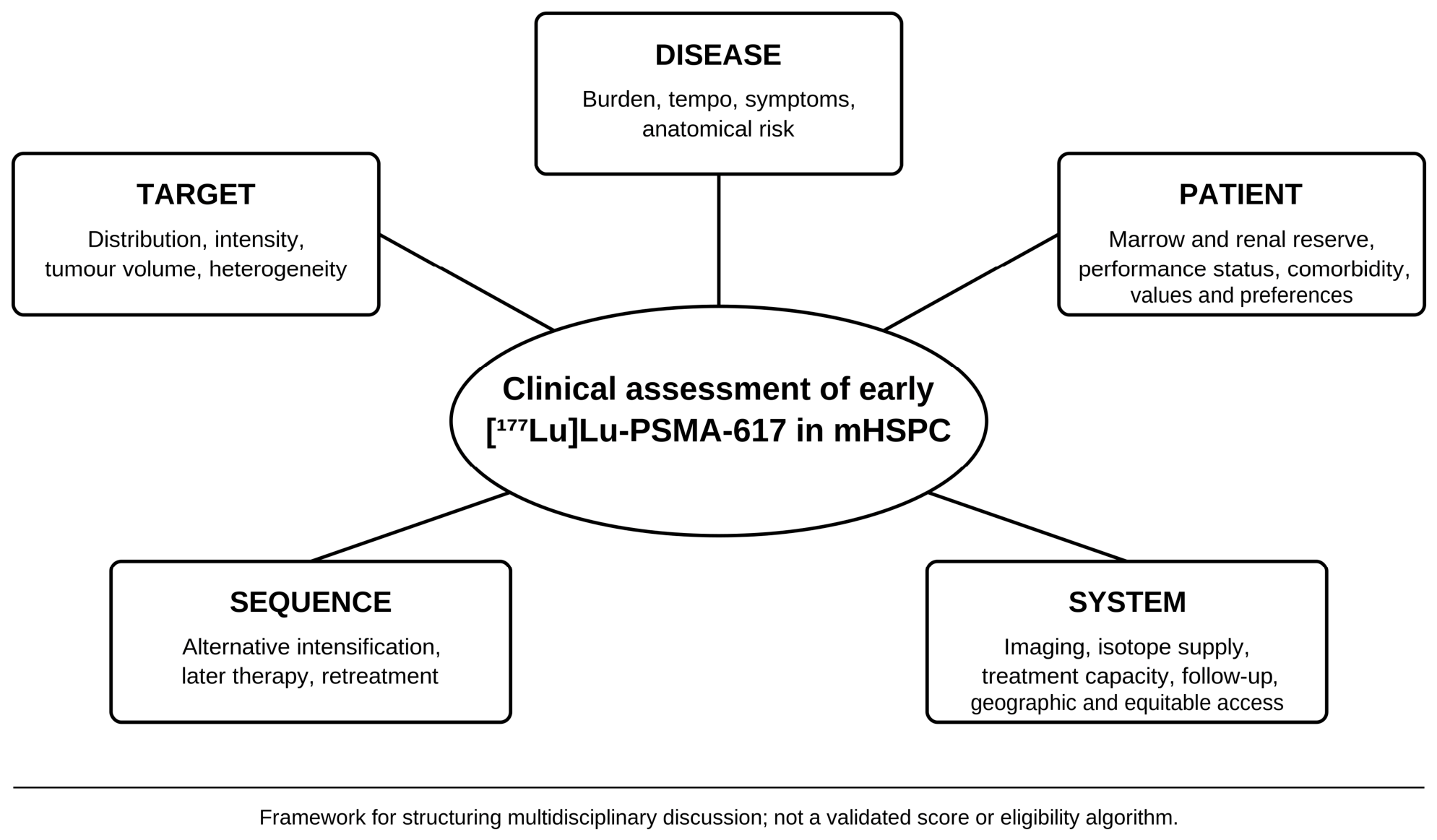
Clinical assessment can be organised across five domains: target, disease, patient, sequence, and system (Figure 1). The five domains are an author-proposed conceptual synthesis of the reviewed literature and expert clinical interpretation, not a formal consensus product. The framework is a non-validated discussion aid, not a score, treatment-selection algorithm, or source of eligibility restrictions beyond the indication and trial evidence. Table 4 maps the domains to clinical questions, supporting evidence, its directness and limitations, and multidisciplinary considerations; these descriptive assessments are not formal certainty grades.
Figure 1.
Author-proposed, non-validated five-domain framework for multidisciplinary assessment of early [177Lu]Lu-PSMA-617 in metastatic hormone-sensitive prostate cancer (mHSPC).
Table 4.
Evidence map for the author-proposed five-domain framework.
Procedure guidance and consensus recommendations chiefly address eligibility, imaging, organ function, administration, and monitoring, largely in advanced mCRPC [36,37]. The framework complements them by focusing on a question raised by earlier use: should this eligible patient receive radioligand therapy now? It brings disease urgency, competing intensification, later treatment options, and delivery capacity into the same assessment.
The target domain considers whether the disease most likely to determine prognosis, symptoms, or organ threat is broadly PSMA-accessible. It includes overall distribution, uptake, volume, heterogeneity, and the presence of clinically important target-poor lesions. The disease domain considers metastatic burden, tempo, symptoms, visceral involvement, anatomical risk, de novo versus recurrent presentation, and the anticipated absolute benefit from additional disease control. These two domains distinguish technical eligibility from the clinical need for early intensification.
The patient domain considers performance status, marrow and renal reserve, baseline symptoms, comorbidity, life expectancy, concurrent medication, prior treatment, and preferences regarding toxicity and mode of delivery. The sequence domain examines the likely need for chemotherapy, molecularly targeted agents, local therapy, later radioligand treatment, and clinical trials. It also considers whether early radioligand treatment could affect access to, or tolerance of, later therapy.
The system domain asks whether the planned treatment and monitoring can be delivered on time, and whether waiting periods or travel requirements change its feasibility for this patient. Delivery feasibility is distinct from clinical appropriateness: isotope supply, treatment capacity, and travel barriers are not biological eligibility criteria. These constraints may worsen geographic and socioeconomic inequities in access.
The domains are considered together, without a required sequence. The framework complements product information, multidisciplinary review, and patient preference; it is not a score or eligibility algorithm (PSMA—prostate-specific membrane antigen).
5.4. Implementation, Treatment Burden, and Patient-Reported Outcomes
Delivery requires coordination between medical oncology, nuclear medicine, radiology, urology, pharmacy, radiation safety, and supportive care. Responsibilities should be clear for imaging review, scheduling, laboratory assessment, adverse-event management, and progression. Expansion into mHSPC increases the importance of planning these services before referrals increase.
Isotope supply, scanners, licensed treatment facilities, trained staff, and follow-up capacity vary between health systems, as do authorisation and reimbursement. Concentration in specialist centres can add travel, accommodation, and caregiver burdens. Waiting times, completion rates, and reasons for non-initiation after referral should therefore be documented alongside clinical outcomes.
Patient-reported evaluation should extend beyond time to first worsening. VISION showed delayed deterioration in several quality-of-life and pain outcomes in advanced mCRPC [47], but differs from PSMAddition in disease state, comparator, baseline symptoms, endpoints, and follow-up. In mHSPC, repeated assessments should capture function, salivary symptoms, fatigue, work and caregiver burden, and quality of life across later treatments.
Counselling with the nuclear medicine team should clarify the added treatment burden and confirm that hormonal therapy continues. Patients may weigh avoidance of particular chemotherapy toxicities against travel, radiation precautions, or caregiving constraints. Recording their priorities and the alternatives discussed makes the decision understandable across the treating team.
5.5. Evidence Gaps and Research Priorities
Mature survival and prespecified PFS2 results should be accompanied by complete crossover and subsequent-treatment reporting, with assumption-explicit sensitivity analyses and outcomes across the full treatment sequence. Longer-term patient-reported data are needed to determine whether disease control preserves function and quality of life across successive treatments.
Imaging priorities include prospective evaluation of PSMA total tumour volume, uptake heterogeneity, target-poor high-risk lesions, and selected FDG discordance using harmonised methods and treatment-interaction analyses. Prospective comparisons of the tested fixed-activity regimen with response-adapted or dosimetry-guided schedules, including retreatment, should incorporate harmonised absorbed-dose measurements, dose–response and dose–toxicity relationships, cumulative organ exposure, and long-term surveillance.
Comparative and sequencing trials should evaluate radioligand intensification against docetaxel-containing strategies, including toxicity, patient preference, cost, and later therapy. ARPI-specific interactions require prespecified analyses or dedicated randomisation. Registries should document delivery, access, long-term marrow and renal outcomes, retreatment, and rare delayed events.
6. Conclusions
PSMAddition establishes that adding [177Lu]Lu-PSMA-617 to ADT and an investigator-selected ARPI improves radiographic progression-free survival in trial-eligible PSMA-positive mHSPC, with increased toxicity. Overall survival remains immature and was not significantly improved at the peer-reviewed and subsequent sponsor-reported interim analyses. The effect on outcomes across the full treatment sequence—including subsequent therapy, cumulative toxicity, quality-adjusted survival, and long-term treatment burden—remains unresolved. Optional crossover does not equate to guaranteed delayed treatment.
Clinical decisions should integrate target expression, disease characteristics, patient fitness and preferences, alternative treatments, and delivery feasibility. Mature follow-up and comparative sequencing evidence are needed; the author-proposed five-domain framework provides a non-validated aid to multidisciplinary discussion, not an eligibility algorithm.
Author Contributions
Conceptualisation, C.B. and G.D.L.; writing—original draft preparation, C.B.; writing—review and editing, C.B. and G.D.L. All authors have read and agreed to the published version of the manuscript.
Funding
This research received no external funding.
Institutional Review Board Statement
Not applicable.
Informed Consent Statement
Not applicable.
Data Availability Statement
No new data were created or analyzed in this study. Data sharing is not applicable to this article.
Acknowledgments
During the preparation of this manuscript, the authors used ChatGPT 5.6 (OpenAI, San Francisco, CA, USA) and Claude Opus 5 (Anthropic, San Francisco, CA, USA) for the purposes of language editing and document formatting.
Conflicts of Interest
G.D.L. serves as a Section Board Member of Current Oncology and did not participate in the editorial handling, peer review, or decision-making concerning this manuscript. The authors declare no other conflicts of interest.
References
- US Food and Drug Administration. FDA Approves Lutetium Lu 177 Vipivotide Tetraxetan with Androgen Receptor Pathway Inhibitor Therapy for Metastatic Androgen Pathway Modulation-Naive or -Sensitive Prostate Cancer. Available online: https://www.fda.gov/drugs/resources-information-approved-drugs/fda-approves-lutetium-lu-177-vipivotide-tetraxetan-androgen-receptor-pathway-inhibitor-therapy (accessed on 11 October 2026).
- Tagawa, S.T.; Sartor, O.; Piulats, J.M.; Saad, F.; Fizazi, K.; Reid, A.; Beltran, H.; Kramer, G.; Mahammedi, H.; Eiber, M.; et al. [177Lu]Lu-PSMA-617 in Patients with PSMA-Positive Metastatic Androgen Pathway Modulator-Naive/Sensitive Prostate Cancer (PSMAddition): A Phase 3 Randomised, Controlled Trial. Lancet 2026, 408, 793–807. [Google Scholar] [CrossRef] [Scilit] [PubMed]
- Sartor, O.; de Bono, J.; Chi, K.N.; Fizazi, K.; Herrmann, K.; Rahbar, K.; Tagawa, S.T.; Nordquist, L.T.; Vaishampayan, N.; El-Haddad, G.; et al. Lutetium-177-PSMA-617 for Metastatic Castration-Resistant Prostate Cancer. N. Engl. J. Med. 2021, 385, 1091–1103. [Google Scholar] [CrossRef] [Scilit] [PubMed]
- Morris, M.J.; Castellano, D.; Herrmann, K.; de Bono, J.S.; Shore, N.D.; Chi, K.N.; Crosby, M.; Piulats, J.M.; Fléchon, A.; Wei, X.X.; et al. [177Lu]Lu-PSMA-617 versus a Change of Androgen Receptor Pathway Inhibitor Therapy for Taxane-Naive Patients with Progressive Metastatic Castration-Resistant Prostate Cancer (PSMAfore): A Phase 3, Randomised, Controlled Trial. Lancet 2024, 404, 1227–1239, Erratum in Lancet 2024, 404, 2542. https://doi.org/10.1016/S0140-6736(24)02716-8. [Google Scholar] [CrossRef] [Scilit] [PubMed]
- Hofman, M.S.; Emmett, L.; Sandhu, S.; Iravani, A.; Joshua, A.M.; Goh, J.C.; Pattison, D.A.; Tan, T.H.; Kirkwood, I.D.; Ng, S.; et al. [177Lu]Lu-PSMA-617 versus Cabazitaxel in Patients with Metastatic Castration-Resistant Prostate Cancer (TheraP): A Randomised, Open-Label, Phase 2 Trial. Lancet 2021, 397, 797–804. [Google Scholar] [CrossRef] [Scilit] [PubMed]
- Emmett, L.; Subramaniam, S.; Crumbaker, M.; Nguyen, A.; Joshua, A.M.; Weickhardt, A.; Lee, S.-T.; Ng, S.; Francis, R.J.; Goh, J.C.; et al. [177Lu]Lu-PSMA-617 plus Enzalutamide in Patients with Metastatic Castration-Resistant Prostate Cancer (ENZA-p): An Open-Label, Multicentre, Randomised, Phase 2 Trial. Lancet Oncol. 2024, 25, 563–571. [Google Scholar] [CrossRef] [Scilit] [PubMed]
- Azad, A.A.; Bressel, M.; Tan, H.; Voskoboynik, M.; Suder, A.; Weickhardt, A.J.; Guminski, A.; Francis, R.J.; Saghebi, J.; Dhiantravan, N.; et al. Sequential [177Lu]Lu-PSMA-617 and Docetaxel versus Docetaxel in Patients with Metastatic Hormone-Sensitive Prostate Cancer (UpFrontPSMA): A Multicentre, Open-Label, Randomised, Phase 2 Study. Lancet Oncol. 2024, 25, 1267–1276. [Google Scholar] [CrossRef] [Scilit] [PubMed]
- Privé, B.M.; Noordzij, W.; Muselaers, C.H.J.; de Jong, I.J.; van Oort, I.M.; Janssen, M.J.R.; Van Rijk, M.C.; van Gemert, W.A.; Timmermans, B.; de Groot, M.; et al. [177Lu]Lu-PSMA-617 in Oligometastatic Hormone-Sensitive Prostate Cancer (BULLSEYE): An Open-Label, Randomised, Phase 2 Study. Lancet Oncol. 2026, 27, 461–469, Erratum in Lancet Oncol. 2026, 27, e236. https://doi.org/10.1016/S1470-2045(26)00186-5. [Google Scholar] [CrossRef] [Scilit] [PubMed]
- Novartis Pharmaceuticals Corporation. PLUVICTO (Lutetium Lu 177 Vipivotide Tetraxetan) Injection: US Prescribing Information. Revised July 2026. Available online: https://dailymed.nlm.nih.gov/dailymed/fda/fdaDrugXsl.cfm?setid=14908037-2892-4d98-a053-253ce35afb1a&type=display (accessed on 11 October 2026).
- Tagawa, S.T.; Sartor, O.; Piulats, J.M.; Saad, F.; Fizazi, K.; Reid, A.H.; Beltran, H.; Kramer, G.; Mahammedi, H.; Eiber, M.; et al. Phase III Trial of [177Lu]Lu-PSMA-617 Combined with ADT + ARPI in Patients with PSMA-Positive Metastatic Hormone-Sensitive Prostate Cancer (PSMAddition). Investigator Presentation, ESMO Congress 2025, Berlin, Germany, Abstract LBA6. Available online: https://www.medicalcongresspresentations.com/ESMO25/PC/pdf/Tagawa_Oral_LBA6.pdf (accessed on 6 September 2026).
- Novartis. FDA Approves Pluvicto for PSMA+ Metastatic Hormone-Sensitive Prostate Cancer (mHSPC), Advancing Potential New Standard of Care Across Metastatic Disease. Available online: https://www.novartis.com/news/media-releases/fda-approves-pluvicto-psma-metastatic-hormone-sensitive-prostate-cancer-mhspc-advancing-potential-new-standard-care-across-metastatic-disease (accessed on 11 October 2026).
- Novartis Pharmaceuticals Corporation. PSMAddition: Efficacy Data in Metastatic Hormone-Sensitive Prostate Cancer. Healthcare Professional Website; Sponsor-Reported Data. Available online: https://www.pluvicto-hcp.com/psma-positive-mhspc/efficacy (accessed on 11 October 2026).
- Fizazi, K.; Chi, K.N.; Shore, N.D.; Herrmann, K.; De Bono, J.S.; Castellano, D.; Piulats, J.M.; Fléchon, A.; Wei, X.X.; Mahammedi, H.; et al. Final Overall Survival and Safety Analyses of the Phase III PSMAfore Trial of [177Lu]Lu-PSMA-617 versus Change of Androgen Receptor Pathway Inhibitor in Taxane-Naive Patients with Metastatic Castration-Resistant Prostate Cancer. Ann. Oncol. 2025, 36, 1319–1330. [Google Scholar] [CrossRef] [Scilit] [PubMed]
- Morris, M.J.; Gupta, S.; Tagawa, S.T.; Sartor, A.O.; Saad, F.; Reid, A.H.; Beltran, H.; Piulats, J.M.; Kramer, G.; Mahammedi, H.; et al. Health-Related Quality of Life, Pain, and Symptomatic Skeletal Events in the Phase 3 PSMAddition Study of [177Lu]Lu-PSMA-617 (177Lu-PSMA-617) Combined with ADT and ARPI in Patients with PSMA-Positive mHSPC. J. Clin. Oncol. 2026, 44, 18. [Google Scholar] [CrossRef] [Scilit]
- Saad, F.; Tagawa, S.T.; Sartor, A.O.; Fizazi, K.O.; Reid, A.H.; Beltran, H.; Piulats, J.M.; Kramer, G.; Mahammedi, H.; Eiber, M.; et al. Subgroup Analyses by Disease Volume and De Novo/Recurrent mHSPC in the PSMAddition Study of [177Lu]Lu-PSMA-617. J. Clin. Oncol. 2026, 44, 5020. [Google Scholar] [CrossRef] [Scilit]
- Fizazi, K.; Morris, M.J.; Shore, N.D.; Chi, K.N.; Crosby, M.; de Bono, J.S.; Herrmann, K.; Roubaud, G.; Nagarajah, J.; Fleming, M.; et al. Health-Related Quality of Life, Pain, and Symptomatic Skeletal Events with [177Lu]Lu-PSMA-617 in Patients with Progressive Metastatic Castration-Resistant Prostate Cancer (PSMAfore): An Open-Label, Randomised, Phase 3 Trial. Lancet Oncol. 2025, 26, 948–959. [Google Scholar] [CrossRef] [Scilit] [PubMed]
- Emmett, L.; Subramaniam, S.; Crumbaker, M.; Sandhu, S.; Nguyen, A.; Weickhardt, A.; Lee, S.-T.; Ng, S.; Tan, T.H.; Gedye, C.; et al. Overall Survival and Quality of Life with [177Lu]Lu-PSMA-617 plus Enzalutamide versus Enzalutamide Alone in Metastatic Castration-Resistant Prostate Cancer (ENZA-p): Secondary Outcomes from a Multicentre, Open-Label, Randomised, Phase 2 Trial. Lancet Oncol. 2025, 26, 291–299. [Google Scholar] [CrossRef] [Scilit] [PubMed]
- Satapathy, S.; Das, C.K.; Goyal, S.; Sood, A.; Periasamy, K.; Aggarwal, P.; Preet, K.; Singh, S.K.; Mavuduru, R.S.; Bora, G.S.; et al. [177Lu]Lu-PSMA-617 Consolidation Therapy After Docetaxel in Patients with Synchronous High-Volume Metastatic Hormone-Sensitive Prostate Cancer: A Randomized, Phase 2 Trial. J. Nucl. Med. 2025, 66, 1068–1074. [Google Scholar] [CrossRef] [Scilit] [PubMed]
- Hofman, M.S.; Emmett, L.; Sandhu, S.; Iravani, A.; Buteau, J.P.; Joshua, A.M.; Goh, J.C.; Pattison, D.A.; Tan, T.H.; Kirkwood, I.D.; et al. Overall Survival with [177Lu]Lu-PSMA-617 versus Cabazitaxel in Metastatic Castration-Resistant Prostate Cancer (TheraP): Secondary Outcomes of a Randomised, Open-Label, Phase 2 Trial. Lancet Oncol. 2024, 25, 99–107. [Google Scholar] [CrossRef] [Scilit] [PubMed]
- Muniz, M.; Sartor, O.; Orme, J.J.; Koch, R.M.; Scharf, Z.; Heath, E.I.; Zarka, J.G.; Kase, A.M.; Riaz, I.B.; Andrews, J.R.; et al. Outcomes for [177Lu]Lu-PSMA-617 with and without Concurrent Use of Androgen Receptor Pathway Inhibitors in Patients with Metastatic Castration-Resistant Prostate Cancer. Eur. Urol. Oncol. 2025, 8, 1087–1093. [Google Scholar] [CrossRef] [Scilit] [PubMed]
- Davis, I.D.; Martin, A.J.; Stockler, M.R.; Begbie, S.; Chi, K.N.; Chowdhury, S.; Coskinas, X.; Frydenberg, M.; Hague, W.E.; Horvath, L.G.; et al. Enzalutamide with Standard First-Line Therapy in Metastatic Prostate Cancer. N. Engl. J. Med. 2019, 381, 121–131. [Google Scholar] [CrossRef] [Scilit] [PubMed]
- Armstrong, A.J.; Szmulewitz, R.Z.; Petrylak, D.P.; Holzbeierlein, J.; Villers, A.; Azad, A.; Alcaraz, A.; Alekseev, B.; Iguchi, T.; Shore, N.D.; et al. ARCHES: A Randomized, Phase III Study of Androgen Deprivation Therapy with Enzalutamide or Placebo in Men with Metastatic Hormone-Sensitive Prostate Cancer. J. Clin. Oncol. 2019, 37, 2974–2986. [Google Scholar] [CrossRef] [Scilit] [PubMed]
- Chi, K.N.; Agarwal, N.; Bjartell, A.; Chung, B.H.; Gomes, A.J.P.d.S.; Given, R.; Soto, Á.J.; Merseburger, A.S.; Özgüroğlu, M.; Uemura, H.; et al. Apalutamide for Metastatic, Castration-Sensitive Prostate Cancer. N. Engl. J. Med. 2019, 381, 13–24. [Google Scholar] [CrossRef] [Scilit] [PubMed]
- Fizazi, K.; Tran, N.; Fein, L.; Matsubara, N.; Rodriguez-Antolin, A.; Alekseev, B.Y.; Özgüroğlu, M.; Ye, D.; Feyerabend, S.; Protheroe, A.; et al. Abiraterone plus Prednisone in Metastatic, Castration-Sensitive Prostate Cancer. N. Engl. J. Med. 2017, 377, 352–360. [Google Scholar] [CrossRef] [Scilit] [PubMed]
- Saad, F.; Vjaters, E.; Shore, N.D.; Olmos, D.; Xing, N.; Gomes, A.J.P.d.S.; Mota, A.C.d.A.; Salman, P.; Jievaltas, M.; Ulys, A.; et al. Darolutamide in Combination with Androgen-Deprivation Therapy in Patients with Metastatic Hormone-Sensitive Prostate Cancer from the Phase III ARANOTE Trial. J. Clin. Oncol. 2024, 42, 4271–4281. [Google Scholar] [CrossRef] [Scilit] [PubMed]
- Sweeney, C.J.; Chen, Y.H.; Carducci, M.; Liu, G.; Jarrard, D.F.; Eisenberger, M.; Wong, Y.-N.; Hahn, N.; Kohli, M.; Cooney, M.M.; et al. Chemohormonal Therapy in Metastatic Hormone-Sensitive Prostate Cancer. N. Engl. J. Med. 2015, 373, 737–746. [Google Scholar] [CrossRef] [Scilit] [PubMed]
- Smith, M.R.; Hussain, M.; Saad, F.; Fizazi, K.; Sternberg, C.N.; Crawford, E.D.; Kopyltsov, E.; Park, C.H.; Alekseev, B.; Montesa-Pino, Á.; et al. Darolutamide and Survival in Metastatic, Hormone-Sensitive Prostate Cancer. N. Engl. J. Med. 2022, 386, 1132–1142. [Google Scholar] [CrossRef] [Scilit] [PubMed]
- Fizazi, K.; Foulon, S.; Carles, J.; Roubaud, G.; McDermott, R.; Fléchon, A.; Tombal, B.; Supiot, S.; Berthold, D.; Ronchin, P.; et al. Abiraterone plus Prednisone Added to Androgen Deprivation Therapy and Docetaxel in de Novo Metastatic Castration-Sensitive Prostate Cancer (PEACE-1): A Multicentre, Open-Label, Randomised, Phase 3 Study with a 2 × 2 Factorial Design. Lancet 2022, 399, 1695–1707. [Google Scholar] [CrossRef] [Scilit] [PubMed]
- Riaz, I.B.; Naqvi, S.A.A.; He, H.; Asghar, N.; Siddiqi, R.; Liu, H.; Singh, P.; Childs, D.S.; Ravi, P.; Hussain, S.A.; et al. First-Line Systemic Treatment Options for Metastatic Castration-Sensitive Prostate Cancer: A Living Systematic Review and Network Meta-analysis. JAMA Oncol. 2023, 9, 635–645. [Google Scholar] [CrossRef] [Scilit] [PubMed]
- Hofman, M.S.; Lawrentschuk, N.; Francis, R.J.; Tang, C.; Vela, I.; Thomas, P.; Rutherford, N.; Martin, J.M.; Frydenberg, M.; Shakher, R.; et al. Prostate-Specific Membrane Antigen PET-CT in Patients with High-Risk Prostate Cancer before Curative-Intent Surgery or Radiotherapy (proPSMA): A Prospective, Randomised, Multicentre Study. Lancet 2020, 395, 1208–1216. [Google Scholar] [CrossRef] [Scilit] [PubMed]
- Buteau, J.P.; Martin, A.J.; Emmett, L.; Iravani, A.; Sandhu, S.; Joshua, A.M.; Francis, R.J.; Zhang, A.Y.; Scott, A.M.; Lee, S.-T.; et al. PSMA and FDG-PET as Predictive and Prognostic Biomarkers in Patients Given [177Lu]Lu-PSMA-617 versus Cabazitaxel for Metastatic Castration-Resistant Prostate Cancer (TheraP): A Biomarker Analysis from a Randomised, Open-Label, Phase 2 Trial. Lancet Oncol. 2022, 23, 1389–1397. [Google Scholar] [CrossRef] [Scilit] [PubMed]
- Saad, F.; Tagawa, S.T.; Sartor, O.; Fizazi, K.; Reid, A.; Beltran, H.; Piulats, J.M.; Kramer, G.; Mahammedi, H.; Eiber, M.; et al. PD23-02 Prostate-Specific Antigen Endpoints in the Phase 3 PSMAddition Study of [177Lu]Lu-PSMA-617 (177Lu-PSMA-617) Combined with ADT and ARPI in Patients with PSMA-Positive (PSMA+) Metastatic Hormone-Sensitive Prostate Cancer (mHSPC). J. Urol. 2026, 215, e1335. [Google Scholar] [CrossRef] [Scilit]
- Fendler, W.P.; Eiber, M.; Beheshti, M.; Bomanji, J.; Calais, J.; Ceci, F.; Cho, S.Y.; Fanti, S.; Giesel, F.L.; Goffin, K.; et al. PSMA PET/CT: Joint EANM Procedure Guideline/SNMMI Procedure Standard for Prostate Cancer Imaging 2.0. Eur. J. Nucl. Med. Mol. Imaging 2023, 50, 1466–1486. [Google Scholar] [CrossRef] [Scilit] [PubMed]
- Emmett, L.; Papa, N.; Subramaniam, S.; Crumbaker, M.; Nguyen, A.; Sandhu, S.; Weickhardt, A.; Lee, S.-T.; Ng, S.; Tan, T.H.; et al. Prognostic and Predictive Value of Baseline PSMA-PET Total Tumour Volume and SUVmean in Metastatic Castration-Resistant Prostate Cancer in ENZA-p (ANZUP1901): A Substudy from a Multicentre, Open-Label, Randomised, Phase 2 Trial. Lancet Oncol. 2025, 26, 1168–1177. [Google Scholar] [CrossRef] [Scilit] [PubMed]
- Kuo, P.H.; Morris, M.J.; Hesterman, J.; Kendi, A.T.; Rahbar, K.; Wei, X.X.; Fang, B.; Adra, N.; Garje, R.; Michalski, J.M.; et al. Quantitative [68Ga]Ga-PSMA-11 PET and Clinical Outcomes in Metastatic Castration-Resistant Prostate Cancer Following [177Lu]Lu-PSMA-617 (VISION Trial). Radiology 2024, 312, e233460. [Google Scholar] [CrossRef] [Scilit] [PubMed]
- Kratochwil, C.; Fendler, W.P.; Eiber, M.; Hofman, M.S.; Emmett, L.; Calais, J.; Osborne, J.R.; Iravani, A.; Koo, P.; Lindenberg, L.; et al. Joint EANM/SNMMI Procedure Guideline for the Use of 177Lu-Labeled PSMA-Targeted Radioligand-Therapy (177Lu-PSMA-RLT). Eur. J. Nucl. Med. Mol. Imaging 2023, 50, 2830–2845. [Google Scholar] [CrossRef] [Scilit] [PubMed]
- Hope, T.A.; Antonarakis, E.S.; Bodei, L.; Calais, J.; Iravani, A.; Jacene, H.; Koo, P.J.; Morgans, A.K.; Osborne, J.R.; Tagawa, S.T.; et al. SNMMI Consensus Statement on Patient Selection and Appropriate Use of 177Lu-PSMA-617 Radionuclide Therapy. J. Nucl. Med. 2023, 64, 1417–1423. [Google Scholar] [CrossRef] [Scilit] [PubMed]
- Groener, D.; Nguyen, C.T.; Baumgarten, J.; Bockisch, B.; Davis, K.; Happel, C.; Mader, N.; Ngoc, C.N.; Wichert, J.; Banek, S.; et al. Hematologic Safety of 177Lu-PSMA-617 Radioligand Therapy in Patients with Metastatic Castration-Resistant Prostate Cancer. EJNMMI Res. 2021, 11, 61. [Google Scholar] [CrossRef] [Scilit] [PubMed]
- Herrmann, K.; Rahbar, K.; Eiber, M.; Sparks, R.; Baca, N.; Krause, B.J.; Lassmann, M.; Jentzen, W.; Tang, J.; Chicco, D.; et al. Renal and Multiorgan Safety of [177Lu]Lu-PSMA-617 in Patients with Metastatic Castration-Resistant Prostate Cancer in the VISION Dosimetry Substudy. J. Nucl. Med. 2024, 65, 71–78, Erratum in J. Nucl. Med. 2026, 67, 1689–1691. https://doi.org/10.2967/jnumed.126.265448e. [Google Scholar] [CrossRef] [Scilit] [PubMed]
- Rosar, F.; Kochems, N.; Bartholomä, M.; Maus, S.; Stemler, T.; Linxweiler, J.; Khreish, F.; Ezziddin, S. Renal Safety of [177Lu]Lu-PSMA-617 Radioligand Therapy in Patients with Compromised Baseline Kidney Function. Cancers 2021, 13, 3095. [Google Scholar] [CrossRef] [Scilit] [PubMed]
- Ells, Z.; Grogan, T.R.; Czernin, J.; Dahlbom, M.; Calais, J. Dosimetry of [177Lu]Lu-PSMA-Targeted Radiopharmaceutical Therapies in Patients with Prostate Cancer: A Comparative Systematic Review and Meta-analysis. J. Nucl. Med. 2024, 65, 1264–1271. [Google Scholar] [CrossRef] [Scilit] [PubMed]
- Kratochwil, C.; Giesel, F.L.; Stefanova, M.; Benešová, M.; Bronzel, M.; Afshar-Oromieh, A.; Mier, W.; Eder, M.; Kopka, K.; Haberkorn, U. PSMA-Targeted Radionuclide Therapy of Metastatic Castration-Resistant Prostate Cancer with 177Lu-Labeled PSMA-617. J. Nucl. Med. 2016, 57, 1170–1176. [Google Scholar] [CrossRef] [Scilit] [PubMed]
- Sjögreen Gleisner, K.; Chouin, N.; Gabina, P.M.; Cicone, F.; Gnesin, S.; Stokke, C.; Konijnenberg, M.; Cremonesi, M.; Verburg, F.A.; Bernhardt, P.; et al. EANM Dosimetry Committee Recommendations for Dosimetry of 177Lu-Labelled Somatostatin-Receptor- and PSMA-Targeting Ligands. Eur. J. Nucl. Med. Mol. Imaging 2022, 49, 1778–1809. [Google Scholar] [CrossRef] [Scilit] [PubMed]
- Uribe, C.; Iravani, A.; Savir-Baruch, B.; Jacene, H.; Graves, S.A.; Dewaraja, Y.K.; Heath, C.L.; Hope, T.A. SNMMI/ACNM Procedure Standard for Post-Treatment Imaging of 177Lu-Based Radiopharmaceuticals. Society of Nuclear Medicine and Molecular Imaging. 2025. Available online: https://snmmi.org/common/Uploaded%20files/Web/Clinical%20Practice/Procedure%20Standards/2025/SNMMI_PostTreatmentImaging_20250613_SNMMI_BOD_FINAL%20V2%20%281%29.pdf (accessed on 11 October 2026).
- Violet, J.; Sandhu, S.; Iravani, A.; Ferdinandus, J.; Thang, S.-P.; Kong, G.; Kumar, A.R.; Akhurst, T.; Pattison, D.; Beaulieu, A.; et al. Long-Term Follow-up and Outcomes of Retreatment in an Expanded 50-Patient Single-Center Phase II Prospective Trial of [177Lu]Lu-PSMA-617 Theranostics in Metastatic Castration-Resistant Prostate Cancer. J. Nucl. Med. 2020, 61, 857–865. [Google Scholar] [CrossRef] [Scilit] [PubMed]
- Eifer, M.; Sutherland, D.E.K.; Goncalves, I.; Buteau, J.P.; Au, L.; Azad, A.A.; Emmett, L.; Kong, G.; Kostos, L.; Kumar, A.S.R.; et al. Therapy-Related Myeloid Neoplasms after [177Lu]Lu-PSMA Therapy in Patients with Metastatic Castration-Resistant Prostate Cancer: A Case Series. J. Nucl. Med. 2025, 66, 579–584. [Google Scholar] [CrossRef] [Scilit] [PubMed]
- Fizazi, K.; Herrmann, K.; Krause, B.J.; Rahbar, K.; Chi, K.N.; Morris, M.J.; Sartor, O.; Tagawa, S.T.; Kendi, A.T.; Vogelzang, N.; et al. Health-Related Quality of Life and Pain Outcomes with [177Lu]Lu-PSMA-617 plus Standard of Care versus Standard of Care in Patients with Metastatic Castration-Resistant Prostate Cancer (VISION): A Multicentre, Open-Label, Randomised, Phase 3 Trial. Lancet Oncol. 2023, 24, 597–610. [Google Scholar] [CrossRef] [Scilit] [PubMed]

Disclaimer/Publisher’s Note: The statements, opinions and data contained in all publications are solely those of the individual author(s) and contributor(s) and not of MDPI and/or the editor(s). MDPI and/or the editor(s) disclaim responsibility for any injury to people or property resulting from any ideas, methods, instructions or products referred to in the content. |
© 2026 by the authors. Licensee MDPI, Basel, Switzerland. This article is an open access article distributed under the terms and conditions of the Creative Commons Attribution (CC BY) license.