


Case presentation
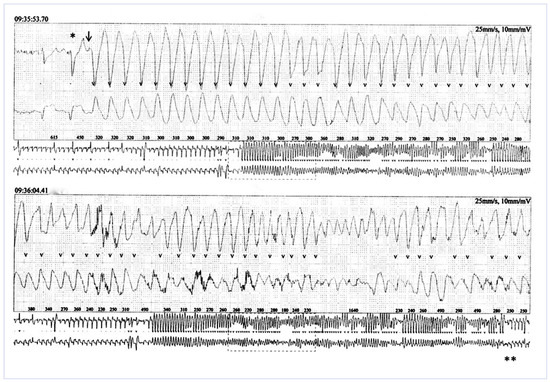
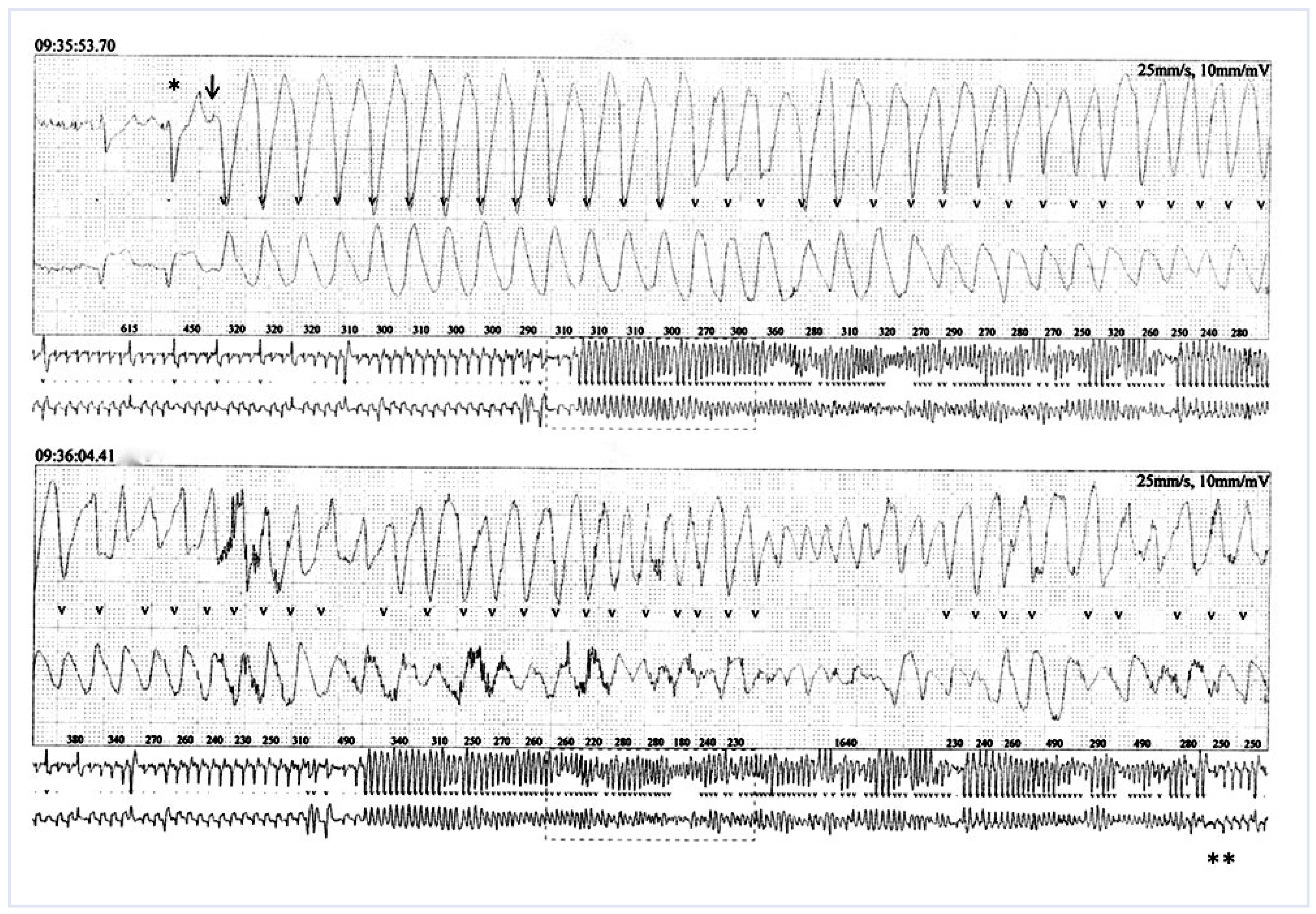
A 51-year-old lady had been admitted 9 months previously with typical chest pain occurring at rest associated with transient palpitations and dizziness. Her medical history was unremarkable apart from active smoking and ophthalmic migraine. The resting ECG was normal, but troponin I levels were slightly elevated at 4.1 µg/l. A transthoracic echocardiogram and coronary angiogram were normal. The patient was discharged with a suspected diagnosis of myocarditis because a cardiac MRI showed focal late Gadolinium enhancement on the anteroseptal segment. During follow-up, chest pain recurred during sleep and once when walking. The latter episode was also associated with palpitations and severe shortness of breath. A second cardiac MRI was performed, which showed signs of transmural late Gadolinium enhancement at the apex (suggesting infarction, inflammation or infiltration). A 24-hour Holter was performed during which the patient experienced severe chest pain associated with palpitations and presyncope while driving. The tracings corresponding to the episode are shown in Figure 1.
Figure 1.
Holter recording showing onset of a wide complex tachycardia corresponding to the clinical episode of chest pain and presyncope.
Questions
What is the diagnosis of the wide complex tachycardia? What is the most likely aetiology of the arrhythmia?
Commentary
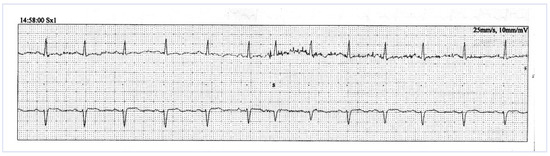
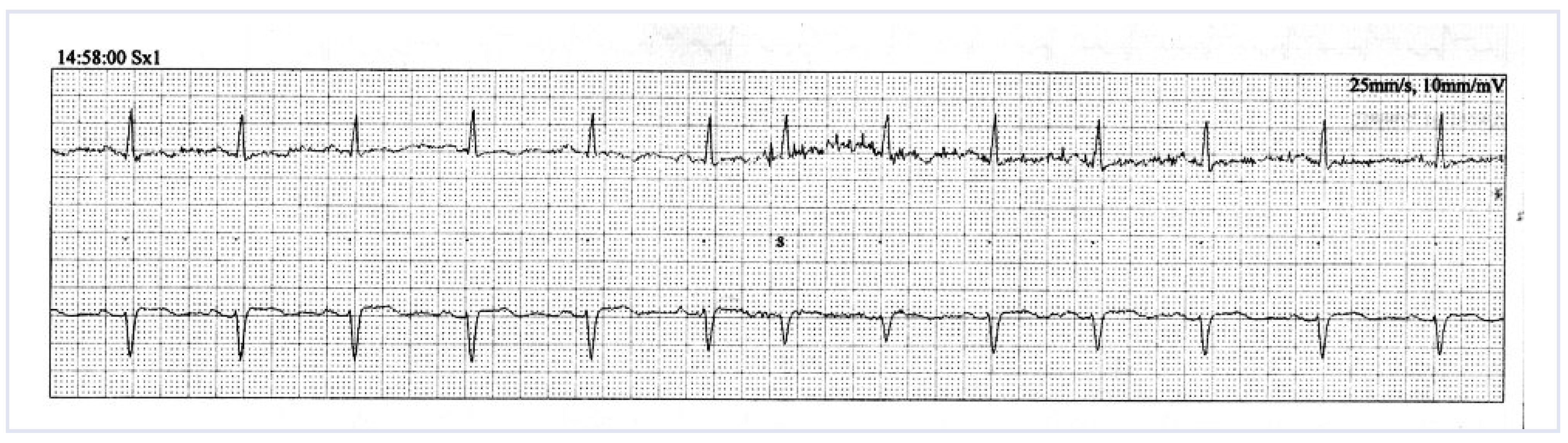
The arrhythmia is initiated by a fusion beat (*) followed by AV dissociation (a nonconducted P-wave is shown by ↓), confirming the diagnosis of ventricular tachycardia that degenerates into polymorphic ventricular tachycardia before spontaneously converting to sinus rhythm after 40 seconds (indicated by ** at the bottom right of the Figure 1). The arrhythmia is preceded by ST segment elevation on the second channel (Figure 1), which is clearly increased compared to an asymptomatic period (Figure 2). This finding, along with the concomitant chest pain in the context of a patient with a history of migraine and evidence of myocardial infarction in two different territories without abnormal coronary arteries, strongly suggests variant (Prinzmetal) angina as a trigger of the ventricular arrhythmia. The 12-lead ECG upon admission was normal, with a QTc interval of 420 ms. Calcium channel blockers (Nifedipine [Adalat® retard] 20 mg) were prescribed and an internal cardioverter defibrillator (ICD) was implanted.
Figure 2.
Holter recording during an asymptomatic period.
Prinzmetal angina was described in 1959 [1]. This syndrome may be associated with myocardial infarction and life-threatening cardiac arrhythmia, including complete atrioventricular block (if the right coronary artery is involved) or ventricular tachycardia/fibrillation.
Pharmacological treatment (calcium channel blocking agents and long-acting nitrates) and cessation of smoking (that was strongly encouraged in our patient) may be effective in preventing coronary spasm. Prognosis is generally good unless arrhythmic complications are present. When life-threatening ventricular arrhythmias are documented, an ICD should be considered, especially as there is no guarantee that medical therapy will prevent recurrence of spasm and arrhythmias. In a series of eight patients with drug-refractory variant angina and documented ventricular fibrillation, arrhythmia recurred in all patients during a mean follow-up of 3.5 years [2]. An ICD was subsequently implanted in seven patients, in whom four received appropriate shocks.
In conclusion, variant angina, although often associated with a good prognosis, may sometimes present as syncope or sudden death. Calcium channel antagonists are the mainstay of therapy, and cessation of smoking should be strongly encouraged. An ICD should be considered when life-threatening arrhythmias are documented, as coronary spasm may recur despite medical therapy.
Conflicts of Interest
The authors certify that there is no actual or potential conflict of interest in relation to this article.
References
- Prinzmetal, M.; Kennamer, R.; Merliss, R.; Wada, T.; Bor, N. Angina pectoris. I. A variant form of angina pectoris; preliminary report. Am J Med 1959, 27, 375–388. [Google Scholar] [CrossRef] [Scilit] [PubMed]
- Meisel, S.R.; Mazur, A.; Chetboun, I.; Epshtein, M.; Canetti, M.; Gallimidi, J.; et al. Usefulness of implantable cardioverter-defibrillators in refractory variant angina pectoris complicated by ventricular fibrillation in patients with angiographically normal coronary arteries. Am J Cardiol 2002, 89, 1114–1116. [Google Scholar] [CrossRef] [Scilit] [PubMed]
© 2011 by the author. Attribution - Non-Commercial - NoDerivatives 4.0.