


Highlights
Public health relevance—How does this work relate to a public health issue?
- By exacerbating psychiatric symptoms and psychological distress within a rapidly aging global population, climate change acts as a critical risk multiplier for suicidal behaviour.
- Older adults are disproportionately vulnerable to environmental stressors like heat anomalies and natural disasters, which aggravate their pre-existing physical and social fragilities.
Public health significance—Why is this work of significance to public health?
- This systematic review maps literature spanning 2007–2025 with the objective of clarifying the complex, non-linear interactions among climatic changes, sociodemographic variations and suicidality of older adults.
- By identifying key risk factors and clinically associated factors such as solastalgia, depression and PTSD, this study successfully fills a gap in environmental public health research.
Public health implications—What are the key implications or messages for practitioners, policy makers and/or researchers in public health?
- Public health adaptation plans regarding climate change must explicitly integrate targeted mental health strategies, including systematic suicide risk screening, post-disaster cognitive behavioural therapies, and telemedicine hotlines.
- Multi-dimensional policies should address structural vulnerabilities like inadequate housing and social isolation, while investigating and acting upon public health and mental health issues, especially regarding older adults.
Abstract
Background: Climate change is being recognized as a factor associated with increased suicidal behavior, especially in the older adult population. Extreme temperatures, thermal anomalies, and intense weather events can amplify pre-existing physical, psychological, and social vulnerabilities, increasing the risk of suicidal ideation and behavior in older adults. Objectives: This systematic review aims to map the literature on the relationship between climate change and suicidal behavior in older people, identifying risk and protective factors, as well as the prevention and intervention strategies aimed at this age group. Methods: A systematic review was conducted according to PRISMA guidelines. The literature search was performed in the EBSCO PsycINFO, Scopus and MEDLINE (PubMed) databases in the period 2007–2025, using combinations of the keywords “climate change”, “global warming”, “older adults”, “elderly”, “suicide”, “suicidal ideation” and related terms. Out of 35 studies, 16 articles were included in the final analysis. Results: Five thematic areas emerged from the analysis of the studies: (1) risk factors, (2) protective factors, (3) sociodemographic factors, (4) prevention and intervention strategies and (5) variables associated with suicidal behavior. Across the included studies, suicidal ideation, non-fatal attempts, and suicide mortality were examined with differing frequency and are reported separately in the thematic synthesis rather than pooled, reflecting the heterogeneity of outcome definitions and study designs. Significant limitations in the literature remain, including the paucity of longitudinal studies, the widespread use of aggregate data and the limited integration of environmental, social, and psychological factors. Conclusions: Climate change and extreme weather events may contribute to suicidal behavior in older adults. It is therefore necessary to develop multidimensional approaches that address structural vulnerabilities and promote the active role of older adults in climate resilience and social cohesion.
1. Introduction
Climate change represents one of the most complex challenges of the 21st century and is now recognized as a potential determinant of suicidal phenomena. In this context, the older population emerges as one of the groups most vulnerable to the direct and indirect effects of global warming, which include extreme temperatures, thermal anomalies, intense weather events, and progressive environmental deterioration. These factors not only contribute to morbidity and mortality but are also strongly associated with an increased manifestation of psychiatric symptoms, such as anxiety, depression, cognitive impairment, and post-traumatic stress disorder [1,2].
In particular, the most recent evidence indicates a significant relationship between temperature anomalies and suicide risk, with a particularly significant impact on the older adults’ population. In Australia, for example, 0.5% of suicides recorded between 2000 and 2019 were attributed to abnormal heat related to climate change, with a statistically significant association especially in men aged 55 and over [3]. Furthermore, seasonal variations and heat waves appear to amplify pre-existing vulnerabilities, suggesting a complex interaction between climatic, biological, psychological, and social factors. As highlighted by Arafat et al. [4], suicide is indeed a multifactorial phenomenon, resulting from the dynamic interaction of individual, social, cultural, and environmental determinants.
Our research group recently completed a broader systematic review on the impact of climate change on older adults’ health [5], encompassing 81 studies organized into seven thematic dimensions (medical, psychological, suicidal behavior, demographic, psychosocial, protective, and preventive strategies), in which suicide-related outcomes were examined only marginally, within a single dimension based on four studies. The present review was designed to complement and extend that earlier work, focusing specifically on suicidal behavior—encompassing suicidal ideation, attempts and suicide—as the primary outcome of interest. This narrower focus allowed for a dedicated Population–Exposure–Outcome framework, an extended search window (through September 2025), and a suicide-specific risk-of-bias appraisal, providing a level of depth on this single, clinically critical outcome that was not achievable within the broader scope of the previous work [5].
Integrating evidence on the climate-related vulnerability of older adults with the broader literature on suicide risk factors highlights the need to systematically examine the role of climate stressors in shaping suicide risk in this population. Building on this rationale, the general objective of this systematic review was to critically summarize and synthesize the available evidence on the association between climate change and suicidal behavior in older adults, in order to help fill a significant gap in the scientific literature and to inform prevention, service planning, and the development of future public health policies.
To operationalize this general objective and to ensure coherence across the search strategy, eligibility criteria, data extraction, and evidence synthesis, this review was guided by a Population–Exposure–Outcome (PEO) framework, consistent with the largely descriptive, non-comparative nature of the available evidence on this topic. The Population (P) was defined as older adults, operationalized across the included studies as individuals aged ≥55, ≥60, or ≥65 years, in both community and clinical settings. The Exposure (E) was defined as climate change-related stressors, including chronic/cumulative phenomena (long-term warming trends, temperature anomalies) and acute climate-related events (heatwaves, cold spells, hurricanes, floods, cyclones, and earthquakes with a documented climate-related component). The Outcome (O) was defined as suicidal behavior across its full spectrum, including suicidal ideation, non-fatal suicide attempts, and suicide mortality. Because most of the eligible studies used ecological, cross-sectional, or correlational designs, a formal comparator (C) was not defined a priori as an eligibility requirement; where a comparator was present in the primary studies (e.g., younger age groups, or non-exposed geographic areas or time periods), the corresponding data were extracted and are reported narratively in the results. This PEO framework also provides the conceptual structure adopted throughout the review to distinguish climate exposures, pre-existing individual and social vulnerabilities, hypothesized psychological and clinical mechanisms, and suicide-related outcomes, addressing the need for a model capable of organizing this heterogeneous body of evidence.
2. Methods
This systematic review was conducted according to the PRISMA guidelines. Nevertheless, some elements of the PRISMA 2020 checklist, developed primarily for systematic reviews of studies estimating a quantitative effect, were not fully applicable to the conceptual nature of the present review (Checklist see Supplementary Files S1 and S2). For each of these elements, an explicit statement of non-applicability is provided below, accompanied by a rationale, in line with the checklist’s own guidance, which allows for non-applicable items, provided that this choice is justified. For the purposes of this review, ‘older adults’ was defined in accordance with the most frequently adopted threshold among the included studies, namely ≥65 years of age (consistent with WHO and UN conventions for high-income and upper-middle-income settings). It should be noted, however, that the operational definition of old age varied considerably across the included studies, ranging from ≥45 years [6] to ≥65–75 years [7,8], while some studies [2,9,10,11,12] did not report an explicit numerical cut-off, treating older adults as a qualitatively defined vulnerable population. This heterogeneity in age classification is discussed among the limitations of the present review, as it may limit the comparability of findings across studies.
2.1. Eligibility Criteria
Eligible studies were required to explicitly examine the relationship between climate change and suicide (including suicidal ideation, suicide attempts, and fatal suicidal behaviors) in older adults, or in vulnerable populations including older adults. No restrictions were applied regarding study design or outcome measures.
Only articles published in English between 2007 and September 2025 were considered. Articles without an abstract, editorials, book reviews, doctoral theses, dissertations, conference abstracts and commentaries were excluded, as were studies that did not specifically address climate change, suicide, or older/vulnerable populations. One scoping review [8] was retained despite not directly addressing suicide as an outcome, given its relevance to the broader mental-health and mortality burden associated with climate exposure in older adults; its findings were used only as background/contextual evidence and were excluded from the suicide-specific thematic synthesis.
Studies focusing exclusively on non-older-adult populations were eligible only when they provided direct comparative or mechanistic evidence relevant to interpreting pathways later discussed in relation to older adults [13].
To avoid double counting, reviews were used exclusively for contextual interpretation and triangulation of findings and were not treated as equivalent, independently weighted evidence alongside primary studies in the thematic synthesis. The eligibility criteria intentionally combine primary studies and reviews, and, in a small number of cases, evidence from younger or mixed-age populations and one earthquake-exposed sample; these inclusions were retained only where they offered mechanistic or comparative evidence directly relevant to older adults, as specified above, and are treated throughout as lower-weight, indirect evidence rather than as equivalent to the core body of older-adult, suicide-specific primary studies, to avoid double counting and conceptual conflation.
2.2. Information Sources
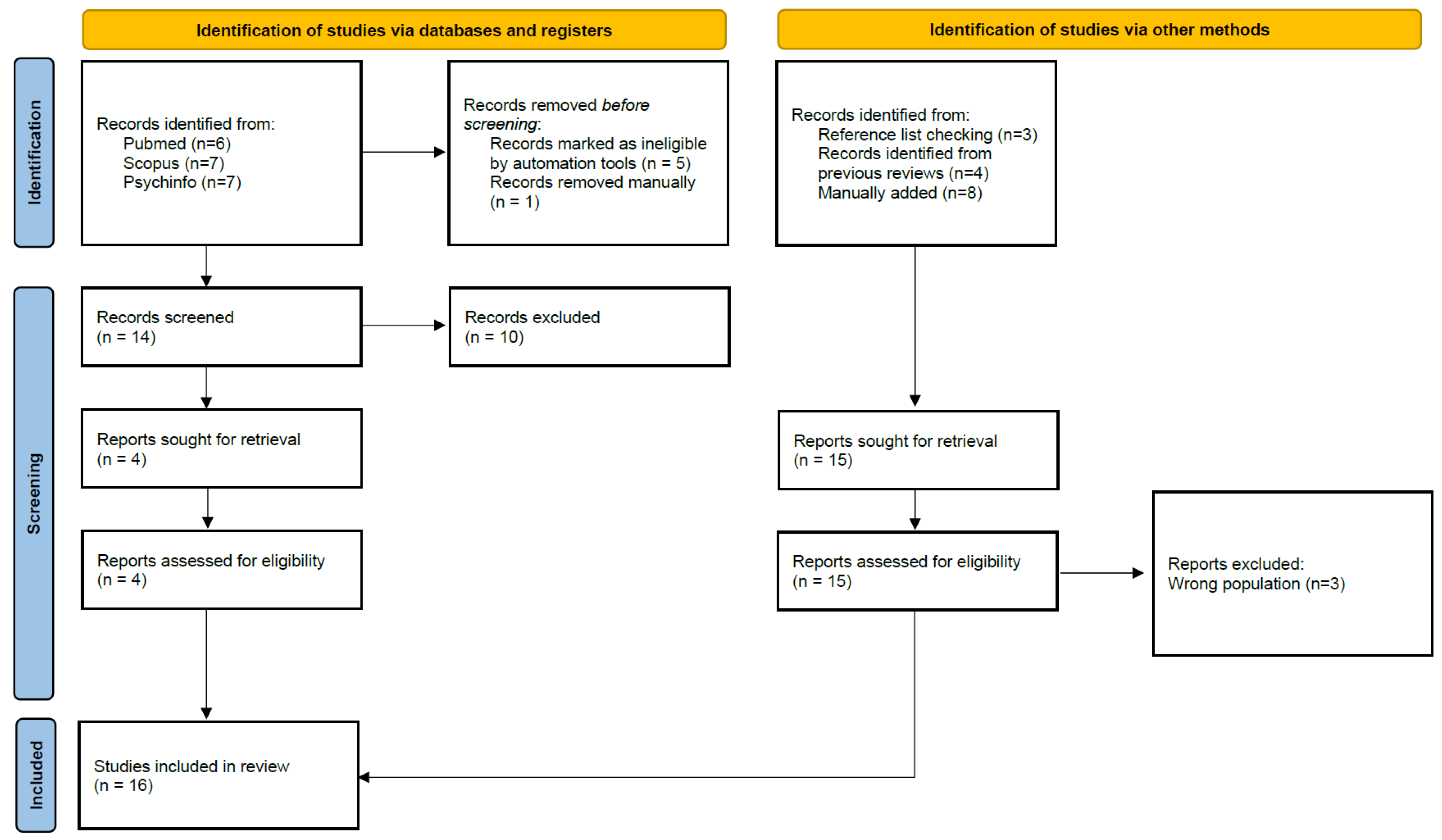
Literature searches were conducted in three electronic databases: PsycINFO (via the EBSCOhost platform), Scopus, and MEDLINE (via PubMed). The last search was conducted in September 2025. In addition to the systematic database search, the reference list of another pertinent review was screened [5], and further articles judged relevant were added. All records retrieved through the systematic search and reference list screening were merged into a single database, and duplicate records were removed iteratively before the screening phase. The PRISMA flow diagram (Figure 1) distinguishes, for full transparency, records identified through the systematic database search from those added through reference-list screening of a related review; the latter contributed a substantial share of the final sample, underlining the limited sensitivity of the database search string discussed above as a review limitation.
Figure 1.
PRISMA flow diagram.
2.3. Search Strategy
The following search string was used for all three databases: (“climate change” OR “global warming”) AND (“older adults” OR “elderly” OR “aged people” OR “older people”) AND (“suicide” OR “suicidal ideation” OR “suicidality” OR “suicide attempts” OR “suicidal thoughts” OR “suicidal behaviors”). Before finalizing this strategy, a preliminary exploratory phase was conducted using single search terms and partial combinations, aimed at identifying key studies and estimating the breadth of the available literature. No date or language restriction was applied to the search strategy, and studies that did not meet these criteria were manually excluded during the screening process. No tool for the translation of the search string into different databases was used. The database search string was limited to “climate change” and “global warming” and did not include additional terms for extreme temperatures, natural disasters, or displacement, nor controlled vocabulary or database-specific syntax; this restricted the sensitivity of the systematic search and is a limitation the authors acknowledge and flag for a future, broader re-run of the search rather than resolve retrospectively within the present dataset.
2.4. Selection Process
Six researchers (MAV, LV, FDR, EZ, FL, CB) independently conducted the literature search. Title/abstract and full-text screening were subsequently performed independently by two reviewers (MAV, JZ) using a standardized procedure. Disagreements were resolved through discussion between the two reviewers or, when necessary, through consultation with a third, senior reviewer (DDL). No automatic selection tools were used. Authors of the studies retrieved were not contacted.
2.5. Data Collection Process
The same independent selection process (MAV, JZ) and decision on discrepancies (DDL) were maintained for the extraction of relevant data. No automated tools or software were used. Critical reading of the studies enabled the extraction and interpretation of data from the studies.
2.5.1. Data Items—Outcomes
Data were sought on five specific domains relating to the relationship between climate change and suicide in older populations: (1) sociodemographic factors, (2) risk factors, (3) protective factors, (4) preventive and intervention strategies, and (5) associated factors. These domains coincide with the domains of data extracted.
2.5.2. Data Items—Other Variables
For each included study, data were extracted on country, reference population, sample size, and study design (Table 1). In case of missing or unclear data, authors were not contacted. In cases where the full text of a study could not be retrieved, it was not included in the final synthesis, without formulating substitute assumptions about the missing information. No characteristics other than those present in Table 1 were sought.
Table 1.
Summary table of the articles used.
2.6. Study Risk of Bias Assessment
Risk of bias in the included studies was independently assessed by two reviewers (MAV, JZ). Because standardized risk-of-bias instruments commonly used in systematic reviews (e.g., Cochrane RoB 2, ROBINS-I) are designed to evaluate the internal validity of studies estimating a quantitative effect—for example through appraisal of randomization, blinding, or handling of missing outcome data—and because the included studies did not report such quantitative effect estimates, these tools were not considered suitable for the present synthesis. A structured coding framework was therefore developed specifically for this review to appraise methodological quality across the heterogeneous set of included study designs. The framework examined five domains: confounding factors, missing data, and major methodological, sampling, measurement, and interpretative/structural biases (Table 2). Assessments were conducted independently by the two reviewers, and disagreements were resolved through discussion or, when necessary, through consultation with a third, senior reviewer (DDL), following the same procedure used for study selection (Item 8). An overall summary judgement of risk of bias was not formulated for each individual study; domain-level assessments are instead reported in Table 2. No automation tools were used to support the assessment, and study investigators were not contacted to confirm or obtain additional information.
Table 2.
Identified biases across thematic dimensions.
2.7. Effect Measures
Not applicable, as no meta-analysis was performed.
2.8. Synthesis Methods
For the Process of selecting studies for synthesis, all studies meeting the inclusion criteria were considered eligible for a single qualitative synthesis.
For Data preparation, since no numerical data were envisaged for quantitative synthesis, preparation was limited to transcribing, for each included study, the textual passages relevant to the influence of climate change on suicidal phenomena in the older population and classifying them according to the categories described in the “Data Items” section.
Extracted data were organized in a summary table reporting country, reference population, sample size, and study design for each included study (Table 1).
Given the methodological heterogeneity of the included studies, a narrative synthesis was adopted, in accordance with PRISMA guidance for reviews where meta-analysis is not appropriate. Studies used a variety of methods, populations and settings. For this reason, a statistical synthesis was not applicable.
2.9. Methods to Explore Heterogeneity
For the Exploration of heterogeneity, no statistical analysis was conducted, such as subgroup analysis or meta-regression, given that the synthesis is not quantitative in nature.
2.10. Sensitivity Analyses
Sensitivity analysis is not applicable, as no quantitative synthesis of the results was conducted.
2.11. Reporting Bias Assessment
No formal tool (e.g., funnel plot, statistical tests for asymmetry) was used to assess the risk of bias due to missing results, as such tools are designed for quantitative syntheses of effect estimates and are not applicable to the qualitative nature of the present synthesis. It should be noted, however, that the exclusion of unpublished material (theses, conference abstracts, preprints) and of non-English-language articles, although justified by reasons of quality and usability of the included material, constitutes a potential source of reporting bias and language bias, which was taken into account in the interpretation of the results and is discussed among the limitations of the review.
2.12. Certainty Assessment
No standardized tool for assessing the certainty of the body of evidence (such as the GRADE approach—Grading of Recommendations, Assessment, Development and Evaluation) was applied in this review. GRADE and related quantitative certainty frameworks are designed to express confidence in a pooled effect estimate synthesized across multiple studies, based on factors such as risk of bias, inconsistency, imprecision, indirectness, and publication bias. Since the present review did not generate a pooled quantitative effect estimate for any outcome, but instead narratively synthesized heterogeneous evidence on the relationship between climate change and suicide in older adults, the conceptual premises underlying a GRADE-type assessment do not apply to this synthesis. Qualitative-evidence-synthesis-specific frameworks (e.g., GRADE-CERQual) were also not considered appropriate, as they are intended to assess confidence in findings derived specifically from syntheses of qualitative research, whereas the present review integrates a broader and more heterogeneous set of study designs. Instead, factors relevant to the overall trustworthiness of the evidence base—including the risk of bias domains examined for each study (Table 2) and the methodological heterogeneity of the included studies—are discussed qualitatively in the interpretation of results and acknowledged as a limitation of the review.
3. Results
The findings summarized below are organized thematically rather than statistically pooled; within each theme, time-series and longitudinal studies, cross-sectional and ecological studies, and conceptual or narrative reviews are identified explicitly in the text, and findings drawn from the latter are flagged as lower-weight, contextual evidence rather than as equivalent to primary quantitative studies. Constructs such as depression, anxiety, PTSD, and insomnia are described below as associated factors or hypothesized mechanisms rather than as formally tested mediators, since the included studies did not conduct mediation analyses.
The literature review revealed five main thematic areas: sociodemographic factors, risk factors, protective factors, preventive strategies/interventions, and associated factors of suicide risk. These dimensions represent the most recurrent interpretative cores in the relationship between climate change and suicidality in the older adult population.
3.1. Sociodemographic Factors
3.1.1. Gender Differences and Housing Conditions
Gender differences are particularly relevant in the association between extreme weather events and suicide risk. In Australia, Hertzog et al. [3] observed an increase in suicide mortality in men ≥ 55 years of age during periods of thermal anomaly (rising temperature). Similarly, Yu et al. [10], in an ecological study conducted in China, highlighted a greater sensitivity of older adults, especially men, to the effects of absolute humidity and temperature variations on suicide risk. Several studies also highlighted the role of housing conditions. Lee [16] found that older women exposed to extreme heat showed higher levels of suicidal ideation, especially in the presence of homes with poor thermal insulation, insufficient ventilation, or limited capacity to mitigate heat stress. Consistently, Mehta et al. [1], studying the effects of Hurricane Sandy, found increased suicidal ideation in socially isolated or widowed older women.
3.1.2. Geographic Location
Regional differences significantly influence the impact of climate stressors on mental health. Hertzog et al. [3] highlighted regional variations in the association between temperature anomalies and suicide in Australia, while Yu et al. [10] observed greater vulnerability among older adults living in rural areas compared to urban areas.
3.2. Risk Factors
The analysis of risk factors was organized according to the WHO ecological model [18], considering the health, community, and relational levels.
3.2.1. Health System Level
Preti et al. [9] highlighted that reduced family supervision during warm months can increase the risk of suicide in vulnerable older adults. Mehta et al. [1] also highlighted how climate disasters compromise access to mental health services and continuity of treatment, exacerbating depressive, anxious, and post-traumatic symptoms associated with suicide.
3.2.2. Community Level
The loss of housing, personal belongings, and support networks represents a major vulnerability factor. Wahid et al. [11] showed that floods and cyclones significantly increase psychological distress and suicidality in vulnerable populations. In Bangladesh, over 57% of flood survivors in Kurigram reported suicidal tendencies, while 10.9% of individuals exposed to Cyclone Amphan reported suicidal ideation [11]. Climate migration also emerges as a critical factor: White et al. [2] evidenced that displacement, loss of livelihoods, and reduced social support promote depression, anxiety, hopelessness, and suicidality in older adults. Preti et al. [9] suggested that environmental deterioration and loss of contact with natural environments may contribute to increased suicidal ideation.
3.2.3. Relational Level
The loss of family, property, or autonomy amplifies the risk of suicide in older adults exposed to extreme weather events [1,11]. Guo et al. [14], studying survivors of the Wenchuan earthquake, found that the perception of “not having recovered” from the disaster was significantly associated with suicidality, especially in older adults. Social isolation is also a key factor. Li et al. [6] observed a greater impact of hot nights and cold spells on depressive symptoms in older adults living alone. White et al. [2] also reported that climate migrants frequently experience a loss of sense of belonging, isolation, and increased suicidal ideation.
3.3. Protective Factors
The review identified both direct and indirect protective factors.
3.3.1. Direct Factors
Family networks and social support represent important protective elements against suicide risk, especially during periods of climate stress [9]. The active presence of family members and caregivers also promotes greater surveillance of vulnerable older adults.
3.3.2. Indirect Factors
Family support reduces depressive symptoms and psychological distress associated with extreme weather events [1,11]. Some studies also highlighted the role of thermoregulation, sleep quality, and physical activity in mitigating the psychological effects of extreme heat [1,11]. Mehta et al. [1] reported that older adults may show higher levels of resilience than younger adults after traumatic events, with fewer depressive and post-traumatic symptoms and greater involvement in community and volunteer activities.
3.4. Preventive Strategies and Interventions
The interventions identified in the literature could also be divided into direct and indirect categories.
3.4.1. Direct Interventions
The literature highlights the importance of screening and monitoring programs for suicide risk before and after extreme weather events, with particular attention to older adults [1,2]. Jeong et al. [17] also proposed specific policies for the prevention of suicide related to heat stress. Among psychological interventions, post-disaster CBT (CBT-PD) has proven effective in online modalities after extreme events such as Hurricane Sandy [1]. Mehta et al. [1] also suggested implementing mental health hotlines and telemedicine services.
3.4.2. Indirect Interventions
Psychological First Aid (PFA) appeared useful in reducing acute distress, feelings of abandonment, and hopelessness [19]. Community-based interventions such as the RISE (Retirees in Service to the Environment program, https://citra-rise.human.cornell.edu) promote resilience, socialization, and a sense of purpose in older adults exposed to climate stress [19]. Environmental and housing interventions show promise too: improving housing conditions and reducing air pollution and greenhouse gas emissions can indirectly contribute to reducing suicide risk [5,15,16]. Training physicians, caregivers, and gatekeepers is indicated as an important prevention strategy [4].
3.5. Associated Factors of Suicide Risk
The literature identifies numerous psychological and clinical associated factors in the relationship between climate change and suicidality in older adults.
3.5.1. Depression and Mood Disorders
Depression emerges as the main associated factor of suicide risk. Li et al. [6] found that hot nights and cold spells significantly exacerbate depressive symptoms in older adults. Mehta et al. [1], Wahid et al. [11], and White et al. [2] confirmed that extreme temperatures, air pollution, and climate disasters increase depression, bipolar disorder, and suicidal ideation. Sim et al. [15] also suggested a possible neurobiological mechanism linked to reduced serotonin levels.
3.5.2. PTSD and Anxiety
Guo et al. [14] highlighted the presence of elevated levels of suicidal ideation, planning, and suicide attempts in survivors of the Wenchuan earthquake, strongly associated with posttraumatic stress disorder (PTSD) and depression. Similar findings were reported by Mehta et al. [1], White et al. [2], and Wahid et al. [11], who describe PTSD, anxiety, and eco-anxiety as frequent psychological consequences of extreme weather events.
3.5.3. Hopelessness and Sense of Entrapment
White et al. [2] linked the concept of hopelessness to solastalgia, the distress resulting from the transformation of one’s environment. Guo et al. [14] showed that the perception of “failure to recover” after a disaster is a strong predictor of suicidality in older adults. Similarly, Mehta et al. [1] highlighted that displacement, loss of autonomy, and housing instability can fuel despair and suicidal vulnerability.
3.5.4. Preexisting Mental Disorders and Insomnia
Older adults with preexisting mental disorders are particularly vulnerable to the effects of climate change [1,11]. Furthermore, Li et al. [6] showed that extremely hot nights impair sleep and thermoregulation, worsening depressive symptoms and indirectly increasing suicide risk. White et al. [2] confirmed that insomnia and suicidality represent frequent responses to climate stressors.
4. Discussion
The results of this review suggest that the relationship between climate change and suicidality in older adults cannot be interpreted through a linear cause-and-effect model but should be understood as the result of a complex interaction between climate vulnerabilities, pre-existing social conditions, psychological fragility, and structural inequalities. In this sense, climate change appears to act primarily as a “risk multiplier,” capable of amplifying existing vulnerabilities rather than generating suicidal behavior ex novo. This interpretation appears particularly relevant in the older population, where exposure to climate stressors is intertwined with physiological processes of aging, social isolation, loss of autonomy, and a higher prevalence of chronic diseases.
Gender differences represent one of the most consistent findings in the literature, but also one of the most complex to interpret. Older men show particularly high rates of suicide mortality during periods of thermal anomalies and extreme heat [3,10], while in older women suicidal ideation appears to be more associated with social isolation, widowhood, and housing insecurity [1,16]. However, attributing these differences exclusively to physical factors risks oversimplifying the phenomenon. It is plausible that gender functions instead as an indicator of different trajectories of social and relational vulnerability: older men may be more exposed to lethal suicidal outcomes due to a lower propensity to seek help and a greater tendency towards emotional isolation, while women appear more vulnerable to the cumulative effects of caregiving, loss of energy, and housing insecurity. In this sense, climate-related suicide risk does not appear uniformly distributed but rather reflects gender inequalities already entrenched throughout the life course [5,20,21].
The role of housing conditions also deserves broader critical reflection. The included studies show that homes with poor thermal insulation, insufficient ventilation, or inadequate cooling systems increase exposure to climate stress and are associated with higher levels of suicidal ideation [16]. However, housing quality should not be interpreted solely as an environmental variable, but rather as an indicator of social marginalization and economic vulnerability. Indeed, the home represents not only a physical space of protection from heat or cold, but also a place of identity and relational value. This suggests that the psychological effects of extreme weather events may stem both from physical exposure and from perceived precariousness, loss of control, and existential insecurity that such conditions may produce in older adults [8,20].
Similarly, geographic location appears to influence suicide risk not only due to climatic differences, but also to the unequal distribution of health and social resources. Rural areas or those with weak infrastructure show stronger associations between extreme weather events and suicidality [3,10], but these findings could reflect a broader condition of territorial disadvantage. Climate vulnerability, therefore, appears closely intertwined with social vulnerability: climate does not affect everyone in the same way, but tends to intensify pre-existing fragilities in less protected contexts.
One aspect emerging from this review concerns the role of environmental and symbolic loss in suicidal processes. The concept of solastalgia described by White et al. [2] broadens our understanding of the link between climate change and mental health, suggesting that the deterioration of the natural environment can generate feelings of alienation, helplessness, and thwarted belonging. From this perspective, climate change represents not only a physical threat, but also a fracture of identity and existential tension. This dimension may be particularly relevant in older adults, for whom the connection to the local area and familiar places often plays a central role in building autobiographical continuity and a sense of psychological stability. The loss of the familiar environment—through natural disasters, climate migration, or progressive landscape transformations—could therefore act as an important destabilizing factor [5,8,13,20].
Findings also underline how social support appears as one of the main protective factors against suicide risk. However, this finding also requires critical reading. It does not appear to be the mere presence of social relationships that exerts a protective effect, but rather the perceived quality of the support obtained and, probably, the ability to maintain a significant role within the community [12,13]. In this sense, the involvement in prosocial and volunteer activities reported by Mehta et al. [1] appears particularly interesting, as it suggests that a sense of usefulness and belonging can mitigate the psychological effects of climate uncertainty. This element opens a broader reflection on the active role older adults can play in climate adaptation processes, countering an exclusively passive view of vulnerability in old age.
The review also highlights the central role of psychological and clinically associated factors, particularly depression, anxiety, PTSD, and eco-distress. In this context, climate change appears to act primarily by exacerbating psychiatric vulnerabilities and pre-existing health conditions [1,2,6]. However, reducing the phenomenon to a simple exacerbation of mental disorders may be limiting. Indeed, some findings suggest that climate stressors can directly impact the perception of the future, identity continuity, and sense of existential security, configuring themselves as a form of chronic and widespread trauma. The emergence of constructs such as eco-anxiety and solastalgia points precisely to the need to move beyond traditional models of individual psychopathology to include collective, environmental, and cultural dimensions of psychological distress.
The potential role of chronic diseases as indirectly associated factors of suicide risk also appears particularly relevant. White et al. [2] and Mehta et al. [1] showed that older adults with cardiovascular, respiratory, renal, or neurocognitive diseases are particularly vulnerable to the effects of extreme heat. Although the link between worsening physical conditions and suicidality is not yet clear, these findings suggest that climate change may also impact suicide risk through the progressive deterioration of general health, autonomy, and quality of life. This aspect appears particularly important because it highlights how the mental health of older adults cannot be separated from the physical and environmental conditions in which aging occurs.
This systematic review is subject to certain methodological limitations. The search strategy was restricted to three major databases (PubMed, EBSCO PsycInfo, and Scopus) and limited to English-language articles published from 2007 onwards. Consequently, this approach may have omitted foundational research published prior to 2007, or studies published in other languages and indexed in different databases. These constraints inevitably impact the comprehensiveness of the synthesized literature and warrant caution when generalizing the present results. Furthermore, the exclusion of grey literature may have introduced a publication bias. Overall, the available literature presents significant limitations that reduce the possibility of drawing solid causal conclusions. Most studies use ecological or cross-sectional designs and aggregate data, often incapable of capturing the subjective experience of climate exposure [9,10]. Moreover, older adults are frequently considered as a homogeneous group, failing to distinguish differences related to advanced age, gender, socioeconomic status, or health conditions. This approach risks flattening the complexity of aging and underestimating the existence of particularly vulnerable subgroups. In addition, out of the retrieved studies for this review, only four publications considered a “global” dimension involving a variety of countries. Most of the remaining studies derived from Asian realities (China: four studies; South Korea: two studies; Japan: 1 study; Bangladesh: two studies), then one study each from Italy, Germany and Australia. Climatic conditions characterising a given country, frequency of extreme phenomena and cultural, traditional and religious factors may have an impact on determining outcomes from climatic changes.
In light of these considerations, the need to develop more integrated theoretical and methodological models capable of connecting climatic, biological, psychological, social, and cultural dimensions emerges. Future research should adopt longitudinal designs, include individual measures of climate exposure, and delve deeper into underexplored phenomena such as eco-anxiety, solastalgia, loss of a sense of belonging, and the impact of climate migration on older adults. At the same time, preventive interventions should transcend a purely clinical approach and include community, urban, and social strategies aimed at reducing isolation, improving housing conditions, and strengthening collective resilience [22]. From this perspective, climate change-related suicide among older adults appears not only as a matter of individual mental health, but also as an indicator of the profound interactions between environmental crisis, aging, and social inequalities.
5. Conclusions
The evidence synthesized in this review must be interpreted in light of several overarching limitations. The literature on climate change and suicidal behavior in older adults remains limited in volume, methodologically heterogeneous (encompassing ecological, cross-sectional, correlational, and case–control designs alongside narrative, scoping, and systematic reviews), geographically concentrated (predominantly derived from Asian countries, China, South Korea, Japan, and Bangladesh, with only single studies from Italy, Germany, and Australia, and just four adopting an explicitly global perspective), and predominantly observational in nature, precluding causal inference. Within these constraints, findings can be organized into three tiers of evidentiary strength.
Relatively consistent findings, replicated across multiple independent studies and study designs, indicate that extreme temperatures and thermal anomalies are associated with increased suicide risk in older adults, with a disproportionate impact on older men, and that structural vulnerabilities, poor housing conditions, social isolation, and limited access to mental health services amplify this risk. Across studies, older adults are not uniformly vulnerable: cumulative conditions of fragility, rather than age per se, appear to drive risk, while experience, resilience, and social participation emerge consistently as protective resources.
Exploratory associations, supported by a smaller number of studies or by indirect/mixed-population evidence, include the mediating role of psychological constructs such as solastalgia, eco-anxiety, and entrapment; the potential contribution of chronic physical illness to suicide risk through progressive functional decline; the impact of climate-driven migration and displacement on isolation and hopelessness; and disaster-related mechanisms (e.g., perceived non-recovery after earthquakes) that may be relevant to, but are not directly attributable to, climate change. These associations warrant further investigation before being considered as established.
Applied recommendations emerging from the reviewed literature, including systematic suicide risk screening, post-disaster cognitive behavioral therapy, telemedicine and mental health hotlines, housing policy reform, and community-based resilience programs, are grounded in expert and practice-based sources rather than in experimental evidence. As such, they should accordingly be regarded as plausible, literature-informed directions for public health action rather than as validated interventions.
Taken together, climate change appears to act as a risk-amplifying factor for suicidal behavior in older adults, operating through the interaction of environmental stressors with pre-existing structural, social, and psychological vulnerabilities, rather than as a direct determinant. Addressing this relationship will require more integrated research models, particularly longitudinal designs with individual-level exposure measures, and multidimensional prevention policies that explicitly incorporate mental health into climate adaptation planning while addressing the structural inequalities that modulate risk.
Supplementary Materials
The following supporting information can be downloaded at: https://www.mdpi.com/article/10.3390/ijerph23091158/s1, File S1: PRISMA 2020 Main Checklist; File S2: PRIMSA Abstract Checklist [23].
Author Contributions
Conceptualization, D.D.L.; methodology, C.B., F.C.D.R., F.L. and E.Z.; software, F.C.D.R.; validation, F.C.D.R., L.V. and E.Z.; formal analysis, C.B., F.C.D.R., F.L. and E.Z.; investigation, C.B., F.C.D.R., F.L. and E.Z.; resources, M.A.V.; data curation, M.A.V., C.B., F.C.D.R., F.L. and E.Z.; writing—original draft preparation, C.B., F.C.D.R., F.L., J.Z. and E.Z.; writing—review and editing, L.V. and J.Z.; visualization, C.B., F.C.D.R., F.L., L.V. and E.Z.; supervision, D.D.L.; project administration, M.A.V. and J.Z. All authors have read and agreed to the published version of the manuscript.
Funding
This research received no external funding.
Institutional Review Board Statement
Not applicable.
Informed Consent Statement
Not applicable.
Data Availability Statement
No new data were created or analyzed in this study.
Conflicts of Interest
Some authors (Diego De Leo, Josephine Zammarrelli, Elena Zamò, Fausto Carlo De Rossi, Francesca Lippi, Luca Vannucci Cristina Bordignon) are affiliated with De Leo Fund, a non-profit organisation. None of the authors is employed by the organisation. Diego De Leo is its President and receives no remuneration. These affiliations did not influence the study design, data collection, analysis or interpretation of the data, manuscript preparation, or the decision to submit the manuscript for publication. The authors declare no competing financial, commercial, or personal interests related to this work.
References
- Mehta, M.M.; Johnson, A.E.; Ratnakaran, B.; Seritan, I.; Seritan, L. Climate change and aging: Implications for psychiatric care. Curr. Psychiatry Rep. 2024, 26, 499–513. [Google Scholar] [CrossRef] [Scilit]
- White, B.P.; Breaket, S.; Brown, M.J.; Smith, J.R.; Tarbet, A.; Nicholas, P.K.; Ros, A.M.V. Mental health impacts of climate change among vulnerable populations globally: An integrative review. Ann. Glob. Health 2023, 89, 66. [Google Scholar] [CrossRef] [Scilit]
- Hertzog, L.; Charlson, F.; Tschakert, P.; Morgan, G.G.; Norman, R.; Pereira, G.; Hanigan, I.C. Suicide deaths associated with climate change-induced heat anomalies in Australia: A time series regression analysis. BMJ Ment. Health 2024, 27, e301131. [Google Scholar] [CrossRef] [Scilit]
- Arafat, S.Y.; Saleem, T. Suicide in Bangladesh: An Ecological Systems Analysis. Brain Behav. 2025, 15, e70233. [Google Scholar] [CrossRef] [Scilit]
- De Leo, D.; Zammarrelli, J.; Meda, N.; Spisto, S.; Paone, F.; Carrozzino, J.; Viecelli, M.A. Impact of climate change on older adults: A systematic literature review. GeroPsych J. Gerontopsychology Geriatr. Psychiatry 2026, 39, 25–46. [Google Scholar] [CrossRef] [Scilit]
- Li, X.; Ye, Z.; Lang, H.; Fang, Y. Climate change and depressive disorders in middle-aged and older people in China: A quasi-experimental study. J. Environ. Psychol. 2023, 92, 102162. [Google Scholar] [CrossRef] [Scilit]
- Zhou, Y.; Gao, Y.; Yin, P.; He, C.; Liu, W.; Kan, H.; Zhou, M.; Chen, R. Assessing the burden of suicide death associated with nonoptimum temperature in a changing climate. JAMA Psychiatry 2023, 80, 488–497. [Google Scholar] [CrossRef] [Scilit]
- Montoro-Ramírez, E.M.; Parra-Anguita, L.; Álvarez-Nieto, C.; Parra, G.; López-Medina, I.M. Climate change effects in older people’s health: A scoping review. J. Adv. Nurs. 2025, 81, 8066–8079. [Google Scholar] [CrossRef] [Scilit]
- Preti, A.; Lentini, G.; Maugeri, M. Global warming possibly linked to an enhanced risk of suicide: Data from Italy, 1974–2003. J. Affect. Disord. 2007, 102, 19–25. [Google Scholar] [CrossRef] [Scilit]
- Yu, L.; Zhou, T.; Shao, M.; Zhang, T.; Wang, J.; Ma, Y.; Xu, S.; Chen, Y.; Zhu, J.; Pan, F. The role of meteorological factors in suicide mortality in Wuhu, a humid city along the Yangtze River in Eastern China. Environ. Sci. Pollut. Res. 2023, 30, 9558–9575. [Google Scholar] [CrossRef] [Scilit]
- Wahid, S.S.; Islam, M.N.; Raza, W.A. Climate change and mental health in Bangladesh: Vulnerability, inequality, and the crucial need for intervention on the frontlines of the climate crisis. In Mental Health in Bangladesh: From Bench to Community; Springer Nature: Singapore, 2024; pp. 255–270. [Google Scholar] [CrossRef] [Scilit]
- Chen, D.D.; Tu, J.H.; Ling, K.N.; Jin, X.H.; Huang, H.Y. Climate change and suicide epidemiology: A systematic review and meta-analysis of gender variations in global suicide rates. Front. Public Health 2025, 12, 1463676. [Google Scholar] [CrossRef] [Scilit]
- Brailovskaia, J.; Teismann, T. Climate change distress, entrapment, and suicidal ideation. Clim. Change 2024, 177, 127. [Google Scholar] [CrossRef] [Scilit]
- Guo, J.; He, H.; Fu, M.; Han, Z.; Qu, Z.; Wang, X.; Guan, L. Suicidality associated with PTSD, depression, and disaster recovery status among adult survivors 8 years after the 2008 Wenchuan earthquake in China. Psychiatry Res. 2017, 253, 383–390. [Google Scholar] [CrossRef] [Scilit]
- Sim, K.; Kim, Y.; Hashizume, M.; Gasparrini, A.; Armstrong, B.; Sera, F.; Ng, C.F.S.; Honda, Y.; Chung, Y. Nonlinear temperature-suicide association in Japan from 1972 to 2015: Its heterogeneity and the role of climate, demographic, and socioeconomic factors. Environ. Int. 2020, 142, 105829. [Google Scholar] [CrossRef] [Scilit]
- Lee, J.H. Housing quality determinants of depression and suicide ideation by age and gender. Hous. Stud. 2024, 39, 502–528. [Google Scholar] [CrossRef] [Scilit]
- Jeong, S.; Kim, G.; Kang, S.; Jung, J.; Myung, W.; Lee, H. Effect of daily temperature variations on years of life lost from suicide in the capital city of South Korea. J. Psychiatr. Res. 2025, 181, 108–115. [Google Scholar] [CrossRef] [Scilit]
- World Health Organization. Preventing Suicide: A Global Imperative. 2014. Available online: https://www.who.int/publications/i/item/9789241564779 (accessed on 15 March 2026).
- Pillemer, K.; Wells, N.M.; Meador, R.H.; Schultz, L.; Henderson, C.R., Jr.; Cope, M.T. Engaging older adults in environmental volunteerism: The Retirees in Service to the Environment Program. Gerontologist 2017, 57, 367–375. [Google Scholar] [CrossRef] [Scilit]
- De Leo, D. Late-life suicide in an aging world. Nat. Aging 2022, 2, 7–12. [Google Scholar] [CrossRef] [Scilit]
- De Leo, D.; Too, L.S.; Kolves, K.; Milner, A.; Ide, N. Has the suicide rate risen with the 2011 Queensland floods? J. Loss Trauma 2013, 18, 170–178. [Google Scholar] [CrossRef] [Scilit]
- Connors, M.H.; Draper, B.; Wand, A.P.F.; De Leo, D.; Reppermund, S. Suicide and self-harm in older adults. Nat. Rev. Psychol. 2025, 4, 440–456. [Google Scholar] [CrossRef] [Scilit]
- Page, M.J.; McKenzie, J.E.; Bossuyt, P.M.; Boutron, I.; Hoffmann, T.C.; Mulrow, C.D.; Shamseer, L.; Tetzlaff, J.M.; Akl, E.A.; Brennan, S.E.; et al. The PRISMA 2020 statement: An updated guideline for reporting systematic reviews. BMJ 2021, 372, n71. [Google Scholar] [CrossRef] [Scilit]

Disclaimer/Publisher’s Note: The statements, opinions and data contained in all publications are solely those of the individual author(s) and contributor(s) and not of MDPI and/or the editor(s). MDPI and/or the editor(s) disclaim responsibility for any injury to people or property resulting from any ideas, methods, instructions or products referred to in the content. |
© 2026 by the authors. Licensee MDPI, Basel, Switzerland. This article is an open access article distributed under the terms and conditions of the Creative Commons Attribution (CC BY) license.