


Highlights
Public health relevance—How does this work relate to a public health issue?
- This study provides a complementary approach to overcome biases in traditional drug surveillance by using wastewater as an objective population-level data source.
- The practical framework enables rapid detection of emerging drug trends across communities.
Public health significance—Why is this work of significance to public health?
- This study establishes a scalable analytical method for simultaneous detection of dozens of drugs in wastewater.
- Our proposed workflow enhances reliability of wastewater surveillance by minimizing analyte loss and matrix interference.
Public health implications—What are the key implications or messages for practitioners, policy makers and/or researchers in public health?
- The workflow enables earlier detection of emerging substance use threats to guide rapid public health responses.
- It provides a transferable framework to strengthen national drug monitoring and policy decision-making.
Abstract
The ongoing substance use crisis in the United States involves a broad range of illicit and prescription drugs, including opioids, stimulants, sedatives, and various psychoactive and non-psychoactive compounds. Traditional surveillance methods rely on self-reported data, which could lead to bias and recall inconsistencies. Wastewater-based epidemiology has emerged as a powerful, non-invasive tool for monitoring community-level drug use, offering near real-time estimates and the potential to serve as an early warning system. However, challenges such as analyte degradation, wastewater variability, and matrix effects can affect data quality and comparability across regions. This study presents a standardized, practical workflow for multi-drug (n = 52) detection in wastewater, aiming to minimize analyte loss and improve reproducibility. Composite samples were collected from multiple U.S. cities, transported on ice, and extracted using solid-phase extraction. Extraction efficiencies were compared using Oasis Hydrophilic-Lipophilic-Balanced and Mixed-mode Cation-Exchange (MCX) cartridges, with the MCX sorbent providing complementary reversed-phase and cation-exchange interactions that enabled the retention of chemically diverse compounds across multiple drug classes. Analysis was performed with an Ultra-High-Performance Liquid Chromatography system coupled to a triple quadrupole mass spectrometer, in which the instrument parameters and critical methodological considerations, including sample handling, transport, column selection, and method validation, are detailed. This work contributes to the development of a robust, scalable protocol for multi-drug surveillance in wastewater, supporting timely, data-driven public health responses and informing national drug policy efforts.
1. Introduction
Opioid use dates back to the 1800s, when these substances were introduced as an effective treatment for pain [1,2]. They quickly gained popularity among both physicians and patients. However, by the late 1880s, concerns began to emerge about the misuse and harmful effects of opioids, prompting tighter regulations and more restricted use [2,3], which led to a decline in opioid consumption in the early 1900s [2]. Despite this, a modern opioid epidemic remains closely tied to misuse. Although prescription rates have generally declined, there has been a troubling rise in the occurrence of fatal overdoses, initially involving heroin and, more recently, illicitly manufactured fentanyl and its highly potent analogues [1,2,4,5]. This opioid epidemic has impacted all aspects of society and the Center for Disease Control and Prevention estimates $78.5 billion a year as its economic burden related to healthcare, lost productivity, addiction treatment, and criminal justice [4,6].
Opioids are substances that interact with opioid receptors in the central nervous system. Opioids exist in various forms and can be classified as endogenous, naturally occurring, semi-synthetic, or fully synthetic. Natural opioids, such as morphine and codeine, are derived directly from the opium poppy, with morphine being the most widely used in clinical settings due to its potent analgesic properties. Semi-synthetic opioids, like heroin and oxycodone, are chemically modified versions of natural alkaloids. In contrast, fully synthetic opioids—such as methadone and fentanyl—have entirely different chemical structures from naturally occurring opioids but still bind to the same receptors, producing similar effects [1,2].
The substance use epidemic in the United States extends far beyond opioids. Other widely used substances include stimulants such as methamphetamine and cocaine, as well as other legal substances such as nicotine (used by >21% of Americans aged > 12 years old), alcohol (used by >50% of Americans aged > 12 years old), and cannabis (used by >17% of Americans aged > 12 years old)—the three most commonly used drugs in the country [4]. Nicotine use has evolved over time, with current trends showing that vaping nicotine and cannabis has become the most prevalent form of substance use among adolescents [7]. While cannabis (cannabidiol, CBD) is legally available for medical purposes, recreational marijuana remains the most commonly used illegal drug and is linked to increased risk of motor vehicle accidents [8]. Meanwhile, the use of stimulants, such as cocaine and amphetamines, continues to rise, with global cocaine manufacture rising by 56% between 2013 and 2016, and global seizures of amphetamine-related stimulants increasing by 20% between 2015 and 2016 [9]. The concurrent use of alcohol with other substances further compounds these dangers, significantly increasing the risk of overdose or the occurrence of accidental injury or death. These concerning trends highlight the urgent need for comprehensive surveillance systems and sustained monitoring to inform effective public health strategies.
Traditional surveillance on substance abuse typically involves self-reported data or the analysis of human biological samples. However, self-reported data can be subject to bias due to underreporting, social desirability, and recall inconsistencies. Additionally, the analysis of biological samples requires detailed care and adds privacy risks and concerns. Modern approaches, such as utilizing mass spectrometry, have been developed along with the use of different types of samples [10]. These newer techniques can aid in the earlier identification of substance abuse and emerging drugs. Moreover, the utilization of mass spectrometry on wastewater-based samples allows for the surveillance and ability to monitor drug abuse on a short time scale with precise measurements [10,11].
The use of wastewater has played a role in public health since the early 2000s, when the term wastewater-based epidemiology (WBE) was first used by the World Health Organization (WHO) in efforts to monitor the polio virus and confirm eradication in certain areas [12,13]. Since then, WBE has evolved into a valuable tool for tracking infectious disease and patterns of substance use. This emerging method is based on the analysis of chemicals and/or biomarkers in untreated wastewater from a given catchment area to obtain both qualitative and quantitative data on the activity of local populations. WBE offers several advantages, such as near-real time consumption estimates, and represents a more cost-effective approach to population testing that could become an early warning system [12,14,15].
The analysis of wastewater for illicit drug detection typically involves complex analytical procedures to acquire easily understandable results (e.g., identification and quantitation). Wastewater samples typically undergo an extraction, such as solid-phase extraction (SPE), to concentrate and purify drug analytes, followed by analysis using liquid-chromatography tandem mass spectrometry (LC-MS/MS) or gas chromatography tandem mass spectrometry (GC-MS/MS), though LC-MS/MS is more frequently used due to its robustness, high sensitivity, and high selectivity for most illicit drugs [16].
While WBE holds great promise for monitoring illicit drug use, its application presents several challenges. Analyte degradation during storage, variability in wastewater composition, and matrix effects during analysis can all compromise data quality and subsequent interpretation [17]. Current WBE studies often focus on single or limited drug classes and may not capture emerging substances or novel psychoactive compounds, which restricts the comprehensiveness of community-level drug surveillance. In addition, substantial variability in analytical methodologies, such as extraction techniques (namely, solid-phase extraction sorbent selection), chromatographic columns, and instrumental configurations, represents a major source of inconsistency among studies. Furthermore, these factors make it difficult to compare results across studies and regions. To address these issues, our study aimed to establish a standardized, practical workflow for rapid wastewater collection, extraction, and drug detection in wastewater, with a focus on minimizing analyte loss, reducing variability, and improving reproducibility. This study presents a validated and scalable method for close-to-real-time analysis of multiple drug residues in wastewater. Additional considerations are also discussed with a goal of providing a comprehensive set of factors to consider when establishing wastewater-based surveillance for drugs in a public health context.
2. Materials and Methods
2.1. Sample Collection
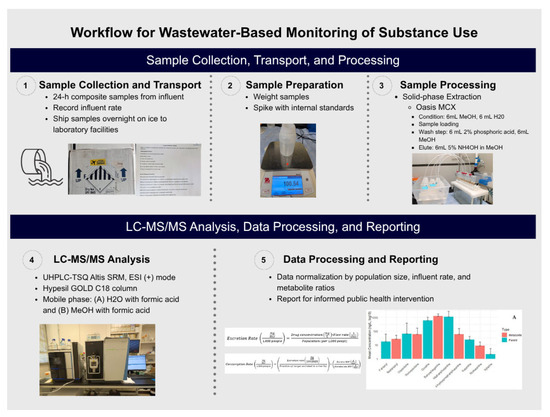
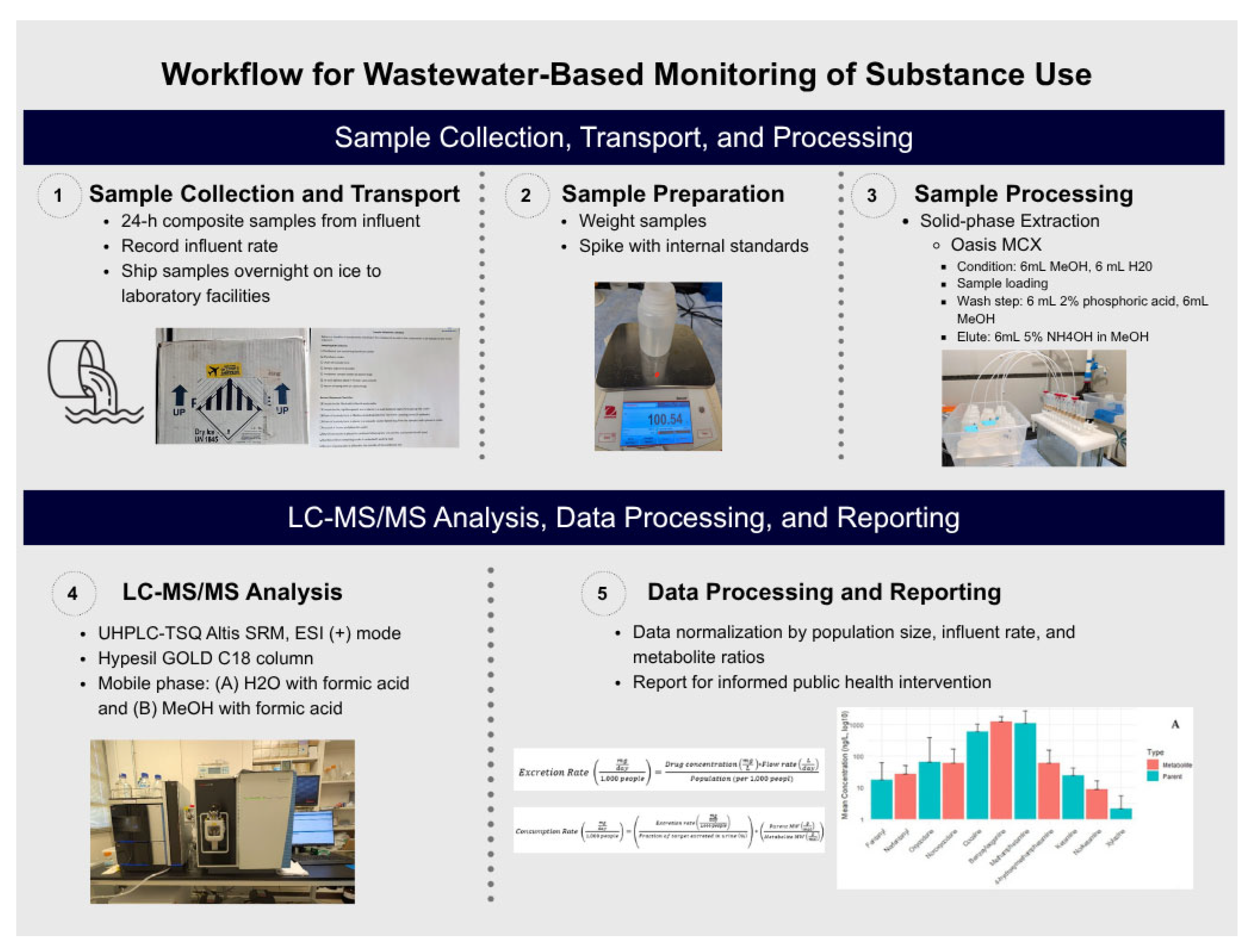
Pooled influent wastewater samples from the University of Florida (UF) wastewater treatment facility (WWTF) were collected and used for method development and validation to ensure consistency across all experimental analyses. Wastewater samples were transported on wet ice or ice packs to the laboratory and divided into 100 mL aliquots, which were immediately used in spike recovery experiments. Additionally, 100 mL aliquots were used for quality assurance (see Section 2.3 for method validation details). An overview of the standardized analytical workflow from sample collection through quantitative data reporting is provided in Figure 1.
Figure 1.
Overview of the standardized analytical workflow for wastewater-based monitoring of substance use, from sample collection through quantitative data re-porting.
2.2. Sample Preparation
Each wastewater sample was gravimetrically weighed and spiked with 50 µL of an internal standard mixture containing 22 isotopically labeled compounds (listed in Table A1). Individual isotopically labeled internal standards (IS), purchased from Cayman Chemical, Ann Arbor, MI, USA, were first diluted to approximately 500 ng/mL in methanol. A secondary working stock was then prepared by further diluting this mixture to 50 ng/mL, which was used for sample spiking. In total, 52 native analytes, as shown in Table A1, were monitored in this method (Table A1), spanning major drug subclasses commonly detected in wastewater: opioids (n = 15), stimulants (n = 11), benzodiazepines (n = 5), synthetic cathinones (n = 5), dissociatives (n = 2), and other pharmaceuticals and metabolites (n = 14). These native standards were also purchased from Cayman Chemical, USA, and were spiked into both calibrants and quality control (QC) samples. Solvents and reagents used for extraction were Optima LC-MS grade methanol, ammonium hydroxide, water, and HPLC grade phosphoric acid (Fisher Scientific, Waltham, MA, USA). The wastewater samples were spiked with 100 µL of phosphoric acid. Once acidified, the samples were filtered via vacuum using 55 mm grade GF/A glass microfiber filters (Sigma Aldrich, St. Louis, MO, USA). Samples were then extracted via solid phase extraction (SPE) using Oasis MCX 60 µm mixed-mode polymeric cationic (Waters, Milford, MA, USA) exchange sorbent cartridges (500 mg/6 mL) from Waters. The cartridges were first conditioned with 6 mL of 5:95 ammonium hydroxide:methanol solution until saturation, soaked for 2 min, and passed through the cartridge by gravity. This process was repeated with 6 mL of Milli-Q water. This was followed by the loading and passing of the wastewater samples, dripping at a rate of 1–2 drops per second. The cartridges were then washed with 6 mL of 90:10 2% phosphoric acid to methanol buffer solution and dried under full vacuum for 50 min. Once the cartridges were dried, they were washed with 6 mL of methanol. Analytes were eluted using 6 mL of a 5% ammonium hydroxide solution in methanol and collected into 15 mL glass conical centrifuge tubes. Extracts were evaporated under ultra-high-purity nitrogen gas to a final volume of approximately 0.125 mL. Samples were then diluted with 0.375 mL of water to achieve a final volume of 0.5 mL. Reconstituted extracts were stored at −20 °C until analysis. For LC-MS/MS analysis, a 50 µL aliquot was transferred to a polypropylene autosampler vial for immediate injection.
In a preliminary evaluation, a subset of samples was also extracted using Oasis HLB cartridges (60 µm hydrophilic-lipophilic balance polymer sorbent; Waters, Milford, MA, USA) to compare recovery performance with the MCX extraction. These samples were not acidified prior to extraction. HLB cartridges were conditioned with 6 mL of 100% methanol followed by 6 mL of Milli-Q water. Sample loading and flow rate were consistent with the MCX protocol. Cartridges were then washed with 6 mL of 95:5 (v/v) water to methanol, dried under vacuum for 50 min, and eluted with 6 mL of 100% methanol. The eluates were evaporated and reconstituted in the same manner as the MCX samples. To test the selectivity of the cartridges, extraction efficiencies were determined by spiking half of the samples prior to extraction and the other half after extraction for both sorbents. Extraction efficiencies were calculated for each compound and for each of the sorbents by dividing the mean of the peak areas for three replicate extractions that were spiked before extraction by the mean of the peak areas of three replicate extractions that were spiked after extraction. The comparison of recovery and precision between MCX and HLB informed the selection of the MCX method for all subsequent sample processing, and cartridge performance differences are discussed in Section 3.
2.3. Analytical Method Development and Validation
The analysis of extracts was completed using a Thermo Scientific Vanquish Ultra-High Performance Liquid Chromatography (UHPLC) system, coupled to a TSQ Altis triple quadrupole mass spectrometer (Thermo Scientific, Waltham, MA, USA), with electrospray ionization in positive mode. The chromatographic separation was achieved using a Hypersil GOLD C18 column (150 mm × 2.1 mm, 5 µm; Thermo Scientific, Waltham, MA, USA). The mobile phases were composed of water (A) and methanol (B), both containing 0.1% of formic acid. The multistep chromatographic gradient employed was as follows: 0–0.5 min 1% B, 0.5–20 min 99% B, 20–23 99% B, 23–25 min 1% B, and 25–30 min 1% B. The temperature of the column compartment was set to 40 °C, with the autosampler temperature set to 4 °C. The flow rate was set to 0.2 mL/min, and the injection volume was 2 µL. Additional LC parameters are displayed in Table 1. The mass spectrometer was operated in positive selected reaction monitoring (SRM) mode using two transitions per species. The transition with the largest intensity was used for quantification, with the second transition used for confirmation. All precursor m/z ions for each species, along with their respective first and second transition m/z values and collision energies can be seen in Table A2. The positive mode source conditions were set to spray voltage 2000 V and sheath, auxiliary, and sweep gas being set to 50, 10, and 1 Arb, respectively. The temperatures of the ion transfer tube and vaporizer were set to 325 °C and 350 °C, respectively. Additional ion source parameters can be found in Table 1.
Table 1.
LC and ion source parameters.
The calibrants were spiked with ranging native standard, 25 µL of the isotopically labeled internal standard mixture, and were diluted with 3:1 Optima Water and Optima methanol to achieve target concentrations. Quantitation was accomplished through isotope dilution using 22 calibration levels spanning from 0.001 ng/mL to 200 ng/mL. Calibration curves were constructed for each species, with each having an R2 > 0.995. For quality assurance, sample extracts, method blanks, wastewater as quality control (QC) samples, and calibrants were randomly distributed within the queue for analysis. The QCs samples consisted of a method blank (MilliQ water spiked with IS only) and two wastewater samples, one spiked with IS only, and one spiked with both IS and native stock. The resultant peak areas were obtained using Thermo Scientific TraceFinder software v 5.1. Limits of detection (LOD) and limits of quantitation (LOQ) for each native compound were determined visually for each extract based on signal-to-noise (S/N) ratios, with thresholds defined as 3:1 for LOD and 10:1 for LOQ. All samples were spiked with corresponding isotopically labeled internal standards prior to extraction to account for matrix effects and analytical variability during integration and quantification. The average of the first five LOD and LOQ determinations for each native compound was calculated and used as a reference value for subsequent analyses. For each run, if the LOD or LOQ was lower than the reference average, the average value was applied to maintain consistency. Conversely, if the LOD or LOQ exceeded the average, the higher value was used to adopt a more conservative approach. The average LOD and LOQ for each native compound are listed in Table A2. Final concentrations were normalized by the density of wastewater extracted and were reported in ng drug per L of wastewater (ng/L).
3. Results and Discussion
3.1. Sample Preparation
One of the most essential aspects of any analytical method is the extraction (e.g., preconcentration and purification of target compounds). In this study, the target analytes belong to different chemical classes, which results in varying physicochemical properties and a concomitant increase in the complexity of extraction. For example, some chemicals, such as cannabinoids, are neutral at lower pHs [18]. In our efforts to establish a standardized and practical workflow for multi-drug detection in wastewater, we compared two extraction methods to determine which one provided the best recovery for the majority of the target compounds. We optimized the solid-phase extraction (SPE) process by evaluating two distinct types of sorbents: the 6 mL Oasis HLB and the 6 mL Oasis MCX. The analytes extracted using the MCX cartridges showed adequate extraction efficiencies, ranging from 65% to 120%, with a few exceptions such as 2-Ethylidene-1,5-dimethyl-3,3-diphenylpyrrolidine, the primary metabolite of methadone, naproxen, propylhexedrine, phenacetin, and tianeptine. The mean extraction efficiency across all compounds using MCX was 82%, while HLB cartridges showed a higher mean efficiency of 103%. However, extraction variability differed substantially between the two sorbents: most HLB recoveries exhibited relative standard deviations (RSDs) greater than 20%, whereas MCX cartridges showed a markedly lower overall RSD of 15%. Although a few outliers reduced the overall mean efficiency for MCX, this sorbent provided more uniform recoveries across the analyte panel, which is critical for multi-residue methods. Given the lower variability and broader consistency observed with MCX, this sorbent was selected for further method development. Recoveries for all compounds obtained with both sorbents are presented in Table 2. Comparable findings have been reported by González-Mariño et al. (2009), who also noted improved performance and manageable signal suppression when using MCX, compared to HLB [19]. In their study, they reported recoveries of 451% and 112% for amphetamine and methamphetamine, respectively, using HLB and 118% and 101% using MCX. In our method, we report recoveries of 100% and 112% in HLB and 85% and 78% in MCX for the same drugs respectively.
Table 2.
Comparison of analyte recoveries from solid phase extraction using Oasis HLB and Oasis MCX cartridges.
3.2. Method Validation
Overall validation of the workflow was conducted prior to the application of the analytical procedure to the actual wastewater samples from the 17 sites explained in Section 3.3. This validation considered linearity, precision, accuracy, LODs, and LOQs. The following results are based on MCX cartridges as they were selected for usage in the extraction of the actual samples.
Calibration curves for all analytes had determination coefficients (R2) higher than 0.99. Additionally, recoveries (65–120%) and precision (calculated relative standard deviation (RSD) < 20%) were satisfactory for most compounds (>80%). Accuracy was calculated by dividing the measured concentration by the nominal concentration for each drug in the QC samples. All drugs spiked into the QCs were considered satisfactory when the measured concentrations were within ±20% of the expected values, and the relative standard deviation (RSD) below 20% [20]. The list of drugs, along with their accuracy, is presented in Table A3.
The LOD and LOQ for each compound were determined and visually confirmed. Several analytes, with high abundance in wastewater, typically had lower sensitivity (i.e., amphetamine and caffeine, with higher LODs and LOQs). Overall, the LOD and LOQ of all analytes were within the three lowest calibrants, which confirms the high sensitivity of the workflow to detect the compounds at very low ranges, down to 0.001 ng/mL LOD and 0.006 ng/mL LOQ. The set of calibration standards, ranging from 0.001 to 200 ng/mL, was run five times, and the average LOD and LOQ of those five calibration curves (shown in Table A2) were used as a reference for subsequent samples as detailed in Section 2.3.
3.3. Application to City Wastewater Samples
To demonstrate the performance and applicability of our validated method, we evaluated the occurrence of 52 drugs of abuse in influent wastewater collected from 17 sites across five major U.S. metropolitan areas using the multi-drug workflow described above. The selected analytes span multiple drug classes, enabling comprehensive assessment of community-level consumption patterns. These classes include stimulants, opioids, benzodiazepines and related sedatives, cocaine-related compounds, hallucinogens, other psychoactive substances (e.g., mitragynine), antivirals (e.g., oseltamivir), and non-psychoactive compounds (e.g., xylazine, 4-hydroxyxylazine, and pentachlorophenol).
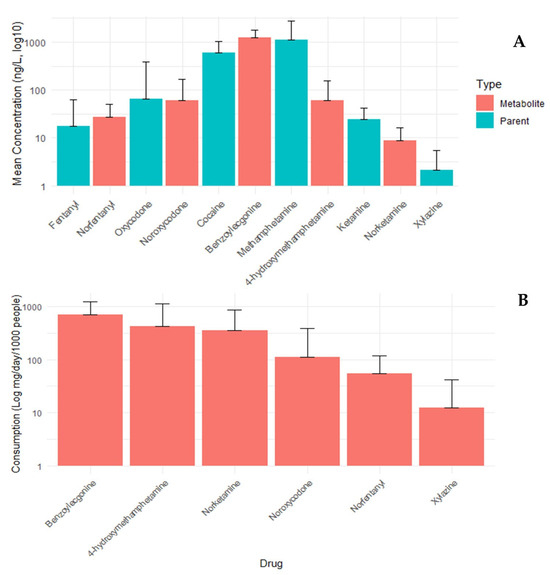
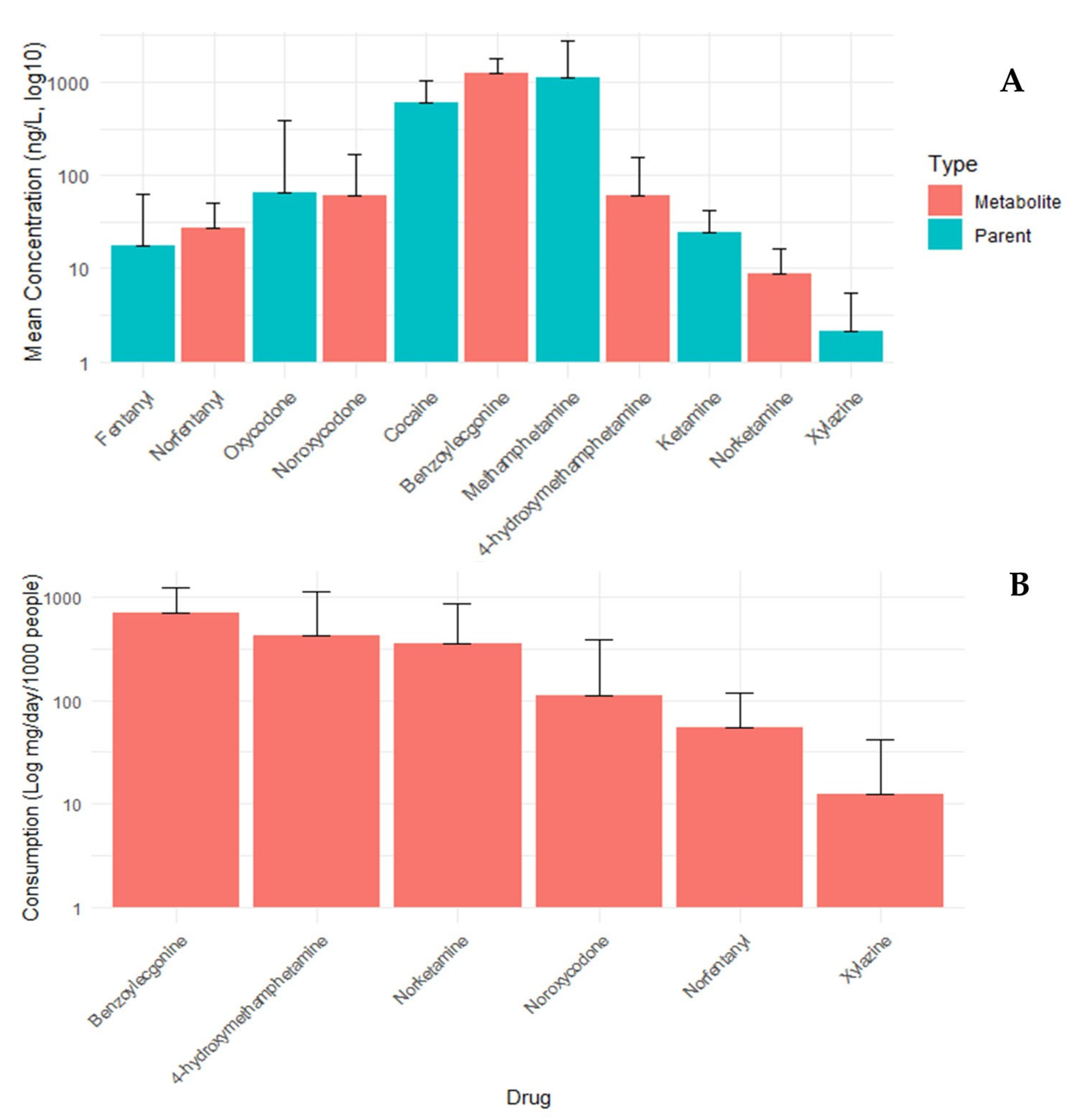
Influent wastewater samples (250 mL, 24 h composites) were collected once per week over a 9-month period from the 17 participating wastewater treatment facilities (WWTFs) as part of the National Drug Early Warning System (NDEWS) project. Samples were shipped overnight to the laboratory on wet ice or ice packs immediately following collection. Concentrations of each drug (ng/L) were quantified for every facility and weekly sample (total n = 598) and subsequently used to calculate excretion and consumption rates using the equations in Appendix A.5, which were reported to the corresponding city authorities. To aid in interpretation, Figure 2A,B present the concentration and consumption rate, respectively, of several of the most frequently detected compounds from different drug classes, where each data point represents the mean across the entire dataset. Figure 2B depicts only metabolites, except for Xylazine given that the metabolite, 4-hydroxyxylazine, was inconsistently detected in the dataset. A complete list of targeted analytes and their concentration ranges in city wastewater samples is provided in Table A4.
Figure 2.
Average concentration (A) and consumption rate (B) of selected drugs (green) and their respective primary metabolite (orange) across all the 17 treatment facilities and weekly samples over the 9-month period for a total n of 598 for each drug.
3.4. Additional Considerations for Method Development
3.4.1. Sample Handling and Preparation
Proper handling of wastewater samples is essential for ensuring the accuracy and reproducibility of analytical results, particularly when analyzing multiple drugs with varying chemical moieties and stability. Special attention should be given to sample collection and shipping, sample processing, and both short-term and long-term storage. During sample collection, it is recommended to use composite sampling over 24 h as this is more representative of community-level drug abuse and also minimizes temporal variability. Additionally, normalization techniques should be used to account for flow rates in catchment areas and population size. Once the samples have been collected, transportation must be performed rapidly and under cooled conditions to prevent microbial degradation and chemical transformation of the target analytes [10]. In our validated workflow, samples were shipped overnight on ice the same day as they were collected. Upon receipt of samples, they were immediately extracted or stored at −20 °C until further analysis.
Sample processing can become challenging when addressing multiple drugs, especially in complex matrices such as wastewater. While we aimed to provide a comprehensive approach, to encompass analysis of a wide myriad of drugs, for those drugs not detected well enough, methods tailored to their optimal conditions may need to be considered. For example, THC and its primary metabolite, THC-COOH, are highly hydrophobic and tend to adsorb to suspended solids in wastewater. As a result, sample filtration can reduce their recovery and detection in the dissolved phase [11,18], representing a limitation of the proposed standardized protocol when targeting cannabinoid biomarkers. Additionally, raw samples should be stored in an environment at or below −20 °C, but ideally at −80 °C, especially for long-term storage. For example, a study on the effect of temperature storage in wastewater degradation showed little variation in water physicochemical parameters among 4, −20, and 80 °C up to 12 weeks; however, these parameters varied significantly among temperatures after 12 weeks [21]. Continuous freeze–thaw cycles could also compromise sample integrity; thus, those cycles should be minimized as much as possible [21]. Overall, multiple considerations need to be evaluated throughout the entire process of analyzing wastewater samples for illicit drug monitoring and surveillance.
When developing methods to analyze a broad range of drugs in complex matrices like wastewater, several key factors must be considered. These include selecting an appropriate extraction approach to effectively concentrate the analytes of interest. This is done by selecting the appropriate type of SPE cartridge based on analyte characteristics, or solvent system if using liquid–liquid extraction (LLE). Each extraction technique has tradeoffs; for example, LLE may provide broader selectivity of compounds, but may also result in decreased sensitivity due to ion suppression from matrix. Additionally, the optimization of the mobile phase composition for LC-MS analysis must be considered when developing a multi-drug method. While our study focused on solid-phase extraction (SPE), other studies have successfully employed LLE methods [19,22,23]. Most studies utilize an SPE method, though some studies have explored the use of different cartridges such as HLB or weak anionic exchange (WAX) sorbents [24]. Though successful in their extraction selectivity, these previous studies targeted fewer drugs in their method and focused more on select drug classes. Additionally, with the use of these different cartridges, different elution solvents such as NH3/MeOH, MeOH/ethyl acetate, chloroform, and acetonitrile/acetic acid were used [25,26].
3.4.2. Mobile Phase and Column Selection
In our study, a gradient of methanol and water (both with 0.1% formic acid) was utilized with success; however, other studies have also used different mobile phases, such as acetonitrile or acetonitrile with acetic acid [26,27]. Selection of appropriate mobile phase and gradient conditions will depend on column selection, required chromatographic resolution, and compound compatibility.
The choice of analytical column plays a critical role in the overall performance of LC-MS/MS methods for drug detection in wastewater. The Hypersil GOLD C18 column (150 mm × 2.1 mm, 5 µm; Thermo Scientific, Waltham, MA, USA) was selected for its robust performance in separating a broad spectrum of analytes with varying polarity and structural complexity [28], which makes it an ideal candidate for our multi-drug approach. The C18 stationary phase is widely used in drug analysis due to its compatibility with both polar and non-polar compounds and its high reproducibility. Moreover, C18 provided sufficient resolution and peak shape across the drug classes detected, though alternative columns such as phenyl-hexyl, biphenyl, or polar-embedded phases are sometimes used to enhance retention or resolution of specific drug classes (e.g., synthetic cannabinoids, stimulants, or highly polar metabolites) [29]. Our method demonstrated adequate chromatographic separation, with analyte retention times ranging from 7 to 19 min (Table A2). Data were acquired using a TSQ Altis Plus triple quadrupole mass spectrometer (Thermo Scientific, Waltham, MA, USA) operated in multiple reaction monitoring (MRM) mode, with acquisition speeds of up to approximately 600 transitions per second. For multi-drug methods, further improvements in resolution may be achieved by optimizing acquisition parameters, including scan speed and the number of monitored transitions.
3.4.3. Reporting Metrics
When utilizing wastewater surveillance for drug use, compound concentration in the sample may not allow for comparison across sites if flow rates across sites are considerably different. In these cases, normalized excretion rates for each compound can be calculated and reported by adjusting for the population served by each WWTF catchment area and the corresponding wastewater flow rate at the time of sample collection [30]. Another key reporting metric is the consumption rate of each compound, in which these rates are estimated by adjusting calculated excretion values using pharmacokinetic correction factors. Specifically, the excretion rate is divided by the fraction of the compound excreted in urine. When metabolites are measured, instead of the parent compounds, the excretion rate is further adjusted by multiplying it by the ratio of the parent compound’s molecular weight to that of the metabolite, to account for biotransformation. The equations used to back-calculate both excretion and consumption rates are provided in Appendix A.5. It is important to note several uncertainties and assumptions involved in estimating these rates. For instance, weather patterns can affect flow rates and/or more touristic areas may be influenced by visitors during certain months of the year, affecting the accuracy of per capita consumption estimates [30]. Nevertheless, the presence of certain compounds in wastewater may not necessarily imply local consumption, as contributions may also come from non-residential sources such as commuters, hospitals, or industrial facilities, potentially affecting the representativeness of the data.
4. Conclusions
This study reaffirms the utility of wastewater-based epidemiology as a cost-effective and non-invasive approach for monitoring community drug use trends, with the potential to inform public health interventions and guide policy development. The methodology demonstrated here is scalable and sustainable, offering strong potential for long-term surveillance and timely public health response to emerging drug trends.
This work contributes to the development of a standardized protocol for multi-drug detection in wastewater, addressing critical methodological components from sample collection to analytical data interpretation. A key finding was the importance of sorbent selection during sample processing, with Oasis MCX cartridges being selected for their robust performance across a broad range of compounds with diverse physicochemical properties, providing consistently high recovery, accuracy, and precision compared to Oasis HLB. Furthermore, this framework is designed to be adaptable to specific drug classes. For instance, cannabinoid recovery may be improved by omitting filtration prior to SPE to minimize analyte loss, as well as by evaluating alternative analytical columns with greater compound affinity.
Additional considerations include proper sample collection strategies (e.g., 24 h composite sampling), rapid and temperature-controlled transport, careful processing, optimal storage conditions, and important reporting metrics such as excretion and consumption rates. Together, this research supports the use of LC-MS/MS and WBE as a valuable tool in public health surveillance and policy development. Moreover, WBE combined with hospitalizations and clinical survey data could enhance the understanding of opioid and substance use, improving public health interventions. Lastly, in addition to the inter-regional validation presented in the current framework, international collaborations, such as those described in [31], represent important ongoing efforts to harmonize methodologies, expand validation across diverse settings, and further enhance the applicability and impact of WBE in public health monitoring.
Author Contributions
Conceptualization, J.H.B.J. and T.S.-A.; methodology, J.H.B.J., S.E.R., F.P., S.T.-S., T.D.S. and J.A.B.; validation, J.H.B.J. and J.A.B.; formal analysis, J.H.B.J., N.W. and S.T.-S.; investigation, J.H.B.J., S.E.R., L.B.C., T.D.S., F.P., J.C. and S.T.-S.; resources, J.H.B.J. and T.S.-A.; data curation, J.H.B.J., N.W. and S.T.-S.; writing—original draft preparation, S.T.-S. and T.D.S.; writing—review and editing, J.H.B.J., S.E.R., L.B.C., F.P., J.C. and J.A.B.; visualization, J.H.B.J. and S.T.-S.; supervision, J.H.B.J.; project administration, J.H.B.J.; funding acquisition, J.H.B.J. and T.S.-A. All authors have read and agreed to the published version of the manuscript.
Funding
This research was funded by National Institute of Drug Abuse, grant number 3U01DA051126-04S1.
Institutional Review Board Statement
Not applicable.
Informed Consent Statement
Not applicable.
Data Availability Statement
The datasets presented in this article are not readily available because they contain location-specific information and are part of an effort to maintain the anonymity of the cities included in the study. Requests to access the datasets should be directed to the corresponding author.
Acknowledgments
We would like to thank the cities that contributed samples used in this studies to validate our method and provide a range of measured values to reference. During the preparation of this manuscript, the authors used Grammarly and OpenAI for the purpose of improving the readability of the manuscript. The authors have reviewed and edited the output and take full responsibility for the content of this publication.
Conflicts of Interest
The authors declare no conflicts of interest. The funders had no role in the design of the study; in the collection, analyses, or interpretation of data; in the writing of the manuscript; or in the decision to publish the results.
Abbreviations
The following abbreviations are used in this manuscript:
| SPE | Solid Phase Extraction |
| LLE | Liquid–Liquid Extraction |
| IS | Internal Standard |
| LOD | Limit of Detection |
| LOQ | Limit of Quantification |
| SRM | Selected Reaction Monitoring |
| MRM | Multiple Reaction Monitoring |
| QC | Quality Control |
| UHPLC | Ultra-High Performance Liquid Chromatography |
| MCX | Mixed-mode Cation eXchange |
| HLB | Hydrophilic-Lipophilic Balanced |
| WBE | Wastewater-Based-Epidemiology |
| WWTF | WasteWater Treatment Facility |
| LC-MS/MS | Liquid Chromatography-Tandem Mass Spectrometry |
Appendix A
Appendix A.1
Table A1.
List of drugs analyzed along with their corresponding isotope-labeled internal standards.
Appendix A.2
Table A2.
List of drugs with corresponding instrument parameters, including retention time, precursor and product ions, collision energy, RF lens voltage, and limits of detection and quantification.
Appendix A.3
Table A3.
Accuracy and standard deviation for each drug calculated based on native and internal standard quality controls.
Appendix A.4
Table A4.
Summary statistics of drug concentrations measured in actual city samples.
Appendix A.5
Excretion rates are calculated according to the following equation:
Consumption rates are calculated according to the following equation:
References
- Cook, J.L. The Opioid Epidemic. Best Pract. Res. Clin. Obstet. Gynaecol. 2022, 85, 53–58. [Google Scholar] [CrossRef] [Scilit]
- Lyden, J.; Binswanger, I.A. The United States Opioid Epidemic. Semin. Perinatol. 2019, 43, 123–131. [Google Scholar] [CrossRef] [Scilit]
- Terry, C.E. The harrison anti-narcotic act. Am. J. Public Health 1915, 5, 518. [Google Scholar] [CrossRef] [Scilit]
- Ignaszewski, M.J. The Epidemiology of Drug Abuse. J. Clin. Pharmacol. 2021, 61, S10–S17. [Google Scholar] [CrossRef] [Scilit] [PubMed]
- Seth, P.; Scholl, L.; Rudd, R.A.; Bacon, S. Overdose Deaths Involving Opioids, Cocaine, and Psychostimulants—United States, 2015–2016. Morb. Mortal. Wkly. Rep. 2018, 67, 349–358. [Google Scholar] [CrossRef] [Scilit] [PubMed]
- Florence, C.S.; Zhou, C.; Luo, F.; Xu, L. The Economic Burden of Prescription Opioid Overdose, Abuse, and Dependence in the United States, 2013. Med. Care 2016, 54, 901–906. [Google Scholar] [CrossRef] [Scilit] [PubMed]
- Schulenberg, J.E.; Johnston, L.D.; O’Malley, P.M.; Bachman, J.G.; Miech, R.A.; Patrick, M.E. Monitoring the Future National Survey Results on Drug USE, 1975–2018; The University of Michigan Institute for Social Research: Ann Arbor, MI, USA, 2019. [Google Scholar]
- Li, M.-C.; Brady, J.E.; DiMaggio, C.J.; Lusardi, A.R.; Tzong, K.Y.; Li, G. Marijuana Use and Motor Vehicle Crashes. Epidemiol. Rev. 2012, 34, 65–72. [Google Scholar] [CrossRef] [Scilit]
- Farrell, M.; Martin, N.K.; Stockings, E.; Bórquez, A.; Cepeda, J.A.; Degenhardt, L.; Ali, R.; Tran, L.T.; Rehm, J.; Torrens, M.; et al. Responding to Global Stimulant Use: Challenges and Opportunities. Lancet 2019, 394, 1652–1667. [Google Scholar] [CrossRef] [Scilit]
- El-Deen, A.K.; Hussain, C.M. The Cutting Edge of Surveillance: Exploring High-Resolution Mass Spectrometry in Wastewater-Based Epidemiology for Monitoring Forensic Samples. J. Pharm. Biomed. Anal. 2025, 260, 116821. [Google Scholar] [CrossRef] [Scilit]
- Wang, W.; Wang, D.; Liu, L.; Qiu, C.; Fan, J.; Jin, Y. Estimation of the Prevalence of Substance Use by Wastewater-Based Epidemiology Study in Four Cities of Guangdong, China. PLoS ONE 2025, 20, e0320141. [Google Scholar] [CrossRef] [Scilit]
- Singer, A.C.; Thompson, J.R.; Filho, C.R.M.; Street, R.; Li, X.; Castiglioni, S.; Thomas, K.V. A World of Wastewater-Based Epidemiology. Nat. Water 2023, 1, 408–415. [Google Scholar] [CrossRef] [Scilit]
- WHO. Guidelines for Environmental Surveillance of Poliovirus Circulation; WHO: Geneva, Switzerland, 2003. [Google Scholar]
- Boogaerts, T.; Ahmed, F.; Choi, P.M.; Tscharke, B.; O’Brien, J.; De Loof, H.; Gao, J.; Thai, P.; Thomas, K.; Mueller, J.F.; et al. Current and Future Perspectives for Wastewater-Based Epidemiology as a Monitoring Tool for Pharmaceutical Use. Sci. Total Environ. 2021, 789, 148047. [Google Scholar] [CrossRef] [Scilit] [PubMed]
- Murni, I.K.; Oktaria, V.; McCarthy, D.T.; Supriyati, E.; Nuryastuti, T.; Handley, A.; Donato, C.M.; Wiratama, B.S.; Dinari, R.; Laksono, I.S.; et al. Wastewater-Based Epidemiology Surveillance as an Early Warning System for SARS-CoV-2 in Indonesia. PLoS ONE 2024, 19, e0307364. [Google Scholar] [CrossRef] [Scilit] [PubMed]
- Castiglioni, S.; Bijlsma, L.; Covaci, A.; Emke, E.; Hernández, F.; Reid, M.; Ort, C.; Thomas, K.V.; Van Nuijs, A.L.N.; De Voogt, P.; et al. Evaluation of Uncertainties Associated with the Determination of Community Drug Use through the Measurement of Sewage Drug Biomarkers. Environ. Sci. Technol. 2013, 47, 1452–1460. [Google Scholar] [CrossRef] [Scilit] [PubMed]
- De Oliveira, A.F.B.; De Melo Vieira, A.; Santos, J.M. Trends and Challenges in Analytical Chemistry for Multi-Analysis of Illicit Drugs Employing Wastewater-Based Epidemiology. Anal. Bioanal. Chem. 2023, 415, 3749–3758. [Google Scholar] [CrossRef] [Scilit]
- Pandopulos, A.J.; Bade, R.; O’Brien, J.W.; Tscharke, B.J.; Mueller, J.F.; Thomas, K.; White, J.M.; Gerber, C. Towards an Efficient Method for the Extraction and Analysis of Cannabinoids in Wastewater. Talanta 2020, 217, 121034. [Google Scholar] [CrossRef] [Scilit]
- González-Mariño, I.; Quintana, J.B.; Rodríguez, I.; Rodil, R.; González-Peñas, J.; Cela, R. Comparison of Molecularly Imprinted, Mixed-Mode and Hydrophilic Balance Sorbents Performance in the Solid-Phase Extraction of Amphetamine Drugs from Wastewater Samples for Liquid Chromatography–Tandem Mass Spectrometry Determination. J. Chromatogr. A 2009, 1216, 8435–8441. [Google Scholar] [CrossRef] [Scilit]
- Magnusson, B. The Fitness for Purpose of Analytical Methods: A Laboratory Guide to Method Validation and Related Topics, 2nd ed.; Eurachem: Teddington, UK, 2014. [Google Scholar]
- Webster, G.; Dighe, S.N.; Perry, W.B.; Stenhouse, E.H.; Jones, D.L.; Kille, P.; Weightman, A.J. Wastewater Sample Storage for Physicochemical and Microbiological Analysis. J. Virol. Methods 2025, 332, 115063. [Google Scholar] [CrossRef] [Scilit]
- Gouveia, T.I.A.; Silva, A.M.T.; Ribeiro, A.R.; Alves, A.; Santos, M.S.F. Liquid-Liquid Extraction as a Simple Tool to Quickly Quantify Fourteen Cytostatics in Urban Wastewaters and Access Their Impact in Aquatic Biota. Sci. Total Environ. 2020, 740, 139995. [Google Scholar] [CrossRef] [Scilit]
- Koçoğlu, E.S.; Bakırdere, S.; Keyf, S. A Novel Liquid–Liquid Extraction for the Determination of Sertraline in Tap Water and Waste Water at Trace Levels by GC–MS. Bull. Environ. Contam. Toxicol. 2017, 99, 354–359. [Google Scholar] [CrossRef] [Scilit]
- Alygizakis, N.A.; Gago-Ferrero, P.; Borova, V.L.; Pavlidou, A.; Hatzianestis, I.; Thomaidis, N.S. Occurrence and Spatial Distribution of 158 Pharmaceuticals, Drugs of Abuse and Related Metabolites in Offshore Seawater. Sci. Total Environ. 2016, 541, 1097–1105. [Google Scholar] [CrossRef] [Scilit] [PubMed]
- Hasegawa, K.; Suzuki, O.; Gonmori, K.; Yamagishi, I.; Nozawa, H.; Watanabe, K. Simultaneous Analysis of Sildenafil, Vardenafil, Tadalafil, and Their Desalkyl Metabolites in Human Whole Blood and Urine by Isotope Dilution LC–MS–MS. Forensic Toxicol. 2012, 30, 25–32. [Google Scholar] [CrossRef] [Scilit]
- Le, T.N.N.; Chuong, N.N.; Nguyen, T.D. A One-Step Sample Processing Method in Combination with HPLC-MS/MS for the Simultaneous Quantification of Atorvastatin, Ezetimibe and Three Metabolites Including o-Hydroxyl Atorvastatin, p-Hydroxyl Atorvastatin, and Ezetimibe-Glucuronide in Human Plasma. Separations 2023, 10, 409. [Google Scholar] [CrossRef] [Scilit]
- Young, M.S.; Phillips, D.J.; Iraneta, P.C.; Krol, J. Mixed-Mode Solid-Phase Extraction and Cleanup Procedures for the Liquid Chromatographic Determination of Thiabendazole and Carbendazim in Fruit Juices. J. AOAC Int. 2001, 84, 556–562. [Google Scholar] [CrossRef] [Scilit]
- Contrepois, K.; Jiang, L.; Snyder, M. Optimized Analytical Procedures for the Untargeted Metabolomic Profiling of Human Urine and Plasma by Combining Hydrophilic Interaction (HILIC) and Reverse-Phase Liquid Chromatography (RPLC)–Mass Spectrometry*. Mol. Cell. Proteom. 2015, 14, 1684–1695. [Google Scholar] [CrossRef] [Scilit]
- Dong, M.W. HPLC and UHPLC for Practicing Scientists, 2nd ed.; Wiley: Hoboken, NJ, USA, 2019. [Google Scholar]
- Şenol, Ş. Investigation of Common Analysis Methods for Detecting Illicit Drugs in Wastewater. Alpha J. Eng. Appl. Sci. 2025, 3, 51–74. [Google Scholar] [CrossRef] [Scilit]
- González-Mariño, I.; Baz-Lomba, J.A.; Alygizakis, N.A.; Andrés-Costa, M.J.; Bade, R.; Bannwarth, A.; Barron, L.P.; Been, F.; Benaglia, L.; Berset, J.; et al. Spatio-temporal Assessment of Illicit Drug Use at Large Scale: Evidence from 7 Years of International Wastewater Monitoring. Addiction 2020, 115, 109–120. [Google Scholar] [CrossRef] [Scilit]

Disclaimer/Publisher’s Note: The statements, opinions and data contained in all publications are solely those of the individual author(s) and contributor(s) and not of MDPI and/or the editor(s). MDPI and/or the editor(s) disclaim responsibility for any injury to people or property resulting from any ideas, methods, instructions or products referred to in the content. |
© 2026 by the authors. Licensee MDPI, Basel, Switzerland. This article is an open access article distributed under the terms and conditions of the Creative Commons Attribution (CC BY) license.