


Highlights
Public health relevance—How does this work relate to a public health issue?
- Stigma has accompanied many infectious-disease outbreaks, from SARS to Ebola. This study examined perceived community stigma and self-stigma among 399 adults hospitalized with COVID-19 in Ulaanbaatar, Mongolia, in a hospital cohort whose enrollment began in June 2021, after vaccination started.
- Stigma was measured with two 12-item sets from a Mongolian study questionnaire. Some items resemble an existing tuberculosis stigma scale, but the questionnaire has not been validated. After adjustment for demographic and clinical factors, higher self-stigma scores at admission were associated with more depressive, anxiety, and post-traumatic stress symptoms (standardized β 0.13–0.27).
Public health significance—Why is this work of significance to public health?
- Perceived community stigma and self-stigma scores were only moderately correlated (r = 0.45). The two should therefore be assessed separately.
- Each additional household member was associated with a slightly higher self-stigma score (0.6 points on a 12–48 scale). However, all measured factors together explained only about 5% of the variation in scores. Household size therefore needs further research and should not be used to identify patients at risk.
Public health implications—What are the key implications or messages for practitioners, policy makers and/or researchers in public health?
- The link with mental-health symptoms supports research on asking hospitalized patients, in private, about shame, fear of others’ reactions, and social withdrawal during future outbreaks. However, this study did not test any such screening.
- The questionnaire still needs cultural and psychometric validation. This study assessed only its internal consistency and structure. Two social items are worded in the opposite direction, and the self-stigma items ask about “some infected people” rather than about the respondents themselves.
Abstract
COVID-19 stigma may accompany psychological distress, but hospital-based evidence from Central Asia is limited. We analyzed baseline data from 399 adults hospitalized with RT-PCR-confirmed COVID-19 in Ulaanbaatar, Mongolia; enrollment began in June 2021 after vaccination started. Participants completed two unvalidated 12-item sets from a Mongolian questionnaire. The first assessed perceptions of community attitudes toward infected people; the second described feelings attributed to ‘some infected people,’ rather than participants’ own experiences. We examined internal consistency, exploratory factor structure, demographic and clinical correlates, and concurrent associations with depression (PHQ-9), anxiety (GAD-7), insomnia (ISI), and post-traumatic stress (PCL-5) symptoms. Cronbach’s alpha was 0.90 and 0.89; scores were moderately correlated (r = 0.45). Each additional household member was associated with a 0.59-point higher self-stigma/self-exclusion score (95% CI 0.18–1.00), although measured covariates explained approximately 5% of its variation. Higher self-stigma/self-exclusion scores were modestly associated with more depressive, anxiety, and post-traumatic stress symptoms after adjustment (standardized β = 0.13–0.27). Third-person wording and absent cultural validation limit interpretation. These cross-sectional findings describe a past pandemic phase, not current attitudes. Future outbreak research needs validated stigma measures and direct assessment of patients’ experiences.
1. Introduction
Stigma is a social process in which labeling and stereotyping are linked to separation, status loss, and discrimination [1]. Self-stigma, or internalized stigma, occurs when individuals absorb devaluing social beliefs and apply them to themselves. It may contribute to shame, withdrawal, and reduced self-worth [2,3]. Infectious-disease outbreaks can intensify both processes. Fear of contagion and uncertainty may transform a health condition into a socially discrediting identity. Fear and stigmatization were documented during the 2003 epidemic of severe acute respiratory syndrome (SARS) [4] and the 2013–2016 Ebola outbreak in West Africa [5]. A narrative review describes the same pattern across outbreaks [6]. A meta-analysis of 50 studies covering SARS, H1N1 influenza, Middle East respiratory syndrome (MERS), Zika, Ebola, and COVID-19 estimated a pooled stigma prevalence of 34% (95% CI 28–40%) [7].
During the COVID-19 pandemic, patients and survivors reported social rejection and internalized stigma in diverse settings. Studies from Lebanon, China, Korea, Indonesia, Malaysia, Thailand, and Nepal linked COVID-19-related stigma with psychological distress, depression, anxiety, post-traumatic stress symptoms, and reduced quality of life [8,9,10,11,12,13,14,15,16]. These studies used different instruments. Some studies adapted scales developed for other conditions. Examples are a MERS stigma scale in Korea [10], the Berger HIV Stigma Scale in Indonesia [11], a 12-item COVID-19 Stigma Scale derived from a short HIV stigma scale in China [12], and the Social Impact Scale, a general measure of illness-related stigma, also used in China [9,17]. Others were adapted or developed specifically for COVID-19 and then validated, such as an adapted COVID-19 stigma scale [18] and the Post-COVID-19 Condition Stigma Questionnaire [19]. These instruments differ in content and in the populations in which they were tested. Their cut-offs and factor structures therefore cannot be assumed to transfer from one setting to another.
Stigma also changes over the course of an epidemic. Among Ebola survivors in Liberia, the proportion reporting any stigma fell from 63% to 5% over 18 months after the outbreak [20]. In contrast, survivors of SARS in Hong Kong still described stigma after that epidemic had ended [21]. In Japan, people infected in later waves of COVID-19 reported discrimination less often than those infected in earlier waves. However, discrimination was more strongly associated with psychological distress in the later group [22]. In Thailand, recovered patients still reported stigma in the post-vaccination period [14]. The World Health Organization ended the COVID-19 public health emergency of international concern in May 2023 [23]. Public perceptions of the disease have changed since most stigma studies, including this one, collected their data. Stigma data therefore need to be read in light of the epidemic phase in which they were obtained. Their lasting value lies in what they show about how stigma operates under outbreak conditions, which is relevant to preparedness for future outbreaks.
Evidence from Central Asia is sparse, and Mongolia has been studied only occasionally. Munkh et al. examined social discrimination and self-stigma in an online survey of 339 people treated for COVID-19 [24]. Sattler et al. included Mongolia in a multinational study linking COVID-19 stigma with post-traumatic stress [25]. The country’s epidemic followed its own course. Strict control measures prevented widespread transmission until early 2021. Vaccination began in February 2021 and reached the national target of 60% population coverage by July 2021. The first sustained epidemics occurred in 2021 and were followed by a substantial Omicron epidemic [26]. The present study used data from a prospective cohort study conducted at three university-affiliated hospitals in Ulaanbaatar (hereafter, the parent study). The parent study enrolled patients hospitalized with COVID-19 and a comparison group of patients hospitalized for other conditions. Its follow-up ended in February 2023. An earlier report from the parent study described 12-month changes in depression, anxiety, insomnia, and post-traumatic stress symptoms but did not analyze stigma [27]. At baseline, two sets of stigma items were administered only to the patients with COVID-19. These items are the subject of the present study.
The two stigma indices come from a Mongolian questionnaire used in the parent study. They are not established, validated scales. In the 399 patients with COVID-19, this study had four aims. The first was to describe the score distributions and internal consistency of the two 12-item indices: social discrimination/stigma (perceived community stigma) and self-stigma/self-exclusion. The second was to examine the internal structure of each index and the association between the two. The third was to identify sociodemographic and clinical correlates of each score. The fourth was to assess concurrent associations of each score with depressive, anxiety, insomnia, and post-traumatic stress symptoms. Because the questionnaire had not been validated, all analyses were exploratory. The findings are interpreted within the period in which the data were collected.
2. Materials and Methods
2.1. Study Design and Setting
This was a cross-sectional secondary analysis of baseline data from the parent study, a prospective hospital-based cohort study in Ulaanbaatar, Mongolia [27]. The parent study was conducted at the Mongolia–Japan Hospital, the Central Hospital, and the Central Hospital of Mongolian Medicine. The English names are descriptive translations of the hospital names recorded in the parent-study thesis. The parent-study protocol was approved on 28 May 2021 (No. 2021/3-08), and enrollment began on 18 June 2021. The baseline assessment took place during hospitalization, and follow-up was planned at approximately 14 days, 3 months, and 12 months. Follow-up in the parent study continued until February 2023. The last baseline enrollment date was not available. This secondary analysis used baseline data only.
Hospitalized adults were eligible if they were aged 18 years or older, provided written informed consent, and were able to take part in follow-up assessments. Patients were not eligible if they had a pre-existing severe psychiatric condition, were receiving psychotropic medication or psychotherapy, or were unable to complete the questionnaires [27]. Eligible patients who agreed to take part were recruited consecutively, without probability sampling. During the study period, 801 patients were hospitalized with COVID-19 at the participating hospitals, and 399 (49.8%) of them were enrolled. This percentage uses all hospitalized patients as the denominator, not only eligible patients. The remaining patients were not enrolled because they did not meet the eligibility criteria or did not agree to take part. The numbers in these two groups were not recorded separately, so the participation rate among eligible patients cannot be calculated.
The parent-study protocol was designed to include patients admitted because of RT-PCR-confirmed SARS-CoV-2 infection. Outpatients were not eligible. The primary indication for hospitalization was not recorded as a separate variable. We therefore could not verify the reason for admission for any individual participant. Participants did report how their infection had been detected (Table 1). In 367 participants (92.0%), it was detected through self-initiated testing, contact tracing, population screening, or other routes. In the remaining 32 (8.0%), it was detected when they sought care for another illness. Some in this group may have been admitted primarily for their other illness. However, 31 of these 32 reported symptoms of COVID-19, 3 had severe or critical COVID-19, and 18 were admitted more than 24 h after diagnosis. Detection route alone could not establish the admission indication in either subgroup. We therefore retained all 399 confirmed cases in the analysis and acknowledge this uncertainty (Section 4.7).
Table 1.
Baseline characteristics of the analytic sample of adults hospitalized with COVID-19 (n = 399).
The de-identified dataset does not contain individual admission dates or the date of the last baseline enrollment. We therefore know when enrollment began but not exactly when it ended. February 2023 marks the end of follow-up, not the date of the last admission. We therefore cannot assign individual observations to specific epidemic waves (Section 4.7). Vaccination in Mongolia began in February 2021 and reached 60% population coverage by July 2021 [26]. Enrollment began in June 2021, four months after vaccination started. Among the 399 cases, 329 (82.5%) reported at least one vaccine dose before infection (Section 3.1). Thus, no participant was enrolled during the first, pre-vaccination phase of the pandemic. During enrollment, hospitalized confirmed cases were managed in designated isolation wards.
Baseline questionnaires were completed within 48 h of admission [27]. Researchers could not routinely enter the COVID-19 isolation wards. The study team therefore trained the physicians working in these wards online. These physicians explained the study and the questionnaire to patients, who then completed paper questionnaires themselves. Completed forms were photographed and sent to the research team. When the State Emergency Commission permitted access, researchers collected data in the wards directly. The questionnaire covered (1) sociodemographic and clinical characteristics; (2) the circumstances of infection and admission, including how the infection had been detected, the interval between diagnosis and admission, and vaccination before infection; (3) the two sets of stigma items; and (4) the mental-health measures described in Section 2.5. Case-report forms were double-entered, and incomplete or inconsistent entries were checked against source records [27]. Completing the questionnaire in an isolation ward, after explanation by a treating physician, may have influenced how participants answered sensitive items (Section 4.7). The present analysis used the de-identified archived dataset.
2.2. Participants and Analytic Sample
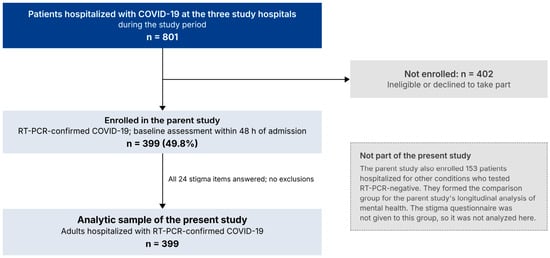
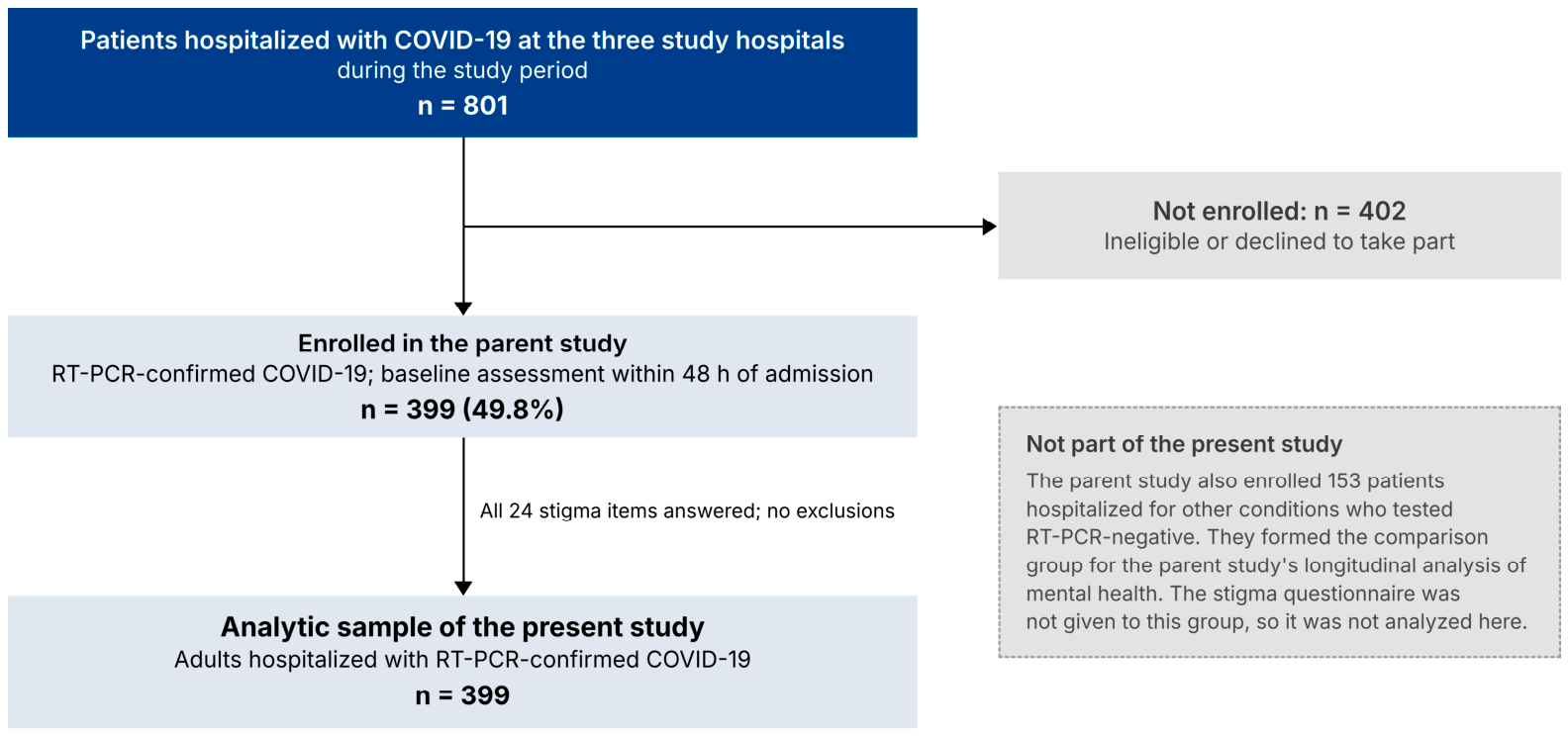
The present study includes only the patients with COVID-19 (Figure 1). The parent study enrolled 552 adults in two groups: 399 patients with RT-PCR-confirmed COVID-19 and 153 patients hospitalized for other conditions who tested negative. The 153 RT-PCR-negative patients served only as a comparison group in the earlier longitudinal mental-health analysis [27]. They were not given the stigma questionnaire and were not eligible for the present stigma analysis. All 399 patients with COVID-19 answered all 24 stigma items, so no participant was excluded, and the analytic sample comprised 399 patients. No a priori sample-size calculation was performed for this secondary analysis; all COVID-19 cases in the archived dataset were included.
Figure 1.
Selection of the analytic sample. Of the 801 patients hospitalized with COVID-19 at the three study hospitals during the study period, 399 were enrolled in the parent study. All 399 answered the 24 stigma items at baseline and formed the analytic sample. Separately, the parent cohort included 153 RT-PCR-negative patients hospitalized for other conditions as a comparison group for its earlier longitudinal analysis [27]. They were not given the stigma questionnaire and were not analyzed.
Relationship to the earlier publication: The earlier report from the parent study [27] compared changes in depression, anxiety, insomnia, and post-traumatic stress symptoms over 12 months between the COVID-19 and comparison groups. Unlike that analysis, this study uses baseline data only and includes all 399 COVID-19 cases, without excluding patients on the basis of baseline mental-health symptoms. It addresses 24 stigma items not reported previously. Demographic, clinical, and symptom variables overlap with the earlier report, but they are used here only to describe the sample or evaluate concurrent associations. No longitudinal analyses or inferential results from the earlier report are reproduced.
2.3. Study-Specific Stigma Indices
Stigma was assessed in all 399 participants with a Mongolian paper questionnaire for assessing discrimination. This questionnaire was used in the parent study and is not an established, validated scale. It comprises two sets of 12 statements, each scored as a separate archived index. The first set, headed “Assessment of Discrimination in Society” in English translation (database prefix YGUA), is termed the social discrimination/stigma index. The second, headed “Assessment of Self-Exclusion/Self-Devaluation” in English translation (database prefix OGBU), is termed the self-stigma/self-exclusion index. The form instructs respondents to understand “infected” as “coronavirus infection”. Each statement has four response options (translated from Mongolian: 1 = not at all, 2 = no, 3 = yes, 4 = definitely yes). Each archived index is the unweighted sum of 12 recorded item values (theoretical range 12–48). No validated category thresholds were applied. Two social items are worded in a positive rather than a stigmatizing direction. Higher social totals therefore cannot simply be interpreted as greater stigma.
The paper questionnaire was retrieved during revision. Investigator-verified English translations of all 24 statements and the response anchors are provided in Supplementary Table S8. The source-language items remain documented in the original archived questionnaire forms. All 12 social items ask respondents what “some people” think or do about infected people (e.g., avoiding meals, physical distance, or fear). They therefore assess perceptions of community attitudes rather than personal experiences of discrimination. Eleven social items closely resemble content from the community-perspectives subscale of the tuberculosis-related stigma instrument described by Van Rie et al. [28]. However, the form does not identify a source instrument or document a formal adaptation process. The second set likewise describes experiences attributed to “some infected people”, such as anxiety about disclosure, social withdrawal, loneliness, guilt, and concerns about further infection. It does not directly ask respondents to report their own internalized stigma. Notably, self-stigma item 7 refers explicitly to HIV/AIDS as an analogy, although the form instructs respondents to interpret infection as COVID-19. The original source, translation procedures, cultural adaptation, and construct validity of these Mongolian items have not been established. The stored low/medium/high score categories had undocumented thresholds and were not analyzed.
The item content is heterogeneous, especially in the self-stigma/self-exclusion section. Throughout this manuscript, the archived index names are used only for continuity. They do not imply that the summed scores are validated measures of experienced discrimination or of respondents’ own self-stigma.
Both indices were analyzed using their archived 12-item totals. Social items 7 (“some people want to talk with an infected person”) and 10 (“some people do not avoid touching infected people”) are positively worded, unlike the other ten social items. The archived total sums all 12 responses in their recorded direction, without reverse-scoring these two items. We therefore examined item correlations and factor structure. We also conducted a post hoc sensitivity analysis that excluded items 7 and 10 (10-item social score; Supplementary Table S6). The original 12-item total was retained for consistency with the archive and the initial submission. However, it is interpreted cautiously, because the mixed item directions make its meaning less clear. The 10-item results are provided as an alternative and are not presented as formal validation.
2.4. Covariates
Candidate covariates were selected before model fitting from baseline variables with plausible relationships to stigma. These were age (years); sex; education (higher/university, technical/vocational, complete secondary, or incomplete secondary); employment (employed or not employed); marital status (married or not married); household size (number of household members); residence type (apartment, traditional ger, or house); body mass index (BMI, kg/m2); COVID-19 severity (mild, moderate, or severe/critical); and any recorded chronic condition. The chronic-condition composite indicated at least one recorded diagnosis of hypertension, obesity as a comorbidity, liver disease, chronic respiratory disease, tuberculosis, gastrointestinal disease, diabetes, cancer, or another chronic disease. Education and residence type were modeled as categorical variables, with higher/university education and apartment residence as the reference categories. Tuberculosis can itself be stigmatizing. Its frequency was therefore reported separately, and a sensitivity analysis excluded participants with recorded tuberculosis. Self-reported variables describing the circumstances of infection were not part of the prespecified models. These were vaccine doses before infection, suspected source of infection, COVID-19 among family members and among people close to the participant, the participant’s own reactions to the diagnosis, and the reactions of close others. They were used descriptively and in the post hoc analyses described in Section 2.6.
2.5. Concurrent Mental-Health Measures
Continuous baseline symptom scores were available for depression (Patient Health Questionnaire-9; PHQ-9) [29], generalized anxiety (Generalized Anxiety Disorder-7; GAD-7) [30], insomnia (Insomnia Severity Index; ISI) [31], and post-traumatic stress symptoms (PTSD Checklist for DSM-5; PCL-5) [32]. These scores were used only to examine concurrent associations with stigma. They were not used to exclude participants. Follow-up scores were not analyzed to keep a clear boundary from the parent study’s longitudinal analysis [27].
2.6. Statistical Analysis
Analyses were performed from the raw dataset using IBM SPSS Statistics for Windows, Version 27.0 (IBM Corp., Armonk, NY, USA) and Python 3.13.5 with pandas 2.2.3, NumPy 2.3.5, SciPy 1.17.0, statsmodels 0.14.6, and scikit-learn 1.8.0. Continuous variables are summarized as mean (SD) and, when informative, median [interquartile range]; categorical variables are summarized as n (%). For each stigma index, we calculated Cronbach’s alpha with a bootstrap 95% confidence interval (3000 resamples with a fixed seed), corrected item-total correlations, the mean inter-item correlation, and the proportions at the theoretical floor and ceiling. As an exploratory check of internal structure, sampling adequacy was assessed with the Kaiser–Meyer–Olkin statistic and Bartlett’s test of sphericity. Parallel analysis (2000 random permutations) informed the number of factors. Maximum-likelihood factor analysis of standardized items followed, with varimax rotation when more than one factor was retained. Formal content validation and adaptation records were unavailable. Factor labels therefore remained descriptive, and the analysis was not treated as evidence of construct validation.
The relationship between the indices was evaluated with Pearson’s correlation and a 95% confidence interval based on Fisher’s z transformation. Spearman’s rho was used as a robustness check. An adjusted linear model was also fitted, with self-stigma/self-exclusion as the outcome and social discrimination/stigma as the primary predictor. It used the same covariates as the determinant models, including residence type.
Separate multivariable linear regressions explored correlates of each continuous stigma score. All prespecified covariates were entered simultaneously, and heteroskedasticity-consistent HC3 standard errors were used. Model fit is reported as R2 and adjusted R2. Variance inflation factors (VIFs) were calculated for all predictors; VIF < 5 was considered acceptable. Residual-versus-fitted and Q-Q plots were inspected for gross departures from linear-model assumptions. Robust omnibus Wald tests were used for the education and residence factors. Two prespecified sensitivity analyses excluded (i) the 11 severe/critical cases and (ii) the 7 participants with recorded tuberculosis. These determinant analyses were exploratory and involved multiple coefficients. Interpretation therefore emphasizes effect estimates, confidence intervals, overall factor tests, and robustness rather than isolated p-values.
Pearson correlations were calculated between each stigma index and the four baseline mental-health scores. Benjamini–Hochberg false-discovery-rate (FDR) correction was applied across these eight tests. As a sensitivity analysis, each standardized mental-health score was regressed separately on a standardized stigma score. These models were adjusted for the same demographic and clinical covariates as the determinant models, and FDR correction was again applied across the eight stigma coefficients. Two-sided p < 0.05 was used as the nominal statistical threshold. All primary analyses included all 399 participants.
In response to peer review, four sets of post hoc analyses were added. They are exploratory and are reported in full, including null results. First, the circumstances of infection, vaccination, and admission were described (Supplementary Table S4). Second, as an indirect check on what the indices capture, mean scores were compared between participants who did and did not report each of eight infection-related experiences (Welch’s t-test and Hedges’ g; Supplementary Table S5). These experiences included negative reactions from close others, being isolated immediately by close others, and fear of infecting others. FDR correction was applied across the 16 comparisons. Third, after the item wording had been retrieved, the two positively worded social items were examined. Internal consistency and parallel analysis were repeated without them, and the determinant and mental-health models were repeated with the resulting 10-item score (Supplementary Table S6). Fourth, we examined explanations for the household-size association and the influence of vaccination (Supplementary Table S7). The determinant models were re-estimated after adding, in turn, COVID-19 among family members, infection of someone close to the participant, a family member as the suspected source of infection, fear of infecting others, negative reactions from close others, and vaccine doses before infection (0, 1, or 2). Interactions of household size with infection among family members and with a family source of infection were also tested. The mental-health models were re-estimated with adjustment for vaccination. Finally, the variance explained by eight infection-context indicators added together was tested with a robust Wald test.
2.7. Ethical Considerations
The parent study was reviewed and approved by the Research Ethics Review Committee of the Mongolian National University of Medical Sciences (approval No. 2021/3-08; 28 May 2021). All participants provided written informed consent after receiving information about study objectives, confidentiality, and use of their data [27]. The present work is a secondary analysis of the de-identified dataset collected under that approved protocol. It involved no new participant contact or data collection. Personal identifiers had been replaced with unique codes, and the analysis was conducted in accordance with the Declaration of Helsinki.
2.8. Use of Generative Artificial Intelligence
ChatGPT (OpenAI, San Francisco, CA, USA; GPT-5.6 Sol) was used for code drafting, and statistical cross-checking. All final numerical analyses reported in this manuscript were re-executed from the raw de-identified study dataset using the software specified above; references and manuscript claims were checked against source materials. The authors reviewed and edited AI-assisted outputs and take full responsibility for the final content.
3. Results
3.1. Participant Flow and Baseline Characteristics
All 399 patients with RT-PCR-confirmed COVID-19 formed the analytic sample, and all had complete responses to both 12-item stigma indices (Figure 1). All percentages in this section and in Table 1 are based on these 399 participants. Their mean age was 40.5 years (SD 14.3). Of the 399 participants, 225 (56.4%) were female, 190 (47.6%) had higher/university education, 264 (66.2%) were employed, and 268 (67.2%) were married. Mean household size was 3.89 (SD 1.61), and mean BMI was 25.0 kg/m2 (SD 3.8). Most participants had mild COVID-19 (291, 72.9%); 97 (24.3%) had moderate disease, and 11 (2.8%) had severe/critical disease. At least one recorded chronic condition was present in 205 participants (51.4%), and tuberculosis was recorded in 7 participants (1.8%) (Table 1).
Before infection, 214 participants (53.6%) had received two vaccine doses, 115 (28.8%) one dose, and 70 (17.5%) none. Most infections had been detected through self-initiated testing (234, 58.6%) or contact tracing (96, 24.1%). A further 32 (8.0%) were detected when the participant sought care for another illness, 25 (6.3%) by population screening, and 12 (3.0%) by other routes. Admission followed within 24 h of diagnosis for 176 participants (44.1%), within 2–3 days for 130 (32.6%), and after more than 3 days for 93 (23.3%). The route of infection detection does not establish the primary reason for admission or where infection was acquired. Because the admission indication was not separately recorded, incidental SARS-CoV-2 detection cannot be ruled out (Section 2.1). At least one family member had also had COVID-19 in 291 cases (72.9%), and 207 participants (51.9%) reported that someone close to them had been infected. Fear of infecting others was the most frequently reported reaction to the diagnosis (281, 70.4%). Close others most often advised early treatment (221, 55.4%) or offered encouragement (149, 37.3%). However, 94 participants (23.6%) reported being isolated immediately by close others, and 19 (4.8%) reported being blamed or cursed. During the admission, 79 participants (19.8%) received psychological counseling (Supplementary Table S4).
3.2. Distribution and Internal Consistency of the Stigma Indices
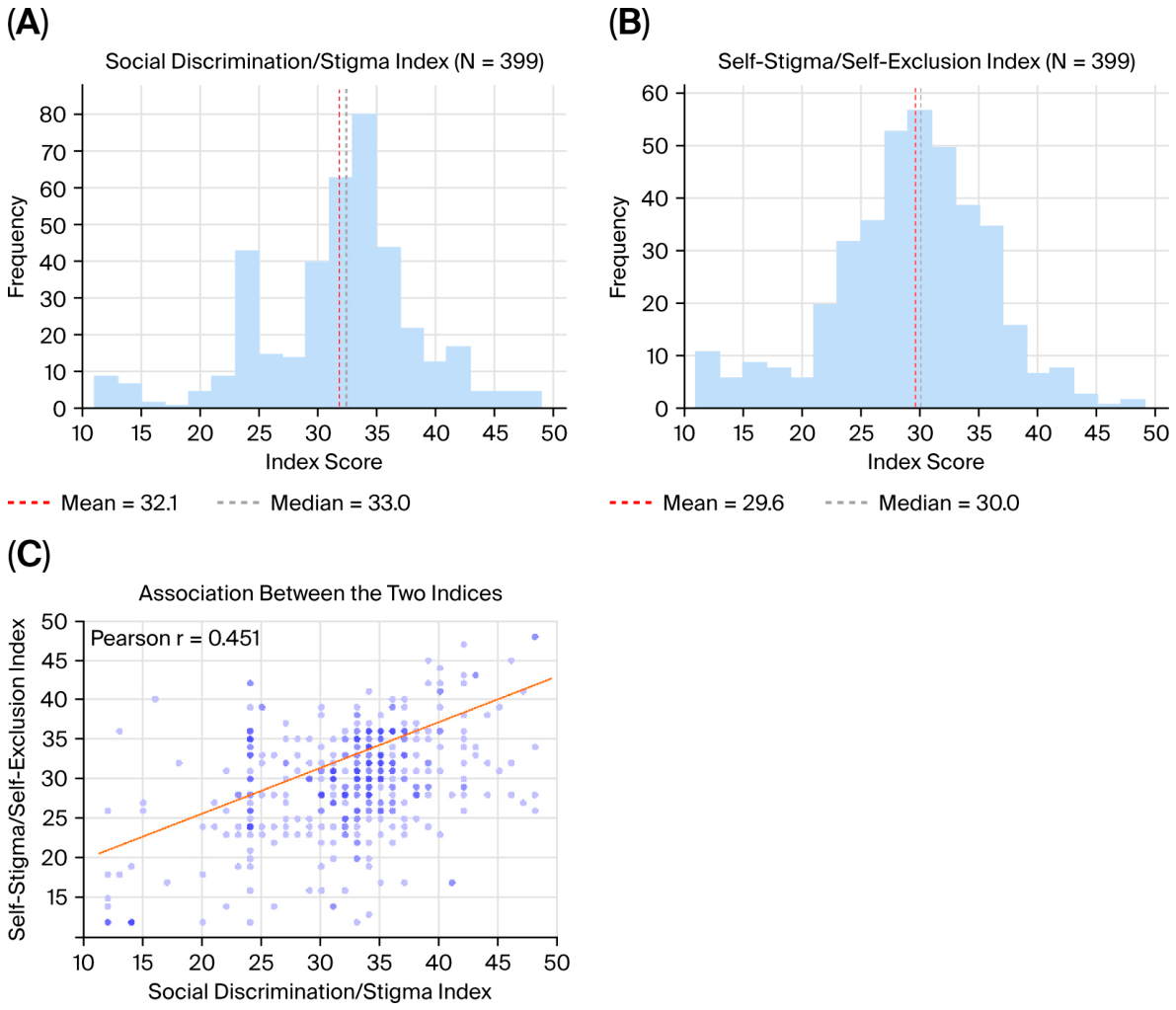
The social discrimination/stigma index had a mean of 32.14 (SD 6.96), a median of 33.0 [IQR 29.0–36.0], and an observed range of 12–48. The distribution was mildly negatively skewed (skewness −0.631). Seven participants (1.8%) had the minimum score, and five (1.3%) had the maximum. Cronbach’s alpha was 0.903 (bootstrap 95% CI 0.882–0.920). Corrected item–total correlations ranged from 0.359 to 0.785, and the mean inter-item correlation was 0.442.
The self-stigma/self-exclusion index had a mean of 29.62 (SD 6.77), a median of 30.0 [IQR 26.0–34.0], and an observed range of 12–48. Skewness was −0.396. Ten participants (2.5%) had the minimum score, and two (0.5%) had the maximum. Cronbach’s alpha was 0.891 (bootstrap 95% CI 0.867–0.909). Corrected item–total correlations ranged from 0.507 to 0.697, and the mean inter-item correlation was 0.403 (Table 2). Item-level statistics are given in Supplementary Table S1.
Table 2.
Descriptive and internal-consistency properties of the two stigma indices.
Sampling adequacy was high for both item sets (KMO = 0.927 for social discrimination/stigma and 0.907 for self-stigma/self-exclusion). Bartlett’s tests were significant for each (χ2(66) = 2516.8 and 1868.7, respectively; both p < 0.001). Parallel analysis retained two factors for the social discrimination/stigma items (observed first and second eigenvalues 6.07 and 1.28) and one factor for the self-stigma/self-exclusion items (first eigenvalue 5.46). In the two-factor solution, items 1–5 loaded mainly on the first factor and items 6–12 on the second, with cross-loadings for several items. The one-factor self-stigma loadings ranged from 0.536 to 0.747 (Supplementary Table S2).
The differing item directions offer one plausible explanation for the second social factor. Items 7 and 10, the two positively worded items, had the lowest corrected item–total correlations (0.359 and 0.374). They loaded on the second factor only (0.41 and 0.49). They correlated 0.39 with each other but, on average, only 0.25 and 0.26 with the other ten items. The other ten items correlated 0.53 with each other on average. Both items correlated positively with the sum of the other ten items (r = 0.33 and 0.34). A negative correlation would be expected if their reversed wording had been read as intended. When items 7 and 10 were omitted, parallel analysis retained a single factor (eigenvalues 5.79 and 0.94), and Cronbach’s alpha was 0.916. The 10-item score correlated 0.98 with the 12-item total (Supplementary Table S6). This pattern is consistent with a wording-related factor but does not establish that wording is its sole cause. In this exploratory analysis, the remaining ten items showed an approximately unidimensional structure.
In the post hoc comparisons (Supplementary Table S5), neither index differed between participants who did and did not report negative reactions from close others. The mean difference was 0.08 (95% CI −1.80 to 1.97) for social discrimination/stigma and 0.94 (95% CI −0.76 to 2.64) for self-stigma. Social discrimination/stigma scores were higher among participants who feared infecting others (32.81 versus 30.55; Hedges’ g = 0.33; p = 0.005). However, this difference did not survive FDR correction (q = 0.081). No self-stigma comparison approached significance (smallest q = 0.42).
3.3. Relationship Between Social Discrimination/Stigma and Self-Stigma
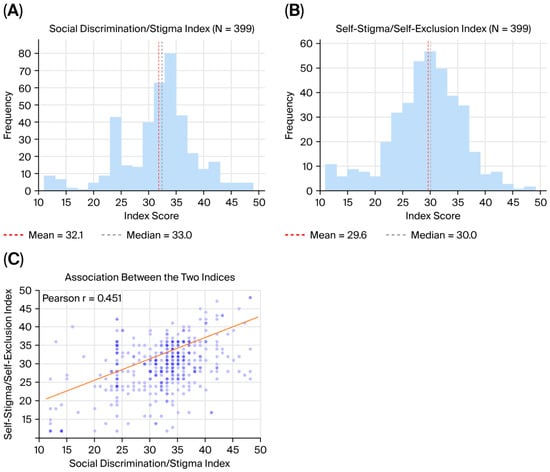
The two indices were moderately correlated (Pearson r = 0.451; 95% CI 0.369–0.526; p < 0.001; Spearman rho = 0.372; p < 0.001). This corresponds to approximately 20% shared variance (Figure 2) and indicates related but clearly nonredundant scores. In the residence-adjusted model, each 1-point increase in social discrimination/stigma was associated with a 0.457-point higher self-stigma/self-exclusion score (HC3 SE = 0.055; 95% CI 0.350–0.564; p < 0.001). This model was adjusted for age, sex, education, employment, marital status, household size, residence type, COVID-19 severity, chronic conditions, and BMI. The adjusted R2 was 0.230.
Figure 2.
(A) Social discrimination/stigma index distribution. (B) Self-stigma/self-exclusion index distribution. (C) Association between the indices. Red dashed lines denote means and gray dashed lines medians. The solid line in panel C is the least-squares best-fit line; Pearson correlation was calculated from the original paired scores.
3.4. Multivariable Correlates of the Stigma Indices
The multivariable models are summarized in Table 3. With residence type added to the prespecified model, the social discrimination/stigma model had R2 = 0.057 and adjusted R2 = 0.022. The robust omnibus test provided insufficient evidence of an overall association with education (Wald χ2 = 5.69; df = 3; p = 0.128). Within this exploratory factor, participants with incomplete secondary education scored 2.91 points lower than those with higher/university education (95% CI −5.67 to −0.15; p = 0.039). The residence factor was not significant overall (p = 0.659). The education omnibus test was not significant, and multiple coefficients were examined. The isolated education contrast is therefore considered hypothesis-generating rather than confirmatory.
Table 3.
Multivariable correlates of the two stigma indices using HC3 robust standard errors (n = 399).
The self-stigma/self-exclusion model had R2 = 0.050 and adjusted R2 = 0.016. Each additional household member was associated with a 0.59-point higher score (95% CI 0.18–1.00; p = 0.005). Neither education (omnibus p = 0.328) nor residence type (omnibus p = 0.313) showed evidence of an overall association. Multicollinearity was minimal in both models (maximum VIF = 1.52). The household-size association was similar after excluding severe/critical cases (B = 0.56; 95% CI 0.14–0.97; p = 0.009) and after excluding the seven participants with tuberculosis (B = 0.55; 95% CI 0.14–0.96; p = 0.009). Sensitivity results are provided in Supplementary Table S3.
The household-size association with self-stigma did not change in the post hoc models (Supplementary Table S7). Larger households more often included infected relatives: mean household size was 4.02 among participants with an infected family member and 3.56 among those without (p = 0.011). However, the household-size coefficient was 0.59 (95% CI 0.17–1.00) after adjustment for COVID-19 among family members and 0.60 (0.19–1.02) after adjustment for infection of someone close to the participant. The corresponding values were 0.60 (0.19–1.01) for a family member as the suspected source of infection, 0.57 (0.16–0.98) for fear of infecting others, 0.61 (0.19–1.02) for negative reactions from close others, and 0.60 (0.19–1.01) for vaccine doses. None of the added variables were itself associated with self-stigma (all p ≥ 0.17). The association did not differ by infection among family members (interaction p = 0.281) or by family source of infection (interaction p = 0.563). Vaccination was not associated with either index (robust Wald p = 0.160 and 0.740). Adding eight infection-context indicators together raised R2 for social discrimination/stigma from 0.057 to 0.098 (robust Wald p = 0.022), mainly through fear of infecting others (B = 1.90; 95% CI 0.26–3.54). For self-stigma, R2 rose from 0.050 to 0.078 (p = 0.136). Even these extended models left more than 90% of the variance in either score unexplained. With the 10-item social score, the coefficients were similar to those for the 12-item total: B = 0.28 (95% CI −0.12 to 0.68) for household size and B = −2.57 (95% CI −4.97 to −0.16) for incomplete secondary education. The omnibus p value for education was 0.124 (Supplementary Table S6).
3.5. Concurrent Associations with Mental-Health Symptom Scores
In unadjusted (zero-order) analyses, social discrimination/stigma had small positive correlations with PHQ-9 and PCL-5 scores after FDR correction. Self-stigma/self-exclusion correlated with PHQ-9, GAD-7, and PCL-5 scores (Table 4). The adjusted models included age, sex, education, employment, marital status, household size, residence type, BMI, COVID-19 severity, and chronic conditions. After this adjustment, self-stigma remained independently associated with PHQ-9 (standardized β = 0.227; 95% CI 0.120–0.333; FDR q < 0.001), GAD-7 (β = 0.130; 95% CI 0.023–0.238; q = 0.035), and PCL-5 scores (β = 0.267; 95% CI 0.161–0.372; q < 0.001). Social discrimination/stigma remained associated only with PCL-5 (β = 0.138; 95% CI 0.039–0.236; q = 0.016). Adjusted associations are shown in Supplementary Table S3. These estimates were essentially unchanged after additional adjustment for vaccine doses (Supplementary Table S7). The corresponding coefficients were 0.227 (PHQ-9), 0.132 (GAD-7), and 0.264 (PCL-5) for self-stigma and 0.131 (PCL-5; 95% CI 0.032–0.231; q = 0.026) for social discrimination/stigma. With the 10-item social score, the adjusted association with PCL-5 scores was slightly larger (β = 0.167; 95% CI 0.062–0.272; q = 0.005). No other adjusted association of the social score was significant after FDR correction (Supplementary Table S6).
Table 4.
Concurrent correlations between stigma indices and baseline mental-health symptom scores (n = 399).
4. Discussion
4.1. Principal Findings
This study examined two archived stigma-related indices in 399 adults hospitalized with COVID-19 in Ulaanbaatar. The data came from the hospitalization baseline of a cohort whose enrollment began in June 2021, after vaccination started. Three findings stand out. First, after adjustment, the self-stigma/self-exclusion index was associated with depressive, anxiety, and post-traumatic stress symptom scores (standardized β 0.13–0.27). The social discrimination/stigma index was associated only with post-traumatic stress symptoms (β = 0.14). Second, the two indices were only moderately correlated (r = 0.45). Both item sets ask about “some people” or “some infected people”, so neither directly documents the respondent’s own experienced discrimination or internalized stigma. Third, each additional household member was associated with a slightly higher self-stigma/self-exclusion score (about 0.6 points). However, the measured demographic and clinical variables explained only about 5% of score variance. Both indices had high internal consistency, but the questionnaire was not formally validated. The estimates must therefore be regarded as exploratory.
4.2. The Findings in Their Pandemic Context
The period of data collection determines how these results should be read. Three phases of the pandemic can be distinguished. In the first phase, before vaccines were available, strict control measures prevented widespread transmission in Mongolia until early 2021 [26]. The second phase began with vaccination in February 2021 [26]. It lasted until May 2023, when the WHO ended the COVID-19 public health emergency of international concern [23]. The third phase is the period since then. All participants were enrolled in the second phase. Enrollment began in June 2021, and all baseline assessments were completed before follow-up ended in February 2023. Most participants (82.5%) had received at least one vaccine dose before infection. However, a positive test still led to isolation in a dedicated ward. Because individual admission dates were unavailable, the data cannot be assigned to specific epidemic waves within the second phase. They also should not be taken to represent attitudes in the first phase or current attitudes toward COVID-19.
Among our participants, infection was often shared within families. Nearly three quarters (72.9%) had a family member who had also had COVID-19, and 70.4% named fear of infecting others among their reactions to the diagnosis. Overt mistreatment by close others was uncommon: 4.8% reported being blamed or cursed, whereas more than half had been advised to seek early treatment. Because the indices have no validated cut-offs, we cannot estimate the prevalence of stigma. Nor can we compare these mean scores with those from earlier phases or other countries, including the earlier Mongolian survey [24]. What the data do show is that endorsement of self-stigma-related beliefs on the archived third-person questionnaire accompanied mental-health symptoms in this post-vaccine-rollout hospital cohort. This is consistent with findings from Japan, where people infected in later waves reported discrimination less often, but discrimination was more strongly associated with distress [22]. However, this association does not directly establish participants’ personally internalized stigma. First-person experience should be assessed with validated instruments in future studies.
4.3. What the Two Indices Can and Cannot Show
The moderate correlation between the two indices shows that they are related but not interchangeable. The retrieved wording clarifies what each index can capture. The social items ask respondents how “some people” treat individuals with infection. They therefore reflect perceived community attitudes rather than discrimination actually experienced by the respondent. The self-stigma/self-exclusion items also use third-person statements about “some infected people”. They are not first-person reports of respondents’ own shame, withdrawal, or internalized beliefs. This index should therefore be interpreted as endorsement of self-stigma-related experiences attributed to infected people. It is not a validated, direct measure of each participant’s internalized stigma. This distinction is consistent with the Health Stigma and Discrimination Framework [33] and is essential to avoid overstating the findings.
Three measurement cautions are important. First, the two positively worded social items did not behave like the other ten. Mixed item directions can create apparent factors and ambiguous totals [34]. Omitting these two items produced a higher internal-consistency estimate, an approximately one-factor solution, and similar regression results (Supplementary Table S6). However, this does not establish the validity of the original score. Second, the social items resemble an instrument developed for tuberculosis. The self-stigma section has heterogeneous content: avoidance to prevent transmission, anticipated consequences of disclosure, guilt, concern about further infection, and an explicit comparison with HIV/AIDS (self-stigma item 7). These items may not map cleanly onto internalized COVID-19 stigma. Third, neither archived index has formally validated Mongolian cut-offs or documented cultural adaptation. We therefore report exploratory associations of continuous scores rather than stigma prevalence or diagnostic classifications.
4.4. Household Size and Other Correlates
Each additional household member was associated with a 0.59-point higher self-stigma score (95% CI 0.18–1.00). On the 12–48 scale, this is about 0.09 standard deviations per member. The difference between a two-person and a five-person household is therefore about 1.8 points (0.26 standard deviations). The estimate was stable across all sensitivity analyses. However, it is small, and the full model explained only 5% of the variance in self-stigma.
Previous studies point in the same direction, although none used the same measures. Among discharged patients in Wuhan, living with other people was associated with moderate and severe perceived stigma [12]. Among survivors in Chongqing, being married and having infected family members were associated with higher stigma [9]. In contrast, among survivors in Qatar, living alone was associated with perceived stigma, but only in unadjusted analysis [35]. Qualitative studies suggest why family circumstances may matter. In Malaysia, patients and family members described being isolated, labeled, and blamed [36]. In Wuhan, hospitalized patients who were part of family clusters described family responsibilities and worry about their relatives [37]. In Finland, members of affected households described stigma driven by fear and by blame for infection [38].
Several explanations are possible. Patients in larger households have more co-residents whom they may have exposed. They may therefore feel more responsible for transmission or anticipate more blame. Contact tracing and household quarantine may also make an infection more visible in and around a large family. In addition, household size may stand in for crowding or socioeconomic circumstances that were not measured. The post hoc models tested the first of these explanations. Larger households did more often include infected relatives. However, the coefficient did not change after adjustment for COVID-19 among family members, a family member as the suspected source of infection, fear of infecting others, or negative reactions from close others. Self-stigma scores also did not differ between participants with and without an infected family member. The association is therefore not explained by infection within the family or by the other recorded transmission-related experiences. Crowding, family roles, and socioeconomic position remain untested. Household size should therefore be regarded as a lead for research that measures household composition, crowding, and family responses directly. It should not be used as a marker for targeting support.
The education result is weaker still. Participants with incomplete secondary education scored 2.9 points lower on social discrimination/stigma than those with university education. However, the overall test for education was not significant (p = 0.128), and the subgroup was small (n = 39). Previous studies report inconsistent associations with education [9,12,14,16]. Moreover, the direction of our result is opposite to the trend toward more stigma among people with less education in pooled data [7]. The contrast may reflect reporting behavior or residual confounding and should not be interpreted causally.
4.5. Concurrent Mental-Health Correlates
Self-stigma was the index more consistently related to symptoms. After adjustment for demographic and clinical factors, it remained associated with depressive, anxiety, and post-traumatic stress symptoms. These associations were essentially unchanged after further adjustment for vaccination. Social discrimination/stigma retained an adjusted association only with post-traumatic stress symptoms. Similar relationships have been reported in other pandemic-era samples [10,11,13,16] and in the multinational study that included Mongolia [25]. The largest adjusted coefficient was modest (β = 0.27 for PCL-5 scores). Stigma is therefore better understood as one psychosocial dimension of the illness experience than as a proxy for symptom severity. Stigma and symptoms were measured at the same time, by self-report, during an acute admission. The direction of the association therefore cannot be inferred. Self-stigma may add to distress, and distress may color how patients see themselves. Both may also reflect a common response to a frightening diagnosis under isolation. The pattern is nevertheless consistent with models in which internalization is the step that links stigma to psychological harm [2,3].
4.6. Lessons for Future Outbreaks
These baseline data describe a past epidemic phase. Higher endorsement of the self-stigma/self-exclusion item set accompanied greater depressive, anxiety, and post-traumatic stress symptoms. For future outbreaks, this association supports further study of brief questions that staff could ask hospitalized patients in private about shame, anticipated reactions of others, and withdrawal. However, because of the instrument’s third-person wording, the present study does not directly establish patients’ own internalized stigma. It also did not test a screening or counseling intervention. Only one in five participants reported receiving psychological counseling during hospitalization. Finally, the two indices showed only moderate overlap. This supports treating community-stigma beliefs and self-stigma-related beliefs as distinct exploratory constructs in further research.
The wider literature recommends other measures that this study did not evaluate [6,39,40]. These include communication that avoids blaming patients or groups and non-stigmatizing language in public messages and media reports. They also include confidential handling of case information and attention to patients’ families. Commentators drew on these lessons from COVID-19 during the 2022 mpox outbreak [41]. Our data are compatible with these recommendations but do not test them. We also draw no conclusion about overlapping stigma from tuberculosis and COVID-19. Only seven participants had recorded tuberculosis, overlapping stigma was not measured, and excluding these participants did not change the results. Finally, the measurement problems encountered here are themselves a lesson. The questionnaire drew on a scale developed for another disease, and its source and adaptation were not documented. Two positively worded items were summed without reverse-scoring. The self-stigma section also referred directly to HIV/AIDS, and several of its items concerned transmission or disclosure rather than internalized stigma. Instruments used in outbreak research should be archived with their source, translation, and scoring rules. They should also be validated before cut-offs or prevalence estimates are derived from them.
4.7. Strengths and Limitations
The study has several strengths. Stigma-item data were complete for all 399 COVID-19 cases, and case status was confirmed by RT-PCR. The two indices were analyzed separately. The analyses used heteroskedasticity-robust inference and FDR correction, and multicollinearity was low. Sensitivity analyses excluded severe/critical cases and participants with tuberculosis and adjusted for vaccination and infection-related experiences. Restricting the work to baseline stigma-focused questions keeps it distinct from the earlier longitudinal analysis of the parent cohort [27].
The study also has important limitations, which define how far the findings can be taken. First, the stigma questionnaire has not been validated. Its social items resemble a tuberculosis stigma scale, but the form does not name its source. The translation and adaptation procedures were not documented, and no validation of the Mongolian version was found. Both sections are worded in the third person. The self-stigma section mixes disclosure fears, prevention-related withdrawal, guilt, an explicit HIV/AIDS analogy, and concern about other infections. It therefore cannot be assumed that this sum directly measures respondents’ own internalized stigma. Internal consistency and exploratory factor analysis cannot substitute for content, construct, or criterion validity. Two positively worded social items were summed without reverse-scoring and had weaker relationships to the other items. However, a 10-item score without them led to the same conclusions. The social index measures perceived community stigma, not experienced discrimination. Its post hoc comparisons with single-item reports of reactions from close others were largely null. Neither index has validated cut-offs.
Second, the findings are specific to their period and setting: adults hospitalized in Ulaanbaatar after vaccine rollout, while confirmed cases were still isolated. They may not apply to earlier pandemic phases, to the present situation, or to future outbreaks with different transmission patterns. Nor may they apply to community-managed, asymptomatic, rural, or non-hospitalized infections. Individual admission dates were unavailable, so we could not compare epidemic waves or verify the last enrollment date. The primary reason for hospitalization was also unavailable. Detection route alone could not distinguish admissions primarily due to COVID-19 from incidental infections. In particular, 32 participants (8.0%) learned of their infection while seeking care for another illness. We could not identify which, if any, were admitted primarily because of that illness. Third, the cross-sectional design prevents temporal or causal inference. Fourth, all stigma and mental-health measures were self-reported, which creates potential reporting and common-method bias. The questionnaires were completed in isolation wards during the acute admission, usually after explanation by a treating physician. This may have encouraged socially desirable answers or under-reporting of stigma, but the size of any such effect cannot be estimated. Fifth, participants were recruited consecutively at university-affiliated hospitals, not by probability sampling. About half of the patients hospitalized with COVID-19 at these hospitals during the study period were enrolled, and those who were not enrolled may have differed from those who were. Sixth, viral variant, income, social support, perceived threat, family dynamics, and prior discrimination were not measured. Seventh, the determinant models explained only about 5% of score variance, and less than 10% even after infection-context indicators were added. The main drivers of differences in stigma were therefore not captured, and the household-size association explains only a small part of these differences. Finally, the post hoc analyses were added during peer review and were not prespecified. Subgroup findings are exploratory, and the single-country setting limits generalizability.
5. Conclusions
This exploratory secondary analysis used baseline data from 399 adults hospitalized with COVID-19 in a hospital-based cohort in Ulaanbaatar whose enrollment began in June 2021. Higher scores on a study-specific self-stigma/self-exclusion item set were modestly associated with more depressive, anxiety, and post-traumatic stress symptoms at admission. These scores were moderately correlated with a perceived community-stigma score. Larger households were associated with slightly higher self-stigma/self-exclusion scores, but the models explained little score variation. Both item sets used third-person wording and lacked formal Mongolian validation. In addition, two social items had opposite wording, and one self-stigma item explicitly mentioned HIV/AIDS. The findings therefore concern exploratory associations between questionnaire scores, not verified levels of personal discrimination or internalized stigma. They cannot be assigned to particular epidemic waves and do not describe current attitudes to COVID-19. Future research needs culturally adapted, validated measures of outbreak-related stigma. It should also assess patients’ psychosocial needs and household context directly.
Supplementary Materials
The following supporting information can be downloaded at: https://www.mdpi.com/article/10.3390/ijerph23121453/s1, Supplementary Table S1: Item-level statistics for the two stigma indices (n = 399). Supplementary Table S2: Exploratory internal-structure analysis of the two stigma indices (n = 399). Supplementary Table S3: Robustness and covariate-adjusted sensitivity analyses. Supplementary Table S4: Circumstances of infection, vaccination, and admission in the analytic sample (n = 399). Supplementary Table S5: Post hoc comparisons of stigma index scores by infection-related experiences (n = 399). Supplementary Table S6: The two positively worded social items (items 7 and 10) and the 10-item social discrimination/stigma score (n = 399). Supplementary Table S7: Post hoc household-size, vaccination-adjusted, and incremental-variance models (n = 399). Supplementary Table S8: Investigator-verified English translations of the original Mongolian questionnaire items.
Author Contributions
Conceptualization, E.R., O.R. and N.L.; methodology, E.R., O.R. and N.L.; validation, D.G.; formal analysis, D.G.; investigation, E.R., O.R. and N.L.; resources, E.R., O.R. and N.L.; data curation, E.R., O.R. and N.L.; writing—original draft preparation, E.R., O.R. and N.L.; writing—review and editing, D.G. and K.Z.; visualization, D.G.; supervision, K.Z.; project administration, K.Z. All authors have read and agreed to the published version of the manuscript.
Funding
This research received no external funding.
Institutional Review Board Statement
The study was conducted in accordance with the Declaration of Helsinki and was approved by the Research Ethics Review Committee of the Mongolian National University of Medical Sciences (approval No. 2021/3-08; 28 May 2021). The present study was a secondary analysis of de-identified data collected under the approved parent-study protocol and involved no additional participant contact, intervention, or data collection.
Informed Consent Statement
Informed consent was obtained from all participants enrolled in the parent study.
Data Availability Statement
The de-identified data supporting the findings are available from the corresponding authors on reasonable request, subject to applicable institutional and ethics requirements.
Acknowledgments
The authors thank the study participants and the clinical and research staff of the participating hospitals. ChatGPT (OpenAI; GPT-5.6 Sol) was used for code drafting, and statistical cross-checking. All final numerical analyses reported in this manuscript were re-executed from the raw de-identified study dataset using the software specified above; references and manuscript claims were checked against source materials. The authors reviewed and edited AI-assisted outputs and take full responsibility for the final content.
Conflicts of Interest
The authors declare no conflicts of interest.
Abbreviations
BMI, body mass index; CI, confidence interval; FDR, false discovery rate; GAD-7, Generalized Anxiety Disorder-7; HC3, heteroskedasticity-consistent covariance estimator type 3; ISI, Insomnia Severity Index; KMO, Kaiser-Meyer-Olkin; MERS, Middle East respiratory syndrome; PCL-5, PTSD Checklist for DSM-5; PHQ-9, Patient Health Questionnaire-9; PTSD, post-traumatic stress disorder; RT-PCR, reverse-transcription polymerase chain reaction; SARS, severe acute respiratory syndrome; VIF, variance inflation factor.
References
- Link, B.G.; Phelan, J.C. Conceptualizing stigma. Annu. Rev. Sociol. 2001, 27, 363–385. [Google Scholar] [CrossRef] [Scilit]
- Corrigan, P.W.; Watson, A.C. The paradox of self-stigma and mental illness. Clin. Psychol. Sci. Pract. 2002, 9, 35–53. [Google Scholar] [CrossRef]
- Corrigan, P.W.; Rao, D. On the self-stigma of mental illness: Stages, disclosure, and strategies for change. Can. J. Psychiatry 2012, 57, 464–469. [Google Scholar] [CrossRef] [Scilit] [PubMed]
- Person, B.; Sy, F.; Holton, K.; Govert, B.; Liang, A.; Garza, B.; Gould, D.; Hickson, M.; McDonald, M.; Meijer, C.; et al. Fear and stigma: The epidemic within the SARS outbreak. Emerg. Infect. Dis. 2004, 10, 358–363. [Google Scholar] [CrossRef] [Scilit] [PubMed]
- Van Bortel, T.; Basnayake, A.; Wurie, F.; Jambai, M.; Koroma, A.S.; Muana, A.T.; Hann, K.; Eaton, J.; Martin, S.; Nellums, L.B. Psychosocial effects of an Ebola outbreak at individual, community and international levels. Bull. World Health Organ. 2016, 94, 210–214. [Google Scholar] [CrossRef] [Scilit] [PubMed]
- Saeed, F.; Mihan, R.; Mousavi, S.Z.; Reniers, R.L.E.P.; Bateni, F.S.; Alikhani, R.; Mousavi, S.B. A narrative review of stigma related to infectious disease outbreaks: What can be learned in the face of the Covid-19 pandemic? Front. Psychiatry 2020, 11, 565919. [Google Scholar] [CrossRef] [Scilit] [PubMed]
- Yuan, K.; Huang, X.L.; Yan, W.; Zhang, Y.X.; Gong, Y.M.; Su, S.Z.; Huang, Y.T.; Zhong, Y.; Wang, Y.J.; Yuan, Z.; et al. A systematic review and meta-analysis on the prevalence of stigma in infectious diseases, including COVID-19: A call to action. Mol. Psychiatry 2022, 27, 19–33. [Google Scholar] [CrossRef] [Scilit] [PubMed]
- Haddad, C.; Bou Malhab, S.; Malaeb, D.; Sacre, H.; Saadeh, D.; Mourtada, V.; Salameh, P. Stigma toward people with COVID-19 among the Lebanese population: A cross-sectional study of correlates and mediating effects. BMC Psychol. 2021, 9, 164. [Google Scholar] [CrossRef] [Scilit] [PubMed]
- Yuan, Y.; Zhao, Y.J.; Zhang, Q.E.; Zhang, L.; Cheung, T.; Jackson, T.; Jiang, G.Q.; Xiang, Y.T. COVID-19-related stigma and its sociodemographic correlates: A comparative study. Glob. Health 2021, 17, 54. [Google Scholar] [CrossRef] [Scilit] [PubMed]
- Kang, E.K.; Lee, S.Y.; Kim, M.S.; Jung, H.; Kim, K.H.; Kim, K.N.; Park, H.Y.; Lee, Y.J.; Cho, B.; Sohn, J.H. The psychological burden of COVID-19 stigma: Evaluation of the mental health of isolated mild condition COVID-19 patients. J. Korean Med. Sci. 2021, 36, e33. [Google Scholar] [CrossRef] [Scilit] [PubMed]
- Wahyuhadi, J.; Efendi, F.; Al Farabi, M.J.; Harymawan, I.; Ariana, A.D.; Arifin, H.; Adnani, Q.E.S.; Levkovich, I. Association of stigma with mental health and quality of life among Indonesian COVID-19 survivors. PLoS ONE 2022, 17, e0264218. [Google Scholar] [CrossRef] [Scilit] [PubMed]
- Wu, Y.; Dai, Z.; Xiao, W.; Wang, H.; Huang, Y.; Si, M.; Fu, J.; Chen, X.; Jia, M.; Leng, Z.; et al. Perceived stigma among discharged patients of COVID-19 in Wuhan, China: A latent profile analysis. Front. Public Health 2023, 11, 1111900. [Google Scholar] [CrossRef] [Scilit] [PubMed]
- Abdul Taib, N.I.; Nik Jaafar, N.R.; Azman, N.; Leong Bin Abdullah, M.F.I.; Mohamad Kamal, N.A.; Baharudin, A.; Bin Abdullah, M.N.; Chidambaram, S.K.; Adlan, A.; Tan, L.H.; et al. Stigma, sociodemographic factors, and clinical factors associated with psychological distress among COVID-19 survivors during the convalescence period: A multi-centre study in Malaysia. Int. J. Environ. Res. Public Health 2023, 20, 3795. [Google Scholar] [CrossRef] [Scilit] [PubMed]
- Techapoonpon, K.; Kerdchareon, N.; Polruamngern, N.; Chalermrungroj, T.; Srikhamdokkhae, O.; Matangkarat, P. Stigma experienced by patients who recovered from COVID-19 in the post-vaccination period in Thailand: Prevalence and associated factors. Psychol. Res. Behav. Manag. 2023, 16, 3561–3571. [Google Scholar] [CrossRef] [Scilit] [PubMed]
- Azman, N.; Nik Jaafar, N.R.; Leong Bin Abdullah, M.F.I.; Abdul Taib, N.I.; Mohamad Kamal, N.A.; Abdullah, M.N.; Dollah, S.N.; Mohamed Said, M.S. Stigma and posttraumatic growth among COVID-19 survivors during the first wave of the COVID-19 pandemic in Malaysia: A multicenter cross-sectional study. Front. Psychiatry 2023, 14, 1152105. [Google Scholar] [CrossRef] [Scilit] [PubMed]
- Shah, B.; Mahapatra, A.; Singh, U.N.; Mishra, V.; Daha, S.K.; Pande, R.; Neupane, M.R.; Banjade, A.; Khatik, C.B.; K.C., T.B.; et al. Internalized stigma related to COVID-19 and its psychosocial and mental health correlates: A multicentric health facility-based observational study from Nepal. Front. Psychiatry 2024, 14, 1276369. [Google Scholar] [CrossRef] [Scilit] [PubMed]
- Wang, R.; Wang, Z.; Shi, D.; Xu, L.; Liu, Y.; Liu, S.; Chen, H.; Chen, Y.; Xia, D.; Ge, X.; et al. Evaluation of the psychometrics of the Social Impact Scale and its association with depression among asymptomatic COVID-19 carriers. BJPsych Open 2024, 10, e41. [Google Scholar] [CrossRef] [Scilit] [PubMed]
- Pallavi, P.; Bakhla, A.K.; Akhouri, P.K.; Kisku, R.R.; Bala, R. Stigma scale adaptation and validation for measuring COVID-19 stigma. Cureus 2023, 15, e38744. [Google Scholar] [CrossRef] [Scilit] [PubMed]
- Damant, R.W.; Rourke, L.; Cui, Y.; Lam, G.Y.; Smith, M.P.; Fuhr, D.P.; Tay, J.K.; Varughese, R.A.; Laratta, C.R.; Lau, A.; et al. Reliability and validity of the post COVID-19 condition stigma questionnaire: A prospective cohort study. eClinicalMedicine 2022, 55, 101755. [Google Scholar] [CrossRef] [Scilit] [PubMed]
- Kelly, J.D.; Weiser, S.D.; Wilson, B.; Cooper, J.B.; Glayweon, M.; Sneller, M.C.; Drew, C.; Steward, W.T.; Reilly, C.; Johnson, K.; et al. Ebola virus disease-related stigma among survivors declined in Liberia over an 18-month, post-outbreak period: An observational cohort study. PLoS Negl. Trop. Dis. 2019, 13, e0007185. [Google Scholar] [CrossRef] [Scilit] [PubMed]
- Siu, J.Y. The SARS-associated stigma of SARS victims in the post-SARS era of Hong Kong. Qual. Health Res. 2008, 18, 729–738. [Google Scholar] [CrossRef] [Scilit] [PubMed]
- Hazumi, M.; Kataoka, M.; Usuda, K.; Narita, Z.; Okazaki, E.; Nishi, D. Difference in the risk of discrimination on psychological distress experienced by early wave infected and late wave infected COVID-19 survivors in Japan. Sci. Rep. 2023, 13, 13139. [Google Scholar] [CrossRef] [Scilit] [PubMed]
- World Health Organization. Statement on the Fifteenth Meeting of the IHR (2005) Emergency Committee on the COVID-19 Pandemic, 5 May 2023. Available online: https://www.who.int/news/item/05-05-2023-statement-on-the-fifteenth-meeting-of-the-international-health-regulations-(2005)-emergency-committee-regarding-the-coronavirus-disease-(covid-19)-pandemic (accessed on 11 November 2026).
- Munkh, E.; Oyunsuren, D.; Battuya, B.; Khishig-Undrakh, M.; Oyungerel, R.; Khishigsuren, Z. The discrimination and stigmatization against people with COVID-19 disease in Mongolia. J. Data Anal. 2024, 19, 61–69. [Google Scholar] [CrossRef]
- Sattler, D.N.; Bishkhorloo, B.; Lawley, K.A.; Hackler, R.; Byambajav, C.; Munkhbat, M.; Smith-Galeno, B. Stigma, post-traumatic stress, and COVID-19 vaccination intent in Mongolia, India, and the United States. Int. J. Environ. Res. Public Health 2023, 20, 2084. [Google Scholar] [CrossRef] [Scilit] [PubMed]
- Chimeddorj, B.; Bailie, C.R.; Mandakh, U.; Price, D.J.; Bayartsogt, B.; Meagher, N.; Altanbayar, O.; Magvan, B.; Deleg, Z.; Gantumur, A.; et al. SARS-CoV-2 seroepidemiology in Mongolia, 2020–2021: A longitudinal national study. Lancet Reg. Health West. Pac. 2023, 36, 100760. [Google Scholar] [CrossRef] [Scilit] [PubMed]
- Regzedmaa, E.; Altankhuyag, M.; Enkhbaatar, M.; Mungunkhuyag, U.; Madi, Y.; Byambadash, A.; Mukhtar, Y.; Davaanyam, M.U.; Erdenetsetseg, M.; Bat-Erdene, A.; et al. Changes in mental health following COVID-19 infection: Results of a prospective cohort study in Mongolia. Cent. Asian J. Med. Sci. 2026, 12, 69–78. [Google Scholar] [CrossRef] [Scilit]
- Van Rie, A.; Sengupta, S.; Pungrassami, P.; Balthip, Q.; Choonuan, S.; Kasetjaroen, Y.; Strauss, R.P.; Chongsuvivatwong, V. Measuring stigma associated with tuberculosis and HIV/AIDS in southern Thailand: Exploratory and confirmatory factor analyses of two new scales. Trop. Med. Int. Health 2008, 13, 21–30. [Google Scholar] [CrossRef] [Scilit] [PubMed]
- Kroenke, K.; Spitzer, R.L.; Williams, J.B.W. The PHQ-9: Validity of a brief depression severity measure. J. Gen. Intern. Med. 2001, 16, 606–613. [Google Scholar] [CrossRef] [Scilit] [PubMed]
- Spitzer, R.L.; Kroenke, K.; Williams, J.B.W.; Lowe, B. A brief measure for assessing generalized anxiety disorder: The GAD-7. Arch. Intern. Med. 2006, 166, 1092–1097. [Google Scholar] [CrossRef] [Scilit] [PubMed]
- Morin, C.M.; Belleville, G.; Belanger, L.; Ivers, H. The Insomnia Severity Index: Psychometric indicators to detect insomnia cases and evaluate treatment response. Sleep 2011, 34, 601–608. [Google Scholar] [CrossRef] [Scilit] [PubMed]
- Blevins, C.A.; Weathers, F.W.; Davis, M.T.; Witte, T.K.; Domino, J.L. The Posttraumatic Stress Disorder Checklist for DSM-5 (PCL-5): Development and initial psychometric evaluation. J. Trauma. Stress 2015, 28, 489–498. [Google Scholar] [CrossRef] [Scilit] [PubMed]
- Stangl, A.L.; Earnshaw, V.A.; Logie, C.H.; van Brakel, W.; Simbayi, L.C.; Barré, I.; Dovidio, J.F. The Health Stigma and Discrimination Framework: A global, crosscutting framework to inform research, intervention development, and policy on health-related stigmas. BMC Med. 2019, 17, 31. [Google Scholar] [CrossRef] [Scilit] [PubMed]
- Crispim, J.d.A.; da Silva, L.M.C.; Yamamura, M.; Popolin, M.P.; Ramos, A.C.V.; Arroyo, L.H.; de Queiroz, A.A.R.; Belchior, A.d.S.; dos Santos, D.T.; Pieri, F.M.; et al. Validity and reliability of the tuberculosis-related stigma scale version for Brazilian Portuguese. BMC Infect. Dis. 2017, 17, 510. [Google Scholar] [CrossRef] [Scilit] [PubMed]
- Alchawa, M.; Naja, S.; Ali, K.; Kehyayan, V.; Haddad, P.M.; Bougmiza, I. COVID-19 perceived stigma among survivors: A cross-sectional study of prevalence and predictors. Eur. J. Psychiatry 2023, 37, 24–35. [Google Scholar] [CrossRef] [Scilit] [PubMed]
- Chew, C.C.; Lim, X.J.; Chang, C.T.; Rajan, P.; Nasir, N.; Low, W.Y. Experiences of social stigma among patients tested positive for COVID-19 and their family members: A qualitative study. BMC Public Health 2021, 21, 1623. [Google Scholar] [CrossRef] [Scilit] [PubMed]
- Liu, W.; Liu, J. Living with COVID-19: A phenomenological study of hospitalised patients involved in family cluster transmission. BMJ Open 2021, 11, e046128. [Google Scholar] [CrossRef] [Scilit] [PubMed]
- Lohiniva, A.L.; Dub, T.; Hagberg, L.; Nohynek, H. Learning about COVID-19-related stigma, quarantine and isolation experiences in Finland. PLoS ONE 2021, 16, e0247962. [Google Scholar] [CrossRef] [Scilit] [PubMed]
- Gronholm, P.C.; Nosé, M.; van Brakel, W.H.; Eaton, J.; Ebenso, B.; Fiekert, K.; Milenova, M.; Sunkel, C.; Barbui, C.; Thornicroft, G. Reducing stigma and discrimination associated with COVID-19: Early stage pandemic rapid review and practical recommendations. Epidemiol. Psychiatr. Sci. 2021, 30, e15. [Google Scholar] [CrossRef] [Scilit] [PubMed]
- Logie, C.H.; Turan, J.M. How do we balance tensions between COVID-19 public health responses and stigma mitigation? Learning from HIV research. AIDS Behav. 2020, 24, 2003–2006. [Google Scholar] [CrossRef] [Scilit] [PubMed]
- Dzobo, M.; Gwinji, P.T.; Murewanhema, G.; Musuka, G.; Dzinamarira, T. Stigma and public health responses: Lessons learnt from the COVID-19 pandemic to inform the recent monkeypox outbreak. Public Health Pract. 2022, 4, 100315. [Google Scholar] [CrossRef] [Scilit] [PubMed]

Disclaimer/Publisher’s Note: The statements, opinions and data contained in all publications are solely those of the individual author(s) and contributor(s) and not of MDPI and/or the editor(s). MDPI and/or the editor(s) disclaim responsibility for any injury to people or property resulting from any ideas, methods, instructions or products referred to in the content. |
© 2026 by the authors. Licensee MDPI, Basel, Switzerland. This article is an open access article distributed under the terms and conditions of the Creative Commons Attribution (CC BY) license.