


Highlights
Public health relevance—How does this work relate to a public health issue?
- •
- Depression is a major public health concern among migrant populations, who are frequently exposed to psychological stressors associated with migration and social adaptation.
- •
- Identifying factors linked to depressive symptoms, including personality traits and perceived stress, is important for informing mental health promotion strategies in vulnerable migrant communities..
Public health significance—Why is this work of significance to public health?
- •
- This study found that neuroticism and perceived stress were associated with depressive symptoms among Myanmar Buddhist migrants.
- •
- The findings contribute to understanding psychological factors related to depression in migrant populations and highlight the need for culturally sensitive mental health research.
Public health implications—What are the key implications or messages for practitioners, policy makers and/or researchers in public health?
- •
- Public health interventions for migrant populations should address perceived stress and other psychological risk factors associated with depressive symptoms.
- •
- Although Buddhist ethical practices may represent a culturally relevant resource, further research is needed to clarify whether and how Five Precept practice contributes to mental health resilience and prevention efforts.
Abstract
Depressive symptoms are an important public health concern among Myanmar migrants in Thailand, but the role of culturally embedded Buddhist ethical practices remains insufficiently understood. This cross-sectional study examined associations among neuroticism, perceived stress, and depressive symptoms and explored whether Five Precept practice moderated the direct association between neuroticism and depressive symptoms. A survey of 205 Myanmar Buddhist migrants used the Neuroticism Inventory, Perceived Stress Scale, Core Symptom Index–Depression Subscale, and Precept Practice Questionnaire. Regression-based analyses using PROCESS macro version 5.0 (Model 5) estimated the indirect association through perceived stress and tested moderation of the direct association by precept practice. Neuroticism was positively associated with perceived stress and depressive symptoms, with a statistically significant indirect association through perceived stress. Total precept practice was not a statistically significant moderator, and none of the individual-precept interactions in the continuous-item models remained significant after Bonferroni correction. Supplementary categorical analyses identified an omnibus interaction for refraining from intoxicants that survived correction (unadjusted p = 0.0003; adjusted p = 0.0015). However, its nonmonotonic pattern did not indicate a consistently weaker association with increasing observance. Evidence for moderation was therefore exploratory and dependent on model specification. The cross-sectional design precludes conclusions about temporal ordering or causal mediation. These findings do not establish Five Precept practice as a protective psychological resource; its potential relevance to culturally appropriate mental health support requires replication and longitudinal investigation.
1. Introduction
Depression is a major global public health challenge associated with substantial personal, social, and economic consequences [1,2]. It can impair daily functioning, diminish quality of life, and increase mortality risk [3,4,5]. Understanding the relationships among personality, perceived stress, and culturally embedded practices may help clarify factors associated with depressive symptoms in migrant communities. Neuroticism is a relatively enduring personality trait characterized by negative emotionality, including anxiety, irritability, anger, and sadness [6,7]. Longitudinal studies have linked higher premorbid neuroticism to the subsequent development and persistence of depression [6,8]. Several psychological processes have been proposed to explain this relationship, including rumination, cognitive reactivity, social inhibition, and cognitive emotion regulation strategies [6,9,10,11]. Perceived stress is another proposed intermediary between neuroticism and depressive symptoms [12]. It reflects an individual’s appraisal of the demands and threats associated with stressful circumstances [13]. The stress perception hypothesis suggests that individuals higher in neuroticism may appraise circumstances as more threatening or difficult to manage [12]. Studies among Latin American participants and older Thai adults have reported indirect associations between neuroticism and depressive symptoms through perceived stress [12,14]. These findings provide a rationale for examining this pattern in other populations, although cross-sectional associations cannot establish temporal ordering or causal mediation.
Religious involvement has also been examined in relation to mental health and coping with stressful experiences [15,16,17,18]. However, general religious involvement and the observance of specific ethical practices are distinct constructs. Religious involvement may encompass beliefs, affiliation, worship, or participation in communal activities, whereas Five Precept practice concerns the reported frequency of adherence to particular behavioral commitments. Findings concerning general religiosity therefore cannot be assumed to apply directly to precept practice.
The Five Precepts are basic moral rules in Buddhism. They guide people to avoid harming living things, stealing, sexual misconduct, lying, and using intoxicants [19]. Empirical studies in Thai samples have examined associations between precept practice and mental health. Among 453 adolescents in Thai boarding schools, precept adherence and meditation practice were involved in indirect associations between attachment anxiety and depressive symptoms [20]. In a survey of 1472 Thai adults, precept adherence and meditation practice moderated the association between perceived stress and depressive symptoms among older adults, whereas precept adherence showed an indirect association linking perceived stress with depressive symptoms among younger adults [21]. These observational findings support further investigation but do not establish causal effects or their applicability to Myanmar migrants. In Myanmar, observance of the precepts is actively promoted in community settings [22]. Wongpakaran et al. examined Five Precept practice as a potential moderator of associations among neuroticism, perceived stress, and depressive symptoms in 644 adults from the general Thai population [2]. Participants were predominantly female (74.2%), their mean age was 28.28 years (SD = 10.6), and 93.3% identified as Buddhist. Religious affiliation was reported, but religious involvement was not assessed. Five Precept practice moderated the association between perceived stress and depressive symptoms, whereas the interaction involving neuroticism was not statistically significant. Whether comparable associations occur among Myanmar Buddhist migrants in Thailand remains insufficiently understood.
Neuroticism, Five Precept practice, and depressive symptoms represent distinct constructs within the proposed framework. Neuroticism reflects a relatively enduring disposition toward negative emotionality, whereas depressive symptoms represent the severity of mood-related difficulties experienced during the assessment period. Five Precept practice, measured as the reported frequency of adherence to ethical behaviors, represents behavioral practice rather than personality characteristics or measures of psychological well-being. Frequent observance therefore should not be interpreted as indicating low neuroticism or the absence of depressive symptoms. Within a stress-and-coping perspective, precept practice may represent a culturally embedded behavioral resource. Individuals with similar levels of neuroticism may differ in how they respond to negative emotions. Ethical practices may support behavioral self-regulation and reduce interpersonal conflict or potentially harmful coping behaviors [20]. This provides a theoretical rationale for examining whether greater observance is associated with a weaker direct relationship between neuroticism and depressive symptoms, beyond the association statistically accounted for by perceived stress. These proposed mechanisms were not directly assessed, and this rationale does not establish that observance has preventive efficacy.
Myanmar migrants in Thailand may face financial insecurity, language barriers, difficulties navigating local systems, reduced social networks, and family responsibilities [23,24,25]. In a mixed-methods study of 398 undocumented Myanmar migrant workers in Thailand during the COVID-19 pandemic and following the 2021 military coup in Myanmar, participants described depression, anxiety, stress, and panic in connection with job loss, social stigma, limited access to healthcare, and fear of detention. Reported coping strategies included prayer and visiting religious institutions [25,26,27]. Among 589 Myanmar migrant workers in and around Mae Sot, security stressors, daily hassles, and coercive working conditions were associated with greater depressive and anxiety symptoms, with patterns differing by occupation and sex [28]. These findings identify migration-related stressors relevant to mental health, although exposure to such stressors is conceptually distinct from perceived stress, which concerns how individuals appraise their circumstances. Migration-related adversity should not be assumed to affect all migrants uniformly.
Although Thai and Myanmar Buddhists share aspects of a Buddhist ethical framework, migration-related circumstances and the cultural meaning of observance may differ. Findings from Thai samples therefore require examination rather than direct extrapolation to Myanmar migrant communities. Investigating precept practice may contribute to understanding culturally meaningful practices in relation to mental health, without assuming that such practices constitute effective preventive interventions.
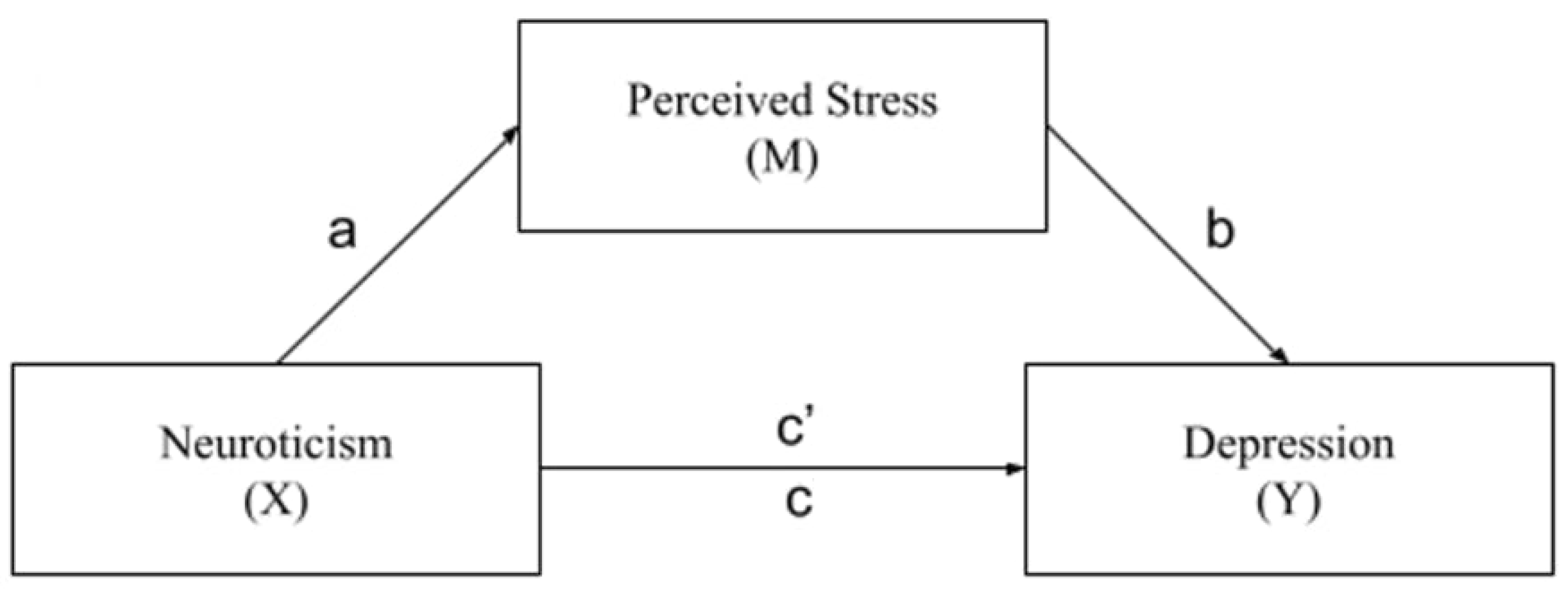
The present cross-sectional study examined associations among neuroticism, perceived stress, and depressive symptoms among Myanmar Buddhist migrants in Thailand, using culturally validated Burmese-language questionnaires. PROCESS Model 5 was used to estimate the indirect association through perceived stress and test whether Five Precept practice moderated the direct neuroticism–depressive symptoms association (the c′ path). Moderation of the neuroticism–perceived stress association (a path) and the perceived stress–depressive symptoms association (the b path) was not tested.
The study hypotheses were as follows: (1) Neuroticism would be positively associated with perceived stress and depressive symptoms, and perceived stress would be positively associated with depressive symptoms. (2) Neuroticism would have a positive indirect association with depressive symptoms through perceived stress. (3) Higher total Five Precept practice would be associated with a weaker positive direct association between neuroticism and depressive symptoms. Individual-precept analyses and categorical sensitivity analyses were treated as exploratory assessments of whether findings differed across specific practices and alternative specifications of ordinal observance scores.
2. Materials and Methods
2.1. Setting and Design
This study employed a cross-sectional design, and the survey was conducted between January and March 2026 among 205 Myanmar Buddhist migrants in Thailand. The setting included various locations where significant Myanmar migrant populations are found, such as Bangkok, Chiang Mai, Mae Sot, and Mae Hong Son. A convenience sampling method was used to recruit participants both online and in-person.
Access to the target population was facilitated through coordination with local community networks, migrant support non-governmental organizations (NGOs), and Buddhist temples. Of the 205 participants, 175 (85.4%) were recruited mainly online through community organizations and social media platforms, and 30 (14.6%) were recruited in person at Buddhist temples. Most participants resided in Mae Sot (n = 138, 67.3%) and Chiang Mai (n = 50, 24.4%), with smaller numbers in Bangkok (n = 6, 2.9%), Mae Hong Son (n = 1, 0.5%), and other areas (n = 1, 0.5%); place of residence was not reported by 9 participants (4.4%). Eligibility was assessed using mandatory screening questions at the beginning of the questionnaire, in which participants confirmed their ability to read and write Burmese and self-identified as Buddhist. Only those who met both criteria were able to proceed with the main survey.
2.2. Participants
This study included Myanmar migrants residing in Thailand. Inclusion criteria included (1) age of 40 to 65 years (selected to specifically target midlife migrants who often navigate distinct psychological stressors related to dual caregiving and financial burdens), (2) ability to read, write, and understand the Burmese language, (3) having lived in Thailand for at least 1 year, and (4) people who describe themselves as Buddhists. Exclusion criteria consisted of (1) Myanmar tourists, (2) non-Buddhists, (3) individuals with uncorrected visual or hearing impairments, and (4) those with ongoing psychiatric treatment for psychotic disorders. Individuals with uncorrected sensory impairments were excluded to ensure they could accurately comprehend and independently complete the survey materials. Those undergoing treatment for psychotic disorders were excluded because severe cognitive symptoms could compromise the validity of self-reported psychological measures. Electronic or written informed consent was obtained from all participants prior to their involvement. To ensure data confidentiality, all collected responses were completely anonymized, stored securely in password-protected files, and accessible only to the primary research team.
The target sample size was established using two complementary criteria. First, the sample-to-variable ratio guideline for multiple regression was applied, which recommends a minimum of 10 to 20 participants per predictor. Second, because greater statistical power is typically required to detect moderation effects than main effects, an a priori power analysis was conducted in G*Power 3.1. The linear multiple regression F test for an increase in R2 was specified, with α = 0.05, power = 0.80, a small-to-medium effect size (f2 = 0.05), one tested predictor (the interaction term), and 9 predictors in total. A minimum required sample of 160 participants was indicated. The final sample of 205 therefore exceeded both criteria, providing adequate power to test the hypothesized main and interaction effects.
2.3. Instruments
The questionnaire included sociodemographic items and standardized self-report measures. Sociodemographic information, such as age, sex, education, employment, income, marital status, legal status, and duration of residence in Thailand, was collected.
The original English questionnaires were translated into Burmese by professional translators at the Language Institute of Chiang Mai University. An independent bilingual translator then back-translated the Burmese versions into English. The back-translations were compared with the original instruments, and discrepancies in meaning were reviewed and resolved before the Burmese versions were finalized. These procedures were intended to support linguistic equivalence between the original and translated questionnaires; they do not, by themselves, establish cultural or psychometric validity in the target population. The following measurement scales were used to assess neurotic personality traits, perceived stress, depression, and precepts practice.
2.3.1. Neuroticism Inventory (NI)
Neuroticism Inventory (NI) consists of 15 items [29]. It is used to assess the neuroticism personality trait based on the five-factor model of personality. Participants can rate on a Likert scale from 1 (“never like me”) to 4 (“always like me”). The total score ranges from 15 to 60, with higher scores indicating greater levels of neuroticism. In the previous study by Wongpakaran et al. (2022) [29] with 644 samples, Cronbach’s alpha for the NI was 0.90, indicating excellent internal consistency. In the current study, this instrument demonstrated strong internal consistency, yielding a Cronbach’s alpha of 0.899.
2.3.2. Perceived Stress Scale (PSS-10)
This is an instrument to measure how individuals perceive stress over the past four weeks [30]. It consists of 10 items, each rated on a five-point Likert scale (0 = never to 4 = very often), with total scores ranging from 0 to 40. Higher scores indicate more significant perceived stress. In a study with 644 samples by Wongpakaran et al. in 2022 [29], the PSS-10 demonstrated good internal consistency with Cronbach’s alpha at 0.78. In this study, the PSS-10 demonstrated robust internal consistency, yielding a Cronbach’s alpha of 0.787.
2.3.3. Core Symptom Index—Depression Subscale (CSI-D)
The Core Symptom Index (CSI) is a tool developed to evaluate common psychological symptoms [31]. Participants are asked to reflect on their experiences over the past week and rate them accordingly. The full scale includes 17 items, categorized into depressive symptoms (5 items), anxiety (4 items), and somatization (6 items). Responses are recorded on a five-point Likert scale, ranging from 0 (never) to 4 (almost always), with total scores spanning from 0 to 60, where higher scores indicate greater symptom severity. For this study, only the depressive symptom subscale (CSI-D) was used, with possible scores ranging from 0 to 20. A cutoff score of ≥9 was used to identify participants screening positive for elevated depressive symptoms [reference31]. A positive screening result does not establish a diagnosis of major depressive disorder, which requires clinical assessment [31]. The CSI-D demonstrated strong internal consistency in the previous study sample of 644, as indicated by a Cronbach’s alpha of 0.79. For the current sample, the depressive symptom subscale showed high internal consistency, with a Cronbach’s alpha of 0.876.
2.3.4. Precept Practice Questionnaire (PPQ)
Precept practice was measured using the Precept Practice Questionnaire (PPQ), a five-point Likert scale ranging from 1 (Never) to 5 (Always). This scale assessed the frequency of observance of the five precepts: refraining from killing or harming all living things, stealing, sexual misconduct, lying, and consuming alcohol and drugs [32]. Higher scores indicate greater adherence to the Five Precepts. It also includes a motivational component, asking participants to select one of three options to indicate their reason for avoiding these behaviors: “I do not understand why I do not do these behaviors.” “I think they are good for everyone.”, and “I want people to think I am a good person.”, though this component was not used in this study. For the current sample, the PPQ exhibited strong internal reliability, with a Cronbach’s alpha of 0.890; however, this coefficient alone does not establish unidimensionality. We therefore evaluated a one-factor measurement model using confirmatory factor analysis (CFA).
2.4. Statistical Analysis
Quantitative data were analyzed using the Statistical Package for the Social Sciences (SPSS) Version 26.0, with the significance level established a priori at p < 0.05. Descriptive statistics were computed to summarize the socio-demographic and clinical profile of the sample. Univariate normality was assessed for core clinical variables (skewness and kurtosis within ±1.96), and collinearity diagnostics indicated the absence of multicollinearity (VIF < 10, Tolerance > 0.1). Preliminary relationships among variables were assessed using Pearson’s bivariate correlations.
To test the hypothesized pathways, a simple mediation analysis (PROCESS macro for SPSS version 5.0) was first conducted to evaluate perceived stress as a mediator between neuroticism and depressive symptoms, controlling for age, sex, and marital status.
CFA was conducted using AMOS version 24, with the five PPQ items specified as indicators of a single latent factor. Model fit was assessed using the chi-square statistic, comparative fit index (CFI), Tucker–Lewis index (TLI), and root mean square error of approximation (RMSEA) with its 90% confidence interval. No post hoc modifications were made to the CFA model.
The main analysis used the total PPQ score as a continuous moderator of the direct association between neuroticism and depressive symptoms, accounting for perceived stress (PROCESS Model 5). Exploratory follow-up analyses examined each of the five PPQ items as a continuous moderator in separate models. These item-level analyses assessed specific behavioral practices rather than independently validated subscales. Because the residual covariances were introduced after examining modification indices, the modified measurement model was considered exploratory.
Subsequently, mediation models with moderation of the direct path (PROCESS Model 5) were used to examine whether Five Precept practice moderated the direct association between neuroticism and depressive symptoms (c′ path), accounting for perceived stress and adjusting for age, gender, education, income, and marital status. The total PPQ score was entered as a continuous moderator in the main analysis. Exploratory follow-up analyses examined the five individual PPQ items (PPQ-1 through PPQ-5) as continuous moderators in separate models. To assess sensitivity to treating ordinal item scores as continuous, supplementary models specified each item as a multicategorical moderator. In these models, the four neuroticisms × category interaction terms were evaluated jointly by comparing models with and without these terms while retaining all main effects and covariates.
To address multiple comparisons, Bonferroni-adjusted p-values were calculated separately for the five continuous-item interaction tests and the five categorical omnibus interaction tests, using p_adj = min(5p, 1). Both unadjusted and adjusted p-values are reported. This correction addressed multiplicity within each set of five tests rather than across all analyses. Interaction magnitudes were summarized using unstandardized coefficients and unadjusted 95% confidence intervals, where applicable, and the incremental variance explained by the interaction terms (ΔR2). For the categorical models, Cohen’s f2 was calculated as ΔR2/(1 − R2_full).
Indirect associations were estimated using 5000 bootstrap resamples to obtain 95% bootstrap confidence intervals. Conditional direct associations were evaluated at specified moderator scores or categories and reported with unadjusted 95% confidence intervals. These conditional estimates were used to describe the fitted associations and were not interpreted as independent evidence of moderation or complete buffering (Figure 1).
Figure 1.
Conceptual mediation model of neuroticism and perceived stress predicting depressive symptoms.
3. Results
The study included 205 Myanmar Buddhist migrants with a mean age of 49.35 years (SD = 6.70). The sample was predominantly female (60.0%) and currently employed (47.8%), with the largest proportion holding a bachelor’s degree (42.9%). Geographically, most participants resided in Mae Sot (67.3%) and Chiang Mai (24.4%). Regarding legal status, most of the participants were documented (76.1%). The details are shown in Table 1.
Table 1.
Socio-demographic characteristics of the participants (n = 205).
The descriptive statistics for the primary clinical variables, including Neuroticism (NI), depressive symptoms (CSI-D), Perceived Stress (PSS), and Precept Practice (PPQ), are summarized in Table 2. Participants reported a mean Neuroticism score of 35.22 (SD = 8.87), with scores ranging from 15 to 59. Regarding symptom burden, the sample exhibited a mean score of 4.70 (SD = 4.07) for depressive symptoms and 18.68 (SD = 5.99) for perceived stress. For the moderator variable, the PPQ mean score was 21.34 (SD = 4.47). The elevated mean score and the corresponding negative skewness of the PPQ indicate that most participants within this migrant sample reported high levels of daily ethical observance.
Table 2.
Descriptive statistics of clinical variables.
When evaluating these variables categorically (Table 3), a high prevalence of psychological distress was observed. Based on the established cutoff score of ≥9 for the CSI-D subscale, 15.6% (n = 32) of the sample met the criteria for elevated depressive symptoms. For perceived stress, the majority of participants (76.6%, n = 157) reported moderate stress, with an additional 7.3% (n = 15) reporting high stress. Due to the absence of universal cutoffs for the NI and the PPQ, categories were established using sample-mean and standard-deviation boundaries. For neuroticism, 63.4% (n = 130) of the sample fell into the moderate category, while 16.6% (n = 34) exhibited high neuroticism. Despite these elevated distress levels, adherence to the Five Precepts remained robust, with 62.9% (n = 129) of the sample exhibiting high adherence and only 6.8% (n = 14) reporting low adherence.
Table 3.
Prevalence rates and categorical distribution of clinical variables.
Table 4 presents bivariate correlation analyses revealing that depressive symptoms were positively correlated with perceived stress and neuroticism, which were also positively associated with each other. Gender was significantly associated with depressive symptoms, perceived stress, neuroticism, and precept practice; the direction of these associations should be interpreted according to the gender coding. Higher income was associated with lower perceived stress and neuroticism. Education was negatively associated with neuroticism and precept practice. Precept practice showed a weak positive association with neuroticism but was not significantly correlated with depressive symptoms or perceived stress.
Table 4.
Correlation matrix among variables.
A mediation analysis using the PROCESS macro was conducted to assess the indirect effect of neuroticism on depressive symptoms through perceived stress, controlling for age, sex, and marital status. Table 5 presents a summary of this analysis. In the first step, neuroticism significantly and positively predicted perceived stress (β = 0.386, p < 0.001), with the model explaining 37.8% of the variance in perceived stress (F (4, 195) = 29.57, p < 0.001). When both neuroticism and perceived stress were included as predictors of depressive symptoms, perceived stress remained a strong positive predictor (β = 0.273, p < 0.001), while the direct effect of neuroticism also remained significant (β = 0.087, p = 0.010). The overall model accounted for 35.7% of the variance in depressive symptoms (F (5, 194) = 21.54, p < 0.001). These findings confirm that perceived stress partially mediates the relationship between neuroticism and depressive symptoms.
Table 5.
Summary of mediation analysis of neuroticism and perceived stress predicting depressive symptoms (controlling for age, sex, and marital status).
3.1. PPQ Measurement Structure
The initial one-factor CFA without correlated residuals showed inadequate overall fit, χ2(5) = 56.758, p < 0.001, CFI = 0.927, TLI = 0.854, and RMSEA = 0.225, 90% CI [0.175, 0.280]. Standardized factor loadings ranged from 0.60 to 0.95. A modified one-factor model allowing three residual covariances showed improved fit, χ2(2) = 2.065, p = 0.356, CFI = 1.000, TLI = 1.000, and RMSEA = 0.013, 90% CI [0.000, 0.140], with standardized loadings ranging from 0.57 to 0.97. Although these findings indicate a common factor underlying the five items, the inadequate fit of the initial model and the additional residual relationships in the modified model do not provide clear support for a simple unidimensional structure. Accordingly, the total PPQ score was interpreted as an overall index of observance rather than a confirmed unidimensional measure (Figure 2).
Figure 2.
Conceptual mediation model with Five Precept practice moderating the direct association between neuroticism and depressive symptoms (PROCESS Model 5).
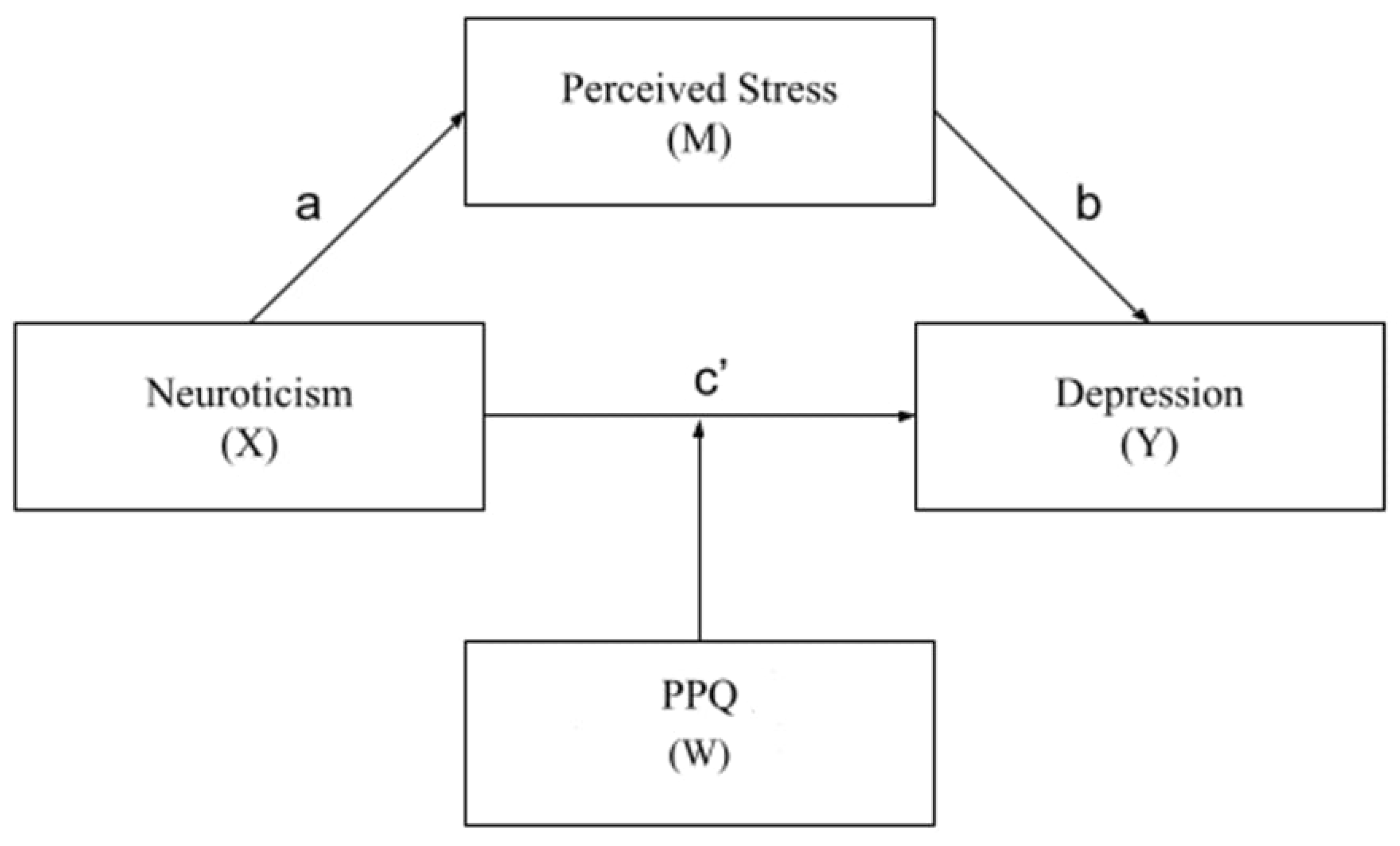
A mediation model with moderation of the direct path (PROCESS Model 5) was used to examine whether precept practice moderated the direct association between neuroticism and depressive symptoms, accounting for perceived stress (Table 6). The interaction between neuroticism and the total PPQ score, entered as a continuous moderator, was not statistically significant at the 0.05 level (p = 0.072). Exploratory follow-up analyses examined the individual PPQ items in separate models. Findings from these analyses were interpreted as item-specific moderation patterns rather than evidence of effects shared uniformly across the Five Precepts (Table 7).
Table 6.
Regression results for PROCESS Model 5, with total Five Precept practice (PPQ) as a moderator of the direct association between neuroticism and depressive symptoms.
Table 7.
Conditional direct associations between neuroticism and depressive symptoms in the continuous-item PROCESS Model 5 analyses (N = 205).
3.2. Categorical Sensitivity Analyses
To assess sensitivity to treating the five-point ordinal item scores as continuous, supplementary analyses modeled observance levels as distinct categories (Table 8). After Bonferroni correction for the five omnibus interaction tests, only the interaction for refraining from intoxicants (PPQ-5) remained statistically significant (unadjusted p = 0.0003; adjusted p = 0.0015). The interaction for refraining from false speech (PPQ-4) was significant before correction but did not survive adjustment (unadjusted p = 0.0127; adjusted p = 0.0635).
Table 8.
Categorical sensitivity analyses of individual precepts using PROCESS Model 5, with interaction effect sizes and Bonferroni correction.
In the categorical sensitivity analyses, only the neuroticism × PPQ-5 omnibus interaction remained statistically significant after Bonferroni correction, F (4, 189) = 5.58, adjusted p = 0.0015. This interaction explained an additional 6.84% of the variance in depressive symptoms (ΔR2 = 0.0684, Cohen’s f2 = 0.131). The PPQ-4 interaction was significant before correction but did not survive adjustment (unadjusted p = 0.0127; adjusted p = 0.0635). The remaining omnibus interactions were nonsignificant. The PPQ-5 findings indicate variation in the neuroticism–depressive symptoms association across observance categories, rather than a consistently decreasing association with increasing observance.
4. Discussion
This study examined the relationships among neuroticism, perceived stress, and depressive symptoms and investigated whether observance of the Five Precepts moderated the direct association between neuroticism and depressive symptoms among Myanmar Buddhist migrants in Thailand. To contextualize the differences between this sample and the previously studied Thai sample, it is important to account for the differing lived realities of the two samples. The Thai group was a general population, younger on average (mean age 28.28), whereas the Myanmar migrants were older (mean age 49.31), with most having resided in Thailand for only one to three years, during and after Myanmar’s 2021 political crisis [33]. Although migration-related adversity was not directly measured, the broader literature suggests that migrants in this context may experience political trauma, displacement, financial insecurity, and caregiving responsibilities. These contextual differences may help explain the somewhat higher neuroticism score in the Myanmar sample than in the previously studied Thai sample (35.22 versus 33.4), but this explanation remains speculative. Age-related differences in emotional regulation may also be relevant [34]; however, the present findings do not establish that middle age protected participants against migration-related distress.
The findings were consistent with previous evidence linking neuroticism, perceived stress, and depressive symptoms. Higher neuroticism was associated with greater perceived stress, consistent with research suggesting that individuals higher in neuroticism experience stronger emotional responses to daily stressors [35]. This comparison is relevant because earlier findings suggest that emotional reactivity, rather than exposure to stressors alone, contributes to distress. However, the present study assessed perceived stress rather than daily stress exposure or emotional reactivity, so it cannot directly establish that mechanism.
The significant indirect association between neuroticism and depressive symptoms through perceived stress also converges with findings reported among young adults in Colombia [12], older Thai patients [14], and a general Thai adult sample [2]. The use of the same neuroticism and perceived stress measures in the two Thai studies strengthens the conceptual comparability of these findings, although differences in age, recruitment, and social context limit direct comparisons of their magnitude. The present study extends this pattern of associations to a sample of midlife Myanmar Buddhist migrants in Thailand. Nevertheless, this convergence should not be interpreted as demonstrating an identical mechanism across populations. Migration-related circumstances may shape stress appraisal, but these circumstances were not directly measured. Moreover, cross-sectional design cannot establish whether neuroticism preceded perceived stress and depressive symptoms or ruled out reciprocal relationships.
The positive association between neuroticism and depressive symptoms, together with the indirect association through perceived stress, is consistent with previous research and with the Stress Perception Hypothesis health [36]. Individuals with higher neuroticism may be more sensitive to perceived threats and more likely to appraise stressful circumstances negatively, which may increase vulnerability to psychological distress health [37]. These proposed processes may be particularly relevant among Myanmar Buddhist migrants, whose experiences may include displacement, financial difficulties, legal uncertainty, family responsibilities, and other challenges associated with migration. Despite the geographical proximity and cultural similarities between Myanmar and Thailand, social determinants and difficulties integrating into Thai society may remain influential on mental health [36]. Among undocumented Myanmar people in Thailand, one study reported substantial mental and physical health difficulties, alongside barriers to navigating the healthcare system [37]. These contextual considerations provide possible explanations for the observed associations but were not directly evaluated in this study. The observed indirect association is therefore compatible with a role for subjective stress appraisal but does not establish this explanatory mechanism.
Evidence for moderation by precept observance was more limited and depended on model specification. Previous studies provide contextual evidence linking social and economic adversity with mental health difficulties among Myanmar migrants [28]. In a survey of 360 documented Myanmar migrant workers in Chiang Mai, 14.4% screened positive for depression; associated factors included female sex, residence in Thailand for more than 10 years, living with co-workers, and a marginalized acculturation pattern [38]. Among 224 displaced Myanmar adults receiving treatment for hypertension or diabetes in Thailand, more than one-third had moderate-to-severe mental health problems. Greater symptom severity was associated with debt and poor financial circumstances, comorbidity, and poor sleep [39]. Among 165 young Myanmar migrant workers, 47.9% reported depressive symptoms, and workplace, security, and living stressors were associated with greater symptom severity [36]. Although these findings concern stress-related circumstances and mental health, the cited studies did not examine neuroticism or test the combination of personality, perceived stress, and precept practice investigated here. They therefore provide contextual support rather than direct evidence for the proposed moderated mediation model.
Wongpakaran and colleagues surveyed 644 adults from the general Thai population (74.2% female; mean age = 28.28 years, SD = 10.6; 93.3% Buddhist) [2]. Religious involvement was not assessed. Five Precept practice moderated the association between perceived stress and depressive symptoms, whereas the interaction involving neuroticism was not statistically significant. The predominantly female, relatively young Thai sample and the absence of a measure of religious involvement limit direct generalization to midlife Myanmar Buddhist migrants.
These findings do not support interpreting precept observance as a consistent moderator of the association between neuroticism and depressive symptoms. Differences across continuous and categorical specifications suggest that conclusions may depend on how observance is modeled, underscoring the need for caution in interpretation. The finding concerning refraining from intoxicants should be considered exploratory and requires independent replication. Future studies using prespecified analyses and longitudinal designs could clarify whether, and under what conditions, individual precepts are associated with variation in the relationship between neuroticism and depressive symptoms. The individual-precept analyses require particular caution. The conditional direct associations reported in Table 7 describe the estimated neuroticism–depressive symptoms association at selected observance scores; they do not independently establish moderation. In particular, a statistically significant conditional association at one score and a nonsignificant association at another do not demonstrate that the two associations differ. A nonsignificant conditional association at the highest observance score should not be interpreted as evidence that the neuroticism–depressive symptoms association was eliminated or completely buffered.
Moreover, the significant categorical PPQ-5 interaction indicated differences across observance categories rather than a consistently decreasing association with increasing observance. Although this omnibus interaction survived correction, its nonmonotonic pattern does not establish a dose–response relationship or a uniformly protective effect. It should therefore be interpreted as an exploratory, specification-dependent finding requiring replication.
Differences between the continuous and categorical models reflect their functional form of assumptions, not the choice of reference category. Changing the reference category alters individual interaction contrasts but leaves the estimated conditional association within each category and the omnibus interaction test unchanged. The continuous models constrain the neuroticism–depressive symptoms association to change linearly across observance scores, whereas the categorical models estimate category-specific associations without this constraint. In the final analysis, the PPQ-1 conditional association at the highest observance level was positive in both specifications. Neither PPQ-1 interaction remained significant after Bonferroni correction.
Ethical practices involving non-harming, truthful interpersonal conduct, and behavioral restraint may nevertheless represent culturally meaningful resources. Previous research has linked related practices to moral identity, interpersonal trust, and self-worth [38,39].
Culturally embedded ethical practices may also be relevant to understanding how migrants experience meaning, identity, and social connection in relation to mental health. However, these possibilities were not directly assessed in this study, and the exploratory, specification-dependent findings do not demonstrate that Five Precept observance prevents depressive symptoms or establishes its effectiveness as an intervention.
These mechanisms offer hypotheses for future investigation rather than explanations established by the present analyses. In particular, the PPQ-5 finding warrants replication with adequate representation across observance categories and direct assessment of relevant behavioral and psychosocial mechanisms.
Cultural specificity may also contribute to differences between the present findings and those reported in Thai samples [2]. Although the Five Precepts constitute a shared Buddhist ethical framework, their interpretation and everyday practice may vary across national, ethnic, and local communities. In Myanmar Buddhist contexts, observance has been described in relation to merit-making and support for the monastic community [40], with further variation across ethnic groups [41]. Differences in ritual participation and communal religious activities may also shape how observance is experienced [42]. Importantly, neither Myanmar nor Thai Buddhist practice should be treated as culturally uniform. Myanmar communities in Thailand may retain distinctive religious traditions [43], while migration may alter access to familiar religious networks and opportunities for collective practice [44,45]. These factors may influence both the psychosocial meaning of observance and how participants interpret and answer PPQ items. Consequently, equivalent reported frequencies of observance may not necessarily reflect equivalent motivations, religious engagement, or social resources across samples. However, these cultural dimensions and the cross-cultural measurement equivalence of the PPQ were not directly assessed. Cultural explanations for the differing results therefore remain tentative and warrant investigation through qualitative research and cross-cultural measurement studies.
The scope of the moderation of findings should also be distinguished from the role of perceived stress. PROCESS Model 5 specifies moderation of the direct neuroticism–depressive symptoms association, not of the perceived stress–depressive symptoms pathway. Consequently, these analyses cannot establish whether precept observance buffers the association between perceived stress and depressive symptoms. More broadly, religious and ethical resources may coexist with substantial distress arising from sustained external adversity [18,46]. Evaluating their potential buffering role requires models that explicitly test the relevant pathway, ideally using longitudinal data and direct measures of migration-related stressors.
These findings have tentative implications for healthcare practice and public health programs among Myanmar migrant communities. Voluntary, culturally appropriate engagement with Buddhist ethical practices may be considered as a potential source of meaning and social connection, rather than as an intervention whose effectiveness is demonstrated by this study. The exploratory and specification-dependent results do not justify recommending greater observance as a proven means of preventing depressive symptoms. Such practices should not be viewed as substitutes for interventions addressing severe or ongoing external stressors. Mental health support for migrants may benefit from an integrated approach that combines culturally grounded psychological resources with practical assistance addressing legal status, employment, financial insecurity, safety, and other structural determinants of well-being. Trauma-informed and culturally responsive approaches may therefore be particularly relevant for populations experiencing displacement and prolonged adversity [46,47].
Several limitations should be considered. First, the cross-sectional design precludes temporal or causal conclusions. Longitudinal research is needed to examine how these relationships change over time. Second, self-reported precept practice may be susceptible to social desirability bias despite anonymity and the use of Burmese-language measures. Third, although PPQ internal consistency was good, the initial one-factor CFA showed inadequate fit. The modified model fitted better but required three correlated residuals, limiting support for unidimensionality. The total score may therefore obscure item-specific relationships and requires further validation. Fourth, the individual-precept analyses were exploratory, relied on single items, and produced findings sensitive to continuous versus categorical specification. Unadjusted multiple comparisons increased the risk of false-positive findings. Separate models do not establish each precept’s unique contribution, and differences in statistical significance do not demonstrate differences between effects. Likewise, a nonsignificant conditional association does not establish complete protection against depressive symptoms. Residual confounding remains possible because legal status, residential area, and residence duration were not included in the models; their nonsignificant bivariate associations do not rule out confounding. Education and income were modeled as ordinal numeric covariates, assuming linear trends across categories. Robustness to alternative adjustment sets and coding schemes was not evaluated. Finally, the focus on Myanmar Buddhist migrants in Thailand limits generalizability. Replication in diverse populations and independent samples is needed.
5. Conclusions
This cross-sectional study examined the associations among neuroticism, perceived stress, Five Precept practice, and depressive symptoms among Myanmar Buddhist migrants in Thailand. Neuroticism was associated with depressive symptoms both directly and indirectly through perceived stress in the fitted models; however, the temporal ordering of these associations cannot be established. The interaction involving total Five Precept practice was not statistically significant, and exploratory individual-precept findings were inconsistent across model specifications. These results do not establish Five Precept practice as a protective psychological resource. Culturally appropriate mental health approaches remain an important consideration for migrant populations, but whether incorporating Buddhist ethical practices offers additional benefits requires longitudinal and intervention research.
Author Contributions
Conceptualization, M.H.P., T.W., K.A., Z.K., R.R.O. and J.D.; methodology, M.H.P., T.W., K.A. and Z.K.; software, M.H.P. and T.W.; validation, M.H.P., T.W., K.A., Z.K. and R.R.O.; formal analysis, M.H.P., T.W. and J.D.; investigation, M.H.P., T.W., K.A., Z.K., R.R.O. and J.D.; resources, M.H.P. and T.W.; data curation, M.H.P. and T.W.; writing—original draft preparation, M.H.P.; writing—review and editing, T.W., K.A., Z.K., R.R.O. and J.D.; visualization, M.H.P.; supervision, T.W., K.A., Z.K. and R.R.O.; project administration, T.W. All authors have read and agreed to the published version of the manuscript.
Funding
This research received no external funding.
Institutional Review Board Statement
The study was conducted in accordance with the Declaration of Helsinki and was approved by the Ethics Committee of the Faculty of Medicine, Chiang Mai University (protocol code PSY-2568-0490; date of approval 12 November 2025).
Informed Consent Statement
Informed consent was obtained from all subjects involved in the study.
Data Availability Statement
The datasets used and/or analyzed during the current study are available from the corresponding author upon reasonable request.
Acknowledgments
The authors thank all participants in this study. Mya Hnin Phyu thanks Chiang Mai University for the support through the Presidential Scholarship (PS) during her master’s study in the Master of Science in Mental Health (International Program) at the Multidisciplinary and Interdisciplinary School (2024–2026).
Conflicts of Interest
The authors declare no conflicts of interest.
Abbreviations
The following abbreviations are used in this manuscript:
| CSI-D | Core Symptom Index for Depressive symptom Subscale |
| Dep | Depressive Symptoms |
| NI | Neuroticism Inventory |
| Neuro | Neuroticism |
| PPQ | Precept Practice Questionnaire |
| PPQ-1 | Precept Practice Questionnaire—Refraining from killing |
| PPQ-2 | Precept Practice Questionnaire—Refraining from stealing |
| PPQ-3 | Precept Practice Questionnaire—Refraining from sexual misconduct |
| PPQ-4 | Precept Practice Questionnaire—Refraining from lying |
| PPQ-5 | Precept Practice Questionnaire—Refraining from intoxication |
| PSS | Perceived Stress Scale |
| SD | Standard Deviation |
| SE | Standard Error |
| VIF | Variance Inflation Factor |
References
- Lehtinen, V.; Joukamaa, M. Epidemiology of depression: Prevalence, risk factors and treatment situation. Acta Psychiatr. Scand. 1994, 89, 7–10. [Google Scholar] [CrossRef] [Scilit]
- Wongpakaran, N.; Pooriwarangkakul, P.; Suwannachot, N.; Mirnics, Z.; Kövi, Z.; Wongpakaran, T. Moderating role of observing the five precepts of Buddhism on neuroticism, perceived stress, and depressive symptoms. PLoS ONE 2022, 17, e0277351. [Google Scholar] [CrossRef] [Scilit]
- Dobrek, L.; Głowacka, K. Depression and its phytopharmacotherapy—A narrative review. Int. J. Mol. Sci. 2023, 24, 4772. [Google Scholar] [CrossRef] [Scilit]
- Ibrahim, A.K.; Kelly, S.J.; Adams, C.E.; Glazebrook, C. A systematic review of studies of depression prevalence in university students. J. Psychiatr. Res. 2013, 47, 391–400. [Google Scholar] [CrossRef] [Scilit]
- Richards, D. Prevalence and clinical course of depression: A review. Clin. Psychol. Rev. 2011, 31, 1117–1125. [Google Scholar] [CrossRef] [Scilit]
- Barnhofer, T.; Chittka, T. Cognitive reactivity mediates the relationship between neuroticism and depression. Behav. Res. Ther. 2010, 48, 275–281. [Google Scholar] [CrossRef] [Scilit]
- Widiger, T.A.; Oltmanns, J.R. Neuroticism is a fundamental domain of personality with enormous public health implications. World Psychiatry 2017, 16, 144. [Google Scholar] [CrossRef] [Scilit]
- Hodgins, S.; Ellenbogen, M. Neuroticism and depression. Br. J. Psychiatry 2003, 182, 79–80. [Google Scholar] [CrossRef] [Scilit]
- Chen, X.; Pu, J.; Shi, W.; Zhou, Y. The impact of neuroticism on symptoms of anxiety and depression in elderly adults: The mediating role of rumination. Curr. Psychol. 2020, 39, 42–50. [Google Scholar] [CrossRef] [Scilit]
- Wongpakaran, N.; Wongpakaran, T.; Van Reekum, R. Social inhibition as a mediator of neuroticism and depression in the elderly. BMC Geriatr. 2012, 12, 41. [Google Scholar] [CrossRef] [Scilit]
- Liu, C.; Chen, L.; Chen, S. Influence of neuroticism on depressive symptoms among Chinese adolescents: The mediation effects of cognitive emotion regulation strategies. Front. Psychiatry 2020, 11, 420. [Google Scholar] [CrossRef] [Scilit]
- Pereira-Morales, A.J.; Adan, A.; Forero, D.A. Perceived stress as a mediator of the relationship between neuroticism and depression and anxiety symptoms. Curr. Psychol. 2019, 38, 66–74. [Google Scholar] [CrossRef] [Scilit]
- Heinen, I.; Bullinger, M.; Kocalevent, R.-D. Perceived stress in first year medical students—associations with personal resources and emotional distress. BMC Med. Educ. 2017, 17, 4. [Google Scholar] [CrossRef] [Scilit]
- Banjongrewadee, M.; Wongpakaran, N.; Wongpakaran, T.; Pipanmekaporn, T.; Punjasawadwong, Y.; Mueankwan, S. The role of perceived stress and cognitive function on the relationship between neuroticism and depression among the elderly: A structural equation model approach. BMC Psychiatry 2020, 20, 25. [Google Scholar] [CrossRef] [Scilit]
- Bonelli, R.; Dew, R.E.; Koenig, H.G.; Rosmarin, D.H.; Vasegh, S. Religious and spiritual factors in depression: Review and integration of the research. Depress. Res. Treat. 2012, 2012, 962860. [Google Scholar] [CrossRef] [Scilit]
- Braam, A.W.; Koenig, H.G. Religion, spirituality and depression in prospective studies: A systematic review. J. Affect. Disord. 2019, 257, 428–438. [Google Scholar] [CrossRef] [Scilit]
- Berg, G. The relationship between spiritual distress, PTSD and depression in Vietnam combat veterans. J. Pastor. Care Couns. 2011, 65, 1–11. [Google Scholar] [CrossRef] [Scilit]
- Hasanović, M.; Pajević, I. Religious moral beliefs as mental health protective factor of war veterans suffering from PTSD, depressiveness, anxiety, tobacco and alcohol abuse in comorbidity. Psychiatr. Dan. 2010, 22, 203–210. [Google Scholar]
- Dahlke, P.; Sīlācāra, B.; Oates, L.; Lounsbery, G.C. The Five Precepts; Buddhist Publication Society: Colombo, Sri Lanka, 1963. [Google Scholar]
- McCullough,, M.E.; Willoughby, , B.L.B. Religion, self-regulation, and self-control: Associations, explanations, and implications. Psychol. Bull. 2009, 135, 69–93. [Google Scholar] [CrossRef] [Scilit]
- Hang, H. Analysis of Moral Impact and Practices of the Five Precepts by Cambodian Buddhism. ShodhPatra Int. J. Sci. Humanit. 2025, 2, 79–88. [Google Scholar] [CrossRef] [Scilit]
- Vajira, V. Promoting the Buddhist Five Precepts of People of Mahar Aung Myay Township, Mandalay, Myanmar. J. Int. Assoc. Buddh. Univ. (JIABU) 2019, 12, 106–117. [Google Scholar]
- Virupaksha, H.; Kumar, A.; Nirmala, B.P. Migration and mental health: An interface. J. Nat. Sci. Biol. Med. 2014, 5, 233. [Google Scholar] [CrossRef] [Scilit]
- Meyer, S.R.; Lasater, M.; Tol, W.A. Migration and mental health in low-and middle-income countries: A systematic review. Psychiatry 2017, 80, 374–381. [Google Scholar] [CrossRef] [Scilit]
- Khai, T.S.; Asaduzzaman, M. ‘I Doubt Myself and Am Losing Everything I Have since COVID Came’—A Case Study of Mental Health and Coping Strategies among Undocumented Myanmar Migrant Workers in Thailand. Int. J. Environ. Res. Public Health 2022, 19, 15022. [Google Scholar] [CrossRef] [Scilit]
- Bhardwaj, U.; Sharma, V.; George, S.; Khan, A. Mental health risk assessment in selected Urban Slum of Delhi—A survey report. J. Nurs. Sci. Pract. 2012, 1, 116–122. [Google Scholar]
- Kirkbride, J.B.; Anglin, D.M.; Colman, I.; Dykxhoorn, J.; Jones, P.B.; Patalay, P.; Pitman, A.; Soneson, E.; Steare, T.; Wright, T. The social determinants of mental health and disorder: Evidence, prevention and recommendations. World Psychiatry 2024, 23, 58–90. [Google Scholar] [CrossRef] [Scilit]
- Meyer, S.R.; Decker, M.R.; Tol, W.A.; Abshir, N.; Mar, A.A.; Robinson, W.C. Workplace and security stressors and mental health among migrant workers on the Thailand–Myanmar border. Soc. Psychiatry Psychiatr. Epidemiol. 2016, 51, 713–723. [Google Scholar] [CrossRef] [Scilit]
- Wongpakaran, T.; Wongpakaran, N. The Effect of Neuroticism on Academic Performance and Quality of Life in Third-Year Medical Students, Chiang Mai University. Chaing Mai: Chaing Mai University 2013. Available online: https://www.wongpakaran.com/index.php?lay=show&ac=article&Id=2147664678 (accessed on 10 November 2026).
- Wongpakaran, N.; Wongpakaran, T. Research The Thai version of the PSS-10: An Investigation of its psychometric properties. Biopsychosoc. Med. 2010, 4, 6. [Google Scholar]
- Wongpakaran, N.; Wongpakaran, T.; Lertkachatarn, S.; Sirirak, T.; Kuntawong, P. Core Symptom Index (CSI): Testing for bifactor model and differential item functioning. Int. Psychogeriatr. 2019, 31, 1769–1779. [Google Scholar] [CrossRef] [Scilit]
- DeMaranville, J.; Wongpakaran, T.; Wongpakaran, N.; Wedding, D. Meditation and Five Precepts Mediate the Relationship between Attachment and Resilience. Children 2022, 9 371. [Google Scholar] [CrossRef] [Scilit]
- Win, N.; Hounnaklang, N.; Tantirattanakulchai, P.; Panza, A. The impact of stressors on depressive symptoms among youth Myanmar migrant workers in Thailand: A cross-sectional study. Psychol. Res. Behav. Manag. 2024, 17, 2653–2663. [Google Scholar] [CrossRef] [Scilit]
- Haehner, P.; Hopwood, C.J.; Schellenberg, L.; Schwaba, T.; Bleidorn, W. Individual differences in personality trait changes across the lifespan: A meta-analysis of longitudinal studies. Psychol. Bull. 2026, 152, 420. [Google Scholar] [CrossRef] [Scilit]
- Bolger, N.; Schilling, E.A. Personality and the problems of everyday life: The role of neuroticism in exposure and reactivity to daily stressors. J. Personal. 1991, 59, 355–386. [Google Scholar] [CrossRef] [Scilit]
- Aung, T.N.N.; Shirayama, Y.; Moolphate, S.; Lorga, T.; Angkurawaranon, C.; Yuasa, M.; Aung, M.N. Prevalence and social determinants of depression: A cross-sectional survey of Myanmar migrant workers in Chiang Mai, Northern Thailand. Glob. Public Health 2024, 19, 2334316. [Google Scholar] [CrossRef] [Scilit]
- Bass, J.K.; Nguyen, A.; Sornlorm, K.; Oo, Y.H.; Sappayabanphot, J.; Lee, C.; Laohasiriwong, W. Mental and behavioral health problems among displaced Myanmar adults exhibiting suboptimal adherence to chronic disease medication treatment in Thailand. J. Migr. Health 2024, 10, 100279. [Google Scholar] [CrossRef] [Scilit]
- Ariyabuddhiphongs, V.; Hongladarom, C. Violation of Buddhist five precepts, money consciousness, and the tendency to pay bribes among organizational employees in Bangkok, Thailand. Arch. Psychol. Relig. 2011, 33, 325–344. [Google Scholar] [CrossRef] [Scilit]
- Ariyabuddhiphongs, V.; Jaiwong, D. Observance of the Buddhist five precepts, subjective wealth, and happiness among Buddhists in Bangkok, Thailand. Arch. Psychol. Relig. 2010, 32, 327–344. [Google Scholar] [CrossRef] [Scilit]
- Spiro, M.E. Buddhism and Society: A Great Tradition and Its Burmese Vicissitudes; Univ of California Press: Oakland, CA, USA, 1982. [Google Scholar]
- Hayami, Y. Pagodas and prophets: Contesting sacred space and power among Buddhist Karen in Karen State. J. Asian Stud. 2011, 70, 1083–1105. [Google Scholar] [CrossRef] [Scilit]
- Thara, T. Observing the Sabbath in Buddhist Cultures: A Cross-Cultural Perspective Between Thai and Burmese Practices. J. MCU Kosai Rev. 2025, 3, 111–120. [Google Scholar]
- Murakami, T. Buddhism on the Border: Shan Buddhism and Transborder Migration in Northern Thailand (<Special Issue> De-institutionalizing Religion in Southeast Asia). Southeast Asian Stud. 2012, 1, 365–393. [Google Scholar] [CrossRef] [Scilit]
- Bodeker, G.; Neumann, C.; Lall, P.; Oo, Z.M. Traditional medicine use and healthworker training in a refugee setting at the Thai–Burma border. J. Refug. Stud. 2005, 18, 76–99. [Google Scholar] [CrossRef] [Scilit]
- Kesornsri, S.; Sitthimongkol, Y.; Punpuing, S.; Vongsirimas, N.; Hegadoren, K.M. Mental health and related factors among migrants from Myanmar in Thailand. J. Popul. Soc. Stud. 2019, 27, 124–138. [Google Scholar] [CrossRef] [Scilit]
- Orang, T.M.; Missmahl, I.; Gardisi, M.; Kluge, U. Rethinking mental health care provided to migrants and refugees; a randomized controlled trial on the effectiveness of Value Based Counseling, a culturally sensitive, strength-based psychological intervention. PLoS ONE 2023, 18, e0283889. [Google Scholar] [CrossRef] [Scilit]
- Bhatia, P.; McLaren, H.; Huang, Y. Exploring social determinants of mental health of older unforced migrants: A systematic review. The Gerontologist 2024, 64, gnae003. [Google Scholar] [CrossRef] [Scilit]

Disclaimer/Publisher’s Note: The statements, opinions and data contained in all publications are solely those of the individual author(s) and contributor(s) and not of MDPI and/or the editor(s). MDPI and/or the editor(s) disclaim responsibility for any injury to people or property resulting from any ideas, methods, instructions or products referred to in the content. |
© 2026 by the authors. Licensee MDPI, Basel, Switzerland. This article is an open access article distributed under the terms and conditions of the Creative Commons Attribution (CC BY) license.