


Highlights
Public health relevance—How does this work relate to a public health issue?
- Hair and other personal care products may contribute to exposure to chemicals of public health concern, yet little is known about perceived breast cancer risk related to hair product use among women in sub-Saharan Africa.
- Among 744 women in Embu and Nakuru Counties, Kenya, three distinct profiles of perceived breast cancer risk were identified, with substantial differences in concern, behavioral intentions, and interest in information about hair product ingredients.
Public health significance—Why is this work of significance to public health?
- Women with very high perceived breast cancer risk reported the greatest concern and strongest intentions to modify hair product practices, but perceived risk was not associated with lower hair product use.
- The findings highlight an intention–behavior gap and suggest that risk awareness alone may be insufficient to change personal care product use when practical, cultural, and structural barriers persist.
Public health implications—What are the key implications or messages for practitioners, policy makers and/or researchers in public health?
- Public health interventions should extend beyond risk communication to provide actionable guidance, affordable safer alternatives, clearer ingredient labeling, and culturally responsive approaches to hair product use.
- Collaboration among public health agencies, manufacturers, community leaders, cosmetologists, and researchers may help support safer product choices and advance health equity in Kenya.
Abstract
Breast cancer (BC) is the leading cancer among women, with rising incidence in sub-Saharan Africa. Personal care products (PCPs), including hair products, contain endocrine-disrupting chemicals and carcinogens implicated in BC risk, yet evidence is largely from Western populations. We examined perceived BC risk and its association with hair product use among women in Embu and Nakuru Counties, Kenya. A cross-sectional survey of 744 women aged 15–50 years conducted in May–July 2023 assessed perceived BC risk related to hair product use. Latent class analysis (LCA) identified risk profiles, and multivariable logistic regression examined associations between risk class and PCP use in the prior 7–14 days. LCA identified three risk classes: no/low (11.0%), high (42.7%), and very high (46.2%). Classes differed in concern, behavioral intentions, and information-seeking about hair product ingredients, with the very high-risk class reporting the greatest concern and intention to change practices. However, perceived risk was not associated with lower hair product use after correction for multiple comparisons. Perceived BC risk was associated with greater concern and intention to change hair product practices, but not lower product use. Culturally responsive interventions are needed to translate risk awareness into behavior change and safer PCP use.
1. Introduction
Cancer remains a serious global health challenge, claiming millions of lives annually and affecting survivors’ quality of life. Among its various forms, breast cancer (BC) is the most frequently diagnosed cancer and a leading cause of cancer-related deaths among women worldwide [1,2]. Incidence and mortality rates vary across regions, with transitioning countries, like Kenya, bearing a disproportionately higher burden [2].
While the precise etiology of BC remains incompletely understood, both non-modifiable and modifiable risk factors contribute to its development [3]. Non-modifiable factors include age, family history, genetic predisposition, and reproductive history, among others. Modifiable factors include increased adiposity, alcohol consumption, smoking, physical inactivity, and postmenopausal hormone replacement therapy [3]. Modifiable risk factors offer opportunities for intervention, including maintaining a healthy body weight, limiting alcohol consumption, and engaging in regular physical activity. Furthermore, chronic exposure to industrial chemicals has emerged as a significant risk factor [4], with substances such as bisphenol A (BPA) and propylparaben implicated in breast carcinogenesis [5].
Personal care products (PCPs), particularly hair products, frequently contain endocrine-disrupting chemicals (EDCs) [6,7,8]. Phthalates are commonly used as plasticizers and fragrance stabilizers, while parabens serve as preservatives. Both EDCs can mimic or interfere with estrogen signaling and have been detected in breast tissue and tumors [9,10,11,12,13,14]. Formaldehyde-releasing preservatives, classified as human carcinogens, are also common in PCPs [15]. Cumulative daily exposure to these chemicals through routine product use underscores the need for stricter regulation and consumer awareness of their potential contribution to BC risk [16]. Certain PCPs contain hormonally active chemicals, including EDCs and carcinogens, implicated in BC risk, yet evidence comes almost exclusively from Western populations. While BC incidence is rising in sub-Saharan Africa and PCPs may contribute to exposure to hormonally active chemicals, little is known about how African women perceive PCP-related BC risk or whether these perceptions influence product use.
Epidemiologic data underscore disparities in chemical exposures from PCPs, particularly among marginalized groups [17]. Furthermore, United States (US)-based studies suggest associations between hair product use and increased risk of breast and other hormone-related cancers, particularly among Black and African American women [18,19,20,21,22,23]. This association may be exacerbated by sociocultural pressures around hair aesthetics, often influenced by societal norms that idealize Eurocentric beauty standards, including straight hair. Black and African American women may feel pressure to use hair-straightening products that contain EDCs such as parabens and phthalates and carcinogens such as formaldehyde, which have been linked to hormonal dysregulation and cancer risk [21,23,24]. Understanding women’s perceptions and attitudes toward hair product use in the context of perceived BC risk is crucial.
To address this gap, this study assessed BC risk perceptions related to hair product use among women in Embu and Nakuru Counties, Kenya. Using latent class analysis (LCA), the study identified distinct subgroups of women with similar BC risk perceptions, allowing greater understanding of heterogeneity in knowledge, beliefs, and practices related to hair product use. Ultimately, these findings can inform public health strategies to promote safer hair product choices and reduce potential health hazards.
2. Methods
2.1. Study Design
This community-based study collected self-reported sociodemographic information, knowledge, attitudes, and perceptions regarding BC risk as well as specific PCP use data among women aged 15–50 years residing in Embu and Nakuru Counties, Kenya, between May and July 2023. Participants were identified using convenience sampling of randomly selected beauty shops/salons and purposive sampling of households in select sub-counties of Nakuru County (Kuresoi North, Njoro, Nakuru West, Nakuru East, Bahati, and Naivasha) and Embu County (Embu North, Embu South, Embu East, Runyenjes, and Mbeere) [25]. Combining these approaches enabled recruitment from both commercial and community settings, increasing sample diversity and reducing reliance on a single recruitment source. All participants provided written consent before completing the interviewer-administered questionnaire. Of the respondents, 744 provided complete information on the predictors and outcomes of interest and were included in the analysis.
2.2. Measures
Perceived BC risk related to hair product use was assessed with the six-item perceived risk subscale of the Black Identity, Hair Product Use, and Breast Cancer Scale (BHBS), which was developed and validated among Black women in the US [26,27]. As previously described [26,27], items were first derived from key informant interviews and focus groups with Black women, their partners, hair stylists, and salon owners, and were pilot tested before use [26]. In the initial validation among 185 Black women in Southern California, 27% of whom identified as African or Caribbean, principal component analysis with parallel analysis identified a two-component, 11-item structure. The six perceived risk items formed a distinct component (loadings 0.53–0.85, 29% of total variance) with good internal consistency (Cronbach’s α = 0.82, 95% CI 0.74–0.86), and confirmatory factor analysis supported the two-factor structure over one- and three-factor alternatives (RMSEA = 0.07; CFI = 0.91; TLI = 0.88) [26]. This structure was replicated in a sample of 167 Black BC survivors in the US (loadings 0.71–0.82; 35% of variance; Cronbach’s α = 0.86, 95% CI: 0.81–0.94; RMSEA = 0.034; CFI = 0.93; TLI = 0.89) [27]. The BHBS had not been previously evaluated in African populations. An adapted version of the perceived risk BHBS subscale was used in the current study and it asks respondents to rate their agreement with six statements using a 5-point Likert scale (strongly agree, agree, neither agree nor disagree, disagree, or strongly disagree): (1) “I am concerned that the labels of hair care products do NOT list all the ingredients,” (2) “Because I am concerned about breast cancer, I plan to go natural (style my hair without chemicals),” (3) “Because I am concerned about breast cancer, I intend to watch the ingredients of the hair care products I use,” (4) “All women should worry about the ingredients in hair products,” (5) “Because I am concerned about breast cancer, I plan to adjust how I use hair care products,” and (6) “I want to learn more about the risk hair products can cause to my health.” Because <5% of participants selected “strongly disagree” or “disagree” to most items, these categories were combined for the main analysis into “strongly disagree/disagree”. The specific adaptations made for use in Kenya included the reference to “Black women” in one item being changed to “women”, and overall item wording was simplified slightly. Item wording is provided in Supplementary Table S1.
Participants reported the number of the following hair products used in the last 7–14 days: (1) shampoo, conditioner, detangler, and/or dandruff treatment products; (2) hair styling and/or hair/scalp treatment products (including hair spray, hair oil, hair gel, pomade, styling gel/lotion, styling mousse/foam, hair serum, hair food, and natural/essential oils); and (3) hair loss treatment products (including castor oil, Rogaine, and other types of topical treatment). Responses were combined to derive a composite measure of the total number of hair products used in the last 7–14 days (including shampoo, conditioner, detangler, dandruff treatment, hair styling, hair/scalp treatment, and/or hair loss treatment products).
The questionnaire also assessed the number of other PCPs used daily: (1) beauty products and/or cosmetics (including face makeup, eye makeup, lip products, and nail products); (2) skin care products (including facial skin products, body cleansing products, soaps, and products used for bathing, skin moisturizing or other topical skin products, at-home hair removal products [shaving cream, shaving foam, shaving gel, after-shave products, other types of topical hair removal products], antiperspirants and deodorants, and sunscreen); (3) perfumes and colognes or other types of fragrance products; and (4) intimate care products (including intimate cleansing washes, intimate cleansing wipes, powders, and douche products), not including menstrual products. Responses were also combined to derive a second composite measure: the total number of hair and other PCPs used in the last 7–14 days and/or daily (including shampoo, conditioner, detangler, dandruff treatment, hair styling, hair/scalp treatment, hair loss treatment products, beauty products, cosmetics, skin care products, fragrance products, and intimate care products). Overall, nine measures (seven questioned and two derived) captured the number of hair and other PCPs used.
Sociodemographic characteristics included age (in years), religion (Christian, Muslim, other), marital status (currently married, formerly married [divorced, separated, widowed], never married), education level (less than high school certificate, high school certificate, some college but no degree, bachelor’s degree and above), current occupation field (business and administration, farming and agriculture, sales and service, student, unemployed or casual work, and other [education, government, law enforcement, science, technology, engineering]), current income in Kenyan shillings per month (<10,000, 10,000–50,000, >50,000), household size (1–2, 3–4, ≥5), and number of children under age 15 residing in household (0, 1, 2, ≥3). Health history characteristics included age at menarche (in years), menopausal status (premenopausal, postmenopausal), personal history of BC (no, yes), and whether the participant was currently pregnant (no, yes).
2.3. Statistical Analysis
The psychometric properties of the adapted BHBS perceived risk subscale were evaluated in the present sample. Item response distributions were examined for floor and ceiling effects. Dimensionality was assessed with Horn’s parallel analysis of the polychoric correlation matrix [28]. Structural validity was evaluated with a one-factor confirmatory factor analysis (CFA) treating items as ordered categorical, estimated with diagonally weighted least squares with mean- and variance-adjusted test statistics (WLSMV) [29] and pairwise deletion of missing item responses. Model fit was evaluated using robust fit indices for categorical data, with CFI and TLI ≥ 95, RMSEA ≤ 0.06, and SRMR ≤ 0.08 as indicators of good fit [30]. RMSEA is reported with its 90% CI, consistent with convention for this index [31]; all other estimates are reported with 95% CIs. Among participants with complete item responses, internal consistency was estimated using Cronbach’s α with Feldt 95% CIs, ordinal α based on the polychoric correlation matrix, and categorical ω, which estimates the reliability of the summed score while accounting for the ordinal response format [32]. Corrected item–total correlations and α with items deleted were examined to identify poorly performing items. Measurement invariance across counties (Embu vs. Nakuru) was tested among participants with complete item responses by sequentially constraining thresholds, factor loadings, and intercepts to equality, following the identification approach for ordered categorical indicators as described by Wu and Estabrook [33]. A decrease in CFI greater than 0.01 relative to the less constrained model was taken to indicate non-invariance. Analyses were conducted in R version 4.3.3 using the lavaan [34], psych [35], and semTools [36] packages.
To identify distinct patterns of perceived BC risk related to hair product use, latent class analysis (LCA) was performed using the BHBS 6-item subscale. LCA models with two to five classes were tested to identify the number of classes that best represented mutually exclusive BC risk perception patterns related to hair product use. Models used randomly generated seed values.
The Bayesian Information Criterion (BIC) was generated for each model, with lower BIC indicating better fit. To compare models, the Vuong–Lo–Mendell–Rubin likelihood ratio test (LRT) and Lo–Mendell–Rubin adjusted LRT were also examined; a significant p-value indicates better fit than a model with one fewer class. To determine the appropriate number of latent classes, we evaluated model interpretability and compared BIC and LRT p-values.
After selecting a latent class model, each participant was assigned to the perceived BC risk class with the highest membership probability. Differences in perceived BC risk across latent classes were assessed using pairwise comparisons of proportions with the two-sided test of equality for column proportions (assuming equal variances). The Benjamini–Hochberg (B-H) approach was used to correct for multiple comparisons, with significant pairs identified at the 5% significance level.
Descriptive statistics characterized sociodemographic and health history characteristics and hair product and other PCP use across latent classes. For categorical variables, proportions across the latent classes were compared using two-sided Chi-Squared tests when ≤20% of expected cell counts were <5 and Fisher’s Exact test when >20% were <5. For continuous variables, means were compared across the latent classes using Analysis of Variance (ANOVA). The B-H approach corrected for multiple comparisons using a False Discovery Rate (FDR) of 5%. Following B-H correction, comparisons with p-values ≤ 0.008 remained significant.
Associations between perceived BC risk class and increasing use of products were examined using latent class regression with multinomial and logistic regression models and robust error variances. Multinomial regression was run for outcomes with >2 categories and logistic regression for binary outcomes. Nine models were run, each assessing a different product-use outcome, including two composite measures: (1) total number of hair products used and (2) total number of hair products and other PCPs used. Models with hair product use as the outcome were adjusted for age, education, occupation, number of children under age 15 in household, age at menarche, and personal history of BC. Models with other PCP use as the outcome were also adjusted for marital status and household size. These covariates were selected a priori based on existing literature and subject matter knowledge as potential confounders of BC risk perceptions and PCP use, helping to isolate the association between latent class membership and study outcomes. Associations were reported as adjusted odds ratios (ORs) and plotted as adjusted log odds ratios (log ORs) with 95% confidence intervals (CIs). The B-H approach corrected for multiple comparisons using an FDR of 5%. Following B-H correction, associations with p-values < 0.001 were considered significant. SPSS (version 26.0), Mplus (version 8.8), STATA (version 16.1), and GraphPad Prism (version 9.4.1) were used for descriptive statistics, latent class analysis, latent class regression, and log OR visualization, respectively.
3. Results
3.1. Study Participant Characteristics
LCA identified a three-class model as the best fitting and most interpretable model for characterizing perceived BC risk associated with hair product use, based on the lowest BIC (Supplementary Table S2). Item response probabilities for each class are presented in Supplementary Table S3. Among the 744 participants, the three latent classes were characterized as (A) no/low perceived BC risk (n = 82, 11.0%), (B) high perceived BC risk (n = 318, 42.7%), and (C) very high perceived BC risk (n = 344, 46.2%).
Study participants’ sociodemographic and health history characteristics were previously reported [25]. Briefly, the mean age of participants was 30.4 ± 8.1 years; approximately 19.1% of participants had less than a high school certificate, 37.9% had a high school certificate, 34.0% had attended some college without earning a degree, and 9.0% had a bachelor’s degree or higher. Nearly half (48.8%) worked in sales and service occupations, including 40.5% who were cosmetologists, and 57.4% earned less than 10,000 Kenyan shillings (KES) per month.
The mean age at menarche in the overall sample was 14.3 ± 1.7 years and differed by latent classes, with participants in the high perceived BC risk class reporting a slightly later age at menarche (14.6 ± 1.8 years) than those in the no/low perceived BC risk class (14.1 ± 1.6 years) and the very high perceived BC risk class (14.1 ± 1.7 years) (p ≤ 0.001). Few participants reported a personal history of BC (2.4%) or current pregnancy (6.3%). Occupational distribution also differed by latent class: participants in the no/low perceived BC risk latent class were more likely to work in sales and service occupations than those in the high and very high perceived BC risk classes (67.1% vs. 49.1% and 44.2%, respectively; p = 0.008).
3.2. Perceived Breast Cancer Risk Strongly Differentiates Concern and Behavior Around Hair Product Use
Of the 744 participants, 724 (97.3%) answered all six perceived risk items. Parallel analysis supported a single component (eigenvalue = 3.12; 52% of variance), and a one-factor CFA fit the data well (robust CFI = 0.985; TLI = 0.975; RMSEA = 0.058, 90% CI: 0.030–0.087; SRMR = 0.025), with standardized loadings of 0.27–0.80. Internal consistency was acceptable when items were treated as ordinal (ordinal α = 0.80; ω = 0.70), and Cronbach’s α was modest (α = 0.66, 95% CI 0.62–0.70), similar in Embu (0.65) and Nakuru (0.68). Loadings and intercepts were invariant across counties (ΔCFI ≤ 0.005), supporting comparison of subscale scores between Embu and Nakuru. The item on incomplete ingredient labeling loaded weakly (0.27); excluding it increased Cronbach’s α to 0.72.
Responses to the six Breast Health Belief Scale items differed significantly across latent classes (Table 1). Participants in the no/low perceived BC risk class were more likely to select “neither agree nor disagree,” “disagree,” or “strongly disagree,” whereas those in the high perceived BC risk class were more likely to select “agree.” Participants in the very high perceived BC risk class were most likely to select “strongly agree” across all six items.
Table 1.
Perceptions about breast cancer risk related to hair product use among study participants, overall and by latent class membership.
Overall, the classes reflected progressively greater concern about hair product-related BC risk, stronger intentions to modify hair product use, and greater interest in avoiding potentially harmful ingredients. For example, 33% of participants in the very high perceived BC risk class strongly agreed that hair product labels should clearly identify potentially harmful ingredients, compared with 10% and 6% in the high and no/low perceived BC risk classes, respectively. Similarly, 53% of participants in the very high perceived BC risk class strongly agreed that they planned to wear their hair naturally, compared with fewer than 10% in either of the other classes. Strong agreement that all women should be concerned about hair product ingredients was reported by 85% of participants in the very high perceived BC risk class versus 7% in the no/low perceived BC risk class. Additionally, 96% of participants in the very high perceived BC risk class strongly agreed that they wanted to learn more about the potential health risks of hair product use, compared with 38% in the no/low perceived BC risk class.
3.3. Hair Product and Personal Care Product Use
After Benjamini–Hochberg correction for multiple comparisons, hair product use did not differ significantly by perceived BC risk latent class. This included the number of shampoo, conditioner, detangler, and dandruff treatment products; hair styling and hair/scalp treatment products; hair loss treatment products; and total hair products used during the previous 7–14 days (all p > 0.008; Table 2).
Table 2.
Use of hair products and other personal care products among study participants, overall and by perceived breast cancer risk latent class membership.
Daily use of beauty products and cosmetics, fragrance products, and total combined hair and personal care products also did not differ significantly across latent classes (all p > 0.008). However, daily use of skin care and intimate care products differed significantly by latent class (both p ≤ 0.004). Participants in the very high perceived BC risk class were more likely than those in the high perceived BC risk class to report using three or more skin care products daily (47.4% vs. 29.6%). In contrast, participants in the no/low perceived BC risk class were more likely than those in the high and very high perceived BC risk classes to report using two or more intimate care products daily (19.5% vs. 7.2% and 9.6%, respectively) and less likely to report no daily intimate care product use (47.6% vs. 66.0% and 60.2%, respectively).
3.4. Associations Between Perceived Breast Cancer Risk and Hair Product Use
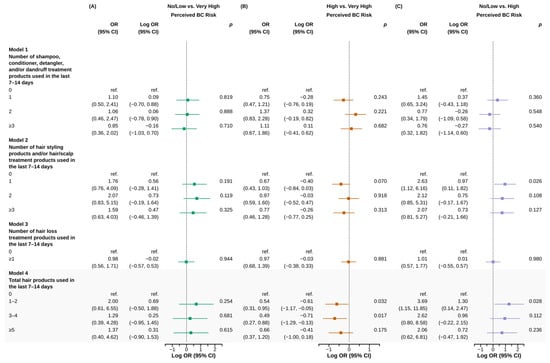
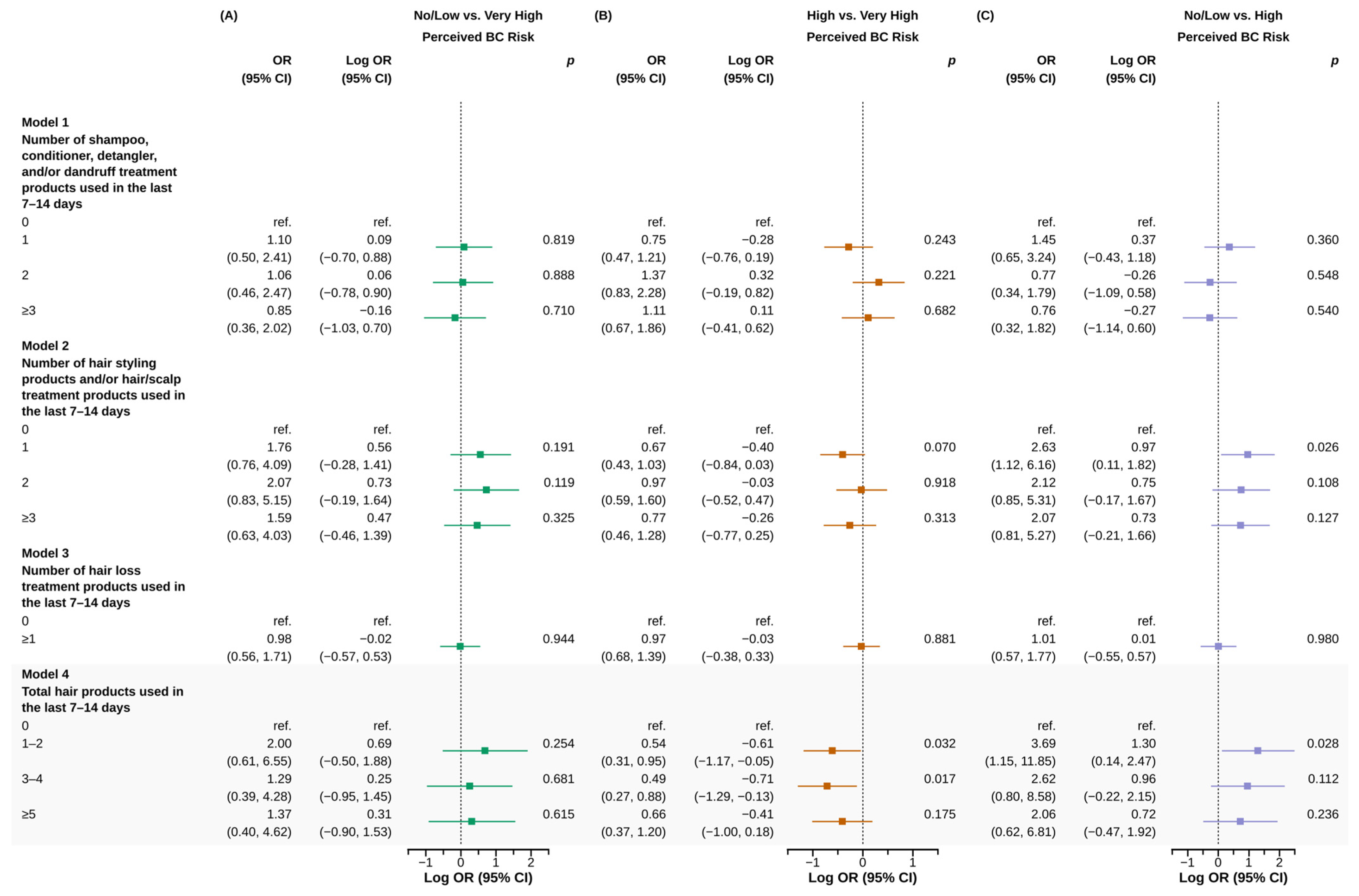
In multivariable-adjusted models, perceived BC risk latent class membership was not significantly associated with the number of shampoo, conditioner, detangler, and dandruff treatment products; hair styling and hair/scalp treatment products; hair loss treatment products; or total hair products used during the previous 7–14 days (Figure 1, Models 1–4).
Figure 1.
Odds of using an increasing number of hair products by perceived breast cancer risk latent class membership. Associations between latent classes of perceived breast cancer (BC) risk (as the exposure) and use of an increasing number of hair products (as the outcome) were examined using multivariable multinomial and logistic regression models with robust error variances. Each of the first three models assessed use of a different hair product type by study participants: Model 1—number of shampoo, conditioner, detangler, and/or dandruff treatment products used in the last 7–14 days (multinomial); Model 2—number of hair styling products and/or hair/scalp treatment products used in the last 7–14 days (multinomial); and Model 3—number of hair loss treatment products used in the last 7–14 days (logistic). The final model (4) assessed the total number of hair products (including shampoo, conditioner, detangler, dandruff treatment, hair styling, hair/scalp treatment, and/or hair loss treatment products) used in the last 7–14 days by perceived BC risk latent class membership. All models adjusted for relevant sociodemographic (age in years, education level, current occupation field, number of children under age 15 residing in household) and health history (age at menarche in years, personal history of BC) characteristics. Associations were reported as adjusted odds ratios (ORs) and plotted as adjusted log odds ratios (log ORs), accompanied by their corresponding 95% confidence intervals (CIs). Squares denote adjusted log ORs and horizontal lines their 95% CIs; colors distinguish the three class comparisons (green, panel (A); orange, panel (B); purple, panel (C)). The vertical dashed line marks the null value (log OR = 0, i.e., OR = 1). Shading highlights the final model of total product use. Each plot illustrates how, after adjustment for confounders, members of a lower perceived BC risk class were more or less likely to use hair products compared to members of a higher perceived BC risk class: (A) ‘no/low’ vs. ‘very high’ perceived BC risk class comparison, (B) ‘high’ vs. ‘very high’ perceived BC risk class comparison, and (C) ‘no/low’ vs. ‘high’ perceived BC risk class comparison. The Benjamini–Hochberg (B-H) approach was employed to correct for multiple comparisons, using a False Discovery Rate (FDR) of 5%. Following B-H correction, associations with p-values < 0.001 would be statistically significant, but none were.
3.5. Associations Between Perceived Breast Cancer Risk and Other Personal Care Product Use
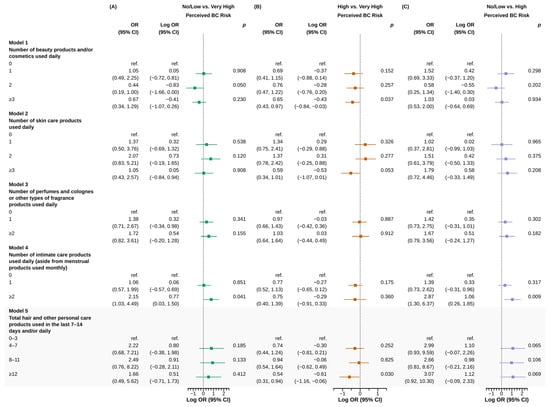
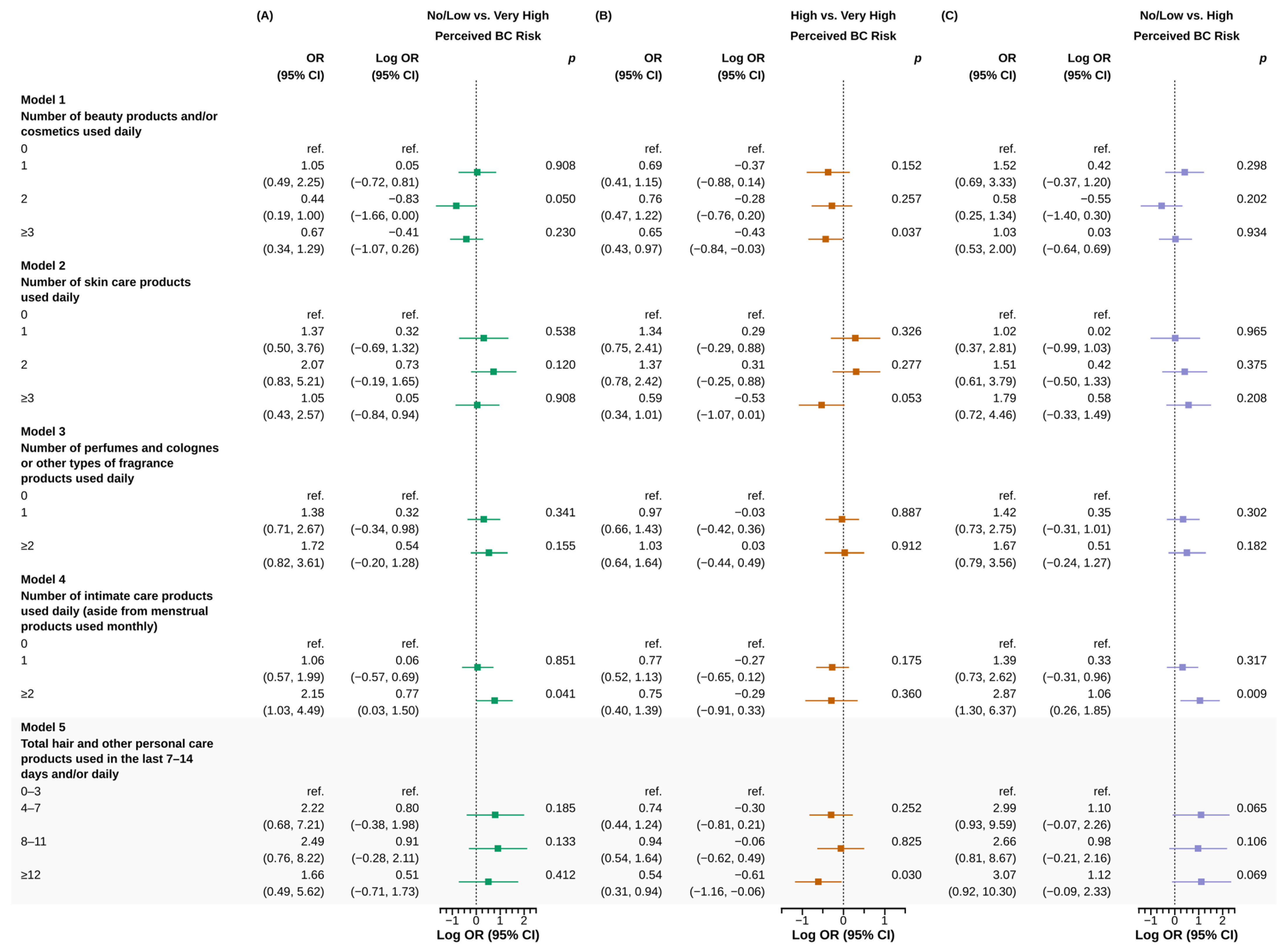
In multivariable-adjusted models, perceived BC risk latent class membership was not significantly associated with the number of beauty products and cosmetics, skin care products, fragrance products, intimate care products, or total combined hair and personal care products used (Figure 2, Models 1–5). Although several point estimates suggested greater product use among participants in the no/low perceived BC risk class, all corresponding confidence intervals included the null and were wide, indicating substantial statistical imprecision.
Figure 2.
Odds of using an increasing number of hair and other personal care products by perceived breast cancer risk latent class membership. Associations between latent classes of perceived breast cancer (BC) risk (as the exposure) and use of an increasing number of hair and other personal care products (as the outcome) were examined using multivariable multinomial regression models with robust error variances. Each of the first four models assessed daily use of a different personal care product type by study participants: Model 1—number of beauty products and/or cosmetics used daily; Model 2—number of skin care products used daily; Model 3—number of perfumes and colognes or other types of fragrance products used daily; and Model 4—number of intimate care products used daily (aside from menstrual products used monthly). The final model (5) assessed the total number of hair products (including shampoo, conditioner, detangler, dandruff treatment, hair styling, hair/scalp treatment, and/or hair loss treatment products) used in the last 7–14 days and other personal care products (including beauty products, cosmetics, skin care products, fragrance products, and intimate care products) used daily by perceived BC latent class membership. All models adjusted for relevant sociodemographic (age in years, marital status, education level, current occupation field, household size, number of children under age 15 residing in household) and health history (age at menarche in years, personal history of BC) characteristics. Associations were reported as adjusted odds ratios (ORs) and plotted as adjusted log odds ratios (log ORs), accompanied by their corresponding 95% confidence intervals (CIs). Squares denote adjusted log ORs and horizontal lines their 95% CIs; colors distinguish the three class comparisons (green, panel (A); orange, panel (B); purple, panel (C)). The vertical dashed line marks the null value (log OR = 0, i.e., OR = 1). Shading highlights the final model of total product use. Each plot illustrates how, after adjustment for confounders, members of a lower perceived BC risk class were more or less likely to use hair and other personal care products compared to members of a higher perceived BC risk class: (A) ‘no/low’ vs. ‘very high’ perceived BC risk class comparison, (B) ‘high’ vs. ‘very high’ perceived BC risk class comparison, and (C) ‘no/low’ vs. ‘high’ perceived BC risk class comparison. The Benjamini–Hochberg (B-H) approach was employed to correct for multiple comparisons, using a False Discovery Rate (FDR) of 5%. Following B-H correction, associations with p-values < 0.001 would be statistically significant, but none were.
4. Discussion
This study builds on our earlier findings [25] by examining associations between perceived BC risk and use of hair products and other PCPs among women in Embu and Nakuru, Kenya. We identified three distinct patterns of perceived BC risk—no/low, high, and very high—with sharp, graded differences in concern, behavioral intentions, and perceived normative responsibility regarding hair product ingredients. Although sociodemographic characteristics were largely comparable across classes, significant differences emerged in occupation and age at menarche. These findings suggest that perceived BC risk may vary by selected occupational and reproductive characteristics rather than broader sociodemographic characteristics. Women in the very high perceived BC risk class consistently reported the greatest concern, strongest intentions to modify product use, and highest demand for information; those in the no/low perceived BC risk class showed minimal concern and little inclination toward behavior change. Overall, women in the no/low perceived BC risk class had higher odds of using a greater number of hair products and PCPs compared with those with high or very high perceived risk.
Our findings regarding BC risk perception are broadly consistent with those obtained using the BHBS among Black women in Southern California [26] and Black breast cancer survivors in the US [27]. In all three samples, the perceived risk items formed a single factor; the same two items, concern about incomplete ingredient labeling and intention to go natural, loaded most weakly; and wanting to learn more about the health risks of products was the most strongly endorsed item. Internal consistency was lower in our Kenyan sample (Cronbach’s α = 0.66 vs. 0.82 in California), possibly reflecting ceiling effects, the adapted five-point response scale, and inconsistent interpretation of the negatively worded ingredient labeling item. Because of differences in setting, sampling, and response format, we were limited to comparing these findings descriptively.
Knowledge and awareness, concern about environmental exposures, information-seeking and behavioral intentions to reduce exposure provide a framework for understanding how perceived BC risk influences responses to environmental health information. Individuals in the very high perceived risk group may be more receptive to detailed risk information and behavior-change guidance, while those in the no/low perceived risk group may require strategies that first increase risk salience before promoting action. Perceived risk may drive both concern and intended behavior, shaping how individuals interpret and respond to environmental health information.
4.1. Intention–Behavior Gap
Despite reporting the greatest concern about hair product-related BC risk and the strongest intentions to modify their behavior, women in the very high perceived risk class did not report using fewer hair products. This disconnect suggests that heightened risk perception and concern alone may be insufficient to produce meaningful reductions in product use. The relationship between perceived health risk and behavior is complex and may not be linear when behaviors are shaped by established routines, cultural identity, appearance norms, and social expectations [26,37,38,39,40].
Women who perceive greater risk may reduce potential harm by modifying rather than decreasing product use, such as switching brands, avoiding select ingredients, choosing products marketed as natural or organic, or altering specific hair care practices [41,42,43,44,45]. Thus, the number of products used may not fully capture risk-reduction behaviors related to product selection, formulation, frequency, or application.
Practical and structural constraints may also limit behavior change. These include the limited availability and affordability of alternative products, unclear or incomplete ingredient labeling, skepticism about marketing claims, and difficulty determining which products are safer. Although greater access to health information through digital platforms may increase awareness and encourage product reformulation or improve ingredient transparency, information alone may not overcome these barriers [46,47,48].
Our findings therefore highlight the importance of distinguishing behavioral intentions from enacted behavior and reductions in product quantity from changes in product type or use practices [49]. Future studies should incorporate more detailed measures of product switching, ingredient avoidance, frequency of use, and other risk management strategies to better characterize how perceived BC risk influences hair product behaviors.
4.2. Sociocultural Influences on Hair Product Use
Beyond individual risk perception, hair product use is shaped by a complex interplay of sociocultural norms, personal preferences, peer networks, and media [50,51,52]. Beauty ideals favoring straight or smooth hair have driven widespread use of chemical relaxers and straightening products across many cultures, including in sub-Saharan Africa [53,54,55,56,57,58], while personal preferences and identity further anchor product choices [55,56,59,60]. Peer networks and trusted social contacts remain highly influential in product selection [61,62,63,64,65,66], and celebrity endorsements and social media influencers amplify aspirational product use by making specific products and routines seem normative and desirable [67,68,69,70,71]. Together, these social and cultural forces create inertia that can make hair care practices resistant to change despite health concerns, consistent with our findings.
4.3. Cultural and Structural Context in Kenya
In Kenya, these dynamics are amplified by cultural frameworks that closely link beauty and social status to appearance [72,73]. The widespread use of chemical hair relaxers and skin-lightening agents reflect societal beauty norms favoring lighter skin and straighter hair [72,74,75,76]. Despite documented health risks—including skin irritation, hair loss, and elevated cancer risk—demand for these products remains high [17,77], sustained in part by limited health literacy and entrenched beauty ideals that frequently take precedence over health concerns [72]. Kenya’s beauty and personal care sector has expanded steadily, reflecting increasing consumer demand and highlighting the importance of understanding associated public health risks. Women may face disproportionate exposure to harmful products due to limited access to safer alternatives, inadequate regulation, and economic constraints. These are concerns with direct implications for health equity. Knowledge alone is insufficient without supportive environments that enable safer choices; interventions engaging community leaders, cosmetologists, and peer networks may be more effective than information campaigns alone in shifting norms and are more likely to be culturally appropriate and responsive to local realities.
4.4. Occupation and Perceived BC Risk
Women in the no/low perceived BC risk class were significantly more likely to be employed in sales and service—particularly cosmetology—than those in the high or very high perceived risk classes. Given that cosmetologists have elevated occupational exposure to hair chemicals and may serve as trusted sources of health information for clients, this finding warrants further investigation. Future research should examine how occupational context shapes health risk perceptions and inform interventions tailored to cosmetology settings to improve BC awareness and reduce chemical exposures. Future studies should also examine substitution behaviors and decision-making processes to better understand how women reconcile health concern with everyday product use practices.
4.5. Public Health Implications
Efforts focused solely on raising awareness are unlikely to produce meaningful behavior change if not accompanied by actionable guidance, accessible and affordable alternatives, and regulatory requirements for clearer ingredient labeling. Interventions must address the sociocultural contexts of hair product use rather than assuming individuals can readily reduce or eliminate use in response to perceived risk. The socioecological model is instructive here; individual behavior is shaped by interpersonal, community, organizational, and policy-level factors, and effective public health strategies must engage across these levels [78]. In Kenya, this means collaborating with government health agencies, cosmetics manufacturers, community leaders, and hairdressers to develop culturally appropriate, structurally supported strategies that promote safer product choices and advance health equity.
4.6. Strengths and Limitations
One strength of this study was the use of community-engaged approaches combining convenience sampling of beauty shops and salons with purposive sampling of households across select sub-counties in two diverse Kenyan counties. The sampling strategy aimed to recruit approximately equal numbers from Embu and Nakuru Counties. The resulting sample was nearly equally distributed across Embu (49.7%) and Nakuru (50.3%), supporting balanced representation and enhancing generalizability within these regions. The study also characterized a broad range of sociodemographic and health history factors across perceived BC risk classes, providing useful information for targeting future interventions.
Several limitations should also be considered. The cross-sectional design precludes causal inference between BC risk perceptions and PCP use. Self-reported data may be subject to recall and social desirability biases, though questionnaires remain among the most feasible tools for assessing product use in this context. The sample was limited to women aged 15–50 years in two Kenyan counties, which may limit generalizability to other populations and regions, including men and gender-diverse individuals, who are understudied in epidemiologic research on PCP use and health. Additionally, two of the six perceived risk items from the BHBS subscale (concern about incomplete ingredient labels and intention to go natural) loaded weakly in this sample. The negatively worded ingredient labeling statement may have been interpreted inconsistently across study participants. The remaining items showed ceiling effects (84–97% agreed or strongly agreed), which may have lowered internal consistency relative to US validation samples [26,27]. Future studies should employ longitudinal designs with larger and more diverse samples and include men and sexual- and gender-minority populations to examine prospective associations between BC risk perceptions, product use, and long-term health outcomes.
5. Conclusions
These findings provide new insights into the complex relationship between perceived BC risk, hair product-related attitudes, and PCP use among women in Kenya. Perceived BC risk strongly differentiated concern and behavioral intentions across latent classes in a sharp, graded fashion, yet did not translate directly into reduced product use, suggesting a critical role of practical, cultural, and structural barriers in mediating the perception–behavior relationship. Addressing these barriers requires public health strategies that extend beyond individual risk communication to include ingredient regulation, community engagement, and economically accessible safer alternatives. As Kenya’s beauty and personal care market continues to grow, these efforts are increasingly important for protecting the health of consumers and advancing health equity.
Supplementary Materials
The following supporting information can be downloaded at https://www.mdpi.com/article/10.3390/ijerph23101334/s1: Table S1: Comparison of wording six-item perceived risk subscale of the Black Identity, Hair Product Use, and Breast Cancer Scale (BHBS); Table S2: Evaluating Class Solutions in a Latent Class Analysis, N = 744; Table S3: Item Response Probabilities for Each Breast Cancer Risk Perception Latent Class in a 3-Class Model, N = 744.
Author Contributions
Conceptualization, C.K., B.I., E.M. and A.A.M.L.; methodology, C.K., B.I., E.M., D.K.T.-B., M.B.T., J.A.M. and A.A.M.L.; formal analysis, C.K. and A.A.; investigation, C.K., B.I., E.M., T.O., M.B.T., J.A.M. and A.A.M.L.; resources, D.K.T.-B. and A.A.M.L.; data curation, C.K., A.A., B.I., T.O. and A.A.M.L.; writing—original draft, C.K., A.S. and A.A.M.L.; writing—review and editing, C.K., A.A., B.I., E.M., D.K.T.-B., J.G., T.O., A.R., A.S., D.T.D., M.B.T., J.A.M. and A.A.M.L.; visualization, A.A.; supervision, A.A.M.L.; project administration, A.R., A.S. and A.A.M.L.; funding acquisition, A.A.M.L. All authors have read and agreed to the published version of the manuscript.
Funding
This research was funded by Columbia University (ICAP-HICCC initiative and the Department of Epidemiology).
Institutional Review Board Statement
All procedures performed in studies involving human participants were in accordance with the ethical standards of the institutional and/or national research committee and with the 1964 Helsinki declaration and its later amendments or comparable ethical standards. Ethical approval for the study was obtained from the Kenya National Commission for Science, Technology & Innovation (NACOSTI) (approval code: NACOSTI/P/22/19920; approval date: 6 September 2022), the Scientific and Ethics Review Unit of the Kenya Medical Research Institute (SERU-KEMRI) (approval code: KEMRI/SERU/CTMDR/094/4138; approval date: 5 March 2022), and the Institutional Review Board of Columbia University (approval code: AAAU3921; approval date: 23 November 2022).
Informed Consent Statement
This was a community-based study that collected self-reported sociodemographic information, knowledge, attitudes, and perceptions about hair care and the use of specific hair products and PCPs among women aged 15–50 years, residing in Embu and Nakuru Counties in Kenya. Prior to participation, informed consent was obtained from all individual participants included in the study. Written informed consent was obtained for individuals 18 years and older and ascent for individuals aged 15–17 years, ensuring their voluntary involvement in the interviewer-administered study questionnaire.
Data Availability Statement
The data generated and/or analyzed during the current study are not publicly available due to privacy and ethical restrictions but may be available from the corresponding author upon reasonable request and subject to appropriate approvals.
Acknowledgments
We thank the Director General of Kenya Medical Research Institute for the support throughout the conduct of this study. We also thank the County Executive Members for Health and the County Health Management Teams in Embu and Nakuru Counties as well as County Commissioners, public health focal persons, community health volunteers, field research assistants, and all study participants for engaging and partnering with us for this study. We acknowledge the African Caribbean Cancer Consortium (AC3) for making this collaboration possible.
Conflicts of Interest
The authors declare no conflicts of interest.
References
- Bougias, H.; Stogiannos, N. Breast MRI: Where are we currently standing? J. Med. Imaging Radiat. Sci. 2022, 53, 203–211. [Google Scholar] [CrossRef] [Scilit] [PubMed]
- Hirko, K.A.; Rocque, G.; Reasor, E.; Taye, A.; Daly, A.; Cutress, R.I.; Copson, E.R.; Lee, D.-W.; Lee, K.-H.; Im, S.-A.; et al. The impact of race and ethnicity in breast cancer-disparities and implications for precision oncology. BMC Med. 2022, 20, 72. [Google Scholar] [CrossRef] [Scilit] [PubMed] [PubMed Central]
- Admoun, C.; Mayrovitz, H.N. The Etiology of Breast Cancer. In Breast Cancer [Internet]; Mayrovitz, H.N., Ed.; Exon Publications: Brisbane, Australia, 2022. Available online: http://www.ncbi.nlm.nih.gov/books/NBK583809/ (accessed on 4 August 2026).
- Madia, F.; Worth, A.; Whelan, M.; Corvi, R. Carcinogenicity assessment: Addressing the challenges of cancer and chemicals in the environment. Environ. Int. 2019, 128, 417–429. [Google Scholar] [CrossRef] [Scilit] [PubMed] [PubMed Central]
- Polemi, K.M.; Nguyen, V.K.; Heidt, J.; Kahana, A.; Jolliet, O.; Colacino, J.A. Identifying the link between chemical exposures and breast cancer in African American women via integrated in vitro and exposure biomarker data. Toxicology 2021, 463, 152964. [Google Scholar] [CrossRef] [Scilit] [PubMed] [PubMed Central]
- Johnson, P.I.; Favela, K.; Jarin, J.; Le, A.M.; Clark, P.Y.; Fu, L.; Gillis, A.D.; Morga, N.; Nguyen, C.; Harley, K.G. Chemicals of concern in personal care products used by women of color in three communities of California. J. Expo. Sci. Environ. Epidemiol. 2022, 32, 864–876. [Google Scholar] [CrossRef] [Scilit] [PubMed] [PubMed Central]
- Xu, S.; Wang, H.; Liu, Y.; Zhang, C.; Xu, Y.; Tian, F.; Mei, L. Hair chemicals may increase breast cancer risk: A meta-analysis of 210319 subjects from 14 studies. PLoS ONE 2021, 16, e0243792. [Google Scholar] [CrossRef] [Scilit] [PubMed] [PubMed Central]
- Brody, J.G.; Rudel, R.A.; Michels, K.B.; Moysich, K.B.; Bernstein, L.; Attfield, K.R.; Gray, S. Environmental pollutants, diet, physical activity, body size, and breast cancer: Where do we stand in research to identify opportunities for prevention? Cancer 2007, 109, 2627–2634. [Google Scholar] [CrossRef] [Scilit] [PubMed]
- Braun, J.M.; Sathyanarayana, S.; Hauser, R. Phthalate exposure and children’s health. Curr. Opin. Pediatr. 2013, 25, 247–254. [Google Scholar] [CrossRef] [Scilit] [PubMed] [PubMed Central]
- Meeker, J.D.; Sathyanarayana, S.; Swan, S.H. Phthalates and other additives in plastics: Human exposure and associated health outcomes. Philos. Trans. R. Soc. Lond. B Biol. Sci. 2009, 364, 2097–2113. [Google Scholar] [CrossRef] [Scilit] [PubMed] [PubMed Central]
- Hauser, R.; Meeker, J.D.; Singh, N.P.; Silva, M.J.; Ryan, L.; Duty, S.; Calafat, A. DNA damage in human sperm is related to urinary levels of phthalate monoester and oxidative metabolites. Hum. Reprod. 2007, 22, 688–695. [Google Scholar] [CrossRef] [Scilit] [PubMed]
- Swan, S.H.; Sathyanarayana, S.; Barrett, E.S.; Janssen, S.; Liu, F.; Nguyen, R.H.N.; Redmon, J.B.; The TIDES Study Team; Scher, E.; Stasenko, M.; et al. First trimester phthalate exposure and anogeni-tal distance in newborns. Hum. Reprod. 2015, 30, 963–972. [Google Scholar] [CrossRef] [Scilit] [PubMed] [PubMed Central]
- James-Todd, T.; Stahlhut, R.; Meeker, J.D.; Powell, S.G.; Hauser, R.; Huang, T.; Rich-Edwards, J. Urinary phthalate metabolite concentrations and diabetes among women in the National Health and Nutrition Examination Survey (NHANES) 2001–2008. Environ. Health Perspect. 2012, 120, 1307–1313. [Google Scholar] [CrossRef] [Scilit] [PubMed] [PubMed Central]
- Trasande, L.; Spanier, A.J.; Sathyanarayana, S.; Attina, T.M.; Blustein, J. Urinary phthalates and increased insulin resistance in adolescents. Pediatrics 2013, 132, e646–e655. [Google Scholar] [CrossRef] [Scilit] [PubMed] [PubMed Central]
- Dodson, R.E.; Franklin, E.T.; Zota, A.R.; Jameson, R.L.; Flint, J.R.; Edwards, L.; Weaver, E.B.; Shamasunder, B. Formaldehyde and Formaldehyde Releasing Pre-servatives in Personal Care Products Used by Black Women and Latinas. Environ. Sci. Technol. Lett. 2025, 12, 1205–1210. [Google Scholar] [CrossRef] [Scilit] [PubMed] [PubMed Central]
- Dodson, R.E.; Nishioka, M.; Standley, L.J.; Perovich, L.J.; Brody, J.G.; Rudel, R.A. Endocrine disruptors and asthma-associated chemicals in consumer products. Environ. Health Perspect. 2012, 120, 935–943. [Google Scholar] [CrossRef] [Scilit] [PubMed] [PubMed Central]
- Zota, A.R.; Shamasunder, B. The Environmental Injustice of Beauty: Framing Chemical Exposures from Beauty Products as a Health Disparities Concern. Am. J. Obstet. Gynecol. 2017, 217, 418.e1–418.e6. [Google Scholar] [CrossRef] [Scilit] [PubMed] [PubMed Central]
- Llanos, A.A.M.; Rabkin, A.; Bandera, E.V.; Zirpoli, G.; Gonzalez, B.D.; Xing, C.Y.; Qin, B.; Lin, Y.; Hong, C.-C.; Demissie, K.; et al. Hair product use and breast cancer risk among African American and White women. Carcinogenesis 2017, 38, 883–892. [Google Scholar] [CrossRef] [Scilit] [PubMed] [PubMed Central]
- Eberle, C.E.; Sandler, D.P.; Taylor, K.W.; White, A.J. Hair dye and chemical straightener use and breast cancer risk in a large US population of black and white women. Int. J. Cancer 2020, 147, 383–391. [Google Scholar] [CrossRef] [Scilit] [PubMed] [PubMed Central]
- Rao, R.; McDonald, J.A.; Barrett, E.S.; Greenberg, P.; Teteh, D.K.; Montgomery, S.B.; Qin, B.; Lin, Y.; Hong, C.-C.; Ambrosone, C.B.; et al. Associations of hair dye and relaxer use with breast tumor clinicopathologic features: Findings from the Women’s circle of Health Study. Environ. Res. 2022, 203, 111863. [Google Scholar] [CrossRef] [Scilit] [PubMed] [PubMed Central]
- Chang, C.J.; O’Brien, K.M.; Keil, A.P.; Gaston, S.A.; Jackson, C.L.; Sandler, D.P.; White, A.J. Use of Straighteners and Other Hair Products and Incident Uterine Cancer. J. Natl. Cancer Inst. 2022, 114, 1636–1645. [Google Scholar] [CrossRef] [Scilit] [PubMed] [PubMed Central]
- White, A.J.; Sandler, D.P.; Gaston, S.A.; Jackson, C.L.; O’Brien, K.M. Use of hair products in relation to ovarian cancer risk. Carcinogenesis 2021, 42, 1189–1195. [Google Scholar] [CrossRef] [Scilit] [PubMed] [PubMed Central]
- Bertrand, K.A.; Delp, L.; Coogan, P.F.; Cozier, Y.C.; Lenzy, Y.M.; Rosenberg, L.; Palmer, J.R. Hair relaxer use and risk of uterine cancer in the Black Women’s Health Study. Environ. Res. 2023, 239, 117228. [Google Scholar] [CrossRef] [Scilit] [PubMed] [PubMed Central]
- Helm, J.S.; Nishioka, M.; Brody, J.G.; Rudel, R.A.; Dodson, R.E. Measurement of endocrine disrupting and asthma-associated chemicals in hair products used by Black women. Environ. Res. 2018, 165, 448–458. [Google Scholar] [CrossRef] [Scilit] [PubMed]
- Llanos, A.A.M.; Ashrafi, A.; Olisa, T.; Rockson, A.; Schaefer, A.; McDonald, J.A.; Terry, M.B.; Teteh-Brooks, D.K.; Duncan, D.T.; Irungu, B.; et al. Hair Dye and Relaxer Use among Cisgender Women in Embu and Nakuru Counties, Kenya: Associations with Perceived Risk of Breast Cancer and Other Health Effects. Int. J. Environ. Res. Public Health 2024, 21, 846. [Google Scholar] [CrossRef] [Scilit] [PubMed] [PubMed Central]
- Teteh, D.; Ericson, M.; Monice, S.; Dawkins-Moultin, L.; Bahadorani, N.; Clark, P.; Mitchell, E.; Treviño, L.S.; Llanos, A.; Kittles, R.; et al. The Black identity, hair product use, and breast cancer scale. PLoS ONE 2019, 14, e0225305. [Google Scholar] [CrossRef] [Scilit] [PubMed] [PubMed Central]
- Teteh-Brooks, D.K.; Ericson, M.; Bethea, T.N.; Dawkins-Moultin, L.; Sarkaria, N.; Bailey, J.; Llanos, A.A.M.; Montgomery, S. Val-idating the Black Identity, Hair Product Use, and Breast Cancer Scale (BHBS) Among Black Breast Cancer Survivors. Int. J. Environ. Res. Public Health 2025, 22, 174. [Google Scholar] [CrossRef] [Scilit] [PubMed]
- Horn, J.L. A rationale and test for the number of factors in factor analysis. Psychometrika 1965, 30, 179–185. [Google Scholar] [CrossRef] [Scilit] [PubMed]
- Flora, D.B.; Curran, P.J. An empirical evaluation of alternative methods of estimation for confirmatory factor analysis with ordinal data. Psychol. Methods 2004, 9, 466–491. [Google Scholar] [CrossRef] [Scilit] [PubMed]
- Hu, L.; Bentler, P.M. Cutoff criteria for fit indexes in covariance structure analysis: Conventional criteria versus new alternatives. Struct. Equ. Model. A Multidiscip. J. 1999, 6, 1–55. [Google Scholar] [CrossRef] [Scilit]
- Browne, M.W.; Cudeck, R. Alternate Ways of Assessing Model Fit. In Testing Structural Equation Models; Bollen, K.A., Long, J.S., Eds.; Sage: Newbury Park, CA, USA, 1993; pp. 136–162. [Google Scholar]
- Green, S.B.; Yang, Y. Reliability of Summed Item Scores Using Structural Equation Modeling: An Alternative to Coefficient Alpha. Psychometrika 2009, 74, 155–167. [Google Scholar] [CrossRef] [Scilit]
- Wu, H.; Estabrook, R. Identification of Confirmatory Factor Analysis Models of Different Levels of Invariance for Or-dered Categorical Outcomes. Psychometrika 2016, 81, 1014–1045. [Google Scholar] [CrossRef] [Scilit] [PubMed]
- Rosseel, Y. Lavaan: An R Package for Structural Equation Modeling. J. Stat. Softw. 2012, 48, 1–36. [Google Scholar] [CrossRef] [Scilit]
- Revelle, W. psych: Procedures for Psychological, Psychometric, and Personality Research. Northwestern University. R Package Version 2.4.1. 2022. Available online: https://CRAN.R-project.org/package=psych (accessed on 2 October 2026).
- Jorgensen, T.D.; Pornprasertmanit, S.; Schoemann, A.M.; Rosseel, Y. SemTools: Useful Tools for Structural Equation Modeling. R Package Version 0.5-6. r-Project. 2022. Available online: https://CRAN.R-project.org/package=semTools (accessed on 2 October 2026).
- Ferrer, R.; Klein, W.M. Risk perceptions and health behavior. Curr. Opin. Psychol. 2015, 5, 85–89. [Google Scholar] [CrossRef] [Scilit] [PubMed] [PubMed Central]
- Kobeissi, L.; Samari, G.; Telesca, D.; Esfandiari, M.; Galal, O. The impact of breast cancer knowledge and attitudes on screening and early detection among an immigrant Iranian population in southern California. J. Relig. Health 2014, 53, 1759–1769. [Google Scholar] [CrossRef] [Scilit] [PubMed] [PubMed Central]
- Ndichu, E.; Upadhyaya, S. “Going natural”: Black women’s identity project shifts in hair care practices. Consum. Mark. Cult. 2018, 22, 44–67. [Google Scholar] [CrossRef] [Scilit]
- Teteh-Brooks, D.; Montgomery, S.; Monice, S.; Stiel, L.; Clark, P.; Mitchell, E. My crown and glory: Community, identity, culture, and Black women’s concerns of hair product-related breast cancer risk. Cogent Arts Humanit. 2017, 4, 1345297. [Google Scholar] [CrossRef] [Scilit]
- Kim, H.; Chung, J. Consumer purchase intention for organic personal care products. J. Consum. Mark. 2011, 28, 40–47. [Google Scholar] [CrossRef] [Scilit]
- Ghazali, E.; Soon, P.C.; Mutum, D.S.; Nguyen, B. Health and cosmetics: Investigating consumers’ values for buying organic per-sonal care products. J. Retail. Consum. Serv. 2017, 39, 154–163. [Google Scholar] [CrossRef] [Scilit]
- Kim, S.; Seock, Y.K. Impacts of health and environmental consciousness on young female consumers’ attitude towards and pur-chase of natural beauty products. Int. J. Consum. Stud. 2009, 33, 627–638. [Google Scholar] [CrossRef] [Scilit]
- Payne, C.E.; Rockson, A.; Ashrafi, A.; McDonald, J.A.; Bethea, T.N.; Barrett, E.S.; Llanos, A.A.M. Beauty Beware: Associations between Perceptions of Harm and Safer Hair-Product-Purchasing Behaviors in a Cross-Sectional Study of Adults Affiliated with a University in the Northeast. Int. J. Environ. Res. Public Health 2023, 20, 7129. [Google Scholar] [CrossRef] [Scilit] [PubMed] [PubMed Central]
- Kisawike, B. The Role of Perceived Risk in Consumer Purchasing Decisions. Cureus J. Bus. Econ. 2026, 3, 1577–1597. [Google Scholar] [CrossRef] [Scilit]
- Lamberton, C.; Stephen, A.T. A Thematic Exploration of Digital, Social Media, and Mobile Marketing: Research Evolution from 2000 to 2015 and an Agenda for Future Inquiry. J. Mark. 2016, 80, 146–172. [Google Scholar] [CrossRef] [Scilit]
- Nohynek, G.J.; Antignac, E.; Re, T.; Toutain, H. Safety assessment of personal care products/cosmetics and their ingredients. Toxicol. Appl. Pharmacol. 2010, 243, 239–259. [Google Scholar] [CrossRef] [Scilit] [PubMed]
- Rundh, B. Linking packaging to marketing: How packaging is influencing the marketing strategy. Br. Food J. 2013, 115, 1547–1563. [Google Scholar] [CrossRef] [Scilit]
- Grappe, C.G.; Lombart, C.; Louis, D.; Durif, F. Clean labeling: Is it about the presence of benefits or the absence of detriments? Consumer response to personal care claims. J. Retail. Consum. Serv. 2022, 65, 102893. [Google Scholar] [CrossRef] [Scilit]
- Henriques, M.; Patnaik, D. Social Media and Its Effects on Beauty; IntechOpen: London, UK, 2020. [Google Scholar] [CrossRef] [Scilit]
- Cash, T.F.; Pruzinsky, T. Body Image: A Handbook of Theory, Research, and Clinical Practice; Guildford Press: New York, NY, USA, 2002. [Google Scholar]
- Tiggemann, M.; Polivy, J. Upward and Downward: Social Comparison Processing of Thin Idealized Media Images. Psychol. Women Q. 2010, 34, 356–364. [Google Scholar] [CrossRef] [Scilit]
- Byrd, A.D.; Tharps, L.L. Hair Story: Untangling the Roots of Black Hair in America; St. Martin’s Griffin: New York, NY, USA, 2002. [Google Scholar]
- Rucker Wright, D.; Gathers, R.; Kapke, A.; Johnson, D.; Joseph, C.L.M. Hair care practices and their association with scalp and hair disorders in African American girls. J. Am. Acad. Dermatol. 2011, 64, 253–262. [Google Scholar] [CrossRef] [Scilit] [PubMed]
- Tate, S. Black beauty: Shade, hair and anti-racist aesthetics. Ethn. Racial Stud. 2007, 30, 300–319. [Google Scholar] [CrossRef] [Scilit]
- Banks, I. Hair Matters: Beauty, Power, and Black Women’s Consciousness; NYU Press: New York, NY, USA, 2000. [Google Scholar] [CrossRef] [Scilit]
- Jacobs-Huey, L. From the Kitchen to the Parlor: Language and Becoming in African American Women’s Hair Care; Oxford University Press: Oxford, UK, 2006. [Google Scholar] [CrossRef] [Scilit]
- Rooks, N.M. Hair Raising: Beauty, Culture, and African American Women; Rutgers University Press: New Brunswick, NJ, USA, 1996. [Google Scholar]
- Rook, D.W.; Hoch, S.J. Consuming Impulses. Adv. Consum. Res. 1985, 12, 23–27. [Google Scholar]
- Gathers, R.C.; Mahan, M.G. African american women, hair care, and health barriers. J. Clin. Aesthet. Dermatol. 2014, 7, 26–29. [Google Scholar] [PubMed] [PubMed Central]
- Larose, R.; Mastro, D.; Eastin, M. Understanding Internet Usage. Soc. Sci. Comput. Rev. 2001, 19, 395–413. [Google Scholar] [CrossRef] [Scilit]
- Solomon, M.R.; Russell, C.A. Consumer Behavior: Buying, Having, Being, 14th ed.; Pearson: London, UK, 2023. [Google Scholar]
- Goldsmith, R.E.; Clark, R.A. An analysis of factors affecting fashion opinion leadership and fashion opinion seeking. J. Fash. Mark. Manag. Int. J. 2008, 12, 308–322. [Google Scholar] [CrossRef] [Scilit]
- Sherman, L.E.; Payton, A.A.; Hernandez, L.M.; Greenfield, P.M.; Dapretto, M. The Power of the Like in Adolescence: Effects of Peer Influence on Neural and Behavioral Responses to Social Media. Psychol. Sci. 2016, 27, 1027–1035. [Google Scholar] [CrossRef] [Scilit] [PubMed] [PubMed Central]
- Phua, J.; Kim, J.J. Starring in your own Snapchat advertisement: Influence of self-brand congruity, self-referencing and per-ceived humor on brand attitude and purchase intention of advertised brands. Telemat. Inform. 2018, 35, 1524–1533. [Google Scholar] [CrossRef] [Scilit]
- Aral, S.; Walker, D. Identifying influential and susceptible members of social networks. Science 2012, 337, 337–341. [Google Scholar] [CrossRef] [Scilit] [PubMed]
- Chetioui, Y.; Benlafqih, H.; Lebdaoui, H. How fashion influencers contribute to consumers’ purchase intention. J. Fash. Mark. Manag. Int. J. 2020, 24, 361–380. [Google Scholar] [CrossRef] [Scilit]
- Keel, A.; Nataraajan, R. Celebrity Endorsements and Beyond: New Avenues for Celebrity Branding. Psychol. Mark. 2012, 29, 690–703. [Google Scholar] [CrossRef] [Scilit]
- Jin, S.A.; Phua, J. Following Celebrities’ Tweets About Brands: The Impact of Twitter-Based Electronic Word-of-Mouth on Consumers’ Source Credibility Perception, Buying Intention, and Social Identification with Celebrities. J. Advert. 2014, 43, 181–195. [Google Scholar] [CrossRef] [Scilit]
- Lim, X.J.; Mohd Radzol, A.R.B.; Cheah, J.; Wong, M.W. The Impact of Social Media Influencers on Purchase Intention and the Mediation Effect of Customer Attitude. Asian J. Bus. Res. 2017, 7, 19–36. [Google Scholar] [CrossRef] [Scilit]
- Schouten, A.P.; Janssen, L.; Verspaget, M. Celebrity vs. Influencer endorsements in advertising: The role of identification, credibility, and Product-Endorser fit. Int. J. Advert. 2020, 39, 258–281. [Google Scholar] [CrossRef] [Scilit]
- Balogun-Mwangi, O.; Robinson-Wood, T.L.; DeTore, N.R.; Edwards George, J.B.; Rodgers, R.F.; Sanchez, W. Body image and Black African women: A comparative study of Kenya and Nigeria. Body Image 2023, 45, 331–342. [Google Scholar] [CrossRef] [Scilit] [PubMed]
- Thomas, L.M. Consumer culture and ‘black is beautiful’ in apartheid South Africa and early postcolonial Kenya. Afr. Stud. 2019, 78, 6–32. [Google Scholar] [CrossRef] [Scilit]
- Mbilishaka, A.M.; Hudlin, M. “I Remember My First Relaxer”: Black Women Voicing Psychologically Engrained Practices of Chemical Hair Straightening. J. Black Psychol. 2023, 49, 716–741. [Google Scholar] [CrossRef] [Scilit]
- Aryiku, S.A.; Salam, A.; Dadzie, O.E.; Jablonski, N.G. Clinical and anthropological perspectives on chemical relaxing of af-ro-textured hair. J. Eur. Acad. Dermatol. Venereol. 2015, 29, 1689–1695. [Google Scholar] [CrossRef] [Scilit] [PubMed]
- Jablonski, N.G. Living Color: The Biological and Social Meaning of Skin Color; University of California Press: Berkeley, CA, USA, 2012; 260p. [Google Scholar]
- Asbeck, S.; Riley-Prescott, C.; Glaser, E.; Tosti, A. Afro-Ethnic Hairstyling Trends, Risks, and Recommendations. Cosmetics 2022, 9, 17. [Google Scholar] [CrossRef] [Scilit]
- Baden, D.; Prasad, S. Applying Behavioural Theory to the Challenge of Sustainable Development: Using Hairdressers as Dif-fusers of More Sustainable Hair-Care Practices. J. Bus. Ethics 2016, 133, 335–349. [Google Scholar] [CrossRef] [Scilit]

Disclaimer/Publisher’s Note: The statements, opinions and data contained in all publications are solely those of the individual author(s) and contributor(s) and not of MDPI and/or the editor(s). MDPI and/or the editor(s) disclaim responsibility for any injury to people or property resulting from any ideas, methods, instructions or products referred to in the content. |
© 2026 by the authors. Licensee MDPI, Basel, Switzerland. This article is an open access article distributed under the terms and conditions of the Creative Commons Attribution (CC BY) license.