


Highlights
Public health relevance—How does this work relate to a public health issue?
- University students face sustained academic demands that may undermine engagement and positive mental health, making student well-being a relevant issue for health promotion in higher education.
- This study focuses on PSD as a potentially modifiable everyday study behavior associated with student engagement and emotional, social, and psychological well-being
Public health significance—Why is this work of significance to public health?
- The findings extend research on student well-being by linking the playful redesign of study activities with a multidimensional model of positive mental health, rather than focusing only on distress or global well-being.
- Student engagement emerged as having a central indirect role in the cross-sectional associations between PSD and students’ emotional, social, and psychological well-being.
Public health implications—What are the key implications or messages for practitioners, policy makers and/or researchers in public health?
- The findings provide a rationale for developing and rigorously evaluating PSD-based initiatives; they do not establish intervention effectiveness, feasibility, cost, or scalability.
- Any future PSD-based initiative should complement, rather than replace, supportive educational environments, adequate institutional resources, and manageable study demands.
Abstract
University students face sustained academic demands that can compromise engagement and positive mental health, underscoring the need to identify modifiable everyday strategies that support health promotion in higher education. Drawing on Study Demands–Resources theory and proactive motivational perspectives, this cross-sectional study examined the direct and indirect associations among playful study design (PSD)—students’ self-initiated efforts to make study activities more enjoyable (designing fun) and more challenging (designing competition)—student engagement, and emotional, social, and psychological well-being. A sample of 511 Italian university students completed validated measures of PSD, student engagement, and positive mental health. The hypothesized indirect-association model was tested using structural equation modeling (SEM) with bootstrapped confidence intervals. PSD was positively associated with student engagement and with all three dimensions of well-being. Significant indirect associations between PSD and emotional, social, and psychological well-being through student engagement were observed. After accounting for student engagement, none of the direct associations between PSD and the three well-being dimensions were statistically significant in the primary ML analysis. The model showed a mixed pattern of fit: RMSEA and SRMR indicated acceptable fit, whereas CFI and TLI remained below conventional thresholds. These findings extend emerging PSD research by identifying student engagement as having an indirect role in the associations between the playful redesign of study activities and multidimensional positive mental health. Given the cross-sectional design, the results do not establish temporal precedence or causal mediation. The findings provide a preliminary rationale for further longitudinal and intervention research, but do not establish the effectiveness or practical feasibility of PSD-based initiatives.
1. Introduction
Higher education is a formative context for academic, professional, and personal development, but it also exposes students to sustained academic demands, performance pressure, uncertainty about future careers, and continuous adaptation to changing educational conditions. These demands may undermine both academic functioning and positive mental health, making student well-being a central concern for universities and public health-oriented educational policies [1,2]. From a health-promotion perspective, which emphasizes enabling individuals and communities to increase control over determinants of health [3], this highlights the need to identify modifiable, everyday strategies through which students can actively support their own engagement and well-being while navigating academic tasks.
Research on student mental health has traditionally focused on risk factors and indicators of ill-being, including stress, anxiety, and burnout. Although this perspective remains essential, positive mental health is not merely the absence of psychological symptoms; it also involves feeling well and functioning effectively in personal and social life [4,5,6]. A health-promotion perspective therefore requires greater attention to proactive and modifiable strategies that may help students cultivate well-being in their everyday academic activities, alongside institutional efforts to reduce excessive demands and provide adequate support. Such strategies are particularly relevant because they can be enacted in students’ everyday academic activities rather than depending exclusively on formal interventions or changes in the educational environment.
Study Demands–Resources (SD–R) theory offers a useful framework for understanding this agentic role. According to this perspective, study demands and study resources activate health-impairment and motivational processes, while students may also proactively influence these processes through their own behaviors [1]. Students are therefore not merely recipients of educational conditions; they may actively shape the motivational quality of studying by adopting self–initiated strategies. However, research has devoted more attention to contextual resources, such as lecturer support and learning opportunities, and to established self–regulatory behaviors, such as study crafting and goal management, than to the possibility that students use play proactively to enrich routine academic activities. This possibility is captured by playful study design (PSD), defined as a cognitive–behavioral orientation through which students proactively make study tasks more fun and/or more challenging [7]. Although research on PSD is still emerging, initial evidence links it to study engagement, goal attainment, social integration, subjective well-being, flow, and attentional focus [7,8,9]. However, two important questions remain unresolved. First, previous research has mainly considered study-related motivational outcomes or global indicators of subjective well-being, leaving unclear whether PSD is associated with the distinct emotional, psychological, and social components of positive mental health identified by Keyes [4]. Second, although engagement is an established associate with PSD, its indirect role in the cross-sectional associations between PSD and broader well-being has not been examined.
The present study addresses these gaps by drawing on SD–R theory alongside Keyes’ multidimensional model of positive mental health [4,5]. We propose that PSD is a proactive study behavior that may be associated with a more engaging study experience, and indirectly, with emotional, psychological, and social well-being. By doing so, this study advances previous research in three ways. First, it extends the nomological network of PSD from academic and global well-being outcomes to a differentiated model of positive mental health. Second, it open new insights about the motivational logic of SD–R theory to examine a pattern of associations involving self-initiated study behavior, engagement, and functioning beyond the immediate study context. Because study demands, contextual study resources, and the proposed resource-like experiences were not directly assessed, the study does not constitute a comprehensive support to SD–R theory; rather, it examines whether the observed associations are compatible with its motivational process. Third, it examines the indirect role of engagement in the associations between playful study redesign and broader positive functioning. Together, these contributions position PSD as a potentially relevant, modifiable strategy for health promotion in higher education, while recognizing that individual proactive behaviors should complement, not replace, supportive educational environments.
1.1. PSD and Student Well-Being
Play is a voluntary and intrinsically motivated activity that supports exploration, creativity, cognitive flexibility, and meaning-making [10,11,12,13]. Although its developmental value is well-established, research in higher education has generally examined play through instructor-designed approaches, such as gamification and game-based learning [14,15,16]. In these approaches, playful elements are embedded in learning activities by educators or institutions. Less attention has been paid to self-initiated play: what students themselves do to make ordinary study tasks more enjoyable or stimulating. This distinction is theoretically important because autonomy, volition, and self-direction are central characteristics of play [17,18]. It is also relevant for health promotion, because self-initiated playful strategies may be embedded in everyday study routines and enacted without waiting for formal curricular or institutional interventions.
PSD addresses this gap by conceptualizing students as active designers of their subjective study experience. Rather than requiring students to change the objective content or formal requirements of a task, PSD concerns how they approach that task [7]. Students may introduce amusing, imaginative, or novel elements into studying, or create personally meaningful challenges that make an otherwise routine activity more stimulating. PSD is related to, but distinct from, other proactive study strategies. Study crafting involves broader changes to study demands and resources [19], whereas PSD specifically concerns adding elements of fun and/or competition to existing activities. Self-regulated learning encompasses a wider set of cognitive, metacognitive, motivational, emotional, and behavioral processes used to plan, monitor, and regulate learning [20], whereas PSD represents a narrower strategy for altering the subjective experience of studying. Strengths use entails actively applying one’s personal strengths to study activities [21], whereas PSD does not require identifying or deploying particular strengths. PSD also differs from educator- or institution-designed forms of gamification and game-based learning, in which game elements or games are incorporated into learning activities to support specific educational outcomes [22]. In PSD, in contrast, playful redesign is initiated by the student, adapted to personal preferences, and enacted without altering the formal educational goals of the activity. PSD comprises two related dimensions: designing fun and designing competition [7]. Designing fun refers to introducing humor, imagination, curiosity, or novelty to make study activities more enjoyable and intrinsically rewarding. Designing competition refers to creating self-relevant challenges, for example, by setting a personal target or attempting to improve on one’s previous performance. Importantly, designing competition primarily refers to self-referenced challenge rather than interpersonal rivalry. Students may compete with their own previous performance, time records, or personal goals, thereby transforming study activities into meaningful challenges without necessarily increasing social comparison or competitive pressure [7]. The two dimensions capture different ways of enriching the study experience, but both serve the broader purpose of proactively improving its motivational quality. Although designing fun and designing competition represent distinct dimensions, they share the broader function of proactively enriching the study experience. Because the present study focuses on the health-promoting potential of playful redesign as an overall study strategy, PSD is examined as a global construct.
Within SD–R theory, PSD is best understood as a proactive study behavior rather than as a contextual study resource. By designing fun and competition, students may enrich the subjective experience of studying and may experience resource-like qualities within academic tasks, such as enjoyment, meaningful challenge, perceived autonomy, and opportunities to experience competence [23,24]. In this sense, PSD may be compatible with the motivational process described by SD–R theory, even when the objective task and the surrounding educational conditions remain unchanged. This interpretation also avoids shifting responsibility for student well-being entirely onto individuals: PSD should be understood as complementing, not replacing, adequate institutional resources and manageable study demands. Evidence across complementary research designs supports the motivational relevance of PSD. In a four-week diary study, Wang et al. [9] found that weekly PSD was positively related to weekly study engagement, which in turn was associated with goal attainment. Costantini et al. [7] subsequently developed and validated the PSD construct and showed that its dimensions explained additional variance in study engagement and subjective well-being beyond psychological capital and core self-evaluations. Their intervention study also demonstrated that students could learn to use PSD and subsequently reported greater active learning, study-task proactivity, and absorption. At the episodic level, Liu et al. [8] found that PSD was positively related to flow; flow, in turn, was associated with subsequent subjective attentional focus, although not with objective attentional performance. Taken together, these studies provide converging, although still emerging, evidence that PSD is associated with adaptive motivational experiences and study-related outcomes. Nevertheless, this evidence remains limited in at least two respects: it has primarily focused on study-related motivational outcomes or global well-being indicators, and it has not clarified the indirect role of engagement in the association between PSD and differentiated dimensions of positive mental health.
The implications of PSD for positive mental health, however, remain insufficiently differentiated. Costantini et al. [7] established that PSD is associated with a global indicator of subjective well-being, but global scores do not reveal whether playful study redesign is related only to feeling good or also to functioning well psychologically and socially. Keyes’ model addresses this limitation by conceptualizing positive mental health as comprising emotional, psychological, and social well-being [4,5,25]. Emotional well-being represents the hedonic component and includes positive affect, happiness, interest in life, and life satisfaction. Psychological well-being concerns positive individual functioning, including autonomy, environmental mastery, personal growth, purpose in life, self-acceptance, and positive relations with others. Social well-being concerns positive functioning in society through social integration, contribution, acceptance, coherence, and actualization. Thus, emotional well-being reflects feeling well, whereas psychological and social well-being capture functioning well in personal and collective life [6].
PSD may be relevant to each of these components. Designing fun may support emotional well-being by introducing enjoyment, curiosity, and positive affect into ordinary study routines. Designing competition may support psychological well-being by creating self-relevant challenges that foster competence, mastery, and personal growth. Moreover, when playful redesign increases active participation in academic life, it may also contribute to social well-being by strengthening students’ sense of belonging, contribution, and integration within the university community. Examining the three dimensions separately therefore provides a more stringent test of whether PSD is associated with comprehensive positive mental health rather than with positive affect alone.
Hypothesis 1.
PSD is positively associated with (a) emotional well-being, (b) social well-being, and (c) psychological well-being.
1.2. The Indirect Role of Student Engagement in the Association Between PSD and Well-Being
Student engagement is a positive, fulfilling, study-related psychological state characterized by vigor, dedication, and absorption [26]. Vigor refers to energy and mental resilience while studying; dedication reflects a sense of significance, enthusiasm, and inspiration; and absorption refers to full concentration and immersion in study activities. Engagement therefore captures the quality and intensity of students’ motivational connection with their studies rather than mere participation or compliance. Student engagement is shaped not only by individual characteristics but also by the educational contexts and instructional practices through which students experience their studies [27]. One prominent example is problem-based learning. By organizing learning around complex problems, collaborative inquiry, and students’ identification of their own learning needs, problem-based learning is designed to encourage active participation, knowledge application, collaboration, and self-directed learning [28,29]. Meta-analytic evidence also indicates that problem-based learning can support the development and application of students’ skills [30]. This literature illustrates how the design of educational environments can create conditions conducive to student engagement. PSD complements this perspective but operates at a different level: whereas problem-based learning is generally structured by educators or institutions, PSD concerns students’ self-initiated efforts to modify the subjective experience of existing study activities. Students may therefore use PSD within conventional, problem-based, or other instructional settings.
Student engagement occupies a central position in the motivational process of SD–R theory. Study resources are theoretically expected to support engagement by helping students attain their goals and satisfy basic psychological needs, whereas proactive behaviors may be associated with engagement by optimizing the study experience [1]. PSD may be relevant to this process because it introduces enjoyment and meaningful challenge into ongoing tasks. Designing fun may be associated with more intrinsically rewarding study activities and greater absorption, whereas designing competition may be associated with effort, persistence, and dedication by creating clear, self-relevant challenges.
This proposition is consistent with existing evidence. Wang et al. [9] showed that week-to-week increases in PSD were associated with higher weekly engagement. Costantini et al. [7] likewise found that PSD explained engagement beyond established personal resources and that learning to use PSD was followed by greater absorption. Liu et al. [8] further demonstrated that episodic PSD was associated with flow, a closely related optimal experience involving absorption, enjoyment, and intrinsic motivation [31]. More recently, Liu et al. [32] found that autonomy support and psychological capital were positively associated with both dimensions of PSD, whereas designing fun was positively associated with study engagement and self-perceived creativity. Taken together, these studies provide converging, although still emerging, evidence that PSD is associated with energized and immersive involvement in studying.
Hypothesis 2.
PSD is positively associated with student engagement.
Student engagement may help account for the association between PSD and positive mental health. In SD–R theory, engagement is not only a desirable outcome but also a motivational state through which resources and proactive behaviors may be associated with adaptive functioning [1]. PSD may be associated with the immediate experience of studying by adding enjoyment or meaningful challenge. These playful modifications may also be associated with broader positive functioning when accompanied by energy, dedication, and absorption. Accordingly, engagement may have an indirect role in the associations between playful study redesign and students’ evaluations of how well they feel and function.
The proposed indirect association can be specified for each dimension of positive mental health. First, vigor, dedication, and absorption may be associated with positive affect, interest, and satisfaction during an activity that occupies a substantial part of university life, and consequently, with emotional well-being. Second, sustained investment in meaningful study activities may be associated with experiences of competence, autonomy, environmental mastery, personal growth, and purpose and with psychological well-being. Third, engaged students may be more likely to participate actively in academic life, invest in collaborative activities, and experience themselves as contributing members of the university community. These forms of participation may be associated with belonging, integration, and perceived social contribution, which are central to social well-being. Accordingly, engagement is expected to have an indirect role in the associations between PSD and the three dimensions of positive mental health.
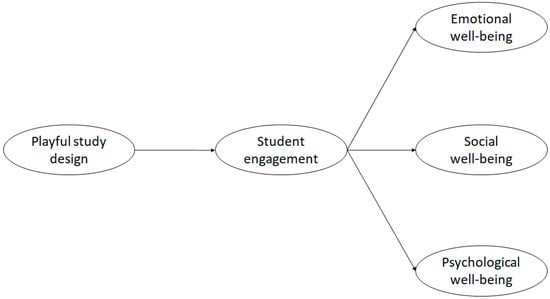
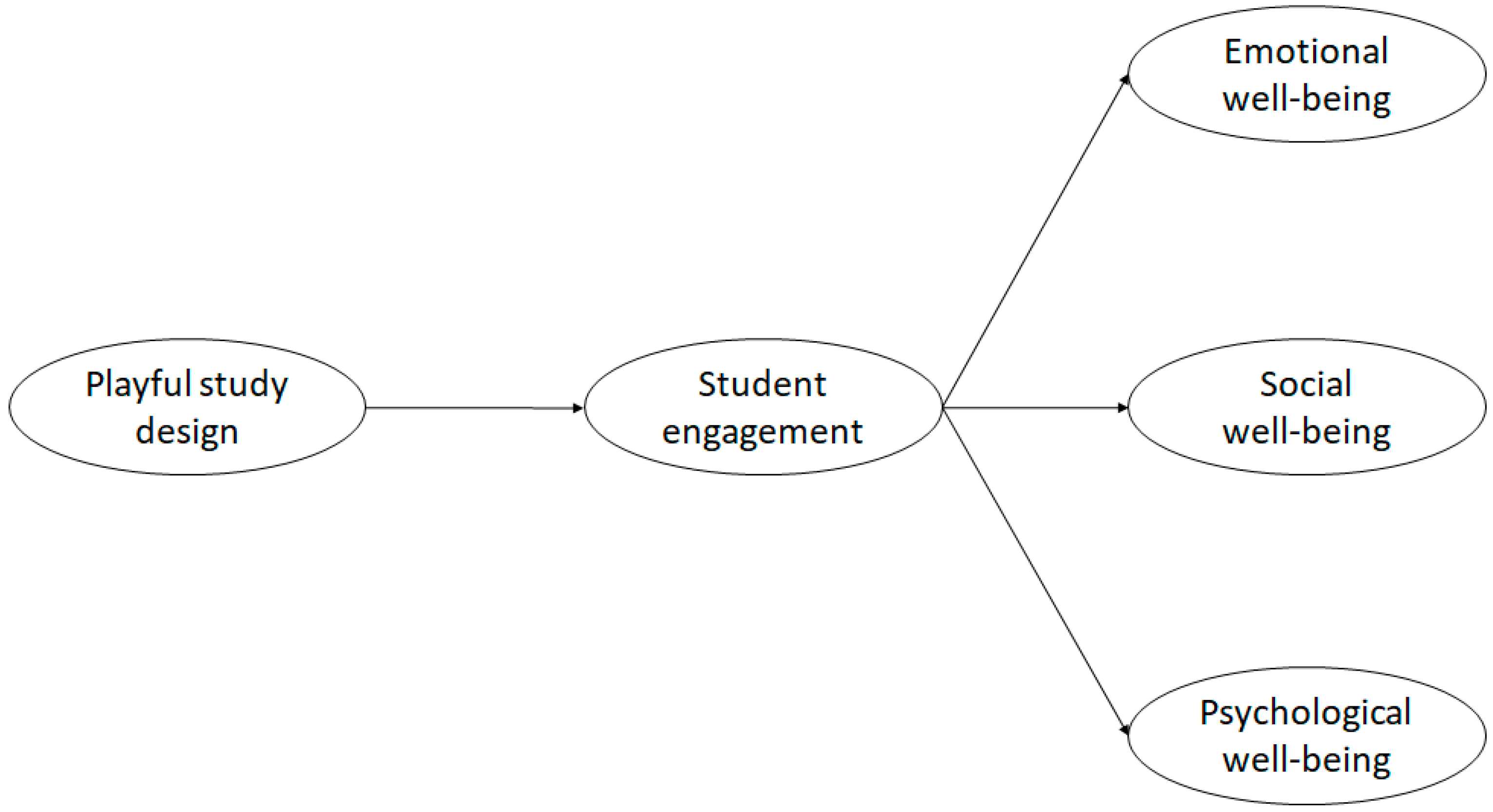
The proposed model advances previous PSD research in two respects. Wang et al. [9] identified engagement as a mechanism linking PSD with goal attainment but did not examine positive mental health. Costantini et al. [7] linked PSD with engagement and subjective well-being, but did not examine the indirect association between PSD and differentiated forms of well-being through engagement. By combining the motivational process proposed by SD–R theory with Keyes’ multidimensional account, the present study tests whether PSD is indirectly associated with emotional, social, and psychological well-being through engagement. Figure 1 summarizes the proposed conceptual model.
Figure 1.
The conceptual model.
Hypothesis 3.
PSD is indirectly associated with (a) emotional well-being, (b) social well-being, and (c) psychological well-being through student engagement.
2. Materials and Method
2.1. Participants and Procedure
A total of 511 Italian university students participated in the study. Participants were predominantly women (n = 428, 83.7%); 79 participants were men (15.5%), and 4 preferred not to report their gender (0.8%). The mean age was 20.40 years (SD = 2.41). In terms of educational level, most participants had a high school diploma (approximately 96.8%), followed by a Bachelor’s degree (1.2%), a Master’s degree (1%), and a small proportion had completed only compulsory education (1%). Most participants were full-time students (n = 434, 84.9%), whereas the remaining participants were student-workers (n = 77, 15.1%). The socio-demographic characteristics of participants were reported in Table 1.
Table 1.
Socio-demographic characteristics of participants (n = 511).
Participants were recruited through a snowball sampling procedure. Initial participants were contacted by email and invited to complete an online questionnaire hosted on Google Forms and to share the survey link with other eligible university students. Inclusion criteria were: (a) being between 18 and 30 years old and (b) being currently enrolled as a university student, including student-workers. The introductory page described the study aims, emphasized voluntary and anonymous participation, and informed participants that they could withdraw before submitting the questionnaire. Informed consent was obtained before survey completion. The study was conducted in accordance with the Declaration of Helsinki. Institutional affiliation and recruitment-chain identifiers were not collected; therefore, intraclass correlations and cluster-robust standard errors could not be estimated.
Completion time was examined before the analyses. Given the number and length of the administered items, four questionnaires completed in less than 5 min were considered implausibly rapid and were excluded. Data collection took place between November 2025 and May 2026, ensuring a sufficient timeframe to reach the targeted sample size.
As a broad sample-size consideration, an a priori calculation indicated that approximately 259 participants would be required to detect a bivariate association of r = 0.20 with 90% power, using a two-tailed test and α = 0.05. This calculation was used only as a general recruitment reference and should not be interpreted as a model-specific power analysis for the latent indirect associations. The final analytic sample comprised N = 511 participants.
2.2. Measures
PSD was assessed using the Italian version of the PSD Scale [7]. The scale includes 12 item rated on a 5-point frequency scale ranging from 1 (never) to 5 (very often). It measures two dimensions: designing fun (6 items, e.g., “I approach my study in a playful way”) and designing competition (6 items, e.g., “I approach my study tasks as a series of exciting challenges”). In line with the aim of examining PSD as an overall proactive study strategy, an overall PSD score was used in the present study. The scale showed good internal consistency (ω = 0.86).
Student engagement was assessed using the Italian version of the Utrecht Work Engagement Scale-Student version (UWES-S) [33]. The scale includes 17 items rated on a 7-point frequency scale ranging from 0 (never) to 6 (always). It assesses three dimensions of engagement: vigor (e.g., “I feel full of energy when I am studying”), dedication (e.g., “My studies inspire me”), and absorption (e.g., “I get drawn into my studies”). For descriptive analyses, an overall student engagement score was calculated. In the latent-variable analyses, all individual items were specified as indicators of their respective first-order dimensions, which in turn defined the second-order student engagement factor. In the present study, an overall student engagement score was used, and the scale showed excellent internal consistency (ω = 0.93).
Positive mental health was assessed with the Italian version of the Mental Health Continuum–Short Form (MHC–SF) [4,5,34]. The scale includes 14 item assessing three dimensions of well-being: emotional well-being (3 items, e.g., “In the past month, how often did you feel happy”), social well-being (5 items, e.g., “In the past month, how often did you feel that people are basically good”), and psychological well-being (6 items, e.g., “In the past month, how often did you feel good at managing the responsibilities of your daily life”). Participants indicated how often they had experienced each aspect of well-being during the past month on a frequency scale ranging from 0 (never) to 5 (everyday). For descriptive analyses, each well-being score was calculated by averaging the items of the corresponding dimension; in the SEM, individual items served as indicators of the three separate latent well-being factors. The three dimensions showed good internal consistency: emotional well-being (ω = 0.82), social well-being (ω = 0.80), and psychological well-being (ω = 0.85).
2.3. Data Analyses
First, descriptive statistics and bivariate correlations among the study variables were computed. No missing data were present because all survey items were mandatory. Item distributions were examined through means, standard deviations, skewness, and kurtosis to evaluate the assumptions underlying their treatment as approximately continuous indicators. Multivariate normality was additionally examined using Mardia’s multivariate skewness and kurtosis tests.
Before testing the structural model, a series of item-level confirmatory factor analyses was conducted to examine the measurement structure of each construct [35,36]. For PSD, a unidimensional model was compared with a two-factor model distinguishing designing fun and designing competition. For student engagement, a unidimensional model was compared with a three-factor model comprising vigor, dedication, and absorption. For positive mental health, alternative one-, two-, and three-factor models were compared to determine whether emotional, social, and psychological well-being should be represented as distinct dimensions. Nested models were evaluated via the χ2 difference test (Δχ2). Based on these measurement analyses, the hypothesized full measurement model specified designing fun and designing competition as first-order factors loading onto a second-order PSD factor, and vigor, dedication, and absorption as first-order factors loading onto a second-order student engagement factor. Emotional, social, and psychological well-being were specified as three distinct correlated latent factors. To examine whether the covariance among all item responses could be adequately represented by a single general factor, the hypothesized multidimensional hierarchical measurement model was compared with an alternative model in which all study items loaded onto one latent factor. This comparison was not intended to demonstrate the absence of common method bias [37,38], but only to examine whether the covariance among the item responses could be adequately represented by a single general factor.
The hypothesized indirect associations were subsequently tested using item-level latent-variable SEM. PSD was specified as a predictor of student engagement, and both PSD and student engagement were specified as predictors of emotional, social, and psychological well-being. Residual covariances among the three well-being outcomes were freely estimated. Indirect effects were tested using 5000 bootstrap resamples and bias-corrected 95% confidence intervals [39]. Because the data were cross-sectional, indirect effects were interpreted as indirect associations rather than evidence of causal mediation [40,41].
All SEM analyses were conducted using Mplus 8.3 with ML estimation. Completely standardized coefficients from the Mplus STDYX solution are reported. Within SEM analyses, model fit was evaluated using the chi-square statistic, the Comparative Fit Index (CFI), the Tucker–Lewis Index (TLI), the root mean square error of approximation (RMSEA), and the standardized root mean square residual (SRMR). Model fit was evaluated by considering these indices jointly as approximate guidelines rather than as rigid decision rules. Values around 0.90 for CFI and TLI and around 0.08 or lower for RMSEA and SRMR were treated as broadly indicative of acceptable fit, whereas values around 0.95 for CFI and TLI, 0.06/0.08 for RMSEA, and 0.08 for SRMR were considered indicative of comparatively good fit [36,42].
Finally, two additional analyses were conducted. First, as an ordinal-data sensitivity analysis, the hypothesized model was re-estimated using WLSMV, with all items specified as ordered categorical indicators. Second, to examine the potentially differentiated contributions of the two PSD dimensions, an alternative structural model was estimated in which designing fun and designing competition were entered as distinct correlated latent predictors of student engagement and the three well-being dimensions.
3. Results
3.1. Preliminary Analyses
Correlational analyses showed that designing fun, designing competition, and PSD were positively associated with student engagement and with all three dimensions of well-being. Student engagement was also positively associated with emotional, social, and psychological well-being. All correlations among variables were in the expected direction and are reported in Table 2.
Table 2.
Mean, standard deviation and correlations among the variables.
3.2. Measurement Models
The distributions of the study indicators were examined before model estimation. As reported in Supplementary Table S1, item skewness ranged from −0.96 to 1.26 and kurtosis ranged from −1.00 to 1.21, indicating no severe univariate departures from normality. Given that the indicators were measured using ordered response scales with at least five categories and showed only moderate asymmetry and kurtosis, they were treated as approximately continuous, and the primary analyses were estimated using maximum likelihood. Despite the moderate univariate distributions, Mardia’s tests indicated significant departures from multivariate normality for both skewness, coefficient = 263, χ2 (14,190) = 22,381, p < 0.001, and kurtosis, coefficient = 2181, z = 44.70, p < 0.001. Thus, the assumption of multivariate normality was not supported. These findings, together with the ordered response formats of the indicators, provided the rationale for repeating the hypothesized model using WLSMV as an ordinal-data sensitivity analysis.
Before testing the structural model, we conducted item-level confirmatory factor analyses to examine the measurement structure of each construct, using all items. Specifically, for PSD, we compared a unidimensional model with a two-factor model distinguishing designing fun and designing competition. For student engagement, we compared a unidimensional model with a three-factor model comprising vigor, dedication, and absorption. Finally, for positive mental health, we compared a unidimensional model with a three-factor model distinguishing emotional, social, and psychological well-being. The main results of these comparisons, including the essential model-fit indices, are summarized in Table 3. Complete results—including standardized factor loadings, item-level explained variances, factor correlations, and residual correlations—are reported in the Supplementary Materials. The confirmatory factor analyses supported the multidimensional representation of all three constructs. For PSD, the two-factor model distinguishing designing fun and designing competition (M2) fitted the data significantly better than the one-factor model (M1), Δχ2 (1) = 263.53, p < 0.001. Similarly, the three-factor student engagement model distinguishing vigor, dedication, and absorption (M4) showed a substantial and significant improvement over the one-factor solution (M3), Δχ2 (3) = 1642.41, p < 0.001. Regarding well-being, the three-factor model distinguishing emotional, social, and psychological well-being (M9) provided the best fit among the tested solutions and fitted significantly better than the one-factor model, Δχ2 (3) = 315.18, p < 0.001.
Table 3.
Measurement model comparison.
These findings did not support strictly unidimensional representations of PSD and student engagement. Accordingly, in the subsequent analyses, individual items were specified as indicators of their respective first-order dimensions: designing fun and designing competition for PSD, and vigor, dedication, and absorption for student engagement. At the same time, because these dimensions represent theoretically related facets of broader constructs, second-order factors were specified to capture their shared variance. Thus, the hierarchical measurement model preserved the conceptual and empirical distinctiveness of the first-order dimensions while allowing PSD and student engagement to be examined as broader constructs in the structural model. Emotional, social, and psychological well-being were instead retained as three distinct correlated outcomes, consistent with the study’s aim of examining potentially differentiated associations across well-being domains.
Finally, the hypothesized multidimensional hierarchical measurement model was compared with an alternative model in which all study items loaded onto a single latent factor. The single-factor model (M10) showed a substantially poorer fit than the hypothesized measurement model (M11), Δχ2 (16) = 5997.25, p < 0.001. This finding supports the empirical distinguishability of the study constructs and indicates that the covariance among the item responses cannot be adequately represented by one general factor. However, this comparison provides only limited evidence regarding common method concerns and does not demonstrate that common method bias is absent or controlled.
3.3. Hypothesized Indirect-Association Model
The structural model yielded the same global fit indices as the measurement model because its latent structural component was just identified. The model estimated the direct paths from PSD and student engagement to each well-being dimension, as well as the residual covariances among emotional, social, and psychological well-being. Consequently, overall model fit did not constitute an independent test of the proposed directional structure. The hypotheses were therefore evaluated through the individual structural coefficients and the bootstrapped confidence intervals of the indirect associations. The structural model included the path from PSD to student engagement, the direct paths from PSD and student engagement to each of the three well-being dimensions, and the residual covariances among emotional, social, and psychological well-being. The covariation between designing fun and designing competition, as well as that among vigor, dedication, and absorption, was accounted for by their respective second-order factors. No correlated residuals among individual items were specified.
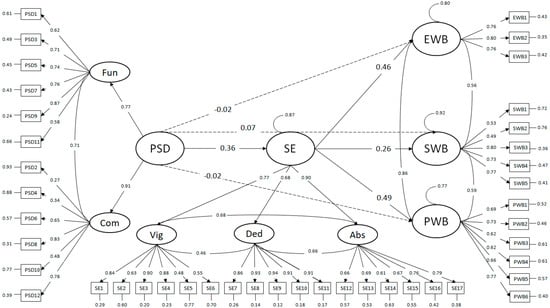
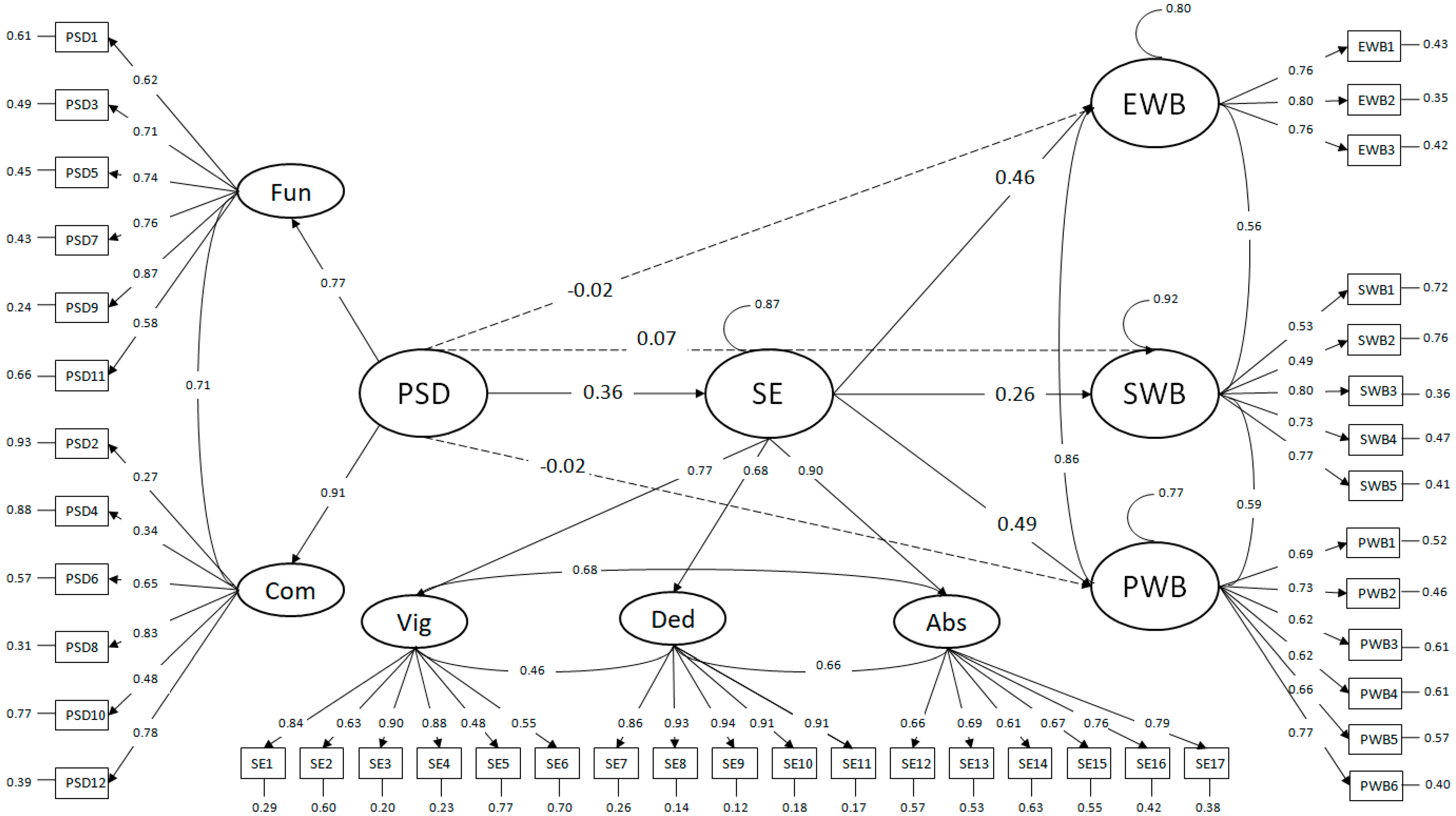
The hypothesized model (Figure 2) showed a mixed pattern of fit to the data, χ2 (844) = 2323.27, p < 0.001. The RMSEA and SRMR indicated an acceptable fit, RMSEA = 0.059, 90% CI [0.056, 0.061], and SRMR = 0.073, whereas the incremental fit indices remained slightly below conventional acceptability thresholds, CFI = 0.884 and TLI = 0.875.
Figure 2.
Hypothesized indirect-association model. Note. Fun = designing fun; Com = designing competition; PSD = playful study design; Vig = vigor; Ded = dedication; Abs = absorption; SE = student engagement; EWB = emotional well-being; SWB = social well-being; PWB = psychological well-being. Standardized coefficients are reported. Solid lines indicate statistically significant associations, whereas dashed lines indicate non-significant associations. Circles represent latent variables, whereas rectangles represent observed indicators. Single-headed arrows represent factor loadings or structural paths, and curved double-headed arrows represent freely estimated covariances.
Table 4 reports the completely standardized total, direct, and indirect associations estimated in the model. PSD showed significant positive total associations with emotional well-being (β = 0.141, p < 0.001), social well-being (β = 0.159, p < 0.001), and psychological well-being (β = 0.152, p < 0.001), supporting H1a– H1c. PSD was also positively associated with student engagement (β = 0.357, p < 0.001), supporting H2. In turn, student engagement was positively associated with emotional (β = 0.458, p < 0.001), social (β = 0.257, p < 0.001), and psychological well-being (β = 0.493, p < 0.001). After accounting for student engagement, the direct associations between PSD and emotional (β = −0.023), social (β = 0.067), and psychological well-being (β = −0.024) were not statistically significant. Finally, the indirect associations between PSD and emotional (β = 0.164, p < 0.001), social (β = 0.092, p < 0.001), and psychological well-being (β = 0.176, p < 0.001) through student engagement were positive and statistically significant, supporting H3a– H3c. Given the cross-sectional design, these findings represent statistical indirect associations and do not establish temporal or causal mediation. The model explained 21.5% of the variance in student engagement, 20.3% of the variance in emotional well-being, 8.6% of the variance in social well-being, and 23.6% of the variance in psychological well-being.
Table 4.
Total, direct, and indirect associations estimated in the model.
3.4. Additional Analyses
Two supplementary analyses were conducted to evaluate the robustness of the findings (see Supplementary Table S2). First, the hypothesized model was re-estimated using WLSMV, with all items specified as ordered categorical indicators. Second, to examine the potentially differentiated contribution of the two PSD dimensions, designing fun and designing competition were entered as distinct correlated latent predictors.
As a sensitivity analysis, the hypothesized model was re-estimated using WLSMV, treating the item responses as ordered categorical variables. The model showed a mixed but generally acceptable pattern of fit to the data, χ2 (845) = 2587.70, p < 0.001, CFI = 0.950, TLI = 0.947, RMSEA = 0.064, 90% CI [0.061, 0.066], and SRMR = 0.064. PSD was positively associated with student engagement (β = 0.271, p < 0.001). In turn, student engagement was positively associated with emotional (β = 0.477, p < 0.001), social (β = 0.294, p < 0.001), and psychological well-being (β = 0.518, p < 0.001). The total associations between PSD and emotional (β = 0.124, p < 0.001), social (β = 0.156, p < 0.001), and psychological well-being (β = 0.124, p < 0.001) were positive and statistically significant. The direct associations between PSD and emotional (β = −0.005) and psychological well-being (β = −0.016) were not statistically significant, whereas the direct association with social well-being was positive and significant (β = 0.076, p ≤ 0.01). Finally, the indirect associations between PSD and emotional (β = 0.129, p < 0.001), social (β = 0.080, p < 0.001), and psychological well-being (β = 0.140, p < 0.001) through student engagement were positive and statistically significant. Overall, the WLSMV analysis supported the robustness of the hypothesized indirect associations, although the direct association between PSD and social well-being was statistically significant only in the WLSMV analysis.
As an additional analysis, we estimated an alternative structural model in which designing fun and designing competition were specified as distinct correlated latent predictors of student engagement and the three well-being dimensions. The model showed a mixed pattern of fit, χ2 (842) = 2311.56, p < 0.001, CFI = 0.884, TLI = 0.876, RMSEA = 0.058, 90% CI [0.056, 0.061], and SRMR = 0.071. Designing fun and designing competition were strongly correlated (r = 0.716), indicating substantial shared variance between the two dimensions. When both dimensions were entered simultaneously, designing fun was negatively associated with student engagement (β = −0.306, p < 0.001), whereas designing competition showed a strong positive association with student engagement (β = 0.767, p < 0.001). Student engagement, in turn, was positively associated with emotional (β = 0.486, p < 0.001), social (β = 0.235, p < 0.001), and psychological well-being (β = 0.520, p < 0.001). The total associations between designing fun and the three well-being dimensions were not statistically significant. In contrast, designing competition showed significant positive total associations with emotional (β = 0.277, p < 0.001) and social well-being (β = 0.183, p < 0.05). Among the direct associations with well-being, only the association between designing fun and social well-being was positive and statistically significant (β = 0.187, p < 0.05). The indirect associations of designing fun through student engagement were negative and statistically significant for emotional (β = −0.149, p < 0.001), social (β = −0.072, p < 0.05), and psychological well-being (β = −0.159, p < 0.001). Conversely, designing competition showed positive indirect associations with emotional (β = 0.373, p < 0.001) and social well-being (β = 0.180, p < 0.05). Given the strong correlation between the two PSD dimensions, the negative coefficients for designing fun represent its unique residual association after controlling for designing competition and should therefore be interpreted cautiously as a possible suppression or sign-reversal pattern.
4. Discussion
The present study examined whether PSD is directly and indirectly associated with emotional, social, and psychological well-being through student engagement. Drawing on the Study Demands–Resources framework [1] and Keyes’ multidimensional model of positive mental health [4], we proposed that PSD may represent a proactive study behavior associated with the motivational quality of students’ academic activities, and indirectly, with their well-being. Overall, the findings were consistent with the proposed model. The comparison of alternative measurement models also supported the empirical distinctiveness of PSD, student engagement, and the three dimensions of well-being, strengthening confidence in the interpretation of the structural associations.
PSD was positively associated with student engagement and showed positive total associations with all three dimensions of well-being. Significant indirect associations between PSD and emotional, social, and psychological well-being through student engagement were also observed. In the primary ML analysis, none of the direct associations between PSD and the three well-being dimensions was statistically significant; a small positive direct association with social well-being emerged only in the WLSMV sensitivity analysis. These findings extend the emerging literature on PSD in several ways. Previous research has shown that students who redesign their study activities in playful ways tend to report higher study engagement, goal attainment, social integration, subjective well-being, flow, and attentional focus [7,8,9,32]. The present study moves this literature forward by linking PSD to a differentiated model of positive mental health. Rather than considering well-being as a global outcome, we examined emotional, psychological, and social well-being separately. This distinction is theoretically relevant because positive mental health includes not only feeling good, but also functioning effectively at the personal and social levels [4,5,6,25]. The results suggest that the playful redesign of study activities may be associated with a broader pattern of positive functioning, extending beyond immediate study motivation.
A second contribution concerns the indirect role of student engagement. The proposed model is informed by, and compatible with, the motivational process outlined in SD–R theory [1]. However, although PSD may theoretically be associated with student engagement through experiences of autonomy, competence, meaningful challenge, and motivational enrichment, these processes were not directly assessed and should be regarded as theoretically proposed explanations rather than empirically established mechanisms. PSD was positively associated with student engagement, and student engagement was positively associated with emotional, social, and psychological well-being. Because these variables were measured at the same time, the findings do not demonstrate that PSD produces engagement or that engagement subsequently produces well-being. Rather, they show that engagement statistically accounted for part of the cross-sectional associations between PSD and the three dimensions of well-being. The theoretical contribution of the present study is therefore limited to extending the nomological network of PSD and showing that the observed pattern of associations among a proactive study behavior, engagement, and multidimensional well-being is compatible with the motivational process proposed by SD–R theory. This pattern is consistent with previous research reporting an indirect association between PSD and goal attainment through engagement [9], while extending the outcomes considered to multidimensional positive mental health.
The pattern of indirect associations is also theoretically informative. Significant indirect associations through student engagement were observed between PSD and both emotional and psychological well-being, whereas the corresponding direct associations were not statistically significant. The findings concerning social well-being require particular caution. The indirect association through student engagement was positive but relatively small, and the proportion of variance explained in social well-being was comparatively limited. Moreover, the residual direct association was not statistically significant in the primary ML analysis, whereas a small positive association emerged only in the WLSMV sensitivity analysis. Thus, the findings do not provide consistent evidence of a residual PSD–social well-being association beyond student engagement. At the same time, the comparatively small indirect association and the limited explained variance suggest that other unmeasured processes may contribute to the relationship between PSD and social well-being. Possible candidates include social connectedness, peer interaction, university belonging, and collaborative engagement. However, these possibilities were not tested and should not be inferred from the present results. PSD was conceptualized and measured as an individual, predominantly self-referenced strategy, and the instrument did not assess playful social interaction or collaboration. Future research should therefore directly measure these interpersonal processes before interpreting them as mechanisms linking PSD to social well-being.
From a health-promotion perspective, the findings provide a preliminary rationale for developing and rigorously evaluating PSD-based initiatives, rather than evidence that such initiatives are already effective or ready for implementation. The present study did not evaluate an intervention, changes in mental health over time, feasibility, acceptability, cost, or scalability. Accordingly, PSD cannot yet be characterized as a low-cost, flexible, or scalable health-promotion strategy. Any future application should also complement, rather than replace, supportive educational environments, adequate institutional resources, and manageable study demands.
The practical implications for teaching and student support should therefore be considered cautiously. Future pilot interventions could examine whether students find it feasible and helpful to introduce curiosity, humor, imagination, self-referenced challenges, or personally meaningful goals into their study activities. Such interventions should also assess possible disadvantages and heterogeneous responses. Even when designing competition is self-referenced, it may increase pressure, perfectionistic striving, frustration, social comparison, or compulsive performance monitoring for some students. Moreover, playful approaches may be less accessible or appropriate for students experiencing severe psychological distress, exhaustion, financial strain, disability, or overwhelming study demands. For these students, individual playful strategies should not substitute for reasonable accommodations, professional support, financial assistance, or structural changes to academic demands.
Several limitations should be acknowledged. First, the study used a cross-sectional design, which prevents causal conclusions and does not establish temporal precedence among PSD, engagement, and positive mental health. Although the tested model was theoretically grounded and consistent with SD–R theory, the indirect associations observed in this study should not be interpreted as evidence of causal mediation. Reverse and reciprocal relationships are equally plausible; for example, students with higher well-being may be more able to approach study activities playfully and may consequently report greater engagement. Longitudinal, diary, and intervention studies are needed to clarify the temporal ordering and possible reciprocal relations among PSD, engagement, and positive mental health. Second, the study did not directly assess study demands, contextual study resources, or the resource-like experiences through which PSD is theoretically expected to operate, such as autonomy, competence, meaningful challenge, and motivational enrichment. Consequently, the proposed motivational explanations remain theoretical assumptions rather than empirically tested mechanisms. Future research should incorporate these variables to provide a more comprehensive test of the motivational process proposed by SD–R theory. Third, the use of self-report measures collected at the same time may have inflated the associations among variables due to common method variance. Although the hypothesized multidimensional measurement model fitted the data substantially better than the single-factor model, this comparison does not rule out common method bias. Future research should combine data from different sources, temporally separate the assessment of predictors and outcomes, or employ more direct approaches to modelling method variance. Fourth, the snowball recruitment procedure represents an additional limitation. Institutional affiliation, program level, year of study, academic discipline, study workload, and recruitment-chain identifiers were not collected. Consequently, the potential concentration of participants within particular institutions, fields of study, or social networks could not be evaluated, and any unobserved dependence among observations may have affected the estimated standard errors. Moreover, because neither the number of students who received the invitation nor the number who opened or started the questionnaire was available, a conventional response rate could not be calculated. These limitations restrict the assessment of sample representativeness. The sample was also predominantly female, further limiting the extent to which the findings can be generalized to the broader population of university students. Future studies should employ more systematic recruitment procedures, collect institutional and academic information, track recruitment chains and response rates, and test the proposed model in more gender-balanced samples drawn from diverse universities, degree programs, years of study, and academic disciplines. Fifth, although the supplementary analysis examined designing fun and designing competition as separate predictors, their strong correlation produced unstable unique coefficients and a possible suppression or sign-reversal pattern. Consequently, the differentiated associations of the two PSD dimensions could not be established conclusively. Future research should examine these associations using longitudinal or experimental designs and samples in which the two dimensions show sufficient independent variability. Finally, the measures did not employ fully aligned temporal frames; the MHC-SF referred explicitly to experiences during the previous month, whereas PSD and student engagement were assessed as more general study-related perceptions. This mismatch may have affected the observed associations and limits the temporal comparability of the constructs. Future studies should employ aligned reference periods and longitudinal designs to examine their temporal relationships more precisely.
Future research could extend the present findings in several directions. Longitudinal and diary studies could examine whether PSD predicts within-person fluctuations in engagement and well-being across days or weeks. Experimental and intervention studies could test whether training students to use PSD strategies leads to improvements in engagement and positive mental health over time. Moreover, future studies could investigate boundary conditions, such as emotional intelligence, self-regulation, study demands, academic pressure, or perceived institutional support, to clarify for whom and under what conditions PSD is most beneficial. Finally, examining PSD across different academic disciplines, educational levels, and cultural contexts would help establish the robustness and practical relevance of the construct.
5. Conclusions
The present study indicates that PSD is positively associated with emotional, social, and psychological well-being among Italian university students and that student engagement has an indirect role in these associations. By integrating the Study Demands–Resources framework with a multidimensional model of positive mental health, the study identifies a pattern of associations suggesting that PSD may warrant further investigation as a potentially relevant proactive behavior in the context of health promotion in higher education. Students who report approaching their study activities in more playful ways also report greater engagement and higher levels of well-being. However, because all variables were measured at the same time, the temporal direction of these associations remains unknown, and reverse or reciprocal relationships cannot be excluded. The findings provide a promising basis for future longitudinal and intervention research. Before PSD-based initiatives can be recommended, their effectiveness, feasibility, accessibility, and potential unintended consequences require rigorous evaluation within broader institutional efforts to create supportive and sustainable learning environments.
Supplementary Materials
The following supporting information can be downloaded at: https://www.mdpi.com/article/10.3390/ijerph23101308/s1, Table S1: Item-Level Descriptive Statistics, Standardized Factor Loadings, Residual Variances, Explained Variance, and Latent Factor Correlations; Table S2: Sensitivity and Dimension-Specific Structural Analyses.
Author Contributions
Conceptualization, F.U., A.C. and E.C.; methodology, F.U. and A.C.; formal analysis, A.C.; investigation, F.U., A.C., T.P. and E.C.; data curation, F.U. and A.C.; writing—original draft preparation, F.U., A.C. and E.C.; writing—review and editing, F.U., A.C. and E.C.; supervision, F.U. and A.C. All authors have read and agreed to the published version of the manuscript. F.U. and A.C. contributed equally to this work.
Funding
This research received no external funding.
Institutional Review Board Statement
The study was conducted according to the guidelines of the Declaration of Helsinki, and approved by the Ethics Committee for Scientific Research of LUMSA University (CERS, approval no. 7/2024, 17 May 2024).
Informed Consent Statement
Informed consent was obtained from all subjects involved in the study.
Data Availability Statement
The data presented in this study are available on request from the corresponding author. The data are not publicly available due to privacy issues.
Acknowledgments
The authors are grateful to the anonymous reviewers for their careful and constructive comments, which helped strengthen the conceptual framing, methodological rigor, and overall clarity of the manuscript.
Conflicts of Interest
The authors declare no conflicts of interest.
Abbreviations
| PSD | Playful Study Design |
| SD–R | Study Demands–Resources |
| UWES-S | Utrecht Work Engagement Scale-Student version |
| MHC-SF | Mental Health Continuum-Short Form |
| CFA | Confirmatory Factor Analysis |
| SEM | Structural Equation Modeling |
| ML | Maximum Likelihood |
| WLSMV | Weighted Least Squares Mean and Variance Adjusted |
| CFI | Comparative Fit Index |
| TLI | Tucker–Lewis Index |
| RMSEA | Root Mean Square Error of Approximation |
| SRMR | Standardized Root Mean Square Residual |
| CI | Confidence Interval |
References
- Bakker, A.B.; Mostert, K. Study demands–resources theory: Understanding student well-being in higher education. Educ. Psychol. Rev. 2024, 36, 92. [Google Scholar] [CrossRef] [Scilit]
- Ruiz-Hernández, J.A.; Guillén, Á.; Pina, D.; Puente-López, E. Mental health and healthy habits in university students: A comparative associative study. Eur. J. Investig. Health Psychol. Educ. 2022, 12, 114–126. [Google Scholar] [CrossRef] [Scilit] [PubMed]
- World Health Organization. Ottawa Charter for Health Promotion; World Health Organization: Geneva, Switzerland, 1986. [Google Scholar]
- Keyes, C.L.M. The mental health continuum: From languishing to flourishing in life. J. Health Soc. Behav. 2002, 43, 207–222. [Google Scholar] [CrossRef] [Scilit]
- Keyes, C.L.M. Mental illness and/or mental health? Investigating axioms of the complete state model of health. J. Consult. Clin. Psychol. 2005, 73, 539–548. [Google Scholar] [CrossRef] [Scilit] [PubMed]
- Kraiss, J.T.; Redelinghuys, K.; Weiss, L.A. The effects of psychological interventions on well-being measured with the Mental Health Continuum: A meta-analysis. J. Happiness Stud. 2022, 23, 3655–3689. [Google Scholar] [CrossRef] [Scilit]
- Costantini, A.; Bakker, A.B.; Scharp, Y.S. Playful study design: A novel approach to enhancing student well-being and academic performance. Educ. Psychol. Rev. 2025, 37, 47. [Google Scholar] [CrossRef] [Scilit]
- Liu, W.; van der Linden, D.; Bakker, A.B. Enhancing student well-being and focus: The role of playful study design and strengths use. Appl. Psychol. Health Well-Being 2025, 17, e70058. [Google Scholar] [CrossRef] [Scilit] [PubMed]
- Wang, H.; Ren, Y.; Liu, W. A weekly diary study on playful study design, study engagement, and goal attainment: The role of proactive personality. J. Happiness Stud. 2023, 24, 159–184. [Google Scholar] [CrossRef] [Scilit] [PubMed]
- Bergen, D. Foundations of play theory. In The SAGE Handbook of Play and Learning in Early Childhood; Brooker, L., Blaise, M., Edwards, S., Eds.; SAGE Publications: London, UK, 2014; pp. 5–21. [Google Scholar]
- Bodrova, E.; Leong, D.J. Vygotskian and post-Vygotskian views on children’s play. Am. J. Play 2015, 7, 371–388. [Google Scholar]
- Bubikova-Moan, J.; Næss Hjetland, H.; Wollscheid, S. ECE teachers’ views on play-based learning: A systematic review. Eur. Early Child. Educ. Res. J. 2019, 27, 776–800. [Google Scholar] [CrossRef] [Scilit]
- Kolb, A.Y.; Kolb, D.A. Learning to play, playing to learn: A case study of a ludic learning space. J. Organ. Change Manag. 2010, 23, 26–50. [Google Scholar] [CrossRef] [Scilit]
- Connolly, T.M.; Boyle, E.A.; MacArthur, E.; Hainey, T.; Boyle, J.M. A systematic literature review of empirical evidence on computer games and serious games. Comput. Educ. 2012, 59, 661–686. [Google Scholar] [CrossRef] [Scilit]
- Hanus, M.D.; Fox, J. Assessing the effects of gamification in the classroom: A longitudinal study on intrinsic motivation, social comparison, satisfaction, effort, and academic performance. Comput. Educ. 2015, 80, 152–161. [Google Scholar] [CrossRef] [Scilit]
- Whitton, N. Playful learning: Tools, techniques, and tactics. Res. Learn. Technol. 2018, 26, 2035. [Google Scholar] [CrossRef] [Scilit]
- Scharp, Y.S.; Bakker, A.B.; Breevaart, K.; Kruup, K.; Uusberg, A. Playful work design: Conceptualization, measurement, and validity. Hum. Relat. 2023, 76, 509–550. [Google Scholar] [CrossRef] [Scilit]
- Van Vleet, M.; Feeney, B.C. Play behavior and playfulness in adulthood. Soc. Personal. Psychol. Compass 2015, 9, 630–643. [Google Scholar] [CrossRef] [Scilit]
- Levin, K.; Creed, P.A.; Jones, L.; Duffy, A. Study crafting in higher education: Scale development and initial validation. Int. J. Educ. Vocat. Guid. 2025, 25, 1485–1505. [Google Scholar] [CrossRef] [Scilit]
- Panadero, E. A review of self-regulated learning: Six models and four directions for research. Front. Psychol. 2017, 8, 422. [Google Scholar] [CrossRef] [Scilit] [PubMed]
- van Zyl, L.E.; Arijs, D.; Cole, M.L.; Glińska-Neweś, A.; Roll, L.C.; Rothmann, S.; Shankland, R.; Stavros, J.M.; Verger, N.B. The Strengths Use Scale: Psychometric properties, longitudinal invariance and criterion validity. Front. Psychol. 2021, 12, 676153. [Google Scholar] [CrossRef] [Scilit] [PubMed]
- Plass, J.L.; Homer, B.D.; Kinzer, C.K. Foundations of game-based learning. Educ. Psychol. 2015, 50, 258–283. [Google Scholar] [CrossRef] [Scilit]
- Deci, E.L.; Ryan, R.M. The “what” and “why” of goal pursuits: Human needs and the self-determination of behavior. Psychol. Inq. 2000, 11, 227–268. [Google Scholar] [CrossRef] [Scilit]
- Ryan, R.M.; Deci, E.L. Self-Determination Theory: Basic Psychological Needs in Motivation, Development, and Wellness; Guilford Press: New York, NY, USA, 2017. [Google Scholar]
- Keyes, C.L.M. Social well-being. Soc. Psychol. Q. 1998, 61, 121–140. [Google Scholar] [CrossRef] [Scilit] [PubMed]
- Schaufeli, W.B.; Martínez, I.M.; Pinto, A.M.; Salanova, M.; Bakker, A.B. Burnout and engagement in university students: A cross-national study. J. Cross-Cult. Psychol. 2002, 33, 464–481. [Google Scholar] [CrossRef] [Scilit]
- Kahu, E.R.; Nelson, K. Student engagement in the educational interface: Understanding the mechanisms of student success. High. Educ. Res. Dev. 2018, 37, 58–71. [Google Scholar] [CrossRef] [Scilit]
- Hmelo-Silver, C.E. Problem-based learning: What and how do students learn? Educ. Psychol. Rev. 2004, 16, 235–266. [Google Scholar] [CrossRef] [Scilit]
- Loyens, S.M.M.; Magda, J.; Rikers, R.M.J.P. Self-directed learning in problem-based learning and its relationships with self-regulated learning. Educ. Psychol. Rev. 2008, 20, 411–427. [Google Scholar] [CrossRef] [Scilit]
- Dochy, F.; Segers, M.; Van den Bossche, P.; Gijbels, D. Effects of problem-based learning: A meta-analysis. Learn. Instr. 2003, 13, 533–568. [Google Scholar] [CrossRef] [Scilit]
- Csikszentmihalyi, M. Finding Flow: The Psychology of Engagement with Everyday Life; Hachette UK: London, UK, 2020. [Google Scholar]
- Liu, M.; Tong, X.; Qi, J.; Cai, W. How to promote playful study design, study engagement and creativity in higher education: The role of study and personal resources. Int. J. Manag. Educ. 2025, 23, 101196. [Google Scholar] [CrossRef] [Scilit]
- Fiorilli, C.; Galimberti, V.; De Stasio, S.; Di Chiacchio, C.; Albanese, O. L’utilizzazione dello School Burnout Inventory (SBI) con studenti italiani di scuola superiore di primo e secondo grado. Psicol. Clin. Svilupp. 2014, 18, 403–424. [Google Scholar] [CrossRef] [Scilit]
- Petrillo, G.; Capone, V.; Caso, D.; Keyes, C.L.M. The Mental Health Continuum–Short Form (MHC–SF) as a measure of well-being in the Italian context. Soc. Indic. Res. 2015, 121, 291–312. [Google Scholar] [CrossRef] [Scilit]
- Brown, T.A. Confirmatory Factor Analysis for Applied Research, 2nd ed.; Guilford Press: New York, NY, USA, 2015. [Google Scholar]
- Kline, R.B. Principles and Practice of Structural Equation Modeling, 5th ed.; Guilford Press: New York, NY, USA, 2023. [Google Scholar]
- Podsakoff, P.M.; MacKenzie, S.B.; Lee, J.-Y.; Podsakoff, N.P. Common method biases in behavioral research: A critical review of the literature and recommended remedies. J. Appl. Psychol. 2003, 88, 879–903. [Google Scholar] [CrossRef] [Scilit] [PubMed]
- Podsakoff, P.M.; MacKenzie, S.B.; Podsakoff, N.P. Sources of method bias in social science research and recommendations on how to control it. Annu. Rev. Psychol. 2012, 63, 539–569. [Google Scholar] [CrossRef] [Scilit] [PubMed]
- Preacher, K.J.; Hayes, A.F. Asymptotic and resampling strategies for assessing and comparing indirect effects in multiple mediator models. Behav. Res. Methods 2008, 40, 879–891. [Google Scholar] [CrossRef] [Scilit] [PubMed]
- Cole, D.A.; Maxwell, S.E. Testing mediational models with longitudinal data: Questions and tips in the use of structural equation modeling. J. Abnorm. Psychol. 2003, 112, 558–577. [Google Scholar] [CrossRef] [Scilit] [PubMed]
- Maxwell, S.E.; Cole, D.A. Bias in cross-sectional analyses of longitudinal mediation. Psychol. Methods 2007, 12, 23–44. [Google Scholar] [CrossRef] [Scilit] [PubMed]
- Hu, L.; Bentler, P.M. Cutoff criteria for fit indexes in covariance structure analysis: Conventional criteria versus new alternatives. Struct. Equ. Model. Multidiscip. J. 1999, 6, 1–55. [Google Scholar] [CrossRef] [Scilit]

Disclaimer/Publisher’s Note: The statements, opinions and data contained in all publications are solely those of the individual author(s) and contributor(s) and not of MDPI and/or the editor(s). MDPI and/or the editor(s) disclaim responsibility for any injury to people or property resulting from any ideas, methods, instructions or products referred to in the content. |
© 2026 by the authors. Licensee MDPI, Basel, Switzerland. This article is an open access article distributed under the terms and conditions of the Creative Commons Attribution (CC BY) license.