


Abstract
Air pollution is the world’s greatest environmental health risk. Pollutants that pose large health concerns are particulate matter (PM2.5 and PM10), ozone (O3), carbon monoxide (CO), nitrogen dioxide (NO2), and sulphur dioxide (SO2). These compounds (especially PM2.5 and PM10) contribute to the onset of diseases, such as respiratory diseases (e.g., asthma, chronic obstructive pulmonary disease (COPD), or lung cancer) and cardiovascular diseases. Abatement interventions are implemented to reduce air pollution and thereby the risk of these diseases. This systematic review examined the published scientific evidence on the cost-effectiveness of strategies aimed at reducing or controlling air pollution and assessed the reporting quality of included studies. It employed rigorous data extraction and quality scoring procedures to ensure the reliability and validity of our findings. Overall, there is substantial evidence supporting the cost-effectiveness of interventions aimed at reducing air pollution. Seventy-four studies and four policy reports were included in this review. Predominantly, cost–benefit analyses have been reported (n = 40), reflecting the multisectoral impacts and associated costs of air pollution. Only four cost–utility analyses were found, indicating the need for more research within this domain. Additionally, eight articles reported one or more non-economic results. Thirty-nine studies focused on particulate matter (PM), and eleven focused on nitrogen oxides (NOx). The quality assessment yielded moderate results. The heterogeneity of studies and moderate quality of reporting make it difficult to compare results and draw definitive conclusions.
1. Introduction
Clean air is an essential element in making life on Earth possible. However, anthropogenic sources are releasing large amounts of polluting waste into the atmosphere, resulting in air pollution [1]. Air pollution can be defined as “contamination of the indoor or outdoor environment by any chemical, physical or biological agent that modifies the natural characteristics of the atmosphere”. It is the world’s greatest environmental health risk [2,3]. Especially low- and middle-income countries are suffering from this. In large cities, however, exposure to pollutants can also be very high [2,3,4].
The World Health Organization (WHO) differentiates air pollution in ambient air pollution and household air pollution. The first, which includes ozone, is mainly caused by vehicles and industry emissions. The second is generated by cooking with solid fuels, heating homes with wood or coal, and smoking [5,6].
In 2019, air pollution caused 6.7 million deaths worldwide [7]. In Europe, it has been estimated to account for more than 400,000 premature deaths per year [2]. Pollutants that pose large health concerns are particulate matter (PM2.5 and PM10), ozone, carbon monoxide (CO), nitrogen dioxide (NO2), and sulphur dioxide (SO2) [3]. These compounds (especially PM2.5 and PM10) contribute to the onset of diseases, such as respiratory diseases (e.g., asthma, chronic obstructive pulmonary disease (COPD), or lung cancer) and cardiovascular diseases [8]. Long-term exposure to PM2.5 is accountable for the loss of 103.1 million disability-adjusted life years (DALYs), which is 7.6% of the overall global DALYs [9].
The economic impact of air pollution is significant. In Brazil, Miraglia et al. (2014) calculated that air pollution costs USD 1.7 billion annually due to premature mortality in urban areas [10]. Shamsi et al. (2021) estimated the health costs resulting from traffic on Highway 401 in Canada at 416 million Canadian dollars per year [11]. A Belgian study demonstrated that a 10% reduction in PM10, PM2.5, and NO2 could result in substantial annual savings for cardiovascular hospitalisation costs, with 3.7 million, 3.6 million, and 5.9 million euros for arrhythmias, respectively, and 5.2 million, 5.0 million, and 8.4 million euros for ischemic heart diseases, respectively [12].
The implementation of air quality mitigation strategies can have various goals and additional consequences, such as complying with air quality standards, enhancing traffic flow, or addressing public health concerns [4]. Due to these abatement measures, air pollution concentrations have shown a decreasing trend, including the mortality rate associated with it [2,9]. As these strategies incur costs and generate benefits, economic evidence of these interventions can serve various purposes, including advocacy, resource allocation decisions, and policy-making decisions [13,14].
The cost-effectiveness of air pollution mitigation strategies has been reviewed in a few reviews, each with different inclusion criteria. A recent review on health economic analyses of air pollution control policies in China reported a wide variety of ways to analyse and report methods of cost-effectiveness of air pollution mitigation [15]. Another review summarised the health economic evidence in three environmental health areas, including air pollution. This study only included articles from 1990 until 2008 and concluded that the available health economic evidence was limited due to the small number of studies and variation in scientific quality and location [13]. These reviews did not assess the reporting quality of the included studies in a standardised way. A third more recent review only analysed cost–benefit analyses that included health benefits of air pollution mitigation strategies worldwide and divided these into groups (ambient, indoor, and mixed strategies). This article has a broad focus on the economic impact of air pollution control strategies worldwide. It assesses the reporting quality of the studies and stresses the need for more economic and epidemiological data to enable more robust health economic evaluations [16].
A significant gap has been identified in the literature regarding a comprehensive evaluation of cost–utility, cost-effectiveness, cost–benefit, and cost–minimisation analyses of air pollution mitigating strategies across various sectors. This review aims to address this gap by incorporating a broader range of economic evaluation methodologies, offering a more nuanced understanding of the financial implications and health benefits associated with air pollution mitigation strategies.
Specific focus will be placed on the potential cost-effectiveness of air pollution mitigation strategies, examining various interventions across different sectors. Additionally, this review will assess the reporting quality by means of the CHEERS II checklist, to enhance transparency and reliability in the presented findings.
This systematic review has the following objectives: (1) to investigate the published scientific evidence on the cost-effectiveness of strategies aimed at reducing or controlling air pollution and (2) to assess the reporting quality of the studies included in the literature review. As health economics and environmental health are both highly evolving fields, an up-to-date review may be useful in providing future researchers and policy maker with the latest relevant information. This review can contribute to essential insights for policy making, cost savings, and improvements to health.
2. Materials and Methods
A systematic review was conducted on the cost-effectiveness of air pollution interventions to reduce or control air pollution. This systematic review is performed according to the principles of the PRISMA guidelines, stated in Page et al. (2021) [17], and additional guidance was sought from established frameworks for conducting systematic reviews on the cost-effectiveness of health interventions [18,19,20]. A detailed protocol, developed in collaboration with another expert (NV), outlines the methodology for this systematic review. This document can be requested on demand. The study protocol was prospectively registered on PROSPERO (ID: CRD42023488753). There were no deviations from this protocol in this study.
2.1. Literature Search
Three databases have been systematically searched on the subject of cost-effectiveness of air pollution mitigation strategies. A search strategy has been developed for the database of MEDLINE (via PubMed) and has been adapted to EMBASE and Web of Science Core Collection (via Web of Science) (see Supplementary Materials). The grey literature has also been systematically searched for by means of Google (scholar) based on the following key terms mentioned below. Only policy reports have been included in the review for reasons of validity.
The search strategy is composed of the key concepts ‘air pollution’, ‘intervention(s) or strategy’, and ‘full health economic evaluations’. The concept ‘full health economic evaluations’ has been elaborated in another systematic review on the cost-effectiveness of the prevention of gestational diabetes, and these terms were also used in this review [21], with an update on a recent new MeSH term ‘cost-effectiveness’. The Boolean operators ‘AND’ and ‘OR’ were used to create a search strategy. This search strategy has further been reviewed by a librarian of the VUB University Medical Library. The last search was performed on 8 April 2025.
2.2. Study Selection
Eligibility criteria were defined using the PICO (Population, Intervention, Comparator, Outcome) strategy (Table 1). Exposure to the general population was included because air pollution is a ubiquitous environmental issue that affects all individuals, irrespective of demographic, geographic, or socioeconomic factors. Studies that focus on specific occupational exposures to certain types of air pollution were excluded. For example, the study of Ge et al. (2022) on inhalation of coal mine dust by coal workers or the study of Huang et al. (2021) on the exposure of aromatic hydrocarbons by Chinese chefs were excluded in this review [22,23]. This paper focuses on air pollution control strategies, both indoors and outdoors. It focuses exclusively on interventions that directly lead to air pollution reduction. Strategies or interventions where air pollution reduction is merely a co-benefit of other measures, such as climate mitigation, were excluded. Papers analysing the cost-effectiveness, cost–utility, or cost–benefit of air pollution abatement measures were eligible for inclusion, provided they described and compared the incremental costs and effects of two or more alternatives. Cost-minimisation analyses were also included. Economic evaluations that did not include health effects were excluded from this study. There were no restrictions on how health effects were expressed. Other systematic reviews or meta-analyses were excluded. No geographical restrictions were applied, and only articles written in Dutch, English, and French were included. Only articles published from 2013 onwards were eligible for this systematic review (as the cut-off was set at 10 years prior to the start of the screening process in October 2023).
Table 1.
Study eligibility criteria.
For the screening process, the web application Rayyan was used [24]. All three reviewers (BV, LC, and NV) were blinded from each other’s decisions. One reviewer (BV) screened all records, while the other two reviewers each screened half of the articles. The first round screened the titles and abstracts. Next, all records that were retained from the first round were screened on full text, and reasons for exclusion were registered. In case of conflicts, a fourth independent reviewer (KP) acted as a tiebreaker. When full articles were not available, the original author was contacted via email. In addition, a ‘backward and forward citation’ search was performed to search for papers that have been overlooked.
2.3. Data Extraction
For data extraction from the papers included in this systematic review, a data extraction table was developed in Microsoft® Excel based on an existing template [19]. The following characteristics were retrieved from the articles: (1) first author, (2) publication year, (3) country, (4) type of study, (5) intervention, (6) comparator, (7) sort model, (8) perspective, (9) time horizon, (10) costs, (11) effects/outcome, (12) type of sensitivity analysis, (13) result of sensitivity analysis, (14) incremental costs, (15) incremental effects, (16) ICER/ICUR,NB,CBR, (17) main conclusion, and (18) discount rate. One reviewer (BV) filled in this table, and when in doubt, she consulted a second independent reviewer (NV). The data extraction table has been validated by an expert (SS).
2.4. Synthesis of the Results
The results are summarised in evidence tables and figures or explained comprehensively in the main text. Because the articles included in this systematic review are difficult to compare, due to different methodologies and modelling, a narrative synthesis of the results is sufficient [25]. The grey literature included in this review is, together with the included scientific studies, referred as ‘articles’ in the Results section.
Guerriero et al. (2020) [26] state that the costs of a cost–benefit analysis can be divided into three major groups: compliance costs (purchase, construction, and maintenance); regulatory costs (government costs to implement the measure); and damage costs (e.g., environmental damage resulting from the intervention). However, they note that there are no clear specific guidelines for estimating the costs of an environmental intervention. Depending on the perspective, the type of intervention, and the number of markets affected, this cost analysis can vary [26]. We used the three abovementioned groups to analyse the costs from the articles. The benefits and effects of the interventions were also categorised to facilitate reporting [4,16]. Where possible, costs were converted to euros in the year 2024 using the online CCEMG–EPPI Centre Cost Converter [27].
2.5. Quality Assessment
Complete and transparent reporting of how health economic evaluation studies are designed and conducted is important to assess the validity of research findings and conclusions [28]. This is why the quality of reporting of the included articles was evaluated by means of the Consolidated Health Economic Evaluation Reporting Standards (CHEERS) II checklist. This is a guideline on the comprehensive and transparent reporting of health economic evaluations in the literature, to make these identifiable and useful in decision making. This 28-item checklist was used to assess the included papers [29]. This was performed by one reviewer (BV) and discussed with a second independent reviewer (NV). The results of this quality assessment were discussed narratively at the individual study level. An item was given a ‘1’ when reported in the article, ‘0’ when not reported, and ‘0.5’ when the reported information did not match entirely with the item. ‘NA’ was indicated when an item was not applicable for that particular study.
3. Results
3.1. Study Selection
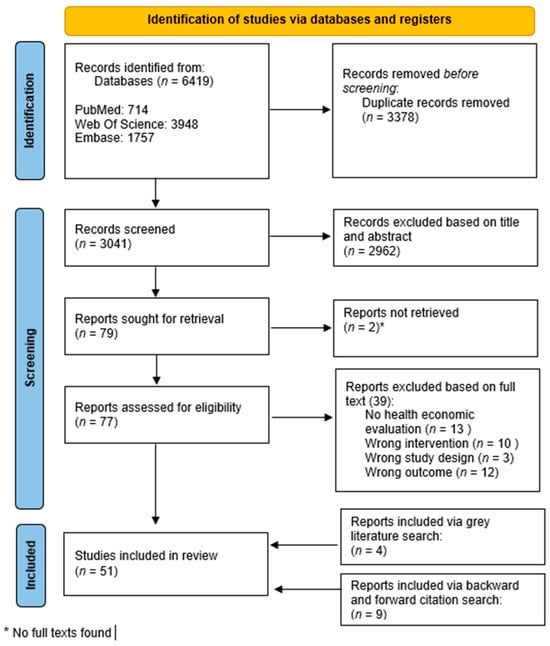
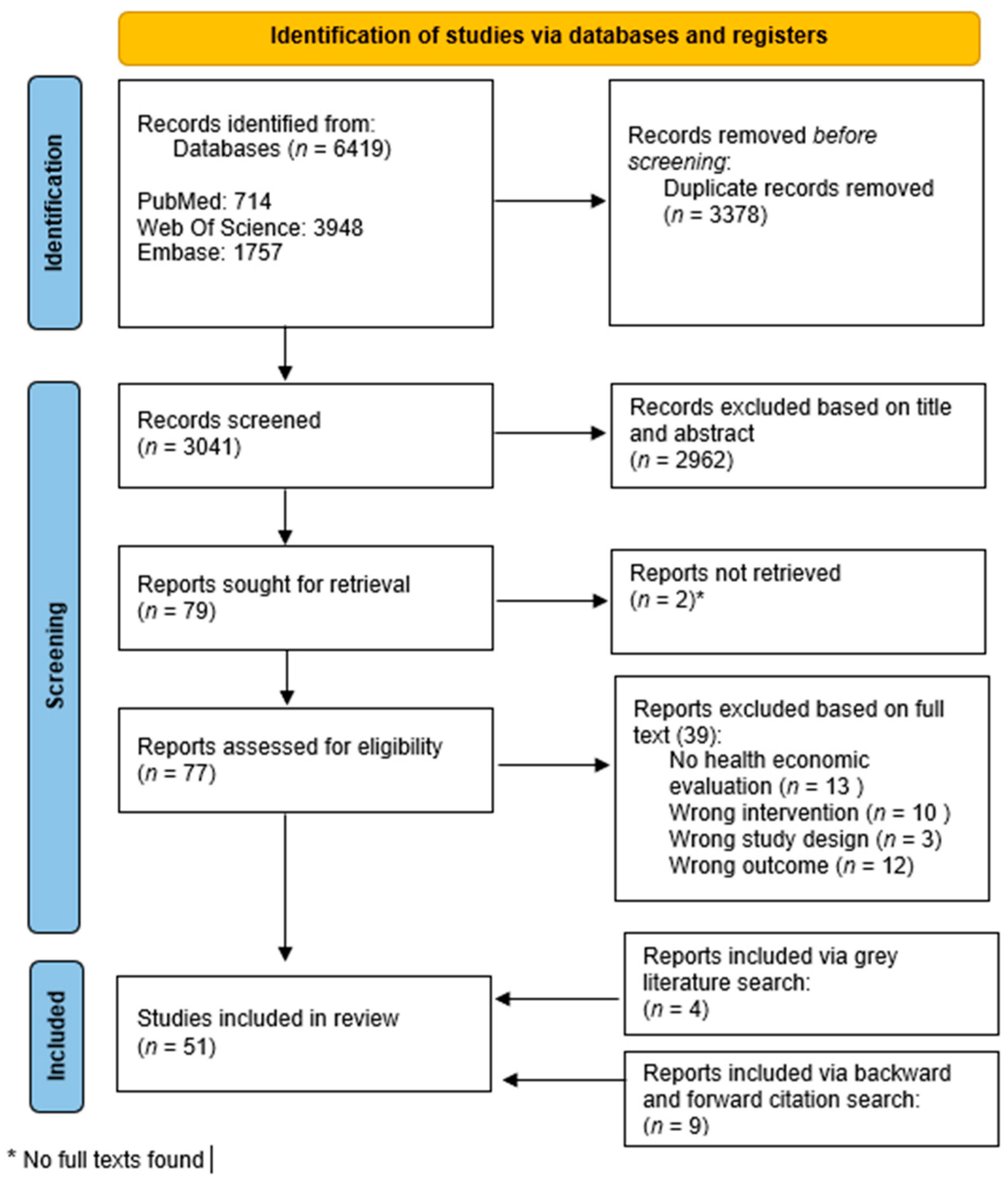
A total of 6419 articles were extracted from the aforementioned databases using the established search string (Figure 1). A large number of duplicates were removed (n = 3378), leaving 3041 articles to be screened based on their titles and abstracts. Of these, 2962 articles were excluded. Seventy-nine articles were subsequently screened based on the full text, with the full text of two articles not found. Attempts to contact the original authors were made, but no response was received. Of the 77 articles, 39 were excluded based on an intervention that did not meet the inclusion criteria (n = 10); a different study design than the inclusion criteria (n = 3); a different outcome than the inclusion criteria (n = 12); and no health economic evaluation (n = 13). Additionally, a ‘forward and backward citation search’ was conducted, resulting in nine additional articles being included. Finally, the grey literature was also searched, resulting in four additional reports being included. This makes a total of 51 studies retained for data extraction.
Figure 1.
PRISMA flowchart of the literature search.
3.2. Study Identification
Of the 47 included studies, 40 report a cost–benefit analysis (CBA) [30,31,32,33,34,35,36,37,38,39,40,41,42,43,44,45,46,47,48,49,50,51,52,53,54,55,56,57,58,59,60,61,62,63,64,65,66,67,68,69] and 4 articles are cost–utility analyses (CUA) [14,70,71,72]. In three articles, it is not explicitly stated which analysis was performed, but it can be inferred that a cost–benefit analysis was conducted [73,74,75]. One policy report conducted both a CUA and a CBA [76], while the other three policy reports only performed a CBA [77,78,79]. In Table 2, the main characteristics of the studies are presented. Nineteen articles focus on China [34,36,37,38,41,44,47,49,54,56,57,58,59,61,64,67,68,75]; eight articles on Europe [30,35,48,50,51,53,71,74]; six on the United States [42,43,46,52,55,73]; two articles on the United Kingdom [14,72]; and eleven articles on other parts of the world such as Asia, Turkey, Canada, and South America [31,32,33,39,40,45,62,63,65,66,69,70]. Three of the four reports included in this review were set in the United Kingdom [76] and Europe [77,78], and one report is from India [79].
Table 2.
Main characteristics of the included studies.
Since air pollution is a broad concept, the selected articles focused on a variety of pollutants. Particulate matter (PM2.5 of PM10) was investigated in 39 studies [14,31,32,33,34,35,36,38,39,40,41,42,43,46,47,48,49,50,51,52,54,56,58,59,60,61,62,64,65,66,67,68,70,71,72,77,78], and nitrogen oxides (NOx) were studied in 11 articles [14,44,48,50,51,54,55,57,59,67,79]. Ammonia (NH3), sulphur dioxide (SO2), and ozone (O3) were analysed in eight, nine, and nine articles, respectively (NH3 [30,35,37,53,74,75]; SO2 [44,54,55,57,59,63,67,79]; O3 [39,51,52,59,64,65,68,77]). Carbon (di)oxide (CO2) was reported in three articles [48,59,73]. Two studies did not specify which pollutant was addressed, simply referred to as ‘indoor air pollution’ [45,69]. Twenty-eight of forty-four articles analysed only one pollutant [30,31,32,33,34,36,37,38,40,41,42,43,46,47,49,53,56,58,60,61,62,66,70,71,72,73,74,75], while the other nineteen articles included multiple pollutants in their analyses [14,35,39,44,45,48,50,51,52,54,55,57,59,63,64,65,67,68,69].
The types of intervention discussed in the articles were divided into five groups: residential interventions (n = 15) [32,33,34,36,38,41,42,43,45,47,49,56,62,69,70]; industrial interventions (n = 12) [39,44,46,52,54,55,57,58,63,64,67,73]; transport interventions (n = 7) [14,40,48,60,61,66,76]; agricultural interventions (n = 6) [30,35,37,53,74,75]; and multiple interventions (i.e., spread across different sectors) (n = 5) [50,51,59,65,77]. In seven articles, no specific intervention was discussed [31,68,71,72,77,78,79]. These concern a reduction in the amount of a specific pollutant/emissions. An overview of the interventions per study can be found in Appendix A.
3.3. Characteristics of Health Economic Evaluations
Table 3 and Table 4 present the characteristics of the economic evaluations analysed in the included studies. Thirty-five articles do not report a clear perspective [30,31,33,34,36,37,38,39,40,42,43,45,46,47,48,49,50,51,52,54,55,56,57,59,62,63,64,65,67,71,72,73,75,78,79]. Seven CBA’s mention a societal perspective [44,58,60,61,68,74], and two report from a (local) government perspective [66,76]. In five CBAs, multiple perspectives are mentioned, encompassing both societal and individual perspectives (farmers, residents, and households) [32,35,41,53,69]. In two of the four CUAs, a healthcare perspective was clearly reported [14,70], while in the other two, no perspective was mentioned [71,72]. In 19 articles no time horizon was mentioned [30,31,33,35,36,38,39,40,42,47,48,49,50,51,56,62,73,74,75], but in 13 studies, it was explicitly mentioned in the methodology section [14,55,66,67,68,69,71,72,76,77,78,79].
Table 3.
Characteristics of the included health economic evaluations.
Table 4.
Characteristics of the included grey literature.
According to Liu et al. (2023), CBAs can be categorised into two major groups: the traditional ex post evaluations and the ex ante simulations, also known as ‘integrated assessment models’ (IAMs) [15]. The first group evaluates already implemented policy measures, while the second group assesses potential future measures and predicts their impacts through modelling. This is achieved by combining various models. Most reported CBAs belong to the latter category (n = 31) [30,31,34,35,37,39,46,47,48,49,50,51,52,53,54,55,60,61,63,64,65,67,68,69,73,74,75,76,77,78,79]. Five articles are ex post CBAs [33,41,58,59,62]. In 11 articles, the methodology used was not specified [32,36,38,40,42,43,44,45,56,57,66]. Three CUAs utilised a Markov model [70,71,72], and in one article, the model applied was not specified [14].
In most CBAs, compliance costs are described (n = 27) [31,32,34,36,37,38,40,42,43,45,46,47,49,50,55,56,57,62,63,64,66,68,69,76,79]. Three articles incorporate these costs along with regulatory expenses in the analysis [33,41,67], while one article focuses solely on regulatory costs [52]. Three CBAs include additional costs, such as those related to accidents and noise; a reduction in gross profit margin due to mitigation measures; or the remaining expected value of ‘scrapped’ vehicles [48,53,60]. Among the four CUAs, three address healthcare costs [70,71,72], and in one article, this was not specified [14]. Two articles also included productivity loss as an indirect cost [77,78].
Each study examines health benefits based on various health outcomes. The most common are premature mortality and hospitalisations for various conditions such as lung diseases and cardiovascular diseases. In addition to health effects, six articles also consider productivity gains from reduced air pollution as benefits [41,45,51,58,59,60]. Seventeen other articles describe other benefits such as environmental, social, or economic benefits [32,34,35,37,44,45,48,55,58,60,61,62,64,65,66,69]. In 28 articles, the (health) outcomes are monetised using the Value of Statistical Life (VSL) [30,31,32,33,34,35,37,38,39,40,45,47,51,54,68,69,74,76,77,78,79] or by means of a willingness-to-pay (WTP) value (n = 3) [44,53,58]. Productivity gains are the most often monetised using the human capital method (n = 5) [44,56,60,61,62]. Ten other articles did not provide information on this aspect [36,41,42,43,46,49,50,55,73,75]. In the four CUAs, QALYs were evaluated [14,70,71,72].
In terms of discounting, both costs and effects should be discounted in economic evaluations to account for the time value of money, allowing them to be compared to each other. This way, a picture of the actual economic impact of a policy measure can be drawn. However, not every article appears to do this. In 29 articles, no discounting seemed to be applied at all [30,31,35,36,41,42,43,47,48,49,50,51,52,54,56,57,58,59,62,64,65,67,68,69,73,74,75]. In nine articles, only discounting of costs is mentioned, with rates ranging from 1.5% to 15% [32,33,34,37,39,40,44,53,66]. Thirteen articles discount both costs and effects, with a range of 1.5% to 12% [14,38,45,46,55,60,61,63,70,71,72].
Sensitivity analyses are an important component of economic evaluations. They map out the uncertainty of the data used. In 20 articles, no sensitivity analysis was shown or mentioned [14,30,39,43,46,50,51,54,58,59,60,61,62,65,67,68,69,73,75,79]. Six articles mention performing a sensitivity analysis but do not report the results [35,37,40,41,44,45]. Twelve articles report Monte Carlo simulations [32,33,34,36,38,47,49,52,56,57,71,72]. Eight studies conduct one-way sensitivity analyses [32,38,63,64,66,70,71]. Five articles report scenario analyses or probabilistic sensitivity analyses [31,42,48,53,74].
3.4. Results of Health Economic Evaluations
Table 5 and Table 6 show the results, outcome valuation and the sensitivity analysis results of the included studies.
Table 5.
Outcome valuation, sensitivity analysis, and results of included health economic evaluations.
Table 6.
Results of included health economic evaluations from the grey literature.
The incremental costs and effects represent the difference in costs and effects between at least two interventions or strategies being compared. Only three articles explicitly mention incremental costs: one CBA and two CUAs [32,65,66]. Reporting on incremental benefits also varies, with only four articles explicitly mentioning them: two CBAs and two CUAs [32,34,65,66].
Eleven articles mention one or more non-cost-effective results [32,33,45,47,48,50,51,65,67,68,70], while the rest of the articles report only cost-effective results [30,31,34,35,36,37,38,39,40,41,42,43,44,46,49,52,53,54,55,56,57,58,59,60,61,62,63,64,66,69,71,72,73,74,75]. In four articles, no incremental cost–utility ratio (ICUR), cost–benefit ratio (CBR), or net benefits (NB) were mentioned [37,43,55,72]. In two cost–utility studies, an ICUR was calculated. One article analysed the different governmental reimbursement scenarios of air purifiers in various Canadian cities compared to full reimbursement and showed that only in one city would the base scenario be cost-effective (USD 38,628/QALY (EUR 31,878/QALY (2024)) at a WTP of USD 50,000/QALY (EUR 34,358/QALY (2024))) [70]. The other study analysed the implementation of US emission standards in Italy and France compared to the current national emission standards, reporting cost savings of, respectively, EUR 3000 (EUR 3952.78 (2024)) and EUR 1000 (EUR 1317.59 (2024)) and health gains of 0.31 and 0.04 QALYs [71].
Across various studies, similar interventions are often described, and in the majority of cases, the results are consistent (i.e., whether or not they are cost-effective). One exception is a residential intervention: the implementation of a liquefied petroleum gas (LPG) stove. Jeuland et al. (2016) [32] compare this intervention with standard wood-burning stoves and concluded it to not be cost-effective. Ramirez et al. (2024) [69] also find this to be the least cost-effective solution, compared with traditional biomass cooking stoves. In contrast, Irfan et al. (2016) identify it as the most cost-effective option, even in the most pessimistic scenarios, but they do not specify the comparative situation in their analysis. They report that in the most pessimistic scenario, all CBRs calculated, including those for LPG stoves, remain above 1, except for improved cookstoves (ICS). Jeuland et al. (2016) also shows a low probability of cost-effectiveness for ICS using charcoal or biomass (40% and 50%, respectively) [32,45]. Another negative outcome is reported by Schucht et al. (2018) and Miranda et al. (2016), who analyse different measures such as the implementation of hybrid and electric vehicles. They compare these scenarios with reference scenarios from, respectively, 2020 and 2012, which are not further specified. The intervention is not cost-effective, with net benefits of, respectively, −EUR 569 million (−EUR 719,277,863 (2024)) and −EUR 0.5 million (−EUR 867,685 (2024)) per year [50,51].
Wagner et al. (2015) [35], Giannadaki et al. (2019) [74], and Giannakis et al. (2019) [30] investigate the same agricultural interventions, including the use of low-nitrogen feed, manure storage capacity, low-emission animal housing, and the improvement or replacement of fertilisers. Wagner et al. (2015) [35] compare these interventions with the estimated emissions under current conditions, while Giannadaki et al. (2019) [74] and Giannakis et al. (2019) [30] do so using a control simulation, the details of which are not specified. All these studies report positive results: Giannakis et al. (2019) [30] and Wagner et al. (2015) [35] present these in the form of a cost–benefit ratio, while Giannadaki et al. (2019) [74] report net benefits [28,33,69]. However, due to the different comparators, no overarching conclusions can be drawn.
Other studies have shown that replacing traditional heating and cooking with solid fuels with gas and electricity is cost-effective [32,33,34,41,67], as is the use of solar panels [62]. The use of air purifiers in various forms has also been analysed in various articles. In all cases, air purifiers were found to be cost-effective [36,42,43,47,56,62,70], although the comparative situations varied: Fisk et al. (2017) [43], Fisk et al. (2017a) [42], Liu Y. et al. (2021) [47], and Yang et al. (2024) [36] compared the intervention to a baseline scenario without air purifiers, while Cansino et al. (2019) [62] compared it to the current situation involving wood-burning stoves. This makes it difficult to draw definitive conclusions. Lomas et al. (2016) [14] and Miranda et al. (2016) discuss the cost-effectiveness of implementing a low-emission zone. Both compare this measure to a baseline scenario from 2012 and report limited cost-effectiveness, depending on certain conditions [14,50].
The parameters that most influence cost-effectiveness results are discount rate [33,57,63], health-related parameters (dose–response coefficients, relative risk of asthma incidence, baseline prevalence of various conditions, and total mortality due to PM2.5) [33,38,57,71] and the value of VSL [38,57,63,66].
3.5. Results Quality Assessment
Each study was rated based on its quality of reporting using the CHEERS II checklist (Appendix B). Overall, the cost–benefit analyses seem to score relatively low (ranging from 12.5/28 to 21/28). Very often, no time horizon, perspective, or discount rate is described. Six CBAs do include these [32,44,53,60,61,66]. Policy reports also failed to include crucial elements of methodological reporting, scoring from 15.5 to 19 out of 28. The CUAs generally score higher (17/28 to 22/28). Items 18 (characterisation of heterogeneity), 19 (characterisation of distributional effects), 21 (approach to involving patients and others affected by the research), and 25 (impact of involving patients and others affected by the research) are less relevant to the topic of air pollution, so no article scored on these topics. The last two items have only recently been added to the CHEERS II checklist in 2022, making this result logical. Three articles scored on item 5 (population characteristics) [38,70,72]. All articles provided sufficient (albeit sometimes vague) information on item 6 (context and location) and item 7 (comparators). Only one article reports a health economic plan [70]. Item 27 (source of funding) was mentioned in 28 articles and 3 policy reports [14,30,38,41,42,43,44,46,47,48,49,50,51,52,53,54,55,56,57,59,60,61,62,66,67,68,71,75,76,78,79], and item 28 (conflict of interest) was mentioned in 26 articles [14,30,33,34,36,37,41,42,43,47,48,49,51,54,56,59,61,62,64,65,66,67,68,69,71,74].
4. Discussion
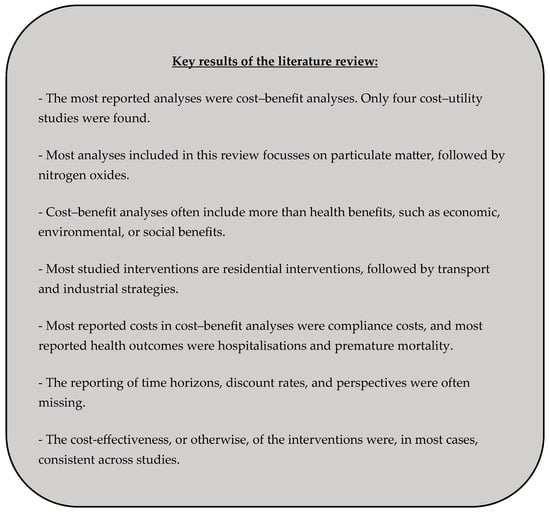
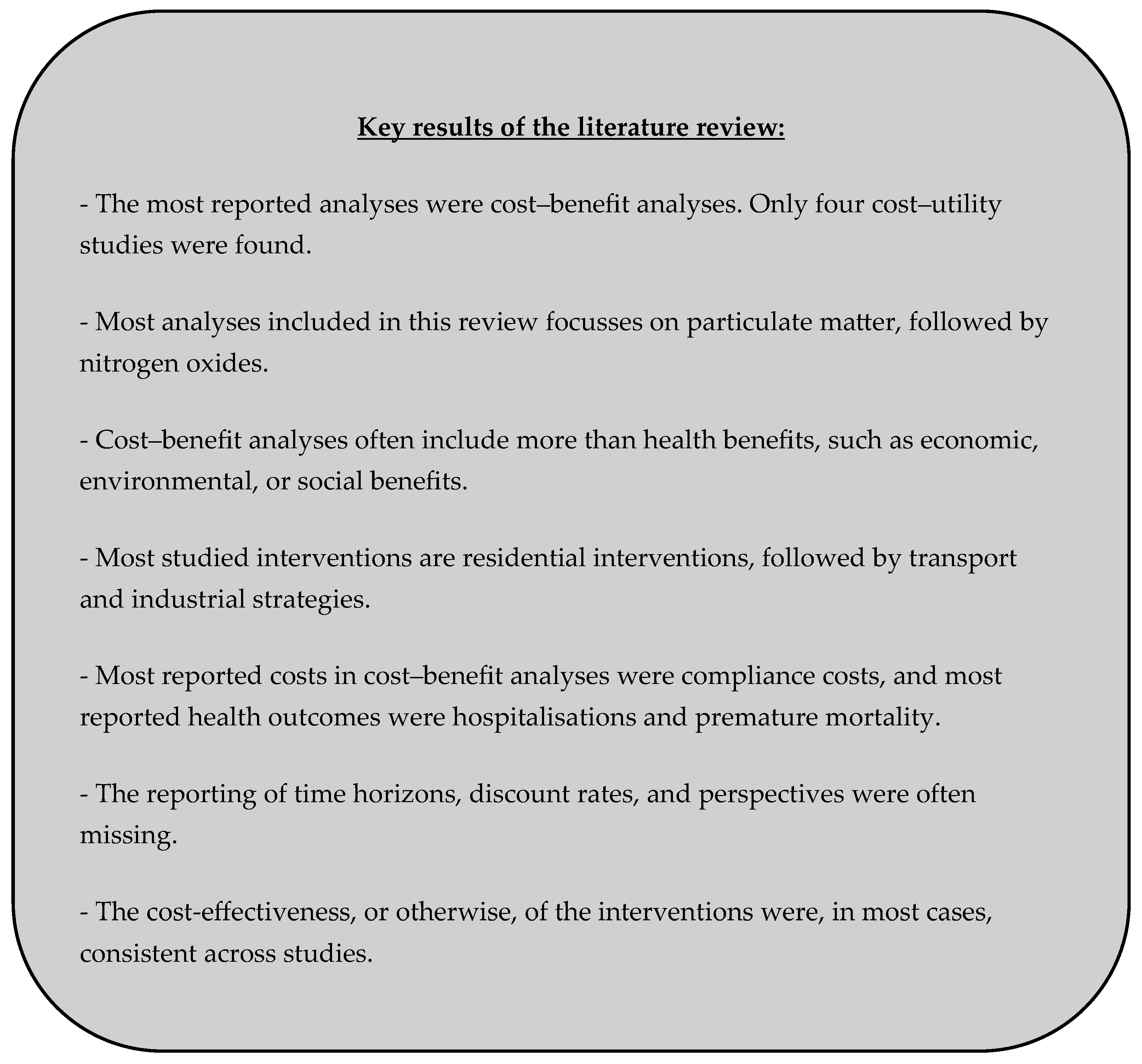
The aim of this systematic review was to inventory the published evidence on the cost-effectiveness of strategies to reduce air pollution. The key results of this literature review are shown in Figure 2. Most of the studies reviewed conducted a cost–benefit analysis (n = 48). This approach can be explained by the fact that air pollution is often evaluated more broadly than just from a health perspective [16,81]. Some studies also consider environmental, social, and economic benefits. Unlike cost-effectiveness or cost–utility studies, cost–benefit analyses encompass more than just health outcomes. This broader scope allows for cross-sectoral comparisons, which is reflected in several articles [82,83]. However, CBAs have their limitations. One of the main issues here is the diversity of monetisation approaches (VSL, WTP, and human capital approach) and the fact that there is no universal standard for valuing health effects. This lack of standardisation poses a significant shortcoming, making it challenging to compare different analyses [83].
Figure 2.
Key results of the literature review.
Only a limited number of articles focus specifically on a cost–utility analysis. This indicates that little research has been conducted in this area, even though such an analysis could be particularly valuable for healthcare policy makers. A CUA can specifically emphasise health outcomes and quality of life. This allows for weighing the costs of the intervention against the health gains achieved [72]. Additionally, health outcomes expressed in generic outcome measures can be compared with other health interventions. When the primary goal of the analysis is to improve health by reducing air pollution, a cost-effectiveness or cost–utility study can be conducted [14]. However, if one opts for a cost–benefit analysis, the outcomes can still be monetised by, for example, using the willingness-to-pay (WTP) method [14,72,82].
The interventions in the articles are classified into four major groups according to Burns et al. (2020) [4]. A significant portion of the studies focus on residential interventions, emphasising indoor air pollution, in particular fine particulate matter (PM2.5 or PM10). Given that people spend up to 90% of their time indoors, these analyses are of great importance [84]. Most articles focus on low-income countries or poorer regions of countries like China, where households often still use solid fuels such as wood or coal for heating and cooking. In this context, new methods are introduced. These include the use of electricity and gas. The literature also indicates that the health effects of indoor air pollution in these countries are the most significant, as indoor air quality often exceeds recommended limits [85,86,87]. Almost all of these residual interventions are reported to be cost-effective. However, indoor air pollution in high-income countries also deserves attention. Urban areas often have high concentrations of ambient pollution, which can infiltrate indoors through ventilation systems and negatively impact health [84,88]. In this regard, six articles analyse the use of air purification devices in the home. This intervention is found to be cost-effective when compared with different scenarios. In urban areas, transport and industrial air pollution constitute the largest share of ambient air pollution. This is reflected by the fact that transport and industrial interventions are the second and third most reported intervention types in this review [87,89].
Air pollution is a broad concept, and the included studies focus on different types of pollutants. Agricultural interventions lead to a reduction in ammonia; traffic interventions reduce particulate matter (PM2.5 and PM10); and industrial interventions often focus on reducing SOx and NOx, and other pollutants. Most articles focus on particulate matter, which has the largest share in health damage and causes millions of deaths worldwide annually [90]. Sixteen studies focus on multiple types of pollutants, named as multipollutant analyses. Liu, X. et al. (2023) mention that these analyses have become increasingly popular in China [15]. Since air pollution is an overarching term for various pollutants, all of which are present in the air simultaneously, it is sometimes difficult to study the effects of a single type of pollutant in isolation. An intervention or strategy will often reduce the emissions of multiple substances, making it more evident to apply a multipollutant analysis. Advantages of this approach include savings in time and money by reducing various pollutants together [91]. In a case study in Detroit, a multi-pollutant approach was compared with an approach where PM2.5 and O3 were measured and analysed separately. The results showed that a multipollutant approach led to a comparable or even greater reduction in both pollutants, resulting in improved quality of life. This approach also yielded twice the monetised benefits for PM2.5 and O3, reduced non-cancer risk, and proved to be more cost-effective than addressing both pollutants separately [92].
The methodologies of the included studies appear to be very different, making cross-comparison of the results challenging. The studies were conducted in both developed and developing countries, leading to significant differences in results. This difference is reflected in the valuation of benefits, which are sometimes calculated using WTP. These values are based on individual preferences and influenced by cultural norms, gender, age, and level of education, resulting in considerable international differences. To address this issue, organisations like the Organisation for Economic Co-operation and Development (OECD) have been generating reliable country-specific estimates of VSL [93]. Notably, 28 studies have utilised this measure, ensuring a more standardised approach to benefit valuation.
Additionally, perspectives often vary, meaning that different costs and effects are taken into account. This can influence the final results for cost-effectiveness, as also mentioned in Kim et al. (2020) [94]. Sometimes, the stated perspective does not match the included costs; for example, Giannadaki et al. (2018) only includes compliance costs from a societal perspective, while healthcare costs, which are normally included in such a perspective, are missing [74].
The time horizon chosen for a study significantly impacts its outcomes. Interestingly, this is mentioned in only a few studies and rarely in cost–benefit analyses. The studies included here often use a short time horizon of 5–10 years. However, air pollution reduction strategies typically incur high initial costs and only yield health benefits in the long term. Therefore, a sufficiently long time horizon is essential to fully capture their impact [80,95]. Discounting is another important aspect of health economic evaluations. Only 13 articles discount both costs and effects. Failing to discount effects can lead to an overestimation of future benefits, affecting the cost-effectiveness ratio and having significant policy implications [96]. It is crucial for studies to apply this methodology to provide a more accurate assessment of the true value of health interventions.
In addition to discounting costs and effects, conducting a sensitivity analysis is an essential part of health economic evaluations to test the robustness of the results. Only 17 articles performed a sensitivity analysis. This aligns with the findings of Jain et al. (2012) regarding other systematic literature reviews [97]. Moreover, there is a great variety in how these sensitivity analyses are conducted, which may be due to the lack of clear guidelines. This can complicate the interpretation and comparison of the results.
The previously mentioned shortcomings are also reflected in the quality assessment results. CBAs score significantly lower than CUAs. Only seven articles and one policy report mention the perspectives, time horizons, and discount rates, three important factors that, as previously indicated, influence the outcome of a cost-effectiveness study [98]. Only one article discusses a health economic protocol, which is understandable since this was only included in the CHEERS II checklist from 2022 [29]. The quality assessment of the included studies indicates that the reporting is generally of moderate quality. This lack of transparency hinders accurate interpretation of the results and makes it challenging to adequately assess the methodological robustness of the economic evaluations. Consequently, the reproducibility of these analyses is low.
All the diverse methodologies used in these studies make it challenging to draw a clear conclusion about the cost-effectiveness of these interventions. This difficulty is also highlighted by another systematic literature review that examined the health effects of air pollution reduction interventions. Burns et al. (2020) concluded that it was not possible to derive an overall conclusion of effectiveness due to heterogeneity of the included studies [4].
Additionally, the heterogeneity of the included articles makes the transferability of results to any specific country or region complex. Various contextual factors such as payment and reimbursement systems, economic climate, government and regulatory factors, and geographical factors can influence these decision-making processes [99]. Although models already exist that make this translation possible [100], these methods are complex and also have their limitations [101,102].
Upon reviewing the studies, three key recommendations emerged. Firstly, there is a critical need for financial support to implement environmental interventions in less developed countries and regions to achieve equitable implementation of, for example, air purifiers. This funding could be sourced from governments or other entities. Secondly, regional or national cooperation is essential for policy implementation, as air pollution transcends borders. For example, Gao et al. (2016) [44] lobby for increased communication and cooperation with other regions to encourage the development of the environmental technology industry. Lastly, increasing awareness among polluters, such as farmers and households, is crucial for gaining social acceptance and mitigating public resistance.
More research is needed on the cost-effectiveness or cost–utility of air pollution reduction from a healthcare perspective. Another future perspective for further research could be the importance of standardising methodologies for economic evaluations of environmental interventions and the need for long-term studies that capture the full impact of air pollution reduction strategies. The WHO published a report in 2000 about considerations in evaluating the cost-effectiveness of environmental health interventions [103]. Although this report may be outdated, it can still be used as a starting point for future economic evaluations. These studies should also report according to the CHEERS II checklist to make comparability possible.
Next to some opportunities for further research, this literature review also has several limitations. The first important limitation is the difficult delineation of inclusion criteria. Determining the centrality of air pollution proved to be challenging at times, potentially resulting in missing important studies. Another inclusion criterion was to include only articles from 2013 onward. As a result, we may have missed older relevant articles. Additionally, only articles written in English, Dutch, or French were included, meaning we might have missed studies in other languages. Another limitation of this paper concerns the categorisation of costs into specific sectors (such as the residential, transport, industrial, and agricultural sectors). This process was constrained by inconsistent reporting across the reviewed studies. As a result, we adopted broader cost groupings to ensure comparability and inclusiveness. This approach, while useful for identifying general trends, may limit the granularity of policy-specific insights that could be drawn from more sector-specific cost analyses. Furthermore, this paper did not differentiate findings based on the CHEERS II reporting scores of the included studies. While the CHEERS II checklist is a valuable tool for assessing the completeness of reporting in health economic evaluations, it does not directly reflect the methodological quality or validity of the evaluations themselves. This limitation restricts the ability to assess whether studies with higher reporting quality reach systematically different conclusions from those with lower reporting quality.
Lastly, ‘publication bias’ could result in fewer non-cost-effective interventions being reported compared to cost-effective interventions, which could have skewed the results of this review.
5. Conclusions
This systematic review fills a gap in the literature by examining the cost-effectiveness of environmental health interventions through various economic evaluation methodologies. It specifically highlights the potential cost-effectiveness of strategies aimed at mitigating air pollution. Overall, there is substantial evidence supporting the (non)-cost-effectiveness of interventions aimed at reducing air pollution, which is also stated in Wang et al. (2024) [16]. Predominantly, cost–benefit analyses have been reported, reflecting the multisectoral impacts and associated costs of air pollution, where cost–utility and cost-effectiveness analyses were less frequently documented. Across all studies, residential interventions were discussed the most, and significant attention was given to particulate matter and nitrogen oxides. The quality assessment revealed that the reporting quality, particularly of the cost–benefit analyses, is moderate. This heterogeneity is also reflected in other reviews on this topic [13,15,16].
This, combined with the heterogeneity of studies, makes it complicated to compare the results and form overall conclusions. By emphasising this difficulty, this review can contribute to a more standardised and robust framework for evaluating the economic impact and health benefits of environmental health interventions. The lack of cost–utility and cost-effectiveness studies indicate a need for further research on air pollution mitigation from a healthcare perspective, specifically through health economic evaluations. This can be invaluable for policy makers focusing on healthcare and public health.
The common thread in the policy recommendations that emerged from the studies proves that there is a consensus among researchers on the key strategies needed to effectively address environmental health issues. This alignment underscores the importance of financial support, regional cooperation, and increasing awareness among polluters as fundamental components of successful environmental interventions. It also highlights the need for a standardised approach to policy implementation, ensuring that efforts are coordinated and impactful across different regions and sectors.
Supplementary Materials
The following supporting information can be downloaded at: https://www.mdpi.com/article/10.3390/ijerph22060926/s1. Table S1: Search string MEDLINE via PubMed; Table S2: Search string Web of Science Core Collection; Table S3: Search string EMBASE.
Author Contributions
Conceptualisation, B.V. and N.V.; methodology, B.V.; validation, S.S. and K.P.; investigation, B.V., L.C.; writing—original draft preparation, B.V.; writing—review and editing, B.V., N.V., S.S., L.C., M.L., and K.P.; supervision, K.P. and S.S.; funding acquisition, K.P. All authors have read and agreed to the published version of the manuscript.
Funding
This research was funded by the Flemish Department of Care, VLOV132, 2021. The funder was involved in the selection of the topic but had no role in the study design, data collection, data analysis, data interpretation, or reporting.
Conflicts of Interest
The authors declare no conflicts of interest. The funders had no role in the design of this study; in the collection, analyses, or interpretation of data; or in the writing of the manuscript.
Abbreviations
The following abbreviations are used in this manuscript:
| CBA | Cost–benefit analysis |
| CBR | Cost–benefit ratio |
| CHEERS | Consolidated Health Economic Evaluation Reporting Standards |
| COI | Cost of illness |
| COPD | Chronic obstructive pulmonary disease |
| CUA | Cost–utility analysis |
| DALY | Disability-adjusted life year |
| IAM | Integrated assessment model |
| ICER | Incremental cost-effectiveness ratio |
| ICS | Improved cooking stoves |
| ICUR | Incremental cost–utility ratio |
| LPG | Liquid petroleum gas |
| MeSH | Medical Subject Heading |
| NB | Net benefits |
| QALY | Quality-adjusted life year |
| UK | United Kingdom |
| USA | United States of America |
| VSL | Value of statistical life |
| WHO | World Health Organization |
| WTP | Willingness to pay |
Appendix A
Table A1.
Types of interventions found in the included studies.
Appendix B
Table A2.
Quality assessment of the included studies. Part 1.
Table A3.
Quality assessment of the included studies. Part 2.
Table A4.
Quality assessment of the included grey literature.
References
- Gautam, D.; Bolia, N.B. Air pollution: Impact and interventions. Air Qual. Atmos. Health 2020, 13, 209–223. [Google Scholar] [CrossRef] [Scilit]
- Viana, M.; de Leeuw, F.; Bartonova, A.; Castell, N.; Ozturk, E.; Gonzalez Ortiz, A. Air quality mitigation in European cities: Status and challenges ahead. Environ. Int. 2020, 143, 105907. [Google Scholar] [CrossRef] [Scilit]
- World Health Organization. Air Pollution. Available online: https://www.who.int/health-topics/air-pollution#tab=tab_1 (accessed on 11 December 2023).
- Burns, J.; Boogaard, H.; Polus, S.; Pfadenhauer, L.M.; Rohwer, A.C.; van Erp, A.M.; Turley, R.; Rehfuess, E.A. Interventions to reduce ambient air pollution and their effects on health: An abridged Cochrane systematic review. Environ. Int. 2020, 135, 105400. [Google Scholar] [CrossRef] [Scilit] [PubMed]
- Farmer, S.A.; Nelin, T.D.; Falvo, M.J.; Wold, L.E. Ambient and household air pollution: Complex triggers of disease. Am. J. Physiol. Heart Circ. Physiol. 2014, 307, H467–H476. [Google Scholar] [CrossRef] [Scilit] [PubMed]
- World Health Organization. Household Air Pollution. Available online: https://www.who.int/news-room/fact-sheets/detail/household-air-pollution-and-health (accessed on 12 December 2023).
- Fuller, R.; Landrigan, P.J.; Balakrishnan, K.; Bathan, G.; Bose-O’Reilly, S.; Brauer, M.; Caravanos, J.; Chiles, T.; Cohen, A.; Corra, L.; et al. Pollution and health: A progress update. Lancet Planet Health 2022, 6, e535–e547. [Google Scholar] [CrossRef] [Scilit]
- World Health Organization. WHO Global Air Quality Guidelines. Particulate Matter (PM2.5 and PM10), Ozone, Nitrogen Dioxide, Sulfur Dioxide and Carbon Monoxide. Executive Summary; World Health Organization: Geneva, Switzerland, 2021. [Google Scholar]
- Cohen, A.J.; Brauer, M.; Burnett, R.; Anderson, H.R.; Frostad, J.; Estep, K.; Balakrishnan, K.; Brunekreef, B.; Dandona, L.; Dandona, R.; et al. Estimates and 25-year trends of the global burden of disease attributable to ambient air pollution: An analysis of data from the Global Burden of Diseases Study 2015. Lancet 2017, 389, 1907–1918. [Google Scholar] [CrossRef] [Scilit]
- Miraglia, S.G.E.; Gouveia, N. Costs of air pollution in Brazilian metropolitan regions. Cienc. Saude Coletiva 2014, 19, 4141–4147. [Google Scholar] [CrossRef] [Scilit]
- Shamsi, H.; Munshed, M.; Tran, M.K.; Lee, Y.; Walker, S.; The, J.; Raahemifar, K.; Fowler, M. Health Cost Estimation of Traffic-Related Air Pollution and Assessing the Pollution Reduction Potential of Zero-Emission Vehicles in Toronto, Canada. Energies 2021, 14, 4956. [Google Scholar] [CrossRef] [Scilit]
- Devos, S.; Cox, B.; Dhondt, S.; Nawrot, T.; Putman, K. Cost saving potential in cardiovascular hospital costs due to reduction in air pollution. Sci. Total Environ. 2015, 527, 413–419. [Google Scholar] [CrossRef] [Scilit]
- Hutton, G. Economic Evaluation of Environmental Health Interventions to Support Decision Making. Environ. Health Insights 2008, 2, 137–155. [Google Scholar] [CrossRef] [Scilit]
- Lomas, J.; Schmitt, L.; Jones, S.; McGeorge, M.; Bates, E.; Holland, M.; Cooper, D.; Crowther, R.; Ashmore, M.; Rojas-Rueda, D.; et al. A pharmacoeconomic approach to assessing the costs and benefits of air quality interventions that improve health: A case study. BMJ Open 2016, 6, e010686. [Google Scholar] [CrossRef] [Scilit] [PubMed]
- Liu, X.; Guo, C.; Wu, Y.; Huang, C.; Lu, K.; Zhang, Y.; Duan, L.; Cheng, M.; Chai, F.; Mei, F.; et al. Evaluating cost and benefit of air pollution control policies in China: A systematic review. J. Environ. Sci. 2023, 123, 140–155. [Google Scholar] [CrossRef] [Scilit]
- Wang, S.; Song, R.; Xu, Z.; Chen, M.; Di Tanna, G.L.; Downey, L.; Jan, S.; Si, L. The costs, health and economic impact of air pollution control strategies: A systematic review. Glob. Health Res. Policy 2024, 9, 30. [Google Scholar] [CrossRef] [Scilit] [PubMed]
- Page, M.J.; McKenzie, J.E.; Bossuyt, P.M.; Boutron, I.; Hoffmann, T.C.; Mulrow, C.D.; Shamseer, L.; Tetzlaff, J.M.; Akl, E.A.; Brennan, S.E.; et al. The PRISMA 2020 statement: An updated guideline for reporting systematic reviews. PLoS Med. 2021, 18, e1003583. [Google Scholar] [CrossRef]
- van Mastrigt, G.A.; Hiligsmann, M.; Arts, J.J.; Broos, P.H.; Kleijnen, J.; Evers, S.M.; Majoie, M.H. How to prepare a systematic review of economic evaluations for informing evidence-based healthcare decisions: A five-step approach (part 1/3). Expert Rev. Pharmacoecon Outcomes Res. 2016, 16, 689–704. [Google Scholar] [CrossRef] [Scilit]
- Thielen, F.W.; Van Mastrigt, G.; Burgers, L.T.; Bramer, W.M.; Majoie, H.; Evers, S.; Kleijnen, J. How to prepare a systematic review of economic evaluations for clinical practice guidelines: Database selection and search strategy development (part 2/3). Expert Rev. Pharmacoecon Outcomes Res. 2016, 16, 705–721. [Google Scholar] [CrossRef] [Scilit] [PubMed]
- Wijnen, B.; Van Mastrigt, G.; Redekop, W.K.; Majoie, H.; De Kinderen, R.; Evers, S. How to prepare a systematic review of economic evaluations for informing evidence-based healthcare decisions: Data extraction, risk of bias, and transferability (part 3/3). Expert Rev. Pharmacoecon Outcomes Res. 2016, 16, 723–732. [Google Scholar] [CrossRef] [Scilit]
- Werbrouck, A.; Schmidt, M.; Putman, K.; Benhalima, K.; Verhaeghe, N.; Annemans, L.; Simoens, S. A systematic review on costs and cost-effectiveness of screening and prevention of type 2 diabetes in women with prior gestational diabetes: Exploring uncharted territory. Diabetes Res. Clin. Pract. 2019, 147, 138–148. [Google Scholar] [CrossRef] [Scilit]
- Ge, X.; Cui, K.; Ma, H.; Zhao, S.; Meng, W.; Wang, W. Cost-effectiveness of comprehensive preventive measures for coal workers’ pneumoconiosis in China. BMC Health Serv. Res. 2022, 22, 266. [Google Scholar] [CrossRef] [Scilit]
- Huang, L.; Cheng, H.; Ma, S.; He, R.; Gong, J.; Li, G.; An, T. The exposures and health effects of benzene, toluene and naphthalene for Chinese chefs in multiple cooking styles of kitchens. Environ. Int. 2021, 156, 106721. [Google Scholar] [CrossRef] [Scilit]
- Ouzzani, M.; Hammady, H.; Fedorowicz, Z.; Elmagarmid, A. Rayyan-a web and mobile app for systematic reviews. Syst. Rev. 2016, 5, 210. [Google Scholar] [CrossRef] [Scilit] [PubMed]
- Mandrik, O.; Severens, J.L.; Bardach, A.; Ghabri, S.; Hamel, C.; Mathes, T.; Vale, L.; Wisløff, T.; Goldhaber-Fiebert, J.D. Critical Appraisal of Systematic Reviews With Costs and Cost-Effectiveness Outcomes: An ISPOR Good Practices Task Force Report. Value Health 2021, 24, 463–472. [Google Scholar] [CrossRef] [Scilit] [PubMed]
- Guerriero, C. Chapter 1—The key steps in cost–benefit analysis of environmental health interventions. In Cost-Benefit Analysis of Environmental Health Interventions; Guerriero, C., Ed.; Academic Press: Cambridge, MA, USA, 2020; pp. 1–19. [Google Scholar]
- EPPI. CCEMG—EPPI-Centre Cost Converter. Available online: https://eppi.ioe.ac.uk/costconversion/ (accessed on 26 February 2025).
- Catalá-López, F.; Ridao, M.; Alonso-Arroyo, A.; García-Altés, A.; Cameron, C.; González-Bermejo, D.; Aleixandre-Benavent, R.; Bernal-Delgado, E.; Peiró, S.; Tabarés-Seisdedos, R.; et al. The quality of reporting methods and results of cost-effectiveness analyses in Spain: A methodological systematic review. Syst. Rev. 2016, 5, 6. [Google Scholar] [CrossRef] [Scilit]
- Husereau, D.; Drummond, M.; Augustovski, F.; de Bekker-Grob, E.; Briggs, A.H.; Carswell, C.; Caulley, L.; Chaiyakunapruk, N.; Greenberg, D.; Loder, E.; et al. Consolidated Health Economic Evaluation Reporting Standards 2022 (CHEERS 2022) Statement: Updated Reporting Guidance for Health Economic Evaluations. Value Health 2022, 25, 3–9. [Google Scholar] [CrossRef] [Scilit]
- Giannakis, E.; Kushta, J.; Bruggeman, A.; Lelieveld, J. Costs and benefits of agricultural ammonia emission abatement options for compliance with European air quality regulations. Environ. Sci. Eur. 2019, 31, 93. [Google Scholar] [CrossRef] [Scilit]
- Howard, D.B.; Thé, J.; Soria, R.; Fann, N.; Schaeffer, R.; Saphores, J.-D.M. Health benefits and control costs of tightening particulate matter emissions standards for coal power plants—The case of Northeast Brazil. Environ. Int. 2019, 124, 420–430. [Google Scholar] [CrossRef] [Scilit]
- Jeuland, M.; Soo, J.S. Analyzing the Costs and Benefits of Clean and Improved Cooking Solutions; Clean Cooking Alliance: Washington, DC, USA, 2016. [Google Scholar]
- Mardones, C. Ex-post evaluation and cost-benefit analysis of a heater replacement program implemented in southern Chile. Energy 2021, 227, 120484. [Google Scholar] [CrossRef] [Scilit]
- Meng, W.; Kiesewetter, G.; Zhang, S.; Schoepp, W.; Rafaj, P.; Klimont, Z.; Tao, S. Costs and Benefits of Household Fuel Policies and Alternative Strategies in the Jing-Jin-Ji Region. Environ. Sci. Technol. 2023, 57, 21662–21672. [Google Scholar] [CrossRef] [Scilit] [PubMed]
- Wagner, S.; Angenendt, E.; Beletskaya, O.; Zeddies, J. Costs and benefits of ammonia and particulate matter abatement in German agriculture including interactions with greenhouse gas emissions. Agric. Syst. 2015, 141, 58–68. [Google Scholar] [CrossRef] [Scilit]
- Yang, K.; Wang, Y.; Guo, Y.; Liu, N.; Weschler, L.; Wei, J.; Guo, J.; Cao, Y.; Zhang, Y. Cost-effective analysis of different intervention scenarios with air cleaners to reduce the exposure to fine particulate matters in China. J. Build. Eng. 2024, 86, 108827. [Google Scholar] [CrossRef] [Scilit]
- Zhang, X.; Gu, B.; van Grinsven, H.; Lam, S.K.; Liang, X.; Bai, M.; Chen, D. Societal benefits of halving agricultural ammonia emissions in China far exceed the abatement costs. Nat. Commun. 2020, 11, 4357. [Google Scholar] [CrossRef] [Scilit] [PubMed]
- Aunan, K.; Alnes, L.W.H.; Berger, J.; Dong, Z.; Ma, L.; Mestl, H.E.S.; Vennemo, H.; Wang, S.; Zhang, W. Upgrading to cleaner household stoves and reducing chronic obstructive pulmonary disease among women in rural China—A cost-benefit analysis. Energy Sustain. Dev. 2013, 17, 489–496. [Google Scholar] [CrossRef] [Scilit]
- Chen, F.; Yamashita, K.; Kurokawa, J.; Klimont, Z. Cost–Benefit Analysis of Reducing Premature Mortality Caused by Exposure to Ozone and PM2.5 in East Asia in 2020. Water Air Soil Pollut. 2015, 226, 108. [Google Scholar] [CrossRef] [Scilit]
- Evans, J.; Rojas-Bracho, L.; Hammitt, J.; Dockery, D. Mortality Benefits and Control Costs of Improving Air Quality in Mexico City: The Case of Heavy Duty Diesel Vehicles. Risk Anal. 2020, 41, 661–677. [Google Scholar] [CrossRef] [Scilit]
- Feng, T.; Du, H.; Coffman, D.M.; Qu, A.; Dong, Z. Clean heating and heating poverty: A perspective based on cost-benefit analysis. Energy Policy 2021, 152, 112205. [Google Scholar] [CrossRef] [Scilit]
- Fisk, W.J.; Chan, W.R. Effectiveness and cost of reducing particle-related mortality with particle filtration. Indoor Air 2017, 27, 909–920. [Google Scholar] [CrossRef] [Scilit] [PubMed]
- Fisk, W.J.; Chan, W.R. Health benefits and costs of filtration interventions that reduce indoor exposure to PM2.5 during wildfires. Indoor Air 2017, 27, 191–204. [Google Scholar] [CrossRef] [Scilit]
- Gao, J.; Yuan, Z.; Liu, X.; Xia, X.; Huang, X.; Dong, Z. Improving air pollution control policy in China—A perspective based on cost–benefit analysis. Sci. Total Environ. 2016, 543, 307–314. [Google Scholar] [CrossRef] [Scilit]
- Irfan, M.; Cameron, M.P.; Hassan, G. Interventions to mitigate indoor air pollution: A cost-benefit analysis. PLoS ONE 2021, 16, e0257543. [Google Scholar] [CrossRef] [Scilit]
- Levy, J.I.; Biton, L.; Hopke, P.K.; Zhang, K.M.; Rector, L. A cost-benefit analysis of a pellet boiler with electrostatic precipitator versus conventional biomass technology: A case study of an institutional boiler in Syracuse, New York. Environ. Res. 2017, 156, 312–319. [Google Scholar] [CrossRef] [Scilit]
- Liu, Y.; Zhou, B.; Wang, J.; Zhao, B. Health benefits and cost of using air purifiers to reduce exposure to ambient fine particulate pollution in China. J. Hazard. Mater. 2021, 414, 125540. [Google Scholar] [CrossRef] [Scilit] [PubMed]
- Lopez-Aparicio, S.; Grythe, H.; Thorne, R.; Vogt, M. Costs and benefits of implementing an Environmental Speed Limit in a Nordic city. Sci. Total Environ. 2020, 70, 137577. [Google Scholar] [CrossRef] [Scilit]
- Meng, W.; Zhu, L.; Liang, Z.; Xu, H.; Zhang, W.; Li, J.; Zhang, Y.; Luo, Z.; Shen, G.; Shen, H.; et al. Significant but Inequitable Cost-Effective Benefits of a Clean Heating Campaign in Northern China. Environ. Sci. Technol. 2023, 57, 8467–8475. [Google Scholar] [CrossRef] [Scilit] [PubMed]
- Miranda, A.I.; Ferreira, J.; Silveira, C.; Relvas, H.; Duque, L.; Roebeling, P.; Lopes, M.; Costa, S.; Monteiro, A.; Gama, C.; et al. A cost-efficiency and health benefit approach to improve urban air quality. Sci. Total Environ. 2016, 569–570, 342–351. [Google Scholar] [CrossRef] [Scilit] [PubMed]
- Schucht, S.; Real, E.; Couvidat, F.; Rouil, L.; Brignon, J.-M.; Allemand, N.; Clercq, G.; Fayolle, D. Analyse économique des impacts sanitaires dans le cadre de l’élaboration du PREPA. Environ. Risques Santé 2018, 17, 393–400. [Google Scholar]
- Thompson, T.; Rausch, S.; Saari, R.; Selin, N. Air Quality Co-Benefits of Sub-National Carbon Policies. J. Air Waste Manag. Assoc. 2016, 66, 988–1002. [Google Scholar] [CrossRef] [Scilit]
- Wagner, S.; Angenendt, E.; Beletskaya, O.; Zeddies, J. Assessing ammonia emission abatement measures in agriculture: Farmers’ costs and society’s benefits—Case study for Lower Saxony, Germany. Agric. Syst. 2017, 157, 70–80. [Google Scholar] [CrossRef] [Scilit]
- Wan, R.; Tang, L.; Guo, J.; Zhai, W.; Li, L.; Xie, Y.; Bo, X.; Wu, J. Cost-benefits analysis of ultra-low emissions standard on air quality and health impact in thermal power plants in China. J. Environ. Manag. 2023, 345, 118731. [Google Scholar] [CrossRef] [Scilit]
- Wiser, R.; Mai, T.; Millstein, D.; Barbose, G.; Bird, L.; Heeter, J.; Keyser, D.; Krishnan, V.; Macknick, J. Assessing the costs and benefits of US renewable portfolio standards. Environ. Res. Lett. 2017, 12, 094023. [Google Scholar] [CrossRef] [Scilit]
- Zhang, A.; Liu, Y.; Ji, J.S.; Zhao, B. Air Purifier Intervention to Remove Indoor PM(2.5) in Urban China: A Cost-Effectiveness and Health Inequality Impact Study. Environ. Sci. Technol. 2023, 57, 4492–4503. [Google Scholar] [CrossRef] [Scilit]
- Zhang, H.; Zhang, B.; Bi, J. More efforts, more benefits: Air pollutant control of coal-fired power plants in China. Energy 2015, 80, 1–9. [Google Scholar] [CrossRef] [Scilit]
- Zhang, J.; Jiang, H.; Zhang, W.; Ma, G.; Wang, Y.; Lu, Y.; Hu, X.; Zhou, J.; Peng, F.; Bi, J.; et al. Cost-benefit analysis of China’s Action Plan for Air Pollution Prevention and Control. Front. Eng. Manag. 2019, 6, 524–537. [Google Scholar] [CrossRef] [Scilit]
- Zhao, N.; Elshareef, H.; Li, B.; Wang, B.; Jia, Z.; Zhou, L.; Liu, Y.; Sultan, M.; Dong, R.; Zhou, Y. The efforts of China to combat air pollution during the period of 2015–2018: A case study assessing the environmental, health and economic benefits in the Beijing-Tianjin-Hebei and surrounding “2 + 26” regions. Sci. Total Environ. 2022, 853, 158437. [Google Scholar] [CrossRef] [Scilit]
- Zhou, J.; Wang, J.; Jiang, H.; Cheng, X.; Lu, Y.; Zhang, W.; Bi, J.; Xue, W.; Liu, N. Cost-benefit analysis of yellow-label vehicles scrappage subsidy policy: A case study of Beijing-Tianjin-Hebei region of China. J. Clean. Prod. 2019, 232, 94–103. [Google Scholar] [CrossRef] [Scilit]
- Zhou, J.; Jiang, H.; Cheng, X.; Lu, Y.; Zhang, W.; Dong, Z. Are the Benefits of a High-Emission Vehicle Driving Area Restriction Policy Greater Than the Costs? Int. J. Environ. Res. Public Health 2022, 19, 15789. [Google Scholar] [CrossRef] [Scilit] [PubMed]
- Cansino, J.; Moreno, R.; Quintana, D.; Román-Collado, R. Health and Heating in the City of Temuco (Chile). Monetary Savings of Replacing Biomass with PV System in the Residential Sector. Sustainability 2019, 11, 5205. [Google Scholar] [CrossRef] [Scilit]
- Cropper, M.L.; Guttikunda, S.; Jawahar, P.; Lazri, Z.; Malik, K.; Song, X.P.; Yao, X. Applying Benefit-Cost Analysis to Air Pollution Control in the Indian Power Sector. J. Benefit Cost Anal. 2019, 10, 185–205. [Google Scholar] [CrossRef] [Scilit]
- Guo, Y.; Zhou, M.; Peng, L.; Yang, J.; Li, M.; Chen, L.; Mauzerall, D. Carbon Mitigation and Environmental Co-Benefits of a Clean Energy Transition in China’s Industrial Parks. Environ. Sci. Technol. 2023, 57, 6494–6505. [Google Scholar] [CrossRef] [Scilit]
- Lavee, D. Cost-benefit analysis of implementing policy measures for reducing PM and O3 concentrations: The case of Israel. J. Pollut. Eff. Control. 2017, 5, 683–695. [Google Scholar] [CrossRef]
- Whitehurst, D.G.T.; DeVries, D.N.; Fuller, D.; Winters, M. An economic analysis of the health-related benefits associated with bicycle infrastructure investment in three Canadian cities. PLoS ONE 2021, 16, e0246419. [Google Scholar] [CrossRef] [Scilit]
- Liu, K.; Wang, K.; Jia, S.; Liu, Y.; Liu, S.; Yin, Z.; Zhang, X. Air quality and health benefits for different heating decarbonization pathways in China. Sci. Total Environ. 2024, 919, 170976. [Google Scholar] [CrossRef] [Scilit] [PubMed]
- Liu, Z.; Zhang, Y.; Wang, Y.; Jiang, F.; Qi, Z.; Cao, W.; Xue, W.; Ni, X.; Zhang, Q.; Wang, J. Cost-Effectiveness of NOX and VOC Co-operative Controls for PM2.5 and O3 Mitigation in the Context of China’s Carbon Neutrality. Environ. Sci. Technol. Lett. 2023, 10, 1109–1116. [Google Scholar] [CrossRef] [Scilit]
- Ramirez, C.; Khavari, B.; Oberholzer, A.; Ghimire, B.R.; Mishra, B.; Sinclair-Lecaros, S.; Mentis, D.; Gurung, A.; Khatiwada, D.; Nerini, F.F. Achieving Nepal’s clean cooking ambitions: An open source and geospatial cost–benefit analysis. Lancet Planet. Health 2024, 8, e754–e765. [Google Scholar] [CrossRef] [Scilit]
- Adibi, A.; Barn, P.; Shellington, E.M.; Harvard, S.; Johnson, K.M.; Carlsten, C. HEPA Air Filters for Preventing Wildfire-Related Asthma Complications, a Cost-effectiveness Study. medRxiv 2023, 2023, 23288697. [Google Scholar] [CrossRef] [Scilit]
- Kim, S.; Xiao, C.; Platt, I.; Zafari, Z.; Bellanger, M.; Muennig, P. Health and economic consequences of applying the United States’ PM2.5 automobile emission standards to other nations: A case study of France and Italy. Public Health 2020, 183, 81–87. [Google Scholar] [CrossRef] [Scilit] [PubMed]
- Schmitt, L.H.M. QALY gain and health care resource impacts of air pollution control: A Markov modelling approach. Environ. Sci. Policy 2016, 63, 35–43. [Google Scholar] [CrossRef] [Scilit]
- Buonocore, J.J.; Lambert, K.F.; Burtraw, D.; Sekar, S.; Driscoll, C.T. An Analysis of Costs and Health Co-Benefits for a U.S. Power Plant Carbon Standard. PLoS ONE 2016, 11, e0156308. [Google Scholar] [CrossRef] [Scilit]
- Giannadaki, D.; Giannakis, E.; Pozzer, A.; Lelieveld, J. Estimating health and economic benefits of reductions in air pollution from agriculture. Sci. Total Environ. 2018, 622–623, 1304–1316. [Google Scholar] [CrossRef] [Scilit] [PubMed]
- Liu, M.; Huang, X.; Song, Y.; Tang, J.; Cao, J.; Zhang, X.; Zhang, Q.; Wang, S.; Xu, T.; Kang, L.; et al. Ammonia emission control in China would mitigate haze pollution and nitrogen deposition, but worsen acid rain. Proc. Natl. Acad. Sci. USA 2019, 116, 7760–7765. [Google Scholar] [CrossRef] [Scilit]
- Ballinger, A.; Chowdhury, T.; Chris, S.; Cole, G. Air Pollution: Economic Analysis. Main Report; Springer: Berlin/Heidelberg, Germany, 2016. [Google Scholar]
- Amann, M.; Holland, M.; Maas, R.; Vandyck, T.; Saveyn, B. Costs, Benefits and Economic Impacts of the EU Clean Air Strategy and Their Implications on Innovation and Competitiveness. IIASA Report; International Institute for Applied Systems Analysis (IIASA): Laxenburg, Austria, 2017. [Google Scholar]
- Holland, M. Cost-Benefit Analysis of Final Policy Scenarios for the EU Clean Air Package; European Maritime Safety Agency: Lisboa, Portugal, 2016. [Google Scholar]
- Srinivasan, S.; Roshna, N.; Guttikunda, S.; Kanudia, A.; Saif, S.; Asundi, J. Benefit Cost Analysis of Emission Standards for Coal-based Thermal Power Plants in India, (CSTEP-Report-2018-06); Shakti Sustainable Energy Foundation: New Delhi, India, 2018. [Google Scholar]
- Bojke, L.; Schmitt, L.; Lomas, J.; Richardson, G.; Weatherly, H. Economic Evaluation of Environmental Interventions: Reflections on Methodological Challenges and Developments. Int. J. Environ. Res. Public Health 2018, 15, 2459. [Google Scholar] [CrossRef] [Scilit]
- Center for Science Education. Effects of Air Pollution. Available online: https://scied.ucar.edu/learning-zone/air-quality/effects-air-pollution (accessed on 26 February 2025).
- Hutton, G.; Rehfuess, E.; World Health Organization. Guidelines for Conducting Cost-Benefit Analysis of Household Energy and Health Interventions/Guy Hutton with Eva Rehfuess; World Health Organization: Geneva, Switzerland, 2006. [Google Scholar]
- Turner, H.C.; Archer, R.A.; Downey, L.E.; Isaranuwatchai, W.; Chalkidou, K.; Jit, M.; Teerawattananon, Y. An Introduction to the Main Types of Economic Evaluations Used for Informing Priority Setting and Resource Allocation in Healthcare: Key Features, Uses, and Limitations. Front. Public Health 2021, 9, 722927. [Google Scholar] [CrossRef] [Scilit] [PubMed]
- Tran, V.V.; Park, D.; Lee, Y.C. Indoor Air Pollution, Related Human Diseases, and Recent Trends in the Control and Improvement of Indoor Air Quality. Int. J. Environ. Res. Public Health 2020, 17, 2927. [Google Scholar] [CrossRef] [Scilit]
- Ritchie, H.; Roser, M. Indoor Air Pollution. Available online: https://ourworldindata.org/indoor-air-pollution#:~:text=In%20the%20map%20here,%20we%20see (accessed on 26 February 2025).
- Rentschler, J.; Leonova, N. Global air pollution exposure and poverty. Nat. Commun. 2023, 14, 4432. [Google Scholar] [CrossRef] [Scilit] [PubMed]
- Jonidi Jafari, A.; Charkhloo, E.; Pasalari, H. Urban air pollution control policies and strategies: A systematic review. J. Environ. Health Sci. Eng. 2021, 19, 1911–1940. [Google Scholar] [CrossRef] [Scilit]
- Ferguson, L.; Taylor, J.; Davies, M.; Shrubsole, C.; Symonds, P.; Dimitroulopoulou, S. Exposure to indoor air pollution across socio-economic groups in high-income countries: A scoping review of the literature and a modelling methodology. Environ. Int. 2020, 143, 105748. [Google Scholar] [CrossRef] [Scilit]
- Sofia, D.; Gioiella, F.; Lotrecchiano, N.; Giuliano, A. Mitigation strategies for reducing air pollution. Environ. Sci. Pollut. Res. Int. 2020, 27, 19226–19235. [Google Scholar] [CrossRef] [Scilit]
- State of Global Air. PM2.5. Available online: https://www.stateofglobalair.org/pollution-sources/pm25 (accessed on 26 February 2025).
- United States Environmental Protection Agency. Managing Air Quality—Multi-Pollutant Planning and Control. Available online: https://www.epa.gov/air-quality-management-process/managing-air-quality-multi-pollutant-planning-and-control#:~:text=Some%20control%20technologies%20can%20reduce%20emissions%20of%20multiple,goals%20in%20developing%20an%20air%20pollution%20management%20plan (accessed on 26 February 2025).
- Wesson, K.; Fann, N.; Morris, M.; Fox, T.; Hubbell, B. A multi–pollutant, risk–based approach to air quality management: Case study for Detroit. Atmos. Pollut. Res. 2010, 1, 296–304. [Google Scholar] [CrossRef] [Scilit]
- Martuzzi, M.; George, F. Chapter 5—Health benefit analysis: Monetization of health impacts and its use in environment and health. In Cost-Benefit Analysis of Environmental Health Interventions; Guerriero, C., Ed.; Academic Press: Cambridge, MA, USA, 2020; pp. 95–109. [Google Scholar]
- Kim, D.D.; Silver, M.C.; Kunst, N.; Cohen, J.T.; Ollendorf, D.A.; Neumann, P.J. Perspective and Costing in Cost-Effectiveness Analysis, 1974-2018. Pharmacoeconomics 2020, 38, 1135–1145. [Google Scholar] [CrossRef] [Scilit] [PubMed]
- O’Mahony, T. Cost-Benefit Analysis and the environment: The time horizon is of the essence. Environ. Impact Assess. Rev. 2021, 89, 106587. [Google Scholar] [CrossRef] [Scilit]
- Brouwer, W.B.F.; Niessen, L.W.; Postma, M.J.; Rutten, F.F.H. Need for differential discounting of costs and health effects in cost effectiveness analyses. BMJ 2005, 331, 446. [Google Scholar] [CrossRef] [Scilit]
- Jain, R.; Grabner, M.; Onukwugha, E. Sensitivity Analysis in Cost-Effectiveness Studies. Pharmacoeconomics 2011, 29, 297–314. [Google Scholar] [CrossRef] [Scilit] [PubMed]
- Drummond, M.F.; Sculpher, M.J.; Claxton, K.; Stoddart, G.L.; Torrance, G.W. Drummond—Methods for the Economic Evaluation of Health Care Programmes; Oxford University Press: Oxford, UK, 2015. [Google Scholar]
- Williams, I.; Brown, H.; Healy, P. Contextual Factors Influencing Cost and Quality Decisions in Health and Care: A Structured Evidence Review and Narrative Synthesis. Int. J. Health Policy Manag. 2018, 7, 683–695. [Google Scholar] [CrossRef] [Scilit] [PubMed]
- Welte, R.; Feenstra, T.; Jager, H.; Leidl, R. A decision chart for assessing and improving the transferability of economic evaluation results between countries. Pharmacoeconomics 2004, 22, 857–876. [Google Scholar] [CrossRef] [Scilit] [PubMed]
- Mandrik, O.; Knies, S.; Kaló, Z.; Severens, H. Reviewing Transferability in Economic Evaluations Originating from Eastern Europe. Int. J. Technol. Assess. Health Care 2015, 31, 434–441. [Google Scholar] [CrossRef] [Scilit]
- Goeree, R.; Burke, N.; O’Reilly, D.; Manca, A.; Blackhouse, G.; Tarride, J.-E. Transferability of economic evaluations: Approaches and factors to consider when using results from one geographic area for another. Curr. Med. Res. Opin. 2007, 23, 671–682. [Google Scholar] [CrossRef] [Scilit]
- World Health Organization. Considerations in Evaluating the Cost-Effectiveness of Environmental Health Interventions; World Health Organization: Geneva, Switzerland, 2000. [Google Scholar]

Disclaimer/Publisher’s Note: The statements, opinions and data contained in all publications are solely those of the individual author(s) and contributor(s) and not of MDPI and/or the editor(s). MDPI and/or the editor(s) disclaim responsibility for any injury to people or property resulting from any ideas, methods, instructions or products referred to in the content. |
© 2025 by the authors. Licensee MDPI, Basel, Switzerland. This article is an open access article distributed under the terms and conditions of the Creative Commons Attribution (CC BY) license (https://creativecommons.org/licenses/by/4.0/).