


Abstract
Objectives: To review the risk of airborne infections in schools and evaluate the effect of intervention measures reported in field studies. Background: Schools are part of a country’s critical infrastructure. Good infection prevention measures are essential for reducing the risk of infection in schools as much as possible, since these are places where many individuals spend a great deal of time together every weekday in a small area where airborne pathogens can spread quickly. Appropriate ventilation can reduce the indoor concentration of airborne pathogens and reduce the risk of infection. Methods: A systematic search of the literature was conducted in the databases Embase, MEDLINE, and ScienceDirect using keywords such as school, classroom, ventilation, carbon dioxide (CO2) concentration, SARS-CoV-2, and airborne transmission. The primary endpoint of the studies selected was the risk of airborne infection or CO2 concentration as a surrogate parameter. Studies were grouped according to the study type. Results: We identified 30 studies that met the inclusion criteria, six of them intervention studies. When specific ventilation strategies were lacking in schools being investigated, CO2 concentrations were often above the recommended maximum values. Improving ventilation lowered the CO2 concentration, resulting in a lower risk of airborne infections. Conclusions: The ventilation in many schools is not adequate to guarantee good indoor air quality. Ventilation is an important measure for reducing the risk of airborne infections in schools. The most important effect is to reduce the time of residence of pathogens in the classrooms.
1. Introduction
In Germany, there are about 32,228 schools, around half of them primary schools. During the 2020/2021 school year, 790,608 teachers taught about 8.38 million students at general education schools [1]. Many individuals of different age groups spend several hours together every weekday in relatively small areas in educational facilities. In connection with the Severe Acute Respiratory Syndrome Corona Virus 2 (SARS-CoV-2)—the cause of COVID-19 that was declared a pandemic by the WHO on 11 March 2020 [2]—schools attracted attention as potential hotspots for the transmission of SARS-CoV-2. As a result, schools in Germany were closed in March 2020 as part of a nationwide lockdown to reduce the further spread of SARS-CoV-2 and the infection of families [3]. Certainly, these measures prevented many infections. However, there were various side effects, such as deterioration in school performance, psychological and physiological illness, and violence in homes, not to mention economic costs, which will need to be prevented in the future [4,5,6,7]. SARS-CoV-2 is transmitted primarily via infectious droplets and aerosols produced when speaking, breathing, coughing, and sneezing [8,9,10,11,12]. As far as is known, contact transmission, by means of contaminated surfaces or objects, plays only a minor role [13]. Aerosols spread in a room and can persist for longer periods, especially when air exchange is limited. They remain potentially infectious so that there is also a more widespread risk of infection in the far field (more than 1.5 m from an infectious person). In the case of droplet infection, on the other hand, transmission tends to take place between individuals in closer proximity, in the near field (in a radius of about 1.5 m from an infectious person). Airborne infections through droplets and aerosols can, however, merge so that a strict distinction is either difficult to make or is not useful [14].
There are other pathogens that are not as well known to the public but which can also lead to local outbreaks in a school setting. Important examples are respiratory pathogens such as the influenza virus [15,16], the measles virus [17], or the mycobacterium tuberculosis [18].
Improving ventilation can reduce the transmission of airborne pathogens by diluting or eliminating pathogens [11,19]. The ventilation can be natural ventilation (NV), for example through windows/doors, or mechanical ventilation (MV), for example by heating, ventilation, and air conditioning (HVAC) systems. A combination of NV and MV in the form of hybrid ventilation is also possible [20]. Most European schools are ventilated by natural ventilation without a defined ventilation rate [21,22].
Carbon dioxide (CO2) is exhaled together with droplets/particles that can contain virus. Indoor CO2 concentration is often used as an indicator of indoor air quality (IAQ) and the available ventilation rate per person [23], and is therefore often used as a surrogate parameter for the risk of infection or transmission of SARS-CoV-2 or other airborne infectious pathogens [24,25,26]. In Germany, indoor CO2 concentrations below 1000 ppm are classified as harmless, concentrations between 1000 and 2000 ppm as conspicuous, and concentrations over 2000 ppm as unacceptable [27]. It is possible that revised CO2 limit values are necessary, related to activity levels [26]. Originally, von Pettenkofer proposed the reference value of 1000 ppm as the upper limit for CO2 concentration indoors [28]. When proposing this reference value, he intended primarily to prevent students from having problems concentrating because of excessive concentrations of CO2. It is relatively easy and comparatively cheap to measure CO2 concentration using CO2 measurement equipment.
There are some limitations to using the CO2 concentration as a surrogate parameter for the risk of infection: after a certain amount of time, it reaches a steady state, whereas the number of particles containing virus that are inhaled by a person in the room increases over time even if the concentration of particles in the room remains unchanged. Kriegel et al. postulate that the CO2 dose (ppm*h) might be more meaningful than the CO2 concentration when estimating the risk of infection [29].
After more than 2.5 years of pandemic experience we want to examine, on the basis of published field studies, whether and to what extent interventions in relation to ventilation measures in schools have contributed to reducing the risk of airborne infection or to CO2 concentration, the surrogate endpoint. Additional measures such as masks, regular testing, vaccinations, etc., which can also reduce the risk of infection, were not investigated [16,30,31,32,33].
2. Methods
2.1. Search Strategy
Systematic searches of the literature in the databases Embase, MEDLINE, and ScienceDirect were carried out by two persons between 9 July 2021 and 6 May 2022. Publications in English or German, with a publication date previous to 1 May 2022 were considered. To identify relevant studies in the literature, a combination of the following keywords was used: “school”, “classroom”, “child”, “student”, “pupil”, “ventilation”, “CO2”, “air filtration”, “indoor air quality”, “architecture”, “building”, “COVID-19”, “SARS-CoV-2”, “measles”, “respiratory syncytial virus”, “infection”, “prevention”, and “airborne transmission”. In addition, we considered relevant publications found during the study of publications identified earlier. The program Endnote was used for reference management and the elimination of duplicates.
2.2. Inclusion and Exclusion Criteria
Studies were included that were carried out in classrooms or school buildings with the primary endpoint CO2 concentration or the risk of infection/transmission of various airborne pathogens (e.g., SARS-CoV-2, measles, influenza) or infection from these airborne pathogens in relation to ventilation or building-associated factors. “School” here, depending on the country where a study was carried out, refers to K-12 schools or pre-schools, or primary and secondary schools. Colleges and universities, frequently with larger classroom designs, are not considered. In addition, only studies carried out in high and middle-income countries in climate zones comparable to Germany’s were included in order to ensure comparability and transferability. Regarding the study design, intervention studies, observational studies, and mathematical modeling studies were included. In the course of the writing this article, a new study was published that was highly relevant to the question being investigated [34]. This study was also included, although its publication date was later than the period used in literature search.
There was a great deal of overlap among studies carried out before the pandemic which examined the effects of CO2 in classrooms, e.g., as a surrogate parameter for the occurrence of concentration disorders. Hence, observational and mathematical modeling studies published before 2020, in which CO2 concentration was not associated with the transmission of airborne infections as their primary endpoint, were excluded.
2.3. Study Selection and Structuring
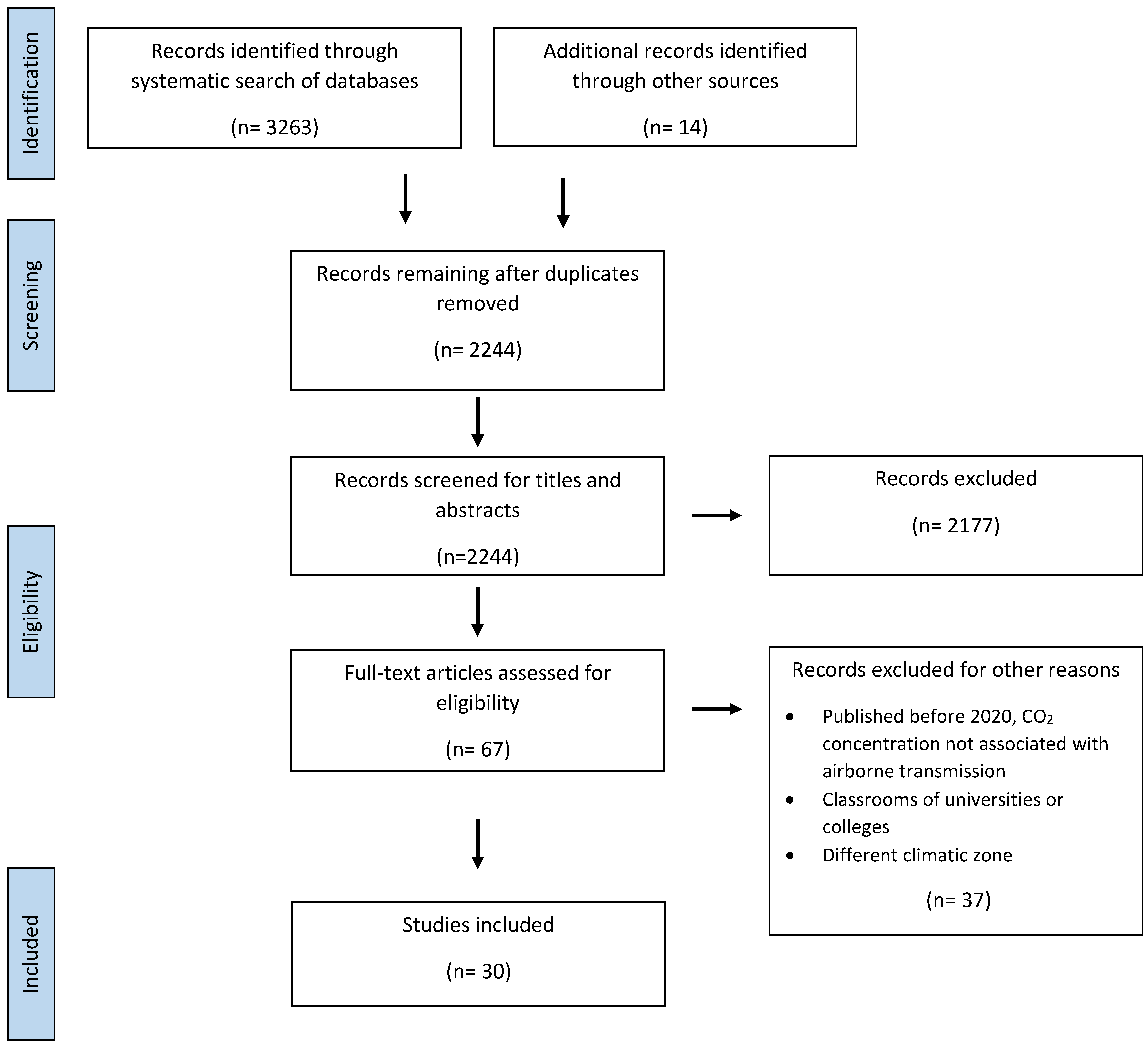
In selecting studies, after duplicates were eliminated, studies were screened by title and abstract. The remaining studies were then read in full and checked for relevance. A flowchart depicting the process of study selection is shown in Figure 1.
Figure 1.
Flowchart of study selection process.
3. Results
We identified 30 studies that met the inclusion criteria (Figure 1). Of these, six were intervention studies whose primary endpoint was CO2 concentration or SARS-CoV-2 infection in clusters of cases (Table 1), 16 were observational studies, some with additional mathematical modeling, and eight were mathematical modeling studies whose primary endpoints were CO2 concentration or infection by/transmission of various respiratory pathogens, e.g., SARS-CoV-2, measles, and influenza (Table 2).
In summary, in many classrooms, CO2 concentrations were higher than 1000 ppm and ventilation could lower CO2 concentrations [24,34,35,36,37,38]. Nevertheless, even this step was sometimes not adequate to keep CO2 concentrations below 1000 ppm permanently, especially when individuals were present in the room during the ventilation period [39]. As shown in other studies [40,41,42,43], CO2 concentrations in classrooms with mechanical ventilation were lower than in those naturally ventilated. For example, Vassella et al. found the median CO2 concentration in MV classrooms was 686–1320 ppm, whereas in NV classrooms it was 862–2898 ppm [38]. In one intervention study, the authors found that in mechanically ventilated classrooms, the relative risk of infection with SARS-CoV-2 was reduced by at least 74% compared with those naturally ventilated. At higher ventilation rates of > 10 L s−1 student −1, the relative risk of infection decreased by at least 80%. The protective effect of MV was greater in periods of higher regional incidence of SARS-CoV-2 [34].
Some building-associated factors can influence the efficiency of ventilation and the risk of infection by airborne pathogens. Room size affected the risk of infection, to a particular degree in small, poorly ventilated rooms [22,44]. Stein-Zamir et al. describe a major SARS-CoV-2 outbreak triggered by two index cases. In the school in question, classrooms were overcrowded (1.1–1.3 m2 per person). The requirement to wear masks had nonetheless been abolished and contacts between students also existed outside the school setting, possibly leading to infections outside the school [45].
A visual feedback system that monitored CO2 concentrations and indicated the need for ventilation could achieve a considerable reduction in CO2 concentrations through increased NV as compared to the control group without a visual feedback system [35].
Table 1.
Intervention studies.
Table 2.
Observational studies and mathematical modeling studies.
4. Discussion
Improving ventilation in classrooms by means of mechanical or natural ventilation decreased CO2 concentrations and thus the assumed risk of infection [24,34,35,37,38]. In some studies, however, CO2 concentrations were still above the recommended upper limit of 1000 ppm [37]. Despite the large number of studies found in the literature search, only six intervention studies were identified that met the inclusion criteria. In addition, the studies were very heterogeneous with regard to the building architecture (size of the classrooms, number, size, arrangement and orientation of the windows, etc.) and setting (country, season). In some studies, several infection prevention measures were applied simultaneously, which complicated a determination of the extent of the effect of a specific measure.
The literature search did not enable us to define maximum acceptable values for CO2 concentration. However, because it is often recommended by other authors and organizations [63,64,65], we postulate that the indoor CO2 concentration should not exceed 1000 ppm on average over time in all classrooms. During a pandemic involving an airborne pathogen, it should not exceed 800 ppm on average over time, although CO2 concentrations up to 1000 ppm for short periods are tolerable. This can be implemented using mechanical ventilation, for example, using HVAC systems, or by NV with windows and doors [66]. Our literature search confirms earlier findings that mechanically ventilated classrooms have significantly higher ventilation rates than naturally ventilated ones [40,41,42,43]. Thus, we also conclude that classrooms should be equipped with an MV system, since mechanically ventilated classrooms appear to have lower, more stable mean CO2 concentrations than naturally ventilated ones. Hence, a reduction of aerosols that could contain virus can be more easily achieved, which would result in a reduction of the risk of infection [30,34,38,46]. In one study, it was shown that a 74% reduction of the relative risk of infection could be achieved in classrooms with MV systems, and that for each additional unit in the ventilation rate per student, the relative risk reduction ranged from 12–15% [34]. The ventilation rates need to be adjusted depending on the age, activity, and number of individuals in the room. There are other positive effects of HVAC systems, such as indoor temperature regulation, which may prevent school closures due to extremely high temperatures. Birmili et al. found that, especially with extremely low or high outdoor temperatures, HVAC systems can prevent thermal discomfort [14]. Moreover, the elimination of CO2 and other possible pollutants may improve students’ ability to concentrate [67,68]. Installation or retrofitting of HVAC systems should be standard in schools. Until this is implemented, rooms should have a sufficient number of windows to enable large-area natural ventilation by means of a standardized ventilation regime.
Miranda et al. found that a strong NV regime could keep the average CO2 concentrations at low levels between 450 and 650 ppm in university classrooms. However, the significant drop in indoor temperature led to thermal dissatisfaction [69]. Rooms that cannot be ventilated either naturally or mechanically are not suitable for school lessons. Like other authors [70,71] and organizations [72], we recommend installing CO2 measuring devices with clearly visible displays or sound alarms in classrooms. Such equipment indicates when ventilation is needed and helps to check the success of the ventilation. Several studies showed that CO2 concentration could be decreased dramatically using NV if CO2 measuring devices that visualized the effect of ventilation monitored CO2 concentration [24,35,37]. Laurent and Frans found that the use of CO2 measuring devices in a hospital resulted in significantly shorter periods of time with CO2 concentrations above 1000 ppm and lower overall maximum values [73]. A visual feedback system makes it easy to recognize when ventilation is necessary [35]. The REHVA recommends using CO2 monitors with red, yellow, and green indicator lights similar to a traffic signal [72].
As is already known from other studies, various environmental and building-related factors, (for example the difference between outside and inside temperature, the wind speed and direction, the arrangement/orientation of the windows, etc.) influence the efficiency of NV [22,50,74]. Due to the heterogeneity of the studies identified in our literature search, it was not possible to derive general recommendations about such environmental and building-related factors. Korsavi et al. suggest designers be aware of all contextual, occupant, and building-related factors and consider, for example, that an opening can have different airflow rates depending on the season and the outdoor conditions [75]. With NV, cross ventilation should be used, which is more effective than single-sided ventilation [55]. This is also recommended by Ferrari et al. [71] and was shown by Aguilar et al. to be true of university classrooms [76].
The use of (portable) air purifiers (APs) was controversial. The literature search turned up three studies which examined the influence of APs on aerosol concentration [44,50,77]. The endpoint “aerosol concentration” did not meet the inclusion criteria, thus these studies were not listed in Table 2 unless the CO2 concentration was also examined. In the three studies mentioned above, it was shown that it was possible to reduce the concentration of aerosol that could contain virus particles by means of air APs. It should be noted that these APs were equipped with HEPA filters. Air purification efficiency depends on, amongst others, the air purifier and filter class used. If it is not possible to guarantee the necessary air flow rates by means of MV or NV alone, an AP might be an ancillary measure for reducing the risk of infection. However, it should be kept in mind that APs only filter and recirculate air. Moreover, it is difficult to measure the effect of the air filtration during school hours. Although it is possible to conduct particle measurements, there are confounding factors, such as other sources of particles which are not emitted exclusively by human respiration which can influence the measurements. To guarantee good indoor air quality, the removal of “used air” and a supplementary supply of fresh outside air is still necessary to eliminate other (harmful) substances such as CO2 and other gaseous contaminants like volatile organic compounds.
Improving the ventilation situation can also have side effects. Frequent and long NV periods can cause a significant drop in interior temperatures, particularly in winter months, and thus result in thermal discomfort for those present [24,36]. Other side effects of NV may include noise and air pollution from neighboring streets or construction sites [48].
In addition to eliminating potentially infectious aerosols, the viral emission of individuals should be kept as low as possible. This depends on, among other things, the age, the intensity with which an individual speaks, and the type of activity of the individuals. In general, especially with the wild type of SARS-CoV-2, adults have higher viral emission than children do and in the context of schools, mainly the teacher speaks a lot and loudly [12,78,79,80,81,82,83]. The risk of transmission from teacher to student was greater than from student to teacher or from student to student in the studies identified [30,58]. The location of an infectious individual in the classroom can also influence the risk of infection. For example, the risk of inhaling a higher concentration of a pathogen was higher in close vicinity to the source individual, while the risk of infection decreased with increased distance from the infectious person [84,85,86]. For these reasons, we recommend that the distance between the teacher and the first row of school benches, in particular, should be large enough (at least 1.5 m) to reduce as much as possible the risk of infection to those in the near field of the teacher. Distance between students may further reduce the risk of infection, but due to limited classroom sizes, a large distance will not be possible in most classrooms. Since the teacher speaks the most and the loudest, the use of a microphone by the teacher can reduce the intensity of speech [22,61]. Other outbreak analyses have shown that transmission from teacher to teacher or from teacher to student had a large impact on outbreaks [52,87,88]. Likewise, Fleischer et al. postulate that particle emission by children is lower than by adults, possibly resulting in a lower risk of transmission by children. However individual/interpersonal variability of emission rates should be taken into consideration [79].
Improving ventilation can also reduce the transmission of other airborne pathogens. Du et al. (2020), for example, studied the impact of increased ventilation on tuberculosis outbreaks in poorly ventilated universities. As a result, maximum CO2 concentrations were reduced from approximately 3200 ppm to concentrations of approximately 600 ppm, and the incidence of tuberculosis in contact individuals was reduced by 97%. In summary, guaranteeing that CO2 concentrations do not exceed 1000 ppm could effectively control a tuberculosis outbreak in a university building [89].
5. Limitations
This review has several limitations. The number of intervention studies identified was small. Only studies published on or before 30 April 2022 were considered. Further studies have been published in the meantime which were not part of the review, with the exception of one that was highly relevant to this review. Similarly, other studies might have been found by expanding the keywords used in the literature search. In addition, we excluded observational and modeling studies published before 2020 whose primary endpoint was CO2 concentration unrelated to the transmission of airborne infections. The same applies to the exclusion of studies conducted in low-income countries in climate zones unlike Germany’s. Studies carried out in university classrooms were excluded due to room sizes, which are usually larger than school classrooms. Some results of such studies, however, might be applicable to school classrooms. CO2 concentration was chosen as a primary endpoint because it is often used as a surrogate parameter for estimating the risk of infection. It needs to be evaluated whether other parameters might be more appropriate (e.g., CO2 dose, relative humidity, temperature, etc.). Some of the study results were based on mathematical models whose estimates (e.g., the existence of a steady state or an even particle distribution in rooms) as well as specific values (e.g., quanta emission rate) were based on available data. The application of such models based on data of the wild type or early variants of SARS-CoV-2 to the current situation might be limited, as a result of the emergence of new SARS-CoV-2 variants and subsequent other individual emission rates and susceptibility. Our focus was on ventilation strategies as part of infection prevention measures. Hence, other measures, such as masks, regular screening tests, etc. were not discussed.
6. Conclusions
The ventilation situation in many schools is not adequate to guarantee good indoor air quality. Ventilation is an important measure for reducing the risk of airborne infection in schools. It is most important to reduce the time of residence of pathogens in the classrooms. Schools should have a well-functioning mechanical or natural ventilation system in order to avoid airborne infections in general. Compliance with ventilation measures must be ensured, in particular during a pandemic, and ventilation measures may need to be intensified to further reduce risk of infection during school operations.
Author Contributions
Conceptualization: S.N.J. and P.G.; methodology: S.N.J. and P.G.; formal analysis: S.N.J.; investigation: S.N.J.; writing—original draft preparation: S.N.J.; writing—review and editing: P.G., L.A.J., K.R., W.S., Y.E.C. and M.K.; supervision: P.G.; project administration: W.S.; funding acquisition: P.G., W.S. and M.K. All authors have read and agreed to the published version of the manuscript.
Funding
The authors acknowledge receipt of the following financial support for the research, authorship, and/or publication of this article: this work was supported by the German Federal Institute for Research on Building, Urban Affairs and Spatial Development (BBSR) in the German Federal Office for Building and Regional Planning (BBR) [SWD-10.08.18.7-20.02] as part of the project “Effektive Strategien zur Kontrolle und zum Umgang mit Ausbreitungswegen von Erregern zum Schutz kritischer Infrastrukturen (SAVE)”.
Institutional Review Board Statement
Not applicable.
Informed Consent Statement
Not applicable.
Data Availability Statement
Not applicable.
Conflicts of Interest
The authors declare no conflict of interest.
References
- Statistisches_Bundesamt. 2022. Available online: https://www.destatis.de/DE/Themen/Gesellschaft-Umwelt/Bildung-Forschung-Kultur/Schulen/_inhalt.html (accessed on 17 June 2022).
- WHO. WHO Director-General’s Opening Remarks at the Mission Briefing on COVID-19—11 March 2020. Available online: https://www.who.int/director-general/speeches/detail/who-director-general-s-opening-remarks-at-the-media-briefing-on-covid-19--11-march-2020 (accessed on 17 August 2022).
- Otte Im Kampe, E.; Lehfeld, A.S.; Buda, S.; Buchholz, U.; Haas, W. Surveillance of COVID-19 school outbreaks, Germany, March to August 2020. Euro. Surveill. 2020, 25, 2001645. [Google Scholar] [CrossRef] [Scilit] [PubMed]
- Kuhfeld, M.; Soland, J.; Tarasawa, B.; Johnson, A.; Ruzek, E.; Liu, J. Projecting the Potential Impact of COVID-19 School Closures on Academic Achievement. Educ. Res. 2020, 49, 549–565. [Google Scholar] [CrossRef] [Scilit]
- Nicola, M.; Alsafi, Z.; Sohrabi, C.; Kerwan, A.; Al-Jabir, A.; Iosifidis, C.; Agha, M.; Agha, R. The socio-economic implications of the coronavirus pandemic (COVID-19): A review. Int. J. Surg. 2020, 78, 185–193. [Google Scholar] [CrossRef] [Scilit] [PubMed]
- UNESCO. Adverse Consequences of School Closures. Available online: https://en.unesco.org/covid19/educationresponse/consequences (accessed on 11 August 2022).
- ECDC. COVID-19 in Children and the Role of School Settings in Transmission—Second Update. 2021. Available online: https://www.ecdc.europa.eu/en/publications-data/children-and-school-settings-covid-19-transmission (accessed on 11 August 2022).
- van Doremalen, N.; Bushmaker, T.; Morris, D.H.; Holbrook, M.G.; Gamble, A.; Williamson, B.N.; Tamin, A.; Harcourt, J.L.; Thornburg, N.J.; Gerber, S.I.; et al. Aerosol and Surface Stability of SARS-CoV-2 as Compared with SARS-CoV-1. N. Engl. J. Med. 2020, 382, 1564–1567. [Google Scholar] [CrossRef] [Scilit]
- Wang, C.C.; Prather, K.A.; Sznitman, J.; Jimenez, J.L.; Lakdawala, S.S.; Tufekci, Z.; Marr, L.C. Airborne transmission of respiratory viruses. Science 2021, 373, 6558. [Google Scholar] [CrossRef] [Scilit]
- Guo, Z.-D.; Wang, Z.-Y.; Zhang, S.-F.; Li, X.; Li, L.; Li, C.; Cui, Y.; Fu, R.-B.; Dong, Y.-Z.; Chi, X.-Y.; et al. Aerosol and Surface Distribution of Severe Acute Respiratory Syndrome Coronavirus 2 in Hospital Wards, Wuhan, China, 2020. Emerg. Infect. Dis. 2020, 26, 1583–1591. [Google Scholar] [CrossRef] [Scilit]
- Morawska, L.; Cao, J. Airborne transmission of SARS-CoV-2: The world should face the reality. Environ. Int. 2020, 139, 105730. [Google Scholar] [CrossRef] [Scilit]
- Hartmann, A.; Lange, J.; Rotheudt, H.; Kriegel, M. Emissionsrate und Partikelgröße von Bioaerosolen beim Atmen, Sprechen und Husten; Technische Universität Berlin: Berlin, Germany, 2020. [Google Scholar] [CrossRef]
- ECDC. Factsheet for health Professionals on Coronaviruses European Centre for Disease Prevention and Control. 2022. Available online: https://www.ecdc.europa.eu/en/factsheet-health-professionals-coronaviruses (accessed on 17 June 2022).
- Birmili, W.; Selinka, H.C.; Moriske, H.J.; Daniels, A.; Straff, W. Ventilation Concepts in Schools for the Prevention of Transmission of Highly Infectious Viruses (SARS-CoV-2) by Aerosols in Indoor air. Bundesgesundheitsblatt Gesundh. Gesundh. 2021, 64, 1570–1580. [Google Scholar] [CrossRef] [Scilit]
- Coleman, K.K.; Sigler, W.V. Airborne Influenza A Virus Exposure in an Elementary School. Sci. Rep. 2020, 10, 1859. [Google Scholar] [CrossRef] [Scilit]
- Chen, S.C.; Liao, C.M. Modelling control measures to reduce the impact of pandemic influenza among schoolchildren. Epidemiol. Infect. 2008, 136, 1035–1045. [Google Scholar] [CrossRef] [Scilit]
- Riley, R.L.; Riley, E.C.; Murphy, G. Airborne Spread of Measles in a Suburban Elementary-School. Am. Rev. Respir. Dis. 1978, 117, 255. [Google Scholar] [CrossRef] [Scilit] [PubMed]
- Fang, Y.; Ma, Y.; Lu, Q.; Sun, J.; Pei, Y. An outbreak of pulmonary tuberculosis and a follow-up investigation of latent tuberculosis in a high school in an eastern city in China, 2016–2019. PLoS ONE 2021, 16, e0247564. [Google Scholar] [CrossRef] [Scilit] [PubMed]
- Somsen, G.A.; van Rijn, C.; Kooij, S.; Bem, R.A.; Bonn, D. Small droplet aerosols in poorly ventilated spaces and SARS-CoV-2 transmission. Lancet Respir. Med. 2020, 8, 658–659. [Google Scholar] [CrossRef] [Scilit]
- Megahed, N.A.; Ghoneim, E.M. Indoor Air Quality: Rethinking rules of building design strategies in post-pandemic architecture. Environ. Res. 2021, 193, 110471. [Google Scholar] [CrossRef] [Scilit] [PubMed]
- Baloch, R.M.; Maesano, C.N.; Christoffersen, J.; Banerjee, S.; Gabriel, M.; Csobod, É.; de Oliveira Fernandes, E.; Annesi-Maesano, I. Indoor Air Pollution, Physical and Comfort Parameters Related to Schoolchildren’s Health: Data from the European SINPHONIE Study. Sci. Total Environ. 2020, 739, 139870. [Google Scholar] [CrossRef] [Scilit]
- Zivelonghi, A.; Lai, M. Mitigating aerosol infection risk in school buildings: The role of natural ventilation, volume, occupancy and CO2 monitoring. Build. Environ. 2021, 204, 108139. [Google Scholar] [CrossRef] [Scilit]
- Shendell, D.G.; Prill, R.; Fisk, W.J.; Apte, M.G.; Blake, D.; Faulkner, D. Associations between classroom CO2 concentrations and student attendance in Washington and Idaho. Indoor Air 2004, 14, 333–341. [Google Scholar] [CrossRef] [Scilit]
- Di Gilio, A.; Palmisani, J.; Pulimeno, M.; Cerino, F.; Cacace, M.; Miani, A.; de Gennaro, G. CO2 concentration monitoring inside educational buildings as a strategic tool to reduce the risk of Sars-CoV-2 airborne transmission. Environ. Res. 2021, 202, 111560. [Google Scholar] [CrossRef] [Scilit]
- Rudnick, S.N.; Milton, D.K. Risk of indoor airborne infection transmission estimated from carbon dioxide concentration. Indoor Air 2003, 13, 237–245. [Google Scholar] [CrossRef] [Scilit]
- Peng, Z.; Jimenez, J.L. Exhaled CO2 as COVID-19 infection risk proxy for different indoor environments and activities. medRxiv 2021, 8, 392–397. [Google Scholar] [CrossRef] [Scilit]
- Ad-hoc-Arbeitsgruppe_Innenraumrichtwerte, Gesundheitliche Bewertung von Kohlendioxid in der Innenraumluft- Mitteilungen der Ad-hoc-Arbeitsgruppe Innenraumrichtwerte der Innenraumlufthygiene-Kommission des Umweltbundesamtes und der Obersten Landesgesundheitsbehörden. Bundesgesundheitsblatt Gesundh. Gesundh. 2018, 51, 1358–1369. [CrossRef] [Scilit]
- Pettenkofer, M.V. Über den Luftwechsel in Wohngebäuden; Cotta’sche Buchhandlung: Munich, Germany, 1858. [Google Scholar]
- Kriegel, M.; Hartmann, A.; Buchholz, U.; Seifried, J.; Baumgarte, S.; Gastmeier, P. SARS-CoV-2 Aerosol Transmission Indoors: A Closer Look at Viral Load, Infectivity, the Effectiveness of Preventive Measures and a Simple Approach for Practical Recommendations. Int. J. Environ. Res. Public Health 2021, 19, 220. [Google Scholar] [CrossRef] [Scilit] [PubMed]
- Pavilonis, B.; Ierardi, A.M.; Levine, L.; Mirer, F.; Kelvin, E.A. Estimating aerosol transmission risk of SARS-CoV-2 in New York City public schools during reopening. Environ. Res. 2021, 195, 110805. [Google Scholar] [CrossRef] [Scilit] [PubMed]
- Donovan, C.V.; Rose, C.; Lewis, K.N.; Vang, K.; Stanley, N.; Motley, M.; Brown, C.C.; Gray, F.J., Jr.; Thompson, J.W.; Amick, B.C.; et al. SARS-CoV-2 Incidence in K-12 School Districts with Mask-Required Versus Mask-Optional Policies—Arkansas, August-October 2021. MMWR Morb. Mortal Wkly. Rep. 2022, 71, 384–389. [Google Scholar] [CrossRef] [Scilit]
- Falk, A.; Benda, A.; Falk, P.; Steffen, S.; Wallace, Z.; Hoeg, T.B. COVID-19 Cases and Transmission in 17 K-12 Schools—Wood County, Wisconsin, August 31-November 29, 2020. MMWR Morb. Mortal Wkly Rep. 2021, 70, 136–140. [Google Scholar] [CrossRef] [Scilit]
- Robert-Koch-Institut. Die Impfung gegen COVID-19 in Deutschland zeigt eine hohe Wirksamkeit gegen SARS-CoV-2-Infektionen, Krankheitslast und Sterbefälle (Analyse der Impfeffekte im Zeitraum Januar bis Juli 2021). 2021. Available online: https://www.rki.de/DE/Content/Infekt/EpidBull/Archiv/2021/35/Art_01.html (accessed on 19 August 2022).
- Buonanno, G.; Ricolfi, L.; Morawska, L.; Stabile, L. Increasing ventilation reduces SARS-CoV-2 airborne transmission in schools: A retrospective cohort study in Italy’s Marche region. Front Public Health 2022, 10, 1087087. [Google Scholar] [CrossRef] [Scilit]
- Wargocki, P.; Da Silva, N.A. Use of visual CO2 feedback as a retrofit solution for improving classroom air quality. Indoor Air 2015, 25, 105–114. [Google Scholar] [CrossRef] [Scilit]
- Monge-Barrio, A.; Bes-Rastrollo, M.; Dorregaray-Oyaregui, S.; González-Martínez, P.; Martin-Calvo, N.; López-Hernández, D.; Arriazu-Ramos, A.; Sánchez-Ostiz, A. Encouraging natural ventilation to improve indoor environmental conditions at schools. Case studies in the north of Spain before and during COVID. Energy Build. 2022, 254, 111567. [Google Scholar] [CrossRef] [Scilit]
- Geelen, L.M.J.; Huijbregts, M.A.J.; Ragas, A.M.J.; Bretveld, R.W.; Jans, H.W.A.; van Doorn, W.J.; Evertz, S.J.C.J.; van der Zijden, A. Comparing the effectiveness of interventions to improve ventilation behavior in primary schools. Indoor Air 2008, 18, 416–424. [Google Scholar] [CrossRef] [Scilit]
- Vassella, C.C.; Koch, J.; Henzi, A.; Jordan, A.; Waeber, R.; Iannaccone, R.; Charriere, R. From spontaneous to strategic natural window ventilation: Improving indoor air quality in Swiss schools. Int. J. Hyg. Environ. Health 2021, 234, 113746. [Google Scholar] [CrossRef] [Scilit]
- Zemitis, J.; Bogdanovics, R.; Bogdanovica, S. The Study of CO2 Concentration in A Classroom During the COVID-19 Safety Measures. E3S Web. Conf. 2021, 246, 01004. [Google Scholar] [CrossRef] [Scilit]
- Rodríguez, D.; Urbieta, I.R.; Velasco, Á.; Campano-Laborda, M.; Jiménez, E. Assessment of indoor air quality and risk of COVID-19 infection in Spanish secondary school and university classrooms. Build. Environ. 2022, 226, 109717. [Google Scholar] [CrossRef] [Scilit] [PubMed]
- Scheff, P.A.; Paulius, V.K.; Huang, S.W.; Conroy, L.M. Indoor air quality in a middle school, Part I: Use of CO2 as a tracer for effective ventilation. Appl. Occup. Environ. Hyg. 2000, 15, 824–834. [Google Scholar] [CrossRef] [Scilit] [PubMed]
- Canha, N.; Mandin, C.; Ramalho, O.; Wyart, G.; Riberon, J.; Dassonville, C.; Hanninen, O.; Almeida, S.M.; Derbez, M. Assessment of ventilation and indoor air pollutants in nursery and elementary schools in France. Indoor Air 2016, 26, 350–365. [Google Scholar] [CrossRef] [Scilit] [PubMed]
- Canha, N.; Almeida, S.M.; Freitas, M.C.; Täubel, M.; Hänninen, O. Winter ventilation rates at primary schools: Comparison between Portugal and Finland. J. Toxicol. Environ. Health. A 2013, 76, 400–408. [Google Scholar] [CrossRef] [Scilit] [PubMed]
- Duill, F.F.; Schulz, F.; Jain, A.; Krieger, L.; van Wachem, B.; Beyrau, F. The Impact of Large Mobile Air Purifiers on Aerosol Concentration in Classrooms and the Reduction of Airborne Transmission of SARS-CoV-2. Int. J. Environ. Res. Public Health 2021, 18, 11523. [Google Scholar] [CrossRef] [Scilit] [PubMed]
- Stein-Zamir, C.; Abramson, N.; Shoob, H.; Libal, E.; Bitan, M.; Cardash, T.; Cayam, R.; Miskin, I. A large COVID-19 outbreak in a high school 10 days after schools’ reopening, Israel, May 2020. Eurosurveillance 2020, 25, 2–6. [Google Scholar] [CrossRef] [Scilit]
- Rosbach, J.T.; Vonk, M.; Duijm, F.; van Ginkel, J.T.; Gehring, U.; Brunekreef, B. A ventilation intervention study in classrooms to improve indoor air quality: The FRESH study. Environ. Health 2013, 12, 110. [Google Scholar] [CrossRef] [Scilit]
- McNeill, V.F.; Corsi, R.; Huffman, J.A.; King, C.; Klein, R.; Lamore, M.; Maeng, D.Y.; Miller, S.L.; Ng, N.L.; Olsiewski, P.; et al. Room-level ventilation in schools and universities. Atmos. Environ. X 2022, 13, 100152. [Google Scholar] [CrossRef] [Scilit]
- Villanueva, F.; Notario, A.; Cabañas, B.; Martín, P.; Salgado, S.; Gabriel, M.F. Assessment of CO(2) and aerosol (PM(2.5), PM(10), UFP) concentrations during the reopening of schools in the COVID-19 pandemic: The case of a metropolitan area in Central-Southern Spain. Environ. Res. 2021, 197, 111092. [Google Scholar] [CrossRef] [Scilit]
- Alonso, A.; Llanos, J.; Escandón, R.; Sendra, J.J. Effects of the COVID-19 Pandemic on Indoor Air Quality and Thermal Comfort of Primary Schools in Winter in a Mediterranean Climate. Sustainability 2021, 13, 2699. [Google Scholar] [CrossRef] [Scilit]
- Curtius, J.; Granzin, M.; Schrod, J. Testing mobile air purifiers in a school classroom: Reducing the airborne transmission risk for SARS-CoV-2. Aerosol. Sci. Technol. 2021, 55, 586–599. [Google Scholar] [CrossRef] [Scilit]
- Gillespie, D.L.; Meyers, L.A.; Lachmann, M.; Redd, S.C.; Zenilman, J.M. The Experience of 2 Independent Schools with In-Person Learning During the COVID-19 Pandemic. J. Sch. Health 2021, 91, 347–355. [Google Scholar] [CrossRef] [Scilit] [PubMed]
- Baumgarte, S.; Hartkopf, F.; Hölzer, M.; von Kleist, M.; Neitz, S.; Kriegel, M.; Bollongino, K. Investigation of a Limited but Explosive COVID-19 Outbreak in a German Secondary School. Viruses 2022, 14, 87. [Google Scholar] [CrossRef] [Scilit] [PubMed]
- Vouriot, C.V.M.; Burridge, H.C.; Noakes, C.J.; Linden, P.F. Seasonal variation in airborne infection risk in schools due to changes in ventilation inferred from monitored carbon dioxide. Indoor Air 2021, 31, 1154–1163. [Google Scholar] [CrossRef] [Scilit]
- Schibuola, L.; Chiara, T. High energy efficiency ventilation to limit COVID-19 contagion in school environments. Energy Build. 2021, 240, 110882. [Google Scholar] [CrossRef] [Scilit]
- Park, S.; Choi, Y.; Song, D.; Kim, E.K. Natural ventilation strategy and related issues to prevent coronavirus disease 2019 (COVID-19) airborne transmission in a school building. Sci. Total Environ. 2021, 789, 147764. [Google Scholar] [CrossRef] [Scilit]
- Gettings, J.; Czarnik, M.; Morris, E.; Haller, E.; Thompson-Paul, A.M.; Rasberry, C.; Lanzieri, T.M.; Smith-Grant, J.; Aholou, T.M.; Thomas, E.; et al. Mask Use and Ventilation Improvements to Reduce COVID-19 Incidence in Elementary Schools—Georgia, November 16-December 11, 2020. MMWR Morb. Mortal Wkly. Rep. 2021, 70, 779–784. [Google Scholar] [CrossRef] [Scilit]
- Xu, Y.; Cai, J.; Li, S.; He, Q.; Zhu, S. Airborne infection risks of SARS-CoV-2 in U.S. schools and impacts of different intervention strategie. Sustain. Cities Soc. 2021, 74, 103188. [Google Scholar] [CrossRef] [Scilit]
- Shen, J.; Kong, M.; Dong, B.; Birnkrant, M.J.; Zhang, J. A systematic approach to estimating the effectiveness of multi-scale IAQ strategies for reducing the risk of airborne infection of SARS-CoV-2. Build. Environ. 2021, 200, 107926. [Google Scholar] [CrossRef] [Scilit]
- Dai, H.; Zhao, B. Association of the infection probability of COVID-19 with ventilation rates in confined spaces. Build. Simul. 2020, 13, 1321–1327. [Google Scholar] [CrossRef] [Scilit] [PubMed]
- Kurnitski, J.; Kiil, M.; Wargocki, P.; Boerstra, A.; Seppänen, O.; Olesen, B.; Morawska, L. Respiratory infection risk-based ventilation design method. Build. Environ. 2021, 206, 108387. [Google Scholar] [CrossRef] [Scilit] [PubMed]
- Stabile, L.; Pacitto, A.; Mikszewski, A.; Morawska, L.; Buonanno, G. Ventilation procedures to minimize the airborne transmission of viruses in classrooms. Build. Environ. 2021, 202, 108042. [Google Scholar] [CrossRef] [Scilit] [PubMed]
- Azimi, P.; Keshavarz, Z.; Cedeno Laurent, J.G.; Allen, J.G. Estimating the nationwide transmission risk of measles in US schools and impacts of vaccination and supplemental infection control strategies. BMC Infect. Dis. 2020, 20, 497. [Google Scholar]
- Clements-Croome, D.J.; Awbi, H.B.; Bakó-Biró, Z.; Kochhar, N.; Williams, M. Ventilation rates in schools. Build. Environ. 2008, 43, 362–367. [Google Scholar] [CrossRef] [Scilit]
- REHVA. CO₂ Monitoring and Indoor Air Quality. 2021. Available online: https://www.rehva.eu/rehva-journal/chapter/co2-monitoring-and-indoor-air-quality (accessed on 13 December 2022).
- The_Lancet_COVID-19_Commission. Proposed Non-infectious Air Delivery Rates (NADR) for Reducing Exposure to Airborne Respiratory Infectious Diseases. 2022. Available online: https://covid19commission.org/safe-work-travel (accessed on 18 January 2023).
- Umweltbundesamt. Anforderungen an Lüftungskonzeptionen in Gebäuden Teil I: Bildungseinrichtungen. 2017. Available online: https://www.umweltbundesamt.de/sites/default/files/medien/1410/publikationen/uba_empfehlungspapier_lueftung_unterrichtsgebaeude_final_bf.pdf (accessed on 18 January 2023).
- Bakó-Biró, Z.; Clements-Croome, D.J.; Kochhar, N.; Awbi, H.B.; Williams, M.J. Ventilation rates in schools and pupils’ performance. Build. Environ. 2012, 48, 215–223. [Google Scholar] [CrossRef] [Scilit]
- Haverinen-Shaughnessy, U.; Moschandreas, D.J.; Shaughnessy, R.J. Association between substandard classroom ventilation rates and students’ academic achievement. Indoor Air 2011, 21, 121–131. [Google Scholar] [CrossRef] [Scilit]
- Miranda, M.T.; Romero, P.; Valero-Amaro, V.; Arranz, J.I.; Montero, I. Ventilation conditions and their influence on thermal comfort in examination classrooms in times of COVID-19. A case study in a Spanish area with Mediterranean climate. Int. J. Hyg. Env. Health 2022, 240, 113910. [Google Scholar] [CrossRef] [Scilit]
- Kienbaum, T. Hygienemanagement in Gesundheitseinrichtungen Teil 4: Effektives Lüften während der Pandmie. Hygienemanagement 2020, 10, 47–58. [Google Scholar]
- Ferrari, S.; Blázquez, T.; Cardelli, R.; Puglisi, G.; Suárez, R.; Mazzarella, L. Ventilation strategies to reduce airborne transmission of viruses in classrooms: A systematic review of scientific literature. Build. Environ. 2022, 222, 109366. [Google Scholar] [CrossRef] [Scilit]
- REHVA. REHVA COVID19 Guidance version 4.1 How to operate HVAC and Other Building Service Systems to Prevent the Spread of the Coronavirus (SARS-CoV-2) Disease (COVID-19) in Workplaces. 2021. Available online: https://www.rehva.eu/fileadmin/user_upload/REHVA_COVID-19_guidance_document_V4.1_15042021.pdf (accessed on 10 November 2022).
- Laurent, M.R.; Frans, J. Monitors to improve indoor air carbon dioxide concentrations in the hospital: A randomized crossover trial. Sci. Total Environ. 2022, 806, 151349. [Google Scholar] [CrossRef] [Scilit] [PubMed]
- de la Hoz-Torres, M.L.; Aguilar, A.J.; Ruiz, D.P.; Martínez-Aires, M.D. Analysis of Impact of Natural Ventilation Strategies in Ventilation Rates and Indoor Environmental Acoustics Using Sensor Measurement Data in Educational Buildings. Sensors 2021, 21, 6122. [Google Scholar] [CrossRef] [Scilit] [PubMed]
- Korsavi, S.S.; Montazami, A.; Mumovic, D. Ventilation rates in naturally ventilated primary schools in the UK.; Contextual, Occupant and Building-related (COB) factors. Build. Environ. 2020, 181, 107061. [Google Scholar] [CrossRef] [Scilit]
- Aguilar, A.J.; de la Hoz-Torres, M.L.; Costa, N.; Arezes, P.; Martínez-Aires, M.D.; Ruiz, D.P. Assessment of ventilation rates inside educational buildings in Southwestern Europe: Analysis of implemented strategic measures. J. Build. Eng. 2022, 51, 104204. [Google Scholar] [CrossRef] [Scilit]
- Burgmann, S.; Janoske, U. Transmission and reduction of aerosols in classrooms using air purifier systems. Phys. Fluids 2021, 33, 033321. [Google Scholar] [CrossRef] [Scilit]
- Asadi, S.; Wexler, A.S.; Cappa, C.D.; Barreda, S.; Bouvier, N.M.; Ristenpart, W.D. Aerosol emission and superemission during human speech increase with voice loudness. Sci. Rep. 2019, 9, 2348. [Google Scholar] [CrossRef] [Scilit]
- Fleischer, M.; Schumann, L.; Hartmann, A.; Walker, R.S.; Ifrim, L.; von Zadow, D.; Luske, J.; Seybold, J.; Kriegel, M.; Murbe, D. Pre-adolescent children exhibit lower aerosol particle volume emissions than adults for breathing, speaking, singing and shouting. J. R. Soc. Interface 2022, 19, 20210833. [Google Scholar] [CrossRef] [Scilit]
- Murbe, D.; Kriegel, M.; Lange, J.; Schumann, L.; Hartmann, A.; Fleischer, M. Aerosol emission of adolescents voices during speaking, singing and shouting. PLoS ONE 2021, 16, e0246819. [Google Scholar] [CrossRef] [Scilit]
- Euser, S.; Aronson, S.; Manders, I.; van Lelyveld, S.; Herpers, B.; Sinnige, J.; Kalpoe, J.; van Gemeren, C.; Snijders, D.; Jansen, R.; et al. SARS-CoV-2 viral-load distribution reveals that viral loads increase with age: A retrospective cross-sectional cohort study. Int. J. Epidemiol. 2022, 50, 1795–1803. [Google Scholar] [CrossRef] [Scilit]
- Thompson, H.A.; Mousa, A.; Dighe, A.; Fu, H.; Arnedo-Pena, A.; Barrett, P.; Bellido-Blasco, J.; Bi, Q.; Caputi, A.; Chaw, L.; et al. Severe Acute Respiratory Syndrome Coronavirus 2 (SARS-CoV-2) Setting-specific Transmission Rates: A Systematic Review and Meta-analysis. Clin. Infect. Dis. 2021, 73, e754–e764. [Google Scholar] [CrossRef] [Scilit]
- Viner, R.M.; Mytton, O.T.; Bonell, C.; Melendez-Torres, G.J.; Ward, J.; Hudson, L.; Waddington, C.; Thomas, J.; Russell, S.; van der Klis, F.; et al. Susceptibility to SARS-CoV-2 Infection Among Children and Adolescents Compared with Adults: A Systematic Review and Meta-analysis. JAMA Pediatr. 2021, 175, 143–156. [Google Scholar] [CrossRef] [Scilit]
- Zafarnejad, R.-G.; Paul, M. Assessing school-based policy actions for COVID-19: An agent-based analysis of incremental infection risk. Comput. Biol. Med. 2021, 134, 104518. [Google Scholar] [CrossRef] [Scilit] [PubMed]
- Liu, L.; Li, Y.; Nielsen, P.V.; Wei, J.; Jensen, R.L. Short-range airborne transmission of expiratory droplets between two people. Indoor Air 2017, 27, 452–462. [Google Scholar] [CrossRef] [Scilit] [PubMed]
- Makris, R.; Tawackolian, K.; Lausch, K.; Kopic, C.; Kriegel, M. Near-Field Exposure of Pathogen-Laden Respiratory Particles Based on Statistical Evaluation of One Emitting Person Indoors. 2022. Available online: https://www.researchgate.net/publication/361312085_Near-field_exposure_of_pathogen-laden_respiratory_particles_based_on_statistical_evaluation_of_one_emitting_person_indoors (accessed on 17 June 2022).
- Gold, J.A.W.; Gettings, J.R.; Kimball, A.; Franklin, R.; Rivera, G.; Morris, E.; Scott, C.; Marcet, P.L.; Hast, M.; Swanson, M.; et al. Clusters of SARS-CoV-2 Infection Among Elementary School Educators and Students in One School District—Georgia, December 2020-January 2021. MMWR Morb. Mortal Wkly. Rep. 2021, 70, 289–292. [Google Scholar] [CrossRef] [Scilit] [PubMed]
- Ismail, S.A.; Saliba, V.; Lopez Bernal, J.; Ramsay, M.E.; Ladhani, S.N. SARS-CoV-2 infection and transmission in educational settings: A prospective, cross-sectional analysis of infection clusters and outbreaks in England. Lancet Infect Dis. 2021, 21, 344–353. [Google Scholar] [CrossRef] [Scilit]
- Du, C.R.; Wang, S.C.; Yu, M.C.; Chiu, T.F.; Wang, J.Y.; Chuang, P.C.; Jou, R.; Chan, P.C.; Fang, C.T. Effect of ventilation improvement during a tuberculosis outbreak in underventilated university buildings. Indoor Air 2020, 30, 422–432. [Google Scholar] [CrossRef] [Scilit]
Disclaimer/Publisher’s Note: The statements, opinions and data contained in all publications are solely those of the individual author(s) and contributor(s) and not of MDPI and/or the editor(s). MDPI and/or the editor(s) disclaim responsibility for any injury to people or property resulting from any ideas, methods, instructions or products referred to in the content. |
© 2023 by the authors. Licensee MDPI, Basel, Switzerland. This article is an open access article distributed under the terms and conditions of the Creative Commons Attribution (CC BY) license (https://creativecommons.org/licenses/by/4.0/).