


Abstract
With the continuous prominence of environmental problems, some online environmental platforms have been built in China. Such platforms provide an important carrier for public to learn environmental knowledge and participate in environmental protection. However, whether such platforms can play a substantive role in promoting users’ green consumption behaviors is still unclear. Focusing on this question, the influence of online environmental platform services on public green consumption behaviors is explored. A model based on the theory of stimulus–organism–response is established to analyze the influential mechanism, using the online environmental platform services as the independent variable, users’ green consumption behaviors as the dependent variable, environmental attitude as the mediator, and users’ price sensitivity as the moderator. Survey data are used to test the model. The empirical results show that online environmental platform services have a significant positive impact on users’ green consumption behaviors. Environmental attitude plays a partial mediating role and price sensitivity negatively moderates the mediating role of environmental attitude. Suggestions are given from the perspectives of platform operators and government. This paper provides both theoretical and practical implications for sustainable consumption.
1. Introduction
Environmental problems, such as environmental pollution, resource shortage, greenhouse gases, and haze weather, need to be solved urgently. Public green consumption behaviors (GCB) are indispensable to promoting sustainable development. Although China has effectively promoted the public GCB by issuing relevant policies and carrying out public education, on the whole, GCB are still relatively scattered and small-scale. How to promote the public GCB is currently the main problem. With the development of the new generation information technology and the 5th generation mobile networks, mobile phones have become indispensable tools for the public. Some traditional services have been moved online. To be specific, an online environmental platform called “Ant Forest” was launched by “Alipay” (the world’s leading independent third-party payment operator, a subsidiary of Ali). Many green activities are offered to the public by this platform, such as green travel, recyclable express packaging, etc. Similar online environmental platforms include “Castle Peak School” and “Flying Ant” in China. These platforms, characterized by convenience, interactivity, and sociability, have attracted more and more users. According to the company’s data, the number of users participating in the “Ant Forest” has reached 600 million by 2021, involving individuals of all ages. Behind the upsurge, we have to think: Can such online environmental platforms encourage users to practice GCB? It is very meaningful to analyze the impact of such platforms on the psychology and behaviors of users.
Extant research shows that the main influential factors of GCB are demographic characteristics, such as age [1] and education level [2]; psychological factors, such as environmental concern [3], moral identity [4], and environmental awareness [5]; and external factors, such as living environment [6], information intervention [7], and social media [8]. In recent times, research from the perspective of online environmental platforms has begun to appear. The effect of a single feature of these platforms on users’ GCB, such as interactive characteristic and gaming features, has been studied [9,10]. In summary, the studies focusing on GCB are still based on the traditional lifestyle and the research considering characteristics of the Internet era is still lacking.
Extant research has confirmed that related services provided by online platforms can affect users’ psychology and behaviors [11,12,13,14]. In this paper, we posit that online environmental platform services (OEPS) will impact users’ GCB. For example, environmental information can enrich users’ knowledge and improve their perception of environmental problems [15]. The communication between platform users will deepen their empathy for environmental pollution and awareness of the contribution of the environmental behaviors they adopt [16].
In order to explain the influential mechanism, the stimulus–organism–response theory is adopted. OEPS could deepen users’ understanding of environmental issues and promote their environmental attitude (EA), which can be regarded as an external stimulus. EA, belonging to organism, can make individuals feel their environmental responsibility and encourage their responses [17]. Since the price of green products is always higher than that of general ones, scholars believe that it is an important factor in predicting GCB [18,19]. Consumers’ price sensitivity (PS) is directly related to product price, which reflects the individual’s acceptance of price differences or fluctuations [20,21,22,23]. Therefore, PS was selected as a moderating variable to moderate the relationship between EA and GCB.
In summary, this paper establishes a research model with OEPS as the independent variable, EA as the mediator variable, the user’s GCB as the dependent variable, and PS as the moderator variable. Hierarchical regression analysis and the bootstrap method were used to test the hypotheses mentioned in the model. Hierarchical regression analysis is often used to test the relationships between variables in empirical research [3,6]. It has the merits of simple operation and easy interpretation. The bootstrap method is suitable for testing complex models, especially models including a mediation effect and moderating effect [24]. Moreover, the bootstrap method can verify the results of hierarchical regression analysis, thus ensuring the robustness of the research results.
Five hundred and seventeen valid questionnaires collected in China were used as research samples. As is known to all, China is the country with the largest population in the world. Therefore, it is helpful to carry out an investigation in China to promote Chinese citizens’ GCB. It can also provide guidance for other countries.
The potential contributions of this article are two-fold: (1) As an external factor, OEPS could have a direct impact on users’ psychology and behavior. In order to explore the effect of OEPS in-depth, they are divided into three dimensions: enjoyable services, practical services, and symbolic services. (2) In order to explain the influential mechanism of OEPS on users’ GCB, the mediating effect of EA and the moderating effect of PS are analyzed. We hope this comprehensive analysis will provide theoretical and practical implications to stimulate green consumption.
2. Theoretical Basis and Hypotheses
2.1. Theoretical Basis
The stimulus–organism–response (S-O-R) theory proposed by Mehrabian and Russell (1974) holds that external factors affect an individual’s emotional state and emotional perception, and further affect an individual’s behaviors [25]. Stimulation is an external influence that provokes the individual’s response. After being stimulated, the individual will respond consciously or unconsciously, resulting in specific behavior, such as proximity or avoidance of a particular object [26]. The S-O-R theory plays an important role in analyzing the influence of external environment on individuals’ behaviors and has been widely used. For example, Konuk analyzed consumers’ decision-making process in buying green organic food [27] and Tang et al. discussed the impacts of environmental stimulation and internal psychological state on employees’ energy-saving intentions [28].
We posit that S-O-R theory is applicable to the study of the impact of online environmental platforms on users’ GCB. The platforms have a subtle impact on users’ psychology and behaviors by providing specific services, which are external stimulations to users. EA is the psychological change triggered by external stimulations at the organic level. At the same time, users’ GCB are the responses generated by the stimulations of OEPS.
2.2. Hypotheses
2.2.1. The Relationship between Online Environmental Platform Services and Users’ Green Consumption Behavior
GCB refers to the consumption behavior that consumers strive to protect the ecological environment and minimize the negative impact on the environment during the purchase, usage, and disposing of goods [29]. Online environmental platforms provide services to their users through information technology and advocate a culture of public welfare participation, which form a novel environmental protection model with the characteristics of convenience, accessibility, intelligence, efficiency, and transparency [30]. As a result, online environmental platforms are regarded as important methods of promoting GCB.
The services of these platforms are diverse, including online environmental protection participation, environmental knowledge learning, environmental information communication and sharing, and the recommendation of environmental protection activities [31]. From the perspective of users’ experience, these services can be divided into enjoyable services, practical services, and symbolic services [32]. Enjoyable services refer to those services with environmental themes that can promote users’ positive emotions or sensory enjoyment [33], such as games, challenging tasks, and other fun activities. Practical services are those foundation services that provide opportunities and channels for users to engage in green consumption, such as old clothing donations, idle items sharing, etc. Symbolic services include such services as participation score ranking and achievement certification, which help users improve self-image, gain social identity, and the sense of group belonging.
Enjoyable services can attract users and increase users’ stickiness [34]. On the one hand, enjoyable services provided by online environmental platforms can enhance users’ experience by providing fun games. On the other hand, users are instilled with knowledge about protecting the environment and saving resources through games and interesting activities. In this way, users’ understanding of green consumption has been improved. Practical services can provide a carrier for users’ green consumption, which stimulate and facilitate users’ GCB [35]. Symbolic services in platforms give users the opportunity to exhibit their achievements. Users who actively participate in environmental protection activities in the platform can receive awards from the platform. These awards include active credits, honor certificates, etc. In order to obtain the corresponding awards or unique honors, users must deliberately change their behavior [36] and implement GCB in real life. For example, in order to obtain “energy value”, a symbol of green consumption, users of “Ant Forest” deliberately choose green travel tools and avoid using disposable tableware. Therefore, the following hypothesis is proposed:
Hypothesis 1 (H1).
OEPS have positive impacts on users’ GCB.
2.2.2. The Mediating Role of Environmental Attitude
EA is an individual’s tendency to protect the environment and can be reflected by the person’s standpoint or view on a specific and detailed environmental problem [37]. On the one hand, the environmental information and activities provided by the platforms can deepen users’ understanding and perception of environmental problems [38] and encourage users to establish a correct EA. On the other hand, the negative news about environmental pollution and resource shortage posted by these platforms can arouse users’ emotional resonance, which could make users feel anxious and nervous [39]. With such anxiety and tension accumulating, users will feel the urgency of environmental protection [40]. The sense of urgency could promote users to generate a positive EA. Therefore, we propose the following hypothesis:
Hypothesis 2 (H2).
OEPS have a positive effect on users’ EA.
The theory of planned behavior holds that an individual’s behavior does not occur in a vacuum [41]. Attitude is an important precondition that determines behavior [42,43]. Attitude will affect an individual’s conscious response, regulate the individual’s views on specific problems, and, finally, influence the individual’s actual behaviors. EA is the specific attitude towards environmental problems, which helps people to behave pro-environmentally in real life [44]. In addition, a positive EA increases individuals’ concerns about environmental pollution and resource shortage, foster individuals’ enthusiasm to solve environmental problems, and stimulate them to participate in environmental protection behavior [45]. Therefore, EA has a positive effect on users’ GCB. The following hypothesis is posited:
Hypothesis 3 (H3).
EA has a positive effect on users’ GCB.
Based on the above analysis, this article posits that OEPS positively affect users’ EA, and EA plays a positive role in generating GCB. Therefore, EA is a mediator in the relationship between OEPS and users’ GCB. Hence, the following hypothesis is proposed:
Hypothesis 4 (H4).
EA plays a mediating role in the relationship between OEPS and users’ GCB.
2.2.3. The Moderating Effect of Price Sensitivity
PS is the degree of awareness and responsiveness shown by consumers when they detect price differences in products or services [46]. Organic green foods, energy efficient household appliances, and other green products tend to have a higher price than general products due to their own green attributes, such as energy saving, low pollution, and recyclable [47]. It is the price premium that aggravates the dilemma of green consumption, which is easy to understand but difficult to perform, causing the long-existing attitude–behavior gap [48]. The price of green products or services is an important factor affecting users’ GCB. If users’ PS is high, their willingness to purchase green products or services with relatively high prices will be reduced. PS inhibits users’ enthusiasm to implement GCB. Although EA can promote users’ GCB, PS will inhibit the driving effect of EA on GCB. Therefore, we posit the following hypothesis:
Hypothesis 5 (H5).
PS negatively moderates the relationship between EA and users’ GCB. That is to say, GCB of users with lower price sensitivity will be more likely to be influenced by EA, ceteris paribus.
According to the previous analysis, we argue that the enjoyable, practical, and symbolic services provided by platforms stimulate users’ EA promote their active GCB in daily life. In addition, combined with the extant research, users with low PS would be loyal [49] and are likely to be influenced by platform services to implement GCB. Therefore, this article argues that high PS inhibits the mediating role of EA in the relationship between OEPS and users’ GCB. Specifically, the services provided by the platforms have an impact on users’ attitude and behavior. Under the stimulation of OEPS, users will generate positive EA. However, if the price of green products or services is high, users with high PS are likely to choose low-price ones [50] and decrease their GCB. As a result, the effect of platforms on promoting users to implement GCB through EA is restrained. Therefore, we propose the following hypothesis:
Hypothesis 6 (H6).
PS negatively moderates the mediating role of EA in the relationship between OEPS and users’ GCB.
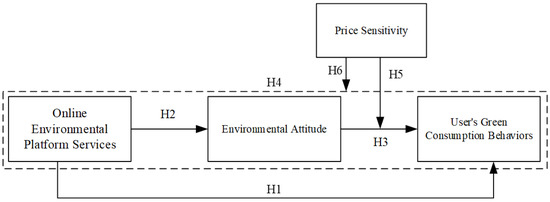
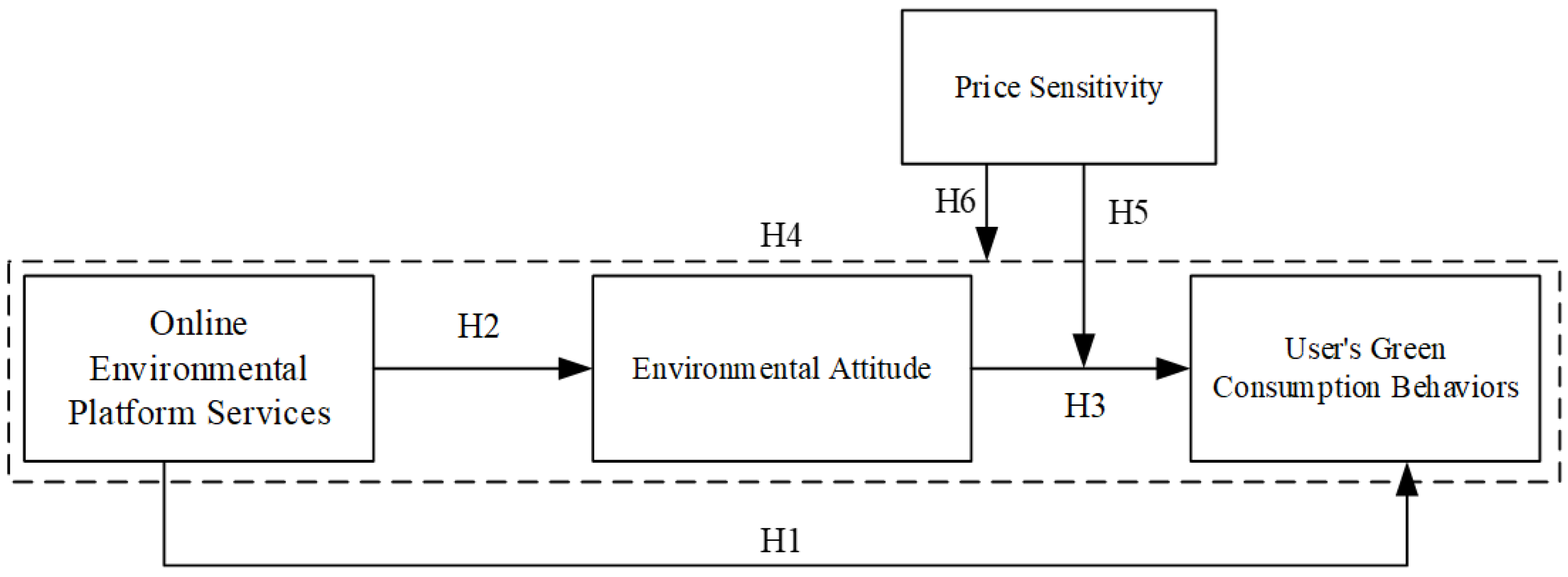
The research model developed in this paper is shown in Figure 1.
Figure 1.
Hypotheses and analytical framework.
3. Methods
3.1. Variable Measurement
Online environmental platform services (OEPS): It is divided into enjoyable services, practical services, and symbolic services from the perspective of users’ experience. The measurement of this variable refers to Mathwick et al. and includes six items [51].
Environmental attitude (EA): It is measured from two aspects, the severity of environmental problems and the importance of environmental protection. A total of six items are designed with two reverse items [52].
Price sensitivity (PS): It includes two dimensions: price importance and price search propensity [53]. There are four items in total.
Green consumption behavior (GCB): Four items are used, including clothing, food, housing, and transportation [54].
All variables are scored by a five-point Likert scale. The specific items can be seen in Appendix A.
3.2. Sample and Data Collection
Survey data were used. Besides the items of all variables, respondents’ demographic information was included in the questionnaire, such as gender, age, monthly consumption and expenditure, etc. In order to avoid the social desirability bias, some reverse items were included and questions were randomly arranged. The informed consent and some explanations were given to the respondents to eliminate confusion before they filled out the questionnaires.
Considering the disproportion of economy levels in China, the questionnaires were distributed in 3 cities, Qingdao, Shenyang, and Chengdu. The 3 cities belong to East China, Northeast China, and Southwest China. Whether or not they have used online environmental platforms and the reasons for using such platforms were asked before the participants filled out the questionnaires. If respondents answered yes and because of curiosity and other people’s recommendation to use rather than because of concern for the environment, they were invited to participate in the survey. At the same time, this paper reduces the potential impact of other factors on the results in the process of collecting data regarding two aspects. Firstly, the team members told the respondents to try to answer without considering the interference of other conditions. Secondly, for the measurement of green consumption behavior, four aspects of clothing, food, housing, and transportation that are less affected by external factors are selected as the measurement aspects. Initially, 604 questionnaires were obtained. Questionnaires with a too short response time and multiple questions in a row with the same answer were eliminated. Ultimately, 517 valid questionnaires were obtained. The basic information of the 517 respondents is shown in Table 1.
Table 1.
Respondents’ demographic information.
4. Results
4.1. Reliability and Validity
4.1.1. Reliability
The reliability of the items is analyzed by SPSS25.0 and the results are shown in Table 2. The Cronbach’s alpha coefficients for all variables all exceed 0.8, and the CR values are greater than 0.8, indicating that the combined reliability is good [55].
Table 2.
The results of reliability and validity test of scale.
4.1.2. Validity
Since all the variables were measured with mature scales, the content validity can be guaranteed [56]. The exploratory factor analysis was conducted to ensure the selected scale is applicable. The KMO value is 0.924, and the significance level of Bartlett’s sphericity test is 0.00, indicating that it is suitable for factor analysis. A total of four factors were extracted. The results can be seen in Table 3. Table 2 also show that the AVE value of each variable is greater than 0.5, indicating that the convergent validity is good. The results in Table 4 show that the square root of AVE corresponding to each variable is greater than the correlation coefficient between this variable and other variable, indicating that the scale for each variable has good discriminatory validity [57]. In addition, confirmatory factor analysis is performed using structural equation modeling to test the construct validity. The results are shown in Table 5. The relevant indicators from single-factor model to the four-factor model are more and more ideal, reflecting that the construct validity of the model is good. χ2/df = 2.218, RMSEA = 0.049, CFI, IFI, and TLI all are greater than 0.9 in the four-factor model, which show that the four-factor model has ideal construct validity and is suitable for further analysis [58].
Table 3.
The results of the exploratory factor analysis.
Table 4.
The AVE square root of variables and correlation coefficient matrix.
Table 5.
The results of the confirmative factor analysis.
4.2. Common Method Bias Test
A method factor was added to the four-factor model to test whether common method bias exists [59]. The result is shown in the five-factor model in Table 5. After adding the method factor, the construct validity test results of the model do not obviously change: The added values of CFI, TLI, and IFI are less than 0.05, and the value of RMSEA is only reduced by 0.005. The results show that the common method bias of the four-factor model is not serious.
4.3. Descriptive Statistics and Correlation Coefficients
The correlation coefficients between the main variables are shown in Table 4. The OEPS (Mean = 4.087, SD = 0.717) is significantly and positively related to EA (Mean = 4.326, SD = 0.538) and GCB (Mean = 4.256, SD = 0.641). There is a significant positive correlation between EA and GCB. Besides, there are also significant correlations between PS (Mean = 3.838, SD = 0.814) and other variables.
4.4. Regression Results
4.4.1. The Test of the Direct Impact of Online Environmental Platform Services
The results of Model 2 in Table 6 reflect the direct effect. In Model 2, OEPS is set as the independent variable and GCB is set as the dependent variable. The results suggest that OEPS have a significant positive effect on users’ GCB (β = 0.569, p < 0.001). Therefore, Hypothesis 1 is verified.
Table 6.
The results of regression analysis.
4.4.2. The Test of the Mediating Effect of Environmental Attitude
Regression analysis is used to examine the mediating effect of EA. The test results are shown in Model 1, Model 3, and Model 4 in Table 6.
In Model 1, OEPS is set as the independent variable, and EA is set as the dependent variable. The results show that OEPS have a significant positive effect on EA (β = 0.543, p < 0.001). Hypothesis 2 is checked.
In Model 3, EA is set as the independent variable, and GCB is set as the dependent variable. The results indicate that EA has a significant positive effect on users’ GCB (β = 0.568, p < 0.001), which supports Hypothesis 3.
In Model 4, OEPS and EA are set as the independent variables and GCB is set as the dependent variable. The results show that the positive effect of OEPS on users’ GCB is still significant, but the effect is significantly lower than the results in Model 2 (β = 0.370, p < 0.001). The change in the coefficient of influence indicates that EA plays a mediating role between OEPS and users’ GCB. Therefore, Hypothesis 4 is checked.
4.4.3. The Test of the Moderating Effect of Price Sensitivity
The two variables of EA and PS are centralized and multiplied to obtain a new variable, named “interaction”. The control variables, independent variable, mediating variable, moderating variable, and interaction are put into Model 5 and Model 6. The results can be seen in Table 6.
In Model 5, EA, PS, and interaction are set as the independent variables, GCB is set as the dependent variable. The results show that interaction has a significant negative impact on users’ GCB (β = −0.130, p < 0.001), which verifies that PS plays a negative moderating effect on the relationship between EA and users’ GCB. Therefore, Hypothesis 5 is checked.
In Model 6, OEPS, EA, PS, and interaction are set as the independent variables and GCB is set as the dependent variable. The results reveal that the interaction has a significant negative impact on GCB (β = −0.094, p < 0.05), suggesting that PS negatively moderates the mediating role of EA. Therefore, Hypothesis 6 is checked.
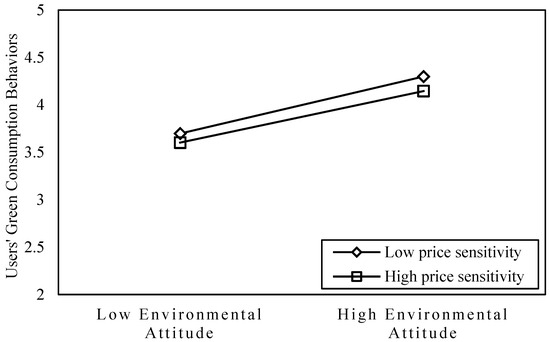
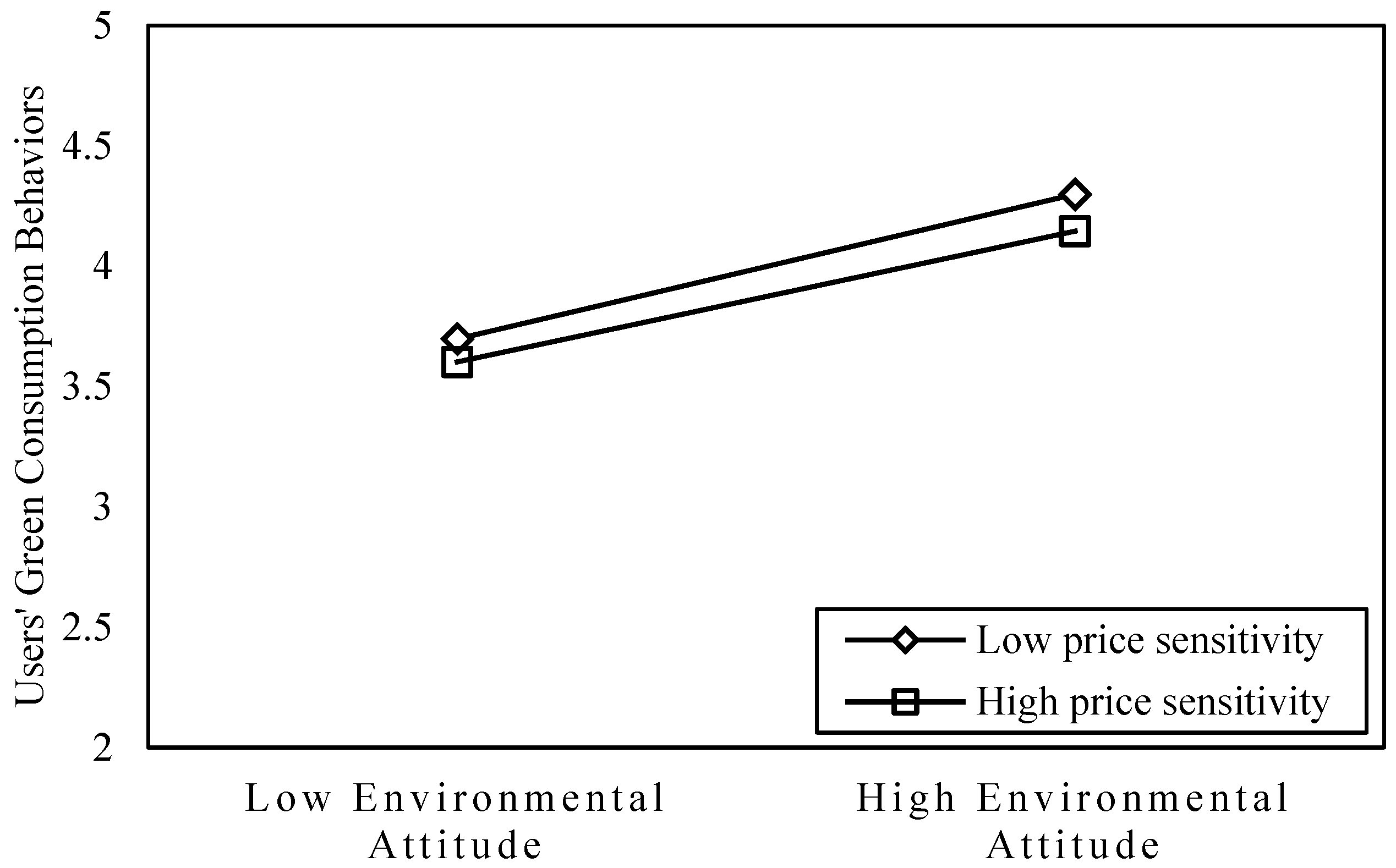
In addition, this article uses graphic to visually reflect the moderating effect of PS on EA-GCB relationship, as shown in Figure 2. The results indicate that users with low PS are more motivated to adopt GCB at the same level of EA, showing a negative moderating effect of PS on the relationship between EA and GCB.
Figure 2.
The moderating effect of price sensitivity on the relationship between environmental attitude and green consumption behavior.
4.5. Robustness Test
The bootstrap method is used to test the robustness of the results [60]. The number of samples is 5000 and the confidence interval is 95%. The results can be seen in Table 7, Table 8 and Table 9.
Table 7.
The results of the direct effect and the mediating effect using the bootstrap method.
Table 8.
The moderating effect of price sensitivity on environmental attitude–green consumption behaviors relationship.
Table 9.
The mediating role of EA in the relationship between OEPS and users’ GCB under different levels of PS.
The results in Table 7 show the mediating effect of EA. The total effect value of OEPS on users’ GCB is 0.3303, and the 95% confidence interval is [0.2593, 0.4013], excluding 0. The mediating effect value of EA between OEPS and GCB is 0.1784, and the 95% confidence interval is [0.0931, 0.2846], excluding 0. The results support the direct effect of OEPS and the mediating effect of EA, verifying H1, H2, H3, and H4.
The results of the moderating effect of PS on EA-GCB relationship are shown in Table 8. The moderating effect value of PS is −0.1242 with the p value less than 0.01. The upper and lower limit interval of 95% confidence is [−0.1980, −0.0504], excluding 0. Therefore, PS has a negative moderating effect on the EA-GCB relationship, verifying H5.
The bootstrap method was used to examine the indirect effect of OEPS to users’ GCB under the moderating effect. The method focuses on the mediated effect values and the 95% confidence intervals of users’ EA between OEPS and users’ GCB under three different PS conditions (mean and mean plus or minus one standard deviation). As can be seen from Table 9, changes in users’ PS causes the mediating effect of EA to change. Compared with the mediating effect of EA under low PS, the effect under high PS level is reduced by 34.59%. The results suggest that the mediating role of EA in the relationship between OEPS and GCB becomes weaker as PS level gets higher, which also reflects that PS limits the effect of OEPS in promoting users’ GCB. In other words, it is likely that the high price of green products will have a negative impact on the role of OEPS in promoting users’ GCB, especially for users with high PS. Thus, H6 is further verified.
5. Discussions and Implications
5.1. Discussions
Only few extant studies demonstrate that some special features of online environmental platforms can affect users’ GCB [9,10]. The research findings of this study strengthen the results of the few studies. The positive effect of OEPS on users’ GCB is corroborated. Specifically, OEPS have a direct effect on GCB. The enjoyable, practical, and symbolic services provided by online environmental platforms can affect users’ psychology and behavior. Users are stimulated by the environmental information and personal achievement feedback. In this case, users generate the urge to practice GCB. Taking “Ant Forest” as an example, in order to obtain the environmental achievements, many users will actively implement GCB in their daily life, such as not using disposable tableware, giving priority to recycled express packaging, etc. This is the true portrayal of the effect of OEPS on users’ GCB.
Moreover, the information, services, and activities stimulate users to think about environmental issues, encourage them to understand the environmental responsibility that individuals should take, and develop users’ EA. The generated EA will make users pay attention to their own behaviors and promote their GCB. This is consistent with the conclusion that external information or activities can affect users’ attention to environmental issues and then promote users’ GCB [40]. The EA generated by OEPS also becomes stronger with the increase of usage time.
However, users’ enthusiasm to implement GCB is affected by other factors [50]. PS has a negative moderating effect on users’ GCB. OEPS can promote users’ EA and their GCB. When individuals make consumption decisions, they make the most appropriate decisions according to their own conditions. Users with high PS are more concerned about the price of products. When ordinary products can also meet consumers’ needs, they prefer ordinary products with lower prices at the expense of the environment. Therefore, the impact of the price of green products or service and the level of individual PS on GCB cannot be ignored.
5.2. Implications
5.2.1. Theoretical Implications
First, the impact of online environmental platforms on users’ GCB was researched. Based on the S-O-R theory, OEPS were taken as the stimulating factors and the services are divided into three dimensions, named enjoyable services, practical services, and symbolic services. The influential mechanism of platform services on users’ GCB was explored in depth. This article expands the research on the factors affecting GCB. The research results can be helpful for scholars and society to realize the importance of the services provided by online environmental platforms to promote users to implement GCB.
Second, this article explained why online environmental platforms can influence users’ consumption behaviors. The results demonstrate that the effect of online environmental platforms on users’ GCB can be achieved through the mediation of users’ EA. EA has been suggested as an important factor influencing individuals’ green consumption intentions and behaviors [61]. This article demonstrated the mediating role of EA in the relationship between OEPS and users’ GCB. It indicated that specific services provided by online platforms would motivate users’ positive EA, then encourage users to practice GCB. This article provided theoretical explanations for existing studies.
Third, the negative moderating effect of PS was examined in this article. PS weakens the role of EA in promoting users’ GCB and restricts the mediating role of EA between OEPS and users’ GCB. Therefore, it has been fully demonstrated that PS would inhibit users from implementing GCB. According to previous studies, PS is a key factor influencing individuals’ green purchase decisions [62].
5.2.2. Practical Implications
Firstly, suggestions for platform operators are put forward. First of all, platform operators should strengthen the application of innovative intelligent interaction technology to improve the interaction between users and the platform, as well as the connection between users. In this way, users’ sense of participation and experience will be increased, and users’ enthusiasm to practice GCB can be improved. In addition, it is necessary for platform operators to adjust the acquisition rules of participation points. At present, it is difficult to obtain participation points on some online environmental platforms, which can discourage the enthusiasm of some users and reduce the positive effect of OEPS on users’ GCB. Therefore, platform operators should optimize the rules for obtaining participation points to make users’ green and low-carbon behavior more meaningful and rewarding. At last, platform operators should try their best to meet the diversified interests of users. Specifically, they could consider introducing more incentives and optimizing the symbolic service pattern to meet the spiritual or material needs of different users, thus increasing users’ sense of accomplishment and motivation to participate.
Secondly, suggestions for the government are proposed. The government should strengthen incentives and support for such online environmental platforms, so as to make them more effective. At the same time, product price is an important factor in consumers’ purchasing decisions. The government should strengthen financial subsidies for green products and services and formulate supportive policies for green product manufacturers to reduce the price of green products, thus improving consumers’ acceptance of green products.
6. Conclusions
The following conclusions have been drawn: (1) OEPS have a direct impact on users’ GCB. Enjoyable services, practical services, and symbolic services provide platforms for users, thus improving the enthusiasm of users to implement GCB. (2) The effect of OEPS on users’ GCB is also indirectly realized through EA. Specifically, OEPS encourages users to generate EA. EA can affect users’ understanding of environmental problems and encourage them to implement GCB. (3) PS negatively moderates the relationship between EA and GCB and the mediating effect of EA. For users with high PS, the indirect effect of OEPS is weakened. To sum up, based on the theory of stimulus–organism–response, this paper demonstrates the positive influence of OEPS on users’ GCB. In addition, the results suggest that promoting GCB through OEPS requires the joint efforts of platform operators and government departments.
Some limitations could open new directions for future research. First, the participants of this survey were mainly young and middle-aged, the proportion of elderly participants was small. Therefore, whether the conclusions are suitable for the elderly is still worth exploring. Second, PS was used to measure the acceptability of users to price fluctuation. Although the negative moderating effect of PS has been examined, it is difficult to explain to what extent price fluctuations eliminate the impact of OEPS on users’ GCB, which can be explored in the future. Finally, based on the research findings of this paper, it would also be meaningful to study the actual situation of users’ GCB in real life.
Author Contributions
Y.M. designed the research. C.L. collected data and wrote the draft. All authors have read and agreed to the published version of the manuscript.
Funding
This work was supported by the National Social Science Planning Project of China (granted number 20BGL195).
Institutional Review Board Statement
Not applicable.
Informed Consent Statement
Informed consent was obtained from all subjects involved in the study.
Data Availability Statement
Data can be available by E-mail if requested.
Conflicts of Interest
The authors have no relevant financial or non-financial interests to disclose.
Appendix A
Table A1.
Abbreviation for variable names.
Table A2.
The specific items of all variables.
References
- Li, Y.; Lu, Y.; Zhang, X.; Liu, L.P.; Wang, M.H.; Jiang, X.Q. Propensity of green consumption behaviors in representative cities in China. J. Clean. Prod. 2016, 133, 1328–1336. [Google Scholar] [CrossRef] [Scilit]
- Wang, Q.; Wang, S.Y.; Zhang, M.; Bu, Z.H.; Liu, J.Q. Green public procurement as a promoter for green consumption: From the perspective of individual’s knowledge. Clean. Responsib. Consum. 2021, 3, 100035. [Google Scholar] [CrossRef] [Scilit]
- Enzler, H.B.; Diekmann, A.; Liebe, U. Do environmental concern and future orientation predict metered household electricity use. J. Environ. Psychol. 2019, 62, 22–29. [Google Scholar] [CrossRef] [Scilit]
- Wu, B.; Yang, Z.Y. The impact of moral identity on consumers’ green consumption tendency: The role of perceived responsibility for environmental damage. J. Environ. Psychol. 2018, 59, 74–84. [Google Scholar] [CrossRef] [Scilit]
- Yang, D.F.; Lu, Y.; Zhu, W.T.; Su, C.T. Going green: How different advertising appeals impact green consumption behavior. J. Bus. Res. 2015, 68, 2663–2675. [Google Scholar] [CrossRef] [Scilit]
- Zhang, M.; Guo, S.; Bai, C.Y.; Wang, W.W. Study on the impact of haze pollution on residents’ green consumption behavior: The case of Shandong Province. J. Clean. Prod. 2019, 219, 11–19. [Google Scholar] [CrossRef] [Scilit]
- Takahashi, R. Who is attracted to purchase green products through information provision: A nationwide social experiment to promote eco-friendly coffee. Environ. Sci. Policy 2021, 124, 593–603. [Google Scholar] [CrossRef] [Scilit]
- Chi, N.T.K. Understanding the effects of eco-label, eco-brand, and social media on green consumption intention in ecotourism destinations. J. Clean. Prod. 2021, 321, 61–77. [Google Scholar] [CrossRef] [Scilit]
- Tan, T.M.; Makkonen, H.; Kaur, P.; Salo, J. How do ethical consumers utilize sharing economy platforms as part of their sustainable resale behavior? The role of consumers green consumption values. Technol. Forecast. Soc. Chang. 2022, 176, 121432. [Google Scholar] [CrossRef] [Scilit]
- Douglas, B.D.; Brauer, M. Gamification to prevent climate change: A review of games and apps for sustainability. Curr. Opin. Psychol. 2021, 42, 89–94. [Google Scholar] [CrossRef] [Scilit]
- Du, L.Y.; Li, X.M.; Chen, F.; Feng, Y. Evaluating participants’ customer citizenship behaviors using an Internet charity platform. Soc. Behav. Pers. 2020, 48, e9098. [Google Scholar] [CrossRef] [Scilit]
- Kruft, T.; Kock, A. Unlocking novel opportunities: How online ideation platforms implicitly guide employees toward better ideas by spurring their desire to innovate. Creat. Innov. Manag. 2021, 30, 816–835. [Google Scholar] [CrossRef] [Scilit]
- Han, L.; Sun, R.; Gao, F.Q.; Zhou, Y.C.; Jou, M. The effect of negative energy news on social trust and helping behavior. Comput. Hum. Behav. 2019, 92, 128–138. [Google Scholar] [CrossRef] [Scilit]
- D’Amato, A.; Giaccherini, M.; Zoli, M. The role of information sources and providers in shaping green behaviors. Evidence from Europe. Ecol. Econ. 2019, 164, 106292. [Google Scholar] [CrossRef] [Scilit]
- Wang, C.; Zhu, T.T.; Yao, H.L.; Sun, Q. The Impact of green information on the participation intention of consumers in online recycling: An experimental study. Sustainability 2020, 12, 2498. [Google Scholar] [CrossRef] [Scilit]
- Zhang, Y.L.; Zhang, H.X.; Yang, Z.J.; Sun, J.; Tan, C.D. Snowball effect of user participation in online environmental communities: Elaboration likelihood under social influence. Int. J. Environ. Res. Public Health 2019, 16, 3198. [Google Scholar] [CrossRef] [Scilit] [PubMed]
- Wyss, A.M.; Knoch, D.; Berger, S. When and how pro-environmental attitudes turn into behavior: The role of costs, benefits, and self-control. J. Environ. Psychol. 2022, 79, 101748. [Google Scholar] [CrossRef] [Scilit]
- Joshi, Y.; Rahman, Z. Factors affecting green purchase behaviour and future research directions. Int. Strateg. Manag. Rev. 2015, 3, 128–143. [Google Scholar] [CrossRef] [Scilit]
- Tripathi, A.; Pandey, N. Does impact of price endings differ for the non-green and green products? Role of product categories and price levels. J. Consum. Market. 2018, 35, 143–156. [Google Scholar] [CrossRef] [Scilit]
- Wang, J.M.; Pham, T.L.; Dang, V.T. Environmental consciousness and organic food purchase intention: A moderated mediation model of perceived food quality and price sensitivity. Int. J. Environ. Res. Public Health 2020, 17, 850. [Google Scholar] [CrossRef] [Scilit]
- Hsu, C.L.; Chang, C.Y.; Yansritakul, C. Exploring purchase intention of green skincare products using the theory of planned behavior: Testing the moderating effects of country of origin and price sensitivity. J. Retail. Consum. Serv. 2017, 34, 145–152. [Google Scholar] [CrossRef] [Scilit]
- Ghali, Z. Determinants of consumer purchase intention and behavior toward green product: The moderating role of price sensitivity. Arch. Bus. Res. 2020, 8, 261–273. [Google Scholar]
- Hong, Z.F.; Wang, H.; Yu, Y.G. Green product pricing with non-green product reference. Transp. Res. Part E Logist. Transp. Rev. 2018, 115, 1–15. [Google Scholar] [CrossRef] [Scilit]
- Osborne, J.W. Advantages of Hierarchical Linear Modeling. Pract. Assess. Res. Eval. 2000, 7, 1. [Google Scholar]
- Mehrabian, A.; Rossiterll, J.A. An Approach to Environmental Psychology; MIT Press: Cambridge, UK, 1974. [Google Scholar]
- Namkung, Y.; Seoul, K.; Jang, S.C. Effects of perceived service fairness on emotions, and behavioral intentions in restaurants. Eur. J. Mark. 2010, 44, 1233–1259. [Google Scholar] [CrossRef] [Scilit]
- Konuk, F.A. The influence of perceived food quality, price fairness, perceived value and satisfaction on customers’ revisit and word-of-mouth intentions towards organic food restaurants. J. Retail. Consum. Serv. 2019, 50, 103–110. [Google Scholar] [CrossRef] [Scilit]
- Tang, Z.; Warkentin, M.; Le, W. Understanding employees’ energy saving behavior from the perspective of stimulus-organism-responses. Resour. Conserv. Recycl. 2019, 140, 216–223. [Google Scholar] [CrossRef] [Scilit]
- Urban, J.; Bahnik, S.; Kohlova, M.B. Green consumption does not make people cheat: Three attempts to replicate moral licensing effect due to pro-environmental behavior. J. Environ. Psychol. 2019, 63, 139–147. [Google Scholar] [CrossRef] [Scilit]
- Haile, N.; Altmann, J. Value creation in software service platforms. Future Gener. Comput. Syst. 2016, 55, 495–509. [Google Scholar] [CrossRef] [Scilit]
- Ranerup, A.; Henriksen, H.Z.; Hedman, J. An analysis of business models in public service platforms. Gov. Inf. Q. 2016, 33, 6–14. [Google Scholar] [CrossRef] [Scilit]
- Millan, E.; Reynolds, J. Self-construals, symbolic and hedonic preferences, and actual purchase behavior. J. Retail. Consum. Serv. 2014, 21, 550–560. [Google Scholar] [CrossRef] [Scilit]
- Tobon, S.; Ruiz-Alba, L.J.; Garcia-Madariaga, J. Gamification and online consumer decisions: Is the game over. Decis. Support Syst. 2020, 128, 113–167. [Google Scholar] [CrossRef] [Scilit]
- Merikivi, J.; Tuunainen, V.; Nguyen, D. What makes continued mobile gaming enjoyable? Comput. Hum. Behav. 2017, 68, 411–421. [Google Scholar] [CrossRef] [Scilit]
- Wheeler, S.C.; DeMarree, G.K. Multiple mechanisms of prime-to-behavior effects. Soc. Pers. Psychol. Compass 2009, 23, 566–581. [Google Scholar] [CrossRef] [Scilit]
- Mi, L.Y.; Xu, T.; Sun, Y.H.; Zhao, J.J.; Lv, T.; Gan, X.L.; Shang, K.; Qiao, L.J. Playing Ant Forest to promote online green behavior: A new perspective on uses and gratifications. J. Environ. Manag. 2021, 278, 111544. [Google Scholar] [CrossRef] [Scilit]
- Henn, L.; Taube, O.; Kaiser, F.G. The role of environmental attitude in the efficacy of smart-meter-based feedback interventions. J. Environ. Psychol. 2019, 63, 74–81. [Google Scholar] [CrossRef] [Scilit]
- Shen, X.D.; Wang, L.; Huang, X.M.; Yang, S. How China’s internet commonweal platform improves customer participation willingness? An exploratory study of Ant Forest. Chin. Manag. Stud. 2021, 15, 196–221. [Google Scholar] [CrossRef] [Scilit]
- Clark, C.F.; Kotchen, M.J.; Moore, M.R. Internal and external influences on pro-environmental behavior: Participation in a green electricity program. J. Environ. Psychol. 2003, 23, 237–246. [Google Scholar] [CrossRef] [Scilit]
- Zhang, J.P.; Cheng, M.W.; Wei, X.Y.; Gong, X.M.; Zhang, S. Internet use and the satisfaction with governmental environmental protection: Evidence from China. J. Clean. Prod. 2019, 212, 1025–1035. [Google Scholar] [CrossRef] [Scilit]
- Ajzen, I. Attitudes, traits, and actions: Dispositional prediction of behavior in personality and social psychology. Adv. Exp. Soc. Psychol. 1987, 20, 1–63. [Google Scholar]
- Paul, J.; Modi, A.; Patel, J. Predicting green product consumption using theory of planned behavior and reasoned action. J. Retail. Consum. Serv. 2016, 29, 123–134. [Google Scholar] [CrossRef] [Scilit]
- Jain, S.; Singhal, L.; Jain, N.K.; Bhaskar, K. Construction and demolition waste recycling: Investigating the role of theory of planned behavior, institutional pressures, and environmental consciousness. J. Clean. Prod. 2020, 263, 121405. [Google Scholar] [CrossRef] [Scilit]
- Julia, M.H.; Yoshihisa, H. Navigating sustainably within the urban environment: The role of environmental identity and attitudes on sign and object evaluation. Asian J. Soc. Psychol. 2020, 23, 407–421. [Google Scholar]
- Mamun, A.A.; Mohamad, M.R.; Yaacob, M.R.B.; Mohiuddin, M. Intention and behavior towards green consumption among low-income households. J. Environ. Manag. 2018, 227, 73–86. [Google Scholar] [CrossRef] [Scilit]
- Zeng, F.; Yang, Z.L.; Li, Y.Q.; Fam, K.S. Small business industrial buyers’ price sensitivity: Do service quality dimensions matter in business markets. Ind. Mark. Manag. 2011, 40, 395–404. [Google Scholar] [CrossRef] [Scilit]
- Ogiemwonyi, O. Factors influencing generation Y green behavior on green products in Nigeria: An application of theory of planned behavior. Environ. Sustain. Indic. 2022, 13, 100164. [Google Scholar] [CrossRef] [Scilit]
- Park, H.J.; Lin, L.M. Exploring attitude-behavior gap in sustainable consumption: Comparison of recycled and upcycled fashion products. J. Bus. Res. 2020, 117, 623–628. [Google Scholar] [CrossRef] [Scilit]
- Bae, J.H.; Rishi, M. Increasing consumer participation rates for green pricing programs: A choice experiment for South Korea. Energy Econ. 2018, 74, 490–502. [Google Scholar] [CrossRef] [Scilit]
- Choi, H.M.; Mukherjee, S.G. Price sensitivity of the consumer-investor: Evidence from energy prices and mutual fund fees. Glob. Financ. J. 2022, 51, 100695. [Google Scholar] [CrossRef] [Scilit]
- Mathwick, C.; Malhotra, N.; Rigdon, R. Experiential value: Conceptualization, measurement and application in the catalog and internet shopping environment. J. Retail. 2001, 77, 39–56. [Google Scholar] [CrossRef] [Scilit]
- Dunlap, R.E.; Liere, K.D.V. The “new environmental paradigm”. J. Environ. Edu. 2008, 40, 19–28. [Google Scholar] [CrossRef] [Scilit]
- Sinha, I.; Batra, R. The effect of consumer price consciousness on private label purchase. Int. J. Res. Mark. 1999, 16, 237–251. [Google Scholar] [CrossRef] [Scilit]
- Wu, S.I. Effect of green consumption perception degree on relationship model of green consumption behavior. J. Manag. Strategy 2015, 6, 109–123. [Google Scholar] [CrossRef] [Scilit]
- Carlbring, P.; Brunt, S.; Bohman, S.; Austin, D.; Richards, J.; Öst, L.G.; Andersson, G. Internet vs. paper and pencil administration of questionnaires commonly used in panic/agoraphobia research. Comput. Hum. Behav. 2007, 23, 1421–1434. [Google Scholar] [CrossRef] [Scilit]
- Bech, P. Rating scales for anxiety and depression: Content and construct validity. J. Psychiatr. Res. 1990, 24, 73–74. [Google Scholar] [CrossRef] [Scilit]
- Zotoo, I.K.; Lu, Z.P.; Liu, G.F. Big data management capabilities and librarians’ innovative performance: The role of value perception using the theory of knowledge-based dynamic capability. J. Acad. Librariansh. 2021, 47, 102272. [Google Scholar] [CrossRef] [Scilit]
- Mendi, O.; Yildirim, N.; Mendi, B. Cross-cultural adaptation, reliability, and validity of the Turkish version of the health professionals communication skills scale. Asian Nurs. Res. 2020, 14, 312–319. [Google Scholar] [CrossRef] [Scilit]
- Schouten, R.W.; Nadort, E.; Ballegooijen, W.V.; Loosman, W.L.; Honig, A.; Siegert, C.E.H.; Meuleman, Y.; Broekman, B.F.P. General distress and symptoms of anxiety and depression: A factor analysis in two cohorts of dialysis patients. Gen. Hosp. Psychiatry 2020, 65, 91–99. [Google Scholar] [CrossRef] [Scilit]
- Preacher, K.J.; Hayes, A.F. Asymptotic and resampling strategies for assessing and comparing indirect effects in multiple mediator models. Behav. Res. Methods 2008, 40, 879–891. [Google Scholar] [CrossRef] [Scilit]
- Baldi, L.; Daverio, M.; Mancuso, T.; Peri, M. Attitude toward environmental protection and toward nature: How do they shape consumer behavior for a sustainable tomato. Food Qual. Prefer. 2021, 90, 104175. [Google Scholar] [CrossRef] [Scilit]
- Ramayah, T.; Lee, J.; Mohamad, O. Green product purchase intention: Some insights from a developing country. Resour. Conserv. Recycl. 2010, 54, 1419–1427. [Google Scholar] [CrossRef] [Scilit]

Publisher’s Note: MDPI stays neutral with regard to jurisdictional claims in published maps and institutional affiliations. |
© 2022 by the authors. Licensee MDPI, Basel, Switzerland. This article is an open access article distributed under the terms and conditions of the Creative Commons Attribution (CC BY) license (https://creativecommons.org/licenses/by/4.0/).