


Abstract
The COVID-19 outbreak is a global health concern. Understanding the transmission modes of the SARS-CoV-2 virus is key to limit the spread of the pandemic. A lack of knowledge about the possibility of SARS-CoV-2 transmission and infection through contaminated surfaces is noticeable and recent studies have stated conflicting findings. This scoping review aims to understand the risks of contaminations via fomites better. Relevant publications were selected through Google Scholar, Web of Science, PubMed, Embase, Medline, and Cochrane Library, with related keywords. PRISMA-ScR guidelines were followed. Out of the 565 articles found, exclusion criteria were applied, duplicates removed, and a total of 25 articles were finally included in the study. The included documents were assessed by the contamination risk: “low” (37.5%), “high” (16.7%), “plausible” (8.3%), “unlikely” (8.3%) risk, and “insufficient evidence” (29.2%). Research in hospital settings was found as the main setting in the reviewed papers, which precisely indicated the risk of contaminated surfaces. This scoping review underscores the risk of SARS-CoV-2 infection via contaminated surfaces assessed as low in the majority of the reviewed articles. Further evaluation of the risk of the virus transmission by fomites and providing adequate information on its infectivity via contaminated surfaces in real-life conditions is essential.
1. Introduction
The coronavirus disease 2019 (COVID-19) outbreak is a global health concern [1], with an undoubtedly serious impact affecting people’s lives in various aspects, including healthcare, economic, and social factors [2,3]. The novel coronavirus was firstly detected in Wuhan in December 2019 [4]. On 12 March 2020, due to the high infectivity of SARS-CoV-2 [5] and numerous reported cases and deaths, the World Health Organization (WHO) declared the COVID-19 as a pandemic [6]. The virus SARS-CoV-2 belongs to the Coronaviridae family, some of whose viruses are associated with respiratory tract infections [7].
Understanding of the transmission modes of SARS-CoV-2 is a crucial matter. From a general perspective, the transmission of the respiratory virus has a few known routes, which are mainly (a) direct contact (person-to-person), (b) indirect contact by contaminated surfaces (fomites), and (c) airborne transmission by droplets or aerosols [8]. Based on the evidence to date, the transmission of SARS-CoV-2 is stated to be mostly airborne via droplets or aerosols through close contact with infected individuals [9,10]. However, other previous studies have suggested the possibility of hand to face transmission of pathogens by touching contaminated objects and surfaces, otherwise known as fomite transmission [11,12,13,14,15,16]. Moreover, face-touching behavior has been understood as a self-inoculation for microbial transmission [11,12,17,18]. In addition, some other studies underscore that contaminated surfaces could play a key role in the transmission of pathogens [13,14,15,16].
However, in the specific case of the SARS-CoV-2 virus, recent studies on the risk of fomites transmission have stated various findings. Most authors have demonstrated a low risk of contamination [11,19,20,21], while fewer authors suggested a higher risk [22,23].
For instance, as Kraay et al. stated, “while direct transmission is important, our model suggests that fomites can also transmit, which is important for exposures that are not in-person. Therefore, fomites transmission may be an important source of risk [22]”. Another study emphasized a key role of fomites transmission, as “the results showed that moderate protein concentration in droplets markedly increased the infectivity of SARS-CoV-2, suggesting that a protein-rich medium like airway secretions could protect the virus when it is expelled and may enhance its persistence and transmission by contaminated fomites. Accordingly, it is plausible that fomites infected with SARS-CoV-2 play a key role in the indirect transmission of COVID-19 [24].”
However, Goldman believes that “the chance of transmission through inanimate surfaces is very small and only in instances where an infected person coughs or sneezes on the surface, and someone else touches that surface soon after they cough or sneeze (within 1–2 h) [19]. Another study has found that “despite prolonged viability of SARS-CoV-2 under laboratory-controlled conditions, uncultivable viral contamination of inanimate surfaces might suggest low feasibility for indirect fomite transmission [25].” In addition, findings from Moore et al. demonstrated that “the concentration of viral RNA was low and ranged from <10 to 460 genomic copies/m3 air. Infectious virus was not recovered from any of the PCR-positive samples analyzed.” [26].
Therefore, in this present scoping review, we aim to provide a comprehensive overview of the literature about the risk of SARS-CoV-2 transmission via fomites in order to participate in a better understanding of relevant approaches to mitigate the propagation of the COVID-19 pandemic.
2. Materials and Methods
A scoping review of peer-reviewed and grey literature was conducted to identify the risks of infection with SARS-CoV-2 by contaminated surfaces.
A general literature search was first done on the SARS-CoV-2 virus to have a preliminary overview of the concepts and previous studies on this specific topic. Several studies on the SARS-CoV-2 virus were related to the risk of infection, such as contact and droplet transmission, airborne transmission, fomite transmission, and the possibility of transmission by animals. Importantly, this scoping review solely focused on resources related to the risks of infection with the SARS-CoV-2 due to contaminated surfaces. This review follows the framework of the Preferred Reporting Items for Systematic Review and Meta-analysis for Scoping Reviews (PRISMA-ScR) guideline.
2.1. Search Strategy
In order to broadly capture existing research on the defined topic, relevant publications were gathered using the search engines of Google Scholar, Web of Science, PubMed, Embase, Medline, and Cochrane Library.
Firstly, the search for the relevant literature was conducted using the following keywords in the titles of the articles: (SARS-CoV-2) OR (Novel Coronavirus) OR (COVID-19) AND (Fomites) OR (surface) OR (Inanimate surfaces) OR (Contaminated surfaces) OR (Environmental contamination) AND (Transmission) OR (Pathogen transmission) OR (Disease Transmission) AND (Viability) OR (Stability) OR (Survival) OR (Persistence).
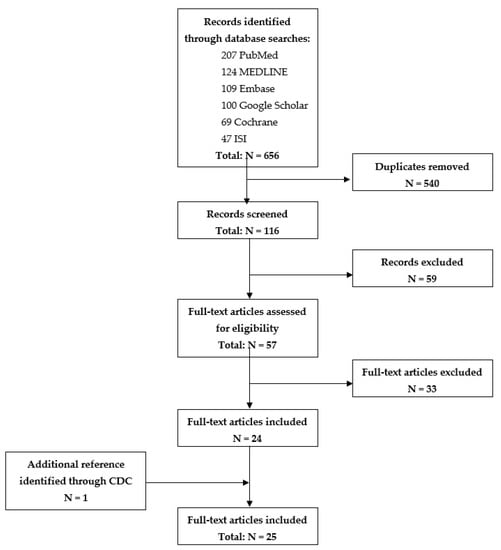
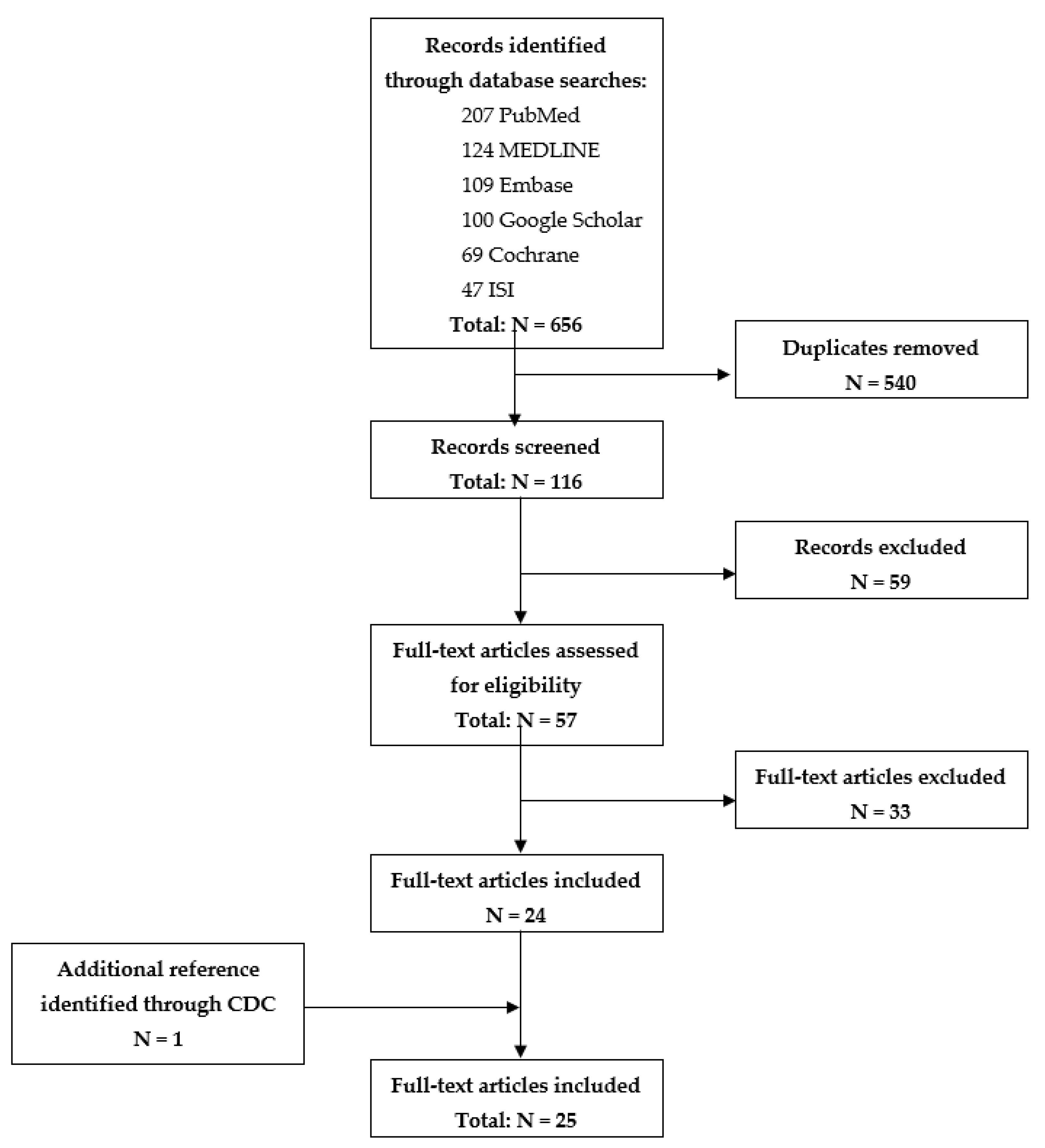
The search was then broadened by including the ‘Abstracts’ in the search field. The methodology process used is summarized in Figure 1 (PRISMA flowchart).
Figure 1.
PRISMA flowchart.
Additionally, the search was also conducted by Mesh terms in PubMed as follows: (SARS-CoV-2) AND (Fomites) AND (Disease Transmission, Infectious) AND (Microbial viability) OR (Survival). The World Health Organization (WHO) and Centers for Disease Control and Prevention (CDC) websites were analyzed for relevant publications, which were considered as additional publications from other sources.
In order to find potential additional relevant sources, identification and screening of further articles from references were undertaken. After completing the search with all relevant publications, duplicates were omitted.
2.2. Inclusion and Exclusion Criteria
The inclusion criteria were: (i) English-language publications related to the potential risks of infection by contaminated surfaces with the SARS-CoV-2 virus; (ii) all types of scientific publications such as editorials, viewpoints, articles, guidelines, etc., were included; (iii) any relevant settings such as fomites in hospitals, public places or in-house, for instance.
Exclusion criteria included publications related to other findings on COVID-19 disease and its clinical aspects or other routes of transmission of the virus, for instance, as examples. In addition, publications that did not imply a correlation between variables, such as the viral stability or virus load with the risk of infection, for example, were excluded.
2.3. Data Extraction
The relevant dataset was extracted and imported into an Excel extraction table by the main researcher (M.M.) This table includes the title, author(s), date of publication, study location focus, type of publication, the main topic, key findings, contamination risk assessment, and limits. The other co-authors screened publications to ensure their relevance and eligibility. The selected articles were imported by EndNote X7. The process of selection is reported in Figure 1.
3. Results
The search performed in the different databases underscores various interesting findings related to the risk of infection with SARS-CoV-2 from contaminated surfaces. The key results can be summarized as follow:
From the 25 documents selected for this review, 24 were retrieved through the database searches and 1 from the website of the CDC.
As mentioned in Figure 1, of a total of 565 publications found in the databases and SARS-CoV-2 source-related websites, 116 publications remained after removing the duplicates and then were screened by titles and abstracts. At this stage, 59 of the reviewed articles were classified as out of the scope of our research question and, therefore, were excluded. The full text of the remaining 57 publications was assessed, and 24 articles finally met the inclusion criteria.
Importantly, some excluded articles did not exactly state the risk of infection by fomites but had investigated some features of the virus that might lead to infectivity, but the relationship between those features and infectivity was not precisely discussed.
In addition, several excluded articles discussed the stability of the virus in different environmental conditions, but a lack of evidence on the relationship between the stability features and the risk of infection by contaminated surfaces was observed. Contrastingly, 17 articles from this category discussed a potential correlation and were included in our scoping review.
Five out of the 24 selected articles were surveyed in Europe, namely France, Switzerland, Germany, Italy, and England. Two of them were from the USA and one article, respectively, from Israel, China, and Singapore.
We could not identify a specific study setting in the remaining articles classified as Not Applicable, most of which were review articles and editorial letters. Articles since the beginning of the COVID-19 pandemic in early 2020 were assessed, and the last search was performed on 10 February 2021.
Amongst the included articles, ten out of 24 were review articles, which stated a clear conclusion about the risk of infection by fomites contaminated with SARS-CoV-2. Amongst the articles which have precisely indicated the risk of contaminated surfaces with SARS-CoV-2, five of them performed the research in hospital settings, three of them in community settings including schools, offices and high-touch surfaces in a city, one in a laboratory environment, and finally one in a quarantine household.
Based on our review, the main topics of the relevant publications found were: (I) persistence of the SARS-CoV-2 on fomites or inanimate surfaces, (II) risk of transmission of SARS-CoV-2 from fomites, (III) infectivity of SARS-CoV-2 on surfaces, (IV) modes of transmission, (V) nosocomial transmission of SARS-CoV-2 from surface environments.
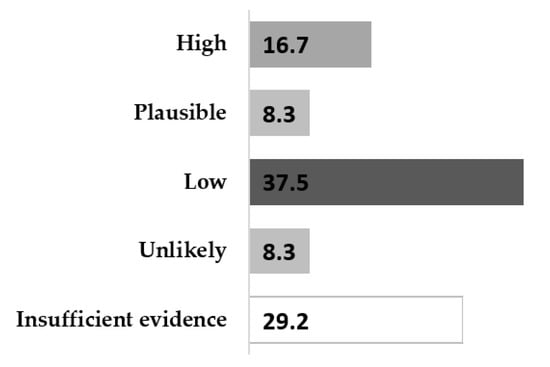
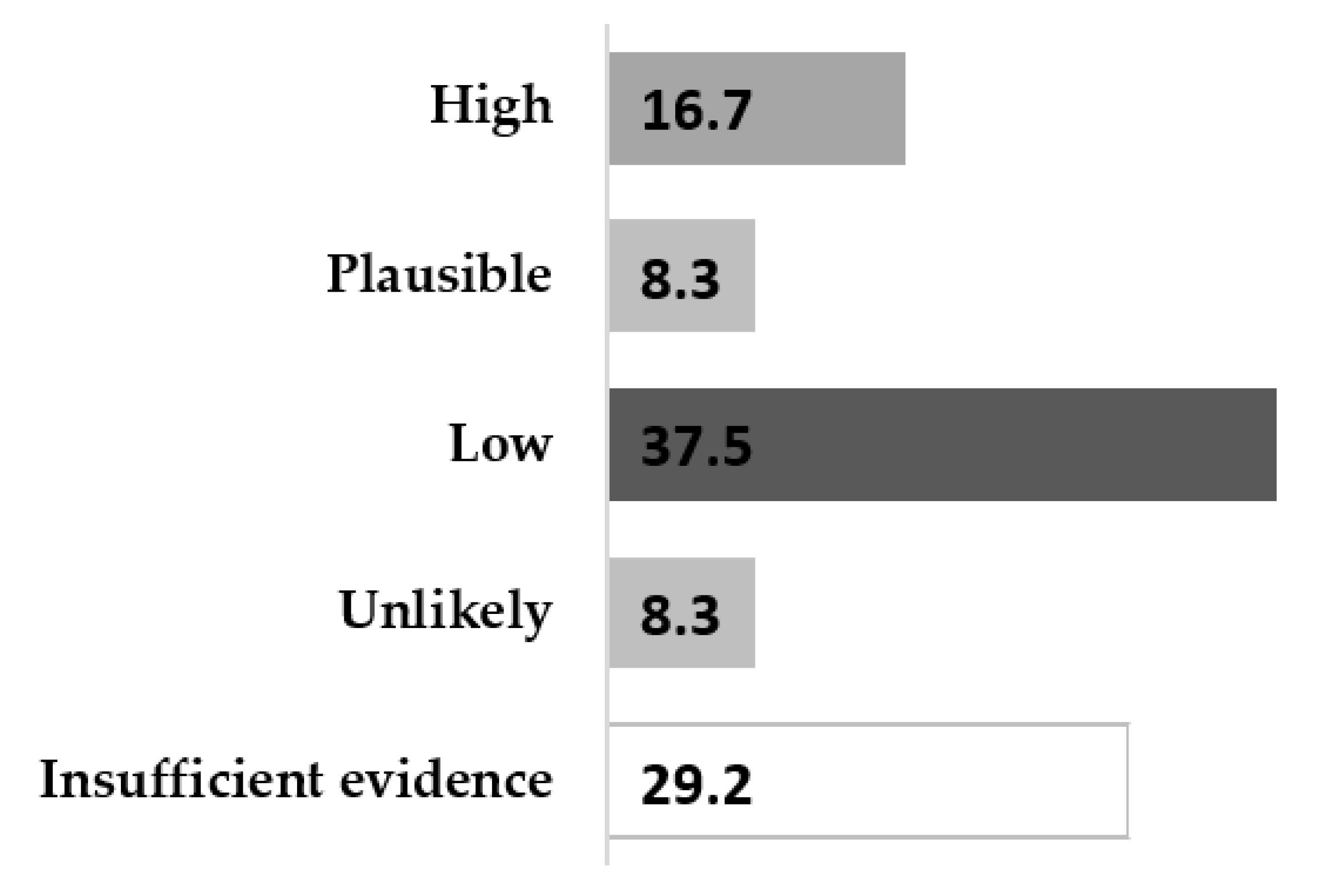
Moreover, the articles were assessed by the contamination risk and were classified by “low”, “high”, “plausible”, and “unlikely” risk. Furthermore, a category was defined as “insufficient evidence”. Nine articles out of 24 (37.5%) assessed a low probability of transmission, and four articles out of 24 (16.7%) stated a high transmission probability.
Importantly, seven out of the 24 articles (29.2%) indicated not having enough evidence to determine the risk of SARS-CoV-2 infection by contaminated surfaces. These findings are summarized in Figure 2, and a detailed review of the risk assessment can be found in Table 1.
Figure 2.
Contamination risk assessment of SARS-CoV-2 with contaminated surfaces (%).
Table 1.
Comments from the reviewed articles regarding the level of risk of SARS-CoV-2 infection through contact with contaminated surfaces.
4. Discussion
This scoping review was performed to evaluate the available literature related to the risks of infection transmission via contaminated surfaces with SARS-CoV-2.
Our research highlights a noticeable variability in the findings of articles assessing the risk of transmission via fomites classified as follows: low or high possibility, unlikeliness, plausibility, or lack of adequate evidence to identify the risks of infection transmitted by fomites.
While previous studies on different microorganisms have demonstrated the existing risk of transmission by contaminated surfaces [13,14,15,16,17,18], surprisingly, only six out of 24 of the articles had indicated the “plausibility” or high risk of infection via fomites in the case of SARS-CoV-2 contamination.
We found that 29.2% of the reviewed articles stated an absence of enough evidence, and most of the articles, i.e., 45.8%, concluded a low probability or unlikeliness. Interestingly, those articles were mostly focused on the following conclusions: (i) the existence of the virus on surfaces does not prevail the risks of infection by the virus, and (ii) there is a lack of information about the infectious dose of SARS-CoV-2 on the surfaces to be transmitted in order to cause infection [32,35,38,39]. For instance, “The infectious dose of SARS-CoV-2, namely the average number of viral particles required to establish an infection for COVID-19 is unknown” as stated by Xue et al. 2020 [36]. Another rationale observed to support the low probability of transmission of the SARS-CoV-2 via contaminated surfaces is the demonstration that viruses cannot reproduce outside the host, and the observation of the rare occurrence of touching surfaces contaminated with viral loads high enough to be infective and the subsequently touch face membranes such as eyes, or nose [11,39].
In addition, as mentioned by the World Health Organization (WHO), “it is difficult to disentangle the relative contributions of inhaled droplets and contaminated surfaces because people who have come into contact with potentially infectious surfaces have generally also been in close contact with infected individuals”.
Moreover, there are differences between real-life and laboratory conditions, which lead to lower risks in the real living environment, especially when hygiene protocols and cleaning procedures are followed [11,29,33].
From another standpoint, the long persistence of the virus on surfaces might cause a high possibility of infection via contaminated surfaces [24,28]. In one reviewed study focused on hospital settings, with the assumption made that the concentration of the virus might be more important, fomites were identified as potential sources of the virus spread [25]. On the contrary, three other studies performed in the same settings concluded that the risk of transmission and infection is not high [21,26,31].
Interestingly although this scoping review aimed to identify specifically the risk of infection via fomites, we could observe debates about the duration of the virus presence on different surfaces and the environmental effects on it. For instance, “in laboratory-controlled conditions and at the ambient temperature, SARS-CoV-2 lost its infectivity completely by day 4” [31].
We also consider it crucial to mention that studies demonstrated that higher temperature, sunlight, and UV radiation highly lead to the inactivation of SARS-CoV-2 [23,37]. Those are important factors to be understood in the real-life context of the SARS-CoV-2 life cycle. In addition, studies demonstrated that the RNA of common viruses, such as SARS-CoV-2, Influenza, and MERS-CoV, can persist on surfaces for days after they have lost their infectivity [23], therefore, detecting viral RNA on surfaces cannot solely provide information about the infectivity of the virus [35]. Thus, such information has to be taken with the necessary scrutiny to avoid potential incomplete conclusions about the probability of getting infected via fomites in real-life conditions.
5. Conclusions
Given the date of the last search performed, articles published after 10 February 2021, were not integrated in our review. Some recent publications on that topic were found, confirming the relevance of this topic.
Conclusively, the main outcome of this scoping review is that the risk of SARS-CoV-2 infection via contaminated surfaces was assessed as low in the majority of the reviewed articles. Further evaluation of the risk of the virus transmission by fomites and adequate information on its infectivity via contaminated surfaces in real-life conditions are essential. Those investigations would participate in setting more efficient guidelines to limit the spread of the SARS-CoV-2. Until more evidence on the risk of the virus transmission by fomites in real-life situations can be gathered, it remains important to follow disinfection guidelines and, most importantly, respect physical distancing and the use of masks to limit the propagation of the COVID-19 pandemic. Finally, the authors acknowledge that scientific data and related issues regarding the SARS-CoV-2 virus and potential variants evolve rapidly, but at the time of the research, no sufficient data was available mentioning possible variants and fomites transmission. Therefore, it appears key to take into consideration those elements in future research.
Author Contributions
M.M. contributed to the implementation of the research, analysis of the results, and writing of the manuscript. A.B.-A. contributed to the validation, review of the overall manuscript. A.L. reviewed the content of the manuscript. A.F. designed, directed, and supervised the project. All authors have read and agreed to the published version of the manuscript.
Funding
This research received no external funding.
Conflicts of Interest
The authors stated that they had no interests, which might be perceived as posing a conflict of interest, or bias.
Appendix A
Table A1.
Detailed information of review articles.
Table A2.
Key findings of review articles.
Table A3.
Recommendations and limitations of review articles.
References
- Lomont, A.; Boubaya, M.; Khamis, W.; Deslandes, A.; Cordel, H.; Seytre, D.; Tandjaoui-Lambiotte, Y. Environmental contamination related to SARS-CoV-2 in ICU patients. ERJ Open Res. 2020, 6, 00595-2020. [Google Scholar] [CrossRef] [Scilit] [PubMed]
- Haleem, A.; Javaid, M.; Vaishya, R. Effects of COVID 19 pandemic in daily life. Curr. Med. Res. Pract. 2020, 10, 78–79. [Google Scholar] [CrossRef] [Scilit] [PubMed]
- Donthu, N.; Gustafsson, A. Effects of COVID-19 on business and research. J. Bus. Res. 2020, 117, 284. [Google Scholar] [CrossRef] [Scilit] [PubMed]
- Peeri, N.C.; Shrestha, N.; Rahman, M.S.; Zaki, R.; Tan, Z.; Bibi, S.; Baghbanzadeh, M.; Aghamohammadi, N.; Zhang, W.; Haque, U. The SARS, MERS and novel coronavirus (COVID-19) epidemics, the newest and biggest global health threats: What lessons have we learned? Int. J. Epidemiol. 2020, 49, 717–726. [Google Scholar] [CrossRef] [Scilit] [PubMed]
- Krishan, K.; Kanchan, T. Aerosol and surface persistence: SARS-CoV-2 versus other coronaviruses. J. Infect. Dev. Ctries. 2020, 14, 748–749. [Google Scholar] [CrossRef] [Scilit]
- Ciotti, M.; Ciccozzi, M.; Terrinoni, A.; Jiang, W.-C.; Wang, C.-B.; Bernardini, S. The COVID-19 pandemic. Crit. Rev. Clin. Lab. Sci. 2020, 57, 365–388. [Google Scholar] [CrossRef] [Scilit]
- Carraturo, F.; Del Giudice, C.; Morelli, M.; Cerullo, V.; Libralato, G.; Galdiero, E.; Guida, M. Persistence of SARS-CoV-2 in the environment and COVID-19 transmission risk from environmental matrices and surfaces. Environ. Pollut. 2020, 265, 115010. [Google Scholar] [CrossRef] [Scilit]
- Castaño, N.; Cordts, S.; Jalil, M.K.; Zhang, K.; Koppaka, S.; Bick, A.; Tang, S.K. Fomite transmission and disinfection strategies for SARS-CoV-2 and related viruses. arXiv 2020. Available online: arXiv.org/abs/2005.11443 (accessed on 15 January 2021).
- Zhang, R.; Li, Y.; Zhang, A.L.; Wang, Y.; Molina, M.J. Identifying airborne transmission as the dominant route for the spread of COVID-19. Proc. Natl. Acad. Sci. USA 2020, 117, 14857–14863. [Google Scholar] [CrossRef] [Scilit] [PubMed]
- Kanamori, H.; Weber, D.J.; Rutala, W.A. The role of the healthcare surface environment in SARS-CoV-2 transmission and potential control measures. Clin. Infect. Dis. 2020, 72, 2052–2061. [Google Scholar] [CrossRef] [Scilit]
- Pitol, A.K.; Julian, T.R. Community Transmission of SARS-CoV-2 by Fomites: Risks and Risk Reduction Strategies. medRxiv 2020, 8, 263–269. [Google Scholar]
- Lu, C.-W.; Liu, X.-F.; Jia, Z.-F. 2019-nCoV transmission through the ocular surface must not be ignored. Lancet 2020, 395, e39. [Google Scholar] [CrossRef] [Scilit]
- Otter, J.A.; Yezli, S.; French, G.L. The Role of Contaminated Surfaces in the Transmission of Nosocomial Pathogens. In Use of Biocidal Surfaces for Reduction of Healthcare Acquired Infections; Springer: Cham, Switzerland, 2014; pp. 27–58. [Google Scholar]
- Stephens, B.; Azimi, P.; Thoemmes, M.S.; Heidarinejad, M.; Allen, J.G.; Gilbert, J.A. Microbial exchange via fomites and implications for human health. Curr. Pollut. Rep. 2019, 5, 198–213. [Google Scholar] [CrossRef] [Scilit]
- Boone, S.A.; Gerba, C.P. Significance of fomites in the spread of respiratory and enteric viral disease. Appl. Environ. Microbiol. 2007, 73, 1687–1696. [Google Scholar] [CrossRef] [Scilit] [PubMed]
- Lei, H.; Li, Y.; Xiao, S.; Yang, X.; Lin, C.; Norris, S.L.; Wei, D.; Hu, Z.; Ji, S. Logistic growth of a surface contamination network and its role in disease spread. Sci. Rep. 2017, 7, 1–10. [Google Scholar]
- Rusin, P.; Maxwell, S.; Gerba, C. Comparative surface-to-hand and fingertip-to-mouth transfer efficiency of gram-positive bacteria, gram-negative bacteria, and phage. J. Appl. Microbiol. 2002, 93, 585–592. [Google Scholar] [CrossRef] [Scilit] [PubMed]
- Kwok, Y.L.A.; Gralton, J.; McLaws, M.-L. Face touching: A frequent habit that has implications for hand hygiene. Am. J. Infect. Control. 2015, 43, 112–114. [Google Scholar] [CrossRef] [Scilit] [PubMed]
- Goldman, E. Exaggerated risk of transmission of COVID-19 by fomites. Lancet Infect. Dis. 2020, 20, 892–893. [Google Scholar] [CrossRef] [Scilit]
- Ren, S.-Y.; Wang, W.-B.; Hao, Y.-G.; Zhang, H.-R.; Wang, Z.-C.; Chen, Y.-L.; Gao, R.D. Stability and infectivity of coronaviruses in inanimate environments. World J. Clin. Cases 2020, 8, 1391. [Google Scholar] [CrossRef] [Scilit]
- Ong, S.W.X.; Tan, Y.K.; Chia, P.Y.; Lee, T.H.; Ng, O.T.; Wong, M.S.Y.; Marimuthu, K. Air, surface environmental, and personal protective equipment contamination by severe acute respiratory syndrome coronavirus 2 (SARS-CoV-2) from a symptomatic patient. Jama 2020, 323, 1610–1612. [Google Scholar] [CrossRef] [Scilit] [PubMed]
- Kraay, A.N.M.; Hayashi, M.A.; Berendes, D.M.; Sobolik, J.S.; Leon, J.S.; Lopman, B.A. Risk of fomite-mediated transmission of SARS-CoV-2 in child daycares, schools, and offices: A modeling study. MedRxiv 2020. [Google Scholar] [CrossRef] [Scilit]
- Bueckert, M.; Gupta, R.; Gupta, A.; Garg, M.; Mazumder, A. Infectivity of SARS-CoV-2 and Other Coronaviruses on Dry Surfaces: Potential for Indirect Transmission. Materials 2020, 13, 5211. [Google Scholar] [CrossRef] [Scilit]
- Pastorino, B.; Touret, F.; Gilles, M.; de Lamballerie, X.; Charrel, R.N. Prolonged infectivity of SARS-CoV-2 in fomites. Emerg. Infect. Dis. 2020, 26, 2256. [Google Scholar] [CrossRef] [Scilit] [PubMed]
- Ye, G.; Lin, H.; Chen, S.; Wang, S.; Zeng, Z.; Wang, W.; Wang, X. Environmental contamination of SARS-CoV-2 in healthcare premises. J. Infect. 2020, 81, e1–e5. [Google Scholar] [CrossRef] [Scilit] [PubMed]
- Moore, G.; Rickard, H.; Stevenson, D.; Aranega-Bou, P.; Pitman, J.; Crook, A.; Bennett, A. Detection of SARS-CoV-2 within the healthcare environment: A multi-centre study conducted during the first wave of the COVID-19 outbreak in England. J. Hosp. Infect. 2021, 108, 189–196. [Google Scholar] [CrossRef] [Scilit] [PubMed]
- Ong, S.W.X.; Coleman, K.K.; Chia, P.Y.; Thoon, K.C.; Pada, S.; Venkatachalam, I.; Marimuthu, K. Transmission modes of severe acute respiratory syndrome coronavirus 2 and implications on infection control: A review. Singap. Med. J. 2020, 1, 21. [Google Scholar] [CrossRef] [Scilit]
- Van Doremalen, N.; Bushmaker, T.; Morris, D.H.; Holbrook, M.G.; Gamble, A.; Williamson, B.N.; Munster, V.J. Aerosol and surface stability of SARS-CoV-2 as compared with SARS-CoV-1. N. Engl. J. Med. 2020, 382, 1564–1567. [Google Scholar] [CrossRef] [Scilit]
- Mondelli, M.U.; Colaneri, M.; Seminari, E.M.; Baldanti, F.; Bruno, R. Low risk of SARS-CoV-2 transmission by fomites in real-life conditions. Lancet Infect. Dis. 2020, 21, e112. [Google Scholar] [CrossRef] [Scilit]
- Harvey, A.P.; Fuhrmeister, E.R.; Cantrell, M.E.; Pitol, A.K.; Swarthout, J.M.; Powers, J.E.; Pickering, A.J. Longitudinal monitoring of SARS-CoV-2 RNA on high-touch surfaces in a community setting. Environ. Sci. Technol. Lett. 2020, 8, 168–175. [Google Scholar] [CrossRef] [Scilit]
- Ben-Shmuel, A.; Brosh-Nissimov, T.; Glinert, I.; Bar-David, E.; Sittner, A.; Poni, R.; Weiss, S. Detection and infectivity potential of severe acute respiratory syndrome coronavirus 2 (SARS-CoV-2) environmental contamination in isolation units and quarantine facilities. Clin. Microbiol. Infect. 2020, 26, 1658–1662. [Google Scholar] [CrossRef] [Scilit]
- Kampf, G. Potential role of inanimate surfaces for the spread of coronaviruses and their inactivation with disinfectant agents. Infect. Prev. Pract. 2020, 2, 100044. [Google Scholar] [CrossRef] [Scilit]
- Colaneri, M.; Seminari, E.; Novati, S.; Asperges, E.; Biscarini, S.; Piralla, A.; Vecchia, M. Severe acute respiratory syndrome coronavirus 2 RNA contamination of inanimate surfaces and virus viability in a health care emergency unit. Clin. Microbiol. Infect. 2020, 26, 1094.e1–1094.e5. [Google Scholar] [CrossRef] [Scilit]
- Hoseinzadeh, E.; Javan, S.; Farzadkia, M.; Mohammadi, F.; Hossini, H.; Taghavi, M. An updated min-review on environmental route of the SARS-CoV-2 transmission. Ecotoxicol. Environ. Saf. 2020, 202, 111015. [Google Scholar] [CrossRef] [Scilit] [PubMed]
- Kampf, G.; Brüggemann, Y.; Kaba, H.E.; Steinmann, J.; Pfaender, S.; Scheithauer, S.; Steinmann, E. Potential sources, modes of transmission and effectiveness of prevention measures against SARS-CoV-2. J. Hosp. Infect. 2020, 106, 678–697. [Google Scholar] [CrossRef] [Scilit] [PubMed]
- Xue, X.; Ball, J.K.; Alexander, C.; Alexander, M.R. All surfaces are not equal in contact transmission of SARS-CoV-2. Matter 2020, 3, 1433–1441. [Google Scholar] [CrossRef] [Scilit] [PubMed]
- Wathore, R.; Gupta, A.; Bherwani, H.; Labhasetwar, N. Understanding air and water borne transmission and survival of coronavirus: Insights and way forward for SARS-CoV-2. Total Environ. 2020, 749, 141486. [Google Scholar] [CrossRef] [Scilit] [PubMed]
- Bedrosian, N.; Mitchell, E.; Rohm, E.; Rothe, M.; Kelly, C.; String, G.; Lantagne, D. A Systematic Review of Surface Contamination, Stability, and Disinfection Data on SARS-CoV-2 (Through July 10, 2020). Environ. Sci. Technol. 2020, 55, 4162–4173. [Google Scholar] [CrossRef] [Scilit]
- Kanamori, H. Rethinking environmental contamination and fomite transmission of SARS-CoV-2 in the healthcare. J. Infect. 2021, 82, e17–e18. [Google Scholar] [CrossRef] [Scilit]
- Eslami, H.; Jalili, M. The role of environmental factors to transmission of SARS-CoV-2 (COVID-19). Amb Express. 2020, 10, 1–8. [Google Scholar] [CrossRef] [Scilit]
- Döhla, M.; Wilbring, G.; Schulte, B.; Kümmerer, B.M.; Diegmann, C.; Sib, E.; Schmithausen, R.M. SARS-CoV-2 in environmental samples of quarantined households. medRxiv 2020. [Google Scholar] [CrossRef] [Scilit]

Publisher’s Note: MDPI stays neutral with regard to jurisdictional claims in published maps and institutional affiliations. |
© 2021 by the authors. Licensee MDPI, Basel, Switzerland. This article is an open access article distributed under the terms and conditions of the Creative Commons Attribution (CC BY) license (https://creativecommons.org/licenses/by/4.0/).