


Abstract
The multitude of national strategies used against the COVID-19 pandemic makes it necessary to review and synthesize them in order to identify potential gaps and shortcomings, and to help prioritize future control efforts. This systematic mapping review is aimed at identifying the coronavirus pandemic management strategies adopted by France, Tunisia, and Germany during the early stage of the COVID-19 outbreak. A set of government websites in addition to the PubMed and Google Scholar databases were searched to identify scientific articles and institutional documents related to the national strategies of the three countries up until July 2020. The references included were mapped and narratively synthesized based on the pillars of the Monitoring and Evaluation Framework of the Strategic Preparedness and Response Plan defined by the World Health Organization. Of the 2765 records screened, 65 documents were included in the study. The analysis of these documents showed that Germany was the first country to implement mass screening of cases and that France was the first country to implement measures to impose general containment at the national level. It also showed that Tunisia was the only country to have imposed the confinement of passengers on repatriation flights in dedicated containment centers and at the expense of the state.
1. Introduction
Since December 2019, humanity has been facing a health crisis of unprecedented magnitude. Coronavirus disease 2019, or COVID-19, started as an outbreak in China and then spread rapidly around the world. On 11 March 2020, the World Health Organization announced that the situation reached the pandemic stage [1,2,3].
This pandemic is distinguished by three characteristics [4]:
- Its contagion and its high rate of spread caused the saturation of all health systems, even the most resilient. By 2 November 2020 the world had seen 46,049,978 cases and 1,201,442 deaths, including 516,774 new cases of contamination and 6088 new deaths in the previous 24 h [5].
- Its severity (20% of infected people develop a serious or critical form of the disease [4]).
- Its profound societal and economic consequences (over USD 220 billion has been lost in developing countries [6]).
Faced with this situation and the peculiarities of the rapid spread of COVID-19, each country applied a differentiated policy, which was always influenced by its degree of development, socio-economic situation, and political system [7,8,9].
The multitude and differences of strategies make it necessary to review and synthesize them in order to identify the most effective measures at the early stage of the pandemic and help prioritize future control efforts.
To this end, we carried out a systematic mapping review of three different national strategies, which are considered to be representative sample of what has been adopted in many countries.
Our choices were France, Germany, and Tunisia, for the representativeness of their strategies due to the countries’ cultural, political, and economic differences, and the availability and ease of access to data.
1.1. Background
1.1.1. Socio-Economic Situations of Tunisia, Germany, and France
The socio-economic and political situation of countries has played a key role in implementing their national control strategies [10].
Countries’ degrees of preparedness have differed considerably, depending on their degrees of development. The provision of the resources and infrastructure needed to cope with the pandemic was one of the greatest challenges for all countries, and especially for developing countries whose health systems are far less efficient [10].
In our study we are interested in an African developing country, which is Tunisia, and two developed European countries but with different demographic and political characteristics, which are France and Germany.
Tunisia has a GDP of USD 38.79 billion, of which 7% is dedicated to health (2019). It experienced a popular revolution in 2011 that led to the establishment of a democracy. However, its economy, which was once considered one of the best performing in the developing world, is currently undergoing an unprecedented crisis. The protracted recession risks greatly reducing the ability of the authorities to respond to the various crises. Tunisia has 2.3 hospital beds, 1.3 doctors and 2.5 nurses per 1000 inhabitants [11].
The other two countries in the study are France and Germany, which are the two largest economic powers in the European Union with a GDP of USD 2716 billion for France and USD 3846 billion for Germany [11]. Each one of the two countries allocate about 11% of their gross domestic product to health care, which is the highest rate in Europe. France has 6.5 hospital beds and 11.5 nurses per 1000 inhabitants and Germany has 8.3 hospital beds and 13.2 nurses [12].
However, our choice of these two countries is due to the great differences between them in terms of political systems (Germany is a federal republic, while France is a republic with a semi-presidential system) and the organization of their health systems [13]. This allows us to have an overview of the role that a political system can play during a pandemic and health crisis.
Tunisia, France, and Germany also have different demographic properties (Table 1) [11].
Table 1.
Demographic data relevant to the impact of COVID-19 in Tunisia, Germany, France.
1.1.2. The COVID-19 Pandemic in Tunisia, Germany, and France
The three countries experienced two main pandemic waves. The first spread from January to July. The second one started around August and is still ongoing.
The first positive cases of COVID-19 were detected in France and Germany 3 days apart (24 January (France) and 24 January (Germany)), while the first case detected in Tunisia was on 2 March 2020 [14].
Since its introduction in the three countries, the pandemic has taken on different evolutionary aspects.
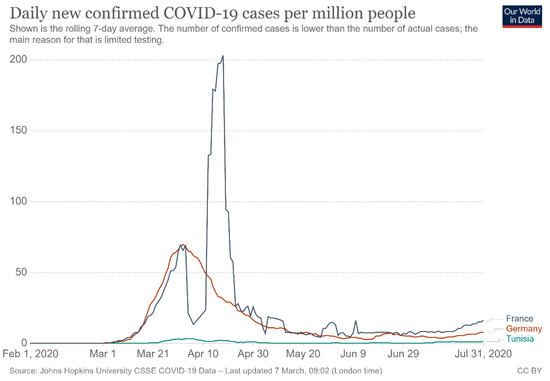
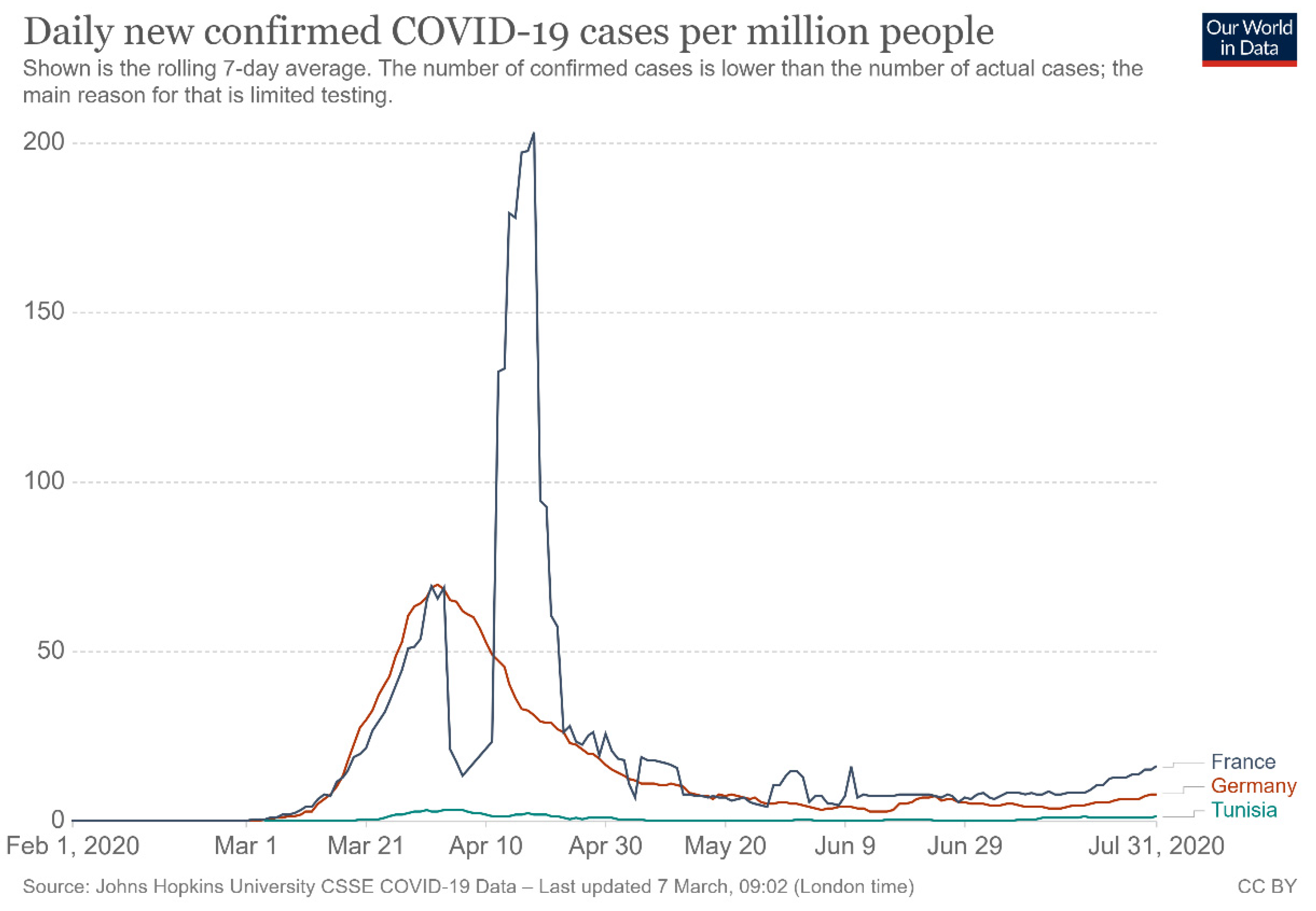
During the first pandemic wave, the curves relating to the evolution of the number of new positive cases (per million inhabitants per week) of France and Germany took paths in superimposable bells with peaks around 7 April. For Tunisia, the curve remained rather flat without exponential changes in the number of cases (Figure 1) [14].
Figure 1.
Shown is the rolling 7-day average of coronavirus cases in France, Germany, and Tunisia from 1 February 2020 to 31 July 2020. Source: Max Roser HR, Esteban Ortiz-Ospina, Joe Hasell. Posted online on OurWorldInData.org, 30 January 2021.
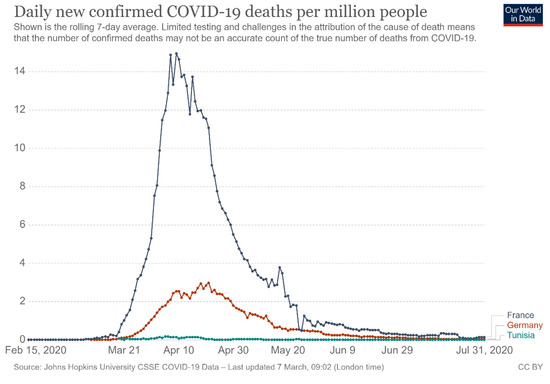
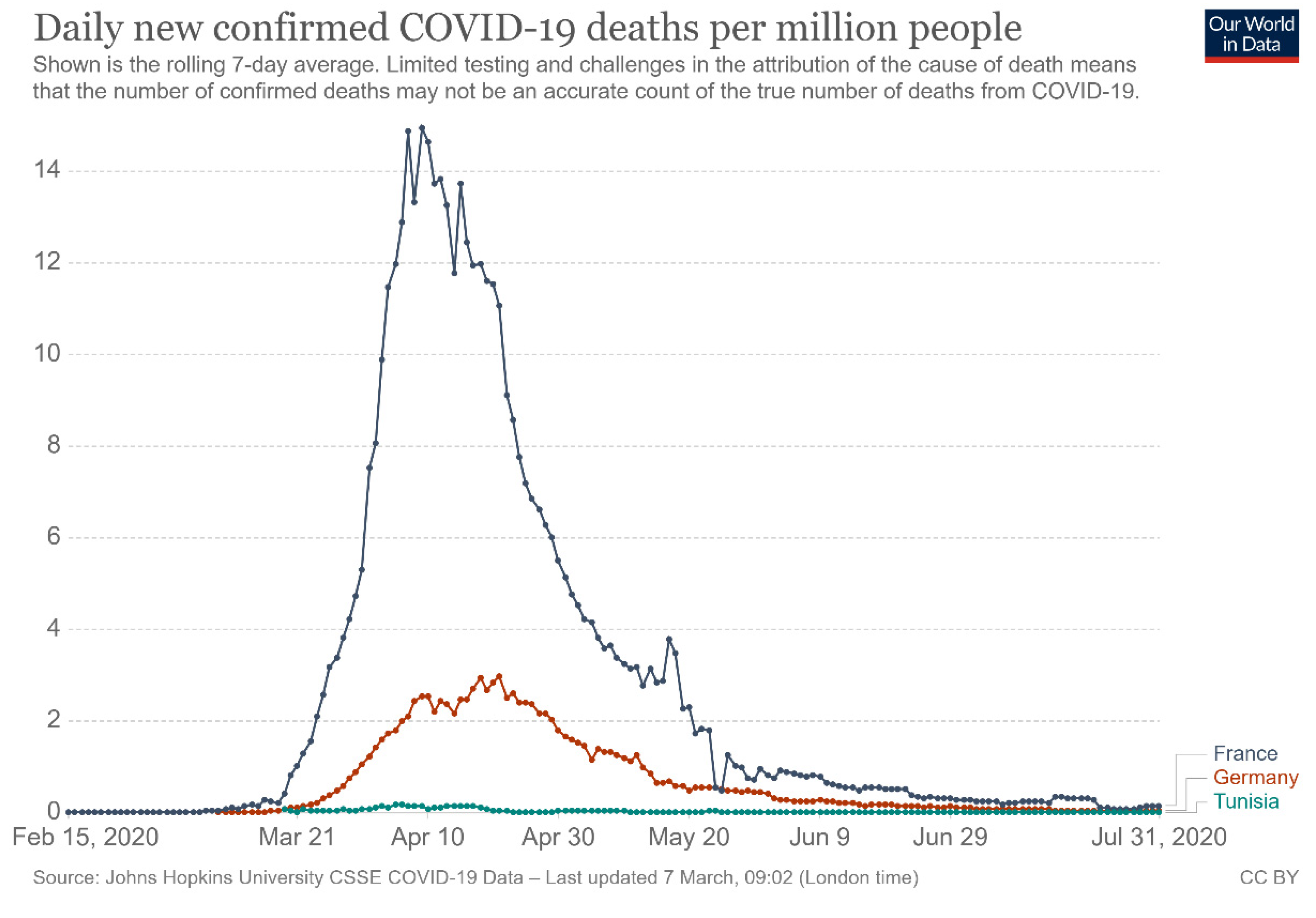
For France and Germany, the curves of the number of new deaths per million inhabitants (Figure 2) took the same shape as the curves of the new positive cases. They show a slight evolution initially followed by a rapid increase and then a relapse. The most striking observation is that the curves of France and Germany ceased to follow follow the same pattern. France recorded much higher death rates than Germany. This can be explained by the early and high level of testing in Germany among a wide sample of the population (which included milder cases in younger people). That means that more people with few or no symptoms were identified as COVID-positive, increasing the number of known cases, but not the number of fatalities [15].
Figure 2.
Shown is the rolling 7-day average of deaths caused by coronavirus in France, Germany, and Tunisia from 1 February 2020 to 31 July 2020. Source: Max Roser HR, Esteban Ortiz-Ospina, Joe Hasell. Posted online on OurWorldInData.org, 30 January 2021.
Due to a delay in the transmission of death certificates and the consolidation of data, the French data for the week of 13 April until 19 April were specified the following week of 20–26 April, which explains the drop in data around 13 April [16].
For Tunisia, the number of deaths was so small that the curve is practically linear [14].
1.1.3. The World Health Organization’s COVID-19 Strategic Plan and Monitoring and Evaluation Framework
On 14 April 2020, the WHO released an update of the COVID-19 Preparedness and Response Strategic Plan (PSPR) (released 3 February 2020) to inform the COVID-19 public health response at the national and sub-national levels and help identify gaps [4].
The eight pillars of the PSPR are:
- 1.
- National coordination, planning, and surveillance: Successful implementation of adaptive COVID-preparedness and response strategies will depend on the participation of the whole society in the plan and on the strength of national and sub-national coordination.
- 2.
- Risk communication and public engagement: Transparent communication to the public with responsive, empathetic, and culturally appropriate messages. Implementation of systems to detect and respond to concerns, rumors and false information.
- 3.
- Surveillance, early intervention, and case investigation: Early detection of imported cases, comprehensive and rapid contact tracing, and case investigation.
- 4.
- Ports of entry: Support for efforts and resources at ports of entry.
- 5.
- National laboratories: Preparation of laboratory capacity to manage the volume of COVID-19 testing.
- 6.
- Infection, prevention, and control: Review and improvement of infection prevention and control practices.
- 7.
- Case management: Preparation of health facilities and training of health professionals for the management of COVID-19 cases.
- 8.
- Logistics and operational support: Identification of resources and supply systems (supply, storage, security, transportation, and distribution).
On 5 June 2020, the WHO released The Monitoring and Evaluation Framework of the Strategic Preparedness and Response Plan (SPRP) [17] to track preparedness, responses, and situations during the COVID-19 pandemic. It was intended to assess performance and provide recorded information to support the analysis of progress against the COVID-19 Preparedness and Response Strategic Plan (PSPR) [4,17]. It includes input, output, and outcome indicators to achieve the objectives.
2. Materials and Methods
2.1. Study Type
This work consists of a study of the literature aimed at mapping systematically the different documentation related to the national strategies against COVID-19 in Tunisia, France, and Germany.
The procedure of systematic mapping warrants the organization in a systematized, clear, and robust manner, of references about a certain context, and assisting the decision-making process [18].
2.2. Eligibility Criteria
We note that, because this is a recent and rapid pandemic, scientific publications that discuss strategies are still scarce. For this reason, the study will also include official institutional documents published by the authorities of each country.
The inclusion criteria were defined according to the PIS criteria [19]:
- P (population): the governments of the three countries concerned (France, Germany, Tunisia)
- I (intervention): COVID-19 national pandemic strategies and policies
- S (study design): Any document that meets the following criteria will be included:
- o
- Any scientific article or official institutional document.
- o
- Carried out before 31 July 2020.
- o
- Languages: studies written in French, Arabic, German, or English.
- o
- Concerns France, Germany, or Tunisia.
2.3. Information Sources
The following websites were used to search for scientific articles:
- The electronic database PubMed (https://pubmed.ncbi.nlm.nih.gov, accessed on 1 September 2020).
- Google Scholar for the search of grey literature.
The following websites were used to search for government institutional publications:
- The platform of the French Ministry of Solidarity and Health (https://solidarites-sante.gouv.fr/, accessed on 1 September 2020).
- The platform Santé Publique France”’ (https://www.santepubliquefrance.fr/, accessed on 1 September 2020).
- The French government website (https://www.gouvernement.fr/, accessed on 1 September 2020).
- The platform of the Robert Koch Institute (Germany) (https://www.rki.de/DE/Home/homepage_node.html, accessed on 1 September 2020).
- The platform of the Federal Ministry of Health Germany (https://www.bundesgesundheitsministerium.de/, accessed on 1 September 2020).
- The platform of the Ministry of Public Health Tunisia (http://www.santetunisie.rns.tn/, accessed on 1 September 2020).
- The National Observatory for New and Emerging Diseases (https://www.onmne.tn/fr/index.php, accessed on 1 September 2020).
- The website “COVID-19 Tunisia”, which was set up by the Presidency of the Tunisian government (https://covid-19.tn/fr/accueil-2, accessed on 2 September 2020).
2.4. Search Strategy
Keywords and search equations used to search for articles:
- 1#: “2019 nCoV” OR “2019nCoV” OR “2019 novel coronavirus” OR “COVID-19” OR COVID19 OR “new coronavirus” OR “novel coronavirus” OR “SARS CoV-2” OR “فيروس كورونا المستجد’’.
- 2#: “Tunisia” OR “France” OR “Germany” OR “Deutschland” OR “Tunisie” OR “Tunesien” OR “Frankreich” OR “Allemagne” OR “تونس” OR “ فرنسا” OR”ألمانيا “
- 3#: “Health Polic”[Mesh]” OR “Strategy” OR “ Strategie”; OR “ إستراتيجية “ OR “ Gesundheitspolitik”
- Equation de recherche (Pubmed): 1# AND 2# AND 3#
- Keywords used to search for institutional documents:
- For Tunisian websites: 2019 novel coronavirus/COVID-19/new coronavirus/novel coronavirus/SARS CoV-2/les coronavirus/la pandémie de covid-19/فيروس كورونا المستجد/كورونافيروس/وباء الكورونا
- For French websites: 2019 novel coronavirus/COVID-19/new coronavirus/novel coronavirus/SARS CoV-2/les coronavirus/la pandémie de covid-19/
- For German websites: 2019 novel coronavirus/COVID-19/new coronavirus/novel coronavirus/SARS CoV-2/Coronaviren/die Covid-19 Pandemie/
2.5. Study Records
The document selection process involved several essential steps based on the PRISMA 2009 model [20]:
- Identification by title: in a first step, the documents were identified according to their titles.
- Eligibility: the second identification was carried out on the summary of each bibliographic reference (this step concerned only scientific articles).
- Inclusion: based on the complete texts, by applying the pre-established criteria and after elimination of duplicates.
Between 1 September and 1 November 2020, two reviewers (KL, FH) independently screened the titles, abstracts, and, if ambiguous, full texts for the inclusion of documents. Discrepancies were resolved through discussions among the two reviewers, and in consultation with a third reviewer (RN), to reach a consensus. Subsequently, KL and FH independently conducted information extraction from the included documents. Discrepancies were similarly resolved through discussion among the reviewers and in consultation with NE, RN, and MRT.
2.6. Data Extraction
The results were extracted based on the Monitoring and Evaluation Framework for the Strategic Plan for Preparedness and Response, which was published on 5 June 2020 by the WHO [17]. This framework proposes global and national assessment indicators for each of the eight strategic pillars published by WHO in the Strategic Plan for Preparedness and Response to COVID-19 (SPPR). Only national indicators were considered in extracting the results of our study.
2.7. Data Synthesis
An abductive approach was used in the analysis of the results. This approach is based on all of the pillars of the WHO’s Strategic Preparedness and Response to COVID-19 Monitoring and Evaluation Framework (SPRP) [21].
A narrative and mapping analysis of the results, which are presented in tabular and map form, is done.
3. Results
3.1. Quantitative Results
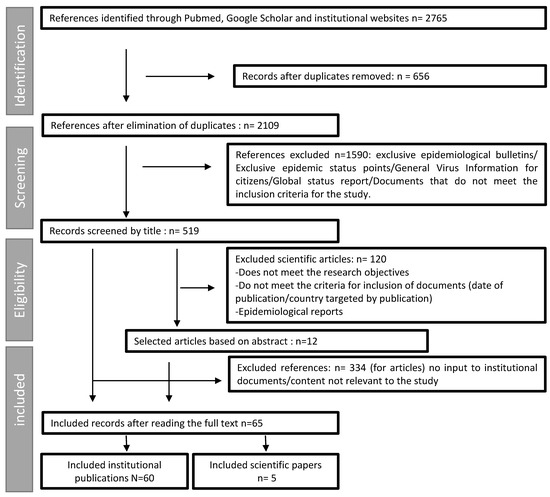
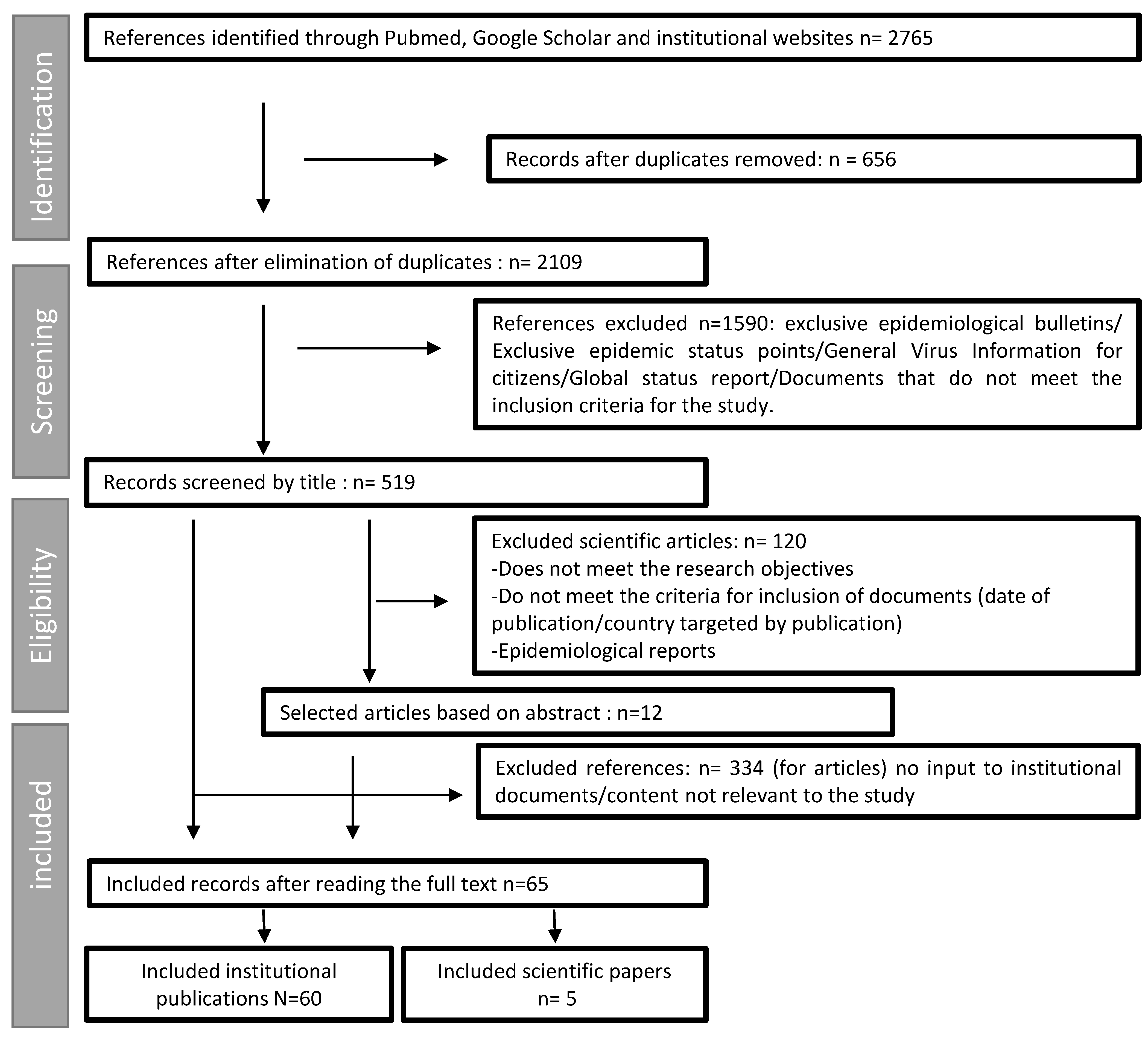
The search strategy identified 2765 potential documents, 1590 documents were eliminated based on the title, 120 articles were eliminated based on the abstract, and a total of 396 were retained for final selection. A number of 65 documents were included in the study, including 60 institutional and 5 scientific publications (Figure 3).
Figure 3.
Flow diagram of the review process.
Among the documents included, only five are scientific articles, while 60 are institutional documents. Most institutional publications are devices/plans or guides (33.8%) and information sources for citizens (Table 2).
Table 2.
Types of documents included in the study.
3.2. Qualitative Results
Table 3, Table 4, Table 5, Table 6, Table 7, Table 8, Table 9 and Table 10 illustrate the set of data selected based on the main strategic pillars of the WHO (which were studied using a set of indicators).
Table 3.
Pillar 1: National coordination, planning, and monitoring.
Table 4.
Pillar 2: Risk communication and community engagement.
Table 5.
Pillar 3: Surveillance, rapid response teams, and case investigation.
Table 6.
Pillar 4: Points of entry (PoE), international travel, and transport.
Table 7.
Pillar 5: National laboratories.
Table 8.
Pillar 6: Infection prevention and control.
Table 9.
Pillar 7: Case management.
Table 10.
Pillar 8: Maintaining essential health services and systems.
3.2.1. Pillar 1: National Coordination, Planning, and Monitoring
The references selected for this first pillar show that the three countries have chosen similar measures and plans in national pandemic coordination, planning, and surveillance, including activation of a national response plan (based primarily on World Health Organization recommendations), and use of reviews and reporting to strengthen pandemic response, barrier measures, and general containment (Table 3). However, each plan was marked by different timelines and periods of implementation and set-up, which can be seen in Supplementary Material Table S1.
Germany distinguished itself from Tunisia and France by not declaring a state of emergency at the national level.
3.2.2. Pillar 2: Risk Communication and Population Mobilization
The governments of the three countries have opted for transparent communication to the public. They have also put in place mechanisms to regularly gather community feedback and assess public perceptions and concerns, as well as practical and logistical support for people living in socially vulnerable contexts (Table 4).
No publications were found for Tunisia and France regarding the presence of a national communication plan on the risks related to COVID-19.
3.2.3. Pillar 3: Surveillance, Rapid Response Teams, and Case Investigation
The three countries of the study have used surveillance systems to ensure regular epidemiological monitoring and to study the characteristics of the SARS-CoV2 virus.
Different testing strategies have been identified depending on the country and the period. Germany has distinguished itself from Tunisia and France by using mass screening since the beginning of the pandemic.
No publications were found regarding prevalence estimates of infection from prevalence studies in Tunisia (Table 5).
3.2.4. Pillar 4: Points of Entry, International Travel, and Transport
International travel management strategies have been implemented in all three countries.
Tunisia has followed stricter measures in the confinement of passengers on repatriation flights during the period of border closure (Table 6).
3.2.5. Pillar 5: National Laboratories
Some references showed different strategic measures for national laboratories to face the pandemic. No reference was found for Tunisia and France regarding the number of laboratories authorized until 31 July 2020.
The preparation of the laboratories in Tunisia has not been documented in the selected references (Table 7).
3.2.6. Pillar 6: Infection Prevention and Control
Guidance documents for healthcare centers to implement a COVID-19 circuit have been identified in the three countries of the study.
Contact tracing strategies are different in each of the three countries (Table 8, Supplementary Material Table S9).
3.2.7. Pillar 7: Case Management
The three studied countries have implemented case-management measures by training health professionals and by census of health facilities and preparing them for significant increases in the number of patients suspected of being infected with COVID-19 (Table 9).
3.2.8. Pillar 8: Maintaining Essential Health Services and Systems
Continuity of care for non-COVID-19 patients was disrupted in the three countries (Table 10).
3.3. Synthesis of Results
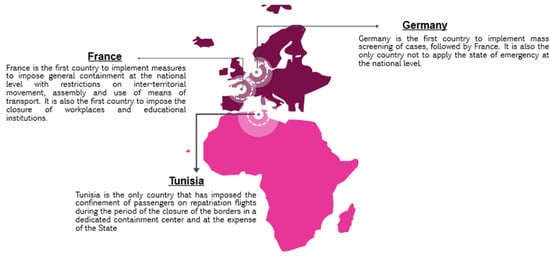
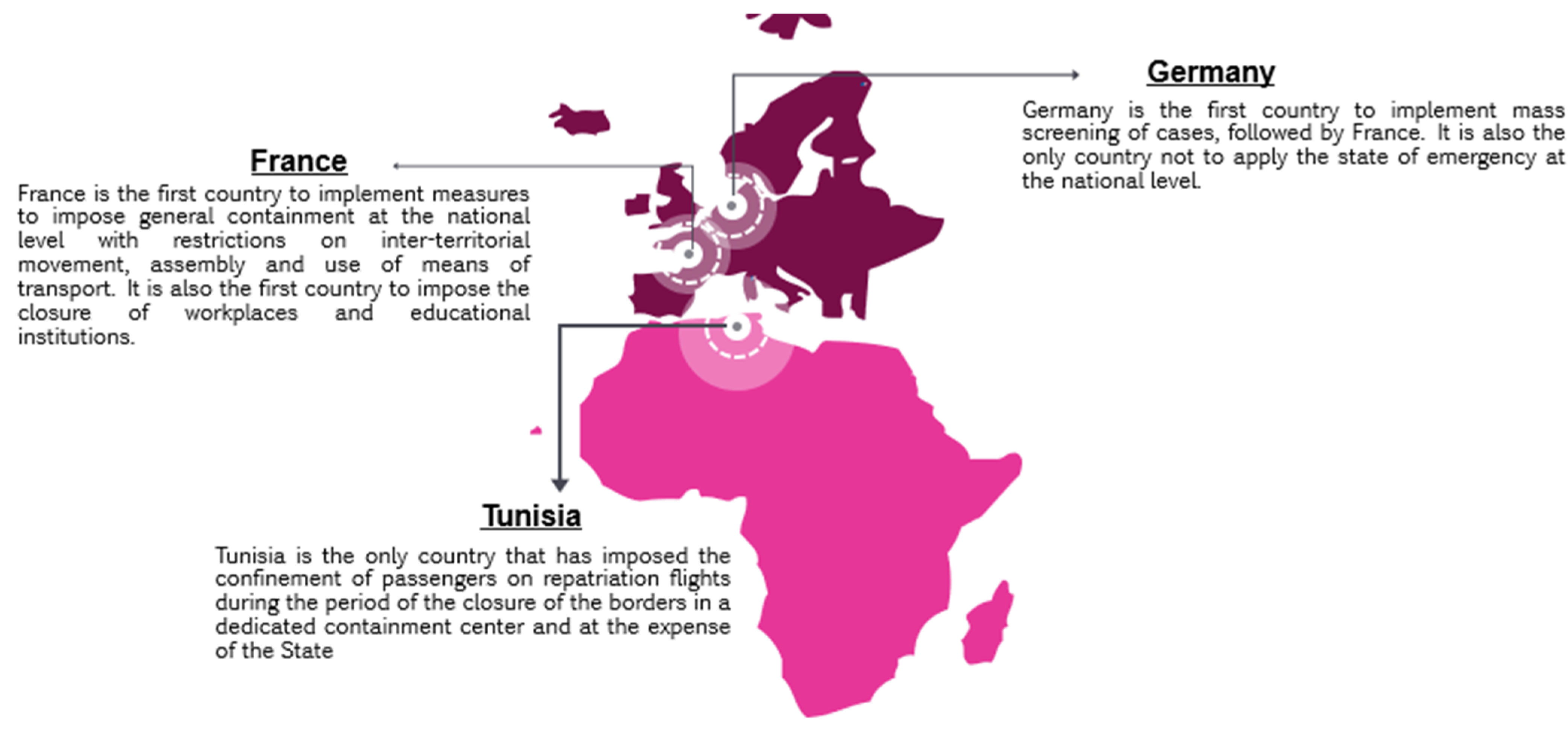
The measures taken in relation to the eight strategic pillars are for the most part similar for the three countries. However, there are differences in terms of the timing, the means put in place, and the methods used to implement certain measures (Figure 4).
Figure 4.
Mapping of the main differences in the national strategies of Tunisia, France, and Germany.
4. Discussion
4.1. Discussion of the Method
The understanding of a national strategy is sometimes dependent on confidential data that is not accessible to all [73], which has led to a limited number of indicators for each pillar. However, the countries in the study chose transparency in communicating information to citizens and the world population.
It might have been interesting to compare the results through interviews with health leaders from each country, but as the crisis continued this was not possible.
4.2. Discussion of Results
4.2.1. Impact of the Political Regime
The three countries have chosen similar measures and plans for national coordination, planning, and surveillance of the pandemic, including activation of a national response plan (based primarily on World Health Organization recommendations), use of reviews and reporting to strengthen the pandemic response, barrier measures, and general containment. However, each plan was marked by the nature of the political system in place.
While Tunisia and France have a centralized power and a common strategy for the entire country, Germany has been characterized by different strategies among the federal states, creating a more differentiated political set of actions across the country [89].
Indeed, the German government has been reluctant to make use of the provisions of the emergency constitutional powers [90]. The abuses of emergency powers in the last years of the Weimar Republic, which led to the rise and domination of Nazism, are still in their minds. These provisions included in the Basic Law of 1968 are still controversial and have never been used [91].
Nevertheless, on 27 March 2020, the Bundestag declared a national epidemic (“epidemische Lage von nationaler Tragweite”) on the legal basis of the Infection Protection Act, which gave national and subnational frameworks additional powers to combat the spread of COVID-19.
The federal level exercised its prerogatives regarding travel restrictions and closing borders, ensuring the availability of relevant health resources through the establishment of means for rapid acceleration of production. The states took measures at the local level, such as policies related to schools, kindergartens, and universities, as well as those related to business. This decentralization of power allowed the measures taken to be better adapted to local pandemic conditions and the specific needs of each federal state [92].
In addition to the duty to respond, a kind of constructive rivalry has developed between the Ländern and intensified during the fourth phase of crisis management, with several governments surpassing themselves and trying to do their best in developing strategies to revive public life [90].
On the French side, this decentralization has not found a place. The French authorities have chosen a common management policy based on an analysis of the evidence. Therefore, they created an advisory board of 11 scientists to help them manage the crisis. This approach carries with it a radical uncertainty, because the simple fact of examining the evolution of confirmed cases with a disease that spreads faster than influenza and has a higher morbidity rate, does not allow lessons to be learned in real time and decisions and policies to be made quickly [93].
Strict measures were taken by the three countries to control and limit gatherings, but these were sometimes contradicted by other decisions. In France, for example, despite the ban on rallies, the first round of national elections on 15 March was maintained, thus confronting the population with a situation of double constraint by dissonant incentives [94].
4.2.2. Testing/Screening Strategy and Tracing
Germany’s testing strategy is distinguished from those in France and Tunisia by the early launch of mass population screening campaigns. This strategy, which meets the recommendations of the World Health Organization, has been practiced by several other countries such as South Korea and Australia [10].
France chose the strategy of targeted testing at the beginning of the pandemic due to logistical problems, the limited number of accredited laboratories (only 45 in public institutions), and the limited availability of SARS-COV-2 reagents for RT-PCR at the beginning of the pandemic [94]. However, France rapidly increased its testing capacity from 47,732 tests a day on 30 March 2020 to 968,454 tests a day on 30 May 2020 [37].
Tunisia chose the same strategy of targeted testing as in France: tests were carried out mainly for people who were in contact with people infected with COVID-19 or patients with symptoms. However, the capacity for laboratory analysis (RT PCR) in Tunisia is very limited compared to France [95].
4.2.3. Importance of Prevention and Predictive Measures
With the delayed appearance of the pandemic in Tunisia, the newly elected Tunisian government chose to learn from countries that have already reached the exponential phase of the spread of the infection, as well as from those that have lived through and gone beyond this phase. The Tunisian people who saw the consequences and effects of the pandemic in Italy, Spain, and China quickly joined the government effort and showed absolute solidarity [95].
Indeed, the lack of resources in Tunisia was remedied by its predictive strategy, which made it possible to take strict and effective measures, such as measures to contain passengers on repatriation flights during the period of the closure of the borders.
The Tunisian containment strategy has distinguished itself from its two European counterparts by the mandatory confinement at the expense of the state in a dedicated center. This strategy has proven to be effective because at this phase of the pandemic, the risk of COVID-19 occurring among arrivals after the general quarantine was 60 times greater than the incidence rate at the premises. That means that the risk of local infection was mainly related to imported cases, according to the Tunisian Ministry of Health [96].
The effectiveness of Tunisia’s predictive strategy at the beginning of the pandemic can be seen through the relapse and flattening of its epidemiological curve relative to the number of new cases from the end of April until the month of July [36].
Indeed, the application of containment measures in the world varies clearly between countries. Few countries have chosen zero containment, with the exception of South Korea, Taiwan, and the Netherlands, in order to establish collective immunity. Other countries, such as the United Kingdom, initially opted for this strategy but changed their strategy in view of the rapid spread of the virus and the growing social challenges [95].
France and Germany followed a model of partial containment at the beginning of the crisis, by the isolation of epidemic outbreaks at regional level, and by the closure of schools/universities and non-essential public places.
4.2.4. Social Acceptance and Commitment
The three countries made use of new information and communication techniques, through the adoption of mobile applications for case-finding and tracing. However, their effectiveness has been challenged because of the delicate balance between protecting public health and respecting fundamental rights such as privacy [97,98].
Thus, despite the urgency of the context, certain measures taken by the authorities have been challenged, and judged as an attack on democracy and especially on individual freedoms. Demonstrations and protest movements were organized to denounce decisions taken, some even tried and won trials before the courts [90].
Moreover, the social acceptance of these measures varied according to the culture, the political regime in place and the epidemic history of the country. Greater acceptance has been found in areas of the world that have faced previous epidemics (including SARS) [95].
Noting that, for Tunisia, social engagement has played a key role in its fight against the pandemic. The Tunisian government has chosen the transparency route since the beginning (regular speeches by the Ministry of Health, a permanent government presence on TV sets, a daily press briefing, etc.). This has stimulated social engagement and mobilized civil society to support the government’s efforts. A collection of donations took place through a fund, called 1818, in which financial contributions were deposited [89].
4.2.5. Continuity of Non-COVID-19 Care Services
There was a disruption in continuity of care for non-COVID-19 patients in all three countries. This disturbance can be explained by two phenomena. On the one hand, hospitals deprogrammed their activities and postponed their consultations/operations massively in order to have the resources and equipment for the management of the epidemic crisis. On the other hand, hospital arrivals for non-COVID-19 conditions declined for a variety of reasons, such as not wanting to “disturb” the staff while they were overwhelmed by COVID-19 case management, fear of travelling to the hospital, or rescheduling appointments that were not considered urgent (screening, vaccination, etc.) [25].
5. Conclusions
The COVID-19 pandemic is neither the first nor the last viral pandemic that societies around the world have been, are, and will be affected by.
The first measures taken against the pandemic are of particular importance because they make it possible to slow down the spread and thus allow countries to gain a margin of time to prepare their material and human resources for defense.
Measures that have been shown to be effective in response strategies should be considered as future recommendations at an international level (such as early detection, mass screening, effective management logistics, protection of the vulnerable population, etc.). Indeed, the COVID-19 pandemic has been a difficult ordeal for humanity, which is called upon to review its priorities, through the highlighting of the health and hygiene dimensions. These dimensions need much more attention and investment.
National strategy studies, which include countries with different health systems (e.g., the Beveridge model), as well as those that include the pandemic in its four waves, are needed to gain a more precise overview of control strategies.
Supplementary Materials
The following are available online at https://www.mdpi.com/article/10.3390/ijerph18168622/s1, Table S1: Indicator 1.5 General Lockdown, Table S2: Indicator 1.8 Restrictions on the use of public transport, Table S3: Indicator 1.9 Closure of workplaces, Table S4: Indicator 1.11 Closure of educational establishments, Table S5: Indicator 1.14 Restrictions on inter-territorial movements, Table S6: Indicator 1.15 Restrictions on gatherings, Table S7: Indicator 3.4 Testing strategies, Table S8: Indicator 4.2 Management of international travel, Table S9: Indicator 6.2 Contact tracing strategy.
Author Contributions
All authors contributed during the conceptualization phase. The collection and selection of data were carried by K.L. and F.H. The article was written by K.L., N.E., R.G.N., and M.R.-T. provided their supervision and validation throughout this study. All authors have read and agreed to the published version of the manuscript.
Funding
This research received no external funding. The APC was funded by the Nursing Sciences Research Chair, Laboratory Educations and Health Practices (LEPS), Université Sorbonne Paris Nord, (EA 3412), UFR SMBH, F-93017 Bobigny, France.
Institutional Review Board Statement
Not applicable.
Informed Consent Statement
Not applicable.
Data Availability Statement
Not applicable.
Conflicts of Interest
The research was carried out as part of Master degree research work in public health (research and innovation in care) at the university Sorbonne Paris-Nord and was conducted during an internship at the Medical Research Directorate of the Tunisian Ministry of Health. The Tunisian Ministry of Health and the Sorbonne Paris-Nord university had no influence on the interpretation and analysis of the results.
References
- World Health Organization. WHO Director-General’s Opening Remarks at the Media Briefing on COVID-19—11 March 2020. WHO Official Website. 2020. Available online: https://www.who.int/director-general/speeches/detail/who-director-general-s-opening-remarks-at-the-media-briefing-on-covid-19---11-march-2020 (accessed on 2 September 2020).
- Eastin, C.; Eastin, T. Clinical Characteristics of Coronavirus Disease 2019 in China: Guan W, Ni Z, Hu Y; et al. N. Engl. J. Med. 2020 Feb 28 [Online ahead of print] doi:10.1056/NEJMoa2002032. J. Emerg. Med. 2020, 58, 711–712. [Google Scholar] [CrossRef] [Scilit]
- Agrawal, S.; Goel, A.D.; Gupta, N. Emerging prophylaxis strategies against COVID-19. Monaldi Arch. Chest Dis. 2020, 90, 1289. [Google Scholar] [CrossRef] [Scilit]
- mondiale de la Santé, O.; World Health Organization. COVID-19 strategy update (as of 14 April 2020)—Mise à jour de la stratégie COVID-19 (au 14 avril 2020). Wkly. Epidemiol. Rec. Relev. Épidémiologique Hebd. 2020, 95, 185–208. [Google Scholar]
- World Health Organization. Rapport de L’organisation Mondiale de la Santé du 1er Juillet. 2020. Available online: https://www.who.int/docs/default-source/coronaviruse/situation-reports/20200701-covid-19-sitrep-163.pdf?sfvrsn=c202f05b_2 (accessed on 2 September 2020).
- Programme des Nations Unles pour le Développement. COVID-19, Réponse Intégrée du PNUD. Available online: https://www1.undp.org/content/undp/fr/home/librarypage/hiv-aids/covid-19-undp_s-integrated-response.html (accessed on 2 September 2020).
- Contreras, G.W. Getting ready for the next pandemic COVID-19: Why we need to be more prepared and less scared. J. Emerg. Manag. 2020, 18, 87–89. [Google Scholar] [CrossRef] [Scilit] [PubMed]
- Wong, J.E.L.; Leo, Y.S.; Tan, C.C. COVID-19 in Singapore-current experience: Critical global issues that require attention and action. JAMA 2020, 323, 1243–1244. [Google Scholar] [CrossRef] [Scilit] [PubMed]
- Koh, J.; Shah, S.U.; Chua PE, Y.; Gui, H.; Pang, J. Epidemiological and Clinical Characteristics of Cases During the Early Phase of COVID-19 Pandemic: A Systematic Review and Meta-Analysis. Front. Med. 2020, 7, 295. [Google Scholar] [CrossRef] [Scilit]
- Deloitte Afrique SAS. Une Entité du Réseau Deloitte. COVID-19: Gouverner l’imprévisible—Analyse Comparative des Différentes Stratégies de Crise Déployées. Available online: https://www2.deloitte.com/content/dam/Deloitte/fr/Documents/covid-insights/gouverner_imprevisible.pdf (accessed on 4 September 2020).
- World Bank Open Data. Available online: https://data.worldbank.org/ (accessed on 4 September 2020).
- Hale, T.; Petherick, A.; Phillips, T.; Webster, S. Variation in government responses to COVID-19. Blavatnik Sch. Gov. Work. Paper 2020, 31, 11. [Google Scholar]
- Country Health Profiles. The European Observatory on Health Systems and Policies and the Organisation for Economic Co-operation and Development (OECD) Website of the European Observatory on Health Systems and Policies. 2019. Available online: https://www.oecd.org/health/country-health-profiles-eu.htm (accessed on 3 September 2020).
- Roser, M.; Ritchie, H.; Ortiz-Ospina, E.; Hasell, J. Coronavirus Pandemic (COVID-19). 2020. Available online: https://ourworldindata.org/coronavirus (accessed on 4 September 2020).
- Stafford, N. Covid-19: Why Germany’s case fatality rate seems so low. BMJ 2020, 369. [Google Scholar] [CrossRef] [Scilit]
- Santé Publique France. COVID-19: Point Épidémiologique Hebdomadaire du 30 Avril 2020. 2020. Available online: https://www.santepubliquefrance.fr/maladies-et-traumatismes/maladies-et-infections-respiratoires/infection-a-coronavirus/documents/bulletin-national/covid-19-point-epidemiologique-du-30-avril-2020 (accessed on 1 September 2020).
- World Health Organization. COVID-19 Strategic Preparedness and Response (SPRP). Monitoring and Evaluation Framework. 2020. Available online: https://www.who.int/publications/i/item/monitoring-and-evaluation-framework (accessed on 1 August 2020).
- James, K.L.; Randall, N.P.; Haddaway, N.R. A methodology for systematic mapping in environmental sciences. Environ. Evid. 2016, 5, 7. [Google Scholar] [CrossRef] [Scilit]
- Schmucker, C.; Motschall, E.; Meerpohl, J. Methoden des Evidence Mappings: Eine Systematische Übersicht; Deutsches Cochrane Deutschland: Freiburg, Deutschland, 2013. [Google Scholar]
- Moher, D.L.A.; Tetzlaff, J.; Altman, D.G.; The PRISMA Group. Preferred Reporting Items for Systematic Reviews and Meta-Analyses: The PRISMA Statement. PLoS Med. 2009, 6, e1000097. [Google Scholar] [CrossRef] [Scilit]
- World Health Organization. Novel Coronavirus (2019-nCoV)-Situation Report-10–30 January 2020. Available online: https://www.who.int/docs/default-source/coronaviruse/situation-reports/20200130-sitrep-10-ncov.pdf?sfvrsn=d0b2e480_2 (accessed on 1 August 2020).
- Binder, K.; Diaz Crego, M.; Eckert, G.; Kotanidis, S.; Manko, R.; Del Monte, M. States of emergency in response to the coronavirus crisis: Situation in certain Member States. EPRS Eur. Parliam. 2020, 659, 408. [Google Scholar]
- Hale, T.; Webster, S.; Petherick, A.; Phillips, T.; Kira, B. COVID-19 Government Response Tracker. Blavatnik Sch. Gov. 2020, 8, 30. [Google Scholar]
- Roser, M.; Ritchie, H.; Ortiz-Ospina, E.; Hasell, J. Coronavirus Pandemic (COVID-19). Our World Data. 2020. Available online: https://ourworldindata.org/coronavirus/country/democratic-republic-of-congo?country=~COD (accessed on 1 August 2020).
- Barro, K.; Malone, A.; Mokede, A.; Chevance, C. Management of the COVID-19 epidemic by public health establishments—Analysis by the Federation hospitaliere de France. J. Chir. Visc 2020, 157, S20–S24. [Google Scholar] [CrossRef] [Scilit]
- Fuhrer, A.; Frese, T.; Karch, A.; Mau, W.; Meyer, G.; Richter, M.; Schildmann, J.; Steckelberg, A.; Wagner, K.; Mikolajczyk, R. COVID-19: Knowledge, risk perception and strategies for handling the pandemic. Z. Evid. Fortbild. Qual. Gesundhwes 2020, 153–154, 32–38. [Google Scholar] [CrossRef] [Scilit]
- Décret no 2016-1327 du 6 Octobre 2016 Relatif à L’organisation de la Réponse du Système de Santé (Dispositif « ORSAN ») et au Réseau National des Cellules D’urgence Médico-Psychologique pour la Gestion des Situations Sanitaires Exceptionnelle. Journal Officiel de la République Française. 2016. Available online: https://www.legifrance.gouv.fr/jorf/id/JORFTEXT000033203698 (accessed on 5 September 2020).
- Décret n° 2005-3294 du 19 Décembre 2005, Portant Création de L’observatoire National des Maladies Nouvelles et Émergentes et Fixant son Organisation Administrative et Financière ainsi que les Modalités de son Fonctionnement. PUBLIQUE, M.D.L.S., Ed. Journal Officiel de la République Tunisienne. 2005. Available online: http://www.legislation.tn/sites/default/files/fraction-journal-officiel/2005/2005F/102/TF200532943.pdf (accessed on 4 September 2020).
- Décret no 2020-524 du 5 mai 2020 Modifiant le Décret no 2016-151 du 11 Février 2016 Relatif aux Conditions et Modalités de mise en Œuvre du Télétravail Dans la Fonction Publique et la Magistrature. FRANÇAISE, J.O.D.L.R., Ed. Available online: https://www.legifrance.gouv.fr/jorf/id/JORFTEXT000041849917 (accessed on 5 September 2020).
- 4.1 Décret du 8 Janvier 1953, Relatif aux Règlements de la Police Sanitaire. République Tunisienne Titre Vi: La Prevention, Soins Et MedicamentsSanté; M.d.l., Ed.; 1953. Tunisia health ministry official website November 2020. Available online: http://www.santetunisie.rns.tn/fr/images/textejuridique/decret1953.pdf (accessed on 5 September 2020).
- Robert Koch Institut Website. Mission Statement. Available online: https://www.rki.de/EN/Content/Institute/Mission_Statement/Mission_Statement_node.html (accessed on 6 September 2020).
- Official Website of the Covidnet project. Available online: https://covidnet.fr/fr/ (accessed on 6 September 2020).
- Web Page E7mi App. Available online: https://app.e7mi.tn/language (accessed on 9 September 2020).
- L’application StopCovid est Disponible au Téléchargement Dans les Magasins D’applications. Available online: https://www.economie.gouv.fr/appli-stop-covid-disponible (accessed on 9 September 2020).
- Corona Warn APP Website. Available online: https://www.coronawarn.app/de/ (accessed on 9 September 2020).
- Tableau de Bord COVID 19 Tunisie. Available online: https://covid-19.tn/fr/tableau-de-bord/ (accessed on 2 September 2020).
- Carte et Données COVID 19 France. Available online: https://www.gouvernement.fr/info-coronavirus/carte-et-donnees (accessed on 30 September 2020).
- COVID-19-Dashboard mit Täglich Aktualisierten Fallzahlen. Available online: https://experience.arcgis.com/experience/478220a4c454480e823b17327b2bf1d4 (accessed on 30 September 2020).
- Robert Koch Institut. Ergänzung zum Nationalen Pandemieplan—COVID-19—Neuartige Coronaviruserkrankung. Available online: https://www.rki.de/DE/Content/InfAZ/N/Neuartiges_Coronavirus/Ergaenzung_Pandemieplan_Covid.html (accessed on 30 September 2020).
- o.n.d.m.é. (Ed.) Plan de Préparation et de Riposte au Risque D’introduction et de Dissémination du « SARS-CoV-2 » en Tunisie. Tunisie; Observatoire National des Maladies Émergentes Tunisie: Tunis, Tunisia, 2020. [Google Scholar]
- Robert Koch Institut. Strukturen und Massnahmen—Nationaler Pandemieplan Teil I. 2017. Available online: https://edoc.rki.de/handle/176904/187 (accessed on 30 September 2020).
- la Fiche Pratique: Présentation du CORRUSS. Available online: https://solidarites-sante.gouv.fr/IMG/pdf/fiche-corruss_14jan19.pdf (accessed on 1 September 2020).
- REGLEMENT INTERIEUR DU CONSEIL SCIENTIFIQUE COVID-19. Ministère des Solidarités et de la Santé. 2020. Available online: https://solidarites-sante.gouv.fr/IMG/pdf/reglement_interieur_cs.pdf (accessed on 5 September 2020).
- Avis n°6 du Conseil scientifique COVID-19 20 avril 2020 SORTIE PROGRESSIVE DE CONFINEMENT PREREQUIS ET MESURES PHARES; Santé Publique France Official Website. 2020. Available online: https://solidarites-sante.gouv.fr/IMG/pdf/avis_conseil_scientifique_20_avril_2020.pdf. (accessed on 5 September 2020).
- Bundesministerium für Arbeit und Soziales. Coronavirus (SARS-CoV-2): Questions Relating to Labour Law and Safety and Health at Work. Available online: https://www.bmas.de/SharedDocs/Downloads/DE/Arbeitsschutz/corona-faqs-en.pdf?__blob=publicationFile&v=1 (accessed on 4 September 2020).
- Personnes Vulnérables: Le Nouveau Dispositif Mis en Place Depuis le 31 Août. Site Officiel de L’administration Française. 2020. Available online: https://pays-de-la-loire.dreets.gouv.fr/Personnes-vulnerables-le-nouveau-dispositif-a-partir-du-31-aout (accessed on 5 September 2020).
- RKI Website -Gesundheitsmonitoring. Available online: https://www.rki.de/DE/Content/Gesundheitsmonitoring/gesundheitsmonitoring_node.html;jsessionid=BE9121AFA89FD6F744A370F3BB1CA847.internet081 (accessed on 6 September 2020).
- اسألعزيزة. Available online: https://covid-19.tn/blog/%d8%a7%d8%b3%d8%a3%d9%84-%d8%b9%d8%b2%d9%8a%d8%b2%d8%a9/ (accessed on 6 September 2020).
- Dispositifs D’aide à Distance en Santé Accessibles Pendant L’épidémie de Covid-19. Available online: https://www.santepubliquefrance.fr/a-propos/services/aide-a-distance-en-sante-l-offre-de-service (accessed on 5 September 2020).
- PRÉPARATION AU RISQUE ÉPIDÉMIQUE Covid-19. Ministère des Solidarités et de la Santé FRANCE: 2020. Available online: https://solidarites-sante.gouv.fr/IMG/pdf/guide_methodologique_covid-19-2.pdf (accessed on 4 September 2020).
- Robert Koch institut. Bericht zur Optimierung der Laborkapazitäten zum Direkten und Indirekten Nachweis von SARS-CoV-2 im Rahmen der Steuerung von Maßnahmen. Available online: https://www.rki.de/DE/Content/InfAZ/N/Neuartiges_Coronavirus/Laborkapazitaeten.pdf?__blob=publicationFile (accessed on 2 September 2020).
- Guide Parcours du Patient Suspect ou Atteint par le Covid-19 Situations Particulières 08 Avril 2020. Direction Qualité des Soins et Sécurité des Patients. 2020. Available online: http://ineas.tn/sites/default/files/parcours_du_patient_atteint_du_covid-19.pdf (accessed on 5 September 2020).
- Optionen zur Getrennten Versorgung von COVID-19-Fällen, Verdachtsfällen und Anderen Patienten im Stationären Bereich. Available online: https://www.rki.de/DE/Content/InfAZ/N/Neuartiges_Coronavirus/Getrennte_Patientenversorg_stationaer.html (accessed on 4 September 2020).
- Plan Organisationnel D’un Etablissement De Santé COVID-19. Direction de l’Accréditation en Santé. Available online: https://www.ineas.tn/sites/default/files/plan_organisationnel_dun_es_covid-_avril_2020.pdf (accessed on 5 September 2020).
- Fiche Professionnels De Santé Prise En Charge Par Les Médecins De Ville Des Patients Atteints De Covid-19 En Phase De Déconfinement. Ministère des Solidarités et de la Santé Site de Ministère des Solidarités et de la Santé 2020. Available online: https://solidarites-sante.gouv.fr/IMG/pdf/prise-en-charge-medecine-ville-covid-19.pdf (accessed on 6 September 2020).
- Plan Blanc et Gestion de Crise, Guide D’aide à L’élaboration des Plans Blancs Élargis et des Plans Blancs des Établissement de Santé. Ministère de la Santé et des Solidarités 2006. Available online: https://solidarites-sante.gouv.fr/systeme-de-sante-et-medico-social/securite-sanitaire/article/la-gestion-de-crise-des-etablissements-de-sante (accessed on 3 September 2020).
- Hinweise zum Ambulanten Management von COVID-19-Verdachtsfällen und Leicht Erkrankten Bestätigten COVID-19-Patienten. Available online: https://www.rki.de/DE/Content/InfAZ/N/Neuartiges_Coronavirus/ambulant.html?nn=13490888 (accessed on 8 September 2020).
- Covid-19 Dispositif D’accompagnement Personnalisé des Personnes Contacts. Direction Générale de la Santé 2020. Available online: https://www.santepubliquefrance.fr/media/files/01-maladies-et-traumatismes/maladies-et-infections-respiratoires/infection-a-coronavirus/dispositif-d-accompagnement-personnalise-des-personnes-contacts (accessed on 9 September 2020).
- Conduite à Tenir Devant un Patient Suspect D’infection au SARS-CoV-2 (COVID-19). Site de Santé publique France. 2020. Available online: https://splf.fr/wp-content/uploads/2020/04/SPF-Conduite-a-tenir-devant-un-patient-suspect-infection-au-SARS-CoV-2-COVID-19-03-04-20.pdf (accessed on 2 September 2020).
- Adaptation du Plan de Riposte « 2P2R COVID-19 » pendant la phase d’ouverture des Frontières. République Tunisienne Ministére de la Santé. Available online: https://www.onmne.tn/?p=10216 (accessed on 7 September 2020).
- Santé Publique France. COVID-19: Une Étude Pour Connaître la part de la Population Infectée par le Coronavirus en France. Available online: https://www.santepubliquefrance.fr/etudes-et-enquetes/covid-19-etudes-pour-suivre-la-part-de-la-population-infectee-par-le-sars-cov-2-en-france (accessed on 6 September 2020).
- L’établissement de Santé en Tension. Available online: https://solidarites-sante.gouv.fr/IMG/pdf/Guide_de_l_etablissement_de_sante_en_tension.pdf (accessed on 2 September 2020).
- Besprechung der Bundeskanzlerin mit den Regierungschefinnen und Regierungschefs der Länder am 22. März 2020. The German Federal Government Official Website. Available online: https://www.bundesregierung.de/breg-de/themen/coronavirus/besprechung-der-bundeskanzlerin-mit-den-regierungschefinnen-und-regierungschefs-der-laender-vom-22-03-2020-1733248 (accessed on 6 September 2020).
- COVID-19—Situation des Français Bloqués à L’étranger—Entretien de M. Jean-Yves Le Drian, Ministre de l’Europe et des Affaires Étrangères, Avec France Info (Paris, 20/03/2020). Available online: https://www.diplomatie.gouv.fr/IMG/pdf/covid-19_-_situation_des_francais_bloques_a_l_etranger_-_entretien_de_m._jean-yves_le_drian_ministre_de_l_europe_et_des_affaires_etrangeres_avec_france_info_paris_20032020__cle0177a9.pdf (accessed on 3 September 2020).
- Spahn, B.J.; Spahn: “Schritt um Schritt Wieder zu Einer Normaleren Versorgung in den Kliniken Kommen”. WAZ-Interview, Ed. Bundesministerium für Gesundheit DEUTSCHLAND WEBSITE. Available online: https://www.bundesgesundheitsministerium.de/presse/interviews/interviews/waz-260420.html (accessed on 8 September 2020).
- Kabinett Beschließt Entwurf Eines Zweiten Gesetzes zum Schutz der Bevölkerung bei Einer Epidemischen Lage von Nationaler Tragweite. Bundesministerium für Gesundheit: Bundesministerium für Gesundheit. Available online: https://www.bundesgesundheitsministerium.de/covid-19-bevoelkerungsschutz-2.html (accessed on 7 September 2020).
- ندوةصحفيةلوزارتيالصحةوالداخلية Portail Covid19 Tunisie, République Tunisienne, Présidence du Gouvernement, Ministère de la Santé. Available online: https://covid-19.tn/%20%20%D9%86%D8%AF%D9%88%D8%A9%20%D8%B5%D8%AD%D9%81%D9%8A%D8%A9%20%D9%84%D9%88%D8%B2%D8%A7%D8%B1%D8%AA%D9%8A%20%D8%A7%D9%84%D8%B5%D8%AD%D8%A9%20%D9%88%20%D8%A7%D9%84%D8%AF%D8%A7%D8%AE%D9%84%D9%8A%D8%A9/ (accessed on 3 September 2020).
- Robert Koch Institut. COVID-19: Jetzt handeln, vorausschauend planen Strategie-Ergänzung zu empfohlenen Infektionsschutzmaßnahmen und Zielen (2. Update). Epidemiol. Bull. 2020, 12, 5–6. [Google Scholar] [CrossRef]
- Robert Koch Institut. Vorläufige Bewertung der Krankheitsschwere von COVID-19 in Deutschland basierend auf übermittelten Fällen gemäß Infektionsschutzgesetz. Epid. Bull. 2020. [Google Scholar] [CrossRef]
- Point de Situation sur L’épidémie D’infections au Nouveau Coronavirus « 2019-nCov » A la Date du 26 Janvier 2020, 11H30. Santé, M.d.l., Ed. République Tunisienne Site Web de L’observatoire National des Maladies Nouvelles et Émergentes 2020. Available online: http://wp-content/uploads/2020/10/Point_situation_epidemie_infections_Nouveau_Coronavirus_2019-nCoV_-26012020.pdf (accessed on 5 September 2020).
- الإجراءاتالمتخذةإلىحدوديوم 9 مارس 2020. Available online: https://covid-19.tn/blog/%d8%a7%d9%84%d8%a5%d8%ac%d8%b1%d8%a7%d8%a1%d8%a7%d8%aa-%d8%a7%d9%84%d9%85%d8%b9%d8%aa%d9%85%d8%af%d8%a9-%d8%a5%d9%84%d9%89-%d8%ad%d8%af%d9%88%d8%af-%d9%8a%d9%88%d9%85-09-%d9%85%d8%a7%d8%b1%d8%b3/ (accessed on 3 September 2020).
- Gouvernement Liberté Egalité Fraternité. Info Coronavirus/les Actions du Gouvernement. Available online: https://www.gouvernement.fr/info-coronavirus/les-actions-du-gouvernement (accessed on 1 September 2020).
- COVID-19: Notre Action. Available online: https://www.santepubliquefrance.fr/dossiers/coronavirus-covid-19/covid-19-notre-action (accessed on 2 September 2020).
- Santé Publique France. COVID-19—Etat des Connaissances et Veille Documentaire. Available online: https://www.santepubliquefrance.fr/dossiers/coronavirus-covid-19/covid-19-etat-des-connaissances-et-veille-documentaire (accessed on 4 September 2020).
- توقيتواجراءاتاستئنافالعملفيالمؤسّساتالعموميّةوالهيئاتوالمؤسّساتوالمنشآتالعموميّةمن 04 مايالى 24 ماي. Available online: https://covid-19.tn/blog/%d8%aa%d9%88%d9%82%d9%8a%d8%aa-%d9%88%d8%a7%d8%ac%d8%b1%d8%a7%d8%a1%d8%a7%d8%aa-%d8%a7%d8%b3%d8%aa%d8%a6%d9%86%d8%a7%d9%81-%d8%a7%d9%84%d8%b9%d9%85%d9%84-%d9%81%d9%8a-%d8%a7%d9%84%d9%85%d8%a4%d8%b3/ (accessed on 3 September 2020).
- Portail Covid19 Tunisie, R.T.; , Présidence du Gouvernement, Ministère de la Santé. قراراتمجلسالأمنالقوميلمنعتفشيفيروسكورونا. Available online: https://covid-19.tn/blog/%d9%82%d8%b1%d8%a7%d8%b1%d8%a7%d8%aa-%d9%85%d8%ac%d9%84%d8%b3-%d8%a7%d9%84%d8%a3%d9%85%d9%86-%d8%a7%d9%84%d9%82%d9%88%d9%85%d9%8a-%d9%84%d9%85%d9%86%d8%b9-%d8%aa%d9%81%d8%b4%d9%8a-%d9%81%d9%8a%d8%b1/ (accessed on 3 September 2020).
- Portail Covid19 Tunisie, R.T. Présidence du Gouvernement, Ministère de la Santé بلاغحولتعليقالعملالحضوريبمصالحالدولةوالجماعاتالمحليةوالمؤسساتالعموميةذاتالصبغةالإداريةوالمؤسساتوالمنشآتالعمومية. Available online: http://www.tunisie.gov.tn/37-%D8%A7%D9%84%D8%A7%D8%AE%D8%A8%D8%A7%D8%B1.htm?ip=2&op=ACT_DATE+desc&cp=4e8e1b4a0a2c0b862bcb&mp=20 (accessed on 4 September 2020).
- Portail Covid19 Tunisie, R.T.; Présidence du Gouvernement, Ministère de la Santé. إجراءاتللحدّمنتداعياتفيروسكوروناالاقتصاديةوالاجتماعية. Available online: https://covid-19.tn/blog/%d8%a5%d8%ac%d8%b1%d8%a7%d8%a1%d8%a7%d8%aa-%d9%84%d9%84%d8%ad%d8%af%d9%91-%d9%85%d9%86-%d8%aa%d8%af%d8%a7%d8%b9%d9%8a%d8%a7%d8%aa-%d9%81%d9%8a%d8%b1%d9%88%d8%b3-%d9%83%d9%88%d8%b1%d9%88%d9%86%d8%a7/ (accessed on 3 September 2020).
- Institut, R.K. Mund-Nasen-Bedeckung im Öffentlichen Raum als Weitere Komponente zur Reduktion der Übertragungen von COVID-19. Available online: https://www.rki.de/DE/Content/Infekt/EpidBull/Archiv/2020/19/Art_02.html (accessed on 8 September 2020).
- Portail Covid19 Tunisie, R.T.; Présidence du Gouvernement. Ministère de la Santé. إحداثوحدةيقظةومتابعةالوضعالاجتماعيالعامالناجمعنتفشيفيروسكورونا. Available online: https://covid-19.tn/blog/%d8%a5%d8%ad%d8%af%d8%a7%d8%ab-%d9%88%d8%ad%d8%af%d8%a9-%d9%8a%d9%82%d8%b8%d8%a9-%d9%88%d9%85%d8%aa%d8%a7%d8%a8%d8%b9%d8%a9-%d8%a7%d9%84%d9%88%d8%b6%d8%b9-%d8%a7%d9%84%d8%a7%d8%ac%d8%aa%d9%85%d8%a7/ (accessed on 3 September 2020).
- Portail Covid19 Tunisie, R.T.; Présidence du Gouvernement; Ministère de la Santé. Le Mardi 16 Mars 2020, les Dernières Mesures de Mr Elyes Fakhfekh. Available online: https://covid-19.tn/fr/blog/le-mardi-16-mars-2020-les-dernieres-mesures-de-mr-elyes-fakhfekh/ (accessed on 4 September 2020).
- Portail Covid19 Tunisie, R.T.; Présidence du Gouvernement; Ministère de la Santé. وزارةالنقلواللوجستيك: برنامجرحلاتعودةالتونسيينبالخارجالىأرضالوطن. Available online: https://covid-19.tn/blog/%d9%88%d8%b2%d8%a7%d8%b1%d8%a9-%d8%a7%d9%84%d9%86%d9%82%d9%84-%d9%88%d8%a7%d9%84%d9%84%d9%88%d8%ac%d8%b3%d8%aa%d9%8a%d9%83-%d8%a8%d8%b1%d9%86%d8%a7%d9%85%d8%ac-%d8%b1%d8%ad%d9%84%d8%a7%d8%aa-%d8%b9/ (accessed on 3 September 2020).
- Portail Covid19 Tunisie, R.T.; Présidence du Gouvernement; Ministère de la santé. اجراءاتفتحالحدودالتونسيةبدايةمن 27 جوان 2020. 2020. Available online: https://covid-19.tn/blog/%d8%a7%d8%ac%d8%b1%d8%a7%d8%a1%d8%a7%d8%aa-%d9%81%d8%aa%d8%ad-%d8%a7%d9%84%d8%ad%d8%af%d9%88%d8%af-%d8%a7%d9%84%d8%aa%d9%88%d9%86%d8%b3%d9%8a%d8%a9/ (accessed on 3 September 2020).
- Portail Covid19 Tunisie, R.T.; Présidence du Gouvernement; Ministère de la Santé. تنظيمدوراتتكوينيةعنبعدلفائدةمهنييالصحة. Available online: https://covid-19.tn/blog/%d8%aa%d9%86%d8%b8%d9%8a%d9%85-%d8%af%d9%88%d8%b1%d8%a7%d8%aa-%d8%aa%d9%83%d9%88%d9%8a%d9%86%d9%8a%d8%a9-%d8%b9%d9%86-%d8%a8%d8%b9%d8%af-%d9%84%d9%81%d8%a7%d8%a6%d8%af%d8%a9-%d9%85%d9%87%d9%86%d9%8a/ (accessed on 4 September 2020).
- استكمالالتلاقيحالمدرسيةالخاصةبالسنةالدراسيةالحالية. Available online: https://covid-19.tn/blog/%d8%a7%d8%b3%d8%aa%d9%83%d9%85%d8%a7%d9%84-%d8%a7%d9%84%d8%aa%d9%84%d8%a7%d9%82%d9%8a%d8%ad-%d8%a7%d9%84%d9%85%d8%af%d8%b1%d8%b3%d9%8a%d8%a9-%d8%a7%d9%84%d8%ae%d8%a7%d8%b5%d8%a9-%d8%a8%d8%a7%d9%84/ (accessed on 4 September 2020).
- حولالحجرالصحيالإجباريبالمراكزالمخصّصةللغرض. Available online: https://covid-19.tn/blog/%d8%ad%d9%88%d9%84-%d8%a7%d9%84%d8%ad%d8%ac%d8%b1-%d8%a7%d9%84%d8%b5%d8%ad%d9%8a-%d8%a7%d9%84%d8%a5%d8%ac%d8%a8%d8%a7%d8%b1%d9%8a-%d8%a8%d8%a7%d9%84%d9%85%d8%b1%d8%a7%d9%83%d8%b2-%d8%a7%d9%84%d9%85/ (accessed on 3 September 2020).
- Robert Koch Institut. Laborbasierte Surveillance von SARS-CoV-2. Wochenbericht vom 28.07.2020. Available online: https://ars.rki.de/Content/COVID19/Main.aspx (accessed on 4 September 2020).
- Wartenberg, D.; Thompson, W.D. Privacy Versus Public Health: The Impact of Current Confidentiality Rules. Am. J. Public Health. 2010, 100, 407–412. [Google Scholar] [CrossRef] [Scilit]
- Schumacher, E. Germany’s Corona-virus Response: Separating Fact from Fiction. DW 2020, 7, 1–4. [Google Scholar]
- Siewert, M.; Wurster, S.; Messerschmidt, L.; Cheng, C.; Buthe, T. A German Miracle? Crisis Management during the COVID-19 Pandemic in a Multi-Level System. In PEX Special Report: Coronavirus Outbreak, Presidents’ Responses, and Institutional Consequences; 2020. Available online: https://papers.ssrn.com/sol3/papers.cfm?abstract_id=3637013 (accessed on 4 September 2020).
- Pierre Thielbörger, B.B. COVID-19 and the Basic Law: On the (Un)suitability of the German Constitutional “Immune System”. Available online: www.iconnectblog.com/covid-19-and-the-basic-law-on-the-unsuitability-of-the-german-constitutional-immune-system/ (accessed on 3 September 2020).
- König, L.P.F.T.; Der Föderalismus Wirkt. Zeit Online. Available online: https://www.zeit.de/politik/deutschland/202005/corona-krise-deutschland-foederalismus-lokaleschutzmassnahmenlockerungen?utm_referrer=https%3A%2F%2Fwww.google.com%2F (accessed on 9 September 2020).
- Ghanchi, A. Adaptation of the National Plan for the Prevention and Fight Against Pandemic Influenza to the 2020 COVID-19 Epidemic in France. Disaster. Med. Public Health Prep. 2020, 14, 805–807. [Google Scholar] [CrossRef] [Scilit]
- Moatti, J.P. The French response to COVID-19: Intrinsic difficulties at the interface of science, public health, and policy. Lancet Public Health 2020, 5, e255. [Google Scholar] [CrossRef] [Scilit]
- Chaari, L.; Golubnitschaja, O. Covid-19 pandemic by the “real-time” monitoring: The Tunisian case and lessons for global epidemics in the context of 3PM strategies. EPMA J. 2020, 11, 133–138. [Google Scholar] [CrossRef] [Scilit] [PubMed]
- Germain, M.; Caputo, F.; Metcalfe, S.; Tosi, G.; Spring, K.; Aslund, A.K.O.; Pottier, A.; Schiffelers, R.; Ceccaldi, A.; Schmid, R. Delivering the power of nanomedicine to patients today. J. Control Release 2020, 326, 164–171. [Google Scholar] [CrossRef] [Scilit] [PubMed]
- Mouron, P.; Lancement de l’application StopCovid après l’avis positif de la CNIL. In Revue Européenne des Médias et du Numérique; 2020; pp. 5–8. Available online: https://hal-amu.archives-ouvertes.fr/hal-02885791 (accessed on 6 September 2020).
- Maxwell, W.; L’outil de traçage StopCovid: Entre inefficacité et proportionnalité. Légipresse. 2020. Available online: https://hal.telecom-paris.fr/hal-02612317/document (accessed on 6 September 2020).

Publisher’s Note: MDPI stays neutral with regard to jurisdictional claims in published maps and institutional affiliations. |
© 2021 by the authors. Licensee MDPI, Basel, Switzerland. This article is an open access article distributed under the terms and conditions of the Creative Commons Attribution (CC BY) license (https://creativecommons.org/licenses/by/4.0/).