

Factors Affecting Onset and Persistence of Metabolic Syndrome in Korean Breast Cancer Survivors: A Prospective Study


Abstract
1. Introduction
2. Materials and Methods
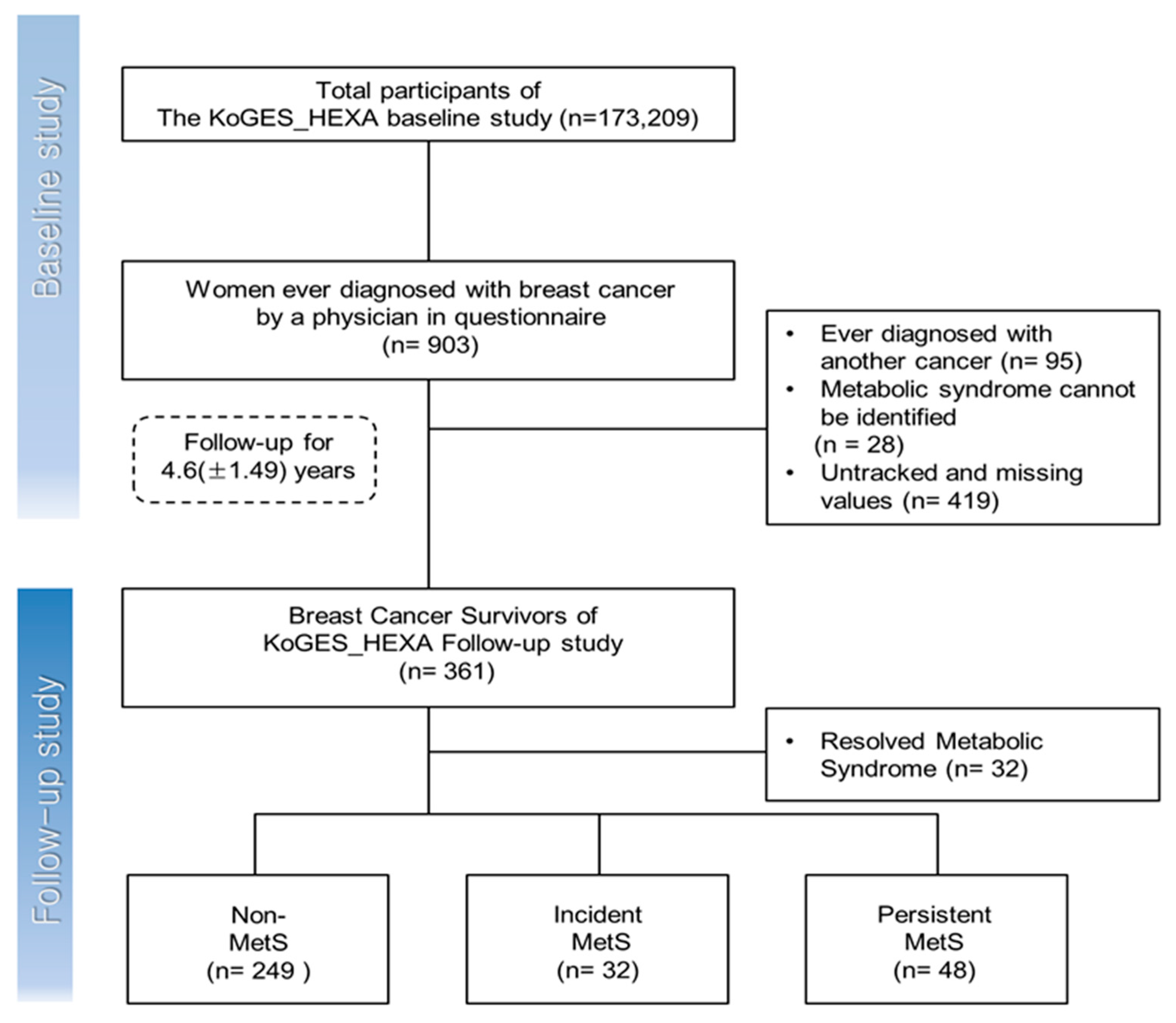
2.1. Study Population
2.2. Measurements
2.2.1. Demographic Characteristics
2.2.2. Health Behaviors and Characteristics
2.2.3. Metabolic Syndrome
2.3. Data Analysis
3. Results
3.1. Comparison of the Demographic Characteristics
3.2. Comparison of Health Behaviors and Characteristics
3.3. Factors Influencing Metabolic Syndrome
4. Discussion
5. Conclusions
Author Contributions
Funding
Conflicts of Interest
References
- Korea Central Cancer Registry: Annual Report of Cancer Statistics in Korea in 2016; National Cancer Center: Goyang, Korea, 2016. Available online: https://ncc.re.kr/cancerStatsView.ncc?bbsnum=478&searchKey=total&searchValue=&pageNum=1 (accessed on 20 August 2019).
- Oh, C.M.; Won, Y.J.; Jung, K.W.; Kong, H.J.; Cho, H.; Lee, J.K.; Lee, D.H.; Lee, K.H. Cancer statistics in Korea: Incidence, mortality, survival and prevalence in 2013. Cancer Res. Treat. 2016, 48, 436–450. [Google Scholar] [CrossRef] [Scilit] [PubMed]
- Lee, J.A.; Yu, J.H.; Song, Y.M. Management of long-term breast cancer survivors in Korea. J. Korean Med. Assoc. 2016, 59, 266–275. [Google Scholar] [CrossRef] [Scilit]
- Hooning, M.J.; Botma, A.; Aleman, B.M.; Baaijens, M.H.; Bartelink, H.; Klijn, J.G.M.; Taylor, C.W.; Van Leeuwen, F.E. Long-term risk of cardiovascular disease in 10-year survivors of breast cancer. J. Natl. Cancer Inst. 2007, 99, 365–375. [Google Scholar] [CrossRef] [Scilit] [PubMed]
- Bradshaw, P.T.; Stevens, J.; Khankari, N.; Teitelbaum, S.L.; Neugut, A.I.; Gammon, M.D. Cardiovascular disease mortality among breast cancer survivors. Epidemiology 2016, 27, 6–13. [Google Scholar] [CrossRef] [Scilit]
- Patnaik, J.L.; Byers, T.; DiGuiseppi, C.; Dabelea, D.; Denberg, T.D. Cardiovascular disease competes with breast cancer as the leading cause of death for older females diagnosed with breast cancer: A retrospective cohort study. Breast Cancer Res. 2011, 13, 64. [Google Scholar] [CrossRef] [Scilit]
- Park, S.H.; Lee, S.J.; Kim, Y.R.; Lee, Y.H.; Kang, M.W.; Han, K.D.; Han, S.S.; Lee, H.; Lee, J.P.; Joo, K.W.; et al. Altered risk for cardiovascular events with changes in the metabolic syndrome status. Ann. Intern. Med. 2019, 171, 875–884. [Google Scholar] [CrossRef] [Scilit]
- Park, B.Y.; Kong, S.Y.; Lee, E.K.; Lee, M.H.; Lee, E.S. Metabolic syndrome in breast cancer survivors with high carbohydrate consumption. Clin. Nutr. 2017, 36, 1372–1377. [Google Scholar] [CrossRef] [Scilit]
- Buttros Dde, A.; Nahas, E.A.; Vespoli Hde, L.; Uemura, G.; de Almeida Bda, R.; Nahas-Neto, J. Risk of metabolic syndrome in postmenopausal breast cancer survivors. Menopause 2013, 20, 448–454. [Google Scholar] [CrossRef] [Scilit]
- Berrino, F.; Villarini, A.; Traina, A.; Bonanni, B.; Panico, S.; Mano, M.P.; Mercandino, A.; Galasso, R.; Barbero, M.; Simeoni, M.; et al. Metabolic syndrome and breast cancer prognosis. Breast Cancer Res. Treat. 2014, 147, 159–165. [Google Scholar] [CrossRef] [Scilit]
- Zamorano, J.L.; Lancellotti, P.; Rodriguez Muñoz, D.; Aboyans, V.; Asteggiano, R.; Galderisi, M.; Habib, G.; Lenihan, D.J.; Lip, G.Y.H.; Lyon, A.R.; et al. 2016 ESC position paper on cancer treatments and cardiovascular toxicity developed under the auspices of the ESC committee for practice guidelines: The task force for cancer treatments and cardiovascular toxicity of the European Society of Cardiology (ESC). Eur. Heart J. 2016, 37, 2768–2801. [Google Scholar] [CrossRef] [Scilit]
- Carr, M.C. The emergence of the metabolic syndrome with menopause. J. Clin. Endocrinol. Metab. 2003, 88, 2404–2411. [Google Scholar] [CrossRef] [Scilit] [PubMed]
- Lipscombe, L.L.; Chan, W.W.; Yun, L.; Austin, P.C.; Anderson, G.M.; Rochon, P.A. Incidence of diabetes among postmenopausal breast cancer survivors. Diabetologia 2013, 56, 476–483. [Google Scholar] [CrossRef] [Scilit]
- Li, C.I.; Daling, J.R.; Porter, P.L.; Tang, M.T.; Malone, K.E. Relationship between potentially modifiable lifestyle factors and risk of second primary contralateral breast cancer among women diagnosed with estrogen receptor-positive invasive breast cancer. J. Clin. Oncol. 2009, 27, 5312–5318. [Google Scholar] [CrossRef] [Scilit] [PubMed]
- Lee, J.A.; Yoo, J.E.; Park, H.S. Metabolic syndrome and incidence of breast cancer in middle-aged Korean women: A nationwide cohort study. Breast Cancer Res. Treat. 2017, 162, 389–393. [Google Scholar] [CrossRef] [Scilit] [PubMed]
- Defining Cancer Survivorship; National Coalition for Cancer Survivorship: Silver Spring, MD, USA, 1985. Available online: https://www.canceradvocacy.org/news/defining-cancer-survivorship/ (accessed on 24 July 2014).
- Chang, S.J. Standardization of Collection and Measurement of Health Statistics Data; The Korean Society for Preventive Medicine: Seoul, Korea, 2000; pp. 92–143. [Google Scholar]
- Grundy, S.M.; Cleeman, J.I.; Daniels, S.R.; Donato, K.A.; Eckel, R.H.; Franklin, B.A.; Gordon, D.J.; Krauss, R.M.; Savage, P.J.; Smith, S.C.; et al. Diagnosis and Management of the Metabolic Syndrome: An American Heart Association/National Heart, Lung, and Blood Institute Scientific Statement. Circulation 2005, 112, 2735–2752. [Google Scholar] [CrossRef] [Scilit] [PubMed]
- World Health Organization. The Asia-Pacific Perspective: Redefining Obesity and Its Treatment; International Obesity Taskforce: Manila, The Philippines, 2000. [Google Scholar]
- Calip, G.S.; Malone, K.E.; Gralow, J.R.; Stergachis, A.; Hubbard, R.A.; Boudreau, D.M. Metabolic syndrome and outcomes following early-stage breast cancer. Breast Cancer Res. Treat. 2014, 148, 363–377. [Google Scholar] [CrossRef] [Scilit] [PubMed]
- Amiri, P.; Hosseinpanah, F.; Jalali-Farahani, S.; Mehrabi, Y.; Montazeri, A.; Azizi, F. Is persistence of metabolic syndrome associated with poor health-related quality of life in non diabetic Iranian adults? Tehran Lipid and Glucose Study. J. Diabetes Investig. 2014, 5, 687–693. [Google Scholar] [CrossRef] [Scilit] [PubMed]
- Lee, J.Y.; Park, N.H.; Song, Y.S.; Park, S.M.; Lee, H.W.; Kim, K.H.; Choi, K.H. Prevalence of the metabolic syndrome and associated factors in Korean cancer survivors. Asian Pac. J. Cancer Prev. 2013, 14, 1773–1780. [Google Scholar] [CrossRef] [Scilit] [PubMed]
- Seo, J.M.; Lim, N.K.; Lim, J.Y.; Park, H.Y. Gender difference in association with socioeconomic status and incidence of metabolic syndrome in Korean adults. Korean J. Obes. 2016, 25, 249. [Google Scholar] [CrossRef] [Scilit]
- Oh, M.J.; Kim, Y.J.; Lee, J.G.; Yi, Y.H.; Tak, Y.J.; Hwang, H.R.; Lee, S.H. The health behavior and status according to household income level in Korean women aged 35 years or older: The 2013 National Health and Nutrition Examination Survey. Korean J. Health Promot. 2017, 17, 20–30. [Google Scholar] [CrossRef] [Scilit]
- Darmon, N.; Briend, A.; Drewnowski, A. Energy-dense diets are associated with lower diet costs: A community study of French adults. Public Health Nutr. 2004, 7, 21–27. [Google Scholar] [CrossRef] [Scilit] [PubMed]
- Kim, S.H.; Choi, H.S.; Ji, S.H.; Park, Y.M.; Cho, K.H. The relationship of the prevalence metabolic syndrome and the difference of life style in Korean adult. Korean J. Fam. Pract. 2015, 5 (Suppl. 3), 500–509. [Google Scholar]
- Van Gaal, L.F.; Mertens, I.L.; De Block, C.E. Mechanisms linking obesity with cardiovascular disease. Nature 2006, 14. [Google Scholar] [CrossRef] [Scilit] [PubMed]
- Kwan, M.L.; Chen, W.Y.; Kroenke, C.H.; Weltzien, E.K.; Beasley, J.M.; Nechuta, S.J.; Poole, E.M.; Lu, W.; Holmes, M.D.; Quesenberry, C.P.; et al. Pre-Diagnosis Body Mass Index and Survival after Breast Cancer in the after Breast Cancer Pooling Project. Breast Cancer Res. Treat. 2012, 132, 729–739. [Google Scholar] [CrossRef] [Scilit] [PubMed]
- Sun, L.; Zhu, Y.; Qian, Q.; Tang, L. Body mass index and prognosis of breast cancer: An analysis by menstruation status when breast cancer diagnosis. Medicine 2018, 97, e11220. [Google Scholar] [CrossRef] [Scilit] [PubMed]
- Winkels, R.M.; Sturgeon, K.M.; Kallan, M.J.; Dean, L.T.; Zhang, Z.; Evangelisti, M.; Brown, J.C.; Sarwer, D.B.; Troxel, A.B.; Denlinger, C.; et al. The women in steady exercise research (WISER) survivor trial: The innovative transdisciplinary design of a randomized controlled trial of exercise and weight-loss interventions among breast cancer survivors with lymphedema. Contemp. Clin. Trials 2017, 61, 63–72. [Google Scholar] [CrossRef] [Scilit]
- Dietary Reference Intakes for Koreans 2015; Ministry of Health and Welfare, The Korean Nutrition Society: Sejong, Korea, 2015. Available online: http://www.kns.or.kr/FileRoom/FileRoom_view.asp?idx=79&BoardID=Kdr (accessed on 18 January 2016).

| Variables | Non-MetS (n = 249) M ± SD or n (%) | Onset MetS (n = 32) M ± SD or n (%) | Persistent MetS (n = 48) M ± SD or n (%) | F or χ2 | p |
|---|---|---|---|---|---|
| Age (yr) | 52.8 ± 6.82 | 54.8 ± 6.22 | 57.5 ± 6.87 | 11.31 | <001 |
| 40–49 | 81 (87.1) | 7 (7.5) | 5 (5.4) | 21.36 | <001 |
| 50–59 | 129 (75.9) | 18 (10.6) | 23 (13.5) | ||
| ≥60 | 39 (59.1) | 7 (10.6) | 20 (30.3) | ||
| Menopausal status | |||||
| Postmenopause | 196 (73.1) | 26 (9.7) | 46 (17.2) | 7.81 | 0.020 |
| Premenopause | 53 (86.9) | 6 (9.8) | 2 (3.3) | ||
| Education (yr) | |||||
| ≤12 | 166 (70.6) | 27 (11.5) | 42 (17.9) | 8.75 | 0.013 |
| >12 | 68 (87.2) | 5 (6.4) | 5 (6.4) | ||
| Income ($) | |||||
| <2000 | 75 (67.0) | 15 (13.4) | 22 (19.6) | 7.03 | 0.030 |
| ≥2000 | 174 (80.2) | 17 (7.8) | 26 (12.0) | ||
| After diagnosis (yr) | |||||
| <5 | 132 (79.0) | 17 (10.2) | 18 (10.8) | 5.23 | 0.264 |
| 5–9 | 67 (76.1) | 7 (8.0) | 14 (15.9) | ||
| ≥10 | 48 (67.6) | 8 (11.3) | 15 (21.1) |
| Variables | Non-MetS M ± SD or n (%) | Onset MetS M ± SD or n (%) | Persistent MetS M ± SD or n (%) | χ2 | p |
|---|---|---|---|---|---|
| Drinking status | |||||
| Never or Past | 212 (75.7) | 24 (8.6) | 44 (15.7) | 4.28 | 0.118 |
| Current | 36 (75.0) | 8 (16.7) | 4 (8.3) | ||
| Exercise | |||||
| Regularly | 116 (74.8) | 15 (9.7) | 24 (15.5) | 0.19 | 0.910 |
| Irregularly | 133 (76.4) | 17 (9.8) | 24 (13.8) | ||
| Carbohydrate intake | |||||
| 25–75% | 129 (78.2) | 13 (7.9) | 23 (13.9) | 1.40 | 0.497 |
| 75–100% | 117 (73.1) | 18 (11.3) | 25 (15.6) | ||
| Stress score | |||||
| <27 | 217 (76.7) | 26 (9.2) | 40 (14.1) | 1.50 | 0.472 |
| ≥27 | 25 (67.6) | 5 (13.5) | 7 (18.9) | ||
| Body mass index | 22.66 ± 2.37 | 24.31 ± 2.75 | 26.61 ± 3.75 | 47.06 | <001 |
| <23 kg/m2 | 153 (89.0) | 12 (7.0) | 7 (4.0) | 64.54 | <001 |
| 23–24.9 kg/m2 | 61 (76.3) | 9 (11.2) | 10 (12.5) | ||
| ≥25 kg/m2 | 35 (45.5) | 11 (14.3) | 31 (40.2) |
| Variables | Onset MetS | Persistent MetS | ||
|---|---|---|---|---|
| aOR (95% CI) | p | aOR (95% CI) | p | |
| Age (yr) | ||||
| ≥60 | 1.57 (0.43–5.75) | 0.491 | 4.27 (1.10–16.62) | 0.037 |
| 50–59 | 1.44 (0.49–4.23) | 0.505 | 1.67 (0.47–6.00) | 0.428 |
| 40–49 | 1 | 1 | ||
| Menopausal status | ||||
| Postmenopause | 0.87 (0.28–2.70) | 0.815 | 4.03 (0.77–21.09) | 0.098 |
| Premenopause | 1 | 1 | ||
| Education (yr) | ||||
| >12 | 0.64 (0.22–1.81) | 0.397 | 0.42 (0.13–1.38) | 0.153 |
| ≤12 | 1 | 1 | ||
| Income ($) | ||||
| <2000 | 1.45 (0.65–3.26) | 0.364 | 0.96 (0.44–2.06) | 0.911 |
| ≥2000 | 1 | 1 | ||
| Body mass index | ||||
| ≥25 kg/m2 | 3.33 (1.32–8.43) | 0.011 | 16.34 (6.35–42.06) | <001 |
| 23–24.9 kg/m2 | 1.66 (0.66–4.19) | 0.284 | 2.61 (0.90–7.53) | 0.077 |
| <23 kg/m2 | 1 | 1 | ||
© 2020 by the authors. Licensee MDPI, Basel, Switzerland. This article is an open access article distributed under the terms and conditions of the Creative Commons Attribution (CC BY) license (http://creativecommons.org/licenses/by/4.0/).
Share and Cite
Maeng, S.; Yu, J. Factors Affecting Onset and Persistence of Metabolic Syndrome in Korean Breast Cancer Survivors: A Prospective Study. Int. J. Environ. Res. Public Health 2020, 17, 6814. https://doi.org/10.3390/ijerph17186814
Maeng S, Yu J. Factors Affecting Onset and Persistence of Metabolic Syndrome in Korean Breast Cancer Survivors: A Prospective Study. International Journal of Environmental Research and Public Health. 2020; 17(18):6814. https://doi.org/10.3390/ijerph17186814
Chicago/Turabian StyleMaeng, Suyoun, and Jungok Yu. 2020. "Factors Affecting Onset and Persistence of Metabolic Syndrome in Korean Breast Cancer Survivors: A Prospective Study" International Journal of Environmental Research and Public Health 17, no. 18: 6814. https://doi.org/10.3390/ijerph17186814
APA StyleMaeng, S., & Yu, J. (2020). Factors Affecting Onset and Persistence of Metabolic Syndrome in Korean Breast Cancer Survivors: A Prospective Study. International Journal of Environmental Research and Public Health, 17(18), 6814. https://doi.org/10.3390/ijerph17186814

