


Abstract
The aim of this review is to evaluate the health and social effects of accessible home environments for people with functional limitations, in order to provide evidence to promote well-informed decision making for policy guideline development and choices about public health interventions. MEDLINE and nine other electronic databases were searched between December 2014 and January 2015, for articles published since 2004. All study types were included in this review. Two reviewers independently screened 12,544 record titles or titles and abstracts based on our pre-defined eligibility criteria. We identified 94 articles as potentially eligible; and assessed their full text. Included studies were critically appraised using the Mixed Method Appraisal Tool, version 2011. Fourteen studies were included in the review. We did not identify any meta-analysis or systematic review directly relevant to the question for this systematic review. A narrative approach was used to synthesise the findings of the included studies due to methodological and statistical heterogeneity. Results suggest that certain interventions to enhance the accessibility of homes can have positive health and social effects. Home environments that lack accessibility modifications appropriate to the needs of their users are likely to result in people with physical impairments becoming disabled at home.
1. Introduction
The United Nations Convention on the Rights of Persons with Disabilities, Article 9 safeguards the rights of persons with disabilities to live in an accessible physical environment, as well as the right to equal access to information and communications [1]. Among physical environments, there is little doubt that the accessible domestic home is fundamental to enabling independent living for persons with disabilities. Home environments without the basic accessibility components can negatively impact on the daily activities of persons with functional limitations. For instance, those dependent on mobility devices may be confined indoors, or even to very limited spaces within the dwelling; consequently violating their human rights and diminishing their quality of life. It is often assumed that persons with disabilities are a small proportion of the total population, but the World Report on Disability has estimated that more than a billion people, or 15% of the world’s population, have some form of disability [2].
The relationship between ageing and associated functional limitations is becoming increasingly important [3]. The increase in life expectancy over recent decades has resulted in an ageing population especially in high-income countries [4]. More than 20% of the world population is predicted to be aged 60 years or over by the year 2050, with the European region having the highest proportion at an estimated 37% [4]. However, some of the fastest rates of population ageing are now found in low- and middle-income countries [4]. Due to ageing related functional limitations, many older adults face the prospect of living with poor access to their own home environments; threatening their safety and undermining their quality of life. The majority of older adults wish to continue independent living in their own home [5]. However, they are often forced to move into institutional settings due to lack of accessibility to their home environments. Such institutional settings are associated with higher economic costs to both the individual and society in general [6].
According to the International Classification of Functioning (ICF), disability and health, disability is an umbrella term to indicate impairments in body functions and structures, limitations in activities or participation restrictions [7]. Environmental factors (physical, social and attitudinal) can be facilitators or barriers and will determine the level of disability experienced by a person [7]. Disability is not an attribute: it is the outcome of the interaction between bodily impairments and health conditions, and contextual factors (environmental and internal personal factors) [7]. How society is organised, for instance in terms of architectural accessibility, affects whether someone with impairments is “disabled”, or not.
Although the concept of functioning is broad and encompasses impairments, it is often operationalised in terms of whether a person can accomplish Activities of Daily Living (ADL) and Instrumental Activities of Daily Living (IADL) [8]. The term ADL applies to the basic tasks of everyday life, such as bathing, dressing, transferring, toileting and feeding [9,10]. While ADL are more related to personal self-care, IADL refer to a range of activities that are required for independent living in the community, such as preparing meals, housekeeping, taking medications, shopping, managing own finances, travelling and using the telephone [9,10].
It has been estimated that 60% of new houses in the USA are, at some point, likely to be resided in by a person with physical impairment [6]. According to the environmental docility hypothesis, persons with low functional capacity are more likely to be vulnerable concerning environmental demands than are those with higher functional capacity [11]. Therefore, a home without accessibility features creates further strain for persons with functional limitations, increasing their risk of falls and injuries as well as restricting their social participation [12]. Such environments also increase the burden on caregivers and external social services [12,13]. Whereas the built environment and its effects on health and wellbeing have been widely studied [14,15,16], there has been relatively little specific attention to the accessible home environment in the domestic context for persons with functional limitations.
There are various labels that are used for access or accessibility in relation to home environments [17]. For example, Universal Design is defined as the design, construction and adaptation of standard housing that can be used by all people regardless of their age, size or ability [17]. Life Span Housing refers to housing that can accommodate changing capabilities of a person over his/her lifetime, and is also known as Lifetime Homes in the UK and Adaptable Housing in Australia [17]. Enabling technologies for independent living by the elderly has become a new and essential approach, as known as Ambient Assisted Living [18]. For the purpose of this review, we defined the accessible home environment as one which allows a person with functional limitations to get into, out of, and circulate within the home, and to function independently.
Accessible homes can be purposely built or achieved through modifications, from which various groups of people can benefit: persons with ageing related functional limitations, those with other disabilities, as well as their caregivers and visitors. Furthermore, the importance of an accessible home environment is most likely to increase in coming years and decades because of the increasing prevalence of functional limitations in an ageing population. It is therefore important to evaluate the effects of homes that have accessibility features. This is the objective of the present systematic review. This systematic review is part of a programme of work conducted to support the development of the World Health Organization’s (WHO) Guidelines on Housing.
2. Methods
2.1. Eligibility Criteria
We addressed the research question using the following structure, which influenced the search strategies used in this review:
- Context: Domestic home in the community setting regardless of household tenure. Indoor and immediate outside of house, and public spaces and mutual corridors in the case of blocks of flats or buildings. Assisted living facilities, group homes and institutional settings were excluded.
- Participants: People of all ages who have functional limitations whether physical or cognitive. Frail older adults were included, given that “frail” indicates some forms of impairments. Older adults were excluded if no functional limitations were specified.
- Interventions: Those implemented in the physical environment of home building that were intended to enhance accessibility: modification of specific furniture and fixture, structural changes, affixed assistive device. Multicomponent interventions and other interventions, e.g., occupational programmes, were included if an accessibility component was incorporated.
- Comparisons: Groups living in accessible and conventional/unmodified home environments. Comparisons that assessed outcomes before and after an eligible intervention were included.
- Outcomes: Health or social related changes. Outcomes that were measured jointly regarding home accessibility features and participants’ health/social changes were excluded if they could not be disaggregated.
Searches were conducted in English but there was no language restriction for studies to be eligible. There was no restriction by study type in searching. We planned to limit ourselves to studies with a high level of evidence only if the number of such studies were sufficient for this review. The aim of searching was to identify individual studies and reviews of studies, published as journal articles, technical reports and accessible dissertations. Theoretical papers, commentaries, editorials and abstracts with no full paper were excluded. Book chapters, book reviews and conference proceedings were closely scrutinised as sources for potentially eligible studies.
2.2. Data Sources and Search Strategy
Tailored and sensitive search strategies were developed by the expert searcher in liaison with the research team. The search strategy for MEDLINE (Appendix A) was used as the basis for search strategies in the other databases: Cumulative Index of Nursing and Allied Health Literature, Cochrane Database of Systematic Reviews, Cochrane Central Register of Controlled Trials, Database of Abstracts of Reviews of Effects, Health Technology Assessment Database, Embase, OT Seeker, PsycINFO and National Health Service Economic Evaluation Database. Searches were performed from December 2014 to January 2015.
2.3. Study Selection
We originally carried out our electronic database searches without any restriction by publication year. However, due to the high number of retrieved records, the WHO Guideline Development Group later set the eligibility to publications to the last 10 years (since 2004), which was more feasible for our review in terms of time frame and budget. Duplicates of records were identified and removed within each database first. After the results from each database had been added to EndNote library, another round of de-duplication was carried out.
Two reviewers independently screened record titles or titles and abstracts based on the pre-defined eligibility criteria, using the EndNote library software programme. Where there was any disagreement or ambiguity, a third reviewer assessed the relevant records and consensus was reached between the three researchers. If it was unclear whether to include or exclude a study on the basis of its abstract, we retrieved its full text. Authors of papers were contacted when more information was required. We checked the reference lists of the included studies, and of systematic reviews that were excluded at the full text screening stage if they concerned home environmental interventions or home interventions on older adult populations.
2.4. Data Extraction and Critical Appraisal
After the full text screening process, necessary information was extracted by one reviewer from potentially eligible studies. This included study type, number of participants and their functional limitations, study inclusion and exclusion criteria, interventions and any comparators, outcome measures and results reported. A second reviewer checked data extracted, with any discrepancies resolved by a third reviewer. Potentially eligible studies were then discussed among all the researchers to agree on their relevance to the review.
One of the special characteristics of this review is that such a wide range of study designs were included: studies with no comparison group, correlation studies looking at the association between home accessibility features and outcomes, and mixed-method studies for which results are presented as qualitative themes. Therefore, we used the Mixed Method Appraisal Tool (MMAT), version 2011 to have coherence when assessing the quality of all included studies. The MMAT has been designed to appraise the methodological quality of studies included in complex systematic reviews that incorporate qualitative, quantitative and mixed-method studies [19,20]. The MMAT checklist has two initial screening questions and 19 components corresponding to qualitative research, randomised controlled trial (RCT), non-randomised studies, quantitative descriptive studies and mixed methods studies. It has a scoring metric whereby each study is scored between 1 as the lowest and 4 as the highest quality.
The Evidence Profile was completed using all the information extracted and data from the quality assessment. The summary of findings table was also prepared to identify the effects of interventions for each outcome. All the researchers reviewed and discussed the quality assessment results, the evidence table and summary of findings, easily reaching consensus.
3. Results
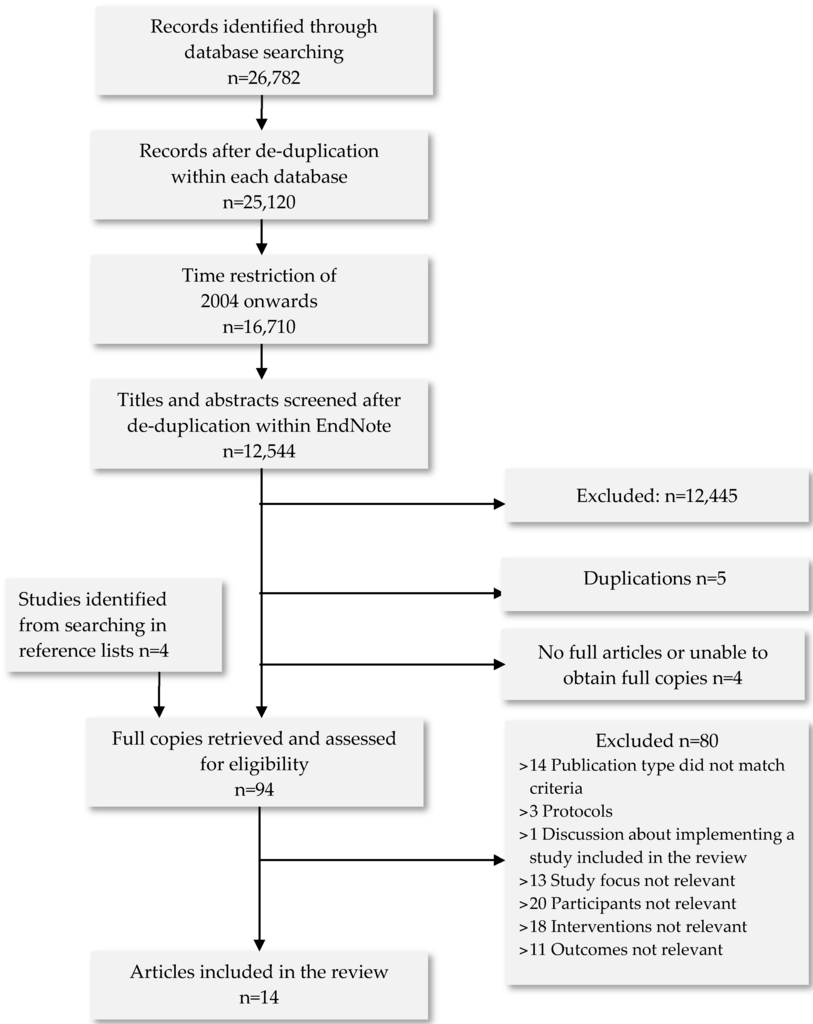
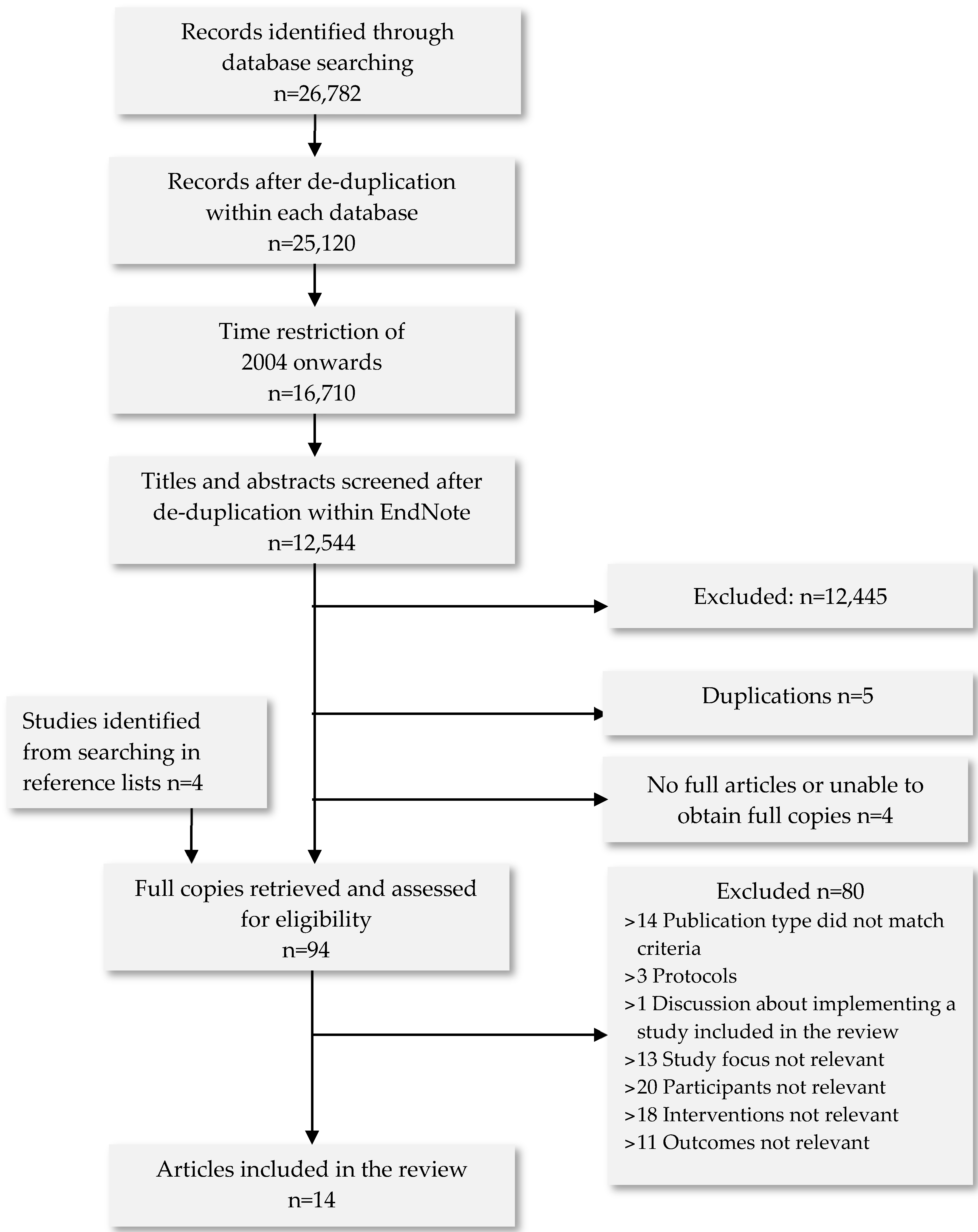
Initially, 26,782 records were identified without any time restriction. After removing records that were published before 2004 and de-duplications, 12,544 records were identified. After titles or titles and abstracts screening, we identified 99 records eligible for the full text screening. Snowballing was also performed and as a result we identified 4 more citations by checking reference lists. Of 103 studies, 5 studies were found to be duplications and 4 with no full articles or unable to obtain full copies. A total of 94 articles were judged to be potentially eligible and therefore we assessed their full text, leading to the exclusion of 80 articles. We did not identify any meta-analysis or systematic review directly relevant to the research question. All researchers agreed on the eligibility of the remaining 14 papers. Figure 1 shows the flow diagram for the identification of studies for this review.
Figure 1.
Flow diagram for the identification of eligible studies. (Only one reason is given per excluded study although in many cases reasons for exclusion were more than singular.)
We included all study types in this review as a small number of studies were identified. Table 1 provides a brief presentation of included studies. Full details of characteristics of included studies and their quality assessments are in Appendix B.
Table 1.
Studies included in the review.
3.1. Participants
The majority of study participants were elderly population over 70-year old, although inclusion criteria for age groups varied with one study including children [29]. In terms of functional limitations, all study participants had physical impairments except one cross-sectional study that had participants with cognitive impairments [28]. While some studies reported participants with specific functional limitations (such as paraplegia and visual impairments), the majority used diverse terms for and definitions of functional limitations (see Table 2).
Table 2.
Descriptions of functional limitations in studies included.
3.2. Interventions and Home Accessibility Features
Interventions implemented to enhance home accessibility features were home modifications, described as housing adaptations or home safety programmes in some studies. Home modifications were carried out either as a sole intervention [21,22,24,29,30,31,32] or part of a multicomponent programme [25,26,27,34]. Furthermore, the safety component of these, such as hazard reduction, tended to be integrated with the accessibility interventions. Home modifications were mainly focused on architectural changes or fitted devices such as grab bars, targeting mobility issues; a few focused on lighting improvements or adjustments targeting vision. One cohort study had a distinctive intervention which consisted of the installation of a light path near the bed, coupled with tele-assistance: this aimed to reduce falls at night among frail older adults [34]. One randomised trial used a factorial design to evaluate the effect of each intervention, and possible interactions between interventions: home safety programmes; exercise programme; and social visits [23]. Two cross-sectional studies reported the association between accessible home environments and ADL or quality of life [28,33]. Table 3 provides descriptions of accessibility features identified from each included study.
Table 3.
Descriptions of accessibility features in each study included.
3.3. Effects of Interventions on Outcomes
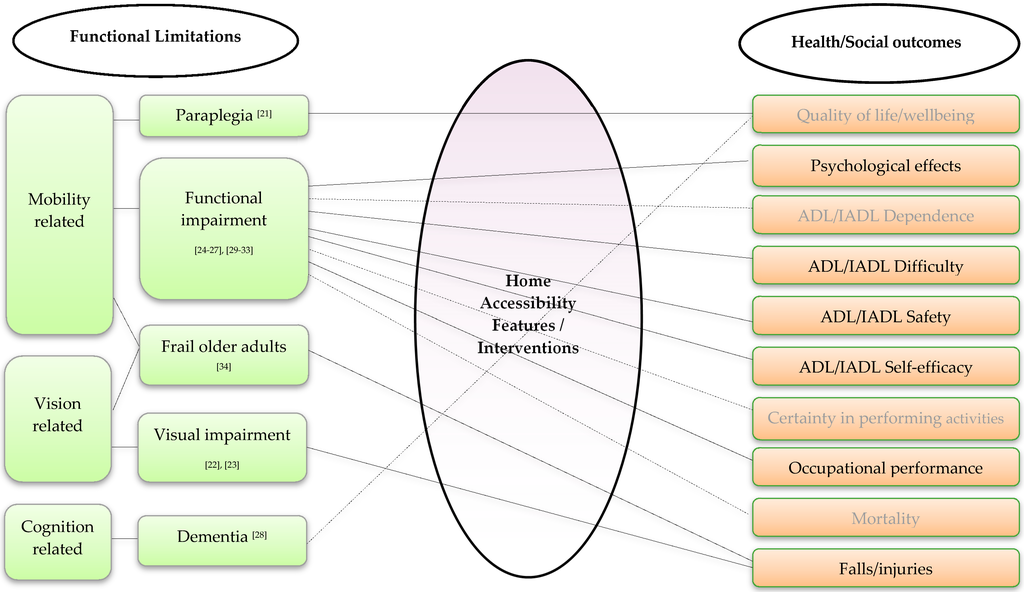
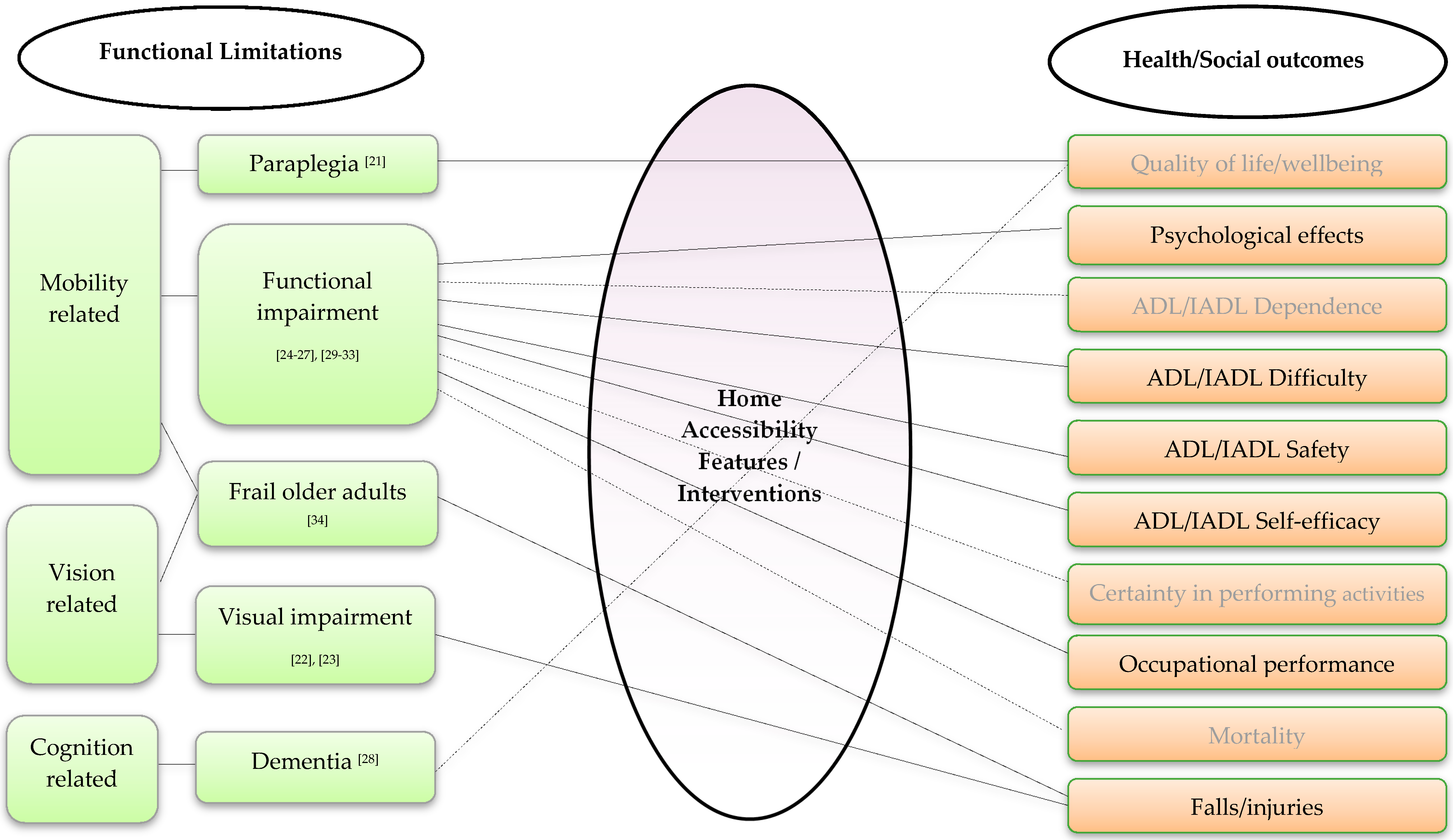
Six different outcomes of home accessibility interventions were identified. The most common outcomes measured were those related to changes in ADL/IADL. Some outcomes were directly related to physical health, such as falls and mortality, and some were related to quality of life and psychological health. Occupational performance was also reported as an outcome of home modifications [32]. All the outcomes were collected via self-report, except mortality that was sourced from the National Death Index [26,27], and fall induced serious injuries which were collected from hospital and general practice records [23]. As will be discussed, Figure 2 schematically illustrates associations between functional limitations categorised into groups (mobility, vision and cognition related) and effects of home accessibility features or interventions on ADL/IADL, occupational performance, falls, mortality, quality of life and psychological health.
Figure 2.
Associations between functional limitations, home accessibility features and outcomes (…. represents no significant or inconsistent associations/effects).
3.4. Activities of Daily Living
Five studies reported the effects on ADL/IADL related outcomes [22,24,30,31]. In addition, one population-based survey study identified a strong association (odds ratio 3.7, 95% confidence interval, 2.9–4.6) between self-recognised difficulty managing ADL and perceived unmet needs for home accessibility features among people with activity limitations, after adjusting for severity of their limitations [33]. Large decreases in perceived difficulties performing ADL/IADL were identified after home modifications and the multicomponent programme [25,30,31], whereas difficulty with mobility/transfer did not significantly change [25]. Several other aspects in performing ADL/IADL were also reported: safety, dependence, self-efficacy and certainty. Self-efficacy, which was defined as confidence in managing difficulty, was improved in the intervention group after the multicomponent programme among older adults with functional limitations [25]. Increased safety with ADL/IADL was also identified two months after home modifications among adults with functional limitations [30]. In particular, the greatest benefits were in relation to difficulty and safety in bathroom use and entry access [30]. Gitlin 2006a also found that the greatest benefit was in bathing and toileting [25].
On the other hand, two studies found no significant change in dependence with ADL/IADL at 2 months and up to 8–9 months after home modifications [24,30]. However, it was noted that dependence in bathing was significantly decreased between 2–3 months and 8–9 months after home modifications [24]. Furthermore, one randomised trial did not identify a significant improvement overall in self-rated certainty in performing specific activities 6 months after lighting adjustments [22]. Certainty in performing activities of “pour drink“ and “slice bread“ on the working surface of the kitchen were the only ones that improved significantly 6 months after the intervention.
3.5. Falls/Injuries and Mortality
Two studies reported on reductions in the likelihood of falls and injuries [23,34]. One randomised trial reported 41% fewer falls by one year follow-up in the home safety programme with a group of older adults with severe visual impairments, compared with those who did not receive this programme [23]. Also, Tchalla 2012 identified a significant reduction in falls at home and post-fall hospitalisations among frail older adults after the use of a light path coupled with tele-assistance [34]. Two studies reported a significantly lower mortality rate at up to 2 years in the intervention group over the control group, after the implementation of the multicomponent programme, which included home modifications as well as training control-oriented strategies to promote healthy behaviours [26,27]. However, there was no statistically significant effect on survival at 3 years post intervention.
3.6. Quality of Life
Two randomised trials found a positive effect of interventions on quality of life [21,22]. Ahmed 2013 found that quality of life was significantly enhanced in the intervention group, compared to the control group, 2 months after home modifications among paraplegic wheelchair users [21]. Also, additional lighting adjustments in the living room increased quality of life and wellbeing among adults with low vision [22]. Conversely, a cross-sectional study found no associations between quality of life, and home safety and accessibility factors such as hazards, grab bars and visual cues among adults with dementia [28].
3.7. Psychological Effects
Psychological effects of home accessibility interventions were identified. For instance, older adults with functional difficulties reported less fear of falling following multicomponent home intervention [25]. One mixed-method study, which presented findings as themes from the qualitative part of the study, also identified a reduced fear of accidents: 62% of the recipients of minor adaptations (mainly handrails and grab-rails) reported “feeling safer from accidents”, and recipients of major adaptations also expressed the relief of feeling safer [29]. In addition, “ending depression” was identified in the theme of health gains from good quality adaptations for people with physical impairments.
3.8. Occupational Performance
A significant increase in self-perceived occupational performance up to 6 months after home modifications among low-income adults with functional limitations was reported [32]. The outcome measurement included self-care (personal care, functional mobility and community management), productivity in work, household and play/school, and leisure (quiet recreation, active recreation and socialisation) [35].
4. Discussion
Studies included in this review differ greatly in terms of study designs, participants, interventions and outcomes. Although the majority of the studies’ participants were from the elderly population over 70-year old, the type, definition and level of functional limitations varied. Elements of interventions were remarkably diverse. Despite the fact that mobility related modifications were the most common, some home modifications also included heating or lighting. In addition, it is not clear if the effect of the multicomponent intervention was directly from the accessibility component, and which part of the intervention was more effective. Numerous psychometric instruments were used to measure the same outcomes, such as quality of life and changes in ADL/IADL. This methodological and statistical heterogeneity meant that we adopted a narrative approach to synthesise the findings, rather than performing a meta-analysis.
We found evidence for the positive effect of accessible home environments among people with functional limitations either ageing related or from other causes in this systematic review. Although it contains studies with a low level of quality of evidence, gathering and synthesising the existing evidence will help to guide further research and develop guidelines based on the best evidence available. Overall findings of this review suggest that, in general, people with functional limitations living in accessible home environments have better health, wellbeing and ADL/IADL than those living in conventional or inaccessible home environments. Physical health benefits were identified, such as reductions in falls and injuries. Lower mortality rates were also identified among older adults with functional limitations up to two years after a multicomponent home intervention. Self-perceptions of increased quality of life and general wellbeing were found, along with psychological effects such as reduced fear of falling/accidents and feeling of depression. As fear of falling is known to be a strong risk factor for functional decline and falls [25] this reduction in fear is also an important finding. Furthermore, home modifications decreased difficulties and increased safety and self-efficacy in ADL/IADL outcome measures [25,30,31]. This suggests that people who already have difficulties functioning in everyday life can benefit from home accessibility features, possibly delaying deterioration of their already limited functions.
We did not identify any study reporting the effects of the interventions on dependency on external social care services. Instead, most outcomes were elements in performing ADL/IADL. It seems that longitudinally, improvements in managing ADL/IADL, such as safety, may delay people with impairments being reliant on caregivers or social services. Also, social participation was not directly measured as an outcome in any study. Nevertheless, some psychometric instruments used in the included studies contain rather broad components. For example, occupational performance was reported in one study [32] in terms of performance, and satisfaction with performance in work and leisure. Also, the Client-Clinician Assessment Protocol Part 1, which was used in two studies [30,31], contains a leisure and social activities component, although the remainder is related to ADL, IADL and mobility.
It is noticeable that two studies found no significant change in perceived dependence with ADL/IADL after home modifications [24,30]. This is important because one reason for providing interventions that enhance home accessibility features is to increase the functional independence of people with impairments. However, the participants in both of these studies were aging populations thus their functions may rapidly decline, which means specific home modifications might have an effect for a short period of time only [36]. Furthermore, the primary goal of home modifications for older adults with impairments may be to enable them to live in their own home, rather than increasing their independence per se [30].
Several studies indicated that people with functional limitations received the greatest benefits from interventions in terms of bathroom use, such as bathing, showering and toileting [24,25,30]. This may be because half of ADL tasks focus on the bathroom; and a large number of home adaptations have targeted hygiene facilities [24]. Nonetheless, this is an important finding because it can inform planning for home modifications for people with impairments. Furthermore, Heywood 2004 identified that home modifications that were inadequately implemented due to bad planning or administrative errors, actually had a negative impact on physical and mental health of persons with functional limitations [29]. This indicates that home modification planning should consult with service users as well as health and architectural professionals.
Our search strategy was not restricted to any type of functional limitations but all included studies, except one, were with participants who had physical impairments. During our screening process, it was clear that studies on home environments for people with cognitive impairments were concerned with other environmental matters, such as ‘the creation of safe and secure, simple and well-structured, and familiar environments’ for older adults with dementia [37]. Nevertheless, some of those environmental factors may not necessarily be related to their quality of life: no association was found between patient-perceived quality of life and home accessibility and safety factors among adults with dementia [28]. Instead, having more unmet assistive device/navigation needs and health conditions were associated with lower quality of life [28].
We conducted this systematic review to gather evidence on the effects of the accessible home environment for people with functional limitations, but the findings reach beyond this group. Benefits of accessibility features in the home environments were also apparent for caregivers and family members, who gained positive health impacts, such as greater safety, and prevention of falls and injuries [29]. Furthermore, it is clear that a second person—usually also an older adult—in the household would also use the accessibility features, such as rails or shower [29]. From a population health perspective, this indicates that providing home accessibility interventions may have additional benefits for others; preventing the development of more severe functional limitations, enhancing quality of life and lowering the costs of healthcare. The results of our review are clearly relevant to the ICF framework, given the emphases on the interaction between personal, technological and environmental factors. Furthermore, the results are applicable to the WHO World report on ageing and health, providing evidence that environmental accessibility and safety enable greater functioning in older people [38].
Study Limitations
There are methodological limitations in the studies included in this review. First, this systematic review included a relatively small number of papers with relatively small sample sizes; making it unfeasible to draw generalised conclusions. Furthermore, the quality of the evidence compiled in this review is quite uneven. Non-randomised studies were included and only four randomised trials of good quality were identified. However, there might be ethical challenges in randomising persons to not receive an intervention or to delay its implementation if there is insufficient uncertainty about the potential benefits of the intervention. It is also important to note that most of the studies included in this review were conducted in the USA and Sweden. While there is no comprehensive national programme and only a few local programmes for home modifications in the USA [17], every local authority in Sweden has to provide home modifications for people with impairments by law [30]. Therefore, the country and systems context in which interventions are evaluated may be quite different, making it impossible to have a control group of people if they have been scheduled for home modifications.
A further limitation is that most of the outcomes in the included studies were subjective self-reports (e.g., ADL/IADL), not objective performance-based measures. However, self-rated function has been found to be useful in clinical assessment as it is predictive of broader health outcomes [39]. In addition, although outcomes are grouped in categories for the reason of convenience, it is important to acknowledge that ADL/IADL related outcomes—such as safety and self-efficacy—are not completely distinct from the psychological effects identified. There are also reliability and validity concerns with some of the psychometric instruments used for ADL/IADL related outcomes, as noted in several papers [22,30,31]. Finally, while the technology used to allow home improvements clearly has some psychologically beneficial effects, related areas have found that the use of assistive technologies, for instance, can present challenging issues concerning user’s self-identity—as being “disabled”—both in terms of how people think about themselves and their own bodily self-image [40,41]. Further exploration of these issues in the context of home improvements may also be worthwhile.
5. Conclusions
Home environments that lack accessibility modifications appropriate to the needs of their users are likely to result in people with functional limitations becoming disabled at home. The increasingly aging population means that this is a major concern and also related to the fundamental rights of persons with disabilities. Our systematic review indicates that, in general, interventions to enhance the accessibility of homes can have positive effects. However, currently available research is not robust as a body of evidence and should be considered as providing some support for this finding, albeit with some exceptions. Future research may need to be more specific about type of functional limitations, because different accessibility features may apply to mobility or cognitive impairments for instance. As researchers cannot entirely control the home modification process, it is problematic to conduct controlled studies in the home environment. However, high-quality research is needed, especially longitudinal studies, using standardised outcome measurements, to obtain a stronger evidence base for the benefits of home accessibility interventions. As it is unlikely that improvements to accessibility in the home will be instigated one modification at a time, researchers need to develop more sophisticated designs and analyses in order to partial out the effects of multiple interventions in different types of settings, and health and welfare systems.
Acknowledgments
We thank Kath Wright, expert searcher, from the Centre for Reviews & Dissemination, University of York, UK, who designed and refined the search strategies. We also thank the World Health Organization for funding this research, Susan Stark from Washington University, USA for her advice; and reviewers of this paper for helpful comments.
Author Contributions
All authors contributed to designing the research. Hea Young Cho conducted the article screening, study appraisal, data extraction and preparation of the manuscript, which was supervised and finalized by Malcolm MacLachlan. Michael Clarke contributed as the method expert and independently screened the records. Hasheem Mannan reviewed the data extracted and quality assessments of the studies. All authors edited and approved the final manuscript.
Conflicts of Interest
The authors declare no conflict of interest.
Appendix A. Search Strategy for Ovid MEDLINE
In-Process & Other Non-Indexed Citations and Ovid MEDLINE(R) <1946 to Present>, Search date: 22 December 2014, Records identified: 6829 (5635 after de-duplication)
- exp Disabled Persons/ (48958)
- exp housing/ (26214)
- 1 and 2 (426)
- (home or homes or house or houses or housing or residen$ or built environment or living environment).ti. (111898)
- 1 and 4 (1382)
- architectural accessibility/or “Facility Design and Construction”/or residence characteristics/or environment design/ (34524)
- 1 and 6 (1156)
- ((home or homes or house$ or housing or residen$) adj2 (adapt$ or modif$ or access$ or usability)).ti,ab. (2117)
- (smart home$ or smart home technolog$).ti,ab. (193)
- (assistive technolog$ and (home or homes or house or houses or housing or residence$ or built environment$ or living situation)).ti,ab. (163)
- environmental barrier$.ti,ab. (430)
- universal design.ti,ab. (148)
- (disability or disabled or handicap$).ti,ab. (129312)
- 2 and 13 (410)
- ((disability or disabled or handicap$ or frail$) adj2 (home or homes or house or houses or housing or residen$ or environment)).ti,ab. (592)
- (home environment$ adj2 intervention$).ti,ab. (15)
- (environment$ intervention$ adj2 home$).ti,ab. (26)
- person environment$ fit.ti,ab. (139)
- person-environment$ fit.ti,ab. (139)
- person environment$-fit.ti,ab. (139)
- person-environment$-fit.ti,ab. (139)
- (home or homes or house or houses or housing or residen$ or built environment or living environment).ti,ab. (378471)
- (functional$ adj (handicap$ or impair$ or limit$ or decline$ or deficit$ or disable$ or disability)).ti,ab. (28806)
- (cognitive$ adj (handicap$ or impair$ or limit$ or decline$ or deficit$ or disable$ or disability)).ti,ab. (57923)
- (mental$ adj (handicap$ or impair$ or limit$ or decline$ or deficit$ or disable$ or disability)).ti,ab. (5162)
- (physical$ adj (handicap$ or impair$ or limit$ or decline$ or deficit$ or disable$ or disability)).ti,ab. (8385)
- (motor adj (handicap$ or impair$ or limit$ or decline$ or deficit$ or disable$ or disability)).ti,ab. (11157)
- (hearing adj (reduc$ or loss or handicap$ or impair$ or limit$ or decline$ or deficit$ or disable$ or disability)).ti,ab. (39532)
- ((vision or visual or sight) adj (reduc$ or loss or handicap$ or impair$ or limit$ or decline$ or deficit$ or disable$ or disability)).ti,ab. (21276)
- (blind or deaf or frail$).ti,ab. (173515)
- wheelchair user$.ti,ab. (856)
- amputee$.ti,ab. (4124)
- 23 or 24 or 25 or 26 or 27 or 28 or 29 or 30 or 31 or 32 (338691)
- 2 and 33 (331)
- (((functional$ adj (handicap$ or impair$ or limit$ or decline$ or deficit$ or disable$ or disability)) or (cognitive$ adj (handicap$ or impair$ or limit$ or decline$ or deficit$ or disable$ or disability)) or (mental$ adj (handicap$ or impair$ or limit$ or decline$ or deficit$ or disable$ or disability)) or (physical$ adj (handicap$ or impair$ or limit$ or decline$ or deficit$ or disable$ or disability)) or (motor adj (handicap$ or impair$ or limit$ or decline$ or deficit$ or disable$ or disability)) or (hearing adj (reduc$ or loss or handicap$ or impair$ or limit$ or decline$ or deficit$ or disable$ or disability)) or ((vision or visual or sight) adj (reduc$ or loss or handicap$ or impair$ or limit$ or decline$ or deficit$ or disable$ or disability)) or (blind or deaf) or wheelchair user$ or amputee$) adj (home or homes or house or houses or housing or residen$ or built environment)).ti,ab. (170)
- wheelchairs/ (3833)
- 2 and 36 (27)
- 22 and 36 (246)
- communication aids for disabled/ (2187)
- 2 and 39 (6)
- 22 and 39 (82)
- (mobility adj (impair$ or device$ or aid$)).ti,ab. (934)
- 2 and 42 (6)
- 22 and 42 (171)
- 3 or 5 or 7 or 8 or 9 or 10 or 11 or 12 or 14 or 15 or 16 or 17 or 18 or 19 or 20 or 21 or 34 or 35 or 37 or 38 or 40 or 41 or 43 or 44 (6931)
- (rat or rats or mouse or mice or poultry or pig or pigs or cat or cats or sheep or cow or cows).ti. (1370530)
- 45 not 46 (6829)
Appendix B. Characteristics of Included Studies

References
- United Nations General Assembly. Optional Protocol to the Convention on the Rights of Persons with Disabilities; UN: New York, NY, USA, 2006. [Google Scholar]
- World Health Organization (WHO). Disability and Health. Fact Sheet N°352; WHO: Geneva, Switzerland, 2014. [Google Scholar]
- Crews, D.E.; Zavotka, S. Aging, disability, and frailty: Implications for universal design. J. Physiol. Anthropol. 2006, 25, 113–118. [Google Scholar] [CrossRef] [PubMed]
- United Nation (UN). World Population Ageing, 1950–2050; Department of Economic and Social Affairs, Ed.; UN: New York, NY, USA, 2002. [Google Scholar]
- Gitlin, L.N. Next Steps in Home Modification and Assistive Technology Research; Springer Publishing Company: New York, NY, USA, 2003. [Google Scholar]
- Smith, S.K.; Rayer, S.; Smith, E.A. Aging and disability: Implications for the housing industry and housing policy in the United States. J. Am. Plan. Assoc. 2008, 74, 289–306. [Google Scholar] [CrossRef]
- World Health Organization (WHO). Towards a Common Language for Functioning, Disability and Health: ICF; WHO: Geneva, Switzerland, 2002. [Google Scholar]
- Spector, W.D.; Fleishman, J.A. Combining activities of daily living with instrumental activities of daily living to measure functional disability. J. Gerontol. B Psychol. Sci. Soc. Sci. 1998, 53, 46–57. [Google Scholar] [CrossRef]
- Katz, S.; Ford, A.B.; Moskowitz, R.W.; Jackson, B.A.; Jaffe, M.W. Studies of illness in the aged-the index of ADL: A standardized measure of biological and psychosocial function. JAMA 1963, 185, 914–919. [Google Scholar] [CrossRef] [PubMed]
- Katz, S. Assessing self-maintenance: Activities of daily living, mobility, and instrumental activities of daily living. J. Am. Geriatr. Soc. 1983, 31, 721–727. [Google Scholar] [CrossRef] [PubMed]
- Lawton, M.P. Social ecology and the health of older people. Am. J. Public Health 1974, 64, 257–260. [Google Scholar] [CrossRef] [PubMed]
- Close, J.; Ellis, M.; Hooper, R.; Glucksman, E.; Jackson, S.; Swift, C. Prevention of falls in the elderly trial (PROFET): A randomised controlled trial. Lancet 1999, 353, 93–97. [Google Scholar] [CrossRef]
- Whiteford, G. Occupational deprivation: Global challenge in the new millennium. Br. J. Occup. Ther. 2000, 63, 200–204. [Google Scholar] [CrossRef]
- Humpel, N.; Owen, N.; Leslie, E. Environmental factors associated with adults’ participation in physical activity: A review. Am. J. Prev. Med. 2002, 22, 188–199. [Google Scholar] [CrossRef]
- Evans, G.W.; Wells, N.M.; Moch, A. Housing and mental health: A review of the evidence and a methodological and conceptual critique. J. Soc. Issues 2003, 59, 475–500. [Google Scholar] [CrossRef]
- Thomas, H.; Weaver, N.; Patterson, J.; Jones, P.; Bell, T.; Playle, R.; Dunstan, F.; Palmer, S.; Lewis, G.; Araya, R. Mental health and quality of residential environment. Br. J. Psychiatry 2007, 191, 500–505. [Google Scholar] [CrossRef] [PubMed]
- Scotts, M.; Saville-Smith, K.; James, B. International Trends in Accessible Housing for People with Disabilities: A Selected Review of Policies and Programme in Europe, North America, United Kingdom, Japan and Australia—Working Paper 2; Centre for Research Housing Aoteroa New Zealand: Auckland, New Zealand, 2007. [Google Scholar]
- Al-Shaqi, R.; Mourshed, M.; Rezgui, Y. Progress in ambient assisted systems for independent living by the elderly. SpringerPlus 2016. [Google Scholar] [CrossRef] [PubMed]
- Pluye, P.; Gagnon, M.-P.; Griffiths, F.; Johnson-Lafleur, J. A scoring system for appraising mixed methods research, and concomitantly appraising qualitative, quantitative and mixed methods primary studies in mixed studies reviews. IJNS 2009, 46, 529–546. [Google Scholar] [CrossRef] [PubMed]
- Souto, R.Q.; Khanassov, V.; Hong, Q.N.; Bush, P.L.; Vedel, I.; Pluye, P. Systematic mixed studies reviews: Updating results on the reliability and efficiency of the mixed methods appraisal tool. IJNS 2015, 52, 500–501. [Google Scholar] [CrossRef] [PubMed]
- Ahmad, J.; Shakil-ur-Rehman, S.; Sibtain, F. Effectiveness of home modification on quality of life on wheel chair user paraplegic population. Rawal Med. J. 2013, 38, 263–265. [Google Scholar]
- Brunnstrom, G.; Sorensen, S.; Alsterstad, K.; Sjöstrand, J. Quality of light and quality of life—The effect of lighting adaptation among people with low vision. Ophthalmic Physiol. Opt. 2004, 24, 274–280. [Google Scholar] [PubMed]
- Campbell, A.J.; Robertson, M.C.; Grow, S.J.L.; Kerse, N.M.; Gordon, F.S.; Jacobs, R.J.; Sharp, D.M.; Hale, L.A. Randomised controlled trial of prevention of falls in people aged ≥75 with severe visual impairment: The VIP trial. BMJ 2005, 331, 817–820. [Google Scholar] [CrossRef] [PubMed]
- Fange, A.; Iwarsson, S. Changes in ADL dependence and aspects of usability following housing adaptation—A longitudinal perspective. Am. J. Occup. Ther. 2005, 59, 296–304. [Google Scholar] [CrossRef] [PubMed]
- Gitlin, L.N.; Winter, L.; Dennis, M.P.; Corcoran, M.; Schinfeld, S.; Hauck, W.W. A randomized trial of a multicomponent home intervention to reduce functional difficulties in older adults. J. Am. Geriatr. Soc. 2006, 54, 809–816. [Google Scholar] [CrossRef] [PubMed]
- Gitlin, L.N.; Hauck, W.W.; Winter, L.; Dennis, M.P.; Schulz, R. Effect of an in-home occupational and physical therapy intervention on reducing mortality in functionally vulnerable older people: Preliminary findings. J. Am. Geriatr. Soc. 2006, 54, 950–955. [Google Scholar] [CrossRef] [PubMed]
- Gitlin, L.N.; Hauck, W.W.; Dennis, M.P.; Winter, L.; Hodgson, N.; Schinfeld, S. Long-term effect on mortality of a home intervention that reduces functional difficulties in older adults: Results from a randomized trial. J. Am. Geriatr. Soc. 2009, 57, 476–481. [Google Scholar] [CrossRef] [PubMed]
- Gitlin, L.N.; Hodgson, N.; Piersol, C.V.; Hess, E.; Hauck, W.W. Correlates of quality of life for individuals with dementia living at home: The role of home environment, caregiver, and patient-related characteristics. Am. J. Geriatr. Psychiatry 2014, 22, 587–597. [Google Scholar] [CrossRef] [PubMed]
- Heywood, F. The health outcomes of housing adaptations. Disabil. Soc. 2004, 19, 129–143. [Google Scholar] [CrossRef]
- Petersson, I.; Lilja, M.; Hammel, J.; Kottorp, A. Impact of home modification services on ability in everyday life for people ageing with disabilities. J. Rehabil. Med. 2008, 40, 253–260. [Google Scholar] [CrossRef] [PubMed]
- Petersson, I.; Kottorp, A.; Bergstrom, J.; Lilja, M. Longitudinal changes in everyday life after home modifications for people aging with disabilities. Scand. J. Occup. Ther. 2009, 16, 78–87. [Google Scholar] [CrossRef] [PubMed]
- Stark, S. Removing environmental barriers in the homes of older adults with disabilities improves occupational performance. OTJR Occup. Particip. Health 2004, 24, 32–39. [Google Scholar] [CrossRef]
- Stineman, M.G.; Ross, R.N.; Maislin, G.; Gray, D. Population-based study of home accessibility features and the activities of daily living: Clinical and policy implications. Disabil. Rehabil. 2007, 29, 1165–1175. [Google Scholar] [CrossRef] [PubMed]
- Tchalla, A.E.; Lachal, F.; Cardinaud, N.; Saulnier, I.; Bhalla, D.; Roquejoffre, A.; Rialle, V.; Preux, P.M.; Dantoine, T. Efficacy of simple home-based technologies combined with a monitoring assistive center in decreasing falls in a frail elderly population (results of the ESOPPE study). Arch. Gerontol. Geriatr. 2012, 55, 683–689. [Google Scholar] [CrossRef] [PubMed]
- Law, M.; Baptiste, S.; McColl, M.; Opzoomer, A.; Polatajko, H.; Pollock, N. The canadian occupational performance measure: An outcome measure for occupational therapy. Can. J. Occup. Ther. 1990, 57, 82–87. [Google Scholar] [CrossRef] [PubMed]
- Gitlin, L.N. Testing home modification interventions: Issues of theory, measurement, design, and implementation. Annu. Rev. Geriatr. 1998, 18, 190–246. [Google Scholar]
- Van Hoof, J.; Kort, H.; Van Waarde, H.; Blom, M. Environmental interventions and the design of homes for older adults with dementia: An overview. Am. J. Alzheimers Dis. Other Dement. 2010, 25, 202–232. [Google Scholar] [CrossRef] [PubMed]
- World Health Organization (WHO). World Report on Ageing and Health; WHO: Switzerland, Geneva, 2015. [Google Scholar]
- Greiner, P.A.; Snowdon, D.A.; Greiner, L.H. The relationship of self-rated function and self-rated health to concurrent functional ability, functional decline, and mortality: Findings from the nun study. J. Gerontol. B Psychol. Sci. Soc. Sci. 1996, 51, 234–241. [Google Scholar] [CrossRef]
- Desmond, D.; MacLachlan, M. Psychosocial issues in the field of prosthetics and orthotics. JPO J. Prosthet. Orthot. 2002, 12, 12–24. [Google Scholar] [CrossRef]
- Gallagher, P.; Horgan, O.; Franchignoni, F.; Giordano, A.; MacLachlan, M. Body image in people with lower-limb amputation: A rasch analysis of the amputee body image scale. Am. J. Phys. Med. Rehabil. 2007, 86, 205–215. [Google Scholar] [CrossRef] [PubMed]
© 2016 by the authors; licensee MDPI, Basel, Switzerland. This article is an open access article distributed under the terms and conditions of the Creative Commons Attribution (CC-BY) license (http://creativecommons.org/licenses/by/4.0/).