


Abstract
Background and Objectives: Sodium-glucose cotransporter 2 inhibitors (SGLT2i) reduce cardiovascular (CV) death and heart failure hospitalizations (HFH) in patients with heart failure with reduced ejection fraction (HFrEF). However, data regarding their use in combination with different doses of guideline-directed medical therapy (GDMT) remain limited. This study aimed to evaluate whether SGLT2i combined with low-dose conventional triple therapy is non-inferior to high-dose conventional triple therapy in preventing adverse cardiovascular outcomes. Materials and Methods: This retrospective observational study included 334 patients with HFrEF treated between 31 March 2018 and 31 March 2024. Of these, 110 received SGLT2i plus low-dose conventional triple therapy, and 224 received high-dose conventional triple therapy. A non-inferiority framework was applied to compare outcomes between groups. The primary endpoint was a composite of CV death and HFH, while secondary endpoints included the individual components. Results: The composite endpoint occurred more frequently in the SGLT2i plus low-dose group. After inverse probability of treatment weighting and multivariable Cox analysis, this group demonstrated a significantly higher risk of the composite outcome (adjusted HR 4.10, 95% CI 2.07–8.13; p < 0.001). CV death was similar between groups; however, HFH was significantly more frequent in the SGLT2i plus low-dose group. Conclusions: In patients with HFrEF, SGLT2i combined with low-dose conventional triple therapy did not demonstrate comparable clinical outcomes to high-dose conventional triple therapy in reducing CV death and HFH, particularly in patients with a higher baseline burden of disease severity. These findings underscore the importance of optimizing background GDMT dosing alongside the incorporation of SGLT2i into clinical practice.
1. Introduction
Heart failure with reduced ejection fraction (HFrEF) is characterized by a reduced left ventricular ejection fraction (LVEF) ≤ 40%. Episodes of decompensation require hospitalization and are associated with increased mortality and reduced quality of life. Current treatment guidelines recommend that all patients with HFrEF receive guideline-directed medical therapy (GDMT), comprising four key drug classes [1,2]. Titration to the maximally tolerated dose is strongly recommended to optimize therapeutic outcomes. The first class is renin–angiotensin system inhibitors (RASi), which encompass angiotensin-converting enzyme inhibitors (ACEi), angiotensin receptor blockers (ARB), and angiotensin receptor–neprilysin inhibitors (ARNi), all of which act on the renin–angiotensin–aldosterone system. The second class comprises beta-blockers (BB), which attenuate sympathetic nervous system activity, thereby reducing heart rate and myocardial oxygen demand. The third class consists of mineralocorticoid receptor antagonists (MRA), which inhibit the effects of aldosterone and reduce sodium and water retention [1,2]. Collectively, this conventional triple therapy mitigates cardiac remodeling. Landmark clinical trials have demonstrated that RASi significantly reduce the incidence of cardiovascular (CV) death and heart failure hospitalization (HFH) [3,4,5,6,7]. In parallel, BB and MRA have been shown to reduce all-cause mortality and HFH [8,9,10,11,12]. The fourth class is the sodium–glucose cotransporter 2 inhibitors (SGLT2i), a recent addition to heart failure treatment guidelines. Originally developed as antihyperglycemic agents, this class exerts its effects by inhibiting glucose reabsorption in the proximal tubule through selective blockade of sodium–glucose co-transporter 2. Subsequent landmark trials have provided evidence supporting the use of SGLT2i in patients with HFrEF, regardless of the presence or absence of concomitant diabetes mellitus. The DAPA-HF and EMPEROR-Reduced studies demonstrated that dapagliflozin and empagliflozin significantly reduced the composite endpoint of CV death and HFH. Notably, dapagliflozin was also shown to reduce the risk of death from cardiovascular causes. These findings have led to the incorporation of dapagliflozin and empagliflozin into current clinical guidelines for the treatment of HFrEF, regardless of diabetes status [13,14].
Despite strong evidence supporting the clinical benefits of GDMT in chronic HFrEF, including significant reductions in mortality and hospitalizations, previous studies have shown that the effectiveness of conventional triple therapy (RASi, BB and MRA) is markedly enhanced when each drug is administered at target doses (TD) (≥50% TD) [15]. Prior investigations in the United States, Europe, and Asia have demonstrated that only approximately one-fourth of HFrEF patients receive conventional triple therapy at TD. Moreover, more than half of patients are prescribed RASi and BB at low-dose, defined as <50% TD [15,16,17]. Data from the ASIAN-HF registry, which encompasses multiple countries across Asia, revealed that only 32% of patients received RASi and 26.8% received BB at ≥50% TD, whereas 46.5% received RASi and 48.9% received BB at only 0–24% TD [17]. Consistent with these findings, data from Thailand similarly indicate that only 16% of patients received BB at ≥50% TD, and 52.8% were treated at 0–24% TD [18]. Taken together, international and Thai data underscore that the majority of HFrEF patients are treated with inadequate dose of RASi and BB, thereby limiting the full therapeutic potential of these agents.
For patients with chronic HFrEF, treatment with BB and RASi is typically initiated at a low-dose and subsequently titrated upward in small increments until the target dose is reached. This stepwise titration process is one of the key factors contributing to the frequent use of low-dose in clinical practice. In contrast, the use of SGLT2i in patients with chronic HFrEF generally circumvents this issue, as these agents are prescribed at a single standardized dose in which the initial and target dose are identical. Consequently, dose titration is unnecessary, helping to ensure that patients consistently receive the target dose. Post hoc analysis suggests that HFrEF patients receiving RASi and/or BB at low-dose in combination with SGLT2i, may achieve clinical outcomes, defined as the composite of CV death and heart failure hospitalization, comparable to those observed in patients receiving high-dose RASi and BB without SGLT2i therapy [19,20]. However, direct comparative data between these two groups remains lacking. A previous study conducted in an intensive heart failure clinic at one of our current study sites (Chiangrai Prachanukroh Hospital) reported that the cardiovascular mortality rates at 12 months were 16.42%, while the rehospitalization from heart failure was 24–27%, despite more than 50% TD of GDMT being achieved in those patients (88% of patients received RASi at ≥50% TD, 98% of patients received BB at ≥50% TD and 88% of patients received MRA at ≥50% TD) and only 10.45% receiving SGLT2i [21]. Heart failure management in Thailand faces ongoing challenges, particularly in the titration of RASi and BB to achieve ≥50% TD. In addition, access to SGLT2i remains limited for a subset of heart failure patients. Based on the aforementioned data, a substantial proportion of patients with HFrEF are unable to access SGLT2i. In this group, physicians attempt to titrate RASi and BB to achieve ≥50% of TD. In contrast, some patients cannot tolerate RASi or BB at doses ≥50% of TD, yet remain eligible for treatment with SGLT2i.
This highlights the critical need for evidence-based strategies to ensure appropriate pharmacologic therapy tailored to individual patient profiles, which is essential for optimizing outcomes and maximizing the therapeutic benefits of chronic HFrEF management. This study aimed to compare clinical cardiovascular outcomes, particularly CV death and HFH, in routine clinical practice among patients with HFrEF treated with low-dose RASi and/or BB plus MRA in combination with SGLT2i, versus those receiving high-dose RASi and beta-blockers plus MRA without SGLT2i.
2. Materials and Methods
2.1. Study Design and Setting
This retrospective observational study used electronic medical records of patients with chronic heart failure who attended outpatient clinics at Chiangrai Prachanukroh Hospital (Chiang Rai Province) and Naresuan University Hospital (Phitsanulok Province), Thailand. Ethical approval was obtained from the Human Research Ethics Committee of Chiangrai Prachanukroh Hospital (CRH), protocol number EC CRH 082/66 In, approved on 11 September 2023. This approval also granted permission to access and collect data from Naresuan University Hospital (NUH).
2.2. Participants
2.2.1. Sample Size
Sample size was calculated using the [artbin] command in Stata version 14.0 based on a non-inferiority design [22,23]. Expected event rates of 17% and 18% for the exposed cohort and reference cohort respectively were derived from post hoc analysis of the DAPA-HF trial [19]. A non-inferiority margin of 13% was adopted from the VALIANT trial [24]. Assuming a one-sided alpha of 0.025, 80% power, and a 2:1 allocation ratio, the required total sample size was 321 participants (214 in the reference cohort and 107 in the exposed cohort). The calculation was based on asymptotic normal approximations, which are suitable for planning trials with binary endpoints [22,23].
2.2.2. Inclusion and Exclusion Criteria
This study included all patients aged ≥18 years with a history of chronic heart failure who attended outpatient clinics between 31 March 2018 and 31 March 2024. Eligibility was defined using the International Classification of Diseases, Tenth Revision (ICD-10 codes), including I50 (heart failure), I25.0 (atherosclerotic cardiovascular disease), I25.1 (atherosclerotic heart disease), I25.2 (old myocardial infarction), I25.5 (ischemic cardiomyopathy), I42.0 (dilated cardiomyopathy), I42.6 (alcoholic cardiomyopathy), and I42.9 (unspecified cardiomyopathy), and a documented LVEF <40%. HFrEF Patients who subsequently developed a diagnosis of Heart Failure with improved Ejection Fraction (HFimpEF) were also eligible. All patients were required to have received guideline-recommended conventional triple therapy at stable doses for at least 3 months [25].
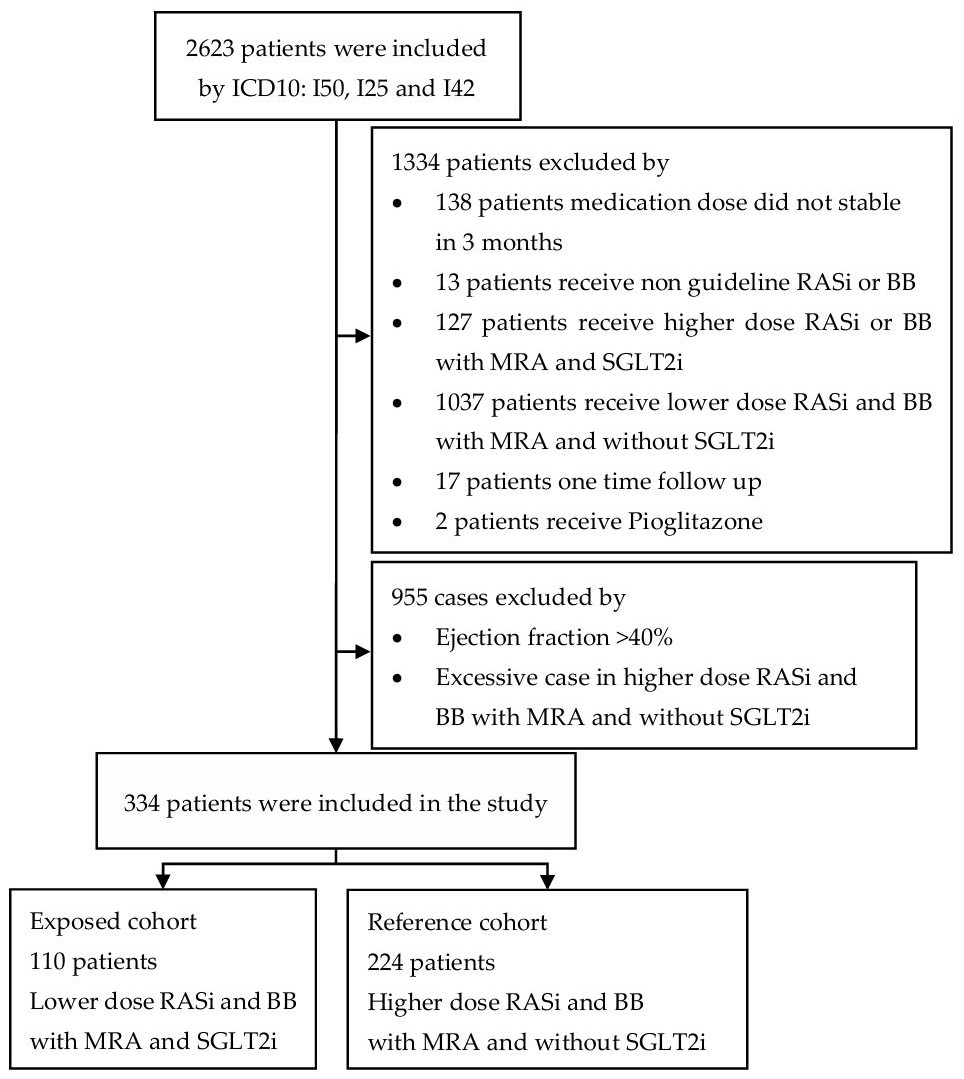
Patients were excluded if they had only a single outpatient visit or received RASi or BB not recommended by heart failure guidelines (e.g., metoprolol tartrate, atenolol, and propranolol). Specifically, patients receiving ≥50% TD of RASi and BB combined with SGLT2i were excluded, as were those receiving spironolactone at a dose lower than 25 mg. Additionally, patients receiving <50% of the recommended dose without SGLT2i were also excluded. Furthermore, exclusion criteria included SGLT2i treatment for less than one month, or the concomitant use of pioglitazone or non-dihydropyridine calcium channel blockers. In total, 334 patients were included in the study (Figure 1).
Figure 1.
Flow chart of participants included in the study.
2.3. Definition of Terms
The conventional triple therapy doses used in the study were based on heart failure clinical practice guideline recommendations. Participants were stratified by dose intensity into two categories: high-dose (≥50% of the guideline target dose) and low-dose (<50% of the guideline target dose) [15,16,17,18,19,20].
The exposed cohort included patients who received SGLT2i with at least one of RASi or BB prescribed at a low-dose (<50% of the target dose) plus MRA. This treatment pattern is referred to as SGLT2i with low-dose conventional triple therapy. The reference cohort consisted of patients receiving high-dose conventional triple therapy defined as high-dose (≥50% of the target dose) of both RASi and BB plus MRA but without SGLT2i.
Comorbidities were defined as non-heart failure conditions identified by ICD-10 codes, including hypertension (I10–I15), ischemic heart disease (I20–I25), atrial fibrillation (I48), diabetes mellitus (E10–E14), chronic obstructive pulmonary disease (J44), asthma (J45), and chronic kidney disease (N18).
Concomitant medications were defined as non-GDMT cardiovascular medication prescribed for patients. These included digoxin, hydralazine, isosorbide dinitrate, isosorbide mononitrate, ivabradine, trimetazidine, furosemide, hydrochlorothiazide, dihydropyridine and non-dihydropyridine calcium channel blockers (CCB), pioglitazone, and non-steroidal anti-inflammatory drugs (NSAID).
Hospitalization was defined as a physician-directed inpatient admission for heart failure, requiring treatment in a hospital.
CV death was defined based on a physician-diagnosed primary cause of death as documented in the hospital’s medical records. Cases lost to follow-up were censored at the date of the last contact
2.4. Data Collection
Patient data were collected from electronic medical records between 31 March 2018, and 31 March 2024. The outpatient dataset included the following patient characteristics: age, sex, date of outpatient visit, New York Heart Association (NYHA) functional class, LVEF, vital signs (blood pressure, heart rate), body weight, height, comorbidities classified by ICD-10 codes, prescribed cardiovascular medications, and laboratory results (serum potassium and estimated glomerular filtration rate [eGFR]). Inpatient data included date of hospital admission, principal diagnosis, and cardiovascular medications prescribed at discharge.
2.5. Study Objectives and Outcomes
This study aimed to compare clinical outcomes between the exposed cohort (SGLT2i with low-dose conventional triple therapy) and the reference cohort (high-dose conventional triple therapy). The primary outcome of this study was a composite endpoint consisting of cardiovascular death and heart failure hospitalization. Secondary outcomes included each individual component of the primary outcome, specifically cardiovascular death and heart failure hospitalization.
2.6. Statistical Analysis
Data was pre-processed using Microsoft Excel (Microsoft 365, private license) and analyzed with STATA software (version 14.0; Stata Corp, College Station, TX, USA; licensed to Faculty of Pharmacy, Chiang Mai University).
Baseline characteristics were summarized as mean and standard deviation (SD) or median with interquartile range (IQR) for continuous variables, and as counts with percentages for categorical variables. The Shapiro–Wilk test was used to assess the normality of continuous variables. Between-group differences were examined using the independent t-test or Wilcoxon rank-sum test for continuous data, and Fisher’s exact test for categorical data. The study was designed as a non-inferiority framework. The non-inferiority margin was prespecified at a hazard ratio (HR) of 1.13, based on prior evidence [24]. Non-inferiority was established if the upper limit of the one-sided 97.5 percent confidence interval for the comparison between the exposed cohort and the reference cohort was below 1.13.
To minimize confounding prior to outcome analysis, inverse probability of treatment weighting (IPTW) based on propensity scores was applied to construct a weighted cohort with improved covariate balance. Covariate balance was assessed using absolute standardized differences (ASD), and covariates with ASD > 10% between groups were considered imbalanced. These imbalanced covariates, together with variables showing p < 0.20 in univariable Cox analyses of the weighted cohort, were subsequently included in the multivariable Cox proportional hazards model. This approach represents a covariate-adjusted IPTW analysis, conceptually related to double robust methods. Kaplan–Meier curves were generated from the crude data to illustrate the cumulative incidence of outcomes, and between-group differences were assessed using the log-rank test. Cox proportional hazards regression was applied to estimate hazard ratios (HRs) with 95% confidence intervals (CIs).
Final results were reported as HR with corresponding 95% CIs. Non-inferiority was assessed by comparing the upper bound of the 95% CI for HR against the prespecified non-inferiority margin. The primary analysis in the present study was conducted using a Cox proportional hazards model and expressed as a hazard ratio (HR), which is the standard approach for time-to-event outcomes. The proportional hazards assumption was rigorously verified using Schoenfeld residuals (p = 0.611), confirming the appropriateness of the cox model for this analysis.
3. Results
3.1. Patient Baseline Characteristics and Medication Dosing
A total of 2623 outpatient records were collected from the database between 31 March 2018, and 31 March 2024. After applying the study’s inclusion and exclusion criteria, 334 patients were ultimately recruited into the final cohort. We enrolled 263 patients from Chiangrai Prachanukroh Hospital and 71 patients from Naresuan University Hospital; 298 patients (89.2%) were classified as having NYHA functional class I or II. The most prevalent comorbidities included hypertension, ischemic heart disease (IHD), atrial fibrillation (AF), diabetes mellitus (DM), and chronic kidney disease (CKD). The patients were divided into two comparative groups, with 110 patients in the exposed cohort, and 224 patients in the reference cohort. Baseline characteristics are presented in Table 1. Baseline characteristics were significantly different between the two groups for various variables before adjustment. Compared with the control group, patients in the exposed cohort had a higher prevalence of comorbid conditions, including hypertension, ischemic heart disease, atrial fibrillation, and diabetes mellitus. They also exhibited lower average blood pressure and eGFR. Additionally, a greater proportion of patients in this group received ASA, furosemide, ivabradine and trimetazidine. Patients in the exposed cohort had a mean age of 63.5 years. The majority (66 (60.0%) patients) were covered under the civil servant medical benefit scheme (CSMBS). BB was prescribed in 96 patients (87.3%), with a median dose of 25.00% TD. RASi was used in 102 patients (92.7%), with a median dose of 33.33% TD. Among SGLT2i, dapagliflozin was prescribed in 88 patients (80.0%) and empagliflozin in 22 patients (20.0%). The reference cohort had a mean age of 61.0 years. The majority were covered under the universal coverage scheme (UCS), accounting for 193 (86.2%) patients. The median dose of BB was 100% TD and that of RASi was 75% TD. The median MRA (spironolactone) dose was 25 mg in both groups (73.6% of patients in the exposed cohort and 69.6% in the reference cohort), with no significant difference between the two cohorts (p = 0.666).
Table 1.
Patient characteristics at baseline.
After balancing patient characteristics using Inverse Probability of Treatment Weighting (IPTW), variables with an absolute standardized difference (ASD) exceeding 10% included NYHA functional class, systolic blood pressure, LVEF, case type, atrial fibrillation, estimated glomerular filtration rate (eGFR), and the administration of aspirin (ASA), NSAIDs, furosemide, hydralazine, isosorbide mononitrate (ISMN), ivabradine, and trimetazidine in Table 2.
Table 2.
Balance of patient characteristics after IPTW.
Consequently, these imbalanced covariates, along with other potential predictors identified in the weighted univariable Cox proportional hazards models with a p-value < 0.20, were considered for further analysis. These included age, body mass index (BMI), study site, systolic blood pressure, diastolic blood pressure, ejection fraction, eGFR, use of furosemide, hydralazine, and a history of hypertension, ischemic heart disease, and atrial fibrillation, shown in Table 3. Ultimately, these selected variables were included in the final multivariable weighted Cox proportional hazards analysis.
Table 3.
Univariable Cox proportional hazards analysis with IPTW for patient characteristics.
3.2. Association Between Treatment Strategy and Cardiovascular Death or Heart Failure Hospitalization
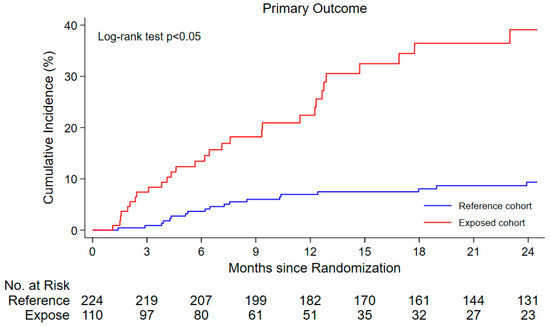
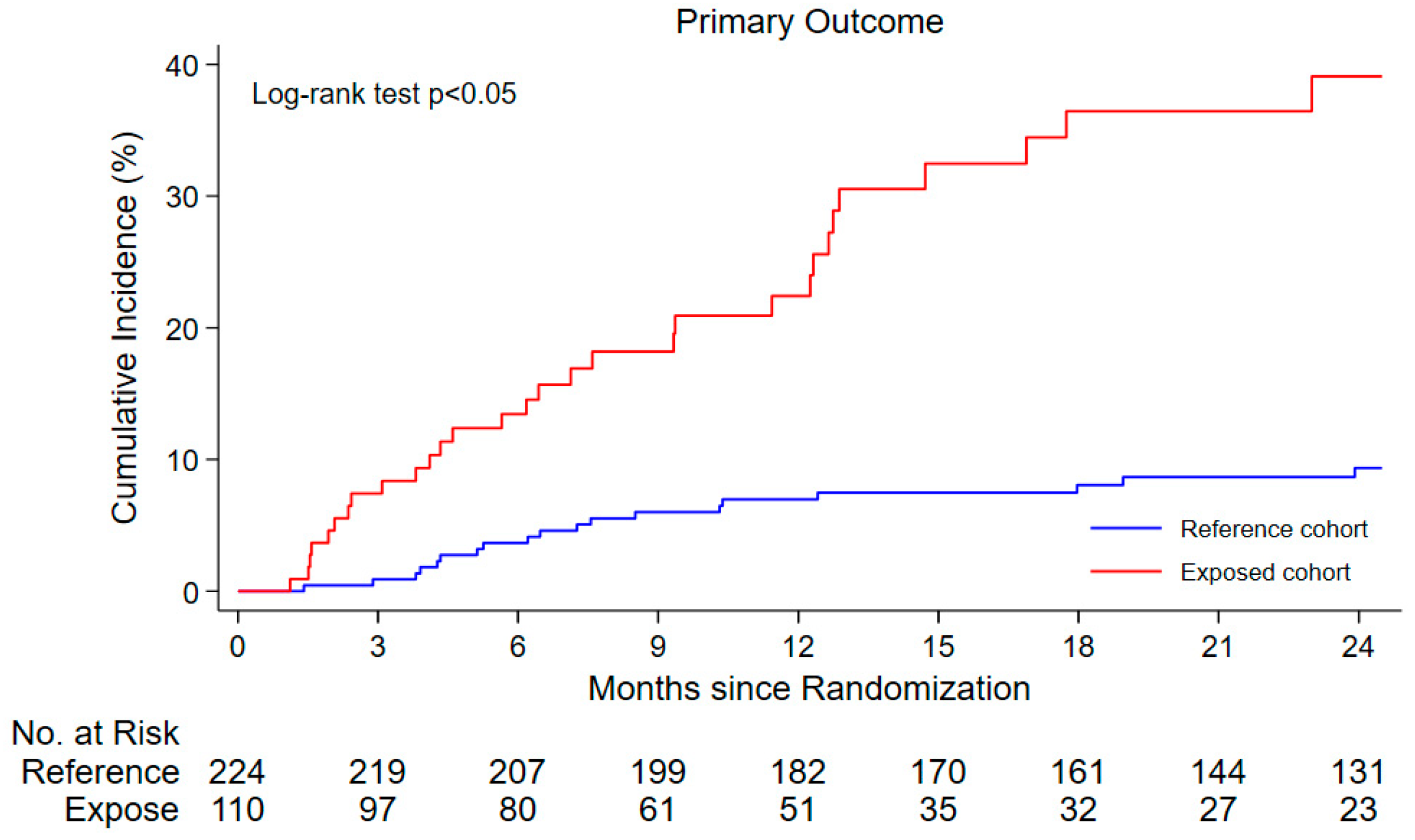
The mean follow-up duration was 1.2 years in the exposed cohort and 2.5 years in the reference cohort. A total of 60 patients experienced the composite outcome of CV death and HFH. The composite outcome occurred more frequently in the exposed cohort (32 patients, crude event rate 24.38 per 100 patient-years) compared to the reference cohort (28 patients, 4.99 per 100 patient-years). Similarly, crude event rates were higher in the exposed group for CV death (6.09 vs. 0.89 per 100 patient-years) and heart failure hospitalization (19.5 vs. 5.17 per 100 patient-years), respectively. Figure 2 shows a higher incidence of the composite outcome in the exposed cohort.
Figure 2.
The Kaplan–Meier curve for survival composite outcome.
After applying IPTW and conducting multivariable Cox proportional hazards analysis, patients in the exposed cohort showed a significantly higher risk of experiencing the composite outcome (adjusted HR 4.10, 95% CI 2.07–8.13, p < 0.001). Non-inferiority could not be established. Based on the secondary outcome analysis using a multivariable cox proportional hazards model with IPTW, the two treatment cohorts showed no significant difference in CV death (adjusted HR 6.40, 95% CI 0.89–46.19, p = 0.065). However, the exposure cohort had a higher rate of HFH (adjusted HR 4.47, 95% CI 2.20–9.06, p < 0.001) (Table 4).
Table 4.
Multivariable Cox proportional hazards model of the clinical outcome.
4. Discussion
This study was based on retrospective data collection beginning in 2018, during which SGLT2i had not yet been approved in Thailand for the treatment of chronic heart failure. The primary objective was to evaluate whether the exposed cohort could achieve comparable clinical effectiveness to the reference cohort. Within this comparative context, we employed a non-inferiority framework. However, non-inferiority was not demonstrated, as the exposed cohort exhibited a higher incidence of the composite outcome compared to the reference cohort. These findings differ from post hoc analyses of the DAPA-HF and EMPEROR-Reduced trials, which reported comparable incidences of composite outcomes between patients receiving low-dose of conventional triple therapy combined with a SGLT2i and those receiving high-dose conventional triple therapy [19,20]. Differences in patient characteristics and treatment accessibility may partly explain the divergence from DAPA-HF and EMPEROR-Reduced. Although propensity scores with IPTW were applied in our study to adjust baseline clinical characteristics at study entry in order to enhance comparability between the two groups, and a multivariable Cox proportional hazards model was used, patients in the exposed cohort still exhibited a higher incidence of the composite outcome compared with those in the reference cohort. Several systematic reviews and network meta-analyses suggest that combination therapy with multiple guideline-recommended medications, especially ACEI + BB + MRA + SGLT2i or ARNI + BB + MRA, reduces the incidence of the primary composite outcome more effectively than partial regimens. Patients receiving ACEI + BB + MRA + SGLT2i showed a 10–25% reduction in composite outcomes and an 8–25% reduction in heart failure hospitalization compared to those not receiving SGLT2i. However, these findings are based on indirect comparisons and do not account for actual medication doses, limiting conclusions about dose–response relationships [26,27,28].
Although the primary publications of the DAPA-HF and EMPEROR-Reduced trials did not include detailed neurohormonal blockade (NHB) doses, post hoc analyses from both studies did provide some data. In the DAPA-HF trial, 49.5% of patients received BB at more than 50% TD, while 35.8% received RASi at over 50% TD. In the EMPEROR-Reduced trial, the corresponding figures were 51.7% and 46.4%, respectively. Based on data from both trials, the average dosing of BB and RASi was likely close to 50% TD [19,20]. Importantly, while these trials demonstrated benefit from SGLT2i regardless of background dose, a notable finding from the EMPEROR-Reduced post hoc analysis revealed that patients receiving RASi at less than 50% TD appeared less likely to derive the full benefit from empagliflozin in reducing hospitalization risk [20]. The NHB is an important component of heart failure management, particularly the use of NHB at target dose. High-dose NHB appears to confer greater clinical benefit than low-dose [15,16,17]. In contrast, patients in our study who received SGLT2i had substantially lower median dose, i.e., 25.00% TD for BB and 33.33% TD for RASi, representing a very low-dose of conventional triple therapy. This may have attenuated the clinical benefit of SGLT2i in reducing the composite outcome. Conversely, patients in the reference cohort who received high-dose BB and RASi (median 100% TD and 75% TD, respectively) with target dose of MRA but without SGLT2i, were treated at very high-dose. This may partly explain the superior composite outcome profile in the reference cohort and the divergence from findings in the landmark trials. A sensitivity analysis was conducted by excluding patients who received very low doses (less than 25% of the target dose) of any conventional triple therapy. This refined the cohort to 300 cases. Interestingly, after this exclusion, the Hazard Ratio (HR) for the primary outcome remained comparable to the original estimate and increased slightly to 4.89 (95% CI: 2.07–11.56, p < 0.001). These findings reinforce the robustness of our primary analysis and clearly demonstrate that the high-risk profile observed in the exposed cohort remains consistent, even when foundational heart failure treatments are titrated to more clinically significant levels. Our findings should be interpreted within the context of real-world clinical complexity. Recent evidence in HFrEF populations suggests that the clinical benefits of contemporary therapies are closely linked to dose–response patterns and specific patient phenotypes [29,30].
Data from prior studies with patient characteristics similar to our current study reported fewer cardiovascular deaths or heart failure admissions in HFrEF patients receiving conventional GDMT. Specifically, the PARADIGM-HF trial reported an event rate of 26.5 in the group receiving enalapril at 20 mg/day over a median follow-up of 27 months, which means an event rate of 11.8 per 100 patient-years. Furthermore, the HEAAL study reported an event rate of 9.3 per 100 patient-years in the group receiving losartan 150 mg and 10.7 per 100 patient-years in the group receiving losartan 50 mg. In contrast, studies within Thailand have previously reported a higher burden of events. The ASIAN-HF registry encompasses both heart failure with reduced ejection fraction (HFrEF) and heart failure with preserved ejection fraction. The cardiovascular (CV) death rate among HFrEF patients was approximately 8.0 per 100 patient-years [31], whereas in our exposed cohort, the IPTW-adjusted CV death rate was 6.4 per 100 patient-years (8.03 after IPTW). Specifically, a study on BB use in HFrEF patients in Thailand reported a composite outcome of all-cause mortality and hospitalization at a rate of 49.5 per 100 patient-years. Notably, that study did not report the analysis of beta-blocker and RASi dosages as a percentage of their respective target doses. A previous study conducted at Chiangrai Prachanukroh Hospital, involving HFrEF patients receiving intensive treatment and followed for one year, found CV death rates of 16.42 per 100 patient-years and rehospitalization from heart failure at 24.24 per 100 patient-years, despite more than 50% TD of GDMT with 10% received SGLT2i [21]. Although the exposed cohort in our study exhibited a higher incidence of the composite outcome compared with the reference cohort, the event rates for the composite endpoint, CV death, and heart failure hospitalization were lower than those reported in previous Thai studies.
During the initial data collection period of this study, SGLT2i use in Thailand was primarily restricted to diabetes mellitus indication and had not yet been officially approved for HFrEF, even following the publication of the DAPA-HF and EMPEROR-Reduced trial results. Consequently, patients in the cohort receiving SGLT2i with low-dose NHB were predominantly those diagnosed with HFrEF and concomitant diabetes mellitus. This resulted in a significantly higher prevalence of diabetes mellitus as a comorbidity in the exposed group. Furthermore, this cohort also presented with a higher burden of other high-risk conditions, including hypertension, atrial fibrillation, and ischemic heart disease. The higher prevalence of these comorbidities is a critical factor, as managing these conditions is deemed essential for reducing morbidity and mortality in heart failure patients. These conditions are specifically addressed in contemporary heart failure guidelines, underscoring their substantial prognostic impact. This baseline burden of comorbidities likely contributed to the poorer clinical outcomes observed in this patient group [1,2]. Furthermore, differences in disease pathophysiology and severity persisted between the cohorts, as suggested by baseline data on NYHA functional class, principal cause of heart failure, and blood pressure. Even after adjustment using IPTW and the multivariable Cox proportional hazards model, these remaining differences likely represent residual confounding that influenced treatment response and subsequent clinical outcomes. Evidence consistently indicates that heart failure patients with non-ischemic etiology respond better to medical therapy, present with fewer comorbidities, and experience lower rates of cardiovascular death CV death and HFH compared to those with ischemic etiology [32]. Even after adjusting baseline characteristics, more patients in the exposed cohort received furosemide in addition to GDMT, which aligns with HF guidelines recommending diuretics in patients who have fluid retention to relieve congestion, improve symptoms, and prevent worsening HF. Consequently, this data suggests that patients in the exposed cohort may have more unstable disease status and a higher likelihood of HF worsening compared to the reference cohort, who received less Furosemide, reflecting a lower risk of HF worsening in that group [1,2].
Additionally, the median BMI of patients in both groups was approximately 23.5 kg/m2. Previous research examining the relationship between BMI and all-cause mortality in chronic heart failure has suggested that the lowest risk is observed among patients with a BMI between 25 and 40 kg/m2 [33]. Therefore, patients in this study may have had a higher baseline risk compared to those in the DAPA-HF and EMPEROR-Reduced trials, where the average BMI was reported at 28 kg/m2. However, this does not suggest that patients should gain weight, as the observed association may be confounded by other factors. Clinical care should remain individualized and guided by evidence-based risk modification.
Recent evidence highlights the extensive pleiotropic effects of SGLT2 inhibitors beyond diuresis and glucose lowering. Notably, these agents exert significant anti-arrhythmic benefits, which are vital in reducing the burden of atrial and ventricular arrhythmias in heart failure patients [34]. In our study, despite these well-documented benefits, the exposed cohort which featured a markedly higher baseline prevalence of atrial fibrillation (ASD 0.282) still exhibited a significantly higher event rate (HR 4.10). This divergence suggests that in real-world clinical practice, the profound baseline disease severity and high-risk profile may temporarily outweigh the pleiotropic benefits of SGLT2 inhibitors, particularly when background conventional triple therapy is maintained at very low dose (nearly 25% of target).
Furthermore, the observed outcomes may be attributed to a cluster of residual confounding that persists despite a rigorous doubly robust approach using IPTW and Cox proportional hazards models. This confounding cluster encompasses baseline disease severity and a high-risk clinical profile, including frailty, prolonged disease duration, and a potentially intolerant phenotype toward the up-titration of foundational therapies. When these factors aggregate, they create a complex confounding environment that may temporarily obscure the therapeutic benefits of SGLT2 inhibitors, particularly in a real-world setting where background conventional triple therapy remains at a very low dose.
Therefore, patients with heart failure in Thailand should receive conventional GDMT at target dose whenever feasible, with the addition of SGLT2i as appropriate. Several studies, including clinical trials and meta-analyses, have supported the use of all four guideline-recommended drug classes for chronic heart failure. However, no prior reports have specifically evaluated outcomes based on adherence to target dose, particularly regarding individual drug titration. This study is the first to assess the impact of heart failure pharmacotherapy in a real-world Thai population with varying limitations in drug access, dose, and regimen composition. The findings may help inform treatment planning for patients with restricted access to certain medications.
While the benefits of SGLT2i are robust, very low dosing of conventional triple therapy may attenuate overall clinical optimization. This underscores that SGLT2i should be used in conjunction with efforts to up-titrate conventional triple therapy whenever feasible, rather than prioritizing dose escalation of conventional therapy alone without the addition of SGLT2i in patients who are eligible to receive it. However, in patients who are unable to receive SGLT2i, efforts to titrate conventional triple therapy to the maximally tolerated target dose remain essential, as this approach has been clearly demonstrated to provide significant clinical benefit.
This study aligns with the United Nations Sustainable Development Goal (SDG) 3, particularly Targets 3.4 and 3.8, and contributes to SDG 10 on Reduced Inequalities. It provides evidence to inform treatment strategies aimed at reducing cardiovascular death and heart failure hospitalizations, thereby supporting SDG Target 3.4. The findings underscore the importance of optimizing guideline-directed medical therapy, which is central to achieving universal health coverage and ensuring access to safe, effective, and essential medicines in line with SDG Target 3.8. Conducted in Thailand, this study offers context-specific evidence for resource-limited and middle-income settings where SGLT2 inhibitors remain costly, supporting equitable, evidence-based care and helping to reduce disparities related to financial and resource constraints in accordance with SDG 10.
This study has several limitations. First, there is a potential for selection bias, as the exposed cohort likely represents a higher-risk or intolerant phenotype of patients who could not undergo further up-titration of foundational therapies. Second, as a retrospective analysis, some medical records were incomplete, and certain data such as patient or caregiver adherence, reasons for dose adjustments (for hemodynamic instability, worsening renal function, or other side effects), reasons for treatment discontinuation, period for up-titration, documentation of furosemide use under flexible diuretic guidelines, and HF status (severity and HF progress, repeat EF measurement, laboratory parameters in HF patients) were unavailable. Perhaps this missing data may have influenced the interpretation of outcomes. Future studies should adopt a prospective design to capture additional clinical details, particularly the rationale for medication discontinuation and barriers to dose up-titration. Moreover, limited access to SGLT2i remains a challenge in Thailand. As access improves, further analyses in larger populations will be valuable to better define the optimal sequencing of GDMT when titration to target doses faces real-world constraints, ultimately guiding more effective treatment strategies.
Our study underscores the importance of titrating GDMT to the highest tolerated target dose, highlighting that effective heart failure management requires not only the use of all four GDMT classes but also optimization of each agent whenever feasible.
5. Conclusions
In this study of patients with HFrEF, SGLT2 inhibitor combined with low-dose conventional triple therapy did not demonstrate comparable clinical outcomes to high-dose conventional triple therapy with respect to cardiovascular outcomes, defined as the composite of cardiovascular death and heart failure hospitalization. This finding appears particularly pronounced in this cohort, which presented with a notably higher baseline burden of disease severity. Further investigation is warranted to clarify these findings and their implications for the management of HFrEF.
Author Contributions
Conceptualization, S.K., P.B., P.J. and S.C.; methodology, S.K., P.B., P.J. and S.C.; formal analysis, S.K.; investigation, S.K., P.B., P.J. and S.C.; project administration, S.K.; writing—original draft preparation, S.K.; writing—review and editing, S.K., P.B., P.J. and S.C.; supervision, S.C. All authors have read and agreed to the published version of the manuscript.
Funding
This research received no external funding.
Institutional Review Board Statement
The study was conducted according to the guidelines of the Declaration of Helsinki and approved by the Ethics Committee in Human Research Chiangrai Prachanukroh Hospital, Thailand (EC CRH 082/66 In, approved on 11 September 2023).
Informed Consent Statement
Because this study is retrospective, informed consent is waived.
Data Availability Statement
The data presented in this study are available on request from the corresponding author. The data are not publicly available due to privacy and ethical restrictions.
Acknowledgments
We wish to acknowledge financial support for this publication from the Research Center for Innovation in Analytical Science and Technology for Biodiversity-Based Economic and Society (I-ANALY-S-T_B.BES-CMU). The authors wish to thank all advisors for their invaluable guidance. We express our gratitude to the Ethics Committee in Human Research at Chiangrai Prachanukroh Hospital and Naresuan University Hospital for their support. Special thanks are extended to the Faculty of Pharmacy, Chiang Mai University, as well as our colleagues, families, and brother for their encouragement. The authors declare that this manuscript was not generated by any Artificial Intelligence (AI). However, we used Gemini exclusively for proofreading, checking grammar, and improving the fluency of the English language. No content was generated by the AI model. The authors have reviewed and take full responsibility for the accuracy of the final content. Additionally, the authors used the reference management tool EndNote to manage, cite, and format the bibliography and references listed in this manuscript.
Conflicts of Interest
The authors declare no conflicts of interest.
References
- Heidenreich, P.A.; Bozkurt, B.; Aguilar, D.; Allen, L.A.; Byun, J.J.; Colvin, M.M.; Deswal, A.; Drazner, M.H.; Dunlay, S.M.; Evers, L.R.; et al. 2022 AHA/ACC/HFSA Guideline for the Management of Heart Failure: A Report of the American College of Cardiology/American Heart Association Joint Committee on Clinical Practice Guidelines. Circulation 2022, 145, e895–e1032. [Google Scholar] [CrossRef] [Scilit] [PubMed]
- McDonagh, T.A.; Metra, M.; Adamo, M.; Gardner, R.S.; Baumbach, A.; Böhm, M.; Burri, H.; Butler, J.; Čelutkienė, J.; Chioncel, O.; et al. 2021 ESC Guidelines for the diagnosis and treatment of acute and chronic heart failure. Eur. Heart J. 2021, 42, 3599–3726. [Google Scholar] [CrossRef] [Scilit] [PubMed]
- CONSENSUS Trial Study Group. Effects of enalapril on mortality in severe congestive heart failure. Results of the Cooperative North Scandinavian Enalapril Survival Study (CONSENSUS). N. Engl. J. Med. 1987, 316, 1429–1435. [Google Scholar] [CrossRef] [Scilit] [PubMed]
- Cohn, J.N.; Tognoni, G. A randomized trial of the angiotensin-receptor blocker valsartan in chronic heart failure. N. Engl. J. Med. 2001, 345, 1667–1675. [Google Scholar] [CrossRef] [Scilit] [PubMed]
- Konstam, M.A.; Neaton, J.D.; Dickstein, K.; Drexler, H.; Komajda, M.; Martinez, F.A.; Riegger, G.A.; Malbecq, W.; Smith, R.D.; Guptha, S.; et al. Effects of high-dose versus low-dose losartan on clinical outcomes in patients with heart failure (HEAAL study): A randomised, double-blind trial. Lancet 2009, 374, 1840–1848. [Google Scholar] [CrossRef] [Scilit] [PubMed]
- Granger, C.B.; McMurray, J.J.; Yusuf, S.; Held, P.; Michelson, E.L.; Olofsson, B.; Ostergren, J.; Pfeffer, M.A.; Swedberg, K. Effects of candesartan in patients with chronic heart failure and reduced left-ventricular systolic function intolerant to angiotensin-converting-enzyme inhibitors: The CHARM-Alternative trial. Lancet 2003, 362, 772–776. [Google Scholar] [CrossRef] [Scilit] [PubMed]
- McMurray, J.J.; Packer, M.; Desai, A.S.; Gong, J.; Lefkowitz, M.P.; Rizkala, A.R.; Rouleau, J.L.; Shi, V.C.; Solomon, S.D.; Swedberg, K.; et al. Angiotensin-neprilysin inhibition versus enalapril in heart failure. N. Engl. J. Med. 2014, 371, 993–1004. [Google Scholar] [CrossRef] [Scilit] [PubMed]
- CIBIS-II Investigators and Committees. The Cardiac Insufficiency Bisoprolol Study II (CIBIS-II): A randomised trial. Lancet 1999, 353, 9–13. [Google Scholar] [PubMed]
- MERIT-HF Study Group. Effect of metoprolol CR/XL in chronic heart failure: Metoprolol CR/XL Randomised Intervention Trial in Congestive Heart Failure (MERIT-HF). Lancet 1999, 353, 2001–2007. [Google Scholar] [PubMed]
- Packer, M.; Fowler, M.B.; Roecker, E.B.; Coats, A.J.; Katus, H.A.; Krum, H.; Mohacsi, P.; Rouleau, J.L.; Tendera, M.; Staiger, C.; et al. Effect of carvedilol on the morbidity of patients with severe chronic heart failure: Results of the carvedilol prospective randomized cumulative survival (COPERNICUS) study. Circulation 2002, 106, 2194–2199. [Google Scholar] [CrossRef] [Scilit] [PubMed]
- Flather, M.D.; Shibata, M.C.; Coats, A.J.; Van Veldhuisen, D.J.; Parkhomenko, A.; Borbola, J.; Cohen-Solal, A.; Dumitrascu, D.; Ferrari, R.; Lechat, P.; et al. Randomized trial to determine the effect of nebivolol on mortality and cardiovascular hospital admission in elderly patients with heart failure (SENIORS). Eur. Heart J. 2005, 26, 215–225. [Google Scholar] [CrossRef] [Scilit] [PubMed]
- Pitt, B.; Zannad, F.; Remme, W.J.; Cody, R.; Castaigne, A.; Perez, A.; Palensky, J.; Wittes, J. The effect of spironolactone on morbidity and mortality in patients with severe heart failure. Randomized Aldactone Evaluation Study Investigators. N. Engl. J. Med. 1999, 341, 709–717. [Google Scholar] [CrossRef] [Scilit] [PubMed]
- McMurray, J.J.V.; Solomon, S.D.; Inzucchi, S.E.; Køber, L.; Kosiborod, M.N.; Martinez, F.A.; Ponikowski, P.; Sabatine, M.S.; Anand, I.S.; Bělohlávek, J.; et al. Dapagliflozin in Patients with Heart Failure and Reduced Ejection Fraction. N. Engl. J. Med. 2019, 381, 1995–2008. [Google Scholar] [CrossRef] [Scilit] [PubMed]
- Packer, M.; Anker, S.D.; Butler, J.; Filippatos, G.; Pocock, S.J.; Carson, P.; Januzzi, J.; Verma, S.; Tsutsui, H.; Brueckmann, M.; et al. Cardiovascular and Renal Outcomes with Empagliflozin in Heart Failure. N. Engl. J. Med. 2020, 383, 1413–1424. [Google Scholar] [CrossRef] [Scilit] [PubMed]
- Ouwerkerk, W.; Voors, A.A.; Anker, S.D.; Cleland, J.G.; Dickstein, K.; Filippatos, G.; van der Harst, P.; Hillege, H.L.; Lang, C.C.; Ter Maaten, J.M.; et al. Determinants and clinical outcome of uptitration of ACE-inhibitors and beta-blockers in patients with heart failure: A prospective European study. Eur. Heart J. 2017, 38, 1883–1890. [Google Scholar] [CrossRef] [Scilit] [PubMed]
- Greene, S.J.; Butler, J.; Hellkamp, A.S.; Spertus, J.A.; Vaduganathan, M.; Devore, A.D.; Albert, N.M.; Patterson, J.H.; Thomas, L.; Williams, F.B.; et al. Comparative Effectiveness of Dosing of Medical Therapy for Heart Failure: From the CHAMP-HF Registry. J. Card. Fail. 2022, 28, 370–384. [Google Scholar] [CrossRef] [Scilit]
- Teng, T.K.; Tromp, J.; Tay, W.T.; Anand, I.; Ouwerkerk, W.; Chopra, V.; Wander, G.S.; Yap, J.J.; MacDonald, M.R.; Xu, C.F.; et al. Prescribing patterns of evidence-based heart failure pharmacotherapy and outcomes in the ASIAN-HF registry: A cohort study. Lancet Glob. Health 2018, 6, e1008–e1018. [Google Scholar] [CrossRef] [Scilit] [PubMed]
- Masing, M.; Sangviroon Sujarit, A.; Wattanavijitkul, T. Composite outcome of all-cause mortality and hospitalization among chronic heart failure patients receiving different doses of beta-blockers. Thai J. Pharm. Pract. 2021, 13, 825–836. [Google Scholar]
- Docherty, K.F.; Jhund, P.S.; Inzucchi, S.E.; Køber, L.; Kosiborod, M.N.; Martinez, F.A.; Ponikowski, P.; DeMets, D.L.; Sabatine, M.S.; Bengtsson, O.; et al. Effects of dapagliflozin in DAPA-HF according to background heart failure therapy. Eur. Heart J. 2020, 41, 2379–2392. [Google Scholar] [CrossRef] [Scilit] [PubMed]
- Verma, S.; Dhingra, N.K.; Butler, J.; Anker, S.D.; Ferreira, J.P.; Filippatos, G.; Januzzi, J.L.; Lam, C.S.P.; Sattar, N.; Peil, B.; et al. Empagliflozin in the treatment of heart failure with reduced ejection fraction in addition to background therapies and therapeutic combinations (EMPEROR-Reduced): A post-hoc analysis of a randomised, double-blind trial. Lancet Diabetes Endocrinol. 2022, 10, 35–45. [Google Scholar] [CrossRef] [Scilit] [PubMed]
- Bunditboondee, P.; Wanchaitanawong, W.; Honchai, T. Treatment outcome in intensive heart failure clinic in Chiangrai Prachanukroh Hospital. Chiangrai Med. J. 2023, 15, 41–52. [Google Scholar]
- Marley-Zagar, E.; White, I.R.; Royston, P.; Barthel, F.M.-S.; Parmar, M.K.B.; Babiker, A.G. artbin: Extended sample size for randomized trials with binary outcomes. Stata J. 2023, 23, 24–52. [Google Scholar] [CrossRef] [Scilit] [PubMed]
- Quartagno, M.; Walker, A.S.; Babiker, A.G.; Turner, R.M.; Parmar, M.K.B.; Copas, A.; White, I.R. Handling an uncertain control group event risk in non-inferiority trials: Non-inferiority frontiers and the power-stabilising transformation. Trials 2020, 21, 145. [Google Scholar] [CrossRef] [Scilit] [PubMed]
- Pfeffer, M.A.; McMurray, J.J.; Velazquez, E.J.; Rouleau, J.L.; Køber, L.; Maggioni, A.P.; Solomon, S.D.; Swedberg, K.; Van de Werf, F.; White, H.; et al. Valsartan, captopril, or both in myocardial infarction complicated by heart failure, left ventricular dysfunction, or both. N. Engl. J. Med. 2003, 349, 1893–1906. [Google Scholar] [CrossRef] [Scilit] [PubMed]
- Maddox, T.M.; Januzzi, J.L., Jr.; Allen, L.A.; Breathett, K.; Butler, J.; Davis, L.L.; Fonarow, G.C.; Ibrahim, N.E.; Lindenfeld, J.; Masoudi, F.A.; et al. 2021 Update to the 2017 ACC Expert Consensus Decision Pathway for Optimization of Heart Failure Treatment: Answers to 10 Pivotal Issues About Heart Failure With Reduced Ejection Fraction: A Report of the American College of Cardiology Solution Set Oversight Committee. J. Am. Coll. Cardiol. 2021, 77, 772–810. [Google Scholar] [CrossRef] [Scilit] [PubMed]
- Suebsaicharoen, T.; Chunekamrai, P.; Yingchoncharoen, T.; Tansawet, A.; Issarawattana, T.; Numthavaj, P.; Thakkinstian, A. Comparative cardiovascular outcomes of novel drugs as an addition to conventional triple therapy for heart failure with reduced ejection fraction (HFrEF): A network meta-analysis of randomised controlled trials. Open Heart 2023, 10, e002364. [Google Scholar] [CrossRef] [Scilit] [PubMed]
- Tromp, J.; Ouwerkerk, W.; van Veldhuisen, D.J.; Hillege, H.L.; Richards, A.M.; van der Meer, P.; Anand, I.S.; Lam, C.S.P.; Voors, A.A. A Systematic Review and Network Meta-Analysis of Pharmacological Treatment of Heart Failure With Reduced Ejection Fraction. JACC Heart Fail. 2022, 10, 73–84. [Google Scholar] [CrossRef] [Scilit] [PubMed]
- Xiang, B.; Yu, Z.; Zhou, X. Comparative Efficacy of Medical Treatments for Chronic Heart Failure: A Network Meta-Analysis. Front. Cardiovasc. Med. 2021, 8, 787810. [Google Scholar] [CrossRef] [Scilit] [PubMed]
- Pătru, O.; Luca, S.; Cozma, D.; Văcărescu, C.; Crișan, S.; Valcovici, M.D.; Vîrtosu, M.; Zus, A.S.; Luca, C.T.; Drăgan, S.R. The Role of ARNI in Enhancing Outcomes of Cardiac Resynchronization Therapy: A Comprehensive Review. J. Clin. Med. 2025, 14, 2743. [Google Scholar] [CrossRef] [Scilit]
- Patru, O.; Luca, S.; Cozma, D.; Vacarescu, C.; Crisan, S.; Bena, A.; Virtosu, M.; Zus, A.S.; Luca, C.T.; Dragan, S.R. Impact of Late ARNI Initiation on Quality of Life and Functional Capacity in CRT-Treated HFrEF Patients: A Single-Centre Cohort Study. J. Clin. Med. 2026, 15, 1617. [Google Scholar] [CrossRef] [Scilit] [PubMed]
- MacDonald, M.R.; Tay, W.T.; Teng, T.K.; Anand, I.; Ling, L.H.; Yap, J.; Tromp, J.; Wander, G.S.; Naik, A.; Ngarmukos, T.; et al. Regional Variation of Mortality in Heart Failure With Reduced and Preserved Ejection Fraction Across Asia: Outcomes in the ASIAN-HF Registry. J. Am. Heart Assoc. 2020, 9, e012199. [Google Scholar] [CrossRef] [Scilit] [PubMed]
- Tymińska, A.; Ozierański, K.; Balsam, P.; Maciejewski, C.; Wancerz, A.; Brociek, E.; Marchel, M.; Crespo-Leiro, M.G.; Maggioni, A.P.; Drożdż, J.; et al. Ischemic Cardiomyopathy versus Non-Ischemic Dilated Cardiomyopathy in Patients with Reduced Ejection Fraction- Clinical Characteristics and Prognosis Depending on Heart Failure Etiology (Data from European Society of Cardiology Heart Failure Registries). Biology 2022, 11, 341. [Google Scholar] [CrossRef] [Scilit] [PubMed]
- Jones, N.R.; Ordóñez-Mena, J.M.; Roalfe, A.K.; Taylor, K.S.; Goyder, C.R.; Hobbs, F.R.; Taylor, C.J. Body mass index and survival in people with heart failure. Heart 2023, 109, 1542–1549. [Google Scholar] [CrossRef] [Scilit] [PubMed]
- Mariani, M.V.; Lavalle, C.; Palombi, M.; Pierucci, N.; Trivigno, S.; D’Amato, A.; Filomena, D.; Cipollone, P.; Laviola, D.; Piro, A.; et al. SGLT2i reduce arrhythmic events in heart failure patients with cardiac implantable electronic devices. ESC Heart Fail. 2025, 12, 2125–2133. [Google Scholar] [CrossRef] [Scilit] [PubMed]

Disclaimer/Publisher’s Note: The statements, opinions and data contained in all publications are solely those of the individual author(s) and contributor(s) and not of MDPI and/or the editor(s). MDPI and/or the editor(s) disclaim responsibility for any injury to people or property resulting from any ideas, methods, instructions or products referred to in the content. |
© 2026 by the authors. Published by MDPI on behalf of the Lithuanian University of Health Sciences. Licensee MDPI, Basel, Switzerland. This article is an open access article distributed under the terms and conditions of the Creative Commons Attribution (CC BY) license.