Article

Preoperative Psychological Factors and Early Postoperative Pain After Posterior Spinal Fusion for Scoliosis: A Retrospective Preliminary Study


1
Orthopedic and Traumatology Unit, Department of Surgery, Bambino Gesù Children’s Hospital, 00050 Rome, Italy
2
Department of Anesthesia and Critical Care, IRCCS, Bambino Gesù Children’s Hospital, 00165 Rome, Italy
3
Research Unit of Orthopaedic and Trauma Surgery, Department of Medicine and Surgery, Università Campus Bio-Medico di Roma, Via Alvaro del Portillo, 21, 00128 Rome, Italy
*
Author to whom correspondence should be addressed.
Medicina 2026, 62(4), 698; https://doi.org/10.3390/medicina62040698

Submission received: 3 March 2026 / Revised: 28 March 2026 / Accepted: 1 April 2026 / Published: 5 April 2026
(This article belongs to the Section Pediatrics)

Abstract

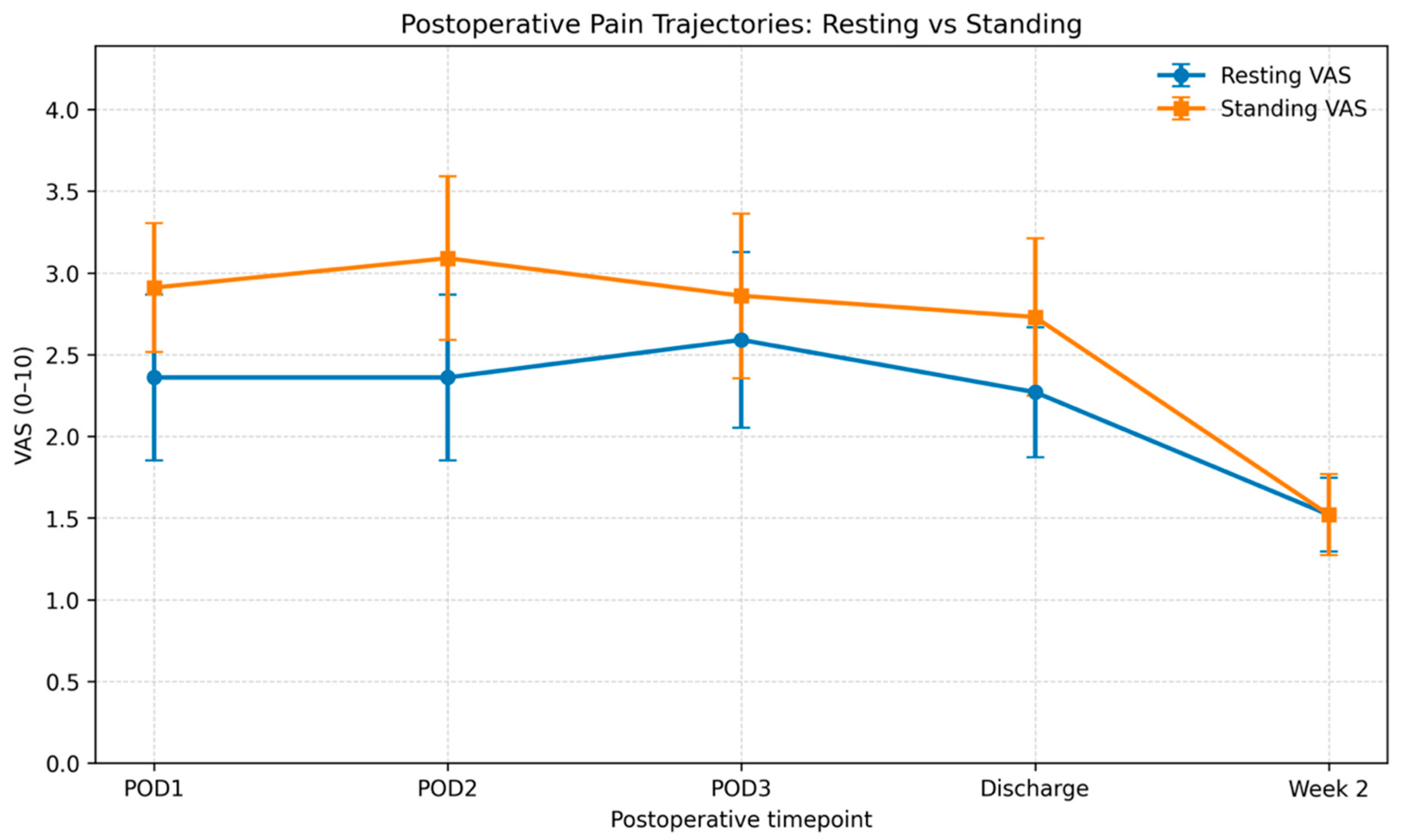
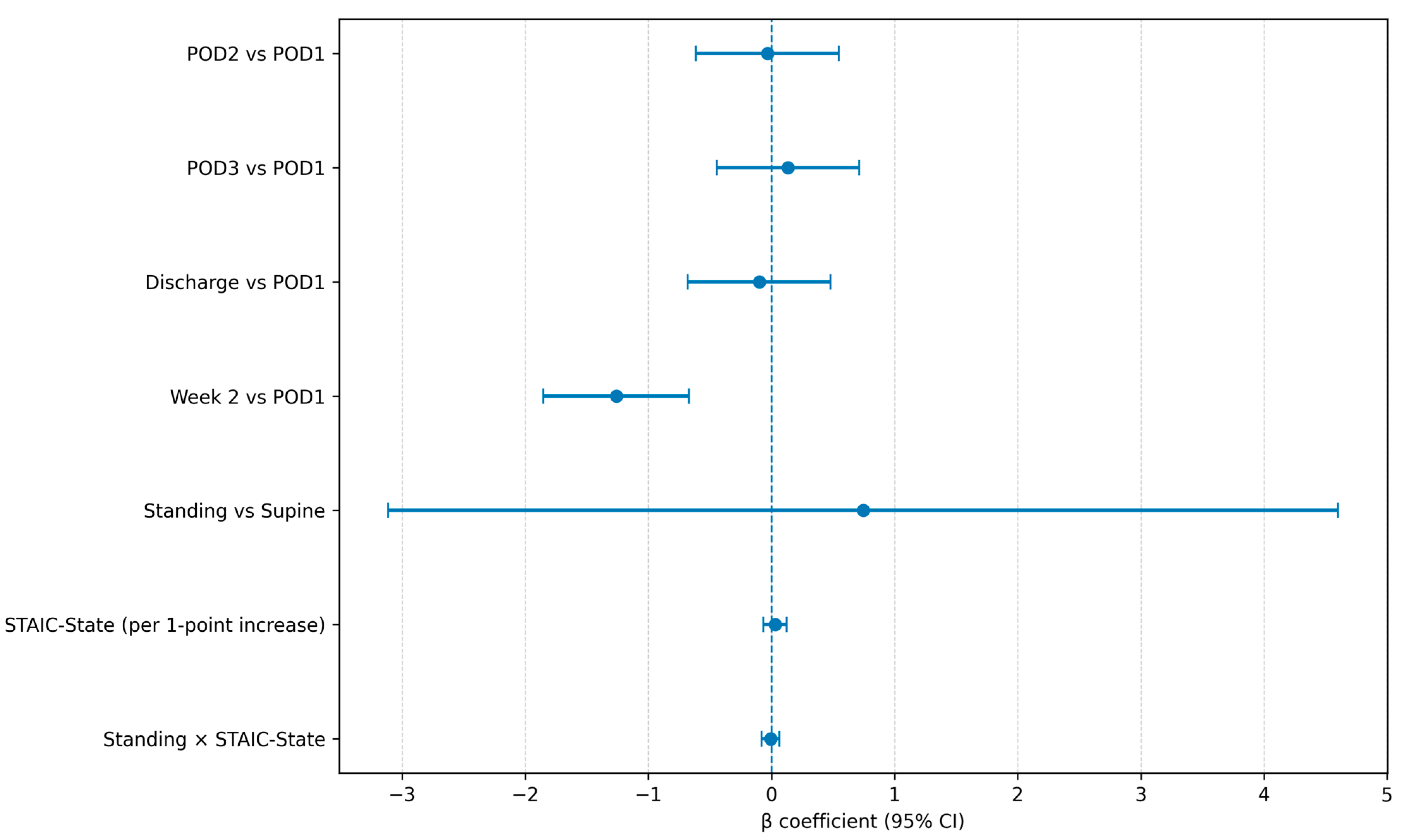
Background and Objectives: Postoperative pain after posterior spinal fusion (PSF) for adolescent idiopathic scoliosis (AIS) shows substantial interindividual variability, particularly during early mobilization. Although preoperative psychological vulnerability has been associated with less favorable pain trajectories in prior AIS research, evidence focused on the acute postoperative phase remains limited. This preliminary study evaluated whether preoperative psychological factors are associated with acute postoperative pain intensity, with separate assessment of resting and standing pain. Materials and Methods: A single-center retrospective cohort study included consecutive adolescents with AIS (<18 years) who underwent primary elective posterior instrumented spinal fusion between 1 January 2024 and 31 December 2025. Preoperative psychological variables were collected using validated instruments (STAIC-State, STAIC-Trait, Pain Catastrophizing Scale, HAQ/FDI, and inverted SRS-22). Pain intensity (VAS 0–10) was recorded at postoperative day (POD) 1, POD2, POD3, discharge, and 2-week follow-up in supine and standing positions. Derived endpoints included peak in-hospital standing pain, in-hospital standing pain burden (AUC), and standing–rest pain gaps. The prespecified inferential analysis used a linear mixed-effects model with fixed effects for time, position, preoperative STAIC-State, and position × STAIC-State interaction, with a patient-level random intercept. Results: Thirty-five patients were analyzed (mean age 15.2 ± 3.4 years; 62.9% female), with complete pain data at all timepoints. During hospitalization, standing pain was descriptively higher than resting pain (largest mean difference at POD2: 0.73 VAS points), with convergence at week 2 (both 1.52). In mixed-model analysis, pain significantly decreased at week 2 versus POD1 (β = −1.261, 95% CI −1.853 to −0.669; p < 0.001). Preoperative STAIC-State was not independently associated with postoperative pain (β = 0.030, 95% CI −0.065 to 0.124; p = 0.545), and no significant position × STAIC-State interaction was found (β = −0.008, 95% CI −0.079 to 0.064; p = 0.836). Conclusions: In this retrospective preliminary AIS cohort, postoperative pain improved significantly over time, while movement-evoked pain remained relevant during early recovery. In this preliminary cohort, no clear association was detected between preoperative state anxiety and acute postoperative pain intensity, supporting the need for broader multidimensional prognostic models in future prospective multicenter studies.
Keywords: adolescent idiopathic scoliosis; posterior spinal fusion; postoperative pain; pediatric spine surgery; preoperative anxiety; pain catastrophizing; movement-evoked pain; linear mixed-effects model; risk stratification adolescent idiopathic scoliosis; posterior spinal fusion; postoperative pain; pediatric spine surgery; preoperative anxiety; pain catastrophizing; movement-evoked pain; linear mixed-effects model; risk stratification