


Highlights
What are the main findings?
- Clinically diagnosed catheter-related bloodstream infection and catheter occlusion/non-function were the most frequent complications of tunneled Hickman catheters in this cohort.
- Younger age, lower body weight, and smaller catheter caliber were associated with complications in univariable analyses, but none reached statistical significance after multivariable adjustment.
- The observed associations with age, body weight, and catheter size suggest the importance of individualized catheter selection and careful surveillance, particularly in smaller children.
- A standardized approach combining ultrasound-guided venous access, echocardiographic tip verification, and meticulous catheter care may support safe and reliable long-term central venous access.
Abstract
Background and Objectives: We described complications of tunneled Hickman catheters in pediatric oncology patients undergoing standardized ultrasound-guided insertion with echocardiographic tip verification and explored associated patient and catheter characteristics. Materials and Methods: This retrospective single-center study (January 2016 to June 2026) included 75 catheter insertions in 65 children. Logistic regression analyses used patient-clustered robust standard errors. Catheter-related bloodstream infection (CRBSI) was classified from clinical documentation and paired positive blood cultures. Strict microbiological confirmation was not possible retrospectively. Results: During 17,668 catheter-days, 44/75 catheters (58.7%) experienced at least one complication. Clinically diagnosed CRBSI and occlusion/non-function were the most frequent (14/75 each, 18.7%, 0.79 per 1000 catheter-days). In univariable analyses, younger age (OR 0.86, 95% CI 0.77–0.95), lower body weight (OR 0.96, 95% CI 0.93–0.99), and smaller catheter caliber (OR 0.68, 95% CI 0.52–0.90) were associated with complications. None reached statistical significance after adjustment. Conclusions: Catheter complications were common. The infection rate reflects clinically diagnosed CRBSI. Collinearity and the modest sample size limited inference about independent associations.
1. Introduction
In the world, around 400,000 children and adolescents of 0–19 years old develop cancer each year [1,2]. Central venous access is a cornerstone of modern pediatric oncology care. Reliable vascular access is required for chemotherapy, fluids, antibiotics and other medications, parenteral nutrition when indicated, and repeated blood sampling. Accordingly, selection of an appropriate device and insertion technique is important for minimizing catheter-related morbidity [3]. Long-term central venous catheters (CVCs) can cause adverse events and complications [4].
The chosen device may include a peripherally inserted central catheter (PICC), totally implantable venous access device (TIVAD), or tunneled central venous catheter (TCVC) [5].
There are currently three standard techniques used for the insertion of long-term vascular access in childhood: open surgical cutdown (OSC), percutaneous landmark technique (LT), and the ultrasound guided percutaneous technique (USG) [3,4,6,7]. Complications are numerous, including failure to cannulate the vein, inadvertent arterial puncture, haemo and/or pneumothorax, pericardial tamponade, and even death [8,9,10,11,12,13]. The real-time ultrasound-guided (US-guided) percutaneous technique of CVC cannulation allows in-plane puncture to display the progression of the whole needle, including the tip. Therefore, this method is associated with a lower risk of complications such as pneumothorax and inadvertent arterial punctures. It also relates to shorter puncture time and decreased guidewire misplacement [14,15].
Common sites for CVC access are the internal jugular (IJV), subclavian (SCV), and femoral (FV) veins. In the pediatric population, supraclavicular US-guided access to the subclavian or the brachiocephalic vein (BCV) appears to be the safe alternative to IJV and FV [4,5].
The ideal location for CVC tips has not yet been defined in children. There are some recommendations to place the tip within the superior vena cava (SVC) or at the cavo-atrial junction. Although ultrasound is used during catheter insertion, an additional x-ray is often performed to check the final position of the catheter tip [16]. A disadvantage of this strategy is that the x-ray examination is often performed postoperatively when the patient is out of the operating theater, and increases the child’s exposure to radiation. To determine the tip position in a pediatric patient, echocardiography can be used as an alternative, without radiation. Some studies have shown that it is practicable with a good success rate [16,17]. Minimizing radiation dose is desirable, especially in children.
Complications associated with CVC cannulation are divided into mechanical, infectious, and thromboembolic complications. Mechanical complications may include pneumothorax, inadvertent arterial punctures, hematomas, pulmonary embolism, nervous system injury, and, rarely, death [15]. The incidence of mechanical complications is directly associated with the number of cannulation attempts. Post-insertion complications include catheter-related bloodstream infection (CRBSI), CVCs-associated venous thromboembolism, local infection, mechanical complications, and dehiscence [5]. These complications require treatment, resulting in delays to anti-cancer therapy and thus increasing morbidity and mortality in pediatric oncology patients.
The primary aim of this study was to describe the frequency and spectrum of complications associated with tunneled Hickman catheters in pediatric oncology patients managed using a standardized insertion and catheter-care protocol. A secondary, exploratory aim was to examine associations between patient and catheter characteristics and the occurrence of complications. The study was not designed to compare vascular access devices or to assess the superiority of ultrasound-guided insertion or echocardiographic tip verification.
2. Materials and Methods
2.1. Study Design and Patients
This retrospective, single-center observational cohort study was conducted at a tertiary pediatric referral center between January 2016 and June 2026. Patients included in the study were younger than 18 years at catheter insertion and had a confirmed malignant disease requiring long-term central venous access. Eligibility required available documentation of catheter insertion and subsequent catheter-related outcomes. Patients who were transferred to another institution and had incomplete medical records or insufficient follow-up data were excluded from the analysis. The catheter insertion encounter was the unit of analysis because outcomes and device characteristics were defined at that level. Each insertion represented a distinct exposure period. Patient-clustered robust standard errors accounted for repeat insertions in both univariable and multivariable models. All consecutive eligible catheter insertion encounters during the predefined study period were included. Each catheter was followed until removal, death with the catheter in situ, or the last documented follow-up. Death with the catheter in situ was not, by itself, classified as a catheter-related complication.
The study protocol was approved by the Review Board of the Institute for Child and Youth Healthcare of Vojvodina (Approval 9000-4361-2/2026, August 2026). Informed consent (other than the consent for the CVC cannulation) was not required. The Health Information System and medical source documentation were used to retrieve the patients’ data. Patient confidentiality was maintained throughout the study in accordance with the Declaration of Helsinki.
2.2. Data Collection
Clinical data were retrieved from electronic medical records and operative reports. The following variables were collected: age at catheter insertion; sex; body weight; underlying malignant diagnosis; date of catheter insertion; associated comorbidities; type of anesthesia; duration of surgery; duration of anesthesia; number of venous puncture attempts; Hickman catheter material and size; catheter dwell time; catheter-related complications; microbiological findings; reason for catheter removal; and patient outcome.
All tunneled Hickman catheters were inserted by experienced pediatric surgeons and anesthesiologists under sterile operating-room conditions and general anesthesia. All tunneled Hickman catheters were made of silicone and were manufactured by Vygon (Écouen, France), Medical Components, Inc. (Harleysville, PA, USA), or Cook Incorporated (Bloomington, IN, USA). Venous access was obtained using real-time ultrasound guidance with a Venue 40 ultrasound system (GE Healthcare, Wauwatosa, WI, USA), equipped with L8-18i-SC and 12L-SC linear transducers. The brachiocephalic vein was accessed using an in-plane needle technique. Intraoperative echocardiographic verification of catheter tip position was performed using a separate LOGIQ 7 ultrasound system (GE Healthcare, Wauwatosa, WI, USA), equipped with a 5S sector transducer. Catheter care was standardized according to the institutional pediatric oncology protocol throughout the study period.
2.3. Outcomes
The primary outcome was the occurrence of at least one catheter-related complication during insertion, subsequent catheter use, or removal. Catheter-related complications and events were classified according to their timing and clinical context to avoid overlap between categories:
- Infectious complications included clinically diagnosed catheter-related bloodstream infection (CRBSI), exit-site infection, and tunnel infection. CRBSI was identified retrospectively from a documented clinical diagnosis and positive blood cultures obtained from both the CVC and a peripheral vein. Data on concordance of isolates and differential time to positivity were not consistently available, precluding retrospective verification against strict microbiological criteria.
- Occlusive complications: catheter occlusion or non-function occurring after successful placement.
- Post-insertion mechanical complications: catheter dislodgement/migration, malposition developing during catheter use, or technical catheter damage/rupture occurring after insertion.
- Insertion-related procedural adverse events: technical difficulties or adverse events occurring during catheter placement, including difficult or failed advancement of the guidewire/dilator, inability to use the initially intended venous access requiring an alternative access site, catheter damage during insertion, inadvertent arterial puncture, pneumothorax, or hematoma.
- Removal-related adverse events: adverse events occurring specifically during catheter removal, including catheter fracture, retained or adherent catheter fragments, bleeding, or the need for additional interventional or surgical retrieval procedures.
No recurrent episodes of the same complication type were documented within an individual catheter. A catheter could contribute once to each applicable subtype and was counted once in the overall outcome of any catheter-related complication.
Secondary outcomes included catheter dwell time, reason for catheter removal, and factors associated with catheter-related complications. Catheter exposure time was calculated from the date of insertion to the date of catheter removal, the date of patient death if the catheter remained in situ, or 30 June 2026 for catheters that were still in use at the end of the study. Catheters remaining in situ on 30 June 2026 were administratively censored at that date. Total catheter-days were calculated by summing the individual catheter exposure periods.
2.4. Sample Size and Statistical Considerations
The sample size was determined by the number of eligible catheter insertion encounters during the study period; no a priori sample size calculation was performed. Given the modest cohort size, repeated insertions within some patients, and substantial collinearity among age, body weight, and catheter caliber, analyses of associated factors were considered exploratory.
2.5. Statistical Analysis
Continuous variables are presented as medians with interquartile ranges (IQRs) and categorical variables are presented as frequencies and percentages. Because relevant continuous variables deviated from normality, between-group comparisons were performed using the Mann–Whitney U test. Categorical variables were analyzed using Pearson’s chi-square test or Fisher’s exact test, as appropriate. Complication incidence rates were calculated per 1000 catheter-days, with 95% confidence intervals estimated using the exact Poisson method.
Collinearity among age, body weight, and catheter caliber was assessed using Spearman correlation coefficients and variance inflation factors (VIFs). Univariable and multivariable logistic regression analyses with patient-clustered robust standard errors were performed to evaluate factors associated with the occurrence of at least one catheter-related complication while accounting for repeated catheter insertions within the same child. The primary multivariable model included age, body weight, sex, and catheter caliber. Catheter caliber was analyzed as a continuous variable per 1-Fr increment. Given the limited sample size, this parsimonious specification assumed a linear relationship between catheter caliber and the log odds of complications.
Underlying malignant diagnoses were grouped into three categories: leukemia/myelodysplastic syndrome (MDS), lymphoma, and solid tumors. Diagnostic group was not included in the primary model to limit model complexity in this relatively small cohort. An additional exploratory multivariable model included diagnostic group alongside age, body weight, sex, and catheter caliber, with leukemia/MDS as the reference category. A sensitivity analysis restricted to the first catheter insertion per patient (n = 65) was also performed.
Odds ratios (ORs) and adjusted odds ratios (aORs), together with 95% confidence intervals (CIs) and p-values, are reported. The exact timing of the first complication was not consistently available; therefore, a valid time-to-event analysis could not be performed. Total catheter dwell time was not entered as a risk-factor covariate because complications could themselves result in premature catheter removal, creating potential reverse causation. Statistical significance was defined as a two-sided p-value < 0.05. Statistical analyses were performed using Python (version 3.15.2; Python Software Foundation, Beaverton, OR, USA; https://www.python.org/, accessed on 20 November 2026) with the SciPy (version 1.18.1; https://scipy.org/, accessed on 20 November 2026) and statsmodels (version 0.15.0; https://www.statsmodels.org/, accessed on 20 November 2026) libraries.
Given the modest sample size and the strong correlations among age, body weight, and catheter caliber, the multivariable analyses were considered exploratory. Adjusted effect estimates were interpreted primarily in terms of their magnitude and 95% confidence intervals rather than statistical significance alone. The study was not specifically powered to identify independent predictors of catheter-related complications, and non-significant findings were not interpreted as evidence of the absence of clinically meaningful associations.
3. Results
3.1. Study Population
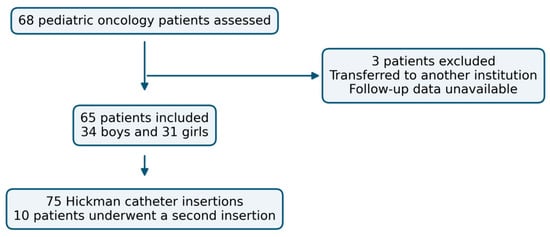
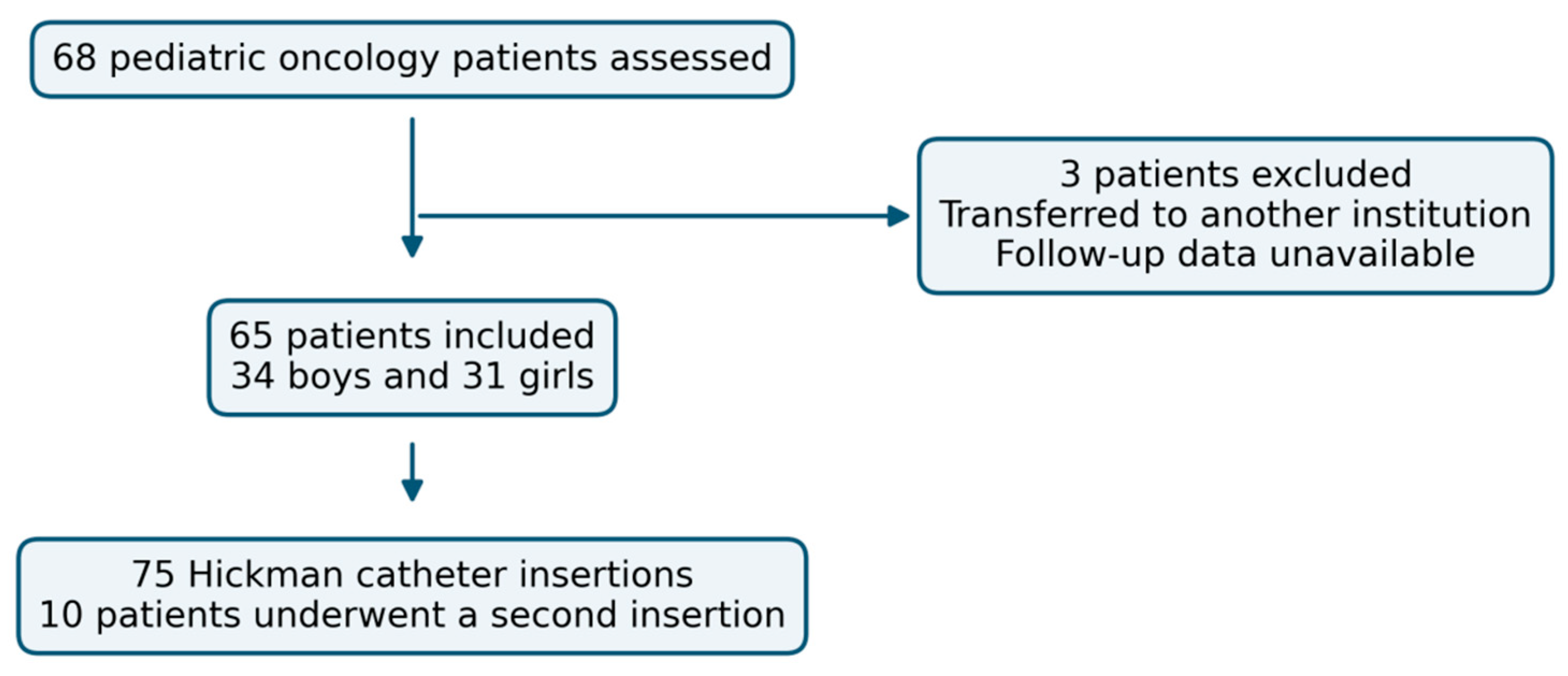
The analysis included 75 tunneled Hickman catheter insertions in 65 children. Three patients were excluded because follow-up data were unavailable after transfer to another institution. Ten included patients underwent a second Hickman catheter insertion (Figure 1).
Figure 1.
Flow diagram of patient and catheter inclusion.
3.2. Patient and Catheter Characteristics
The cohort comprised 65 children, including 34 boys (52.3%) and 31 girls (47.7%), with a mean age at first catheter insertion of 7.44 ± 5.09 years. The median age at catheter insertion was 6.50 [3.00–11.75] years, and the median body weight was 24.00 [14.50–48.50] kg. Leukemia or myelodysplastic syndrome represented the largest diagnostic group (41/75; 54.7%), followed by solid tumors (25/75; 33.3%) and lymphomas (9/75; 12.0%). The median catheter dwell time was 6.25 [3.00–12.00] months. Catheter sizes ranged from 5 to 11 Fr, including 5, 7, 9, 9.5, and 11 Fr devices (Table 1).
Table 1.
Patient, catheter, and procedural characteristics across 75 catheter insertion encounters in 65 children.
3.3. Procedural Characteristics
All Hickman catheters were inserted in the operating room under general anesthesia. Venous access was ultrasound-guided, and catheter tip position and function were verified by echocardiography. The median operation duration was 30.00 [30.00–40.00] min, the median anesthesia duration was 60.00 [60.00–65.00] min, and the median number of puncture attempts was 1.00 [1.00–1.00].
3.4. Catheter-Related Complications
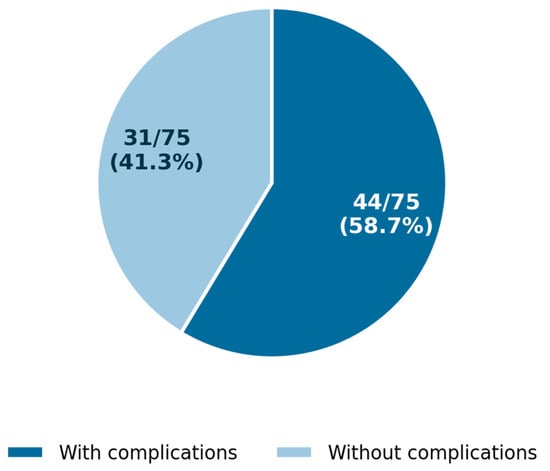
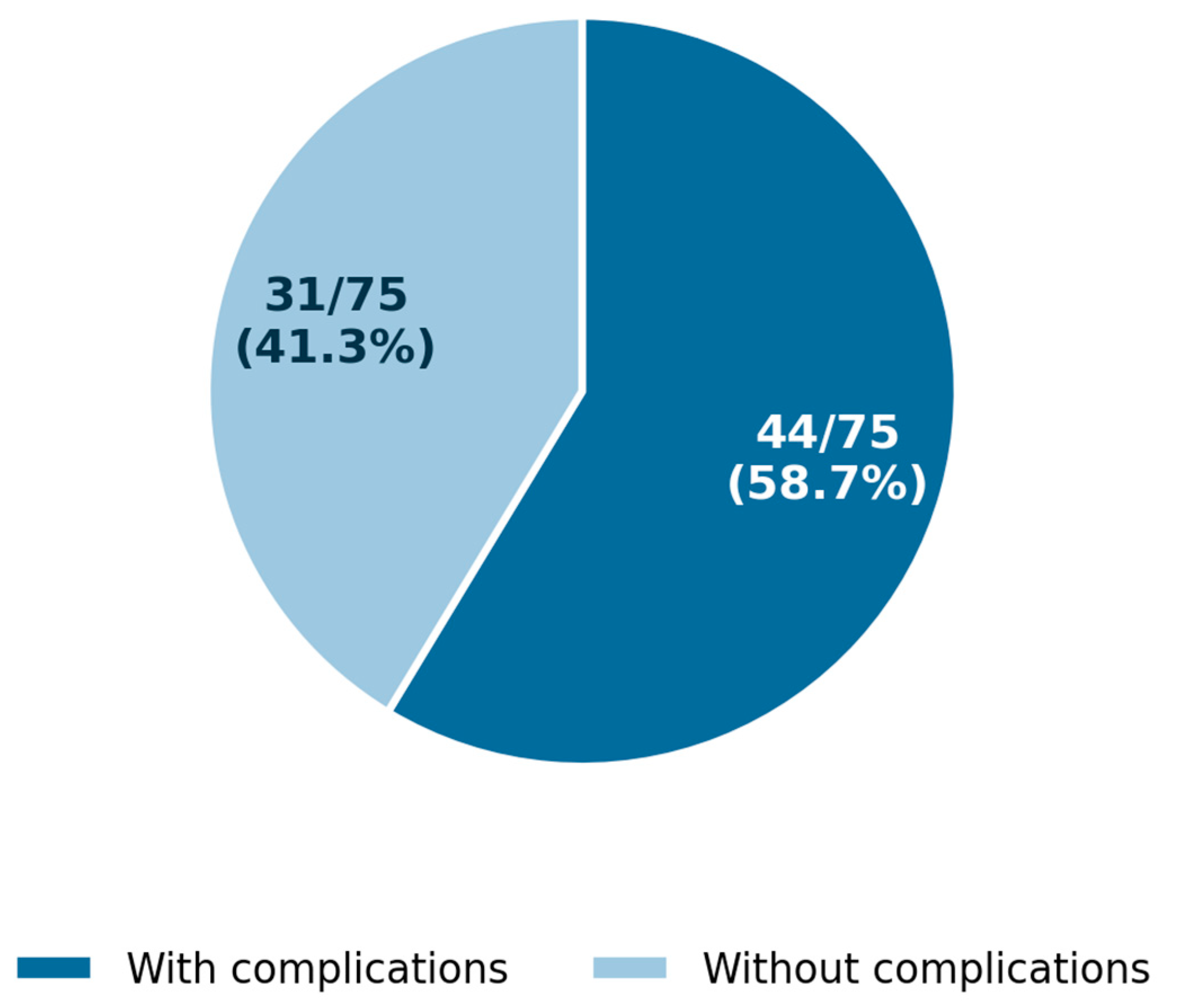
At least one catheter-related complication occurred in 44/75 catheters (58.7%) (Figure 2). Post-insertion complications occurred in 40/75 catheters (53.3%).
Figure 2.
Proportion of catheter insertion encounters with and without a catheter-related complication (n = 75).
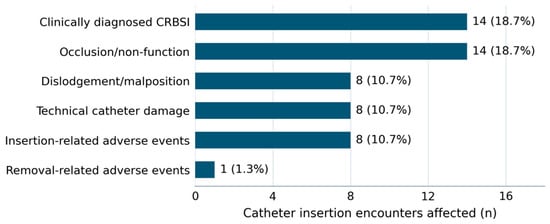
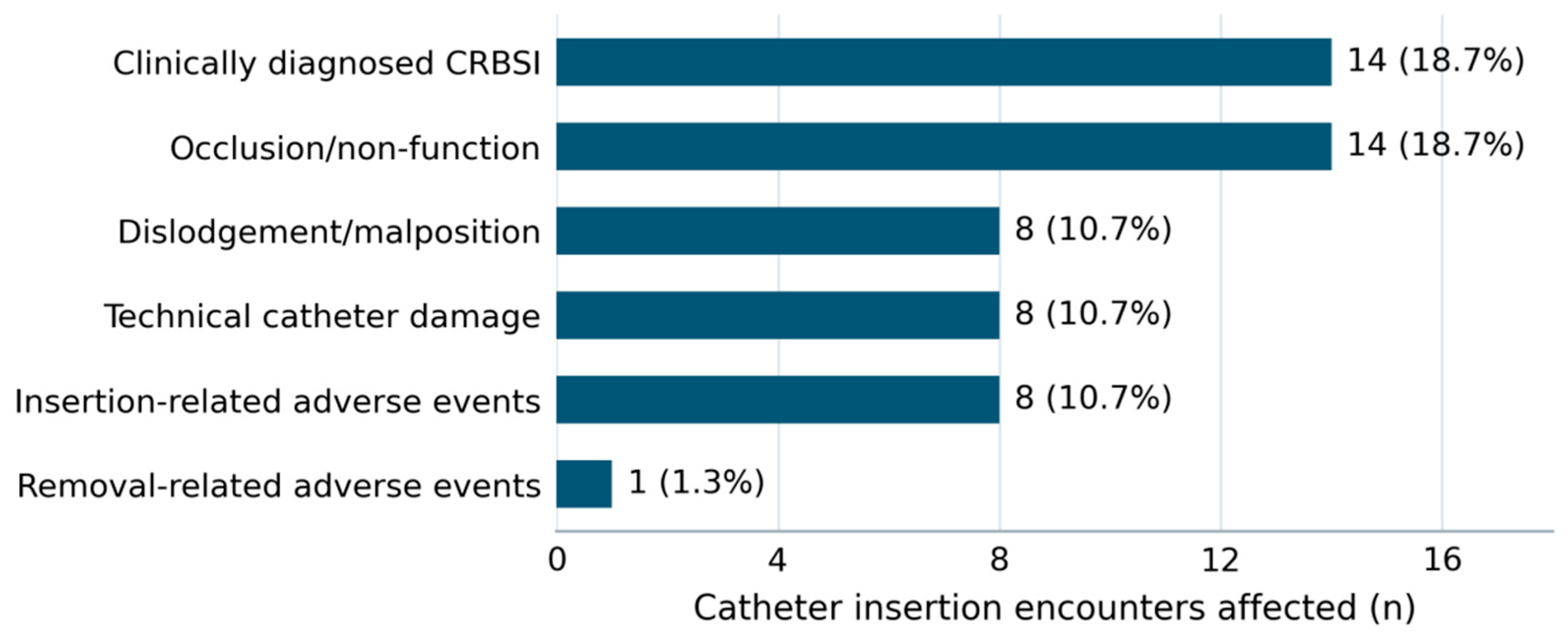
The most frequent specific complications were clinically diagnosed CRBSI and occlusion/non-function (Figure 3). Insertion-related adverse events predominantly consisted of technical difficulties during placement or the need for an alternative access site. There were no inadvertent arterial punctures, pneumothoraces, or clinically documented hematomas.
Figure 3.
Catheter insertion encounters affected by each complication type (n = 75). Categories can overlap. CRBSI denotes clinically diagnosed catheter-related bloodstream infection.
Catheters were removed because of complications in 43/75 cases (57.3%) and following completion of treatment in 23/75 cases (30.7%). Eight catheters (10.7%) remained in situ at the end of the observation period, while one patient (1.3%) died with the catheter in place. Removal-related adverse events were documented in one catheter (1/75; 1.3%): the catheter tip was adherent to the vascular endothelium and required removal by interventional cardiologists. Individual catheters could experience more than one complication subtype; therefore, subtype counts exceed the number of affected catheters.
3.5. Complication Rates per 1000 Catheter-Days
The total catheter exposure for the 75 Hickman catheters was 17,668 catheter-days, calculated directly from the dates of catheter insertion to their respective observation endpoints. The incidence rates of clinically diagnosed catheter-related bloodstream infection (CRBSI) and occlusion/non-function were both 0.79 events per 1000 catheter-days (95% CI 0.43–1.33). Dislodgement/malposition and technical damage each occurred at a rate of 0.45 events per 1000 catheter-days (95% CI 0.20–0.89).
In two catheters, clinically diagnosed CRBSI was successfully treated, but subsequent occlusion necessitated catheter removal. These catheters were included in both complication categories but were counted only once in the overall complication outcome (Table 2). Overall and subtype-specific catheter-related complications stratified by catheter caliber, age group, and body weight are presented in Supplementary Table S1.
Table 2.
Catheter-related complications and incidence rates.
3.6. Univariable Analysis
In univariable logistic regression analyses accounting for repeated catheter insertions within patients, catheter-related complications were significantly associated with younger age (OR = 0.86, 95% CI: 0.77–0.95; p = 0.0033), lower body weight (OR = 0.96, 95% CI: 0.93–0.99; p = 0.0083), and smaller catheter caliber (OR = 0.68 per 1-Fr increase, 95% CI: 0.52–0.90; p = 0.0064). No statistically significant association was observed for sex (OR = 1.17, 95% CI: 0.45–3.05; p = 0.7504) (Table 3).
Table 3.
Univariable associations with catheter-related complications and first-insertion sensitivity analysis.
3.7. Multivariable Analysis
Strong correlations were observed among age, body weight, and catheter size. Spearman correlation coefficients were 0.929 between age and body weight, 0.839 between age and catheter size, and 0.859 between body weight and catheter size (all p < 0.001). The corresponding variance inflation factors were 5.03 for age, 5.57 for body weight, and 3.94 for catheter size, indicating substantial collinearity, particularly between age and body weight.
In the multivariable model, none of the adjusted associations reached statistical significance.
The wide confidence intervals, particularly for sex and catheter size, encompassed potentially clinically meaningful effects in either direction. Substantial collinearity among age, body weight, and catheter size further limited the ability to distinguish their independent associations with complications. Given the modest sample size and limited precision of the adjusted estimates, these findings should be interpreted as exploratory and cannot establish or exclude clinically meaningful independent associations (Table 4).
Table 4.
Patient-clustered multivariable logistic regression for any catheter-related complication.
An additional exploratory multivariable model including diagnostic group did not materially change the estimates or the overall conclusions. Neither lymphoma nor solid tumors were significantly associated with catheter-related complications compared with leukemia/MDS.
4. Discussion
Children with cancer commonly require the placement of long-term tunneled or implanted central venous catheters to facilitate the delivery of chemotherapy, parenteral hydration, antibiotics, nutrition, and repeated blood sampling. The use of CVC is associated with the risk of complications that can prolong hospitalization, increase costs, and sometimes determine additional systemic treatments (i.e., antibiotics, antifungals, heparin). Moreover, some complications require the premature removal of the catheter and might be life-threatening [18,19].
The institutional insertion protocol and postoperative catheter-care procedures remained consistent throughout the study period. However, catheter manufacturers changed according to market availability. Although all devices were silicone tunneled Hickman catheters, differences between manufacturers may have introduced device-related heterogeneity.
In this single-center retrospective study, we analyzed 75 tunneled Hickman catheters placed in 65 pediatric oncology patients over 10.5 years. A consistent procedural strategy was used, including real-time ultrasound-guided venous access and intraoperative echocardiographic verification of catheter function and tip position. This approach avoided routine intraoperative radiography and therefore eliminated radiation exposure for tip confirmation.
We found that catheter-related complications were common, occurring in 58.7% of catheters. A recent systematic review and meta-analysis in pediatric oncology reported that approximately 31% of central venous access devices developed at least one device-associated complication [5], whereas van den Bosch et al. reported one or more complications in 68.1% of inserted CVCs [20]. Direct comparisons should be interpreted cautiously because studies differ in device types, complication definitions, patient characteristics, surveillance duration, and methods of counting recurrent events. Our overall proportion also included insertion-related procedural and removal-related adverse events, which may partly explain the relatively high cumulative burden. In the present cohort, no recurrent episodes of the same complication type were documented, and most catheters were removed following complications, limiting the opportunity for recurrence.
Clinically diagnosed CRBSI occurred in 14 of 75 catheter encounters (18.7%), or 0.79 events per 1000 catheter-days. Nunn et al. reported a pooled central line-associated bloodstream infection (CLABSI) rate of 0.9 per 1000 catheter-days [5]. CLABSI is a surveillance outcome. In our study, CRBSI was assigned from clinical documentation and paired positive cultures, with insufficient data to verify catheter attribution using strict microbiological criteria. These differences in case ascertainment limit direct comparison of the rates.
Van den Bosch et al. described bloodstream infections among pediatric oncology patients with central venous access [20], and a pediatric systematic review highlights the clinical burden of CLABSI [21]. Beck et al. also reported bloodstream infections in a pediatric oncology cohort [22]. Differences in infection definitions and device mix limit comparisons across cohorts.
An evidence-based practice (EBP) care bundle is recommended for all pediatric oncology patients and includes several key practices, such as regularly assessing the necessity of the central line, ensuring the infusion system is regularly checked, maintaining the line’s security, and adhering to proper dressing changes [23].
Catheter occlusion or non-function was equally frequent in our cohort, occurring in 18.7% of catheters, with an incidence of 0.79 per 1000 catheter-days. In a recent study involving 71 Hickman catheters in 68 pediatric oncology patients, Zvizdic et al. reported catheter obstruction in 8.5% of cases, highlighting the clinical relevance of this complication [19]. In another prospective study involving 581 CVCs inserted in 421 patients, Garonzi et al. reported a higher malfunction/occlusion incidence of 1.88 per 1000 catheter-days [18]. Differences in complication rates between studies may be partly attributable to variations in catheter types, patient populations, chemotherapy intensity, catheter maintenance protocols, and definitions of catheter dysfunction.
The mechanisms underlying catheter dysfunction are heterogeneous and include intraluminal thrombus formation, fibrin sheath development, and precipitation of infused substances, catheter malposition, and mechanical damage. The most effective approaches to managing CVC occlusions are implementing flushing and locking protocols, which are more cost-effective and efficient and less invasive than removing or replacing the CVCs. Currently, nurses routinely flush CVCs to maintain open lumens. Flushing occluded catheters with appropriate agents has become the first treatment option to avoid the risks and costs associated with removing and reimplanting a CVC. A panel of experts belonging to the working groups on Infections and Supportive Therapy, Surgery and Nursing of the Italian Pediatric Hematology Oncology Association (AIEOP) revised the scientific literature systematically, scored the level of evidence and prepared guidelines in order to maintain a proper level of skills in CVC management [24]. This is particularly relevant for tunneled external catheters, which may remain in place for prolonged periods and undergo frequent manipulation.
Dislodgement/malposition and technical catheter damage each occurred in 10.7% of catheters in our cohort, with exposure-adjusted rates of 0.45 per 1000 catheter-days for each category. In their prospective study of 581 CVCs in 421 patients, Garonzi et al. reported a mechanical complication rate of 0.74 per 1000 catheter-days. Younger age at catheter insertion was independently associated with mechanical complications in that study [18]. Comparisons should be interpreted cautiously because catheter types and complication definitions differed between cohorts.
Younger age, lower body weight, and smaller catheter caliber were significantly associated with catheter-related complications in univariable logistic regression analyses accounting for repeated catheter insertions within patients. However, these associations did not reach statistical significance after simultaneous adjustment for age, body weight, sex, and catheter caliber. Strong correlations among these variables, particularly between age and body weight, limited the ability to distinguish their independent contributions to complication risk. These findings should therefore be interpreted cautiously and do not exclude potentially clinically meaningful associations.
Totally implantable venous access device (TIVAD) placement requires more steps than tunneled CVC placement, whereas TIVADs offer better cosmesis, minimal maintenance and allow for bathing and swimming. In a systematic review, twenty-four observational studies were included, with 4100 in the tunneled CVC group and 3294 in the TIVAD group. The authors concluded that TIVADs are associated with lower risks of systemic infections, mechanical failure, and premature device removal, as well as a longer duration of use in children with cancer [25].
The relationship between underlying malignancy and catheter-related complications remains clinically relevant. In a study involving 71 Hickman catheters in 68 pediatric oncology patients, Zvizdic et al. reported a slightly higher complication incidence among children with hematological malignancies than among those with solid tumors (1.59 versus 1.22 per 1000 catheter-days) [19]. In our cohort, the diagnosis-adjusted sensitivity model yielded imprecise estimates and did not establish a clear association between diagnostic group and catheter-related complications.
In a recently published study, the authors analyzed effectiveness of antimicrobial lock therapy for central venous catheter-associated bloodstream infections. Patients with acute myeloid leukemia had the highest infection density (5.36 episodes/1000 patient-days). In multivariate analysis, acute lymphoblastic leukemia was associated with poor outcome [26].
Catheters with recorded complications had shorter observed dwell times. This finding should not be interpreted as evidence that shorter exposure increases complication risk, because catheter-related complications may themselves prompt premature catheter removal. Conversely, longer catheter exposure provides a greater opportunity for a complication to occur. The exact timing of the first complication was not consistently available in the retrospective dataset, precluding a valid time-to-event analysis. For this reason, dwell time was not included as a predictor in the logistic risk-factor model, while exposure-adjusted complication rates were reported per 1000 catheter-days.
All catheter placements were performed under general anesthesia using real-time ultrasound-guided venous access with an “in-plane” technique, allowing visualization of the entire needle. Insertion-related procedural adverse events were documented in 10.7% of procedures and predominantly reflected technical difficulties during placement or the need for an alternative venous access site. Importantly, no inadvertent arterial puncture, pneumothorax, or clinically documented hematoma occurred. Published pediatric data generally support ultrasound guidance because direct visualization of the target vein and needle trajectory may improve technical success and reduce access-related complications compared with landmark-based approaches [15,16,17].
Difficult catheter removal was uncommon in our cohort, with one case requiring interventional retrieval. A systematic review and meta-analysis of 4019 pediatric central venous access device removals reported a 5.6% incidence of removal complications, identifying prolonged dwell time (>2 years) and acute lymphoblastic leukemia as potential risk factors [27].
Because 10 patients underwent two Hickman catheter insertions, potential within-patient correlation was an important methodological consideration. A sensitivity analysis restricted to the first catheter insertion per patient (n = 65) yielded a broadly similar pattern of associations, supporting the consistency of the findings. Nevertheless, the modest sample size and limited number of repeated insertions warrant cautious interpretation.
4.1. Strengths and Limitations
The present study has several strengths. First, it represents 10.5 years of experience from a tertiary pediatric center. Second, only tunneled silicone Hickman catheters were included, reducing the device heterogeneity that affects studies combining tunneled catheters, ports, PICCs, and non-tunneled central lines. Third, all catheter placements followed a consistent procedural approach involving general anesthesia, ultrasound-guided venous access, and echocardiographic confirmation of catheter tip position. Fourth, repeated catheter insertions were accounted for using patient-clustered robust standard errors in both univariable and multivariable analyses, supplemented by a sensitivity analysis restricted to the first insertion per patient. Finally, subtype-specific rates per 1000 catheter-days account for total cohort exposure.
Several limitations should be acknowledged. The retrospective, single-center design creates the possibility of incomplete documentation and limits generalizability. The modest cohort of 75 catheter insertions in 65 children limited statistical power and the precision of effect estimates, particularly in multivariable and subgroup analyses. Strong collinearity among age, body weight, and catheter caliber further limited the ability to distinguish their independent associations with complications. Consequently, non-significant adjusted estimates cannot reliably exclude clinically meaningful associations, and the multivariable findings should be regarded as exploratory rather than confirmatory. Furthermore, the small number of patients with repeated catheter insertions may affect the reliability of patient-clustered variance estimates.
Different Hickman catheter manufacturers were used during the 10.5-year study period, which may have introduced device-related heterogeneity despite consistent institutional insertion and catheter-care protocols. Other changes in oncological treatment and supportive care over time could not be fully assessed retrospectively.
Detailed microbiological data, including concordance between catheter-drawn and peripheral blood culture isolates and differential time to positivity, were not consistently available. Therefore, CRBSI diagnoses could not be retrospectively verified against standardized microbiological criteria, which may affect comparisons with studies using stricter diagnostic definitions. In addition, the exact timing of the first catheter-related complication was not consistently available. Consequently, a time-to-event analysis such as Cox proportional hazards regression could not be performed, and the multivariable analysis was based on a binary complication outcome. Although incidence rates were reported per 1000 catheter-days, variation in exposure duration was not directly incorporated into the risk-factor model.
Several potentially relevant factors were not available for inclusion in the multivariable model, including neutrophil count, treatment phase, chemotherapy intensity, frequency of catheter manipulation, and longitudinal catheter-maintenance variables. Finally, because the cohort exclusively included Hickman catheters, direct within-center comparisons with totally implanted ports or other CVAD types were not possible.
4.2. Clinical Implications
The study quantifies the burden of complications associated with tunneled Hickman catheters in a pediatric oncology cohort. Comparisons with published rates depend on outcome definitions, surveillance periods, and catheter-management practices. This is particularly important for bloodstream infections, for which case definitions and confirmation methods differ.
The observed associations between younger age, lower body weight, smaller catheter caliber, and catheter-related complications suggest that particular attention may be warranted in smaller children regarding device selection, secure catheter fixation, caregiver education, and surveillance. However, these findings remain exploratory and should not be interpreted as evidence of independent risk factors.
Prospective multicenter studies using standardized complication definitions, detailed catheter-care variables, and time-to-event analysis are required to clarify independent predictors of Hickman catheter failure and to identify modifiable strategies capable of reducing catheter-related morbidity.
5. Conclusions
Tunneled Hickman catheters provided reliable long-term central venous access for pediatric oncology patients but were associated with a substantial cumulative burden of catheter-related complications. Clinically diagnosed catheter-related bloodstream infection and catheter occlusion/non-function were the most frequent complications. The infection rate should be interpreted in light of limited microbiological confirmation.
Younger age, lower body weight, and catheter size were associated with complications in univariable analyses. However, the modest sample size and substantial collinearity among these variables limited the precision and interpretability of multivariable estimates. Consequently, the present study could neither establish nor exclude clinically meaningful independent associations, and these findings should be considered exploratory.
These findings underscore the importance of appropriate catheter selection, standardized insertion techniques, and meticulous catheter maintenance in pediatric oncology patients.
Supplementary Materials
The following supporting information can be downloaded at: https://www.mdpi.com/article/10.3390/medicina62122313/s1. Table S1: Overall and subtype-specific catheter-related complications by catheter caliber, age, and body weight.
Author Contributions
Conceptualization, J.A. and S.V.; methodology, J.A., R.J., I.F. and S.V.; investigation, J.A., I.F., S.V., N.B. and S.B.; data curation, J.A., I.F., S.V., G.R., S.B. and A.U.B.; formal analysis, J.A., I.F., S.V. and G.R.; visualization, J.A., I.F. and S.V.; writing—original draft preparation, J.A. and S.V.; writing—review and editing, R.J., J.A., I.F., G.R., N.B., A.U.B. and M.P.; supervision, J.A. and R.J.; project administration, J.A. and I.F. All authors have read and agreed to the published version of the manuscript.
Funding
This research received no external funding.
Institutional Review Board Statement
The study was conducted in accordance with the Declaration of Helsinki and approved by the Ethics Committee of the Institute for Children and Youth Healthcare of Vojvodina (Approval 9000-4361-2/2026, 14 August 2026).
Informed Consent Statement
Patient consent was waived due to the retrospective nature of the study and the use of anonymized medical records, as approved by the Ethics Committee.
Data Availability Statement
The data that support the findings of this study are available from the corresponding author upon reasonable request. The data are not publicly available due to privacy and ethical restrictions related to pediatric patient information.
Acknowledgments
During the preparation of this manuscript, the authors used ChatGPT (GPT-5.6, OpenAI, San Francisco, CA, USA) to assist with language editing, organization, and structural refinement of the manuscript. The authors reviewed and edited all AI-assisted output and take full responsibility for the content of the publication.
Conflicts of Interest
The authors declare no conflicts of interest.
References
- Steliarova-Foucher, E.; Colombet, M.; Ries, L.A.G.; Moreno, F.; Dolya, A.; Bray, F.; Hesseling, P.; Shin, H.Y.; Stiller, C.A.; IICC-3 Contributors. International incidence of childhood cancer, 2001–10: A population-based registry study. Lancet Oncol. 2017, 18, 719–731, Correction in Lancet Oncol. 2017, 18, e301. [Google Scholar] [CrossRef] [Scilit] [PubMed]
- Lam, C.G.; Howard, S.C.; Bouffet, E.; Pritchard-Jones, K. Science and health for all children with cancer. Science 2019, 363, 1182–1186. [Google Scholar] [CrossRef] [Scilit] [PubMed]
- El-Ella, Y.A.; Arul, S.G. US guided percutaneous insertion for permanent central vascular access in children: The new gold stand-ardstandard. Ann. Vasc. Med. Res. 2017, 4, 1073. [Google Scholar]
- Christison-Lagay, E.R.; Brown, E.G.; Bruny, J.; Funaro, M.; Glick, R.D.; Dasgupta, R.; Grant, C.N.; Engwall-Gill, A.J.; Lautz, T.B.; Rothstein, D.; et al. Central venous catheter consideration in pediatric oncology: A systematic review and meta-analysis from the American Pediatric Surgical Association Cancer Committee. J. Pediatr. Surg. 2024, 59, 1427–1443. [Google Scholar] [CrossRef] [Scilit] [PubMed]
- Nunn, J.L.; Takashima, M.D.; Wray-Jones, E.M.; Soosay Raj, T.A.; Hanna, D.M.T.; Ullman, A.J. Central venous access device adverse events in pediatric patients with cancer: A systematic review and meta-analysis. Support Care Cancer 2024, 32, 662. [Google Scholar] [CrossRef] [Scilit] [PubMed]
- Khera, S.; Kumar, A.; Parikh, B.; Simalti, A.K.; Davera, S.; Mahajan, P.; Dhingra, S. Safety and outcome of ultrasound-guided tunneled central venous catheter in children with cancers from low middle-income country: A prospective study. Pediatr. Blood Cancer 2023, 70, e30029. [Google Scholar] [CrossRef] [Scilit] [PubMed]
- Kouna, N.; Noutsos, G.; Koufopoulou, C.; Panagopoulos, D.; Kattamis, A. Open versus transcutaneous (ultrasound-guided and based on anatomic landmarks) tunneled venous access to the right internal jugular vein in children: A prospective single-center study. Diseases 2023, 11, 174. [Google Scholar] [CrossRef] [Scilit] [PubMed]
- de Souza, T.H.; Brandão, M.B.; Nadal, J.A.H.; Nogueira, R.J.N. Ultrasound guidance for pediatric central venous catheterization: A meta-analysis. Pediatrics 2018, 142, e20181719. [Google Scholar] [CrossRef] [Scilit] [PubMed]
- Cui, Y.; Wang, Y.; Gong, T.; Huang, Q.; Zhang, Q.Q. Systematic review of ultrasound-guided central venous catheter placement-related complications in neonates and infants aged <12 months. J. Int. Med. Res. 2024, 52, 3000605241287168. [Google Scholar] [CrossRef] [Scilit] [PubMed]
- Teja, B.; Bosch, N.A.; Diep, C.; Pereira, T.V.; Mauricio, P.; Sklar, M.C.; Sankar, A.; Wijeysundera, H.C.; Saskin, R.; Walkey, A.; et al. Complication rates of central venous catheters: A systematic review and meta-analysis. JAMA Intern Med. 2024, 184, 474–482. [Google Scholar] [CrossRef] [Scilit] [PubMed]
- Johansen, M.; Classen, V.; Muchantef, K. Long-term IV access in paediatrics—Why, what, where, who and how. Acta Anaesthesiol. Scand. 2021, 65, 282–291. [Google Scholar] [CrossRef] [Scilit] [PubMed]
- Ivanov, Z.; Neycheva, I.; Halil, Z.; Bukov, G.; Galabova, F.; Ali, S.; Kerezov, A.; Paskaleva, I.; Yankov, I. Cardiac tamponade after late central venous catheter dislodgement in two pediatric patients—A rare but potentially fatal complication. Children 2026, 13, 689. [Google Scholar] [CrossRef] [Scilit] [PubMed]
- Liu, Z.; Li, R.; Zhou, B.; Ye, X.; Li, G. Cardiac tamponade in an infant with PICC: A case report. Clin. Pediatr. 2024, 63, 1171–1175. [Google Scholar] [CrossRef] [Scilit] [PubMed]
- Lee, I.K.; Lee, K.H.; Han, H.J.; Choi, J.; Kim, N.J.; Kim, K. Different axis approaches for ultrasound-guided centrally inserted central catheterization in children: A systematic review and meta-analysis of randomized controlled trials. Front. Surg. 2025, 12, 1481975. [Google Scholar] [CrossRef] [Scilit] [PubMed]
- Vafek, V.; Skříšovská, T.; Kosinová, M.; Klabusayová, E.; Musilová, T.; Kramplová, T.; Djakow, J.; Klučka, J.; Kalina, J.; Štourač, P. Central venous catheter cannulation in pediatric anesthesia and intensive care: A prospective observational trial. Children 2022, 9, 1611. [Google Scholar] [CrossRef] [Scilit] [PubMed]
- Neumann, C.; Breil, M.; Schild, A.; Schenk, A.; Jakobs, P.; Mikus, M.; Schindler, E. Central venous catheter tip positioning using ultrasound in pediatric patients—A prospective observational study. Paediatr. Anaesth. 2024, 34, 551–558. [Google Scholar] [CrossRef] [Scilit] [PubMed]
- Baehner, T.; Rohner, M.; Heinze, I.; Schindler, E.; Wittmann, M.; Strassberger-Nerschbach, N.; Kim, S.-C.; Velten, M. Point-of-care ultrasound-guided protocol to confirm central venous catheter placement in pediatric patients undergoing cardiothoracic surgery: A prospective feasibility study. J. Clin. Med. 2021, 10, 5971. [Google Scholar] [CrossRef] [Scilit] [PubMed]
- Garonzi, C.; Zeni, F.; Tridello, G.; Giacomazzi, A.; Castagna, A.; Esposto, M.P.; Caddeo, G.; Pezzella, V.; Zaccaron, A.; Bonetti, E.; et al. Results of a long-term, prospective study on complications of central venous catheter in pediatric patients with hematologic-oncologic diseases. Pediatr. Blood Cancer 2024, 71, e30990. [Google Scholar] [CrossRef] [Scilit] [PubMed]
- Zvizdic, Z.; Zaimovic, E.; Milisic, E.; Jonuzi, A.; Glamoclija, U.; Vranic, S. The frequency, severity, and risk factors of Hickman catheter-related complications in pediatric cancer patients: A single-center experience from Bosnia and Herzegovina. Turk. Arch. Pediatr. 2024, 59, 144–149. [Google Scholar] [CrossRef] [Scilit] [PubMed]
- van den Bosch, C.H.; van der Bruggen, J.T.; Frakking, F.N.J.; Terwisscha van Scheltinga, C.E.J.; van de Ven, C.P.; van Grotel, M.; Wellens, L.M.; Loeffen, Y.G.; Fiocco, M.; Wijnen, M.H. Incidence, severity and outcome of central line related complications in pediatric oncology patients: A single center study. J. Pediatr. Surg. 2019, 54, 1894–1900. [Google Scholar] [CrossRef] [Scilit] [PubMed]
- Li, L.; Zheng, Y.; Deng, W.; Chen, X.; Lin, S. Central line-associated bloodstream infections in children: A systematic review and meta-analysis. Transl. Pediatr. 2025, 14, 799–811. [Google Scholar] [CrossRef] [Scilit] [PubMed]
- Beck, O.; Muensterer, O.; Hofmann, S.; Rossmann, H.; Poplawski, A.; Faber, J.; Gödeke, J. Central venous access devices (CVAD) in pediatric oncology patients—A single-center retrospective study over more than 9 years. Front. Pediatr. 2019, 7, 260. [Google Scholar] [CrossRef] [Scilit] [PubMed]
- Murray, J.; Pontieri, J.; Yam, P.; Zavotsky, K.E. Decreasing community acquired CLABSI: Creating a new infection prevention bundle for management of the pediatric patient discharged with a central line. J. Pediatr. Nurs. 2025, 82, e16–e22. [Google Scholar] [CrossRef] [Scilit] [PubMed]
- Cellini, M.; Bergadano, A.; Crocoli, A.; Badino, C.; Carraro, F.; Sidro, L.; Botta, D.; Pancaldi, A.; Rossetti, F.; Pitta, F.; et al. Guidelines of the Italian Association of Pediatric Hema-tologyHematology and Oncology for the management of the central venous access devices in pediatric patients with onco-hematological disease. J. Vasc. Access. 2022, 23, 3–17. [Google Scholar] [CrossRef] [Scilit] [PubMed]
- Liu, C.; Yang, D.; Guo, X.; Wang, J.; Wang, R.; Qu, H.; Liu, L. Adverse events of tunneled central venous catheters versus totally im-plantableimplantable venous access devices in pediatric oncology: A systematic review and meta-analysis. J. Vasc. Interv. Radiol. 2025, 36, 1513–1522.e8. [Google Scholar] [CrossRef] [Scilit] [PubMed]
- Tsai, H.C.; Huang, L.M.; Chang, L.Y.; Lee, P.I.; Chen, J.M.; Shao, P.L.; Hsueh, P.R.; Sheng, W.H.; Chang, Y.C.; Lu, C.Y. Central venous catheter-associated bloodstream infections in pediatric hematology-oncology patients and effectiveness of antimicrobial lock therapy. J. Microbiol. Immunol. Infect. 2015, 48, 639–646. [Google Scholar] [CrossRef] [Scilit] [PubMed]
- Sakthivel, M.; Sakthivel, D.; Nataraja, R.M.; Pacilli, M. Complications during central venous access device removal in children: A systematic review and meta-analysis. J. Pediatr. Surg. 2026, 61, 162445. [Google Scholar] [CrossRef] [Scilit] [PubMed]

Disclaimer/Publisher’s Note: The statements, opinions and data contained in all publications are solely those of the individual author(s) and contributor(s) and not of MDPI and/or the editor(s). MDPI and/or the editor(s) disclaim responsibility for any injury to people or property resulting from any ideas, methods, instructions or products referred to in the content. |
© 2026 by the authors. Published by MDPI on behalf of the Lithuanian University of Health Sciences. Licensee MDPI, Basel, Switzerland. This article is an open access article distributed under the terms and conditions of the Creative Commons Attribution (CC BY) license.